
A English
Lowering of vapour pressure Questions in English
Class 12 Chemistry · Solutions · Lowering of vapour pressure
341+
Questions
English
Language
100%
With Solutions
Showing 50 of 341 questions in English
201
Advanced
The vapour pressure of pure liquids $A$ and $B$ are $450 \ mm \ Hg$ and $700 \ mm \ Hg$ respectively at $350 \ K$. Find out the composition of the liquid mixture if total vapour pressure is $600 \ mm \ Hg$. Also,find the composition of the vapour phase.
Solution
(N/A) Given: $P_A^0 = 450 \ mm \ Hg$,$P_B^0 = 700 \ mm \ Hg$,$P_{total} = 600 \ mm \ Hg$.
Let the mole fraction of $A$ in the liquid phase be $x_A$. Then the mole fraction of $B$ is $x_B = 1 - x_A$.
According to Raoult's Law: $P_{total} = P_A^0 x_A + P_B^0 x_B$.
$600 = 450 x_A + 700(1 - x_A)$.
$600 = 450 x_A + 700 - 700 x_A$.
$250 x_A = 100$.
$x_A = 100 / 250 = 0.4$.
So,$x_B = 1 - 0.4 = 0.6$.
The partial pressures are: $P_A = P_A^0 x_A = 450 \times 0.4 = 180 \ mm \ Hg$ and $P_B = P_B^0 x_B = 700 \times 0.6 = 420 \ mm \ Hg$.
In the vapour phase,the mole fractions are $y_A = P_A / P_{total} = 180 / 600 = 0.3$ and $y_B = P_B / P_{total} = 420 / 600 = 0.7$.
Let the mole fraction of $A$ in the liquid phase be $x_A$. Then the mole fraction of $B$ is $x_B = 1 - x_A$.
According to Raoult's Law: $P_{total} = P_A^0 x_A + P_B^0 x_B$.
$600 = 450 x_A + 700(1 - x_A)$.
$600 = 450 x_A + 700 - 700 x_A$.
$250 x_A = 100$.
$x_A = 100 / 250 = 0.4$.
So,$x_B = 1 - 0.4 = 0.6$.
The partial pressures are: $P_A = P_A^0 x_A = 450 \times 0.4 = 180 \ mm \ Hg$ and $P_B = P_B^0 x_B = 700 \times 0.6 = 420 \ mm \ Hg$.
In the vapour phase,the mole fractions are $y_A = P_A / P_{total} = 180 / 600 = 0.3$ and $y_B = P_B / P_{total} = 420 / 600 = 0.7$.
0 likes
View Solution202
Advanced
State Raoult's law for a solution containing a non-volatile solute and a volatile solvent and explain it.
Solution
(N/A) Raoult's law states that for a solution of volatile liquids,the partial vapour pressure of each component in the solution is directly proportional to its mole fraction present in the solution.
For a solution containing a non-volatile solute,only the solvent contributes to the vapour pressure. The law is expressed as: $p_{1} = x_{1} \cdot p_{1}^{0}$,where $p_{1}$ is the vapour pressure of the solvent in the solution,$x_{1}$ is its mole fraction,and $p_{1}^{0}$ is the vapour pressure of the pure solvent.
The reduction in vapour pressure $(\Delta p_{1})$ is given by: $\Delta p_{1} = p_{1}^{0} - p_{1} = p_{1}^{0} - p_{1}^{0} x_{1} = p_{1}^{0}(1 - x_{1})$.
Since $1 - x_{1} = x_{2}$ (where $x_{2}$ is the mole fraction of the solute),we have $\Delta p_{1} = x_{2} \cdot p_{1}^{0}$.
The relative lowering of vapour pressure is given by: $\frac{p_{1}^{0} - p_{1}}{p_{1}^{0}} = x_{2} = \frac{n_{2}}{n_{1} + n_{2}}$.
For dilute solutions,$n_{2} \ll n_{1}$,so $\frac{p_{1}^{0} - p_{1}}{p_{1}^{0}} \approx \frac{n_{2}}{n_{1}} = \frac{w_{2} \times M_{1}}{M_{2} \times w_{1}}$,where $w$ is mass and $M$ is molar mass.
For a solution containing a non-volatile solute,only the solvent contributes to the vapour pressure. The law is expressed as: $p_{1} = x_{1} \cdot p_{1}^{0}$,where $p_{1}$ is the vapour pressure of the solvent in the solution,$x_{1}$ is its mole fraction,and $p_{1}^{0}$ is the vapour pressure of the pure solvent.
The reduction in vapour pressure $(\Delta p_{1})$ is given by: $\Delta p_{1} = p_{1}^{0} - p_{1} = p_{1}^{0} - p_{1}^{0} x_{1} = p_{1}^{0}(1 - x_{1})$.
Since $1 - x_{1} = x_{2}$ (where $x_{2}$ is the mole fraction of the solute),we have $\Delta p_{1} = x_{2} \cdot p_{1}^{0}$.
The relative lowering of vapour pressure is given by: $\frac{p_{1}^{0} - p_{1}}{p_{1}^{0}} = x_{2} = \frac{n_{2}}{n_{1} + n_{2}}$.
For dilute solutions,$n_{2} \ll n_{1}$,so $\frac{p_{1}^{0} - p_{1}}{p_{1}^{0}} \approx \frac{n_{2}}{n_{1}} = \frac{w_{2} \times M_{1}}{M_{2} \times w_{1}}$,where $w$ is mass and $M$ is molar mass.
0 likes
View Solution203
Easy
Why is the vapour pressure of an aqueous solution of glucose lower than that of pure water?
Solution
(N/A) The vapour pressure of a liquid is determined by the escaping tendency of its molecules from the surface. In pure water,the entire surface is occupied by water molecules. When a non-volatile solute like glucose is added,the glucose molecules occupy some space on the surface. This reduces the number of water molecules available at the surface to escape into the vapour phase. Consequently,the rate of evaporation decreases,leading to a lower vapour pressure for the solution compared to pure water. This phenomenon is a colligative property.
0 likes
View Solution204
Medium
Using Raoult's law,explain how the total vapour pressure over the solution is related to the mole fraction of components in the following solutions:
$(a)$ $CHCl_{3(l)}$ and $CH_{2}Cl_{2(l)}$
$(b)$ $NaCl_{(s)}$ and $H_{2}O_{(l)}$
$(a)$ $CHCl_{3(l)}$ and $CH_{2}Cl_{2(l)}$
$(b)$ $NaCl_{(s)}$ and $H_{2}O_{(l)}$
Solution
(N/A) For a binary solution where both components are volatile liquids ($CHCl_{3}$ and $CH_{2}Cl_{2}$),the total vapour pressure $(p_{total})$ is given by the sum of the partial vapour pressures of the components:
$p_{total} = p_{1} + p_{2} = x_{1}p_{1}^{0} + x_{2}p_{2}^{0}$
Since $x_{1} + x_{2} = 1$,we can write $p_{total} = x_{1}p_{1}^{0} + (1 - x_{1})p_{2}^{0} = x_{1}(p_{1}^{0} - p_{2}^{0}) + p_{2}^{0}$.
Thus,the total vapour pressure varies linearly with the mole fraction of one component.
$(b)$ For a solution containing a non-volatile solute $(NaCl_{(s)})$ and a volatile solvent $(H_{2}O_{(l)})$,the solute does not contribute to the vapour pressure.
According to Raoult's law,the total vapour pressure of the solution is equal to the partial vapour pressure of the solvent:
$p_{total} = p_{solvent} = x_{solvent}p_{solvent}^{0}$
Here,the total vapour pressure is directly proportional to the mole fraction of the solvent $(H_{2}O_{(l)})$.
$p_{total} = p_{1} + p_{2} = x_{1}p_{1}^{0} + x_{2}p_{2}^{0}$
Since $x_{1} + x_{2} = 1$,we can write $p_{total} = x_{1}p_{1}^{0} + (1 - x_{1})p_{2}^{0} = x_{1}(p_{1}^{0} - p_{2}^{0}) + p_{2}^{0}$.
Thus,the total vapour pressure varies linearly with the mole fraction of one component.
$(b)$ For a solution containing a non-volatile solute $(NaCl_{(s)})$ and a volatile solvent $(H_{2}O_{(l)})$,the solute does not contribute to the vapour pressure.
According to Raoult's law,the total vapour pressure of the solution is equal to the partial vapour pressure of the solvent:
$p_{total} = p_{solvent} = x_{solvent}p_{solvent}^{0}$
Here,the total vapour pressure is directly proportional to the mole fraction of the solvent $(H_{2}O_{(l)})$.
0 likes
View Solution205
Difficult
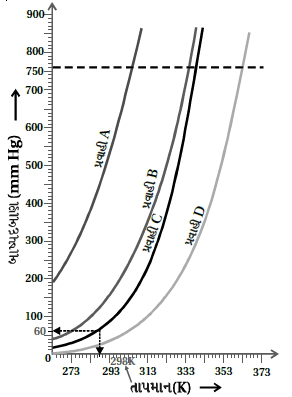
The variation of vapour pressure of different liquids with temperature is shown in the figure.
$(i)$ Calculate graphically the boiling points of liquids $A$ and $B$.
(ii) If we take liquid $C$ in a closed vessel and heat it continuously,at what temperature will it boil?
(iii) At high altitude,atmospheric pressure is low (say $60 \ mm \ Hg$). At what temperature does liquid $D$ boil?
(iv) $A$ pressure cooker is used for cooking food at hill stations. Explain in terms of vapour pressure why this is so.
$(i)$ Calculate graphically the boiling points of liquids $A$ and $B$.
(ii) If we take liquid $C$ in a closed vessel and heat it continuously,at what temperature will it boil?
(iii) At high altitude,atmospheric pressure is low (say $60 \ mm \ Hg$). At what temperature does liquid $D$ boil?
(iv) $A$ pressure cooker is used for cooking food at hill stations. Explain in terms of vapour pressure why this is so.
Solution
(N/A) $(i)$ Boiling point is the temperature at which vapour pressure equals atmospheric pressure $(760 \ mm \ Hg)$. From the graph,for liquid $A$,the boiling point is approximately $315 \ K$,and for liquid $B$,it is approximately $345 \ K$.
(ii) Liquid $C$ will not boil in a closed vessel because as the temperature increases,the vapour pressure increases,but the pressure inside the vessel also increases simultaneously,preventing the liquid from reaching its boiling point.
(iii) At $60 \ mm \ Hg$,by observing the graph for liquid $D$,the corresponding temperature is approximately $313 \ K$.
(iv) $A$ liquid boils when its vapour pressure equals the external atmospheric pressure. At high altitudes,atmospheric pressure is low,so water boils at a lower temperature,which is insufficient for cooking food properly. $A$ pressure cooker increases the internal pressure,which in turn increases the boiling point of water,allowing food to cook faster at a higher temperature.
(ii) Liquid $C$ will not boil in a closed vessel because as the temperature increases,the vapour pressure increases,but the pressure inside the vessel also increases simultaneously,preventing the liquid from reaching its boiling point.
(iii) At $60 \ mm \ Hg$,by observing the graph for liquid $D$,the corresponding temperature is approximately $313 \ K$.
(iv) $A$ liquid boils when its vapour pressure equals the external atmospheric pressure. At high altitudes,atmospheric pressure is low,so water boils at a lower temperature,which is insufficient for cooking food properly. $A$ pressure cooker increases the internal pressure,which in turn increases the boiling point of water,allowing food to cook faster at a higher temperature.
0 likes
View Solution206
Medium
What is the relationship between vapor pressure and temperature? What will be the vapor pressure at $373 \, K$?
Solution
(N/A) Vapor pressure is directly proportional to temperature $(T)$.
At $373 \, K$ $(100^{\circ} \, C)$,which is the boiling point of water at standard atmospheric pressure,the vapor pressure is equal to $1 \, atm$.
At $373 \, K$ $(100^{\circ} \, C)$,which is the boiling point of water at standard atmospheric pressure,the vapor pressure is equal to $1 \, atm$.
0 likes
View Solution207
EasyMCQ
Among acetone,ether,and ethanol,which one will have the maximum and which one will have the minimum vapor pressure?
A
Maximum: Ether,Minimum: Ethanol
B
Maximum: Acetone,Minimum: Ethanol
C
Maximum: Ethanol,Minimum: Ether
D
Maximum: Ether,Minimum: Acetone
Solution
(A) Vapor pressure depends on the strength of intermolecular forces.
Ether has weak dipole-dipole interactions,resulting in the highest vapor pressure.
Ethanol exhibits strong hydrogen bonding,which restricts the escape of molecules into the vapor phase,resulting in the lowest vapor pressure.
Acetone has intermediate dipole-dipole interactions.
Therefore,the order of vapor pressure is: $\text{Ether} > \text{Acetone} > \text{Ethanol}$.
Ether has weak dipole-dipole interactions,resulting in the highest vapor pressure.
Ethanol exhibits strong hydrogen bonding,which restricts the escape of molecules into the vapor phase,resulting in the lowest vapor pressure.
Acetone has intermediate dipole-dipole interactions.
Therefore,the order of vapor pressure is: $\text{Ether} > \text{Acetone} > \text{Ethanol}$.
0 likes
View Solution208
EasyMCQ
At a temperature of $300 \ K$,if a liquid is transferred from a small test tube to a large beaker,what will be the change in its vapor pressure?
A
It will increase.
B
It will decrease.
C
It will remain the same.
D
It will become zero.
Solution
(C) There will be no change in the vapor pressure.
Vapor pressure is an intensive property that depends only on the temperature and the nature of the liquid.
Since the temperature remains constant at $300 \ K$ and the intermolecular forces within the liquid do not change,the vapor pressure remains constant regardless of the size of the container.
Vapor pressure is an intensive property that depends only on the temperature and the nature of the liquid.
Since the temperature remains constant at $300 \ K$ and the intermolecular forces within the liquid do not change,the vapor pressure remains constant regardless of the size of the container.
0 likes
View Solution209
MediumMCQ
An open beaker of water in equilibrium with water vapour is in a sealed container. When a few grams of glucose are added to the beaker of water,the rate at which water molecules :
A
leaves the vapour increases
B
leaves the solution increases
C
leaves the solution decreases
D
leaves the vapour decreases
Solution
(C) When a non-volatile solute like glucose is added to a solvent,the number of solvent molecules at the surface decreases.
This results in a decrease in the rate of evaporation,meaning fewer water molecules leave the solution.
Consequently,the vapour pressure of the solution decreases.
This results in a decrease in the rate of evaporation,meaning fewer water molecules leave the solution.
Consequently,the vapour pressure of the solution decreases.
0 likes
View Solution210
MediumMCQ
At $300 \ K$,the vapour pressure of a solution containing $1 \ mole$ of $n-hexane$ and $3 \ moles$ of $n-heptane$ is $550 \ mm \ Hg$. At the same temperature,if one more mole of $n-heptane$ is added to this solution,the vapour pressure of the solution increases by $10 \ mm \ Hg$. What is the vapour pressure in $mm \ Hg$ of $n-heptane$ in its pure state?
A
$600$
B
$620$
C
$590$
D
$628$
Solution
(A) Let $P_{A}^{\circ}$ be the vapour pressure of pure $n-hexane$ and $P_{B}^{\circ}$ be the vapour pressure of pure $n-heptane$.
According to Raoult's Law,$P_{total} = X_{A}P_{A}^{\circ} + X_{B}P_{B}^{\circ}$.
For the first case: $X_{A} = \frac{1}{1+3} = \frac{1}{4}$ and $X_{B} = \frac{3}{4}$.
$550 = \frac{1}{4}P_{A}^{\circ} + \frac{3}{4}P_{B}^{\circ} \implies P_{A}^{\circ} + 3P_{B}^{\circ} = 2200 \dots (i)$
For the second case: $1 \ mole$ of $n-heptane$ is added,so total moles = $1 + 4 = 5$. $X_{A} = \frac{1}{5}$ and $X_{B} = \frac{4}{5}$.
The new vapour pressure is $550 + 10 = 560 \ mm \ Hg$.
$560 = \frac{1}{5}P_{A}^{\circ} + \frac{4}{5}P_{B}^{\circ} \implies P_{A}^{\circ} + 4P_{B}^{\circ} = 2800 \dots (ii)$
Subtracting equation $(i)$ from $(ii)$:
$(P_{A}^{\circ} + 4P_{B}^{\circ}) - (P_{A}^{\circ} + 3P_{B}^{\circ}) = 2800 - 2200$
$P_{B}^{\circ} = 600 \ mm \ Hg$.
According to Raoult's Law,$P_{total} = X_{A}P_{A}^{\circ} + X_{B}P_{B}^{\circ}$.
For the first case: $X_{A} = \frac{1}{1+3} = \frac{1}{4}$ and $X_{B} = \frac{3}{4}$.
$550 = \frac{1}{4}P_{A}^{\circ} + \frac{3}{4}P_{B}^{\circ} \implies P_{A}^{\circ} + 3P_{B}^{\circ} = 2200 \dots (i)$
For the second case: $1 \ mole$ of $n-heptane$ is added,so total moles = $1 + 4 = 5$. $X_{A} = \frac{1}{5}$ and $X_{B} = \frac{4}{5}$.
The new vapour pressure is $550 + 10 = 560 \ mm \ Hg$.
$560 = \frac{1}{5}P_{A}^{\circ} + \frac{4}{5}P_{B}^{\circ} \implies P_{A}^{\circ} + 4P_{B}^{\circ} = 2800 \dots (ii)$
Subtracting equation $(i)$ from $(ii)$:
$(P_{A}^{\circ} + 4P_{B}^{\circ}) - (P_{A}^{\circ} + 3P_{B}^{\circ}) = 2800 - 2200$
$P_{B}^{\circ} = 600 \ mm \ Hg$.
0 likes
View Solution211
MediumMCQ
$A$ set of solutions is prepared using $180 \ g$ of water as a solvent and $10 \ g$ of different non-volatile solutes $A, B$ and $C$. The relative lowering of vapour pressure in the presence of these solutes are in the order
[Given,molar mass of $A = 100 \ g \ mol^{-1}; B = 200 \ g \ mol^{-1}; C = 10,000 \ g \ mol^{-1}]$
[Given,molar mass of $A = 100 \ g \ mol^{-1}; B = 200 \ g \ mol^{-1}; C = 10,000 \ g \ mol^{-1}]$
A
$A > B > C$
B
$A > C > B$
C
$C > B > A$
D
$B > C > A$
Solution
(A) According to Raoult's law,the relative lowering of vapour pressure is equal to the mole fraction of the solute: $\frac{\Delta P}{P^0} = x_{\text{solute}} = \frac{n_{\text{solute}}}{n_{\text{solute}} + n_{\text{solvent}}}$.
Since the mass of the solvent ($180 \ g$ of water) and the mass of the solutes $(10 \ g)$ are constant,the mole fraction of the solute depends on the number of moles of the solute $(n = \frac{\text{mass}}{\text{molar mass}})$.
As the molar mass of the solute increases,the number of moles of the solute decreases,which in turn decreases the mole fraction of the solute.
Given molar masses: $M_A = 100 \ g \ mol^{-1}$,$M_B = 200 \ g \ mol^{-1}$,$M_C = 10,000 \ g \ mol^{-1}$.
Since $M_A < M_B < M_C$,the number of moles follows $n_A > n_B > n_C$.
Therefore,the relative lowering of vapour pressure follows the order $A > B > C$.
Since the mass of the solvent ($180 \ g$ of water) and the mass of the solutes $(10 \ g)$ are constant,the mole fraction of the solute depends on the number of moles of the solute $(n = \frac{\text{mass}}{\text{molar mass}})$.
As the molar mass of the solute increases,the number of moles of the solute decreases,which in turn decreases the mole fraction of the solute.
Given molar masses: $M_A = 100 \ g \ mol^{-1}$,$M_B = 200 \ g \ mol^{-1}$,$M_C = 10,000 \ g \ mol^{-1}$.
Since $M_A < M_B < M_C$,the number of moles follows $n_A > n_B > n_C$.
Therefore,the relative lowering of vapour pressure follows the order $A > B > C$.
0 likes
View Solution212
MediumMCQ
If $8 \; g$ of a non-electrolyte solute is dissolved in $114 \; g$ of $n$-octane to reduce its vapour pressure to $80 \%$,the molar mass (in $g \; mol^{-1}$) of the solute is.
Given that the molar mass of $n$-octane is $114 \; g \; mol^{-1}$.
Given that the molar mass of $n$-octane is $114 \; g \; mol^{-1}$.
A
$20$
B
$40$
C
$60$
D
$80$
Solution
(B) According to Raoult's law for non-volatile solutes,the relative lowering of vapour pressure is given by:
$\frac{P_{A}^{0} - P_{s}}{P_{A}^{0}} = \frac{n_{B}}{n_{A} + n_{B}} \approx \frac{n_{B}}{n_{A}}$ (for dilute solutions).
Given:
$w_{B} = 8 \; g$,$W_{A} = 114 \; g$,$M_{A} = 114 \; g \; mol^{-1}$.
Since the vapour pressure is reduced to $80 \%$,$P_{s} = 0.8 P_{A}^{0}$.
Therefore,$\frac{P_{A}^{0} - 0.8 P_{A}^{0}}{P_{A}^{0}} = \frac{0.2 P_{A}^{0}}{P_{A}^{0}} = 0.2$.
Using the formula $\frac{\Delta P}{P_{A}^{0}} = \frac{w_{B} \times M_{A}}{m_{B} \times W_{A}}$:
$0.2 = \frac{8 \times 114}{m_{B} \times 114}$.
$0.2 = \frac{8}{m_{B}}$.
$m_{B} = \frac{8}{0.2} = 40 \; g \; mol^{-1}$.
$\frac{P_{A}^{0} - P_{s}}{P_{A}^{0}} = \frac{n_{B}}{n_{A} + n_{B}} \approx \frac{n_{B}}{n_{A}}$ (for dilute solutions).
Given:
$w_{B} = 8 \; g$,$W_{A} = 114 \; g$,$M_{A} = 114 \; g \; mol^{-1}$.
Since the vapour pressure is reduced to $80 \%$,$P_{s} = 0.8 P_{A}^{0}$.
Therefore,$\frac{P_{A}^{0} - 0.8 P_{A}^{0}}{P_{A}^{0}} = \frac{0.2 P_{A}^{0}}{P_{A}^{0}} = 0.2$.
Using the formula $\frac{\Delta P}{P_{A}^{0}} = \frac{w_{B} \times M_{A}}{m_{B} \times W_{A}}$:
$0.2 = \frac{8 \times 114}{m_{B} \times 114}$.
$0.2 = \frac{8}{m_{B}}$.
$m_{B} = \frac{8}{0.2} = 40 \; g \; mol^{-1}$.
1 likes
View Solution213
DifficultMCQ
The vapour pressure of pure $CHCl_3$ and $CH_2Cl_2$ are $200 \,atm$ and $41.5 \,atm$ respectively. The weights of $CHCl_3$ and $CH_2Cl_2$ are respectively $11.9 \,g$ and $17 \,g$. The vapour pressure of the solution will be (in $,atm$)
A
$80.5$
B
$79.5$
C
$94.3$
D
$105.3$
Solution
(C) The molar mass of $CHCl_3$ is $119.5 \,g/mol$ and the molar mass of $CH_2Cl_2$ is $85 \,g/mol$.
Number of moles of $CHCl_3$ $(n_1)$ = $\frac{11.9 \,g}{119.5 \,g/mol} \approx 0.1 \,mol$.
Number of moles of $CH_2Cl_2$ $(n_2)$ = $\frac{17 \,g}{85 \,g/mol} = 0.2 \,mol$.
Total moles = $0.1 + 0.2 = 0.3 \,mol$.
Mole fraction of $CHCl_3$ $(x_1)$ = $\frac{0.1}{0.3} = \frac{1}{3}$.
Mole fraction of $CH_2Cl_2$ $(x_2)$ = $\frac{0.2}{0.3} = \frac{2}{3}$.
According to Raoult's law,the total vapour pressure $(P_T)$ is:
$P_T = P_1^{\circ} x_1 + P_2^{\circ} x_2$
$P_T = (200 \times \frac{1}{3}) + (41.5 \times \frac{2}{3})$
$P_T = 66.67 + 27.67 = 94.34 \,atm \approx 94.3 \,atm$.
Number of moles of $CHCl_3$ $(n_1)$ = $\frac{11.9 \,g}{119.5 \,g/mol} \approx 0.1 \,mol$.
Number of moles of $CH_2Cl_2$ $(n_2)$ = $\frac{17 \,g}{85 \,g/mol} = 0.2 \,mol$.
Total moles = $0.1 + 0.2 = 0.3 \,mol$.
Mole fraction of $CHCl_3$ $(x_1)$ = $\frac{0.1}{0.3} = \frac{1}{3}$.
Mole fraction of $CH_2Cl_2$ $(x_2)$ = $\frac{0.2}{0.3} = \frac{2}{3}$.
According to Raoult's law,the total vapour pressure $(P_T)$ is:
$P_T = P_1^{\circ} x_1 + P_2^{\circ} x_2$
$P_T = (200 \times \frac{1}{3}) + (41.5 \times \frac{2}{3})$
$P_T = 66.67 + 27.67 = 94.34 \,atm \approx 94.3 \,atm$.
0 likes
View Solution214
MediumMCQ
Vapour pressure of $CCl_{4}$ at $25\,^{\circ} C$ is $143\, mm\, Hg$. $0.5\, g$ of a non-volatile solute (mol. wt. $65$) is dissolved in $100\, mL$ of $CCl_{4}$. Find the vapour pressure of the solution. (Density of $CCl_{4} = 1.58\, g / cm^{3}$)
A
$141.93\, mm\, Hg$
B
$94.39\, mm\, Hg$
C
$199.34\, mm\, Hg$
D
$143.99\, mm\, Hg$
Solution
(A) The relative lowering of vapour pressure is given by the formula: $\frac{p^{\circ} - p_{s}}{p^{\circ}} = x_{2} = \frac{n_{2}}{n_{1} + n_{2}} \approx \frac{n_{2}}{n_{1}}$.
First,calculate the moles of solute $(n_{2})$: $n_{2} = \frac{0.5}{65} \approx 0.00769 \, mol$.
Next,calculate the mass of $CCl_{4}$: $Mass = Density \times Volume = 1.58 \, g/cm^{3} \times 100 \, cm^{3} = 158 \, g$.
Molar mass of $CCl_{4} = 12 + 4 \times 35.5 = 154 \, g/mol$.
Moles of solvent $(n_{1})$: $n_{1} = \frac{158}{154} \approx 1.026 \, mol$.
Using the formula: $\frac{143 - p_{s}}{143} = \frac{0.00769}{1.026}$.
$143 - p_{s} = 143 \times 0.007495 = 1.0718$.
$p_{s} = 143 - 1.0718 = 141.9282 \, mm\, Hg \approx 141.93 \, mm\, Hg$.
First,calculate the moles of solute $(n_{2})$: $n_{2} = \frac{0.5}{65} \approx 0.00769 \, mol$.
Next,calculate the mass of $CCl_{4}$: $Mass = Density \times Volume = 1.58 \, g/cm^{3} \times 100 \, cm^{3} = 158 \, g$.
Molar mass of $CCl_{4} = 12 + 4 \times 35.5 = 154 \, g/mol$.
Moles of solvent $(n_{1})$: $n_{1} = \frac{158}{154} \approx 1.026 \, mol$.
Using the formula: $\frac{143 - p_{s}}{143} = \frac{0.00769}{1.026}$.
$143 - p_{s} = 143 \times 0.007495 = 1.0718$.
$p_{s} = 143 - 1.0718 = 141.9282 \, mm\, Hg \approx 141.93 \, mm\, Hg$.
0 likes
View Solution215
MediumMCQ
$224 \, mL$ of $SO_{2(g)}$ at $273 \, K$ and $1 \, atm$ is passed through $100 \, mL$ of $0.1 \, M \, NaOH$ solution. The non-volatile solute produced is dissolved in $36 \, g$ of water. The lowering of vapour pressure of the solution (assuming the solution is dilute) $(P^0_{H_2O} = 24 \, mm \, Hg)$ is $x \times 10^{-2} \, mm \, Hg$. The value of $x$ is ...... . (Integer answer)
A
$50$
B
$12$
C
$67$
D
$89$
Solution
(B) Step $1$: Calculate moles of reactants.
$n_{SO_2} = \frac{224 \, mL}{22400 \, mL/mol} = 0.01 \, mol$.
$n_{NaOH} = 0.1 \, M \times 0.1 \, L = 0.01 \, mol$.
Step $2$: Reaction stoichiometry.
$SO_2 + NaOH \rightarrow NaHSO_3$.
Since $n_{SO_2} = n_{NaOH} = 0.01 \, mol$, both are consumed to produce $0.01 \, mol$ of $NaHSO_3$.
Step $3$: Calculate lowering of vapour pressure.
$\Delta P = P^0_{H_2O} \times \chi_{solute} = P^0_{H_2O} \times \frac{n_{solute}}{n_{solute} + n_{solvent}}$.
$n_{solvent} = \frac{36 \, g}{18 \, g/mol} = 2 \, mol$.
$\Delta P = 24 \times \frac{0.01}{0.01 + 2} = 24 \times \frac{0.01}{2.01} \approx 24 \times 0.004975 = 0.1194 \, mm \, Hg$.
$\Delta P = 11.94 \times 10^{-2} \, mm \, Hg$.
Rounding to the nearest integer, $x = 12$.
$n_{SO_2} = \frac{224 \, mL}{22400 \, mL/mol} = 0.01 \, mol$.
$n_{NaOH} = 0.1 \, M \times 0.1 \, L = 0.01 \, mol$.
Step $2$: Reaction stoichiometry.
$SO_2 + NaOH \rightarrow NaHSO_3$.
Since $n_{SO_2} = n_{NaOH} = 0.01 \, mol$, both are consumed to produce $0.01 \, mol$ of $NaHSO_3$.
Step $3$: Calculate lowering of vapour pressure.
$\Delta P = P^0_{H_2O} \times \chi_{solute} = P^0_{H_2O} \times \frac{n_{solute}}{n_{solute} + n_{solvent}}$.
$n_{solvent} = \frac{36 \, g}{18 \, g/mol} = 2 \, mol$.
$\Delta P = 24 \times \frac{0.01}{0.01 + 2} = 24 \times \frac{0.01}{2.01} \approx 24 \times 0.004975 = 0.1194 \, mm \, Hg$.
$\Delta P = 11.94 \times 10^{-2} \, mm \, Hg$.
Rounding to the nearest integer, $x = 12$.
0 likes
View Solution216
MediumMCQ
The correct option for the value of vapour pressure of a solution at $45^{\circ} C$ with benzene to octane in molar ratio $3 : 2$ is ...... $mm$ of $Hg$. [At $45^{\circ} C$,vapour pressure of benzene is $280 \ mm \ Hg$ and that of octane is $420 \ mm \ Hg$. Assume ideal solution.]
A
$160$
B
$168$
C
$336$
D
$350$
Solution
(C) According to Raoult's law for an ideal solution,the total vapour pressure $P_s$ is given by:
$P_s = P_A^0 x_A + P_B^0 x_B$
Given:
$P_A^0$ (benzene) $= 280 \ mm \ Hg$
$P_B^0$ (octane) $= 420 \ mm \ Hg$
Molar ratio $= 3 : 2$,so mole fractions are:
$x_A = \frac{3}{3+2} = \frac{3}{5} = 0.6$
$x_B = \frac{2}{3+2} = \frac{2}{5} = 0.4$
Substituting the values:
$P_s = (280 \times 0.6) + (420 \times 0.4)$
$P_s = 168 + 168$
$P_s = 336 \ mm \ Hg$
$P_s = P_A^0 x_A + P_B^0 x_B$
Given:
$P_A^0$ (benzene) $= 280 \ mm \ Hg$
$P_B^0$ (octane) $= 420 \ mm \ Hg$
Molar ratio $= 3 : 2$,so mole fractions are:
$x_A = \frac{3}{3+2} = \frac{3}{5} = 0.6$
$x_B = \frac{2}{3+2} = \frac{2}{5} = 0.4$
Substituting the values:
$P_s = (280 \times 0.6) + (420 \times 0.4)$
$P_s = 168 + 168$
$P_s = 336 \ mm \ Hg$
1 likes
View Solution217
DifficultMCQ
At $20^{\circ} C$,the vapour pressure of benzene is $70 \, torr$ and that of methyl benzene is $20 \, torr$. The mole fraction of benzene in the vapor phase at $20^{\circ} C$ above an equimolar mixture of benzene and methyl benzene is $..... \times 10^{-2}$ (Nearest integer).
A
$71$
B
$87$
C
$95$
D
$78$
Solution
(D) Given: $P_{B}^{\circ} = 70 \, torr$,$P_{M}^{\circ} = 20 \, torr$.
Since the mixture is equimolar,the mole fractions in the liquid phase are $X_{B} = 0.5$ and $X_{M} = 0.5$.
The partial pressure of benzene is $P_{B} = X_{B} \times P_{B}^{\circ} = 0.5 \times 70 = 35 \, torr$.
The partial pressure of methyl benzene is $P_{M} = X_{M} \times P_{M}^{\circ} = 0.5 \times 20 = 10 \, torr$.
The total pressure is $P_{total} = P_{B} + P_{M} = 35 + 10 = 45 \, torr$.
The mole fraction of benzene in the vapor phase $(y_{B})$ is given by $y_{B} = \frac{P_{B}}{P_{total}} = \frac{35}{45} = 0.777...$.
Rounding to the nearest integer for $y_{B} \times 10^{-2}$,we get $78 \times 10^{-2}$.
Since the mixture is equimolar,the mole fractions in the liquid phase are $X_{B} = 0.5$ and $X_{M} = 0.5$.
The partial pressure of benzene is $P_{B} = X_{B} \times P_{B}^{\circ} = 0.5 \times 70 = 35 \, torr$.
The partial pressure of methyl benzene is $P_{M} = X_{M} \times P_{M}^{\circ} = 0.5 \times 20 = 10 \, torr$.
The total pressure is $P_{total} = P_{B} + P_{M} = 35 + 10 = 45 \, torr$.
The mole fraction of benzene in the vapor phase $(y_{B})$ is given by $y_{B} = \frac{P_{B}}{P_{total}} = \frac{35}{45} = 0.777...$.
Rounding to the nearest integer for $y_{B} \times 10^{-2}$,we get $78 \times 10^{-2}$.
0 likes
View Solution218
DifficultMCQ
The vapour pressures of $A$ and $B$ at $25^{\circ} C$ are $90 \ mm \ Hg$ and $15 \ mm \ Hg$ respectively. If $A$ and $B$ are mixed such that the mole fraction of $A$ in the mixture is $0.6$,then the mole fraction of $B$ in the vapour phase is $x \times 10^{-1}$. The value of $x$ is $.....$ (Nearest integer)
A
$1$
B
$2$
C
$3$
D
$4$
Solution
(A) Given: $P_{A}^{\circ} = 90 \ mm \ Hg$,$P_{B}^{\circ} = 15 \ mm \ Hg$ at $25^{\circ} C$.
Mole fraction of $A$ in liquid phase,$X_{A} = 0.6$.
Mole fraction of $B$ in liquid phase,$X_{B} = 1 - 0.6 = 0.4$.
Total vapour pressure,$P_{T} = X_{A} P_{A}^{\circ} + X_{B} P_{B}^{\circ}$.
$P_{T} = (0.6 \times 90) + (0.4 \times 15) = 54 + 6 = 60 \ mm \ Hg$.
Partial pressure of $B$ in vapour phase,$P_{B} = X_{B} P_{B}^{\circ} = 0.4 \times 15 = 6 \ mm \ Hg$.
Mole fraction of $B$ in vapour phase,$Y_{B} = \frac{P_{B}}{P_{T}} = \frac{6}{60} = 0.1$.
Given $Y_{B} = x \times 10^{-1}$,so $0.1 = x \times 10^{-1}$,which gives $x = 1$.
Mole fraction of $A$ in liquid phase,$X_{A} = 0.6$.
Mole fraction of $B$ in liquid phase,$X_{B} = 1 - 0.6 = 0.4$.
Total vapour pressure,$P_{T} = X_{A} P_{A}^{\circ} + X_{B} P_{B}^{\circ}$.
$P_{T} = (0.6 \times 90) + (0.4 \times 15) = 54 + 6 = 60 \ mm \ Hg$.
Partial pressure of $B$ in vapour phase,$P_{B} = X_{B} P_{B}^{\circ} = 0.4 \times 15 = 6 \ mm \ Hg$.
Mole fraction of $B$ in vapour phase,$Y_{B} = \frac{P_{B}}{P_{T}} = \frac{6}{60} = 0.1$.
Given $Y_{B} = x \times 10^{-1}$,so $0.1 = x \times 10^{-1}$,which gives $x = 1$.
0 likes
View Solution219
MediumMCQ
Toluene in the vapour phase is in equilibrium with a solution of benzene and toluene having mole fraction of toluene $0.50$. If vapour pressure of pure benzene is $119 \ torr$ and that of toluene is $37.0 \ torr$ at the same temperature,mole fraction of toluene in vapour phase will be:
A
$0.462$
B
$0.237$
C
$0.506$
D
$0.325$
Solution
(B) Let $A$ be toluene and $B$ be benzene.
Given: $X_{A} = 0.50$,$X_{B} = 1 - 0.50 = 0.50$.
$P_{A}^{0} = 37.0 \ torr$,$P_{B}^{0} = 119 \ torr$.
Total vapour pressure $P_{total} = P_{A}^{0} X_{A} + P_{B}^{0} X_{B} = (37.0 \times 0.50) + (119 \times 0.50) = 18.5 + 59.5 = 78.0 \ torr$.
According to Dalton's Law,the mole fraction of toluene in the vapour phase $(y_{A})$ is given by $y_{A} = \frac{P_{A}}{P_{total}}$.
$P_{A} = P_{A}^{0} X_{A} = 37.0 \times 0.50 = 18.5 \ torr$.
$y_{A} = \frac{18.5}{78.0} \approx 0.237$.
Given: $X_{A} = 0.50$,$X_{B} = 1 - 0.50 = 0.50$.
$P_{A}^{0} = 37.0 \ torr$,$P_{B}^{0} = 119 \ torr$.
Total vapour pressure $P_{total} = P_{A}^{0} X_{A} + P_{B}^{0} X_{B} = (37.0 \times 0.50) + (119 \times 0.50) = 18.5 + 59.5 = 78.0 \ torr$.
According to Dalton's Law,the mole fraction of toluene in the vapour phase $(y_{A})$ is given by $y_{A} = \frac{P_{A}}{P_{total}}$.
$P_{A} = P_{A}^{0} X_{A} = 37.0 \times 0.50 = 18.5 \ torr$.
$y_{A} = \frac{18.5}{78.0} \approx 0.237$.
0 likes
View Solution220
MediumMCQ
The vapour pressures of two volatile liquids $A$ and $B$ at $25^{\circ} C$ are $50 \ Torr$ and $100 \ Torr,$ respectively. If the liquid mixture contains $0.3$ mole fraction of $A$,then the mole fraction of liquid $B$ in the vapour phase is $\frac{x}{17}$. The value of $x$ is $...$
A
$140$
B
$89$
C
$14$
D
$54$
Solution
(C) Given: $P_A^{\circ} = 50 \ Torr$,$P_B^{\circ} = 100 \ Torr$,$X_A = 0.3$,$X_B = 1 - 0.3 = 0.7$.
According to Raoult's Law,the partial pressures are:
$P_A = P_A^{\circ} X_A = 50 \times 0.3 = 15 \ Torr$.
$P_B = P_B^{\circ} X_B = 100 \times 0.7 = 70 \ Torr$.
Total pressure $P_{total} = P_A + P_B = 15 + 70 = 85 \ Torr$.
The mole fraction of $B$ in the vapour phase $(y_B)$ is given by:
$y_B = \frac{P_B}{P_{total}} = \frac{70}{85} = \frac{14}{17}$.
Comparing this with $\frac{x}{17}$,we get $x = 14$.
According to Raoult's Law,the partial pressures are:
$P_A = P_A^{\circ} X_A = 50 \times 0.3 = 15 \ Torr$.
$P_B = P_B^{\circ} X_B = 100 \times 0.7 = 70 \ Torr$.
Total pressure $P_{total} = P_A + P_B = 15 + 70 = 85 \ Torr$.
The mole fraction of $B$ in the vapour phase $(y_B)$ is given by:
$y_B = \frac{P_B}{P_{total}} = \frac{70}{85} = \frac{14}{17}$.
Comparing this with $\frac{x}{17}$,we get $x = 14$.
0 likes
View Solution221
MediumMCQ
When a certain amount of solid $A$ is dissolved in $100 \ g$ of water at $25^{\circ} \ C$ to make a dilute solution,the vapour pressure of the solution is reduced to one-half of that of pure water. The vapour pressure of pure water is $23.76 \ mm \ Hg$. The number of moles of solute $A$ added is $...........$ (Nearest Integer).
A
$2$
B
$3$
C
$4$
D
$6$
Solution
(D) According to Raoult's law for non-volatile solutes,the relative lowering of vapour pressure is given by: $\frac{P^{0} - P_{s}}{P^{0}} = \frac{n_{A}}{n_{A} + n_{solvent}}$.
Given that the vapour pressure of the solution $P_{s}$ is half of the pure water $P^{0}$,so $P_{s} = \frac{P^{0}}{2}$.
Substituting the values: $\frac{P^{0} - P^{0}/2}{P^{0}} = \frac{n_{A}}{n_{A} + n_{solvent}} \implies \frac{1}{2} = \frac{n_{A}}{n_{A} + n_{solvent}}$.
This simplifies to $n_{A} + n_{solvent} = 2n_{A}$,which means $n_{A} = n_{solvent}$.
The number of moles of water $(n_{solvent})$ is $\frac{100 \ g}{18 \ g/mol} = 5.55 \ mol$.
Therefore,$n_{A} = 5.55 \ mol$.
Rounding to the nearest integer,we get $6$.
Given that the vapour pressure of the solution $P_{s}$ is half of the pure water $P^{0}$,so $P_{s} = \frac{P^{0}}{2}$.
Substituting the values: $\frac{P^{0} - P^{0}/2}{P^{0}} = \frac{n_{A}}{n_{A} + n_{solvent}} \implies \frac{1}{2} = \frac{n_{A}}{n_{A} + n_{solvent}}$.
This simplifies to $n_{A} + n_{solvent} = 2n_{A}$,which means $n_{A} = n_{solvent}$.
The number of moles of water $(n_{solvent})$ is $\frac{100 \ g}{18 \ g/mol} = 5.55 \ mol$.
Therefore,$n_{A} = 5.55 \ mol$.
Rounding to the nearest integer,we get $6$.
0 likes
View Solution222
MediumMCQ
$A$ gaseous mixture of two substances $A$ and $B$,under a total pressure of $0.8 \ atm$ is in equilibrium with an ideal liquid solution. The mole fraction of substance $A$ is $0.5$ in the vapour phase and $0.2$ in the liquid phase. The vapour pressure of pure liquid $A$ is $...... \ atm$. (Nearest integer)
A
$1$
B
$0$
C
$2$
D
$3$
Solution
(C) According to Dalton's Law of partial pressures,the partial pressure of $A$ is given by $P_A = Y_A \times P_{total}$.
Given $Y_A = 0.5$ and $P_{total} = 0.8 \ atm$,we have $P_A = 0.5 \times 0.8 = 0.4 \ atm$.
According to Raoult's Law,$P_A = P_A^0 \times X_A$,where $X_A$ is the mole fraction in the liquid phase.
Given $X_A = 0.2$,we have $0.4 = P_A^0 \times 0.2$.
Therefore,$P_A^0 = \frac{0.4}{0.2} = 2 \ atm$.
Given $Y_A = 0.5$ and $P_{total} = 0.8 \ atm$,we have $P_A = 0.5 \times 0.8 = 0.4 \ atm$.
According to Raoult's Law,$P_A = P_A^0 \times X_A$,where $X_A$ is the mole fraction in the liquid phase.
Given $X_A = 0.2$,we have $0.4 = P_A^0 \times 0.2$.
Therefore,$P_A^0 = \frac{0.4}{0.2} = 2 \ atm$.
0 likes
View Solution223
MediumMCQ
The plot of total vapour pressure as a function of mole fraction of the components of an ideal solution formed by mixing liquids $X$ and $Y$ is
A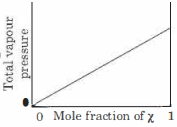
B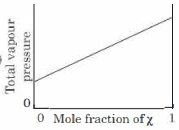
C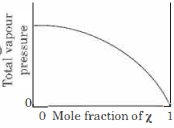
D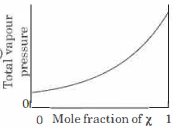
Solution
(B) According to Raoult's law,for an ideal solution of liquids $X$ and $Y$:
$p_X = p_X^0 \chi_X$
$p_Y = p_Y^0 \chi_Y = p_Y^0 (1 - \chi_X)$
According to Dalton's law of partial pressures,the total vapour pressure $p_T$ is:
$p_T = p_X + p_Y$
$p_T = p_X^0 \chi_X + p_Y^0 (1 - \chi_X)$
$p_T = p_Y^0 + (p_X^0 - p_Y^0) \chi_X$
This equation represents a linear relationship between $p_T$ and $\chi_X$,which is of the form $y = mx + c$,where the slope is $(p_X^0 - p_Y^0)$ and the intercept is $p_Y^0$.
Thus,the plot of total vapour pressure versus mole fraction of $X$ is a straight line.
$p_X = p_X^0 \chi_X$
$p_Y = p_Y^0 \chi_Y = p_Y^0 (1 - \chi_X)$
According to Dalton's law of partial pressures,the total vapour pressure $p_T$ is:
$p_T = p_X + p_Y$
$p_T = p_X^0 \chi_X + p_Y^0 (1 - \chi_X)$
$p_T = p_Y^0 + (p_X^0 - p_Y^0) \chi_X$
This equation represents a linear relationship between $p_T$ and $\chi_X$,which is of the form $y = mx + c$,where the slope is $(p_X^0 - p_Y^0)$ and the intercept is $p_Y^0$.
Thus,the plot of total vapour pressure versus mole fraction of $X$ is a straight line.
0 likes
View Solution224
MediumMCQ
In $108 \, g$ of water,$18 \, g$ of a non-volatile compound is dissolved. At $100^{\circ} C$,the vapour pressure of the solution is $750 \, mm \, Hg$. Assuming that the compound does not undergo association or dissociation,the molar mass of the compound in $g \, mol^{-1}$ is
A
$128$
B
$182$
C
$152$
D
$228$
Solution
(D) The relative lowering of vapour pressure is given by the formula: $\frac{p_0 - p_s}{p_0} = \chi_2 = \frac{n_2}{n_1 + n_2}$.
Given: $p_0 = 760 \, mm \, Hg$ (at $100^{\circ} C$),$p_s = 750 \, mm \, Hg$,$w_2 = 18 \, g$,$w_1 = 108 \, g$,$M_1 = 18 \, g \, mol^{-1}$.
$n_1 = \frac{108}{18} = 6 \, mol$.
$n_2 = \frac{18}{M_2}$.
Using the formula $\frac{760 - 750}{760} = \frac{n_2}{n_1 + n_2} \approx \frac{n_2}{n_1}$ (since $n_2$ is small compared to $n_1$):
$\frac{10}{760} = \frac{18/M_2}{6}$.
$\frac{1}{76} = \frac{3}{M_2}$.
$M_2 = 3 \times 76 = 228 \, g \, mol^{-1}$.
Given: $p_0 = 760 \, mm \, Hg$ (at $100^{\circ} C$),$p_s = 750 \, mm \, Hg$,$w_2 = 18 \, g$,$w_1 = 108 \, g$,$M_1 = 18 \, g \, mol^{-1}$.
$n_1 = \frac{108}{18} = 6 \, mol$.
$n_2 = \frac{18}{M_2}$.
Using the formula $\frac{760 - 750}{760} = \frac{n_2}{n_1 + n_2} \approx \frac{n_2}{n_1}$ (since $n_2$ is small compared to $n_1$):
$\frac{10}{760} = \frac{18/M_2}{6}$.
$\frac{1}{76} = \frac{3}{M_2}$.
$M_2 = 3 \times 76 = 228 \, g \, mol^{-1}$.
0 likes
View Solution225
MediumMCQ
At $300 \ K$,the vapour pressures of two pure liquids,$A$ and $B$ are $100 \ mm \ Hg$ and $500 \ mm \ Hg$,respectively. If in a mixture of $A$ and $B$,the total vapour pressure is $300 \ mm \ Hg$,the mole fractions of $A$ in the liquid and in the vapour phase,respectively,are:
A
$1 / 2$ and $1 / 10$
B
$1 / 4$ and $1 / 6$
C
$1 / 4$ and $1 / 10$
D
$1 / 2$ and $1 / 6$
Solution
(D) According to Raoult's law,the total vapour pressure $p_T$ is given by:
$p_T = x_A p_A^{\circ} + x_B p_B^{\circ}$
Since $x_B = 1 - x_A$,we have:
$p_T = x_A p_A^{\circ} + (1 - x_A) p_B^{\circ}$
Substituting the given values:
$300 = x_A(100) + (1 - x_A)(500)$
$300 = 100x_A + 500 - 500x_A$
$400x_A = 200$
$x_A = 1 / 2$
Thus,the mole fraction of $A$ in the liquid phase is $1 / 2$.
In the vapour phase,the mole fraction of $A$ $(y_A)$ is given by:
$y_A = \frac{p_A}{p_T} = \frac{x_A p_A^{\circ}}{p_T}$
$y_A = \frac{(1 / 2) \times 100}{300} = \frac{50}{300} = 1 / 6$
Therefore,the mole fractions of $A$ in the liquid and vapour phases are $1 / 2$ and $1 / 6$ respectively.
$p_T = x_A p_A^{\circ} + x_B p_B^{\circ}$
Since $x_B = 1 - x_A$,we have:
$p_T = x_A p_A^{\circ} + (1 - x_A) p_B^{\circ}$
Substituting the given values:
$300 = x_A(100) + (1 - x_A)(500)$
$300 = 100x_A + 500 - 500x_A$
$400x_A = 200$
$x_A = 1 / 2$
Thus,the mole fraction of $A$ in the liquid phase is $1 / 2$.
In the vapour phase,the mole fraction of $A$ $(y_A)$ is given by:
$y_A = \frac{p_A}{p_T} = \frac{x_A p_A^{\circ}}{p_T}$
$y_A = \frac{(1 / 2) \times 100}{300} = \frac{50}{300} = 1 / 6$
Therefore,the mole fractions of $A$ in the liquid and vapour phases are $1 / 2$ and $1 / 6$ respectively.
0 likes
View Solution226
MediumMCQ
$651 \ g$ of ethylene glycol $(HOCH_2CH_2OH)$ is dissolved in $1.5 \ kg$ of water at $363 \ K$. The vapour pressure of pure water at $363 \ K$ is $0.7 \ atm$. Assuming ideal solution behaviour,the vapour pressure of water over the solution (in $atm$) is closest to $...$
A
$0.57$
B
$0.62$
C
$0.65$
D
$0.68$
Solution
(B) The molar mass of ethylene glycol $(HOCH_2CH_2OH)$ is $62 \ g/mol$.
Number of moles of ethylene glycol $(n_{solute}) = \frac{651 \ g}{62 \ g/mol} = 10.5 \ mol$.
Number of moles of water $(n_{solvent}) = \frac{1500 \ g}{18 \ g/mol} \approx 83.33 \ mol$.
Using Raoult's law for a non-volatile solute: $\frac{P^{\circ} - P}{P^{\circ}} = \frac{n_{solute}}{n_{solute} + n_{solvent}}$.
$\frac{0.7 - P}{0.7} = \frac{10.5}{10.5 + 83.33} = \frac{10.5}{93.83} \approx 0.1119$.
$0.7 - P = 0.7 \times 0.1119 \approx 0.0783$.
$P = 0.7 - 0.0783 = 0.6217 \ atm$.
Thus,the vapour pressure is closest to $0.62 \ atm$.
Number of moles of ethylene glycol $(n_{solute}) = \frac{651 \ g}{62 \ g/mol} = 10.5 \ mol$.
Number of moles of water $(n_{solvent}) = \frac{1500 \ g}{18 \ g/mol} \approx 83.33 \ mol$.
Using Raoult's law for a non-volatile solute: $\frac{P^{\circ} - P}{P^{\circ}} = \frac{n_{solute}}{n_{solute} + n_{solvent}}$.
$\frac{0.7 - P}{0.7} = \frac{10.5}{10.5 + 83.33} = \frac{10.5}{93.83} \approx 0.1119$.
$0.7 - P = 0.7 \times 0.1119 \approx 0.0783$.
$P = 0.7 - 0.0783 = 0.6217 \ atm$.
Thus,the vapour pressure is closest to $0.62 \ atm$.
0 likes
View Solution227
MediumMCQ
Mass of Urea $(NH_2CONH_2)$ required to be dissolved in $1000 \ g$ of water to reduce the vapour pressure of water by $25 \ \%$ is $...... \ g$. (Nearest integer) Given: Molar mass of $N, C, O$ and $H$ are $14, 12, 16$ and $1 \ g \ mol^{-1}$ respectively.
A
$1112$
B
$1113$
C
$1114$
D
$1111$
Solution
(D) The relative lowering of vapour pressure is given by the formula: $\frac{P^0 - P_s}{P^0} = \frac{n_2}{n_1 + n_2} \approx \frac{n_2}{n_1}$ for dilute solutions.
Given that the vapour pressure is reduced by $25 \ \%$,the final vapour pressure $P_s = 0.75 P^0$.
Thus,$\frac{P^0 - 0.75 P^0}{P^0} = \frac{n_2}{n_1} = 0.25$.
Here,$n_2 = \frac{x}{60}$ (moles of urea) and $n_1 = \frac{1000}{18} \approx 55.56$ (moles of water).
$\frac{x/60}{1000/18} = 0.25 \Rightarrow \frac{x}{60} = 0.25 \times 55.56 = 13.89$.
$x = 13.89 \times 60 = 833.4 \ g$.
Wait,re-evaluating the formula: $\frac{P^0 - P_s}{P_s} = \frac{n_2}{n_1} = \frac{0.25 P^0}{0.75 P^0} = \frac{1}{3}$.
$\frac{x/60}{1000/18} = \frac{1}{3} \Rightarrow \frac{x}{60} = \frac{1}{3} \times 55.56 = 18.52$.
$x = 18.52 \times 60 = 1111.2 \ g$.
Rounding to the nearest integer,we get $1111 \ g$.
Given that the vapour pressure is reduced by $25 \ \%$,the final vapour pressure $P_s = 0.75 P^0$.
Thus,$\frac{P^0 - 0.75 P^0}{P^0} = \frac{n_2}{n_1} = 0.25$.
Here,$n_2 = \frac{x}{60}$ (moles of urea) and $n_1 = \frac{1000}{18} \approx 55.56$ (moles of water).
$\frac{x/60}{1000/18} = 0.25 \Rightarrow \frac{x}{60} = 0.25 \times 55.56 = 13.89$.
$x = 13.89 \times 60 = 833.4 \ g$.
Wait,re-evaluating the formula: $\frac{P^0 - P_s}{P_s} = \frac{n_2}{n_1} = \frac{0.25 P^0}{0.75 P^0} = \frac{1}{3}$.
$\frac{x/60}{1000/18} = \frac{1}{3} \Rightarrow \frac{x}{60} = \frac{1}{3} \times 55.56 = 18.52$.
$x = 18.52 \times 60 = 1111.2 \ g$.
Rounding to the nearest integer,we get $1111 \ g$.
0 likes
View Solution228
MediumMCQ
What weight of glucose must be dissolved in $100 \ g$ of water to lower the vapour pressure by $0.20 \ mm \ Hg$ (in $g$)? (Assume dilute solution is being formed) Given: Vapour pressure of pure water is $54.2 \ mm \ Hg$ at room temperature. Molar mass of glucose is $180 \ g \ mol^{-1}$
A
$4.69$
B
$3.59$
C
$2.59$
D
$3.69$
Solution
(D) For a dilute solution,the relative lowering of vapour pressure is given by: $\frac{P^0 - P_s}{P^0} = \frac{n}{N}$
Where $P^0 - P_s = 0.20 \ mm \ Hg$,$P^0 = 54.2 \ mm \ Hg$,$n$ is the moles of glucose,and $N$ is the moles of water.
$N = \frac{100 \ g}{18 \ g \ mol^{-1}} = 5.55 \ mol$.
Substituting the values: $\frac{0.20}{54.2} = \frac{w / 180}{100 / 18}$.
$\frac{0.20}{54.2} = \frac{w \times 18}{180 \times 100}$.
$w = \frac{0.20 \times 180 \times 100}{54.2 \times 18} = \frac{3600}{975.6} \approx 3.69 \ g$.
Where $P^0 - P_s = 0.20 \ mm \ Hg$,$P^0 = 54.2 \ mm \ Hg$,$n$ is the moles of glucose,and $N$ is the moles of water.
$N = \frac{100 \ g}{18 \ g \ mol^{-1}} = 5.55 \ mol$.
Substituting the values: $\frac{0.20}{54.2} = \frac{w / 180}{100 / 18}$.
$\frac{0.20}{54.2} = \frac{w \times 18}{180 \times 100}$.
$w = \frac{0.20 \times 180 \times 100}{54.2 \times 18} = \frac{3600}{975.6} \approx 3.69 \ g$.
0 likes
View Solution229
MediumMCQ
The vapour pressure of $30 \%$ $(w/v)$ aqueous solution of glucose is $...... \ mm \ Hg$ at $25^{\circ} \ C$. [Given : The density of $30 \%$ $(w/v)$ aqueous solution of glucose is $1.2 \ g \ cm^{-3}$ and vapour pressure of pure water is $24 \ mm \ Hg$.] (Molar mass of glucose is $180 \ g \ mol^{-1}$.)
A
$23$
B
$22$
C
$21$
D
$24$
Solution
(A) The relative lowering of vapour pressure is given by $\frac{P^{\circ} - P_{s}}{P_{s}} = \frac{n_{solute}}{n_{solvent}}$.
Given: $30 \% \ (w/v)$ solution means $30 \ g$ of glucose in $100 \ mL$ of solution.
Mass of solution $= \text{density} \times \text{volume} = 1.2 \ g \ cm^{-3} \times 100 \ mL = 120 \ g$.
Mass of solvent (water) $= 120 \ g - 30 \ g = 90 \ g$.
Moles of glucose $(n_{solute})$ $= \frac{30 \ g}{180 \ g \ mol^{-1}} = \frac{1}{6} \ mol \approx 0.1667 \ mol$.
Moles of water $(n_{solvent})$ $= \frac{90 \ g}{18 \ g \ mol^{-1}} = 5 \ mol$.
Using the formula $\frac{24 - P_{s}}{P_{s}} = \frac{0.1667}{5} = 0.03334$.
$24 - P_{s} = 0.03334 \ P_{s} \implies 24 = 1.03334 \ P_{s}$.
$P_{s} = \frac{24}{1.03334} \approx 23.22 \ mm \ Hg$. The closest integer value is $23 \ mm \ Hg$.
Given: $30 \% \ (w/v)$ solution means $30 \ g$ of glucose in $100 \ mL$ of solution.
Mass of solution $= \text{density} \times \text{volume} = 1.2 \ g \ cm^{-3} \times 100 \ mL = 120 \ g$.
Mass of solvent (water) $= 120 \ g - 30 \ g = 90 \ g$.
Moles of glucose $(n_{solute})$ $= \frac{30 \ g}{180 \ g \ mol^{-1}} = \frac{1}{6} \ mol \approx 0.1667 \ mol$.
Moles of water $(n_{solvent})$ $= \frac{90 \ g}{18 \ g \ mol^{-1}} = 5 \ mol$.
Using the formula $\frac{24 - P_{s}}{P_{s}} = \frac{0.1667}{5} = 0.03334$.
$24 - P_{s} = 0.03334 \ P_{s} \implies 24 = 1.03334 \ P_{s}$.
$P_{s} = \frac{24}{1.03334} \approx 23.22 \ mm \ Hg$. The closest integer value is $23 \ mm \ Hg$.
0 likes
View Solution230
MediumMCQ
The vapour pressure of pure benzene and methyl benzene at $27^{\circ} C$ is given as $80 \ Torr$ and $24 \ Torr$,respectively. The mole fraction of methyl benzene in vapour phase,in equilibrium with an equimolar mixture of those two liquids (ideal solution) at the same temperature is. . . . . . .$\times 10^{-2}$ (nearest integer)
A
$20$
B
$25$
C
$23$
D
$30$
Solution
(C) Given that the mixture is equimolar,the mole fraction of benzene $(X_B)$ and methyl benzene $(X_M)$ in the liquid phase are both $0.5$.
The partial vapour pressure of methyl benzene is $P_M = X_M \times P^{\circ}_M = 0.5 \times 24 \ Torr = 12 \ Torr$.
The partial vapour pressure of benzene is $P_B = X_B \times P^{\circ}_B = 0.5 \times 80 \ Torr = 40 \ Torr$.
The total vapour pressure is $P_{\text{total}} = P_M + P_B = 12 \ Torr + 40 \ Torr = 52 \ Torr$.
The mole fraction of methyl benzene in the vapour phase $(Y_M)$ is given by $Y_M = \frac{P_M}{P_{\text{total}}}$.
$Y_M = \frac{12}{52} \approx 0.2307$.
Rounding to the nearest integer as requested,$Y_M \approx 23 \times 10^{-2}$.
The partial vapour pressure of methyl benzene is $P_M = X_M \times P^{\circ}_M = 0.5 \times 24 \ Torr = 12 \ Torr$.
The partial vapour pressure of benzene is $P_B = X_B \times P^{\circ}_B = 0.5 \times 80 \ Torr = 40 \ Torr$.
The total vapour pressure is $P_{\text{total}} = P_M + P_B = 12 \ Torr + 40 \ Torr = 52 \ Torr$.
The mole fraction of methyl benzene in the vapour phase $(Y_M)$ is given by $Y_M = \frac{P_M}{P_{\text{total}}}$.
$Y_M = \frac{12}{52} \approx 0.2307$.
Rounding to the nearest integer as requested,$Y_M \approx 23 \times 10^{-2}$.
0 likes
View Solution231
MediumMCQ
When a non-volatile solute is added to the solvent,the vapour pressure of the solvent decreases by $10 \ mm \ Hg$. The mole fraction of the solute in the solution is $0.2$. What would be the mole fraction of the solvent if the decrease in vapour pressure is $20 \ mm \ Hg$?
A
$0.6$
B
$0.4$
C
$0.2$
D
$0.8$
Solution
(A) According to Raoult's law,the relative lowering of vapour pressure is equal to the mole fraction of the solute: $\frac{P^{\circ} - P}{P^{\circ}} = X_{\text{solute}}$.
Since $P^{\circ} - P \propto X_{\text{solute}}$,we have $10 \propto 0.2$.
For a decrease of $20 \ mm \ Hg$,the new mole fraction of the solute $(X'_{\text{solute}})$ will be: $20 \propto X'_{\text{solute}}$.
Thus,$X'_{\text{solute}} = \frac{20}{10} \times 0.2 = 0.4$.
The mole fraction of the solvent is $X_{\text{solvent}} = 1 - X'_{\text{solute}} = 1 - 0.4 = 0.6$.
Since $P^{\circ} - P \propto X_{\text{solute}}$,we have $10 \propto 0.2$.
For a decrease of $20 \ mm \ Hg$,the new mole fraction of the solute $(X'_{\text{solute}})$ will be: $20 \propto X'_{\text{solute}}$.
Thus,$X'_{\text{solute}} = \frac{20}{10} \times 0.2 = 0.4$.
The mole fraction of the solvent is $X_{\text{solvent}} = 1 - X'_{\text{solute}} = 1 - 0.4 = 0.6$.
0 likes
View Solution232
DifficultMCQ
Consider a binary solution of two volatile liquid components $1$ and $2$. $x_1$ and $y_1$ are the mole fractions of component $1$ in liquid and vapour phase,respectively. The slope and intercept of the linear plot of $\frac{1}{x_1}$ vs $\frac{1}{y_1}$ are given respectively as :
A
$\frac{P_1^0}{P_2^0}, \frac{P_2^0-P_1^0}{P_2^0}$
B
$\frac{P_2^0}{P_1^0}, \frac{P_1^0-P_2^0}{P_2^0}$
C
$\frac{P_1^0}{P_2^0}, \frac{P_1^0-P_2^0}{P_2^0}$
D
$\frac{P_2^0}{P_1^0}, \frac{P_2^0-P_1^0}{P_2^0}$
Solution
(A) According to Raoult's law for a binary solution of two volatile liquids $1$ and $2$:
$P_T = P_1^0 x_1 + P_2^0 x_2 = P_1^0 x_1 + P_2^0 (1 - x_1) = P_2^0 + x_1 (P_1^0 - P_2^0)$
Also,from Dalton's law,$P_1 = P_T y_1$,where $P_1 = P_1^0 x_1$.
So,$P_T y_1 = P_1^0 x_1 \implies P_T = \frac{P_1^0 x_1}{y_1}$.
Equating the two expressions for $P_T$:
$P_2^0 + x_1 (P_1^0 - P_2^0) = \frac{P_1^0 x_1}{y_1}$
Dividing both sides by $x_1 P_2^0$:
$\frac{P_2^0}{x_1} + \frac{P_1^0 - P_2^0}{P_2^0} = \frac{P_1^0}{P_2^0 y_1}$
Rearranging to the form $Y = mX + c$ where $Y = \frac{1}{x_1}$ and $X = \frac{1}{y_1}$:
$\frac{1}{x_1} = \left( \frac{P_1^0}{P_2^0} \right) \frac{1}{y_1} + \left( \frac{P_2^0 - P_1^0}{P_2^0} \right)$
Comparing with $Y = mX + c$,the slope is $\frac{P_1^0}{P_2^0}$ and the intercept is $\frac{P_2^0 - P_1^0}{P_2^0}$.
$P_T = P_1^0 x_1 + P_2^0 x_2 = P_1^0 x_1 + P_2^0 (1 - x_1) = P_2^0 + x_1 (P_1^0 - P_2^0)$
Also,from Dalton's law,$P_1 = P_T y_1$,where $P_1 = P_1^0 x_1$.
So,$P_T y_1 = P_1^0 x_1 \implies P_T = \frac{P_1^0 x_1}{y_1}$.
Equating the two expressions for $P_T$:
$P_2^0 + x_1 (P_1^0 - P_2^0) = \frac{P_1^0 x_1}{y_1}$
Dividing both sides by $x_1 P_2^0$:
$\frac{P_2^0}{x_1} + \frac{P_1^0 - P_2^0}{P_2^0} = \frac{P_1^0}{P_2^0 y_1}$
Rearranging to the form $Y = mX + c$ where $Y = \frac{1}{x_1}$ and $X = \frac{1}{y_1}$:
$\frac{1}{x_1} = \left( \frac{P_1^0}{P_2^0} \right) \frac{1}{y_1} + \left( \frac{P_2^0 - P_1^0}{P_2^0} \right)$
Comparing with $Y = mX + c$,the slope is $\frac{P_1^0}{P_2^0}$ and the intercept is $\frac{P_2^0 - P_1^0}{P_2^0}$.
0 likes
View Solution233
MediumMCQ
$A$ solution is made by mixing $1 \ mole$ of volatile liquid $A$ with $3 \ moles$ of volatile liquid $B$. The vapour pressure of pure $A$ is $200 \ mm \ Hg$ and that of the solution is $500 \ mm \ Hg$. The vapour pressure of pure $B$ and the least volatile component of the solution,respectively,are $:$
A
$1400 \ mm \ Hg, A$
B
$1400 \ mm \ Hg, B$
C
$600 \ mm \ Hg, B$
D
$600 \ mm \ Hg, A$
Solution
(D) According to Raoult's Law,the total vapour pressure of the solution is given by $P_{S} = P_{A}^{o} \cdot X_{A} + P_{B}^{o} \cdot X_{B}$.
Given: $n_{A} = 1 \ mole$,$n_{B} = 3 \ moles$,$P_{A}^{o} = 200 \ mm \ Hg$,$P_{S} = 500 \ mm \ Hg$.
Mole fractions are $X_{A} = \frac{1}{1+3} = 0.25$ and $X_{B} = \frac{3}{1+3} = 0.75$.
Substituting the values: $500 = (200 \times 0.25) + (P_{B}^{o} \times 0.75)$.
$500 = 50 + 0.75 \cdot P_{B}^{o}$.
$450 = 0.75 \cdot P_{B}^{o} \Rightarrow P_{B}^{o} = \frac{450}{0.75} = 600 \ mm \ Hg$.
Since $P_{A}^{o} (200 \ mm \ Hg) < P_{B}^{o} (600 \ mm \ Hg)$,component $A$ is the least volatile.
Given: $n_{A} = 1 \ mole$,$n_{B} = 3 \ moles$,$P_{A}^{o} = 200 \ mm \ Hg$,$P_{S} = 500 \ mm \ Hg$.
Mole fractions are $X_{A} = \frac{1}{1+3} = 0.25$ and $X_{B} = \frac{3}{1+3} = 0.75$.
Substituting the values: $500 = (200 \times 0.25) + (P_{B}^{o} \times 0.75)$.
$500 = 50 + 0.75 \cdot P_{B}^{o}$.
$450 = 0.75 \cdot P_{B}^{o} \Rightarrow P_{B}^{o} = \frac{450}{0.75} = 600 \ mm \ Hg$.
Since $P_{A}^{o} (200 \ mm \ Hg) < P_{B}^{o} (600 \ mm \ Hg)$,component $A$ is the least volatile.
0 likes
View Solution234
MediumMCQ
Assertion $:-$ Vapour pressure of a liquid increases on increasing surface area.
Reason $:-$ Rate of vaporisation of a liquid is directly proportional to surface area.
Reason $:-$ Rate of vaporisation of a liquid is directly proportional to surface area.
A
Both Assertion and Reason are true and Reason is the correct explanation of Assertion.
B
Both Assertion and Reason are true but Reason is $NOT$ the correct explanation of Assertion.
C
Assertion is true but Reason is false.
D
Assertion is false but Reason is true.
Solution
(D) Vapour pressure is an intensive property and is independent of the surface area of the liquid. It depends only on the nature of the liquid and the temperature. Therefore,the Assertion is false.
However,the rate of vaporisation is indeed directly proportional to the surface area of the liquid,as more molecules are exposed to the surface to escape into the vapour phase. Therefore,the Reason is true.
However,the rate of vaporisation is indeed directly proportional to the surface area of the liquid,as more molecules are exposed to the surface to escape into the vapour phase. Therefore,the Reason is true.
0 likes
View Solution235
MediumMCQ
At a certain temperature,when some amount of glucose is dissolved in water,it is observed that the lowering in vapour pressure is $0.6 \ mm \ Hg$ for this solution. What will be the vapour pressure of the same glucose solution if its molality is $(\frac{1}{18}) \ mol \ kg^{-1}$ (in $mm \ Hg$)?
A
$200$
B
$300$
C
$600$
D
$720$
Solution
(C) The relative lowering of vapour pressure is given by the formula: $\frac{\Delta P}{P^o} = \frac{n_2}{n_1 + n_2} \approx \frac{n_2}{n_1} = m \times \frac{M_A}{1000}$.
Here,$\Delta P = 0.6 \ mm \ Hg$,$m = \frac{1}{18} \ mol \ kg^{-1}$,and $M_A$ (molar mass of water) $= 18 \ g \ mol^{-1}$.
Using the relation $\Delta P = P^o \times \frac{m \times M_A}{1000}$,we find the vapour pressure of pure solvent $P^o = \frac{\Delta P \times 1000}{m \times M_A} = \frac{0.6 \times 1000}{(1/18) \times 18} = 600 \ mm \ Hg$.
Since the solution is dilute,the vapour pressure of the solution $P_s = P^o - \Delta P = 600 - 0.6 = 599.4 \ mm \ Hg$.
However,in many textbook contexts,the approximation $\Delta P \approx P_s \times \frac{m \times M_A}{1000}$ is used,leading to $P_s = \frac{0.6 \times 1000}{18 \times (1/18)} = 600 \ mm \ Hg$.
Here,$\Delta P = 0.6 \ mm \ Hg$,$m = \frac{1}{18} \ mol \ kg^{-1}$,and $M_A$ (molar mass of water) $= 18 \ g \ mol^{-1}$.
Using the relation $\Delta P = P^o \times \frac{m \times M_A}{1000}$,we find the vapour pressure of pure solvent $P^o = \frac{\Delta P \times 1000}{m \times M_A} = \frac{0.6 \times 1000}{(1/18) \times 18} = 600 \ mm \ Hg$.
Since the solution is dilute,the vapour pressure of the solution $P_s = P^o - \Delta P = 600 - 0.6 = 599.4 \ mm \ Hg$.
However,in many textbook contexts,the approximation $\Delta P \approx P_s \times \frac{m \times M_A}{1000}$ is used,leading to $P_s = \frac{0.6 \times 1000}{18 \times (1/18)} = 600 \ mm \ Hg$.
0 likes
View Solution236
EasyMCQ
If two substances $A$ and $B$ have $P_{A}^{\circ} : P_{B}^{\circ} = 1 : 2$ and have mole fraction in solution in the ratio $1 : 2$,then mole fraction of $A$ in vapour phase is:-
A
$0.33$
B
$0.25$
C
$0.20$
D
$0.52$
Solution
(C) According to Raoult's law,the mole fraction of component $A$ in the vapour phase $(Y_A)$ is given by:
$Y_A = \frac{P_A}{P_{total}} = \frac{X_A P_A^{\circ}}{X_A P_A^{\circ} + X_B P_B^{\circ}}$
Given:
$P_A^{\circ} : P_B^{\circ} = 1 : 2 \implies P_B^{\circ} = 2 P_A^{\circ}$
$X_A : X_B = 1 : 2 \implies X_B = 2 X_A$
Substituting these values:
$Y_A = \frac{X_A P_A^{\circ}}{X_A P_A^{\circ} + (2 X_A)(2 P_A^{\circ})}$
$Y_A = \frac{X_A P_A^{\circ}}{X_A P_A^{\circ} + 4 X_A P_A^{\circ}}$
$Y_A = \frac{X_A P_A^{\circ}}{5 X_A P_A^{\circ}} = \frac{1}{5} = 0.2$
$Y_A = \frac{P_A}{P_{total}} = \frac{X_A P_A^{\circ}}{X_A P_A^{\circ} + X_B P_B^{\circ}}$
Given:
$P_A^{\circ} : P_B^{\circ} = 1 : 2 \implies P_B^{\circ} = 2 P_A^{\circ}$
$X_A : X_B = 1 : 2 \implies X_B = 2 X_A$
Substituting these values:
$Y_A = \frac{X_A P_A^{\circ}}{X_A P_A^{\circ} + (2 X_A)(2 P_A^{\circ})}$
$Y_A = \frac{X_A P_A^{\circ}}{X_A P_A^{\circ} + 4 X_A P_A^{\circ}}$
$Y_A = \frac{X_A P_A^{\circ}}{5 X_A P_A^{\circ}} = \frac{1}{5} = 0.2$
0 likes
View Solution237
MediumMCQ
The vapour pressure of a pure solvent is $0.70 \ atm.$ When a non-volatile solute $A$ is dissolved in it,the vapour pressure of the solution becomes $0.35 \ atm.$ The mole fraction of solute $A$ will be$:-$
A
$0.40$
B
$0.20$
C
$0.50$
D
$0.60$
Solution
(C) According to Raoult's law for a solution containing a non-volatile solute,the relative lowering of vapour pressure is equal to the mole fraction of the solute.
Formula: $\frac{P^o - P_s}{P^o} = X_A$
Where:
$P^o = 0.70 \ atm$ (Vapour pressure of pure solvent)
$P_s = 0.35 \ atm$ (Vapour pressure of solution)
$X_A$ = Mole fraction of solute $A$
Substituting the values:
$X_A = \frac{0.70 - 0.35}{0.70}$
$X_A = \frac{0.35}{0.70}$
$X_A = 0.50$
Formula: $\frac{P^o - P_s}{P^o} = X_A$
Where:
$P^o = 0.70 \ atm$ (Vapour pressure of pure solvent)
$P_s = 0.35 \ atm$ (Vapour pressure of solution)
$X_A$ = Mole fraction of solute $A$
Substituting the values:
$X_A = \frac{0.70 - 0.35}{0.70}$
$X_A = \frac{0.35}{0.70}$
$X_A = 0.50$
0 likes
View Solution238
MediumMCQ
The vapour pressure of pure benzene and toluene are $160 \ torr$ and $60 \ torr$ respectively. The mole fraction of toluene in the vapour phase in contact with an equimolar solution of benzene and toluene is:
A
$0.50$
B
$0.60$
C
$0.27$
D
$0.73$
Solution
(C) Given: $P_{benzene}^{\circ} = 160 \ torr$,$P_{toluene}^{\circ} = 60 \ torr$.
Since the solution is equimolar,the mole fractions are $x_{benzene} = 0.5$ and $x_{toluene} = 0.5$.
The partial pressure of benzene is $P_{benzene} = P_{benzene}^{\circ} \times x_{benzene} = 160 \times 0.5 = 80 \ torr$.
The partial pressure of toluene is $P_{toluene} = P_{toluene}^{\circ} \times x_{toluene} = 60 \times 0.5 = 30 \ torr$.
The total pressure is $P_{total} = P_{benzene} + P_{toluene} = 80 + 30 = 110 \ torr$.
The mole fraction of toluene in the vapour phase $(Y_{toluene})$ is given by $Y_{toluene} = \frac{P_{toluene}}{P_{total}} = \frac{30}{110} \approx 0.27$.
Since the solution is equimolar,the mole fractions are $x_{benzene} = 0.5$ and $x_{toluene} = 0.5$.
The partial pressure of benzene is $P_{benzene} = P_{benzene}^{\circ} \times x_{benzene} = 160 \times 0.5 = 80 \ torr$.
The partial pressure of toluene is $P_{toluene} = P_{toluene}^{\circ} \times x_{toluene} = 60 \times 0.5 = 30 \ torr$.
The total pressure is $P_{total} = P_{benzene} + P_{toluene} = 80 + 30 = 110 \ torr$.
The mole fraction of toluene in the vapour phase $(Y_{toluene})$ is given by $Y_{toluene} = \frac{P_{toluene}}{P_{total}} = \frac{30}{110} \approx 0.27$.
0 likes
View Solution239
MediumMCQ
Calculate the vapour pressure of pure volatile liquid $B$ $(P_B^o)$ at a given temperature if the mole fraction of liquid $B$ $(x_B)$ is $0.4$ and the vapour pressure of pure volatile liquid $A$ $(P_A^o)$ is $400 \ mm \ Hg$. The total vapour pressure of the solution is $P_{total} = 600 \ mm \ Hg$. (in $mm \ Hg$)
A
$750$
B
$800$
C
$850$
D
$900$
Solution
(D) According to Raoult's Law for a solution of two volatile liquids,$P_{total} = P_A^o x_A + P_B^o x_B$.
Given: $x_B = 0.4$,so $x_A = 1 - 0.4 = 0.6$.
Given: $P_A^o = 400 \ mm \ Hg$ and $P_{total} = 600 \ mm \ Hg$.
Substituting the values: $600 = (400 \times 0.6) + (P_B^o \times 0.4)$.
$600 = 240 + 0.4 P_B^o$.
$0.4 P_B^o = 600 - 240 = 360$.
$P_B^o = \frac{360}{0.4} = 900 \ mm \ Hg$.
Therefore,the correct option is $D$.
Given: $x_B = 0.4$,so $x_A = 1 - 0.4 = 0.6$.
Given: $P_A^o = 400 \ mm \ Hg$ and $P_{total} = 600 \ mm \ Hg$.
Substituting the values: $600 = (400 \times 0.6) + (P_B^o \times 0.4)$.
$600 = 240 + 0.4 P_B^o$.
$0.4 P_B^o = 600 - 240 = 360$.
$P_B^o = \frac{360}{0.4} = 900 \ mm \ Hg$.
Therefore,the correct option is $D$.
0 likes
View Solution240
MediumMCQ
Calculate the vapour pressure of pure volatile liquid $A$ at a given temperature if the mole fraction and vapour pressure of pure volatile liquid $B$ are $0.4$ and $900 \ mm \ Hg$ respectively,given that the total vapour pressure of the solution is $600 \ mm \ Hg$. (in $mm \ Hg$)
A
$450$
B
$560$
C
$500$
D
$400$
Solution
(D) According to Raoult's Law for a binary solution of two volatile liquids $A$ and $B$:
$P_{total} = P_A + P_B = P_A^0 \chi_A + P_B^0 \chi_B$
Given:
$P_B^0 = 900 \ mm \ Hg$
$\chi_B = 0.4$
$P_{total} = 600 \ mm \ Hg$
Since $\chi_A + \chi_B = 1$,we have $\chi_A = 1 - 0.4 = 0.6$.
Substituting the values into the equation:
$600 = P_A^0(0.6) + (900)(0.4)$
$600 = P_A^0(0.6) + 360$
$P_A^0(0.6) = 600 - 360 = 240$
$P_A^0 = \frac{240}{0.6} = 400 \ mm \ Hg$
Thus,the vapour pressure of pure liquid $A$ is $400 \ mm \ Hg$.
$P_{total} = P_A + P_B = P_A^0 \chi_A + P_B^0 \chi_B$
Given:
$P_B^0 = 900 \ mm \ Hg$
$\chi_B = 0.4$
$P_{total} = 600 \ mm \ Hg$
Since $\chi_A + \chi_B = 1$,we have $\chi_A = 1 - 0.4 = 0.6$.
Substituting the values into the equation:
$600 = P_A^0(0.6) + (900)(0.4)$
$600 = P_A^0(0.6) + 360$
$P_A^0(0.6) = 600 - 360 = 240$
$P_A^0 = \frac{240}{0.6} = 400 \ mm \ Hg$
Thus,the vapour pressure of pure liquid $A$ is $400 \ mm \ Hg$.
0 likes
View Solution241
MediumMCQ
Calculate the mole fraction of pure liquid $B$ in solution if total vapour pressure of solution,vapour pressure of pure liquid $A$ and vapour pressure of pure liquid $B$ are $500 \ mmHg$,$400 \ mmHg$ and $575 \ mmHg$ respectively at given temperature.
A
$0.43$
B
$0.57$
C
$0.62$
D
$0.38$
Solution
(B) According to Raoult's Law,the total vapour pressure of a solution is given by $P_{total} = P_A^0 x_A + P_B^0 x_B$.
Given: $P_{total} = 500 \ mmHg$,$P_A^0 = 400 \ mmHg$,$P_B^0 = 575 \ mmHg$.
Since $x_A + x_B = 1$,we can write $x_A = 1 - x_B$.
Substituting these values into the equation: $500 = 400(1 - x_B) + 575x_B$.
$500 = 400 - 400x_B + 575x_B$.
$500 - 400 = 175x_B$.
$100 = 175x_B$.
$x_B = \frac{100}{175} = \frac{4}{7} \approx 0.57$.
Given: $P_{total} = 500 \ mmHg$,$P_A^0 = 400 \ mmHg$,$P_B^0 = 575 \ mmHg$.
Since $x_A + x_B = 1$,we can write $x_A = 1 - x_B$.
Substituting these values into the equation: $500 = 400(1 - x_B) + 575x_B$.
$500 = 400 - 400x_B + 575x_B$.
$500 - 400 = 175x_B$.
$100 = 175x_B$.
$x_B = \frac{100}{175} = \frac{4}{7} \approx 0.57$.
0 likes
View Solution242
DifficultMCQ
$A$ solution of a non-volatile solute is obtained by dissolving $2 \ g$ of solute in $50 \ g$ of benzene. Calculate the vapour pressure of the solution if the vapour pressure of pure benzene is $640 \ mmHg$ at $25^{\circ} C$. [Molar mass of benzene $= 78 \ g \ mol^{-1}$,Molar mass of solute $= 64 \ g \ mol^{-1}$] (in $mm \ Hg$)
A
$600.21$
B
$604.52$
C
$608.64$
D
$612.83$
Solution
(C) According to Raoult's Law for non-volatile solutes: $\frac{P^0 - P}{P^0} = \frac{n_2}{n_1 + n_2} \approx \frac{n_2}{n_1} = \frac{W_2 \times M_1}{M_2 \times W_1}$
Given: $W_2 = 2 \ g$,$W_1 = 50 \ g$,$M_2 = 64 \ g \ mol^{-1}$,$M_1 = 78 \ g \ mol^{-1}$,$P^0 = 640 \ mm \ Hg$
$\frac{640 - P}{640} = \frac{2 \times 78}{64 \times 50}$
$\frac{640 - P}{640} = \frac{156}{3200} = 0.04875$
$640 - P = 640 \times 0.04875 = 31.2$
$P = 640 - 31.2 = 608.8 \ mm \ Hg$
The closest value is $608.64 \ mm \ Hg$.
Given: $W_2 = 2 \ g$,$W_1 = 50 \ g$,$M_2 = 64 \ g \ mol^{-1}$,$M_1 = 78 \ g \ mol^{-1}$,$P^0 = 640 \ mm \ Hg$
$\frac{640 - P}{640} = \frac{2 \times 78}{64 \times 50}$
$\frac{640 - P}{640} = \frac{156}{3200} = 0.04875$
$640 - P = 640 \times 0.04875 = 31.2$
$P = 640 - 31.2 = 608.8 \ mm \ Hg$
The closest value is $608.64 \ mm \ Hg$.
0 likes
View Solution243
EasyMCQ
Calculate the vapour pressure of a solution containing a mixture of $2 \ moles$ of volatile liquid $A$ and $3 \ moles$ of volatile liquid $B$ at room temperature. $(P_{A}^{\circ} = 420 \ mm \ Hg, P_{B}^{\circ} = 610 \ mm \ Hg)$ (in $mm \ Hg$)
A
$600$
B
$570$
C
$534$
D
$480$
Solution
(C) The mole fraction of $A$ is $x_A = \frac{n_A}{n_A + n_B} = \frac{2}{2+3} = 0.4$.
The mole fraction of $B$ is $x_B = \frac{n_B}{n_A + n_B} = \frac{3}{2+3} = 0.6$.
According to Raoult's law,the total vapour pressure of the solution is $P_{\text{total}} = P_{A}^{\circ} x_A + P_{B}^{\circ} x_B$.
Substituting the values: $P_{\text{total}} = (420 \times 0.4) + (610 \times 0.6)$.
$P_{\text{total}} = 168 + 366 = 534 \ mm \ Hg$.
The mole fraction of $B$ is $x_B = \frac{n_B}{n_A + n_B} = \frac{3}{2+3} = 0.6$.
According to Raoult's law,the total vapour pressure of the solution is $P_{\text{total}} = P_{A}^{\circ} x_A + P_{B}^{\circ} x_B$.
Substituting the values: $P_{\text{total}} = (420 \times 0.4) + (610 \times 0.6)$.
$P_{\text{total}} = 168 + 366 = 534 \ mm \ Hg$.
0 likes
View Solution244
MediumMCQ
What is the relation between the vapour pressure of the solution,the vapour pressure of the pure solvent,and its mole fraction in the solution?
A
$P_1 = P_1^* x_1$
B
$P_1^* = P_1 x_1$
C
$P_1 = P_1^* x_2$
D
$P_1^* = P_1 x_2$
Solution
(A) The relation between the vapour pressure of the solution $(P_1)$,the vapour pressure of the pure solvent $(P_1^*)$,and the mole fraction of the solvent $(x_1)$ in the solution is defined by Raoult's Law for an ideal solution.
Raoult's Law states that for a solution of volatile liquids,the partial vapour pressure of each component in the solution is directly proportional to its mole fraction present in the solution.
The mathematical expression is:
$P_1 = P_1^* \cdot x_1$
Where:
-$P_1$ is the partial vapour pressure of the solvent in the solution.
-$P_1^*$ is the vapour pressure of the pure solvent.
-$x_1$ is the mole fraction of the solvent in the solution.
Therefore,the correct option is $(A)$.
Raoult's Law states that for a solution of volatile liquids,the partial vapour pressure of each component in the solution is directly proportional to its mole fraction present in the solution.
The mathematical expression is:
$P_1 = P_1^* \cdot x_1$
Where:
-$P_1$ is the partial vapour pressure of the solvent in the solution.
-$P_1^*$ is the vapour pressure of the pure solvent.
-$x_1$ is the mole fraction of the solvent in the solution.
Therefore,the correct option is $(A)$.
0 likes
View Solution245
MediumMCQ
What is the vapour pressure of a solution containing $1 \ mol$ of a non-volatile solute in $36 \ g$ of water $\left(P_1^0 = 32 \ mm \ Hg\right) (in $mm \ Hg$)?$
A
$8.14$
B
$12.31$
C
$16.08$
D
$21.33$
Solution
(D) Given: $n_2 = 1 \ mol$ (solute),$w_1 = 36 \ g$ (solvent),$P_1^0 = 32 \ mm \ Hg$.
Moles of water $(n_1)$ = $\frac{36 \ g}{18 \ g/mol} = 2 \ mol$.
According to Raoult's law for non-volatile solutes: $\frac{P_1^0 - P_1}{P_1^0} = \frac{n_2}{n_1 + n_2}$.
Substituting the values: $\frac{32 - P_1}{32} = \frac{1}{2 + 1} = \frac{1}{3}$.
$3(32 - P_1) = 32$.
$96 - 3P_1 = 32$.
$3P_1 = 96 - 32 = 64$.
$P_1 = \frac{64}{3} = 21.33 \ mm \ Hg$.
Moles of water $(n_1)$ = $\frac{36 \ g}{18 \ g/mol} = 2 \ mol$.
According to Raoult's law for non-volatile solutes: $\frac{P_1^0 - P_1}{P_1^0} = \frac{n_2}{n_1 + n_2}$.
Substituting the values: $\frac{32 - P_1}{32} = \frac{1}{2 + 1} = \frac{1}{3}$.
$3(32 - P_1) = 32$.
$96 - 3P_1 = 32$.
$3P_1 = 96 - 32 = 64$.
$P_1 = \frac{64}{3} = 21.33 \ mm \ Hg$.
0 likes
View Solution246
MediumMCQ
If vapour pressure of pure solvent and solution are $240 \ mm Hg$ and $216 \ mm Hg$ respectively,then the mole fraction of solvent in the solution is:
A
$0.9$
B
$0.1$
C
$0.6$
D
$0.4$
Solution
(A) Given: Vapour pressure of pure solvent,$P_1^0 = 240 \ mm Hg$.
Vapour pressure of solution,$P_1 = 216 \ mm Hg$.
According to Raoult's Law,the relative lowering of vapour pressure is equal to the mole fraction of the solute $(x_2)$:
$\frac{P_1^0 - P_1}{P_1^0} = x_2$
$\frac{240 - 216}{240} = x_2$
$x_2 = \frac{24}{240} = 0.1$
The mole fraction of the solvent $(x_1)$ is given by $x_1 = 1 - x_2$.
$x_1 = 1 - 0.1 = 0.9$.
Vapour pressure of solution,$P_1 = 216 \ mm Hg$.
According to Raoult's Law,the relative lowering of vapour pressure is equal to the mole fraction of the solute $(x_2)$:
$\frac{P_1^0 - P_1}{P_1^0} = x_2$
$\frac{240 - 216}{240} = x_2$
$x_2 = \frac{24}{240} = 0.1$
The mole fraction of the solvent $(x_1)$ is given by $x_1 = 1 - x_2$.
$x_1 = 1 - 0.1 = 0.9$.
0 likes
View Solution247
MediumMCQ
What is the vapour pressure of a solution containing $0.1 \ mol$ of non-volatile solute dissolved in $16.2 \ g$ of water (in $mm \ Hg$)? $(P_1^{\circ} = 32 \ mm \ Hg)$
A
$21.6$
B
$28.8$
C
$15.7$
D
$18.1$
Solution
(B) According to Raoult's law for non-volatile solutes: $\frac{P^{\circ} - P_s}{P^{\circ}} = X_{\text{solute}}$
Here,$P^{\circ} = 32 \ mm \ Hg$,$n_{\text{solute}} = 0.1 \ mol$.
The number of moles of solvent (water) is $n_{\text{solvent}} = \frac{16.2 \ g}{18 \ g/mol} = 0.9 \ mol$.
The mole fraction of the solute is $X_{\text{solute}} = \frac{n_{\text{solute}}}{n_{\text{solute}} + n_{\text{solvent}}} = \frac{0.1}{0.1 + 0.9} = \frac{0.1}{1.0} = 0.1$.
Substituting the values: $\frac{32 - P_s}{32} = 0.1$.
$32 - P_s = 32 \times 0.1 = 3.2$.
$P_s = 32 - 3.2 = 28.8 \ mm \ Hg$.
Here,$P^{\circ} = 32 \ mm \ Hg$,$n_{\text{solute}} = 0.1 \ mol$.
The number of moles of solvent (water) is $n_{\text{solvent}} = \frac{16.2 \ g}{18 \ g/mol} = 0.9 \ mol$.
The mole fraction of the solute is $X_{\text{solute}} = \frac{n_{\text{solute}}}{n_{\text{solute}} + n_{\text{solvent}}} = \frac{0.1}{0.1 + 0.9} = \frac{0.1}{1.0} = 0.1$.
Substituting the values: $\frac{32 - P_s}{32} = 0.1$.
$32 - P_s = 32 \times 0.1 = 3.2$.
$P_s = 32 - 3.2 = 28.8 \ mm \ Hg$.
0 likes
View Solution248
MediumMCQ
What is the vapour pressure of a solution containing $0.1 \ mol$ of solute dissolved in $1.8 \times 10^{-2} \ kg$ of $H_2O$ (in $mm \ Hg$)? $(P_1^0 = 24 \ mm \ Hg)$
A
$12.40$
B
$18.12$
C
$15.72$
D
$21.84$
Solution
(D) The relative lowering of vapour pressure is given by the formula: $\frac{P_1^0 - P_s}{P_1^0} = X_{\text{solute}} = \frac{n_{\text{solute}}}{n_{\text{solute}} + n_{\text{solvent}}}$
Mass of water $= 1.8 \times 10^{-2} \ kg = 18 \ g$.
Moles of water $(n_{\text{solvent}})$ $= \frac{18 \ g}{18 \ g/mol} = 1 \ mol$.
Given $n_{\text{solute}} = 0.1 \ mol$ and $P_1^0 = 24 \ mm \ Hg$.
Substituting the values: $\frac{24 - P_s}{24} = \frac{0.1}{0.1 + 1} = \frac{0.1}{1.1} = \frac{1}{11}$.
$24 - P_s = \frac{24}{11} \approx 2.18 \ mm \ Hg$.
$P_s = 24 - 2.18 = 21.82 \ mm \ Hg \approx 21.84 \ mm \ Hg$.
Mass of water $= 1.8 \times 10^{-2} \ kg = 18 \ g$.
Moles of water $(n_{\text{solvent}})$ $= \frac{18 \ g}{18 \ g/mol} = 1 \ mol$.
Given $n_{\text{solute}} = 0.1 \ mol$ and $P_1^0 = 24 \ mm \ Hg$.
Substituting the values: $\frac{24 - P_s}{24} = \frac{0.1}{0.1 + 1} = \frac{0.1}{1.1} = \frac{1}{11}$.
$24 - P_s = \frac{24}{11} \approx 2.18 \ mm \ Hg$.
$P_s = 24 - 2.18 = 21.82 \ mm \ Hg \approx 21.84 \ mm \ Hg$.
0 likes
View Solution249
MediumMCQ
What is the vapour pressure of a solution containing $1 \ mol$ of a non-volatile solute in $36 \ g$ of water (in $mm \ Hg$)? $(P_1^0 = 400 \ mm \ Hg)$
A
$334$
B
$267$
C
$240$
D
$284$
Solution
(B) According to Raoult's law for non-volatile solutes: $\frac{P_1^0 - P_s}{P_1^0} = X_{\text{solute}} = \frac{n_{\text{solute}}}{n_{\text{solute}} + n_{\text{water}}}$.
Number of moles of water $(n_{\text{water}})$ = $\frac{36 \ g}{18 \ g/mol} = 2 \ mol$.
Given $n_{\text{solute}} = 1 \ mol$ and $P_1^0 = 400 \ mm \ Hg$.
Substituting the values: $\frac{400 - P_s}{400} = \frac{1}{1 + 2} = \frac{1}{3}$.
$400 - P_s = \frac{400}{3} = 133.33 \ mm \ Hg$.
$P_s = 400 - 133.33 = 266.67 \ mm \ Hg \approx 267 \ mm \ Hg$.
Number of moles of water $(n_{\text{water}})$ = $\frac{36 \ g}{18 \ g/mol} = 2 \ mol$.
Given $n_{\text{solute}} = 1 \ mol$ and $P_1^0 = 400 \ mm \ Hg$.
Substituting the values: $\frac{400 - P_s}{400} = \frac{1}{1 + 2} = \frac{1}{3}$.
$400 - P_s = \frac{400}{3} = 133.33 \ mm \ Hg$.
$P_s = 400 - 133.33 = 266.67 \ mm \ Hg \approx 267 \ mm \ Hg$.
0 likes
View Solution250
MediumMCQ
Which of the following changes will cause an increase in the vapour pressure of a $1 \ m$ aqueous $KI$ solution at the same temperature?
A
Addition of $0.1 \ m$ $NaCl$ solution
B
Addition of $0.5 \ m$ $Na_2SO_4$ solution
C
Addition of water
D
Addition of $1 \ m$ $KI$ solution
Solution
(C) The vapour pressure of a solution is determined by the mole fraction of the solvent. According to Raoult's Law,$P_{sol} = X_{solvent} \times P^0_{solvent}$.
Adding water to an aqueous solution increases the amount of solvent relative to the solute,thereby increasing the mole fraction of the solvent $(X_{solvent})$.
Since $P^0_{solvent}$ (vapour pressure of pure water) is constant at a given temperature,an increase in $X_{solvent}$ leads to an increase in the vapour pressure of the solution.
Adding more solute (as in options $A$,$B$,and $D$) would decrease the mole fraction of the solvent,thereby decreasing the vapour pressure.
Adding water to an aqueous solution increases the amount of solvent relative to the solute,thereby increasing the mole fraction of the solvent $(X_{solvent})$.
Since $P^0_{solvent}$ (vapour pressure of pure water) is constant at a given temperature,an increase in $X_{solvent}$ leads to an increase in the vapour pressure of the solution.
Adding more solute (as in options $A$,$B$,and $D$) would decrease the mole fraction of the solvent,thereby decreasing the vapour pressure.
0 likes
View SolutionSolutions — Lowering of vapour pressure · Frequently Asked Questions
1Are these Solutions questions useful for JEE and NEET?
Yes. All questions in this section are mapped to JEE Main and NEET exam patterns. Previous year questions from JEE Main, NEET, GUJCET and state-level exams are included with full solutions.
2Can I switch to Hindi or Gujarati for these questions?
Yes. Use the language tabs in the hero section or the sidebar to view the same questions and solutions in English, Hindi or Gujarati.
3How do I generate a question paper from this subtopic?
Use the Vedclass Exam Paper Generator — select the chapter and subtopic, set difficulty, and generate Sets A, B, C, D automatically. First 3 chapters of every subject are free.
Vedclass Products
For Students
Vedclass Test Series
Mock tests in real JEE/NEET style with performance analysis. 5-day free trial.
Start Free TrialFor Teachers
Exam Paper Generator
Generate Set A/B/C/D papers from this chapter in 2 minutes. 3 chapters free.
Try FreeFor Institutes
Online Exam Module
Live online exams with unlimited students, 360° analytics & white-label branding.
See DemoFor Teachers & Institutes
Generate a Solutions Exam Paper in 2 Minutes
Select subtopic & difficulty — Sets A, B, C, D auto-generated with No Repeat logic.
First 3 chapters of every subject are free — no payment required.