
A English
Composition, Properties and Uses of Polymer Questions in English
Class 12 Chemistry · Polymers · Composition, Properties and Uses of Polymer
556+
Questions
English
Language
100%
With Solutions
Showing 49 of 556 questions in English
251
MediumMCQ
The monomeric unit of Orlon is $...$.
A
$CH_2 = CH - Cl$
B
$CH_2 = CH - CN$
C
$CH_2 = CH - C_6H_5$
D
$CH_2 = CH - COOCH_3$
Solution
(B) Orlon is a polymer of acrylonitrile.
The chemical name of acrylonitrile is vinyl cyanide.
Its structure is $CH_2 = CH - CN$.
Therefore,the monomeric unit of Orlon is $CH_2 = CH - CN$.
The chemical name of acrylonitrile is vinyl cyanide.
Its structure is $CH_2 = CH - CN$.
Therefore,the monomeric unit of Orlon is $CH_2 = CH - CN$.
0 likes
View Solution252
EasyMCQ
Which of the following statements is incorrect?
A
$PVC$ stands for Polyvinyl chloride
B
$PTFE$ stands for Teflon
C
$PMMA$ stands for Polymethyl methacrylate
D
$Buna-S$ stands for natural rubber
Solution
(D) $PVC$ is Polyvinyl chloride.
$PTFE$ is Polytetrafluoroethylene,commonly known as Teflon.
$PMMA$ is Polymethyl methacrylate.
$Buna-S$ is a synthetic copolymer of butadiene and styrene,not natural rubber. Natural rubber is a polymer of isoprene ($2$-methyl-$1,3$-butadiene).
Therefore,the statement '$Buna-S$ stands for natural rubber' is incorrect.
$PTFE$ is Polytetrafluoroethylene,commonly known as Teflon.
$PMMA$ is Polymethyl methacrylate.
$Buna-S$ is a synthetic copolymer of butadiene and styrene,not natural rubber. Natural rubber is a polymer of isoprene ($2$-methyl-$1,3$-butadiene).
Therefore,the statement '$Buna-S$ stands for natural rubber' is incorrect.
0 likes
View Solution253
EasyMCQ
Novolac is ............. .
A
a linear condensation product of phenol and formaldehyde
B
a cross-linked condensation product of urea and formaldehyde
C
a cross-linked condensation product of phenol and formaldehyde
D
a linear condensation product of urea and formaldehyde
Solution
(A) Novolac is a linear condensation polymer formed by the reaction of phenol and formaldehyde in the presence of an acid catalyst.
It is used in paints and as a binder in laminated wooden planks.
In contrast,Bakelite is the cross-linked condensation product of phenol and formaldehyde.
It is used in paints and as a binder in laminated wooden planks.
In contrast,Bakelite is the cross-linked condensation product of phenol and formaldehyde.
0 likes
View Solution254
EasyMCQ
The synthetic rubber neoprene is a .....
A
Polyester
B
Polyamide
C
Polysaccharide
D
Polyhalodiene
Solution
(D) Neoprene is a synthetic rubber formed by the free radical polymerization of chloroprene ($2$-chloro-$1,3$-butadiene).
Since chloroprene contains a chlorine atom and two double bonds,the resulting polymer is classified as a polyhalodiene.
Since chloroprene contains a chlorine atom and two double bonds,the resulting polymer is classified as a polyhalodiene.
0 likes
View Solution255
EasyMCQ
The synthetic rubber that resembles natural rubber is .....
A
Glyptal
B
Chloroprene
C
Neoprene
D
Nylon
Solution
(C) Natural rubber is a polymer of isoprene ($2$-methyl-$1,3$-butadiene).
Neoprene is a synthetic rubber formed by the polymerization of chloroprene ($2$-chloro-$1,3$-butadiene).
Neoprene is structurally similar to natural rubber and is often used as a synthetic substitute for it due to its superior resistance to oils and chemicals.
Neoprene is a synthetic rubber formed by the polymerization of chloroprene ($2$-chloro-$1,3$-butadiene).
Neoprene is structurally similar to natural rubber and is often used as a synthetic substitute for it due to its superior resistance to oils and chemicals.
0 likes
View Solution256
EasyMCQ
$Buna-S$ is a polymer of .......
A
Butadiene only
B
Butadiene and Styrene
C
Styrene only
D
Butadiene and Nitrile
Solution
(B) $Buna-S$ is a synthetic rubber formed by the copolymerization of $1,3-butadiene$ and $styrene$ in the presence of a peroxide catalyst. The name $Buna-S$ is derived from $Bu$ (butadiene),$na$ (sodium,which acts as a catalyst),and $S$ (styrene).
0 likes
View Solution257
MediumMCQ
Which of the following statements is incorrect?
A
Butyl rubber is a branched polymer.
B
Dacron is a copolymer.
C
Dextron is a biodegradable polymer of the polyamide class.
D
Orlon is used in the manufacture of synthetic wool.
Solution
(C) $1$. Butyl rubber is a copolymer of isobutylene and a small amount of isoprene,and it is generally considered a linear or slightly branched elastomer.
$2$. Dacron (also known as Terylene) is a copolymer formed by the condensation of ethylene glycol and terephthalic acid.
$3$. Dextron (or Dextran) is a polysaccharide,not a polyamide. Polyamides are polymers containing amide linkages (e.g.,Nylon-$6$,$6$).
$4$. Orlon is polyacrylonitrile,which is used as a substitute for wool in synthetic textiles.
Therefore,the statement that Dextron is a biodegradable polyamide is incorrect.
$2$. Dacron (also known as Terylene) is a copolymer formed by the condensation of ethylene glycol and terephthalic acid.
$3$. Dextron (or Dextran) is a polysaccharide,not a polyamide. Polyamides are polymers containing amide linkages (e.g.,Nylon-$6$,$6$).
$4$. Orlon is polyacrylonitrile,which is used as a substitute for wool in synthetic textiles.
Therefore,the statement that Dextron is a biodegradable polyamide is incorrect.
0 likes
View Solution258
EasyMCQ
Which polymer is useful as both a lubricant and an electrical insulator?
A
Polystyrene
B
Teflon
C
$PVC$
D
Polythene
Solution
(B) Teflon (Polytetrafluoroethylene) is a polymer that exhibits high chemical resistance,low friction,and excellent electrical insulating properties. Due to its low coefficient of friction,it is used as a lubricant,and due to its high dielectric strength,it is used as an electrical insulator.
0 likes
View Solution259
EasyMCQ
Which of the following polymers is used in the manufacture of chewing gum?
A
Neoprene
B
Buna-$S$
C
Buna-$N$
D
Polystyrene
Solution
(D) Polystyrene is a synthetic aromatic hydrocarbon polymer made from the monomer styrene. It is widely used in the production of chewing gum base due to its rubbery and elastic properties.
0 likes
View Solution260
EasyMCQ
Which of the following is used for making non-stick cookware?
A
$PVC$
B
Polystyrene
C
Polyethylene
D
Polytetrafluoroethylene
Solution
(D) Non-stick cookware is coated with $Polytetrafluoroethylene$ $(PTFE)$,commonly known as $Teflon$.
$PTFE$ is a polymer of tetrafluoroethylene $(CF_2=CF_2)$.
It is chemically inert and resistant to attack by corrosive reagents,making it ideal for non-stick coatings.
$PTFE$ is a polymer of tetrafluoroethylene $(CF_2=CF_2)$.
It is chemically inert and resistant to attack by corrosive reagents,making it ideal for non-stick coatings.
0 likes
View Solution261
EasyMCQ
Soft drinks and baby feeding bottles are generally made of $.....$.
A
Polyester
B
Polyurethane
C
Polystyrene
D
Polyamide
Solution
(A) Soft drink bottles and baby feeding bottles are typically manufactured using $Polyethylene \ terephthalate$ $(PET)$,which is a type of polyester. Therefore,the correct option is $A$.
0 likes
View Solution262
EasyMCQ
Which of the following polymers is used in paints?
A
Terylene
B
Nylon
C
Glyptal
D
Chloroprene
Solution
(C) Glyptal is a polyester formed by the condensation polymerization of ethylene glycol and phthalic acid. It is widely used in the manufacture of paints and lacquers.
0 likes
View Solution263
EasyMCQ
Which of the following polymers is used in tyre cords?
A
Terylene
B
Bakelite
C
Rubber
D
Nylon
Solution
(D) Nylon-$6$,$6$ is a polyamide polymer known for its high tensile strength and elasticity. Due to these properties,it is widely used in the manufacturing of tyre cords,ropes,and fabrics.
0 likes
View Solution264
EasyMCQ
The polymer used in bulletproof glass is .......
A
Plexiglass
B
Kevlar
C
Nomex
D
Lexan
0 likes
View Solution265
EasyMCQ
Natural rubber is a polymer of ....
A
trans-isoprene
B
cis-isoprene
C
co-cis and trans-isoprene
D
none of these
Solution
(B) Natural rubber is a linear polymer of $2$-methyl-$1,3$-butadiene,which is commonly known as isoprene.
It is a $cis$-$-1,4$-polyisoprene,where the double bonds are in the $cis$-configuration,which gives it elastic properties.
It is a $cis$-$-1,4$-polyisoprene,where the double bonds are in the $cis$-configuration,which gives it elastic properties.
0 likes
View Solution266
MediumMCQ
Natural rubber and gutta-percha rubber are respectively ...
A
$cis$-polyisoprene and $trans$-polyisoprene
B
Both are $cis$-polyisoprene
C
Both are $trans$-polyisoprene
D
$trans$-polyisoprene and $cis$-polyisoprene
Solution
(A) Natural rubber is a polymer of $isoprene$ ($2$-methyl-$1,3$-butadiene).
In natural rubber,the double bonds are in the $cis$-configuration,making it $cis$-polyisoprene.
Gutta-percha is a naturally occurring isomer of natural rubber where the double bonds are in the $trans$-configuration,making it $trans$-polyisoprene.
Therefore,natural rubber and gutta-percha are $cis$-polyisoprene and $trans$-polyisoprene respectively.
In natural rubber,the double bonds are in the $cis$-configuration,making it $cis$-polyisoprene.
Gutta-percha is a naturally occurring isomer of natural rubber where the double bonds are in the $trans$-configuration,making it $trans$-polyisoprene.
Therefore,natural rubber and gutta-percha are $cis$-polyisoprene and $trans$-polyisoprene respectively.
0 likes
View Solution267
EasyMCQ
At what temperature does natural rubber become brittle?
A
Below $0\,^oC$
B
Below $60\,^oC$
C
Below $10\,^oC$
D
Above $60\,^oC$
Solution
(C) Natural rubber is an elastomer that exhibits elastic properties at room temperature. However,it becomes brittle at low temperatures,specifically below $283 \ K$ $(10\,^oC)$. At this temperature,the polymer chains lose their flexibility,causing the material to lose its elasticity and become brittle.
0 likes
View Solution268
EasyMCQ
The process of heating rubber with sulfur is known as ...........
A
Galvanization
B
Vulcanization
C
Bessemerization
D
Sulfonation
Solution
(B) The process of heating natural rubber with sulfur or sulfur compounds is known as $Vulcanization$.
This process improves the physical properties of rubber,such as its elasticity,strength,and resistance to heat and cold,by creating cross-links between polymer chains.
This process improves the physical properties of rubber,such as its elasticity,strength,and resistance to heat and cold,by creating cross-links between polymer chains.
0 likes
View Solution269
EasyMCQ
In the vulcanization of rubber,..........
A
Sulfur reacts to form a new compound
B
Sulfur cross-links are added
C
Sulfur forms a very thin protective layer on the rubber
D
All statements are correct
Solution
(B) Vulcanization is a chemical process for converting natural rubber or related polymers into more durable materials by the addition of sulfur or other equivalent curatives.
In this process,sulfur forms cross-links between the polymer chains of polyisoprene.
These cross-links make the rubber harder,more durable,and resistant to heat and chemical degradation.
Therefore,the correct statement is that sulfur cross-links are added.
In this process,sulfur forms cross-links between the polymer chains of polyisoprene.
These cross-links make the rubber harder,more durable,and resistant to heat and chemical degradation.
Therefore,the correct statement is that sulfur cross-links are added.
0 likes
View Solution270
EasyMCQ
Ebonite is a .......
A
Natural rubber
B
Synthetic rubber
C
Highly vulcanized rubber
D
Polypropene
Solution
(C) Ebonite is a hard,non-conductive material produced by the vulcanization of natural rubber with a high percentage of sulfur (typically $25\% - 40\%$).
Due to the high sulfur content,it becomes extremely hard and rigid,making it a form of highly vulcanized rubber.
Due to the high sulfur content,it becomes extremely hard and rigid,making it a form of highly vulcanized rubber.
0 likes
View Solution271
MediumMCQ
The number average molecular mass $(M_n)$ and weight average molecular mass $(M_w)$ of a polymer are $30000$ and $40000$ respectively. The polydispersity index $(PDI)$ of the polymer is:
A
$< 1$
B
$> 1$
C
$1$
D
$0$
Solution
(B) The polydispersity index $(PDI)$ is defined as the ratio of weight average molecular mass $(M_w)$ to number average molecular mass $(M_n)$.
$PDI = \frac{M_w}{M_n}$
Given:
$M_n = 30000$
$M_w = 40000$
$PDI = \frac{40000}{30000} = \frac{4}{3} \approx 1.33$
Since $1.33 > 1$,the correct option is $B$.
$PDI = \frac{M_w}{M_n}$
Given:
$M_n = 30000$
$M_w = 40000$
$PDI = \frac{40000}{30000} = \frac{4}{3} \approx 1.33$
Since $1.33 > 1$,the correct option is $B$.
0 likes
View Solution272
MediumMCQ
The turbidity of a polymer solution is a measure of ........
A
Light absorbed by the solution
B
Light transmitted through the solution
C
Light scattered by the solution
D
None of these
Solution
(C) Turbidity is defined as the cloudiness or haziness of a fluid caused by large numbers of individual particles that are generally invisible to the naked eye. In the context of polymer solutions,the turbidity is a measure of the light scattered by the polymer molecules present in the solution. This scattering is used to determine the molecular weight of the polymer.
0 likes
View Solution273
EasyMCQ
Which of the following is $NOT$ true for polymers?
A
Polymers do not carry any charge.
B
Polymers have high viscosity.
C
Polymers scatter light.
D
Polymers have low molecular masses.
Solution
(D) Polymers are macromolecules formed by the polymerization of monomers. They are characterized by very high molecular masses,typically ranging from $10^3$ to $10^7 \ u$. Therefore,the statement that polymers have low molecular masses is incorrect.
0 likes
View Solution274
MediumMCQ
Which chromatography mode is used to determine the molecular mass of polymer substances?
A
$QELS$
B
$DLS$
C
$CLS$
D
$SEC$
Solution
(D) Size Exclusion Chromatography $(SEC)$,also known as Gel Permeation Chromatography $(GPC)$,is the standard technique used to determine the molecular weight distribution and average molecular mass of polymers. In this method,polymer molecules are separated based on their hydrodynamic volume as they pass through a porous stationary phase.
0 likes
View Solution275
EasyMCQ
Which of the following is a biodegradable polymer?
A
Nylon-$6$
B
Nylon-$6,6$
C
Nylon-$2$-Nylon-$6$
D
Nylon-$6,10$
Solution
(C) Biodegradable polymers are polymers that degrade by microbial action.
Nylon-$2$-Nylon-$6$ is a polyamide copolymer of glycine $(H_2N-CH_2-COOH)$ and amino caproic acid $(H_2N-(CH_2)_5-COOH)$.
It is a well-known biodegradable polymer used in surgical sutures.
Nylon-$2$-Nylon-$6$ is a polyamide copolymer of glycine $(H_2N-CH_2-COOH)$ and amino caproic acid $(H_2N-(CH_2)_5-COOH)$.
It is a well-known biodegradable polymer used in surgical sutures.
0 likes
View Solution276
EasyMCQ
Which biodegradable polymer was first used for post-operative stitches?
A
Dextran
B
$PGA$
C
$PLA$
D
$PHBV$
Solution
(B) The biodegradable polymer used for post-operative stitches is $PGA$ (Polyglycolic acid).
It is a synthetic polymer that undergoes hydrolysis in the body,making it suitable for surgical sutures.
It is a synthetic polymer that undergoes hydrolysis in the body,making it suitable for surgical sutures.
0 likes
View Solution277
EasyMCQ
Which of the following statements are correct?
$(1)$ Biodegradable polymers can be converted into essential life substances after degradation.
$(2)$ Non-biodegradable polymers are active towards environmental processes.
$(3)$ Non-biodegradable polymers can be converted into essential life substances.
$(4)$ $PHBV$ is degraded by bacteria under environmental conditions.
$(1)$ Biodegradable polymers can be converted into essential life substances after degradation.
$(2)$ Non-biodegradable polymers are active towards environmental processes.
$(3)$ Non-biodegradable polymers can be converted into essential life substances.
$(4)$ $PHBV$ is degraded by bacteria under environmental conditions.
A
$1$ and $3$
B
$1$ and $4$
C
$2$ and $4$
D
$2$ and $3$
Solution
(B) Statement $(1)$ is correct: Biodegradable polymers are designed to break down into harmless,often essential,substances in the environment.
Statement $(2)$ is incorrect: Non-biodegradable polymers are inert and resistant to environmental degradation processes.
Statement $(3)$ is incorrect: Non-biodegradable polymers do not easily break down into essential life substances.
Statement $(4)$ is correct: $PHBV$ (Poly-$\beta$-hydroxybutyrate-co-$\beta$-hydroxyvalerate) is a well-known biodegradable polymer that undergoes bacterial degradation in the environment.
Therefore,statements $(1)$ and $(4)$ are correct.
Statement $(2)$ is incorrect: Non-biodegradable polymers are inert and resistant to environmental degradation processes.
Statement $(3)$ is incorrect: Non-biodegradable polymers do not easily break down into essential life substances.
Statement $(4)$ is correct: $PHBV$ (Poly-$\beta$-hydroxybutyrate-co-$\beta$-hydroxyvalerate) is a well-known biodegradable polymer that undergoes bacterial degradation in the environment.
Therefore,statements $(1)$ and $(4)$ are correct.
0 likes
View Solution278
MediumMCQ
What is the structure of $PHBV$?
A
$[-O-CH(CH_3)-CH_2-CO-O-CH(CH_2CH_3)-CH_2-CO-]_n$
B
$[-O-CH(CH_3)-CH_2-CO-O-CH(CH_3)-CH_2-CO-]_n$
C
$[-O-CH(CH_2CH_3)-CH_2-CO-O-CH(CH_2CH_3)-CH_2-CO-]_n$
D
$[-O-CH(CH_3)-CH_2-CO-O-CH(CH_3)-CH_2-CO-]_n$
Solution
(A) $PHBV$ stands for Poly($\beta$-hydroxybutyrate-co-$\beta$-hydroxyvalerate).
It is a copolymer formed by the condensation polymerization of $3$-hydroxybutanoic acid and $3$-hydroxypentanoic acid.
The structure consists of repeating units of these two monomers linked by ester bonds.
The correct repeating unit structure is $[-O-CH(CH_3)-CH_2-CO-O-CH(CH_2CH_3)-CH_2-CO-]_n$.
It is a copolymer formed by the condensation polymerization of $3$-hydroxybutanoic acid and $3$-hydroxypentanoic acid.
The structure consists of repeating units of these two monomers linked by ester bonds.
The correct repeating unit structure is $[-O-CH(CH_3)-CH_2-CO-O-CH(CH_2CH_3)-CH_2-CO-]_n$.
0 likes
View Solution279
MediumMCQ
Which of the following is a polymer containing nitrogen?
A
Polyvinyl chloride
B
Bakelite
C
Nylon
D
Terylene
Solution
(C) $Nylon$ is a polyamide polymer formed from adipic acid and hexamethylenediamine,thus it contains nitrogen atoms in its backbone.
$Polyvinyl \ chloride$ is a polymer of vinyl chloride $(CH_2=CHCl)$,which does not contain nitrogen.
$Bakelite$ is a thermosetting phenol-formaldehyde resin,which does not contain nitrogen.
$Terylene$ (also known as $Dacron$) is a polyester formed from ethylene glycol and terephthalic acid,which does not contain nitrogen.
$Polyvinyl \ chloride$ is a polymer of vinyl chloride $(CH_2=CHCl)$,which does not contain nitrogen.
$Bakelite$ is a thermosetting phenol-formaldehyde resin,which does not contain nitrogen.
$Terylene$ (also known as $Dacron$) is a polyester formed from ethylene glycol and terephthalic acid,which does not contain nitrogen.
0 likes
View Solution280
MediumMCQ
The repeating unit present in Nylon $6$ is
A
$[NH-(CH_2)_6-NH-CO-(CH_2)_4-CO]_n$
B
$[CO-(CH_2)_5-NH]_n$
C
$[CO-(CH_2)_6-NH]_n$
D
$[CO-(CH_2)_4-NH]_n$
Solution
(B) Nylon $6$ is synthesized from caprolactam.
When caprolactam is heated with water at high temperatures,it undergoes ring-opening polymerization to form Nylon $6$.
The repeating unit is $[CO-(CH_2)_5-NH]$.
When caprolactam is heated with water at high temperatures,it undergoes ring-opening polymerization to form Nylon $6$.
The repeating unit is $[CO-(CH_2)_5-NH]$.
0 likes
View Solution281
MediumMCQ
Assertion : Bakelite is a thermosetting polymer.
Reason : Bakelite can be melted again and again without any change.
Reason : Bakelite can be melted again and again without any change.
A
If both Assertion and Reason are correct and the Reason is a correct explanation of the Assertion.
B
If both Assertion and Reason are correct but Reason is not a correct explanation of the Assertion.
C
If the Assertion is correct but Reason is incorrect.
D
If both the Assertion and Reason are incorrect.
Solution
(C) Bakelite is a cross-linked polymer formed by the condensation reaction of phenol and formaldehyde.
It is a thermosetting polymer,which means it becomes hard and infusible on heating and cannot be remelted or reshaped.
Therefore,the Assertion is correct,but the Reason is incorrect.
It is a thermosetting polymer,which means it becomes hard and infusible on heating and cannot be remelted or reshaped.
Therefore,the Assertion is correct,but the Reason is incorrect.
0 likes
View Solution282
MediumMCQ
Assertion : In vulcanisation of rubber,sulphur cross links are introduced.
Reason : Vulcanisation is a free radical initiated chain reaction.
Reason : Vulcanisation is a free radical initiated chain reaction.
A
If both Assertion and Reason are correct and the Reason is a correct explanation of the Assertion.
B
If both Assertion and Reason are correct but Reason is not a correct explanation of the Assertion.
C
If the Assertion is correct but Reason is incorrect.
D
If both the Assertion and Reason are incorrect.
Solution
(C) Vulcanisation is a process of treating natural rubber with sulphur or some compounds of sulphur under heat to modify its properties.
In this process,sulphur forms cross-links at the reactive sites of double bonds in the rubber chain,which provides mechanical strength and elasticity to the rubber.
Therefore,the Assertion is correct.
However,vulcanisation is not a free radical initiated chain reaction; it is a chemical cross-linking process.
Thus,the Reason is incorrect.
In this process,sulphur forms cross-links at the reactive sites of double bonds in the rubber chain,which provides mechanical strength and elasticity to the rubber.
Therefore,the Assertion is correct.
However,vulcanisation is not a free radical initiated chain reaction; it is a chemical cross-linking process.
Thus,the Reason is incorrect.
0 likes
View Solution283
EasyMCQ
The biodegradable polymer is
A
nylon-$6,6$
B
Nylon $2$-nylon $6$
C
nylon-$6$
D
Buna-$S$
Solution
(B) Nylon $2$-nylon $6$ is the correct answer.
It is an alternating polyamide copolymer of glycine $(H_{2}N-CH_{2}-COOH)$ and aminocaproic acid $[H_{2}N(CH_{2})_{5}COOH]$.
This polymer is biodegradable.
It is an alternating polyamide copolymer of glycine $(H_{2}N-CH_{2}-COOH)$ and aminocaproic acid $[H_{2}N(CH_{2})_{5}COOH]$.
This polymer is biodegradable.
0 likes
View Solution284
EasyMCQ
The polymer that is used as a substitute for wool in making commercial fibres is
A
Melamine
B
nylon-$6, 6$
C
polyacrylonitrile
D
Buna-$N$
Solution
(C) Polyacrylonitrile is used as a substitute for wool in making commercial fibres,such as Orlon or Acrilan.
0 likes
View Solution285
MediumMCQ
Which polymer has 'chiral' monomer$(s)$?
A
Buna-$N$
B
Nylon $6,6$
C
Neoprene
D
$PHBV$
Solution
(D) $PHBV$ stands for Poly $\beta$-hydroxybutyrate-co-$\beta$-hydroxyvalerate.
The monomers involved are $3$-hydroxybutanoic acid and $3$-hydroxypentanoic acid.
Both of these monomers contain a chiral carbon atom (the carbon atom attached to the $-OH$ group),making them chiral.
The monomers involved are $3$-hydroxybutanoic acid and $3$-hydroxypentanoic acid.
Both of these monomers contain a chiral carbon atom (the carbon atom attached to the $-OH$ group),making them chiral.
0 likes
View Solution286
MediumMCQ
Explain the difference between Buna $-N$ and Buna $-S$.
A
Buna $-N$ is a homopolymer,while Buna $-S$ is a copolymer.
B
Buna $-N$ is a copolymer of $1,3-$butadiene and acrylonitrile,while Buna $-S$ is a copolymer of $1,3-$butadiene and styrene.
C
Buna $-N$ is a natural rubber,while Buna $-S$ is a synthetic rubber.
D
Buna $-N$ is used for making tyres,while Buna $-S$ is used for making oil seals.
Solution
(B) Buna $-N$ is a synthetic copolymer formed by the polymerization of $1,3-$butadiene and acrylonitrile.
Buna $-S$ is a synthetic copolymer formed by the polymerization of $1,3-$butadiene and styrene.
Buna $-S$ is a synthetic copolymer formed by the polymerization of $1,3-$butadiene and styrene.
0 likes
View Solution287
Medium
Arrange the following polymers in increasing order of their intermolecular forces.
$(i)$ Nylon $6,6$,Buna$-S$,Polythene.
$(ii)$ Nylon $6$,Neoprene,Polyvinyl chloride.
$(i)$ Nylon $6,6$,Buna$-S$,Polythene.
$(ii)$ Nylon $6$,Neoprene,Polyvinyl chloride.
Solution
(N/A) The intermolecular forces of attraction in polymers depend on their classification as elastomers,plastics,or fibres.
$1$. Elastomers (e.g.,Buna$-S$,Neoprene) have the weakest intermolecular forces.
$2$. Plastics (e.g.,Polythene,Polyvinyl chloride) have intermediate intermolecular forces.
$3$. Fibres (e.g.,Nylon $6,6$,Nylon $6$) have the strongest intermolecular forces due to strong hydrogen bonding.
Therefore,the increasing order is:
$(i)$ $\text{Buna-}S < \text{Polythene} < \text{Nylon } 6,6$
$(ii)$ $\text{Neoprene} < \text{Polyvinyl chloride} < \text{Nylon } 6$
$1$. Elastomers (e.g.,Buna$-S$,Neoprene) have the weakest intermolecular forces.
$2$. Plastics (e.g.,Polythene,Polyvinyl chloride) have intermediate intermolecular forces.
$3$. Fibres (e.g.,Nylon $6,6$,Nylon $6$) have the strongest intermolecular forces due to strong hydrogen bonding.
Therefore,the increasing order is:
$(i)$ $\text{Buna-}S < \text{Polythene} < \text{Nylon } 6,6$
$(ii)$ $\text{Neoprene} < \text{Polyvinyl chloride} < \text{Nylon } 6$
0 likes
View Solution288
Medium
How does the presence of double bonds in rubber molecules influence their structure and reactivity?
Solution
(N/A) Natural rubber is a linear $cis$-polyisoprene in which the double bonds are present between $C_{2}$ and $C_{3}$ of the isoprene units as shown below:
$CH_2-C(CH_3)=CH-CH_2-CH_2-C(CH_3)=CH-CH_2$
Because of this $cis$-configuration,the chains do not fit together well,leading to weak intermolecular interactions between the various strands of isoprene. As a result,the strands in natural rubber are arranged randomly in a coiled structure. This allows the polymer to stretch,which gives it its characteristic elasticity.
$CH_2-C(CH_3)=CH-CH_2-CH_2-C(CH_3)=CH-CH_2$
Because of this $cis$-configuration,the chains do not fit together well,leading to weak intermolecular interactions between the various strands of isoprene. As a result,the strands in natural rubber are arranged randomly in a coiled structure. This allows the polymer to stretch,which gives it its characteristic elasticity.
0 likes
View Solution289
Medium
Discuss the main purpose of vulcanisation of rubber.
Solution
(N/A) Natural rubber,while useful,has several limitations:
$1.$ It is soft and sticky at room temperature,becomes softer at high temperatures $( > 335 \ K)$,and brittle at low temperatures $( < 283 \ K)$.
$2.$ It has a high capacity to absorb water.
$3.$ It possesses low tensile strength and low resistance to abrasion.
$4.$ It is soluble in non-polar solvents.
$5.$ It is easily attacked by oxidizing agents.
Vulcanization is performed to overcome these limitations. In this process,raw rubber is heated with sulfur and appropriate additives at a temperature range of $373 \ K$ to $415 \ K$. This creates cross-links between polymer chains,significantly improving the rubber's mechanical properties,elasticity,and durability.
$1.$ It is soft and sticky at room temperature,becomes softer at high temperatures $( > 335 \ K)$,and brittle at low temperatures $( < 283 \ K)$.
$2.$ It has a high capacity to absorb water.
$3.$ It possesses low tensile strength and low resistance to abrasion.
$4.$ It is soluble in non-polar solvents.
$5.$ It is easily attacked by oxidizing agents.
Vulcanization is performed to overcome these limitations. In this process,raw rubber is heated with sulfur and appropriate additives at a temperature range of $373 \ K$ to $415 \ K$. This creates cross-links between polymer chains,significantly improving the rubber's mechanical properties,elasticity,and durability.
0 likes
View Solution290
Medium
What are the monomeric repeating units of Nylon-$6$ and Nylon-$6, 6$?
Solution
(N/A) The monomeric repeating unit of Nylon-$6$ is $[NH-(CH_2)_5-CO]_n$,which is derived from the ring-opening polymerization of Caprolactam.
The monomeric repeating unit of Nylon-$6, 6$ is $[NH-(CH_2)_6-NH-CO-(CH_2)_4-CO]_n$,which is derived from the condensation polymerization of Hexamethylenediamine and Adipic acid.
The monomeric repeating unit of Nylon-$6, 6$ is $[NH-(CH_2)_6-NH-CO-(CH_2)_4-CO]_n$,which is derived from the condensation polymerization of Hexamethylenediamine and Adipic acid.
0 likes
View Solution291
Medium
Write the names and structures of the monomers of the following polymers: $(i)$ Buna-$S$ $(ii)$ Buna-$N$ $(iii)$ Dacron $(iv)$ Neoprene
Solution
(N/A) The names and structures of the monomers are as follows:
| Polymer | Monomer Name and Structure |
| $(i)$ Buna-$S$ | $1,3$-Butadiene $(CH_2=CH-CH=CH_2)$ and Styrene $(C_6H_5-CH=CH_2)$ |
| $(ii)$ Buna-$N$ | $1,3$-Butadiene $(CH_2=CH-CH=CH_2)$ and Acrylonitrile $(CH_2=CH-CN)$ |
| $(iii)$ Dacron | Ethylene glycol $(HO-CH_2-CH_2-OH)$ and Terephthalic acid $(HOOC-C_6H_4-COOH)$ |
| $(iv)$ Neoprene | Chloroprene ($2$-chloro-$1,3$-butadiene) $(CH_2=C(Cl)-CH=CH_2)$ |
0 likes
View Solution292
Medium
Identify the monomers in the following polymeric structures:
$(i)$ $-[CO-(CH_2)_8-CO-NH-(CH_2)_6-NH]-_n$
$(ii)$ Melamine-formaldehyde polymer
$(i)$ $-[CO-(CH_2)_8-CO-NH-(CH_2)_6-NH]-_n$
$(ii)$ Melamine-formaldehyde polymer
Solution
(N/A) $(i)$ The monomers of the given polymeric structure (Nylon-$6,6$) are decanedioic acid $[HOOC-(CH_2)_8-COOH]$ and hexamethylene diamine $[H_2N-(CH_2)_6-NH_2]$.
$(ii)$ The monomers of the melamine-formaldehyde polymer are melamine $(C_3H_6N_6)$ and formaldehyde $(HCHO)$.
$(ii)$ The monomers of the melamine-formaldehyde polymer are melamine $(C_3H_6N_6)$ and formaldehyde $(HCHO)$.
0 likes
View Solution293
Medium
What is a biodegradable polymer? Give an example of a biodegradable aliphatic polyester.
Solution
(N/A) polymer that can be decomposed by microorganisms (bacteria) is called a biodegradable polymer.
An example of a biodegradable aliphatic polyester is Poly$-\beta-$hydroxybutyrate$-co-\beta-$hydroxyvalerate $(PHBV)$.
An example of a biodegradable aliphatic polyester is Poly$-\beta-$hydroxybutyrate$-co-\beta-$hydroxyvalerate $(PHBV)$.
0 likes
View Solution294
Medium
What is a polymer? What can we say about the molecular mass of a polymer? In which four industries are polymers mostly used?
Solution
(N/A) The word 'polymer' is derived from two Greek words: 'poly' meaning many and 'mer' meaning unit or part.
$A$ polymer is defined as a very large molecule (macromolecule) formed by the joining of repeating structural units on a large scale.
Polymers possess a very high molecular mass,typically in the range of $10^{3} - 10^{7} \ u$.
Polymers are the backbone of four major industries: $1.$ Plastics,$2.$ Elastomers,$3.$ Fibres,and $4.$ Paints and varnishes.
$A$ polymer is defined as a very large molecule (macromolecule) formed by the joining of repeating structural units on a large scale.
Polymers possess a very high molecular mass,typically in the range of $10^{3} - 10^{7} \ u$.
Polymers are the backbone of four major industries: $1.$ Plastics,$2.$ Elastomers,$3.$ Fibres,and $4.$ Paints and varnishes.
0 likes
View Solution295
Advanced
Write down the preparation,uses and properties of Bakelite.
Solution
(N/A) Preparation: Bakelite is a thermosetting polymer formed by the condensation polymerization of phenol and formaldehyde in the presence of an acid or base catalyst. The reaction involves the formation of ortho- and para-hydroxymethylphenol derivatives,which further undergo cross-linking to form a rigid,infusible solid structure.
Properties: It is a hard,rigid,and infusible thermosetting plastic. It has high thermal stability,excellent electrical insulation properties,and is resistant to most chemicals and solvents.
Uses: It is widely used in making electrical switches,plugs,handles of utensils,computer discs,and various molded components.
Properties: It is a hard,rigid,and infusible thermosetting plastic. It has high thermal stability,excellent electrical insulation properties,and is resistant to most chemicals and solvents.
Uses: It is widely used in making electrical switches,plugs,handles of utensils,computer discs,and various molded components.
0 likes
View Solution296
Advanced
What is polythene? Write down its properties and types. Explain the preparation,properties,and uses of different types of polythene.
Solution
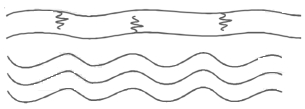
(N/A) Polythene is a polymer formed by the polymerization of ethene. It consists of linear or slightly branched long-chain molecules.
These are thermoplastic polymers,meaning they soften on heating and harden on cooling.
There are two main types of polythene:
$(a)$ Low Density Polythene $(LDP)$:
Preparation: It is obtained by the polymerization of ethene under high pressure of $1000$ to $2000 \ atm$ at a temperature of $350 \ K$ to $570 \ K$ in the presence of traces of dioxygen or a peroxide initiator.
Properties: $LDP$ has a branched-chain structure. It is chemically inert,tough,flexible,and a poor conductor of electricity.
Uses: Used in the insulation of electricity-carrying wires,squeeze bottles,toys,and flexible pipes.
$(b)$ High Density Polythene $(HDP)$:
Preparation: It is formed by the addition polymerization of ethene in a hydrocarbon solvent in the presence of a Ziegler-Natta catalyst (triethylaluminium and titanium tetrachloride) at $333 \ K$ to $343 \ K$ and a pressure of $6-7 \ atm$.
Properties: $HDP$ consists of linear molecules,leading to close packing and high density. It is chemically inert,tougher,and harder than $LDP$.
Uses: Used for manufacturing buckets,dustbins,bottles,and pipes.
These are thermoplastic polymers,meaning they soften on heating and harden on cooling.
There are two main types of polythene:
$(a)$ Low Density Polythene $(LDP)$:
Preparation: It is obtained by the polymerization of ethene under high pressure of $1000$ to $2000 \ atm$ at a temperature of $350 \ K$ to $570 \ K$ in the presence of traces of dioxygen or a peroxide initiator.
Properties: $LDP$ has a branched-chain structure. It is chemically inert,tough,flexible,and a poor conductor of electricity.
Uses: Used in the insulation of electricity-carrying wires,squeeze bottles,toys,and flexible pipes.
$(b)$ High Density Polythene $(HDP)$:
Preparation: It is formed by the addition polymerization of ethene in a hydrocarbon solvent in the presence of a Ziegler-Natta catalyst (triethylaluminium and titanium tetrachloride) at $333 \ K$ to $343 \ K$ and a pressure of $6-7 \ atm$.
Properties: $HDP$ consists of linear molecules,leading to close packing and high density. It is chemically inert,tougher,and harder than $LDP$.
Uses: Used for manufacturing buckets,dustbins,bottles,and pipes.
0 likes
View Solution297
Advanced
Write down the preparation,properties and uses of Polytetrafluoroethene (Teflon).
Solution
(N/A) Preparation: Polytetrafluoroethene (Teflon) is manufactured by heating tetrafluoroethene with a free radical or persulphate catalyst at high pressures.
The chemical reaction is: $n CF_2=CF_2 \xrightarrow[\text{High Pressure}]{\text{Catalyst}} -(CF_2-CF_2)-_n$
Properties:
$1$. It is chemically inert and resistant to attack by corrosive reagents.
$2$. It has a high melting point and is tough.
$3$. It is non-stick and has low coefficient of friction.
Uses:
$1$. It is used in making oil seals and gaskets.
$2$. It is used for non-stick surface coating of cooking utensils.
The chemical reaction is: $n CF_2=CF_2 \xrightarrow[\text{High Pressure}]{\text{Catalyst}} -(CF_2-CF_2)-_n$
Properties:
$1$. It is chemically inert and resistant to attack by corrosive reagents.
$2$. It has a high melting point and is tough.
$3$. It is non-stick and has low coefficient of friction.
Uses:
$1$. It is used in making oil seals and gaskets.
$2$. It is used for non-stick surface coating of cooking utensils.
0 likes
View Solution298
Difficult
Explain the preparation of polyacrylonitrile and also write down its uses.
Solution
(N/A) Preparation: The addition polymerization of acrylonitrile $(CH_2=CHCN)$ in the presence of a peroxide catalyst leads to the formation of polyacrylonitrile. The reaction is as follows:
$nCH_2=CHCN \xrightarrow{\text{Polymerization, Peroxide catalyst}} [CH_2-CH(CN)]_n$
Uses: Polyacrylonitrile is used as a substitute for wool in making commercial fibres such as orlon or acrilan.
$nCH_2=CHCN \xrightarrow{\text{Polymerization, Peroxide catalyst}} [CH_2-CH(CN)]_n$
Uses: Polyacrylonitrile is used as a substitute for wool in making commercial fibres such as orlon or acrilan.
0 likes
View Solution299
MediumMCQ
Which of the following statements correctly describes the condensation polymers of the polyamide category?
A
They are formed by the addition polymerization of alkenes.
B
They contain amide linkages and are commonly known as nylons.
C
They are exclusively natural polymers found in proteins.
D
They are formed by the polymerization of monomers containing only hydroxyl groups.
Solution
(B) Polyamides are polymers that possess amide linkages $(-CONH-)$ in their backbone.
They are important examples of synthetic fibres and are commonly termed as nylons.
The general method of preparation involves the condensation polymerization of diamines with dicarboxylic acids or the condensation of amino acids or their lactams.
Examples include: $(i)$ $Nylon-6,6$ and $(ii)$ $Nylon-6$.
They are important examples of synthetic fibres and are commonly termed as nylons.
The general method of preparation involves the condensation polymerization of diamines with dicarboxylic acids or the condensation of amino acids or their lactams.
Examples include: $(i)$ $Nylon-6,6$ and $(ii)$ $Nylon-6$.
0 likes
View SolutionPolymers — Composition, Properties and Uses of Polymer · Frequently Asked Questions
1Are these Polymers questions useful for JEE and NEET?
Yes. All questions in this section are mapped to JEE Main and NEET exam patterns. Previous year questions from JEE Main, NEET, GUJCET and state-level exams are included with full solutions.
2Can I switch to Hindi or Gujarati for these questions?
Yes. Use the language tabs in the hero section or the sidebar to view the same questions and solutions in English, Hindi or Gujarati.
3How do I generate a question paper from this subtopic?
Use the Vedclass Exam Paper Generator — select the chapter and subtopic, set difficulty, and generate Sets A, B, C, D automatically. First 3 chapters of every subject are free.
Vedclass Products
For Students
Vedclass Test Series
Mock tests in real JEE/NEET style with performance analysis. 5-day free trial.
Start Free TrialFor Teachers
Exam Paper Generator
Generate Set A/B/C/D papers from this chapter in 2 minutes. 3 chapters free.
Try FreeFor Institutes
Online Exam Module
Live online exams with unlimited students, 360° analytics & white-label branding.
See DemoFor Teachers & Institutes
Generate a Polymers Exam Paper in 2 Minutes
Select subtopic & difficulty — Sets A, B, C, D auto-generated with No Repeat logic.
First 3 chapters of every subject are free — no payment required.