
A English
Composition, Properties and Uses of Polymer Questions in English
Class 12 Chemistry · Polymers · Composition, Properties and Uses of Polymer
556+
Questions
English
Language
100%
With Solutions
Showing 50 of 556 questions in English
301
Difficult
Write a short note on: Nylon-$6,6$.
Solution
(N/A) Preparation: It is prepared by the condensation polymerization of hexamethylenediamine with adipic acid under high pressure and at high temperature $(553 \ K)$.
Chemical Reaction:
$nHOOC(CH_2)_4COOH + nH_2N(CH_2)_6NH_2$ $\xrightarrow{553 \ K, \text{high pressure}} [-NH(CH_2)_6NHCO(CH_2)_4CO-]_n + 2nH_2O$
Properties:
$1$. Nylon-$6,6$ is a fibre-forming solid.
$2$. It possesses high tensile strength due to strong intermolecular forces like hydrogen bonding.
$3$. These strong forces lead to close packing of chains,imparting a crystalline nature.
Uses:
It is used in making sheets,bristles for brushes,and in the textile industry.
Chemical Reaction:
$nHOOC(CH_2)_4COOH + nH_2N(CH_2)_6NH_2$ $\xrightarrow{553 \ K, \text{high pressure}} [-NH(CH_2)_6NHCO(CH_2)_4CO-]_n + 2nH_2O$
Properties:
$1$. Nylon-$6,6$ is a fibre-forming solid.
$2$. It possesses high tensile strength due to strong intermolecular forces like hydrogen bonding.
$3$. These strong forces lead to close packing of chains,imparting a crystalline nature.
Uses:
It is used in making sheets,bristles for brushes,and in the textile industry.
0 likes
View Solution302
Medium
Explain the preparation of Nylon-$6$ and also write its uses.
Solution
(N/A) Preparation: Nylon-$6$ is obtained by heating caprolactam with water at a high temperature $(533-543 \ K)$.
Chemical Reaction:
Caprolactam $\xrightarrow{533-543 \ K, H_2O}$ Nylon-$6$
Uses: Nylon-$6$ is used for the manufacture of tyre cords,fabrics,and ropes.
Chemical Reaction:
Caprolactam $\xrightarrow{533-543 \ K, H_2O}$ Nylon-$6$
Uses: Nylon-$6$ is used for the manufacture of tyre cords,fabrics,and ropes.
0 likes
View Solution303
Difficult
Write down the name of a well-known polymer of the polyester category and explain its preparation and uses.
Solution
(N/A) Dacron or Terylene are well-known examples of polyesters.
These are polycondensation products of dicarboxylic acids and diols.
Preparation of Terylene or Dacron:
It is manufactured by heating a mixture of ethylene glycol and terephthalic acid at $420 \ K$ to $460 \ K$ in the presence of a zinc acetate-antimony trioxide catalyst through condensation polymerization.
The chemical reaction is as follows:
$n(HO-CH_2-CH_2-OH) + n(HOOC-C_6H_4-COOH) \xrightarrow{\Delta, \text{catalyst}} [-O-CH_2-CH_2-O-CO-C_6H_4-CO-]_n + 2nH_2O$
Properties:
Dacron fibre (Terylene) is crease-resistant and is used in blending with cotton and wool fibres.
Uses:
It is used in the manufacture of wash-and-wear garments,as glass-reinforcing materials in safety helmets,and in industrial applications like conveyor belts.
These are polycondensation products of dicarboxylic acids and diols.
Preparation of Terylene or Dacron:
It is manufactured by heating a mixture of ethylene glycol and terephthalic acid at $420 \ K$ to $460 \ K$ in the presence of a zinc acetate-antimony trioxide catalyst through condensation polymerization.
The chemical reaction is as follows:
$n(HO-CH_2-CH_2-OH) + n(HOOC-C_6H_4-COOH) \xrightarrow{\Delta, \text{catalyst}} [-O-CH_2-CH_2-O-CO-C_6H_4-CO-]_n + 2nH_2O$
Properties:
Dacron fibre (Terylene) is crease-resistant and is used in blending with cotton and wool fibres.
Uses:
It is used in the manufacture of wash-and-wear garments,as glass-reinforcing materials in safety helmets,and in industrial applications like conveyor belts.
0 likes
View Solution304
Advanced
What is a phenol-formaldehyde polymer? Write down one polymer name of this category and also explain its preparation,properties,and uses.
Solution
(N/A) Phenol-formaldehyde polymers are the oldest synthetic polymers. These are obtained by the condensation reaction of phenol with formaldehyde in the presence of either an acid or a base catalyst.
One common polymer in this category is $Bakelite$.
$Preparation$:
The reaction starts with the initial formation of $o-$ and/or $p-$hydroxymethylphenol derivatives,which further react with phenol to form compounds having rings joined to each other through $-CH_2-$ groups. The initial product could be a linear product called $Novolac$,which is used in paints. On further heating with formaldehyde,$Novolac$ forms a cross-linked fusible product known as $Bakelite$.
$Properties$:
$Bakelite$ is a thermosetting polymer. It is hard,rigid,and has high thermal stability and electrical insulation properties.
$Uses$:
It is used for making electrical switches,handles of various utensils,computer discs,and phonograph records.
One common polymer in this category is $Bakelite$.
$Preparation$:
The reaction starts with the initial formation of $o-$ and/or $p-$hydroxymethylphenol derivatives,which further react with phenol to form compounds having rings joined to each other through $-CH_2-$ groups. The initial product could be a linear product called $Novolac$,which is used in paints. On further heating with formaldehyde,$Novolac$ forms a cross-linked fusible product known as $Bakelite$.
$Properties$:
$Bakelite$ is a thermosetting polymer. It is hard,rigid,and has high thermal stability and electrical insulation properties.
$Uses$:
It is used for making electrical switches,handles of various utensils,computer discs,and phonograph records.
0 likes
View Solution305
Difficult
Write a short note on the melamine-formaldehyde polymer.
Solution
(N/A) Melamine-formaldehyde polymer is formed by the condensation polymerization of melamine and formaldehyde.
The reaction involves the formation of a resin intermediate,which then undergoes further condensation polymerization to form the final polymer.
It is used in the manufacture of unbreakable crockery.
The reaction involves the formation of a resin intermediate,which then undergoes further condensation polymerization to form the final polymer.
It is used in the manufacture of unbreakable crockery.
0 likes
View Solution306
Difficult
What is copolymerization? Explain its preparation,properties and uses with an example.
Solution
(N/A) Copolymerization is a polymerization reaction in which a mixture of more than one monomeric species is allowed to polymerize and form a copolymer.
The copolymer can be made not only by chain growth polymerization but by step growth polymerization also.
It contains multiple units of each monomer used in the same polymeric chain.
For example,a mixture of $1,3$-butadiene and styrene can form a copolymer as shown below:
$nCH_2=CH-CH=CH_2 + nC_6H_5CH=CH_2 \rightarrow -[CH_2-CH=CH-CH_2-CH(C_6H_5)-CH_2]_n-$
Copolymers have properties quite different from homopolymers.
For example,butadiene-styrene copolymer is quite tough and is a good substitute for natural rubber.
It is used for the manufacture of autotyres,floor tiles,footwear components,cable insulation,etc.
The copolymer can be made not only by chain growth polymerization but by step growth polymerization also.
It contains multiple units of each monomer used in the same polymeric chain.
For example,a mixture of $1,3$-butadiene and styrene can form a copolymer as shown below:
$nCH_2=CH-CH=CH_2 + nC_6H_5CH=CH_2 \rightarrow -[CH_2-CH=CH-CH_2-CH(C_6H_5)-CH_2]_n-$
Copolymers have properties quite different from homopolymers.
For example,butadiene-styrene copolymer is quite tough and is a good substitute for natural rubber.
It is used for the manufacture of autotyres,floor tiles,footwear components,cable insulation,etc.
0 likes
View Solution307
Difficult
Write a short note on: Natural rubber.
Solution
(N/A) Rubber is a natural polymer and possesses elastic properties.
It is also termed as an elastomeric polymer. In elastomeric polymers,the polymer chains are held together by weak intermolecular forces. These weak binding forces permit the polymer to be stretched.
$A$ few 'crosslinks' are introduced in between the chains,which help the polymer to retract to its original position after the force is released.
Rubber has a variety of uses. It is manufactured from rubber latex,which is a colloidal dispersion of rubber in water.
This latex is obtained from the rubber tree,which is found in India,Sri Lanka,Indonesia,Malaysia,and South America.
Natural rubber may be considered as a linear polymer of isoprene ($2$-methyl-$1,3$-butadiene) and is also called $cis$-$1,4$-polyisoprene.
The $cis$-polyisoprene molecule consists of various chains held together by weak van der Waals interactions and has a coiled structure.
Thus,it can be stretched like a spring and exhibits elastic properties.
The chemical structure is as follows:
Isoprene: $CH_2=C(CH_3)-CH=CH_2$
Natural rubber: $-(CH_2-C(CH_3)=CH-CH_2)_n-$
It is also termed as an elastomeric polymer. In elastomeric polymers,the polymer chains are held together by weak intermolecular forces. These weak binding forces permit the polymer to be stretched.
$A$ few 'crosslinks' are introduced in between the chains,which help the polymer to retract to its original position after the force is released.
Rubber has a variety of uses. It is manufactured from rubber latex,which is a colloidal dispersion of rubber in water.
This latex is obtained from the rubber tree,which is found in India,Sri Lanka,Indonesia,Malaysia,and South America.
Natural rubber may be considered as a linear polymer of isoprene ($2$-methyl-$1,3$-butadiene) and is also called $cis$-$1,4$-polyisoprene.
The $cis$-polyisoprene molecule consists of various chains held together by weak van der Waals interactions and has a coiled structure.
Thus,it can be stretched like a spring and exhibits elastic properties.
The chemical structure is as follows:
Isoprene: $CH_2=C(CH_3)-CH=CH_2$
Natural rubber: $-(CH_2-C(CH_3)=CH-CH_2)_n-$
0 likes
View Solution308
Difficult
Explain the process of vulcanization of rubber.
Solution
(N/A) Natural rubber becomes soft at high temperatures $( >335 \ K)$ and brittle at low temperatures $( < 283 \ K)$ and shows high water absorption capacity. It is soluble in non-polar solvents and is non-resistant to attack by oxidizing agents.
To improve upon these physical properties,a process of vulcanization is carried out. This process consists of heating a mixture of raw rubber with sulphur and an appropriate additive at a temperature range between $373 \ K$ to $415 \ K$. On vulcanization,sulphur forms cross-links at the reactive sites of double bonds and thus the rubber gets stiffened.
In the manufacture of tyre rubber,$5 \%$ of sulphur is used as a cross-linking agent. The probable structures of vulcanized rubber molecules are shown below:
(Structure Image: $939-$s48)
To improve upon these physical properties,a process of vulcanization is carried out. This process consists of heating a mixture of raw rubber with sulphur and an appropriate additive at a temperature range between $373 \ K$ to $415 \ K$. On vulcanization,sulphur forms cross-links at the reactive sites of double bonds and thus the rubber gets stiffened.
In the manufacture of tyre rubber,$5 \%$ of sulphur is used as a cross-linking agent. The probable structures of vulcanized rubber molecules are shown below:
(Structure Image: $939-$s48)
0 likes
View Solution309
Difficult
Write down the preparation,properties,and uses of Neoprene.
Solution
(N/A) Preparation: Neoprene (polychloroprene) is formed by the free radical polymerization of chloroprene ($2$-chloro$-1,3-$butadiene).
Reaction: $nCH_2=C(Cl)-CH=CH_2 \xrightarrow{\text{Polymerization}} [-CH_2-C(Cl)=CH-CH_2-]_n$
Properties: It has superior resistance to vegetable and mineral oils.
Uses: It is used for manufacturing conveyor belts,gaskets,and hoses.
Reaction: $nCH_2=C(Cl)-CH=CH_2 \xrightarrow{\text{Polymerization}} [-CH_2-C(Cl)=CH-CH_2-]_n$
Properties: It has superior resistance to vegetable and mineral oils.
Uses: It is used for manufacturing conveyor belts,gaskets,and hoses.
0 likes
View Solution310
Medium
What is collodion?
Solution
(N/A) $4 \%$ solution of nitrocellulose in a mixture of alcohol and ether is called collodion.
0 likes
View Solution311
Medium
Write down the preparation and use of Buna-$N$.
Solution
(N/A) Preparation: Buna-$N$ is obtained by the copolymerization of $1,3-$butadiene and acrylonitrile in the presence of a peroxide catalyst.
The reaction is as follows:
$nCH_2=CH-CH=CH_2 + nCH_2=CH(CN) \xrightarrow{\text{Copolymerization}} [-CH_2-CH=CH-CH_2-CH_2-CH(CN)-]_n$
Uses: It is resistant to the action of petrol,lubricating oil,and organic solvents and is used in making oil seals,tank lining,etc.
The reaction is as follows:
$nCH_2=CH-CH=CH_2 + nCH_2=CH(CN) \xrightarrow{\text{Copolymerization}} [-CH_2-CH=CH-CH_2-CH_2-CH(CN)-]_n$
Uses: It is resistant to the action of petrol,lubricating oil,and organic solvents and is used in making oil seals,tank lining,etc.
0 likes
View Solution312
Medium
Give reason: Why is the molecular mass of a polymer always expressed as an average?
Solution
(N/A) The properties of polymers are closely related to their molecular mass,size,and structure.
During the synthesis of polymers,the growth of the polymer chain depends on the availability of monomers in the reaction mixture.
As a result,a polymer sample contains chains of varying lengths,meaning the molecules are not uniform in size.
Therefore,the molecular mass of a polymer is always expressed as an average value,such as the number-average molecular mass $(M_n)$ or weight-average molecular mass $(M_w)$.
During the synthesis of polymers,the growth of the polymer chain depends on the availability of monomers in the reaction mixture.
As a result,a polymer sample contains chains of varying lengths,meaning the molecules are not uniform in size.
Therefore,the molecular mass of a polymer is always expressed as an average value,such as the number-average molecular mass $(M_n)$ or weight-average molecular mass $(M_w)$.
0 likes
View Solution313
MediumMCQ
Why have biodegradable synthetic polymers been designed and developed?
A
To increase the durability of plastic products.
B
To reduce the accumulation of non-biodegradable polymeric solid waste in the environment.
C
To make polymers cheaper to produce.
D
To improve the mechanical strength of synthetic fibers.
Solution
(B) large number of synthetic polymers are highly resistant to environmental degradation processes,leading to the accumulation of persistent polymeric solid waste.
These wastes cause severe environmental pollution and remain undegraded for very long periods.
To address the growing concern regarding the environmental impact of these non-biodegradable wastes,scientists have designed and developed new biodegradable synthetic polymers that can be broken down by microorganisms.
These wastes cause severe environmental pollution and remain undegraded for very long periods.
To address the growing concern regarding the environmental impact of these non-biodegradable wastes,scientists have designed and developed new biodegradable synthetic polymers that can be broken down by microorganisms.
0 likes
View Solution314
Difficult
Write the full form of $PHBV$. Also,write down its preparation and uses.
Solution
(N/A) The full form of $PHBV$ is poly $\beta$-hydroxybutyrate-co-$\beta$-hydroxyvalerate $(PHBV)$.
Preparation: It is obtained by the copolymerization of $3$-hydroxybutanoic acid and $3$-hydroxypentanoic acid.
The reaction is as follows:
$n CH_3-CH(OH)-CH_2-COOH + n CH_3-CH_2-CH(OH)-CH_2-COOH$ $\rightarrow -[O-CH(CH_3)-CH_2-CO-O-CH(CH_2CH_3)-CH_2-CO]_n- + 2n H_2O$
Uses: $PHBV$ is used in speciality packaging,orthopaedic devices,and in the controlled release of drugs.
$PHBV$ undergoes bacterial degradation in the environment.
Preparation: It is obtained by the copolymerization of $3$-hydroxybutanoic acid and $3$-hydroxypentanoic acid.
The reaction is as follows:
$n CH_3-CH(OH)-CH_2-COOH + n CH_3-CH_2-CH(OH)-CH_2-COOH$ $\rightarrow -[O-CH(CH_3)-CH_2-CO-O-CH(CH_2CH_3)-CH_2-CO]_n- + 2n H_2O$
Uses: $PHBV$ is used in speciality packaging,orthopaedic devices,and in the controlled release of drugs.
$PHBV$ undergoes bacterial degradation in the environment.
0 likes
View Solution315
Difficult
Write down the name of monomers,structure of polymer and uses for the following polymers.
Solution
(N/A) The details for the requested polymers are provided in the table below:
| Name of Polymer | Monomer | Structure | Uses |
| :--- | :--- | :--- | :--- |
| Polypropene | Propene | $(-CH_2-CH(CH_3)-)_n$ | Manufacture of ropes,toys,pipes,fibres,etc. |
| Polystyrene | Styrene | $(-CH_2-CH(C_6H_5)-)_n$ | As insulator,wrapping material,manufacture of toys,radio and television cabinets. |
| Polyvinyl chloride $(PVC)$ | Vinyl chloride | $(-CH_2-CH(Cl)-)_n$ | Manufacture of rain coats,hand bags,vinyl flooring,water pipes. |
| Urea-formaldehyde Resin | Urea,Formaldehyde | $(-NH-CO-NH-CH_2-)_n$ | For making unbreakable cups and laminated sheets. |
| Glyptal | Ethylene glycol,Phthalic acid | $(-OCH_2-CH_2OOC-C_6H_4-CO-)_n$ | Manufacture of paints and lacquers. |
| Bakelite | Phenol,Formaldehyde | $(-C_6H_3(OH)-CH_2-)_n$ | For making combs,electrical switches,handles of utensils and computer discs. |
| Name of Polymer | Monomer | Structure | Uses |
| :--- | :--- | :--- | :--- |
| Polypropene | Propene | $(-CH_2-CH(CH_3)-)_n$ | Manufacture of ropes,toys,pipes,fibres,etc. |
| Polystyrene | Styrene | $(-CH_2-CH(C_6H_5)-)_n$ | As insulator,wrapping material,manufacture of toys,radio and television cabinets. |
| Polyvinyl chloride $(PVC)$ | Vinyl chloride | $(-CH_2-CH(Cl)-)_n$ | Manufacture of rain coats,hand bags,vinyl flooring,water pipes. |
| Urea-formaldehyde Resin | Urea,Formaldehyde | $(-NH-CO-NH-CH_2-)_n$ | For making unbreakable cups and laminated sheets. |
| Glyptal | Ethylene glycol,Phthalic acid | $(-OCH_2-CH_2OOC-C_6H_4-CO-)_n$ | Manufacture of paints and lacquers. |
| Bakelite | Phenol,Formaldehyde | $(-C_6H_3(OH)-CH_2-)_n$ | For making combs,electrical switches,handles of utensils and computer discs. |
0 likes
View Solution316
Medium
$A$ natural linear polymer of $2-$methyl$-1,3-$butadiene becomes hard on treatment with sulphur between $373 \ K$ to $415 \ K$ and $-S-S-$ bonds are formed between chains. Write the structure of the product of this treatment.
Solution
(N/A) This process is known as vulcanization of rubber and the product is known as vulcanized rubber. In this process,sulphur forms cross-links at the reactive sites of double bonds in the polymer chains,making the rubber harder and more durable. The structure of vulcanized rubber is represented as follows:
$\sim CH_2-C(CH_3)-CH-CH_2 \sim$
$| \quad \quad \quad |$
$S \quad \quad \quad S$
$| \quad \quad \quad |$
$\sim CH_2-C(CH_3)-CH-CH_2 \sim$
$\sim CH_2-C(CH_3)-CH-CH_2 \sim$
$| \quad \quad \quad |$
$S \quad \quad \quad S$
$| \quad \quad \quad |$
$\sim CH_2-C(CH_3)-CH-CH_2 \sim$
0 likes
View Solution317
Medium
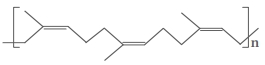
Identify the polymer given below:
Solution
(N/A) The polymer shown in the image is $cis-polyisoprene$,which is commonly known as natural rubber.
It is formed by the $1,4$-polymerization of $2-methylbuta-1,3-diene$ (isoprene) units.
The stereochemistry of the double bonds in natural rubber is exclusively $cis$.
It is formed by the $1,4$-polymerization of $2-methylbuta-1,3-diene$ (isoprene) units.
The stereochemistry of the double bonds in natural rubber is exclusively $cis$.
0 likes
View Solution318
Medium
Why are rubbers called elastomers?
Solution
(N/A) Rubbers are called elastomers because they possess weak intermolecular forces of attraction between the polymer chains. These weak forces allow the polymer to be stretched. Upon applying a force,they change their shape,and upon removal of the force,they regain their original shape due to the presence of cross-links between the chains.
0 likes
View Solution319
EasyMCQ
Why are cross-links introduced in rubber for practical applications?
A
To decrease the elasticity of rubber.
B
To increase the elasticity and strength of rubber.
C
To make rubber soluble in organic solvents.
D
To make rubber brittle.
Solution
(B) Natural rubber is soft and sticky at high temperatures and brittle at low temperatures.
To improve its physical properties,such as elasticity and strength,cross-links are introduced between the polymer chains through the process of vulcanization.
This makes the rubber more durable and suitable for practical applications.
To improve its physical properties,such as elasticity and strength,cross-links are introduced between the polymer chains through the process of vulcanization.
This makes the rubber more durable and suitable for practical applications.
0 likes
View Solution320
MediumMCQ
Why does $cis-polyisoprene$ possess elastic property?
A
Due to strong covalent bonding between chains.
B
Due to weak Van der Waals forces between polymer chains.
C
Due to the presence of cross-links between chains.
D
Due to high crystallinity.
Solution
(B) The elastic property of $cis-polyisoprene$ (natural rubber) is due to the presence of weak Van der Waals forces between its polymer chains.
These weak forces allow the polymer chains to slide over each other when stretched and return to their original position when the stretching force is removed,providing elasticity.
These weak forces allow the polymer chains to slide over each other when stretched and return to their original position when the stretching force is removed,providing elasticity.
0 likes
View Solution321
Medium
What is the structural difference between $HDP$ and $LDP$? How does the structure account for their different behavior,nature,and usage?
Solution
(N/A) $HDP$ (High Density Polyethylene) consists of linear molecules,which allow for close packing,resulting in high density and a translucent appearance.
$LDP$ (Low Density Polyethylene) has a highly branched structure,which prevents close packing,resulting in low density and a transparent appearance.
Due to these structural differences,$HDP$ is used for making buckets,dustbins,and pipes,while $LDP$ is used in the manufacture of squeeze bottles,toys,and flexible pipes.
$LDP$ (Low Density Polyethylene) has a highly branched structure,which prevents close packing,resulting in low density and a transparent appearance.
Due to these structural differences,$HDP$ is used for making buckets,dustbins,and pipes,while $LDP$ is used in the manufacture of squeeze bottles,toys,and flexible pipes.
0 likes
View Solution322
MediumMCQ
Which factor imparts crystalline nature to a polymer like nylon?
A
High molecular weight
B
Strong intermolecular hydrogen bonding
C
Presence of aromatic rings
D
Cross-linking between chains
Solution
(B) Nylon contains amide groups $( -CONH- )$ in its backbone,which facilitate strong intermolecular hydrogen bonding. This,combined with its linear structure,allows the polymer chains to pack closely together,resulting in a crystalline character.
0 likes
View Solution323
Medium
Name the polymer used in laminating sheets and give the name of monomeric units involved in its formation.
Solution
(N/A) The polymer used in laminating sheets is Urea-formaldehyde resin.
Its monomeric units are Urea $(NH_2CONH_2)$ and Formaldehyde $(HCHO)$.
The reaction is a condensation polymerization:
$nNH_2CONH_2 + nHCHO \rightarrow [-NH-CO-NH-CH_2-]_n + nH_2O$
Its monomeric units are Urea $(NH_2CONH_2)$ and Formaldehyde $(HCHO)$.
The reaction is a condensation polymerization:
$nNH_2CONH_2 + nHCHO \rightarrow [-NH-CO-NH-CH_2-]_n + nH_2O$
0 likes
View Solution324
Medium
Match the polymer of column-$I$ with correct monomer of column-$II$.
| column-$I$ | column-$II$ |
| $A$. High density polythene | $i$. Isoprene |
| $B$. Neoprene | $ii$. Tetrafluoroethene |
| $C$. Natural rubber | $iii$. Chloroprene |
| $D$. Teflon | $iv$. Acrylonitrile |
| $E$. Acrilan | $v$. Ethene |
Solution
(A-V, B-III, C-I, D-II, E-IV) The correct matches are as follows:
$A$. High density polythene is formed from $v$. Ethene.
$B$. Neoprene is formed from $iii$. Chloroprene.
$C$. Natural rubber is formed from $i$. Isoprene.
$D$. Teflon is formed from $ii$. Tetrafluoroethene.
$E$. Acrilan is formed from $iv$. Acrylonitrile.
Thus,the correct sequence is $A-v, B-iii, C-i, D-ii, E-iv$.
$A$. High density polythene is formed from $v$. Ethene.
$B$. Neoprene is formed from $iii$. Chloroprene.
$C$. Natural rubber is formed from $i$. Isoprene.
$D$. Teflon is formed from $ii$. Tetrafluoroethene.
$E$. Acrilan is formed from $iv$. Acrylonitrile.
Thus,the correct sequence is $A-v, B-iii, C-i, D-ii, E-iv$.
0 likes
View Solution325
Medium
Match the polymers given in column-$I$ with their chemical names given in column-$II$.
| Column-$I$ | Column-$II$ |
| $A$. Nylon-$6$ | $i$. Polycaprolactum |
| $B$. $PVC$ | $ii$. Polyvinyl chloride |
| $C$. Acrilan | $iii$. Polyacrylonitrile |
| $D$. Natural rubber | $iv$. cis-polyisoprene |
| $E$. $LDP$ | $v$. Low density polythene |
Solution
(A) The correct matches are:
$A-i$ (Nylon-$6$ is polycaprolactum)
$B-ii$ ($PVC$ is polyvinyl chloride)
$C-iii$ (Acrilan is polyacrylonitrile)
$D-iv$ (Natural rubber is cis-polyisoprene)
$E-v$ ($LDP$ is low density polythene)
Therefore,the correct sequence is $A-i, B-ii, C-iii, D-iv, E-v$.
$A-i$ (Nylon-$6$ is polycaprolactum)
$B-ii$ ($PVC$ is polyvinyl chloride)
$C-iii$ (Acrilan is polyacrylonitrile)
$D-iv$ (Natural rubber is cis-polyisoprene)
$E-v$ ($LDP$ is low density polythene)
Therefore,the correct sequence is $A-i, B-ii, C-iii, D-iv, E-v$.
0 likes
View Solution326
Medium
Match the polymers given in column $-I$ with their main applications given in column $-II$.
| Column $-I$ | Column $-II$ |
| $A$. Bakelite | $i$. Unbreakable crockery |
| $B$. Low density polythene | $ii$. Non-stick cookwares |
| $C$. Melamine-formaldehyde resin | $iii$. Packaging material for shock |
| $D$. Nylon $-6$ | $iv$. Electrical switches |
| $E$. Polytetrafluoroethene | $v$. Squeeze bottles |
| $F$. Polystyrene | $vi$. Tyre cords |
Solution
(A) The correct matches are:
$A$ (Bakelite) $\rightarrow$ $iv$ (Electrical switches)
$B$ (Low density polythene) $\rightarrow$ $v$ (Squeeze bottles)
$C$ (Melamine-formaldehyde resin) $\rightarrow$ $i$ (Unbreakable crockery)
$D$ (Nylon $-6$) $\rightarrow$ $vi$ (Tyre cords)
$E$ (Polytetrafluoroethene) $\rightarrow$ $ii$ (Non-stick cookwares)
$F$ (Polystyrene) $\rightarrow$ $iii$ (Packaging material for shock)
Thus,the correct sequence is: $A-iv, B-v, C-i, D-vi, E-ii, F-iii$.
$A$ (Bakelite) $\rightarrow$ $iv$ (Electrical switches)
$B$ (Low density polythene) $\rightarrow$ $v$ (Squeeze bottles)
$C$ (Melamine-formaldehyde resin) $\rightarrow$ $i$ (Unbreakable crockery)
$D$ (Nylon $-6$) $\rightarrow$ $vi$ (Tyre cords)
$E$ (Polytetrafluoroethene) $\rightarrow$ $ii$ (Non-stick cookwares)
$F$ (Polystyrene) $\rightarrow$ $iii$ (Packaging material for shock)
Thus,the correct sequence is: $A-iv, B-v, C-i, D-vi, E-ii, F-iii$.
0 likes
View Solution327
Medium
Match the polymers given in Column-$I$ with the type of linkage present in them given in Column-$II$.
| Column-$I$ | Column-$II$ |
| $A$. Terylene | $i$. Glycosidic linkage |
| $B$. Nylon | $ii$. Ester linkage |
| $C$. Cellulose | $iii$. Phosphodiester linkage |
| $D$. Protein | $iv$. Amide linkage |
| $E$. $RNA$ |
Solution
(A) (Terylene) contains ester linkages $(ii)$.
$B$ (Nylon) contains amide linkages $(iv)$.
$C$ (Cellulose) contains glycosidic linkages $(i)$.
$D$ (Protein) contains peptide linkages (a type of amide linkage,but in this context,it is distinct; however,based on the options provided,$D$ corresponds to amide linkage $iv$ if we consider the general structure,but typically $D$ is peptide. Given the options,$A-ii, B-iv, C-i, D-iv, E-iii$ is the mapping).
Correct matching: $A-ii, B-iv, C-i, D-iv, E-iii$.
$B$ (Nylon) contains amide linkages $(iv)$.
$C$ (Cellulose) contains glycosidic linkages $(i)$.
$D$ (Protein) contains peptide linkages (a type of amide linkage,but in this context,it is distinct; however,based on the options provided,$D$ corresponds to amide linkage $iv$ if we consider the general structure,but typically $D$ is peptide. Given the options,$A-ii, B-iv, C-i, D-iv, E-iii$ is the mapping).
Correct matching: $A-ii, B-iv, C-i, D-iv, E-iii$.
0 likes
View Solution328
MediumMCQ
Match the polymers given in Column-$I$ with their repeating units given in Column-$II$.
| Column-$I$ | Column-$II$ |
|---|---|
| $A$. Acrilan | $i$. $-[CH_2-CH(CN)]_n-$ |
| $B$. Polystyrene | $ii$. $-[CH_2-CH(C_6H_5)]_n-$ |
| $C$. Neoprene | $iii$. $-[CH_2-C(Cl)=CH-CH_2]_n-$ |
| $D$. Novolac | $iv$. $-[CH_2-CH=CH-CH_2-CH_2-CH(CN)]_n-$ |
| $E$. Buna-$N$ | $v$. Linear phenol-formaldehyde polymer |
A
$A-iv, B-ii, C-iii, D-v, E-i$
B
$A-i, B-ii, C-iii, D-v, E-iv$
C
$A-iv, B-ii, C-iii, D-v, E-i$
D
$A-iv, B-ii, C-iii, D-v, E-i$
Solution
(D) The correct matches are as follows:
$A$. Acrilan (Polyacrylonitrile) has the repeating unit $-[CH_2-CH(CN)]_n-$ $(iv)$.
$B$. Polystyrene is formed from styrene,so its repeating unit is $-[CH_2-CH(C_6H_5)]_n-$ $(ii)$.
$C$. Neoprene is polychloroprene,with the repeating unit $-[CH_2-C(Cl)=CH-CH_2]_n-$ $(iii)$.
$D$. Novolac is a linear polymer of phenol and formaldehyde $(v)$.
$E$. Buna-$N$ is a copolymer of $1,3$-butadiene and acrylonitrile,with the repeating unit $-[CH_2-CH=CH-CH_2-CH_2-CH(CN)]_n-$ $(i)$.
Therefore,the correct match is $A-iv, B-ii, C-iii, D-v, E-i$.
$A$. Acrilan (Polyacrylonitrile) has the repeating unit $-[CH_2-CH(CN)]_n-$ $(iv)$.
$B$. Polystyrene is formed from styrene,so its repeating unit is $-[CH_2-CH(C_6H_5)]_n-$ $(ii)$.
$C$. Neoprene is polychloroprene,with the repeating unit $-[CH_2-C(Cl)=CH-CH_2]_n-$ $(iii)$.
$D$. Novolac is a linear polymer of phenol and formaldehyde $(v)$.
$E$. Buna-$N$ is a copolymer of $1,3$-butadiene and acrylonitrile,with the repeating unit $-[CH_2-CH=CH-CH_2-CH_2-CH(CN)]_n-$ $(i)$.
Therefore,the correct match is $A-iv, B-ii, C-iii, D-v, E-i$.
0 likes
View Solution329
Difficult
Synthetic polymers do not degrade in the environment for a long time. How can biodegradable synthetic polymers be made? Differentiate between biopolymers and biodegradable polymers and give examples of each type.
Solution
(N/A) Synthetic polymers are resistant to environmental degradation,leading to the accumulation of solid waste.
Biodegradable synthetic polymers are designed by incorporating functional groups similar to those found in biopolymers,such as aliphatic polyesters (e.g.,$PHBV$).
Biopolymers are polymers produced by living organisms. They may or may not be biodegradable. For example,$Protein$ and $starch$ are biodegradable,whereas $Keratin$ is non-biodegradable.
Biodegradable polymers are specifically designed to be broken down by microorganisms into simpler,non-toxic substances in the environment. An example is $PHBV$ (poly-$\beta$-hydroxybutyrate-co-$\beta$-hydroxyvalerate).
Biodegradable synthetic polymers are designed by incorporating functional groups similar to those found in biopolymers,such as aliphatic polyesters (e.g.,$PHBV$).
Biopolymers are polymers produced by living organisms. They may or may not be biodegradable. For example,$Protein$ and $starch$ are biodegradable,whereas $Keratin$ is non-biodegradable.
Biodegradable polymers are specifically designed to be broken down by microorganisms into simpler,non-toxic substances in the environment. An example is $PHBV$ (poly-$\beta$-hydroxybutyrate-co-$\beta$-hydroxyvalerate).
0 likes
View Solution330
Advanced
Phenol and formaldehyde undergo condensation to give a polymer $(A)$ which on heating with formaldehyde gives a thermosetting polymer $(B)$. Name the polymers. Write the reactions involved in the formation of $(A)$. What is the structural difference between the two polymers?
Solution
(N/A) Phenol and formaldehyde undergo condensation to give a polymer $Novolac$ $(A)$,which on heating with formaldehyde gives $Bakelite$ $(B)$ as a thermosetting polymer.
$Novolac$ is a linear polymer,while $Bakelite$ is a cross-linked polymer.
The reactions involved in the formation of $Novolac$ are:
$1$. Phenol reacts with formaldehyde in the presence of an acid or base catalyst to form $o$-hydroxybenzyl alcohol and $p$-hydroxybenzyl alcohol derivatives.
$2$. These derivatives undergo condensation polymerization to form the linear polymer $Novolac$.
$Novolac$ is a linear polymer,while $Bakelite$ is a cross-linked polymer.
The reactions involved in the formation of $Novolac$ are:
$1$. Phenol reacts with formaldehyde in the presence of an acid or base catalyst to form $o$-hydroxybenzyl alcohol and $p$-hydroxybenzyl alcohol derivatives.
$2$. These derivatives undergo condensation polymerization to form the linear polymer $Novolac$.
0 likes
View Solution331
Difficult
Low density polythene and high density polythene,both are polymers of ethene but there is marked difference in their properties. Explain.
Solution
(N/A) Low density polythene $(LDPE)$ and high density polythene $(HDPE)$ are both polymers of ethene $(CH_2=CH_2)$,but they are synthesized under different conditions,leading to distinct structural features.
$LDPE$ is obtained by the polymerization of ethene under high pressure $(1000-2000 \ atm)$ and temperature $(350-570 \ K)$ in the presence of traces of dioxygen or a peroxide initiator. It has a highly branched structure,which results in low density and flexibility.
$HDPE$ is formed by the addition polymerization of ethene in the presence of a catalyst like triethylaluminium and titanium tetrachloride ($Ziegler-Natta$ catalyst) at low pressure $(6-7 \ atm)$ and temperature $(333-343 \ K)$. It consists of closely packed linear molecules,which results in high density and greater mechanical strength.
$LDPE$ is obtained by the polymerization of ethene under high pressure $(1000-2000 \ atm)$ and temperature $(350-570 \ K)$ in the presence of traces of dioxygen or a peroxide initiator. It has a highly branched structure,which results in low density and flexibility.
$HDPE$ is formed by the addition polymerization of ethene in the presence of a catalyst like triethylaluminium and titanium tetrachloride ($Ziegler-Natta$ catalyst) at low pressure $(6-7 \ atm)$ and temperature $(333-343 \ K)$. It consists of closely packed linear molecules,which results in high density and greater mechanical strength.
0 likes
View Solution332
MediumMCQ
The correct match between Item-$I$ and Item-$II$ :
| Item-$I$ | Item-$II$ |
|---|---|
| $a$. Natural rubber | $I$. $1,3-$butadiene $+$ styrene |
| $b$. Neoprene | $II$. $1,3-$butadiene $+$ acrylonitrile |
| $c$. Buna$-N$ | $III$. Chloroprene |
| $d$. Buna$-S$ | $IV$. Isoprene |
A
$a-III, b-IV, c-I, d-II$
B
$a-IV, b-III, c-II, d-I$
C
$a-IV, b-III, c-I, d-II$
D
$a-III, b-IV, c-II, d-I$
Solution
(B) The correct matches are as follows:
$a$. Natural rubber is a polymer of isoprene ($2-$methyl$-1,3-$butadiene). Thus,$a-IV$.
$b$. Neoprene is a polymer of chloroprene ($2-$chloro$-1,3-$butadiene). Thus,$b-III$.
$c$. Buna$-N$ is a copolymer of $1,3-$butadiene and acrylonitrile. Thus,$c-II$.
$d$. Buna$-S$ is a copolymer of $1,3-$butadiene and styrene. Thus,$d-I$.
Therefore,the correct sequence is $a-IV, b-III, c-II, d-I$.
$a$. Natural rubber is a polymer of isoprene ($2-$methyl$-1,3-$butadiene). Thus,$a-IV$.
$b$. Neoprene is a polymer of chloroprene ($2-$chloro$-1,3-$butadiene). Thus,$b-III$.
$c$. Buna$-N$ is a copolymer of $1,3-$butadiene and acrylonitrile. Thus,$c-II$.
$d$. Buna$-S$ is a copolymer of $1,3-$butadiene and styrene. Thus,$d-I$.
Therefore,the correct sequence is $a-IV, b-III, c-II, d-I$.
0 likes
View Solution333
MediumMCQ
Consider the Assertion and Reason given below.
Assertion $(A):$ Ethene polymerized in the presence of Ziegler-Natta catalyst at high temperature and pressure is used to make buckets and dustbins.
Reason $(R):$ High density polymers are closely packed and are chemically inert.
Choose the correct answer from the following:
Assertion $(A):$ Ethene polymerized in the presence of Ziegler-Natta catalyst at high temperature and pressure is used to make buckets and dustbins.
Reason $(R):$ High density polymers are closely packed and are chemically inert.
Choose the correct answer from the following:
A
$(A)$ is correct but $(R)$ is wrong.
B
$(A)$ and $(R)$ both are wrong.
C
Both $(A)$ and $(R)$ are correct and $(R)$ is the correct explanation of $(A).$
D
Both $(A)$ and $(R)$ are correct but $(R)$ is not the correct explanation of $(A).$
Solution
(C) The polymerization of ethene in the presence of a Ziegler-Natta catalyst (triethylaluminium and titanium tetrachloride) at low pressure and temperature produces High Density Polyethylene $(HDPE)$.
$HDPE$ consists of linear chains that are closely packed,resulting in high density and chemical inertness.
Due to these properties,$HDPE$ is used in the manufacture of buckets,dustbins,bottles,and pipes.
Therefore,both the Assertion $(A)$ and Reason $(R)$ are correct,and $(R)$ is the correct explanation of $(A).$
$HDPE$ consists of linear chains that are closely packed,resulting in high density and chemical inertness.
Due to these properties,$HDPE$ is used in the manufacture of buckets,dustbins,bottles,and pipes.
Therefore,both the Assertion $(A)$ and Reason $(R)$ are correct,and $(R)$ is the correct explanation of $(A).$
0 likes
View Solution334
MediumMCQ
Which of the following statements is correct about Bakelite?
A
It is a linear polymer
B
It is a cross-linked polymer
C
It is an addition polymer
D
It is a branched chain polymer
Solution
(B) Bakelite is a thermosetting polymer formed by the condensation reaction of phenol and formaldehyde. It possesses a highly cross-linked structure,which makes it hard and infusible.
0 likes
View Solution335
EasyMCQ
Match the following columns:
Correct set of answer:
| Polymer | Monomer |
|---|---|
| $i$. Buna-$S$ | $P$. Styrene |
| $ii$. Terylene | $Q$. Ethylene glycol |
| $iii$. Elastomer (Neoprene) | $R$. Chloroprene |
Correct set of answer:
A
$i-P, ii-Q, iii-R$
B
$i-R, ii-P, iii-Q$
C
$i-Q, ii-R, iii-P$
D
$i-P, ii-R, iii-Q$
Solution
(A) $i$. Buna-$S$ is a copolymer formed from $1,3$-butadiene and styrene $(P)$.
$ii$. Terylene (Dacron) is a polyester formed from ethylene glycol $(Q)$ and terephthalic acid.
$iii$. Neoprene is a type of elastomer formed from the monomer chloroprene $(R)$.
Therefore,the correct matching is $i-P, ii-Q, iii-R$.
$ii$. Terylene (Dacron) is a polyester formed from ethylene glycol $(Q)$ and terephthalic acid.
$iii$. Neoprene is a type of elastomer formed from the monomer chloroprene $(R)$.
Therefore,the correct matching is $i-P, ii-Q, iii-R$.
0 likes
View Solution336
MediumMCQ
Which of the following polymers is used in the manufacture of wood laminates?
A
cis-polyisoprene
B
Melamine formaldehyde resin
C
Urea-formaldehyde resin
D
Phenol-formaldehyde resin
Solution
(C) Urea-formaldehyde resin is widely used in the manufacture of wood laminates and adhesives for bonding wood.
0 likes
View Solution337
EasyMCQ
Match List-$I$ with List-$II$.
Choose the correct answer from the options given below:
| List-$I$ (Monomer Unit) | List-$II$ (Polymer) |
| $(a)$ Caprolactum | $(i)$ Natural rubber |
| $(b)$ $2-$Chloro$-1,3-$butadiene | $(ii)$ Buna$-N$ |
| $(c)$ Isoprene | $(iii)$ Nylon$-6$ |
| $(d)$ Acrylonitrile | $(iv)$ Neoprene |
Choose the correct answer from the options given below:
A
$(a)$ $\rightarrow (iv), (b)$ $\rightarrow (iii), (c)$ $\rightarrow (ii), (d)$ $\rightarrow (i)$
B
$(a)$ $\rightarrow (ii), (b)$ $\rightarrow (i), (c)$ $\rightarrow (iv), (d)$ $\rightarrow (iii)$
C
$(a)$ $\rightarrow (iii), (b)$ $\rightarrow (iv), (c)$ $\rightarrow (i), (d)$ $\rightarrow (ii)$
D
$(a)$ $\rightarrow (i), (b)$ $\rightarrow (ii), (c)$ $\rightarrow (iii), (d)$ $\rightarrow (iv)$
Solution
(C) Caprolactum is the monomeric unit of polymer Nylon$-6$.
$(b)$ $2-$Chloro$-1,3-$butadiene is the monomeric unit of polymer Neoprene.
$(c)$ Isoprene ($2-$methylbuta$-1,3-$diene) is the monomeric unit of Natural rubber.
$(d)$ Acrylonitrile $(CH_2=CH-CN)$ is one of the monomeric units of polymer Buna$-N$.
Therefore,the correct matching is: $(a)$ $\rightarrow (iii), (b)$ $\rightarrow (iv), (c)$ $\rightarrow (i), (d)$ $\rightarrow (ii)$.
$(b)$ $2-$Chloro$-1,3-$butadiene is the monomeric unit of polymer Neoprene.
$(c)$ Isoprene ($2-$methylbuta$-1,3-$diene) is the monomeric unit of Natural rubber.
$(d)$ Acrylonitrile $(CH_2=CH-CN)$ is one of the monomeric units of polymer Buna$-N$.
Therefore,the correct matching is: $(a)$ $\rightarrow (iii), (b)$ $\rightarrow (iv), (c)$ $\rightarrow (i), (d)$ $\rightarrow (ii)$.
0 likes
View Solution338
EasyMCQ
Which statement is correct?
A
Synthesis of $Buna-S$ needs nascent oxygen.
B
Neoprene is an addition copolymer used in plastic bucket manufacturing.
C
$Buna-S$ is a synthetic and linear thermosetting polymer.
D
$Buna-N$ is a natural polymer.
Solution
(A) The provided image shows the polymerization of $1,3-butadiene$ and styrene to form $Buna-S$ in the presence of nascent oxygen as an initiator.
$Buna-S$ is a synthetic elastomer (a type of rubber),not a thermosetting polymer.
$Neoprene$ is a homopolymer of $chloroprene$,not a copolymer.
$Buna-N$ is a synthetic copolymer,not a natural polymer.
Therefore,the statement that the synthesis of $Buna-S$ requires nascent oxygen is correct based on the provided reaction scheme.
$Buna-S$ is a synthetic elastomer (a type of rubber),not a thermosetting polymer.
$Neoprene$ is a homopolymer of $chloroprene$,not a copolymer.
$Buna-N$ is a synthetic copolymer,not a natural polymer.
Therefore,the statement that the synthesis of $Buna-S$ requires nascent oxygen is correct based on the provided reaction scheme.
0 likes
View Solution339
EasyMCQ
The structure of Neoprene is
A
$[-CH_2-C(Cl)=CH-CH_2-]_n$
B
$[-CH_2-C(CH_3)=CH-CH_2-]_n$
C
$[-CH_2-CH=CH-CH_2-]_n$
D
$[-CH_2-CH(CN)-]_n$
Solution
(A) Neoprene is a polymer of chloroprene ($2-$chloro$-1,3-$butadiene). Its structure is formed by the polymerization of the monomer $CH_2=C(Cl)-CH=CH_2$. The resulting polymer is $n[CH_2=C(Cl)-CH=CH_2] \rightarrow [-CH_2-C(Cl)=CH-CH_2-]_n$.
0 likes
View Solution340
EasyMCQ
In polymer Buna-$S$,'$S$' stands for :-
A
Sulphonation
B
Strength
C
Sulphur
D
Styrene
Solution
(D) Buna-$S$ is a copolymer formed by the polymerization of $1,3$-butadiene and styrene.
In the name Buna-$S$,'Bu' stands for $1,3$-butadiene,'na' stands for sodium (catalyst),and '$S$' stands for styrene.
In the name Buna-$S$,'Bu' stands for $1,3$-butadiene,'na' stands for sodium (catalyst),and '$S$' stands for styrene.
0 likes
View Solution341
DifficultMCQ
Monomer units of $Dacron$ polymer are :
A
ethylene glycol and phthalic acid
B
ethylene glycol and terephthalic acid
C
glycerol and terephthalic acid
D
glycerol and phthalic acid
Solution
(B) $Dacron$ (also known as $Terylene$) is a polyester polymer.
It is formed by the condensation polymerization of $Ethylene \ glycol$ $(HO-CH_2-CH_2-OH)$ and $Terephthalic \ acid$ $(HOOC-C_6H_4-COOH)$.
The reaction is as follows:
$n(HOOC-C_6H_4-COOH) + n(HO-CH_2-CH_2-OH) \rightarrow [-OC-C_6H_4-CO-O-CH_2-CH_2-O-]_n + 2n(H_2O)$
Thus,the correct option is $B$.
It is formed by the condensation polymerization of $Ethylene \ glycol$ $(HO-CH_2-CH_2-OH)$ and $Terephthalic \ acid$ $(HOOC-C_6H_4-COOH)$.
The reaction is as follows:
$n(HOOC-C_6H_4-COOH) + n(HO-CH_2-CH_2-OH) \rightarrow [-OC-C_6H_4-CO-O-CH_2-CH_2-O-]_n + 2n(H_2O)$
Thus,the correct option is $B$.
0 likes
View Solution342
MediumMCQ
Orlon fibres are made up of:
A
Polyacrylonitrile
B
Cellulose
C
Polyamide
D
Polyesters
Solution
(A) Orlon is a commercial name for polyacrylonitrile $(PAN)$.
It is prepared by the addition polymerization of acrylonitrile $(CH_2=CH-CN)$ in the presence of a peroxide catalyst.
The reaction is as follows:
$n(CH_2=CH-CN) \xrightarrow{\text{Polymerization}} [-CH_2-CH(CN)-]_n$
Thus,Orlon fibres are made up of polyacrylonitrile.
It is prepared by the addition polymerization of acrylonitrile $(CH_2=CH-CN)$ in the presence of a peroxide catalyst.
The reaction is as follows:
$n(CH_2=CH-CN) \xrightarrow{\text{Polymerization}} [-CH_2-CH(CN)-]_n$
Thus,Orlon fibres are made up of polyacrylonitrile.
0 likes
View Solution343
MediumMCQ
Bakelite is a cross-linked polymer of formaldehyde and :
A
Buna-$S$
B
Dacron
C
Phenol
D
$PHBV$
Solution
(C) Bakelite is a thermosetting polymer formed by the condensation polymerization of phenol and formaldehyde.
Initially,the reaction produces a linear polymer called Novolac.
Upon further heating with formaldehyde,Novolac undergoes cross-linking to form the infusible,hard,and cross-linked polymer known as Bakelite.
Initially,the reaction produces a linear polymer called Novolac.
Upon further heating with formaldehyde,Novolac undergoes cross-linking to form the infusible,hard,and cross-linked polymer known as Bakelite.
0 likes
View Solution344
DifficultMCQ
Match List-$I$ with List-$II$ :
| List-$I$ | List-$II$ |
| :--- | :--- |
| $(a)$ Chloroprene | $(i)$ $CH_2=C(CH_3)-CH=CH_2$ |
| $(b)$ Neoprene | (ii) $CH_2=C(Cl)-CH=CH_2$ |
| $(c)$ Acrylonitrile | (iii) $[-CH_2-C(Cl)=CH-CH_2-]_n$ |
| $(d)$ Isoprene | (iv) $CH_2=CH-CN$ |
Choose the correct answer from the options given below :
| List-$I$ | List-$II$ |
| :--- | :--- |
| $(a)$ Chloroprene | $(i)$ $CH_2=C(CH_3)-CH=CH_2$ |
| $(b)$ Neoprene | (ii) $CH_2=C(Cl)-CH=CH_2$ |
| $(c)$ Acrylonitrile | (iii) $[-CH_2-C(Cl)=CH-CH_2-]_n$ |
| $(d)$ Isoprene | (iv) $CH_2=CH-CN$ |
Choose the correct answer from the options given below :
A
$a-ii, b-iii, c-iv, d-i$
B
$a-ii, b-iii, c-i, d-iv$
C
$a-iii, b-iv, c-ii, d-i$
D
$a-iii, b-i, c-iv, d-ii$
Solution
(A) The correct matches are as follows:
$(a)$ Chloroprene is $CH_2=C(Cl)-CH=CH_2$,which corresponds to $(ii)$.
$(b)$ Neoprene is the polymer $[-CH_2-C(Cl)=CH-CH_2-]_n$,which corresponds to $(iii)$.
$(c)$ Acrylonitrile is $CH_2=CH-CN$,which corresponds to $(iv)$.
$(d)$ Isoprene is $CH_2=C(CH_3)-CH=CH_2$,which corresponds to $(i)$.
Therefore,the correct matching is $a-ii, b-iii, c-iv, d-i$.
$(a)$ Chloroprene is $CH_2=C(Cl)-CH=CH_2$,which corresponds to $(ii)$.
$(b)$ Neoprene is the polymer $[-CH_2-C(Cl)=CH-CH_2-]_n$,which corresponds to $(iii)$.
$(c)$ Acrylonitrile is $CH_2=CH-CN$,which corresponds to $(iv)$.
$(d)$ Isoprene is $CH_2=C(CH_3)-CH=CH_2$,which corresponds to $(i)$.
Therefore,the correct matching is $a-ii, b-iii, c-iv, d-i$.
0 likes
View Solution345
MediumMCQ
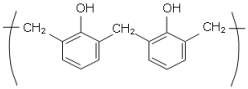
The structure shown is a repeating unit for:
A
Novolac
B
Acrilan
C
Buna-$N$
D
Neoprene
Solution
(A) Novolac is a linear polymer formed by the condensation reaction of phenol and formaldehyde in the presence of an acid catalyst.
The repeating unit consists of phenol rings linked by methylene $(-CH_2-)$ bridges at ortho or para positions,as shown in the structure.
The repeating unit consists of phenol rings linked by methylene $(-CH_2-)$ bridges at ortho or para positions,as shown in the structure.
0 likes
View Solution346
MediumMCQ
$A$ biodegradable polyamide can be made from:
A
Hexamethylene diamine and adipic acid
B
Styrene and caproic acid
C
Glycine and aminocaproic acid
D
Glycine and isoprene
Solution
(C) biodegradable polyamide,known as nylon-$2$-nylon-$6$,is a copolymer formed by the condensation polymerization of glycine $(NH_2CH_2COOH)$ and aminocaproic acid $(NH_2(CH_2)_5COOH)$.
0 likes
View Solution347
MediumMCQ
Match the polymer in Column-$I$ to the monomer from Column-$II$ and assign the correct code.
Code:
$(a) \quad (b) \quad (c) \quad (d)$
| Column-$I$ (Polymer) | Column-$II$ (Monomer) |
|---|---|
| $(a)$ Nylon-$6$ | $(i)$ Ethylene glycol,terephthalic acid |
| $(b)$ Dacron | $(ii)$ Urea,formaldehyde |
| $(c)$ Glyptal | $(iii)$ Ethylene glycol,phthalic acid |
| $(d)$ Novolac | $(iv)$ Phenol,formaldehyde |
| $ $ | $(v)$ Caprolactam |
Code:
$(a) \quad (b) \quad (c) \quad (d)$
A
$(v) \quad (i) \quad (iii) \quad (iv)$
B
$(iii) \quad (i) \quad (iv) \quad (ii)$
C
$(ii) \quad (i) \quad (iv) \quad (ii)$
D
$(v) \quad (iii) \quad (i) \quad (ii)$
Solution
(A) The correct matching is as follows:
$(a)$ Nylon-$6$ is formed from $(v)$ Caprolactam.
$(b)$ Dacron is formed from $(i)$ Ethylene glycol and terephthalic acid.
$(c)$ Glyptal is formed from $(iii)$ Ethylene glycol and phthalic acid.
$(d)$ Novolac is formed from $(iv)$ Phenol and formaldehyde.
Therefore,the correct sequence is $(a)-(v), (b)-(i), (c)-(iii), (d)-(iv)$.
$(a)$ Nylon-$6$ is formed from $(v)$ Caprolactam.
$(b)$ Dacron is formed from $(i)$ Ethylene glycol and terephthalic acid.
$(c)$ Glyptal is formed from $(iii)$ Ethylene glycol and phthalic acid.
$(d)$ Novolac is formed from $(iv)$ Phenol and formaldehyde.
Therefore,the correct sequence is $(a)-(v), (b)-(i), (c)-(iii), (d)-(iv)$.
0 likes
View Solution348
EasyMCQ
Which statement regarding polymers is not correct?
A
Fibers possess high tensile strength.
B
Thermoplastic polymers are capable of repeatedly softening and hardening on heating and cooling respectively.
C
Thermosetting polymers are reusable.
D
Elastomers have polymer chains held together by weak intermolecular forces.
Solution
(C) Thermosetting polymers are cross-linked polymers that undergo extensive cross-linking during molding,making them hard and infusible. Therefore,they cannot be reshaped or reused upon heating.
0 likes
View Solution349
EasyMCQ
Which of the following is an example of a polyester?
A
Butadiene-styrene copolymer
B
Melamine polymer
C
Neoprene
D
Poly-$ \beta $-hydroxybutyrate-co-$ \beta $-hydroxy valerate
Solution
(D) . Polyesters are polymers that contain the ester functional group in their main chain.
$PHBV$ (Poly-$ \beta $-hydroxybutyrate-co-$ \beta $-hydroxy valerate) is a biodegradable aliphatic polyester formed by the copolymerization of $3$-hydroxybutanoic acid and $3$-hydroxypentanoic acid.
$PHBV$ (Poly-$ \beta $-hydroxybutyrate-co-$ \beta $-hydroxy valerate) is a biodegradable aliphatic polyester formed by the copolymerization of $3$-hydroxybutanoic acid and $3$-hydroxypentanoic acid.
0 likes
View Solution350
MediumMCQ
The Novolac polymer has a mass of $963 \ g$. The number of monomer units present in it is $......$
A
$15$
B
$10$
C
$9$
D
$45$
Solution
(C) The monomer unit of Novolac is $o$-hydroxybenzyl alcohol (saligenin),which has the chemical formula $C_7H_8O_2$.
The molecular mass of the monomer unit is $(7 \times 12) + (8 \times 1) + (2 \times 16) = 84 + 8 + 32 = 124 \ g/mol$.
Novolac is formed by the condensation polymerization of phenol and formaldehyde,where water molecules are eliminated.
For a polymer chain consisting of $n$ monomer units,$(n-1)$ molecules of water are removed.
The mass of the polymer is given by: $Mass_{polymer} = (n \times Mass_{monomer}) - ((n-1) \times Mass_{water})$.
Substituting the given values: $963 = (n \times 124) - ((n-1) \times 18)$.
$963 = 124n - 18n + 18$.
$963 - 18 = 106n$.
$945 = 106n$.
$n = 945 / 106 \approx 8.91$.
Rounding to the nearest integer,the number of monomer units $n = 9$.
The molecular mass of the monomer unit is $(7 \times 12) + (8 \times 1) + (2 \times 16) = 84 + 8 + 32 = 124 \ g/mol$.
Novolac is formed by the condensation polymerization of phenol and formaldehyde,where water molecules are eliminated.
For a polymer chain consisting of $n$ monomer units,$(n-1)$ molecules of water are removed.
The mass of the polymer is given by: $Mass_{polymer} = (n \times Mass_{monomer}) - ((n-1) \times Mass_{water})$.
Substituting the given values: $963 = (n \times 124) - ((n-1) \times 18)$.
$963 = 124n - 18n + 18$.
$963 - 18 = 106n$.
$945 = 106n$.
$n = 945 / 106 \approx 8.91$.
Rounding to the nearest integer,the number of monomer units $n = 9$.
0 likes
View SolutionPolymers — Composition, Properties and Uses of Polymer · Frequently Asked Questions
1Are these Polymers questions useful for JEE and NEET?
Yes. All questions in this section are mapped to JEE Main and NEET exam patterns. Previous year questions from JEE Main, NEET, GUJCET and state-level exams are included with full solutions.
2Can I switch to Hindi or Gujarati for these questions?
Yes. Use the language tabs in the hero section or the sidebar to view the same questions and solutions in English, Hindi or Gujarati.
3How do I generate a question paper from this subtopic?
Use the Vedclass Exam Paper Generator — select the chapter and subtopic, set difficulty, and generate Sets A, B, C, D automatically. First 3 chapters of every subject are free.
Vedclass Products
For Students
Vedclass Test Series
Mock tests in real JEE/NEET style with performance analysis. 5-day free trial.
Start Free TrialFor Teachers
Exam Paper Generator
Generate Set A/B/C/D papers from this chapter in 2 minutes. 3 chapters free.
Try FreeFor Institutes
Online Exam Module
Live online exams with unlimited students, 360° analytics & white-label branding.
See DemoFor Teachers & Institutes
Generate a Polymers Exam Paper in 2 Minutes
Select subtopic & difficulty — Sets A, B, C, D auto-generated with No Repeat logic.
First 3 chapters of every subject are free — no payment required.