
A English
Mix Examples-Polymer Questions in English
Class 12 Chemistry · Polymers · Mix Examples-Polymer
19+
Questions
English
Language
100%
With Solutions
Showing 18 of 19 questions in English
1
MediumMCQ
Which of the following has cross-links?
A
Vulcanised rubber
B
Nylon
C
Phenol-formaldehyde resins
D
Both $(A)$ and $(C)$ are correct
Solution
(D) Vulcanised rubber contains sulphur cross-links between polymer chains,which makes the rubber stiff and durable.
Phenol-formaldehyde resins (like Bakelite) are thermosetting polymers that possess a three-dimensional cross-linked structure formed by heating novolac with formaldehyde.
Nylon is a linear thermoplastic polymer without cross-links.
Therefore,both $(A)$ and $(C)$ contain cross-links.
Phenol-formaldehyde resins (like Bakelite) are thermosetting polymers that possess a three-dimensional cross-linked structure formed by heating novolac with formaldehyde.
Nylon is a linear thermoplastic polymer without cross-links.
Therefore,both $(A)$ and $(C)$ contain cross-links.
0 likes
View Solution2
EasyMCQ
Which of the following statements is incorrect?
A
The monomer of $Nylon-6$ is caprolactam.
B
The monomer of natural rubber is isoprene.
C
Phenol-formaldehyde resin is known as Bakelite.
D
The monomer of $Nylon-6$ is Terylene.
Solution
(D) $1$. $Nylon-6$ is formed by the polymerization of caprolactam,so statement $A$ is correct.
$2$. Natural rubber is a polymer of isoprene $(2-methyl-1,3-butadiene)$,so statement $B$ is correct (Note: The original option $B$ mentioned butadiene,which is technically incorrect as natural rubber is polyisoprene,but statement $D$ is explicitly false as Terylene is a polyester,not a monomer of $Nylon-6$).
$3$. Phenol-formaldehyde resin is indeed known as Bakelite,so statement $C$ is correct.
$4$. $Nylon-6$ is a polyamide,while Terylene is a polyester. Thus,statement $D$ is incorrect.
$2$. Natural rubber is a polymer of isoprene $(2-methyl-1,3-butadiene)$,so statement $B$ is correct (Note: The original option $B$ mentioned butadiene,which is technically incorrect as natural rubber is polyisoprene,but statement $D$ is explicitly false as Terylene is a polyester,not a monomer of $Nylon-6$).
$3$. Phenol-formaldehyde resin is indeed known as Bakelite,so statement $C$ is correct.
$4$. $Nylon-6$ is a polyamide,while Terylene is a polyester. Thus,statement $D$ is incorrect.
0 likes
View Solution3
DifficultMCQ
The bond energy of $C=C$ and $C-C$ at $298 \ K$ are $590 \ kJ \ mol^{-1}$ and $331 \ kJ \ mol^{-1}$ respectively. The enthalpy of polymerisation per mole of ethylene is $..... \ kJ$.
A
$-70$
B
$-72$
C
$+72$
D
$-68$
Solution
(B) The polymerisation of ethene involves the breaking of one mole of $C=C$ bond and the formation of two moles of $C-C$ bonds per mole of ethylene monomer unit in the polymer chain.
$\Delta H = \text{Bond energy of reactants} - \text{Bond energy of products}$
$\Delta H = (1 \times \text{Bond energy of } C=C) - (2 \times \text{Bond energy of } C-C)$
$\Delta H = 590 - (2 \times 331)$
$\Delta H = 590 - 662 = -72 \ kJ \ mol^{-1}$.
$\Delta H = \text{Bond energy of reactants} - \text{Bond energy of products}$
$\Delta H = (1 \times \text{Bond energy of } C=C) - (2 \times \text{Bond energy of } C-C)$
$\Delta H = 590 - (2 \times 331)$
$\Delta H = 590 - 662 = -72 \ kJ \ mol^{-1}$.
0 likes
View Solution4
MediumMCQ
Match the following:
| Polymer | Type |
|---|---|
| $A$. Bakelite | $P$. Homo polymer |
| $B$. Nylon-$6$ | $Q$. Condensation polymer |
| $C$. Terylene | $R$. Polyester |
| $D$. $PHBV$ | $S$. Copolymer |
A
$A-(Q,S), B-(P), C-(Q,R,S), D-(Q,R,S)$
B
$A-(Q,R,S), B-(P,R), C-(P,Q,R,S), D-(Q,R)$
C
$A-(Q,S), B-(P,Q), C-(Q,R,S), D-(Q,R,S)$
D
$A-(Q,R,S), B-(P,Q), C-(Q,R,S), D-(Q,R,S)$
Solution
(A) . Bakelite is a cross-linked polymer formed by the condensation of phenol and formaldehyde,making it a condensation polymer $(Q)$ and a copolymer $(S)$.
$B$. Nylon-$6$ is formed by the ring-opening polymerization of caprolactam,making it a homo polymer $(P)$.
$C$. Terylene is a condensation polymer $(Q)$,a copolymer $(S)$,and a polyester $(R)$.
$D$. $PHBV$ (poly-$\beta$-hydroxybutyrate-co-$\beta$-hydroxyvalerate) is a condensation polymer $(Q)$,a copolymer $(S)$,and a polyester $(R)$.
Thus,the correct matching is $A-(Q,S), B-(P), C-(Q,R,S), D-(Q,R,S)$.
$B$. Nylon-$6$ is formed by the ring-opening polymerization of caprolactam,making it a homo polymer $(P)$.
$C$. Terylene is a condensation polymer $(Q)$,a copolymer $(S)$,and a polyester $(R)$.
$D$. $PHBV$ (poly-$\beta$-hydroxybutyrate-co-$\beta$-hydroxyvalerate) is a condensation polymer $(Q)$,a copolymer $(S)$,and a polyester $(R)$.
Thus,the correct matching is $A-(Q,S), B-(P), C-(Q,R,S), D-(Q,R,S)$.
0 likes
View Solution5
MediumMCQ
Which of the following statement$(s)$ is/are incorrect?
$(a)$ $PHBV$ and $Nylon-2-nylon-6$ are biodegradable polymers.
$(b)$ Bakelite is a polymer of urea and formaldehyde.
$(c)$ Novolac is a linear product of phenol and formaldehyde and is used in paints.
$(d)$ Terylene and $Nylon-6,6$ are examples of thermoplastic polymers.
$(e)$ Teflon is an addition polymer.
$(a)$ $PHBV$ and $Nylon-2-nylon-6$ are biodegradable polymers.
$(b)$ Bakelite is a polymer of urea and formaldehyde.
$(c)$ Novolac is a linear product of phenol and formaldehyde and is used in paints.
$(d)$ Terylene and $Nylon-6,6$ are examples of thermoplastic polymers.
$(e)$ Teflon is an addition polymer.
A
$a, c, d$
B
$b, c, e$
C
$c, d$
D
$b, d$
Solution
(D) $PHBV$ and $Nylon-2-nylon-6$ are biodegradable polymers. This statement is correct.
$(b)$ Bakelite is a polymer of phenol and formaldehyde,not urea and formaldehyde. This statement is incorrect.
$(c)$ Novolac is a linear product of phenol and formaldehyde used in paints. This statement is correct.
$(d)$ Terylene and $Nylon-6,6$ are condensation polymers (fibers),not thermoplastic polymers. This statement is incorrect.
$(e)$ Teflon is an addition polymer of tetrafluoroethene. This statement is correct.
Therefore,the incorrect statements are $(b)$ and $(d)$.
$(b)$ Bakelite is a polymer of phenol and formaldehyde,not urea and formaldehyde. This statement is incorrect.
$(c)$ Novolac is a linear product of phenol and formaldehyde used in paints. This statement is correct.
$(d)$ Terylene and $Nylon-6,6$ are condensation polymers (fibers),not thermoplastic polymers. This statement is incorrect.
$(e)$ Teflon is an addition polymer of tetrafluoroethene. This statement is correct.
Therefore,the incorrect statements are $(b)$ and $(d)$.
0 likes
View Solution6
MediumMCQ
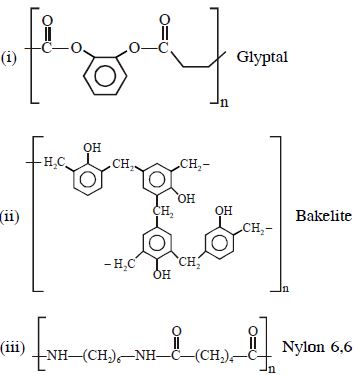
Which of the following is the correct formula for the given polymer?
A
$i, ii, iii$
B
$i, iii$
C
$ii, iii$
D
$i, ii$
Solution
(C) $1$. Glyptal is a polyester formed by the condensation of ethylene glycol and phthalic acid. The structure shown in $(i)$ is incorrect as it does not represent the repeating unit of Glyptal.
$2$. Bakelite is a cross-linked polymer formed by the condensation of phenol and formaldehyde. The structure shown in $(ii)$ correctly represents the cross-linked structure of Bakelite.
$3$. Nylon $6,6$ is a polyamide formed by the condensation of hexamethylenediamine and adipic acid. The structure shown in $(iii)$ correctly represents the repeating unit of Nylon $6,6$: $[-NH-(CH_2)_6-NH-CO-(CH_2)_4-CO-]_n$.
$4$. Therefore,both $(ii)$ and $(iii)$ are correct.
$2$. Bakelite is a cross-linked polymer formed by the condensation of phenol and formaldehyde. The structure shown in $(ii)$ correctly represents the cross-linked structure of Bakelite.
$3$. Nylon $6,6$ is a polyamide formed by the condensation of hexamethylenediamine and adipic acid. The structure shown in $(iii)$ correctly represents the repeating unit of Nylon $6,6$: $[-NH-(CH_2)_6-NH-CO-(CH_2)_4-CO-]_n$.
$4$. Therefore,both $(ii)$ and $(iii)$ are correct.
0 likes
View Solution7
DifficultMCQ
Polyethylene is prepared from calcium carbide as follows:
$CaC_2 + 2H_2O \to Ca(OH)_2 + C_2H_2$
$C_2H_2 + H_2 \to C_2H_4$
$nC_2H_4 \to (-CH_2-CH_2-)_n$
Calculate the amount of polyethylene produced from $64 \ kg$ of $CaC_2$. (in $kg$)
$CaC_2 + 2H_2O \to Ca(OH)_2 + C_2H_2$
$C_2H_2 + H_2 \to C_2H_4$
$nC_2H_4 \to (-CH_2-CH_2-)_n$
Calculate the amount of polyethylene produced from $64 \ kg$ of $CaC_2$. (in $kg$)
A
$7$
B
$14$
C
$21$
D
$28$
Solution
(D) Step $1$: Calculate the molar mass of $CaC_2$ $(40 + 2 \times 12 = 64 \ g/mol)$.
Step $2$: From the stoichiometry,$1 \ mol$ of $CaC_2$ produces $1 \ mol$ of $C_2H_2$,which produces $1 \ mol$ of $C_2H_4$.
Step $3$: $n \ mol$ of $C_2H_4$ produces $1 \ mol$ of polyethylene unit $(-CH_2-CH_2-)$ of molar mass $28 \ g/mol$.
Step $4$: $64 \ kg$ of $CaC_2$ is $1000 \ mol$.
Step $5$: Therefore,$1000 \ mol$ of $C_2H_4$ will produce $1000 \ mol$ of ethylene units in the polymer.
Step $6$: Mass of polyethylene = $1000 \ mol \times 28 \ g/mol = 28000 \ g = 28 \ kg$.
Step $2$: From the stoichiometry,$1 \ mol$ of $CaC_2$ produces $1 \ mol$ of $C_2H_2$,which produces $1 \ mol$ of $C_2H_4$.
Step $3$: $n \ mol$ of $C_2H_4$ produces $1 \ mol$ of polyethylene unit $(-CH_2-CH_2-)$ of molar mass $28 \ g/mol$.
Step $4$: $64 \ kg$ of $CaC_2$ is $1000 \ mol$.
Step $5$: Therefore,$1000 \ mol$ of $C_2H_4$ will produce $1000 \ mol$ of ethylene units in the polymer.
Step $6$: Mass of polyethylene = $1000 \ mol \times 28 \ g/mol = 28000 \ g = 28 \ kg$.
0 likes
View Solution8
MediumMCQ
Assertion : $1, 3-$ Butadiene is the monomer for natural rubber.
Reason : Natural rubber is formed through anionic addition polymerization.
Reason : Natural rubber is formed through anionic addition polymerization.
A
If both Assertion and Reason are correct and the Reason is a correct explanation of the Assertion.
B
If both Assertion and Reason are correct but Reason is not a correct explanation of the Assertion.
C
If the Assertion is correct but Reason is incorrect.
D
If both the Assertion and Reason are incorrect.
Solution
(D) Natural rubber is a polymer of isoprene ($2-$methyl-$1, 3-$butadiene). Thus,the assertion is false.
Natural rubber is formed by the polymerization of isoprene,which typically proceeds via free radical or coordination polymerization,not anionic addition polymerization. Thus,the reason is also false.
Natural rubber is formed by the polymerization of isoprene,which typically proceeds via free radical or coordination polymerization,not anionic addition polymerization. Thus,the reason is also false.
0 likes
View Solution9
Medium
Match the polymers given in Column-$I$ with their commercial names given in Column-$II$.
| Column-$I$ | Column-$II$ |
| $A$. Polyester of glycol and phthalic acid | $i$. Novolac |
| $B$. Copolymer of $1,3$-butadiene and styrene | $ii$. Glyptal |
| $C$. Phenol and formaldehyde resin | $iii$. Buna-$S$ |
| $D$. Polyester of glycol and terephthalic acid | $iv$. Buna-$N$ |
| $E$. Copolymer of $1,3$-butadiene and acrylonitrile | $v$. Dacron |
Solution
(A-II, B-III, C-I, D-V, E-IV) The correct matches are:
$A$ (Polyester of glycol and phthalic acid) matches with $ii$ (Glyptal).
$B$ (Copolymer of $1,3$-butadiene and styrene) matches with $iii$ (Buna-$S$).
$C$ (Phenol and formaldehyde resin) matches with $i$ (Novolac).
$D$ (Polyester of glycol and terephthalic acid) matches with $v$ (Dacron).
$E$ (Copolymer of $1,3$-butadiene and acrylonitrile) matches with $iv$ (Buna-$N$).
Therefore,the correct sequence is: $A-ii, B-iii, C-i, D-v, E-iv$.
$A$ (Polyester of glycol and phthalic acid) matches with $ii$ (Glyptal).
$B$ (Copolymer of $1,3$-butadiene and styrene) matches with $iii$ (Buna-$S$).
$C$ (Phenol and formaldehyde resin) matches with $i$ (Novolac).
$D$ (Polyester of glycol and terephthalic acid) matches with $v$ (Dacron).
$E$ (Copolymer of $1,3$-butadiene and acrylonitrile) matches with $iv$ (Buna-$N$).
Therefore,the correct sequence is: $A-ii, B-iii, C-i, D-v, E-iv$.
0 likes
View Solution10
Medium
Match materials given in Column-$I$ with the polymers given in Column-$II$.
| Column-$I$ | Column-$II$ |
| $A$. Natural rubber latex | $i$. Nylon |
| $B$. Wood laminates | $ii$. Neoprene |
| $C$. Ropes and fibres | $iii$. Dacron |
| $D$. Polyester fabric | $iv$. Melamine formaldehyde resins |
| $E$. Synthetic rubber | $v$. Urea-formaldehyde resins |
| $F$. Unbreakable crockery | $vi$. cis-polyisoprene |
Solution
(A-VI, B-V, C-I, D-III, E-II, F-IV) The correct matches are as follows:
$A$ (Natural rubber latex) $\rightarrow$ $vi$ (cis-polyisoprene)
$B$ (Wood laminates) $\rightarrow$ $v$ (Urea-formaldehyde resins)
$C$ (Ropes and fibres) $\rightarrow$ $i$ (Nylon)
$D$ (Polyester fabric) $\rightarrow$ $iii$ (Dacron)
$E$ (Synthetic rubber) $\rightarrow$ $ii$ (Neoprene)
$F$ (Unbreakable crockery) $\rightarrow$ $iv$ (Melamine formaldehyde resins)
Therefore,the correct sequence is: $A-vi, B-v, C-i, D-iii, E-ii, F-iv$.
$A$ (Natural rubber latex) $\rightarrow$ $vi$ (cis-polyisoprene)
$B$ (Wood laminates) $\rightarrow$ $v$ (Urea-formaldehyde resins)
$C$ (Ropes and fibres) $\rightarrow$ $i$ (Nylon)
$D$ (Polyester fabric) $\rightarrow$ $iii$ (Dacron)
$E$ (Synthetic rubber) $\rightarrow$ $ii$ (Neoprene)
$F$ (Unbreakable crockery) $\rightarrow$ $iv$ (Melamine formaldehyde resins)
Therefore,the correct sequence is: $A-vi, B-v, C-i, D-iii, E-ii, F-iv$.
0 likes
View Solution11
MediumMCQ
Match List-$I$ with List-$II$.
Choose the most appropriate match.
| List-$I$ (Chemicals) | List-$II$ (Use / Preparation / Constituent) |
|---|---|
| $(a)$ Alcoholic potassium hydroxide | $(i)$ Electrodes in batteries |
| $(b)$ $Pd / BaSO_4$ | $(ii)$ Obtained by addition reaction |
| $(c)$ $BHC$ (Benzene hexachloride) | $(iii)$ Used for $\beta$-elimination reaction |
| $(d)$ Polyacetylene | $(iv)$ Lindlar's catalyst |
Choose the most appropriate match.
A
$a-ii, b-i, c-iv, d-iii$
B
$a-iii, b-iv, c-ii, d-i$
C
$a-iii, b-i, c-iv, d-ii$
D
$a-ii, b-iv, c-i, d-iii$
Solution
(B) Alcoholic potassium hydroxide is used for $\beta$-elimination reactions.
$(b)$ $Pd / BaSO_4$ is known as Lindlar's catalyst.
$(c)$ $BHC$ (Benzene hexachloride) is obtained by the addition reaction of chlorine to benzene.
$(d)$ Polyacetylene is a conducting polymer used as electrodes in batteries.
Therefore,the correct match is $a-iii, b-iv, c-ii, d-i$.
$(b)$ $Pd / BaSO_4$ is known as Lindlar's catalyst.
$(c)$ $BHC$ (Benzene hexachloride) is obtained by the addition reaction of chlorine to benzene.
$(d)$ Polyacetylene is a conducting polymer used as electrodes in batteries.
Therefore,the correct match is $a-iii, b-iv, c-ii, d-i$.
0 likes
View Solution12
MediumMCQ
Match List-$I$ with List-$II$.
Choose the correct answer from the options given below:
| List-$I$ | List-$II$ |
|---|---|
| $A$. $2$-Chloro-$1,3$-butadiene | $I$. Biodegradable polymer |
| $B$. Nylon-$2$-nylon-$6$ | $II$. Synthetic Rubber |
| $C$. Polyacrylonitrile | $III$. Polyester |
| $D$. Dacron | $IV$. Addition Polymer |
Choose the correct answer from the options given below:
A
$A-IV, B-I, C-III, D-II$
B
$A-IV, B-III, C-I, D-II$
C
$A-II, B-IV, C-I, D-III$
D
$A-II, B-I, C-IV, D-III$
Solution
(D) . $2$-Chloro-$1,3$-butadiene is the monomer of Neoprene,which is a synthetic rubber $(A-II)$.
$B$. Nylon-$2$-nylon-$6$ is a copolymer of glycine and amino caproic acid,which is a biodegradable polymer $(B-I)$.
$C$. Polyacrylonitrile is formed by the polymerization of acrylonitrile,which is an addition polymer $(C-IV)$.
$D$. Dacron (also known as Terylene) is a polyester formed by the condensation of ethylene glycol and terephthalic acid $(D-III)$.
Therefore,the correct matching is $A-II, B-I, C-IV, D-III$.
$B$. Nylon-$2$-nylon-$6$ is a copolymer of glycine and amino caproic acid,which is a biodegradable polymer $(B-I)$.
$C$. Polyacrylonitrile is formed by the polymerization of acrylonitrile,which is an addition polymer $(C-IV)$.
$D$. Dacron (also known as Terylene) is a polyester formed by the condensation of ethylene glycol and terephthalic acid $(D-III)$.
Therefore,the correct matching is $A-II, B-I, C-IV, D-III$.
0 likes
View Solution13
MediumMCQ
Match List-$I$ with List-$II$.
Choose the correct answer from the options given below:
| List-$I$ | List-$II$ |
|---|---|
| $A$. Weak intermolecular forces of attraction | $I$. Hexamethylenediamine $+$ adipic acid |
| $B$. Hydrogen bonding | $II$. $AlEt_3 + TiCl_4$ |
| $C$. Heavily branched polymer | $III$. $2-$chloro$-1,3-$butadiene |
| $D$. High density polymer | $IV$. Phenol $+$ formaldehyde |
Choose the correct answer from the options given below:
A
$A-III, B-I, C-IV, D-II$
B
$A-III, B-I, C-II, D-IV$
C
$A-I, B-IV, C-III, D-II$
D
$A-IV, B-I, C-III, D-II$
Solution
(A) - $A$. Weak intermolecular forces of attraction: $2-$chloro$-1,3-$butadiene (chloroprene) is the monomer of Neoprene,which is an elastomer (rubber) characterized by weak intermolecular forces.
- $B$. Hydrogen bonding: Hexamethylenediamine reacting with adipic acid forms Nylon-$6,6$,which exhibits strong hydrogen bonding due to the presence of amide groups.
- $C$. Heavily branched polymer: Phenol and formaldehyde react to form Bakelite,which is a heavily branched (cross-linked) thermosetting polymer.
- $D$. High density polymer: $AlEt_3 + TiCl_4$ is the Ziegler-Natta catalyst used to prepare high-density polyethylene $(HDPE)$.
Therefore,the correct matching is $A-III, B-I, C-IV, D-II$.
- $B$. Hydrogen bonding: Hexamethylenediamine reacting with adipic acid forms Nylon-$6,6$,which exhibits strong hydrogen bonding due to the presence of amide groups.
- $C$. Heavily branched polymer: Phenol and formaldehyde react to form Bakelite,which is a heavily branched (cross-linked) thermosetting polymer.
- $D$. High density polymer: $AlEt_3 + TiCl_4$ is the Ziegler-Natta catalyst used to prepare high-density polyethylene $(HDPE)$.
Therefore,the correct matching is $A-III, B-I, C-IV, D-II$.
0 likes
View Solution14
AdvancedMCQ
Match the chemical substances in Column-$I$ with the type of polymers/type of bonds in Column-$II$.
| Column-$I$ | Column-$II$ |
| $A$. Cellulose | $p$. Natural polymer |
| $B$. Nylon-$6,6$ | $q$. Synthetic polymer |
| $C$. Protein | $r$. Amide linkage |
| $D$. Sucrose | $s$. Glycoside linkage |
A
$A$ $\rightarrow p, s; B$ $\rightarrow q, r; C$ $\rightarrow p, r; D$ $\rightarrow s$
B
$A$ $\rightarrow s, r; B$ $\rightarrow q, s; C$ $\rightarrow p, r; D$ $\rightarrow q$
C
$A$ $\rightarrow q, r; B$ $\rightarrow s, r; C$ $\rightarrow p, s; D$ $\rightarrow q$
D
$A$ $\rightarrow p, s; B$ $\rightarrow q, r; C$ $\rightarrow p, r; D$ $\rightarrow s$
Solution
(D) $1$. Cellulose is a natural polymer $(p)$ and contains glycoside linkages $(s)$.
$2$. Nylon-$6,6$ is a synthetic polymer $(q)$ and contains amide linkages $(r)$.
$3$. Protein is a natural polymer $(p)$ and contains amide linkages $(r)$.
$4$. Sucrose is a disaccharide (not a polymer) and contains a glycoside linkage $(s)$.
Therefore,the correct matches are: $A$ $\rightarrow p, s; B$ $\rightarrow q, r; C$ $\rightarrow p, r; D$ $\rightarrow s$.
$2$. Nylon-$6,6$ is a synthetic polymer $(q)$ and contains amide linkages $(r)$.
$3$. Protein is a natural polymer $(p)$ and contains amide linkages $(r)$.
$4$. Sucrose is a disaccharide (not a polymer) and contains a glycoside linkage $(s)$.
Therefore,the correct matches are: $A$ $\rightarrow p, s; B$ $\rightarrow q, r; C$ $\rightarrow p, r; D$ $\rightarrow s$.
0 likes
View Solution15
AdvancedMCQ
An organic compound $P$ with molecular formula $C_{9}H_{18}O_{2}$ decolorizes bromine water and also shows a positive iodoform test. $P$ on ozonolysis followed by treatment with $H_{2}O_{2}$ gives $Q$ and $R$. While compound $Q$ shows a positive iodoform test,compound $R$ does not. $Q$ and $R$ on oxidation with pyridinium chlorochromate $(PCC)$ followed by heating give $S$ and $T$,respectively. Both $S$ and $T$ show a positive iodoform test.
Complete copolymerization of $500$ moles of $Q$ and $500$ moles of $R$ gives one mole of a single acyclic copolymer $U$.
[Given,atomic mass: $H=1, C=12, O=16$ ]
$(1)$ Sum of the number of oxygen atoms in $S$ and $T$ is. . . . . .
$(2)$ The molecular weight of $U$ is
Give the answer for questions $(1)$ and $(2)$.
Complete copolymerization of $500$ moles of $Q$ and $500$ moles of $R$ gives one mole of a single acyclic copolymer $U$.
[Given,atomic mass: $H=1, C=12, O=16$ ]
$(1)$ Sum of the number of oxygen atoms in $S$ and $T$ is. . . . . .
$(2)$ The molecular weight of $U$ is
Give the answer for questions $(1)$ and $(2)$.
A
$2, 93018$
B
$4, 93018$
C
$5, 93018$
D
$6, 93018$
Solution
(A) Based on the provided reaction scheme:
$P$ is $CH_{3}CH(OH)CH_{2}CH=CHCH_{2}CH(OH)CH_{2}CH_{3}$.
Ozonolysis of $P$ with $H_{2}O_{2}$ yields $Q$ ($CH_{3}CH(OH)CH_{2}COOH$,$\beta$-hydroxybutyric acid) and $R$ ($CH_{3}CH_{2}CH(OH)CH_{2}COOH$,$\beta$-hydroxyvaleric acid).
Oxidation of $Q$ with $PCC$ gives $\beta$-ketobutyric acid,which on heating undergoes decarboxylation to give $S$ ($CH_{3}COCH_{3}$,acetone).
Oxidation of $R$ with $PCC$ gives $\beta$-ketovaleric acid,which on heating undergoes decarboxylation to give $T$ ($CH_{3}CH_{2}COCH_{3}$,butan$-2-$one).
Both $S$ and $T$ contain one oxygen atom each,so the sum of oxygen atoms is $1+1=2$.
For copolymerization,$500$ moles of $Q$ ($C_{4}H_{8}O_{3}$,$MW=104$) and $500$ moles of $R$ ($C_{5}H_{10}O_{3}$,$MW=118$) react to form $1$ mole of copolymer $U$ with the loss of $999$ moles of water ($H_{2}O$,$MW=18$).
$MW_{U} = (500 \times 104) + (500 \times 118) - (999 \times 18) = 52000 + 59000 - 17982 = 111000 - 17982 = 93018$.
$P$ is $CH_{3}CH(OH)CH_{2}CH=CHCH_{2}CH(OH)CH_{2}CH_{3}$.
Ozonolysis of $P$ with $H_{2}O_{2}$ yields $Q$ ($CH_{3}CH(OH)CH_{2}COOH$,$\beta$-hydroxybutyric acid) and $R$ ($CH_{3}CH_{2}CH(OH)CH_{2}COOH$,$\beta$-hydroxyvaleric acid).
Oxidation of $Q$ with $PCC$ gives $\beta$-ketobutyric acid,which on heating undergoes decarboxylation to give $S$ ($CH_{3}COCH_{3}$,acetone).
Oxidation of $R$ with $PCC$ gives $\beta$-ketovaleric acid,which on heating undergoes decarboxylation to give $T$ ($CH_{3}CH_{2}COCH_{3}$,butan$-2-$one).
Both $S$ and $T$ contain one oxygen atom each,so the sum of oxygen atoms is $1+1=2$.
For copolymerization,$500$ moles of $Q$ ($C_{4}H_{8}O_{3}$,$MW=104$) and $500$ moles of $R$ ($C_{5}H_{10}O_{3}$,$MW=118$) react to form $1$ mole of copolymer $U$ with the loss of $999$ moles of water ($H_{2}O$,$MW=18$).
$MW_{U} = (500 \times 104) + (500 \times 118) - (999 \times 18) = 52000 + 59000 - 17982 = 111000 - 17982 = 93018$.
0 likes
View Solution16
MediumMCQ
Match the following:
The correct answer is:
| $A$. Teflon | $I$. $SnCl_2$ |
| $B$. Anionic polymerisation | $II$. $C_2F_4$ |
| $C$. Cationic polymerisation | $III$. Bakelite |
| $D$. Thermosetting polymer | $IV$. Polystyrene |
| $V$. $RLi$ |
The correct answer is:
A
$A-II, B-I, C-V, D-III$
B
$A-II, B-V, C-I, D-IV$
C
$A-II, B-V, C-I, D-III$
D
$A-V, B-II, C-I, D-IV$
Solution
(C) . The monomer of Teflon is $C_2F_4$ $(II)$.
$B$. $RLi$ $(V)$ is used in the initiation of anionic polymerisation.
$C$. $SnCl_2$ $(I)$ is used for cationic polymerisation.
$D$. Bakelite $(III)$ is a thermosetting polymer.
Therefore,the correct matching is $A-II, B-V, C-I, D-III$. Hence,option $(C)$ is correct.
$B$. $RLi$ $(V)$ is used in the initiation of anionic polymerisation.
$C$. $SnCl_2$ $(I)$ is used for cationic polymerisation.
$D$. Bakelite $(III)$ is a thermosetting polymer.
Therefore,the correct matching is $A-II, B-V, C-I, D-III$. Hence,option $(C)$ is correct.
0 likes
View Solution17
MediumMCQ
Match the following:
| List-$I$ | List-$II$ |
|---|---|
| $A$. $(CH_2-C(Cl)=CH-CH_2)_n$ | $I$. Cross-linked network |
| $B$. Nylon-$6,6$ | $II$. Elastomer |
| $C$. $HDP$ | $III$. Fibre |
| $D$. Melamine-formaldehyde | $IV$. Ziegler-Natta catalyst |
A
$A-II, B-III, C-IV, D-I$
B
$A-I, B-II, C-III, D-IV$
C
$A-II, B-III, C-I, D-IV$
D
$A-IV, B-III, C-II, D-I$
Solution
(A) . The polymer $(CH_2-C(Cl)=CH-CH_2)_n$ is Neoprene,which is an elastomer.
$B$. Nylon-$6,6$ is a synthetic polymer classified as a fibre.
$C$. High-density polyethylene $(HDP)$ is synthesized using a Ziegler-Natta catalyst.
$D$. Melamine-formaldehyde is a thermosetting polymer with a cross-linked network structure.
Therefore,the correct matching is $A-II, B-III, C-IV, D-I$.
$B$. Nylon-$6,6$ is a synthetic polymer classified as a fibre.
$C$. High-density polyethylene $(HDP)$ is synthesized using a Ziegler-Natta catalyst.
$D$. Melamine-formaldehyde is a thermosetting polymer with a cross-linked network structure.
Therefore,the correct matching is $A-II, B-III, C-IV, D-I$.
0 likes
View Solution18
EasyMCQ
Which of the following statements is correct for a spontaneous polymerization reaction?
A
$\Delta G < 0, \Delta H < 0, \Delta S < 0$
B
$\Delta G < 0, \Delta H > 0, \Delta S > 0$
C
$\Delta G > 0, \Delta H < 0, \Delta S > 0$
D
$\Delta G > 0, \Delta H > 0, \Delta S > 0$
Solution
(A) For a spontaneous reaction,the Gibbs free energy change must be negative,i.e.,$\Delta G < 0$.
In a polymerization reaction,many monomer units combine to form a single polymer chain $(n A \rightarrow A_n)$.
This process leads to a decrease in the number of particles and an increase in order,resulting in a decrease in entropy,i.e.,$\Delta S < 0$.
Using the Gibbs-Helmholtz equation: $\Delta G = \Delta H - T \Delta S$.
Since $\Delta G < 0$ and $\Delta S < 0$,the term $-T \Delta S$ becomes positive.
For $\Delta G$ to remain negative,the enthalpy change $\Delta H$ must be negative and its magnitude must be greater than the magnitude of $T \Delta S$,i.e.,$\Delta H < 0$.
In a polymerization reaction,many monomer units combine to form a single polymer chain $(n A \rightarrow A_n)$.
This process leads to a decrease in the number of particles and an increase in order,resulting in a decrease in entropy,i.e.,$\Delta S < 0$.
Using the Gibbs-Helmholtz equation: $\Delta G = \Delta H - T \Delta S$.
Since $\Delta G < 0$ and $\Delta S < 0$,the term $-T \Delta S$ becomes positive.
For $\Delta G$ to remain negative,the enthalpy change $\Delta H$ must be negative and its magnitude must be greater than the magnitude of $T \Delta S$,i.e.,$\Delta H < 0$.
0 likes
View SolutionPolymers — Mix Examples-Polymer · Frequently Asked Questions
1Are these Polymers questions useful for JEE and NEET?
Yes. All questions in this section are mapped to JEE Main and NEET exam patterns. Previous year questions from JEE Main, NEET, GUJCET and state-level exams are included with full solutions.
2Can I switch to Hindi or Gujarati for these questions?
Yes. Use the language tabs in the hero section or the sidebar to view the same questions and solutions in English, Hindi or Gujarati.
3How do I generate a question paper from this subtopic?
Use the Vedclass Exam Paper Generator — select the chapter and subtopic, set difficulty, and generate Sets A, B, C, D automatically. First 3 chapters of every subject are free.
Vedclass Products
For Students
Vedclass Test Series
Mock tests in real JEE/NEET style with performance analysis. 5-day free trial.
Start Free TrialFor Teachers
Exam Paper Generator
Generate Set A/B/C/D papers from this chapter in 2 minutes. 3 chapters free.
Try FreeFor Institutes
Online Exam Module
Live online exams with unlimited students, 360° analytics & white-label branding.
See DemoFor Teachers & Institutes
Generate a Polymers Exam Paper in 2 Minutes
Select subtopic & difficulty — Sets A, B, C, D auto-generated with No Repeat logic.
First 3 chapters of every subject are free — no payment required.