
A English
Composition, Properties and Uses of Polymer Questions in English
Class 12 Chemistry · Polymers · Composition, Properties and Uses of Polymer
556+
Questions
English
Language
100%
With Solutions
Showing 50 of 556 questions in English
351
EasyMCQ
Which of the following sets are correct regarding polymers?
$A$. Copolymer : $\text{Buna-}S$
$B$. Condensation polymer : $\text{Nylon-}6,6$
$C$. Fibre : $\text{Nylon-}6,6$
$D$. Thermosetting polymer : $\text{Terylene}$
$E$. Homopolymer : $\text{Buna-}N$
Choose the correct answer from the options given below.
$A$. Copolymer : $\text{Buna-}S$
$B$. Condensation polymer : $\text{Nylon-}6,6$
$C$. Fibre : $\text{Nylon-}6,6$
$D$. Thermosetting polymer : $\text{Terylene}$
$E$. Homopolymer : $\text{Buna-}N$
Choose the correct answer from the options given below.
A
$A$,$B$ and $D$ are correct
B
$B$,$C$ and $D$ are correct
C
$A$,$C$ and $E$ are correct
D
$A$,$B$ and $C$ are correct
Solution
(D) $1$. $\text{Buna-}S$ is a copolymer formed from $1,3\text{-butadiene}$ and styrene. Hence,$A$ is correct.
$2$. $\text{Nylon-}6,6$ is a condensation polymer formed by the reaction of adipic acid and hexamethylenediamine. Hence,$B$ is correct.
$3$. $\text{Nylon-}6,6$ possesses high tensile strength and is classified as a fibre. Hence,$C$ is correct.
$4$. $\text{Terylene}$ (Dacron) is a polyester fibre,not a thermosetting polymer. Hence,$D$ is incorrect.
$5$. $\text{Buna-}N$ is a copolymer of $1,3\text{-butadiene}$ and acrylonitrile,not a homopolymer. Hence,$E$ is incorrect.
Therefore,the correct statements are $A$,$B$,and $C$.
$2$. $\text{Nylon-}6,6$ is a condensation polymer formed by the reaction of adipic acid and hexamethylenediamine. Hence,$B$ is correct.
$3$. $\text{Nylon-}6,6$ possesses high tensile strength and is classified as a fibre. Hence,$C$ is correct.
$4$. $\text{Terylene}$ (Dacron) is a polyester fibre,not a thermosetting polymer. Hence,$D$ is incorrect.
$5$. $\text{Buna-}N$ is a copolymer of $1,3\text{-butadiene}$ and acrylonitrile,not a homopolymer. Hence,$E$ is incorrect.
Therefore,the correct statements are $A$,$B$,and $C$.
0 likes
View Solution352
EasyMCQ
Which is true about Buna-$N$?
A
It is a linear polymer of $1, 3-$butadiene.
B
It is obtained by copolymerization of $1, 3-$butadiene and styrene.
C
It is obtained by copolymerization of $1, 3-$butadiene and acrylonitrile.
D
The suffix $N$ in Buna-$N$ stands for its natural occurrence.
Solution
(C) Buna-$N$ is a synthetic rubber.
It is obtained by the copolymerization of $1, 3-$butadiene and acrylonitrile in the presence of a peroxide catalyst.
The $N$ in Buna-$N$ stands for acrylonitrile.
It is obtained by the copolymerization of $1, 3-$butadiene and acrylonitrile in the presence of a peroxide catalyst.
The $N$ in Buna-$N$ stands for acrylonitrile.
0 likes
View Solution353
MediumMCQ
Match List-$I$ with List-$II$:
Choose the correct answer from the options given below:
| List-$I$ (Polymer) | List-$II$ (Used in) |
|---|---|
| $A$. Bakelite | $I$. Radio and television cabinets |
| $B$. Glyptal | $II$. Electrical switches |
| $C$. $PVC$ | $III$. Paints and lacquers |
| $D$. Polystyrene | $IV$. Water pipes |
Choose the correct answer from the options given below:
A
$A-II, B-III, C-IV, D-I$
B
$A-I, B-II, C-III, D-IV$
C
$A-IV, B-III, C-II, D-I$
D
$A-II, B-III, C-I, D-IV$
Solution
(A) . Bakelite is a thermosetting polymer used for making electrical switches $(A-II)$.
$B$. Glyptal is used in the manufacture of paints and lacquers $(B-III)$.
$C$. $PVC$ (Polyvinyl chloride) is used in the manufacture of water pipes,raincoats,and handbags $(C-IV)$.
$D$. Polystyrene is used in the manufacture of radio and television cabinets $(D-I)$.
Therefore,the correct matching is $A-II, B-III, C-IV, D-I$.
$B$. Glyptal is used in the manufacture of paints and lacquers $(B-III)$.
$C$. $PVC$ (Polyvinyl chloride) is used in the manufacture of water pipes,raincoats,and handbags $(C-IV)$.
$D$. Polystyrene is used in the manufacture of radio and television cabinets $(D-I)$.
Therefore,the correct matching is $A-II, B-III, C-IV, D-I$.
0 likes
View Solution354
MediumMCQ
Given below are two statements,one is Assertion $(A)$ and the other is Reason $(R).$
Assertion $(A):$ Natural rubber is a linear polymer of isoprene called cis-polyisoprene with elastic properties.
Reason $(R):$ The cis-polyisoprene molecules consist of various chains held together by strong polar interactions with a coiled structure.
In the light of the above statements,choose the correct one from the options given below:
Assertion $(A):$ Natural rubber is a linear polymer of isoprene called cis-polyisoprene with elastic properties.
Reason $(R):$ The cis-polyisoprene molecules consist of various chains held together by strong polar interactions with a coiled structure.
In the light of the above statements,choose the correct one from the options given below:
A
Both $(A)$ and $(R)$ are true and $(R)$ is the correct explanation of $(A).$
B
Both $(A)$ and $(R)$ are true but $(R)$ is not the correct explanation of $(A).$
C
$(A)$ is true but $(R)$ is false.
D
$(A)$ is false but $(R)$ is true.
Solution
(C) Natural rubber is a linear polymer of isoprene $(2\text{-methyl-}1,3\text{-butadiene})$ and is also called $cis\text{-}1,4\text{-polyisoprene}.$
It possesses elastic properties due to its coiled structure.
The $cis\text{-polyisoprene}$ molecules consist of various chains held together by weak van der Waals interactions,not strong polar interactions.
Therefore,Assertion $(A)$ is true,but Reason $(R)$ is false.
It possesses elastic properties due to its coiled structure.
The $cis\text{-polyisoprene}$ molecules consist of various chains held together by weak van der Waals interactions,not strong polar interactions.
Therefore,Assertion $(A)$ is true,but Reason $(R)$ is false.
0 likes
View Solution355
MediumMCQ
Given below are two statements: one is labelled as Assertion $A$ and the other is labelled as Reason $R$.
Assertion $A:$ Dacron is an example of polyester polymer.
Reason $R:$ Dacron is made up of ethylene glycol and terephthalic acid monomers.
In the light of the above statements,choose the most appropriate answer from the options given below.
Assertion $A:$ Dacron is an example of polyester polymer.
Reason $R:$ Dacron is made up of ethylene glycol and terephthalic acid monomers.
In the light of the above statements,choose the most appropriate answer from the options given below.
A
Both $A$ and $R$ are correct and $R$ is the correct explanation of $A$.
B
Both $A$ and $R$ are correct but $R$ is $NOT$ the correct explanation of $A$.
C
$A$ is correct but $R$ is not correct.
D
$A$ is not correct but $R$ is correct.
Solution
(A) Dacron (also known as Terylene) is a condensation polymer formed by the polymerization of ethylene glycol $(HO-CH_2-CH_2-OH)$ and terephthalic acid $(HOOC-C_6H_4-COOH)$.
Since the linkage formed between the monomers is an ester linkage $(-COO-)$,it is classified as a polyester polymer.
Thus,Assertion $A$ is correct because Dacron is indeed a polyester.
Reason $R$ is also correct as it correctly identifies the monomers involved in the synthesis of Dacron.
Furthermore,Reason $R$ provides the correct explanation for Assertion $A$ because the presence of ester linkages resulting from the condensation of these specific monomers defines it as a polyester.
Since the linkage formed between the monomers is an ester linkage $(-COO-)$,it is classified as a polyester polymer.
Thus,Assertion $A$ is correct because Dacron is indeed a polyester.
Reason $R$ is also correct as it correctly identifies the monomers involved in the synthesis of Dacron.
Furthermore,Reason $R$ provides the correct explanation for Assertion $A$ because the presence of ester linkages resulting from the condensation of these specific monomers defines it as a polyester.
0 likes
View Solution356
EasyMCQ
The polymer,which can be stretched and retains its original status on releasing the force is ....
A
Bakelite
B
Nylon-$6,6$
C
Buna-$N$
D
Terylene
Solution
(C) Polymers that can be stretched and return to their original shape upon the release of force are known as elastomers.
$Buna-N$ is a synthetic rubber,which is an elastomer.
Therefore,it can be stretched and retains its original status on releasing the force.
$Buna-N$ is a synthetic rubber,which is an elastomer.
Therefore,it can be stretched and retains its original status on releasing the force.
0 likes
View Solution357
MediumMCQ
Match List-$I$ with List-$II$ :
Choose the correct answer from the options given below.
| List-$I$ (Polymer) | List-$II$ (Used for items) |
| $A$. $Nylon\,6,6$ | $I$. $Bristles\,of\,brushes$ |
| $B$. $Low\,density\,polythene$ | $II$. $Toys$ |
| $C$. $High\,density\,polythene$ | $III$. $Buckets$ |
| $D$. $Teflon$ | $IV$. $Non-stick\,utensils$ |
Choose the correct answer from the options given below.
A
$A-III, B-I, C-IV, D-II$
B
$A-I, B-II, C-III, D-IV$
C
$A-II, B-I, C-IV, D-III$
D
$A-II, B-IV, C-I, D-III$
Solution
(B) $Nylon\,6,6$ is used for $Bristles\,of\,brushes$ $(A-I)$.
$Low\,density\,polythene$ is used for $Toys$ $(B-II)$.
$High\,density\,polythene$ is used for $Buckets$ $(C-III)$.
$Teflon$ is used for $Non-stick\,utensils$ $(D-IV)$.
Therefore,the correct matching is $A-I, B-II, C-III, D-IV$.
$Low\,density\,polythene$ is used for $Toys$ $(B-II)$.
$High\,density\,polythene$ is used for $Buckets$ $(C-III)$.
$Teflon$ is used for $Non-stick\,utensils$ $(D-IV)$.
Therefore,the correct matching is $A-I, B-II, C-III, D-IV$.
0 likes
View Solution358
EasyMCQ
Vulcanization of rubber is carried out by heating a mixture of.
A
isoprene and styrene
B
neoprene and sulphur
C
isoprene and sulphur
D
neoprene and styrene
Solution
(C) Vulcanization is a process of heating raw rubber with sulphur to improve its physical properties,such as elasticity and strength.
Natural rubber is a polymer of $isoprene$ $(2-methyl-1,3-butadiene)$.
Therefore,vulcanization of rubber is carried out by heating a mixture of $isoprene$ (or natural rubber) and $sulphur$.
Natural rubber is a polymer of $isoprene$ $(2-methyl-1,3-butadiene)$.
Therefore,vulcanization of rubber is carried out by heating a mixture of $isoprene$ (or natural rubber) and $sulphur$.
0 likes
View Solution359
MediumMCQ
Match $List-I$ with $List-II$.
Choose the correct answer from the options given below.
| $List-I$ (Polymer) | $List-II$ (Monomer) |
| $(A)$ Neoprene | $(I)$ Acrylonitrile |
| $(B)$ Teflon | $(II)$ Chloroprene |
| $(C)$ Acrilan | $(III)$ Tetrafluoroethene |
| $(D)$ Natural rubber | $(IV)$ Isoprene |
Choose the correct answer from the options given below.
A
$A-II, B-III, C-I, D-IV$
B
$A-II, B-I, C-III, D-IV$
C
$A-II, B-I, C-IV, D-III$
D
$A-I, B-II, C-III, D-IV$
Solution
(A) The correct matches are as follows:
$(A)$ Neoprene is a polymer of chloroprene $(2-chloro-1,3-butadiene)$. Thus,$A-II$.
$(B)$ Teflon is a polymer of tetrafluoroethene $(CF_2=CF_2)$. Thus,$B-III$.
$(C)$ Acrilan (polyacrylonitrile) is a polymer of acrylonitrile $(CH_2=CH-CN)$. Thus,$C-I$.
$(D)$ Natural rubber is a polymer of isoprene $(2-methyl-1,3-butadiene)$. Thus,$D-IV$.
Therefore,the correct sequence is $A-II, B-III, C-I, D-IV$.
$(A)$ Neoprene is a polymer of chloroprene $(2-chloro-1,3-butadiene)$. Thus,$A-II$.
$(B)$ Teflon is a polymer of tetrafluoroethene $(CF_2=CF_2)$. Thus,$B-III$.
$(C)$ Acrilan (polyacrylonitrile) is a polymer of acrylonitrile $(CH_2=CH-CN)$. Thus,$C-I$.
$(D)$ Natural rubber is a polymer of isoprene $(2-methyl-1,3-butadiene)$. Thus,$D-IV$.
Therefore,the correct sequence is $A-II, B-III, C-I, D-IV$.
0 likes
View Solution360
DifficultMCQ
Match List-$I$ with List-$II$
Choose the correct answer from the options given below.
| List-$I$ (Polymers) | List-$II$ (Commercial names) |
| $A$. Phenol-formaldehyde resin | $I$. Glyptal |
| $B$. Copolymer of $1,3$-butadiene and styrene | $II$. Novolac |
| $C$. Polyester of glycol and phthalic acid | $III$. Buna-$S$ |
| $D$. Polyester of glycol and terephthalic acid | $IV$. Dacron |
Choose the correct answer from the options given below.
A
$A-II, B-III, C-IV, D-I$
B
$A-II, B-III, C-I, D-IV$
C
$A-II, B-I, C-III, D-IV$
D
$A-III, B-II, C-IV, D-I$
Solution
(B) The correct matches are as follows:
$A$. Phenol-formaldehyde resin (linear) is known as Novolac $(II)$.
$B$. Copolymer of $1,3$-butadiene and styrene is known as Buna-$S$ $(III)$.
$C$. Polyester of glycol and phthalic acid is known as Glyptal $(I)$.
$D$. Polyester of glycol and terephthalic acid is known as Dacron $(IV)$.
Therefore,the correct matching is $A-II, B-III, C-I, D-IV$.
$A$. Phenol-formaldehyde resin (linear) is known as Novolac $(II)$.
$B$. Copolymer of $1,3$-butadiene and styrene is known as Buna-$S$ $(III)$.
$C$. Polyester of glycol and phthalic acid is known as Glyptal $(I)$.
$D$. Polyester of glycol and terephthalic acid is known as Dacron $(IV)$.
Therefore,the correct matching is $A-II, B-III, C-I, D-IV$.
0 likes
View Solution361
MediumMCQ
Match List-$I$ with List-$II$:
Choose the correct answer from the options given below.
| List-$I$ (Polymer) | List-$II$ (Nature) |
|---|---|
| $A$. $(-CH_2-C(Cl)=CH-CH_2-)_n$ | $I$. Thermosetting polymer |
| $B$. $(-NH-(CH_2)_6-NH-CO-(CH_2)_4-CO-)_n$ | $II$. Fibers |
| $C$. $(-CH_2-CH(Cl)-)_n$ | $III$. Elastomer |
| $D$. $(-C_6H_3(OH)-CH_2-)_n$ | $IV$. Thermoplastic polymer |
Choose the correct answer from the options given below.
A
$A-III, B-II, C-IV, D-I$
B
$A-II, B-III, C-IV, D-I$
C
$A-III, B-I, C-IV, D-II$
D
$A-I, B-III, C-IV, D-II$
Solution
(A) The given polymers are identified as follows:
$A$. $(-CH_2-C(Cl)=CH-CH_2-)_n$ is Neoprene,which is an elastomer $(III)$.
$B$. $(-NH-(CH_2)_6-NH-CO-(CH_2)_4-CO-)_n$ is Nylon-$6,6$,which is a fiber $(II)$.
$C$. $(-CH_2-CH(Cl)-)_n$ is Polyvinyl chloride $(PVC)$,which is a thermoplastic polymer $(IV)$.
$D$. $(-C_6H_3(OH)-CH_2-)_n$ is Novolac,which is a thermosetting polymer $(I)$.
Therefore,the correct matching is $A-III, B-II, C-IV, D-I$.
$A$. $(-CH_2-C(Cl)=CH-CH_2-)_n$ is Neoprene,which is an elastomer $(III)$.
$B$. $(-NH-(CH_2)_6-NH-CO-(CH_2)_4-CO-)_n$ is Nylon-$6,6$,which is a fiber $(II)$.
$C$. $(-CH_2-CH(Cl)-)_n$ is Polyvinyl chloride $(PVC)$,which is a thermoplastic polymer $(IV)$.
$D$. $(-C_6H_3(OH)-CH_2-)_n$ is Novolac,which is a thermosetting polymer $(I)$.
Therefore,the correct matching is $A-III, B-II, C-IV, D-I$.
0 likes
View Solution362
MediumMCQ
Among the following,the biodegradable polymer is $.....$
A
polylactic acid
B
polyvinyl chloride
C
bakelite
D
teflon
Solution
(A) . Polylactic acid is a biodegradable polymer.
It is a thermoplastic polyester.
It is obtained by the condensation polymerization of lactic acid.
The reaction is as follows:
$2CH_3CH(OH)COOH$ $\xrightarrow{-H_2O} \text{Lactide}$ $\xrightarrow{n} (-O-CH(CH_3)-CO-)_n$ (Polylactic acid).
It is a thermoplastic polyester.
It is obtained by the condensation polymerization of lactic acid.
The reaction is as follows:
$2CH_3CH(OH)COOH$ $\xrightarrow{-H_2O} \text{Lactide}$ $\xrightarrow{n} (-O-CH(CH_3)-CO-)_n$ (Polylactic acid).
0 likes
View Solution363
MediumMCQ
Nylon$-2-$nylon$-6$ is a co-polymer of $6-$aminohexanoic acid and
A
glycine
B
valine
C
alanine
D
leucine
Solution
(A) Nylon$-2-$nylon$-6$ is a biodegradable polyamide copolymer.
It is formed by the condensation polymerization of two monomers:
$1$. Glycine $(H_2N-CH_2-COOH)$
$2$. $6-$aminohexanoic acid $(H_2N-(CH_2)_5-COOH)$
Therefore,the correct option is $(A)$.
It is formed by the condensation polymerization of two monomers:
$1$. Glycine $(H_2N-CH_2-COOH)$
$2$. $6-$aminohexanoic acid $(H_2N-(CH_2)_5-COOH)$
Therefore,the correct option is $(A)$.
0 likes
View Solution364
DifficultMCQ
On complete hydrogenation,natural rubber produces
A
polyethylene
B
ethylene propylene copolymer
C
polyvinyl chloride
D
polypropylene
Solution
(B) Natural rubber is cis$-1,4-$polyisoprene,which has the structure: $(-CH_2-C(CH_3)=CH-CH_2-)_n$.
Upon complete hydrogenation,the double bonds in the polymer chain are saturated with hydrogen atoms.
The resulting structure is: $(-CH_2-CH(CH_3)-CH_2-CH_2-)_n$.
This structure is an alternating copolymer of ethylene $(-CH_2-CH_2-)$ and propylene $(-CH_2-CH(CH_3)-)$ units,commonly referred to as an ethylene-propylene copolymer.
Therefore,the correct option is $(B)$.
Upon complete hydrogenation,the double bonds in the polymer chain are saturated with hydrogen atoms.
The resulting structure is: $(-CH_2-CH(CH_3)-CH_2-CH_2-)_n$.
This structure is an alternating copolymer of ethylene $(-CH_2-CH_2-)$ and propylene $(-CH_2-CH(CH_3)-)$ units,commonly referred to as an ethylene-propylene copolymer.
Therefore,the correct option is $(B)$.
0 likes
View Solution365
MediumMCQ
Match List-$I$ with List-$II$.
Choose the correct answer from the options given below:
| List-$I$ (Name of polymer) | List-$II$ (Uses) |
|---|---|
| $A$. Glyptal | $I$. Flexible pipes |
| $B$. Neoprene | $II$. Synthetic wool |
| $C$. Acrilan | $III$. Paints and Lacquers |
| $D$. $LDP$ | $IV$. Gaskets |
Choose the correct answer from the options given below:
A
$A-III, B-II, C-IV, D-I$
B
$A-III, B-IV, C-II, D-I$
C
$A-III, B-IV, C-I, D-II$
D
$A-III, B-I, C-IV, D-II$
Solution
(B) The correct matches are as follows:
$A$. Glyptal is used in the manufacture of paints and lacquers $(A-III)$.
$B$. Neoprene is used for manufacturing gaskets and hoses $(B-IV)$.
$C$. Acrilan (polyacrylonitrile) is used as a substitute for wool in making synthetic blankets and sweaters $(C-II)$.
$D$. $LDP$ (Low Density Polyethylene) is used in the manufacture of squeeze bottles,toys,and flexible pipes $(D-I)$.
Therefore,the correct sequence is $A-III, B-IV, C-II, D-I$.
$A$. Glyptal is used in the manufacture of paints and lacquers $(A-III)$.
$B$. Neoprene is used for manufacturing gaskets and hoses $(B-IV)$.
$C$. Acrilan (polyacrylonitrile) is used as a substitute for wool in making synthetic blankets and sweaters $(C-II)$.
$D$. $LDP$ (Low Density Polyethylene) is used in the manufacture of squeeze bottles,toys,and flexible pipes $(D-I)$.
Therefore,the correct sequence is $A-III, B-IV, C-II, D-I$.
0 likes
View Solution366
EasyMCQ
The polymer used in Orlon is:
A
Polyacrylonitrile
B
Polyethene
C
Polycarbonate
D
Polyamide
Solution
(A) Orlon is a synthetic fiber made from the polymer polyacrylonitrile.
It is formed by the addition polymerization of acrylonitrile monomer $(CH_2=CH-CN)$.
The reaction is as follows:
$n CH_2=CH-CN \xrightarrow{\text{Polymerisation}} [-CH_2-CH(CN)-]_n$
Thus,the polymer used in Orlon is polyacrylonitrile.
It is formed by the addition polymerization of acrylonitrile monomer $(CH_2=CH-CN)$.
The reaction is as follows:
$n CH_2=CH-CN \xrightarrow{\text{Polymerisation}} [-CH_2-CH(CN)-]_n$
Thus,the polymer used in Orlon is polyacrylonitrile.
0 likes
View Solution367
MediumMCQ
Match List-$I$ with List-$II$:
Choose the correct answer from the options given below:
| List-$I$ Polymer | List-$II$ Type/Class |
|---|---|
| $A$. Nylon-$2$-Nylon-$6$ | $I$. Thermosetting Polymer |
| $B$. Buna-$N$ | $II$. Biodegradable polymer |
| $C$. Urea-formaldehyde | $III$. Synthetic rubber |
| $D$. Dacron | $IV$. Polyester |
Choose the correct answer from the options given below:
A
$A-IV, B-I, C-III, D-II$
B
$A-IV, B-III, C-I, D-II$
C
$A-II, B-I, C-IV, D-III$
D
$A-II, B-III, C-I, D-IV$
Solution
(D) . Nylon-$2$-nylon-$6$: Biodegradable polyamide polymer $(II)$
$B$. Buna-$N$: Copolymer of $1,3$-butadiene and acrylonitrile,which is a synthetic rubber $(III)$
$C$. Urea-formaldehyde: $A$ cross-linked thermosetting polymer $(I)$
$D$. Dacron: $A$ polyester polymer formed from ethylene glycol and terephthalic acid $(IV)$
Therefore,the correct matching is $A-II, B-III, C-I, D-IV$.
$B$. Buna-$N$: Copolymer of $1,3$-butadiene and acrylonitrile,which is a synthetic rubber $(III)$
$C$. Urea-formaldehyde: $A$ cross-linked thermosetting polymer $(I)$
$D$. Dacron: $A$ polyester polymer formed from ethylene glycol and terephthalic acid $(IV)$
Therefore,the correct matching is $A-II, B-III, C-I, D-IV$.
0 likes
View Solution368
MediumMCQ
Buna-$S$ can be represented as:
A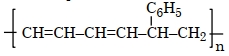
$[-CH_2-CH=CH-CH_2-CH(C_6H_5)-CH_2-]_n$
B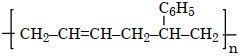
$[-CH_2-CH=CH-CH_2-CH_2-CH(C_6H_5)-]_n$
C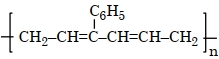
$[-CH_2-CH(C_6H_5)-CH_2-CH_2-CH=CH-]_n$
D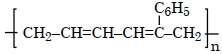
$[-CH_2-CH=CH-CH_2-CH(C_6H_5)-CH_2-CH_2-]_n$
Solution
(A) Buna-$S$ is a copolymer formed by the polymerization of $1,3$-butadiene $(CH_2=CH-CH=CH_2)$ and styrene $(C_6H_5-CH=CH_2)$.
During the polymerization process,the double bonds rearrange to form a chain structure.
The correct repeating unit for Buna-$S$ is represented as $[-CH_2-CH=CH-CH_2-CH(C_6H_5)-CH_2-]_n$.
During the polymerization process,the double bonds rearrange to form a chain structure.
The correct repeating unit for Buna-$S$ is represented as $[-CH_2-CH=CH-CH_2-CH(C_6H_5)-CH_2-]_n$.
0 likes
View Solution369
DifficultMCQ
Given below are two statements:
Statement $I:$ Ethene at $333$ to $343 \ K$ and $6-7 \ atm$ pressure in the presence of $AlEt_3$ and $TiCl_4$ undergoes addition polymerization to give $LDP$.
Statement $II:$ Caprolactam at $533-543 \ K$ in $H_2O$ through step growth polymerizes to give Nylon-$6$.
In the light of the above Statements,choose the correct answer from the options given below:
Statement $I:$ Ethene at $333$ to $343 \ K$ and $6-7 \ atm$ pressure in the presence of $AlEt_3$ and $TiCl_4$ undergoes addition polymerization to give $LDP$.
Statement $II:$ Caprolactam at $533-543 \ K$ in $H_2O$ through step growth polymerizes to give Nylon-$6$.
In the light of the above Statements,choose the correct answer from the options given below:
A
Both Statement $I$ and Statement $II$ are true.
B
Statement $I$ is false but Statement $II$ is true.
C
Statement $I$ is true but Statement $II$ is false.
D
Both Statement $I$ and Statement $II$ are false.
Solution
(B) Statement $I$ is false. The reaction of ethene in the presence of $AlEt_3$ and $TiCl_4$ (Ziegler-Natta catalyst) produces High Density Polyethene $(HDPE)$,not Low Density Polyethene $(LDP)$.
Statement $II$ is true. Caprolactam,when heated with water at $533-543 \ K$,undergoes ring-opening polymerization (a type of step-growth polymerization) to form Nylon-$6$.
Statement $II$ is true. Caprolactam,when heated with water at $533-543 \ K$,undergoes ring-opening polymerization (a type of step-growth polymerization) to form Nylon-$6$.
0 likes
View Solution370
MediumMCQ
Match the following:
Choose the correct answer from the options given below:
| Column-$A$ | Column-$B$ |
| $a.$ Nylon-$6$ | $I.$ Natural Rubber |
| $b.$ Vulcanized Rubber | $II.$ Cross Linked |
| $c.$ cis-$1,4$-polyisoprene | $III.$ Caprolactam |
| $d.$ Polychloroprene | $IV.$ Neoprene |
Choose the correct answer from the options given below:
A
$a$ $\rightarrow IV, b$ $\rightarrow III, c$ $\rightarrow II, d$ $\rightarrow I$
B
$a$ $\rightarrow III, b$ $\rightarrow IV, c$ $\rightarrow I, d$ $\rightarrow II$
C
$a$ $\rightarrow II, b$ $\rightarrow III, c$ $\rightarrow IV, d$ $\rightarrow I$
D
$a$ $\rightarrow III, b$ $\rightarrow II, c$ $\rightarrow I, d$ $\rightarrow IV$
Solution
(D) $a.$ Nylon-$6$ is prepared from the monomer Caprolactam $(III)$.
$b.$ Vulcanized rubber is a cross-linked polymer formed by heating rubber with sulphur $(II)$.
$c.$ cis-$1,4$-polyisoprene is the chemical name for Natural Rubber $(I)$.
$d.$ Polychloroprene is commonly known as Neoprene $(IV)$.
Therefore,the correct matching is $a$ $\rightarrow III, b$ $\rightarrow II, c$ $\rightarrow I, d$ $\rightarrow IV$.
$b.$ Vulcanized rubber is a cross-linked polymer formed by heating rubber with sulphur $(II)$.
$c.$ cis-$1,4$-polyisoprene is the chemical name for Natural Rubber $(I)$.
$d.$ Polychloroprene is commonly known as Neoprene $(IV)$.
Therefore,the correct matching is $a$ $\rightarrow III, b$ $\rightarrow II, c$ $\rightarrow I, d$ $\rightarrow IV$.
0 likes
View Solution371
MediumMCQ
Match List-$I$ with List-$II$:
Choose the correct answer from the options given below:
| List-$I$ (Monomer) | List-$II$ (Polymer) |
| $A$. Tetrafluoroethene | $I$. Orlon |
| $B$. Acrylonitrile | $II$. Natural rubber |
| $C$. Caprolactam | $III$. Teflon |
| $D$. Isoprene | $IV$. Nylon-$6$ |
Choose the correct answer from the options given below:
A
$A-III, B-I, C-IV, D-II$
B
$A-III, B-IV, C-II, D-I$
C
$A-IV, B-I, C-II, D-III$
D
$A-II, B-III, C-IV, D-I$
Solution
(A) The correct matches are as follows:
$A$. Tetrafluoroethene is the monomer of Teflon $(III)$.
$B$. Acrylonitrile is the monomer of Orlon $(I)$.
$C$. Caprolactam is the monomer of Nylon-$6$ $(IV)$.
$D$. Isoprene ($2$-methyl-$1,3$-butadiene) is the monomer of Natural rubber $(II)$.
Therefore,the correct matching is $A-III, B-I, C-IV, D-II$.
$A$. Tetrafluoroethene is the monomer of Teflon $(III)$.
$B$. Acrylonitrile is the monomer of Orlon $(I)$.
$C$. Caprolactam is the monomer of Nylon-$6$ $(IV)$.
$D$. Isoprene ($2$-methyl-$1,3$-butadiene) is the monomer of Natural rubber $(II)$.
Therefore,the correct matching is $A-III, B-I, C-IV, D-II$.
0 likes
View Solution372
DifficultMCQ
Among cellulose,poly(vinyl chloride),nylon and natural rubber,the polymer in which the intermolecular force of attraction is weakest is
A
Nylon
B
Poly(vinyl chloride)
C
Cellulose
D
Natural Rubber
Solution
(D) The strength of intermolecular forces in polymers follows the order: $\text{Fibers} > \text{Thermoplastics} > \text{Elastomers}$.
$1$. $\text{Nylon}$ is a fiber and has strong hydrogen bonding.
$2$. $\text{Cellulose}$ is a natural polymer with strong hydrogen bonding.
$3$. $\text{Poly(vinyl chloride)}$ is a thermoplastic with dipole-dipole interactions.
$4$. $\text{Natural rubber}$ is an elastomer held together by weak van der Waals forces.
Therefore,$\text{natural rubber}$ has the weakest intermolecular forces.
$1$. $\text{Nylon}$ is a fiber and has strong hydrogen bonding.
$2$. $\text{Cellulose}$ is a natural polymer with strong hydrogen bonding.
$3$. $\text{Poly(vinyl chloride)}$ is a thermoplastic with dipole-dipole interactions.
$4$. $\text{Natural rubber}$ is an elastomer held together by weak van der Waals forces.
Therefore,$\text{natural rubber}$ has the weakest intermolecular forces.
0 likes
View Solution373
MediumMCQ
On complete hydrogenation,natural rubber produces
A
ethylene-propylene copolymer
B
vulcanised rubber
C
polypropylene
D
polybutylene
Solution
(A) Natural rubber is a polymer of isoprene ($2$-methyl-$1,3$-butadiene).
Its structure is $(CH_2-C(CH_3)=CH-CH_2)_n$.
On complete hydrogenation,the double bonds in the polymer chain are saturated with hydrogen atoms.
The resulting structure is $(CH_2-CH(CH_3)-CH_2-CH_2)_n$,which is identical to the structure of an ethylene-propylene copolymer.
Its structure is $(CH_2-C(CH_3)=CH-CH_2)_n$.
On complete hydrogenation,the double bonds in the polymer chain are saturated with hydrogen atoms.
The resulting structure is $(CH_2-CH(CH_3)-CH_2-CH_2)_n$,which is identical to the structure of an ethylene-propylene copolymer.
0 likes
View Solution374
EasyMCQ
Choose the correct option$(s)$ from the following:
$(1)$ Natural rubber is polyisoprene containing trans alkene units.
$(2)$ Nylon-$6$ has amide linkages.
$(3)$ Cellulose has only $\alpha-D$-glucose units that are joined by glycosidic linkages.
$(4)$ Teflon is prepared by heating tetrafluoroethene in the presence of a persulphate catalyst at high pressure.
$(1)$ Natural rubber is polyisoprene containing trans alkene units.
$(2)$ Nylon-$6$ has amide linkages.
$(3)$ Cellulose has only $\alpha-D$-glucose units that are joined by glycosidic linkages.
$(4)$ Teflon is prepared by heating tetrafluoroethene in the presence of a persulphate catalyst at high pressure.
A
$1, 2$
B
$1, 3$
C
$2, 4$
D
$1, 4$
Solution
(C) $(1)$ Natural rubber is cis-polyisoprene. Thus,statement $(1)$ is incorrect.
$(2)$ Nylon-$6$ is formed by the polymerization of caprolactam and contains amide linkages $(-NH-CO-)$. Thus,statement $(2)$ is correct.
$(3)$ Cellulose is a linear polymer of $\beta-D$-glucose units joined by $\beta$-glycosidic linkages. Thus,statement $(3)$ is incorrect.
$(4)$ Teflon is prepared by heating tetrafluoroethene $(CF_2=CF_2)$ in the presence of a persulphate catalyst at high pressure. Thus,statement $(4)$ is correct.
Therefore,statements $(2)$ and $(4)$ are correct.
$(2)$ Nylon-$6$ is formed by the polymerization of caprolactam and contains amide linkages $(-NH-CO-)$. Thus,statement $(2)$ is correct.
$(3)$ Cellulose is a linear polymer of $\beta-D$-glucose units joined by $\beta$-glycosidic linkages. Thus,statement $(3)$ is incorrect.
$(4)$ Teflon is prepared by heating tetrafluoroethene $(CF_2=CF_2)$ in the presence of a persulphate catalyst at high pressure. Thus,statement $(4)$ is correct.
Therefore,statements $(2)$ and $(4)$ are correct.
0 likes
View Solution375
AdvancedMCQ
Among the following,the correct statement$(s)$ about polymers is(are):
$A$. The polymerization of chloroprene gives natural rubber.
$B$. Teflon is prepared from tetrafluoroethene by heating it with persulphate catalyst at high pressures.
$C$. $PVC$ are thermoplastic polymers.
$D$. Ethene at $350-570 \ K$ temperature and $1000-2000 \ atm$ pressure in the presence of a peroxide initiator yields high density polythene.
$A$. The polymerization of chloroprene gives natural rubber.
$B$. Teflon is prepared from tetrafluoroethene by heating it with persulphate catalyst at high pressures.
$C$. $PVC$ are thermoplastic polymers.
$D$. Ethene at $350-570 \ K$ temperature and $1000-2000 \ atm$ pressure in the presence of a peroxide initiator yields high density polythene.
A
$A, B, C$
B
$B, A$
C
$B, D$
D
$B, C$
Solution
(D) . Incorrect: The polymerization of chloroprene gives neoprene,not natural rubber. Natural rubber is a polymer of isoprene ($2$-methyl-$1,3$-butadiene).
$B$. Correct: Teflon is prepared by heating tetrafluoroethene with a free radical or persulphate catalyst at high pressures.
$C$. Correct: $PVC$ (polyvinyl chloride) is a thermoplastic polymer as it softens on heating and hardens on cooling.
$D$. Incorrect: Ethene at $350-570 \ K$ and $1000-2000 \ atm$ pressure in the presence of a peroxide initiator yields low density polythene $(LDPE)$,not high density polythene.
$B$. Correct: Teflon is prepared by heating tetrafluoroethene with a free radical or persulphate catalyst at high pressures.
$C$. Correct: $PVC$ (polyvinyl chloride) is a thermoplastic polymer as it softens on heating and hardens on cooling.
$D$. Incorrect: Ethene at $350-570 \ K$ and $1000-2000 \ atm$ pressure in the presence of a peroxide initiator yields low density polythene $(LDPE)$,not high density polythene.
0 likes
View Solution376
DifficultMCQ
Given below are two statements $:$
Statement $I :$ Wet cotton clothes made of cellulose$-based$ carbohydrate take a comparatively longer time to dry than wet nylon polymer$-based$ clothes.
Statement $II :$ Intermolecular hydrogen bonding with water molecules is more in nylon$-based$ clothes than in the case of cotton clothes.
In the light of the above statements,choose the correct answer from the options given below $:$
Statement $I :$ Wet cotton clothes made of cellulose$-based$ carbohydrate take a comparatively longer time to dry than wet nylon polymer$-based$ clothes.
Statement $II :$ Intermolecular hydrogen bonding with water molecules is more in nylon$-based$ clothes than in the case of cotton clothes.
In the light of the above statements,choose the correct answer from the options given below $:$
A
Statement $I$ is false but Statement $II$ is true
B
Statement $I$ is true but Statement $II$ is false
C
Both Statement $I$ and Statement $II$ are true
D
Both Statement $I$ and Statement $II$ are false
Solution
(B) Statement $I$ is true because cellulose contains a large number of hydroxyl $(-OH)$ groups,which form extensive hydrogen bonds with water,leading to higher water retention and longer drying times.
Statement $II$ is false because nylon is a synthetic polyamide with fewer sites for hydrogen bonding with water compared to the numerous hydroxyl groups present in cellulose-based cotton fibers.
Statement $II$ is false because nylon is a synthetic polyamide with fewer sites for hydrogen bonding with water compared to the numerous hydroxyl groups present in cellulose-based cotton fibers.
0 likes
View Solution377
DifficultMCQ
If $Cell-OH$ represents the formula of cellulose,identify the formula of cellulose xanthate from the following.
A
$Cell-ONa$
B
$Cell-O-C(=S)-SNa$
C
$Cell-O-C(=S)-SH$
D
$Cell-O-C(=S)-OH$
Solution
(B) The formation of cellulose xanthate occurs in the viscose process for manufacturing rayon.
First,cellulose $(Cell-OH)$ reacts with $NaOH$ to form alkali cellulose $(Cell-ONa)$.
Then,alkali cellulose reacts with carbon disulfide $(CS_2)$ to form cellulose xanthate,which has the formula $Cell-O-C(=S)-SNa$.
First,cellulose $(Cell-OH)$ reacts with $NaOH$ to form alkali cellulose $(Cell-ONa)$.
Then,alkali cellulose reacts with carbon disulfide $(CS_2)$ to form cellulose xanthate,which has the formula $Cell-O-C(=S)-SNa$.
0 likes
View Solution378
MediumMCQ
Which among the following formulae represents the $\omega$-amino caproic acid?
A
$H_2N-(CH_2)_5-COOH$
B
$H_2N-CH_2-COOH$
C
$H_2N-CO-CH_2-CH(NH_2)-COOH$
D
$HO-CH_2-CH(NH_2)-COOH$
Solution
(A) The $\omega$-amino caproic acid is a straight-chain amino acid with a total of $6$ carbon atoms,where the amino group $(-NH_2)$ is at the terminal $(\omega)$ position and the carboxylic acid group $(-COOH)$ is at the other end.
Caproic acid is a $6$-carbon carboxylic acid $(CH_3(CH_2)_4COOH)$.
Replacing the terminal hydrogen with an amino group gives $H_2N-(CH_2)_5-COOH$,which is $6$-aminohexanoic acid,commonly known as $\omega$-amino caproic acid.
Therefore,the correct formula is $H_2N-(CH_2)_5-COOH$.
Caproic acid is a $6$-carbon carboxylic acid $(CH_3(CH_2)_4COOH)$.
Replacing the terminal hydrogen with an amino group gives $H_2N-(CH_2)_5-COOH$,which is $6$-aminohexanoic acid,commonly known as $\omega$-amino caproic acid.
Therefore,the correct formula is $H_2N-(CH_2)_5-COOH$.
0 likes
View Solution379
MediumMCQ
Which of the following polymers is believed to leach a human carcinogen into food when used as household plastic?
A
$LDPE$
B
$PP$
C
$PS$
D
$PET$
Solution
(C) $PS$ (Polystyrene) is believed to leach styrene,which is a possible human carcinogen,into food when used as a household plastic.
0 likes
View Solution380
EasyMCQ
Which of the following polymers is biodegradable?
A
Nylon $6$
B
Nylon $6,6$
C
Nylon $2-$nylon $6$
D
$HDP$
Solution
(C) Biodegradable polymers are those that can be broken down by microorganisms in the environment.
Nylon $2-$nylon $6$ is a polyamide copolymer of glycine and amino caproic acid,which is biodegradable.
Nylon $6$,Nylon $6,6$,and $HDP$ (High Density Polyethylene) are synthetic polymers that are not biodegradable.
Nylon $2-$nylon $6$ is a polyamide copolymer of glycine and amino caproic acid,which is biodegradable.
Nylon $6$,Nylon $6,6$,and $HDP$ (High Density Polyethylene) are synthetic polymers that are not biodegradable.
0 likes
View Solution381
EasyMCQ
Which of the following is a thermosetting polymer?
A
Buna-$S$
B
Dacron
C
Polyvinyls
D
Bakelite
Solution
(D) Thermosetting polymers are cross-linked or heavily branched molecules that undergo extensive cross-linking in molds when heated,making them permanently hard and infusible.
$Bakelite$ (phenol-formaldehyde resin) is a classic example of a thermosetting polymer.
$Buna-S$ is an elastomer,while $Dacron$ and $Polyvinyls$ are thermoplastic polymers.
$Bakelite$ (phenol-formaldehyde resin) is a classic example of a thermosetting polymer.
$Buna-S$ is an elastomer,while $Dacron$ and $Polyvinyls$ are thermoplastic polymers.
0 likes
View Solution382
EasyMCQ
Identify the biodegradable polymer from the following.
A
Teflon
B
$PHBV$
C
$LDP$
D
Polyacrylonitrile
Solution
(B) is the correct answer.
Biodegradable polymers are those that can be decomposed by microorganisms.
Among the given options,$PHBV$ (Poly-$\beta$-hydroxybutyrate-co-$\beta$-hydroxyvalerate) is a well-known biodegradable polymer.
$Teflon$,$LDP$ (Low Density Polyethylene),and Polyacrylonitrile are synthetic,non-biodegradable polymers.
Biodegradable polymers are those that can be decomposed by microorganisms.
Among the given options,$PHBV$ (Poly-$\beta$-hydroxybutyrate-co-$\beta$-hydroxyvalerate) is a well-known biodegradable polymer.
$Teflon$,$LDP$ (Low Density Polyethylene),and Polyacrylonitrile are synthetic,non-biodegradable polymers.
0 likes
View Solution383
MediumMCQ
Which polymer is obtained from the monomers $CH_2=CH-CH=CH_2$ and $CH_2=CH-CN$?
A
Polycarbonate
B
Polyacrylamide
C
$B$üna-$N$
D
Acrylic glass
Solution
(C) The given monomers are $1,3$-butadiene $(CH_2=CH-CH=CH_2)$ and acrylonitrile $(CH_2=CH-CN)$.
These monomers undergo copolymerization to form $B$üna-$N$ (also known as nitrile rubber).
These monomers undergo copolymerization to form $B$üna-$N$ (also known as nitrile rubber).
0 likes
View Solution384
MediumMCQ
Identify the polymer used to obtain $LCD$ screen from the following.
A
Polyacrylamide
B
Buna-$N$
C
Polycarbonate
D
Perspex
Solution
(C) Polycarbonate is commonly used in the production of $LCD$ ($Liquid$ $Crystal$ $Display$) screens,primarily because it is a durable,transparent plastic with excellent optical properties. Polycarbonate is used to make the outer layers of the screen or protective covers due to its high impact resistance and clarity.
Here is a brief overview of the other options:
- $(A)$ Polyacrylamide: Used mainly in water treatment,paper production,and as a thickening agent; not typically used in $LCD$s.
- $(B)$ Buna-$N$: $A$ synthetic rubber (nitrile rubber) used for making seals,gaskets,and fuel hoses; not used in $LCD$s.
- $(D)$ Perspex: Also known as acrylic,it is a transparent plastic,but it is more commonly used in optical devices,displays,and lenses rather than $LCD$ screens.
Here is a brief overview of the other options:
- $(A)$ Polyacrylamide: Used mainly in water treatment,paper production,and as a thickening agent; not typically used in $LCD$s.
- $(B)$ Buna-$N$: $A$ synthetic rubber (nitrile rubber) used for making seals,gaskets,and fuel hoses; not used in $LCD$s.
- $(D)$ Perspex: Also known as acrylic,it is a transparent plastic,but it is more commonly used in optical devices,displays,and lenses rather than $LCD$ screens.
0 likes
View Solution385
MediumMCQ
Identify a polymer obtained from $\beta$-hydroxybutyric acid and $\beta$-hydroxyvaleric acid.
A
$PHBV$
B
Nylon $2-$nylon $6$
C
Buna-$N$
D
Thermocol
Solution
(A) The copolymer formed by the condensation polymerization of $3$-hydroxybutanoic acid ($\beta$-hydroxybutyric acid) and $3$-hydroxypentanoic acid ($\beta$-hydroxyvaleric acid) is known as Poly-$\beta$-hydroxybutyrate-co-$\beta$-hydroxyvalerate, abbreviated as $PHBV$.
The reaction is:
$n(HO-CH(CH_3)-CH_2-COOH) + n(HO-CH(CH_2CH_3)-CH_2-COOH)$ $\rightarrow [-O-CH(CH_3)-CH_2-CO-O-CH(CH_2CH_3)-CH_2-CO-]_n + 2nH_2O$
Thus, the correct option is $A$.
The reaction is:
$n(HO-CH(CH_3)-CH_2-COOH) + n(HO-CH(CH_2CH_3)-CH_2-COOH)$ $\rightarrow [-O-CH(CH_3)-CH_2-CO-O-CH(CH_2CH_3)-CH_2-CO-]_n + 2nH_2O$
Thus, the correct option is $A$.
0 likes
View Solution386
EasyMCQ
Which of the following polymers contains the $-CO-NH-$ linkage in it?
A
Urea formaldehyde resin
B
Glyptal
C
Polycarbonate
D
Thermacol
Solution
(A) The $-CO-NH-$ linkage is characteristic of amide groups,which are found in polyamides (like Nylon) and certain condensation polymers.
Urea formaldehyde resin is formed by the condensation reaction between urea and formaldehyde.
The structure of urea formaldehyde resin is: $[-NH-CO-NH-CH_2-]_n$.
This structure clearly contains the $-CO-NH-$ linkage.
Therefore,the correct option is $A$.
Urea formaldehyde resin is formed by the condensation reaction between urea and formaldehyde.
The structure of urea formaldehyde resin is: $[-NH-CO-NH-CH_2-]_n$.
This structure clearly contains the $-CO-NH-$ linkage.
Therefore,the correct option is $A$.
0 likes
View Solution387
MediumMCQ
Which of the following polymers (trade name) is used to obtain paints?
A
$Glyptal$
B
$Polycarbonate$
C
$Perspex$
D
$PVC$
Solution
(A) $Glyptal$ is a polyester obtained by the condensation polymerization of glycerol and phthalic anhydride. It is widely used in the manufacture of paints and lacquers.
0 likes
View Solution388
MediumMCQ
Identify the monomer used to obtain a polymer that resembles wool.
A
$CH_2=CHCN$
B
$F_2C=CF_2$
C
$H_2C=CHCl$
D
$H_2C=C(Cl)-CH=CH_2$
Solution
(A) Orlon,also known as polyacrylonitrile $(PAN)$,is a synthetic polymer that resembles wool and is used as a wool substitute. It is obtained by the polymerization of acrylonitrile monomer,which has the chemical formula $CH_2=CHCN$.
0 likes
View Solution389
MediumMCQ
Which of the following polymers is used as a substitute for wool?
A
Teflon
B
$LDP$
C
Dacron
D
Polyacrylonitrile
Solution
(D) Polyacrylonitrile $(PAN)$ is used as a substitute for wool in the form of acrylic fibers.
These synthetic fibers are often used to make fabrics that mimic wool,such as in clothing and blankets.
These synthetic fibers are often used to make fabrics that mimic wool,such as in clothing and blankets.
0 likes
View Solution390
EasyMCQ
Identify the biodegradable polymer from the following.
A
Nylon $2$-nylon $6$
B
Terylene
C
Nylon $6$
D
Nylon $6,6$
Solution
(A) Biodegradable polymers are those that can be decomposed by microorganisms.
Nylon $2$-nylon $6$ is a polyamide copolymer of glycine $(H_2N-CH_2-COOH)$ and amino caproic acid $(H_2N-(CH_2)_5-COOH)$.
It is a well-known biodegradable polymer used in medical sutures and other applications.
Other options like Terylene,Nylon $6$,and Nylon $6,6$ are synthetic polymers that are not biodegradable.
Nylon $2$-nylon $6$ is a polyamide copolymer of glycine $(H_2N-CH_2-COOH)$ and amino caproic acid $(H_2N-(CH_2)_5-COOH)$.
It is a well-known biodegradable polymer used in medical sutures and other applications.
Other options like Terylene,Nylon $6$,and Nylon $6,6$ are synthetic polymers that are not biodegradable.
0 likes
View Solution391
EasyMCQ
Name the accelerator used to introduce a network of crosslinks in elastomers.
A
Zinc butyl xanthate
B
Zinc ethyl xanthate
C
Zinc butyl stearate
D
Zinc propyl xanthate
Solution
(A) In the process of vulcanization of rubber,accelerators are added to speed up the crosslinking process. $Zinc \ butyl \ xanthate$ is a commonly used accelerator for this purpose.
0 likes
View Solution392
EasyMCQ
Which among the following polymers has high tensile strength and is used to obtain tyre cords?
A
Nylon $6$
B
$PHBV$
C
Teflon
D
Dacron
Solution
(A) Nylon $6$ (polyamide) possesses high tensile strength due to strong intermolecular hydrogen bonding,making it suitable for manufacturing tyre cords.
0 likes
View Solution393
EasyMCQ
Urea formaldehyde resin is an example of
A
Elastomer
B
Fibers
C
Thermoplastic polymer
D
Thermosetting polymer
Solution
(D) Urea formaldehyde resin is a cross-linked polymer formed by the condensation reaction between urea and formaldehyde.
It is a classic example of a thermosetting polymer,which becomes hard and infusible upon heating.
It is a classic example of a thermosetting polymer,which becomes hard and infusible upon heating.
0 likes
View Solution394
EasyMCQ
Identify the use of $HDPE$.
A
To prepare drinking straw
B
Manufacturing the disposable cups and plates
C
Manufacturing the bottles to store shampoo
D
To obtain bags used for shopping
Solution
(C) $HDPE$ (High Density Polyethylene) is a linear polymer with high density due to close packing. It is chemically inert and more tough and hard than $LDPE$. It is primarily used for manufacturing buckets,dustbins,bottles,pipes,and containers for storing chemicals and shampoos.
0 likes
View Solution395
MediumMCQ
Which of the following polymers is used in the preparation of cinema films?
A
Semisynthetic polymers
B
Isobutyl carbinol
C
Isopropyl carbinol
D
Diethyl carbinol
Solution
(A) Semisynthetic polymers,such as cellulose acetate,are used in the preparation of cinema films.
0 likes
View Solution396
EasyMCQ
Which polymer is obtained from monomers $3-$Hydroxybutanoic acid and $3-$Hydroxypentanoic acid?
A
$PHBV$
B
Dextron
C
Nylon$-2-$nylon$-6$
D
$HDPE$
Solution
(A) $PHBV$ (Poly-$\beta$-hydroxybutyrate-co-$\beta$-hydroxyvalerate) is a biodegradable aliphatic polyester.
It is obtained by the copolymerisation of $3-$hydroxybutanoic acid and $3-$hydroxypentanoic acid.
The reaction is:
$n CH_3-CH(OH)-CH_2-COOH n CH_3-CH_2-CH(OH)-CH_2-COOH \rightarrow -[O-CH(CH_3)-CH_2-CO-O-CH(CH_2CH_3)-CH_2-CO]_n-$
It is obtained by the copolymerisation of $3-$hydroxybutanoic acid and $3-$hydroxypentanoic acid.
The reaction is:
$n CH_3-CH(OH)-CH_2-COOH n CH_3-CH_2-CH(OH)-CH_2-COOH \rightarrow -[O-CH(CH_3)-CH_2-CO-O-CH(CH_2CH_3)-CH_2-CO]_n-$
0 likes
View Solution397
EasyMCQ
Which among the following polymers is used to make crockeries?
A
Melamine
B
$HDPE$
C
$Buna-S$
D
$Buna-N$
Solution
(A) Melamine is a thermosetting polymer formed by the condensation polymerization of melamine and formaldehyde.
Due to its high heat resistance and hardness,it is widely used in the manufacturing of unbreakable crockeries and kitchenware.
Due to its high heat resistance and hardness,it is widely used in the manufacturing of unbreakable crockeries and kitchenware.
0 likes
View Solution398
EasyMCQ
Which among the following is a biodegradable polymer?
A
$PVC$
B
Polythene
C
Dextron
D
Teflon
Solution
(C) Biodegradable polymers are those that can be decomposed by microorganisms.
$Dextron$ (also known as $PHBV$ or poly-$\beta$-hydroxybutyrate-co-$\beta$-hydroxyvalerate) is a well-known biodegradable polymer.
$PVC$,$Polythene$,and $Teflon$ are synthetic,non-biodegradable polymers.
$Dextron$ (also known as $PHBV$ or poly-$\beta$-hydroxybutyrate-co-$\beta$-hydroxyvalerate) is a well-known biodegradable polymer.
$PVC$,$Polythene$,and $Teflon$ are synthetic,non-biodegradable polymers.
0 likes
View Solution399
EasyMCQ
Which among the following is a biodegradable polymer?
A
$PHBV$
B
$Buna-N$
C
$PTFE$
D
$PVC$
Solution
(A) Poly$(3-hydroxybutyrate-co-3-hydroxyvalerate)$ $(PHBV)$ is a biodegradable polymer.
It is obtained by the copolymerization of $3-hydroxybutanoic$ acid and $3-hydroxypentanoic$ acid.
$Buna-N$,$PTFE$,and $PVC$ are synthetic,non-biodegradable polymers.
It is obtained by the copolymerization of $3-hydroxybutanoic$ acid and $3-hydroxypentanoic$ acid.
$Buna-N$,$PTFE$,and $PVC$ are synthetic,non-biodegradable polymers.
0 likes
View Solution400
EasyMCQ
Which of the following polymers is used to manufacture clothes for firefighters?
A
Thiokol
B
Kevlar
C
Nomex
D
Dynel
Solution
(C) Nomex is a heat-resistant meta-aramid fiber. Due to its high thermal stability and flame resistance,it is widely used to manufacture protective clothing for firefighters.
0 likes
View SolutionPolymers — Composition, Properties and Uses of Polymer · Frequently Asked Questions
1Are these Polymers questions useful for JEE and NEET?
Yes. All questions in this section are mapped to JEE Main and NEET exam patterns. Previous year questions from JEE Main, NEET, GUJCET and state-level exams are included with full solutions.
2Can I switch to Hindi or Gujarati for these questions?
Yes. Use the language tabs in the hero section or the sidebar to view the same questions and solutions in English, Hindi or Gujarati.
3How do I generate a question paper from this subtopic?
Use the Vedclass Exam Paper Generator — select the chapter and subtopic, set difficulty, and generate Sets A, B, C, D automatically. First 3 chapters of every subject are free.
Vedclass Products
For Students
Vedclass Test Series
Mock tests in real JEE/NEET style with performance analysis. 5-day free trial.
Start Free TrialFor Teachers
Exam Paper Generator
Generate Set A/B/C/D papers from this chapter in 2 minutes. 3 chapters free.
Try FreeFor Institutes
Online Exam Module
Live online exams with unlimited students, 360° analytics & white-label branding.
See DemoFor Teachers & Institutes
Generate a Polymers Exam Paper in 2 Minutes
Select subtopic & difficulty — Sets A, B, C, D auto-generated with No Repeat logic.
First 3 chapters of every subject are free — no payment required.