
A English
Composition, Properties and Uses of Polymer Questions in English
Class 12 Chemistry · Polymers · Composition, Properties and Uses of Polymer
556+
Questions
English
Language
100%
With Solutions
Showing 50 of 556 questions in English
201
MediumMCQ
The polymer used for optical lenses is
A
polypropylene
B
polyvinyl chloride
C
polythene
D
polymethyl methacrylate
Solution
(D) Polymethyl methacrylate $(PMMA)$ is a transparent and rigid thermoplastic. Due to its high optical clarity and resistance to shattering,it is widely used in the manufacturing of optical lenses.
0 likes
View Solution202
EasyMCQ
Synthetic polymer bakelite can be prepared from the following compounds:
A
Styrene and vinyl chloride
B
Acrylonitrile and vinyl chloride
C
Adipic acid and ethylene glycol
D
Phenol and formaldehyde
Solution
(D) Bakelite is a thermosetting polymer formed by the condensation polymerization of $Phenol$ and $Formaldehyde$ $(HCHO)$ in the presence of an acid or base catalyst.
The reaction involves the formation of $o$- and $p$-hydroxymethylphenol intermediates,which further undergo polymerization to form a cross-linked structure known as $Bakelite$.
The reaction involves the formation of $o$- and $p$-hydroxymethylphenol intermediates,which further undergo polymerization to form a cross-linked structure known as $Bakelite$.
0 likes
View Solution203
AdvancedMCQ
Major product of the following reaction is

A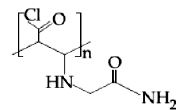
B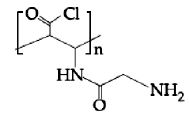
C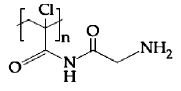
D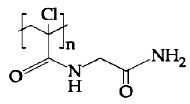
Solution
(D) The reaction proceeds in two steps:
$1$. Nucleophilic substitution: The amino group of glycinamide attacks the acid chloride to form an amide linkage,releasing $HCl$. Triethylamine $(Et_3N)$ is used to neutralize the $HCl$ produced.
$2$. Free radical polymerization: The resulting monomer,which contains a vinyl group,undergoes free radical polymerization to form the final polymer product.
The structure of the final polymer is shown in option $D$.
$1$. Nucleophilic substitution: The amino group of glycinamide attacks the acid chloride to form an amide linkage,releasing $HCl$. Triethylamine $(Et_3N)$ is used to neutralize the $HCl$ produced.
$2$. Free radical polymerization: The resulting monomer,which contains a vinyl group,undergoes free radical polymerization to form the final polymer product.
The structure of the final polymer is shown in option $D$.
0 likes
View Solution204
MediumMCQ
Poly-$\beta$-hydroxybutyrate-co-$\beta$-hydroxyvalerate $(PHBV)$ is a copolymer of . . . . . .
A
$3$-hydroxybutanoic acid and $4$-hydroxypentanoic acid
B
$2$-hydroxybutanoic acid and $3$-hydroxypentanoic acid
C
$3$-hydroxybutanoic acid and $2$-hydroxypentanoic acid
D
$3$-hydroxybutanoic acid and $3$-hydroxypentanoic acid
Solution
(D) $PHBV$ is a biodegradable aliphatic polyester copolymer.
It is obtained by the copolymerization of $3$-hydroxybutanoic acid and $3$-hydroxypentanoic acid.
It is obtained by the copolymerization of $3$-hydroxybutanoic acid and $3$-hydroxypentanoic acid.
0 likes
View Solution205
DifficultMCQ
The structure of Nylon $-6$ is
A
$-[ (CH_2)_4 - CO - NH ]_n$
B
$-[ CO - (CH_2)_6 - NH ]_n$
C
$-[ CO - (CH_2)_5 - NH ]_n$
D
$-[ (CH_2)_6 - CO - NH ]_n$
Solution
(C) Nylon $-6$ is synthesized by the ring-opening polymerization of caprolactam at $533 \ K$ in an inert atmosphere of $N_2$.
The repeating unit of Nylon $-6$ contains $6$ carbon atoms in total ($5$ from the methylene groups and $1$ from the carbonyl group).
The structure is represented as $-[ CO - (CH_2)_5 - NH ]_n$.
The repeating unit of Nylon $-6$ contains $6$ carbon atoms in total ($5$ from the methylene groups and $1$ from the carbonyl group).
The structure is represented as $-[ CO - (CH_2)_5 - NH ]_n$.
0 likes
View Solution206
DifficultMCQ
Which of the following compounds is a constituent of the polymer $[HN-CO-NH-CH_2]_n$?
A
Formaldehyde
B
Ammonia
C
Methylamine
D
$N$-methyl urea
Solution
(A) The given structure $[HN-CO-NH-CH_2]_n$ represents the repeating unit of Urea-Formaldehyde resin.
It is formed by the condensation polymerization of Urea $(NH_2-CO-NH_2)$ and Formaldehyde $(HCHO)$.
Thus,Formaldehyde is one of its constituents.
It is formed by the condensation polymerization of Urea $(NH_2-CO-NH_2)$ and Formaldehyde $(HCHO)$.
Thus,Formaldehyde is one of its constituents.
0 likes
View Solution207
DifficultMCQ
The correct match between Item-$I$ and Item-$II$ is
| Item-$I$ | Item-$II$ |
| $(a)$ High density polythene | $(I)$ Peroxide catalyst |
| $(b)$ Polyacrylonitrile | $(II)$ Condensation at high temperature and pressure |
| $(c)$ Novolac | $(III)$ Ziegler-Natta catalyst |
| $(d)$ Nylon-$6$ | $(IV)$ Acid or base catalyst |
A
$a \to III, b \to I, c \to II, d \to IV$
B
$a \to IV, b \to II, c \to I, d \to III$
C
$a \to II, b \to IV, c \to I, d \to III$
D
$a \to III, b \to I, c \to IV, d \to II$
Solution
(D) High density polythene is prepared using Ziegler-Natta catalyst $(III)$.
$(b)$ Polyacrylonitrile is prepared by addition polymerization using peroxide catalyst $(I)$.
$(c)$ Novolac is a linear polymer of phenol and formaldehyde prepared using acid or base catalyst $(IV)$.
$(d)$ Nylon-$6$ is prepared by heating caprolactam at high temperature and pressure $(II)$.
Therefore,the correct match is $a \to III, b \to I, c \to IV, d \to II$.
$(b)$ Polyacrylonitrile is prepared by addition polymerization using peroxide catalyst $(I)$.
$(c)$ Novolac is a linear polymer of phenol and formaldehyde prepared using acid or base catalyst $(IV)$.
$(d)$ Nylon-$6$ is prepared by heating caprolactam at high temperature and pressure $(II)$.
Therefore,the correct match is $a \to III, b \to I, c \to IV, d \to II$.
0 likes
View Solution208
MediumMCQ
Which of the following is a thermosetting polymer?
A
$PVC$
B
Bakelite
C
Buna $-N$
D
Nylon $6$
Solution
(B) Thermosetting polymers are cross-linked polymers that undergo extensive cross-linking in molds during molding,which makes them hard and infusible.
Bakelite is a classic example of a thermosetting polymer,formed by the condensation reaction of phenol and formaldehyde.
Bakelite is a classic example of a thermosetting polymer,formed by the condensation reaction of phenol and formaldehyde.
0 likes
View Solution209
DifficultMCQ
The correct name of the following polymer is
$[-CH_2-C(CH_3)_2-]_n$
$[-CH_2-C(CH_3)_2-]_n$
A
Polyisoprene
B
Polytert-butylene
C
Polyisobutane
D
Polyisobutylene
Solution
(D) The given structure is the repeating unit of a polymer formed from the monomer isobutylene $(CH_2=C(CH_3)_2)$.
Upon polymerization,the double bond breaks to form a chain,resulting in the polymer polyisobutylene.
Upon polymerization,the double bond breaks to form a chain,resulting in the polymer polyisobutylene.
0 likes
View Solution210
EasyMCQ
Which of the following is a fluorine-containing compound?
A
Fluorescein
B
Teflon
C
Phenolphthalein
D
All of these
Solution
(B) Teflon is a polymer of tetrafluoroethylene,which has the chemical formula $(CF_2=CF_2)_n$. It contains fluorine atoms in its structure.
Fluorescein and phenolphthalein are organic dyes/indicators that do not contain fluorine atoms.
Therefore,the correct answer is $B$.
Fluorescein and phenolphthalein are organic dyes/indicators that do not contain fluorine atoms.
Therefore,the correct answer is $B$.
0 likes
View Solution211
EasyMCQ
Which of the following is not a match with the others?
A
Isoprene
B
Gutta percha
C
Neoprene
D
Natural Rubber
Solution
(C) The polymers $Natural \ Rubber$,$Gutta \ percha$,and $Isoprene$ (as a monomer) are all related to the polyisoprene family.
$Natural \ Rubber$ is $cis-1,4-polyisoprene$.
$Gutta \ percha$ is $trans-1,4-polyisoprene$.
$Isoprene$ is the monomer unit for both.
$Neoprene$ is a synthetic polymer made from the monomer $chloroprene$ $(2-chloro-1,3-butadiene)$.
Therefore,$Neoprene$ does not match the others as it is a synthetic polymer based on $chloroprene$.
$Natural \ Rubber$ is $cis-1,4-polyisoprene$.
$Gutta \ percha$ is $trans-1,4-polyisoprene$.
$Isoprene$ is the monomer unit for both.
$Neoprene$ is a synthetic polymer made from the monomer $chloroprene$ $(2-chloro-1,3-butadiene)$.
Therefore,$Neoprene$ does not match the others as it is a synthetic polymer based on $chloroprene$.
0 likes
View Solution212
EasyMCQ
Arrange the following in decreasing order of their intermolecular forces:
$(a)$ Nylon $6,6$
$(b)$ Buna-$S$
$(c)$ Polyethene
$(a)$ Nylon $6,6$
$(b)$ Buna-$S$
$(c)$ Polyethene
A
$b > a > c$
B
$a > c > b$
C
$a > b > c$
D
$c > a > b$
Solution
(B) The strength of intermolecular forces in polymers depends on their structure:
$1$. Nylon $6,6$ is a fiber. It contains strong hydrogen bonding between the polymer chains,which results in the strongest intermolecular forces.
$2$. Polyethene is a thermoplastic polymer with weak van der Waals forces between the chains.
$3$. Buna-$S$ is an elastomer. It has the weakest intermolecular forces,which allow the polymer chains to be stretched.
Therefore,the decreasing order of intermolecular forces is: Nylon $6,6$ (fiber) $>$ Polyethene (thermoplastic) $>$ Buna-$S$ (elastomer).
This corresponds to the order: $a > c > b$.
$1$. Nylon $6,6$ is a fiber. It contains strong hydrogen bonding between the polymer chains,which results in the strongest intermolecular forces.
$2$. Polyethene is a thermoplastic polymer with weak van der Waals forces between the chains.
$3$. Buna-$S$ is an elastomer. It has the weakest intermolecular forces,which allow the polymer chains to be stretched.
Therefore,the decreasing order of intermolecular forces is: Nylon $6,6$ (fiber) $>$ Polyethene (thermoplastic) $>$ Buna-$S$ (elastomer).
This corresponds to the order: $a > c > b$.
0 likes
View Solution213
EasyMCQ
Which of the following is not correct regarding $Terylene$?
A
Step growth polymer
B
Synthetic fibre
C
Condensation polymer
D
Thermosetting plastic
Solution
(D) $Terylene$ is a synthetic polymer formed by the condensation polymerization reaction of terephthalic acid and ethylene glycol.
It is formed by a step-growth polymerization mechanism.
$Terylene$ is a thermoplastic,not a thermosetting plastic,because it can be remelted and reshaped multiple times without significant chemical degradation.
Therefore,the statement that it is a thermosetting plastic is incorrect.
It is formed by a step-growth polymerization mechanism.
$Terylene$ is a thermoplastic,not a thermosetting plastic,because it can be remelted and reshaped multiple times without significant chemical degradation.
Therefore,the statement that it is a thermosetting plastic is incorrect.
0 likes
View Solution214
EasyMCQ
Arrange the following polymers in order of increasing strength of their intermolecular forces:
$Nylon-6$ $(A)$,$Neoprene$ $(B)$,$Polyvinyl$ $chloride$ $(C)$
$Nylon-6$ $(A)$,$Neoprene$ $(B)$,$Polyvinyl$ $chloride$ $(C)$
A
$A > C > B$
B
$A > B > C$
C
$C > A > B$
D
$B > A > C$
Solution
(A) The strength of intermolecular forces in polymers follows the order: Fibres > Thermoplastics > Elastomers.
$1$. $Nylon-6$ $(A)$ is a fibre,which contains strong hydrogen bonding between the polymer chains,resulting in the strongest intermolecular forces.
$2$. $Polyvinyl$ $chloride$ $(C)$ is a thermoplastic,which has dipole-dipole interactions that are stronger than the weak van der Waals forces found in elastomers but weaker than hydrogen bonds.
$3$. $Neoprene$ $(B)$ is an elastomer,which has weak van der Waals forces between the polymer chains,making it the weakest among the three.
Therefore,the correct order of strength is $A > C > B$.
$1$. $Nylon-6$ $(A)$ is a fibre,which contains strong hydrogen bonding between the polymer chains,resulting in the strongest intermolecular forces.
$2$. $Polyvinyl$ $chloride$ $(C)$ is a thermoplastic,which has dipole-dipole interactions that are stronger than the weak van der Waals forces found in elastomers but weaker than hydrogen bonds.
$3$. $Neoprene$ $(B)$ is an elastomer,which has weak van der Waals forces between the polymer chains,making it the weakest among the three.
Therefore,the correct order of strength is $A > C > B$.
0 likes
View Solution215
EasyMCQ
Which of the following polymers does not involve $C-C$ bond formation during polymerization?
A
Teflon
B
Bakelite
C
Natural rubber
D
Terylene
Solution
(D) $1$. Teflon $(CF_2=CF_2)$ is formed by addition polymerization,which involves $C-C$ bond formation.
$2$. Natural rubber is a polymer of isoprene $(CH_2=C(CH_3)-CH=CH_2)$,which involves $C-C$ bond formation.
$3$. Terylene is a polyester formed by the condensation of ethylene glycol and terephthalic acid,involving $C-O$ bond formation,but the backbone also contains $C-C$ bonds.
$4$. Bakelite is a phenol-formaldehyde resin formed by condensation polymerization. The linkage between phenol units is through methylene $(-CH_2-)$ bridges,involving $C-C$ bond formation between the benzene ring and the methylene group.
$5$. However,in the context of condensation polymers like Terylene (polyester) or Nylon (polyamide),the primary linkage formed is $C-O$ or $C-N$ respectively. Among the given options,Terylene is a polyester where the ester linkage $(R-COO-R')$ is formed,primarily involving $C-O$ bond formation during the condensation reaction between the carboxylic acid and the alcohol group.
$2$. Natural rubber is a polymer of isoprene $(CH_2=C(CH_3)-CH=CH_2)$,which involves $C-C$ bond formation.
$3$. Terylene is a polyester formed by the condensation of ethylene glycol and terephthalic acid,involving $C-O$ bond formation,but the backbone also contains $C-C$ bonds.
$4$. Bakelite is a phenol-formaldehyde resin formed by condensation polymerization. The linkage between phenol units is through methylene $(-CH_2-)$ bridges,involving $C-C$ bond formation between the benzene ring and the methylene group.
$5$. However,in the context of condensation polymers like Terylene (polyester) or Nylon (polyamide),the primary linkage formed is $C-O$ or $C-N$ respectively. Among the given options,Terylene is a polyester where the ester linkage $(R-COO-R')$ is formed,primarily involving $C-O$ bond formation during the condensation reaction between the carboxylic acid and the alcohol group.
0 likes
View Solution216
EasyMCQ
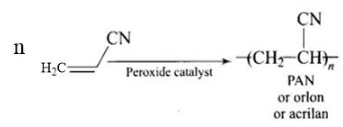
Acrilan is a hard,horny,and high-melting material. Which of the following represents its structure?
A
$[-CH_2-CH(CN)-]_n$
B
$[-CH_2-C(CH_3)(COOCH_3)-]_n$
C
$[-CH_2-CH(COOC_2H_5)-]_n$
D
$[-CH_2-CH(Cl)-]_n$
Solution
(A) Acrilan is the commercial name for Polyacrylonitrile $(PAN)$.
It is a synthetic polymer produced from the monomer acrylonitrile $(CH_2=CH-CN)$ through free radical polymerization.
It is characterized as a hard,horny,and high-melting material.
Its structure is represented as $[-CH_2-CH(CN)-]_n$.
It is a synthetic polymer produced from the monomer acrylonitrile $(CH_2=CH-CN)$ through free radical polymerization.
It is characterized as a hard,horny,and high-melting material.
Its structure is represented as $[-CH_2-CH(CN)-]_n$.
0 likes
View Solution217
MediumMCQ
Which of the following is an organo silicon polymer?
A
Silica
B
Silicone
C
Silicon carbide
D
Silicic acid
Solution
(B) Silicone is a polymeric organo silicon compound which is chemically inert and thermally stable.
0 likes
View Solution218
MediumMCQ
Ethylene glycol and terephthalic acid are monomers of which of the following polymer?
A
Nylon-$6,6$
B
Terylene
C
Glyptal
D
Bakelite
Solution
(B) The condensation polymerization of ethylene glycol $(HO-CH_2-CH_2-OH)$ and terephthalic acid $(C_6H_4(COOH)_2)$ results in the formation of Terylene (also known as Dacron).
This is a polyester fiber.
Therefore,the correct option is $B$.
This is a polyester fiber.
Therefore,the correct option is $B$.
0 likes
View Solution219
MediumMCQ
The structure of the monomer unit of natural rubber is:
A
$H_2C=C(Cl)-CH=CH_2$
B
$H_2C=C(C_6H_5)-CH=CH_2$
C
$H_2C=C(CH_3)-CH=CH_2$
D
$(-CH_2-CH_2-)_n$
Solution
(C) Natural rubber is a linear polymer of isoprene ($2$-methyl-$1,3$-butadiene).
The monomer unit is $H_2C=C(CH_3)-CH=CH_2$.
The monomer unit is $H_2C=C(CH_3)-CH=CH_2$.
0 likes
View Solution220
EasyMCQ
Polyamide linkage is present in
A
Nylon
B
Silk
C
Protein
D
All of these
Solution
(D) polyamide is a polymer containing monomers of amides joined by peptide bonds.
$1$. $Nylon$ (e.g.,$Nylon-6,6$) is a synthetic polyamide containing $-CONH-$ linkages.
$2$. $Silk$ is a natural fiber composed of proteins,which are polypeptides containing peptide (amide) linkages.
$3$. $Proteins$ are polymers of $\alpha$-amino acids linked by peptide bonds $(-CONH-)$.
Therefore,all the given options contain polyamide linkages.
$1$. $Nylon$ (e.g.,$Nylon-6,6$) is a synthetic polyamide containing $-CONH-$ linkages.
$2$. $Silk$ is a natural fiber composed of proteins,which are polypeptides containing peptide (amide) linkages.
$3$. $Proteins$ are polymers of $\alpha$-amino acids linked by peptide bonds $(-CONH-)$.
Therefore,all the given options contain polyamide linkages.
0 likes
View Solution221
EasyMCQ
Natural rubber is a polymer of
A
Styrene
B
Chloroprene
C
Isoprene
D
$1,3-$Butadiene
Solution
(C) Natural rubber is a linear polymer of isoprene ($2-$methyl-$1,3-$butadiene).
Its chemical structure is $(C_5H_8)_n$.
Its chemical structure is $(C_5H_8)_n$.
0 likes
View Solution222
EasyMCQ
Nylon $-6, 6$ is
A
polyamide
B
polyester
C
polystyrene
D
polyvinyl
Solution
(A) The monomers of Nylon $-6, 6$ are adipic acid $(HOOC(CH_2)_4COOH)$ and hexamethylene diamine $(H_2N(CH_2)_6NH_2)$.
These monomers undergo condensation polymerization to form amide linkages $(-CONH-)$.
Therefore,Nylon $-6, 6$ is a polyamide.
These monomers undergo condensation polymerization to form amide linkages $(-CONH-)$.
Therefore,Nylon $-6, 6$ is a polyamide.
0 likes
View Solution223
EasyMCQ
Which of the following is a biodegradable polymer?
A
$PHBV$
B
$PVC$
C
Polyethene
D
All of these
Solution
(A) $PHBV$ is a biodegradable polymer.
$PHBV$ stands for Poly($3$-hydroxybutyrate-co-$3$-hydroxyvalerate).
It is a copolymer formed by the combination of $3$-hydroxybutanoic acid and $3$-hydroxypentanoic acid.
$PHBV$ stands for Poly($3$-hydroxybutyrate-co-$3$-hydroxyvalerate).
It is a copolymer formed by the combination of $3$-hydroxybutanoic acid and $3$-hydroxypentanoic acid.
0 likes
View Solution224
MediumMCQ
Nylon $2-$ Nylon $6$ is
A
Biodegradable polymer
B
Copolymer
C
Polyamide
D
All
Solution
(D) Nylon $2-$ Nylon $6$ is a polyamide copolymer formed by the condensation polymerization of glycine $(H_2N-CH_2-COOH)$ and amino caproic acid $(H_2N-(CH_2)_5-COOH)$.
It is a biodegradable polymer because it can be broken down by microorganisms.
Therefore,all the given options are correct.
It is a biodegradable polymer because it can be broken down by microorganisms.
Therefore,all the given options are correct.
0 likes
View Solution225
EasyMCQ
Which is a biodegradable polymer?
A
$PMMA$
B
$PVC$
C
$PAN$
D
$PHBV$
Solution
(D) . Biodegradable polymers are those that can be decomposed by microorganisms.
$PHBV$ (Poly-$\beta$-hydroxybutyrate-co-$\beta$-hydroxyvalerate) is a well-known biodegradable aliphatic polyester.
$PMMA$,$PVC$,and $PAN$ are synthetic non-biodegradable polymers.
$PHBV$ (Poly-$\beta$-hydroxybutyrate-co-$\beta$-hydroxyvalerate) is a well-known biodegradable aliphatic polyester.
$PMMA$,$PVC$,and $PAN$ are synthetic non-biodegradable polymers.
0 likes
View Solution226
MediumMCQ
The repeating unit of organosilicon polymers (silicones) is:
A
$(- R_2Si -)_n$
B
$(- R_2SiO_2 -)_n$
C
$(- R_2SiO -)_n$
D
All of these
Solution
(C) Silicones are synthetic organosilicon polymers which have the general formula $(R_2SiO)_n$,where $R$ is a methyl or phenyl group.
These polymers contain $(R_2Si-O)$ repeating units held together by $Si-O-Si$ linkages.
Therefore,the repeating unit is $(- R_2SiO -)_n$.
These polymers contain $(R_2Si-O)$ repeating units held together by $Si-O-Si$ linkages.
Therefore,the repeating unit is $(- R_2SiO -)_n$.
0 likes
View Solution227
MediumMCQ
Which of the following is not true?
A
Nylon-$2$-Nylon-$6$: Biodegradable polymer
B
Dacron: Polyester
C
BuNa-$S$: Elastomer
D
Bakelite: Addition polymer
Solution
(D) $1$. Nylon-$2$-Nylon-$6$ is a polyamide copolymer of glycine and amino caproic acid,which is indeed a biodegradable polymer.
$2$. Dacron (also known as Terylene) is a polyester formed by the condensation polymerization of ethylene glycol and terephthalic acid.
$3$. BuNa-$S$ is a synthetic rubber (styrene-butadiene rubber),which is classified as an elastomer.
$4$. Bakelite is a phenol-formaldehyde resin,which is formed by condensation polymerization,not addition polymerization. Therefore,the statement 'Bakelite: Addition polymer' is false.
$2$. Dacron (also known as Terylene) is a polyester formed by the condensation polymerization of ethylene glycol and terephthalic acid.
$3$. BuNa-$S$ is a synthetic rubber (styrene-butadiene rubber),which is classified as an elastomer.
$4$. Bakelite is a phenol-formaldehyde resin,which is formed by condensation polymerization,not addition polymerization. Therefore,the statement 'Bakelite: Addition polymer' is false.
0 likes
View Solution228
MediumMCQ
Nylon $6, 6$ is:
A
Copolymer
B
Fiber
C
Step growth polymer
D
All
Solution
(D) Nylon $6, 6$ is formed by the condensation polymerization of hexamethylenediamine and adipic acid.
$1$. It is a $Copolymer$ because it is formed from two different types of monomers.
$2$. It is a $Fiber$ because it has strong intermolecular forces like hydrogen bonding,which makes it suitable for spinning into fibers.
$3$. It is a $Step \text{ } growth \text{ } polymer$ because the polymerization proceeds through the formation of intermediate species in a step-wise manner.
Therefore,all the given options are correct.
$1$. It is a $Copolymer$ because it is formed from two different types of monomers.
$2$. It is a $Fiber$ because it has strong intermolecular forces like hydrogen bonding,which makes it suitable for spinning into fibers.
$3$. It is a $Step \text{ } growth \text{ } polymer$ because the polymerization proceeds through the formation of intermediate species in a step-wise manner.
Therefore,all the given options are correct.
0 likes
View Solution229
EasyMCQ
Which of the following polymers has the strongest intermolecular forces of attraction?
A
$PVC$
B
Dacron
C
Neoprene
D
Buna-$N$
Solution
(B) The strength of intermolecular forces in polymers follows the order: Fibres > Thermoplastics > Elastomers.
$Dacron$ (also known as Terylene) is a polyester fibre.
Fibres possess strong intermolecular forces like hydrogen bonding or dipole-dipole interactions,which lead to close packing of chains and high crystallinity.
$PVC$,$Neoprene$,and $Buna-N$ are elastomers or thermoplastics,which have weaker intermolecular forces compared to fibres.
Therefore,$Dacron$ has the strongest intermolecular forces of attraction among the given options.
$Dacron$ (also known as Terylene) is a polyester fibre.
Fibres possess strong intermolecular forces like hydrogen bonding or dipole-dipole interactions,which lead to close packing of chains and high crystallinity.
$PVC$,$Neoprene$,and $Buna-N$ are elastomers or thermoplastics,which have weaker intermolecular forces compared to fibres.
Therefore,$Dacron$ has the strongest intermolecular forces of attraction among the given options.
0 likes
View Solution230
MediumMCQ
The polymer having an amide linkage is
A
Nylon $6,6$
B
Terylene
C
Teflon
D
Bakelite
Solution
(A) Polyamides are polymers that contain the amide linkage $(-CONH-)$ in their backbone.
Nylon $6,6$ is a polyamide formed by the condensation polymerization of hexamethylenediamine and adipic acid.
Therefore,Nylon $6,6$ contains amide linkages.
Nylon $6,6$ is a polyamide formed by the condensation polymerization of hexamethylenediamine and adipic acid.
Therefore,Nylon $6,6$ contains amide linkages.
0 likes
View Solution231
EasyMCQ
Orlon is a polymer of:
A
Styrene
B
$CF_2=CF_2$
C
Vinyl chloride
D
Acrylonitrile
Solution
(D) Orlon,also known as polyacrylonitrile $(PAN)$,is a synthetic polymer formed by the polymerization of acrylonitrile $(CH_2=CH-CN)$.
Therefore,the correct option is $D$.
Therefore,the correct option is $D$.
0 likes
View Solution232
EasyMCQ
Which of the following is a condensation polymer?
A
$PVC$
B
Plexiglass
C
Polyisoprene
D
Bakelite
Solution
(D) Condensation polymers are formed by the repeated condensation reaction between two different bi-functional or tri-functional monomeric units,often involving the elimination of small molecules like $H_2O$,$HCl$,or $NH_3$.
$PVC$ (Polyvinyl chloride),Plexiglass (Polymethyl methacrylate),and Polyisoprene (Natural rubber) are all addition polymers formed by the polymerization of unsaturated monomers.
Bakelite is a phenol-formaldehyde resin,which is a classic example of a condensation polymer formed by the reaction of phenol and formaldehyde with the elimination of water molecules.
$PVC$ (Polyvinyl chloride),Plexiglass (Polymethyl methacrylate),and Polyisoprene (Natural rubber) are all addition polymers formed by the polymerization of unsaturated monomers.
Bakelite is a phenol-formaldehyde resin,which is a classic example of a condensation polymer formed by the reaction of phenol and formaldehyde with the elimination of water molecules.
0 likes
View Solution233
MediumMCQ
Formaldehyde is not present as a monomer in:
A
Bakelite
B
Novolac
C
Orlon
D
Melamine resin
Solution
(C) Formaldehyde $(HCHO)$ is a common monomer used in the preparation of condensation polymers like Bakelite,Novolac,and Melamine resin.
$1$. Bakelite and Novolac are formed by the condensation reaction of phenol and formaldehyde.
$2$. Melamine resin is formed by the condensation reaction of melamine and formaldehyde.
$3$. Orlon (also known as polyacrylonitrile) is an addition polymer formed by the polymerization of acrylonitrile $(CH_2=CH-CN)$.
Therefore,formaldehyde is not a monomer in the formation of Orlon.
$1$. Bakelite and Novolac are formed by the condensation reaction of phenol and formaldehyde.
$2$. Melamine resin is formed by the condensation reaction of melamine and formaldehyde.
$3$. Orlon (also known as polyacrylonitrile) is an addition polymer formed by the polymerization of acrylonitrile $(CH_2=CH-CN)$.
Therefore,formaldehyde is not a monomer in the formation of Orlon.
0 likes
View Solution234
MediumMCQ
During the vulcanization of rubber,natural rubber is heated with sulphur and some other additive to:
A
Increase cross-linking
B
Decrease cross-linking
C
Induce hydrogen bonding
D
Sulphur is used as a monomer
Solution
(A) During the vulcanization of rubber,natural rubber is heated with sulphur and an appropriate additive at a temperature range of $373 \ K$ to $415 \ K$. This process forms sulphur bridges between the polymer chains,which increases cross-linking and improves the mechanical properties of the rubber.
0 likes
View Solution235
MediumMCQ
Which of the following polymers contains an amide linkage?
A
Nylon-$6,6$
B
Terylene
C
Teflon
D
Bakelite
Solution
(A) Nylon-$6,6$ is a polyamide formed by the condensation polymerization of hexamethylenediamine and adipic acid.
It contains the characteristic amide linkage,represented as $-CONH-$,in its polymer chain.
It contains the characteristic amide linkage,represented as $-CONH-$,in its polymer chain.
0 likes
View Solution236
EasyMCQ
The monomer of Teflon is
A
$CF_2 = CF_2$
B
$CFCl = CF_2$
C
$CCl_2 = CCl_2$
D
$CFCl = CFCl$
Solution
(A) Teflon is a polymer of tetrafluoroethene.
The chemical formula of tetrafluoroethene is $CF_2 = CF_2$.
Therefore,the monomer of Teflon is $CF_2 = CF_2$.
The chemical formula of tetrafluoroethene is $CF_2 = CF_2$.
Therefore,the monomer of Teflon is $CF_2 = CF_2$.
0 likes
View Solution237
EasyMCQ
In bakelite,the rings are joined to each other through
A
$-CH_2-$
B
$-O-$
C
$-CO-$
D
$-COO-$
Solution
(A) Bakelite is a phenol-formaldehyde resin.
It is a cross-linked polymer where the phenol rings are joined together by methylene bridges ($-CH_2-$ groups) at the ortho and para positions.
It is a cross-linked polymer where the phenol rings are joined together by methylene bridges ($-CH_2-$ groups) at the ortho and para positions.
0 likes
View Solution238
MediumMCQ
Which of the following is incorrectly matched?
A
$Nylon-6$ : Caprolactam
B
$PHBV$ : Biodegradable polymer
C
Dacron : Fibre
D
Low density polyethene $(LDPE)$ : Ziegler-Natta catalyst
Solution
(D) $1$. $Nylon-6$ is prepared by the polymerization of caprolactam. This is correctly matched.
$2$. $PHBV$ (poly-$\beta$-hydroxybutyrate-co-$\beta$-hydroxyvalerate) is a well-known biodegradable polymer. This is correctly matched.
$3$. Dacron (also known as Terylene) is a polyester used as a fibre. This is correctly matched.
$4$. Low density polyethene $(LDPE)$ is prepared by free radical polymerization of ethene at high pressure and temperature. Ziegler-Natta catalyst is used for the preparation of High Density Polyethene $(HDPE)$. Therefore,this is incorrectly matched.
$2$. $PHBV$ (poly-$\beta$-hydroxybutyrate-co-$\beta$-hydroxyvalerate) is a well-known biodegradable polymer. This is correctly matched.
$3$. Dacron (also known as Terylene) is a polyester used as a fibre. This is correctly matched.
$4$. Low density polyethene $(LDPE)$ is prepared by free radical polymerization of ethene at high pressure and temperature. Ziegler-Natta catalyst is used for the preparation of High Density Polyethene $(HDPE)$. Therefore,this is incorrectly matched.
0 likes
View Solution239
EasyMCQ
Which of the following is an incorrect match for the pair of $\text{Polymer} - \text{Monomer}$?
A
$\text{Novolac} - \text{Phenol and formaldehyde}$
B
$\text{Nylon } 6 - \text{Caprolactam}$
C
$\text{BuNa-}N - 1,3\text{-Butadiene and acrylonitrile}$
D
$\text{Natural rubber} - \text{cis-Isoprene}$
Solution
(NONE) The correct pairings are as follows:
$1$. $\text{Novolac}$ is formed from $\text{Phenol}$ and $\text{Formaldehyde}$. (Correct)
$2$. $\text{Nylon } 6$ is formed from $\text{Caprolactam}$. (Correct)
$3$. $\text{BuNa-}N$ is formed from $1,3\text{-Butadiene}$ and $\text{Acrylonitrile}$. (Correct)
$4$. $\text{Natural rubber}$ is a polymer of $\text{cis-1,4-polyisoprene}$,where the monomer is $\text{Isoprene}$ $(2\text{-methyl-1,3-butadiene})$. While the option says $\text{cis-Isoprene}$,$\text{Isoprene}$ itself is the monomer. However,in standard chemistry nomenclature,$\text{Nylon } 6$ is derived from $\text{Caprolactam}$ (spelled with an 'a'). All given options are technically correct in their chemical associations. If this is a multiple-choice question where one must be incorrect,there might be a typo in the provided options. Given the standard curriculum,all these pairs are correct.
$1$. $\text{Novolac}$ is formed from $\text{Phenol}$ and $\text{Formaldehyde}$. (Correct)
$2$. $\text{Nylon } 6$ is formed from $\text{Caprolactam}$. (Correct)
$3$. $\text{BuNa-}N$ is formed from $1,3\text{-Butadiene}$ and $\text{Acrylonitrile}$. (Correct)
$4$. $\text{Natural rubber}$ is a polymer of $\text{cis-1,4-polyisoprene}$,where the monomer is $\text{Isoprene}$ $(2\text{-methyl-1,3-butadiene})$. While the option says $\text{cis-Isoprene}$,$\text{Isoprene}$ itself is the monomer. However,in standard chemistry nomenclature,$\text{Nylon } 6$ is derived from $\text{Caprolactam}$ (spelled with an 'a'). All given options are technically correct in their chemical associations. If this is a multiple-choice question where one must be incorrect,there might be a typo in the provided options. Given the standard curriculum,all these pairs are correct.
0 likes
View Solution240
MediumMCQ
Name the polymer used in the manufacturing of rayon.
A
Polyester
B
Nylon
C
Cellulose
D
Starch
Solution
(C) Rayon is a semi-synthetic fiber obtained from natural sources.
It is manufactured from wood pulp,which is primarily composed of $Cellulose$.
Therefore,$Cellulose$ is the polymer used in the manufacturing of rayon.
It is manufactured from wood pulp,which is primarily composed of $Cellulose$.
Therefore,$Cellulose$ is the polymer used in the manufacturing of rayon.
0 likes
View Solution241
MediumMCQ
Thermosetting polymers are .........
A
Generally soluble
B
Do not melt or soften on heating
C
Become cross-linked during heating
D
All of the above are correct
Solution
(D) Thermosetting polymers are cross-linked or heavily branched molecules,which on heating undergo extensive cross-linking in molds and again become infusible. Thus,they do not melt or soften on heating. They are generally insoluble in common solvents due to their rigid network structure. Therefore,both statements $B$ and $C$ are correct,making $D$ the correct answer.
0 likes
View Solution242
EasyMCQ
Which of the following is an example of a thermosetting polymer?
A
Polyethylene
B
Neoprene
C
$PVC$
D
Bakelite
Solution
(D) Thermosetting polymers are cross-linked polymers that undergo extensive cross-linking in molds during their formation and become infusible and insoluble on heating.
Examples include Bakelite,urea-formaldehyde resins,etc.
Polyethylene,Neoprene,and $PVC$ are thermoplastic polymers.
Examples include Bakelite,urea-formaldehyde resins,etc.
Polyethylene,Neoprene,and $PVC$ are thermoplastic polymers.
0 likes
View Solution243
EasyMCQ
The intermolecular forces present in $Nylon-6,6$ are........
A
Van der Waals forces
B
Hydrogen bonding
C
Dipole-dipole interactions
D
None of the above
Solution
(B) $Nylon-6,6$ is a polyamide polymer formed by the condensation polymerization of hexamethylenediamine and adipic acid.
These polymer chains are held together by strong intermolecular hydrogen bonds between the carbonyl oxygen $(C=O)$ of one chain and the amide hydrogen $(N-H)$ of the adjacent chain.
These hydrogen bonds provide high crystallinity and high tensile strength to the polymer.
These polymer chains are held together by strong intermolecular hydrogen bonds between the carbonyl oxygen $(C=O)$ of one chain and the amide hydrogen $(N-H)$ of the adjacent chain.
These hydrogen bonds provide high crystallinity and high tensile strength to the polymer.
0 likes
View Solution244
EasyMCQ
Which of the following polymers is an elastomer?
A
Buna-$S$
B
Nylon
C
$PVC$
D
Terylene
Solution
(A) Elastomers are polymers in which the polymer chains are held together by the weakest intermolecular forces. These weak forces permit the polymer to be stretched. Buna-$S$ is a synthetic rubber,which is a classic example of an elastomer. Nylon and Terylene are fibers,and $PVC$ is a thermoplastic.
0 likes
View Solution245
MediumMCQ
Which of the following is a cross-linked polymer?
A
Polypropylene
B
Nylon-$66$
C
Nylon-$6$
D
Bakelite
Solution
(D) Cross-linked polymers are formed from bi-functional and tri-functional monomers and contain strong covalent bonds between various linear polymer chains.
Bakelite is a classic example of a cross-linked polymer formed by the condensation reaction of phenol and formaldehyde.
Polypropylene,Nylon-$66$,and Nylon-$6$ are linear polymers.
Bakelite is a classic example of a cross-linked polymer formed by the condensation reaction of phenol and formaldehyde.
Polypropylene,Nylon-$66$,and Nylon-$6$ are linear polymers.
0 likes
View Solution246
MediumMCQ
Which of the following is used to make rubber hard for tire manufacturing?
A
Wax
B
$1, 3-$ Butadiene
C
$CaC_2$
D
Carbon black
Solution
(D) In the manufacturing of tires,rubber is reinforced to increase its durability and hardness.
Carbon black is added to the rubber to improve its tensile strength and resistance to wear and tear,making it suitable for tire production.
Carbon black is added to the rubber to improve its tensile strength and resistance to wear and tear,making it suitable for tire production.
0 likes
View Solution247
EasyMCQ
To make $PVC$ a flexible plastic,............. is added during polymerization.
A
Filler
B
Antioxidant
C
Stabilizer
D
Plasticizer
Solution
(D) Polyvinyl chloride $(PVC)$ is inherently a hard and brittle polymer. To make it flexible and suitable for applications like pipes,cables,and films,additives known as plasticizers (such as di$-2-$ethylhexyl phthalate) are added during the processing or polymerization stage. These molecules insert themselves between the polymer chains,increasing the free volume and reducing intermolecular forces,which results in increased flexibility.
0 likes
View Solution248
MediumMCQ
Which of the following contains an ester linkage?
A
Nylon
B
Bakelite
C
Terylene
D
$PVC$
Solution
(C) Terylene (also known as Dacron) is a polyester polymer.
It is formed by the condensation polymerization of ethylene glycol $(HO-CH_2-CH_2-OH)$ and terephthalic acid $(C_6H_4(COOH)_2)$.
The reaction involves the formation of an ester linkage $(-COO-)$ between the monomer units.
Nylon contains amide linkages,Bakelite is a phenol-formaldehyde resin,and $PVC$ is a vinyl polymer.
It is formed by the condensation polymerization of ethylene glycol $(HO-CH_2-CH_2-OH)$ and terephthalic acid $(C_6H_4(COOH)_2)$.
The reaction involves the formation of an ester linkage $(-COO-)$ between the monomer units.
Nylon contains amide linkages,Bakelite is a phenol-formaldehyde resin,and $PVC$ is a vinyl polymer.
0 likes
View Solution249
MediumMCQ
Which of the following pairs is $NOT$ correctly matched?
A
Terylene - Condensation polymer of terephthalic acid and ethylene glycol
B
Teflon - Thermally stable cross-linked polymer of phenol and formaldehyde
C
Perspex - Homopolymer of methyl methacrylate
D
Synthetic rubber - Co-polymer of butadiene and styrene
Solution
(B) The correct answer is $B$.
$Teflon$ is a polymer of tetrafluoroethylene $(CF_2=CF_2)$,which is a thermoplastic.
Phenol and formaldehyde form $Bakelite$,which is a cross-linked thermosetting polymer.
$Terylene$ is indeed a condensation polymer of terephthalic acid and ethylene glycol.
$Perspex$ (or $PMMA$) is a homopolymer of methyl methacrylate.
$Synthetic$ $rubber$ (like $Buna-S$) is a co-polymer of $1,3-butadiene$ and styrene.
$Teflon$ is a polymer of tetrafluoroethylene $(CF_2=CF_2)$,which is a thermoplastic.
Phenol and formaldehyde form $Bakelite$,which is a cross-linked thermosetting polymer.
$Terylene$ is indeed a condensation polymer of terephthalic acid and ethylene glycol.
$Perspex$ (or $PMMA$) is a homopolymer of methyl methacrylate.
$Synthetic$ $rubber$ (like $Buna-S$) is a co-polymer of $1,3-butadiene$ and styrene.
0 likes
View Solution250
MediumMCQ
The chemical name of the melamine monomer is ....
A
$2, 4, 6-$triamino$-1, 3, 5-$triazine
B
$1, 3, 5-$triamino$-2, 4, 6-$triazine
C
$2, 4-$diamino$-1, 3, 5-$triazine
D
$2-$amino$-1, 3, 5-$triazine
Solution
(A) Melamine is a heterocyclic organic compound with the formula $C_3H_6N_6$.
Its structure consists of a $1, 3, 5-$triazine ring substituted with three amino groups at the $2, 4,$ and $6$ positions.
Therefore,its $IUPAC$ name is $2, 4, 6-$triamino$-1, 3, 5-$triazine.
Its structure consists of a $1, 3, 5-$triazine ring substituted with three amino groups at the $2, 4,$ and $6$ positions.
Therefore,its $IUPAC$ name is $2, 4, 6-$triamino$-1, 3, 5-$triazine.
0 likes
View SolutionPolymers — Composition, Properties and Uses of Polymer · Frequently Asked Questions
1Are these Polymers questions useful for JEE and NEET?
Yes. All questions in this section are mapped to JEE Main and NEET exam patterns. Previous year questions from JEE Main, NEET, GUJCET and state-level exams are included with full solutions.
2Can I switch to Hindi or Gujarati for these questions?
Yes. Use the language tabs in the hero section or the sidebar to view the same questions and solutions in English, Hindi or Gujarati.
3How do I generate a question paper from this subtopic?
Use the Vedclass Exam Paper Generator — select the chapter and subtopic, set difficulty, and generate Sets A, B, C, D automatically. First 3 chapters of every subject are free.
Vedclass Products
For Students
Vedclass Test Series
Mock tests in real JEE/NEET style with performance analysis. 5-day free trial.
Start Free TrialFor Teachers
Exam Paper Generator
Generate Set A/B/C/D papers from this chapter in 2 minutes. 3 chapters free.
Try FreeFor Institutes
Online Exam Module
Live online exams with unlimited students, 360° analytics & white-label branding.
See DemoFor Teachers & Institutes
Generate a Polymers Exam Paper in 2 Minutes
Select subtopic & difficulty — Sets A, B, C, D auto-generated with No Repeat logic.
First 3 chapters of every subject are free — no payment required.