
A English
Composition, Properties and Uses of Polymer Questions in English
Class 12 Chemistry · Polymers · Composition, Properties and Uses of Polymer
556+
Questions
English
Language
100%
With Solutions
Showing 50 of 556 questions in English
151
DifficultMCQ
Which of the following organic compounds polymerizes to form the polyester dacron?
A
Propylene and para-$HO-(C_6H_4)-OH$
B
Benzoic acid and ethanol
C
Terephthalic acid and ethylene glycol
D
Benzoic acid and para-$HO-(C_6H_4)-OH$
Solution
(C) Dacron,also known as terylene,is a condensation polymer formed by the polymerization of terephthalic acid $(HOOC-C_6H_4-COOH)$ and ethylene glycol $(HO-CH_2-CH_2-OH)$.
This reaction occurs by heating the mixture at $420-460 \ K$ in the presence of zinc acetate and antimony trioxide as a catalyst,resulting in the elimination of water molecules.
This reaction occurs by heating the mixture at $420-460 \ K$ in the presence of zinc acetate and antimony trioxide as a catalyst,resulting in the elimination of water molecules.
0 likes
View Solution152
MediumMCQ
Which of the following statements is false?
A
Artificial silk is derived from cellulose.
B
Nylon-$6,6$ is an example of elastomer.
C
The repeat unit in natural rubber is isoprene.
D
Both starch and cellulose are polymers of glucose.
Solution
(B) Elastomers are polymers that possess weak intermolecular forces of attraction,allowing them to be stretched.
Nylon-$6,6$ is a fibre,not an elastomer,because it has strong intermolecular forces like hydrogen bonding.
Artificial silk (rayon) is indeed derived from cellulose.
Natural rubber is a polymer of isoprene ($2$-methyl-$1,3$-butadiene).
Both starch and cellulose are natural polymers of glucose.
Therefore,the statement that Nylon-$6,6$ is an elastomer is false.
Nylon-$6,6$ is a fibre,not an elastomer,because it has strong intermolecular forces like hydrogen bonding.
Artificial silk (rayon) is indeed derived from cellulose.
Natural rubber is a polymer of isoprene ($2$-methyl-$1,3$-butadiene).
Both starch and cellulose are natural polymers of glucose.
Therefore,the statement that Nylon-$6,6$ is an elastomer is false.
0 likes
View Solution153
MediumMCQ
Which one of the following sets forms a biodegradable polymer?
A
$CH_2=CH-CN$ and $CH_2=CH-CH=CH_2$
B
$H_2N-CH_2-COOH$ and $H_2N-(CH_2)_5-COOH$
C
$HO-CH_2-CH_2-OH$ and $HOOC-C_6H_4-COOH$
D
$CH_2=CH-CH=CH_2$ and $C_6H_5-CH=CH_2$
Solution
(B) Biodegradable polymers are polymers that can be decomposed by microorganisms.
Option $B$ involves $H_2N-CH_2-COOH$ (Glycine) and $H_2N-(CH_2)_5-COOH$ (Aminocaproic acid). These monomers undergo condensation polymerization to form Nylon-$2$-Nylon-$6$,which is a well-known biodegradable polyamide polymer.
Therefore,the correct set is $B$.
Option $B$ involves $H_2N-CH_2-COOH$ (Glycine) and $H_2N-(CH_2)_5-COOH$ (Aminocaproic acid). These monomers undergo condensation polymerization to form Nylon-$2$-Nylon-$6$,which is a well-known biodegradable polyamide polymer.
Therefore,the correct set is $B$.
0 likes
View Solution154
DifficultMCQ
Of the following,which one is classified as a polyester polymer?
A
Terylene
B
Bakelite
C
Melamine
D
Nylon $6,6$
Solution
(A) $Terylene$ is a polyester because it contains ester linkages $(-COO-)$ in its backbone.
It is formed by the condensation polymerization of monomer units,terephthalic acid $(C_6H_4(COOH)_2)$ and ethylene glycol $(HO-CH_2-CH_2-OH)$.
It is formed by the condensation polymerization of monomer units,terephthalic acid $(C_6H_4(COOH)_2)$ and ethylene glycol $(HO-CH_2-CH_2-OH)$.
0 likes
View Solution155
MediumMCQ
Which of the following structures represents the neoprene polymer?
A
$[-CH_2-C(Cl)=CH-CH_2-]_n$
B
$[-CH_2-CH(Cl)-]_n$
C
$[-CH_2-CH(CN)-]_n$
D
$[-CH_2-CH(C_6H_5)-]_n$
Solution
(A) Neoprene is a synthetic rubber produced by the free radical polymerization of chloroprene ($2$-chloro-$1,3$-butadiene).
The repeating unit of neoprene is formed by the polymerization of $CH_2=C(Cl)-CH=CH_2$.
The resulting structure is $[-CH_2-C(Cl)=CH-CH_2-]_n$.
The repeating unit of neoprene is formed by the polymerization of $CH_2=C(Cl)-CH=CH_2$.
The resulting structure is $[-CH_2-C(Cl)=CH-CH_2-]_n$.
0 likes
View Solution156
DifficultMCQ
Structures of some common polymers are given. Which one is not correctly presented?
A
Neoprene - $[ - CH_2 - C(Cl) = CH - CH_2 - CH_2 - ]_n$
B
Terylene - $[ - OC - C_6H_4 - COOCH_2 - CH_2 - O - ]_n$
C
Nylon $6,6$ - $[ - NH(CH_2)_6NHCO(CH_2)_4CO - ]_n$
D
Teflon - $[ - CF_2 - CF_2 - ]_n$
Solution
(A) Neoprene is a polymer of chloroprene ($2$-chloro-$1,3$-butadiene). Its correct repeating unit is $[ - CH_2 - C(Cl) = CH - CH_2 - ]_n$. The structure provided in option $(A)$ is incorrect because it contains an extra $-CH_2-$ group in the main chain.
0 likes
View Solution157
DifficultMCQ
Which one of the following statements is not true?
A
$Buna-S$ is a copolymer of butadiene and styrene.
B
Natural rubber is a $1,4$-polymer of isoprene.
C
In vulcanization,the formation of sulphur bridges between different chains makes rubber harder and stronger.
D
Natural rubber has the $trans$-configuration at every double bond.
Solution
(D) Natural rubber is $cis-1,4-polyisoprene$ and has all $cis$ configurations about the double bond as shown in the structure. It is prepared from latex which is obtained as the $cis$ form,called $Havea$ Rubber,from the rubber tree ($Havea$ $brasiliensis$). Therefore,the statement that natural rubber has $trans$-configuration is false.
0 likes
View Solution158
DifficultMCQ
Buna-$N$ synthetic rubber is a copolymer of:
A
$CH_2=CH-CH=CH_2$ and $C_6H_5-CH=CH_2$
B
$CH_2=CH-CN$ and $CH_2=CH-CH=CH_2$
C
$CH_2=CH-CN$ and $CH_2=CH-C(CH_3)=CH_2$
D
$CH_2=CH-C(Cl)=CH_2$ and $CH_2=CH-CH=CH_2$
Solution
(B) Buna-$N$ is a synthetic rubber formed by the copolymerization of $1,3$-butadiene $(CH_2=CH-CH=CH_2)$ and acrylonitrile $(CH_2=CH-CN)$ in the presence of a peroxide catalyst.
0 likes
View Solution159
DifficultMCQ
Which polymer is used in the manufacture of paints and lacquers?
A
Polypropene
B
Polyvinyl chloride
C
Bakelite
D
Glyptal
Solution
(D) Bakelite is used for making gears,protective coatings,and electrical fittings.
$(b)$ Glyptal is used in the manufacture of paints and lacquers.
$(c)$ $PP$ (Polypropene) is used in the manufacture of textiles,packaging materials,etc.
$(d)$ Polyvinyl chloride $(PVC)$ is used in the manufacture of raincoats,handbags,and leather clothes.
$(b)$ Glyptal is used in the manufacture of paints and lacquers.
$(c)$ $PP$ (Polypropene) is used in the manufacture of textiles,packaging materials,etc.
$(d)$ Polyvinyl chloride $(PVC)$ is used in the manufacture of raincoats,handbags,and leather clothes.
0 likes
View Solution160
MediumMCQ
Which of the following statements about low density polythene is $FALSE$?
A
Its synthesis requires dioxygen or a peroxide initiator as a catalyst.
B
It is used in the manufacture of buckets,dust-bins etc.
C
Its synthesis requires high pressure.
D
It is a poor conductor of electricity.
Solution
(B) Low density polythene $(LDPE)$ is a poor conductor of electricity.
Its synthesis involves the polymerization of ethene at high pressure $(1000-2000 \ atm)$ and temperatures $(350-570 \ K)$ in the presence of traces of dioxygen or a peroxide initiator as a catalyst.
$LDPE$ is chemically inert and tough but flexible,making it suitable for squeeze bottles,toys,and flexible pipes.
High density polythene $(HDPE)$ is used in the manufacture of buckets,dust-bins,and bottles.
Therefore,the statement that $LDPE$ is used in the manufacture of buckets and dust-bins is $FALSE$.
Its synthesis involves the polymerization of ethene at high pressure $(1000-2000 \ atm)$ and temperatures $(350-570 \ K)$ in the presence of traces of dioxygen or a peroxide initiator as a catalyst.
$LDPE$ is chemically inert and tough but flexible,making it suitable for squeeze bottles,toys,and flexible pipes.
High density polythene $(HDPE)$ is used in the manufacture of buckets,dust-bins,and bottles.
Therefore,the statement that $LDPE$ is used in the manufacture of buckets and dust-bins is $FALSE$.
0 likes
View Solution161
DifficultMCQ
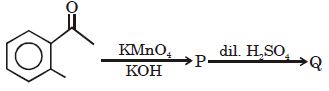
The major product $(Q)$ of the following reaction is used to form:
A
Terylene
B
Bakelite
C
Glyptal
D
Nylon-$6,6$
Solution
(C) The starting material is $o$-methylacetophenone (or $2-$methylacetophenone).
Treatment with $KMnO_4/KOH$ followed by acidification with $dil. H_2SO_4$ leads to the oxidation of both the acetyl group $(-COCH_3)$ and the methyl group $(-CH_3)$ attached to the benzene ring into carboxylic acid groups $(-COOH)$.
The product $(Q)$ is phthalic acid (benzene$-1,2-$dicarboxylic acid).
Phthalic acid is a key monomer used in the synthesis of the polymer Glyptal (polyethylene phthalate) by reacting it with ethylene glycol.
Treatment with $KMnO_4/KOH$ followed by acidification with $dil. H_2SO_4$ leads to the oxidation of both the acetyl group $(-COCH_3)$ and the methyl group $(-CH_3)$ attached to the benzene ring into carboxylic acid groups $(-COOH)$.
The product $(Q)$ is phthalic acid (benzene$-1,2-$dicarboxylic acid).
Phthalic acid is a key monomer used in the synthesis of the polymer Glyptal (polyethylene phthalate) by reacting it with ethylene glycol.
0 likes
View Solution162
MediumMCQ
Arrange the following polymers in their increasing order of intermolecular forces:
$(P)$ Nylon $-6,6$
$(Q)$ Buna $-S$
$(R)$ Polythene
$(P)$ Nylon $-6,6$
$(Q)$ Buna $-S$
$(R)$ Polythene
A
$Q < R < P$
B
$P > R > Q$
C
$Q > P > R$
D
$P > Q > R$
Solution
(A) The intermolecular forces in polymers depend on their structure and the presence of functional groups.
$1$. $(Q)$ Buna $-S$ is an elastomer,which has weak van der Waals forces of attraction between polymer chains.
$2$. $(R)$ Polythene is a thermoplastic polymer with intermediate van der Waals forces.
$3$. $(P)$ Nylon $-6,6$ is a fiber,which possesses strong hydrogen bonding between the polymer chains.
Therefore,the increasing order of intermolecular forces is: $\text{Elastomer} < \text{Thermoplastic} < \text{Fiber}$.
Thus,the correct order is $(Q) < (R) < (P)$.
$1$. $(Q)$ Buna $-S$ is an elastomer,which has weak van der Waals forces of attraction between polymer chains.
$2$. $(R)$ Polythene is a thermoplastic polymer with intermediate van der Waals forces.
$3$. $(P)$ Nylon $-6,6$ is a fiber,which possesses strong hydrogen bonding between the polymer chains.
Therefore,the increasing order of intermolecular forces is: $\text{Elastomer} < \text{Thermoplastic} < \text{Fiber}$.
Thus,the correct order is $(Q) < (R) < (P)$.
0 likes
View Solution163
MediumMCQ
Which of the following represents glyptal?
A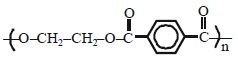
B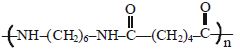
C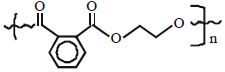
D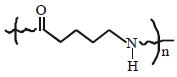
Solution
(C) Glyptal is a polyester formed by the condensation polymerization of ethylene glycol $(HO-CH_2-CH_2-OH)$ and phthalic acid $(C_6H_4(COOH)_2)$.
The structure shown in option $C$ represents the repeating unit of glyptal,which is formed by the esterification of phthalic acid with ethylene glycol.
The structure shown in option $C$ represents the repeating unit of glyptal,which is formed by the esterification of phthalic acid with ethylene glycol.
0 likes
View Solution164
MediumMCQ
Which of the following is an addition and homopolymer?
A
Buna-$S$
B
Gutta-percha
C
Nylon-$6,10$
D
Nylon-$6,6$
Solution
(B) An addition polymer is formed by the repeated addition of monomer molecules possessing double or triple bonds.
$A$ homopolymer is a polymer formed from only one type of monomer unit.
$1$. Buna-$S$ is a copolymer formed from styrene and butadiene.
$2$. Gutta-percha is a naturally occurring isomer of polyisoprene,formed by the polymerization of isoprene $(C_5H_8)$ units. It is an addition homopolymer.
$3$. Nylon-$6,10$ is a condensation copolymer formed from hexamethylenediamine and sebacic acid.
$4$. Nylon-$6,6$ is a condensation copolymer formed from adipic acid and hexamethylenediamine.
Therefore,Gutta-percha is the correct answer.
$A$ homopolymer is a polymer formed from only one type of monomer unit.
$1$. Buna-$S$ is a copolymer formed from styrene and butadiene.
$2$. Gutta-percha is a naturally occurring isomer of polyisoprene,formed by the polymerization of isoprene $(C_5H_8)$ units. It is an addition homopolymer.
$3$. Nylon-$6,10$ is a condensation copolymer formed from hexamethylenediamine and sebacic acid.
$4$. Nylon-$6,6$ is a condensation copolymer formed from adipic acid and hexamethylenediamine.
Therefore,Gutta-percha is the correct answer.
0 likes
View Solution165
EasyMCQ
Which of the following statements is correct?
A
Nylon-$6,6$ is a polyamide
B
Bakelite is not a cross-linked polymer
C
Ziegler-Natta catalyst is $TiCl_4 + Al(C_2H_5)_3$
D
Nylon-$6$ is an elastomer
Solution
(A) $1$. Nylon-$6,6$ is formed by the condensation polymerization of hexamethylenediamine and adipic acid,which contains amide linkages. Thus,it is a polyamide. This statement is correct.
$2$. Bakelite is a thermosetting polymer formed by the condensation of phenol and formaldehyde,resulting in a highly cross-linked structure. Thus,the statement that it is not cross-linked is incorrect.
$3$. The Ziegler-Natta catalyst is a mixture of titanium tetrachloride $(TiCl_4)$ and triethylaluminium $(Al(C_2H_5)_3)$. This statement is also correct.
$4$. Nylon-$6$ is a fiber,not an elastomer. This statement is incorrect.
Note: In many standard chemistry contexts,both $A$ and $C$ are chemically accurate statements. However,$A$ is the most fundamental classification.
$2$. Bakelite is a thermosetting polymer formed by the condensation of phenol and formaldehyde,resulting in a highly cross-linked structure. Thus,the statement that it is not cross-linked is incorrect.
$3$. The Ziegler-Natta catalyst is a mixture of titanium tetrachloride $(TiCl_4)$ and triethylaluminium $(Al(C_2H_5)_3)$. This statement is also correct.
$4$. Nylon-$6$ is a fiber,not an elastomer. This statement is incorrect.
Note: In many standard chemistry contexts,both $A$ and $C$ are chemically accurate statements. However,$A$ is the most fundamental classification.
0 likes
View Solution166
EasyMCQ
Identify the thermosetting polymer.
A
Bakelite
B
Natural rubber
C
Teflon
D
Acrilan
Solution
(A) Thermosetting polymers are cross-linked or heavily branched molecules that undergo extensive cross-linking in molds during hardening,becoming infusible and insoluble.
$Bakelite$ is a classic example of a thermosetting polymer formed by the condensation reaction of phenol and formaldehyde.
Natural rubber,Teflon,and Acrilan are thermoplastic polymers.
$Bakelite$ is a classic example of a thermosetting polymer formed by the condensation reaction of phenol and formaldehyde.
Natural rubber,Teflon,and Acrilan are thermoplastic polymers.
0 likes
View Solution167
EasyMCQ
Which of the following is an example of thermosetting polymers?
A
Polystyrene
B
Urea formaldehyde
C
Terylene
D
Buna-$S$
Solution
(B) Thermosetting polymers are cross-linked polymers that become hard and infusible on heating and cannot be remolded.
Examples include Bakelite and $Urea-formaldehyde$ resin.
Polystyrene,Terylene,and Buna-$S$ are examples of thermoplastic or elastomeric polymers.
Examples include Bakelite and $Urea-formaldehyde$ resin.
Polystyrene,Terylene,and Buna-$S$ are examples of thermoplastic or elastomeric polymers.
0 likes
View Solution168
MediumMCQ
Which one is the correct structure of neoprene?
A
$[-CH_2-C(Cl)=CH-CH_2-]_n$
B
$[-CH_2-CH(CH_2Cl)-O-]_n$
C
$[-CH_3-CH_2-C(=O)-]_n$
D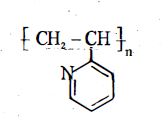
Solution
(A) Neoprene is a synthetic rubber produced by the free radical polymerization of chloroprene ($2$-chloro-$1,3$-butadiene).
The polymerization reaction is:
$n CH_2=C(Cl)-CH=CH_2 \xrightarrow{\text{Polymerization}} [-CH_2-C(Cl)=CH-CH_2-]_n$
Thus,the correct structure of neoprene is $[-CH_2-C(Cl)=CH-CH_2-]_n$.
The polymerization reaction is:
$n CH_2=C(Cl)-CH=CH_2 \xrightarrow{\text{Polymerization}} [-CH_2-C(Cl)=CH-CH_2-]_n$
Thus,the correct structure of neoprene is $[-CH_2-C(Cl)=CH-CH_2-]_n$.
0 likes
View Solution169
MediumMCQ
Which of the following is not a polyamide fibre?
A
Nylon-$6,6$
B
Nylon-$6$
C
Silk
D
Terylene
Solution
(D) Polyamide fibres contain the amide linkage $(-CONH-)$ in their structure.
$Nylon-6,6$ and $Nylon-6$ are synthetic polyamide fibres.
Silk is a natural polyamide fibre.
Terylene is a polyester fibre,which contains the ester linkage $(-COO-)$ in its structure.
Therefore,Terylene is not a polyamide fibre.
$Nylon-6,6$ and $Nylon-6$ are synthetic polyamide fibres.
Silk is a natural polyamide fibre.
Terylene is a polyester fibre,which contains the ester linkage $(-COO-)$ in its structure.
Therefore,Terylene is not a polyamide fibre.
0 likes
View Solution170
MediumMCQ
Which of the following statements is false for biodegradable polymers?
A
Biodegradable polymers are a specific type of polymer that breaks down after its intended purpose to result in natural byproducts.
B
These polymers are found both naturally and synthetically.
C
$PHBV$ and $Nylon-2-Nylon-6$ are examples of biodegradable polymers.
D
Biodegradable polymers cannot be synthesized by condensation reactions.
Solution
(D) . Biodegradable polymers are polymers that degrade by microbial action.
$PHBV$ (poly-$\beta$-hydroxybutyrate-co-$\beta$-hydroxyvalerate) and $Nylon-2-Nylon-6$ are well-known examples of biodegradable polymers.
Many biodegradable polymers are synthesized via condensation polymerization (e.g.,$PHBV$ and $Nylon-2-Nylon-6$).
Therefore,the statement that they cannot be synthesized by condensation reactions is false.
$PHBV$ (poly-$\beta$-hydroxybutyrate-co-$\beta$-hydroxyvalerate) and $Nylon-2-Nylon-6$ are well-known examples of biodegradable polymers.
Many biodegradable polymers are synthesized via condensation polymerization (e.g.,$PHBV$ and $Nylon-2-Nylon-6$).
Therefore,the statement that they cannot be synthesized by condensation reactions is false.
0 likes
View Solution171
DifficultMCQ
Identify the correct structure of caprolactam :-
A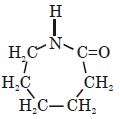
B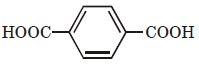
C
$O=C(CH_2)_5-NH$ (as a cyclic $7-$membered ring structure)
D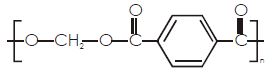
Solution
(C) Caprolactam is a cyclic amide with a $7-$membered ring containing one nitrogen atom and one carbonyl group.
Its chemical formula is $C_6H_{11}NO$.
The structure consists of a $7-$membered ring with five methylene $(-CH_2-)$ groups,one carbonyl $(C=O)$ group,and one amino $(-NH-)$ group.
Therefore,the correct structure is a $7-$membered cyclic amide.
Its chemical formula is $C_6H_{11}NO$.
The structure consists of a $7-$membered ring with five methylene $(-CH_2-)$ groups,one carbonyl $(C=O)$ group,and one amino $(-NH-)$ group.
Therefore,the correct structure is a $7-$membered cyclic amide.
0 likes
View Solution172
DifficultMCQ
When melamine and formaldehyde polymerise,a resin intermediate is formed. Identify the structure of this intermediate :-
A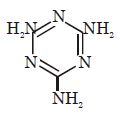
B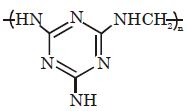
C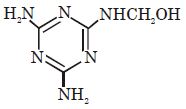
D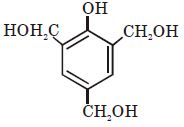
Solution
(C) The reaction between melamine ($2,4,6-$triamino$-1,3,5-$triazine) and formaldehyde proceeds via a nucleophilic addition reaction to form a methylol derivative.
Specifically,the reaction of one molecule of melamine with one molecule of formaldehyde yields monomethylol melamine,which acts as an intermediate in the synthesis of melamine-formaldehyde resin.
The structure shown in option $C$ represents this monomethylol melamine intermediate,where one of the $-NH_2$ groups has reacted with formaldehyde to form $-NHCH_2OH$.
Specifically,the reaction of one molecule of melamine with one molecule of formaldehyde yields monomethylol melamine,which acts as an intermediate in the synthesis of melamine-formaldehyde resin.
The structure shown in option $C$ represents this monomethylol melamine intermediate,where one of the $-NH_2$ groups has reacted with formaldehyde to form $-NHCH_2OH$.
0 likes
View Solution173
MediumMCQ
The monomer of Teflon is :-
A
$CF_2 = CF_2$
B
$CFCl = CF_2$
C
$CCl_2 = CCl_2$
D
$CFCl = CFCl$
Solution
(A) Tetrafluoroethylene,$CF_2 = CF_2$,is the monomer of Teflon,which is polytetrafluoroethylene $\left(-CF_2-CF_2-\right)_n$.
The polymerization reaction is:
$nCF_2 = CF_2 \rightarrow \left(-CF_2-CF_2-\right)_n$
The polymerization reaction is:
$nCF_2 = CF_2 \rightarrow \left(-CF_2-CF_2-\right)_n$
0 likes
View Solution174
MediumMCQ
Arrange the following polymers in the decreasing order of their intermolecular forces:
$A$. Bakelite
$B$. Teflon
$C$. Buna-$S$
$D$. Nylon-$6,6$
$A$. Bakelite
$B$. Teflon
$C$. Buna-$S$
$D$. Nylon-$6,6$
A
$A > C > D > B$
B
$A > D > B > C$
C
$A > D > C > B$
D
$D > A > B > C$
Solution
(B) The strength of intermolecular forces in polymers follows the order: $\text{Thermosetting polymers} > \text{Fibres} > \text{Thermoplastics} > \text{Elastomers}$.
$1$. Bakelite is a thermosetting polymer,which has the strongest intermolecular forces due to cross-linking.
$2$. Nylon-$6,6$ is a fibre,which has strong hydrogen bonding (dipole-dipole interactions).
$3$. Teflon (Polytetrafluoroethylene) is a thermoplastic,which has intermediate forces.
$4$. Buna-$S$ is an elastomer,which has the weakest intermolecular forces.
Therefore,the correct decreasing order is: Bakelite $(A)$ $>$ Nylon-$6,6$ $(D)$ $>$ Teflon $(B)$ $>$ Buna-$S$ $(C)$.
$1$. Bakelite is a thermosetting polymer,which has the strongest intermolecular forces due to cross-linking.
$2$. Nylon-$6,6$ is a fibre,which has strong hydrogen bonding (dipole-dipole interactions).
$3$. Teflon (Polytetrafluoroethylene) is a thermoplastic,which has intermediate forces.
$4$. Buna-$S$ is an elastomer,which has the weakest intermolecular forces.
Therefore,the correct decreasing order is: Bakelite $(A)$ $>$ Nylon-$6,6$ $(D)$ $>$ Teflon $(B)$ $>$ Buna-$S$ $(C)$.
0 likes
View Solution175
MediumMCQ
Which of the following is not a polyester polymer?
A
Terylene
B
Glyptal
C
$PHBV$
D
Novolac
Solution
(D) $1$. $Terylene$ (also known as $Dacron$) is a polyester formed by the condensation of ethylene glycol and terephthalic acid.
$2$. $Glyptal$ is a polyester resin formed by the reaction of ethylene glycol and phthalic acid.
$3$. $PHBV$ (poly-$\beta$-hydroxybutyrate-co-$\beta$-hydroxyvalerate) is a biodegradable polyester.
$4$. $Novolac$ is a phenol-formaldehyde resin,which is a cross-linked polymer,not a polyester.
$2$. $Glyptal$ is a polyester resin formed by the reaction of ethylene glycol and phthalic acid.
$3$. $PHBV$ (poly-$\beta$-hydroxybutyrate-co-$\beta$-hydroxyvalerate) is a biodegradable polyester.
$4$. $Novolac$ is a phenol-formaldehyde resin,which is a cross-linked polymer,not a polyester.
0 likes
View Solution176
EasyMCQ
Strongest intermolecular forces are present in
A
Terylene
B
Buna-$S$
C
Neoprene
D
Polythene
Solution
(A) The strength of intermolecular forces in polymers follows the order: Fibres > Thermoplastics > Elastomers.
$Terylene$ is a polyester fibre,which contains strong dipole-dipole interactions and hydrogen bonding between its polymer chains.
$Buna-S$ and $Neoprene$ are elastomers,which have weak van der Waals forces.
$Polythene$ is a thermoplastic with intermediate forces.
Therefore,$Terylene$ has the strongest intermolecular forces.
$Terylene$ is a polyester fibre,which contains strong dipole-dipole interactions and hydrogen bonding between its polymer chains.
$Buna-S$ and $Neoprene$ are elastomers,which have weak van der Waals forces.
$Polythene$ is a thermoplastic with intermediate forces.
Therefore,$Terylene$ has the strongest intermolecular forces.
0 likes
View Solution177
MediumMCQ
Select the incorrect option for the following polymer:
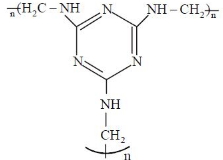
A
Condensation polymer
B
Cross-linked polymer
C
Homopolymer
D
Copolymer
Solution
(C) The given structure represents $Melamine-formaldehyde$ polymer.
It is formed by the condensation reaction between $Melamine$ and $Formaldehyde$.
It is a cross-linked polymer due to the formation of three-dimensional networks.
Since it is formed from two different monomers ($Melamine$ and $Formaldehyde$),it is a copolymer.
Therefore,the statement that it is a $Homopolymer$ is incorrect.
It is formed by the condensation reaction between $Melamine$ and $Formaldehyde$.
It is a cross-linked polymer due to the formation of three-dimensional networks.
Since it is formed from two different monomers ($Melamine$ and $Formaldehyde$),it is a copolymer.
Therefore,the statement that it is a $Homopolymer$ is incorrect.
0 likes
View Solution178
MediumMCQ
Bakelite is an example of
A
Semi-synthetic polymer
B
Cross-linked polymer
C
Synthetic polymer
D
Both $(B)$ and $(C)$
Solution
(D) Bakelite is a thermosetting polymer formed by the condensation polymerization of phenol and formaldehyde.
It possesses a highly cross-linked structure,which makes it hard and infusible.
Since it is prepared in the laboratory,it is classified as a synthetic polymer.
Therefore,it is both a cross-linked polymer and a synthetic polymer.
It possesses a highly cross-linked structure,which makes it hard and infusible.
Since it is prepared in the laboratory,it is classified as a synthetic polymer.
Therefore,it is both a cross-linked polymer and a synthetic polymer.
0 likes
View Solution179
EasyMCQ
Caprolactam is used for the manufacture of
A
Terylene
B
Nylon $-6, 6$
C
Nylon $-6$
D
Teflon
Solution
(C) Caprolactam is used for the manufacture of Nylon $-6$.
Caprolactam is heated at $533 \ K$ in an inert atmosphere to form Nylon $-6$.
Caprolactam is heated at $533 \ K$ in an inert atmosphere to form Nylon $-6$.
0 likes
View Solution180
EasyMCQ
Which of the following statements is not true?
A
In vulcanisation,the formation of sulphur bridges between different chains makes the rubber stiff and stronger.
B
Natural rubber has the trans configuration at every double bond.
C
Buna-$S$ is a copolymer of butadiene and styrene.
D
Nylon-$6, 6$ has amide linkage.
Solution
(B) Natural rubber is cis$-1,4-$polyisoprene,meaning it has the cis configuration at every double bond,not trans. Therefore,statement $B$ is incorrect. Vulcanisation involves cross-linking with sulphur to improve mechanical properties. Buna-$S$ is indeed a copolymer of $1,3-$butadiene and styrene. Nylon-$6, 6$ is a polyamide formed by the condensation of hexamethylenediamine and adipic acid,containing amide linkages.
0 likes
View Solution181
MediumMCQ
Which of the following structures represents the Neoprene polymer?
A
$(-CH(C_6H_5)-CH_2-)_n$
B
$(-CH_2-C(Cl)=CH-CH_2-)_n$
C
$(-CH_2-CH(CN)-)_n$
D
$(-CH_2-CH(Cl)-)_n$
Solution
(B) $Neoprene$ is a synthetic rubber formed by the free radical polymerization of chloroprene ($2$-chloro-$1,3$-butadiene).
The repeating unit of $Neoprene$ is $(-CH_2-C(Cl)=CH-CH_2-)_n$.
The repeating unit of $Neoprene$ is $(-CH_2-C(Cl)=CH-CH_2-)_n$.
0 likes
View Solution182
MediumMCQ
Select the biodegradable polymer.
A
Buna-$S$
B
Nylon-$2$-Nylon-$6$
C
$PVC$
D
None of these
Solution
(B) Biodegradable polymers are those that can be broken down by microorganisms in the environment.
Nylon-$2$-Nylon-$6$ is a biodegradable polyamide copolymer of glycine and amino caproic acid.
Buna-$S$ and $PVC$ are synthetic,non-biodegradable polymers.
Therefore,the correct option is Nylon-$2$-Nylon-$6$.
Nylon-$2$-Nylon-$6$ is a biodegradable polyamide copolymer of glycine and amino caproic acid.
Buna-$S$ and $PVC$ are synthetic,non-biodegradable polymers.
Therefore,the correct option is Nylon-$2$-Nylon-$6$.
0 likes
View Solution183
EasyMCQ
Which of the following statements is incorrect about $Novolac$?
A
It is used in paints.
B
It forms $Bakelite$ when it is heated with formaldehyde.
C
It is a linear polymer.
D
It is a cross-linking polymer.
Solution
(D) $Novolac$ is a linear polymer formed by the condensation reaction of phenol and formaldehyde in the presence of an acid catalyst.
It is used in paints and as a coating material.
When $Novolac$ is heated with formaldehyde,it undergoes cross-linking to form an infusible solid mass known as $Bakelite$.
Therefore,the statement that $Novolac$ is a cross-linking polymer is incorrect,as it is a linear polymer that forms a cross-linked structure only upon further heating with formaldehyde.
It is used in paints and as a coating material.
When $Novolac$ is heated with formaldehyde,it undergoes cross-linking to form an infusible solid mass known as $Bakelite$.
Therefore,the statement that $Novolac$ is a cross-linking polymer is incorrect,as it is a linear polymer that forms a cross-linked structure only upon further heating with formaldehyde.
0 likes
View Solution184
MediumMCQ
Which of the following polymers is biodegradable?
A
$(-CH_2-C(Cl)=CH-CH_2-)_n$
B
$(-CH_2-CH=CH-CH_2-CH_2-CH(CN)-)_n$
C
$(-O-CH(CH_3)-CH_2-C(=O)-O-CH(C_2H_5)-CH_2-C(=O)-)_n$
D
$(-NH-(CH_2)_6-NH-C(=O)-(CH_2)_4-C(=O)-)_n$
Solution
(C) $PHBV$ (Poly($3$-hydroxybutyrate-co$-3-$hydroxyvalerate)) is a biodegradable polymer.
It is formed by the copolymerization of $3$-hydroxybutanoic acid and $3$-hydroxypentanoic acid.
It is formed by the copolymerization of $3$-hydroxybutanoic acid and $3$-hydroxypentanoic acid.
0 likes
View Solution185
EasyMCQ
Which polymer has a $C-O-C$ linkage?
A
Bakelite
B
Melamine formaldehyde resin
C
Starch
D
$B$ and $C$
Solution
(C) The $C-O-C$ linkage is known as a glycosidic linkage.
Starch is a polysaccharide composed of glucose units linked by $\alpha$-glycosidic bonds,which are $C-O-C$ linkages.
Bakelite is a phenol-formaldehyde resin containing $C-CH_2-C$ linkages.
Melamine formaldehyde resin contains $C-N-C$ linkages.
Therefore,only starch contains the $C-O-C$ linkage.
Starch is a polysaccharide composed of glucose units linked by $\alpha$-glycosidic bonds,which are $C-O-C$ linkages.
Bakelite is a phenol-formaldehyde resin containing $C-CH_2-C$ linkages.
Melamine formaldehyde resin contains $C-N-C$ linkages.
Therefore,only starch contains the $C-O-C$ linkage.
0 likes
View Solution186
MediumMCQ
Which of the following is the monomer of $Nylon-6$?
A
B
C
D
Solution
(B) The monomer of $Nylon-6$ is caprolactam. $Caprolactam$ is a seven-membered cyclic amide (lactam) containing six carbon atoms and one nitrogen atom in the ring. Among the given options,the structure representing caprolactam is the seven-membered ring with a $C=O$ group adjacent to the $NH$ group.
0 likes
View Solution187
MediumMCQ
Which of the following polymers contains $H$-bonding?
A
Natural Rubber
B
Teflon
C
Nylon $-6,6$
D
Polystyrene
Solution
(C) Nylon $-6,6$ is a polyamide.
It contains amide linkages $(-CONH-)$ in its structure.
The presence of $N-H$ and $C=O$ groups allows for strong intermolecular $H$-bonding between the polymer chains,which contributes to its high crystalline nature and high melting point.
It contains amide linkages $(-CONH-)$ in its structure.
The presence of $N-H$ and $C=O$ groups allows for strong intermolecular $H$-bonding between the polymer chains,which contributes to its high crystalline nature and high melting point.
0 likes
View Solution188
EasyMCQ
Which intermolecular force is present in $nylon-6,6$?
A
Van der Waals forces
B
Hydrogen bonding
C
Dipole-Dipole interaction
D
Sulphide linkage
Solution
(B) $Nylon-6,6$ is a polyamide polymer formed by the condensation polymerization of hexamethylenediamine and adipic acid.
The structure of $nylon-6,6$ contains amide groups $(-CONH-)$.
The hydrogen atom attached to the nitrogen atom of one amide group forms a strong hydrogen bond with the carbonyl oxygen atom $(C=O)$ of another amide group in the adjacent polymer chain.
Therefore,the primary intermolecular force present in $nylon-6,6$ is hydrogen bonding.
The structure of $nylon-6,6$ contains amide groups $(-CONH-)$.
The hydrogen atom attached to the nitrogen atom of one amide group forms a strong hydrogen bond with the carbonyl oxygen atom $(C=O)$ of another amide group in the adjacent polymer chain.
Therefore,the primary intermolecular force present in $nylon-6,6$ is hydrogen bonding.
0 likes
View Solution189
MediumMCQ
Which is not a monomer for a high molecular mass silicone polymer?
A
$PhSiCl_3$
B
$MeSiCl_3$
C
$Me_2SiCl_2$
D
$Me_3SiCl$
Solution
(D) $MeSiCl_3$,$Me_2SiCl_2$,and $PhSiCl_3$ are monomers used for the synthesis of high molecular mass silicone polymers because they possess multiple reactive $Cl$ atoms,allowing for chain propagation.
However,$Me_3SiCl$ is not a monomer for a high molecular mass silicone polymer because it contains only one $Cl$ atom,which terminates the chain growth and can at best form a dimer.
Hence,the correct answer is option $D$.
However,$Me_3SiCl$ is not a monomer for a high molecular mass silicone polymer because it contains only one $Cl$ atom,which terminates the chain growth and can at best form a dimer.
Hence,the correct answer is option $D$.
0 likes
View Solution190
EasyMCQ
Which of the following features is not true about low density polythene?
A
Highly branched structure
B
Tough
C
Poor conductor of electricity
D
Chemically high reactive
Solution
(D) Low density polythene $(LDPE)$ is prepared by the polymerization of ethene under high pressure and temperature.
It has a highly branched structure,which makes it chemically inert and a poor conductor of electricity.
It is generally tough and flexible.
Therefore,the statement that it is 'chemically high reactive' is incorrect,as $LDPE$ is chemically inert.
It has a highly branched structure,which makes it chemically inert and a poor conductor of electricity.
It is generally tough and flexible.
Therefore,the statement that it is 'chemically high reactive' is incorrect,as $LDPE$ is chemically inert.
0 likes
View Solution191
EasyMCQ
Which of the following statements is false?
A
Artificial silk is derived from cellulose.
B
Nylon-$6,6$ is an example of an elastomer.
C
The repeating unit in natural rubber is isoprene.
D
Both starch and cellulose are polymers of glucose.
Solution
(B) Elastomers are polymers that possess elastic properties,typically due to weak intermolecular forces and cross-linkages.
Nylon-$6,6$ is a fiber,not an elastomer; it is a polyamide formed by the condensation polymerization of adipic acid and hexamethylenediamine.
Artificial silk (rayon) is indeed derived from cellulose.
Natural rubber is a polymer of isoprene ($2$-methyl-$1,3$-butadiene).
Both starch and cellulose are natural polysaccharides composed of glucose units.
Therefore,the statement that Nylon-$6,6$ is an elastomer is false.
Nylon-$6,6$ is a fiber,not an elastomer; it is a polyamide formed by the condensation polymerization of adipic acid and hexamethylenediamine.
Artificial silk (rayon) is indeed derived from cellulose.
Natural rubber is a polymer of isoprene ($2$-methyl-$1,3$-butadiene).
Both starch and cellulose are natural polysaccharides composed of glucose units.
Therefore,the statement that Nylon-$6,6$ is an elastomer is false.
0 likes
View Solution192
DifficultMCQ
$C_6H_6O$ (phenol) $\xrightarrow[\text{3}H_2\text{ (High temp and pressure)}]{Ni} (A)$ $\xrightarrow{Cu} (B)$ $\xrightarrow{NH_2OH} (C)$ $\xrightarrow{H^{+}} (D)$ $\xrightarrow{HO^{-}} (E)$
Product $(E)$ is
Product $(E)$ is
A
Nylon $6,6$
B
Nylon $6$
C
Styrene
D
Polystyrene
Solution
(B) The reaction sequence is as follows:
$1$. Phenol $(C_6H_6O)$ undergoes catalytic hydrogenation with $H_2/Ni$ to form cyclohexanol $(A)$.
$2$. Cyclohexanol $(A)$ is oxidized using $Cu$ (dehydrogenation) to form cyclohexanone $(B)$.
$3$. Cyclohexanone $(B)$ reacts with hydroxylamine $(NH_2OH)$ to form cyclohexanone oxime $(C)$.
$4$. Cyclohexanone oxime $(C)$ undergoes Beckmann rearrangement in the presence of acid $(H^+)$ to form caprolactam $(D)$.
$5$. Caprolactam $(D)$ undergoes ring-opening polymerization in the presence of base $(HO^-)$ to form Nylon $6$ $(E)$.
$1$. Phenol $(C_6H_6O)$ undergoes catalytic hydrogenation with $H_2/Ni$ to form cyclohexanol $(A)$.
$2$. Cyclohexanol $(A)$ is oxidized using $Cu$ (dehydrogenation) to form cyclohexanone $(B)$.
$3$. Cyclohexanone $(B)$ reacts with hydroxylamine $(NH_2OH)$ to form cyclohexanone oxime $(C)$.
$4$. Cyclohexanone oxime $(C)$ undergoes Beckmann rearrangement in the presence of acid $(H^+)$ to form caprolactam $(D)$.
$5$. Caprolactam $(D)$ undergoes ring-opening polymerization in the presence of base $(HO^-)$ to form Nylon $6$ $(E)$.
0 likes
View Solution193
MediumMCQ
What is the structure of the monomer from which the following polymer was made?
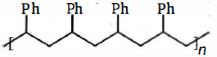
A
B
C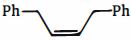
D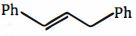
Solution
(B) The given polymer is polystyrene,which is formed by the addition polymerization of styrene $(C_6H_5CH=CH_2)$.
In the polymer chain,the repeating unit is $-[CH_2-CH(Ph)]_n-$.
By identifying the repeating unit,we can determine that the monomer is styrene,which has the structure $Ph-CH=CH_2$.
In the polymer chain,the repeating unit is $-[CH_2-CH(Ph)]_n-$.
By identifying the repeating unit,we can determine that the monomer is styrene,which has the structure $Ph-CH=CH_2$.
0 likes
View Solution194
MediumMCQ
Which of the following is a biodegradable polymer?
A
$[-NH-(CH_2)_5-CO-NH-CH_2-CO-]_n$
B
$[-NH-(CH_2)_5-CO-]_n$
C
$[-NH-(CH_2)_6-NH-CO-(CH_2)_4-CO-]_n$
D
$[-CO-C_6H_4-COO-(CH_2)_2-O-]_n$
Solution
(A) biodegradable polymer is one that can be broken down by microorganisms.
$Nylon-2-nylon-6$ is a biodegradable polyamide copolymer of glycine $(H_2N-CH_2-COOH)$ and aminocaproic acid $(H_2N-(CH_2)_5-COOH)$.
The structure is:
$[-NH-CH_2-CO-NH-(CH_2)_5-CO-]_n$
This corresponds to the structure given in option $A$.
$Nylon-2-nylon-6$ is a biodegradable polyamide copolymer of glycine $(H_2N-CH_2-COOH)$ and aminocaproic acid $(H_2N-(CH_2)_5-COOH)$.
The structure is:
$[-NH-CH_2-CO-NH-(CH_2)_5-CO-]_n$
This corresponds to the structure given in option $A$.
0 likes
View Solution195
MediumMCQ
Assertion: Rayon is a semi-synthetic polymer whose properties are better than natural cotton.
Reason: Mechanical and aesthetic properties of cellulose can be improved by acetylation.
Reason: Mechanical and aesthetic properties of cellulose can be improved by acetylation.
A
Both assertion and reason are correct,but the reason is not the correct explanation for the assertion.
B
Both assertion and reason are correct,and the reason is the correct explanation for the assertion.
C
Assertion is incorrect statement,but the reason is correct.
D
Both assertion and reason are incorrect.
Solution
(B) Both the assertion and the reason are correct statements,and the reason is the correct explanation for the assertion.
Assertion:
Rayon (specifically cellulose acetate) is a semi-synthetic polymer that exhibits superior properties compared to natural cotton fiber.
Reason:
The mechanical and aesthetic properties of cellulose are significantly enhanced through the process of acetylation. Since rayon is produced via the acetylation of cellulose,it possesses improved characteristics over natural cotton.
Conclusion:
Therefore,the reason correctly explains why rayon has better properties than natural cotton.
Assertion:
Rayon (specifically cellulose acetate) is a semi-synthetic polymer that exhibits superior properties compared to natural cotton fiber.
Reason:
The mechanical and aesthetic properties of cellulose are significantly enhanced through the process of acetylation. Since rayon is produced via the acetylation of cellulose,it possesses improved characteristics over natural cotton.
Conclusion:
Therefore,the reason correctly explains why rayon has better properties than natural cotton.
0 likes
View Solution196
DifficultMCQ
Match the polymers in column $- A$ with their main uses in column $- B$ and choose the correct answer.
| Column $- A$ | Column $- B$ |
| $(A)$ Polystyrene | $(i)$ Paints and lacquers |
| $(B)$ Glyptal | $(ii)$ Rain coats |
| $(C)$ Polyvinyl chloride | $(iii)$ Manufacture of toys |
| $(D)$ Bakelite | $(iv)$ Computer discs |
A
$(A) - (ii), (B) - (i), (C) - (iii), (D) - (iv)$
B
$(A) - (ii), (B) - (iv), (C) - (iii), (D) - (i)$
C
$(A) - (iii), (B) - (iv), (C) - (ii), (D) - (i)$
D
$(A) - (iii), (B) - (i), (C) - (ii), (D) - (iv)$
Solution
(D) The correct matching is as follows:
Thus,the correct sequence is $(A)-(iii), (B)-(i), (C)-(ii), (D)-(iv)$.
| Polymer | Use |
| $(A)$ Polystyrene | $(iii)$ Manufacture of toys |
| $(B)$ Glyptal | $(i)$ Paints and lacquers |
| $(C)$ Polyvinyl chloride | $(ii)$ Rain coats |
| $(D)$ Bakelite | $(iv)$ Computer discs |
Thus,the correct sequence is $(A)-(iii), (B)-(i), (C)-(ii), (D)-(iv)$.
0 likes
View Solution197
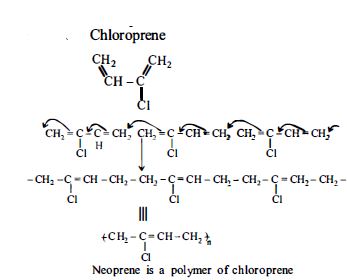
DifficultMCQ
Which one of the following structures represents the neoprene polymer?
A
$[CH(C_6H_5)-CH_2]_n$
B
$[CH_2-CH(CN)]_n$
C
$[CH_2-C(Cl)=CH-CH_2]_n$
D
$[CH_2-CH(Cl)]_n$
Solution
(C) Neoprene is a synthetic rubber formed by the free radical polymerization of chloroprene ($2$-chloro-$1,3$-butadiene).
The repeating unit of the polymer is $[CH_2-C(Cl)=CH-CH_2]_n$.
The repeating unit of the polymer is $[CH_2-C(Cl)=CH-CH_2]_n$.
0 likes
View Solution198
DifficultMCQ
The structures of some important polymers are given. Which one represents Buna-$S$?
A
$-(CH_2-C(CH_3)=CH-CH_2)_n-$
B
$-(CH_2-CH=CH-CH_2-CH(C_6H_5)-CH_2)_n-$
C
$-(CH_2-CH=CH-CH_2-CH(CN)-CH_2)_n-$
D
$-(CH_2-C(Cl)=CH-CH_2)_n-$
Solution
(B) Buna-$S$ is a copolymer formed by the polymerization of $1,3$-butadiene $(CH_2=CH-CH=CH_2)$ and styrene $(C_6H_5-CH=CH_2)$.
Its structure consists of repeating units derived from these two monomers,represented as $-(CH_2-CH=CH-CH_2-CH(C_6H_5)-CH_2)_n-$.
Its structure consists of repeating units derived from these two monomers,represented as $-(CH_2-CH=CH-CH_2-CH(C_6H_5)-CH_2)_n-$.
0 likes
View Solution199
MediumMCQ
Which one of the following is an example of thermosetting polymers?
A
Neoprene
B
Buna-$N$
C
Nylon $6, 6$
D
Bakelite
Solution
(D) Polymers which change irreversibly into hard and rigid material on heating are known as thermosetting polymers.
For example,$Bakelite$ is a thermosetting polymer.
For example,$Bakelite$ is a thermosetting polymer.
0 likes
View Solution200
DifficultMCQ
If a polythene sample contains two monodisperse fractions in the ratio $2:3$ with degree of polymerization $100$ and $200$,respectively,then its weight average molecular weight will be
A
$4900$
B
$4600$
C
$4300$
D
$5200$
Solution
(A) Given,
Degree of polymerization of first polymer $= 100$
Degree of polymerization of second polymer $= 200$
Number of moles ratio $n_1 : n_2 = 2 : 3$
The monomer of polythene is ethylene $(C_2H_4)$ with molar mass $M_0 = 28 \ g/mol$.
Molar mass of first polymer fraction: $M_1 = 100 \times 28 = 2800 \ g/mol$.
Molar mass of second polymer fraction: $M_2 = 200 \times 28 = 5600 \ g/mol$.
The weight average molecular weight is given by the formula:
$\overline{M}_w = \frac{\sum n_i M_i^2}{\sum n_i M_i} = \frac{n_1 M_1^2 + n_2 M_2^2}{n_1 M_1 + n_2 M_2}$
Substituting the values:
$\overline{M}_w = \frac{2 \times (2800)^2 + 3 \times (5600)^2}{2 \times 2800 + 3 \times 5600}$
$\overline{M}_w = \frac{2 \times 7840000 + 3 \times 31360000}{5600 + 16800}$
$\overline{M}_w = \frac{15680000 + 94080000}{22400}$
$\overline{M}_w = \frac{109760000}{22400} = 4900 \ g/mol$.
Degree of polymerization of first polymer $= 100$
Degree of polymerization of second polymer $= 200$
Number of moles ratio $n_1 : n_2 = 2 : 3$
The monomer of polythene is ethylene $(C_2H_4)$ with molar mass $M_0 = 28 \ g/mol$.
Molar mass of first polymer fraction: $M_1 = 100 \times 28 = 2800 \ g/mol$.
Molar mass of second polymer fraction: $M_2 = 200 \times 28 = 5600 \ g/mol$.
The weight average molecular weight is given by the formula:
$\overline{M}_w = \frac{\sum n_i M_i^2}{\sum n_i M_i} = \frac{n_1 M_1^2 + n_2 M_2^2}{n_1 M_1 + n_2 M_2}$
Substituting the values:
$\overline{M}_w = \frac{2 \times (2800)^2 + 3 \times (5600)^2}{2 \times 2800 + 3 \times 5600}$
$\overline{M}_w = \frac{2 \times 7840000 + 3 \times 31360000}{5600 + 16800}$
$\overline{M}_w = \frac{15680000 + 94080000}{22400}$
$\overline{M}_w = \frac{109760000}{22400} = 4900 \ g/mol$.
0 likes
View SolutionPolymers — Composition, Properties and Uses of Polymer · Frequently Asked Questions
1Are these Polymers questions useful for JEE and NEET?
Yes. All questions in this section are mapped to JEE Main and NEET exam patterns. Previous year questions from JEE Main, NEET, GUJCET and state-level exams are included with full solutions.
2Can I switch to Hindi or Gujarati for these questions?
Yes. Use the language tabs in the hero section or the sidebar to view the same questions and solutions in English, Hindi or Gujarati.
3How do I generate a question paper from this subtopic?
Use the Vedclass Exam Paper Generator — select the chapter and subtopic, set difficulty, and generate Sets A, B, C, D automatically. First 3 chapters of every subject are free.
Vedclass Products
For Students
Vedclass Test Series
Mock tests in real JEE/NEET style with performance analysis. 5-day free trial.
Start Free TrialFor Teachers
Exam Paper Generator
Generate Set A/B/C/D papers from this chapter in 2 minutes. 3 chapters free.
Try FreeFor Institutes
Online Exam Module
Live online exams with unlimited students, 360° analytics & white-label branding.
See DemoFor Teachers & Institutes
Generate a Polymers Exam Paper in 2 Minutes
Select subtopic & difficulty — Sets A, B, C, D auto-generated with No Repeat logic.
First 3 chapters of every subject are free — no payment required.