
A English
Compounds of Transitional elements Questions in English
Class 12 Chemistry · d-and f-Block Elements · Compounds of Transitional elements
338+
Questions
English
Language
100%
With Solutions
Showing 50 of 338 questions in English
251
MediumMCQ
An acidified manganate solution undergoes disproportionation reaction. The spin-only magnetic moment value of the product having manganese in higher oxidation state is $....\, B.M.$ (Nearest integer)
A
$2$
B
$56$
C
$10$
D
$0$
Solution
(D) The disproportionation reaction of manganate $(MnO_{4}^{2-})$ in acidic medium is given by:
$3 MnO_{4}^{2-} + 4 H^{+} \longrightarrow 2 MnO_{4}^{-} + MnO_{2} + 2 H_{2}O$
In this reaction,manganese is oxidized to $Mn^{+7}$ (in $MnO_{4}^{-}$) and reduced to $Mn^{+4}$ (in $MnO_{2}$).
The product with the higher oxidation state is $MnO_{4}^{-}$,where the oxidation state of $Mn$ is $+7$.
The electronic configuration of $Mn^{+7}$ is $[Ar] 3d^{0}$.
Since there are no unpaired electrons $(n = 0)$,the spin-only magnetic moment is $\mu = \sqrt{n(n+2)} = \sqrt{0(0+2)} = 0 \, B.M.$
$3 MnO_{4}^{2-} + 4 H^{+} \longrightarrow 2 MnO_{4}^{-} + MnO_{2} + 2 H_{2}O$
In this reaction,manganese is oxidized to $Mn^{+7}$ (in $MnO_{4}^{-}$) and reduced to $Mn^{+4}$ (in $MnO_{2}$).
The product with the higher oxidation state is $MnO_{4}^{-}$,where the oxidation state of $Mn$ is $+7$.
The electronic configuration of $Mn^{+7}$ is $[Ar] 3d^{0}$.
Since there are no unpaired electrons $(n = 0)$,the spin-only magnetic moment is $\mu = \sqrt{n(n+2)} = \sqrt{0(0+2)} = 0 \, B.M.$
0 likes
View Solution252
MediumMCQ
Among $Co^{3+}$,$Ti^{2+}$,$V^{2+}$ and $Cr^{2+}$ ions,one if used as a reagent cannot liberate $H_{2}$ from dilute mineral acid solution,its spin-only magnetic moment in gaseous state is $.....$ $B.M.$ (Nearest integer)
A
$6$
B
$5$
C
$3$
D
$4$
Solution
(B) The standard electrode potential $E^{\circ}$ for the reduction of $H^{+}$ to $H_{2}$ is $0.00 \ V$.
$A$ metal ion can liberate $H_{2}$ from a dilute mineral acid if its standard reduction potential $E^{\circ}(M^{n+}/M)$ is negative.
Among the given ions,$Co^{3+}$ has a high positive reduction potential $(E^{\circ}(Co^{3+}/Co^{2+}) = +1.82 \ V)$,meaning it is a strong oxidizing agent and will not liberate $H_{2}$ from acid; instead,it is reduced to $Co^{2+}$.
The electronic configuration of $Co^{3+}$ $(Z=27)$ is $[Ar] 3d^{6}$.
In the $3d^{6}$ configuration,the number of unpaired electrons $(n)$ is $4$.
The spin-only magnetic moment is calculated as $\mu = \sqrt{n(n+2)} \ B.M.$
$\mu = \sqrt{4(4+2)} = \sqrt{24} \approx 4.899 \ B.M.$
The nearest integer value is $5$.
$A$ metal ion can liberate $H_{2}$ from a dilute mineral acid if its standard reduction potential $E^{\circ}(M^{n+}/M)$ is negative.
Among the given ions,$Co^{3+}$ has a high positive reduction potential $(E^{\circ}(Co^{3+}/Co^{2+}) = +1.82 \ V)$,meaning it is a strong oxidizing agent and will not liberate $H_{2}$ from acid; instead,it is reduced to $Co^{2+}$.
The electronic configuration of $Co^{3+}$ $(Z=27)$ is $[Ar] 3d^{6}$.
In the $3d^{6}$ configuration,the number of unpaired electrons $(n)$ is $4$.
The spin-only magnetic moment is calculated as $\mu = \sqrt{n(n+2)} \ B.M.$
$\mu = \sqrt{4(4+2)} = \sqrt{24} \approx 4.899 \ B.M.$
The nearest integer value is $5$.
0 likes
View Solution253
MediumMCQ
The total number of $Mn=O$ bonds in $Mn_2O_7$ is
A
$4$
B
$5$
C
$6$
D
$3$
Solution
(C) The structure of $Mn_2O_7$ consists of two $MnO_4$ tetrahedra sharing a common oxygen atom at one corner.
In this structure,each $Mn$ atom is bonded to three terminal oxygen atoms via double bonds $(Mn=O)$ and one bridging oxygen atom via a single bond $(Mn-O-Mn)$.
Therefore,there are $3$ $Mn=O$ bonds around each $Mn$ atom.
Total number of $Mn=O$ bonds = $3 + 3 = 6$.
In this structure,each $Mn$ atom is bonded to three terminal oxygen atoms via double bonds $(Mn=O)$ and one bridging oxygen atom via a single bond $(Mn-O-Mn)$.
Therefore,there are $3$ $Mn=O$ bonds around each $Mn$ atom.
Total number of $Mn=O$ bonds = $3 + 3 = 6$.
0 likes
View Solution254
AdvancedMCQ
When a mixture of $NaCl$,$K_{2}Cr_{2}O_{7}$ and conc. $H_{2}SO_{4}$ is heated in a dry test tube,a red vapour $(X)$ is evolved. This vapour $(X)$ turns an aqueous solution of $NaOH$ yellow due to the formation of $Y$. $X$ and $Y$,respectively,are
A
$CrCl_{3}$ and $Na_{2}Cr_{2}O_{7}$
B
$CrCl_{3}$ and $Na_{2}CrO_{4}$
C
$CrO_{2}Cl_{2}$ and $Na_{2}CrO_{4}$
D
$Cr_{2}(SO_{4})_{3}$ and $Na_{2}Cr_{2}O_{7}$
Solution
(C) $X$ is $CrO_{2}Cl_{2}$ and $Y$ is $Na_{2}CrO_{4}$.
When a mixture of $NaCl$,$K_{2}Cr_{2}O_{7}$ and conc. $H_{2}SO_{4}$ is heated in a dry test tube,a red vapour $(X)$,$CrO_{2}Cl_{2}$ (chromyl chloride),is evolved.
This vapour $CrO_{2}Cl_{2}$ reacts with an aqueous solution of $NaOH$ to form $Na_{2}CrO_{4}$ (sodium chromate),which is yellow in color.
The chemical reactions are as follows:
$4Cl^{-} + Cr_{2}O_{7}^{2-} + 6H^{+} \longrightarrow 2CrO_{2}Cl_{2} (X) + 3H_{2}O$
$CrO_{2}Cl_{2} + 4OH^{-} \longrightarrow CrO_{4}^{2-} + 2Cl^{-} + 2H_{2}O$
The resulting $CrO_{4}^{2-}$ ions in the presence of $Na^{+}$ ions form $Na_{2}CrO_{4} (Y)$.
When a mixture of $NaCl$,$K_{2}Cr_{2}O_{7}$ and conc. $H_{2}SO_{4}$ is heated in a dry test tube,a red vapour $(X)$,$CrO_{2}Cl_{2}$ (chromyl chloride),is evolved.
This vapour $CrO_{2}Cl_{2}$ reacts with an aqueous solution of $NaOH$ to form $Na_{2}CrO_{4}$ (sodium chromate),which is yellow in color.
The chemical reactions are as follows:
$4Cl^{-} + Cr_{2}O_{7}^{2-} + 6H^{+} \longrightarrow 2CrO_{2}Cl_{2} (X) + 3H_{2}O$
$CrO_{2}Cl_{2} + 4OH^{-} \longrightarrow CrO_{4}^{2-} + 2Cl^{-} + 2H_{2}O$
The resulting $CrO_{4}^{2-}$ ions in the presence of $Na^{+}$ ions form $Na_{2}CrO_{4} (Y)$.
0 likes
View Solution255
MediumMCQ
The oxidising ability of the given anions follows the order:
A
$TiO_{4}^{4-} < VO_{4}^{3-} < CrO_{4}^{2-} < MnO_{4}^{-}$
B
$VO_{4}^{3-} < CrO_{4}^{2-} < MnO_{4}^{-} < TiO_{4}^{4-}$
C
$CrO_{4}^{2-} < MnO_{4}^{-} < VO_{4}^{3-} < TiO_{4}^{4-}$
D
$VO_{4}^{3-} < TiO_{4}^{4-} < CrO_{4}^{2-} < MnO_{4}^{-}$
Solution
(A) The oxidising ability of an anion depends on the oxidation state of the central metal atom. Higher oxidation state of the central atom leads to higher oxidising power.
Calculating the oxidation states:
$Ti$ in $TiO_{4}^{4-}$: $x + 4(-2) = -4 \implies x = +4$
$V$ in $VO_{4}^{3-}$: $x + 4(-2) = -3 \implies x = +5$
$Cr$ in $CrO_{4}^{2-}$: $x + 4(-2) = -2 \implies x = +6$
$Mn$ in $MnO_{4}^{-}$: $x + 4(-2) = -1 \implies x = +7$
The order of oxidation states is $+4 < +5 < +6 < +7$.
Therefore,the order of oxidising ability is $TiO_{4}^{4-} < VO_{4}^{3-} < CrO_{4}^{2-} < MnO_{4}^{-}$.
Calculating the oxidation states:
$Ti$ in $TiO_{4}^{4-}$: $x + 4(-2) = -4 \implies x = +4$
$V$ in $VO_{4}^{3-}$: $x + 4(-2) = -3 \implies x = +5$
$Cr$ in $CrO_{4}^{2-}$: $x + 4(-2) = -2 \implies x = +6$
$Mn$ in $MnO_{4}^{-}$: $x + 4(-2) = -1 \implies x = +7$
The order of oxidation states is $+4 < +5 < +6 < +7$.
Therefore,the order of oxidising ability is $TiO_{4}^{4-} < VO_{4}^{3-} < CrO_{4}^{2-} < MnO_{4}^{-}$.
0 likes
View Solution256
MediumMCQ
The fusion of chromite ore $(FeCr_{2}O_{4})$ with $Na_{2}CO_{3}$ in air gives a yellow solution upon addition of water. Subsequent treatment with $H_{2}SO_{4}$ produces an orange solution. The yellow and orange colours,respectively,are due to the formation of
A
$Na_{2}CrO_{4}$ and $Na_{2}Cr_{2}O_{7}$
B
$Cr(OH)_{3}$ and $Na_{2}Cr_{2}O_{7}$
C
$Cr_{2}(CO_{3})_{3}$ and $Fe_{2}(SO_{4})_{3}$
D
$Cr(OH)_{3}$ and $Na_{2}CrO_{4}$
Solution
(A) The fusion of chromite ore $(FeCr_{2}O_{4})$ with $Na_{2}CO_{3}$ in the presence of air produces sodium chromate $(Na_{2}CrO_{4})$,which forms a yellow-coloured aqueous solution.
$8Na_{2}CO_{3} + 4FeCr_{2}O_{4} + 7O_{2} \longrightarrow 8Na_{2}CrO_{4} + 2Fe_{2}O_{3} + 8CO_{2}$
Subsequent acidification of the yellow solution with $H_{2}SO_{4}$ converts the chromate ion into the dichromate ion,resulting in an orange-coloured solution.
$2Na_{2}CrO_{4} + H_{2}SO_{4} \longrightarrow Na_{2}Cr_{2}O_{7} + Na_{2}SO_{4} + H_{2}O$
Thus,the yellow colour is due to $Na_{2}CrO_{4}$ and the orange colour is due to $Na_{2}Cr_{2}O_{7}$.
$8Na_{2}CO_{3} + 4FeCr_{2}O_{4} + 7O_{2} \longrightarrow 8Na_{2}CrO_{4} + 2Fe_{2}O_{3} + 8CO_{2}$
Subsequent acidification of the yellow solution with $H_{2}SO_{4}$ converts the chromate ion into the dichromate ion,resulting in an orange-coloured solution.
$2Na_{2}CrO_{4} + H_{2}SO_{4} \longrightarrow Na_{2}Cr_{2}O_{7} + Na_{2}SO_{4} + H_{2}O$
Thus,the yellow colour is due to $Na_{2}CrO_{4}$ and the orange colour is due to $Na_{2}Cr_{2}O_{7}$.
0 likes
View Solution257
MediumMCQ
$MnO_2$ when fused with $KOH$ and oxidised in air gives a dark green compound $X$. In acidic solution,$X$ undergoes disproportionation to give an intense purple compound $Y$ and $MnO_2$. The compounds $X$ and $Y$,respectively,are
A
$K_2MnO_4$ and $KMnO_4$
B
$Mn_2O_7$ and $KMnO_4$
C
$K_2MnO_4$ and $Mn_2O_7$
D
$KMnO_4$ and $K_2MnO_4$
Solution
(A) $MnO_2$,when fused with $KOH$ and oxidised in air,gives a dark green compound $X$,which is potassium manganate $(K_2MnO_4)$.
In acidic solution,$K_2MnO_4$ undergoes disproportionation to give an intense purple solution of potassium permanganate $Y$ $(KMnO_4)$ and $MnO_2$.
The chemical reactions are:
$2MnO_2 + 4KOH + O_2 \longrightarrow 2K_2MnO_4 + 2H_2O$
$3K_2MnO_4 + 4H^{+} \longrightarrow 2KMnO_4 + MnO_2 + 2H_2O + 4K^{+}$
Thus,$X$ is $K_2MnO_4$ and $Y$ is $KMnO_4$.
In acidic solution,$K_2MnO_4$ undergoes disproportionation to give an intense purple solution of potassium permanganate $Y$ $(KMnO_4)$ and $MnO_2$.
The chemical reactions are:
$2MnO_2 + 4KOH + O_2 \longrightarrow 2K_2MnO_4 + 2H_2O$
$3K_2MnO_4 + 4H^{+} \longrightarrow 2KMnO_4 + MnO_2 + 2H_2O + 4K^{+}$
Thus,$X$ is $K_2MnO_4$ and $Y$ is $KMnO_4$.
0 likes
View Solution258
MediumMCQ
When $Cu^{2+}$ ion is treated with $KI$,a white precipitate,$X$ appears in solution. The solution is titrated with sodium thiosulphate,the compound $Y$ is formed. $X$ and $Y$ respectively are
A
$X = Cu_2I_2, Y = Na_2S_4O_5$
B
$X = Cu_2I_2, Y = Na_2S_4O_6$
C
$X = CuI_2, Y = Na_2S_4O_3$
D
$X = CuI_2, Y = Na_2S_4O_6$
Solution
(B) When $Cu^{2+}$ ions react with $KI$,$CuI_2$ is initially formed,which is unstable and decomposes to form a white precipitate of $Cu_2I_2$ and iodine $(I_2)$:
$2Cu^{2+} + 4I^-$ $\rightarrow 2CuI_2$ $\rightarrow Cu_2I_2 \downarrow + I_2$
The liberated $I_2$ dissolves in excess $KI$ to form $KI_3$ (triiodide ion),which gives a brown color to the solution:
$I_2 + I^- \rightarrow I_3^-$
This solution is then titrated against sodium thiosulphate $(Na_2S_2O_3)$,where $I_2$ is reduced to $I^-$ and thiosulphate is oxidized to tetrathionate $(Na_2S_4O_6)$:
$I_2 + 2Na_2S_2O_3 \rightarrow 2NaI + Na_2S_4O_6$
Thus,$X$ is $Cu_2I_2$ and $Y$ is $Na_2S_4O_6$.
$2Cu^{2+} + 4I^-$ $\rightarrow 2CuI_2$ $\rightarrow Cu_2I_2 \downarrow + I_2$
The liberated $I_2$ dissolves in excess $KI$ to form $KI_3$ (triiodide ion),which gives a brown color to the solution:
$I_2 + I^- \rightarrow I_3^-$
This solution is then titrated against sodium thiosulphate $(Na_2S_2O_3)$,where $I_2$ is reduced to $I^-$ and thiosulphate is oxidized to tetrathionate $(Na_2S_4O_6)$:
$I_2 + 2Na_2S_2O_3 \rightarrow 2NaI + Na_2S_4O_6$
Thus,$X$ is $Cu_2I_2$ and $Y$ is $Na_2S_4O_6$.
0 likes
View Solution259
MediumMCQ
The highest oxidation state of $Mn$ is exhibited in $Mn_2O_7$. The correct statements about $Mn_2O_7$ are:
$(A)$ $Mn$ is tetrahedrally surrounded by oxygen atoms.
$(B)$ $Mn$ is octahedrally surrounded by oxygen atoms.
$(C)$ Contains $Mn-O-Mn$ bridge.
$(D)$ Contains $Mn-Mn$ bond.
Choose the correct answer from the options given below:
$(A)$ $Mn$ is tetrahedrally surrounded by oxygen atoms.
$(B)$ $Mn$ is octahedrally surrounded by oxygen atoms.
$(C)$ Contains $Mn-O-Mn$ bridge.
$(D)$ Contains $Mn-Mn$ bond.
Choose the correct answer from the options given below:
A
$A$ and $C$ only
B
$A$ and $D$ only
C
$B$ and $D$ only
D
$B$ and $C$ only
Solution
(A) The structure of $Mn_2O_7$ consists of two $MnO_4$ tetrahedra sharing a common oxygen atom at one corner.
Thus,each $Mn$ atom is tetrahedrally surrounded by four oxygen atoms (statement $A$ is correct).
The structure contains an $Mn-O-Mn$ bridge (statement $C$ is correct).
There is no direct $Mn-Mn$ bond in $Mn_2O_7$ (statement $D$ is incorrect).
Therefore,statements $A$ and $C$ are correct.
Thus,each $Mn$ atom is tetrahedrally surrounded by four oxygen atoms (statement $A$ is correct).
The structure contains an $Mn-O-Mn$ bridge (statement $C$ is correct).
There is no direct $Mn-Mn$ bond in $Mn_2O_7$ (statement $D$ is incorrect).
Therefore,statements $A$ and $C$ are correct.
0 likes
View Solution260
MediumMCQ
Strong reducing and oxidizing agents among the following,respectively,are
A
$Ce^{4+}$ and $Eu^{2+}$
B
$Ce^{4+}$ and $Tb^{4+}$
C
$Ce^{3+}$ and $Ce^{4+}$
D
$Eu^{2+}$ and $Ce^{4+}$
Solution
(D) In the lanthanoid series,$Eu^{2+}$ (europium$(II)$) is a strong reducing agent because it tends to lose an electron to achieve the stable $f^7$ configuration $(Eu^{3+})$.
$Ce^{4+}$ (cerium$(IV)$) is a strong oxidizing agent because it tends to gain an electron to achieve the stable $f^0$ configuration $(Ce^{3+})$.
Therefore,the correct pair is $Eu^{2+}$ and $Ce^{4+}$.
$Ce^{4+}$ (cerium$(IV)$) is a strong oxidizing agent because it tends to gain an electron to achieve the stable $f^0$ configuration $(Ce^{3+})$.
Therefore,the correct pair is $Eu^{2+}$ and $Ce^{4+}$.
0 likes
View Solution261
DifficultMCQ
Which of the following statements are $INCORRECT$?
$A$. All the transition metals except scandium form $MO$ oxides which are ionic.
$B$. The highest oxidation number corresponding to the group number in transition metal oxides is attained in $Sc_2O_3$ to $Mn_2O_7$.
$C$. Basic character increases from $V_2O_3$ to $V_2O_4$ to $V_2O_5$.
$D$. $V_2O_4$ dissolves in acids to give $VO_4^{3-}$ salts.
$E$. $CrO$ is basic but $Cr_2O_3$ is amphoteric.
Choose the correct answer from the options given below:
$A$. All the transition metals except scandium form $MO$ oxides which are ionic.
$B$. The highest oxidation number corresponding to the group number in transition metal oxides is attained in $Sc_2O_3$ to $Mn_2O_7$.
$C$. Basic character increases from $V_2O_3$ to $V_2O_4$ to $V_2O_5$.
$D$. $V_2O_4$ dissolves in acids to give $VO_4^{3-}$ salts.
$E$. $CrO$ is basic but $Cr_2O_3$ is amphoteric.
Choose the correct answer from the options given below:
A
$B$ and $C$ only
B
$A$ and $E$ only
C
$B$ and $D$ only
D
$C$ and $D$ only
Solution
(D) Statement $A$ is correct as transition metals form ionic $MO$ oxides.
Statement $B$ is correct as the highest oxidation state equals the group number from $Sc$ $(Group \ 3)$ to $Mn$ $(Group \ 7)$.
Statement $C$ is incorrect because the acidic character increases as the oxidation state of the metal increases $(V_2O_3 < V_2O_4 < V_2O_5)$. Therefore,the basic character decreases.
Statement $D$ is incorrect because $V_2O_4$ dissolves in acids to form $VO^{2+}$ ions,not $VO_4^{3-}$ salts.
Statement $E$ is correct as $CrO$ is basic and $Cr_2O_3$ is amphoteric.
Thus,statements $C$ and $D$ are incorrect.
Statement $B$ is correct as the highest oxidation state equals the group number from $Sc$ $(Group \ 3)$ to $Mn$ $(Group \ 7)$.
Statement $C$ is incorrect because the acidic character increases as the oxidation state of the metal increases $(V_2O_3 < V_2O_4 < V_2O_5)$. Therefore,the basic character decreases.
Statement $D$ is incorrect because $V_2O_4$ dissolves in acids to form $VO^{2+}$ ions,not $VO_4^{3-}$ salts.
Statement $E$ is correct as $CrO$ is basic and $Cr_2O_3$ is amphoteric.
Thus,statements $C$ and $D$ are incorrect.
0 likes
View Solution262
DifficultMCQ
$NaCl$ reacts with conc. $H_2SO_4$ and $K_2Cr_2O_7$ to give reddish fumes $(B)$,which react with $NaOH$ to give yellow solution $(C)$. $(B)$ and $(C)$ respectively are:
A
$CrO_2Cl_2, Na_2CrO_4$
B
$Na_2Cr_2O_4, CrO_2Cl_2$
C
$CrO_2Cl_2, KHSO_4$
D
$CrO_2Cl_2, Na_2Cr_2O_7$
Solution
(A) $4NaCl + K_2Cr_2O_7 + 6H_2SO_4 \rightarrow 2CrO_2Cl_2 \ [(B) \text{Reddish brown fumes}] + 2KHSO_4 + 4NaHSO_4 + 3H_2O$
$CrO_2Cl_2 + 4NaOH \rightarrow Na_2CrO_4 \ [(C) \text{Yellow solution}] + 2NaCl + 2H_2O$
Therefore,$(B)$ is $CrO_2Cl_2$ and $(C)$ is $Na_2Cr_4$.
$CrO_2Cl_2 + 4NaOH \rightarrow Na_2CrO_4 \ [(C) \text{Yellow solution}] + 2NaCl + 2H_2O$
Therefore,$(B)$ is $CrO_2Cl_2$ and $(C)$ is $Na_2Cr_4$.
0 likes
View Solution263
DifficultMCQ
$KMnO_4$ decomposes on heating at $513 \ K$ to form $O_2$ along with
A
$MnO_2 \& K_2O_2$
B
$K_2MnO_4 \& Mn$
C
$Mn \& KO_2$
D
$K_2MnO_4 \& MnO_2$
Solution
(D) The thermal decomposition of potassium permanganate $(KMnO_4)$ at $513 \ K$ is given by the following reaction:
$2KMnO_4 \xrightarrow{\Delta} K_2MnO_4 + MnO_2 + O_2$
Thus,$KMnO_4$ decomposes to form potassium manganate $(K_2MnO_4)$,manganese dioxide $(MnO_2)$,and oxygen gas $(O_2)$.
$2KMnO_4 \xrightarrow{\Delta} K_2MnO_4 + MnO_2 + O_2$
Thus,$KMnO_4$ decomposes to form potassium manganate $(K_2MnO_4)$,manganese dioxide $(MnO_2)$,and oxygen gas $(O_2)$.
0 likes
View Solution264
DifficultMCQ
The orange colour of $K_2Cr_2O_7$ and purple colour of $KMnO_4$ is due to
A
Charge transfer transition in both.
B
$d \rightarrow d$ transition in $KMnO_4$ and charge transfer transitions in $K_2Cr_2O_7$.
C
$d \rightarrow d$ transition in $K_2Cr_2O_7$ and charge transfer transitions in $KMnO_4$.
D
$d \rightarrow d$ transition in both.
Solution
(A) In $K_2Cr_2O_7$,the oxidation state of $Cr$ is $+6$,which corresponds to a $d^0$ configuration. Thus,no $d-d$ transition is possible.
In $KMnO_4$,the oxidation state of $Mn$ is $+7$,which corresponds to a $d^0$ configuration. Thus,no $d-d$ transition is possible.
The intense colours in both compounds arise due to charge transfer transitions from the oxygen ligands to the metal centre.
In $KMnO_4$,the oxidation state of $Mn$ is $+7$,which corresponds to a $d^0$ configuration. Thus,no $d-d$ transition is possible.
The intense colours in both compounds arise due to charge transfer transitions from the oxygen ligands to the metal centre.
0 likes
View Solution265
DifficultMCQ
Alkaline oxidative fusion of $MnO_2$ gives $A$ which on electrolytic oxidation in alkaline solution produces $B$. $A$ and $B$ respectively are:
A
$Mn_2O_7$ and $MnO_4^{-}$
B
$MnO_4^{2-}$ and $MnO_4^{-}$
C
$Mn_2O_3$ and $MnO_4^{2-}$
D
$MnO_4^{2-}$ and $Mn_2O_7$
Solution
(B) The alkaline oxidative fusion of $MnO_2$ with $KOH$ in the presence of air (or $KNO_3$) produces potassium manganate $(K_2MnO_4)$,where the manganate ion is $MnO_4^{2-}$. Thus,$A = MnO_4^{2-}$.
$2MnO_2 + 4KOH + O_2 \rightarrow 2K_2MnO_4 + 2H_2O$
Electrolytic oxidation of the green manganate solution $(MnO_4^{2-})$ in an alkaline medium converts it into purple permanganate $(MnO_4^{-})$. Thus,$B = MnO_4^{-}$.
$2MnO_4^{2-} + H_2O + [O] \rightarrow 2MnO_4^{-} + 2OH^{-}$
Therefore,$A$ and $B$ are $MnO_4^{2-}$ and $MnO_4^{-}$ respectively.
$2MnO_2 + 4KOH + O_2 \rightarrow 2K_2MnO_4 + 2H_2O$
Electrolytic oxidation of the green manganate solution $(MnO_4^{2-})$ in an alkaline medium converts it into purple permanganate $(MnO_4^{-})$. Thus,$B = MnO_4^{-}$.
$2MnO_4^{2-} + H_2O + [O] \rightarrow 2MnO_4^{-} + 2OH^{-}$
Therefore,$A$ and $B$ are $MnO_4^{2-}$ and $MnO_4^{-}$ respectively.
0 likes
View Solution266
DifficultMCQ
The products $A$ and $B$ formed in the following reactions are:
$CrO_2Cl_2 + 4NaOH \rightarrow A + 2NaCl + 2H_2O$
$A + 2HCl + 2H_2O_2 \rightarrow B + 3H_2O$
$CrO_2Cl_2 + 4NaOH \rightarrow A + 2NaCl + 2H_2O$
$A + 2HCl + 2H_2O_2 \rightarrow B + 3H_2O$
A
$A = Na_2CrO_4, B = CrO_5$
B
$A = Na_2Cr_2O_4, B = CrO_4$
C
$A = Na_2Cr_2O_7, B = CrO_3$
D
$A = Na_2Cr_2O_7, B = CrO_5$
Solution
(A) The reaction of chromyl chloride $(CrO_2Cl_2)$ with $NaOH$ produces sodium chromate $(Na_2CrO_4)$ as follows:
$CrO_2Cl_2 + 4NaOH \rightarrow Na_2CrO_4 + 2NaCl + 2H_2O$
Therefore,$A = Na_2CrO_4$.
Sodium chromate reacts with hydrogen peroxide $(H_2O_2)$ in an acidic medium $(HCl)$ to form the deep blue colored chromium pentoxide $(CrO_5)$:
$Na_2CrO_4 + 2HCl + 2H_2O_2 \rightarrow CrO_5 + 2NaCl + 3H_2O$
Therefore,$B = CrO_5$.
$CrO_2Cl_2 + 4NaOH \rightarrow Na_2CrO_4 + 2NaCl + 2H_2O$
Therefore,$A = Na_2CrO_4$.
Sodium chromate reacts with hydrogen peroxide $(H_2O_2)$ in an acidic medium $(HCl)$ to form the deep blue colored chromium pentoxide $(CrO_5)$:
$Na_2CrO_4 + 2HCl + 2H_2O_2 \rightarrow CrO_5 + 2NaCl + 3H_2O$
Therefore,$B = CrO_5$.
0 likes
View Solution267
DifficultMCQ
Identify correct statements from below:
$A$. The chromate ion is square planar.
$B$. Dichromates are generally prepared from chromates.
$C$. The green manganate ion is diamagnetic.
$D$. Dark green coloured $K_2MnO_4$ disproportionates in a neutral or acidic medium to give permanganate.
$E$. With increasing oxidation number of transition metal,ionic character of the oxides decreases.
Choose the correct answer from the options given below:
$A$. The chromate ion is square planar.
$B$. Dichromates are generally prepared from chromates.
$C$. The green manganate ion is diamagnetic.
$D$. Dark green coloured $K_2MnO_4$ disproportionates in a neutral or acidic medium to give permanganate.
$E$. With increasing oxidation number of transition metal,ionic character of the oxides decreases.
Choose the correct answer from the options given below:
A
$B, C, D$ only
B
$A, D, E$ only
C
$A, B, C$ only
D
$B, D, E$ only
Solution
(D) . The chromate ion $(CrO_4^{2-})$ is tetrahedral,not square planar.
$B$. Dichromates are prepared from chromates by adding acid $(2CrO_4^{2-} + 2H^{+} \rightarrow Cr_2O_7^{2-} + H_2O)$. This statement is correct.
$C$. The green manganate ion $(MnO_4^{2-})$ has $1$ unpaired electron ($d^1$ configuration),making it paramagnetic,not diamagnetic.
$D$. $K_2MnO_4$ disproportionates in neutral or acidic solution to give permanganate $(MnO_4^-)$ and manganese dioxide $(MnO_2)$. This statement is correct.
$E$. As the oxidation number of the transition metal increases,the ionic character of the oxides decreases (covalent character increases). This statement is correct.
Therefore,statements $B, D,$ and $E$ are correct.
$B$. Dichromates are prepared from chromates by adding acid $(2CrO_4^{2-} + 2H^{+} \rightarrow Cr_2O_7^{2-} + H_2O)$. This statement is correct.
$C$. The green manganate ion $(MnO_4^{2-})$ has $1$ unpaired electron ($d^1$ configuration),making it paramagnetic,not diamagnetic.
$D$. $K_2MnO_4$ disproportionates in neutral or acidic solution to give permanganate $(MnO_4^-)$ and manganese dioxide $(MnO_2)$. This statement is correct.
$E$. As the oxidation number of the transition metal increases,the ionic character of the oxides decreases (covalent character increases). This statement is correct.
Therefore,statements $B, D,$ and $E$ are correct.
0 likes
View Solution268
DifficultMCQ
Choose the correct statements from the following:
$A$. $Mn_2O_7$ is an oil at room temperature.
$B$. $V_2O_4$ reacts with acid to give $VO^{2+}$ ions.
$C$. $CrO$ is a basic oxide.
$D$. $V_2O_5$ does not react with acid.
Choose the correct answer from the options given below:
$A$. $Mn_2O_7$ is an oil at room temperature.
$B$. $V_2O_4$ reacts with acid to give $VO^{2+}$ ions.
$C$. $CrO$ is a basic oxide.
$D$. $V_2O_5$ does not react with acid.
Choose the correct answer from the options given below:
A
$A, B$ and $D$ only
B
$A$ and $C$ only
C
$A, B$ and $C$ only
D
$B$ and $C$ only
Solution
(C) $Mn_2O_7$ is a green oil at room temperature. This statement is correct.
$(B)$ $V_2O_4$ dissolves in acids to give $VO^{2+}$ salts. This statement is correct.
$(C)$ $CrO$ is a basic oxide. This statement is correct.
$(D)$ $V_2O_5$ is amphoteric; it reacts with both acids and bases. Therefore,the statement that it does not react with acid is incorrect.
Thus,statements $(A), (B),$ and $(C)$ are correct.
$(B)$ $V_2O_4$ dissolves in acids to give $VO^{2+}$ salts. This statement is correct.
$(C)$ $CrO$ is a basic oxide. This statement is correct.
$(D)$ $V_2O_5$ is amphoteric; it reacts with both acids and bases. Therefore,the statement that it does not react with acid is incorrect.
Thus,statements $(A), (B),$ and $(C)$ are correct.
0 likes
View Solution269
DifficultMCQ
Which of the following compounds shows colour due to $d-d$ transition?
A
$CuSO_4 \cdot 5 H_2 O$
B
$K_2 Cr_2 O_7$
C
$K_2 CrO_4$
D
$KMnO_4$
Solution
(A) The compound $CuSO_4 \cdot 5 H_2 O$ exhibits colour due to $d-d$ transition.
In $CuSO_4 \cdot 5 H_2 O$,the copper ion is in the $Cu^{2+}$ oxidation state.
The electronic configuration of $Cu^{2+}$ is $[Ar] 3 d^9$.
Since there is an unpaired electron in the $d$-orbital,the $d-d$ transition is possible,which results in the observed colour.
In contrast,$K_2 Cr_2 O_7$,$K_2 CrO_4$,and $KMnO_4$ exhibit colour primarily due to charge transfer transitions,as the metal ions ($Cr^{6+}$ and $Mn^{7+}$) have a $d^0$ configuration.
In $CuSO_4 \cdot 5 H_2 O$,the copper ion is in the $Cu^{2+}$ oxidation state.
The electronic configuration of $Cu^{2+}$ is $[Ar] 3 d^9$.
Since there is an unpaired electron in the $d$-orbital,the $d-d$ transition is possible,which results in the observed colour.
In contrast,$K_2 Cr_2 O_7$,$K_2 CrO_4$,and $KMnO_4$ exhibit colour primarily due to charge transfer transitions,as the metal ions ($Cr^{6+}$ and $Mn^{7+}$) have a $d^0$ configuration.
0 likes
View Solution270
MediumMCQ
$A$ first row transition metal with the highest enthalpy of atomization,upon reaction with oxygen at high temperature,forms oxides of the formula $M_2O_n$ (where $n=3, 4, 5$). The 'spin-only' magnetic moment value of the amphoteric oxide from the above oxides is $......$ $BM$ (nearest integer). (Given atomic number: $Sc: 21, Ti: 22, V: 23, Cr: 24, Mn: 25, Fe: 26, Co: 27, Ni: 28, Cu: 29, Zn: 30$)
A
$1$
B
$2$
C
$3$
D
$0$
Solution
(B) The first row transition metal with the highest enthalpy of atomization is Vanadium $(V)$.
Vanadium reacts with oxygen to form oxides like $V_2O_3$,$V_2O_4$,and $V_2O_5$.
Among these,$V_2O_4$ $(VO_2)$ is amphoteric in nature.
In $V_2O_4$,the oxidation state of $V$ is $+4$.
The electronic configuration of $V^{+4}$ is $[Ar] 3d^1$.
It has $1$ unpaired electron $(n=1)$.
The 'spin-only' magnetic moment is calculated as $\mu = \sqrt{n(n+2)} = \sqrt{1(1+2)} = \sqrt{3} \approx 1.732 \ BM$.
The nearest integer value is $2$ $BM$.
Vanadium reacts with oxygen to form oxides like $V_2O_3$,$V_2O_4$,and $V_2O_5$.
Among these,$V_2O_4$ $(VO_2)$ is amphoteric in nature.
In $V_2O_4$,the oxidation state of $V$ is $+4$.
The electronic configuration of $V^{+4}$ is $[Ar] 3d^1$.
It has $1$ unpaired electron $(n=1)$.
The 'spin-only' magnetic moment is calculated as $\mu = \sqrt{n(n+2)} = \sqrt{1(1+2)} = \sqrt{3} \approx 1.732 \ BM$.
The nearest integer value is $2$ $BM$.
0 likes
View Solution271
MediumMCQ
In a borax bead test under hot condition,a metal salt is heated at point $B$ of the flame,resulting in a green-coloured salt bead. The spin-only magnetic moment value of the salt is $..........$ $BM$ (Nearest integer). [Given atomic number of $Cu=29, Ni=28, Mn=25, Fe=26$]

A
$5$
B
$6$
C
$7$
D
$9$
Solution
(B) In the borax bead test,point $A$ represents the oxidizing flame (outer part) and point $B$ represents the reducing flame (inner part).
Copper salts $(Cu^{2+})$ produce a green-coloured bead in the oxidizing flame (hot) and a red-coloured bead in the reducing flame.
However,iron salts $(Fe^{3+})$ produce a yellow-brown bead in the oxidizing flame and a bottle-green bead in the reducing flame (point $B$).
For $Fe^{3+}$ $([Ar] 3d^5)$,the number of unpaired electrons $(n)$ is $5$.
The spin-only magnetic moment is calculated as $\mu = \sqrt{n(n+2)} = \sqrt{5(5+2)} = \sqrt{35} \approx 5.92 \ BM$.
The nearest integer value is $6$.
Copper salts $(Cu^{2+})$ produce a green-coloured bead in the oxidizing flame (hot) and a red-coloured bead in the reducing flame.
However,iron salts $(Fe^{3+})$ produce a yellow-brown bead in the oxidizing flame and a bottle-green bead in the reducing flame (point $B$).
For $Fe^{3+}$ $([Ar] 3d^5)$,the number of unpaired electrons $(n)$ is $5$.
The spin-only magnetic moment is calculated as $\mu = \sqrt{n(n+2)} = \sqrt{5(5+2)} = \sqrt{35} \approx 5.92 \ BM$.
The nearest integer value is $6$.
0 likes
View Solution272
MediumMCQ
The fusion of chromite ore with sodium carbonate in the presence of air leads to the formation of products $A$ and $B$ along with the evolution of $CO_2$. The sum of spin-only magnetic moment values of $A$ and $B$ is .......... $B.M.$ (Nearest integer)
(Given atomic number: $C: 6, Na: 11, O: 8, Fe: 26, Cr: 24$)
(Given atomic number: $C: 6, Na: 11, O: 8, Fe: 26, Cr: 24$)
A
$5$
B
$6$
C
$8$
D
$10$
Solution
(B) The chemical reaction for the fusion of chromite ore $(FeCr_2O_4)$ with sodium carbonate $(Na_2CO_3)$ in the presence of air is:
$4FeCr_2O_4 + 8Na_2CO_3 + 7O_2 \rightarrow 8Na_2CrO_4 + 2Fe_2O_3 + 8CO_2$
Here,$A = Na_2CrO_4$ and $B = Fe_2O_3$.
$1$. For $Na_2CrO_4$ $(Cr^{6+})$: The electronic configuration is $[Ar]3d^0$. The number of unpaired electrons $(n)$ is $0$. Therefore,the spin-only magnetic moment $\mu_s = \sqrt{0(0+2)} = 0 \ B.M.$
$2$. For $Fe_2O_3$ $(Fe^{3+})$: The electronic configuration is $[Ar]3d^5$. The number of unpaired electrons $(n)$ is $5$. Therefore,the spin-only magnetic moment $\mu_s = \sqrt{5(5+2)} = \sqrt{35} \approx 5.91 \ B.M.$
Sum of magnetic moments $= 0 + 5.91 = 5.91 \ B.M.$
The nearest integer value is $6$.
$4FeCr_2O_4 + 8Na_2CO_3 + 7O_2 \rightarrow 8Na_2CrO_4 + 2Fe_2O_3 + 8CO_2$
Here,$A = Na_2CrO_4$ and $B = Fe_2O_3$.
$1$. For $Na_2CrO_4$ $(Cr^{6+})$: The electronic configuration is $[Ar]3d^0$. The number of unpaired electrons $(n)$ is $0$. Therefore,the spin-only magnetic moment $\mu_s = \sqrt{0(0+2)} = 0 \ B.M.$
$2$. For $Fe_2O_3$ $(Fe^{3+})$: The electronic configuration is $[Ar]3d^5$. The number of unpaired electrons $(n)$ is $5$. Therefore,the spin-only magnetic moment $\mu_s = \sqrt{5(5+2)} = \sqrt{35} \approx 5.91 \ B.M.$
Sum of magnetic moments $= 0 + 5.91 = 5.91 \ B.M.$
The nearest integer value is $6$.
0 likes
View Solution273
MediumMCQ
Among $CrO$,$Cr_2O_3$,and $CrO_3$,the sum of spin-only magnetic moment values of basic and amphoteric oxides is . . . . . . . . $10^{-2} \ BM$ (nearest integer).
(Given atomic number of $Cr$ is $24$)
(Given atomic number of $Cr$ is $24$)
A
$877$
B
$879$
C
$880$
D
$881$
Solution
(A) $CrO$ is a basic oxide.
$Cr_2O_3$ is an amphoteric oxide.
In $CrO$,$Cr$ is in the $+2$ oxidation state $([Ar] 3d^4)$,so it has $4$ unpaired electrons. The spin-only magnetic moment $\mu = \sqrt{n(n+2)} = \sqrt{4(4+2)} = \sqrt{24} \approx 4.90 \ BM$.
In $Cr_2O_3$,$Cr$ is in the $+3$ oxidation state $([Ar] 3d^3)$,so it has $3$ unpaired electrons. The spin-only magnetic moment $\mu = \sqrt{3(3+2)} = \sqrt{15} \approx 3.87 \ BM$.
The sum of the spin-only magnetic moments is $4.90 + 3.87 = 8.77 \ BM$.
Expressed as $10^{-2} \ BM$,this is $877 \times 10^{-2} \ BM$.
$Cr_2O_3$ is an amphoteric oxide.
In $CrO$,$Cr$ is in the $+2$ oxidation state $([Ar] 3d^4)$,so it has $4$ unpaired electrons. The spin-only magnetic moment $\mu = \sqrt{n(n+2)} = \sqrt{4(4+2)} = \sqrt{24} \approx 4.90 \ BM$.
In $Cr_2O_3$,$Cr$ is in the $+3$ oxidation state $([Ar] 3d^3)$,so it has $3$ unpaired electrons. The spin-only magnetic moment $\mu = \sqrt{3(3+2)} = \sqrt{15} \approx 3.87 \ BM$.
The sum of the spin-only magnetic moments is $4.90 + 3.87 = 8.77 \ BM$.
Expressed as $10^{-2} \ BM$,this is $877 \times 10^{-2} \ BM$.
0 likes
View Solution274
MediumMCQ
Given below are two statements:
Statement $I$: Fusion of $MnO_2$ with $KOH$ and an oxidising agent gives dark green $K_2MnO_4$.
Statement $II$: Manganate ion on electrolytic oxidation in alkaline medium gives permanganate ion.
In the light of the above statements,choose the correct answer from the options given below.
Statement $I$: Fusion of $MnO_2$ with $KOH$ and an oxidising agent gives dark green $K_2MnO_4$.
Statement $II$: Manganate ion on electrolytic oxidation in alkaline medium gives permanganate ion.
In the light of the above statements,choose the correct answer from the options given below.
A
Both Statement $I$ and Statement $II$ are true
B
Both Statement $I$ and Statement $II$ are false
C
Statement $I$ is true but Statement $II$ is false
D
Statement $I$ is false but Statement $II$ is true
Solution
(A) $MnO_2 + 2 KOH + \frac{1}{2} O_2 \rightarrow K_2MnO_4 + H_2O$ (Dark green color).
Statement $I$ is true because the fusion of $MnO_2$ with $KOH$ in the presence of an oxidizing agent like $KNO_3$ or atmospheric oxygen yields potassium manganate $(K_2MnO_4)$,which is dark green in color.
Statement $II$ is true because the manganate ion $(MnO_4^{2-})$ undergoes electrolytic oxidation in an alkaline medium to form the purple-colored permanganate ion $(MnO_4^-)$.
The reaction at the anode is: $MnO_4^{2-} \rightarrow MnO_4^- + e^-$.
Statement $I$ is true because the fusion of $MnO_2$ with $KOH$ in the presence of an oxidizing agent like $KNO_3$ or atmospheric oxygen yields potassium manganate $(K_2MnO_4)$,which is dark green in color.
Statement $II$ is true because the manganate ion $(MnO_4^{2-})$ undergoes electrolytic oxidation in an alkaline medium to form the purple-colored permanganate ion $(MnO_4^-)$.
The reaction at the anode is: $MnO_4^{2-} \rightarrow MnO_4^- + e^-$.
0 likes
View Solution275
AdvancedMCQ
In the scheme given below,$X$ and $Y$,respectively,are:
$\text{Metal halide} \xrightarrow{\text{aq. NaOH}} \text{White precipitate } (P) + \text{Filtrate } (Q)$
$P \xrightarrow[\text{heat}]{\text{aq. } H_2SO_4, PbO_2 (\text{excess})} X (\text{a coloured species in solution})$
$Q$ $\xrightarrow[\text{warm}]{\text{MnO(OH)}_2, \text{Conc. } H_2SO_4} Y (\text{gives blue-coloration with KI-starch paper})$
$\text{Metal halide} \xrightarrow{\text{aq. NaOH}} \text{White precipitate } (P) + \text{Filtrate } (Q)$
$P \xrightarrow[\text{heat}]{\text{aq. } H_2SO_4, PbO_2 (\text{excess})} X (\text{a coloured species in solution})$
$Q$ $\xrightarrow[\text{warm}]{\text{MnO(OH)}_2, \text{Conc. } H_2SO_4} Y (\text{gives blue-coloration with KI-starch paper})$
A
$CrO_4^{2-}$ and $Br_2$
B
$MnO_4^{2-}$ and $Cl_2$
C
$MnO_4^{-}$ and $Cl_2$
D
$MnSO_4$ and $HOCl$
Solution
(C) The metal halide is $MnCl_2$.
$MnCl_2 + 2NaOH \rightarrow Mn(OH)_2 \downarrow (P) + 2NaCl (Q)$
$P$ is $Mn(OH)_2$ (white precipitate).
$Mn(OH)_2$ reacts with $PbO_2$ in the presence of $H_2SO_4$ to form $MnO_4^-$ (purple coloured species,$X$):
$2Mn(OH)_2 + 5PbO_2 + 6H_2SO_4 \rightarrow 2HMnO_4 + 5PbSO_4 + 6H_2O$
$Q$ is $NaCl$. $Cl^-$ ions react with $MnO(OH)_2$ (or $MnO_2$) and conc. $H_2SO_4$ to liberate $Cl_2$ gas $(Y)$:
$MnO_2 + 2Cl^- + 4H^+ \rightarrow Mn^{2+} + Cl_2 + 2H_2O$
$Cl_2$ reacts with $KI$ to liberate $I_2$,which gives a blue color with starch paper.
Thus,$X = MnO_4^-$ and $Y = Cl_2$.
$MnCl_2 + 2NaOH \rightarrow Mn(OH)_2 \downarrow (P) + 2NaCl (Q)$
$P$ is $Mn(OH)_2$ (white precipitate).
$Mn(OH)_2$ reacts with $PbO_2$ in the presence of $H_2SO_4$ to form $MnO_4^-$ (purple coloured species,$X$):
$2Mn(OH)_2 + 5PbO_2 + 6H_2SO_4 \rightarrow 2HMnO_4 + 5PbSO_4 + 6H_2O$
$Q$ is $NaCl$. $Cl^-$ ions react with $MnO(OH)_2$ (or $MnO_2$) and conc. $H_2SO_4$ to liberate $Cl_2$ gas $(Y)$:
$MnO_2 + 2Cl^- + 4H^+ \rightarrow Mn^{2+} + Cl_2 + 2H_2O$
$Cl_2$ reacts with $KI$ to liberate $I_2$,which gives a blue color with starch paper.
Thus,$X = MnO_4^-$ and $Y = Cl_2$.
0 likes
View Solution276
DifficultMCQ
The oxidation number of $Mn$ in the product of alkaline oxidative fusion of $MnO_2$ is
A
$6$
B
$5$
C
$4$
D
$2$
Solution
(A) The reaction for the alkaline oxidative fusion of manganese dioxide is:
$2MnO_2 + 4KOH + O_2 \rightarrow 2K_2MnO_4 + 2H_2O$
The product formed is potassium manganate,$K_2MnO_4$,which contains the manganate ion,${MnO_4}^{2-}$.
To find the oxidation state of $Mn$ in ${MnO_4}^{2-}$:
Let the oxidation state of $Mn$ be $x$.
$x + 4 \times (-2) = -2$
$x - 8 = -2$
$x = +6$
Thus,the oxidation number of $Mn$ in the product is $6$.
$2MnO_2 + 4KOH + O_2 \rightarrow 2K_2MnO_4 + 2H_2O$
The product formed is potassium manganate,$K_2MnO_4$,which contains the manganate ion,${MnO_4}^{2-}$.
To find the oxidation state of $Mn$ in ${MnO_4}^{2-}$:
Let the oxidation state of $Mn$ be $x$.
$x + 4 \times (-2) = -2$
$x - 8 = -2$
$x = +6$
Thus,the oxidation number of $Mn$ in the product is $6$.
0 likes
View Solution277
DifficultMCQ
Oxidation states of the metal in the minerals haematite and magnetite,respectively,are
A
$II, III$ in haematite and $III$ in magnetite
B
$II, III$ in haematite and $II$ in magnetite
C
$II$ in haematite and $II, III$ in magnetite
D
$III$ in haematite and $II, III$ in magnetite
Solution
(D) Haematite is $Fe_2O_3$,where the oxidation state of iron is $+3$.
Magnetite is $Fe_3O_4$,which is a mixed oxide represented as $FeO \cdot Fe_2O_3$.
In $FeO$,the oxidation state of iron is $+2$,and in $Fe_2O_3$,it is $+3$.
Therefore,the oxidation states of iron in haematite and magnetite are $III$ and $II, III$ respectively.
Magnetite is $Fe_3O_4$,which is a mixed oxide represented as $FeO \cdot Fe_2O_3$.
In $FeO$,the oxidation state of iron is $+2$,and in $Fe_2O_3$,it is $+3$.
Therefore,the oxidation states of iron in haematite and magnetite are $III$ and $II, III$ respectively.
0 likes
View Solution278
MediumMCQ
The green colour produced in the borax bead test of a chromium$(III)$ salt is due to formation of . . . . . . :
A
$Cr(BO_2)_3$
B
$CrB$
C
$Cr_2(B_4O_7)_3$
D
$Cr_2O_3$
Solution
(A) In the borax bead test,the chromium $(III)$ salt decomposes upon heating to form chromium $(III)$ oxide $(Cr_2O_3)$.
Borax $(Na_2B_4O_7 \cdot 10H_2O)$ on heating loses water and forms sodium metaborate $(NaBO_2)$ and boric anhydride $(B_2O_3)$.
The reaction is: $Cr_2O_3 + 3B_2O_3 \longrightarrow 2Cr(BO_2)_3$.
The green colour is due to the formation of chromium metaborate,$Cr(BO_2)_3$.
Borax $(Na_2B_4O_7 \cdot 10H_2O)$ on heating loses water and forms sodium metaborate $(NaBO_2)$ and boric anhydride $(B_2O_3)$.
The reaction is: $Cr_2O_3 + 3B_2O_3 \longrightarrow 2Cr(BO_2)_3$.
The green colour is due to the formation of chromium metaborate,$Cr(BO_2)_3$.
0 likes
View Solution279
MediumMCQ
Fusion of $MnO_2$ with $KOH$ in presence of $O_2$ produces a salt $W$. Alkaline solution of $W$ upon electrolytic oxidation yields another salt $X$. The manganese containing ions present in $W$ and $X$,respectively,are $Y$ and $Z$. Correct statement$(s)$ is (are)
$(1)$ $Y$ is diamagnetic in nature while $Z$ is paramagnetic
$(2)$ Both $Y$ and $Z$ are coloured and have tetrahedral shape
$(3)$ In both $Y$ and $Z$,$\pi$-bonding occurs between $p$-orbitals of oxygen and $d$-orbitals of manganese.
$(4)$ In aqueous acidic solution,$Y$ undergoes disproportionation reaction to give $Z$ and $MnO_2$.
$(1)$ $Y$ is diamagnetic in nature while $Z$ is paramagnetic
$(2)$ Both $Y$ and $Z$ are coloured and have tetrahedral shape
$(3)$ In both $Y$ and $Z$,$\pi$-bonding occurs between $p$-orbitals of oxygen and $d$-orbitals of manganese.
$(4)$ In aqueous acidic solution,$Y$ undergoes disproportionation reaction to give $Z$ and $MnO_2$.
A
$1, 2, 3$
B
$2, 3, 4$
C
$3, 4$
D
$2, 4$
Solution
(B) $MnO_2 + 2 KOH + \frac{1}{2} O_2 \xrightarrow{\Delta} K_2MnO_4 + H_2O$ $(W)$
$W = K_2MnO_4 \rightleftharpoons 2K^{\oplus} + MnO_4^{2-} (Y)$
$K_2MnO_4 + H_2O \xrightarrow{\text{Electrolytic}} H_2 + KOH + KMnO_4 (X)$
Anion of $X = MnO_4^{-} (Z)$
$1$. $Y$ $(MnO_4^{2-})$ is $d^1$ (paramagnetic) and $Z$ $(MnO_4^{-})$ is $d^0$ (diamagnetic). Statement $(1)$ is incorrect.
$2$. Both $MnO_4^{2-}$ and $MnO_4^{-}$ are coloured due to charge transfer and have tetrahedral geometry. Statement $(2)$ is correct.
$3$. In both,$\pi$-bonding occurs between $p$-orbitals of oxygen and $d$-orbitals of manganese ($p\pi-d\pi$ bonding). Statement $(3)$ is correct.
$4$. In acidic solution,$MnO_4^{2-}$ undergoes disproportionation: $3MnO_4^{2-} + 4H^{\oplus} \longrightarrow 2MnO_4^{-} + MnO_2 + 2H_2O$. Statement $(4)$ is correct.
Thus,statements $(2, 3, 4)$ are correct.
$W = K_2MnO_4 \rightleftharpoons 2K^{\oplus} + MnO_4^{2-} (Y)$
$K_2MnO_4 + H_2O \xrightarrow{\text{Electrolytic}} H_2 + KOH + KMnO_4 (X)$
Anion of $X = MnO_4^{-} (Z)$
$1$. $Y$ $(MnO_4^{2-})$ is $d^1$ (paramagnetic) and $Z$ $(MnO_4^{-})$ is $d^0$ (diamagnetic). Statement $(1)$ is incorrect.
$2$. Both $MnO_4^{2-}$ and $MnO_4^{-}$ are coloured due to charge transfer and have tetrahedral geometry. Statement $(2)$ is correct.
$3$. In both,$\pi$-bonding occurs between $p$-orbitals of oxygen and $d$-orbitals of manganese ($p\pi-d\pi$ bonding). Statement $(3)$ is correct.
$4$. In acidic solution,$MnO_4^{2-}$ undergoes disproportionation: $3MnO_4^{2-} + 4H^{\oplus} \longrightarrow 2MnO_4^{-} + MnO_2 + 2H_2O$. Statement $(4)$ is correct.
Thus,statements $(2, 3, 4)$ are correct.
0 likes
View Solution280
MediumMCQ
An acidified solution of potassium chromate was layered with an equal volume of amyl alcohol. When it was shaken after the addition of $1 \ mL$ of $3 \% \ H_2O_2$,a blue alcohol layer was obtained. The blue color is due to the formation of a chromium$(VI)$ compound '$X$'. What is the number of oxygen atoms bonded to chromium through only single bonds in a molecule of $X$ ?
A
$2$
B
$3$
C
$4$
D
$5$
Solution
(C) The reaction between acidified potassium chromate and $H_2O_2$ produces chromium pentoxide $(CrO_5)$,which is a blue-colored compound.
The chemical reaction is: $K_2CrO_4 + 2H_2O_2 + 2H^+ \rightarrow CrO_5 + 2K^+ + 2H_2O$.
$CrO_5$ has a butterfly-like structure.
In this structure,there is one double-bonded oxygen atom $(Cr=O)$ and four single-bonded oxygen atoms $(Cr-O)$ which are part of two peroxo groups $(-O-O-)$.
Therefore,the number of oxygen atoms bonded to chromium through only single bonds is $4$.
The chemical reaction is: $K_2CrO_4 + 2H_2O_2 + 2H^+ \rightarrow CrO_5 + 2K^+ + 2H_2O$.
$CrO_5$ has a butterfly-like structure.
In this structure,there is one double-bonded oxygen atom $(Cr=O)$ and four single-bonded oxygen atoms $(Cr-O)$ which are part of two peroxo groups $(-O-O-)$.
Therefore,the number of oxygen atoms bonded to chromium through only single bonds is $4$.
0 likes
View Solution281
MediumMCQ
Consider the following reactions:
$K_2Cr_2O_7$ $\xrightarrow[-H_2O]{KOH} [A]$ $\xrightarrow[-H_2O]{H_2SO_4} [B] + K_2SO_4$
The products $[A]$ and $[B]$,respectively,are:
$K_2Cr_2O_7$ $\xrightarrow[-H_2O]{KOH} [A]$ $\xrightarrow[-H_2O]{H_2SO_4} [B] + K_2SO_4$
The products $[A]$ and $[B]$,respectively,are:
A
$K_2Cr(OH)_6$ and $Cr_2O_3$
B
$K_2CrO_4$ and $Cr_2O_3$
C
$K_2CrO_4$ and $K_2Cr_2O_7$
D
$K_2CrO_4$ and $CrO$
Solution
(C) The reaction of potassium dichromate $(K_2Cr_2O_7)$ with potassium hydroxide $(KOH)$ yields potassium chromate $(K_2CrO_4)$ and water:
$K_2Cr_2O_7 + 2KOH \rightarrow 2K_2CrO_4 + H_2O$
Thus,$[A] = K_2CrO_4$.
Next,the reaction of potassium chromate $(K_2CrO_4)$ with sulfuric acid $(H_2SO_4)$ yields potassium dichromate $(K_2Cr_2O_7)$,potassium sulfate $(K_2SO_4)$,and water:
$2K_2CrO_4 + H_2SO_4 \rightarrow K_2Cr_2O_7 + K_2SO_4 + H_2O$
Thus,$[B] = K_2Cr_2O_7$.
$K_2Cr_2O_7 + 2KOH \rightarrow 2K_2CrO_4 + H_2O$
Thus,$[A] = K_2CrO_4$.
Next,the reaction of potassium chromate $(K_2CrO_4)$ with sulfuric acid $(H_2SO_4)$ yields potassium dichromate $(K_2Cr_2O_7)$,potassium sulfate $(K_2SO_4)$,and water:
$2K_2CrO_4 + H_2SO_4 \rightarrow K_2Cr_2O_7 + K_2SO_4 + H_2O$
Thus,$[B] = K_2Cr_2O_7$.
0 likes
View Solution282
MediumMCQ
Preparation of potassium permanganate from $MnO_2$ involves a two-step process in which the $1^{st}$ step is a reaction with $KOH$ and $KNO_3$ to produce:
A
$K_4[Mn(OH)_6]$
B
$K_3MnO_4$
C
$KMnO_4$
D
$K_2MnO_4$
Solution
(D) The preparation of potassium permanganate $(KMnO_4)$ from pyrolusite ore $(MnO_2)$ occurs in two steps.
In the $1^{st}$ step,$MnO_2$ is fused with potassium hydroxide $(KOH)$ in the presence of an oxidizing agent like potassium nitrate $(KNO_3)$ or air to form potassium manganate $(K_2MnO_4)$.
The reaction is: $2MnO_2 + 4KOH + O_2 \rightarrow 2K_2MnO_4 + 2H_2O$ or $MnO_2 + 2KOH + KNO_3 \rightarrow K_2MnO_4 + KNO_2 + H_2O$.
Thus,the product of the $1^{st}$ step is $K_2MnO_4$.
In the $1^{st}$ step,$MnO_2$ is fused with potassium hydroxide $(KOH)$ in the presence of an oxidizing agent like potassium nitrate $(KNO_3)$ or air to form potassium manganate $(K_2MnO_4)$.
The reaction is: $2MnO_2 + 4KOH + O_2 \rightarrow 2K_2MnO_4 + 2H_2O$ or $MnO_2 + 2KOH + KNO_3 \rightarrow K_2MnO_4 + KNO_2 + H_2O$.
Thus,the product of the $1^{st}$ step is $K_2MnO_4$.
0 likes
View Solution283
MediumMCQ
The amphoteric oxide among $V_2O_3$,$V_2O_4$,and $V_2O_5$ upon reaction with alkali leads to the formation of an oxide anion. The oxidation state of $V$ in the oxide anion is:
A
$+3$
B
$+7$
C
$+5$
D
$+4$
Solution
(C) Among the given oxides,$V_2O_5$ is amphoteric in nature and reacts with alkali to form vanadate ions.
The reaction is: $V_2O_5 + 6OH^- \rightarrow 2VO_4^{3-} + 3H_2O$.
In the $VO_4^{3-}$ ion,let the oxidation state of $V$ be $x$.
$x + 4(-2) = -3$
$x - 8 = -3$
$x = +5$.
Therefore,the oxidation state of $V$ in the oxide anion is $+5$.
The reaction is: $V_2O_5 + 6OH^- \rightarrow 2VO_4^{3-} + 3H_2O$.
In the $VO_4^{3-}$ ion,let the oxidation state of $V$ be $x$.
$x + 4(-2) = -3$
$x - 8 = -3$
$x = +5$.
Therefore,the oxidation state of $V$ in the oxide anion is $+5$.
0 likes
View Solution284
MediumMCQ
The spin only magnetic moment $(\mu)$ value $(B.M.)$ of the compound with strongest oxidising power among $Mn_2O_3$,$TiO$,and $VO$ is $....$ $B.M.$ (Nearest integer).
A
$5$
B
$6$
C
$7$
D
$8$
Solution
(A) The strongest oxidising agent among the given compounds is $Mn_2O_3$ due to the high reduction potential of the $Mn^{3+}/Mn^{2+}$ couple $(E^{\circ} = +1.57 \ V)$.
In $Mn_2O_3$,the oxidation state of $Mn$ is $+3$.
The electronic configuration of $Mn^{3+}$ is $[Ar] 3d^4$.
The number of unpaired electrons $(n)$ is $4$.
The spin-only magnetic moment is calculated as $\mu = \sqrt{n(n+2)} \ B.M.$
$\mu = \sqrt{4(4+2)} \ B.M. = \sqrt{24} \ B.M. \approx 4.89 \ B.M.$
The nearest integer value is $5$.
In $Mn_2O_3$,the oxidation state of $Mn$ is $+3$.
The electronic configuration of $Mn^{3+}$ is $[Ar] 3d^4$.
The number of unpaired electrons $(n)$ is $4$.
The spin-only magnetic moment is calculated as $\mu = \sqrt{n(n+2)} \ B.M.$
$\mu = \sqrt{4(4+2)} \ B.M. = \sqrt{24} \ B.M. \approx 4.89 \ B.M.$
The nearest integer value is $5$.
0 likes
View Solution285
DifficultMCQ
Consider the following reactions:
$K_2Cr_2O_7 + NaCl + H_2SO_4 \rightarrow CrO_2Cl_2 + \text{Side Products}$
$CrO_2Cl_{2(Vapour)} + NaOH \rightarrow B + NaCl + H_2O$
$B + H^+ \rightarrow C + H_2O$
The number of terminal $'O'$ atoms present in the compound $'C'$ is $..........$
$K_2Cr_2O_7 + NaCl + H_2SO_4 \rightarrow CrO_2Cl_2 + \text{Side Products}$
$CrO_2Cl_{2(Vapour)} + NaOH \rightarrow B + NaCl + H_2O$
$B + H^+ \rightarrow C + H_2O$
The number of terminal $'O'$ atoms present in the compound $'C'$ is $..........$
A
$6$
B
$5$
C
$4$
D
$3$
Solution
(A) The reactions are as follows:
$1$. $K_2Cr_2O_7 + 4NaCl + 6H_2SO_4 \rightarrow 2CrO_2Cl_2 + 2KHSO_4 + 2NaHSO_4 + 3H_2O$ (Chromyl chloride test).
$2$. $CrO_2Cl_2 + 4NaOH \rightarrow Na_2CrO_4 + 2NaCl + 2H_2O$ (Compound $B$ is $Na_2CrO_4$).
$3$. $2Na_2CrO_4 + 2H^+ \rightarrow Na_2Cr_2O_7 + 2Na^+ + H_2O$ (Compound $C$ is $Na_2Cr_2O_7$).
In the dichromate ion $(Cr_2O_7^{2-})$,there are two $Cr$ atoms linked by an oxygen bridge $(Cr-O-Cr)$.
Each $Cr$ atom is bonded to three terminal oxygen atoms (two double-bonded and one single-bonded with a negative charge).
Total terminal oxygen atoms = $3 + 3 = 6$.
$1$. $K_2Cr_2O_7 + 4NaCl + 6H_2SO_4 \rightarrow 2CrO_2Cl_2 + 2KHSO_4 + 2NaHSO_4 + 3H_2O$ (Chromyl chloride test).
$2$. $CrO_2Cl_2 + 4NaOH \rightarrow Na_2CrO_4 + 2NaCl + 2H_2O$ (Compound $B$ is $Na_2CrO_4$).
$3$. $2Na_2CrO_4 + 2H^+ \rightarrow Na_2Cr_2O_7 + 2Na^+ + H_2O$ (Compound $C$ is $Na_2Cr_2O_7$).
In the dichromate ion $(Cr_2O_7^{2-})$,there are two $Cr$ atoms linked by an oxygen bridge $(Cr-O-Cr)$.
Each $Cr$ atom is bonded to three terminal oxygen atoms (two double-bonded and one single-bonded with a negative charge).
Total terminal oxygen atoms = $3 + 3 = 6$.
0 likes
View Solution286
MediumMCQ
The first transition series metal $M$ has the highest enthalpy of atomisation in its series. One of its aquated ion $(M^{n+})$ exists in green colour. The nature of the oxide formed by the above $M^{n+}$ ion is $:$
A
neutral
B
acidic
C
basic
D
amphoteric
Solution
(C) In the $3d$ transition series,Vanadium $(V)$ has the highest enthalpy of atomisation.
The aquated ion $V^{3+}$ exists in a green colour.
The oxide formed by $V^{3+}$ is $V_2O_3$.
$V_2O_3$ is a basic oxide.
The aquated ion $V^{3+}$ exists in a green colour.
The oxide formed by $V^{3+}$ is $V_2O_3$.
$V_2O_3$ is a basic oxide.
0 likes
View Solution287
MediumMCQ
The bonds present in the structure of dichromate ion are:
A
Four equivalent $Cr-O$ bonds only
B
Six equivalent $Cr-O$ bonds and one $Cr-Cr$ bond
C
Eight equivalent $Cr-O$ bonds
D
Six equivalent $Cr-O$ bonds and one $Cr-O-Cr$ bond
Solution
(D) The structure of the dichromate ion,$Cr_2O_7^{2-}$,consists of two $CrO_4$ tetrahedra sharing a common oxygen atom.
In this structure,there are six terminal $Cr-O$ bonds which are equivalent due to resonance.
Additionally,there is one $Cr-O-Cr$ bridge bond.
Therefore,the structure contains six equivalent $Cr-O$ bonds and one $Cr-O-Cr$ bond.
In this structure,there are six terminal $Cr-O$ bonds which are equivalent due to resonance.
Additionally,there is one $Cr-O-Cr$ bridge bond.
Therefore,the structure contains six equivalent $Cr-O$ bonds and one $Cr-O-Cr$ bond.
0 likes
View Solution288
MediumMCQ
Assertion: $KMnO_4$ is purple in colour due to charge transfer.
Reason: There is no electron present in $d$-orbitals of Manganese in $MnO_4^-$.
Reason: There is no electron present in $d$-orbitals of Manganese in $MnO_4^-$.
A
Both Assertion and Reason are true but Reason is $NOT$ a correct explanation of Assertion.
B
Assertion is true but Reason is false.
C
Assertion is false but Reason is true.
D
Both Assertion and Reason are true and Reason is the correct explanation of Assertion.
Solution
(D) In $KMnO_4$,Manganese is in the $+7$ oxidation state.
The electronic configuration of $Mn^{+7}$ is $[Ar] 3d^0 4s^0$.
Since there are no $d$-electrons,the purple colour of $KMnO_4$ cannot be due to $d-d$ transitions.
Instead,the colour arises due to ligand-to-metal charge transfer $(LMCT)$ from oxygen to manganese.
Thus,both the Assertion and the Reason are true,and the Reason correctly explains the Assertion.
The electronic configuration of $Mn^{+7}$ is $[Ar] 3d^0 4s^0$.
Since there are no $d$-electrons,the purple colour of $KMnO_4$ cannot be due to $d-d$ transitions.
Instead,the colour arises due to ligand-to-metal charge transfer $(LMCT)$ from oxygen to manganese.
Thus,both the Assertion and the Reason are true,and the Reason correctly explains the Assertion.
0 likes
View Solution289
MediumMCQ
Which of the following statements is not correct?
A
Tungsten has a very high melting point.
B
Chromyl chloride has a tetrahedral shape.
C
$K_2CrO_4$ has a yellow colour due to charge transfer.
D
$KMnO_4$ does not act as an oxidising agent in an alkaline medium.
Solution
(D) $1$. Tungsten $(W)$ has the highest melting point among all metals due to strong metallic bonding,so statement $A$ is correct.
$2$. Chromyl chloride $(CrO_2Cl_2)$ has a tetrahedral geometry around the central $Cr$ atom,so statement $B$ is correct.
$3$. The yellow colour of $K_2CrO_4$ is due to the ligand-to-metal charge transfer $(LMCT)$ from $O^{2-}$ to $Cr^{6+}$,so statement $C$ is correct.
$4$. $KMnO_4$ acts as a strong oxidising agent in acidic,neutral,and alkaline media. In an alkaline medium,it is reduced to manganate $(MnO_4^{2-})$,so statement $D$ is incorrect.
$2$. Chromyl chloride $(CrO_2Cl_2)$ has a tetrahedral geometry around the central $Cr$ atom,so statement $B$ is correct.
$3$. The yellow colour of $K_2CrO_4$ is due to the ligand-to-metal charge transfer $(LMCT)$ from $O^{2-}$ to $Cr^{6+}$,so statement $C$ is correct.
$4$. $KMnO_4$ acts as a strong oxidising agent in acidic,neutral,and alkaline media. In an alkaline medium,it is reduced to manganate $(MnO_4^{2-})$,so statement $D$ is incorrect.
0 likes
View Solution290
MediumMCQ
The yellow colour solution of $Na_2CrO_4$ changes to orange-red on passing $CO_2$ gas due to the formation of $:-$
A
$CrO_5$
B
$CrO_3$
C
$Na_2Cr_2O_7$
D
$Cr_2O_3$
Solution
(C) The aqueous solution of sodium chromate $(Na_2CrO_4)$ is yellow due to the presence of the chromate ion $(CrO_4^{2-})$.
When $CO_2$ gas is passed through this solution,it reacts with water to form carbonic acid $(H_2CO_3)$,which increases the acidity of the solution.
In an acidic medium,the chromate ions $(CrO_4^{2-})$ are converted into dichromate ions $(Cr_2O_7^{2-})$,which are orange-red in color.
The chemical reaction is as follows:
$2Na_2CrO_4 + 2CO_2 + H_2O \rightarrow Na_2Cr_2O_7 + 2NaHCO_3$
Thus,the formation of sodium dichromate $(Na_2Cr_2O_7)$ is responsible for the color change.
When $CO_2$ gas is passed through this solution,it reacts with water to form carbonic acid $(H_2CO_3)$,which increases the acidity of the solution.
In an acidic medium,the chromate ions $(CrO_4^{2-})$ are converted into dichromate ions $(Cr_2O_7^{2-})$,which are orange-red in color.
The chemical reaction is as follows:
$2Na_2CrO_4 + 2CO_2 + H_2O \rightarrow Na_2Cr_2O_7 + 2NaHCO_3$
Thus,the formation of sodium dichromate $(Na_2Cr_2O_7)$ is responsible for the color change.
0 likes
View Solution291
MediumMCQ
Compounds of $d-$block elements can stabilize in higher oxidation states only with $F$ and $O$. Which statement is incorrect?
A
In case of Fluorine,higher lattice energy of the bond is responsible.
B
In case of oxygen,multiple bond formation is responsible.
C
Oxygen has less ability to stabilize higher oxidation states than Fluorine.
D
$Mn_2O_7$ exists but $MnF_7$ is not possible.
Solution
(C) The ability of $F$ and $O$ to stabilize higher oxidation states is due to their small size and high electronegativity.
For $F$,the higher lattice energy (in solids) or higher bond enthalpy (in covalent compounds) is responsible.
For $O$,the ability to form multiple bonds ($p\pi-d\pi$ bonding) is responsible.
Fluorine is more electronegative than Oxygen,so it has a greater ability to stabilize higher oxidation states.
Therefore,the statement that 'Oxygen has less ability to stabilize higher oxidation state than Fluorine' is actually a correct statement.
However,the question asks for the incorrect statement. Looking at the options,all statements $A$,$B$,and $C$ are scientifically correct. Option $D$ is also a fact,but in the context of standard chemistry questions of this type,the comparison in $C$ is often debated; however,based on electronegativity,$F$ is superior. Upon re-evaluation,all statements provided are technically correct in standard textbooks. Given the constraints,if one must be chosen as 'incorrect' in a typical exam context,it is often a trick question,but here,all are factually true. Assuming the question implies a comparison,$C$ is the most common target for 'incorrect' in some contexts,but strictly speaking,all are correct.
For $F$,the higher lattice energy (in solids) or higher bond enthalpy (in covalent compounds) is responsible.
For $O$,the ability to form multiple bonds ($p\pi-d\pi$ bonding) is responsible.
Fluorine is more electronegative than Oxygen,so it has a greater ability to stabilize higher oxidation states.
Therefore,the statement that 'Oxygen has less ability to stabilize higher oxidation state than Fluorine' is actually a correct statement.
However,the question asks for the incorrect statement. Looking at the options,all statements $A$,$B$,and $C$ are scientifically correct. Option $D$ is also a fact,but in the context of standard chemistry questions of this type,the comparison in $C$ is often debated; however,based on electronegativity,$F$ is superior. Upon re-evaluation,all statements provided are technically correct in standard textbooks. Given the constraints,if one must be chosen as 'incorrect' in a typical exam context,it is often a trick question,but here,all are factually true. Assuming the question implies a comparison,$C$ is the most common target for 'incorrect' in some contexts,but strictly speaking,all are correct.
0 likes
View Solution292
DifficultMCQ
Identify $(A)$,$(B)$ and $(C)$ in the given reaction sequence:
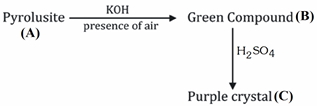
A
$Mn_2O_3, MnO_2, Mn_2O_7$
B
$MnO_2, K_2MnO_4, KMnO_4$
C
$FeCr_2O_4, K_2Cr_2O_7, KCrO_4$
D
$CuSO_4, Cu_2S, V_2O_5$
Solution
(B) The given reaction sequence is as follows:
$1$. Pyrolusite is $MnO_2$,which is $(A)$.
$2$. When $MnO_2$ is fused with $KOH$ in the presence of air,it forms potassium manganate $(K_2MnO_4)$,which is a green compound $(B)$.
$2MnO_2 + 4KOH + O_2 \rightarrow 2K_2MnO_4 + 2H_2O$
$3$. Potassium manganate $(K_2MnO_4)$ on reaction with $H_2SO_4$ (acidic medium) disproportionates to form potassium permanganate $(KMnO_4)$,which is a purple crystal $(C)$.
$3K_2MnO_4 + 2H_2SO_4 \rightarrow 2KMnO_4 + MnO_2 + 2K_2SO_4 + 2H_2O$
Therefore,$(A) = MnO_2$,$(B) = K_2MnO_4$,and $(C) = KMnO_4$.
$1$. Pyrolusite is $MnO_2$,which is $(A)$.
$2$. When $MnO_2$ is fused with $KOH$ in the presence of air,it forms potassium manganate $(K_2MnO_4)$,which is a green compound $(B)$.
$2MnO_2 + 4KOH + O_2 \rightarrow 2K_2MnO_4 + 2H_2O$
$3$. Potassium manganate $(K_2MnO_4)$ on reaction with $H_2SO_4$ (acidic medium) disproportionates to form potassium permanganate $(KMnO_4)$,which is a purple crystal $(C)$.
$3K_2MnO_4 + 2H_2SO_4 \rightarrow 2KMnO_4 + MnO_2 + 2K_2SO_4 + 2H_2O$
Therefore,$(A) = MnO_2$,$(B) = K_2MnO_4$,and $(C) = KMnO_4$.
0 likes
View Solution293
MediumMCQ
Which of the following is the use of potassium permanganate $(KMnO_4)$?
A
Bleaching of wool,cotton,and silk fibres
B
Decolourisation of oils
C
In analytical chemistry
D
All of these
Solution
(D) Potassium permanganate $(KMnO_4)$ is a strong oxidizing agent.
It is widely used for the bleaching of wool,cotton,silk,and other textile fibres.
It is also used for the decolourisation of oils.
In analytical chemistry,it is extensively used in redox titrations (permanganometry) due to its strong oxidizing properties.
Therefore,all the given options are correct uses of $KMnO_4$.
It is widely used for the bleaching of wool,cotton,silk,and other textile fibres.
It is also used for the decolourisation of oils.
In analytical chemistry,it is extensively used in redox titrations (permanganometry) due to its strong oxidizing properties.
Therefore,all the given options are correct uses of $KMnO_4$.
0 likes
View Solution294
MediumMCQ
The colour and magnetic nature of manganate ion $MnO_4^{2-}$ is-
A
Green,paramagnetic
B
Purple,diamagnetic
C
Green,diamagnetic
D
Purple,paramagnetic
Solution
(A) The oxidation state of $Mn$ in $MnO_4^{2-}$ is $+6$.
The electronic configuration of $Mn^{6+}$ is $[Ar] 3d^1$.
Due to the presence of one unpaired electron in the $3d$ orbital,the $MnO_4^{2-}$ ion is paramagnetic.
The manganate ion $(MnO_4^{2-})$ exhibits a green colour.
The electronic configuration of $Mn^{6+}$ is $[Ar] 3d^1$.
Due to the presence of one unpaired electron in the $3d$ orbital,the $MnO_4^{2-}$ ion is paramagnetic.
The manganate ion $(MnO_4^{2-})$ exhibits a green colour.
0 likes
View Solution295
EasyMCQ
Which pair of elements from the following is used to make an alloy for trophies?
A
$Cr$ and $Zn$
B
$Ni$ and $Cu$
C
$Cu$ and $Sn$
D
$Ni$ and $Zn$
Solution
(C) Trophies are typically made of bronze,which is an alloy of copper $(Cu)$ and tin $(Sn)$.
Therefore,the correct pair of elements is $Cu$ and $Sn$.
Therefore,the correct pair of elements is $Cu$ and $Sn$.
0 likes
View Solution296
MediumMCQ
Which of the following alloys is used in the construction of the outer fuselage of ultra-high-speed aircraft?
A
Nichrome
B
Cupra-nickel
C
Stainless steel
D
Bronze
Solution
(C) Stainless steels are used in the construction of the outer fuselage of ultra-high-speed aircraft due to their high strength and resistance to corrosion at elevated temperatures.
0 likes
View Solution297
EasyMCQ
Which from the following alloys is used in gas turbine engines?
A
Titanium alloy
B
Cupra-nickel
C
Stainless steel
D
Nichrome
Solution
(D) Nichrome is an alloy of $Ni$ and $Cr$. Due to its high resistance to oxidation and heat,it is used in heating elements and gas turbine engines.
0 likes
View Solution298
DifficultMCQ
When a mixture of manganese dioxide,potassium hydroxide and potassium chlorate is fused,the product obtained is
A
$K_2SO_4$
B
$K_2MnO_3$
C
$K_2MnO_4$
D
$KMnO_4$
Solution
(C) When a mixture of manganese dioxide $(MnO_2)$,potassium hydroxide $(KOH)$,and potassium chlorate $(KClO_3)$ is fused,the potassium chlorate acts as an oxidizing agent and decomposes to provide oxygen.
The overall reaction is:
$2KClO_{3(s)} \xrightarrow{\Delta} 2KCl_{(s)} + 3O_{2(g)}$
$2MnO_2 + 4KOH + O_2 \rightarrow 2K_2MnO_4 + 2H_2O$
The final product obtained is potassium manganate $(K_2MnO_4)$.
The overall reaction is:
$2KClO_{3(s)} \xrightarrow{\Delta} 2KCl_{(s)} + 3O_{2(g)}$
$2MnO_2 + 4KOH + O_2 \rightarrow 2K_2MnO_4 + 2H_2O$
The final product obtained is potassium manganate $(K_2MnO_4)$.
0 likes
View Solution299
EasyMCQ
The ionic charges on chromate ion and dichromate ion respectively are:
A
$-2, -2$
B
$-3, -2$
C
$-2, -4$
D
$-4, -2$
Solution
(A) The chemical formula for the chromate ion is $CrO_4^{2-}$,which carries a charge of $-2$.
The chemical formula for the dichromate ion is $Cr_2O_7^{2-}$,which also carries a charge of $-2$.
Therefore,the ionic charges are $-2$ and $-2$ respectively.
The chemical formula for the dichromate ion is $Cr_2O_7^{2-}$,which also carries a charge of $-2$.
Therefore,the ionic charges are $-2$ and $-2$ respectively.
0 likes
View Solution300
MediumMCQ
How is sodium chromate converted into sodium dichromate in the manufacture of potassium dichromate from chromite ore?
A
By the action of concentrated sulphuric acid
B
By roasting with soda ash
C
By the action of sodium hydroxide
D
By the action of lime stone
Solution
(A) In the industrial production of potassium dichromate,the yellow solution of sodium chromate $(Na_2CrO_4)$ is acidified with concentrated sulphuric acid $(H_2SO_4)$ to convert it into orange sodium dichromate $(Na_2Cr_2O_7)$.
The reaction is: $2Na_2CrO_4 + 2H^+ \rightarrow Na_2Cr_2O_7 + 2Na^+ + H_2O$.
The reaction is: $2Na_2CrO_4 + 2H^+ \rightarrow Na_2Cr_2O_7 + 2Na^+ + H_2O$.
0 likes
View Solutiond-and f-Block Elements — Compounds of Transitional elements · Frequently Asked Questions
1Are these d-and f-Block Elements questions useful for JEE and NEET?
Yes. All questions in this section are mapped to JEE Main and NEET exam patterns. Previous year questions from JEE Main, NEET, GUJCET and state-level exams are included with full solutions.
2Can I switch to Hindi or Gujarati for these questions?
Yes. Use the language tabs in the hero section or the sidebar to view the same questions and solutions in English, Hindi or Gujarati.
3How do I generate a question paper from this subtopic?
Use the Vedclass Exam Paper Generator — select the chapter and subtopic, set difficulty, and generate Sets A, B, C, D automatically. First 3 chapters of every subject are free.
Vedclass Products
For Students
Vedclass Test Series
Mock tests in real JEE/NEET style with performance analysis. 5-day free trial.
Start Free TrialFor Teachers
Exam Paper Generator
Generate Set A/B/C/D papers from this chapter in 2 minutes. 3 chapters free.
Try FreeFor Institutes
Online Exam Module
Live online exams with unlimited students, 360° analytics & white-label branding.
See DemoFor Teachers & Institutes
Generate a d-and f-Block Elements Exam Paper in 2 Minutes
Select subtopic & difficulty — Sets A, B, C, D auto-generated with No Repeat logic.
First 3 chapters of every subject are free — no payment required.