
A English
Compounds of Transitional elements Questions in English
Class 12 Chemistry · d-and f-Block Elements · Compounds of Transitional elements
338+
Questions
English
Language
100%
With Solutions
Showing 49 of 338 questions in English
151
DifficultMCQ
Thermal decomposition of a $Mn$ compound $(X)$ at $513 \ K$ results in compound $Y$,$MnO_2$ and a gaseous product. $MnO_2$ reacts with $NaCl$ and concentrated $H_2SO_4$ to give a pungent gas $Z$. Identify $X, Y$ and $Z$.
A
$K_2MnO_4, KMnO_4$ and $SO_2$
B
$K_3MnO_4, K_2MnO_4$ and $Cl_2$
C
$K_2MnO_4, KMnO_4$ and $Cl_2$
D
$KMnO_4, K_2MnO_4$ and $Cl_2$
Solution
(D) The thermal decomposition of potassium permanganate $(KMnO_4)$ at $513 \ K$ is given by:
$2KMnO_4 (X) \xrightarrow{513 \ K} K_2MnO_4 (Y) + MnO_2 + O_2 (g)$
Thus,$X = KMnO_4$ and $Y = K_2MnO_4$.
$MnO_2$ reacts with $NaCl$ and concentrated $H_2SO_4$ to produce chlorine gas,which is a pungent gas:
$MnO_2 + 4NaCl + 4H_2SO_4 \to MnCl_2 + 4NaHSO_4 + 2H_2O + Cl_2 (Z)$
Thus,$Z = Cl_2$.
Therefore,the correct sequence is $X = KMnO_4, Y = K_2MnO_4, Z = Cl_2$.
$2KMnO_4 (X) \xrightarrow{513 \ K} K_2MnO_4 (Y) + MnO_2 + O_2 (g)$
Thus,$X = KMnO_4$ and $Y = K_2MnO_4$.
$MnO_2$ reacts with $NaCl$ and concentrated $H_2SO_4$ to produce chlorine gas,which is a pungent gas:
$MnO_2 + 4NaCl + 4H_2SO_4 \to MnCl_2 + 4NaHSO_4 + 2H_2O + Cl_2 (Z)$
Thus,$Z = Cl_2$.
Therefore,the correct sequence is $X = KMnO_4, Y = K_2MnO_4, Z = Cl_2$.
0 likes
View Solution152
EasyMCQ
Which of the following is most basic in nature?
A
$Eu(OH)_3$
B
$Lu(OH)_3$
C
$Pr(OH)_3$
D
$Pm(OH)_3$
Solution
(C) In the lanthanoid series,as we move from $La$ to $Lu$,the ionic radius decreases due to lanthanoid contraction.
As the ionic radius decreases,the covalent character of the $M-OH$ bond increases,which leads to a decrease in the basic strength of the hydroxides.
Therefore,the basic strength follows the order: $La(OH)_3 > Pr(OH)_3 > Pm(OH)_3 > Eu(OH)_3 > Lu(OH)_3$.
Among the given options,$Pr(OH)_3$ has the largest ionic radius and is therefore the most basic.
As the ionic radius decreases,the covalent character of the $M-OH$ bond increases,which leads to a decrease in the basic strength of the hydroxides.
Therefore,the basic strength follows the order: $La(OH)_3 > Pr(OH)_3 > Pm(OH)_3 > Eu(OH)_3 > Lu(OH)_3$.
Among the given options,$Pr(OH)_3$ has the largest ionic radius and is therefore the most basic.
0 likes
View Solution153
MediumMCQ
When acidified $K_2Cr_2O_7$ reacts with $H_2O_2$,a blue-coloured solution is obtained. This blue colour is due to the formation of:
A
$Cr_2O_3$
B
$CrO_3$
C
$Cr_2(SO_4)_3$
D
$CrO_5$
Solution
(D) Step $I$: Acidification of potassium dichromate: $K_2Cr_2O_7 + H_2SO_4 \rightarrow K_2SO_4 + H_2Cr_2O_7$
Step $II$: Reaction with hydrogen peroxide: $H_2Cr_2O_7 + 4H_2O_2 \rightarrow 2CrO_5 + 5H_2O$
Step $III$: The overall balanced chemical equation is $K_2Cr_2O_7 + H_2SO_4 + 4H_2O_2 \rightarrow 2CrO_5 + K_2SO_4 + 5H_2O$
The blue colour is due to the formation of chromium$(VI)$ peroxide,which is $CrO_5$. This compound is unstable and decomposes rapidly in aqueous solution,but it exhibits a characteristic deep blue colour.
Hence,the correct option is $D$.
Step $II$: Reaction with hydrogen peroxide: $H_2Cr_2O_7 + 4H_2O_2 \rightarrow 2CrO_5 + 5H_2O$
Step $III$: The overall balanced chemical equation is $K_2Cr_2O_7 + H_2SO_4 + 4H_2O_2 \rightarrow 2CrO_5 + K_2SO_4 + 5H_2O$
The blue colour is due to the formation of chromium$(VI)$ peroxide,which is $CrO_5$. This compound is unstable and decomposes rapidly in aqueous solution,but it exhibits a characteristic deep blue colour.
Hence,the correct option is $D$.
0 likes
View Solution154
DifficultMCQ
$MnO^{-}_4$ is of intense pink colour,though $Mn$ is in $(+7)$ oxidation state,it is due to
A
Oxygen gives colour to it
B
Charge transfer when $Mn(+7)$ gives its electron to oxygen and oxidise to $Mn(+8)$ temporarily
C
Charge transfer when oxygen gives its electron to $Mn(+7)$ changing in $Mn(+6)$
D
None is correct explanation
Solution
(C) The intense color in $MnO^{-}_4$ arises from a ligand-to-metal charge transfer $(LMCT)$ transition.
In $MnO^{-}_4$,$Mn$ is in the $(+7)$ oxidation state,meaning it has a $d^0$ electronic configuration.
Since there are no $d$-electrons,a $d-d$ transition is impossible.
The color arises because an electron is transferred from the oxygen $2p$ orbitals to the empty $3d$ orbitals of the $Mn(+7)$ ion upon the absorption of light.
This electronic transition corresponds to the energy of yellow light,which is absorbed,resulting in the observation of the complementary color,which is intense pink or purple.
In $MnO^{-}_4$,$Mn$ is in the $(+7)$ oxidation state,meaning it has a $d^0$ electronic configuration.
Since there are no $d$-electrons,a $d-d$ transition is impossible.
The color arises because an electron is transferred from the oxygen $2p$ orbitals to the empty $3d$ orbitals of the $Mn(+7)$ ion upon the absorption of light.
This electronic transition corresponds to the energy of yellow light,which is absorbed,resulting in the observation of the complementary color,which is intense pink or purple.
0 likes
View Solution155
MediumMCQ
The colour of the bead in the borax bead test is mainly due to the formation of:
A
metal oxides
B
boron oxide
C
metal metaborates
D
elemental boron
Solution
(C) The correct option is $(C)$ metal metaborates.
Explanation:
When borax $(Na_2B_4O_7 \cdot 10H_2O)$ is heated,it loses its water of crystallization and swells up. On further heating,it melts to form a transparent glassy bead consisting of sodium metaborate $(NaBO_2)$ and boric anhydride $(B_2O_3)$.
$Na_2B_4O_7 \cdot 10H_2O \xrightarrow{\Delta} Na_2B_4O_7 + 10H_2O$
$Na_2B_4O_7 \xrightarrow{\Delta} 2NaBO_2 + B_2O_3$
When this bead is heated with a transition metal salt in an oxidizing flame,the metal salt decomposes into the corresponding metal oxide,which then reacts with boric anhydride to form coloured metal metaborates,which are responsible for the characteristic colours observed in the test.
$MO + B_2O_3 \rightarrow M(BO_2)_2$ (coloured bead)
Explanation:
When borax $(Na_2B_4O_7 \cdot 10H_2O)$ is heated,it loses its water of crystallization and swells up. On further heating,it melts to form a transparent glassy bead consisting of sodium metaborate $(NaBO_2)$ and boric anhydride $(B_2O_3)$.
$Na_2B_4O_7 \cdot 10H_2O \xrightarrow{\Delta} Na_2B_4O_7 + 10H_2O$
$Na_2B_4O_7 \xrightarrow{\Delta} 2NaBO_2 + B_2O_3$
When this bead is heated with a transition metal salt in an oxidizing flame,the metal salt decomposes into the corresponding metal oxide,which then reacts with boric anhydride to form coloured metal metaborates,which are responsible for the characteristic colours observed in the test.
$MO + B_2O_3 \rightarrow M(BO_2)_2$ (coloured bead)
0 likes
View Solution156
MediumMCQ
Boiling $CuCl_2$ with $Cu$ in concentrated $HCl$ gives:
A
$CuCl$
B
$CuCl_2$
C
$H[CuCl_2]$
D
$Cu_2Cl$
Solution
(C) When $CuCl_2$ is boiled with $Cu$ metal in the presence of concentrated $HCl$,a comproportionation reaction occurs.
The reaction is: $CuCl_2 + Cu + 2HCl \rightarrow 2H[CuCl_2]$.
The product formed is chlorocupric$(I)$ acid,which contains the complex ion $[CuCl_2]^-$.
Therefore,the correct option is $C$.
The reaction is: $CuCl_2 + Cu + 2HCl \rightarrow 2H[CuCl_2]$.
The product formed is chlorocupric$(I)$ acid,which contains the complex ion $[CuCl_2]^-$.
Therefore,the correct option is $C$.
0 likes
View Solution157
MediumMCQ
Calomel is the name of
A
$HgCl_2$
B
$Hg_2Cl_2$
C
$HgCl_2 + Hg$
D
$Hg_2Cl_2 + Hg$
Solution
(B) Calomel is the common name for mercury$(I)$ chloride,which has the chemical formula $Hg_2Cl_2$.
0 likes
View Solution158
MediumMCQ
Which of the following is the correct formula for a compound of scandium and oxygen?
A
$Sc_2O$
B
$ScO$
C
$Sc_3O_2$
D
$Sc_2O_3$
Solution
(D) The oxidation state of scandium $(Sc)$ is $+3$ and the oxidation state of oxygen $(O)$ is $-2$.
To form a neutral compound,the charges must be balanced.
Using the criss-cross method,the formula becomes $Sc_2O_3$.
To form a neutral compound,the charges must be balanced.
Using the criss-cross method,the formula becomes $Sc_2O_3$.
0 likes
View Solution159
AdvancedMCQ
Which of the following statements is incorrect?
A
Mercurous ion exists as $Hg^{+}$
B
Mercurous ion is diamagnetic and exists as dimer $Hg_2^{2+}$
C
Mercurous ion is colourless
D
There is a metallic bond between two $Hg^{+}$ ions
Solution
(A) The mercurous ion does not exist as a monomeric $Hg^{+}$ ion because it would have an unpaired electron in the $6s$ orbital,making it paramagnetic.
Instead,it exists as a dimer $Hg_2^{2+}$,where two $Hg^{+}$ ions are linked by a metal-metal bond.
This pairing of electrons makes the $Hg_2^{2+}$ ion diamagnetic and colourless.
Therefore,the statement that the mercurous ion exists as $Hg^{+}$ is incorrect.
Instead,it exists as a dimer $Hg_2^{2+}$,where two $Hg^{+}$ ions are linked by a metal-metal bond.
This pairing of electrons makes the $Hg_2^{2+}$ ion diamagnetic and colourless.
Therefore,the statement that the mercurous ion exists as $Hg^{+}$ is incorrect.
0 likes
View Solution160
EasyMCQ
Chrome yellow is chemically known as
A
lead chromate
B
lead sulphate
C
lead iodide
D
basic lead acetate
Solution
(A) Chrome yellow is $lead(II)$ chromate $(PbCrO_4)$.
It occurs naturally as the mineral crocoite.
$PbCrO_4$ is widely used as a yellow pigment in paints and coatings.
Therefore,the correct answer is $lead$ chromate.
It occurs naturally as the mineral crocoite.
$PbCrO_4$ is widely used as a yellow pigment in paints and coatings.
Therefore,the correct answer is $lead$ chromate.
0 likes
View Solution161
MediumMCQ
Each of the following ions contains vanadium in the $+V$ oxidation state except:
A
$VO_2^+$
B
$V(OH)_4^+$
C
$VO^{2+}$
D
$[VO_3 \cdot OH]^{2-}$
Solution
(C) To find the oxidation state of $V$ in $VO^{2+}$: Let the oxidation state be $x$. Since the charge on oxygen is $-2$,we have $x + (-2) = +2$,which gives $x = +4$.
In $VO_2^+$,$x + 2(-2) = +1 \implies x = +5$.
In $V(OH)_4^+$,$x + 4(-1) = +1 \implies x = +5$.
In $[VO_3 \cdot OH]^{2-}$,$x + 3(-2) + (-1) = -2 \implies x - 7 = -2 \implies x = +5$.
Thus,$VO^{2+}$ is the only ion where vanadium is in the $+IV$ oxidation state.
In $VO_2^+$,$x + 2(-2) = +1 \implies x = +5$.
In $V(OH)_4^+$,$x + 4(-1) = +1 \implies x = +5$.
In $[VO_3 \cdot OH]^{2-}$,$x + 3(-2) + (-1) = -2 \implies x - 7 = -2 \implies x = +5$.
Thus,$VO^{2+}$ is the only ion where vanadium is in the $+IV$ oxidation state.
0 likes
View Solution162
DifficultMCQ
The false statement about iron $(III)$ hydroxide is that
A
it is a weaker base than $Fe(OH)_2$
B
with concentrated $KOH$,it forms a complex $K_3[Fe(OH)_6]$
C
it gradually loses water and transforms into $Fe_2O_3$
D
None of these
Solution
(D) $1$. $Fe(OH)_3$ is a weaker base than $Fe(OH)_2$ because the oxidation state of $Fe$ in $Fe(OH)_3$ is $+3$,which makes it more acidic and less basic compared to $Fe(OH)_2$ where $Fe$ is in $+2$ oxidation state.
$2$. $Fe(OH)_3$ reacts with concentrated $KOH$ to form the complex $K_3[Fe(OH)_6]$,which is a known reaction.
$3$. $Fe(OH)_3$ is unstable and loses water upon heating or over time to form $Fe_2O_3 \cdot xH_2O$ and eventually $Fe_2O_3$.
$4$. Since all the statements $A$,$B$,and $C$ are chemically correct,the false statement is none of these.
$2$. $Fe(OH)_3$ reacts with concentrated $KOH$ to form the complex $K_3[Fe(OH)_6]$,which is a known reaction.
$3$. $Fe(OH)_3$ is unstable and loses water upon heating or over time to form $Fe_2O_3 \cdot xH_2O$ and eventually $Fe_2O_3$.
$4$. Since all the statements $A$,$B$,and $C$ are chemically correct,the false statement is none of these.
0 likes
View Solution163
MediumMCQ
The oxoanion in which the oxidation state of the central atom is same as its group number in the periodic table is
A
$SO_4^{2-}$
B
$VO_2^+$
C
$MnO_4^{2-}$
D
$Cr_2O_7^{2-}$
Solution
(D) To find the oxidation state of the central atom in each oxoanion,we use the rule that the sum of oxidation states equals the charge on the ion.
$1$. For $SO_4^{2-}$: $x + 4(-2) = -2 \Rightarrow x = +6$. Sulfur is in Group $16$,so oxidation state $+6 \neq 16$.
$2$. For $VO_2^+$: $x + 2(-2) = +1 \Rightarrow x = +5$. Vanadium is in Group $5$,so oxidation state $+5 = 5$.
$3$. For $MnO_4^{2-}$: $x + 4(-2) = -2 \Rightarrow x = +6$. Manganese is in Group $7$,so oxidation state $+6 \neq 7$.
$4$. For $Cr_2O_7^{2-}$: $2x + 7(-2) = -2$ $\Rightarrow 2x = +12$ $\Rightarrow x = +6$. Chromium is in Group $6$,so oxidation state $+6 = 6$.
Note: Both $VO_2^+$ and $Cr_2O_7^{2-}$ satisfy the condition. However,in standard competitive chemistry contexts,$Cr_2O_7^{2-}$ is the classic example of an oxoanion where the oxidation state equals the group number $(6)$. Given the options,$D$ is the most appropriate answer.
$1$. For $SO_4^{2-}$: $x + 4(-2) = -2 \Rightarrow x = +6$. Sulfur is in Group $16$,so oxidation state $+6 \neq 16$.
$2$. For $VO_2^+$: $x + 2(-2) = +1 \Rightarrow x = +5$. Vanadium is in Group $5$,so oxidation state $+5 = 5$.
$3$. For $MnO_4^{2-}$: $x + 4(-2) = -2 \Rightarrow x = +6$. Manganese is in Group $7$,so oxidation state $+6 \neq 7$.
$4$. For $Cr_2O_7^{2-}$: $2x + 7(-2) = -2$ $\Rightarrow 2x = +12$ $\Rightarrow x = +6$. Chromium is in Group $6$,so oxidation state $+6 = 6$.
Note: Both $VO_2^+$ and $Cr_2O_7^{2-}$ satisfy the condition. However,in standard competitive chemistry contexts,$Cr_2O_7^{2-}$ is the classic example of an oxoanion where the oxidation state equals the group number $(6)$. Given the options,$D$ is the most appropriate answer.
0 likes
View Solution164
MediumMCQ
Which compound is formed when iron reacts with carbon?
A
$FeC_2$
B
$Fe_3C$
C
$FeC_3$
D
$Fe_2C$
Solution
(B) When iron reacts with carbon,it forms an interstitial compound known as cementite,which has the chemical formula $Fe_3C$.
0 likes
View Solution165
MediumMCQ
$A$ metal $M$ which is not affected by strong acids like conc. $HNO_3$,conc. $H_2SO_4$ and conc. solutions of alkalies like $NaOH$,$KOH$ forms $MCl_3$,which finds use for toning in photography. The metal $M$ is:
A
$Ag$
B
$Hg$
C
$Au$
D
$Cu$
Solution
(C) Gold $(Au)$ is a noble metal that is not affected by strong acids like concentrated $HNO_3$ or $H_2SO_4$,nor by concentrated solutions of strong alkalies like $NaOH$ or $KOH$.
$Au$ reacts to form gold$(III)$ chloride $(AuCl_3)$,which is widely used for toning in photography.
Silver $(Ag)$ forms $AgCl$,which is not $MCl_3$.
Therefore,the metal $M$ is $Au$.
$Au$ reacts to form gold$(III)$ chloride $(AuCl_3)$,which is widely used for toning in photography.
Silver $(Ag)$ forms $AgCl$,which is not $MCl_3$.
Therefore,the metal $M$ is $Au$.
0 likes
View Solution166
MediumMCQ
Identify the wrong statement regarding copper$(II)$ sulphate $(CuSO_4)$.
A
It reacts with $KI$ to give $I_2$.
B
It reacts with $KCl$ to give $Cl_2$.
C
It gives $CuO$ on strong heating in air.
D
Its tartrate complex reacts with $NaOH$ and glucose to give $Cu_2O$.
Solution
(B) $1$. $CuSO_4$ reacts with $KI$ to form $Cu_2I_2$ and $I_2$ $(2Cu^{2+} + 4I^- \rightarrow Cu_2I_2 + I_2)$. This is a correct statement.
$2$. $CuSO_4$ does not react with $KCl$ to produce $Cl_2$ because $Cl^-$ is not a strong enough reducing agent to reduce $Cu^{2+}$ to $Cu^+$. This is the wrong statement.
$3$. On strong heating,$CuSO_4 \cdot 5H_2O$ loses water and eventually decomposes to $CuO$ and $SO_3$. This is a correct statement.
$4$. The tartrate complex of copper$(II)$ (Fehling's solution) reacts with glucose (an aldehyde) in the presence of $NaOH$ to form a red precipitate of cuprous oxide $(Cu_2O)$. This is a correct statement.
$2$. $CuSO_4$ does not react with $KCl$ to produce $Cl_2$ because $Cl^-$ is not a strong enough reducing agent to reduce $Cu^{2+}$ to $Cu^+$. This is the wrong statement.
$3$. On strong heating,$CuSO_4 \cdot 5H_2O$ loses water and eventually decomposes to $CuO$ and $SO_3$. This is a correct statement.
$4$. The tartrate complex of copper$(II)$ (Fehling's solution) reacts with glucose (an aldehyde) in the presence of $NaOH$ to form a red precipitate of cuprous oxide $(Cu_2O)$. This is a correct statement.
0 likes
View Solution167
EasyMCQ
Sodium chromate,$Na_2CrO_4$ is made commercially by
A
heating a mixture of $Cr_2O_3$ and $Na_2CO_3$
B
heating a mixture of chromite ore and sodium carbonate in the presence of oxygen
C
heating sodium dichromate with sodium carbonate
D
reacting $NaOH$ with chromic acid
Solution
(B) Commercially,sodium chromate $(Na_2CrO_4)$ is produced by roasting chromite ore $(FeCr_2O_4)$ with sodium carbonate $(Na_2CO_3)$ in the presence of excess air (oxygen).
The chemical reaction is:
$4FeCr_2O_4 + 8Na_2CO_3 + 7O_2 \rightarrow 8Na_2CrO_4 + 2Fe_2O_3 + 8CO_2$
This process converts the chromium in the ore into soluble sodium chromate.
The chemical reaction is:
$4FeCr_2O_4 + 8Na_2CO_3 + 7O_2 \rightarrow 8Na_2CrO_4 + 2Fe_2O_3 + 8CO_2$
This process converts the chromium in the ore into soluble sodium chromate.
0 likes
View Solution168
AdvancedMCQ
$Fe(OH)_2$ is precipitated from $Fe(II)$ solutions as a white solid but turns dark green and then brown due to the formation of:
A
$Fe(OH)_2$ and $Fe(OH)_3$
B
only $Fe(OH)_3$
C
$Fe_2O_3 \cdot (H_2O)_n$
D
$Fe_2O_3 \cdot 2H_2O$
Solution
(C) When $Fe(OH)_2$ is precipitated from $Fe(II)$ solutions,it initially appears as a white solid.
Upon exposure to air,it undergoes oxidation.
The dark green color is due to the presence of both $Fe(OH)_2$ and $Fe(OH)_3$.
Finally,it turns brown due to the complete oxidation of $Fe(II)$ to $Fe(III)$,forming hydrated ferric oxide,$Fe_2O_3 \cdot (H_2O)_n$ (also known as rust).
Upon exposure to air,it undergoes oxidation.
The dark green color is due to the presence of both $Fe(OH)_2$ and $Fe(OH)_3$.
Finally,it turns brown due to the complete oxidation of $Fe(II)$ to $Fe(III)$,forming hydrated ferric oxide,$Fe_2O_3 \cdot (H_2O)_n$ (also known as rust).
0 likes
View Solution169
MediumMCQ
Mark the correct statements.
A
$Hg$ forms an amalgam with iron.
B
$Hg$ vapour is non-poisonous.
C
$Hg$ is monoatomic and monovalent in mercurous compounds.
D
Oxysalts of mercury are thermally unstable.
Solution
(D) $1$. $Hg$ does not form an amalgam with iron $(Fe)$,which is why iron containers are used to store mercury. Thus,statement $A$ is incorrect.
$2$. $Hg$ vapour is highly poisonous. Thus,statement $B$ is incorrect.
$3$. In mercurous compounds,mercury exists as the dimer $Hg_2^{2+}$,where each $Hg$ atom is monovalent,but the species is diatomic,not monoatomic. Thus,statement $C$ is incorrect.
$4$. Oxysalts of mercury (like $HgSO_4$,$Hg(NO_3)_2$) are thermally unstable and decompose upon heating to give $Hg$ metal,oxygen,and other products. Thus,statement $D$ is correct.
$2$. $Hg$ vapour is highly poisonous. Thus,statement $B$ is incorrect.
$3$. In mercurous compounds,mercury exists as the dimer $Hg_2^{2+}$,where each $Hg$ atom is monovalent,but the species is diatomic,not monoatomic. Thus,statement $C$ is incorrect.
$4$. Oxysalts of mercury (like $HgSO_4$,$Hg(NO_3)_2$) are thermally unstable and decompose upon heating to give $Hg$ metal,oxygen,and other products. Thus,statement $D$ is correct.
0 likes
View Solution170
DifficultMCQ
Which of the following statements regarding copper salts is not true?
A
Copper $(I)$ disproportionates to copper and copper $(II)$ ion in aqueous solution.
B
Copper $(I)$ can be stabilized by the formation of insoluble complex compounds such as $[CuCl_2]^-$ and $[Cu(CN)_2]^-$.
C
Copper $(II)$ oxide is a red powder.
D
None of these.
Solution
(C) $1$. Copper $(I)$ ions are unstable in aqueous solution and undergo disproportionation: $2Cu^+ (aq) \rightarrow Cu^{2+} (aq) + Cu (s)$. This statement is true.
$2$. Copper $(I)$ can be stabilized by forming insoluble complexes like $[CuCl_2]^-$ or $[Cu(CN)_2]^-$. This statement is true.
$3$. Copper $(II)$ oxide $(CuO)$ is a black powder,whereas Copper $(I)$ oxide $(Cu_2O)$ is a red powder. Therefore,the statement that Copper $(II)$ oxide is a red powder is false.
$2$. Copper $(I)$ can be stabilized by forming insoluble complexes like $[CuCl_2]^-$ or $[Cu(CN)_2]^-$. This statement is true.
$3$. Copper $(II)$ oxide $(CuO)$ is a black powder,whereas Copper $(I)$ oxide $(Cu_2O)$ is a red powder. Therefore,the statement that Copper $(II)$ oxide is a red powder is false.
0 likes
View Solution171
MediumMCQ
The conversion of pig iron to steel frequently requires the addition of
$(I)$ oxygen or iron oxide
$(II)$ transition elements
$(III)$ inner transition elements
$(IV)$ silica
$(I)$ oxygen or iron oxide
$(II)$ transition elements
$(III)$ inner transition elements
$(IV)$ silica
A
$I, II, III$
B
$I, II$
C
$II, III$
D
$I$ only
Solution
(B) Pig iron contains a high percentage of carbon $(3-4.5\%)$ and other impurities like $S, P, Si, Mn$.
To convert pig iron into steel,these impurities must be removed or reduced.
$(I)$ Oxygen or iron oxide is added to oxidize the impurities (like $C$ to $CO$,$Si$ to $SiO_2$,etc.).
$(II)$ Transition elements (like $Cr, Ni, Mn, V, W$) are added to impart specific properties such as hardness,corrosion resistance,and tensile strength to the steel.
$(III)$ Inner transition elements are generally not added for this purpose.
$(IV)$ Silica is an acidic impurity that is usually removed by adding a basic flux,not added to the steel.
Therefore,the correct additions are $(I)$ and $(II)$.
To convert pig iron into steel,these impurities must be removed or reduced.
$(I)$ Oxygen or iron oxide is added to oxidize the impurities (like $C$ to $CO$,$Si$ to $SiO_2$,etc.).
$(II)$ Transition elements (like $Cr, Ni, Mn, V, W$) are added to impart specific properties such as hardness,corrosion resistance,and tensile strength to the steel.
$(III)$ Inner transition elements are generally not added for this purpose.
$(IV)$ Silica is an acidic impurity that is usually removed by adding a basic flux,not added to the steel.
Therefore,the correct additions are $(I)$ and $(II)$.
0 likes
View Solution172
EasyMCQ
The oxoanion which contains all equivalent $M-O$ bonds is:
$(I)$ $CrO_4^{2-}$
$(II)$ $MnO_4^-$
$(III)$ $Cr_2O_7^{2-}$
$(I)$ $CrO_4^{2-}$
$(II)$ $MnO_4^-$
$(III)$ $Cr_2O_7^{2-}$
A
$III$ only
B
$I, II, III$
C
$I, II$
D
$I$ only
Solution
(C) In $CrO_4^{2-}$ (chromate ion),the central $Cr$ atom is $sp^3$ hybridized,and due to resonance,all four $Cr-O$ bonds are equivalent.
In $MnO_4^-$ (permanganate ion),the central $Mn$ atom is $d^3s$ hybridized,and due to resonance,all four $Mn-O$ bonds are equivalent.
In $Cr_2O_7^{2-}$ (dichromate ion),there is a $Cr-O-Cr$ bridge. The terminal $Cr-O$ bonds are not equivalent to the bridging $Cr-O$ bonds.
Therefore,only $CrO_4^{2-}$ and $MnO_4^-$ contain equivalent $M-O$ bonds.
In $MnO_4^-$ (permanganate ion),the central $Mn$ atom is $d^3s$ hybridized,and due to resonance,all four $Mn-O$ bonds are equivalent.
In $Cr_2O_7^{2-}$ (dichromate ion),there is a $Cr-O-Cr$ bridge. The terminal $Cr-O$ bonds are not equivalent to the bridging $Cr-O$ bonds.
Therefore,only $CrO_4^{2-}$ and $MnO_4^-$ contain equivalent $M-O$ bonds.
0 likes
View Solution173
AdvancedMCQ
$Fe_2Cr_2O_4 + Na_2CO_3 + O_2$ $\xrightarrow{\text{Fusion}} [X]$ $\xrightarrow[H_2O]{H^{+}} [Y]$ $\xrightarrow{H_2O_2/H^{+}} [Z]$
Which of the following statements is true for the compounds $[X]$,$[Y]$,and $[Z]$?
Which of the following statements is true for the compounds $[X]$,$[Y]$,and $[Z]$?
A
In all three compounds,the chromium is in $+6$ oxidation state.
B
$(Z)$ is a deep blue-violet coloured compound which decomposes rapidly in aqueous solution into $Cr^{3+}$ and dioxygen.
C
Saturated solution of $[Y]$ gives bright orange compound,chromic anhydride,with concentrated $H_2SO_4$.
D
All of these.
Solution
(D) The reaction sequence is as follows:
$1$. Fusion of chromite ore $(Fe_2Cr_2O_4)$ with $Na_2CO_3$ and $O_2$ gives sodium chromate $[X]$ ($Na_2CrO_4$ where $Cr$ is $+6$).
$2$. Acidification of $[X]$ gives sodium dichromate $[Y]$ ($Na_2Cr_2O_7$ where $Cr$ is $+6$).
$3$. Reaction of $[Y]$ with $H_2O_2$ in acidic medium gives chromium pentoxide $[Z]$ ($CrO_5$ or $CrO(O_2)_2$ where $Cr$ is $+6$).
$4$. Statement $A$ is true as $Cr$ is in $+6$ oxidation state in $Na_2CrO_4$,$Na_2Cr_2O_7$,and $CrO_5$.
$5$. Statement $B$ is true as $CrO_5$ is a deep blue-violet compound that decomposes rapidly in aqueous solution into $Cr^{3+}$ and $O_2$.
$6$. Statement $C$ is true as saturated solution of dichromate $[Y]$ with conc. $H_2SO_4$ yields $CrO_3$ (chromic anhydride),which is a bright orange crystalline solid.
$1$. Fusion of chromite ore $(Fe_2Cr_2O_4)$ with $Na_2CO_3$ and $O_2$ gives sodium chromate $[X]$ ($Na_2CrO_4$ where $Cr$ is $+6$).
$2$. Acidification of $[X]$ gives sodium dichromate $[Y]$ ($Na_2Cr_2O_7$ where $Cr$ is $+6$).
$3$. Reaction of $[Y]$ with $H_2O_2$ in acidic medium gives chromium pentoxide $[Z]$ ($CrO_5$ or $CrO(O_2)_2$ where $Cr$ is $+6$).
$4$. Statement $A$ is true as $Cr$ is in $+6$ oxidation state in $Na_2CrO_4$,$Na_2Cr_2O_7$,and $CrO_5$.
$5$. Statement $B$ is true as $CrO_5$ is a deep blue-violet compound that decomposes rapidly in aqueous solution into $Cr^{3+}$ and $O_2$.
$6$. Statement $C$ is true as saturated solution of dichromate $[Y]$ with conc. $H_2SO_4$ yields $CrO_3$ (chromic anhydride),which is a bright orange crystalline solid.
0 likes
View Solution174
EasyMCQ
Correct statement for $CeO_2$ is/are:
$1$. It is diamagnetic in nature.
$2$. It is a good oxidising agent.
$3$. It is a colourless compound.
$1$. It is diamagnetic in nature.
$2$. It is a good oxidising agent.
$3$. It is a colourless compound.
A
$1$ and $2$
B
$1$ and $3$
C
$2$ and $3$
D
$1, 2$ and $3$
Solution
(D) In $CeO_2$,Cerium is in the $+4$ oxidation state $(Ce^{4+})$.
The electronic configuration of $Ce$ $(Z=58)$ is $[Xe] 4f^1 5d^1 6s^2$. Therefore,$Ce^{4+}$ has the configuration $[Xe] 4f^0$.
$1$. Since there are no unpaired electrons in the $4f$ orbital,$CeO_2$ is diamagnetic. This statement is correct.
$2$. $Ce^{4+}$ has a strong tendency to gain an electron to return to the more stable $+3$ oxidation state $(Ce^{3+})$. Thus,it acts as a good oxidising agent. This statement is correct.
$3$. Due to the absence of $f-f$ transitions ($4f^0$ configuration),$CeO_2$ is colourless. This statement is correct.
Therefore,all three statements are correct.
The electronic configuration of $Ce$ $(Z=58)$ is $[Xe] 4f^1 5d^1 6s^2$. Therefore,$Ce^{4+}$ has the configuration $[Xe] 4f^0$.
$1$. Since there are no unpaired electrons in the $4f$ orbital,$CeO_2$ is diamagnetic. This statement is correct.
$2$. $Ce^{4+}$ has a strong tendency to gain an electron to return to the more stable $+3$ oxidation state $(Ce^{3+})$. Thus,it acts as a good oxidising agent. This statement is correct.
$3$. Due to the absence of $f-f$ transitions ($4f^0$ configuration),$CeO_2$ is colourless. This statement is correct.
Therefore,all three statements are correct.
0 likes
View Solution175
DifficultMCQ
$NaCl + K_2Cr_2O_7 + \text{conc. } H_2SO_4$ $\xrightarrow{\Delta} P(\text{gas})$ $\xrightarrow{NaOH} Q$ $\xrightarrow[Pb(CH_3COO)_2]{CH_3COOH} R(\text{ppt})$
Which of the following is the correct statement?
Which of the following is the correct statement?
A
$P$ is a yellow-coloured gas
B
$Q$ is an orange-red solution
C
$R$ is a yellow precipitate $(ppt)$
D
None of these
Solution
(C) The reaction sequence is as follows:
$1$. $4NaCl + K_2Cr_2O_7 + 6H_2SO_4 \xrightarrow{\Delta} 2CrO_2Cl_2(P) + 2KHSO_4 + 4NaHSO_4 + 3H_2O$. Here,$P$ is chromyl chloride $(CrO_2Cl_2)$,which appears as orange-red vapours.
$2$. $CrO_2Cl_2 + 4NaOH \to Na_2CrO_4(Q) + 2NaCl + 2H_2O$. Here,$Q$ is sodium chromate $(Na_2CrO_4)$,which forms a yellow solution.
$3$. $Na_2CrO_4 + Pb(CH_3COO)_2 \to PbCrO_4(R) + 2CH_3COONa$. Here,$R$ is lead chromate $(PbCrO_4)$,which is a yellow precipitate.
Therefore,the statement '$R$ is a yellow $ppt$' is correct.
$1$. $4NaCl + K_2Cr_2O_7 + 6H_2SO_4 \xrightarrow{\Delta} 2CrO_2Cl_2(P) + 2KHSO_4 + 4NaHSO_4 + 3H_2O$. Here,$P$ is chromyl chloride $(CrO_2Cl_2)$,which appears as orange-red vapours.
$2$. $CrO_2Cl_2 + 4NaOH \to Na_2CrO_4(Q) + 2NaCl + 2H_2O$. Here,$Q$ is sodium chromate $(Na_2CrO_4)$,which forms a yellow solution.
$3$. $Na_2CrO_4 + Pb(CH_3COO)_2 \to PbCrO_4(R) + 2CH_3COONa$. Here,$R$ is lead chromate $(PbCrO_4)$,which is a yellow precipitate.
Therefore,the statement '$R$ is a yellow $ppt$' is correct.
0 likes
View Solution176
EasyMCQ
Which of the following compounds is amphoteric?
A
$Cr(OH)_2$
B
$Fe(OH)_2$
C
$Cr(OH)_3$
D
$Fe(OH)_3$
Solution
(C) $Cr(OH)_3$ reacts with bases (hydroxide ions) to form the complex $[Cr(OH)_6]^{3-}$.
It also reacts with acids (hydrogen ions) to form the complex $[Cr(H_2O)_6]^{3+}$.
Since it reacts with both acids and bases,it is amphoteric in nature.
Thus,option $C$ is correct.
It also reacts with acids (hydrogen ions) to form the complex $[Cr(H_2O)_6]^{3+}$.
Since it reacts with both acids and bases,it is amphoteric in nature.
Thus,option $C$ is correct.
0 likes
View Solution177
EasyMCQ
In $Cr_2O_7^{2-}$,every $Cr$ is linked to
A
$2$ $O$ atoms
B
$3$ $O$ atoms
C
$4$ $O$ atoms
D
$5$ $O$ atoms
Solution
(C) The structure of the dichromate ion $(Cr_2O_7^{2-})$ consists of two $CrO_4$ tetrahedra sharing one oxygen atom at the corner.
Each chromium atom is bonded to $4$ oxygen atoms in total.
Specifically,each $Cr$ atom is linked to $3$ terminal oxygen atoms and $1$ bridging oxygen atom ($Cr-O-Cr$ linkage).
Each chromium atom is bonded to $4$ oxygen atoms in total.
Specifically,each $Cr$ atom is linked to $3$ terminal oxygen atoms and $1$ bridging oxygen atom ($Cr-O-Cr$ linkage).
0 likes
View Solution178
MediumMCQ
The colorless species is
A
$VCl_3$
B
$VOSO_4$
C
$Na_3VO_4$
D
$[V(H_2O)_6]SO_4 \cdot H_2O$
Solution
(C) To determine the color of the species,we look at the oxidation state of Vanadium $(V)$ and the presence of unpaired $d$-electrons.
$1$. In $VCl_3$,$V$ is in the $+3$ oxidation state ($3d^2$ configuration). It has unpaired electrons and is colored.
$2$. In $VOSO_4$,$V$ is in the $+4$ oxidation state ($3d^1$ configuration). It has one unpaired electron and is colored.
$3$. In $Na_3VO_4$,$V$ is in the $+5$ oxidation state ($3d^0$ configuration). There are no $d$-electrons available for $d-d$ transitions,making it colorless.
$4$. In $[V(H_2O)_6]SO_4 \cdot H_2O$,$V$ is in the $+2$ oxidation state ($3d^3$ configuration). It has unpaired electrons and is colored.
Therefore,the colorless species is $Na_3VO_4$.
$1$. In $VCl_3$,$V$ is in the $+3$ oxidation state ($3d^2$ configuration). It has unpaired electrons and is colored.
$2$. In $VOSO_4$,$V$ is in the $+4$ oxidation state ($3d^1$ configuration). It has one unpaired electron and is colored.
$3$. In $Na_3VO_4$,$V$ is in the $+5$ oxidation state ($3d^0$ configuration). There are no $d$-electrons available for $d-d$ transitions,making it colorless.
$4$. In $[V(H_2O)_6]SO_4 \cdot H_2O$,$V$ is in the $+2$ oxidation state ($3d^3$ configuration). It has unpaired electrons and is colored.
Therefore,the colorless species is $Na_3VO_4$.
0 likes
View Solution179
MediumMCQ
Select the salt whose aqueous solution is not green.
A
$FeSO_4$
B
$CrCl_3$
C
$NiCl_2$
D
$MnCl_2$
Solution
(D) The aqueous solution of $FeSO_4$ is light green due to $[Fe(H_2O)_6]^{2+}$ ions.
The aqueous solution of $CrCl_3$ is green due to the formation of $[Cr(H_2O)_4Cl_2]^+$.
The aqueous solution of $NiCl_2$ is green due to $[Ni(H_2O)_6]^{2+}$ ions.
The aqueous solution of $MnCl_2$ is light pink or colourless due to $[Mn(H_2O)_6]^{2+}$ ions.
Therefore,$MnCl_2$ is the salt whose aqueous solution is not green.
The aqueous solution of $CrCl_3$ is green due to the formation of $[Cr(H_2O)_4Cl_2]^+$.
The aqueous solution of $NiCl_2$ is green due to $[Ni(H_2O)_6]^{2+}$ ions.
The aqueous solution of $MnCl_2$ is light pink or colourless due to $[Mn(H_2O)_6]^{2+}$ ions.
Therefore,$MnCl_2$ is the salt whose aqueous solution is not green.
0 likes
View Solution180
MediumMCQ
$FeSO_4 \cdot 7H_2O$ (Green Vitriol) salt on thermal decomposition does not produce
A
$SO_2$
B
$O_2$
C
$SO_3$
D
$H_2O$ vapour
Solution
(B) The thermal decomposition of $FeSO_4 \cdot 7H_2O$ occurs in steps:
$1$. Loss of water of crystallization: $2FeSO_4 \cdot 7H_2O \xrightarrow{\Delta} 2FeSO_4 + 14H_2O \uparrow$
$2$. Decomposition of anhydrous $FeSO_4$: $2FeSO_4 \xrightarrow{\Delta} Fe_2O_3 + SO_2 \uparrow + SO_3 \uparrow$
Comparing the products ($Fe_2O_3$,$SO_2$,$SO_3$,and $H_2O$ vapour) with the given options,$O_2$ is not produced.
$1$. Loss of water of crystallization: $2FeSO_4 \cdot 7H_2O \xrightarrow{\Delta} 2FeSO_4 + 14H_2O \uparrow$
$2$. Decomposition of anhydrous $FeSO_4$: $2FeSO_4 \xrightarrow{\Delta} Fe_2O_3 + SO_2 \uparrow + SO_3 \uparrow$
Comparing the products ($Fe_2O_3$,$SO_2$,$SO_3$,and $H_2O$ vapour) with the given options,$O_2$ is not produced.
0 likes
View Solution181
MediumMCQ
The color of acidified $K_2Cr_2O_7$ is not changed by:
A
$H_2O_2$
B
$Sn^{2+}(aq.)$
C
$HF$
D
$HBr$
Solution
(C) The color of acidified $K_2Cr_2O_7$ remains unchanged if the oxidation state of the transition metal,$Cr$,remains constant after the reaction.
The oxidation state of $Cr$ in $K_2Cr_2O_7$ is calculated as:
$2(+1) + 2x + 7(-2) = 0$
$2 + 2x - 14 = 0$
$2x = 12$
$x = +6$
Potassium dichromate reacts with hydrogen fluoride $(HF)$ to form potassium fluorotrioxochromate$(VI)$ and water:
$K_2Cr_2O_7 + 2HF \rightarrow 2K[CrO_3F] + H_2O$
In $K[CrO_3F]$,the oxidation state of $Cr$ is:
$(+1) + x + 3(-2) + (-1) = 0$
$1 + x - 6 - 1 = 0$
$x - 6 = 0$
$x = +6$
Since the oxidation state of $Cr$ remains $+6$ in both the reactant and the product,the color of the solution does not change. Other reagents like $H_2O_2$,$Sn^{2+}$,and $HBr$ act as reducing agents and reduce $Cr(VI)$ to $Cr(III)$,causing a color change.
The oxidation state of $Cr$ in $K_2Cr_2O_7$ is calculated as:
$2(+1) + 2x + 7(-2) = 0$
$2 + 2x - 14 = 0$
$2x = 12$
$x = +6$
Potassium dichromate reacts with hydrogen fluoride $(HF)$ to form potassium fluorotrioxochromate$(VI)$ and water:
$K_2Cr_2O_7 + 2HF \rightarrow 2K[CrO_3F] + H_2O$
In $K[CrO_3F]$,the oxidation state of $Cr$ is:
$(+1) + x + 3(-2) + (-1) = 0$
$1 + x - 6 - 1 = 0$
$x - 6 = 0$
$x = +6$
Since the oxidation state of $Cr$ remains $+6$ in both the reactant and the product,the color of the solution does not change. Other reagents like $H_2O_2$,$Sn^{2+}$,and $HBr$ act as reducing agents and reduce $Cr(VI)$ to $Cr(III)$,causing a color change.
0 likes
View Solution182
MediumMCQ
$K_2Cr_2O_7 + H_2O_2 \xrightarrow{H^{+}} $
A
$K_2CrO_4$
B
$CrO_5$
C
$Cr_2(SO_4)_3$
D
None
Solution
(B) Step $I$: $K_2Cr_2O_7 + H_2SO_4 \rightarrow K_2SO_4 + H_2Cr_2O_7$
Step $II$: $H_2O_2 \rightarrow H_2O + [O]$
Step $III$: $H_2Cr_2O_7 + 4H_2O_2 \rightarrow 2CrO_5 + 5H_2O$
Overall reaction: $K_2Cr_2O_7 + H_2SO_4 + 4H_2O_2 \rightarrow 2CrO_5 + K_2SO_4 + 5H_2O$
The formation of $CrO_5$ (Chromium pentoxide) results in a deep blue color. $CrO_5$ has a butterfly structure with two peroxide linkages.
Step $II$: $H_2O_2 \rightarrow H_2O + [O]$
Step $III$: $H_2Cr_2O_7 + 4H_2O_2 \rightarrow 2CrO_5 + 5H_2O$
Overall reaction: $K_2Cr_2O_7 + H_2SO_4 + 4H_2O_2 \rightarrow 2CrO_5 + K_2SO_4 + 5H_2O$
The formation of $CrO_5$ (Chromium pentoxide) results in a deep blue color. $CrO_5$ has a butterfly structure with two peroxide linkages.
0 likes
View Solution183
MediumMCQ
Which diagram correctly represents the change in the color of an aqueous solution of chromate ions?
A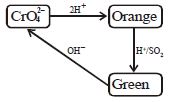
B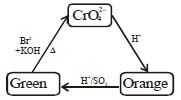
C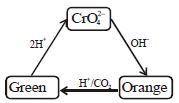
D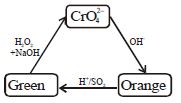
Solution
(A) The aqueous solution of chromate ions ($CrO_4^{2-}$,yellow) changes to dichromate ions ($Cr_2O_7^{2-}$,orange) in an acidic medium $(2CrO_4^{2-} + 2H^+ \rightarrow Cr_2O_7^{2-} + H_2O)$.
This orange dichromate solution can be reduced to green chromium$(III)$ ions $(Cr^{3+})$ using a reducing agent like $SO_2$ in an acidic medium $(Cr_2O_7^{2-} + 3SO_2 + 2H^+ \rightarrow 2Cr^{3+} + 3SO_4^{2-} + H_2O)$.
The green $Cr^{3+}$ ions can be oxidized back to yellow chromate ions $(CrO_4^{2-})$ in an alkaline medium using an oxidizing agent like $H_2O_2$ $(2Cr^{3+} + 3H_2O_2 + 10OH^- \rightarrow 2CrO_4^{2-} + 8H_2O)$.
Comparing these reactions with the given options,option $A$ correctly represents this cycle.
This orange dichromate solution can be reduced to green chromium$(III)$ ions $(Cr^{3+})$ using a reducing agent like $SO_2$ in an acidic medium $(Cr_2O_7^{2-} + 3SO_2 + 2H^+ \rightarrow 2Cr^{3+} + 3SO_4^{2-} + H_2O)$.
The green $Cr^{3+}$ ions can be oxidized back to yellow chromate ions $(CrO_4^{2-})$ in an alkaline medium using an oxidizing agent like $H_2O_2$ $(2Cr^{3+} + 3H_2O_2 + 10OH^- \rightarrow 2CrO_4^{2-} + 8H_2O)$.
Comparing these reactions with the given options,option $A$ correctly represents this cycle.
0 likes
View Solution184
EasyMCQ
The yellow colour of chromates changes to orange on acidification due to the formation of:
A
$Cr^{3+}$
B
$Cr_2O_3$
C
$Cr_2O_7^{2-}$
D
$CrO_4^-$
Solution
(C) In an acidic medium,the chromate ion ($CrO_4^{2-}$,yellow) is in equilibrium with the dichromate ion ($Cr_2O_7^{2-}$,orange).
The chemical equation for this reaction is:
$2CrO_4^{2-} (aq) + 2H^{+} (aq) \rightarrow Cr_2O_7^{2-} (aq) + H_2O (l)$
The chemical equation for this reaction is:
$2CrO_4^{2-} (aq) + 2H^{+} (aq) \rightarrow Cr_2O_7^{2-} (aq) + H_2O (l)$
0 likes
View Solution185
EasyMCQ
$K_2MnO_4$ can be converted into $KMnO_4$ by
A
Passing $CO_2$ gas
B
Passing $Cl_2$
C
Electrolytic oxidation
D
All of these
Solution
(D) The conversion of potassium manganate $(K_2MnO_4)$ to potassium permanganate $(KMnO_4)$ involves the oxidation of $MnO_4^{2-}$ to $MnO_4^-$.
$1$. Passing $CO_2$ gas: $3MnO_4^{2-} + 4H^+ \rightarrow 2MnO_4^- + MnO_2 + 2H_2O$. This is a disproportionation reaction in acidic medium.
$2$. Passing $Cl_2$: $2MnO_4^{2-} + Cl_2 \rightarrow 2MnO_4^- + 2Cl^-$. This is an oxidation reaction.
$3$. Electrolytic oxidation: $2MnO_4^{2-} + H_2O + [O] \rightarrow 2MnO_4^- + 2OH^-$.
Since all three methods effectively convert $K_2MnO_4$ to $KMnO_4$,the correct option is $D$.
$1$. Passing $CO_2$ gas: $3MnO_4^{2-} + 4H^+ \rightarrow 2MnO_4^- + MnO_2 + 2H_2O$. This is a disproportionation reaction in acidic medium.
$2$. Passing $Cl_2$: $2MnO_4^{2-} + Cl_2 \rightarrow 2MnO_4^- + 2Cl^-$. This is an oxidation reaction.
$3$. Electrolytic oxidation: $2MnO_4^{2-} + H_2O + [O] \rightarrow 2MnO_4^- + 2OH^-$.
Since all three methods effectively convert $K_2MnO_4$ to $KMnO_4$,the correct option is $D$.
0 likes
View Solution186
EasyMCQ
Which oxide of $Mn$ is acidic in nature?
A
$MnO$
B
$Mn_2O_7$
C
$Mn_2O_3$
D
$MnO_2$
Solution
(B) The acidic nature of transition metal oxides is directly proportional to the oxidation state of the metal.
For $MnO$,the oxidation state of $Mn$ is $+2$ (basic).
For $Mn_2O_3$,the oxidation state of $Mn$ is $+3$ (basic).
For $MnO_2$,the oxidation state of $Mn$ is $+4$ (amphoteric).
For $Mn_2O_7$,the oxidation state of $Mn$ is $+7$.
Since $Mn_2O_7$ has the highest oxidation state,it is acidic in nature.
For $MnO$,the oxidation state of $Mn$ is $+2$ (basic).
For $Mn_2O_3$,the oxidation state of $Mn$ is $+3$ (basic).
For $MnO_2$,the oxidation state of $Mn$ is $+4$ (amphoteric).
For $Mn_2O_7$,the oxidation state of $Mn$ is $+7$.
Since $Mn_2O_7$ has the highest oxidation state,it is acidic in nature.
0 likes
View Solution187
EasyMCQ
Which of the following is used for making railway tracks?
A
Wrought iron
B
Cast iron
C
$Ni$ steel
D
$Cr$ steel
Solution
(C) Railway tracks are subjected to heavy loads and require high durability and resistance to wear and tear.
$Ni$ steel (Nickel steel) is used for making railway tracks because it possesses high tensile strength and toughness.
$Ni$ steel (Nickel steel) is used for making railway tracks because it possesses high tensile strength and toughness.
0 likes
View Solution188
EasyMCQ
On heating $KMnO_4$,one among the following is not formed:
A
$K_2MnO_4$
B
$O_2$
C
$MnO_2$
D
$MnO$
Solution
(D) The thermal decomposition of potassium permanganate $(KMnO_4)$ occurs according to the following reaction:
$2KMnO_4 \xrightarrow{\Delta} K_2MnO_4 + MnO_2 + O_2$
From the balanced chemical equation,it is evident that $K_2MnO_4$,$MnO_2$,and $O_2$ are produced.
Therefore,$MnO$ is not formed during this process.
$2KMnO_4 \xrightarrow{\Delta} K_2MnO_4 + MnO_2 + O_2$
From the balanced chemical equation,it is evident that $K_2MnO_4$,$MnO_2$,and $O_2$ are produced.
Therefore,$MnO$ is not formed during this process.
0 likes
View Solution189
MediumMCQ
Which of the following statements is true for $Fe_3O_4$?
A
It contains $Fe$ in the form of $Fe(II)$ and $Fe(III)$.
B
It crystallizes in a spinel structure.
C
$Fe^{2+}$ ions are present in octahedral voids.
D
All of the above.
0 likes
View Solution190
EasyMCQ
Which oxide of transition metals exhibits electrical conductivity as high as that of metals?
A
$TiO_2$
B
$CrO_2$
C
$Ti_2O_3$
D
$Fe_2O_3$
Solution
(B) $CrO_2$ is the transition metal oxide that exhibits electrical conductivity as high as that of metals.
It is used in making magnetic tapes.
It is used in making magnetic tapes.
0 likes
View Solution191
EasyMCQ
Which of the following has conductivity and appearance like that of copper metal?
A
$TiO_2$
B
$CrO_2$
C
$ReO_3$
D
$Fe_2O_3$
Solution
(C) The compound $ReO_3$ (rhenium trioxide) exhibits metallic properties.
It has a conductivity and appearance similar to that of copper metal.
Therefore,the correct option is $C$.
It has a conductivity and appearance similar to that of copper metal.
Therefore,the correct option is $C$.
0 likes
View Solution192
MediumMCQ
Which of the following substances will not give the borax bead test?
A
Chromium
B
Ferrous salt
C
Sodium
D
Cobalt
Solution
(C) The borax bead test is used to identify colored transition metal ions. $Borax$ $(Na_2B_4O_7 \cdot 10H_2O)$ on heating forms a transparent glassy bead consisting of $NaBO_2$ and $B_2O_3$. Transition metal oxides react with this bead to form colored metaborates. Since $Sodium$ $(Na)$ is an alkali metal and does not form colored metaborates,it does not give the borax bead test. $Chromium$,$Ferrous$ salts,and $Cobalt$ are transition metals/ions that form characteristic colored beads.
0 likes
View Solution193
EasyMCQ
Which of the following aqueous solutions absorbs nitric oxide in significant amounts?
A
Lead nitrate
B
Nitric acid
C
Ferrous sulfate
D
Sodium hydroxide
Solution
(C) Nitric oxide $(NO)$ is a neutral oxide. It reacts with an aqueous solution of ferrous sulfate $(FeSO_4)$ to form a brown-colored complex known as nitrosoferrous sulfate. The reaction is: $Fe^{2+}(aq) + NO(g) + H_2O(l) \rightarrow [Fe(H_2O)_5(NO)]^{2+}(aq)$. This complex formation allows the aqueous solution of ferrous sulfate to absorb $NO$ gas in significant amounts.
0 likes
View Solution194
MediumMCQ
Assertion : Coloured cations can be identified by borax bead test.
Reason : Transparent bead $(NaBO_2 + B_2O_3)$ forms coloured bead with coloured cation.
Reason : Transparent bead $(NaBO_2 + B_2O_3)$ forms coloured bead with coloured cation.
A
If both Assertion and Reason are correct and the Reason is a correct explanation of the Assertion.
B
If both Assertion and Reason are correct but Reason is not a correct explanation of the Assertion.
C
If the Assertion is correct but Reason is incorrect.
D
If both the Assertion and Reason are incorrect.
Solution
(A) Borax $(Na_2B_4O_7 \cdot 10H_2O)$ when heated,loses water and swells up,then melts to form a transparent glassy bead consisting of sodium metaborate $(NaBO_2)$ and boric anhydride $(B_2O_3)$.
$Na_2B_4O_7 \cdot 10H_2O$ $\xrightarrow{\Delta} Na_2B_4O_7$ $\xrightarrow{\Delta} 2NaBO_2 + B_2O_3$
When this glassy bead is heated with coloured transition metal salts,it forms coloured metaborates,which are characteristic of the metal cation. Thus,the borax bead test is used to identify coloured cations.
Since the formation of the transparent bead and its subsequent reaction with cations to form coloured beads explains why the test works,the Reason is the correct explanation of the Assertion.
$Na_2B_4O_7 \cdot 10H_2O$ $\xrightarrow{\Delta} Na_2B_4O_7$ $\xrightarrow{\Delta} 2NaBO_2 + B_2O_3$
When this glassy bead is heated with coloured transition metal salts,it forms coloured metaborates,which are characteristic of the metal cation. Thus,the borax bead test is used to identify coloured cations.
Since the formation of the transparent bead and its subsequent reaction with cations to form coloured beads explains why the test works,the Reason is the correct explanation of the Assertion.
0 likes
View Solution195
MediumMCQ
The colour imparted by $Co(II)$ compounds to glass is
A
Green
B
Deep blue
C
Yellow
D
Red
Solution
(B) $Co(II)$ compounds,specifically cobalt oxide $(CoO)$,are widely used in the glass industry to impart a characteristic deep blue colour to the glass. This is a well-known property of cobalt ions in silicate matrices.
0 likes
View Solution196
DifficultMCQ
The purple colour of $KMnO_4$ is due to the transition:
A
$C.T. (L \to M)$
B
$C.T. (M \to L)$
C
$d-d$
D
$p-d$
Solution
(A) In $KMnO_4$,Manganese $(Mn)$ is in the $+7$ oxidation state with a $d^0$ electronic configuration.
Since there are no $d$ electrons,$d-d$ transitions are not possible.
The intense purple color arises from Ligand-to-Metal Charge Transfer $(LMCT)$,where an electron is promoted from the $O^{2-}$ ligand to the empty $d$-orbitals of the $Mn^{7+}$ center.
Therefore,the transition is $L \to M$ charge transfer.
Since there are no $d$ electrons,$d-d$ transitions are not possible.
The intense purple color arises from Ligand-to-Metal Charge Transfer $(LMCT)$,where an electron is promoted from the $O^{2-}$ ligand to the empty $d$-orbitals of the $Mn^{7+}$ center.
Therefore,the transition is $L \to M$ charge transfer.
0 likes
View Solution197
MediumMCQ
Assertion : Solution of $Na_2CrO_4$ in water is intensely coloured.
Reason : Oxidation state of $Cr$ in $Na_2CrO_4$ is $+VI$.
Reason : Oxidation state of $Cr$ in $Na_2CrO_4$ is $+VI$.
A
If both Assertion and Reason are correct and the Reason is a correct explanation of the Assertion.
B
If both Assertion and Reason are correct but Reason is not a correct explanation of the Assertion.
C
If the Assertion is correct but Reason is incorrect.
D
If both the Assertion and Reason are incorrect.
Solution
(B) The $Na_2CrO_4$ salt contains the chromate ion,$CrO_4^{2-}$.
In $CrO_4^{2-}$,the oxidation state of $Cr$ is $+VI$,which means its electronic configuration is $[Ar] 3d^0$.
Since there are no $d-$electrons,$d-d$ transitions are not possible.
The intense yellow colour of $Na_2CrO_4$ is due to charge transfer from oxygen to the metal $(Cr)$ atom.
Therefore,both the Assertion and the Reason are correct,but the Reason is not the correct explanation for the colour,as the colour arises from charge transfer,not the oxidation state itself.
In $CrO_4^{2-}$,the oxidation state of $Cr$ is $+VI$,which means its electronic configuration is $[Ar] 3d^0$.
Since there are no $d-$electrons,$d-d$ transitions are not possible.
The intense yellow colour of $Na_2CrO_4$ is due to charge transfer from oxygen to the metal $(Cr)$ atom.
Therefore,both the Assertion and the Reason are correct,but the Reason is not the correct explanation for the colour,as the colour arises from charge transfer,not the oxidation state itself.
0 likes
View Solution198
DifficultMCQ
Among the following,the compound that is both paramagnetic and coloured is
A
$K_2Cr_2O_7$
B
$(NH_4)_2[TiCl_6]$
C
$VOSO_4$
D
$K_3[Cu(CN)_4]$
Solution
(C) $K_3[Cu(CN)_4]$: $Cu$ is in $+1$ oxidation state $(3d^{10})$,so it has no unpaired electrons,making it diamagnetic and colourless.
$(NH_4)_2[TiCl_6]$: $Ti$ is in $+4$ oxidation state $(3d^0)$,so it has no unpaired electrons,making it diamagnetic and colourless.
$VOSO_4$: $V$ is in $+4$ oxidation state $(3d^1)$,so it has one unpaired electron,making it paramagnetic and coloured.
$K_2Cr_2O_7$: $Cr$ is in $+6$ oxidation state $(3d^0)$,so it has no unpaired electrons. It is diamagnetic,but appears coloured due to ligand-to-metal charge transfer $(LMCT)$.
$(NH_4)_2[TiCl_6]$: $Ti$ is in $+4$ oxidation state $(3d^0)$,so it has no unpaired electrons,making it diamagnetic and colourless.
$VOSO_4$: $V$ is in $+4$ oxidation state $(3d^1)$,so it has one unpaired electron,making it paramagnetic and coloured.
$K_2Cr_2O_7$: $Cr$ is in $+6$ oxidation state $(3d^0)$,so it has no unpaired electrons. It is diamagnetic,but appears coloured due to ligand-to-metal charge transfer $(LMCT)$.
0 likes
View Solution199
MediumMCQ
The manganate and permanganate ions are tetrahedral,due to
A
The $\pi-$bonding involves overlap of $p-$orbitals of oxygen with $d-$orbitals of manganese
B
There is no $\pi-$bonding
C
The $\pi-$bonding involves overlap of $p-$orbitals of oxygen with $p-$orbitals of manganese
D
The $\pi-$bonding involves overlap of $d-$orbitals of oxygen with $d-$orbitals of manganese
Solution
(A) $MnO_{4}^{2-}$ (manganate ion) and $MnO_{4}^{-}$ (permanganate ion) both have a tetrahedral geometry.
In these ions,the manganese atom is in a high oxidation state and uses its $d-$orbitals to form $p\pi-d\pi$ bonds with the oxygen atoms.
Specifically,the $\pi-$bonding involves the overlap of filled $2p-$orbitals of oxygen with empty $3d-$orbitals of manganese.
In these ions,the manganese atom is in a high oxidation state and uses its $d-$orbitals to form $p\pi-d\pi$ bonds with the oxygen atoms.
Specifically,the $\pi-$bonding involves the overlap of filled $2p-$orbitals of oxygen with empty $3d-$orbitals of manganese.
0 likes
View Solutiond-and f-Block Elements — Compounds of Transitional elements · Frequently Asked Questions
1Are these d-and f-Block Elements questions useful for JEE and NEET?
Yes. All questions in this section are mapped to JEE Main and NEET exam patterns. Previous year questions from JEE Main, NEET, GUJCET and state-level exams are included with full solutions.
2Can I switch to Hindi or Gujarati for these questions?
Yes. Use the language tabs in the hero section or the sidebar to view the same questions and solutions in English, Hindi or Gujarati.
3How do I generate a question paper from this subtopic?
Use the Vedclass Exam Paper Generator — select the chapter and subtopic, set difficulty, and generate Sets A, B, C, D automatically. First 3 chapters of every subject are free.
Vedclass Products
For Students
Vedclass Test Series
Mock tests in real JEE/NEET style with performance analysis. 5-day free trial.
Start Free TrialFor Teachers
Exam Paper Generator
Generate Set A/B/C/D papers from this chapter in 2 minutes. 3 chapters free.
Try FreeFor Institutes
Online Exam Module
Live online exams with unlimited students, 360° analytics & white-label branding.
See DemoFor Teachers & Institutes
Generate a d-and f-Block Elements Exam Paper in 2 Minutes
Select subtopic & difficulty — Sets A, B, C, D auto-generated with No Repeat logic.
First 3 chapters of every subject are free — no payment required.