
A English
Compounds of Transitional elements Questions in English
Class 12 Chemistry · d-and f-Block Elements · Compounds of Transitional elements
338+
Questions
English
Language
100%
With Solutions
Showing 50 of 338 questions in English
201
AdvancedMCQ
Which one of the following ions exhibits $d-d$ transition and paramagnetism as well?
A
$CrO_4^{2-}$
B
$Cr_2O_7^{2-}$
C
$MnO_4^{-}$
D
$MnO_4^{2-}$
Solution
(D) To exhibit $d-d$ transition and paramagnetism,the ion must have at least one unpaired electron in its $d$-orbitals.
$A$. $CrO_4^{2-}$: $Cr$ is in $+6$ oxidation state $(3d^0)$. It is diamagnetic and shows no $d-d$ transition.
$B$. $Cr_2O_7^{2-}$: $Cr$ is in $+6$ oxidation state $(3d^0)$. It is diamagnetic and shows no $d-d$ transition.
$C$. $MnO_4^{-}$: $Mn$ is in $+7$ oxidation state $(3d^0)$. It is diamagnetic and shows no $d-d$ transition.
$D$. $MnO_4^{2-}$: $Mn$ is in $+6$ oxidation state $(3d^1)$. It has one unpaired electron,making it paramagnetic,and it exhibits $d-d$ transition.
$A$. $CrO_4^{2-}$: $Cr$ is in $+6$ oxidation state $(3d^0)$. It is diamagnetic and shows no $d-d$ transition.
$B$. $Cr_2O_7^{2-}$: $Cr$ is in $+6$ oxidation state $(3d^0)$. It is diamagnetic and shows no $d-d$ transition.
$C$. $MnO_4^{-}$: $Mn$ is in $+7$ oxidation state $(3d^0)$. It is diamagnetic and shows no $d-d$ transition.
$D$. $MnO_4^{2-}$: $Mn$ is in $+6$ oxidation state $(3d^1)$. It has one unpaired electron,making it paramagnetic,and it exhibits $d-d$ transition.
0 likes
View Solution202
DifficultMCQ
Consider the following reactions:
$NaCl + K_{2}Cr_{2}O_{7} + H_{2}SO_{4}$ (conc.) $\rightarrow (A) +$ side products
$(A) + NaOH \rightarrow (B) +$ side product
$(B) + H_{2}SO_{4}$ (dilute) $+ H_{2}O_{2} \rightarrow (C) +$ side product
The sum of the total number of atoms in one molecule each of $(A)$,$(B)$,and $(C)$ is:
$NaCl + K_{2}Cr_{2}O_{7} + H_{2}SO_{4}$ (conc.) $\rightarrow (A) +$ side products
$(A) + NaOH \rightarrow (B) +$ side product
$(B) + H_{2}SO_{4}$ (dilute) $+ H_{2}O_{2} \rightarrow (C) +$ side product
The sum of the total number of atoms in one molecule each of $(A)$,$(B)$,and $(C)$ is:
A
$14$
B
$16$
C
$18$
D
$20$
Solution
(C) The reactions are as follows:
$4 NaCl + K_{2}Cr_{2}O_{7} + 6 H_{2}SO_{4} \rightarrow 2 CrO_{2}Cl_{2} (A) + 4 NaHSO_{4} + 2 KHSO_{4} + 3 H_{2}O$
$CrO_{2}Cl_{2} (A) + 4 NaOH \rightarrow Na_{2}CrO_{4} (B) + 2 NaCl + 2 H_{2}O$
$Na_{2}CrO_{4} (B) + 2 H_{2}SO_{4} + 2 H_{2}O_{2} \rightarrow CrO_{5} (C) + 2 NaHSO_{4} + 3 H_{2}O$
Identifying the compounds:
$(A) = CrO_{2}Cl_{2}$ (Chromyl chloride),number of atoms $= 1 + 2 + 2 = 5$
$(B) = Na_{2}CrO_{4}$ (Sodium chromate),number of atoms $= 2 + 1 + 4 = 7$
$(C) = CrO_{5}$ (Chromium pentoxide),number of atoms $= 1 + 5 = 6$
Sum of total atoms $= 5 + 7 + 6 = 18$.
$4 NaCl + K_{2}Cr_{2}O_{7} + 6 H_{2}SO_{4} \rightarrow 2 CrO_{2}Cl_{2} (A) + 4 NaHSO_{4} + 2 KHSO_{4} + 3 H_{2}O$
$CrO_{2}Cl_{2} (A) + 4 NaOH \rightarrow Na_{2}CrO_{4} (B) + 2 NaCl + 2 H_{2}O$
$Na_{2}CrO_{4} (B) + 2 H_{2}SO_{4} + 2 H_{2}O_{2} \rightarrow CrO_{5} (C) + 2 NaHSO_{4} + 3 H_{2}O$
Identifying the compounds:
$(A) = CrO_{2}Cl_{2}$ (Chromyl chloride),number of atoms $= 1 + 2 + 2 = 5$
$(B) = Na_{2}CrO_{4}$ (Sodium chromate),number of atoms $= 2 + 1 + 4 = 7$
$(C) = CrO_{5}$ (Chromium pentoxide),number of atoms $= 1 + 5 = 6$
Sum of total atoms $= 5 + 7 + 6 = 18$.
0 likes
View Solution203
EasyMCQ
What are the impurities present in ruby and sapphire?
A
$Cr_2O_3$
B
$Fe_2O_3$
C
$TiO_2$
D
$Al_2O_3$
Solution
(A) Ruby and sapphire are gemstones that are primarily composed of aluminum oxide $(Al_2O_3)$. The characteristic red color of ruby is due to the presence of chromium $(Cr)$ impurities,while the blue color of sapphire is due to the presence of iron $(Fe)$ and titanium $(Ti)$ impurities. Therefore,the impurities present in ruby and sapphire are metal oxides like $Cr_2O_3$ (in ruby) and $Fe_2O_3$ or $TiO_2$ (in sapphire).
0 likes
View Solution204
Medium
Name the oxometal anions of the first series of the transition metals in which the metal exhibits the oxidation state equal to its group number.
Solution
(N/A) $(i)$ Vanadate,$VO_3^-$. The oxidation state of $V$ is $+5$,which equals its group number $(5)$.
(ii) Chromate,$CrO_4^{2-}$. The oxidation state of $Cr$ is $+6$,which equals its group number $(6)$.
(iii) Permanganate,$MnO_4^-$. The oxidation state of $Mn$ is $+7$,which equals its group number $(7)$.
(ii) Chromate,$CrO_4^{2-}$. The oxidation state of $Cr$ is $+6$,which equals its group number $(6)$.
(iii) Permanganate,$MnO_4^-$. The oxidation state of $Mn$ is $+7$,which equals its group number $(7)$.
0 likes
View Solution205
Medium
Describe the preparation of potassium dichromate from iron chromite ore. What is the effect of increasing $pH$ on a solution of potassium dichromate?
Solution
(N/A) Potassium dichromate is prepared from chromite ore $(FeCr_2O_4)$ in the following steps:
Step $(1):$ Preparation of sodium chromate
$4FeCr_2O_4 + 16NaOH + 7O_2 \longrightarrow 8Na_2CrO_4 + 2Fe_2O_3 + 8H_2O$
Step $(2):$ Conversion of sodium chromate into sodium dichromate
$2Na_2CrO_4 + 2H^+ \longrightarrow Na_2Cr_2O_7 + H_2O$
Step $(3):$ Conversion of sodium dichromate to potassium dichromate
$Na_2Cr_2O_7 + 2KCl \longrightarrow K_2Cr_2O_7 + 2NaCl$
Potassium dichromate is less soluble than sodium chloride and is obtained as orange-colored crystals.
The dichromate ion $(Cr_2O_7^{2-})$ exists in equilibrium with the chromate ion $(CrO_4^{2-})$ at $pH \approx 4$. Increasing the $pH$ (making the solution more basic) shifts the equilibrium towards the formation of chromate ions $(CrO_4^{2-})$ according to the reaction: $Cr_2O_7^{2-} + 2OH^- \longrightarrow 2CrO_4^{2-} + H_2O$.
Step $(1):$ Preparation of sodium chromate
$4FeCr_2O_4 + 16NaOH + 7O_2 \longrightarrow 8Na_2CrO_4 + 2Fe_2O_3 + 8H_2O$
Step $(2):$ Conversion of sodium chromate into sodium dichromate
$2Na_2CrO_4 + 2H^+ \longrightarrow Na_2Cr_2O_7 + H_2O$
Step $(3):$ Conversion of sodium dichromate to potassium dichromate
$Na_2Cr_2O_7 + 2KCl \longrightarrow K_2Cr_2O_7 + 2NaCl$
Potassium dichromate is less soluble than sodium chloride and is obtained as orange-colored crystals.
The dichromate ion $(Cr_2O_7^{2-})$ exists in equilibrium with the chromate ion $(CrO_4^{2-})$ at $pH \approx 4$. Increasing the $pH$ (making the solution more basic) shifts the equilibrium towards the formation of chromate ions $(CrO_4^{2-})$ according to the reaction: $Cr_2O_7^{2-} + 2OH^- \longrightarrow 2CrO_4^{2-} + H_2O$.
0 likes
View Solution206
Difficult
Describe the oxidising action of potassium dichromate and write the ionic equations for its reaction with:
$(i)$ iodide
$(ii)$ iron $(II)$ solution and
$(iii)$ $H_{2}S$
$(i)$ iodide
$(ii)$ iron $(II)$ solution and
$(iii)$ $H_{2}S$
Solution
(N/A) $K_{2}Cr_{2}O_{7}$ acts as a very strong oxidising agent in the acidic medium.
In acidic solution,the dichromate ion is reduced to chromium $(III)$ ion:
$Cr_{2}O_{7}^{2-} + 14H^{+} + 6e^{-} \longrightarrow 2Cr^{3+} + 7H_{2}O$
$(i)$ Reaction with iodide:
$Cr_{2}O_{7}^{2-} + 14H^{+} + 6I^{-} \longrightarrow 2Cr^{3+} + 3I_{2} + 7H_{2}O$
$(ii)$ Reaction with iron $(II)$ solution:
$Cr_{2}O_{7}^{2-} + 14H^{+} + 6Fe^{2+} \longrightarrow 2Cr^{3+} + 6Fe^{3+} + 7H_{2}O$
$(iii)$ Reaction with $H_{2}S$:
$Cr_{2}O_{7}^{2-} + 8H^{+} + 3H_{2}S \longrightarrow 2Cr^{3+} + 3S + 7H_{2}O$
In acidic solution,the dichromate ion is reduced to chromium $(III)$ ion:
$Cr_{2}O_{7}^{2-} + 14H^{+} + 6e^{-} \longrightarrow 2Cr^{3+} + 7H_{2}O$
$(i)$ Reaction with iodide:
$Cr_{2}O_{7}^{2-} + 14H^{+} + 6I^{-} \longrightarrow 2Cr^{3+} + 3I_{2} + 7H_{2}O$
$(ii)$ Reaction with iron $(II)$ solution:
$Cr_{2}O_{7}^{2-} + 14H^{+} + 6Fe^{2+} \longrightarrow 2Cr^{3+} + 6Fe^{3+} + 7H_{2}O$
$(iii)$ Reaction with $H_{2}S$:
$Cr_{2}O_{7}^{2-} + 8H^{+} + 3H_{2}S \longrightarrow 2Cr^{3+} + 3S + 7H_{2}O$
0 likes
View Solution207
Difficult
Describe the preparation of potassium permanganate. How does the acidified permanganate solution react with $(i)$ iron $(II)$ ions,$(ii)$ $SO_2$,and $(iii)$ oxalic acid? Write the ionic equations for the reactions.
Solution
(N/A) Potassium permanganate is prepared from pyrolusite ore $(MnO_2)$. The ore is fused with $KOH$ in the presence of atmospheric oxygen or an oxidising agent like $KNO_3$ to form potassium manganate $(K_2MnO_4)$.
$2MnO_2 + 4KOH + O_2 \longrightarrow 2K_2MnO_4 + 2H_2O$
The green $K_2MnO_4$ is then oxidized to purple $KMnO_4$ either electrolytically or by passing $Cl_2$ or $O_3$ gas.
Electrolytic oxidation: $2MnO_4^{2-} + H_2O + [O] \longrightarrow 2MnO_4^- + 2OH^-$
$(i)$ Reaction with iron $(II)$ ions: $5Fe^{2+} + MnO_4^- + 8H^+ \longrightarrow 5Fe^{3+} + Mn^{2+} + 4H_2O$
$(ii)$ Reaction with $SO_2$: $5SO_2 + 2MnO_4^- + 2H_2O \longrightarrow 5SO_4^{2-} + 2Mn^{2+} + 4H^+$
$(iii)$ Reaction with oxalic acid: $5C_2H_2O_4 + 2MnO_4^- + 6H^+ \longrightarrow 10CO_2 + 2Mn^{2+} + 8H_2O$
$2MnO_2 + 4KOH + O_2 \longrightarrow 2K_2MnO_4 + 2H_2O$
The green $K_2MnO_4$ is then oxidized to purple $KMnO_4$ either electrolytically or by passing $Cl_2$ or $O_3$ gas.
Electrolytic oxidation: $2MnO_4^{2-} + H_2O + [O] \longrightarrow 2MnO_4^- + 2OH^-$
$(i)$ Reaction with iron $(II)$ ions: $5Fe^{2+} + MnO_4^- + 8H^+ \longrightarrow 5Fe^{3+} + Mn^{2+} + 4H_2O$
$(ii)$ Reaction with $SO_2$: $5SO_2 + 2MnO_4^- + 2H_2O \longrightarrow 5SO_4^{2-} + 2Mn^{2+} + 4H^+$
$(iii)$ Reaction with oxalic acid: $5C_2H_2O_4 + 2MnO_4^- + 6H^+ \longrightarrow 10CO_2 + 2Mn^{2+} + 8H_2O$
0 likes
View Solution208
Medium
Indicate the steps in the preparation of:
$(i)$ $K_2Cr_2O_7$ from chromite ore.
$(ii)$ $KMnO_4$ from pyrolusite ore.
$(i)$ $K_2Cr_2O_7$ from chromite ore.
$(ii)$ $KMnO_4$ from pyrolusite ore.
Solution
(N/A) $(i)$ Potassium dichromate $(K_2Cr_2O_7)$ is prepared from chromite ore $(FeCr_2O_4)$ in the following steps.
Step $(1):$ Preparation of sodium chromate
$4 FeCr_2O_4 + 16 NaOH + 7 O_2 \longrightarrow 8 Na_2CrO_4 + 2 Fe_2O_3 + 8 H_2O$
Step $(2):$ Conversion of sodium chromate into sodium dichromate
$2 Na_2CrO_4 + 2 H^+ \longrightarrow Na_2Cr_2O_7 + 2 Na^+ + H_2O$
Step $(3):$ Conversion of sodium dichromate to potassium dichromate
$Na_2Cr_2O_7 + 2 KCl \longrightarrow K_2Cr_2O_7 + 2 NaCl$
$(ii)$ Potassium permanganate $(KMnO_4)$ is prepared from pyrolusite $(MnO_2)$. The ore is fused with $KOH$ in the presence of air or an oxidizing agent like $KNO_3$ to give $K_2MnO_4$.
$2 MnO_2 + 4 KOH + O_2 \longrightarrow 2 K_2MnO_4 + 2 H_2O$
The green mass is extracted with water and oxidized either electrolytically or by passing chlorine/ozone.
Electrolytic oxidation:
$2 MnO_4^{2-} + H_2O + [O] \longrightarrow 2 MnO_4^- + 2 OH^-$
Oxidation by chlorine:
$2 MnO_4^{2-} + Cl_2 \longrightarrow 2 MnO_4^- + 2 Cl^-$
Oxidation by ozone:
$2 MnO_4^{2-} + O_3 + H_2O \longrightarrow 2 MnO_4^- + 2 OH^- + O_2$
Step $(1):$ Preparation of sodium chromate
$4 FeCr_2O_4 + 16 NaOH + 7 O_2 \longrightarrow 8 Na_2CrO_4 + 2 Fe_2O_3 + 8 H_2O$
Step $(2):$ Conversion of sodium chromate into sodium dichromate
$2 Na_2CrO_4 + 2 H^+ \longrightarrow Na_2Cr_2O_7 + 2 Na^+ + H_2O$
Step $(3):$ Conversion of sodium dichromate to potassium dichromate
$Na_2Cr_2O_7 + 2 KCl \longrightarrow K_2Cr_2O_7 + 2 NaCl$
$(ii)$ Potassium permanganate $(KMnO_4)$ is prepared from pyrolusite $(MnO_2)$. The ore is fused with $KOH$ in the presence of air or an oxidizing agent like $KNO_3$ to give $K_2MnO_4$.
$2 MnO_2 + 4 KOH + O_2 \longrightarrow 2 K_2MnO_4 + 2 H_2O$
The green mass is extracted with water and oxidized either electrolytically or by passing chlorine/ozone.
Electrolytic oxidation:
$2 MnO_4^{2-} + H_2O + [O] \longrightarrow 2 MnO_4^- + 2 OH^-$
Oxidation by chlorine:
$2 MnO_4^{2-} + Cl_2 \longrightarrow 2 MnO_4^- + 2 Cl^-$
Oxidation by ozone:
$2 MnO_4^{2-} + O_3 + H_2O \longrightarrow 2 MnO_4^- + 2 OH^- + O_2$
0 likes
View Solution209
Difficult
Write a note on halide compounds of transition elements.
Solution
(N/A) Transition elements form a wide variety of halides with oxidation states ranging from $+1$ to $+6$. The nature of these halides depends on the electronegativity of the halogen and the oxidation state of the metal.
$1$. Transition elements form ionic halides with fluorine and covalent halides with chlorine,bromine,and iodine. Due to the high electronegativity of fluorine,it stabilizes the highest oxidation states of metals.
$2$. Manganese does not form $MnF_{7}$ because oxygen is more effective at stabilizing high oxidation states through multiple bonding (e.g.,$MnO_{3}F$).
$3$. Metal halides with high oxidation states undergo hydrolysis to form oxohalides,making the solution acidic. Example: $VF_{5} + H_{2}O \rightarrow VOF_{3} + 2HF$.
$4$. $CuI_{2}$ is unstable because $Cu^{2+}$ acts as an oxidizing agent and $I^{-}$ as a reducing agent,leading to the formation of $Cu_{2}I_{2}$ and $I_{2}$.
$5$. Covalent character increases with the size of the halogen (polarizability) and the oxidation state of the metal (polarizing power).
| Oxidation Number | Compounds |
| $+6$ | $CrF_{6}$ |
| $+5$ | $VF_{5}, CrF_{5}$ |
| $+4$ | $TiX_{4}, VX_{4}, CrX_{4}, MnF_{4}$ |
| $+3$ | $TiX_{3}, VX_{3}, CrX_{3}, MnF_{3}, FeX_{3}, CoF_{3}$ |
| $+2$ | $TiX_{2}, VX_{2}, CrX_{2}, MnX_{2}, FeX_{2}, CoX_{2}, NiX_{2}, CuX_{2}, ZnX_{2}$ |
| $+1$ | $CuX$ |
$1$. Transition elements form ionic halides with fluorine and covalent halides with chlorine,bromine,and iodine. Due to the high electronegativity of fluorine,it stabilizes the highest oxidation states of metals.
$2$. Manganese does not form $MnF_{7}$ because oxygen is more effective at stabilizing high oxidation states through multiple bonding (e.g.,$MnO_{3}F$).
$3$. Metal halides with high oxidation states undergo hydrolysis to form oxohalides,making the solution acidic. Example: $VF_{5} + H_{2}O \rightarrow VOF_{3} + 2HF$.
$4$. $CuI_{2}$ is unstable because $Cu^{2+}$ acts as an oxidizing agent and $I^{-}$ as a reducing agent,leading to the formation of $Cu_{2}I_{2}$ and $I_{2}$.
$5$. Covalent character increases with the size of the halogen (polarizability) and the oxidation state of the metal (polarizing power).
0 likes
View Solution210
Difficult
Write a note on oxides and oxoanions of transition elements.
Solution
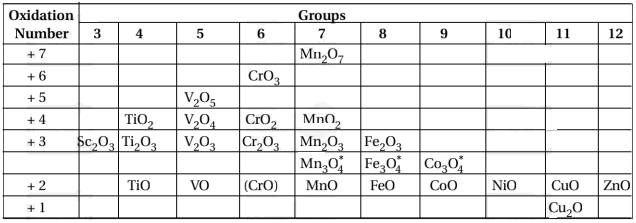
(N/A) The ability of oxygen to stabilize the high oxidation states of metals is greater than that of fluorine because oxygen can form multiple bonds with the metal.
Metal oxides in lower oxidation states are basic,while those in the highest oxidation states are acidic. Metal oxides with intermediate oxidation states are amphoteric.
For example: $Mn_{2}O_{7}$ is acidic,$MnO$ is basic,while $Mn_{3}O_{4}$,$Mn_{2}O_{3}$,and $MnO_{2}$ are amphoteric. Similarly,$CrO$ is basic,but $Cr_{2}O_{3}$ is amphoteric.
Oxides are generally formed by the reaction of metals with oxygen at high temperatures. Scandium forms only one oxide,$Sc_{2}O_{3}$,in which it is in its highest oxidation state of $(+3)$. The oxidation state often coincides with the group number,which is observed up to manganese (e.g.,$Mn_{2}O_{7}$). Beyond manganese,except for iron,no other element forms an oxide of the type $M_{2}O_{3}$ (e.g.,$Fe_{2}O_{3}$).
Although ferrates $(FeO_{4}^{2-})$ are formed in an alkaline medium,they readily decompose to give $Fe_{2}O_{3}$ and $O_{2}$. Besides oxides,oxocations stabilize $V^{+5}$ as $VO_{2}^{+}$,$V^{4+}$ as $VO^{2+}$,and $Ti^{4+}$ as $TiO^{2+}$. $V_{2}O_{5}$ is amphoteric,though mainly acidic,and it gives $VO_{4}^{3-}$ as well as $VO^{2+}$ salts. In vanadium,there is a gradual change from the basic $V_{2}O_{3}$ to less basic $V_{2}O_{4}$ to amphoteric $V_{2}O_{5}$. $V_{2}O_{4}$ dissolves in acid to give $VO^{2+}$ salts,while $V_{2}O_{5}$ when dissolved in alkali gives $VO_{4}^{3-}$ and in acids gives $VO_{2}^{+}$ ions.
Oxides with metals in low oxidation states have the ability to get oxidized and are therefore basic,while oxides with high oxidation states have a tendency to get reduced and are therefore acidic in nature. The ionic character of metal oxides decreases with an increase in the oxidation number of the metal. For example,$Mn_{2}O_{7}$ is a covalent green oil,while $CrO_{3}$ and $V_{2}O_{5}$ have low melting points.
Metal oxides in lower oxidation states are basic,while those in the highest oxidation states are acidic. Metal oxides with intermediate oxidation states are amphoteric.
For example: $Mn_{2}O_{7}$ is acidic,$MnO$ is basic,while $Mn_{3}O_{4}$,$Mn_{2}O_{3}$,and $MnO_{2}$ are amphoteric. Similarly,$CrO$ is basic,but $Cr_{2}O_{3}$ is amphoteric.
Oxides are generally formed by the reaction of metals with oxygen at high temperatures. Scandium forms only one oxide,$Sc_{2}O_{3}$,in which it is in its highest oxidation state of $(+3)$. The oxidation state often coincides with the group number,which is observed up to manganese (e.g.,$Mn_{2}O_{7}$). Beyond manganese,except for iron,no other element forms an oxide of the type $M_{2}O_{3}$ (e.g.,$Fe_{2}O_{3}$).
Although ferrates $(FeO_{4}^{2-})$ are formed in an alkaline medium,they readily decompose to give $Fe_{2}O_{3}$ and $O_{2}$. Besides oxides,oxocations stabilize $V^{+5}$ as $VO_{2}^{+}$,$V^{4+}$ as $VO^{2+}$,and $Ti^{4+}$ as $TiO^{2+}$. $V_{2}O_{5}$ is amphoteric,though mainly acidic,and it gives $VO_{4}^{3-}$ as well as $VO^{2+}$ salts. In vanadium,there is a gradual change from the basic $V_{2}O_{3}$ to less basic $V_{2}O_{4}$ to amphoteric $V_{2}O_{5}$. $V_{2}O_{4}$ dissolves in acid to give $VO^{2+}$ salts,while $V_{2}O_{5}$ when dissolved in alkali gives $VO_{4}^{3-}$ and in acids gives $VO_{2}^{+}$ ions.
Oxides with metals in low oxidation states have the ability to get oxidized and are therefore basic,while oxides with high oxidation states have a tendency to get reduced and are therefore acidic in nature. The ionic character of metal oxides decreases with an increase in the oxidation number of the metal. For example,$Mn_{2}O_{7}$ is a covalent green oil,while $CrO_{3}$ and $V_{2}O_{5}$ have low melting points.
0 likes
View Solution211
Difficult
What are interstitial compounds? Give their examples and characteristics.
Solution
(N/A) Interstitial compounds are those which are formed when small atoms like $H, C,$ or $N$ are trapped inside the crystal lattice of transition metals.
Examples: $TiC, Mn_4N, Fe_3H, VH_{0.56}, TiH_{1.7}$ etc.
These compounds are generally non-stoichiometric and are neither typically ionic nor covalent. Their formulas do not correspond to any normal oxidation state of the metal.
Physical and chemical characteristics of interstitial compounds:
$(i)$ They have high melting points,higher than those of pure metals.
$(ii)$ They are very hard. Some borides approach diamond in hardness.
$(iii)$ They retain metallic conductivity.
$(iv)$ They are chemically inert.
Examples: $TiC, Mn_4N, Fe_3H, VH_{0.56}, TiH_{1.7}$ etc.
These compounds are generally non-stoichiometric and are neither typically ionic nor covalent. Their formulas do not correspond to any normal oxidation state of the metal.
Physical and chemical characteristics of interstitial compounds:
$(i)$ They have high melting points,higher than those of pure metals.
$(ii)$ They are very hard. Some borides approach diamond in hardness.
$(iii)$ They retain metallic conductivity.
$(iv)$ They are chemically inert.
0 likes
View Solution212
Difficult
Fill in the blanks:
$(a)$ The unit of magnetic moment is ......... .
$(b)$ $Mn^{2+}$ has .......... color.
$(c)$ $Fe_3H$ is a ............. type of compound.
$(a)$ The unit of magnetic moment is ......... .
$(b)$ $Mn^{2+}$ has .......... color.
$(c)$ $Fe_3H$ is a ............. type of compound.
Solution
(N/A) The unit of magnetic moment is $\text{Bohr Magneton (BM)}$.
$(b)$ $Mn^{2+}$ has a $\text{pink}$ color.
$(c)$ $Fe_3H$ is an $\text{interstitial}$ type of compound.
$(b)$ $Mn^{2+}$ has a $\text{pink}$ color.
$(c)$ $Fe_3H$ is an $\text{interstitial}$ type of compound.
0 likes
View Solution213
EasyMCQ
The conductivity and appearance of $CrO_2$ are like metallic $Cu$.
A
$CrO_2$
B
$MnO_2$
C
$TiO_2$
D
$V_2O_5$
Solution
(A) The compound $CrO_2$ is known to exhibit metallic conductivity and has a lustrous appearance similar to copper $(Cu)$.
This property is due to the overlapping of $d$-orbitals in the crystal lattice.
This property is due to the overlapping of $d$-orbitals in the crystal lattice.
0 likes
View Solution214
Advanced
State the uses of zinc and iron.
Solution
(N/A) Zinc: Zinc is used for galvanising iron to prevent corrosion. It is also used in large quantities in batteries. It is a constituent of many alloys,e.g.,brass ($Cu$ $60\%$,$Zn$ $40\%$) and German silver ($Cu$ $25-30\%$,$Zn$ $25-30\%$,$Ni$ $40-50\%$). Zinc dust is used as a reducing agent in the manufacture of dye stuffs and paints.
Iron: Cast iron is used for casting stoves,railway sleepers,gutter pipes,and toys. It is used in the manufacture of wrought iron and steel. Wrought iron is used in making anchors,wires,bolts,chains,and agricultural implements. Alloy steel is obtained when other metals are added to iron. Nickel steel is used for making cables,automobiles,aeroplane parts,pendulums,and measuring tapes.
Iron: Cast iron is used for casting stoves,railway sleepers,gutter pipes,and toys. It is used in the manufacture of wrought iron and steel. Wrought iron is used in making anchors,wires,bolts,chains,and agricultural implements. Alloy steel is obtained when other metals are added to iron. Nickel steel is used for making cables,automobiles,aeroplane parts,pendulums,and measuring tapes.
0 likes
View Solution215
Difficult
Write about the oxides and oxoanions of transition metals.
Solution
(N/A) Formation of Oxides: Transition metal oxides are formed by the reaction of metals with oxygen at high temperatures. Except for scandium,all transition metals form $MO$ type oxides,which are ionic in nature. Examples include $TiO, VO, CrO, MnO, FeO, CoO, NiO, CuO, ZnO$.
The maximum oxidation state of the metal in the oxide corresponds to the group number up to $Mn$. For example,in $Sc_2O_3, TiO_2, V_2O_5, CrO_3, Mn_2O_7$,the oxidation states are $Sc^{3+}, Ti^{4+}, V^{5+}, Cr^{6+}, Mn^{7+}$ respectively.
After group $VII (Mn)$,oxides with oxidation states higher than $+3$ are not known. $Fe_2O_3, Co_2O_3, Ni_2O_3$ are common. Oxocations: $VO_2^+$ $(V^{V})$,$VO^{2+}$ $(V^{IV})$,and $TiO^{2+}$ $(Ti^{IV})$ are stable oxocations.
Oxidation State and Properties: As the oxidation state of the metal increases,the ionic character of the oxide decreases and the covalent character increases. For example:
$(i)$ $Mn_2O_7$ is a covalent green oily oxide.
$(ii)$ $CrO_3$ and $V_2O_5$ have low melting points.
$(iii)$ Acidic Nature: Oxides with higher oxidation states are acidic. $Mn_2O_7$ and $CrO_3$ react with water to form $HMnO_4$ and $H_2CrO_4/H_2Cr_2O_7$ respectively.
$(iv)$ $V_2O_5$ is amphoteric but primarily acidic. It forms $VO_4^{3-}$ and $VO_2^+$ salts. $V_2O_5$ (amphoteric),$V_2O_4$ (less basic),and $V_2O_3$ (basic) show that as the oxidation state decreases $(V^{5+} > V^{3+} > V^{2+})$,the basic character increases.
$CrO$ is basic,while $Cr_2O_3$ is amphoteric because $Cr$ in $CrO$ is in a lower oxidation state $(+2)$ compared to $Cr$ in $Cr_2O_3$ $(+3)$.
The maximum oxidation state of the metal in the oxide corresponds to the group number up to $Mn$. For example,in $Sc_2O_3, TiO_2, V_2O_5, CrO_3, Mn_2O_7$,the oxidation states are $Sc^{3+}, Ti^{4+}, V^{5+}, Cr^{6+}, Mn^{7+}$ respectively.
After group $VII (Mn)$,oxides with oxidation states higher than $+3$ are not known. $Fe_2O_3, Co_2O_3, Ni_2O_3$ are common. Oxocations: $VO_2^+$ $(V^{V})$,$VO^{2+}$ $(V^{IV})$,and $TiO^{2+}$ $(Ti^{IV})$ are stable oxocations.
Oxidation State and Properties: As the oxidation state of the metal increases,the ionic character of the oxide decreases and the covalent character increases. For example:
$(i)$ $Mn_2O_7$ is a covalent green oily oxide.
$(ii)$ $CrO_3$ and $V_2O_5$ have low melting points.
$(iii)$ Acidic Nature: Oxides with higher oxidation states are acidic. $Mn_2O_7$ and $CrO_3$ react with water to form $HMnO_4$ and $H_2CrO_4/H_2Cr_2O_7$ respectively.
$(iv)$ $V_2O_5$ is amphoteric but primarily acidic. It forms $VO_4^{3-}$ and $VO_2^+$ salts. $V_2O_5$ (amphoteric),$V_2O_4$ (less basic),and $V_2O_3$ (basic) show that as the oxidation state decreases $(V^{5+} > V^{3+} > V^{2+})$,the basic character increases.
$CrO$ is basic,while $Cr_2O_3$ is amphoteric because $Cr$ in $CrO$ is in a lower oxidation state $(+2)$ compared to $Cr$ in $Cr_2O_3$ $(+3)$.
0 likes
View Solution216
Advanced
Give the preparation of potassium dichromate and state its uses.
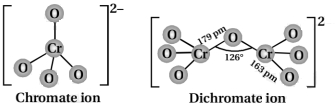
Give the structures of chromate and dichromate ions. How can chromates and dichromates be interconverted?
Give the chemical reactions showing the oxidizing nature of potassium dichromate.
Give the structures of chromate and dichromate ions. How can chromates and dichromates be interconverted?
Give the chemical reactions showing the oxidizing nature of potassium dichromate.
Solution
(N/A) Preparation: The yellow-coloured sodium chromate is obtained by the fusion of chromite ore $[FeCr_{2}O_{4}]$ with sodium carbonate in the presence of excess air.
$4FeCr_{2}O_{4} + 8Na_{2}CO_{3} + 7O_{2} \rightarrow 8Na_{2}CrO_{4} + 2Fe_{2}O_{3} + 8CO_{2}$
The yellow-coloured solution of sodium chromate is filtered and acidified with sulphuric acid to give a solution from which orange sodium dichromate $Na_{2}Cr_{2}O_{7} \cdot 2H_{2}O$ can be crystallized out.
$2Na_{2}CrO_{4} + 2H^{+} \rightarrow Na_{2}Cr_{2}O_{7} + 2Na^{+} + H_{2}O$
Sodium dichromate is more soluble than potassium dichromate. The latter is therefore prepared by treating the solution of sodium dichromate with potassium chloride.
$Na_{2}Cr_{2}O_{7} + 2KCl \rightarrow K_{2}Cr_{2}O_{7} + 2NaCl$
Thus,orange-coloured crystals of potassium dichromate are obtained.
Uses: It is used as a primary standard in volumetric analysis because of its non-hygroscopic nature.
It is used in the leather industry and for the formation of azo compounds.
It is used as an oxidizing agent in organic chemistry.
It is used to measure chemical oxygen demand $(COD)$.
Structures: $CrO_{4}^{2-}$ (chromate) is tetrahedral,whereas $Cr_{2}O_{7}^{2-}$ (dichromate) consists of two tetrahedra sharing one corner with a $Cr-O-Cr$ bond angle of $126^{\circ}$.
Interconversion: Depending upon the $pH$ of a solution,the chromate ion and dichromate ion are interconvertible as:
$2CrO_{4}^{2-} + 2H^{+} \rightarrow Cr_{2}O_{7}^{2-} + H_{2}O$ (Yellow to Orange)
$Cr_{2}O_{7}^{2-} + 2OH^{-} \rightarrow 2CrO_{4}^{2-} + H_{2}O$ (Orange to Yellow)
Oxidizing Nature: In acidic medium,the dichromate ion acts as a very good oxidizing agent. The half-reaction is:
$Cr_{2}O_{7}^{2-} + 14H^{+} + 6e^{-} \rightarrow 2Cr^{3+} + 7H_{2}O$ $(E^{\circ} = +1.33 \ V)$
Acidified dichromate solution oxidizes iodides to iodine,sulphides to sulphur,$Sn(II)$ to $Sn(IV)$,and $Fe(II)$ to $Fe(III)$. The half-reactions are:
$(i) \ 6I^{-} \rightarrow 3I_{2} + 6e^{-}$
$(ii) \ 3H_{2}S \rightarrow 6H^{+} + 3S + 6e^{-}$
$(iii) \ 3Sn^{2+} \rightarrow 3Sn^{4+} + 6e^{-}$
$(iv) \ 6Fe^{2+} \rightarrow 6Fe^{3+} + 6e^{-}$
$4FeCr_{2}O_{4} + 8Na_{2}CO_{3} + 7O_{2} \rightarrow 8Na_{2}CrO_{4} + 2Fe_{2}O_{3} + 8CO_{2}$
The yellow-coloured solution of sodium chromate is filtered and acidified with sulphuric acid to give a solution from which orange sodium dichromate $Na_{2}Cr_{2}O_{7} \cdot 2H_{2}O$ can be crystallized out.
$2Na_{2}CrO_{4} + 2H^{+} \rightarrow Na_{2}Cr_{2}O_{7} + 2Na^{+} + H_{2}O$
Sodium dichromate is more soluble than potassium dichromate. The latter is therefore prepared by treating the solution of sodium dichromate with potassium chloride.
$Na_{2}Cr_{2}O_{7} + 2KCl \rightarrow K_{2}Cr_{2}O_{7} + 2NaCl$
Thus,orange-coloured crystals of potassium dichromate are obtained.
Uses: It is used as a primary standard in volumetric analysis because of its non-hygroscopic nature.
It is used in the leather industry and for the formation of azo compounds.
It is used as an oxidizing agent in organic chemistry.
It is used to measure chemical oxygen demand $(COD)$.
Structures: $CrO_{4}^{2-}$ (chromate) is tetrahedral,whereas $Cr_{2}O_{7}^{2-}$ (dichromate) consists of two tetrahedra sharing one corner with a $Cr-O-Cr$ bond angle of $126^{\circ}$.
Interconversion: Depending upon the $pH$ of a solution,the chromate ion and dichromate ion are interconvertible as:
$2CrO_{4}^{2-} + 2H^{+} \rightarrow Cr_{2}O_{7}^{2-} + H_{2}O$ (Yellow to Orange)
$Cr_{2}O_{7}^{2-} + 2OH^{-} \rightarrow 2CrO_{4}^{2-} + H_{2}O$ (Orange to Yellow)
Oxidizing Nature: In acidic medium,the dichromate ion acts as a very good oxidizing agent. The half-reaction is:
$Cr_{2}O_{7}^{2-} + 14H^{+} + 6e^{-} \rightarrow 2Cr^{3+} + 7H_{2}O$ $(E^{\circ} = +1.33 \ V)$
Acidified dichromate solution oxidizes iodides to iodine,sulphides to sulphur,$Sn(II)$ to $Sn(IV)$,and $Fe(II)$ to $Fe(III)$. The half-reactions are:
$(i) \ 6I^{-} \rightarrow 3I_{2} + 6e^{-}$
$(ii) \ 3H_{2}S \rightarrow 6H^{+} + 3S + 6e^{-}$
$(iii) \ 3Sn^{2+} \rightarrow 3Sn^{4+} + 6e^{-}$
$(iv) \ 6Fe^{2+} \rightarrow 6Fe^{3+} + 6e^{-}$
0 likes
View Solution217
Difficult
Describe the preparation of potassium permanganate. State its physical properties,structure,and uses. Discuss its chemical properties and provide chemical reactions demonstrating the oxidizing character of $KMnO_{4}$.
Solution
(A) $(i)$ Laboratory preparation: In a laboratory,$KMnO_{4}$ is prepared by the oxidation of $Mn(II)$ salts by peroxodisulphate.
$2 Mn^{2+} + 5 S_{2}O_{8}^{2-} + 8 H_{2}O \rightarrow 2 MnO_{4}^{-} + 10 SO_{4}^{2-} + 16 H^{+}$
$(ii)$ Commercial preparation:
Step-$1$: Conversion of $MnO_{2}$ to potassium manganate. $A$ dark green coloured potassium manganate $(K_{2}MnO_{4})$ is obtained when $MnO_{2}$ is fused with an alkali metal hydroxide in the presence of an oxidizing agent such as $KNO_{3}$.
$2 MnO_{2} + 4 KOH + O_{2} \rightarrow 2 K_{2}MnO_{4} \text{ (Green)} + 2 H_{2}O$
Step-$2$: Conversion of $K_{2}MnO_{4}$ to $KMnO_{4}$.
$(a)$ Potassium manganate disproportionates in a neutral or acidic medium to give potassium permanganate.
$3 MnO_{4}^{2-} + 4 H^{+} \rightarrow 2 MnO_{4}^{-} + MnO_{2} + 2 H_{2}O$
$(b)$ Electrolytic method: This is the modern method of conversion. $MnO_{4}^{2-}$ is oxidized to $MnO_{4}^{-}$ at the anode.
Anode: $MnO_{4}^{2-} \rightarrow MnO_{4}^{-} \text{ (Purple)} + e^{-}$
Physical properties: Potassium permanganate forms dark purple crystals which are isostructural with $KClO_{4}$. It is not very soluble in water $[6.4 \ g / 100 \ g$ of water at $293 \ K]$. It is diamagnetic and has an intense colour.
Structure: The $MnO_{4}^{-}$ ion is tetrahedral. The $\pi$-bonding occurs by the overlapping of $p$-orbitals of oxygen with $d$-orbitals of manganese,resulting in $d\pi-p\pi$ bonding.
Uses: It is used as an oxidizing agent in organic chemistry,for bleaching of fibres,decolourisation of oils,and as a disinfectant.
Chemical properties: Decomposition at $513 \ K$ gives $K_{2}MnO_{4}$. $2 KMnO_{4} \rightarrow K_{2}MnO_{4} + MnO_{2} + O_{2}$.
Oxidizing character in acidic medium:
$(i) 5 Fe^{2+} + MnO_{4}^{-} + 8 H^{+} \rightarrow Mn^{2+} + 4 H_{2}O + 5 Fe^{3+}$
$(ii) 5 C_{2}O_{4}^{2-} + 2 MnO_{4}^{-} + 16 H^{+} \rightarrow 2 Mn^{2+} + 8 H_{2}O + 10 CO_{2}$
$2 Mn^{2+} + 5 S_{2}O_{8}^{2-} + 8 H_{2}O \rightarrow 2 MnO_{4}^{-} + 10 SO_{4}^{2-} + 16 H^{+}$
$(ii)$ Commercial preparation:
Step-$1$: Conversion of $MnO_{2}$ to potassium manganate. $A$ dark green coloured potassium manganate $(K_{2}MnO_{4})$ is obtained when $MnO_{2}$ is fused with an alkali metal hydroxide in the presence of an oxidizing agent such as $KNO_{3}$.
$2 MnO_{2} + 4 KOH + O_{2} \rightarrow 2 K_{2}MnO_{4} \text{ (Green)} + 2 H_{2}O$
Step-$2$: Conversion of $K_{2}MnO_{4}$ to $KMnO_{4}$.
$(a)$ Potassium manganate disproportionates in a neutral or acidic medium to give potassium permanganate.
$3 MnO_{4}^{2-} + 4 H^{+} \rightarrow 2 MnO_{4}^{-} + MnO_{2} + 2 H_{2}O$
$(b)$ Electrolytic method: This is the modern method of conversion. $MnO_{4}^{2-}$ is oxidized to $MnO_{4}^{-}$ at the anode.
Anode: $MnO_{4}^{2-} \rightarrow MnO_{4}^{-} \text{ (Purple)} + e^{-}$
Physical properties: Potassium permanganate forms dark purple crystals which are isostructural with $KClO_{4}$. It is not very soluble in water $[6.4 \ g / 100 \ g$ of water at $293 \ K]$. It is diamagnetic and has an intense colour.
Structure: The $MnO_{4}^{-}$ ion is tetrahedral. The $\pi$-bonding occurs by the overlapping of $p$-orbitals of oxygen with $d$-orbitals of manganese,resulting in $d\pi-p\pi$ bonding.
Uses: It is used as an oxidizing agent in organic chemistry,for bleaching of fibres,decolourisation of oils,and as a disinfectant.
Chemical properties: Decomposition at $513 \ K$ gives $K_{2}MnO_{4}$. $2 KMnO_{4} \rightarrow K_{2}MnO_{4} + MnO_{2} + O_{2}$.
Oxidizing character in acidic medium:
$(i) 5 Fe^{2+} + MnO_{4}^{-} + 8 H^{+} \rightarrow Mn^{2+} + 4 H_{2}O + 5 Fe^{3+}$
$(ii) 5 C_{2}O_{4}^{2-} + 2 MnO_{4}^{-} + 16 H^{+} \rightarrow 2 Mn^{2+} + 8 H_{2}O + 10 CO_{2}$
0 likes
View Solution218
DifficultMCQ
Identify the correct $(T)$ and incorrect $(F)$ statements from the following:
$(a)$ $MnO_4^{2-}$ is diamagnetic.
$(b)$ $MnO_4^-$ is green and $MnO_4^{2-}$ is purple.
$(c)$ $K_2Cr_2O_7$ is yellow.
$(d)$ $K_2Cr_2O_7$ is orange.
$(a)$ $MnO_4^{2-}$ is diamagnetic.
$(b)$ $MnO_4^-$ is green and $MnO_4^{2-}$ is purple.
$(c)$ $K_2Cr_2O_7$ is yellow.
$(d)$ $K_2Cr_2O_7$ is orange.
A
a-$T$,b-$F$,c-$F$,d-$T$
B
a-$F$,b-$F$,c-$F$,d-$T$
C
a-$T$,b-$T$,c-$F$,d-$F$
D
a-$F$,b-$T$,c-$T$,d-$F$
Solution
(B) $MnO_4^{2-}$ has one unpaired electron ($d^1$ configuration),so it is paramagnetic. Thus,statement $(a)$ is $F$.
$(b)$ $MnO_4^-$ is purple and $MnO_4^{2-}$ is green. Thus,statement $(b)$ is $F$.
$(c)$ $K_2Cr_2O_7$ is orange,not yellow. Thus,statement $(c)$ is $F$.
$(d)$ $K_2Cr_2O_7$ is orange. Thus,statement $(d)$ is $T$.
Therefore,the correct sequence is $a-F, b-F, c-F, d-T$.
$(b)$ $MnO_4^-$ is purple and $MnO_4^{2-}$ is green. Thus,statement $(b)$ is $F$.
$(c)$ $K_2Cr_2O_7$ is orange,not yellow. Thus,statement $(c)$ is $F$.
$(d)$ $K_2Cr_2O_7$ is orange. Thus,statement $(d)$ is $T$.
Therefore,the correct sequence is $a-F, b-F, c-F, d-T$.
0 likes
View Solution219
DifficultMCQ
Determine the correct $(T)$ and incorrect $(F)$ statements from the following:
$(a)$ In the titration of $C_2O_4^{2-}$ with $KMnO_4$,$C_2O_4^{2-}$ acts as an oxidizing agent.
$(b)$ $KMnO_4$ is a strong oxidizing agent.
$(c)$ In $Cr_2O_4^{2-}$,the $O-Cr-O$ bond angle is $120^o$.
$(d)$ The standard electrode potential for the reaction $Cr_2O_7^{2-} + 14H^+ + 6e^- \to 2Cr^{3+} + 7H_2O$ is $E^o = -1.33 \ V$.
$(a)$ In the titration of $C_2O_4^{2-}$ with $KMnO_4$,$C_2O_4^{2-}$ acts as an oxidizing agent.
$(b)$ $KMnO_4$ is a strong oxidizing agent.
$(c)$ In $Cr_2O_4^{2-}$,the $O-Cr-O$ bond angle is $120^o$.
$(d)$ The standard electrode potential for the reaction $Cr_2O_7^{2-} + 14H^+ + 6e^- \to 2Cr^{3+} + 7H_2O$ is $E^o = -1.33 \ V$.
A
$(a) T, (b) T, (c) F, (d) F$
B
$(a) F, (b) T, (c) F, (d) F$
C
$(a) F, (b) T, (c) T, (d) F$
D
$(a) T, (b) F, (c) T, (d) T$
Solution
(B) Incorrect: In the reaction between $KMnO_4$ and $C_2O_4^{2-}$,$C_2O_4^{2-}$ is oxidized to $CO_2$,so it acts as a reducing agent.
$(b)$ Correct: $KMnO_4$ is a well-known strong oxidizing agent in acidic medium.
$(c)$ Incorrect: The $Cr_2O_4^{2-}$ ion (chromate) has a tetrahedral geometry,where the bond angle is approximately $109.5^o$,not $120^o$.
$(d)$ Incorrect: The standard reduction potential for the reaction $Cr_2O_7^{2-} + 14H^+ + 6e^- \to 2Cr^{3+} + 7H_2O$ is $E^o = +1.33 \ V$,not $-1.33 \ V$.
$(b)$ Correct: $KMnO_4$ is a well-known strong oxidizing agent in acidic medium.
$(c)$ Incorrect: The $Cr_2O_4^{2-}$ ion (chromate) has a tetrahedral geometry,where the bond angle is approximately $109.5^o$,not $120^o$.
$(d)$ Incorrect: The standard reduction potential for the reaction $Cr_2O_7^{2-} + 14H^+ + 6e^- \to 2Cr^{3+} + 7H_2O$ is $E^o = +1.33 \ V$,not $-1.33 \ V$.
0 likes
View Solution220
Difficult
Determine the correct $(T)$ and incorrect $(F)$ statements from the following:
$(a)$ The $E^o$ for $MnO_4^- + 8H^+ + 5e^- \to Mn^{2+} + 4H_2O$ is $-1.52 \ V$.
$(b)$ $MnO_4^-$ oxidizes $I^-$ to $I_2$.
$(c)$ The color of $CrO_4^{2-}$ is yellow in the presence of $H^+$.
$(d)$ The color of $CrO_4^{2-}$ is yellow in the presence of $OH^-$.
$(a)$ The $E^o$ for $MnO_4^- + 8H^+ + 5e^- \to Mn^{2+} + 4H_2O$ is $-1.52 \ V$.
$(b)$ $MnO_4^-$ oxidizes $I^-$ to $I_2$.
$(c)$ The color of $CrO_4^{2-}$ is yellow in the presence of $H^+$.
$(d)$ The color of $CrO_4^{2-}$ is yellow in the presence of $OH^-$.
Solution
(B) The standard reduction potential for the reaction $MnO_4^- + 8H^+ + 5e^- \to Mn^{2+} + 4H_2O$ is $+1.51 \ V$,not $-1.52 \ V$. Thus,statement $(a)$ is $(F)$.
$(b)$ $MnO_4^-$ is a strong oxidizing agent and it oxidizes iodide ions $(I^-)$ to iodine $(I_2)$. Thus,statement $(b)$ is $(T)$.
$(c)$ In acidic medium $(H^+)$,$CrO_4^{2-}$ (yellow) converts to $Cr_2O_7^{2-}$ (orange). Thus,statement $(c)$ is $(F)$.
$(d)$ In basic medium $(OH^-)$,the equilibrium shifts towards $CrO_4^{2-}$,which is yellow. Thus,statement $(d)$ is $(T)$.
$(b)$ $MnO_4^-$ is a strong oxidizing agent and it oxidizes iodide ions $(I^-)$ to iodine $(I_2)$. Thus,statement $(b)$ is $(T)$.
$(c)$ In acidic medium $(H^+)$,$CrO_4^{2-}$ (yellow) converts to $Cr_2O_7^{2-}$ (orange). Thus,statement $(c)$ is $(F)$.
$(d)$ In basic medium $(OH^-)$,the equilibrium shifts towards $CrO_4^{2-}$,which is yellow. Thus,statement $(d)$ is $(T)$.
0 likes
View Solution221
Medium
Fill in the blanks:
$(1)$ ......... acid is added to perform titrations with $KMnO_4$ and $K_2Cr_2O_7$.
$(2)$ Crystals of potassium dichromate are of ......... color,while crystals of potassium chromate are of ......... color.
$(3)$ The color of $MnO_4^{2-}$ is ......... and the color of $MnO_4^-$ is ......... .
$(1)$ ......... acid is added to perform titrations with $KMnO_4$ and $K_2Cr_2O_7$.
$(2)$ Crystals of potassium dichromate are of ......... color,while crystals of potassium chromate are of ......... color.
$(3)$ The color of $MnO_4^{2-}$ is ......... and the color of $MnO_4^-$ is ......... .
Solution
(N/A) $(1)$ Dilute $H_2SO_4$ is used because it does not act as an oxidizing agent itself.
$(2)$ Crystals of potassium dichromate $(K_2Cr_2O_7)$ are orange-red,while crystals of potassium chromate $(K_2CrO_4)$ are yellow.
$(3)$ The color of the manganate ion $(MnO_4^{2-})$ is green,and the color of the permanganate ion $(MnO_4^-)$ is deep purple.
$(2)$ Crystals of potassium dichromate $(K_2Cr_2O_7)$ are orange-red,while crystals of potassium chromate $(K_2CrO_4)$ are yellow.
$(3)$ The color of the manganate ion $(MnO_4^{2-})$ is green,and the color of the permanganate ion $(MnO_4^-)$ is deep purple.
0 likes
View Solution222
Difficult
Fill in the blanks:
$(1)$ In the dichromate ion,the $O-Cr-O$ bond angle is ....... $^o$.
$(2)$ The reaction $3Sn^{2+} \to 3Sn^{4+} + 6e^-$ occurs via .........,in which $Sn^{2+}$ is ......... .
$(3)$ The symbols for stannous and stannic are ......... and ......... respectively.
$(4)$ $V_2O_4$ dissolves in acidic compounds to give ......... salts.
$(1)$ In the dichromate ion,the $O-Cr-O$ bond angle is ....... $^o$.
$(2)$ The reaction $3Sn^{2+} \to 3Sn^{4+} + 6e^-$ occurs via .........,in which $Sn^{2+}$ is ......... .
$(3)$ The symbols for stannous and stannic are ......... and ......... respectively.
$(4)$ $V_2O_4$ dissolves in acidic compounds to give ......... salts.
Solution
(N/A) $(1)$ The $O-Cr-O$ bond angle in the dichromate ion $(Cr_2O_7^{2-})$ is $126^o$.
$(2)$ The reaction $3Sn^{2+} \to 3Sn^{4+} + 6e^-$ occurs via oxidation,in which $Sn^{2+}$ is a reducing agent.
$(3)$ The symbols for stannous and stannic are $Sn^{2+}$ and $Sn^{4+}$ respectively.
$(4)$ $V_2O_4$ dissolves in acidic compounds to give vanadyl $(VO^{2+})$ salts.
$(2)$ The reaction $3Sn^{2+} \to 3Sn^{4+} + 6e^-$ occurs via oxidation,in which $Sn^{2+}$ is a reducing agent.
$(3)$ The symbols for stannous and stannic are $Sn^{2+}$ and $Sn^{4+}$ respectively.
$(4)$ $V_2O_4$ dissolves in acidic compounds to give vanadyl $(VO^{2+})$ salts.
0 likes
View Solution223
Difficult
Fill in the blanks:
$(1)$ Since $V_2O_5$ acts as both an acid and a base,it is an ...... oxide.
$(2)$ The $Cr$ oxide which is basic is ......,and the $Cr$ oxide which is amphoteric is ...... .
$(3)$ The formula of chromite ore is .......... .
$(4)$ The formula of sodium dichromate crystal is .......... .
$(1)$ Since $V_2O_5$ acts as both an acid and a base,it is an ...... oxide.
$(2)$ The $Cr$ oxide which is basic is ......,and the $Cr$ oxide which is amphoteric is ...... .
$(3)$ The formula of chromite ore is .......... .
$(4)$ The formula of sodium dichromate crystal is .......... .
Solution
(N/A) $(1)$ $V_2O_5$ is an amphoteric oxide because it reacts with both acids and bases.
$(2)$ $CrO$ is a basic oxide,while $Cr_2O_3$ is an amphoteric oxide.
$(3)$ The formula of chromite ore is $FeCr_2O_4$ (or $FeO \cdot Cr_2O_3$).
$(4)$ The formula of sodium dichromate crystal is $Na_2Cr_2O_7 \cdot 2H_2O$.
$(2)$ $CrO$ is a basic oxide,while $Cr_2O_3$ is an amphoteric oxide.
$(3)$ The formula of chromite ore is $FeCr_2O_4$ (or $FeO \cdot Cr_2O_3$).
$(4)$ The formula of sodium dichromate crystal is $Na_2Cr_2O_7 \cdot 2H_2O$.
0 likes
View Solution224
EasyMCQ
Give the formulas of the oxocations of the $3d$ series metals.
A
$VO_2^+$ and $VO^{2+}$
B
$TiO^{2+}$ and $TiO_2^{2+}$
C
$CrO_2^{2+}$ and $CrO_4^{2-}$
D
$MnO_4^-$ and $MnO_4^{2-}$
Solution
(A) In the $3d$ series,transition metals form oxocations primarily in their higher oxidation states.
Specifically,Vanadium forms stable oxocations such as the vanadyl ion,$VO^{2+}$ (where $V$ is in $+4$ oxidation state),and the dioxovanadium$(V)$ ion,$VO_2^+$ (where $V$ is in $+5$ oxidation state).
Titanium also forms the titanyl ion,$TiO^{2+}$.
Specifically,Vanadium forms stable oxocations such as the vanadyl ion,$VO^{2+}$ (where $V$ is in $+4$ oxidation state),and the dioxovanadium$(V)$ ion,$VO_2^+$ (where $V$ is in $+5$ oxidation state).
Titanium also forms the titanyl ion,$TiO^{2+}$.
0 likes
View Solution225
Medium
Provide the structures of the following ions:
$1.$ $CrO_4^{2-}$
$2.$ $Cr_2O_7^{2-}$
$1.$ $CrO_4^{2-}$
$2.$ $Cr_2O_7^{2-}$
Solution
(N/A) $1.$ The chromate ion $(CrO_4^{2-})$ has a tetrahedral structure where the central $Cr$ atom is bonded to four oxygen atoms. The bond angles are approximately $109.5^{\circ}$.
$2.$ The dichromate ion $(Cr_2O_7^{2-})$ consists of two $CrO_4$ tetrahedra sharing a common oxygen atom at one corner. The $Cr-O-Cr$ bond angle is approximately $126^{\circ}$.
$2.$ The dichromate ion $(Cr_2O_7^{2-})$ consists of two $CrO_4$ tetrahedra sharing a common oxygen atom at one corner. The $Cr-O-Cr$ bond angle is approximately $126^{\circ}$.
0 likes
View Solution226
EasyMCQ
Which compounds are formed when $Mn_2O_7$ and $CrO_3$ react with water,given that they are acidic in nature?
A
$HMnO_4$ and $H_2CrO_4$
B
$H_2MnO_4$ and $H_2CrO_4$
C
$HMnO_4$ and $H_2Cr_2O_7$
D
$H_2MnO_4$ and $H_2Cr_2O_7$
Solution
(A) The reaction of $Mn_2O_7$ with water is: $Mn_2O_7 + H_2O \rightarrow 2HMnO_4$ (Permanganic acid).
The reaction of $CrO_3$ with water is: $CrO_3 + H_2O \rightarrow H_2CrO_4$ (Chromic acid).
Therefore,the compounds formed are $HMnO_4$ and $H_2CrO_4$.
The reaction of $CrO_3$ with water is: $CrO_3 + H_2O \rightarrow H_2CrO_4$ (Chromic acid).
Therefore,the compounds formed are $HMnO_4$ and $H_2CrO_4$.
0 likes
View Solution227
MediumMCQ
Complete the following reactions:
$(a)$ $4FeCr_2O_4 + 8Na_2CO_3 + 7O_2 \to 8Na_2CrO_4 + 2Fe_2O_3 + 8CO_2$
$(b)$ $2Na_2CrO_4 + 2H^+ \to Na_2Cr_2O_7 + 2Na^+ + H_2O$
Identify the species $X$ in both reactions.
$(a)$ $4FeCr_2O_4 + 8Na_2CO_3 + 7O_2 \to 8Na_2CrO_4 + 2Fe_2O_3 + 8CO_2$
$(b)$ $2Na_2CrO_4 + 2H^+ \to Na_2Cr_2O_7 + 2Na^+ + H_2O$
Identify the species $X$ in both reactions.
A
$X = Na_2CO_3$ in $(a)$ and $X = 2H^+$ in $(b)$
B
$X = NaOH$ in $(a)$ and $X = H_2O$ in $(b)$
C
$X = Na_2O$ in $(a)$ and $X = OH^-$ in $(b)$
D
$X = NaHCO_3$ in $(a)$ and $X = H_2O$ in $(b)$
Solution
(A) In reaction $(a)$,the roasting of chromite ore $(FeCr_2O_4)$ with sodium carbonate $(Na_2CO_3)$ in the presence of air $(O_2)$ produces sodium chromate $(Na_2CrO_4)$. Thus,$X = Na_2CO_3$.
In reaction $(b)$,sodium chromate $(Na_2CrO_4)$ is converted into sodium dichromate $(Na_2Cr_2O_7)$ by the addition of an acid (like $H_2SO_4$),which provides $H^+$ ions. The reaction is: $2Na_2CrO_4 + 2H^+ \to Na_2Cr_2O_7 + 2Na^+ + H_2O$. Thus,$X = 2H^+$.
In reaction $(b)$,sodium chromate $(Na_2CrO_4)$ is converted into sodium dichromate $(Na_2Cr_2O_7)$ by the addition of an acid (like $H_2SO_4$),which provides $H^+$ ions. The reaction is: $2Na_2CrO_4 + 2H^+ \to Na_2Cr_2O_7 + 2Na^+ + H_2O$. Thus,$X = 2H^+$.
0 likes
View Solution228
Medium
Write two uses of $KMnO_4$ and $K_2Cr_2O_7$.
Solution
(N/A) $KMnO_4$ (Potassium permanganate) is used as:
$1$. An oxidizing agent in laboratory and industrial processes.
$2$. $A$ disinfectant and germicide in water treatment.
$K_2Cr_2O_7$ (Potassium dichromate) is used as:
$1$. $A$ primary standard in volumetric analysis.
$2$. An oxidizing agent in the manufacture of azo compounds and in the leather industry for chrome tanning.
$1$. An oxidizing agent in laboratory and industrial processes.
$2$. $A$ disinfectant and germicide in water treatment.
$K_2Cr_2O_7$ (Potassium dichromate) is used as:
$1$. $A$ primary standard in volumetric analysis.
$2$. An oxidizing agent in the manufacture of azo compounds and in the leather industry for chrome tanning.
0 likes
View Solution229
Medium
Fill in the blanks:
$1.$ Heating lanthanoids with sulfur gives .......
$2.$ Mixed oxides of lanthanoids are used as catalysts in ..........
$1.$ Heating lanthanoids with sulfur gives .......
$2.$ Mixed oxides of lanthanoids are used as catalysts in ..........
Solution
(N/A) $1.$ Heating lanthanoids with sulfur gives lanthanoid sulfides $(Ln_2S_3)$.
$2.$ Mixed oxides of lanthanoids are used as catalysts in petroleum cracking.
$2.$ Mixed oxides of lanthanoids are used as catalysts in petroleum cracking.
0 likes
View Solution230
Advanced
Write about the utility of $d$- and $f$-block elements and their compounds. Or describe the following uses of $d$- and $f$-block elements and their compounds: $(i)$ In iron/steel $(ii)$ As pigments $(iii)$ In batteries $(iv)$ In coinage $(v)$ As catalysts.
Solution
(A) $(i)$ Production and use of iron and steel: Iron and steel are important construction materials. Their production is based on the reduction of iron oxide compounds,removal of impurities,and the addition of carbon and alloying metals like $Cr$,$Mn$,and $Ni$.
$(ii)$ In pigment industry: $TiO_2$ is produced for the pigment industry.
$(iii)$ In battery industry: The following are produced for the battery industry:
$\Rightarrow MnO_2$ and $Zn$ for dry cells.
$\Rightarrow Ni/Cd$ for batteries.
$(iv)$ In coinage: Group $11$ elements are valuable and are known as coinage metals. The importance of $Ag$ and $Au$ is limited to storage,but they have industrial uses. In the $UK$,'copper coins' are steel coated with copper,and 'silver coins' are $Cu/Ni$ alloys.
$(v)$ As catalysts: Many elements or their compounds are essential catalysts for chemical industries.
$\Rightarrow V_2O_5$ is used as a catalyst for the oxidation of $SO_2$ to $SO_3$ in the production of sulfuric acid.
$\Rightarrow$ Ziegler-Natta catalyst,which is $TiCl_4$ with $Al(CH_3)_3$,is used in the production of polyethylene.
$\Rightarrow$ Iron catalysts are used in the Haber process for the production of ammonia from $N_2/H_2$ mixtures.
$\Rightarrow$ Nickel acts as a catalyst in the hydrogenation of fats (unsaturated oils).
$\Rightarrow PdCl_2$ is used as a catalyst for the oxidation of ethyne $(C_2H_2)$ in the Wacker process to produce ethanal $(CH_3CHO)$.
$\Rightarrow$ Nickel complexes are used in the polymerization of alkynes and other organic compounds like benzene.
$\Rightarrow$ The photography industry is based on the special light-sensitive properties of $AgBr$.
$(ii)$ In pigment industry: $TiO_2$ is produced for the pigment industry.
$(iii)$ In battery industry: The following are produced for the battery industry:
$\Rightarrow MnO_2$ and $Zn$ for dry cells.
$\Rightarrow Ni/Cd$ for batteries.
$(iv)$ In coinage: Group $11$ elements are valuable and are known as coinage metals. The importance of $Ag$ and $Au$ is limited to storage,but they have industrial uses. In the $UK$,'copper coins' are steel coated with copper,and 'silver coins' are $Cu/Ni$ alloys.
$(v)$ As catalysts: Many elements or their compounds are essential catalysts for chemical industries.
$\Rightarrow V_2O_5$ is used as a catalyst for the oxidation of $SO_2$ to $SO_3$ in the production of sulfuric acid.
$\Rightarrow$ Ziegler-Natta catalyst,which is $TiCl_4$ with $Al(CH_3)_3$,is used in the production of polyethylene.
$\Rightarrow$ Iron catalysts are used in the Haber process for the production of ammonia from $N_2/H_2$ mixtures.
$\Rightarrow$ Nickel acts as a catalyst in the hydrogenation of fats (unsaturated oils).
$\Rightarrow PdCl_2$ is used as a catalyst for the oxidation of ethyne $(C_2H_2)$ in the Wacker process to produce ethanal $(CH_3CHO)$.
$\Rightarrow$ Nickel complexes are used in the polymerization of alkynes and other organic compounds like benzene.
$\Rightarrow$ The photography industry is based on the special light-sensitive properties of $AgBr$.
0 likes
View Solution231
Difficult
Fill in the blanks:
$1.$ The copper layer on copper coins in the $UK$ is .......... .
$2.$ Copper-silver coins in the $UK$ are an alloy of ............ .
$3.$ The catalyst used for the oxidation of $SO_2$ to $SO_3$ is ......... .
$1.$ The copper layer on copper coins in the $UK$ is .......... .
$2.$ Copper-silver coins in the $UK$ are an alloy of ............ .
$3.$ The catalyst used for the oxidation of $SO_2$ to $SO_3$ is ......... .
Solution
(N/A) $1.$ The copper layer on copper coins in the $UK$ is $Cu$ (Copper).
$2.$ Copper-silver coins in the $UK$ are an alloy of $Cu$ and $Ag$.
$3.$ The catalyst used for the oxidation of $SO_2$ to $SO_3$ is $V_2O_5$ (Vanadium pentoxide).
$2.$ Copper-silver coins in the $UK$ are an alloy of $Cu$ and $Ag$.
$3.$ The catalyst used for the oxidation of $SO_2$ to $SO_3$ is $V_2O_5$ (Vanadium pentoxide).
0 likes
View Solution232
EasyMCQ
Which transition metal compound is used in a dry battery cell?
A
$MnO_2$
B
$Fe_2O_3$
C
$ZnO$
D
$TiO_2$
Solution
(A) In a dry battery cell (Leclanche cell),the cathode consists of a carbon rod surrounded by a mixture of manganese dioxide $(MnO_2)$ and carbon powder.
$MnO_2$ acts as a depolarizer in the cell.
$MnO_2$ acts as a depolarizer in the cell.
0 likes
View Solution233
EasyMCQ
Which transition element of the $3d$ series is used in a dry battery cell?
A
$Zn$
B
$Fe$
C
$Cu$
D
$Mn$
Solution
(A) In a dry cell (Leclanché cell),the anode is made of zinc $(Zn)$ and the cathode is a carbon rod surrounded by a mixture of manganese dioxide $(MnO_2)$ and carbon. Among the transition elements of the $3d$ series,$Zn$ is used as the anode container.
0 likes
View Solution234
Medium
Provide the structures for:
$1.$ $MnO_4^{-}$
$2.$ $MnO_4^{2-}$
$1.$ $MnO_4^{-}$
$2.$ $MnO_4^{2-}$
Solution
(N/A) $1.$ The permanganate ion $(MnO_4^-)$ has a tetrahedral geometry where the manganese atom is at the center,bonded to four oxygen atoms. It involves $d\pi-p\pi$ bonding.
$2.$ The manganate ion $(MnO_4^{2-})$ also has a tetrahedral geometry with the manganese atom at the center,bonded to four oxygen atoms. It is paramagnetic due to the presence of one unpaired electron.
$2.$ The manganate ion $(MnO_4^{2-})$ also has a tetrahedral geometry with the manganese atom at the center,bonded to four oxygen atoms. It is paramagnetic due to the presence of one unpaired electron.
0 likes
View Solution235
Medium
Match the aqueous solutions given in List-$I$ with their colors given in List-$II$:
| List-$I$ (Aqueous solution of salt) | List-$II$ (Color) |
| $A$. $FeSO_4 \cdot 7H_2O$ | $i$. Green |
| $B$. $NiCl_2 \cdot 4H_2O$ | $ii$. Pale pink |
| $C$. $MnCl_2 \cdot 4H_2O$ | $iii$. Blue |
| $D$. $CoCl_2 \cdot 6H_2O$ | $iv$. Light green |
| $E$. $Cu_2Cl_2$ | $v$. Pink |
| $vi$. Colorless |
Solution
(A-IV, B-I, C-II, D-V, E-VI) The colors of the aqueous solutions of transition metal salts are as follows:
$A$. $FeSO_4 \cdot 7H_2O$ is light green $(iv)$.
$B$. $NiCl_2 \cdot 4H_2O$ is green $(i)$.
$C$. $MnCl_2 \cdot 4H_2O$ is pale pink $(ii)$.
$D$. $CoCl_2 \cdot 6H_2O$ is pink $(v)$.
$E$. $Cu_2Cl_2$ is colorless $(vi)$ because $Cu^+$ has a $d^{10}$ configuration.
Therefore,the correct matching is: $A-iv, B-i, C-ii, D-v, E-vi$.
$A$. $FeSO_4 \cdot 7H_2O$ is light green $(iv)$.
$B$. $NiCl_2 \cdot 4H_2O$ is green $(i)$.
$C$. $MnCl_2 \cdot 4H_2O$ is pale pink $(ii)$.
$D$. $CoCl_2 \cdot 6H_2O$ is pink $(v)$.
$E$. $Cu_2Cl_2$ is colorless $(vi)$ because $Cu^+$ has a $d^{10}$ configuration.
Therefore,the correct matching is: $A-iv, B-i, C-ii, D-v, E-vi$.
0 likes
View Solution236
Difficult
When a chromite ore $(A)$ is fused with sodium carbonate in free excess of air and the product is dissolved in water,a yellow solution of compound $(B)$ is obtained. After treatment of this yellow solution with sulphuric acid,compound $(C)$ can be crystallised from the solution. When compound $(C)$ is treated with $KCl$,orange crystals of compound $(D)$ crystallise out. Identify $A$ to $D$ and also explain the reactions.
Solution
(A) $A: FeCr_{2}O_{4}$ (Chromite ore)
$B: Na_{2}CrO_{4}$ (Sodium chromate)
$C: Na_{2}Cr_{2}O_{7}$ (Sodium dichromate)
$D: K_{2}Cr_{2}O_{7}$ (Potassium dichromate)
Reactions:
$1$. Fusion of chromite ore with sodium carbonate:
$4FeCr_{2}O_{4} + 8Na_{2}CO_{3} + 7O_{2} \rightarrow 8Na_{2}CrO_{4} + 2Fe_{2}O_{3} + 8CO_{2}$
$2$. Acidification of sodium chromate to form sodium dichromate:
$2Na_{2}CrO_{4} + 2H_{2}SO_{4} \rightarrow Na_{2}Cr_{2}O_{7} + 2Na_{2}SO_{4} + H_{2}O$
$3$. Conversion of sodium dichromate to potassium dichromate:
$Na_{2}Cr_{2}O_{7} + 2KCl \rightarrow K_{2}Cr_{2}O_{7} + 2NaCl$
$B: Na_{2}CrO_{4}$ (Sodium chromate)
$C: Na_{2}Cr_{2}O_{7}$ (Sodium dichromate)
$D: K_{2}Cr_{2}O_{7}$ (Potassium dichromate)
Reactions:
$1$. Fusion of chromite ore with sodium carbonate:
$4FeCr_{2}O_{4} + 8Na_{2}CO_{3} + 7O_{2} \rightarrow 8Na_{2}CrO_{4} + 2Fe_{2}O_{3} + 8CO_{2}$
$2$. Acidification of sodium chromate to form sodium dichromate:
$2Na_{2}CrO_{4} + 2H_{2}SO_{4} \rightarrow Na_{2}Cr_{2}O_{7} + 2Na_{2}SO_{4} + H_{2}O$
$3$. Conversion of sodium dichromate to potassium dichromate:
$Na_{2}Cr_{2}O_{7} + 2KCl \rightarrow K_{2}Cr_{2}O_{7} + 2NaCl$
0 likes
View Solution237
Difficult
When an oxide of manganese $(A)$ is fused with $KOH$ in the presence of an oxidising agent and dissolved in water,it gives a dark green solution of compound $(B)$. Compound $(B)$ disproportionates in neutral or acidic solution to give purple compound $(C)$. An alkaline solution of compound $(C)$ oxidises potassium iodide solution to a compound $(D)$ and compound $(A)$ is also formed. Identify compounds $A$ to $D$ and also explain the reactions involved.
Solution
(A-D)
$1. \text{Fusion reaction: } 2 MnO_{2} + 4 KOH + O_{2} \rightarrow 2 K_{2}MnO_{4} + 2 H_{2}O$
$2. \text{Disproportionation of } (B) \text{ in acidic medium: } 3 MnO_{4}^{2-} + 4 H^{+}$ $\rightarrow 2 MnO_{4}^{-} + MnO_{2} + 2 H_{2}O$
$3. \text{Oxidation of } KI \text{ by } (C) \text{ in alkaline medium: } 2 MnO_{4}^{-} + H_{2}O + I^{-}$ $\rightarrow 2 MnO_{2} + 2 OH^{-} + IO_{3}^{-}$
| $A$: $MnO_{2}$ | $B$: $K_{2}MnO_{4}$ |
| $C$: $KMnO_{4}$ | $D$: $KIO_{3}$ |
$1. \text{Fusion reaction: } 2 MnO_{2} + 4 KOH + O_{2} \rightarrow 2 K_{2}MnO_{4} + 2 H_{2}O$
$2. \text{Disproportionation of } (B) \text{ in acidic medium: } 3 MnO_{4}^{2-} + 4 H^{+}$ $\rightarrow 2 MnO_{4}^{-} + MnO_{2} + 2 H_{2}O$
$3. \text{Oxidation of } KI \text{ by } (C) \text{ in alkaline medium: } 2 MnO_{4}^{-} + H_{2}O + I^{-}$ $\rightarrow 2 MnO_{2} + 2 OH^{-} + IO_{3}^{-}$
0 likes
View Solution238
Difficult
Mention the type of compounds formed when small atoms like $H$,$C$ and $N$ get trapped inside the crystal lattice of transition metals. Also,give the physical and chemical characteristics of these compounds.
Solution
(N/A) The compounds formed are known as interstitial compounds. These are formed when small atoms like $H$,$B$,$C$,and $N$ are trapped inside the interstitial sites of the crystal lattice of transition metals.
The physical and chemical characteristics are:
$(i)$ They have high melting points,which are even higher than those of pure transition metals.
$(ii)$ They are extremely hard; some borides approach diamond in hardness.
$(iii)$ They retain metallic conductivity.
$(iv)$ They are chemically inert.
The physical and chemical characteristics are:
$(i)$ They have high melting points,which are even higher than those of pure transition metals.
$(ii)$ They are extremely hard; some borides approach diamond in hardness.
$(iii)$ They retain metallic conductivity.
$(iv)$ They are chemically inert.
0 likes
View Solution239
Difficult
$A$ violet compound of manganese $(A)$ decomposes on heating to liberate oxygen and compounds $(B)$ and $(C)$ of manganese are formed. Compound $(C)$ reacts with $KOH$ in the presence of potassium nitrate to give compound $(B)$. On heating compound $(C)$ with conc. $H_{2}SO_{4}$ and $NaCl$,chlorine gas is liberated and a compound $(D)$ of manganese along with other products is formed. Identify compounds $A$ to $D$ and also explain the reactions involved.
Solution
(A) $A: KMnO_{4}$,$B: K_{2}MnO_{4}$,$C: MnO_{2}$,$D: MnCl_{2}$
$2KMnO_{4} \rightarrow K_{2}MnO_{4} + MnO_{2} + O_{2}$
$2MnO_{2} + 4KOH + O_{2} \rightarrow 2K_{2}MnO_{4} + 2H_{2}O$
$MnO_{2} + 4NaCl + 4H_{2}SO_{4} \rightarrow MnCl_{2} + 2NaHSO_{4} + 2H_{2}O + Cl_{2}$
$2KMnO_{4} \rightarrow K_{2}MnO_{4} + MnO_{2} + O_{2}$
$2MnO_{2} + 4KOH + O_{2} \rightarrow 2K_{2}MnO_{4} + 2H_{2}O$
$MnO_{2} + 4NaCl + 4H_{2}SO_{4} \rightarrow MnCl_{2} + 2NaHSO_{4} + 2H_{2}O + Cl_{2}$
0 likes
View Solution240
DifficultMCQ
The oxidation states of transition metal atoms in $K_{2}Cr_{2}O_{7}$,$KMnO_{4}$ and $K_{2}FeO_{4}$,respectively,are $x$,$y$ and $z$. The sum of $x$,$y$ and $z$ is
A
$12$
B
$25$
C
$19$
D
$22$
Solution
(C) For $K_{2}Cr_{2}O_{7}$: $2(+1) + 2x + 7(-2) = 0 \implies 2 + 2x - 14 = 0 \implies 2x = 12 \implies x = +6$.
For $KMnO_{4}$: $(+1) + y + 4(-2) = 0 \implies 1 + y - 8 = 0 \implies y = +7$.
For $K_{2}FeO_{4}$: $2(+1) + z + 4(-2) = 0 \implies 2 + z - 8 = 0 \implies z = +6$.
The sum is $x + y + z = 6 + 7 + 6 = 19$.
For $KMnO_{4}$: $(+1) + y + 4(-2) = 0 \implies 1 + y - 8 = 0 \implies y = +7$.
For $K_{2}FeO_{4}$: $2(+1) + z + 4(-2) = 0 \implies 2 + z - 8 = 0 \implies z = +6$.
The sum is $x + y + z = 6 + 7 + 6 = 19$.
0 likes
View Solution241
MediumMCQ
The incorrect statement is:
A
In manganate and permanganate ions,the $\pi$-bonding takes place by overlap of $p$-orbitals of oxygen and $d$-orbitals of manganese.
B
Manganate ion is green in colour and permanganate ion is purple in colour.
C
Manganate and permanganate ions are paramagnetic.
D
Manganate and permanganate ions are tetrahedral.
Solution
(C) $1$) Manganate ion $(MnO_{4}^{2-})$ has $Mn$ in $+6$ oxidation state $(3d^1)$,which is paramagnetic due to one unpaired electron.
$2$) Permanganate ion $(MnO_{4}^{-})$ has $Mn$ in $+7$ oxidation state $(3d^0)$,which is diamagnetic due to no unpaired electrons.
$3$) Therefore,the statement that both are paramagnetic is incorrect.
$4$) Both ions exhibit $d^3s$ hybridization (often described as $sp^3$ in simpler models) and possess a tetrahedral geometry.
$5$) The $\pi$-bonding involves the overlap of $2p$-orbitals of oxygen with $3d$-orbitals of manganese.
$6$) Manganate is green and permanganate is purple.
$2$) Permanganate ion $(MnO_{4}^{-})$ has $Mn$ in $+7$ oxidation state $(3d^0)$,which is diamagnetic due to no unpaired electrons.
$3$) Therefore,the statement that both are paramagnetic is incorrect.
$4$) Both ions exhibit $d^3s$ hybridization (often described as $sp^3$ in simpler models) and possess a tetrahedral geometry.
$5$) The $\pi$-bonding involves the overlap of $2p$-orbitals of oxygen with $3d$-orbitals of manganese.
$6$) Manganate is green and permanganate is purple.
0 likes
View Solution242
MediumMCQ
Which of the following is incorrect about $K_{2}Cr_{2}O_{7}$?
A
It can be prepared from $K_{2}CrO_{4}$.
B
It is used in redox titrations.
C
It is stable in both acid and base.
D
It is orange in colour.
Solution
(C) $K_{2}Cr_{2}O_{7}$ is a strong oxidizing agent used in redox titrations.
It is prepared from $K_{2}CrO_{4}$ by adding acid.
It is orange in color.
However,it is not stable in both acid and base; it exists as $Cr_{2}O_{7}^{2-}$ (dichromate) in acidic medium and converts to $CrO_{4}^{2-}$ (chromate) in basic medium.
Thus,the statement that it is stable in both acid and base is incorrect.
It is prepared from $K_{2}CrO_{4}$ by adding acid.
It is orange in color.
However,it is not stable in both acid and base; it exists as $Cr_{2}O_{7}^{2-}$ (dichromate) in acidic medium and converts to $CrO_{4}^{2-}$ (chromate) in basic medium.
Thus,the statement that it is stable in both acid and base is incorrect.
0 likes
View Solution243
DifficultMCQ
Given below are two statements:
Statement $I :$ Potassium permanganate on heating at $573 \ K$ forms potassium manganate.
Statement $II :$ Both potassium permanganate and potassium manganate are tetrahedral and paramagnetic in nature.
In the light of the above statements,choose the most appropriate answer from the options given below.
Statement $I :$ Potassium permanganate on heating at $573 \ K$ forms potassium manganate.
Statement $II :$ Both potassium permanganate and potassium manganate are tetrahedral and paramagnetic in nature.
In the light of the above statements,choose the most appropriate answer from the options given below.
A
Statement $I$ is true but statement $II$ is false
B
Both statement $I$ and statement $II$ are true
C
Statement $I$ is false but statement $II$ is true
D
Both statement $I$ and statement $II$ are false
Solution
(A) The thermal decomposition of potassium permanganate $(KMnO_4)$ at $573 \ K$ is given by the reaction:
$2 KMnO_4 \xrightarrow{573 \ K} K_2MnO_4 + MnO_2 + O_2$
Thus,Statement-$I$ is true.
Regarding Statement-$II$:
- The permanganate ion $(MnO_4^-)$ has $Mn$ in the $+7$ oxidation state ($d^0$ configuration),making it diamagnetic.
- The manganate ion $(MnO_4^{2-})$ has $Mn$ in the $+6$ oxidation state ($d^1$ configuration),making it paramagnetic.
Both ions are tetrahedral,but they are not both paramagnetic.
Thus,Statement-$II$ is false.
$2 KMnO_4 \xrightarrow{573 \ K} K_2MnO_4 + MnO_2 + O_2$
Thus,Statement-$I$ is true.
Regarding Statement-$II$:
- The permanganate ion $(MnO_4^-)$ has $Mn$ in the $+7$ oxidation state ($d^0$ configuration),making it diamagnetic.
- The manganate ion $(MnO_4^{2-})$ has $Mn$ in the $+6$ oxidation state ($d^1$ configuration),making it paramagnetic.
Both ions are tetrahedral,but they are not both paramagnetic.
Thus,Statement-$II$ is false.
0 likes
View Solution244
EasyMCQ
The incorrect statement among the following is :-
A
$VOSO_4$ is a reducing agent
B
$Cr_2O_3$ is an amphoteric oxide
C
$RuO_4$ is an oxidizing agent
D
Red colour of ruby is due to the presence of $Co^{3+}$
Solution
(A, D) $(I)$ In $VOSO_4$,$V$ is in $+4$ oxidation state. It acts as an oxidizing agent,not a reducing agent.
$(II)$ $Cr_2O_3$ is an amphoteric oxide.
$(III)$ In $RuO_4$,$Ru$ is in $+8$ oxidation state. It acts as an oxidizing agent.
$(IV)$ The red colour of ruby is due to the presence of $Cr^{3+}$ ions in $Al_2O_3$ lattice,not $Co^{3+}$.
Therefore,both $(A)$ and $(D)$ are incorrect statements.
$(II)$ $Cr_2O_3$ is an amphoteric oxide.
$(III)$ In $RuO_4$,$Ru$ is in $+8$ oxidation state. It acts as an oxidizing agent.
$(IV)$ The red colour of ruby is due to the presence of $Cr^{3+}$ ions in $Al_2O_3$ lattice,not $Co^{3+}$.
Therefore,both $(A)$ and $(D)$ are incorrect statements.
0 likes
View Solution245
DifficultMCQ
Which one of the following,when dissolved in water,gives a coloured solution in a nitrogen atmosphere?
A
$CuCl_{2}$
B
$AgCl$
C
$ZnCl_{2}$
D
$Cu_{2}Cl_{2}$
Solution
(A) $CuCl_{2}$ dissolves in water to form $[Cu(H_{2}O)_{6}]^{2+}$,which is blue in colour.
$AgCl$ is insoluble in water.
$ZnCl_{2}$ dissolves in water to form $[Zn(H_{2}O)_{6}]^{2+}$,which is colourless because $Zn^{2+}$ has a $d^{10}$ configuration.
$Cu_{2}Cl_{2}$ is insoluble in water.
Therefore,$CuCl_{2}$ is the correct answer.
$AgCl$ is insoluble in water.
$ZnCl_{2}$ dissolves in water to form $[Zn(H_{2}O)_{6}]^{2+}$,which is colourless because $Zn^{2+}$ has a $d^{10}$ configuration.
$Cu_{2}Cl_{2}$ is insoluble in water.
Therefore,$CuCl_{2}$ is the correct answer.
0 likes
View Solution246
MediumMCQ
Potassium permanganate on heating at $513 \ K$ gives a product which is :
A
paramagnetic and colourless
B
diamagnetic and green
C
diamagnetic and colourless
D
paramagnetic and green
Solution
(D) The thermal decomposition of potassium permanganate $(KMnO_{4})$ at $513 \ K$ $(240^{\circ}C)$ is given by the reaction:
$2 \ KMnO_{4} \xrightarrow{\Delta} K_{2}MnO_{4} + MnO_{2} + O_{2}$
In the product $K_{2}MnO_{4}$ (potassium manganate),the oxidation state of manganese $(Mn)$ is $+6$.
The electronic configuration of $Mn^{6+}$ is $[Ar] \ 3d^{1}$.
Since there is one unpaired electron,the compound $K_{2}MnO_{4}$ is paramagnetic.
Additionally,$K_{2}MnO_{4}$ is known for its characteristic green colour.
$2 \ KMnO_{4} \xrightarrow{\Delta} K_{2}MnO_{4} + MnO_{2} + O_{2}$
In the product $K_{2}MnO_{4}$ (potassium manganate),the oxidation state of manganese $(Mn)$ is $+6$.
The electronic configuration of $Mn^{6+}$ is $[Ar] \ 3d^{1}$.
Since there is one unpaired electron,the compound $K_{2}MnO_{4}$ is paramagnetic.
Additionally,$K_{2}MnO_{4}$ is known for its characteristic green colour.
0 likes
View Solution247
EasyMCQ
In the structure of the dichromate ion,there is a :
A
linear symmetrical $Cr-O-Cr$ bond.
B
non-linear symmetrical $Cr-O-Cr$ bond.
C
linear unsymmetrical $Cr-O-Cr$ bond.
D
non-linear unsymmetrical $Cr-O-Cr$ bond.
Solution
(B) The dichromate ion $(Cr_2O_7^{2-})$ consists of two $CrO_4$ tetrahedra sharing a common oxygen atom.
In this structure,the $Cr-O-Cr$ bond is non-linear (the bond angle is approximately $126^{\circ}$) and symmetrical,as both $Cr$ atoms are equivalent.
In this structure,the $Cr-O-Cr$ bond is non-linear (the bond angle is approximately $126^{\circ}$) and symmetrical,as both $Cr$ atoms are equivalent.
0 likes
View Solution248
EasyMCQ
The spin-only magnetic moment value of the most basic oxide of vanadium among $V_2O_3$,$V_2O_4$,and $V_2O_5$ is $..... \ B.M.$ (Nearest Integer).
A
$3$
B
$30$
C
$0.3$
D
$56$
Solution
(A) The basic character of transition metal oxides decreases as the oxidation state of the metal increases.
In $V_2O_3$,the oxidation state of $V$ is $+3$.
In $V_2O_4$,the oxidation state of $V$ is $+4$.
In $V_2O_5$,the oxidation state of $V$ is $+5$.
Thus,$V_2O_3$ is the most basic oxide.
The electronic configuration of $V^{3+}$ is $[Ar] 3d^2$.
The number of unpaired electrons $(n)$ is $2$.
The spin-only magnetic moment is calculated as $\mu = \sqrt{n(n+2)} \ B.M.$.
$\mu = \sqrt{2(2+2)} = \sqrt{8} \approx 2.83 \ B.M.$.
The nearest integer value is $3$.
In $V_2O_3$,the oxidation state of $V$ is $+3$.
In $V_2O_4$,the oxidation state of $V$ is $+4$.
In $V_2O_5$,the oxidation state of $V$ is $+5$.
Thus,$V_2O_3$ is the most basic oxide.
The electronic configuration of $V^{3+}$ is $[Ar] 3d^2$.
The number of unpaired electrons $(n)$ is $2$.
The spin-only magnetic moment is calculated as $\mu = \sqrt{n(n+2)} \ B.M.$.
$\mu = \sqrt{2(2+2)} = \sqrt{8} \approx 2.83 \ B.M.$.
The nearest integer value is $3$.
0 likes
View Solution249
MediumMCQ
Acidified potassium permanganate solution oxidises oxalic acid. The spin-only magnetic moment of the manganese product formed from the above reaction is $.... \, B.M.$ (Nearest Integer)
A
$9$
B
$8$
C
$4$
D
$6$
Solution
(D) The balanced chemical equation for the reaction is: $2 \ KMnO_4 + 5 \ H_2C_2O_4 + 3 \ H_2SO_4 \rightarrow K_2SO_4 + 2 \ MnSO_4 + 10 \ CO_2 + 8 \ H_2O$.
In this reaction,the manganese product is $MnSO_4$,where manganese exists as the $Mn^{2+}$ ion.
The electronic configuration of $Mn^{2+}$ is $[Ar] \ 3d^5$.
It contains $5$ unpaired electrons.
The spin-only magnetic moment is calculated using the formula $\mu = \sqrt{n(n+2)} \, B.M.$,where $n$ is the number of unpaired electrons.
$\mu = \sqrt{5(5+2)} = \sqrt{35} \approx 5.92 \, B.M.$
Rounding to the nearest integer,we get $6 \, B.M.$
In this reaction,the manganese product is $MnSO_4$,where manganese exists as the $Mn^{2+}$ ion.
The electronic configuration of $Mn^{2+}$ is $[Ar] \ 3d^5$.
It contains $5$ unpaired electrons.
The spin-only magnetic moment is calculated using the formula $\mu = \sqrt{n(n+2)} \, B.M.$,where $n$ is the number of unpaired electrons.
$\mu = \sqrt{5(5+2)} = \sqrt{35} \approx 5.92 \, B.M.$
Rounding to the nearest integer,we get $6 \, B.M.$
0 likes
View Solution250
MediumMCQ
The number of terminal oxygen atoms present in the product $B$ obtained from the following reaction is $....$
$4FeCr_2O_4 + 8Na_2CO_3 + 7O_2 \rightarrow 8Na_2CrO_4 + 2Fe_2O_3 + 8CO_2$
$2Na_2CrO_4 + 2H^{+} \rightarrow B + H_2O + 2Na^{+}$
$4FeCr_2O_4 + 8Na_2CO_3 + 7O_2 \rightarrow 8Na_2CrO_4 + 2Fe_2O_3 + 8CO_2$
$2Na_2CrO_4 + 2H^{+} \rightarrow B + H_2O + 2Na^{+}$
A
$6$
B
$54$
C
$9$
D
$81$
Solution
(A) The reaction $2Na_2CrO_4 + 2H^{+} \rightarrow Na_2Cr_2O_7 + 2Na^{+} + H_2O$ shows that the product $B$ is sodium dichromate $(Na_2Cr_2O_7)$.
The structure of the dichromate ion $(Cr_2O_7^{2-})$ consists of two $CrO_4$ tetrahedra sharing a common oxygen atom at one corner.
In this structure,there are $6$ terminal oxygen atoms (three bonded to each chromium atom) and $1$ bridging oxygen atom.
Therefore,the number of terminal oxygen atoms is $6$.
The structure of the dichromate ion $(Cr_2O_7^{2-})$ consists of two $CrO_4$ tetrahedra sharing a common oxygen atom at one corner.
In this structure,there are $6$ terminal oxygen atoms (three bonded to each chromium atom) and $1$ bridging oxygen atom.
Therefore,the number of terminal oxygen atoms is $6$.
0 likes
View Solutiond-and f-Block Elements — Compounds of Transitional elements · Frequently Asked Questions
1Are these d-and f-Block Elements questions useful for JEE and NEET?
Yes. All questions in this section are mapped to JEE Main and NEET exam patterns. Previous year questions from JEE Main, NEET, GUJCET and state-level exams are included with full solutions.
2Can I switch to Hindi or Gujarati for these questions?
Yes. Use the language tabs in the hero section or the sidebar to view the same questions and solutions in English, Hindi or Gujarati.
3How do I generate a question paper from this subtopic?
Use the Vedclass Exam Paper Generator — select the chapter and subtopic, set difficulty, and generate Sets A, B, C, D automatically. First 3 chapters of every subject are free.
Vedclass Products
For Students
Vedclass Test Series
Mock tests in real JEE/NEET style with performance analysis. 5-day free trial.
Start Free TrialFor Teachers
Exam Paper Generator
Generate Set A/B/C/D papers from this chapter in 2 minutes. 3 chapters free.
Try FreeFor Institutes
Online Exam Module
Live online exams with unlimited students, 360° analytics & white-label branding.
See DemoFor Teachers & Institutes
Generate a d-and f-Block Elements Exam Paper in 2 Minutes
Select subtopic & difficulty — Sets A, B, C, D auto-generated with No Repeat logic.
First 3 chapters of every subject are free — no payment required.