
A English
Basic Terms Questions in English
Class 12 Chemistry · Coordination Compounds · Basic Terms
495+
Questions
English
Language
100%
With Solutions
Showing 50 of 495 questions in English
151
MediumMCQ
Which of the following is a chelating ligand?
A
$H_2O$
B
$OH^-$
C
$DMG$
D
$Cl^-$
Solution
(C) $DMG$ (Dimethylglyoxime) is a bidentate ligand that forms a stable five-membered chelate ring with metal ions like $Ni^{2+}$. Therefore,it acts as a chelating ligand.
0 likes
View Solution152
EasyMCQ
The coordination number of a central metal atom in a complex can be determined by $......$.
A
The number of ligands surrounding the metal ion bonded by $\sigma$ bonds
B
The number of ligands surrounding the metal ion bonded by $\pi$ bonds
C
The number of ligands surrounding the metal ion bonded by both $\sigma$ and $\pi$ bonds
D
The number of metal ions surrounded only by anions
Solution
(A) The coordination number of a central metal atom in a coordination complex is defined as the total number of $\sigma$-bonds formed by the ligands with the central metal atom or ion.
It represents the number of ligand donor atoms to which the metal is directly attached.
It represents the number of ligand donor atoms to which the metal is directly attached.
0 likes
View Solution153
EasyMCQ
The total number of ions present in $K_4[Fe(CN)_6]$ is .....
A
$2$
B
$10$
C
$3$
D
$5$
Solution
(D) $K_4[Fe(CN)_6]$ is a coordination compound that dissociates in water as follows:
$K_4[Fe(CN)_6] \rightarrow 4K^+ + [Fe(CN)_6]^{4-}$.
Thus,it produces $4$ potassium ions $(K^+)$ and $1$ complex ion $([Fe(CN)_6]^{4-})$.
Total number of ions = $4 + 1 = 5$.
$K_4[Fe(CN)_6] \rightarrow 4K^+ + [Fe(CN)_6]^{4-}$.
Thus,it produces $4$ potassium ions $(K^+)$ and $1$ complex ion $([Fe(CN)_6]^{4-})$.
Total number of ions = $4 + 1 = 5$.
0 likes
View Solution154
MediumMCQ
Which of the following metal ions forms a complex with $CN^-$ having a coordination number of $2$?
A
$Cu^{+}$
B
$Ag^{+}$
C
$Ni^{2+}$
D
$Fe^{2+}$
Solution
(B) The metal ion $Ag^{+}$ forms a stable linear complex $[Ag(CN)_2]^-$ with cyanide ions $(CN^-)$.
In this complex,the coordination number of the silver ion is $2$.
In this complex,the coordination number of the silver ion is $2$.
0 likes
View Solution155
MediumMCQ
Which of the following gives a white precipitate with $AgNO_3$?
A
$[CO(NH_3)_5Cl] (NO_2)_2$
B
$[Pt(NH_3)_2Cl_2]$
C
$[Pt(en)Cl_2]$
D
$[Pt(NH_3)_4]Cl_2$
Solution
(D) The compound $[Pt(NH_3)_4]Cl_2$ ionizes in water to give $2Cl^-$ ions as follows:
$[Pt(NH_3)_4]Cl_2 \to [Pt(NH_3)_4]^{2+} + 2Cl^-$.
These free chloride ions react with $AgNO_3$ to form a white precipitate of silver chloride $(AgCl)$:
$Ag^+ + Cl^- \to AgCl \downarrow$ (white precipitate).
Other options do not contain ionizable chloride ions outside the coordination sphere.
$[Pt(NH_3)_4]Cl_2 \to [Pt(NH_3)_4]^{2+} + 2Cl^-$.
These free chloride ions react with $AgNO_3$ to form a white precipitate of silver chloride $(AgCl)$:
$Ag^+ + Cl^- \to AgCl \downarrow$ (white precipitate).
Other options do not contain ionizable chloride ions outside the coordination sphere.
0 likes
View Solution156
MediumMCQ
Which of the following coordination compounds will yield the maximum amount of $AgCl$ upon reaction with an excess of $AgNO_3$ for $1 \ mol$ of the compound?
A
$[Co(NH_3)_6]Cl_3$
B
$[Co(NH_3)_5Cl]Cl_2$
C
$[Co(NH_3)_4Cl_2]Cl$
D
$Na_2[PtCl_4]$
Solution
(A) The amount of $AgCl$ precipitated depends on the number of ionizable $Cl^-$ ions outside the coordination sphere.
$1$. $[Co(NH_3)_6]Cl_3$ gives $3 \ mol$ of $Cl^-$ ions.
$2$. $[Co(NH_3)_5Cl]Cl_2$ gives $2 \ mol$ of $Cl^-$ ions.
$3$. $[Co(NH_3)_4Cl_2]Cl$ gives $1 \ mol$ of $Cl^-$ ions.
$4$. $Na_2[PtCl_4]$ gives $0 \ mol$ of ionizable $Cl^-$ ions.
Since $[Co(NH_3)_6]Cl_3$ provides the highest number of $Cl^-$ ions $(3 \ mol)$,it will yield the maximum amount of $AgCl$.
$1$. $[Co(NH_3)_6]Cl_3$ gives $3 \ mol$ of $Cl^-$ ions.
$2$. $[Co(NH_3)_5Cl]Cl_2$ gives $2 \ mol$ of $Cl^-$ ions.
$3$. $[Co(NH_3)_4Cl_2]Cl$ gives $1 \ mol$ of $Cl^-$ ions.
$4$. $Na_2[PtCl_4]$ gives $0 \ mol$ of ionizable $Cl^-$ ions.
Since $[Co(NH_3)_6]Cl_3$ provides the highest number of $Cl^-$ ions $(3 \ mol)$,it will yield the maximum amount of $AgCl$.
0 likes
View Solution157
MediumMCQ
Which of the following complex compounds does not react with $AgNO_3$ to form a precipitate of $AgCl$?
A
$[Co(NH_3)_3Cl_3]$
B
$[Co(NH_3)_4Cl_2]Cl$
C
$[Co(NH_3)_5Cl]Cl_2$
D
$[Co(NH_3)_6]Cl_3$
Solution
(A) The reaction with $AgNO_3$ depends on the presence of ionizable $Cl^-$ ions outside the coordination sphere.
In the complex $[Co(NH_3)_3Cl_3]$,all three $Cl^-$ ions are directly bonded to the central metal atom inside the coordination sphere.
Therefore,it does not provide any $Cl^-$ ions in the solution to react with $Ag^+$ to form $AgCl$ precipitate.
Thus,the correct answer is $[Co(NH_3)_3Cl_3]$.
In the complex $[Co(NH_3)_3Cl_3]$,all three $Cl^-$ ions are directly bonded to the central metal atom inside the coordination sphere.
Therefore,it does not provide any $Cl^-$ ions in the solution to react with $Ag^+$ to form $AgCl$ precipitate.
Thus,the correct answer is $[Co(NH_3)_3Cl_3]$.
0 likes
View Solution158
MediumMCQ
The bonds in ${K_4[Fe(CN)_6]}$ are
A
All ionic
B
All covalent
C
Ionic and covalent
D
Ionic,covalent and coordinate covalent
Solution
(D) The compound ${K_4[Fe(CN)_6]}$ consists of $4K^+$ ions and the complex ion $[Fe(CN)_6]^{4-}$.
$1$. The bond between $K^+$ and $[Fe(CN)_6]^{4-}$ is ionic.
$2$. Within the cyanide ligand $(CN^-)$,there is a triple bond between $C$ and $N$,which is covalent.
$3$. The bond between the $Fe^{2+}$ central metal ion and the $C$ atom of the $CN^-$ ligand is a coordinate covalent bond (dative bond),where the $CN^-$ ligand donates a lone pair of electrons to the $Fe^{2+}$ ion.
Therefore,the compound contains ionic,covalent,and coordinate covalent bonds.
$1$. The bond between $K^+$ and $[Fe(CN)_6]^{4-}$ is ionic.
$2$. Within the cyanide ligand $(CN^-)$,there is a triple bond between $C$ and $N$,which is covalent.
$3$. The bond between the $Fe^{2+}$ central metal ion and the $C$ atom of the $CN^-$ ligand is a coordinate covalent bond (dative bond),where the $CN^-$ ligand donates a lone pair of electrons to the $Fe^{2+}$ ion.
Therefore,the compound contains ionic,covalent,and coordinate covalent bonds.
0 likes
View Solution159
MediumMCQ
An example of a double salt is:
A
Potassium ferricyanide
B
Cobalt hexamine chloride
C
Cuprous sulphate
D
Mohr’s salt
Solution
(D) double salt is an addition compound that dissociates into its constituent ions in aqueous solution.
$(D)$ Mohr’s salt,$FeSO_4 \cdot (NH_4)_2SO_4 \cdot 6H_2O$,is a classic example of a double salt.
$(D)$ Mohr’s salt,$FeSO_4 \cdot (NH_4)_2SO_4 \cdot 6H_2O$,is a classic example of a double salt.
0 likes
View Solution160
EasyMCQ
The complex $[Pt(NH_3)_6]Cl_4$ furnishes $.......$ ions.
A
$5$
B
$4$
C
$3$
D
$2$
Solution
(A) The complex $[Pt(NH_3)_6]Cl_4$ dissociates in an aqueous solution as follows:
$[Pt(NH_3)_6]Cl_4 \rightarrow [Pt(NH_3)_6]^{4+} + 4Cl^-$
Here,one complex cation $[Pt(NH_3)_6]^{4+}$ and four chloride anions $Cl^-$ are produced.
Total number of ions = $1 + 4 = 5$ ions.
$[Pt(NH_3)_6]Cl_4 \rightarrow [Pt(NH_3)_6]^{4+} + 4Cl^-$
Here,one complex cation $[Pt(NH_3)_6]^{4+}$ and four chloride anions $Cl^-$ are produced.
Total number of ions = $1 + 4 = 5$ ions.
0 likes
View Solution161
DifficultMCQ
The complex salt can be made by the combination of $[Co^{III}(NH_3)_5Cl]^x$ with:
A
$PO_4^{3-}$
B
$Cl^{-}$
C
$2Cl^{-}$
D
$2K^{+}$
Solution
(C) The charge $x$ on the complex ion $[Co^{III}(NH_3)_5Cl]^x$ is calculated as follows:
$x = (+3) + (5 \times 0) + (-1) = +2$.
To form a neutral complex salt,the complex cation must combine with anions having a total charge of $-2$.
Therefore,it combines with $2Cl^-$ to form the neutral complex salt $[Co(NH_3)_5Cl]Cl_2$.
$x = (+3) + (5 \times 0) + (-1) = +2$.
To form a neutral complex salt,the complex cation must combine with anions having a total charge of $-2$.
Therefore,it combines with $2Cl^-$ to form the neutral complex salt $[Co(NH_3)_5Cl]Cl_2$.
0 likes
View Solution162
DifficultMCQ
The number of moles of $AgCl$ precipitate formed when an excess of $AgNO_3$ is added to one mole of $[Cr(NH_3)_4Cl_2]Cl$ is:
A
$0$
B
$1$
C
$2$
D
$3$
Solution
(B) The given coordination compound is $[Cr(NH_3)_4Cl_2]Cl$.
In this complex,there is only $1$ chloride ion outside the coordination sphere,which acts as an ionizable group.
When excess $AgNO_3$ is added,the ionizable $Cl^-$ reacts with $Ag^+$ to form $AgCl$ precipitate according to the reaction: $[Cr(NH_3)_4Cl_2]Cl + AgNO_3 \rightarrow [Cr(NH_3)_4Cl_2]NO_3 + AgCl \downarrow$.
Since there is $1$ mole of ionizable $Cl^-$ per mole of the complex,$1$ mole of $AgCl$ precipitate is formed.
In this complex,there is only $1$ chloride ion outside the coordination sphere,which acts as an ionizable group.
When excess $AgNO_3$ is added,the ionizable $Cl^-$ reacts with $Ag^+$ to form $AgCl$ precipitate according to the reaction: $[Cr(NH_3)_4Cl_2]Cl + AgNO_3 \rightarrow [Cr(NH_3)_4Cl_2]NO_3 + AgCl \downarrow$.
Since there is $1$ mole of ionizable $Cl^-$ per mole of the complex,$1$ mole of $AgCl$ precipitate is formed.
0 likes
View Solution163
DifficultMCQ
The correct order of the stoichiometries of $AgCl$ formed when $AgNO_3$ in excess is treated with the complexes $CoCl_3 \cdot 6NH_3$,$CoCl_3 \cdot 5NH_3$,and $CoCl_3 \cdot 4NH_3$ respectively is:
A
$3 \ AgCl, 1 \ AgCl, 2 \ AgCl$
B
$3 \ AgCl, 2 \ AgCl, 1 \ AgCl$
C
$2 \ AgCl, 3 \ AgCl, 2 \ AgCl$
D
$1 \ AgCl, 3 \ AgCl, 2 \ AgCl$
Solution
(B) The reaction of coordination complexes with excess $AgNO_3$ precipitates the chloride ions present outside the coordination sphere (ionizable chlorides).
$1$. $[Co(NH_3)_6]Cl_3$ contains $3$ ionizable $Cl^-$ ions,yielding $3 \ mol \ AgCl$.
$2$. $[Co(NH_3)_5Cl]Cl_2$ contains $2$ ionizable $Cl^-$ ions,yielding $2 \ mol \ AgCl$.
$3$. $[Co(NH_3)_4Cl_2]Cl$ contains $1$ ionizable $Cl^-$ ion,yielding $1 \ mol \ AgCl$.
Thus,the correct order is $3 \ AgCl, 2 \ AgCl, 1 \ AgCl$.
$1$. $[Co(NH_3)_6]Cl_3$ contains $3$ ionizable $Cl^-$ ions,yielding $3 \ mol \ AgCl$.
$2$. $[Co(NH_3)_5Cl]Cl_2$ contains $2$ ionizable $Cl^-$ ions,yielding $2 \ mol \ AgCl$.
$3$. $[Co(NH_3)_4Cl_2]Cl$ contains $1$ ionizable $Cl^-$ ion,yielding $1 \ mol \ AgCl$.
Thus,the correct order is $3 \ AgCl, 2 \ AgCl, 1 \ AgCl$.
0 likes
View Solution164
DifficultMCQ
The sum of the coordination number and the oxidation number of the metal $M$ in the complex $[M(en)_2(C_2O_4)]Cl$ (where $en$ is ethylenediamine) is:
A
$6$
B
$7$
C
$8$
D
$9$
Solution
(D) Let the oxidation state of metal $M$ be $x$.
The complex is $[M(en)_2(C_2O_4)]Cl$. The charge on $en$ is $0$,the charge on $C_2O_4^{2-}$ is $-2$,and the charge on the complex ion is $+1$ (since $Cl$ is $-1$).
$x + 2(0) + 1(-2) = +1$
$x - 2 = 1$
$x = +3$
Thus,the oxidation number of $M$ is $3$.
Now,for the coordination number:
$en$ (ethylenediamine) is a bidentate ligand,and $C_2O_4^{2-}$ (oxalate) is also a bidentate ligand.
Coordination Number $(C.N.) = (2 \times 2) + (1 \times 2) = 4 + 2 = 6$.
The sum of the coordination number and the oxidation number is $6 + 3 = 9$.
The complex is $[M(en)_2(C_2O_4)]Cl$. The charge on $en$ is $0$,the charge on $C_2O_4^{2-}$ is $-2$,and the charge on the complex ion is $+1$ (since $Cl$ is $-1$).
$x + 2(0) + 1(-2) = +1$
$x - 2 = 1$
$x = +3$
Thus,the oxidation number of $M$ is $3$.
Now,for the coordination number:
$en$ (ethylenediamine) is a bidentate ligand,and $C_2O_4^{2-}$ (oxalate) is also a bidentate ligand.
Coordination Number $(C.N.) = (2 \times 2) + (1 \times 2) = 4 + 2 = 6$.
The sum of the coordination number and the oxidation number is $6 + 3 = 9$.
0 likes
View Solution165
AdvancedMCQ
An excess of $AgNO_3$ is added to $100 \ mL$ of a $0.01 \ M$ solution of dichlorotetraaqua-chromium$(III)$ chloride. The number of moles of $AgCl$ precipitated would be
A
$0.003$
B
$0.01$
C
$0.001$
D
$0.002$
Solution
(C) The formula of dichlorotetraaqua-chromium$(III)$ chloride is $[Cr(H_2O)_4Cl_2]Cl$.
In this coordination compound,only the chloride ion outside the coordination sphere is ionizable.
$[Cr(H_2O)_4Cl_2]Cl \rightarrow [Cr(H_2O)_4Cl_2]^+ + Cl^-$
One mole of the complex yields $1 \ mole$ of $Cl^-$ ions,which reacts with $AgNO_3$ to form $1 \ mole$ of $AgCl$ precipitate.
Number of moles of complex $= M \times V_{(L)} = 0.01 \times 0.1 = 0.001 \ mol$.
Therefore,the number of moles of $AgCl$ precipitated is $0.001 \ mol$.
In this coordination compound,only the chloride ion outside the coordination sphere is ionizable.
$[Cr(H_2O)_4Cl_2]Cl \rightarrow [Cr(H_2O)_4Cl_2]^+ + Cl^-$
One mole of the complex yields $1 \ mole$ of $Cl^-$ ions,which reacts with $AgNO_3$ to form $1 \ mole$ of $AgCl$ precipitate.
Number of moles of complex $= M \times V_{(L)} = 0.01 \times 0.1 = 0.001 \ mol$.
Therefore,the number of moles of $AgCl$ precipitated is $0.001 \ mol$.
0 likes
View Solution166
MediumMCQ
The anion of acetylacetone $(acac)$ forms $Co(acac)_3$ chelate with $Co^{3+}.$ The rings of the chelate are
A
five membered
B
four membered
C
six membered
D
three membered.
Solution
(C) Acetylacetone $(acac)$ is $CH_3COCH_2COCH_3.$ Upon deprotonation,it forms the acetylacetonate anion,$CH_3COCHCOCH_3^-.$
When this anion coordinates with $Co^{3+},$ the metal ion binds to the two oxygen atoms.
This creates a ring consisting of the metal atom,two oxygen atoms,and three carbon atoms from the ligand backbone.
Counting these atoms $(Co, O, C, C, C, O)$,we find that the chelate ring is a six-membered ring.
When this anion coordinates with $Co^{3+},$ the metal ion binds to the two oxygen atoms.
This creates a ring consisting of the metal atom,two oxygen atoms,and three carbon atoms from the ligand backbone.
Counting these atoms $(Co, O, C, C, C, O)$,we find that the chelate ring is a six-membered ring.
0 likes
View Solution167
MediumMCQ
How many $EDTA$ (ethylenediaminetetraacetic acid) molecules are required to make an octahedral complex with a $Ca^{2+}$ ion?
A
$1$
B
$2$
C
$6$
D
$3$
Solution
(A) $EDTA$ is a hexadentate ligand,meaning it has $6$ donor atoms ($4$ oxygen atoms and $2$ nitrogen atoms) that can coordinate to a central metal ion.
Since an octahedral complex requires a coordination number of $6$,a single molecule of $EDTA$ is sufficient to satisfy all $6$ coordination sites of the $Ca^{2+}$ ion.
Therefore,$1$ molecule of $EDTA$ is required.
Since an octahedral complex requires a coordination number of $6$,a single molecule of $EDTA$ is sufficient to satisfy all $6$ coordination sites of the $Ca^{2+}$ ion.
Therefore,$1$ molecule of $EDTA$ is required.
0 likes
View Solution168
DifficultMCQ
Trioxalato aluminate $(III)$ and tetrafluoro-borate $(III)$ ions are :
A
$[Al(C_2O_4)_3] , [BF_4]^{3-}$
B
$[Al(C_2O_4)_3]^{3+} , [BF_4]^{3+}$
C
$[Al(C_2O_4)_3]^{3-} , [BF_4]^{-}$
D
$[Al(C_2O_4)_3]^{2-} , [BF_4]^{2-}$
Solution
(C) Trioxalato aluminate $(III)$: The central metal is $Al$ with an oxidation state of $+3$. The oxalate ion $(C_2O_4^{2-})$ is a bidentate ligand with a charge of $-2$. The coordination entity is $[Al(C_2O_4)_3]^{x}$.
Calculating the charge: $x = +3 + 3(-2) = +3 - 6 = -3$. Thus,the ion is $[Al(C_2O_4)_3]^{3-}$.
Tetrafluoro borate $(III)$: The central atom is $B$ with an oxidation state of $+3$. It is bonded to $4$ fluoride ions $(F^-)$,each with a charge of $-1$. The coordination entity is $[BF_4]^{y}$.
Calculating the charge: $y = +3 + 4(-1) = +3 - 4 = -1$. Thus,the ion is $[BF_4]^{-}$.
Calculating the charge: $x = +3 + 3(-2) = +3 - 6 = -3$. Thus,the ion is $[Al(C_2O_4)_3]^{3-}$.
Tetrafluoro borate $(III)$: The central atom is $B$ with an oxidation state of $+3$. It is bonded to $4$ fluoride ions $(F^-)$,each with a charge of $-1$. The coordination entity is $[BF_4]^{y}$.
Calculating the charge: $y = +3 + 4(-1) = +3 - 4 = -1$. Thus,the ion is $[BF_4]^{-}$.
0 likes
View Solution169
DifficultMCQ
The complex $[Co(NH_3)_5Br]SO_4$ will give a white precipitate with:
A
$AgNO_3$
B
$BaCl_2$
C
$KI$
D
$NaCl$
Solution
(B) The complex $[Co(NH_3)_5Br]SO_4$ ionizes in an aqueous solution to give $[Co(NH_3)_5Br]^{2+}$ and $SO_4^{2-}$ ions.
When $BaCl_2$ is added to the solution,the $SO_4^{2-}$ ions react with $Ba^{2+}$ ions to form a white precipitate of $BaSO_4$.
The chemical reaction is: $[Co(NH_3)_5Br]SO_4 + BaCl_2 \rightarrow [Co(NH_3)_5Br]Cl_2 + BaSO_4 \downarrow$ (white precipitate).
Therefore,the correct reagent is $BaCl_2$.
When $BaCl_2$ is added to the solution,the $SO_4^{2-}$ ions react with $Ba^{2+}$ ions to form a white precipitate of $BaSO_4$.
The chemical reaction is: $[Co(NH_3)_5Br]SO_4 + BaCl_2 \rightarrow [Co(NH_3)_5Br]Cl_2 + BaSO_4 \downarrow$ (white precipitate).
Therefore,the correct reagent is $BaCl_2$.
0 likes
View Solution170
EasyMCQ
Diethylene triamine is:
A
Chelating agent
B
Polydentate ligand
C
Tridentate ligand
D
All of these
Solution
(D) Diethylene triamine,represented as $NH_2CH_2CH_2NHCH_2CH_2NH_2$,contains three nitrogen donor atoms.
Since it has three donor atoms capable of binding to a central metal ion,it is classified as a $Tridentate$ ligand.
Because it is a polydentate ligand,it can form ring structures with the metal ion,making it a $Chelating$ agent.
Since it is a polydentate ligand,a tridentate ligand,and a chelating agent,all the given options are correct.
Since it has three donor atoms capable of binding to a central metal ion,it is classified as a $Tridentate$ ligand.
Because it is a polydentate ligand,it can form ring structures with the metal ion,making it a $Chelating$ agent.
Since it is a polydentate ligand,a tridentate ligand,and a chelating agent,all the given options are correct.
0 likes
View Solution171
MediumMCQ
How many moles of $AgCl$ would be obtained,when $100 \ mL$ of $0.1 \ M$ $[Co(NH_3)_5Cl]Cl_2$ is treated with excess of $AgNO_3$?
A
$0.01$
B
$0.02$
C
$0.03$
D
none of these
Solution
(B) The coordination complex is $[Co(NH_3)_5Cl]Cl_2$. In this complex,there are $2$ ionizable $Cl^-$ ions outside the coordination sphere.
The reaction with excess $AgNO_3$ is:
$[Co(NH_3)_5Cl]Cl_2 + 2AgNO_3 \rightarrow [Co(NH_3)_5Cl](NO_3)_2 + 2AgCl \downarrow$
Number of moles of complex $= M \times V(L) = 0.1 \ M \times 0.1 \ L = 0.01 \ mol$.
Since $1 \ mole$ of the complex yields $2 \ moles$ of $AgCl$,then $0.01 \ mole$ of the complex will yield $0.01 \times 2 = 0.02 \ moles$ of $AgCl$.
The reaction with excess $AgNO_3$ is:
$[Co(NH_3)_5Cl]Cl_2 + 2AgNO_3 \rightarrow [Co(NH_3)_5Cl](NO_3)_2 + 2AgCl \downarrow$
Number of moles of complex $= M \times V(L) = 0.1 \ M \times 0.1 \ L = 0.01 \ mol$.
Since $1 \ mole$ of the complex yields $2 \ moles$ of $AgCl$,then $0.01 \ mole$ of the complex will yield $0.01 \times 2 = 0.02 \ moles$ of $AgCl$.
0 likes
View Solution172
DifficultMCQ
Which of the following is not a chelating agent?
A
thiosulphato
B
oxalato
C
glycinato
D
ethylene diamine
Solution
(A) Chelating agents are ligands that can form ring structures with a central metal atom by binding through two or more donor atoms.
$Oxalato$ $(C_2O_4^{2-})$,$glycinato$ $(NH_2CH_2COO^-)$,and $ethylene diamine$ $(en)$ are all polydentate (specifically bidentate) ligands capable of forming chelate rings.
$Thiosulphato$ $(S_2O_3^{2-})$ acts as a monodentate ligand in most coordination complexes,binding through a single sulfur atom.
Since it cannot form a ring,it is not a chelating agent.
$Oxalato$ $(C_2O_4^{2-})$,$glycinato$ $(NH_2CH_2COO^-)$,and $ethylene diamine$ $(en)$ are all polydentate (specifically bidentate) ligands capable of forming chelate rings.
$Thiosulphato$ $(S_2O_3^{2-})$ acts as a monodentate ligand in most coordination complexes,binding through a single sulfur atom.
Since it cannot form a ring,it is not a chelating agent.
0 likes
View Solution173
DifficultMCQ
Which of the following has five donor (coordinating) sites?
A
Triethylene tetramine
B
Ethylenediamine tetracetate ion
C
Ethylenediamine triacetate ion
D
Diethylene triamine
Solution
(C) donor site is an atom that can donate a lone pair of electrons to the central metal ion to form a coordinate bond.
$1$. Triethylene tetramine $(trien)$ has $4$ nitrogen donor atoms (tetradentate).
$2$. Ethylenediamine tetracetate ion $(EDTA^{4-})$ has $6$ donor atoms ($4$ oxygen and $2$ nitrogen) (hexadentate).
$3$. Ethylenediamine triacetate ion $(EDTA^{3-})$ has $5$ donor atoms ($3$ oxygen and $2$ nitrogen) (pentadentate).
$4$. Diethylene triamine $(dien)$ has $3$ nitrogen donor atoms (tridentate).
Therefore,the correct answer is Ethylenediamine triacetate ion.
$1$. Triethylene tetramine $(trien)$ has $4$ nitrogen donor atoms (tetradentate).
$2$. Ethylenediamine tetracetate ion $(EDTA^{4-})$ has $6$ donor atoms ($4$ oxygen and $2$ nitrogen) (hexadentate).
$3$. Ethylenediamine triacetate ion $(EDTA^{3-})$ has $5$ donor atoms ($3$ oxygen and $2$ nitrogen) (pentadentate).
$4$. Diethylene triamine $(dien)$ has $3$ nitrogen donor atoms (tridentate).
Therefore,the correct answer is Ethylenediamine triacetate ion.
0 likes
View Solution174
DifficultMCQ
On treatment of $10 \ mL$ of $1 \ M$ solution of the complex $CrCl_3 \cdot 6H_2O$ with excess of $AgNO_3$,$4.305 \ g$ of $AgCl$ was obtained. The complex is
A
$[Cr(H_2O)_3Cl_3] \cdot 3H_2O$
B
$[Cr(H_2O)_4Cl_2]Cl \cdot 2H_2O$
C
$[Cr(H_2O)_5Cl]Cl_2 \cdot H_2O$
D
$[Cr(H_2O)_6]Cl_3$
Solution
(D) Number of moles of the given complex $= 10 \ mL \times 1 \ M = 10 \ mmol = 0.01 \ mol$.
Number of moles of $AgCl$ formed $= \frac{4.305 \ g}{143.5 \ g/mol} = 0.03 \ mol$.
Since $AgNO_3$ is in excess,all ionizable $Cl^-$ ions react to form $AgCl$.
Ratio of moles of $AgCl$ to moles of complex $= \frac{0.03 \ mol}{0.01 \ mol} = 3$.
This indicates that each mole of the complex releases $3 \ mol$ of $Cl^-$ ions.
Therefore,the complex must be $[Cr(H_2O)_6]Cl_3$.
Number of moles of $AgCl$ formed $= \frac{4.305 \ g}{143.5 \ g/mol} = 0.03 \ mol$.
Since $AgNO_3$ is in excess,all ionizable $Cl^-$ ions react to form $AgCl$.
Ratio of moles of $AgCl$ to moles of complex $= \frac{0.03 \ mol}{0.01 \ mol} = 3$.
This indicates that each mole of the complex releases $3 \ mol$ of $Cl^-$ ions.
Therefore,the complex must be $[Cr(H_2O)_6]Cl_3$.
0 likes
View Solution175
DifficultMCQ
Which of the following species is not expected to be a ligand?
A
$NO^{+}$
B
$NH_4^{+}$
C
$NH_2-NH_3^{+}$
D
$CO$
Solution
(B) Ligands are species that can donate a pair of electrons to a central metal atom or ion to form a coordinate bond.
For a species to act as a ligand,it must possess at least one lone pair of electrons.
In the ammonium ion $(NH_4^{+})$,the nitrogen atom has used all its valence electrons to form four covalent bonds with hydrogen atoms.
Since there is no lone pair of electrons available on the nitrogen atom in $NH_4^{+}$,it cannot donate electrons to a metal ion.
Therefore,$NH_4^{+}$ is not expected to act as a ligand.
For a species to act as a ligand,it must possess at least one lone pair of electrons.
In the ammonium ion $(NH_4^{+})$,the nitrogen atom has used all its valence electrons to form four covalent bonds with hydrogen atoms.
Since there is no lone pair of electrons available on the nitrogen atom in $NH_4^{+}$,it cannot donate electrons to a metal ion.
Therefore,$NH_4^{+}$ is not expected to act as a ligand.
0 likes
View Solution176
MediumMCQ
The number of donor sites in dimethyl glyoxime,glycinato,diethylene triamine and $EDTA$ are respectively:
A
$2, 2, 3$ and $4$
B
$2, 2, 3$ and $6$
C
$2, 2, 2$ and $6$
D
$2, 3, 3$ and $6$
Solution
(B) The number of donor sites (denticity) for the given ligands are as follows:
$1$. Dimethyl glyoxime $(dmg^-)$: It is a bidentate ligand,so it has $2$ donor sites.
$2$. Glycinato $(gly^-)$: It is a bidentate ligand,so it has $2$ donor sites.
$3$. Diethylene triamine $(dien)$: It is a tridentate ligand,so it has $3$ donor sites.
$4$. Ethylenediaminetetraacetate $(EDTA^{4-})$: It is a hexadentate ligand,so it has $6$ donor sites.
Therefore,the number of donor sites are $2, 2, 3$ and $6$ respectively.
$1$. Dimethyl glyoxime $(dmg^-)$: It is a bidentate ligand,so it has $2$ donor sites.
$2$. Glycinato $(gly^-)$: It is a bidentate ligand,so it has $2$ donor sites.
$3$. Diethylene triamine $(dien)$: It is a tridentate ligand,so it has $3$ donor sites.
$4$. Ethylenediaminetetraacetate $(EDTA^{4-})$: It is a hexadentate ligand,so it has $6$ donor sites.
Therefore,the number of donor sites are $2, 2, 3$ and $6$ respectively.
0 likes
View Solution177
MediumMCQ
The formula of the complex hydridotrimethoxyborate$(III)$ ion is:
A
$[BH(OCH_3)_3]^{2-}$
B
$[BH_2(OCH_3)_3]^{2-}$
C
$[BH(OCH_3)_3]^-$
D
$[BH(OCH_3)_3]^+$
Solution
(C) The complex hydridotrimethoxyborate$(III)$ ion consists of one hydride ion $(H^-)$ and three methoxide ions $(OCH_3^-)$ coordinated to a central boron atom $(B)$.
The oxidation state of boron is given as $+3$.
Let the oxidation state of boron be $x$.
The sum of oxidation states in the complex is equal to the charge on the ion $(n)$:
$x + (1 \times -1) + (3 \times -1) = n$
$x - 1 - 3 = n$
$x - 4 = n$
Given that the oxidation state of boron $(x)$ is $+3$:
$3 - 4 = n$
$n = -1$
Therefore,the charge on the complex ion is $-1$,and the formula is $[BH(OCH_3)_3]^-$.
Thus,option $C$ is correct.
The oxidation state of boron is given as $+3$.
Let the oxidation state of boron be $x$.
The sum of oxidation states in the complex is equal to the charge on the ion $(n)$:
$x + (1 \times -1) + (3 \times -1) = n$
$x - 1 - 3 = n$
$x - 4 = n$
Given that the oxidation state of boron $(x)$ is $+3$:
$3 - 4 = n$
$n = -1$
Therefore,the charge on the complex ion is $-1$,and the formula is $[BH(OCH_3)_3]^-$.
Thus,option $C$ is correct.
0 likes
View Solution178
EasyMCQ
Which of the following molecules cannot act as a bidentate ligand?
A
$dien$
B
$tn$
C
$bn$
D
$gly^{-}$
Solution
(A) bidentate ligand is a ligand that has two donor atoms that coordinate directly to the central metal atom in a complex.
$dien$ (diethylenetriamine,$NH_2CH_2CH_2NHCH_2CH_2NH_2$) is a tridentate ligand because it has three nitrogen donor atoms.
$tn$ (trimethylenediamine or propane$-1,3-$diamine) is a bidentate ligand.
$bn$ (butylenediamine or butane$-1,2-$diamine) is a bidentate ligand.
$gly^{-}$ (glycinate ion,$NH_2CH_2COO^{-}$) is a bidentate ligand.
$dien$ (diethylenetriamine,$NH_2CH_2CH_2NHCH_2CH_2NH_2$) is a tridentate ligand because it has three nitrogen donor atoms.
$tn$ (trimethylenediamine or propane$-1,3-$diamine) is a bidentate ligand.
$bn$ (butylenediamine or butane$-1,2-$diamine) is a bidentate ligand.
$gly^{-}$ (glycinate ion,$NH_2CH_2COO^{-}$) is a bidentate ligand.
0 likes
View Solution179
EasyMCQ
Which of the following ligands is not bidentate?
A
$8$-hydroxyquinolinato ion
B
$N, N$-diethyldithiocarbamato ion
C
Hydrazine
D
Salicylate ion
Solution
(C) bidentate ligand is a ligand that has two donor atoms that coordinate directly to the central metal atom in a complex.
$8$-hydroxyquinolinato ion,$N, N$-diethyldithiocarbamato ion,and salicylate ion are all bidentate ligands.
$Hydrazine$ $(NH_2-NH_2)$ acts as a monodentate ligand because it typically coordinates through only one nitrogen atom due to steric hindrance and the nature of the lone pairs,although it has the potential to be a bridging ligand,it is not classified as a standard bidentate chelating ligand.
$8$-hydroxyquinolinato ion,$N, N$-diethyldithiocarbamato ion,and salicylate ion are all bidentate ligands.
$Hydrazine$ $(NH_2-NH_2)$ acts as a monodentate ligand because it typically coordinates through only one nitrogen atom due to steric hindrance and the nature of the lone pairs,although it has the potential to be a bridging ligand,it is not classified as a standard bidentate chelating ligand.
0 likes
View Solution180
MediumMCQ
Which of the following ligands is ambidentate?
A
$NO_3^-$
B
$SCN^-$
C
$SO_4^{2-}$
D
$CO_3^{2-}$
Solution
(B) An ambidentate ligand is a ligand that can coordinate to a central metal atom through two different donor atoms.
$SCN^-$ is a classic example of an ambidentate ligand because it can coordinate through the sulfur atom (thiocyanato-$S$) or the nitrogen atom (isothiocyanato-$N$).
The other options ($NO_3^-$,$SO_4^{2-}$,and $CO_3^{2-}$) are polyatomic ions that typically coordinate through specific oxygen atoms and do not exhibit ambidentate behavior in the same manner.
$SCN^-$ is a classic example of an ambidentate ligand because it can coordinate through the sulfur atom (thiocyanato-$S$) or the nitrogen atom (isothiocyanato-$N$).
The other options ($NO_3^-$,$SO_4^{2-}$,and $CO_3^{2-}$) are polyatomic ions that typically coordinate through specific oxygen atoms and do not exhibit ambidentate behavior in the same manner.
0 likes
View Solution181
MediumMCQ
Which of the following ligands forms the maximum number of $5$-membered rings with a central metal atom?
A
$en$ (Ethylenediamine)
B
$dmg^-$ (Dimethylglyoximate)
C
$edta^{4-}$ (Ethylenediaminetetraacetate)
D
$trien$ (Triethylenetetramine)
Solution
(C) To determine the number of $5$-membered rings formed,we analyze the denticity and structure of each ligand:
$1$. $en$ (Ethylenediamine) is a bidentate ligand forming $1$ five-membered ring.
$2$. $dmg^-$ (Dimethylglyoximate) is a bidentate ligand forming $2$ five-membered rings.
$3$. $edta^{4-}$ (Ethylenediaminetetraacetate) is a hexadentate ligand. It forms $5$ five-membered chelate rings with the central metal ion.
$4$. $trien$ (Triethylenetetramine) is a tetradentate ligand forming $3$ five-membered rings.
Comparing these,$edta^{4-}$ forms the maximum number of $5$-membered rings ($5$ rings).
$1$. $en$ (Ethylenediamine) is a bidentate ligand forming $1$ five-membered ring.
$2$. $dmg^-$ (Dimethylglyoximate) is a bidentate ligand forming $2$ five-membered rings.
$3$. $edta^{4-}$ (Ethylenediaminetetraacetate) is a hexadentate ligand. It forms $5$ five-membered chelate rings with the central metal ion.
$4$. $trien$ (Triethylenetetramine) is a tetradentate ligand forming $3$ five-membered rings.
Comparing these,$edta^{4-}$ forms the maximum number of $5$-membered rings ($5$ rings).
0 likes
View Solution182
DifficultMCQ
Select the correct statement about the given complex $[Co(NH_3)_4Cl_2]Cl$.
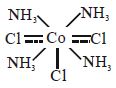
A
It has four ions in aqueous solution.
B
Primary valency of cobalt is six.
C
It gives one mole of $AgCl$ precipitate on reaction with excess of $AgNO_3$.
D
It has one primary valency.
Solution
(C) The given complex is $[Co(NH_3)_4Cl_2]Cl$.
In aqueous solution,it ionizes as: $[Co(NH_3)_4Cl_2]Cl \rightarrow [Co(NH_3)_4Cl_2]^+ + Cl^-$.
This produces two ions in solution,so option $A$ is incorrect.
The primary valency of a metal in a coordination compound corresponds to its oxidation state. Here,$x + 4(0) + 3(-1) = 0$,so $x = +3$. Thus,the primary valency is $3$,not $6$,making option $B$ incorrect.
Since there is one $Cl^-$ ion outside the coordination sphere,it reacts with $AgNO_3$ to give one mole of $AgCl$ precipitate: $Cl^- + AgNO_3 \rightarrow AgCl(s) + NO_3^-$. Thus,option $C$ is correct.
The primary valency is the oxidation state,which is $3$,not $1$,making option $D$ incorrect.
In aqueous solution,it ionizes as: $[Co(NH_3)_4Cl_2]Cl \rightarrow [Co(NH_3)_4Cl_2]^+ + Cl^-$.
This produces two ions in solution,so option $A$ is incorrect.
The primary valency of a metal in a coordination compound corresponds to its oxidation state. Here,$x + 4(0) + 3(-1) = 0$,so $x = +3$. Thus,the primary valency is $3$,not $6$,making option $B$ incorrect.
Since there is one $Cl^-$ ion outside the coordination sphere,it reacts with $AgNO_3$ to give one mole of $AgCl$ precipitate: $Cl^- + AgNO_3 \rightarrow AgCl(s) + NO_3^-$. Thus,option $C$ is correct.
The primary valency is the oxidation state,which is $3$,not $1$,making option $D$ incorrect.
0 likes
View Solution183
MediumMCQ
Some salts,although containing two different metallic elements,give a test for only one of them in solution. Such salts are:
A
Complex salt
B
Double salt
C
Normal salt
D
None of these
Solution
(A) Complex salts contain two different metallic elements but dissociate in such a way that they only provide the test for the ions present in the ionization sphere,not the central metal ion.
Double salts,on the other hand,completely dissociate into their constituent simple ions in an aqueous solution,thereby giving a test for all the ions present.
Double salts,on the other hand,completely dissociate into their constituent simple ions in an aqueous solution,thereby giving a test for all the ions present.
0 likes
View Solution184
EasyMCQ
Consider the following statements according to Werner's theory:
$(a)$ Ligands are connected to the metal ions by coordinate bonds.
$(b)$ Secondary valencies have directional properties.
$(c)$ Secondary valencies are non-ionisable.
Of these statements:
$(a)$ Ligands are connected to the metal ions by coordinate bonds.
$(b)$ Secondary valencies have directional properties.
$(c)$ Secondary valencies are non-ionisable.
Of these statements:
A
$(a), (b)$ and $(c)$ are correct
B
$(b)$ and $(c)$ are correct
C
$(a)$ and $(c)$ are correct
D
$(a)$ and $(b)$ are correct
Solution
(A) According to Werner's theory of coordination compounds:
$1$. Metal atoms exhibit two types of valencies: primary and secondary.
$2$. Primary valencies are ionisable and are satisfied by negative ions.
$3$. Secondary valencies are non-ionisable,fixed in number,and are satisfied by ligands (neutral or negative) connected to the metal ion by coordinate bonds.
$4$. Secondary valencies have specific directional properties,which determine the geometry of the coordination complex.
Therefore,all three statements $(a), (b),$ and $(c)$ are correct.
$1$. Metal atoms exhibit two types of valencies: primary and secondary.
$2$. Primary valencies are ionisable and are satisfied by negative ions.
$3$. Secondary valencies are non-ionisable,fixed in number,and are satisfied by ligands (neutral or negative) connected to the metal ion by coordinate bonds.
$4$. Secondary valencies have specific directional properties,which determine the geometry of the coordination complex.
Therefore,all three statements $(a), (b),$ and $(c)$ are correct.
0 likes
View Solution185
AdvancedMCQ
Which of the following complexes gives only $25\%$ mole of $AgCl$ precipitate when reacted with excess $AgNO_3$?
A
$PtCl_2 \cdot 4NH_3$
B
$PtCl_4 \cdot 5NH_3$
C
$PtCl_4 \cdot 4NH_3$
D
$PtCl_4 \cdot 3NH_3$
Solution
(C) The reaction with $AgNO_3$ precipitates only the ionizable $Cl^-$ ions present outside the coordination sphere.
For $25\%$ mole of $AgCl$ to be formed from $1$ mole of the complex,there must be $1$ ionizable $Cl^-$ ion out of $4$ total $Cl^-$ atoms.
This corresponds to the formula $[Pt(NH_3)_4Cl_3]Cl$,which is represented by $PtCl_4 \cdot 4NH_3$.
Thus,$PtCl_4 \cdot 4NH_3$ dissociates as $[Pt(NH_3)_4Cl_3]^+ + Cl^-$,yielding $1$ mole of $AgCl$ per mole of complex.
For $25\%$ mole of $AgCl$ to be formed from $1$ mole of the complex,there must be $1$ ionizable $Cl^-$ ion out of $4$ total $Cl^-$ atoms.
This corresponds to the formula $[Pt(NH_3)_4Cl_3]Cl$,which is represented by $PtCl_4 \cdot 4NH_3$.
Thus,$PtCl_4 \cdot 4NH_3$ dissociates as $[Pt(NH_3)_4Cl_3]^+ + Cl^-$,yielding $1$ mole of $AgCl$ per mole of complex.
0 likes
View Solution186
DifficultMCQ
Order of the number of chelate rings is correct for:
$(i). \, [Co(en)_2(Ox)]^+$
$(ii). \, [Fe(Trien)(Ox)]^+$
$(iii). \, [Ca(EDTA)]^{2-}$
$(iv). \, [Pt(Ox)_2(H_2O)_2]$
$(i). \, [Co(en)_2(Ox)]^+$
$(ii). \, [Fe(Trien)(Ox)]^+$
$(iii). \, [Ca(EDTA)]^{2-}$
$(iv). \, [Pt(Ox)_2(H_2O)_2]$
A
$iii > i > ii > iv$
B
$iii > ii > i > iv$
C
$iii > iv > i > ii$
D
$ii > iii > i > iv$
Solution
(A) To determine the number of chelate rings,we identify the denticity of the ligands:
$(i) \, [Co(en)_2(Ox)]^+$: $en$ is bidentate ($2$ rings each),$Ox$ is bidentate ($1$ ring). Total rings = $(2 \times 2) + 1 = 5$.
$(ii) \, [Fe(Trien)(Ox)]^+$: $Trien$ (triethylenetetramine) is tetradentate ($3$ rings),$Ox$ is bidentate ($1$ ring). Total rings = $3 + 1 = 4$.
$(iii) \, [Ca(EDTA)]^{2-}$: $EDTA$ is hexadentate,forming $5$ chelate rings. Total rings = $5$.
$(iv) \, [Pt(Ox)_2(H_2O)_2]$: $Ox$ is bidentate ($1$ ring each),$H_2O$ is monodentate ($0$ rings). Total rings = $(2 \times 1) + 0 = 2$.
Comparing the values: $(i) = 5$,$(ii) = 4$,$(iii) = 5$,$(iv) = 2$.
Note: While $(i)$ and $(iii)$ both have $5$ rings,in standard textbook problems,$EDTA$ complexes are often cited as having the maximum number of chelate rings. Re-evaluating the options provided,the sequence $iii > i > ii > iv$ is the most logical fit.
$(i) \, [Co(en)_2(Ox)]^+$: $en$ is bidentate ($2$ rings each),$Ox$ is bidentate ($1$ ring). Total rings = $(2 \times 2) + 1 = 5$.
$(ii) \, [Fe(Trien)(Ox)]^+$: $Trien$ (triethylenetetramine) is tetradentate ($3$ rings),$Ox$ is bidentate ($1$ ring). Total rings = $3 + 1 = 4$.
$(iii) \, [Ca(EDTA)]^{2-}$: $EDTA$ is hexadentate,forming $5$ chelate rings. Total rings = $5$.
$(iv) \, [Pt(Ox)_2(H_2O)_2]$: $Ox$ is bidentate ($1$ ring each),$H_2O$ is monodentate ($0$ rings). Total rings = $(2 \times 1) + 0 = 2$.
Comparing the values: $(i) = 5$,$(ii) = 4$,$(iii) = 5$,$(iv) = 2$.
Note: While $(i)$ and $(iii)$ both have $5$ rings,in standard textbook problems,$EDTA$ complexes are often cited as having the maximum number of chelate rings. Re-evaluating the options provided,the sequence $iii > i > ii > iv$ is the most logical fit.
0 likes
View Solution187
AdvancedMCQ
Which one is the most likely formula of $CrCl_3 \cdot 6H_2O$ if $\frac{2}{3}$ of the total chlorine in the compound is precipitated by adding $AgNO_3$ to its aqueous solution?
A
$[Cr(H_2O)_6]Cl_3$
B
$[CrCl_2(H_2O)_4]Cl \cdot 2H_2O$
C
$[CrCl(H_2O)_5]Cl_2 \cdot H_2O$
D
$[CrCl_3(H_2O)_3] \cdot 3H_2O$
Solution
(C) The total number of chlorine atoms in $CrCl_3 \cdot 6H_2O$ is $3$.
If $\frac{2}{3}$ of the total chlorine is precipitated by $AgNO_3$,it means $2$ chlorine atoms are present as free $Cl^-$ ions outside the coordination sphere.
Therefore,the coordination formula must contain $2$ chloride ions outside the brackets.
The formula is $[CrCl(H_2O)_5]Cl_2 \cdot H_2O$.
If $\frac{2}{3}$ of the total chlorine is precipitated by $AgNO_3$,it means $2$ chlorine atoms are present as free $Cl^-$ ions outside the coordination sphere.
Therefore,the coordination formula must contain $2$ chloride ions outside the brackets.
The formula is $[CrCl(H_2O)_5]Cl_2 \cdot H_2O$.
0 likes
View Solution188
EasyMCQ
Ferrous ammonium sulphate aqueous solution consists of:
A
$Fe^{+2}$ ion
B
$SO_4^{-2}$ ion
C
$NH_4^+$ ion
D
All of these
Solution
(D) Ferrous ammonium sulphate,also known as Mohr's salt,has the chemical formula $FeSO_4 \cdot (NH_4)_2SO_4 \cdot 6H_2O$.
In an aqueous solution,it dissociates completely into its constituent ions: $Fe^{+2}$,$SO_4^{-2}$,and $NH_4^+$.
Therefore,the solution contains all of these ions.
In an aqueous solution,it dissociates completely into its constituent ions: $Fe^{+2}$,$SO_4^{-2}$,and $NH_4^+$.
Therefore,the solution contains all of these ions.
0 likes
View Solution189
AdvancedMCQ
When $0.1 \ mol$ of $CoCl_3(NH_3)_5$ is treated with an excess of $AgNO_3$,$0.2 \ mol$ of $AgCl$ are obtained. The formula of the compound is:
A
$[CoCl_3(NH_3)_3]NH_3$
B
$[CoCl(NH_3)_5]Cl_2$
C
$[CoCl_2(NH_3)_3]Cl \cdot NH_3$
D
$[Co(NH_3)_6]Cl_3$
Solution
(B) The reaction of the coordination compound with $AgNO_3$ precipitates only the chloride ions $(Cl^-)$ present outside the coordination sphere.
Given that $0.1 \ mol$ of the complex yields $0.2 \ mol$ of $AgCl$,the ratio of $AgCl$ to the complex is $2:1$.
This indicates that there are $2$ ionizable $Cl^-$ ions outside the coordination sphere.
Therefore,the formula is $[Co(NH_3)_5Cl]Cl_2$.
Given that $0.1 \ mol$ of the complex yields $0.2 \ mol$ of $AgCl$,the ratio of $AgCl$ to the complex is $2:1$.
This indicates that there are $2$ ionizable $Cl^-$ ions outside the coordination sphere.
Therefore,the formula is $[Co(NH_3)_5Cl]Cl_2$.
0 likes
View Solution190
MediumMCQ
$A$ $Pt$ complex of $NH_3$ and $Cl$ that produces four ions per molecule in an aqueous solution is:
A
$PtCl_4 \cdot 6NH_3$
B
$PtCl_4 \cdot 5NH_3$
C
$PtCl_4 \cdot 2NH_3$
D
$PtCl_4 \cdot 4NH_3$
Solution
(B) To produce four ions per molecule,the complex must dissociate as $[Complex]^{3+} + 3Cl^-$.
This corresponds to the formula $[Pt(NH_3)_5Cl]Cl_3$.
Therefore,the complex is $PtCl_4 \cdot 5NH_3$.
This corresponds to the formula $[Pt(NH_3)_5Cl]Cl_3$.
Therefore,the complex is $PtCl_4 \cdot 5NH_3$.
0 likes
View Solution191
MediumMCQ
The total number of chelate rings in $[Ni(dmg)_2]$ is:
A
$1$
B
$2$
C
$3$
D
$4$
Solution
(B) In the complex $[Ni(dmg)_2]$,the dimethylglyoximate $(dmg^-)$ ligand acts as a bidentate ligand.
Each $dmg^-$ ligand forms one five-membered chelate ring with the $Ni^{2+}$ ion.
Since there are two $dmg^-$ ligands,they form $2$ chelate rings.
The hydrogen bonds present in the structure stabilize the complex but are not considered chelate rings.
Therefore,the total number of chelate rings is $2$.
Each $dmg^-$ ligand forms one five-membered chelate ring with the $Ni^{2+}$ ion.
Since there are two $dmg^-$ ligands,they form $2$ chelate rings.
The hydrogen bonds present in the structure stabilize the complex but are not considered chelate rings.
Therefore,the total number of chelate rings is $2$.
0 likes
View Solution192
AdvancedMCQ
According to Werner's theory,the primary valency of a central metal ion is:
A
Equal to the oxidation state of the $CMA$
B
Satisfied by anions
C
Nondirectional and ionisable
D
All of these
Solution
(D) According to Werner's coordination theory:
$1$. Primary valency corresponds to the oxidation state of the central metal atom $(CMA)$.
$2$. It is satisfied by negative ions (anions).
$3$. It is ionisable and nondirectional in nature.
Therefore,all the given statements are correct.
$1$. Primary valency corresponds to the oxidation state of the central metal atom $(CMA)$.
$2$. It is satisfied by negative ions (anions).
$3$. It is ionisable and nondirectional in nature.
Therefore,all the given statements are correct.
0 likes
View Solution193
EasyMCQ
Which among the following statements is wrong regarding Mohr's salt?
A
It has $5$ ions per molecule.
B
It is a double salt.
C
It does not give the test of $Fe^{2+}$ ion.
D
It contains two types of cations.
Solution
(C) Mohr's salt is represented by the formula $(NH_4)_2SO_4 \cdot FeSO_4 \cdot 6H_2O$.
It is a double salt that dissociates completely in water into its constituent ions: $2NH_4^+$,$Fe^{2+}$,and $2SO_4^{2-}$.
$1$. It has $2 + 1 + 2 = 5$ ions per formula unit,so option $A$ is correct.
$2$. It is a double salt,so option $B$ is correct.
$3$. Since it dissociates into $Fe^{2+}$ ions in aqueous solution,it gives a positive test for $Fe^{2+}$,making option $C$ incorrect.
$4$. It contains two types of cations,$NH_4^+$ and $Fe^{2+}$,so option $D$ is correct.
Therefore,the wrong statement is $C$.
It is a double salt that dissociates completely in water into its constituent ions: $2NH_4^+$,$Fe^{2+}$,and $2SO_4^{2-}$.
$1$. It has $2 + 1 + 2 = 5$ ions per formula unit,so option $A$ is correct.
$2$. It is a double salt,so option $B$ is correct.
$3$. Since it dissociates into $Fe^{2+}$ ions in aqueous solution,it gives a positive test for $Fe^{2+}$,making option $C$ incorrect.
$4$. It contains two types of cations,$NH_4^+$ and $Fe^{2+}$,so option $D$ is correct.
Therefore,the wrong statement is $C$.
0 likes
View Solution194
MediumMCQ
Which is the correct match for the complex and the number of chelate rings formed?
Complex $-$ No. of Rings
Complex $-$ No. of Rings
A
$[Co(ox)_2Cl_2]^{3-}$ $-$ $2$
B
$[Ni(dmg)_2]$ $-$ $2$
C
$[Ca(EDTA)]^{2-}$ $-$ $5$
D
Brown ring complex $-$ $0$
Solution
(C) The number of chelate rings in a coordination complex is equal to the number of chelate rings formed by polydentate ligands.
$A$. $[Co(ox)_2Cl_2]^{3-}$ has two oxalate ligands,each forming one ring. Total rings = $2$.
$B$. $[Ni(dmg)_2]$ has two dimethylglyoximate ligands,each forming one ring. Total rings = $2$.
$C$. $[Ca(EDTA)]^{2-}$ has one $EDTA^{4-}$ ligand,which is hexadentate and forms $5$ chelate rings.
$D$. The brown ring complex $[Fe(H_2O)_5(NO)]SO_4$ contains no chelate rings.
Thus,the correct match is $C$.
$A$. $[Co(ox)_2Cl_2]^{3-}$ has two oxalate ligands,each forming one ring. Total rings = $2$.
$B$. $[Ni(dmg)_2]$ has two dimethylglyoximate ligands,each forming one ring. Total rings = $2$.
$C$. $[Ca(EDTA)]^{2-}$ has one $EDTA^{4-}$ ligand,which is hexadentate and forms $5$ chelate rings.
$D$. The brown ring complex $[Fe(H_2O)_5(NO)]SO_4$ contains no chelate rings.
Thus,the correct match is $C$.
0 likes
View Solution195
AdvancedMCQ
What fraction of chlorine will be precipitated as $AgCl$ by using $AgNO_3$ from $[CrCl(NH_3)_5]Cl_2$?
A
$1/3$
B
$2/3$
C
$1/4$
D
$1$
Solution
(B) The coordination compound $[CrCl(NH_3)_5]Cl_2$ dissociates in water to release the ions present outside the coordination sphere.
The formula can be written as $[CrCl(NH_3)_5]^{2+} + 2Cl^-$.
When $AgNO_3$ is added,it reacts with the ionizable chloride ions: $2Cl^- + 2AgNO_3 \rightarrow 2AgCl(s) + 2NO_3^-$.
Total chlorine atoms in the compound = $3$.
Ionizable chlorine atoms = $2$.
Therefore,the fraction of chlorine precipitated as $AgCl$ is $2/3$.
The formula can be written as $[CrCl(NH_3)_5]^{2+} + 2Cl^-$.
When $AgNO_3$ is added,it reacts with the ionizable chloride ions: $2Cl^- + 2AgNO_3 \rightarrow 2AgCl(s) + 2NO_3^-$.
Total chlorine atoms in the compound = $3$.
Ionizable chlorine atoms = $2$.
Therefore,the fraction of chlorine precipitated as $AgCl$ is $2/3$.
0 likes
View Solution196
DifficultMCQ
Which one of the following complexes will consume more equivalents of aqueous solution of $AgNO_3$?
A
$Na_2[CrCl_5(H_2O)]$
B
$Na_3[CrCl_6]$
C
$[Cr(H_2O)_5Cl]Cl_2$
D
$[Cr(H_2O)_6]Cl_3$
Solution
(D) The consumption of $AgNO_3$ depends on the number of ionizable $Cl^-$ ions present outside the coordination sphere.
$Na_2[CrCl_5(H_2O)]$ provides $0$ ionizable $Cl^-$ ions.
$Na_3[CrCl_6]$ provides $0$ ionizable $Cl^-$ ions.
$[Cr(H_2O)_5Cl]Cl_2$ provides $2$ ionizable $Cl^-$ ions.
$[Cr(H_2O)_6]Cl_3$ provides $3$ ionizable $Cl^-$ ions.
Since $[Cr(H_2O)_6]Cl_3$ furnishes the highest number of $Cl^-$ ions ($3$ moles per mole of complex),it will consume the most equivalents of $AgNO_3$.
$Na_2[CrCl_5(H_2O)]$ provides $0$ ionizable $Cl^-$ ions.
$Na_3[CrCl_6]$ provides $0$ ionizable $Cl^-$ ions.
$[Cr(H_2O)_5Cl]Cl_2$ provides $2$ ionizable $Cl^-$ ions.
$[Cr(H_2O)_6]Cl_3$ provides $3$ ionizable $Cl^-$ ions.
Since $[Cr(H_2O)_6]Cl_3$ furnishes the highest number of $Cl^-$ ions ($3$ moles per mole of complex),it will consume the most equivalents of $AgNO_3$.
0 likes
View Solution197
DifficultMCQ
Which of the following is an example of a homoleptic complex?
A
$[Co(NH_3)_6]Cl_3$
B
$[Pt(NH_3)_2Cl_2]$
C
$[Co(NH_3)_4Cl_2]$
D
$[Co(NH_3)_5Cl]Cl_2$
Solution
(A) homoleptic complex is a coordination compound in which the metal atom or ion is bonded to only one type of donor atom or ligand.
In the complex $[Co(NH_3)_6]Cl_3$,the central metal ion $Co^{3+}$ is bonded to six $NH_3$ ligands,which are all of the same type.
Therefore,$[Co(NH_3)_6]Cl_3$ is a homoleptic complex.
In the complex $[Co(NH_3)_6]Cl_3$,the central metal ion $Co^{3+}$ is bonded to six $NH_3$ ligands,which are all of the same type.
Therefore,$[Co(NH_3)_6]Cl_3$ is a homoleptic complex.
0 likes
View Solution198
DifficultMCQ
Which molecule/ion among the following cannot act as a ligand in complex compounds?
A
$CH_4$
B
$CO$
C
$CN^{-}$
D
$Br^{-}$
Solution
(A) ligand is an atom,molecule,or ion that donates a pair of electrons to a central metal atom or ion to form a coordinate bond.
For a species to act as a ligand,it must possess at least one lone pair of electrons.
In $CH_4$ (methane),the carbon atom is $sp^3$ hybridized and forms four covalent bonds with hydrogen atoms,completing its octet.
Since $CH_4$ has no lone pair of electrons available for donation,it cannot act as a ligand.
For a species to act as a ligand,it must possess at least one lone pair of electrons.
In $CH_4$ (methane),the carbon atom is $sp^3$ hybridized and forms four covalent bonds with hydrogen atoms,completing its octet.
Since $CH_4$ has no lone pair of electrons available for donation,it cannot act as a ligand.
0 likes
View Solution199
DifficultMCQ
Consider the coordination compound,$[Co(NH_3)_6]Cl_3$. In the formation of this complex,the species which acts as the Lewis acid is
A
$[Co(NH_3)_6]^{3+}$
B
$Cl^{-}$
C
$Co^{3+}$
D
$NH_3$
Solution
(C) In the formation of the coordination complex $[Co(NH_3)_6]^{3+}$,the central metal ion $Co^{3+}$ acts as the Lewis acid because it accepts lone pairs of electrons from the ligands.
$NH_3$ acts as the Lewis base because it donates lone pairs of electrons to the central metal ion.
Therefore,the reaction is: $\mathop {Co^{3+}}\limits_{\text{Lewis acid}} + \mathop {6NH_3}\limits_{\text{Lewis base}} \to \mathop {[Co(NH_3)_6]^{3+}}\limits_{\text{adduct}}$
$NH_3$ acts as the Lewis base because it donates lone pairs of electrons to the central metal ion.
Therefore,the reaction is: $\mathop {Co^{3+}}\limits_{\text{Lewis acid}} + \mathop {6NH_3}\limits_{\text{Lewis base}} \to \mathop {[Co(NH_3)_6]^{3+}}\limits_{\text{adduct}}$
0 likes
View Solution200
MediumMCQ
The coordination number of $Th$ in $K_4[Th(C_2O_4)_4(OH_2)_2]$ is
$(C_2O_4^{2-} = \text{Oxalato})$
$(C_2O_4^{2-} = \text{Oxalato})$
A
$14$
B
$6$
C
$8$
D
$10$
Solution
(D) In the complex $K_4[Th(C_2O_4)_4(OH_2)_2]$,the central metal atom is $Th$.
The ligands present are:
$1$. Four oxalate ions $(C_2O_4^{2-})$,which are bidentate ligands. Contribution = $4 \times 2 = 8$.
$2$. Two water molecules $(OH_2)$,which are monodentate ligands. Contribution = $2 \times 1 = 2$.
The coordination number is the sum of the contributions of all ligands attached to the central metal atom.
Coordination number = $8 + 2 = 10$.
The ligands present are:
$1$. Four oxalate ions $(C_2O_4^{2-})$,which are bidentate ligands. Contribution = $4 \times 2 = 8$.
$2$. Two water molecules $(OH_2)$,which are monodentate ligands. Contribution = $2 \times 1 = 2$.
The coordination number is the sum of the contributions of all ligands attached to the central metal atom.
Coordination number = $8 + 2 = 10$.
0 likes
View SolutionCoordination Compounds — Basic Terms · Frequently Asked Questions
1Are these Coordination Compounds questions useful for JEE and NEET?
Yes. All questions in this section are mapped to JEE Main and NEET exam patterns. Previous year questions from JEE Main, NEET, GUJCET and state-level exams are included with full solutions.
2Can I switch to Hindi or Gujarati for these questions?
Yes. Use the language tabs in the hero section or the sidebar to view the same questions and solutions in English, Hindi or Gujarati.
3How do I generate a question paper from this subtopic?
Use the Vedclass Exam Paper Generator — select the chapter and subtopic, set difficulty, and generate Sets A, B, C, D automatically. First 3 chapters of every subject are free.
Vedclass Products
For Students
Vedclass Test Series
Mock tests in real JEE/NEET style with performance analysis. 5-day free trial.
Start Free TrialFor Teachers
Exam Paper Generator
Generate Set A/B/C/D papers from this chapter in 2 minutes. 3 chapters free.
Try FreeFor Institutes
Online Exam Module
Live online exams with unlimited students, 360° analytics & white-label branding.
See DemoFor Teachers & Institutes
Generate a Coordination Compounds Exam Paper in 2 Minutes
Select subtopic & difficulty — Sets A, B, C, D auto-generated with No Repeat logic.
First 3 chapters of every subject are free — no payment required.