
A English
Basic Terms Questions in English
Class 12 Chemistry · Coordination Compounds · Basic Terms
495+
Questions
English
Language
100%
With Solutions
Showing 50 of 495 questions in English
201
DifficultMCQ
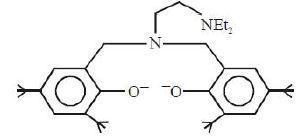
The given ligand is:
A
tridentate
B
bidentate
C
tetradentate
D
hexadentate
Solution
(C) The ligand structure contains one tertiary amine nitrogen atom,two phenolate oxygen atoms,and one diethylamino nitrogen atom.
Counting the potential donor sites:
$1$. One central tertiary amine nitrogen $(N)$.
$2$. Two phenolate oxygen atoms $(O^-)$.
$3$. One terminal diethylamino nitrogen atom $(NEt_2)$.
Thus,there are a total of $4$ donor atoms available for coordination.
Therefore,the ligand is tetradentate.
Counting the potential donor sites:
$1$. One central tertiary amine nitrogen $(N)$.
$2$. Two phenolate oxygen atoms $(O^-)$.
$3$. One terminal diethylamino nitrogen atom $(NEt_2)$.
Thus,there are a total of $4$ donor atoms available for coordination.
Therefore,the ligand is tetradentate.
0 likes
View Solution202
DifficultMCQ
The number of water molecule $(s)$ not coordinated to copper ion directly in $CuSO_4 \cdot 5H_2O$ is
A
$1$
B
$3$
C
$2$
D
$4$
Solution
(A) The chemical formula of copper sulfate pentahydrate is written as $[Cu(H_2O)_4]SO_4 \cdot H_2O$.
In this structure,$4$ water molecules are directly coordinated to the central $Cu^{2+}$ ion as ligands.
The $5^{th}$ water molecule is held by hydrogen bonding in the crystal lattice and is not directly coordinated to the copper ion.
In this structure,$4$ water molecules are directly coordinated to the central $Cu^{2+}$ ion as ligands.
The $5^{th}$ water molecule is held by hydrogen bonding in the crystal lattice and is not directly coordinated to the copper ion.
0 likes
View Solution203
DifficultMCQ
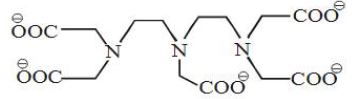
The maximum possible denticities of the ligand shown below towards a common transition metal ion and an inner-transition metal ion,respectively,are:
A
$6$ and $8$
B
$8$ and $6$
C
$8$ and $8$
D
$6$ and $6$
Solution
(A) The ligand shown is diethylenetriaminepentaacetate $(DTPA^{5-})$.
It contains $3$ nitrogen atoms and $5$ carboxylate oxygen atoms capable of coordination.
For common transition metal ions,the maximum coordination number is typically $6$,so the ligand acts as a hexadentate ligand (denticity = $6$).
For inner-transition metal ions (like lanthanides),the coordination number can be higher (up to $8$ or $9$) due to their larger size and availability of more vacant orbitals,allowing the ligand to act as an octadentate ligand (denticity = $8$).
It contains $3$ nitrogen atoms and $5$ carboxylate oxygen atoms capable of coordination.
For common transition metal ions,the maximum coordination number is typically $6$,so the ligand acts as a hexadentate ligand (denticity = $6$).
For inner-transition metal ions (like lanthanides),the coordination number can be higher (up to $8$ or $9$) due to their larger size and availability of more vacant orbitals,allowing the ligand to act as an octadentate ligand (denticity = $8$).
0 likes
View Solution204
DifficultMCQ
The coordination numbers of $Co$ and $Al$ in $[Co(Cl)(en)_2]Cl$ and $K_3[Al(C_2O_4)_3]$,respectively,are ($en =$ ethane$-1,2-$diamine).
A
$6$ and $6$
B
$5$ and $3$
C
$3$ and $3$
D
$5$ and $6$
Solution
(D) The coordination number is defined as the number of ligand donor atoms to which the metal is directly bonded.
$en$ (ethane$-1,2-$diamine) is a bidentate ligand,meaning it occupies $2$ coordination sites.
In $[Co(Cl)(en)_2]Cl$,the coordination number of $Co$ is $1(Cl) + 2(2 \times en) = 5$.
$C_2O_4^{2-}$ (oxalate) is also a bidentate ligand.
In $K_3[Al(C_2O_4)_3]$,the coordination number of $Al$ is $3(C_2O_4) \times 2 = 6$.
Therefore,the coordination numbers are $5$ and $6$.
$en$ (ethane$-1,2-$diamine) is a bidentate ligand,meaning it occupies $2$ coordination sites.
In $[Co(Cl)(en)_2]Cl$,the coordination number of $Co$ is $1(Cl) + 2(2 \times en) = 5$.
$C_2O_4^{2-}$ (oxalate) is also a bidentate ligand.
In $K_3[Al(C_2O_4)_3]$,the coordination number of $Al$ is $3(C_2O_4) \times 2 = 6$.
Therefore,the coordination numbers are $5$ and $6$.
0 likes
View Solution205
DifficultMCQ
In the test of $NO_3^-$ ion,a dark brown ring complex is formed. Which of the following statements is incorrect regarding this complex?
A
The colour is due to charge transfer spectra.
B
Iron and $NO$ both have $+1$ charge.
C
The complex species can be represented as $[Fe^I(H_2O)_5NO]^{2+}$.
D
Iron has $+2$ oxidation state and $NO$ is neutral.
Solution
(D) The brown ring test for nitrate ions involves the reaction of $NO_3^-$ with $Fe^{2+}$ in the presence of concentrated $H_2SO_4$ to form the complex $[Fe(H_2O)_5NO]SO_4$.
In this complex,the iron is in the $+1$ oxidation state $(Fe^+)$ and the nitric oxide ligand is present as $NO^+$.
Therefore,the statement that 'Iron has $+2$ oxidation state and $NO$ is neutral' is incorrect.
The brown colour arises due to charge transfer spectra.
In this complex,the iron is in the $+1$ oxidation state $(Fe^+)$ and the nitric oxide ligand is present as $NO^+$.
Therefore,the statement that 'Iron has $+2$ oxidation state and $NO$ is neutral' is incorrect.
The brown colour arises due to charge transfer spectra.
0 likes
View Solution206
MediumMCQ
Identify the non-ionisable octahedral complex among the following.
A
$[Pt(NH_3)_2Cl_4]$
B
$[Pt(NH_3)_3Cl_3]Cl$
C
$[Pt(NH_3)_4Cl_2]Cl_2$
D
$[Pt(NH_3)_5Cl]Cl_3$
Solution
(A) complex is non-ionisable if it does not contain any counter-ions outside the coordination sphere.
In the given options,$[Pt(NH_3)_2Cl_4]$ has no ions outside the square brackets,meaning it does not dissociate into ions in an aqueous solution.
Therefore,it is the non-ionisable complex.
In the given options,$[Pt(NH_3)_2Cl_4]$ has no ions outside the square brackets,meaning it does not dissociate into ions in an aqueous solution.
Therefore,it is the non-ionisable complex.
0 likes
View Solution207
AdvancedMCQ
In $K_4[Ni(C_2O_4)_3]$,what is the sum of the coordination number and the oxidation number of $Ni$?
A
$5$
B
$6$
C
$7$
D
$8$
Solution
(D) The coordination number of $Ni$ in $[Ni(C_2O_4)_3]^{4-}$ is $6$ because $C_2O_4^{2-}$ (oxalate) is a bidentate ligand and there are $3$ such ligands,so $2 \times 3 = 6$.
Let the oxidation state of $Ni$ be $x$.
$x + 3(-2) = -4$
$x - 6 = -4$
$x = +2$
Sum of coordination number and oxidation number = $6 + 2 = 8$.
Let the oxidation state of $Ni$ be $x$.
$x + 3(-2) = -4$
$x - 6 = -4$
$x = +2$
Sum of coordination number and oxidation number = $6 + 2 = 8$.
0 likes
View Solution208
DifficultMCQ
Consider the following complex: $[Co(CO_3)(NH_3)_5]ClO_4$.
Mark the correct option for the following parameters in order:
Coordination number $-$ Oxidation number $-$ Number of $d$-electrons $-$ Number of unpaired $d$-electrons.
Mark the correct option for the following parameters in order:
Coordination number $-$ Oxidation number $-$ Number of $d$-electrons $-$ Number of unpaired $d$-electrons.
A
$6-3-6-0$
B
$7-2-7-1$
C
$7-1-6-4$
D
$6-2-7-3$
Solution
(A) In $[Co(NH_3)_5(CO_3)]ClO_4$,the central metal atom is $Co$. The ligands are five $NH_3$ (monodentate) and one $CO_3^{2-}$ (bidentate). However,in this specific complex,$CO_3^{2-}$ acts as a monodentate ligand to satisfy the coordination sphere. Thus,the coordination number is $5 + 1 = 6$.
Let $X$ be the oxidation number of $Co$. The charge on $NH_3$ is $0$,$CO_3$ is $-2$,and $ClO_4$ is $-1$. Therefore,$X + 5(0) + (-2) + (-1) = 0$,which gives $X = +3$.
The atomic number of $Co$ is $27$. The electronic configuration of $Co$ is $[Ar] 3d^7 4s^2$. For $Co^{3+}$,the configuration is $[Ar] 3d^6 4s^0$. Thus,there are $6$ $d$-electrons.
$NH_3$ is a strong field ligand. In the presence of strong ligands,the $6$ electrons in the $3d$ orbitals of $Co^{3+}$ pair up,resulting in $0$ unpaired $d$-electrons.
Let $X$ be the oxidation number of $Co$. The charge on $NH_3$ is $0$,$CO_3$ is $-2$,and $ClO_4$ is $-1$. Therefore,$X + 5(0) + (-2) + (-1) = 0$,which gives $X = +3$.
The atomic number of $Co$ is $27$. The electronic configuration of $Co$ is $[Ar] 3d^7 4s^2$. For $Co^{3+}$,the configuration is $[Ar] 3d^6 4s^0$. Thus,there are $6$ $d$-electrons.
$NH_3$ is a strong field ligand. In the presence of strong ligands,the $6$ electrons in the $3d$ orbitals of $Co^{3+}$ pair up,resulting in $0$ unpaired $d$-electrons.
0 likes
View Solution209
AdvancedMCQ
$A$ six-coordinate complex with the formula $CrCl_3 \cdot 6H_2O$ has a green color. $A$ $0.1 \ M$ solution of the complex,when treated with an excess of $AgNO_3$,yields $28.7 \ g$ of a white precipitate. What is the formula of the complex?
A
$[Cr(H_2O)_6]Cl_3$
B
$[CrCl(H_2O)_5]Cl_2 \cdot H_2O$
C
$[CrCl_2(H_2O)_4]Cl \cdot 2H_2O$
D
$[Cr(H_2O)_3Cl_3] \cdot 3H_2O$
Solution
(B) The molar mass of $AgCl$ is $143.5 \ g/mol$.
Given mass of $AgCl$ precipitate = $28.7 \ g$.
Number of moles of $AgCl$ = $\frac{28.7 \ g}{143.5 \ g/mol} = 0.2 \ mol$.
Since $0.1 \ mol$ of the complex produces $0.2 \ mol$ of $AgCl$,each mole of the complex releases $2 \ mol$ of $Cl^-$ ions.
This indicates that $2 \ Cl^-$ ions are ionizable (outside the coordination sphere).
Therefore,the complex is $[CrCl(H_2O)_5]Cl_2 \cdot H_2O$.
Given mass of $AgCl$ precipitate = $28.7 \ g$.
Number of moles of $AgCl$ = $\frac{28.7 \ g}{143.5 \ g/mol} = 0.2 \ mol$.
Since $0.1 \ mol$ of the complex produces $0.2 \ mol$ of $AgCl$,each mole of the complex releases $2 \ mol$ of $Cl^-$ ions.
This indicates that $2 \ Cl^-$ ions are ionizable (outside the coordination sphere).
Therefore,the complex is $[CrCl(H_2O)_5]Cl_2 \cdot H_2O$.
0 likes
View Solution210
AdvancedMCQ
$A$ complex has a composition corresponding to the formula $CoBr_2Cl \cdot 4NH_3$. What is the structural formula if conductance measurements show two ions per formula unit? Silver nitrate solution gives an immediate precipitate of $AgCl$ but no $AgBr$.
A
$[CoBrCl(NH_3)_4]Br$
B
$[CoCl(NH_3)_4]Br_2$
C
$[CoBr_2Cl(NH_3)_4]$
D
$[CoBr_2(NH_3)_4]Cl$
Solution
(D) $1$. The formula is $CoBr_2Cl \cdot 4NH_3$.
$2$. Conductance measurements show $2$ ions per formula unit,which implies the complex dissociates as $[Complex]^+ + [Counterion]^-$.
$3$. Silver nitrate $(AgNO_3)$ gives an immediate precipitate of $AgCl$,meaning $Cl^-$ is outside the coordination sphere (as a counterion).
$4$. It gives no $AgBr$ precipitate,meaning $Br^-$ ions are inside the coordination sphere.
$5$. Therefore,the structure must be $[CoBr_2(NH_3)_4]Cl$.
$6$. This complex dissociates as $[CoBr_2(NH_3)_4]^+ + Cl^-$,providing $2$ ions in solution.
$2$. Conductance measurements show $2$ ions per formula unit,which implies the complex dissociates as $[Complex]^+ + [Counterion]^-$.
$3$. Silver nitrate $(AgNO_3)$ gives an immediate precipitate of $AgCl$,meaning $Cl^-$ is outside the coordination sphere (as a counterion).
$4$. It gives no $AgBr$ precipitate,meaning $Br^-$ ions are inside the coordination sphere.
$5$. Therefore,the structure must be $[CoBr_2(NH_3)_4]Cl$.
$6$. This complex dissociates as $[CoBr_2(NH_3)_4]^+ + Cl^-$,providing $2$ ions in solution.
0 likes
View Solution211
EasyMCQ
$A$ $Pt$ complex of ammonia and chlorine that produces four ions per molecule in the solution is
A
$[Pt(NH_3)_5Cl]Cl_3$
B
$[Pt(NH_3)_6]Cl_4$
C
$[Pt(NH_3)_2Cl_4]$
D
$[Pt(NH_3)_4Cl_2]Cl_2$
Solution
(A) To determine the number of ions produced,we look at the dissociation of the complex in water.
$A$: $[Pt(NH_3)_5Cl]Cl_3 \rightarrow [Pt(NH_3)_5Cl]^{3+} + 3Cl^{-}$. This yields $1 + 3 = 4$ ions.
$B$: $[Pt(NH_3)_6]Cl_4 \rightarrow [Pt(NH_3)_6]^{4+} + 4Cl^{-}$. This yields $1 + 4 = 5$ ions.
$C$: $[Pt(NH_3)_2Cl_4]$ is a neutral complex and does not ionize.
$D$: $[Pt(NH_3)_4Cl_2]Cl_2 \rightarrow [Pt(NH_3)_4Cl_2]^{2+} + 2Cl^{-}$. This yields $1 + 2 = 3$ ions.
Therefore,the complex that produces four ions per molecule is $[Pt(NH_3)_5Cl]Cl_3$.
$A$: $[Pt(NH_3)_5Cl]Cl_3 \rightarrow [Pt(NH_3)_5Cl]^{3+} + 3Cl^{-}$. This yields $1 + 3 = 4$ ions.
$B$: $[Pt(NH_3)_6]Cl_4 \rightarrow [Pt(NH_3)_6]^{4+} + 4Cl^{-}$. This yields $1 + 4 = 5$ ions.
$C$: $[Pt(NH_3)_2Cl_4]$ is a neutral complex and does not ionize.
$D$: $[Pt(NH_3)_4Cl_2]Cl_2 \rightarrow [Pt(NH_3)_4Cl_2]^{2+} + 2Cl^{-}$. This yields $1 + 2 = 3$ ions.
Therefore,the complex that produces four ions per molecule is $[Pt(NH_3)_5Cl]Cl_3$.
0 likes
View Solution212
MediumMCQ
The coordination number of a central metal atom in a complex is determined by
A
the number of only anionic ligands bonded to the metal ion
B
the number of monodentate ligands around a metal ion bonded by $\pi-$ bonds
C
the number of monodentate ligands around a metal ion bonded by $\sigma$ and $\pi-$ bonds both
D
the number of monodentate ligands around a metal ion bonded by $\sigma-$ bonds
Solution
(D) The coordination number of a central metal atom in a coordination complex is defined as the total number of $\sigma-$ bonds formed by the ligands with the central metal atom.
Since each ligand donates at least one lone pair to form a coordinate covalent bond (which is a $\sigma-$ bond),the coordination number is the sum of the number of $\sigma-$ bonds formed by all ligands attached to the metal ion.
Therefore,it is the number of monodentate ligands (or the equivalent number of donor atoms) bonded to the metal ion by $\sigma-$ bonds.
Since each ligand donates at least one lone pair to form a coordinate covalent bond (which is a $\sigma-$ bond),the coordination number is the sum of the number of $\sigma-$ bonds formed by all ligands attached to the metal ion.
Therefore,it is the number of monodentate ligands (or the equivalent number of donor atoms) bonded to the metal ion by $\sigma-$ bonds.
0 likes
View Solution213
DifficultMCQ
Which statement about the coordination number of a cation is true?
A
Most metal ions exhibit only a single characteristic coordination number.
B
The coordination number is equal to the number of ligands bonded to the metal atom.
C
The coordination number is determined solely by the tendency to surround the metal atom with the same number of electrons as one of the rare gases.
D
For most cations,the coordination number depends on the size and charge of the cation.
Solution
(D) The coordination number of a metal ion in a complex is defined as the number of ligand donor atoms to which the metal is directly bonded.
For most cations,the coordination number is not fixed; it depends on several factors,including the size of the central metal ion,the charge of the cation,and the steric/electronic properties of the ligands.
Option $D$ is the most accurate statement as it highlights the dependence on the physical and chemical properties of the cation.
For most cations,the coordination number is not fixed; it depends on several factors,including the size of the central metal ion,the charge of the cation,and the steric/electronic properties of the ligands.
Option $D$ is the most accurate statement as it highlights the dependence on the physical and chemical properties of the cation.
0 likes
View Solution214
DifficultMCQ
Consider the complex $[Co(NH_3)_4 CO_3]ClO_4$. The coordination number,oxidation number,and number of $d$-electrons on the metal are respectively:
A
$6, 3, 6$
B
$6, 2, 7$
C
$5, 3, 6$
D
$5, 3, 7$
Solution
(A) The complex is $[Co(NH_3)_4 CO_3]ClO_4$.
$NH_3$ is a monodentate ligand $(4 \times 1 = 4)$ and $CO_3^{2-}$ is a bidentate ligand $(1 \times 2 = 2)$.
Coordination number $= 4 + 2 = 6$.
Let the oxidation state of $Co$ be $x$.
$x + 4(0) + (-2) = +1$ (since $ClO_4^-$ has a charge of $-1$).
$x - 2 = +1 \implies x = +3$.
The atomic number of $Co$ is $27$. The electronic configuration of $Co$ is $[Ar] 3d^7 4s^2$.
The electronic configuration of $Co^{3+}$ is $[Ar] 3d^6$.
Thus,the number of $d$-electrons is $6$.
$NH_3$ is a monodentate ligand $(4 \times 1 = 4)$ and $CO_3^{2-}$ is a bidentate ligand $(1 \times 2 = 2)$.
Coordination number $= 4 + 2 = 6$.
Let the oxidation state of $Co$ be $x$.
$x + 4(0) + (-2) = +1$ (since $ClO_4^-$ has a charge of $-1$).
$x - 2 = +1 \implies x = +3$.
The atomic number of $Co$ is $27$. The electronic configuration of $Co$ is $[Ar] 3d^7 4s^2$.
The electronic configuration of $Co^{3+}$ is $[Ar] 3d^6$.
Thus,the number of $d$-electrons is $6$.
0 likes
View Solution215
MediumMCQ
Sodium thiosulphate is used to remove the unexposed $AgBr$ from photographic films by forming a complex. In this complex of silver,the coordination number of silver is
A
$2$
B
$4$
C
$6$
D
$8$
Solution
(A) The reaction between sodium thiosulphate and $AgBr$ is given by:
$AgBr(s) + 2Na_2S_2O_3(aq) \rightarrow Na_3[Ag(S_2O_3)_2](aq) + NaBr(aq)$
In the complex ion $[Ag(S_2O_3)_2]^{3-}$,the silver ion $(Ag^+)$ is bonded to two thiosulphate ligands.
Since each thiosulphate ligand acts as a monodentate ligand (binding through the sulphur atom),the coordination number of silver is $2$.
$AgBr(s) + 2Na_2S_2O_3(aq) \rightarrow Na_3[Ag(S_2O_3)_2](aq) + NaBr(aq)$
In the complex ion $[Ag(S_2O_3)_2]^{3-}$,the silver ion $(Ag^+)$ is bonded to two thiosulphate ligands.
Since each thiosulphate ligand acts as a monodentate ligand (binding through the sulphur atom),the coordination number of silver is $2$.
0 likes
View Solution216
EasyMCQ
Which of the following double salts does not exist?
A
$(NH_4)_2SO_4 \cdot CuSO_4 \cdot 6H_2O$
B
$(NH_4)_2SO_4 \cdot FeSO_4 \cdot 6H_2O$
C
$(NH_4)_2SO_4 \cdot ZnSO_4 \cdot 6H_2O$
D
$(NH_4)_2SO_4 \cdot NiSO_4 \cdot 6H_2O$
Solution
(C) Double salts are molecular compounds that exist only in the solid state (crystal lattice) and dissociate into their constituent ions when dissolved in water.
Among the given options,$(NH_4)_2SO_4 \cdot ZnSO_4 \cdot 6H_2O$ is not a known stable double salt.
Other options like Mohr's salt $(NH_4)_2SO_4 \cdot FeSO_4 \cdot 6H_2O$ are well-known examples of double salts.
Among the given options,$(NH_4)_2SO_4 \cdot ZnSO_4 \cdot 6H_2O$ is not a known stable double salt.
Other options like Mohr's salt $(NH_4)_2SO_4 \cdot FeSO_4 \cdot 6H_2O$ are well-known examples of double salts.
0 likes
View Solution217
MediumMCQ
The $NO$ molecule,
A
acts as a one-electron donor,unlike most ligands which donate electrons.
B
acts as a two-electron donor,like most ligands.
C
acts as a three-electron donor,unlike most ligands which donate two electrons.
D
does not act as a donor.
Solution
(C) The $NO$ molecule is a unique ligand. While most ligands donate two electrons to the central metal atom,$NO$ can act as a three-electron donor in certain complexes (e.g.,in $[Fe(H_2O)_5(NO)]SO_4$),where it donates three electrons to the metal center.
0 likes
View Solution218
EasyMCQ
In which of the following compounds is the oxidation state of $Fe$ zero?
A
$FeS$
B
$Fe_2O_3$
C
$FeSO_4$
D
$Fe(CO)_5$
Solution
(D) In the complex $Fe(CO)_5$,$CO$ is a neutral ligand with an oxidation state of $0$.
Let the oxidation state of $Fe$ be $x$.
$x + 5(0) = 0$
$x = 0$
Therefore,the oxidation state of $Fe$ in $Fe(CO)_5$ is $0$.
Let the oxidation state of $Fe$ be $x$.
$x + 5(0) = 0$
$x = 0$
Therefore,the oxidation state of $Fe$ in $Fe(CO)_5$ is $0$.
0 likes
View Solution219
MediumMCQ
The mass of carbon present in $0.5 \, mol$ of $K_4[Fe(CN)_6]$ is .............. $g$.
A
$1.8$
B
$18$
C
$3.6$
D
$36$
Solution
(D) The chemical formula $K_4[Fe(CN)_6]$ contains $6$ atoms of carbon per molecule.
Therefore,$1 \, mol$ of $K_4[Fe(CN)_6]$ contains $6 \, mol$ of carbon atoms.
The molar mass of carbon is $12 \, g/mol$.
So,$1 \, mol$ of $K_4[Fe(CN)_6]$ contains $6 \times 12 = 72 \, g$ of carbon.
For $0.5 \, mol$ of $K_4[Fe(CN)_6]$,the mass of carbon is $0.5 \times 72 = 36 \, g$.
Therefore,$1 \, mol$ of $K_4[Fe(CN)_6]$ contains $6 \, mol$ of carbon atoms.
The molar mass of carbon is $12 \, g/mol$.
So,$1 \, mol$ of $K_4[Fe(CN)_6]$ contains $6 \times 12 = 72 \, g$ of carbon.
For $0.5 \, mol$ of $K_4[Fe(CN)_6]$,the mass of carbon is $0.5 \times 72 = 36 \, g$.
0 likes
View Solution220
MediumMCQ
In which of the following compounds,the transition metal is in an oxidation state of zero?
A
$[Fe(H_2O)_3(OH)_3]$
B
$[Ni(CO)_4]$
C
$[Fe(H_2O)_6]SO_4$
D
$[Co(NH_3)_6]Cl_3$
Solution
(B) To determine the oxidation state of the transition metal,we consider the charge of the ligands:
$1$. In $[Fe(H_2O)_3(OH)_3]$,$Fe + 3(0) + 3(-1) = 0 \implies Fe = +3$.
$2$. In $[Ni(CO)_4]$,$Ni + 4(0) = 0 \implies Ni = 0$. Here,$CO$ (carbonyl) is a neutral ligand.
$3$. In $[Fe(H_2O)_6]SO_4$,$Fe + 6(0) = +2 \implies Fe = +2$.
$4$. In $[Co(NH_3)_6]Cl_3$,$Co + 6(0) = +3 \implies Co = +3$.
Thus,the transition metal with an oxidation state of zero is in $[Ni(CO)_4]$.
$1$. In $[Fe(H_2O)_3(OH)_3]$,$Fe + 3(0) + 3(-1) = 0 \implies Fe = +3$.
$2$. In $[Ni(CO)_4]$,$Ni + 4(0) = 0 \implies Ni = 0$. Here,$CO$ (carbonyl) is a neutral ligand.
$3$. In $[Fe(H_2O)_6]SO_4$,$Fe + 6(0) = +2 \implies Fe = +2$.
$4$. In $[Co(NH_3)_6]Cl_3$,$Co + 6(0) = +3 \implies Co = +3$.
Thus,the transition metal with an oxidation state of zero is in $[Ni(CO)_4]$.
0 likes
View Solution221
EasyMCQ
Which of the following is not expected to be a ligand?
A
$NO$
B
$NH_4^+$
C
$en$
D
$CO$
Solution
(B) Ligands are species that can donate a pair of electrons to a central metal atom or ion to form a coordinate bond.
For a species to act as a ligand,it must possess at least one lone pair of electrons.
In $NH_4^+$,the nitrogen atom has used all its valence electrons to form four covalent bonds with hydrogen atoms.
Since there is no lone pair of electrons available on the nitrogen atom in $NH_4^+$,it cannot donate electrons to a metal ion.
Therefore,$NH_4^+$ is not expected to act as a ligand.
For a species to act as a ligand,it must possess at least one lone pair of electrons.
In $NH_4^+$,the nitrogen atom has used all its valence electrons to form four covalent bonds with hydrogen atoms.
Since there is no lone pair of electrons available on the nitrogen atom in $NH_4^+$,it cannot donate electrons to a metal ion.
Therefore,$NH_4^+$ is not expected to act as a ligand.
0 likes
View Solution222
MediumMCQ
Which of the following is not an ambidentate ligand?
A
$OCN^{-}$
B
$SCN^{-}$
C
$NO_2^{-}$
D
$NH_2CONH_2$
Solution
(D) An ambidentate ligand is a ligand that can coordinate to a central metal atom through two different donor atoms.
$OCN^{-}$ (cyanate) can coordinate through $N$ or $O$.
$SCN^{-}$ (thiocyanate) can coordinate through $S$ or $N$.
$NO_2^{-}$ (nitrite) can coordinate through $N$ or $O$.
$NH_2CONH_2$ (urea) is a monodentate ligand that coordinates only through the oxygen atom. Therefore,it is not an ambidentate ligand.
$OCN^{-}$ (cyanate) can coordinate through $N$ or $O$.
$SCN^{-}$ (thiocyanate) can coordinate through $S$ or $N$.
$NO_2^{-}$ (nitrite) can coordinate through $N$ or $O$.
$NH_2CONH_2$ (urea) is a monodentate ligand that coordinates only through the oxygen atom. Therefore,it is not an ambidentate ligand.
0 likes
View Solution223
AdvancedMCQ
The electrolyte $[Co(NH_3)_5Cl]Cl_2$ is which of the following type?
A
$1:2$
B
$1:3$
C
$2:3$
D
$4:1$
Solution
(A) The given coordination compound is $[Co(NH_3)_5Cl]Cl_2$.
When this compound dissolves in water,it dissociates into ions as follows:
$[Co(NH_3)_5Cl]Cl_2 \rightarrow [Co(NH_3)_5Cl]^{2+} + 2Cl^-$.
Here,the complex ion $[Co(NH_3)_5Cl]^{2+}$ acts as one unit and there are two chloride ions $(Cl^-)$.
Thus,the ratio of the complex ion to the chloride ions is $1:2$.
Therefore,it is a $1:2$ type electrolyte.
When this compound dissolves in water,it dissociates into ions as follows:
$[Co(NH_3)_5Cl]Cl_2 \rightarrow [Co(NH_3)_5Cl]^{2+} + 2Cl^-$.
Here,the complex ion $[Co(NH_3)_5Cl]^{2+}$ acts as one unit and there are two chloride ions $(Cl^-)$.
Thus,the ratio of the complex ion to the chloride ions is $1:2$.
Therefore,it is a $1:2$ type electrolyte.
0 likes
View Solution224
MediumMCQ
The bonds present in $K_4[Fe(CN)_6]$ are ........
A
All ionic
B
All covalent
C
Ionic,covalent,and coordinate covalent
D
Ionic and covalent
Solution
(C) In the complex $K_4[Fe(CN)_6]$,the potassium ions $(K^+)$ and the complex anion $[Fe(CN)_6]^{4-}$ are held together by ionic bonds.
Inside the complex anion $[Fe(CN)_6]^{4-}$,the $C$ and $N$ atoms in the cyanide ligand $(CN^-)$ are connected by a covalent bond (triple bond).
The $Fe^{2+}$ ion and the $CN^-$ ligands are linked by coordinate covalent bonds (dative bonds),where the $CN^-$ ligand donates a lone pair of electrons to the $Fe^{2+}$ center.
Therefore,the compound contains ionic,covalent,and coordinate covalent bonds.
Inside the complex anion $[Fe(CN)_6]^{4-}$,the $C$ and $N$ atoms in the cyanide ligand $(CN^-)$ are connected by a covalent bond (triple bond).
The $Fe^{2+}$ ion and the $CN^-$ ligands are linked by coordinate covalent bonds (dative bonds),where the $CN^-$ ligand donates a lone pair of electrons to the $Fe^{2+}$ center.
Therefore,the compound contains ionic,covalent,and coordinate covalent bonds.
0 likes
View Solution225
MediumMCQ
$A$ complex of platinum,ammonia,and chloride produces four ions per molecule in the solution. Which structure is consistent with this observation?
A
$[Pt(NH_3)_4]Cl_4$
B
$[Pt(NH_3)_2Cl_4]$
C
$[Pt(NH_3)_5Cl]Cl_3$
D
$[Pt(NH_3)_4Cl_2]Cl_2$
Solution
(C) To determine the number of ions produced,we look at the dissociation of the coordination compounds in water:
$1$. $[Pt(NH_3)_4]Cl_4 \rightarrow [Pt(NH_3)_4]^{4+} + 4Cl^-$ ($5$ ions total)
$2$. $[Pt(NH_3)_2Cl_4]$ does not dissociate into ions as it is a neutral complex.
$3$. $[Pt(NH_3)_5Cl]Cl_3 \rightarrow [Pt(NH_3)_5Cl]^{3+} + 3Cl^-$ ($4$ ions total)
$4$. $[Pt(NH_3)_4Cl_2]Cl_2 \rightarrow [Pt(NH_3)_4Cl_2]^{2+} + 2Cl^-$ ($3$ ions total)
Since the question states that the complex produces $4$ ions per molecule,the correct structure is $[Pt(NH_3)_5Cl]Cl_3$.
$1$. $[Pt(NH_3)_4]Cl_4 \rightarrow [Pt(NH_3)_4]^{4+} + 4Cl^-$ ($5$ ions total)
$2$. $[Pt(NH_3)_2Cl_4]$ does not dissociate into ions as it is a neutral complex.
$3$. $[Pt(NH_3)_5Cl]Cl_3 \rightarrow [Pt(NH_3)_5Cl]^{3+} + 3Cl^-$ ($4$ ions total)
$4$. $[Pt(NH_3)_4Cl_2]Cl_2 \rightarrow [Pt(NH_3)_4Cl_2]^{2+} + 2Cl^-$ ($3$ ions total)
Since the question states that the complex produces $4$ ions per molecule,the correct structure is $[Pt(NH_3)_5Cl]Cl_3$.
0 likes
View Solution226
DifficultMCQ
Consider the following statements according to Werner's theory:
$1.$ Ligands are connected to the central metal ions by coordinate bonds.
$2.$ Secondary valencies have directional properties.
$3.$ Secondary valencies are non-ionisable.
Which of these statements are correct?
$1.$ Ligands are connected to the central metal ions by coordinate bonds.
$2.$ Secondary valencies have directional properties.
$3.$ Secondary valencies are non-ionisable.
Which of these statements are correct?
A
$1$,$2$ and $3$ are correct
B
$2$ and $3$ are correct
C
$1$ and $3$ are correct
D
$1$ and $2$ are correct
Solution
(A) According to Werner's theory:
- Primary valencies are ionisable and non-directional.
- Secondary valencies are non-ionisable and possess directional properties,which determine the geometry of the coordination complex.
- Ligands are connected to the central metal ion by coordinate bonds.
- Therefore,all three statements ($1$,$2$,and $3$) are correct.
- Primary valencies are ionisable and non-directional.
- Secondary valencies are non-ionisable and possess directional properties,which determine the geometry of the coordination complex.
- Ligands are connected to the central metal ion by coordinate bonds.
- Therefore,all three statements ($1$,$2$,and $3$) are correct.
0 likes
View Solution227
MediumMCQ
Metals have the tendency to lose electrons to form cations. When $Zn$ is added to $NaOH$,a complex is formed. In this complex,$Zn$ is present in:
A
Cationic part
B
Anionic part
C
In both parts
D
Cannot be determined
Solution
(B) The reaction between $Zn$ and $NaOH$ is given by: $Zn + 2NaOH \to Na_2[Zn(OH)_4]$ or $Na_2ZnO_2 + H_2$.
In the complex $Na_2[Zn(OH)_4]$,the complex ion is $[Zn(OH)_4]^{2-}$.
Since the complex ion carries a negative charge,the $Zn$ atom is present in the anionic part of the complex.
In the complex $Na_2[Zn(OH)_4]$,the complex ion is $[Zn(OH)_4]^{2-}$.
Since the complex ion carries a negative charge,the $Zn$ atom is present in the anionic part of the complex.
0 likes
View Solution228
AdvancedMCQ
Select the correct statements about the $PtCl_4 \cdot 4NH_3$ complex salt:
$I.$ All the chlorides are bonded by primary valency.
$II.$ All the chlorides are bonded by secondary valency.
$III.$ All the $NH_3$ are bonded by secondary valency.
$IV.$ Half of the chlorides are bonded with secondary valency.
$I.$ All the chlorides are bonded by primary valency.
$II.$ All the chlorides are bonded by secondary valency.
$III.$ All the $NH_3$ are bonded by secondary valency.
$IV.$ Half of the chlorides are bonded with secondary valency.
A
$I, II$
B
$III, IV$
C
$II, III$
D
only $III$
Solution
(D) The complex $PtCl_4 \cdot 4NH_3$ can be written as $[Pt(NH_3)_4]Cl_4$ according to Werner's theory.
$1$. The primary valency is satisfied by the $4$ chloride ions $(Cl^-)$ outside the coordination sphere,which are ionizable.
$2$. The secondary valency is satisfied by the $4$ $NH_3$ molecules inside the coordination sphere,which are non-ionizable.
$3$. Therefore,statement $III$ is correct because all $4$ $NH_3$ molecules are bonded by secondary valency.
$4$. Statement $I$ is correct because all $4$ chloride ions are bonded by primary valency.
$5$. Statements $II$ and $IV$ are incorrect because the chloride ions are not bonded by secondary valency in this specific complex.
Thus,the correct statements are $I$ and $III$. However,based on the provided options,the most accurate choice reflecting the secondary valency behavior is $III$.
$1$. The primary valency is satisfied by the $4$ chloride ions $(Cl^-)$ outside the coordination sphere,which are ionizable.
$2$. The secondary valency is satisfied by the $4$ $NH_3$ molecules inside the coordination sphere,which are non-ionizable.
$3$. Therefore,statement $III$ is correct because all $4$ $NH_3$ molecules are bonded by secondary valency.
$4$. Statement $I$ is correct because all $4$ chloride ions are bonded by primary valency.
$5$. Statements $II$ and $IV$ are incorrect because the chloride ions are not bonded by secondary valency in this specific complex.
Thus,the correct statements are $I$ and $III$. However,based on the provided options,the most accurate choice reflecting the secondary valency behavior is $III$.
0 likes
View Solution229
MediumMCQ
Ammonia acts as a ligand but ammonium ion does not form complexes because
A
$NH_3$ is a gas while $NH_4^+$ is in liquid form
B
$NH_3$ undergoes $sp^3$ hybridisation while $NH_4^+$ undergoes $sp^3d$ hybridisation
C
$NH_4^+$ ion does not have any lone pair of electrons
D
$NH_4^+$ ion has one unpaired electron while $NH_3$ has two unpaired electrons
Solution
(C) ligand is defined as a species that can donate a lone pair of electrons to a central metal atom or ion to form a coordinate bond.
In $NH_3$,the nitrogen atom has one lone pair of electrons available for donation.
In $NH_4^+$,the nitrogen atom has used all its valence electrons to form four $N-H$ covalent bonds,leaving no lone pair of electrons available for donation.
Therefore,$NH_4^+$ cannot act as a ligand.
In $NH_3$,the nitrogen atom has one lone pair of electrons available for donation.
In $NH_4^+$,the nitrogen atom has used all its valence electrons to form four $N-H$ covalent bonds,leaving no lone pair of electrons available for donation.
Therefore,$NH_4^+$ cannot act as a ligand.
0 likes
View Solution230
MediumMCQ
Which of the following will give $Fe^{3+}$ ions in solution?
A
$[Fe(CN)_6]^{3-}$
B
$Fe_2(SO_4)_3$
C
$[Fe(CN)_6]^{4-}$
D
$(NH_4)_2SO_4 \cdot FeSO_4 \cdot 6H_2O$
Solution
(B) In coordination compounds,the species inside the square brackets $[...]$ do not dissociate into individual ions in an aqueous solution.
$A$. $[Fe(CN)_6]^{3-}$ is a complex ion and does not release $Fe^{3+}$ ions.
$B$. $Fe_2(SO_4)_3$ is an ionic salt that dissociates completely in water as $Fe_2(SO_4)_3 \rightarrow 2Fe^{3+} + 3SO_4^{2-}$,thus providing $Fe^{3+}$ ions.
$C$. $[Fe(CN)_6]^{4-}$ is a complex ion and does not release $Fe^{3+}$ ions.
$D$. $(NH_4)_2SO_4 \cdot FeSO_4 \cdot 6H_2O$ (Mohr's salt) dissociates to give $Fe^{2+}$ ions,not $Fe^{3+}$ ions.
$A$. $[Fe(CN)_6]^{3-}$ is a complex ion and does not release $Fe^{3+}$ ions.
$B$. $Fe_2(SO_4)_3$ is an ionic salt that dissociates completely in water as $Fe_2(SO_4)_3 \rightarrow 2Fe^{3+} + 3SO_4^{2-}$,thus providing $Fe^{3+}$ ions.
$C$. $[Fe(CN)_6]^{4-}$ is a complex ion and does not release $Fe^{3+}$ ions.
$D$. $(NH_4)_2SO_4 \cdot FeSO_4 \cdot 6H_2O$ (Mohr's salt) dissociates to give $Fe^{2+}$ ions,not $Fe^{3+}$ ions.
0 likes
View Solution231
EasyMCQ
The complex $[Co(NH_3)_3Cl_3]$ is ............ .
A
Neutral
B
Cationic
C
Anionic
D
None of these
Solution
(A) The charge on a coordination complex is the sum of the oxidation states of the central metal atom and the charges on the ligands.
For $[Co(NH_3)_3Cl_3]$:
$Co$ is in the $+3$ oxidation state.
$NH_3$ is a neutral ligand (charge $= 0$).
$Cl^-$ is an anionic ligand (charge $= -1$).
Total charge $= (+3) + 3(0) + 3(-1) = +3 + 0 - 3 = 0$.
Since the total charge is $0$,the complex is neutral.
For $[Co(NH_3)_3Cl_3]$:
$Co$ is in the $+3$ oxidation state.
$NH_3$ is a neutral ligand (charge $= 0$).
$Cl^-$ is an anionic ligand (charge $= -1$).
Total charge $= (+3) + 3(0) + 3(-1) = +3 + 0 - 3 = 0$.
Since the total charge is $0$,the complex is neutral.
0 likes
View Solution232
MediumMCQ
Which of the following is a double salt?
A
Carnallite
B
Mohr's salt
C
Alum
D
All of these
Solution
(D) double salt is an addition compound that dissociates into its constituent ions in aqueous solution.
$1.$ Carnallite $(KCl \cdot MgCl_2 \cdot 6H_2O)$ is a double salt.
$2.$ Mohr's salt $(FeSO_4 \cdot (NH_4)_2SO_4 \cdot 6H_2O)$ is a double salt.
$3.$ Alum $(K_2SO_4 \cdot Al_2(SO_4)_3 \cdot 24H_2O)$ is a double salt.
Since all the given options are double salts,the correct answer is $D$.
$1.$ Carnallite $(KCl \cdot MgCl_2 \cdot 6H_2O)$ is a double salt.
$2.$ Mohr's salt $(FeSO_4 \cdot (NH_4)_2SO_4 \cdot 6H_2O)$ is a double salt.
$3.$ Alum $(K_2SO_4 \cdot Al_2(SO_4)_3 \cdot 24H_2O)$ is a double salt.
Since all the given options are double salts,the correct answer is $D$.
0 likes
View Solution233
MediumMCQ
According to $Werner's$ theory for coordination compounds,which of the following is true?
A
Primary valency is ionizable
B
Secondary valency is ionizable
C
Both primary and secondary valencies are non-ionizable
D
Only primary valency is non-ionizable
Solution
(A) $Werner's$ theory states that in coordination compounds,the central metal atom exhibits two types of valencies: $1$. Primary valency and $2$. Secondary valency.
Primary valency corresponds to the oxidation state of the metal and is ionizable,meaning it is satisfied by negative ions.
Secondary valency corresponds to the coordination number and is non-ionizable,meaning it is satisfied by ligands (neutral molecules or negative ions) attached to the metal atom.
Primary valency corresponds to the oxidation state of the metal and is ionizable,meaning it is satisfied by negative ions.
Secondary valency corresponds to the coordination number and is non-ionizable,meaning it is satisfied by ligands (neutral molecules or negative ions) attached to the metal atom.
0 likes
View Solution234
DifficultMCQ
The number of coordinate bonds in $[Co(NH_3)_6]Cl_3$ is ...... .
A
$3$
B
$6$
C
$9$
D
$18$
Solution
(B) In the coordination compound $[Co(NH_3)_6]Cl_3$,the central metal ion is $Co^{3+}$.
Each $NH_3$ ligand is a monodentate ligand,meaning it donates one lone pair of electrons to the central metal ion to form one coordinate bond.
Since there are $6$ $NH_3$ ligands attached to the $Co^{3+}$ ion,the total number of coordinate bonds formed is $6 \times 1 = 6$.
Each $NH_3$ ligand is a monodentate ligand,meaning it donates one lone pair of electrons to the central metal ion to form one coordinate bond.
Since there are $6$ $NH_3$ ligands attached to the $Co^{3+}$ ion,the total number of coordinate bonds formed is $6 \times 1 = 6$.
0 likes
View Solution235
MediumMCQ
Which of the following statements is incorrect?
A
In $K_3[Fe(CN)_6]$,the ligand satisfies only the secondary valency of the ferric ion.
B
In $K_3[Fe(CN)_6]$,the ligand satisfies both the primary and secondary valencies of the ferric ion.
C
In $K_4[Fe(CN)_6]$,the ligand satisfies both the primary and secondary valencies of the ferrous ion.
D
In $[Cu(NH_3)_4]SO_4$,the ligand satisfies only the secondary valency of the copper ion.
Solution
(A) According to Werner's coordination theory:
$1$. Primary valency corresponds to the oxidation state of the metal ion and is satisfied by anions.
$2$. Secondary valency corresponds to the coordination number and is satisfied by ligands.
In $K_3[Fe(CN)_6]$,the $Fe^{3+}$ ion has an oxidation state of $+3$ (primary valency) and a coordination number of $6$ (secondary valency). The $CN^-$ ions act as ligands,satisfying both the primary valency (by balancing the charge) and the secondary valency (by coordinating to the metal).
Statement $A$ claims the ligand satisfies *only* the secondary valency,which is incorrect because $CN^-$ ions also satisfy the primary valency of the $Fe^{3+}$ ion.
$1$. Primary valency corresponds to the oxidation state of the metal ion and is satisfied by anions.
$2$. Secondary valency corresponds to the coordination number and is satisfied by ligands.
In $K_3[Fe(CN)_6]$,the $Fe^{3+}$ ion has an oxidation state of $+3$ (primary valency) and a coordination number of $6$ (secondary valency). The $CN^-$ ions act as ligands,satisfying both the primary valency (by balancing the charge) and the secondary valency (by coordinating to the metal).
Statement $A$ claims the ligand satisfies *only* the secondary valency,which is incorrect because $CN^-$ ions also satisfy the primary valency of the $Fe^{3+}$ ion.
0 likes
View Solution236
MediumMCQ
Diethylenetriamine is a ......... .
A
Chelating agent
B
Polydentate ligand
C
Tridentate ligand
D
All of these
Solution
(D) Diethylenetriamine,represented as $NH_2CH_2CH_2NHCH_2CH_2NH_2$,contains three nitrogen donor atoms.
It can form three coordinate bonds with a central metal ion,making it a $tridentate$ ligand.
Since it can form a ring structure with the metal ion,it acts as a $chelating$ agent.
Because it has more than one donor atom,it is also classified as a $polydentate$ ligand.
Therefore,all the given options are correct.
It can form three coordinate bonds with a central metal ion,making it a $tridentate$ ligand.
Since it can form a ring structure with the metal ion,it acts as a $chelating$ agent.
Because it has more than one donor atom,it is also classified as a $polydentate$ ligand.
Therefore,all the given options are correct.
0 likes
View Solution237
DifficultMCQ
If $N$ is bonded to the central metal atom in $SCN^-$,what will be the name of this ligand?
A
Thiocyanato-$N$
B
Cyanato-$N$
C
Thiocyanato-$S$
D
Cyanato-$S$
Solution
(A) The ligand $SCN^-$ is an ambidentate ligand,meaning it can coordinate through either the sulfur atom or the nitrogen atom.
When it coordinates through the sulfur atom,it is named as $Thiocyanato-S$.
When it coordinates through the nitrogen atom,it is named as $Thiocyanato-N$ (also known as $Isothiocyanato$).
When it coordinates through the sulfur atom,it is named as $Thiocyanato-S$.
When it coordinates through the nitrogen atom,it is named as $Thiocyanato-N$ (also known as $Isothiocyanato$).
0 likes
View Solution238
EasyMCQ
The ligand present in lithium tetrahydroaluminate is........
A
$Al^{3+}$
B
$H$
C
$H^{-}$
D
None of these
Solution
(C) Lithium tetrahydroaluminate is represented by the formula $LiAlH_4$.
In this complex,the central metal atom is $Al^{3+}$ and the ligands attached to it are hydride ions $(H^{-})$.
Therefore,the ligand present is $H^{-}$.
In this complex,the central metal atom is $Al^{3+}$ and the ligands attached to it are hydride ions $(H^{-})$.
Therefore,the ligand present is $H^{-}$.
0 likes
View Solution239
DifficultMCQ
The glycinato ligand is ....
A
$NH_2-CH_2-COO^-$
B
a bidentate ligand
C
a ligand having $N$ and $O$ as two donor sites
D
All of these
Solution
(D) The glycinato ligand is derived from glycine $(NH_2-CH_2-COOH)$ by the loss of a proton from the carboxylic acid group.
Its formula is $NH_2-CH_2-COO^-$.
It acts as a bidentate ligand because it coordinates through both the nitrogen atom of the amine group and one of the oxygen atoms of the carboxylate group.
Therefore,it has two donor sites ($N$ and $O$).
Its formula is $NH_2-CH_2-COO^-$.
It acts as a bidentate ligand because it coordinates through both the nitrogen atom of the amine group and one of the oxygen atoms of the carboxylate group.
Therefore,it has two donor sites ($N$ and $O$).
0 likes
View Solution240
MediumMCQ
Which of the following is not considered a ligand?
A
$PH_3$
B
$NO^{+}$
C
$BF_3$
D
$Cl^{-}$
Solution
(C) ligand is an ion or molecule that binds to a central metal atom or ion to form a coordination complex. This requires the ligand to have at least one lone pair of electrons to donate to the metal center.
$PH_3$ has a lone pair on $P$.
$NO^{+}$ is a nitrosonium ion,which acts as a ligand in many complexes.
$Cl^{-}$ is a classic anionic ligand.
$BF_3$ is an electron-deficient molecule (Lewis acid) with an incomplete octet on the boron atom. It does not have a lone pair to donate to a metal center,so it is not considered a ligand.
$PH_3$ has a lone pair on $P$.
$NO^{+}$ is a nitrosonium ion,which acts as a ligand in many complexes.
$Cl^{-}$ is a classic anionic ligand.
$BF_3$ is an electron-deficient molecule (Lewis acid) with an incomplete octet on the boron atom. It does not have a lone pair to donate to a metal center,so it is not considered a ligand.
0 likes
View Solution241
MediumMCQ
$NH_2-NH_2$ acts as a .......
A
Monodentate ligand
B
Chelating ligand
C
Bridging ligand
D
Both $(A)$ and $(C)$
Solution
(D) $NH_2-NH_2$ (hydrazine) has two nitrogen atoms,each with a lone pair of electrons.
It can act as a monodentate ligand by donating one lone pair to a metal center.
It can also act as a bridging ligand by using both nitrogen atoms to connect two metal centers.
Therefore,it can function as both a monodentate and a bridging ligand.
It can act as a monodentate ligand by donating one lone pair to a metal center.
It can also act as a bridging ligand by using both nitrogen atoms to connect two metal centers.
Therefore,it can function as both a monodentate and a bridging ligand.
0 likes
View Solution242
MediumMCQ
Which of the following statements is incorrect for $EDTA$?
A
It has two $N$ atoms and four $O$ atoms as donor sites.
B
It is a hexadentate ligand.
C
It carries a charge of $-4$ units.
D
It has all $N$ atoms as donor sites.
0 likes
View Solution243
MediumMCQ
The coordination number of cobalt in $[Co(en)_2Br_2]Cl_2$ is .........
A
$2$
B
$4$
C
$6$
D
$8$
Solution
(C) The coordination number is defined as the number of ligand donor atoms to which the metal is directly bonded.
In the complex $[Co(en)_2Br_2]Cl_2$,the ligands are $en$ (ethylenediamine) and $Br^-$.
$en$ is a bidentate ligand,meaning it donates two donor atoms per molecule.
There are $2$ $en$ ligands,so they provide $2 \times 2 = 4$ donor atoms.
There are $2$ $Br^-$ ligands,which are monodentate,providing $2 \times 1 = 2$ donor atoms.
Total coordination number = $4 + 2 = 6$.
In the complex $[Co(en)_2Br_2]Cl_2$,the ligands are $en$ (ethylenediamine) and $Br^-$.
$en$ is a bidentate ligand,meaning it donates two donor atoms per molecule.
There are $2$ $en$ ligands,so they provide $2 \times 2 = 4$ donor atoms.
There are $2$ $Br^-$ ligands,which are monodentate,providing $2 \times 1 = 2$ donor atoms.
Total coordination number = $4 + 2 = 6$.
0 likes
View Solution244
DifficultMCQ
In $[X(SO_4)(NH_3)_5]Cl$,the coordination number and oxidation state of $X$ are respectively ...............
A
$10$ and $+3$
B
$2$ and $+6$
C
$6$ and $+3$
D
$6$ and $+4$
Solution
(C) $1$. The coordination number is the total number of ligand donor atoms bonded to the central metal atom. Here,$SO_4^{2-}$ acts as a bidentate ligand (or monodentate depending on bonding,but typically in this complex,it occupies one coordination site) and $5$ $NH_3$ molecules are monodentate. However,in $[X(SO_4)(NH_3)_5]Cl$,$SO_4$ is a bidentate ligand in some contexts,but standard coordination chemistry for this formula assumes $SO_4$ acts as a monodentate ligand. Thus,$1 (SO_4) + 5 (NH_3) = 6$ coordination sites.
$2$. To find the oxidation state of $X$,let it be $x$. The charge on $SO_4$ is $-2$,$NH_3$ is $0$,and $Cl$ is $-1$. The total charge of the complex is $0$.
$3$. $x + (-2) + 5(0) + (-1) = 0$
$4$. $x - 3 = 0$,so $x = +3$.
$5$. Therefore,the coordination number is $6$ and the oxidation state is $+3$.
$2$. To find the oxidation state of $X$,let it be $x$. The charge on $SO_4$ is $-2$,$NH_3$ is $0$,and $Cl$ is $-1$. The total charge of the complex is $0$.
$3$. $x + (-2) + 5(0) + (-1) = 0$
$4$. $x - 3 = 0$,so $x = +3$.
$5$. Therefore,the coordination number is $6$ and the oxidation state is $+3$.
0 likes
View Solution245
MediumMCQ
The coordination number of $Fe(II)$ in oxyhemoglobin is ..........
A
$6$
B
$4$
C
$8$
D
$10$
Solution
(A) In oxyhemoglobin,the $Fe(II)$ ion is coordinated to four nitrogen atoms of the porphyrin ring,one nitrogen atom from the proximal histidine residue,and one oxygen molecule $(O_2)$.
Thus,the total coordination number of $Fe(II)$ is $4 + 1 + 1 = 6$.
Thus,the total coordination number of $Fe(II)$ is $4 + 1 + 1 = 6$.
0 likes
View Solution246
EasyMCQ
In $K_4[Fe(CN)_6]$,the primary valency of iron is .........
A
$6$
B
$2$
C
$3$
D
$4$
Solution
(B) The primary valency of a central metal atom in a coordination compound corresponds to its oxidation state.
In $K_4[Fe(CN)_6]$,let the oxidation state of $Fe$ be $x$.
$4(+1) + x + 6(-1) = 0$
$4 + x - 6 = 0$
$x - 2 = 0$
$x = +2$
Therefore,the primary valency of iron is $2$.
In $K_4[Fe(CN)_6]$,let the oxidation state of $Fe$ be $x$.
$4(+1) + x + 6(-1) = 0$
$4 + x - 6 = 0$
$x - 2 = 0$
$x = +2$
Therefore,the primary valency of iron is $2$.
0 likes
View Solution247
EasyMCQ
The number of ions produced in an aqueous solution by the compound $[Co(NH_3)_4Cl_2]Cl$ is ..........
A
$2$
B
$3$
C
$4$
D
$7$
Solution
(A) The given coordination compound is $[Co(NH_3)_4Cl_2]Cl$.
In an aqueous solution,the coordination sphere remains intact,and the ionizable counter-ion dissociates.
The dissociation reaction is: $[Co(NH_3)_4Cl_2]Cl(aq) \rightarrow [Co(NH_3)_4Cl_2]^+(aq) + Cl^-(aq)$.
This results in two ions: one complex cation $[Co(NH_3)_4Cl_2]^+$ and one chloride anion $Cl^-$.
Therefore,the total number of ions produced is $2$.
In an aqueous solution,the coordination sphere remains intact,and the ionizable counter-ion dissociates.
The dissociation reaction is: $[Co(NH_3)_4Cl_2]Cl(aq) \rightarrow [Co(NH_3)_4Cl_2]^+(aq) + Cl^-(aq)$.
This results in two ions: one complex cation $[Co(NH_3)_4Cl_2]^+$ and one chloride anion $Cl^-$.
Therefore,the total number of ions produced is $2$.
0 likes
View Solution248
DifficultMCQ
The number of ions produced when one molecule of $FeSO_4 \cdot (NH_4)_2SO_4 \cdot 6H_2O$ is dissolved in water is ...............
A
$4$
B
$5$
C
$3$
D
$6$
Solution
(B) $FeSO_4 \cdot (NH_4)_2SO_4 \cdot 6H_2O$ is a double salt known as Mohr's salt.
When dissolved in water,it dissociates completely into its constituent ions.
The dissociation reaction is:
$FeSO_4 \cdot (NH_4)_2SO_4 \cdot 6H_2O (aq) \rightarrow Fe^{2+} (aq) + 2NH_4^+ (aq) + 2SO_4^{2-} (aq) + 6H_2O (l)$
The total number of ions produced is $1 (Fe^{2+}) + 2 (NH_4^+) + 2 (SO_4^{2-}) = 5$ ions.
When dissolved in water,it dissociates completely into its constituent ions.
The dissociation reaction is:
$FeSO_4 \cdot (NH_4)_2SO_4 \cdot 6H_2O (aq) \rightarrow Fe^{2+} (aq) + 2NH_4^+ (aq) + 2SO_4^{2-} (aq) + 6H_2O (l)$
The total number of ions produced is $1 (Fe^{2+}) + 2 (NH_4^+) + 2 (SO_4^{2-}) = 5$ ions.
0 likes
View Solution249
AdvancedMCQ
Which of the following will not give a white precipitate with silver nitrate $(AgNO_3)$?
A
$[Co(NH_3)_6]Cl_3$
B
$[Co(NH_3)_5Cl]Cl_2$
C
$[Co(NH_3)_4Cl_2]Cl$
D
$[Co(NH_3)_3Cl_3]$
Solution
(D) The reaction of coordination compounds with silver nitrate $(AgNO_3)$ depends on the presence of ionizable chloride ions $(Cl^-)$ outside the coordination sphere.
If $Cl^-$ ions are present outside the coordination sphere,they react with $Ag^+$ to form a white precipitate of silver chloride $(AgCl)$.
$1$. $[Co(NH_3)_6]Cl_3$ gives $3$ moles of $Cl^-$ ions.
$2$. $[Co(NH_3)_5Cl]Cl_2$ gives $2$ moles of $Cl^-$ ions.
$3$. $[Co(NH_3)_4Cl_2]Cl$ gives $1$ mole of $Cl^-$ ions.
$4$. $[Co(NH_3)_3Cl_3]$ has no $Cl^-$ ions outside the coordination sphere,so it will not give a white precipitate with $AgNO_3$.
If $Cl^-$ ions are present outside the coordination sphere,they react with $Ag^+$ to form a white precipitate of silver chloride $(AgCl)$.
$1$. $[Co(NH_3)_6]Cl_3$ gives $3$ moles of $Cl^-$ ions.
$2$. $[Co(NH_3)_5Cl]Cl_2$ gives $2$ moles of $Cl^-$ ions.
$3$. $[Co(NH_3)_4Cl_2]Cl$ gives $1$ mole of $Cl^-$ ions.
$4$. $[Co(NH_3)_3Cl_3]$ has no $Cl^-$ ions outside the coordination sphere,so it will not give a white precipitate with $AgNO_3$.
0 likes
View Solution250
AdvancedMCQ
If $1/3$ of the total chlorine in the compound $CrCl_3 \cdot 6H_2O$ is precipitated by adding $AgNO_3$ to its aqueous solution,what is the possible structure of the compound?
A
$[Cr(H_2O)_6]Cl_3$
B
$[Cr(H_2O)_3Cl_3] \cdot 3H_2O$
C
$[CrCl_2(H_2O)_4]Cl \cdot 2H_2O$
D
$[CrCl(H_2O)_5]Cl_2 \cdot H_2O$
Solution
(C) The reaction of $AgNO_3$ with the aqueous solution of a coordination compound precipitates only the chloride ions $(Cl^-)$ that are present outside the coordination sphere (ionizable chloride).
Given that $1/3$ of the total chlorine is precipitated,it means that out of $3$ chlorine atoms,only $1$ is present outside the coordination sphere.
Therefore,the formula must be of the type $[CrCl_2(H_2O)_4]Cl \cdot 2H_2O$.
In this structure,there is $1$ ionizable $Cl^-$ ion,which reacts with $AgNO_3$ to form $AgCl$ precipitate.
Given that $1/3$ of the total chlorine is precipitated,it means that out of $3$ chlorine atoms,only $1$ is present outside the coordination sphere.
Therefore,the formula must be of the type $[CrCl_2(H_2O)_4]Cl \cdot 2H_2O$.
In this structure,there is $1$ ionizable $Cl^-$ ion,which reacts with $AgNO_3$ to form $AgCl$ precipitate.
0 likes
View SolutionCoordination Compounds — Basic Terms · Frequently Asked Questions
1Are these Coordination Compounds questions useful for JEE and NEET?
Yes. All questions in this section are mapped to JEE Main and NEET exam patterns. Previous year questions from JEE Main, NEET, GUJCET and state-level exams are included with full solutions.
2Can I switch to Hindi or Gujarati for these questions?
Yes. Use the language tabs in the hero section or the sidebar to view the same questions and solutions in English, Hindi or Gujarati.
3How do I generate a question paper from this subtopic?
Use the Vedclass Exam Paper Generator — select the chapter and subtopic, set difficulty, and generate Sets A, B, C, D automatically. First 3 chapters of every subject are free.
Vedclass Products
For Students
Vedclass Test Series
Mock tests in real JEE/NEET style with performance analysis. 5-day free trial.
Start Free TrialFor Teachers
Exam Paper Generator
Generate Set A/B/C/D papers from this chapter in 2 minutes. 3 chapters free.
Try FreeFor Institutes
Online Exam Module
Live online exams with unlimited students, 360° analytics & white-label branding.
See DemoFor Teachers & Institutes
Generate a Coordination Compounds Exam Paper in 2 Minutes
Select subtopic & difficulty — Sets A, B, C, D auto-generated with No Repeat logic.
First 3 chapters of every subject are free — no payment required.