
A English
First Order reaction Questions in English
Class 12 Chemistry · Chemical Kinetics · First Order reaction
534+
Questions
English
Language
100%
With Solutions
Showing 50 of 534 questions in English
151
MediumMCQ
$99 \%$ of a first order reaction was completed in $64 \text{ min}$. In how many minutes will $99.9 \%$ of the reaction be complete?
A
$50$
B
$48$
C
$32$
D
$96$
Solution
(D) For a first-order reaction,the rate constant $k$ is given by $k = \frac{2.303}{t} \log \frac{[A]_0}{[A]_t}$.
For $99 \%$ completion,$[A]_t = [A]_0 - 0.99[A]_0 = 0.01[A]_0$. Thus,$64 = \frac{2.303}{k} \log \frac{100}{1} = \frac{2.303}{k} \times 2$.
For $99.9 \%$ completion,$[A]_t = [A]_0 - 0.999[A]_0 = 0.001[A]_0$. Thus,$t = \frac{2.303}{k} \log \frac{1000}{1} = \frac{2.303}{k} \times 3$.
Dividing the two equations: $\frac{t}{64} = \frac{3}{2}$.
Therefore,$t = 64 \times 1.5 = 96 \text{ min}$.
For $99 \%$ completion,$[A]_t = [A]_0 - 0.99[A]_0 = 0.01[A]_0$. Thus,$64 = \frac{2.303}{k} \log \frac{100}{1} = \frac{2.303}{k} \times 2$.
For $99.9 \%$ completion,$[A]_t = [A]_0 - 0.999[A]_0 = 0.001[A]_0$. Thus,$t = \frac{2.303}{k} \log \frac{1000}{1} = \frac{2.303}{k} \times 3$.
Dividing the two equations: $\frac{t}{64} = \frac{3}{2}$.
Therefore,$t = 64 \times 1.5 = 96 \text{ min}$.
0 likes
View Solution152
MediumMCQ
$A_{(g)} \rightarrow 2B_{(g)}$. Initially,$2 \ mol$ of $A$ are taken in a $5 \ L$ vessel. After $20 \ min$,$[A]_t = \frac{[B]_t}{2}$. Find the half-life time of $A$ in the first-order reaction in $\min$.
A
$20$
B
$10$
C
$40$
D
$5$
Solution
(A) For the reaction $A_{(g)} \rightarrow 2B_{(g)}$,let the initial concentration of $A$ be $[A]_0 = \frac{2 \ mol}{5 \ L} = 0.4 \ M$.
Let $x$ be the amount of $A$ reacted at time $t = 20 \ min$.
At $t = 20 \ min$,$[A]_t = 0.4 - x$ and $[B]_t = 2x$.
Given that $[A]_t = \frac{[B]_t}{2}$,we have $0.4 - x = \frac{2x}{2} = x$.
Thus,$2x = 0.4$,which means $x = 0.2 \ M$.
At $t = 20 \ min$,$[A]_t = 0.4 - 0.2 = 0.2 \ M$.
Since $[A]_t = \frac{[A]_0}{2}$,the time $t = 20 \ min$ is exactly the half-life $t_{1/2}$ of the reaction.
Therefore,the half-life time is $20 \ min$.
Let $x$ be the amount of $A$ reacted at time $t = 20 \ min$.
At $t = 20 \ min$,$[A]_t = 0.4 - x$ and $[B]_t = 2x$.
Given that $[A]_t = \frac{[B]_t}{2}$,we have $0.4 - x = \frac{2x}{2} = x$.
Thus,$2x = 0.4$,which means $x = 0.2 \ M$.
At $t = 20 \ min$,$[A]_t = 0.4 - 0.2 = 0.2 \ M$.
Since $[A]_t = \frac{[A]_0}{2}$,the time $t = 20 \ min$ is exactly the half-life $t_{1/2}$ of the reaction.
Therefore,the half-life time is $20 \ min$.
0 likes
View Solution153
MediumMCQ
$10 \ g$ mixture of two gases $A_2$ (mol. wt. $= 20$) and $B_2$ (mol. wt. $= 30$),which decompose by first order kinetics,was taken in a vessel. The half-life of decomposition of $A_2$ and $B_2$ are $2 \ hours$ and $3 \ hours$ respectively. After $6 \ hours$,the weight of the mixture of $A_2$ and $B_2$ is found to be $2 \ g$. Find the weight of $A_2$ in the initial mixture in $g$.
A
$4$
B
$6$
C
$8$
D
$2$
Solution
(A) Let the initial mass of $A_2$ be $x \ g$ and $B_2$ be $y \ g$.
Given: $x + y = 10 \ g$ (Equation $1$).
For first-order kinetics,the remaining amount is given by $N = N_0 \times (1/2)^n$,where $n$ is the number of half-lives.
For $A_2$: Half-life $t_{1/2} = 2 \ hours$. In $6 \ hours$,$n = 6/2 = 3$ half-lives. Remaining $A_2 = x \times (1/2)^3 = x/8$.
For $B_2$: Half-life $t_{1/2} = 3 \ hours$. In $6 \ hours$,$n = 6/3 = 2$ half-lives. Remaining $B_2 = y \times (1/2)^2 = y/4$.
Total remaining mass after $6 \ hours = x/8 + y/4 = 2 \ g$ (Equation $2$).
From Equation $1$,$y = 10 - x$.
Substitute into Equation $2$: $x/8 + (10 - x)/4 = 2$.
Multiply by $8$: $x + 2(10 - x) = 16$.
$x + 20 - 2x = 16$.
$-x = -4$,so $x = 4 \ g$.
Given: $x + y = 10 \ g$ (Equation $1$).
For first-order kinetics,the remaining amount is given by $N = N_0 \times (1/2)^n$,where $n$ is the number of half-lives.
For $A_2$: Half-life $t_{1/2} = 2 \ hours$. In $6 \ hours$,$n = 6/2 = 3$ half-lives. Remaining $A_2 = x \times (1/2)^3 = x/8$.
For $B_2$: Half-life $t_{1/2} = 3 \ hours$. In $6 \ hours$,$n = 6/3 = 2$ half-lives. Remaining $B_2 = y \times (1/2)^2 = y/4$.
Total remaining mass after $6 \ hours = x/8 + y/4 = 2 \ g$ (Equation $2$).
From Equation $1$,$y = 10 - x$.
Substitute into Equation $2$: $x/8 + (10 - x)/4 = 2$.
Multiply by $8$: $x + 2(10 - x) = 16$.
$x + 20 - 2x = 16$.
$-x = -4$,so $x = 4 \ g$.
0 likes
View Solution154
MediumMCQ
The reaction $A + B \xrightarrow{k}$ product is first order with respect to $A$ and zero order with respect to $B$. If $a_0$ and $a_t$ are the concentrations of $A$ at $t = 0$ and after time $t \, sec$ respectively,then select the correct relationship -
A
$a_t = a_0 e^{-kt}$
B
$a_t = a_0 - kt$
C
$a_t = a_0 + kt$
D
$a_t = a_0 e^{kt}$
Solution
(A) The rate law for the reaction is given by: $\text{Rate} = k[A]^1[B]^0 = k[A]$.
Since the reaction is first order with respect to $A$,the integrated rate equation for $A$ is: $\ln(a_t) = \ln(a_0) - kt$.
Taking the exponential on both sides,we get: $a_t = a_0 e^{-kt}$.
Since the reaction is first order with respect to $A$,the integrated rate equation for $A$ is: $\ln(a_t) = \ln(a_0) - kt$.
Taking the exponential on both sides,we get: $a_t = a_0 e^{-kt}$.
0 likes
View Solution155
DifficultMCQ
For a first order gas phase elementary reaction $A_{(g)} \xrightarrow{k} 2B_{(g)}$,which of the following is $INCORRECT$?
A
$k$ is independent of pressure and concentration at constant temperature.
B
$k = \frac{1}{t} \ln \frac{(P_A)_0}{(P_A)_t}$
C
$t_{87.5\%} = 3 \cdot t_{50\%}$
D
$t_{90\%} = 4 \cdot t_{50\%}$
Solution
(D) For a first-order reaction,the half-life is given by $t_{50\%} = \frac{\ln 2}{k}$.
For $t_{87.5\%}$,the amount remaining is $100 - 87.5 = 12.5\%$,which is $(1/8)$ of the initial amount. Thus,$t_{87.5\%} = \frac{\ln 8}{k} = \frac{3 \ln 2}{k} = 3 \cdot t_{50\%}$.
For $t_{90\%}$,the amount remaining is $100 - 90 = 10\%$,which is $(1/10)$ of the initial amount. Thus,$t_{90\%} = \frac{\ln 10}{k} \approx \frac{2.303}{k} \approx 3.32 \cdot t_{50\%}$.
Therefore,the statement $t_{90\%} = 4 \cdot t_{50\%}$ is $INCORRECT$.
For $t_{87.5\%}$,the amount remaining is $100 - 87.5 = 12.5\%$,which is $(1/8)$ of the initial amount. Thus,$t_{87.5\%} = \frac{\ln 8}{k} = \frac{3 \ln 2}{k} = 3 \cdot t_{50\%}$.
For $t_{90\%}$,the amount remaining is $100 - 90 = 10\%$,which is $(1/10)$ of the initial amount. Thus,$t_{90\%} = \frac{\ln 10}{k} \approx \frac{2.303}{k} \approx 3.32 \cdot t_{50\%}$.
Therefore,the statement $t_{90\%} = 4 \cdot t_{50\%}$ is $INCORRECT$.
0 likes
View Solution156
DifficultMCQ
Given: $2A \rightarrow B$. The rate constant of the reaction is $K = 10^{-2} \ min^{-1}$. Which statement is correct? $(\ln 2 = 0.7)$
A
$K_B = 10^{-2} \ mol \ L^{-1} \ min^{-1}$
B
Half-life period $t_{0.5}$ is equal to $70 \ min$
C
$75\%$ of the reaction is completed in $70 \ min$
D
None of these
Solution
(B) For the reaction $2A \rightarrow B$,the rate of reaction is given by $Rate = -\frac{1}{2} \frac{d[A]}{dt} = \frac{d[B]}{dt} = K[A]$.
Given $K = 10^{-2} \ min^{-1}$,this is a first-order reaction with respect to $A$.
$(1)$ The rate of formation of $B$ is $\frac{d[B]}{dt} = K[A]$. Since $K$ is the rate constant of the reaction,$K_B$ (rate of formation of $B$) depends on the concentration of $A$,so option $A$ is incorrect.
$(2)$ Half-life $t_{0.5} = \frac{\ln 2}{K} = \frac{0.7}{10^{-2}} = 70 \ min$. Thus,option $B$ is correct.
$(3)$ For a first-order reaction,$t_{0.75} = 2 \times t_{0.5} = 2 \times 70 = 140 \ min$. Thus,option $C$ is incorrect.
Given $K = 10^{-2} \ min^{-1}$,this is a first-order reaction with respect to $A$.
$(1)$ The rate of formation of $B$ is $\frac{d[B]}{dt} = K[A]$. Since $K$ is the rate constant of the reaction,$K_B$ (rate of formation of $B$) depends on the concentration of $A$,so option $A$ is incorrect.
$(2)$ Half-life $t_{0.5} = \frac{\ln 2}{K} = \frac{0.7}{10^{-2}} = 70 \ min$. Thus,option $B$ is correct.
$(3)$ For a first-order reaction,$t_{0.75} = 2 \times t_{0.5} = 2 \times 70 = 140 \ min$. Thus,option $C$ is incorrect.
0 likes
View Solution157
MediumMCQ
Calculate the half-life of the first-order reaction $C_2H_4O_{(g)} \to CH_{4(g)} + CO_{(g)}$ if the initial pressure of $C_2H_4O_{(g)}$ is $80 \ mm$ and the total pressure at the end of $20 \ minutes$ is $120 \ mm$. (in $min$)
A
$40$
B
$120$
C
$20$
D
$80$
Solution
(C) For the reaction $C_2H_4O_{(g)} \to CH_{4(g)} + CO_{(g)}$:
At $t=0$,pressure of $C_2H_4O = P_0 = 80 \ mm$,$P_{CH_4} = 0$,$P_{CO} = 0$. Total pressure $P_t = 80 \ mm$.
At $t=20 \ min$,pressure of $C_2H_4O = 80-x$,$P_{CH_4} = x$,$P_{CO} = x$. Total pressure $P_t = (80-x) + x + x = 80+x = 120 \ mm$.
Thus,$x = 40 \ mm$.
The pressure of reactant remaining is $P_0 - x = 80 - 40 = 40 \ mm$.
Using the first-order rate constant formula $k = \frac{2.303}{t} \log \frac{P_0}{P_0-x} = \frac{2.303}{20} \log \frac{80}{40} = \frac{2.303}{20} \log 2$.
Since $\log 2 \approx 0.3010$,$k = \frac{2.303 \times 0.3010}{20} \approx \frac{0.693}{20} \ min^{-1}$.
The half-life is $t_{1/2} = \frac{0.693}{k} = \frac{0.693 \times 20}{0.693} = 20 \ min$.
At $t=0$,pressure of $C_2H_4O = P_0 = 80 \ mm$,$P_{CH_4} = 0$,$P_{CO} = 0$. Total pressure $P_t = 80 \ mm$.
At $t=20 \ min$,pressure of $C_2H_4O = 80-x$,$P_{CH_4} = x$,$P_{CO} = x$. Total pressure $P_t = (80-x) + x + x = 80+x = 120 \ mm$.
Thus,$x = 40 \ mm$.
The pressure of reactant remaining is $P_0 - x = 80 - 40 = 40 \ mm$.
Using the first-order rate constant formula $k = \frac{2.303}{t} \log \frac{P_0}{P_0-x} = \frac{2.303}{20} \log \frac{80}{40} = \frac{2.303}{20} \log 2$.
Since $\log 2 \approx 0.3010$,$k = \frac{2.303 \times 0.3010}{20} \approx \frac{0.693}{20} \ min^{-1}$.
The half-life is $t_{1/2} = \frac{0.693}{k} = \frac{0.693 \times 20}{0.693} = 20 \ min$.
0 likes
View Solution158
MediumMCQ
For the first$-order$ reaction,$T_{av}$ (average life),$T_{50}$ and $T_{75}$ in the increasing order are:
A
$T_{50} < T_{av} < T_{75}$
B
$T_{50} < T_{75} < T_{av}$
C
$T_{av} < T_{50} < T_{75}$
D
$T_{av} = T_{50} < T_{75}$
Solution
(A) For a first$-order$ reaction,the half$-life$ is $T_{50} = \frac{0.693}{k}$.
Average life is $T_{av} = \frac{1}{k} \approx 1.44 \times T_{50}$.
For $75\%$ completion,the time taken is $T_{75} = \frac{2.303}{k} \log(\frac{100}{100-75}) = \frac{2.303}{k} \log(4) = \frac{2.303 \times 0.602}{k} \approx 2 \times T_{50}$.
Comparing the values: $T_{50} \approx 1.00 \times T_{50}$,$T_{av} \approx 1.44 \times T_{50}$,and $T_{75} \approx 2.00 \times T_{50}$.
Therefore,the increasing order is $T_{50} < T_{av} < T_{75}$.
Average life is $T_{av} = \frac{1}{k} \approx 1.44 \times T_{50}$.
For $75\%$ completion,the time taken is $T_{75} = \frac{2.303}{k} \log(\frac{100}{100-75}) = \frac{2.303}{k} \log(4) = \frac{2.303 \times 0.602}{k} \approx 2 \times T_{50}$.
Comparing the values: $T_{50} \approx 1.00 \times T_{50}$,$T_{av} \approx 1.44 \times T_{50}$,and $T_{75} \approx 2.00 \times T_{50}$.
Therefore,the increasing order is $T_{50} < T_{av} < T_{75}$.
0 likes
View Solution159
MediumMCQ
$N_2O_{(g)} \to N_{2(g)} + \frac{1}{2}O_{2(g)}$
In a closed vessel,the reaction follows first-order kinetics. If starting with pure $N_2O_{(g)}$,the total pressure after time $t$ is $P_t$ and after a very long time is $P_{\infty}$,then which of the following expressions is correct?
In a closed vessel,the reaction follows first-order kinetics. If starting with pure $N_2O_{(g)}$,the total pressure after time $t$ is $P_t$ and after a very long time is $P_{\infty}$,then which of the following expressions is correct?
A
$K = \frac{1}{t} \ln \left( \frac{P_{\infty}}{3P_{\infty} - 3P_t} \right)$
B
$K = \frac{1}{t} \ln \left( \frac{P_{\infty}}{3P_{\infty} - 2P_t} \right)$
C
$K = \frac{1}{t} \ln \left( \frac{2P_{\infty}}{3P_{\infty} - P_t} \right)$
D
$K = \frac{1}{t} \ln \left( \frac{2P_{\infty}}{3P_{\infty} - 3P_t} \right)$
Solution
(A) Let the initial pressure of $N_2O$ be $P_0$. The reaction is $N_2O_{(g)} \to N_{2(g)} + \frac{1}{2}O_{2(g)}$.
At $t=0$,pressure is $P_0, 0, 0$. Total pressure $P_0 = P_{\infty} / 1.5 = \frac{2}{3}P_{\infty}$.
At time $t$,pressure is $(P_0 - x), x, 0.5x$. Total pressure $P_t = P_0 - x + x + 0.5x = P_0 + 0.5x$.
So,$0.5x = P_t - P_0$,which means $x = 2(P_t - P_0)$.
The pressure of $N_2O$ at time $t$ is $P_{N_2O} = P_0 - x = P_0 - 2(P_t - P_0) = 3P_0 - 2P_t$.
Substituting $P_0 = \frac{2}{3}P_{\infty}$,we get $P_{N_2O} = 3(\frac{2}{3}P_{\infty}) - 2P_t = 2P_{\infty} - 2P_t$.
For a first-order reaction,$K = \frac{1}{t} \ln \left( \frac{P_0}{P_{N_2O}} \right) = \frac{1}{t} \ln \left( \frac{2P_{\infty}/3}{2P_{\infty} - 2P_t} \right) = \frac{1}{t} \ln \left( \frac{2P_{\infty}}{3(2P_{\infty} - 2P_t)} \right) = \frac{1}{t} \ln \left( \frac{P_{\infty}}{3P_{\infty} - 3P_t} \right)$.
At $t=0$,pressure is $P_0, 0, 0$. Total pressure $P_0 = P_{\infty} / 1.5 = \frac{2}{3}P_{\infty}$.
At time $t$,pressure is $(P_0 - x), x, 0.5x$. Total pressure $P_t = P_0 - x + x + 0.5x = P_0 + 0.5x$.
So,$0.5x = P_t - P_0$,which means $x = 2(P_t - P_0)$.
The pressure of $N_2O$ at time $t$ is $P_{N_2O} = P_0 - x = P_0 - 2(P_t - P_0) = 3P_0 - 2P_t$.
Substituting $P_0 = \frac{2}{3}P_{\infty}$,we get $P_{N_2O} = 3(\frac{2}{3}P_{\infty}) - 2P_t = 2P_{\infty} - 2P_t$.
For a first-order reaction,$K = \frac{1}{t} \ln \left( \frac{P_0}{P_{N_2O}} \right) = \frac{1}{t} \ln \left( \frac{2P_{\infty}/3}{2P_{\infty} - 2P_t} \right) = \frac{1}{t} \ln \left( \frac{2P_{\infty}}{3(2P_{\infty} - 2P_t)} \right) = \frac{1}{t} \ln \left( \frac{P_{\infty}}{3P_{\infty} - 3P_t} \right)$.
0 likes
View Solution160
DifficultMCQ
In the following first order reactions $A$ $\xrightarrow{K_1} B$ $\xrightarrow{K_2} \text{Product}$,find the ratio $K_1/K_2$ if $90\%$ of $A$ has been reacted in time $t$ while $99\%$ of $B$ has been reacted in time $2t$.
A
$1$
B
$2$
C
$1/2$
D
$4$
Solution
(A) For the first order reaction $A \xrightarrow{K_1} B$,the rate constant $K_1$ is given by: $K_1 = \frac{2.303}{t} \log \left( \frac{[A]_0}{[A]_t} \right)$.
Given $90\%$ of $A$ has reacted,$[A]_t = 10\% \text{ of } [A]_0$,so $K_1 = \frac{2.303}{t} \log \left( \frac{100}{10} \right) = \frac{2.303}{t} \times 1 = \frac{2.303}{t}$.
For the reaction $B \xrightarrow{K_2} \text{Product}$,the rate constant $K_2$ is given by: $K_2 = \frac{2.303}{2t} \log \left( \frac{[B]_0}{[B]_{2t}} \right)$.
Given $99\%$ of $B$ has reacted,$[B]_{2t} = 1\% \text{ of } [B]_0$,so $K_2 = \frac{2.303}{2t} \log \left( \frac{100}{1} \right) = \frac{2.303}{2t} \times 2 = \frac{2.303}{t}$.
Therefore,the ratio $\frac{K_1}{K_2} = \frac{2.303/t}{2.303/t} = 1$.
Given $90\%$ of $A$ has reacted,$[A]_t = 10\% \text{ of } [A]_0$,so $K_1 = \frac{2.303}{t} \log \left( \frac{100}{10} \right) = \frac{2.303}{t} \times 1 = \frac{2.303}{t}$.
For the reaction $B \xrightarrow{K_2} \text{Product}$,the rate constant $K_2$ is given by: $K_2 = \frac{2.303}{2t} \log \left( \frac{[B]_0}{[B]_{2t}} \right)$.
Given $99\%$ of $B$ has reacted,$[B]_{2t} = 1\% \text{ of } [B]_0$,so $K_2 = \frac{2.303}{2t} \log \left( \frac{100}{1} \right) = \frac{2.303}{2t} \times 2 = \frac{2.303}{t}$.
Therefore,the ratio $\frac{K_1}{K_2} = \frac{2.303/t}{2.303/t} = 1$.
0 likes
View Solution161
MediumMCQ
Ethylene is produced by $C_4H_8 (\text{Cyclobutane}) \xrightarrow{\text{Heat}} 2C_2H_4$. The rate constant is $2.3 \times 10^{-4} \text{ s}^{-1}$. In what time will the molar ratio of ethylene to cyclobutane in the reaction mixture attain the value $1$? ...... $\text{min}$
A
$27.25$
B
$30$
C
$25$
D
$20$
Solution
(B) The reaction is $C_4H_8 \rightarrow 2C_2H_4$.
Let the initial moles of $C_4H_8$ be $a$.
At time $t$,let $x$ moles of $C_4H_8$ react.
Remaining moles of $C_4H_8 = a - x$.
Moles of $C_2H_4$ formed = $2x$.
Given that the molar ratio $\frac{[C_2H_4]}{[C_4H_8]} = 1$,so $\frac{2x}{a - x} = 1$.
$2x = a - x$ $\Rightarrow 3x = a$ $\Rightarrow x = \frac{a}{3}$.
Remaining concentration of $C_4H_8$ at time $t$ is $[A]_t = a - \frac{a}{3} = \frac{2a}{3}$.
Using the first-order rate equation $t = \frac{2.303}{k} \log \frac{[A]_0}{[A]_t}$:
$t = \frac{2.303}{2.3 \times 10^{-4}} \log \frac{a}{2a/3} = 10013 \times \log(1.5)$.
$t = 10013 \times 0.1761 \approx 1763.3 \text{ s}$.
Converting to minutes: $t = \frac{1763.3}{60} \approx 29.39 \text{ min} \approx 30 \text{ min}$.
Let the initial moles of $C_4H_8$ be $a$.
At time $t$,let $x$ moles of $C_4H_8$ react.
Remaining moles of $C_4H_8 = a - x$.
Moles of $C_2H_4$ formed = $2x$.
Given that the molar ratio $\frac{[C_2H_4]}{[C_4H_8]} = 1$,so $\frac{2x}{a - x} = 1$.
$2x = a - x$ $\Rightarrow 3x = a$ $\Rightarrow x = \frac{a}{3}$.
Remaining concentration of $C_4H_8$ at time $t$ is $[A]_t = a - \frac{a}{3} = \frac{2a}{3}$.
Using the first-order rate equation $t = \frac{2.303}{k} \log \frac{[A]_0}{[A]_t}$:
$t = \frac{2.303}{2.3 \times 10^{-4}} \log \frac{a}{2a/3} = 10013 \times \log(1.5)$.
$t = 10013 \times 0.1761 \approx 1763.3 \text{ s}$.
Converting to minutes: $t = \frac{1763.3}{60} \approx 29.39 \text{ min} \approx 30 \text{ min}$.
0 likes
View Solution162
MediumMCQ
For a first order reaction $A \to \text{products}$,the concentration of $[A]$ is reduced from $2 \ M$ to $0.125 \ M$ in one hour. The $t_{1/2}$ of this reaction (in $\text{min}$) is:
A
$30$
B
$45$
C
$15$
D
None
Solution
(C) For a first order reaction,the amount remaining after $n$ half-lives is given by $[A] = [A]_0 \times (1/2)^n$.
Given $[A]_0 = 2 \ M$ and $[A] = 0.125 \ M$.
$0.125 = 2 \times (1/2)^n$
$(1/2)^n = 0.125 / 2 = 0.0625 = 1/16 = (1/2)^4$.
Thus,$n = 4$ half-lives.
Total time taken is $1 \text{ hour} = 60 \text{ min}$.
Since $n \times t_{1/2} = 60 \text{ min}$,we have $4 \times t_{1/2} = 60 \text{ min}$.
Therefore,$t_{1/2} = 60 / 4 = 15 \text{ min}$.
Given $[A]_0 = 2 \ M$ and $[A] = 0.125 \ M$.
$0.125 = 2 \times (1/2)^n$
$(1/2)^n = 0.125 / 2 = 0.0625 = 1/16 = (1/2)^4$.
Thus,$n = 4$ half-lives.
Total time taken is $1 \text{ hour} = 60 \text{ min}$.
Since $n \times t_{1/2} = 60 \text{ min}$,we have $4 \times t_{1/2} = 60 \text{ min}$.
Therefore,$t_{1/2} = 60 / 4 = 15 \text{ min}$.
0 likes
View Solution163
DifficultMCQ
The half-life for the first-order reaction $N_2O_5 \to 2NO_2 + \frac{1}{2} O_2$ is $2.4 \text{ hours}$. Starting with $10.8 \text{ g}$ of $N_2O_5$ at $STP$,how many liters of oxygen will be obtained after a period of $9.6 \text{ hours}$? (Given: $10^{0.2} = 1.584$)
A
$1.5$
B
$3.36$
C
$1.05$
D
$0.07$
Solution
(C) Initial moles of $N_2O_5 = \frac{10.8 \text{ g}}{108 \text{ g/mol}} = 0.1 \text{ mol}$.
Number of half-lives $n = \frac{t}{t_{1/2}} = \frac{9.6 \text{ h}}{2.4 \text{ h}} = 4$.
Moles of $N_2O_5$ remaining after $4$ half-lives $= 0.1 \times (\frac{1}{2})^4 = \frac{0.1}{16} = 0.00625 \text{ mol}$.
Moles of $N_2O_5$ reacted $= 0.1 - 0.00625 = 0.09375 \text{ mol}$.
From the reaction $N_2O_5 \to 2NO_2 + \frac{1}{2} O_2$,$1 \text{ mole}$ of $N_2O_5$ produces $0.5 \text{ mole}$ of $O_2$.
Moles of $O_2$ produced $= 0.5 \times 0.09375 = 0.046875 \text{ mol}$.
Volume of $O_2$ at $STP = 0.046875 \text{ mol} \times 22.4 \text{ L/mol} = 1.05 \text{ L}$.
Number of half-lives $n = \frac{t}{t_{1/2}} = \frac{9.6 \text{ h}}{2.4 \text{ h}} = 4$.
Moles of $N_2O_5$ remaining after $4$ half-lives $= 0.1 \times (\frac{1}{2})^4 = \frac{0.1}{16} = 0.00625 \text{ mol}$.
Moles of $N_2O_5$ reacted $= 0.1 - 0.00625 = 0.09375 \text{ mol}$.
From the reaction $N_2O_5 \to 2NO_2 + \frac{1}{2} O_2$,$1 \text{ mole}$ of $N_2O_5$ produces $0.5 \text{ mole}$ of $O_2$.
Moles of $O_2$ produced $= 0.5 \times 0.09375 = 0.046875 \text{ mol}$.
Volume of $O_2$ at $STP = 0.046875 \text{ mol} \times 22.4 \text{ L/mol} = 1.05 \text{ L}$.
0 likes
View Solution164
MediumMCQ
Two first order reactions have half-lives in the ratio $3 : 2$. Calculate the ratio of time intervals $t_1 : t_2$ if $t_1$ is the time period for $25\%$ completion of the first reaction and $t_2$ for $75\%$ completion of the second reaction. (in $: 1$)
A
$0.3$
B
$0.5$
C
$0.2$
D
$0.1$
Solution
(A) For a first order reaction,$k = \frac{0.693}{t_{1/2}}$. Given $\frac{(t_{1/2})_1}{(t_{1/2})_2} = \frac{3}{2}$,so $\frac{k_2}{k_1} = \frac{3}{2}$.
For the first reaction,$t_1 = \frac{2.303}{k_1} \log \left( \frac{100}{100 - 25} \right) = \frac{2.303}{k_1} \log \left( \frac{4}{3} \right)$.
For the second reaction,$t_2 = \frac{2.303}{k_2} \log \left( \frac{100}{100 - 75} \right) = \frac{2.303}{k_2} \log (4)$.
Taking the ratio: $\frac{t_1}{t_2} = \frac{k_2}{k_1} \times \frac{\log(4/3)}{\log(4)} = \frac{3}{2} \times \frac{0.602 - 0.477}{0.602} = \frac{3}{2} \times \frac{0.125}{0.602} \approx 1.5 \times 0.2076 \approx 0.311$.
Thus,the ratio is approximately $0.3 : 1$.
For the first reaction,$t_1 = \frac{2.303}{k_1} \log \left( \frac{100}{100 - 25} \right) = \frac{2.303}{k_1} \log \left( \frac{4}{3} \right)$.
For the second reaction,$t_2 = \frac{2.303}{k_2} \log \left( \frac{100}{100 - 75} \right) = \frac{2.303}{k_2} \log (4)$.
Taking the ratio: $\frac{t_1}{t_2} = \frac{k_2}{k_1} \times \frac{\log(4/3)}{\log(4)} = \frac{3}{2} \times \frac{0.602 - 0.477}{0.602} = \frac{3}{2} \times \frac{0.125}{0.602} \approx 1.5 \times 0.2076 \approx 0.311$.
Thus,the ratio is approximately $0.3 : 1$.
0 likes
View Solution165
MediumMCQ
What is the slope of the graph plotted between half-life $(t_{1/2})$ and initial concentration $(a)$ for a $1^{st}$ order reaction?
A
$K$
B
$-1$
C
$-K$
D
Zero
Solution
(D) For a $1^{st}$ order reaction,the half-life is given by $t_{1/2} = \frac{0.693}{K}$.
Since $t_{1/2}$ is independent of the initial concentration $(a)$,the graph of $t_{1/2}$ versus $a$ is a straight line parallel to the x-axis.
Therefore,the slope of this line is Zero.
Since $t_{1/2}$ is independent of the initial concentration $(a)$,the graph of $t_{1/2}$ versus $a$ is a straight line parallel to the x-axis.
Therefore,the slope of this line is Zero.
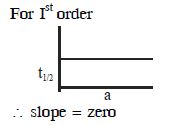
0 likes
View Solution166
MediumMCQ
For the first order reaction $A \to \text{Product}$ $(t_{1/2} = 10 \ \text{min})$,the fraction of reactant degraded after an hour from the reaction has started is
A
$\frac{1}{64}$
B
$\frac{63}{64}$
C
$\frac{1}{32}$
D
$\frac{31}{32}$
Solution
(B) For a first order reaction,the number of half-lives $(n)$ in $60 \ \text{min}$ is $n = \frac{t}{t_{1/2}} = \frac{60}{10} = 6$.
The remaining fraction of reactant is given by $\frac{[A]_t}{[A]_0} = (\frac{1}{2})^n = (\frac{1}{2})^6 = \frac{1}{64}$.
The fraction of reactant degraded $(x)$ is $1 - \text{remaining fraction} = 1 - \frac{1}{64} = \frac{63}{64}$.
The remaining fraction of reactant is given by $\frac{[A]_t}{[A]_0} = (\frac{1}{2})^n = (\frac{1}{2})^6 = \frac{1}{64}$.
The fraction of reactant degraded $(x)$ is $1 - \text{remaining fraction} = 1 - \frac{1}{64} = \frac{63}{64}$.
0 likes
View Solution167
DifficultMCQ
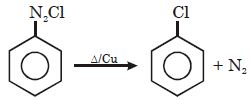
For the reaction shown in the image,the half-life does not depend on the concentration of the reactant. After $10 \, \text{min}$,the volume of $N_2$ gas evolved is $20 \, \text{L}$ and after the completion of the reaction,it is $100 \, \text{L}$. Hence,the rate constant is:
A
$\frac{2.303}{10} \log \frac{5}{4} \, \text{min}^{-1}$
B
$\frac{2.303}{10} \log 5 \, \text{min}^{-1}$
C
$\frac{2.303}{10} \log 15 \, \text{min}^{-1}$
D
$\frac{2.303}{10} \log 20 \, \text{min}^{-1}$
Solution
(A) The reaction is a first-order reaction because the half-life is independent of the initial concentration.
For a first-order reaction,the rate constant $k$ is given by $k = \frac{2.303}{t} \log \frac{V_{\infty}}{V_{\infty} - V_t}$,where $V_{\infty}$ is the total volume of $N_2$ at completion and $V_t$ is the volume at time $t$.
Given: $V_{\infty} = 100 \, \text{L}$,$V_t = 20 \, \text{L}$,and $t = 10 \, \text{min}$.
Substituting the values:
$k = \frac{2.303}{10} \log \frac{100}{100 - 20}$
$k = \frac{2.303}{10} \log \frac{100}{80}$
$k = \frac{2.303}{10} \log \frac{5}{4} \, \text{min}^{-1}$
For a first-order reaction,the rate constant $k$ is given by $k = \frac{2.303}{t} \log \frac{V_{\infty}}{V_{\infty} - V_t}$,where $V_{\infty}$ is the total volume of $N_2$ at completion and $V_t$ is the volume at time $t$.
Given: $V_{\infty} = 100 \, \text{L}$,$V_t = 20 \, \text{L}$,and $t = 10 \, \text{min}$.
Substituting the values:
$k = \frac{2.303}{10} \log \frac{100}{100 - 20}$
$k = \frac{2.303}{10} \log \frac{100}{80}$
$k = \frac{2.303}{10} \log \frac{5}{4} \, \text{min}^{-1}$
0 likes
View Solution168
MediumMCQ
$75\%$ of a first order reaction was completed in $32$ minutes. When was $50\%$ of the reaction completed? ......... $\min$
A
$16$
B
$24$
C
$8$
D
$4$
Solution
(A) For a first order reaction,the time required for $75\%$ completion is twice the half-life $(t_{1/2})$.
$t_{75\%} = 2 \times t_{1/2}$
Given $t_{75\%} = 32 \, \text{min}$.
$32 = 2 \times t_{1/2}$
$t_{1/2} = \frac{32}{2} = 16 \, \text{min}$.
Since $50\%$ completion is equivalent to the half-life $(t_{1/2})$,the reaction is $50\%$ complete in $16$ minutes.
$t_{75\%} = 2 \times t_{1/2}$
Given $t_{75\%} = 32 \, \text{min}$.
$32 = 2 \times t_{1/2}$
$t_{1/2} = \frac{32}{2} = 16 \, \text{min}$.
Since $50\%$ completion is equivalent to the half-life $(t_{1/2})$,the reaction is $50\%$ complete in $16$ minutes.
0 likes
View Solution169
MediumMCQ
If the decomposition reaction $A_{(g)} \to B_{(g)}$ follows first-order kinetics,then the graph of the rate of formation $(R)$ of $B$ against time $t$ will be:
A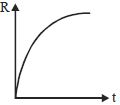
B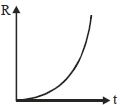
C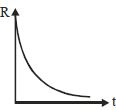
D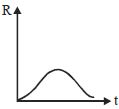
Solution
(C) For a first-order reaction $A \to B$,the rate of reaction is given by $Rate = k[A]$.
Since $[A] = [A]_0 e^{-kt}$,the rate of reaction is $Rate = k[A]_0 e^{-kt}$.
The rate of formation of $B$ is equal to the rate of reaction,so $R = k[A]_0 e^{-kt}$.
This equation represents an exponential decay curve,where the rate $R$ decreases exponentially with time $t$.
Since $[A] = [A]_0 e^{-kt}$,the rate of reaction is $Rate = k[A]_0 e^{-kt}$.
The rate of formation of $B$ is equal to the rate of reaction,so $R = k[A]_0 e^{-kt}$.
This equation represents an exponential decay curve,where the rate $R$ decreases exponentially with time $t$.
0 likes
View Solution170
MediumMCQ
If the rate law is $r = K[A]$,then the concentration of the reactant remaining after time $t = 1/k$ is: ($[A]_0$ is the concentration of the reactant at $t = 0$)
A
$\frac{[A]_0}{e}$
B
$[A]_0 e$
C
$\frac{[A]_0}{e^2}$
D
$\frac{e}{[A]_0}$
Solution
(A) For a first-order reaction,the integrated rate law is given by: $[A]_t = [A]_0 e^{-kt}$
Given that $t = \frac{1}{k}$,we substitute this value into the equation:
$[A]_t = [A]_0 e^{-k \times (1/k)}$
$[A]_t = [A]_0 e^{-1}$
$[A]_t = \frac{[A]_0}{e}$
Given that $t = \frac{1}{k}$,we substitute this value into the equation:
$[A]_t = [A]_0 e^{-k \times (1/k)}$
$[A]_t = [A]_0 e^{-1}$
$[A]_t = \frac{[A]_0}{e}$
0 likes
View Solution171
MediumMCQ
In a first order reaction,the ratio $\frac{a}{a-x}$ was found to be $8$ after $10 \, \text{min}$. The rate constant is:
A
$\frac{2.303 \times 3 \log 2}{10}$
B
$\frac{2.303 \times 2 \log 3}{10}$
C
$10 \times 2.303 \times 2 \log 3$
D
$10 \times 2.303 \times 3 \log 2$
Solution
(A) For a first order reaction,the rate constant $k$ is given by the formula:
$k = \frac{2.303}{t} \log_{10} \frac{a}{a-x}$
Given $t = 10 \, \text{min}$ and $\frac{a}{a-x} = 8$.
Substituting these values into the equation:
$k = \frac{2.303}{10} \log_{10} 8$
Since $8 = 2^3$,we can write $\log_{10} 8 = \log_{10} 2^3 = 3 \log_{10} 2$.
Therefore,$k = \frac{2.303 \times 3 \log 2}{10}$.
$k = \frac{2.303}{t} \log_{10} \frac{a}{a-x}$
Given $t = 10 \, \text{min}$ and $\frac{a}{a-x} = 8$.
Substituting these values into the equation:
$k = \frac{2.303}{10} \log_{10} 8$
Since $8 = 2^3$,we can write $\log_{10} 8 = \log_{10} 2^3 = 3 \log_{10} 2$.
Therefore,$k = \frac{2.303 \times 3 \log 2}{10}$.
0 likes
View Solution172
MediumMCQ
Which of the following curves represents a first-order reaction?
A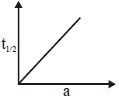
B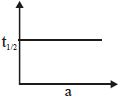
C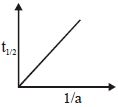
D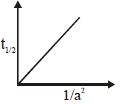
Solution
(B) For a first-order reaction,the half-life $(t_{1/2})$ is given by the formula:
$t_{1/2} = \frac{0.693}{k}$
Here,$k$ is the rate constant.
Since $t_{1/2}$ is independent of the initial concentration $(a)$,the graph of $t_{1/2}$ versus $a$ will be a straight line parallel to the concentration axis ($a$-axis).
Therefore,the correct curve is the one showing $t_{1/2}$ as constant with respect to $a$.
$t_{1/2} = \frac{0.693}{k}$
Here,$k$ is the rate constant.
Since $t_{1/2}$ is independent of the initial concentration $(a)$,the graph of $t_{1/2}$ versus $a$ will be a straight line parallel to the concentration axis ($a$-axis).
Therefore,the correct curve is the one showing $t_{1/2}$ as constant with respect to $a$.
0 likes
View Solution173
MediumMCQ
For the reaction $2A + B \to \text{product}$,the rate law is given by $\frac{-d[A]}{dt} = k[A]$. At a time $t = \frac{t_{1/2}}{\ln 2}$,what is the concentration of the reactant $A$?
A
$[A]_0 e$
B
$\frac{[A]_0}{e^2}$
C
$\frac{[A]_0}{e}$
D
$\frac{1}{[A]_0}$
Solution
(C) The given rate law $\frac{-d[A]}{dt} = k[A]$ indicates a first-order reaction with respect to $A$.
For a first-order reaction,the integrated rate equation is $[A] = [A]_0 e^{-kt}$.
The half-life $t_{1/2}$ for a first-order reaction is given by $t_{1/2} = \frac{\ln 2}{k}$,which implies $k = \frac{\ln 2}{t_{1/2}}$.
Substituting the given time $t = \frac{t_{1/2}}{\ln 2}$ into the rate equation:
$[A] = [A]_0 e^{-k \times (\frac{t_{1/2}}{\ln 2})}$
$[A] = [A]_0 e^{-(\frac{\ln 2}{t_{1/2}}) \times (\frac{t_{1/2}}{\ln 2})}$
$[A] = [A]_0 e^{-1} = \frac{[A]_0}{e}$.
For a first-order reaction,the integrated rate equation is $[A] = [A]_0 e^{-kt}$.
The half-life $t_{1/2}$ for a first-order reaction is given by $t_{1/2} = \frac{\ln 2}{k}$,which implies $k = \frac{\ln 2}{t_{1/2}}$.
Substituting the given time $t = \frac{t_{1/2}}{\ln 2}$ into the rate equation:
$[A] = [A]_0 e^{-k \times (\frac{t_{1/2}}{\ln 2})}$
$[A] = [A]_0 e^{-(\frac{\ln 2}{t_{1/2}}) \times (\frac{t_{1/2}}{\ln 2})}$
$[A] = [A]_0 e^{-1} = \frac{[A]_0}{e}$.
0 likes
View Solution174
MediumMCQ
$A$ first order reaction undergoes $50\,\%$ completion in $50\, min$,then it undergoes $80\, \%$ completion in ........... $min$
A
$80$
B
$160$
C
$117$
D
$200$
Solution
(C) For a first order reaction,the half-life $t_{1/2} = 50\, min$.
The rate constant $k = \frac{0.693}{t_{1/2}} = \frac{0.693}{50\, min}$.
For $80\%$ completion,the remaining concentration is $100\% - 80\% = 20\%$.
The time $t$ is given by the formula: $t = \frac{2.303}{k} \log \left( \frac{[A]_0}{[A]_t} \right)$.
Substituting the values: $t = \frac{2.303}{(0.693/50)} \log \left( \frac{100}{20} \right)$.
$t = \frac{2.303 \times 50}{0.693} \times \log(5)$.
Since $\log(5) \approx 0.699$ and $\frac{2.303}{0.693} \approx 3.32$,we get $t \approx 3.32 \times 50 \times 0.699 \approx 116.1\, min$.
Rounding to the nearest integer,$t \approx 117\, min$.
The rate constant $k = \frac{0.693}{t_{1/2}} = \frac{0.693}{50\, min}$.
For $80\%$ completion,the remaining concentration is $100\% - 80\% = 20\%$.
The time $t$ is given by the formula: $t = \frac{2.303}{k} \log \left( \frac{[A]_0}{[A]_t} \right)$.
Substituting the values: $t = \frac{2.303}{(0.693/50)} \log \left( \frac{100}{20} \right)$.
$t = \frac{2.303 \times 50}{0.693} \times \log(5)$.
Since $\log(5) \approx 0.699$ and $\frac{2.303}{0.693} \approx 3.32$,we get $t \approx 3.32 \times 50 \times 0.699 \approx 116.1\, min$.
Rounding to the nearest integer,$t \approx 117\, min$.
0 likes
View Solution175
MediumMCQ
The reaction $A_{(g)} \to 2B_{(g)} + C_{(g)}$ obeys the rate law,$r = K[A]$ where $K = 0.023 \ s^{-1}$. If $2.5 \ moles$ of $A$ were taken in a $5 \ L$ flask,how many moles of $A$ would remain left after $50 \ seconds$?
A
$0.91$
B
$0.125$
C
$0.52$
D
$0.79$
Solution
(D) The given reaction is a first-order reaction as the rate law is $r = K[A]$.
For a first-order reaction,the integrated rate equation is: $\ln \frac{[A]_0}{[A]_t} = Kt$ or $\ln \frac{n_0}{n_t} = Kt$.
Given: $K = 0.023 \ s^{-1}$,$t = 50 \ s$,$n_0 = 2.5 \ moles$.
Substituting the values: $\ln \frac{2.5}{n_t} = 0.023 \times 50$.
$\ln \frac{2.5}{n_t} = 1.15$.
Taking the exponential of both sides: $\frac{2.5}{n_t} = e^{1.15} \approx 3.158$.
$n_t = \frac{2.5}{3.158} \approx 0.79 \ moles$.
For a first-order reaction,the integrated rate equation is: $\ln \frac{[A]_0}{[A]_t} = Kt$ or $\ln \frac{n_0}{n_t} = Kt$.
Given: $K = 0.023 \ s^{-1}$,$t = 50 \ s$,$n_0 = 2.5 \ moles$.
Substituting the values: $\ln \frac{2.5}{n_t} = 0.023 \times 50$.
$\ln \frac{2.5}{n_t} = 1.15$.
Taking the exponential of both sides: $\frac{2.5}{n_t} = e^{1.15} \approx 3.158$.
$n_t = \frac{2.5}{3.158} \approx 0.79 \ moles$.
0 likes
View Solution176
MediumMCQ
Following data was obtained for the first order decomposition of $SO_2Cl_{2(g)}$ at constant volume:
$SO_2Cl_{2(g)} \to SO_{2(g)} + Cl_{2(g)}$
Calculate the rate constant.
$SO_2Cl_{2(g)} \to SO_{2(g)} + Cl_{2(g)}$
| $S. No.$ | $Time$ $(s)$ | $Total$ $pressure$ $(atm)$ |
| $1$ | $0$ | $0.5$ |
| $2$ | $100$ | $0.6$ |
Calculate the rate constant.
A
$4.02 \times 10^{-3} \text{ s}^{-1}$
B
$8.30 \times 10^{-4} \text{ s}^{-1}$
C
$2.23 \times 10^{-3} \text{ s}^{-1}$
D
$2.06 \times 10^{-3} \text{ s}^{-1}$
Solution
(C) For a first-order reaction: $k = \frac{2.303}{t} \log \frac{P_i}{P_{SO_2Cl_2}}$
Given reaction: $SO_2Cl_{2(g)} \to SO_{2(g)} + Cl_{2(g)}$
At $t = 0$,$P_i = 0.5 \text{ atm}$.
At $t = 100 \text{ s}$,$P_{total} = 0.6 \text{ atm}$.
Let $x$ be the decrease in pressure of $SO_2Cl_2$.
$P_{total} = (P_i - x) + x + x = P_i + x$.
$0.6 = 0.5 + x \Rightarrow x = 0.1 \text{ atm}$.
$P_{SO_2Cl_2} = P_i - x = 0.5 - 0.1 = 0.4 \text{ atm}$.
$k = \frac{2.303}{100} \log \frac{0.5}{0.4} = \frac{2.303}{100} \log 1.25$.
$k = \frac{2.303 \times 0.0969}{100} = 2.23 \times 10^{-3} \text{ s}^{-1}$.
Given reaction: $SO_2Cl_{2(g)} \to SO_{2(g)} + Cl_{2(g)}$
At $t = 0$,$P_i = 0.5 \text{ atm}$.
At $t = 100 \text{ s}$,$P_{total} = 0.6 \text{ atm}$.
Let $x$ be the decrease in pressure of $SO_2Cl_2$.
$P_{total} = (P_i - x) + x + x = P_i + x$.
$0.6 = 0.5 + x \Rightarrow x = 0.1 \text{ atm}$.
$P_{SO_2Cl_2} = P_i - x = 0.5 - 0.1 = 0.4 \text{ atm}$.
$k = \frac{2.303}{100} \log \frac{0.5}{0.4} = \frac{2.303}{100} \log 1.25$.
$k = \frac{2.303 \times 0.0969}{100} = 2.23 \times 10^{-3} \text{ s}^{-1}$.
0 likes
View Solution177
MediumMCQ
For the reaction $2A + B \to \text{Product}$,the rate law is given as $\frac{-d[A]}{dt} = K[A]$. At a time when $t = \frac{1}{K}$,the concentration of the reactant $A$ is ($Co =$ initial concentration).
A
$\frac{Co}{e}$
B
$Co \,e$
C
$\frac{Co}{e^2}$
D
$\frac{1}{Co}$
Solution
(A) The given rate law is $\frac{-d[A]}{dt} = K[A]$.
This represents a first-order reaction with respect to reactant $A$.
The integrated rate equation for a first-order reaction is $[A]_t = [A]_0 e^{-Kt}$.
Given $[A]_0 = Co$ and $t = \frac{1}{K}$.
Substituting these values into the equation:
$[A]_t = Co \, e^{-K \times (\frac{1}{K})}$
$[A]_t = Co \, e^{-1}$
$[A]_t = \frac{Co}{e}$.
This represents a first-order reaction with respect to reactant $A$.
The integrated rate equation for a first-order reaction is $[A]_t = [A]_0 e^{-Kt}$.
Given $[A]_0 = Co$ and $t = \frac{1}{K}$.
Substituting these values into the equation:
$[A]_t = Co \, e^{-K \times (\frac{1}{K})}$
$[A]_t = Co \, e^{-1}$
$[A]_t = \frac{Co}{e}$.
0 likes
View Solution178
AdvancedMCQ
$N_2O_5$ decomposes to $NO_2$ and $O_2$ and follows first order kinetics. After $50 \, min$,the pressure inside the vessel increases from $50 \, mm \, Hg$ to $87.5 \, mm \, Hg$. The pressure of the gaseous mixture after $100 \, min$ at constant temperature will be ........... $mm \, Hg$
A
$136.25$
B
$106.25$
C
$175.0$
D
$116.25$
Solution
(B) The decomposition reaction is: $N_2O_5(g) \to 2NO_2(g) + \frac{1}{2}O_2(g)$
At $t = 0$: $P_{N_2O_5} = 50 \, mm \, Hg$,$P_{NO_2} = 0$,$P_{O_2} = 0$. Total pressure $P_0 = 50 \, mm \, Hg$.
At $t = 50 \, min$: Let $p_1$ be the decrease in pressure of $N_2O_5$. The partial pressures are: $P_{N_2O_5} = 50 - p_1$,$P_{NO_2} = 2p_1$,$P_{O_2} = 0.5p_1$.
Total pressure $P_t = (50 - p_1) + 2p_1 + 0.5p_1 = 50 + 1.5p_1 = 87.5 \, mm \, Hg$.
$1.5p_1 = 37.5 \implies p_1 = 25 \, mm \, Hg$.
Since $p_1 = 25$ is half of the initial pressure $50$,the half-life $t_{1/2} = 50 \, min$.
At $t = 100 \, min$ $(2 \times t_{1/2})$,the remaining pressure of $N_2O_5$ is $50 \times (1/2)^2 = 12.5 \, mm \, Hg$.
Thus,$50 - p_2 = 12.5 \implies p_2 = 37.5 \, mm \, Hg$.
Total pressure at $100 \, min = 50 + 1.5p_2 = 50 + 1.5(37.5) = 50 + 56.25 = 106.25 \, mm \, Hg$.
At $t = 0$: $P_{N_2O_5} = 50 \, mm \, Hg$,$P_{NO_2} = 0$,$P_{O_2} = 0$. Total pressure $P_0 = 50 \, mm \, Hg$.
At $t = 50 \, min$: Let $p_1$ be the decrease in pressure of $N_2O_5$. The partial pressures are: $P_{N_2O_5} = 50 - p_1$,$P_{NO_2} = 2p_1$,$P_{O_2} = 0.5p_1$.
Total pressure $P_t = (50 - p_1) + 2p_1 + 0.5p_1 = 50 + 1.5p_1 = 87.5 \, mm \, Hg$.
$1.5p_1 = 37.5 \implies p_1 = 25 \, mm \, Hg$.
Since $p_1 = 25$ is half of the initial pressure $50$,the half-life $t_{1/2} = 50 \, min$.
At $t = 100 \, min$ $(2 \times t_{1/2})$,the remaining pressure of $N_2O_5$ is $50 \times (1/2)^2 = 12.5 \, mm \, Hg$.
Thus,$50 - p_2 = 12.5 \implies p_2 = 37.5 \, mm \, Hg$.
Total pressure at $100 \, min = 50 + 1.5p_2 = 50 + 1.5(37.5) = 50 + 56.25 = 106.25 \, mm \, Hg$.
0 likes
View Solution179
DifficultMCQ
For a first order reaction,$A \to P$,$t_{1/2}$ (half-life) is $10 \ days$. The time required for $\frac{1}{4}$ conversion of $A$ (in days) is: $(\ln 2 = 0.693, \ln 3 = 1.1)$.
A
$3.2$
B
$2.5$
C
$4.1$
D
$5$
Solution
(C) The half-life $t_{1/2} = 10 \ days$.
The rate constant $k$ is given by $k = \frac{\ln 2}{t_{1/2}} = \frac{0.693}{10} = 0.0693 \ days^{-1}$.
For a first-order reaction,the time $t$ required for a fraction $x$ of the reactant to be converted is given by $t = \frac{1}{k} \ln \left( \frac{a}{a - x} \right)$.
Here,$x = \frac{1}{4}a$,so the remaining amount is $a - x = a - \frac{1}{4}a = \frac{3}{4}a$.
Thus,$t = \frac{1}{0.0693} \ln \left( \frac{a}{3a/4} \right) = \frac{1}{0.0693} \ln \left( \frac{4}{3} \right)$.
$t = \frac{\ln 4 - \ln 3}{0.0693} = \frac{2 \ln 2 - \ln 3}{0.0693} = \frac{2(0.693) - 1.1}{0.0693} = \frac{1.386 - 1.1}{0.0693} = \frac{0.286}{0.0693} \approx 4.13 \ days$.
The closest option is $4.1 \ days$.
The rate constant $k$ is given by $k = \frac{\ln 2}{t_{1/2}} = \frac{0.693}{10} = 0.0693 \ days^{-1}$.
For a first-order reaction,the time $t$ required for a fraction $x$ of the reactant to be converted is given by $t = \frac{1}{k} \ln \left( \frac{a}{a - x} \right)$.
Here,$x = \frac{1}{4}a$,so the remaining amount is $a - x = a - \frac{1}{4}a = \frac{3}{4}a$.
Thus,$t = \frac{1}{0.0693} \ln \left( \frac{a}{3a/4} \right) = \frac{1}{0.0693} \ln \left( \frac{4}{3} \right)$.
$t = \frac{\ln 4 - \ln 3}{0.0693} = \frac{2 \ln 2 - \ln 3}{0.0693} = \frac{2(0.693) - 1.1}{0.0693} = \frac{1.386 - 1.1}{0.0693} = \frac{0.286}{0.0693} \approx 4.13 \ days$.
The closest option is $4.1 \ days$.
1 likes
View Solution180
DifficultMCQ
If $50\%$ of a reaction occurs in $100 \ s$ and $75\%$ of the reaction occurs in $200 \ s$,the order of this reaction is
A
$2$
B
$3$
C
$0$
D
$1$
Solution
(D) For a first-order reaction,the half-life $(t_{1/2})$ is constant.
Given that $50\%$ of the reaction is complete in $100 \ s$,this is the half-life,$t_{1/2} = 100 \ s$.
After another $100 \ s$ (total $200 \ s$),the remaining concentration becomes $A_0/4$,which means $75\%$ of the reaction is complete.
Since the time taken for the second half-life is also $100 \ s$,the reaction follows first-order kinetics.
Given that $50\%$ of the reaction is complete in $100 \ s$,this is the half-life,$t_{1/2} = 100 \ s$.
After another $100 \ s$ (total $200 \ s$),the remaining concentration becomes $A_0/4$,which means $75\%$ of the reaction is complete.
Since the time taken for the second half-life is also $100 \ s$,the reaction follows first-order kinetics.
0 likes
View Solution181
AdvancedMCQ
The reaction $2N_2O_5 \,(g) \to 4NO_2 \,(g) + O_2 \,(g)$ follows first order kinetics. The pressure of a vessel containing only $N_2O_5$ was found to increase from $50 \, mmHg$ to $87.5 \, mmHg$ in $30 \, min$. The pressure exerted by the gases after $60 \, min$ will be .......... $mmHg$ (assume temperature remains constant).
A
$106.25$
B
$150$
C
$125$
D
$116.25$
Solution
(A) For the reaction $2N_2O_5 \,(g) \to 4NO_2 \,(g) + O_2 \,(g)$,let the initial pressure of $N_2O_5$ be $P_0 = 50 \, mmHg$.
At $t = 30 \, min$,let the pressure of $N_2O_5$ decrease by $2p$. The total pressure is $P_t = (50 - 2p) + 4p + p = 50 + 3p = 87.5 \, mmHg$.
Thus,$3p = 37.5 \, mmHg$,so $p = 12.5 \, mmHg$.
The pressure of $N_2O_5$ remaining at $t = 30 \, min$ is $50 - 2(12.5) = 25 \, mmHg$.
Since the pressure of $N_2O_5$ halves in $30 \, min$,the half-life $t_{1/2} = 30 \, min$.
At $t = 60 \, min$ (which is $2 \times t_{1/2}$),the pressure of $N_2O_5$ remaining is $50 / 4 = 12.5 \, mmHg$.
Let $50 - 2p' = 12.5$,so $2p' = 37.5$,which means $p' = 18.75 \, mmHg$.
The total pressure at $t = 60 \, min$ is $50 + 3p' = 50 + 3(18.75) = 50 + 56.25 = 106.25 \, mmHg$.
At $t = 30 \, min$,let the pressure of $N_2O_5$ decrease by $2p$. The total pressure is $P_t = (50 - 2p) + 4p + p = 50 + 3p = 87.5 \, mmHg$.
Thus,$3p = 37.5 \, mmHg$,so $p = 12.5 \, mmHg$.
The pressure of $N_2O_5$ remaining at $t = 30 \, min$ is $50 - 2(12.5) = 25 \, mmHg$.
Since the pressure of $N_2O_5$ halves in $30 \, min$,the half-life $t_{1/2} = 30 \, min$.
At $t = 60 \, min$ (which is $2 \times t_{1/2}$),the pressure of $N_2O_5$ remaining is $50 / 4 = 12.5 \, mmHg$.
Let $50 - 2p' = 12.5$,so $2p' = 37.5$,which means $p' = 18.75 \, mmHg$.
The total pressure at $t = 60 \, min$ is $50 + 3p' = 50 + 3(18.75) = 50 + 56.25 = 106.25 \, mmHg$.
0 likes
View Solution182
DifficultMCQ
The half-life period of a first order reaction is $15 \ minutes$. The amount of substance left after one hour will be
A
$\frac{1}{4}$ of the original amount
B
$\frac{1}{8}$ of the original amount
C
$\frac{1}{16}$ of the original amount
D
$\frac{1}{32}$ of the original amount
Solution
(C) Given half-life $t_{1/2} = 15 \ minutes$.
Total time $T = 1 \ hr = 60 \ minutes$.
The number of half-lives $n$ is calculated as $n = \frac{T}{t_{1/2}} = \frac{60}{15} = 4$.
The amount of substance remaining is given by the formula $\frac{N}{N_0} = (\frac{1}{2})^n$.
Substituting the value of $n$,we get $\frac{N}{N_0} = (\frac{1}{2})^4 = \frac{1}{16}$.
Therefore,the amount of substance left after $1 \ hour$ is $\frac{1}{16}$ of the original amount.
Total time $T = 1 \ hr = 60 \ minutes$.
The number of half-lives $n$ is calculated as $n = \frac{T}{t_{1/2}} = \frac{60}{15} = 4$.
The amount of substance remaining is given by the formula $\frac{N}{N_0} = (\frac{1}{2})^n$.
Substituting the value of $n$,we get $\frac{N}{N_0} = (\frac{1}{2})^4 = \frac{1}{16}$.
Therefore,the amount of substance left after $1 \ hour$ is $\frac{1}{16}$ of the original amount.
0 likes
View Solution183
DifficultMCQ
The following results were obtained during kinetic studies of the reaction $2A + B \to$ products:
The time (in minutes) required to consume half of $A$ is:
| Experiment | $[A]$ $(mol \ L^{-1})$ | $[B]$ $(mol \ L^{-1})$ | Initial rate $(mol \ L^{-1} \ min^{-1})$ |
|---|---|---|---|
| $I$ | $0.10$ | $0.20$ | $6.93 \times 10^{-3}$ |
| $II$ | $0.10$ | $0.25$ | $6.93 \times 10^{-3}$ |
| $III$ | $0.20$ | $0.30$ | $1.386 \times 10^{-2}$ |
The time (in minutes) required to consume half of $A$ is:
A
$5$
B
$10$
C
$1$
D
$100$
Solution
(B) The rate law is given by $R = k[A]^x [B]^y$.
From experiments $I$ and $II$,$[A]$ is constant and $[B]$ changes,but the rate remains constant. Thus,$y = 0$ (zero order with respect to $B$).
From experiments $I$ and $III$,when $[A]$ doubles ($0.10$ to $0.20$),the rate doubles ($6.93 \times 10^{-3}$ to $1.386 \times 10^{-2}$). Thus,$x = 1$ (first order with respect to $A$).
The rate equation is $R = k[A]$.
Using experiment $I$: $6.93 \times 10^{-3} = k(0.10) \Rightarrow k = 6.93 \times 10^{-2} \ min^{-1}$.
For a first-order reaction,the half-life is $t_{1/2} = \frac{\ln(2)}{k} = \frac{0.693}{6.93 \times 10^{-2}} = 10 \ min$.
From experiments $I$ and $II$,$[A]$ is constant and $[B]$ changes,but the rate remains constant. Thus,$y = 0$ (zero order with respect to $B$).
From experiments $I$ and $III$,when $[A]$ doubles ($0.10$ to $0.20$),the rate doubles ($6.93 \times 10^{-3}$ to $1.386 \times 10^{-2}$). Thus,$x = 1$ (first order with respect to $A$).
The rate equation is $R = k[A]$.
Using experiment $I$: $6.93 \times 10^{-3} = k(0.10) \Rightarrow k = 6.93 \times 10^{-2} \ min^{-1}$.
For a first-order reaction,the half-life is $t_{1/2} = \frac{\ln(2)}{k} = \frac{0.693}{6.93 \times 10^{-2}} = 10 \ min$.
0 likes
View Solution184
MediumMCQ
The initial rate for a first order reaction is $0.6932 \times 10^{-2} \ mol \ L^{-1} \ min^{-1}$ and the initial concentration of the reactant is $0.1 \ M$. Then $t_{1/2}$ is equal to ...... $min$.
A
$0.6932 \times 10^{-2}$
B
$0.6932 \times 10^{-3}$
C
$10$
D
$6.93$
Solution
(C) For a first order reaction,the rate is given by $\text{Rate} = K[A]_0$.
Given $\text{Rate} = 0.6932 \times 10^{-2} \ mol \ L^{-1} \ min^{-1}$ and $[A]_0 = 0.1 \ M$.
Calculating the rate constant $K$: $K = \frac{\text{Rate}}{[A]_0} = \frac{0.6932 \times 10^{-2}}{0.1} = 0.6932 \times 10^{-1} \ min^{-1}$.
The half-life $t_{1/2}$ for a first order reaction is given by $t_{1/2} = \frac{0.693}{K}$.
Substituting the value of $K$: $t_{1/2} = \frac{0.693}{0.6932 \times 10^{-1}} \approx \frac{0.693}{0.06932} \approx 10 \ min$.
Hence,option $C$ is correct.
Given $\text{Rate} = 0.6932 \times 10^{-2} \ mol \ L^{-1} \ min^{-1}$ and $[A]_0 = 0.1 \ M$.
Calculating the rate constant $K$: $K = \frac{\text{Rate}}{[A]_0} = \frac{0.6932 \times 10^{-2}}{0.1} = 0.6932 \times 10^{-1} \ min^{-1}$.
The half-life $t_{1/2}$ for a first order reaction is given by $t_{1/2} = \frac{0.693}{K}$.
Substituting the value of $K$: $t_{1/2} = \frac{0.693}{0.6932 \times 10^{-1}} \approx \frac{0.693}{0.06932} \approx 10 \ min$.
Hence,option $C$ is correct.
0 likes
View Solution185
MediumMCQ
Consider the first-order gas-phase decomposition reaction given below:
$A_{(g)} \longrightarrow B_{(g)} + C_{(g)}$
The initial pressure of the system before the decomposition of $A$ was $P_i$. After time $t$,the total pressure of the system increased by $x \ units$ and became $P_t$. The rate constant $k$ for the reaction is given as:
$A_{(g)} \longrightarrow B_{(g)} + C_{(g)}$
The initial pressure of the system before the decomposition of $A$ was $P_i$. After time $t$,the total pressure of the system increased by $x \ units$ and became $P_t$. The rate constant $k$ for the reaction is given as:
A
$K = \frac{2.303}{t} \log \frac{P_i}{P_i - P_t}$
B
$K = \frac{2.303}{t} \log \frac{P_i}{2P_i - P_t}$
C
$K = \frac{2.303}{t} \log \frac{P_i}{2P_i + P_t}$
D
$K = \frac{2.303}{t} \log \frac{P_i}{P_i + x}$
Solution
(B) For the reaction: $A_{(g)} \longrightarrow B_{(g)} + C_{(g)}$
At $t = 0$: Initial pressure of $A = P_i$,$P_B = 0$,$P_C = 0$.
At time $t$: Let the decrease in pressure of $A$ be $x$. Then,$P_A = P_i - x$,$P_B = x$,and $P_C = x$.
The total pressure at time $t$ is $P_t = P_A + P_B + P_C = (P_i - x) + x + x = P_i + x$.
From this,$x = P_t - P_i$.
The partial pressure of $A$ at time $t$ is $P_A = P_i - x = P_i - (P_t - P_i) = 2P_i - P_t$.
For a first-order reaction,$K = \frac{2.303}{t} \log \frac{P_{\text{initial}}}{P_{\text{final}}}$.
Substituting the values,$K = \frac{2.303}{t} \log \frac{P_i}{2P_i - P_t}$.
At $t = 0$: Initial pressure of $A = P_i$,$P_B = 0$,$P_C = 0$.
At time $t$: Let the decrease in pressure of $A$ be $x$. Then,$P_A = P_i - x$,$P_B = x$,and $P_C = x$.
The total pressure at time $t$ is $P_t = P_A + P_B + P_C = (P_i - x) + x + x = P_i + x$.
From this,$x = P_t - P_i$.
The partial pressure of $A$ at time $t$ is $P_A = P_i - x = P_i - (P_t - P_i) = 2P_i - P_t$.
For a first-order reaction,$K = \frac{2.303}{t} \log \frac{P_{\text{initial}}}{P_{\text{final}}}$.
Substituting the values,$K = \frac{2.303}{t} \log \frac{P_i}{2P_i - P_t}$.
0 likes
View Solution186
MediumMCQ
$A$ first order reaction has a rate constant of $5.78 \times 10^{-5} \ s^{-1}$. What fraction of the reactant will remain after $10 \ hours$?
A
$1/10$
B
$1/16$
C
$1/8$
D
$1/5$
Solution
(C) For a first order reaction,the integrated rate equation is:
$K = \frac{2.303}{t} \log \frac{a}{a-x}$
Given: $K = 5.78 \times 10^{-5} \ s^{-1}$,$t = 10 \ hours = 10 \times 3600 \ s = 36000 \ s$.
Substituting the values:
$5.78 \times 10^{-5} = \frac{2.303}{36000} \log \frac{a}{a-x}$
$\log \frac{a}{a-x} = \frac{5.78 \times 10^{-5} \times 36000}{2.303} \approx \frac{2.0808}{2.303} \approx 0.903$
Since $\log 8 \approx 0.903$,we have $\log \frac{a}{a-x} = \log 8$.
Therefore,$\frac{a}{a-x} = 8$,which implies the remaining fraction $\frac{a-x}{a} = \frac{1}{8}$.
$K = \frac{2.303}{t} \log \frac{a}{a-x}$
Given: $K = 5.78 \times 10^{-5} \ s^{-1}$,$t = 10 \ hours = 10 \times 3600 \ s = 36000 \ s$.
Substituting the values:
$5.78 \times 10^{-5} = \frac{2.303}{36000} \log \frac{a}{a-x}$
$\log \frac{a}{a-x} = \frac{5.78 \times 10^{-5} \times 36000}{2.303} \approx \frac{2.0808}{2.303} \approx 0.903$
Since $\log 8 \approx 0.903$,we have $\log \frac{a}{a-x} = \log 8$.
Therefore,$\frac{a}{a-x} = 8$,which implies the remaining fraction $\frac{a-x}{a} = \frac{1}{8}$.
0 likes
View Solution187
MediumMCQ
If $k$ is the rate constant and $t$ is the time,then the degree of dissociation for a substance undergoing decay with first-order kinetics is:
A
$e^{-kt}$
B
$1 - e^{-kt}$
C
$1 + e^{-kt}$
D
$e^{kt}$
Solution
(B) For a first-order reaction,the concentration of the reactant at time $t$ is given by the integrated rate law: $[A]_t = [A]_0 e^{-kt}$.
Here,$[A]_0$ is the initial concentration and $[A]_t$ is the concentration at time $t$.
The amount of substance dissociated is $[A]_0 - [A]_t = [A]_0 - [A]_0 e^{-kt} = [A]_0(1 - e^{-kt})$.
The degree of dissociation $(\alpha)$ is defined as the ratio of the amount dissociated to the initial amount:
$\alpha = \frac{[A]_0(1 - e^{-kt})}{[A]_0} = 1 - e^{-kt}$.
Here,$[A]_0$ is the initial concentration and $[A]_t$ is the concentration at time $t$.
The amount of substance dissociated is $[A]_0 - [A]_t = [A]_0 - [A]_0 e^{-kt} = [A]_0(1 - e^{-kt})$.
The degree of dissociation $(\alpha)$ is defined as the ratio of the amount dissociated to the initial amount:
$\alpha = \frac{[A]_0(1 - e^{-kt})}{[A]_0} = 1 - e^{-kt}$.
0 likes
View Solution188
MediumMCQ
The ratio of $t_{0.75}$ and $t_{0.5}$ for a first-order reaction is:
A
$4 : 3$
B
$3 : 2$
C
$2 : 1$
D
$1 : 2$
Solution
(C) For a first-order reaction,the time $t$ required for a fraction of reaction to complete is given by $t = \frac{2.303}{k} \log \frac{[A]_0}{[A]_t}$.
For $t_{0.5}$ (half-life),$[A]_t = 0.5[A]_0$,so $t_{0.5} = \frac{2.303}{k} \log 2$.
For $t_{0.75}$,$[A]_t = 0.25[A]_0$,so $t_{0.75} = \frac{2.303}{k} \log \frac{[A]_0}{0.25[A]_0} = \frac{2.303}{k} \log 4 = \frac{2.303}{k} \log 2^2 = 2 \times \frac{2.303}{k} \log 2$.
Therefore,$t_{0.75} = 2 \times t_{0.5}$.
The ratio $\frac{t_{0.75}}{t_{0.5}} = \frac{2}{1}$ or $2 : 1$.
For $t_{0.5}$ (half-life),$[A]_t = 0.5[A]_0$,so $t_{0.5} = \frac{2.303}{k} \log 2$.
For $t_{0.75}$,$[A]_t = 0.25[A]_0$,so $t_{0.75} = \frac{2.303}{k} \log \frac{[A]_0}{0.25[A]_0} = \frac{2.303}{k} \log 4 = \frac{2.303}{k} \log 2^2 = 2 \times \frac{2.303}{k} \log 2$.
Therefore,$t_{0.75} = 2 \times t_{0.5}$.
The ratio $\frac{t_{0.75}}{t_{0.5}} = \frac{2}{1}$ or $2 : 1$.
0 likes
View Solution189
EasyMCQ
For the $1^{st}$ order reaction,the half-life is $5 \ minutes$ when $[A] = 0.1 \ M$. If the concentration of $[A]$ becomes twice,then the half-life becomes:
A
half
B
double
C
remains same
D
$10 \ minutes$
Solution
(C) For a $1^{st}$ order reaction,the half-life $(t_{1/2})$ is given by the formula $t_{1/2} = \frac{0.693}{k}$.
Since the half-life is independent of the initial concentration $[A]$,changing the concentration will not affect the half-life.
Therefore,the half-life remains $5 \ minutes$.
Since the half-life is independent of the initial concentration $[A]$,changing the concentration will not affect the half-life.
Therefore,the half-life remains $5 \ minutes$.
0 likes
View Solution190
MediumMCQ
In a first order reaction,the concentration of the reactant decreased from $0.4 \, M$ to $0.1 \, M$ in $20 \, \min$. The rate constant of the reaction will be:
A
$0.693 \, \min^{-1}$
B
$6.93 \, \min^{-1}$
C
$0.0693 \, \min^{-1}$
D
$69.3 \, \min^{-1}$
Solution
(C) For a first order reaction,the rate constant $K$ is given by the formula: $K = \frac{2.303}{t} \log \frac{[A]_0}{[A]_t}$
Given: $[A]_0 = 0.4 \, M$,$[A]_t = 0.1 \, M$,and $t = 20 \, \min$.
Substituting the values: $K = \frac{2.303}{20} \log \frac{0.4}{0.1} = \frac{2.303}{20} \log 4$
Since $\log 4 = 2 \log 2 \approx 2 \times 0.3010 = 0.6020$:
$K = \frac{2.303 \times 0.6020}{20} \approx \frac{1.386}{20} = 0.0693 \, \min^{-1}$.
Given: $[A]_0 = 0.4 \, M$,$[A]_t = 0.1 \, M$,and $t = 20 \, \min$.
Substituting the values: $K = \frac{2.303}{20} \log \frac{0.4}{0.1} = \frac{2.303}{20} \log 4$
Since $\log 4 = 2 \log 2 \approx 2 \times 0.3010 = 0.6020$:
$K = \frac{2.303 \times 0.6020}{20} \approx \frac{1.386}{20} = 0.0693 \, \min^{-1}$.
0 likes
View Solution191
MediumMCQ
The rate constant of the reaction $2H_2O_{2(aq)} \to 2H_2O_{(l)} + O_{2(g)}$ is $3 \times 10^{-3} \ min^{-1}$. At what concentration of $H_2O_2$,the rate of reaction will be $2 \times 10^{-4} \ M \ s^{-1}$? ............ $M$
A
$6.67 \times 10^{-3}$
B
$2$
C
$4$
D
$0.05$
Solution
(C) The reaction is $2H_2O_{2(aq)} \to 2H_2O_{(l)} + O_{2(g)}$.
Given the rate constant $k = 3 \times 10^{-3} \ min^{-1}$.
Convert $k$ to $s^{-1}$: $k = \frac{3 \times 10^{-3}}{60} \ s^{-1} = 5 \times 10^{-5} \ s^{-1}$.
The rate law for the first-order reaction is $\text{Rate} = k[H_2O_2]$.
Given $\text{Rate} = 2 \times 10^{-4} \ M \ s^{-1}$.
$[H_2O_2] = \frac{\text{Rate}}{k} = \frac{2 \times 10^{-4} \ M \ s^{-1}}{5 \times 10^{-5} \ s^{-1}} = 4 \ M$.
Given the rate constant $k = 3 \times 10^{-3} \ min^{-1}$.
Convert $k$ to $s^{-1}$: $k = \frac{3 \times 10^{-3}}{60} \ s^{-1} = 5 \times 10^{-5} \ s^{-1}$.
The rate law for the first-order reaction is $\text{Rate} = k[H_2O_2]$.
Given $\text{Rate} = 2 \times 10^{-4} \ M \ s^{-1}$.
$[H_2O_2] = \frac{\text{Rate}}{k} = \frac{2 \times 10^{-4} \ M \ s^{-1}}{5 \times 10^{-5} \ s^{-1}} = 4 \ M$.
0 likes
View Solution192
MediumMCQ
The reaction $A \to P$ follows first order kinetics. The percentage of $A$ left after $3$ half-lives is
A
$6.25$
B
$12.5$
C
$50$
D
$75$
Solution
(B) For a first-order reaction,the amount of reactant remaining after $n$ half-lives is given by the formula: $\text{Fraction remaining} = \frac{1}{2^n}$.
Here,$n = 3$ half-lives.
Therefore,$\text{Fraction remaining} = \frac{1}{2^3} = \frac{1}{8} = 0.125$.
To find the percentage,multiply by $100$: $0.125 \times 100 = 12.5\%$.
Here,$n = 3$ half-lives.
Therefore,$\text{Fraction remaining} = \frac{1}{2^3} = \frac{1}{8} = 0.125$.
To find the percentage,multiply by $100$: $0.125 \times 100 = 12.5\%$.
0 likes
View Solution193
MediumMCQ
The degree of dissociation of a first-order reaction is
A
$e^{-kt}$
B
$a_0e^{-kt}$
C
$1-e^{+kt}$
D
$1-e^{-kt}$
Solution
(D) For a first-order reaction,the integrated rate equation is given by: $\ln \frac{a}{a-x} = kt$
Rearranging the equation: $\frac{a-x}{a} = e^{-kt}$
This can be written as: $1 - \frac{x}{a} = e^{-kt}$
The degree of dissociation,denoted by $\alpha$,is defined as the fraction of the initial concentration that has reacted,i.e.,$\alpha = \frac{x}{a}$.
Substituting this into the equation: $1 - \alpha = e^{-kt}$
Therefore,$\alpha = 1 - e^{-kt}$
Rearranging the equation: $\frac{a-x}{a} = e^{-kt}$
This can be written as: $1 - \frac{x}{a} = e^{-kt}$
The degree of dissociation,denoted by $\alpha$,is defined as the fraction of the initial concentration that has reacted,i.e.,$\alpha = \frac{x}{a}$.
Substituting this into the equation: $1 - \alpha = e^{-kt}$
Therefore,$\alpha = 1 - e^{-kt}$
0 likes
View Solution194
MediumMCQ
Thermal decomposition of a compound is of first order. If $50\%$ of a sample of this compound is decomposed in $120 \ min$,then how long will it take $90\%$ of the compound to decompose? ........ $min.$
A
$240$
B
$180.8$
C
$398.8$
D
$325.6$
Solution
(C) For a first-order reaction,the half-life is given by $t_{1/2} = 120 \ min$.
The rate constant $K$ is calculated as: $K = \frac{0.693}{t_{1/2}} = \frac{0.693}{120} = 5.775 \times 10^{-3} \ min^{-1}$.
For $90\%$ decomposition,the amount remaining is $10\%$ of the initial concentration $([A]_0 = 100, [A]_t = 10)$.
Using the first-order rate equation: $t = \frac{2.303}{K} \log \frac{[A]_0}{[A]_t}$.
$t_{90\%} = \frac{2.303}{5.775 \times 10^{-3}} \log \frac{100}{10} = \frac{2.303}{5.775 \times 10^{-3}} \times 1 = 398.8 \ min$.
The rate constant $K$ is calculated as: $K = \frac{0.693}{t_{1/2}} = \frac{0.693}{120} = 5.775 \times 10^{-3} \ min^{-1}$.
For $90\%$ decomposition,the amount remaining is $10\%$ of the initial concentration $([A]_0 = 100, [A]_t = 10)$.
Using the first-order rate equation: $t = \frac{2.303}{K} \log \frac{[A]_0}{[A]_t}$.
$t_{90\%} = \frac{2.303}{5.775 \times 10^{-3}} \log \frac{100}{10} = \frac{2.303}{5.775 \times 10^{-3}} \times 1 = 398.8 \ min$.
0 likes
View Solution195
MediumMCQ
For a first order reaction $A \to B$,the reaction rate at reactant concentration of $0.01 \ M$ is found to be $2.0 \times 10^{-5} \ M \ sec^{-1}$. The half-life period of the reaction is .......... $sec$.
A
$333$
B
$300$
C
$346.5$
D
$220$
Solution
(C) For a first order reaction,the rate law is given by $r = k[A]$.
Given: $r = 2.0 \times 10^{-5} \ M \ sec^{-1}$ and $[A] = 0.01 \ M$.
Substituting the values: $2.0 \times 10^{-5} = k \times 0.01$.
$k = \frac{2.0 \times 10^{-5}}{10^{-2}} = 2.0 \times 10^{-3} \ sec^{-1}$.
The half-life period $t_{1/2}$ for a first order reaction is $t_{1/2} = \frac{0.693}{k}$.
$t_{1/2} = \frac{0.693}{2.0 \times 10^{-3}} = 0.3465 \times 10^3 = 346.5 \ sec$.
Given: $r = 2.0 \times 10^{-5} \ M \ sec^{-1}$ and $[A] = 0.01 \ M$.
Substituting the values: $2.0 \times 10^{-5} = k \times 0.01$.
$k = \frac{2.0 \times 10^{-5}}{10^{-2}} = 2.0 \times 10^{-3} \ sec^{-1}$.
The half-life period $t_{1/2}$ for a first order reaction is $t_{1/2} = \frac{0.693}{k}$.
$t_{1/2} = \frac{0.693}{2.0 \times 10^{-3}} = 0.3465 \times 10^3 = 346.5 \ sec$.
0 likes
View Solution196
DifficultMCQ
For a first order reaction,the rate constant is given as $\log_{10} K = 12 - \frac{6 \times 10^3}{T}$. What will be the value of temperature if its half-life period is $6.93 \times 10^{-3} \, \text{min}$ (in $, K$)?
A
$600$
B
$1000$
C
$720$
D
$327$
Solution
(A) For a first-order reaction,the half-life is given by $t_{1/2} = \frac{0.693}{K}$.
Given $t_{1/2} = 6.93 \times 10^{-3} \, \text{min}$,we have $6.93 \times 10^{-3} = \frac{0.693}{K}$.
Thus,$K = \frac{0.693}{6.93 \times 10^{-3}} = 10^2 \, \text{min}^{-1}$.
Substituting $K$ into the given equation: $\log_{10} (10^2) = 12 - \frac{6 \times 10^3}{T}$.
$2 \log_{10} 10 = 12 - \frac{6 \times 10^3}{T}$.
Since $\log_{10} 10 = 1$,we get $2 = 12 - \frac{6 \times 10^3}{T}$.
$\frac{6 \times 10^3}{T} = 12 - 2 = 10$.
$T = \frac{6 \times 10^3}{10} = 600 \, K$.
Given $t_{1/2} = 6.93 \times 10^{-3} \, \text{min}$,we have $6.93 \times 10^{-3} = \frac{0.693}{K}$.
Thus,$K = \frac{0.693}{6.93 \times 10^{-3}} = 10^2 \, \text{min}^{-1}$.
Substituting $K$ into the given equation: $\log_{10} (10^2) = 12 - \frac{6 \times 10^3}{T}$.
$2 \log_{10} 10 = 12 - \frac{6 \times 10^3}{T}$.
Since $\log_{10} 10 = 1$,we get $2 = 12 - \frac{6 \times 10^3}{T}$.
$\frac{6 \times 10^3}{T} = 12 - 2 = 10$.
$T = \frac{6 \times 10^3}{10} = 600 \, K$.
0 likes
View Solution197
MediumMCQ
$t_{1/4}$ for a first-order reaction is given as:
A
$t_{1/4} = \frac{2.303}{K} \log 4$
B
$t_{1/4} = \frac{2.303}{K} \log 2$
C
$t_{1/4} = \frac{2.303}{K} \log \frac{4}{3}$
D
$t_{1/4} = \frac{2.303}{K} \log \frac{3}{4}$
Solution
(C) For a first-order reaction,the integrated rate equation is $t = \frac{2.303}{k} \log \frac{[A]_0}{[A]_t}$.
At $t_{1/4}$,the amount of reactant consumed is $\frac{1}{4}[A]_0$,so the remaining concentration is $[A]_t = [A]_0 - \frac{1}{4}[A]_0 = \frac{3}{4}[A]_0$.
Substituting this into the equation:
$t_{1/4} = \frac{2.303}{k} \log \frac{[A]_0}{\frac{3}{4}[A]_0} = \frac{2.303}{k} \log \frac{4}{3}$.
At $t_{1/4}$,the amount of reactant consumed is $\frac{1}{4}[A]_0$,so the remaining concentration is $[A]_t = [A]_0 - \frac{1}{4}[A]_0 = \frac{3}{4}[A]_0$.
Substituting this into the equation:
$t_{1/4} = \frac{2.303}{k} \log \frac{[A]_0}{\frac{3}{4}[A]_0} = \frac{2.303}{k} \log \frac{4}{3}$.
0 likes
View Solution198
MediumMCQ
$A$ first order reaction is $75\%$ completed in $100 \ min$. How long will it take for its $87.5\%$ completion? (in $\min$)
A
$125$
B
$150$
C
$175$
D
$200$
Solution
(B) For a first order reaction,the rate constant $K$ is given by $K = \frac{2.303}{t} \log \frac{[A]_0}{[A]_t}$.
For $75\%$ completion,$[A]_t = 100 - 75 = 25$,so $t_{75\%} = \frac{2.303}{K} \log \frac{100}{25} = \frac{2.303}{K} \log 4 = 100 \ min$ ...... $(i)$
For $87.5\%$ completion,$[A]_t = 100 - 87.5 = 12.5$,so $t_{87.5\%} = \frac{2.303}{K} \log \frac{100}{12.5} = \frac{2.303}{K} \log 8$ ...... $(ii)$
Dividing $(ii)$ by $(i)$:
$\frac{t_{87.5\%}}{100} = \frac{\log 8}{\log 4} = \frac{\log 2^3}{\log 2^2} = \frac{3 \log 2}{2 \log 2} = 1.5$
$t_{87.5\%} = 1.5 \times 100 = 150 \ min$.
For $75\%$ completion,$[A]_t = 100 - 75 = 25$,so $t_{75\%} = \frac{2.303}{K} \log \frac{100}{25} = \frac{2.303}{K} \log 4 = 100 \ min$ ...... $(i)$
For $87.5\%$ completion,$[A]_t = 100 - 87.5 = 12.5$,so $t_{87.5\%} = \frac{2.303}{K} \log \frac{100}{12.5} = \frac{2.303}{K} \log 8$ ...... $(ii)$
Dividing $(ii)$ by $(i)$:
$\frac{t_{87.5\%}}{100} = \frac{\log 8}{\log 4} = \frac{\log 2^3}{\log 2^2} = \frac{3 \log 2}{2 \log 2} = 1.5$
$t_{87.5\%} = 1.5 \times 100 = 150 \ min$.
0 likes
View Solution199
DifficultMCQ
$A$ first order reaction is $10 \%$ completed in $20 \, \text{minutes}$. What will be the time for $19 \%$ completion of the reaction? (in $\text{min}$)
A
$30$
B
$40$
C
$50$
D
$38$
Solution
(B) For a first order reaction,the rate constant $k$ is given by $k = \frac{2.303}{t} \log \frac{a}{a-x}$.
For $10 \%$ completion,$x = 10$ and $t = 20 \, \text{min}$.
$k = \frac{2.303}{20} \log \frac{100}{90} = \frac{2.303}{20} \times (\log 10 - \log 9) = \frac{2.303}{20} \times (1 - 0.9542) = \frac{2.303 \times 0.0458}{20} \approx 0.00527 \, \text{min}^{-1}$.
Now,for $19 \%$ completion,$x = 19$ and $a = 100$.
$t = \frac{2.303}{k} \log \frac{100}{100-19} = \frac{2.303}{0.00527} \log \frac{100}{81}$.
$t = \frac{2.303}{0.00527} \times (2 - \log 81) = \frac{2.303}{0.00527} \times (2 - 1.9085) = \frac{2.303 \times 0.0915}{0.00527} \approx 40 \, \text{min}$.
For $10 \%$ completion,$x = 10$ and $t = 20 \, \text{min}$.
$k = \frac{2.303}{20} \log \frac{100}{90} = \frac{2.303}{20} \times (\log 10 - \log 9) = \frac{2.303}{20} \times (1 - 0.9542) = \frac{2.303 \times 0.0458}{20} \approx 0.00527 \, \text{min}^{-1}$.
Now,for $19 \%$ completion,$x = 19$ and $a = 100$.
$t = \frac{2.303}{k} \log \frac{100}{100-19} = \frac{2.303}{0.00527} \log \frac{100}{81}$.
$t = \frac{2.303}{0.00527} \times (2 - \log 81) = \frac{2.303}{0.00527} \times (2 - 1.9085) = \frac{2.303 \times 0.0915}{0.00527} \approx 40 \, \text{min}$.
0 likes
View Solution200
MediumMCQ
For the first-order gaseous reaction $A_{(g)} \to 2B_{(g)} + C_{(g)}$,the expression for the rate constant $K$ in terms of initial pressure $P_0$ and total pressure $P_t$ at time $t$ is:
A
$K = \frac{1}{t} \ln \left( \frac{2P_0}{3P_0 - P_t} \right)$
B
$K = \frac{1}{t} \ln \left( \frac{P_0}{3P_0 - P_t} \right)$
C
$K = \frac{1}{t} \ln \left( \frac{2P_0}{P_0 - P_t} \right)$
D
$K = \frac{1}{t} \ln \left( \frac{P_0}{2P_0 - P_t} \right)$
Solution
(A) For the reaction $A_{(g)} \to 2B_{(g)} + C_{(g)}$:
At $t=0$,pressure is $P_0, 0, 0$ for $A, B, C$ respectively.
At time $t$,let the pressure of $A$ decrease by $x$. Then $P_A = P_0 - x$,$P_B = 2x$,and $P_C = x$.
The total pressure $P_t = (P_0 - x) + 2x + x = P_0 + 2x$.
From this,$2x = P_t - P_0$,so $x = \frac{P_t - P_0}{2}$.
The pressure of $A$ at time $t$ is $P_A = P_0 - x = P_0 - \frac{P_t - P_0}{2} = \frac{2P_0 - P_t + P_0}{2} = \frac{3P_0 - P_t}{2}$.
For a first-order reaction,$K = \frac{1}{t} \ln \left( \frac{P_0}{P_A} \right) = \frac{1}{t} \ln \left( \frac{P_0}{(3P_0 - P_t)/2} \right) = \frac{1}{t} \ln \left( \frac{2P_0}{3P_0 - P_t} \right)$.
At $t=0$,pressure is $P_0, 0, 0$ for $A, B, C$ respectively.
At time $t$,let the pressure of $A$ decrease by $x$. Then $P_A = P_0 - x$,$P_B = 2x$,and $P_C = x$.
The total pressure $P_t = (P_0 - x) + 2x + x = P_0 + 2x$.
From this,$2x = P_t - P_0$,so $x = \frac{P_t - P_0}{2}$.
The pressure of $A$ at time $t$ is $P_A = P_0 - x = P_0 - \frac{P_t - P_0}{2} = \frac{2P_0 - P_t + P_0}{2} = \frac{3P_0 - P_t}{2}$.
For a first-order reaction,$K = \frac{1}{t} \ln \left( \frac{P_0}{P_A} \right) = \frac{1}{t} \ln \left( \frac{P_0}{(3P_0 - P_t)/2} \right) = \frac{1}{t} \ln \left( \frac{2P_0}{3P_0 - P_t} \right)$.
0 likes
View SolutionChemical Kinetics — First Order reaction · Frequently Asked Questions
1Are these Chemical Kinetics questions useful for JEE and NEET?
Yes. All questions in this section are mapped to JEE Main and NEET exam patterns. Previous year questions from JEE Main, NEET, GUJCET and state-level exams are included with full solutions.
2Can I switch to Hindi or Gujarati for these questions?
Yes. Use the language tabs in the hero section or the sidebar to view the same questions and solutions in English, Hindi or Gujarati.
3How do I generate a question paper from this subtopic?
Use the Vedclass Exam Paper Generator — select the chapter and subtopic, set difficulty, and generate Sets A, B, C, D automatically. First 3 chapters of every subject are free.
Vedclass Products
For Students
Vedclass Test Series
Mock tests in real JEE/NEET style with performance analysis. 5-day free trial.
Start Free TrialFor Teachers
Exam Paper Generator
Generate Set A/B/C/D papers from this chapter in 2 minutes. 3 chapters free.
Try FreeFor Institutes
Online Exam Module
Live online exams with unlimited students, 360° analytics & white-label branding.
See DemoFor Teachers & Institutes
Generate a Chemical Kinetics Exam Paper in 2 Minutes
Select subtopic & difficulty — Sets A, B, C, D auto-generated with No Repeat logic.
First 3 chapters of every subject are free — no payment required.