
A English
First Order reaction Questions in English
Class 12 Chemistry · Chemical Kinetics · First Order reaction
534+
Questions
English
Language
100%
With Solutions
Showing 50 of 534 questions in English
101
MediumMCQ
In a $1^{st}$ order reaction,$75\%$ of the reactant is consumed in $1.388 \, h$. Find the rate constant of the reaction.
A
$1 \, s^{-1}$
B
$2.8 \times 10^{-4} \, s^{-1}$
C
$17.2 \times 10^{-3} \, s^{-1}$
D
$1.8 \times 10^{-3} \, s^{-1}$
Solution
(B) For a $1^{st}$ order reaction,the rate constant $k$ is given by:
$k = \frac{2.303}{t} \log \frac{[A]_0}{[A]_t}$
Given: $t = 1.388 \, h = 1.388 \times 3600 \, s = 4996.8 \, s$.
If $75\%$ is consumed,then $[A]_t = [A]_0 - 0.75[A]_0 = 0.25[A]_0$.
$k = \frac{2.303}{4996.8} \log \frac{[A]_0}{0.25[A]_0} = \frac{2.303}{4996.8} \log(4) = \frac{2.303 \times 0.602}{4996.8} \approx 2.775 \times 10^{-4} \, s^{-1} \approx 2.8 \times 10^{-4} \, s^{-1}$.
$k = \frac{2.303}{t} \log \frac{[A]_0}{[A]_t}$
Given: $t = 1.388 \, h = 1.388 \times 3600 \, s = 4996.8 \, s$.
If $75\%$ is consumed,then $[A]_t = [A]_0 - 0.75[A]_0 = 0.25[A]_0$.
$k = \frac{2.303}{4996.8} \log \frac{[A]_0}{0.25[A]_0} = \frac{2.303}{4996.8} \log(4) = \frac{2.303 \times 0.602}{4996.8} \approx 2.775 \times 10^{-4} \, s^{-1} \approx 2.8 \times 10^{-4} \, s^{-1}$.
0 likes
View Solution102
DifficultMCQ
Azo-isopropane decomposes according to the following equation:
$((CH_3)_2CHN = NCH(CH_3)_2)_{(g)} \xrightarrow{250 - 290 ^oC} (N_2)_{(g)} + (C_6H_{14})_{(g)}$
It is a first-order reaction. If the initial pressure is $P_o$ and the total pressure of the mixture at time $t$ is $P_t$,find the rate constant $K$.
$((CH_3)_2CHN = NCH(CH_3)_2)_{(g)} \xrightarrow{250 - 290 ^oC} (N_2)_{(g)} + (C_6H_{14})_{(g)}$
It is a first-order reaction. If the initial pressure is $P_o$ and the total pressure of the mixture at time $t$ is $P_t$,find the rate constant $K$.
A
$K = \frac{2.303}{t} \log \frac{P_o}{2P_o - P_t}$
B
$K = \frac{2.303}{t} \log \frac{P_o - P_t}{P_o}$
C
$K = \frac{2.303}{t} \log \frac{P_o}{P_o - P_t}$
D
$K = \frac{2.303}{t} \log \frac{2P_o}{2P_o - P_t}$
Solution
(A) For the reaction: $((CH_3)_2CHN = NCH(CH_3)_2)_{(g)} \rightarrow (N_2)_{(g)} + (C_6H_{14})_{(g)}$
At $t=0$: Initial pressure = $P_o$,$N_2$ = $0$,$C_6H_{14}$ = $0$
At time $t$: Pressure = $(P_o - x)$,$N_2$ = $x$,$C_6H_{14}$ = $x$
The total pressure $P_t$ at time $t$ is given by:
$P_t = (P_o - x) + x + x = P_o + x$
Therefore,$x = P_t - P_o$
The partial pressure of the reactant at time $t$ is $(P_o - x) = P_o - (P_t - P_o) = 2P_o - P_t$
For a first-order reaction,the rate constant $K$ is:
$K = \frac{2.303}{t} \log \frac{P_o}{P_o - x}$
Substituting $(P_o - x) = 2P_o - P_t$:
$K = \frac{2.303}{t} \log \frac{P_o}{2P_o - P_t}$
At $t=0$: Initial pressure = $P_o$,$N_2$ = $0$,$C_6H_{14}$ = $0$
At time $t$: Pressure = $(P_o - x)$,$N_2$ = $x$,$C_6H_{14}$ = $x$
The total pressure $P_t$ at time $t$ is given by:
$P_t = (P_o - x) + x + x = P_o + x$
Therefore,$x = P_t - P_o$
The partial pressure of the reactant at time $t$ is $(P_o - x) = P_o - (P_t - P_o) = 2P_o - P_t$
For a first-order reaction,the rate constant $K$ is:
$K = \frac{2.303}{t} \log \frac{P_o}{P_o - x}$
Substituting $(P_o - x) = 2P_o - P_t$:
$K = \frac{2.303}{t} \log \frac{P_o}{2P_o - P_t}$
0 likes
View Solution103
MediumMCQ
For a first-order reaction,if the value of $a/(a - x)$ is $8$ after $10 \text{ minutes}$,what will be the rate constant $K$?
A
$\frac{2.303 \times 3 \log 2}{10}$
B
$\frac{2.303 \times 2 \log 3}{10}$
C
$10^1 \times 2.303 \times 2 \log 3$
D
$10^1 \times 2.303 \times 3 \log 2$
Solution
(A) The rate constant $K$ for a first-order reaction is given by the formula: $K = \frac{2.303}{t} \log \frac{a}{a-x}$.
Given that $t = 10 \text{ minutes}$ and $\frac{a}{a-x} = 8$.
Substituting the values: $K = \frac{2.303}{10} \log 8$.
Since $8 = 2^3$,we have $\log 8 = \log(2^3) = 3 \log 2$.
Therefore,$K = \frac{2.303 \times 3 \log 2}{10}$.
Given that $t = 10 \text{ minutes}$ and $\frac{a}{a-x} = 8$.
Substituting the values: $K = \frac{2.303}{10} \log 8$.
Since $8 = 2^3$,we have $\log 8 = \log(2^3) = 3 \log 2$.
Therefore,$K = \frac{2.303 \times 3 \log 2}{10}$.
0 likes
View Solution104
MediumMCQ
For the reaction $2N_2O_5 \rightarrow 4NO_2 + O_2$,the rate constant is $3.0 \times 10^{-5} \ s^{-1}$. If the rate of reaction is $2.40 \times 10^{-5} \ mol \ L^{-1} \ s^{-1}$,calculate the concentration of $N_2O_5$ in $mol \ L^{-1}$.
A
$1.4$
B
$1.2$
C
$0.8$
D
$0.04$
Solution
(C) The rate law for the given reaction is $Rate = k[N_2O_5]^1$ because the unit of the rate constant $(s^{-1})$ indicates a first-order reaction.
Given:
$Rate = 2.40 \times 10^{-5} \ mol \ L^{-1} \ s^{-1}$
$k = 3.0 \times 10^{-5} \ s^{-1}$
Substituting the values into the rate equation:
$2.40 \times 10^{-5} = (3.0 \times 10^{-5}) \times [N_2O_5]$
$[N_2O_5] = \frac{2.40 \times 10^{-5}}{3.0 \times 10^{-5}}$
$[N_2O_5] = 0.8 \ mol \ L^{-1}$
Given:
$Rate = 2.40 \times 10^{-5} \ mol \ L^{-1} \ s^{-1}$
$k = 3.0 \times 10^{-5} \ s^{-1}$
Substituting the values into the rate equation:
$2.40 \times 10^{-5} = (3.0 \times 10^{-5}) \times [N_2O_5]$
$[N_2O_5] = \frac{2.40 \times 10^{-5}}{3.0 \times 10^{-5}}$
$[N_2O_5] = 0.8 \ mol \ L^{-1}$
0 likes
View Solution105
DifficultMCQ
$A$ first-order reaction takes $69.3 \ min$ to complete $50\%$ of the reaction. How much time (in $min$) will it take to complete $80\%$ of the reaction?
A
$125.67$
B
$258.36$
C
$160.97$
D
$178.56$
Solution
(C) For a first-order reaction,the rate constant $k$ is given by $k = \frac{0.693}{t_{1/2}}$.
Given $t_{1/2} = 69.3 \ min$,so $k = \frac{0.693}{69.3} = 0.01 \ min^{-1}$.
For $80\%$ completion,the remaining concentration is $100 - 80 = 20\%$.
The time $t$ is calculated using the formula: $t = \frac{2.303}{k} \log \left( \frac{[A]_0}{[A]_t} \right)$.
Substituting the values: $t = \frac{2.303}{0.01} \log \left( \frac{100}{20} \right)$.
$t = 230.3 \times \log(5) = 230.3 \times 0.69897 \approx 160.97 \ min$.
Given $t_{1/2} = 69.3 \ min$,so $k = \frac{0.693}{69.3} = 0.01 \ min^{-1}$.
For $80\%$ completion,the remaining concentration is $100 - 80 = 20\%$.
The time $t$ is calculated using the formula: $t = \frac{2.303}{k} \log \left( \frac{[A]_0}{[A]_t} \right)$.
Substituting the values: $t = \frac{2.303}{0.01} \log \left( \frac{100}{20} \right)$.
$t = 230.3 \times \log(5) = 230.3 \times 0.69897 \approx 160.97 \ min$.
0 likes
View Solution106
MediumMCQ
For two first-order reactions:
$A \rightarrow \text{Products}$
$B \rightarrow \text{Products}$
If at the same time,$50\% \, B$ has reacted and $94\% \, A$ has reacted,calculate the ratio $K_1/K_2$.
$A \rightarrow \text{Products}$
$B \rightarrow \text{Products}$
If at the same time,$50\% \, B$ has reacted and $94\% \, A$ has reacted,calculate the ratio $K_1/K_2$.
A
$4.06$
B
$0.246$
C
$2.06$
D
$0.06$
Solution
(A) For a first-order reaction,the rate constant $K$ is given by $K = \frac{2.303}{t} \log \frac{[R]_0}{[R]_t}$.
For reaction $A$,$94\%$ has reacted,so the remaining amount is $100 - 94 = 6\%$. Thus,$K_1 = \frac{2.303}{t} \log \frac{100}{6}$.
For reaction $B$,$50\%$ has reacted,so the remaining amount is $100 - 50 = 50\%$. Thus,$K_2 = \frac{2.303}{t} \log \frac{100}{50}$.
Taking the ratio: $\frac{K_1}{K_2} = \frac{\log(100/6)}{\log(100/50)} = \frac{\log(16.67)}{\log(2)} = \frac{1.2219}{0.3010} \approx 4.06$.
For reaction $A$,$94\%$ has reacted,so the remaining amount is $100 - 94 = 6\%$. Thus,$K_1 = \frac{2.303}{t} \log \frac{100}{6}$.
For reaction $B$,$50\%$ has reacted,so the remaining amount is $100 - 50 = 50\%$. Thus,$K_2 = \frac{2.303}{t} \log \frac{100}{50}$.
Taking the ratio: $\frac{K_1}{K_2} = \frac{\log(100/6)}{\log(100/50)} = \frac{\log(16.67)}{\log(2)} = \frac{1.2219}{0.3010} \approx 4.06$.
0 likes
View Solution107
MediumMCQ
In a first-order reaction,the concentration of the reactant decreases from $1.0 \, M$ to $0.25 \, M$ in $20 \, \text{minutes}$. What will be the rate constant of the reaction?
A
$10 \, \text{min}^{-1}$
B
$6.931 \, \text{min}^{-1}$
C
$0.6931 \, \text{min}^{-1}$
D
$0.06931 \, \text{min}^{-1}$
Solution
(D) For a first-order reaction,the rate constant $k$ is given by:
$k = \frac{2.303}{t} \log \frac{[A]_0}{[A]_t}$
Given: $[A]_0 = 1.0 \, M$,$[A]_t = 0.25 \, M$,$t = 20 \, \text{min}$.
Substituting the values:
$k = \frac{2.303}{20} \log \frac{1.0}{0.25}$
$k = \frac{2.303}{20} \log(4)$
Since $\log(4) \approx 0.6021$:
$k = \frac{2.303 \times 0.6021}{20} \approx 0.06931 \, \text{min}^{-1}$.
$k = \frac{2.303}{t} \log \frac{[A]_0}{[A]_t}$
Given: $[A]_0 = 1.0 \, M$,$[A]_t = 0.25 \, M$,$t = 20 \, \text{min}$.
Substituting the values:
$k = \frac{2.303}{20} \log \frac{1.0}{0.25}$
$k = \frac{2.303}{20} \log(4)$
Since $\log(4) \approx 0.6021$:
$k = \frac{2.303 \times 0.6021}{20} \approx 0.06931 \, \text{min}^{-1}$.
0 likes
View Solution108
EasyMCQ
Which of the following is a first-order reaction?
A
$NH_4NO_2 \rightarrow N_2 + 2H_2O$
B
$2HI \rightleftharpoons H_2 + I_2$
C
$2NO_2 \rightarrow 2NO + O_2$
D
$2NO + O_2 \rightarrow 2NO_2$
Solution
(A) The decomposition of ammonium nitrite $(NH_4NO_2)$ is a well-known example of a first-order reaction.
The rate law for this reaction is given by $Rate = k[NH_4NO_2]^1$.
Other options like the decomposition of $HI$ or $NO_2$ at high temperatures are typically second-order reactions,and the reaction of $NO$ with $O_2$ is a third-order reaction.
The rate law for this reaction is given by $Rate = k[NH_4NO_2]^1$.
Other options like the decomposition of $HI$ or $NO_2$ at high temperatures are typically second-order reactions,and the reaction of $NO$ with $O_2$ is a third-order reaction.
0 likes
View Solution109
MediumMCQ
For a first-order reaction,it takes $20 \, \text{min}$ for the concentration to decrease from $1 \, M$ to $0.6 \, M$. How much time is required for the concentration to decrease from $0.6 \, M$ to $0.36 \, M$?
A
More than $20 \, \text{min}$
B
Less than $20 \, \text{min}$
C
Exactly $20 \, \text{min}$
D
Infinite
0 likes
View Solution110
MediumMCQ
For a first-order reaction,the concentration of the reactant decreases from $0.8 \, M$ to $0.4 \, M$ in $15 \, \text{minutes}$. The time required for the concentration to change from $0.1 \, M$ to $0.025 \, M$ is ....... $\text{min}$.
A
$7.5$
B
$15$
C
$30$
D
$60$
Solution
(C) For a first-order reaction,the half-life $(t_{1/2})$ is the time taken for the concentration to reduce to half of its initial value.
Given that the concentration decreases from $0.8 \, M$ to $0.4 \, M$ in $15 \, \text{minutes}$,the half-life is $t_{1/2} = 15 \, \text{minutes}$.
To find the time taken for the concentration to change from $0.1 \, M$ to $0.025 \, M$,we note that $0.025 \, M$ is $\frac{1}{4}$ of $0.1 \, M$ (i.e.,$0.1$ $\rightarrow 0.05$ $\rightarrow 0.025$).
This corresponds to two half-lives.
Therefore,the total time required is $2 \times t_{1/2} = 2 \times 15 \, \text{minutes} = 30 \, \text{minutes}$.
Given that the concentration decreases from $0.8 \, M$ to $0.4 \, M$ in $15 \, \text{minutes}$,the half-life is $t_{1/2} = 15 \, \text{minutes}$.
To find the time taken for the concentration to change from $0.1 \, M$ to $0.025 \, M$,we note that $0.025 \, M$ is $\frac{1}{4}$ of $0.1 \, M$ (i.e.,$0.1$ $\rightarrow 0.05$ $\rightarrow 0.025$).
This corresponds to two half-lives.
Therefore,the total time required is $2 \times t_{1/2} = 2 \times 15 \, \text{minutes} = 30 \, \text{minutes}$.
1 likes
View Solution111
MediumMCQ
If the rate constant of a reaction is $x \, sec^{-1}$,by what factor does the rate increase if the initial concentration of $A$ is tripled?
A
$3$
B
$9$
C
$x$
D
Remains constant
Solution
(A) The unit of the rate constant is $sec^{-1}$,which indicates that the reaction is a $1^{st}$ order reaction.
The rate law for a $1^{st}$ order reaction is given by: $\text{Rate} = k[A]^1$.
If the initial concentration of $A$ is tripled (i.e.,$[A]_{new} = 3[A]_{old}$),the new rate becomes: $\text{Rate}_{new} = k(3[A]_{old}) = 3 \times \text{Rate}_{old}$.
Therefore,the rate increases by a factor of $3$.
The rate law for a $1^{st}$ order reaction is given by: $\text{Rate} = k[A]^1$.
If the initial concentration of $A$ is tripled (i.e.,$[A]_{new} = 3[A]_{old}$),the new rate becomes: $\text{Rate}_{new} = k(3[A]_{old}) = 3 \times \text{Rate}_{old}$.
Therefore,the rate increases by a factor of $3$.
0 likes
View Solution112
EasyMCQ
The rate of a first-order reaction is $1.5 \times 10^{-2} \, mol \, L^{-1} \, min^{-1}$ when the concentration of the reactant is $0.5 \, M$. Find the half-life $(t_{1/2})$ of the reaction in $min$.
A
$7.53$
B
$0.383$
C
$23.1$
D
$8.73$
Solution
(C) For a first-order reaction,the rate law is given by $r = k[A]$.
Given: $r = 1.5 \times 10^{-2} \, mol \, L^{-1} \, min^{-1}$ and $[A] = 0.5 \, M$.
Substituting the values: $1.5 \times 10^{-2} = k \times 0.5$.
Therefore,the rate constant $k = \frac{1.5 \times 10^{-2}}{0.5} = 3 \times 10^{-2} \, min^{-1}$.
The half-life $(t_{1/2})$ for a first-order reaction is calculated as $t_{1/2} = \frac{0.693}{k}$.
$t_{1/2} = \frac{0.693}{3 \times 10^{-2}} = 23.1 \, min$.
Given: $r = 1.5 \times 10^{-2} \, mol \, L^{-1} \, min^{-1}$ and $[A] = 0.5 \, M$.
Substituting the values: $1.5 \times 10^{-2} = k \times 0.5$.
Therefore,the rate constant $k = \frac{1.5 \times 10^{-2}}{0.5} = 3 \times 10^{-2} \, min^{-1}$.
The half-life $(t_{1/2})$ for a first-order reaction is calculated as $t_{1/2} = \frac{0.693}{k}$.
$t_{1/2} = \frac{0.693}{3 \times 10^{-2}} = 23.1 \, min$.
0 likes
View Solution113
DifficultMCQ
Which equation represents the $1/4^{th}$ life for a first-order reaction?
A
$\frac{K}{2.303} \log \frac{4}{3}$
B
$\frac{2.303}{K} \log 3$
C
$\frac{2.303}{K} \log \frac{3}{4}$
D
$\frac{2.303}{K} \log \frac{4}{3}$
Solution
(D) For a first-order reaction,the rate equation is $t = \frac{2.303}{K} \log \frac{[A]_0}{[A]_t}$.
Given that the reaction is $1/4^{th}$ complete,$[A]_t = [A]_0 - \frac{1}{4}[A]_0 = \frac{3}{4}[A]_0$.
Substituting the values: $t = \frac{2.303}{K} \log \frac{[A]_0}{\frac{3}{4}[A]_0}$.
$t = \frac{2.303}{K} \log \frac{4}{3}$.
Given that the reaction is $1/4^{th}$ complete,$[A]_t = [A]_0 - \frac{1}{4}[A]_0 = \frac{3}{4}[A]_0$.
Substituting the values: $t = \frac{2.303}{K} \log \frac{[A]_0}{\frac{3}{4}[A]_0}$.
$t = \frac{2.303}{K} \log \frac{4}{3}$.
0 likes
View Solution114
MediumMCQ
If a $75\%$ first-order reaction is completed in $32 \text{ minutes}$,how many minutes will it take for the same reaction to be $50\%$ completed?
A
$24$
B
$16$
C
$8$
D
$4$
Solution
(B) For a first-order reaction,the rate constant $K$ is given by: $K = \frac{2.303}{t} \log \frac{a}{a-x}$.
For $75\%$ completion,$x = 0.75a$,so $a-x = 0.25a$ and $t = 32 \text{ min}$.
$K = \frac{2.303}{32} \log \frac{100}{25} = \frac{2.303}{32} \log 4 = \frac{2.303 \times 0.602}{32}$.
Now,for $50\%$ completion (half-life,$t_{1/2}$),the formula is $t_{1/2} = \frac{0.693}{K}$.
Substituting $K = \frac{2.303 \times 0.602}{32} \approx \frac{0.693}{32} \times 2 = \frac{0.693}{16}$.
Therefore,$t_{1/2} = \frac{0.693}{0.693 / 16} = 16 \text{ minutes}$.
For $75\%$ completion,$x = 0.75a$,so $a-x = 0.25a$ and $t = 32 \text{ min}$.
$K = \frac{2.303}{32} \log \frac{100}{25} = \frac{2.303}{32} \log 4 = \frac{2.303 \times 0.602}{32}$.
Now,for $50\%$ completion (half-life,$t_{1/2}$),the formula is $t_{1/2} = \frac{0.693}{K}$.
Substituting $K = \frac{2.303 \times 0.602}{32} \approx \frac{0.693}{32} \times 2 = \frac{0.693}{16}$.
Therefore,$t_{1/2} = \frac{0.693}{0.693 / 16} = 16 \text{ minutes}$.
0 likes
View Solution115
MediumMCQ
For a first-order reaction,the half-life period is $69.3 \ s$. If the concentration of the reactant is $0.10 \ mol \ L^{-1}$,what will be the rate of the reaction?
A
$10^{-4} \ mol \ L^{-1} \ s^{-1}$
B
$10^{-3} \ mol \ L^{-1} \ s^{-1}$
C
$10^{-1} \ mol \ L^{-1} \ s^{-1}$
D
$6.93 \times 10^{-1} \ mol \ L^{-1} \ s^{-1}$
Solution
(B) For a first-order reaction,the rate constant $k$ is given by $k = \frac{0.693}{t_{1/2}}$.
Substituting the given value: $k = \frac{0.693}{69.3 \ s} = 0.01 \ s^{-1} = 10^{-2} \ s^{-1}$.
The rate of reaction $r$ is given by $r = k[A]$.
Substituting the values: $r = (10^{-2} \ s^{-1}) \times (0.10 \ mol \ L^{-1}) = 10^{-3} \ mol \ L^{-1} \ s^{-1}$.
Substituting the given value: $k = \frac{0.693}{69.3 \ s} = 0.01 \ s^{-1} = 10^{-2} \ s^{-1}$.
The rate of reaction $r$ is given by $r = k[A]$.
Substituting the values: $r = (10^{-2} \ s^{-1}) \times (0.10 \ mol \ L^{-1}) = 10^{-3} \ mol \ L^{-1} \ s^{-1}$.
0 likes
View Solution116
MediumMCQ
For a first-order reaction,the time taken for the initial concentration to decrease to $1/4$ of its value is $20 \ min$. The time taken for the initial concentration to decrease to $1/16$ of its value will be $......... \ min$.
A
$20$
B
$10$
C
$80$
D
$40$
Solution
(D) For a first-order reaction,the concentration decreases as follows: $1$ $\xrightarrow{t_{1/2}} 1/2$ $\xrightarrow{t_{1/2}} 1/4$ $\xrightarrow{t_{1/2}} 1/8$ $\xrightarrow{t_{1/2}} 1/16$.
Time taken to reach $1/4$ of initial concentration is $2 \times t_{1/2} = 20 \ min$,so $t_{1/2} = 10 \ min$.
Time taken to reach $1/16$ of initial concentration is $4 \times t_{1/2} = 4 \times 10 \ min = 40 \ min$.
Time taken to reach $1/4$ of initial concentration is $2 \times t_{1/2} = 20 \ min$,so $t_{1/2} = 10 \ min$.
Time taken to reach $1/16$ of initial concentration is $4 \times t_{1/2} = 4 \times 10 \ min = 40 \ min$.
0 likes
View Solution117
EasyMCQ
The decomposition of substance $A$ follows first-order kinetics. Flask $I$ contains $1 \ L$ of $1 \ M$ solution of $A$,and flask $II$ contains $100 \ mL$ of $0.6 \ M$ solution of $A$. After $8 \ hours$,the concentration of $A$ in flask $I$ becomes $0.25 \ M$. How many hours will it take for the concentration of $A$ in flask $II$ to become $0.3 \ M$?
A
$0.4$
B
$2.4$
C
$4.0$
D
Cannot be determined as the rate constant is not given.
Solution
(C) For a first-order reaction,the rate constant $k$ is given by $k = \frac{2.303}{t} \log(\frac{[A]_0}{[A]_t})$.
For flask $I$: $[A]_0 = 1 \ M$,$[A]_t = 0.25 \ M$,$t = 8 \ hours$.
$k = \frac{2.303}{8} \log(\frac{1}{0.25}) = \frac{2.303}{8} \log(4) = \frac{2.303 \times 0.602}{8} \approx 0.1733 \ h^{-1}$.
For flask $II$: $[A]_0 = 0.6 \ M$,$[A]_t = 0.3 \ M$.
Since $[A]_t = \frac{[A]_0}{2}$,the time taken is the half-life $t_{1/2}$.
$t_{1/2} = \frac{0.693}{k} = \frac{0.693}{0.1733} \approx 4.0 \ hours$.
For flask $I$: $[A]_0 = 1 \ M$,$[A]_t = 0.25 \ M$,$t = 8 \ hours$.
$k = \frac{2.303}{8} \log(\frac{1}{0.25}) = \frac{2.303}{8} \log(4) = \frac{2.303 \times 0.602}{8} \approx 0.1733 \ h^{-1}$.
For flask $II$: $[A]_0 = 0.6 \ M$,$[A]_t = 0.3 \ M$.
Since $[A]_t = \frac{[A]_0}{2}$,the time taken is the half-life $t_{1/2}$.
$t_{1/2} = \frac{0.693}{k} = \frac{0.693}{0.1733} \approx 4.0 \ hours$.
0 likes
View Solution118
MediumMCQ
For the first-order reaction $N_2O_5 \text{ (in } CCl_4) \rightarrow 2NO_2 + \frac{1}{2}O_{2(g)}$,the rate constant is $6.2 \times 10^{-4} \, s^{-1}$. What will be the rate of reaction when $[N_2O_5] = 1.25 \, mol \, L^{-1}$?
A
$7.75 \times 10^{-4} \, mol \, L^{-1} \, s^{-1}$
B
$6.35 \times 10^{-3} \, mol \, L^{-1} \, s^{-1}$
C
$5.15 \times 10^{-5} \, mol \, L^{-1} \, s^{-1}$
D
$3.85 \times 10^{-4} \, mol \, L^{-1} \, s^{-1}$
Solution
(A) The rate law for a first-order reaction is given by: $Rate = k[N_2O_5]^1$
Given,$k = 6.2 \times 10^{-4} \, s^{-1}$ and $[N_2O_5] = 1.25 \, mol \, L^{-1}$.
Substituting the values: $Rate = (6.2 \times 10^{-4} \, s^{-1}) \times (1.25 \, mol \, L^{-1})$
$Rate = 7.75 \times 10^{-4} \, mol \, L^{-1} \, s^{-1}$.
Given,$k = 6.2 \times 10^{-4} \, s^{-1}$ and $[N_2O_5] = 1.25 \, mol \, L^{-1}$.
Substituting the values: $Rate = (6.2 \times 10^{-4} \, s^{-1}) \times (1.25 \, mol \, L^{-1})$
$Rate = 7.75 \times 10^{-4} \, mol \, L^{-1} \, s^{-1}$.
0 likes
View Solution119
EasyMCQ
The plot of $\log(a - x)$ versus time $t$ is a straight line,which indicates that the reaction is of ....... order.
A
$2$
B
$1$
C
$0$
D
$3$
Solution
(B) For a first-order reaction,the integrated rate equation is given by: $Kt = \ln(a) - \ln(a - x)$.
Rearranging this,we get: $\ln(a - x) = -Kt + \ln(a)$.
Converting to base $10$ logarithm: $\log(a - x) = -\frac{Kt}{2.303} + \log(a)$.
Comparing this with the equation of a straight line $y = mx + c$,where $y = \log(a - x)$ and $x = t$,the slope is $-\frac{K}{2.303}$.
Since the plot of $\log(a - x)$ versus $t$ is a straight line,the reaction follows first-order kinetics.
Rearranging this,we get: $\ln(a - x) = -Kt + \ln(a)$.
Converting to base $10$ logarithm: $\log(a - x) = -\frac{Kt}{2.303} + \log(a)$.
Comparing this with the equation of a straight line $y = mx + c$,where $y = \log(a - x)$ and $x = t$,the slope is $-\frac{K}{2.303}$.
Since the plot of $\log(a - x)$ versus $t$ is a straight line,the reaction follows first-order kinetics.
0 likes
View Solution120
MediumMCQ
For a first-order reaction $A \rightarrow B$,the rate of reaction is $2.0 \times 10^{-5} \, mol \, L^{-1} \, s^{-1}$ when the concentration of the reactant is $0.01 \, M$. The half-life of the reaction is ........ seconds.
A
$220$
B
$30$
C
$300$
D
$347$
0 likes
View Solution121
EasyMCQ
Which of the following is a correct statement for a first-order reaction?
A
$t_{\text{completion}} = \text{finite}$
B
$t_{1/2} \propto 1/a$
C
$K$ unit is $\text{mol L}^{-1} \text{s}^{-1}$
D
$t_{1/2} \times K = \text{constant}$ at constant temperature
Solution
(D) For a first-order reaction,the half-life period is given by $t_{1/2} = \frac{0.693}{K}$.
Since $0.693$ is a constant,$t_{1/2} \times K = 0.693$,which is a constant at a given temperature.
Option $A$ is incorrect because a first-order reaction never goes to completion in finite time.
Option $B$ is incorrect because for a first-order reaction,$t_{1/2}$ is independent of the initial concentration $a$.
Option $C$ is incorrect because the unit of $K$ for a first-order reaction is $\text{s}^{-1}$.
Since $0.693$ is a constant,$t_{1/2} \times K = 0.693$,which is a constant at a given temperature.
Option $A$ is incorrect because a first-order reaction never goes to completion in finite time.
Option $B$ is incorrect because for a first-order reaction,$t_{1/2}$ is independent of the initial concentration $a$.
Option $C$ is incorrect because the unit of $K$ for a first-order reaction is $\text{s}^{-1}$.
0 likes
View Solution122
EasyMCQ
What is the unit of the rate constant for a first-order reaction?
A
$mol \ L^{-1} \ s^{-1}$
B
$s^{-1}$
C
$L \ mol^{-1} \ s^{-1}$
D
$L^2 \ mol^{-2} \ s^{-1}$
Solution
(B) For a reaction of order $n$,the unit of the rate constant is $(mol \ L^{-1})^{1-n} \ s^{-1}$.
For a first-order reaction,$n = 1$.
Substituting $n = 1$ into the formula: $(mol \ L^{-1})^{1-1} \ s^{-1} = (mol \ L^{-1})^0 \ s^{-1} = s^{-1}$.
Therefore,the unit of the rate constant for a first-order reaction is $s^{-1}$.
For a first-order reaction,$n = 1$.
Substituting $n = 1$ into the formula: $(mol \ L^{-1})^{1-1} \ s^{-1} = (mol \ L^{-1})^0 \ s^{-1} = s^{-1}$.
Therefore,the unit of the rate constant for a first-order reaction is $s^{-1}$.
0 likes
View Solution123
MediumMCQ
For the first-order reaction $2N_2O_{5(g)} \rightarrow 4NO_{2(g)} + O_{2(g)}$,which of the following statements is incorrect?
A
The concentration of reactants decreases exponentially with time.
B
The half-life of the reaction decreases as the temperature increases.
C
The half-life of the reaction depends on the initial concentration of the reactant.
D
The time required for $99.6\%$ completion of the reaction is $8$ half-lives.
Solution
(C) For a first-order reaction,the rate constant $k$ is given by $k = \frac{0.693}{t_{1/2}}$.
The half-life $t_{1/2} = \frac{0.693}{k}$ is independent of the initial concentration of the reactant.
Therefore,statement $C$ is incorrect because the half-life of a first-order reaction is independent of the initial concentration.
For $99.6\%$ completion,the remaining concentration is $0.4\%$ of the initial concentration $([A]_t = 0.004[A]_0)$.
Using $t = \frac{2.303}{k} \log(\frac{[A]_0}{[A]_t}) = \frac{2.303}{k} \log(\frac{1}{0.004}) = \frac{2.303}{k} \log(250) \approx \frac{2.303}{k} \times 2.398 \approx \frac{5.52}{k}$.
Since $t_{1/2} = \frac{0.693}{k}$,then $8 \times t_{1/2} = 8 \times \frac{0.693}{k} \approx \frac{5.54}{k}$,which is approximately equal to the time for $99.6\%$ completion.
The half-life $t_{1/2} = \frac{0.693}{k}$ is independent of the initial concentration of the reactant.
Therefore,statement $C$ is incorrect because the half-life of a first-order reaction is independent of the initial concentration.
For $99.6\%$ completion,the remaining concentration is $0.4\%$ of the initial concentration $([A]_t = 0.004[A]_0)$.
Using $t = \frac{2.303}{k} \log(\frac{[A]_0}{[A]_t}) = \frac{2.303}{k} \log(\frac{1}{0.004}) = \frac{2.303}{k} \log(250) \approx \frac{2.303}{k} \times 2.398 \approx \frac{5.52}{k}$.
Since $t_{1/2} = \frac{0.693}{k}$,then $8 \times t_{1/2} = 8 \times \frac{0.693}{k} \approx \frac{5.54}{k}$,which is approximately equal to the time for $99.6\%$ completion.
0 likes
View Solution124
MediumMCQ
For a first-order reaction $A \rightarrow \text{Product}$,the rate of reaction is $1 \times 10^{-2} \, \text{mol L}^{-1} \text{min}^{-1}$ when $[A] = 0.2 \, \text{M}$. What is the half-life $(t_{1/2})$ of the reaction?
A
$832 \, \text{min}$
B
$440 \, \text{sec}$
C
$416 \, \text{min}$
D
$14 \, \text{min}$
Solution
(D) For a first-order reaction,the rate law is given by $r = k[A]$.
Given $r = 1 \times 10^{-2} \, \text{mol L}^{-1} \text{min}^{-1}$ and $[A] = 0.2 \, \text{M}$.
Substituting the values: $1 \times 10^{-2} = k \times 0.2$.
$k = \frac{1 \times 10^{-2}}{0.2} = 5 \times 10^{-2} \, \text{min}^{-1}$.
The half-life $t_{1/2}$ is calculated as $t_{1/2} = \frac{0.693}{k}$.
$t_{1/2} = \frac{0.693}{5 \times 10^{-2}} = \frac{69.3}{5} = 13.86 \, \text{min} \approx 14 \, \text{min}$.
Given $r = 1 \times 10^{-2} \, \text{mol L}^{-1} \text{min}^{-1}$ and $[A] = 0.2 \, \text{M}$.
Substituting the values: $1 \times 10^{-2} = k \times 0.2$.
$k = \frac{1 \times 10^{-2}}{0.2} = 5 \times 10^{-2} \, \text{min}^{-1}$.
The half-life $t_{1/2}$ is calculated as $t_{1/2} = \frac{0.693}{k}$.
$t_{1/2} = \frac{0.693}{5 \times 10^{-2}} = \frac{69.3}{5} = 13.86 \, \text{min} \approx 14 \, \text{min}$.
0 likes
View Solution125
DifficultMCQ
For a first-order reaction,the time required for $93.75\%$ completion is $4$ times the half-life of the reaction. What is the relationship between the time required for $93.75\%$ completion and the half-life $(t_{0.5})$?
A
$5 \times t_{0.5}$
B
$4 \times t_{0.5}$
C
$3 \times t_{0.5}$
D
$2 \times t_{0.5}$
Solution
(B) For a first-order reaction,the integrated rate equation is $t = \frac{2.303}{k} \log \frac{[A]_0}{[A]_t}$.
For $93.75\%$ completion,$[A]_t = 100 - 93.75 = 6.25$.
$t_{93.75\%} = \frac{2.303}{k} \log \frac{100}{6.25} = \frac{2.303}{k} \log 16 = \frac{2.303}{k} \log 2^4 = 4 \times \frac{2.303 \times 0.3010}{k}$.
Since $t_{0.5} = \frac{0.693}{k} = \frac{2.303 \times 0.3010}{k}$,we get $t_{93.75\%} = 4 \times t_{0.5}$.
For $93.75\%$ completion,$[A]_t = 100 - 93.75 = 6.25$.
$t_{93.75\%} = \frac{2.303}{k} \log \frac{100}{6.25} = \frac{2.303}{k} \log 16 = \frac{2.303}{k} \log 2^4 = 4 \times \frac{2.303 \times 0.3010}{k}$.
Since $t_{0.5} = \frac{0.693}{k} = \frac{2.303 \times 0.3010}{k}$,we get $t_{93.75\%} = 4 \times t_{0.5}$.
0 likes
View Solution126
EasyMCQ
If the rate constant of a first-order reaction is $0.6932 \ hr^{-1}$,then its half-life period is .......... $hr$.
A
$0.01$
B
$1$
C
$2$
D
$10$
Solution
(B) For a first-order reaction,the half-life period is given by the formula: $t_{1/2} = \frac{0.693}{k}$.
Given,$k = 0.6932 \ hr^{-1}$.
Substituting the value: $t_{1/2} = \frac{0.693}{0.6932} \approx 1 \ hr$.
Given,$k = 0.6932 \ hr^{-1}$.
Substituting the value: $t_{1/2} = \frac{0.693}{0.6932} \approx 1 \ hr$.
0 likes
View Solution127
DifficultMCQ
$A$ first-order reaction takes $10 \ hours$ to complete $90\%$ of the reaction. How much time will it take to complete $99.9\%$ of the reaction (in $hours$)?
A
$20$
B
$28.5$
C
$30$
D
$32.5$
Solution
(C) For a first-order reaction,the rate constant $K$ is given by: $K = \frac{2.303}{t} \log \frac{a}{a-x}$.
For the first part,$a = 100$,$x = 90$,and $t = 10 \ hours$:
$K = \frac{2.303}{10} \log \frac{100}{100-90} = \frac{2.303}{10} \log 10 = \frac{2.303}{10} \times 1 = 0.2303 \ h^{-1}$.
For the second part,$a = 100$,$x = 99.9$,and we need to find $t$:
$t = \frac{2.303}{K} \log \frac{100}{100-99.9} = \frac{2.303}{0.2303} \log \frac{100}{0.1} = \frac{2.303}{0.2303} \log 1000 = 10 \times 3 = 30 \ hours$.
For the first part,$a = 100$,$x = 90$,and $t = 10 \ hours$:
$K = \frac{2.303}{10} \log \frac{100}{100-90} = \frac{2.303}{10} \log 10 = \frac{2.303}{10} \times 1 = 0.2303 \ h^{-1}$.
For the second part,$a = 100$,$x = 99.9$,and we need to find $t$:
$t = \frac{2.303}{K} \log \frac{100}{100-99.9} = \frac{2.303}{0.2303} \log \frac{100}{0.1} = \frac{2.303}{0.2303} \log 1000 = 10 \times 3 = 30 \ hours$.
0 likes
View Solution128
MediumMCQ
If a $99\%$ first-order reaction is completed in $32$ minutes,how many minutes will it take for $99.9\%$ of the reaction to be completed?
A
$50$
B
$46$
C
$49$
D
$48$
Solution
(D) For a first-order reaction,the rate constant $K$ is given by $K = \frac{2.303}{t} \log \frac{[A]_0}{[A]_t}$.
For $99\%$ completion,$[A]_t = 100 - 99 = 1$,so $K = \frac{2.303}{32} \log \frac{100}{1} = \frac{2.303}{32} \times 2$ ........... $(1)$
For $99.9\%$ completion,$[A]_t = 100 - 99.9 = 0.1$,so $K = \frac{2.303}{t} \log \frac{100}{0.1} = \frac{2.303}{t} \times 3$ ............ $(2)$
Equating $(1)$ and $(2)$:
$\frac{2.303 \times 2}{32} = \frac{2.303 \times 3}{t}$
$\frac{2}{32} = \frac{3}{t}$
$t = \frac{3 \times 32}{2} = 48 \ \text{minutes}$.
For $99\%$ completion,$[A]_t = 100 - 99 = 1$,so $K = \frac{2.303}{32} \log \frac{100}{1} = \frac{2.303}{32} \times 2$ ........... $(1)$
For $99.9\%$ completion,$[A]_t = 100 - 99.9 = 0.1$,so $K = \frac{2.303}{t} \log \frac{100}{0.1} = \frac{2.303}{t} \times 3$ ............ $(2)$
Equating $(1)$ and $(2)$:
$\frac{2.303 \times 2}{32} = \frac{2.303 \times 3}{t}$
$\frac{2}{32} = \frac{3}{t}$
$t = \frac{3 \times 32}{2} = 48 \ \text{minutes}$.
0 likes
View Solution129
EasyMCQ
Which of the following graphs represents a first-order reaction?
A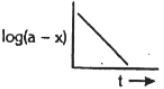
B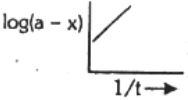
C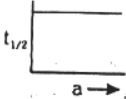
D
Both $A$ and $C$.
Solution
(D) For a first-order reaction,the integrated rate equation is given by: $\log(a - x) = -\frac{kt}{2.303} + \log a$.
This equation is of the form $y = mx + c$,where the slope $m = -\frac{k}{2.303}$. Thus,a plot of $\log(a - x)$ versus $t$ is a straight line with a negative slope. This matches graph $A$.
Additionally,for a first-order reaction,the half-life period is given by: $t_{1/2} = \frac{0.693}{k}$.
This shows that $t_{1/2}$ is independent of the initial concentration $a$. Thus,a plot of $t_{1/2}$ versus $a$ is a horizontal line parallel to the $a$-axis. This matches graph $C$.
Therefore,both graphs $A$ and $C$ represent a first-order reaction.
This equation is of the form $y = mx + c$,where the slope $m = -\frac{k}{2.303}$. Thus,a plot of $\log(a - x)$ versus $t$ is a straight line with a negative slope. This matches graph $A$.
Additionally,for a first-order reaction,the half-life period is given by: $t_{1/2} = \frac{0.693}{k}$.
This shows that $t_{1/2}$ is independent of the initial concentration $a$. Thus,a plot of $t_{1/2}$ versus $a$ is a horizontal line parallel to the $a$-axis. This matches graph $C$.
Therefore,both graphs $A$ and $C$ represent a first-order reaction.
0 likes
View Solution130
EasyMCQ
The reaction $2A \rightarrow \text{Product}$ follows first-order kinetics. If the initial concentration $[A]_0 = 0.2 \ mol \ L^{-1}$ and the half-life period $t_{1/2} = 20 \ min$,calculate the rate constant $k$.
A
$0.03465 \ min^{-1}$
B
$0.0693 \ min^{-1}$
C
$0.0173 \ min^{-1}$
D
None of these
Solution
(A) For a first-order reaction,the rate constant $k$ is related to the half-life $t_{1/2}$ by the formula:
$k = \frac{0.693}{t_{1/2}}$
Given $t_{1/2} = 20 \ min$.
Substituting the value:
$k = \frac{0.693}{20} = 0.03465 \ min^{-1}$
Therefore,the correct option is $A$.
$k = \frac{0.693}{t_{1/2}}$
Given $t_{1/2} = 20 \ min$.
Substituting the value:
$k = \frac{0.693}{20} = 0.03465 \ min^{-1}$
Therefore,the correct option is $A$.
0 likes
View Solution131
EasyMCQ
The half-life of a first-order reaction is $10 \ minutes$. If the initial concentration is $0.08 \ mol/L$ and at some instant the concentration is $0.01 \ mol/L$,then the time elapsed is ...... minutes.
A
$10$
B
$30$
C
$20$
D
$40$
Solution
(B) For a first-order reaction,the relationship between initial concentration $[A]_0$ and concentration at time $t$,$[A]_t$,is given by $[A]_t = \frac{[A]_0}{2^n}$,where $n$ is the number of half-lives.
Given: $[A]_0 = 0.08 \ mol/L$,$[A]_t = 0.01 \ mol/L$,and $t_{1/2} = 10 \ minutes$.
$2^n = \frac{[A]_0}{[A]_t} = \frac{0.08}{0.01} = 8$
Since $2^3 = 8$,we have $n = 3$.
The total time $t$ is given by $t = n \times t_{1/2}$.
$t = 3 \times 10 \ minutes = 30 \ minutes$.
Given: $[A]_0 = 0.08 \ mol/L$,$[A]_t = 0.01 \ mol/L$,and $t_{1/2} = 10 \ minutes$.
$2^n = \frac{[A]_0}{[A]_t} = \frac{0.08}{0.01} = 8$
Since $2^3 = 8$,we have $n = 3$.
The total time $t$ is given by $t = n \times t_{1/2}$.
$t = 3 \times 10 \ minutes = 30 \ minutes$.
0 likes
View Solution132
DifficultMCQ
For the first-order gaseous reaction $A \rightarrow 2B + C$ at $373 \, K$,starting with pure $A$,the total pressure of the system after $10 \, min$ is $176 \, mm \, Hg$ and after a long time,it is $270 \, mm \, Hg$. Based on this information,calculate: $(1)$ Initial pressure of $A$,$(2)$ Pressure of $A$ after $10 \, min$,and $(3)$ Rate constant.
A
$90 \, mm, 47 \, mm, 6.496 \times 10^{-2} \, min^{-1}$
B
$80 \, mm, 43 \, mm, 6.496 \times 10^{-5} \, min^{-1}$
C
$75 \, mm, 41 \, mm, 6.496 \times 10^{-2} \, min^{-1}$
D
$90 \, mm, 43 \, mm, 6.496 \times 10^{-7} \, min^{-1}$
Solution
(A) Let the initial pressure of $A$ be $P_0$.
Reaction: $A(g) \rightarrow 2B(g) + C(g)$
At $t=0$: $P_0, 0, 0$ (Total pressure $= P_0$)
At $t=10 \, min$: $P_0-x, 2x, x$ (Total pressure $= P_0 + 2x = 176 \, mm$)
At $t=\infty$: $0, 2P_0, P_0$ (Total pressure $= 3P_0 = 270 \, mm$)
$(1)$ Initial pressure $P_0 = 270 / 3 = 90 \, mm$.
$(2)$ At $t=10 \, min$,$P_0 + 2x = 176 \implies 90 + 2x = 176 \implies 2x = 86 \implies x = 43 \, mm$.
Pressure of $A$ remaining $= P_0 - x = 90 - 43 = 47 \, mm$.
$(3)$ Rate constant $k = \frac{2.303}{t} \log \frac{P_0}{P_0-x} = \frac{2.303}{10} \log \frac{90}{47} = \frac{2.303}{10} \times 0.2821 = 6.496 \times 10^{-2} \, min^{-1}$.
Reaction: $A(g) \rightarrow 2B(g) + C(g)$
At $t=0$: $P_0, 0, 0$ (Total pressure $= P_0$)
At $t=10 \, min$: $P_0-x, 2x, x$ (Total pressure $= P_0 + 2x = 176 \, mm$)
At $t=\infty$: $0, 2P_0, P_0$ (Total pressure $= 3P_0 = 270 \, mm$)
$(1)$ Initial pressure $P_0 = 270 / 3 = 90 \, mm$.
$(2)$ At $t=10 \, min$,$P_0 + 2x = 176 \implies 90 + 2x = 176 \implies 2x = 86 \implies x = 43 \, mm$.
Pressure of $A$ remaining $= P_0 - x = 90 - 43 = 47 \, mm$.
$(3)$ Rate constant $k = \frac{2.303}{t} \log \frac{P_0}{P_0-x} = \frac{2.303}{10} \log \frac{90}{47} = \frac{2.303}{10} \times 0.2821 = 6.496 \times 10^{-2} \, min^{-1}$.
0 likes
View Solution133
DifficultMCQ
For a first-order reaction,the rate constant is $60 \ s^{-1}$. How much time will it take for the initial concentration of the reactant to be reduced to $1/10$th of its initial value?
A
$3.8 \times 10^{-2} \ s$
B
$1.26 \times 10^{13} \ s$
C
$2.01 \times 10^{13} \ s$
D
$1.097 \times 10^{13} \ s$
Solution
(A) For a first-order reaction,the formula is $t = \frac{2.303}{k} \log \frac{[R]_0}{[R]_t}$.
Here,$[R]_0$ is the initial concentration and $[R]_t$ is the concentration at time $t$.
Given,$k = 60 \ s^{-1}$ and $[R]_t = \frac{[R]_0}{10}$.
Substituting the values: $t = \frac{2.303}{60} \log \frac{[R]_0}{[R]_0/10}$.
$t = \frac{2.303}{60} \log(10)$.
Since $\log(10) = 1$,$t = \frac{2.303}{60} \approx 3.838 \times 10^{-2} \ s$.
Here,$[R]_0$ is the initial concentration and $[R]_t$ is the concentration at time $t$.
Given,$k = 60 \ s^{-1}$ and $[R]_t = \frac{[R]_0}{10}$.
Substituting the values: $t = \frac{2.303}{60} \log \frac{[R]_0}{[R]_0/10}$.
$t = \frac{2.303}{60} \log(10)$.
Since $\log(10) = 1$,$t = \frac{2.303}{60} \approx 3.838 \times 10^{-2} \ s$.
0 likes
View Solution134
EasyMCQ
For a first-order reaction,which of the following statements is correct?
A
The degree of dissociation is equal to $(1 - e^{-kt})$.
B
The pre-exponential factor in the Arrhenius equation has the dimensions of time.
C
The plot of reciprocal concentration versus time is a straight line.
D
Both $A$ and $B$.
Solution
(A) For a first-order reaction,the integrated rate law is given by $[A]_t = [A]_0 e^{-kt}$.
The degree of dissociation (or fraction reacted) $\alpha$ is given by $\alpha = \frac{[A]_0 - [A]_t}{[A]_0} = 1 - \frac{[A]_t}{[A]_0} = 1 - e^{-kt}$.
Thus,option $A$ is correct.
In the Arrhenius equation $k = A e^{-E_a/RT}$,the pre-exponential factor $A$ has the same units as the rate constant $k$. For a first-order reaction,the unit of $k$ is $s^{-1}$,which is the reciprocal of time,not time itself. Therefore,option $B$ is incorrect.
For a first-order reaction,the plot of $\ln[A]$ versus time is a straight line,not the reciprocal of concentration. Therefore,option $C$ is incorrect.
The degree of dissociation (or fraction reacted) $\alpha$ is given by $\alpha = \frac{[A]_0 - [A]_t}{[A]_0} = 1 - \frac{[A]_t}{[A]_0} = 1 - e^{-kt}$.
Thus,option $A$ is correct.
In the Arrhenius equation $k = A e^{-E_a/RT}$,the pre-exponential factor $A$ has the same units as the rate constant $k$. For a first-order reaction,the unit of $k$ is $s^{-1}$,which is the reciprocal of time,not time itself. Therefore,option $B$ is incorrect.
For a first-order reaction,the plot of $\ln[A]$ versus time is a straight line,not the reciprocal of concentration. Therefore,option $C$ is incorrect.
0 likes
View Solution135
MediumMCQ
For a first-order reaction $A \rightarrow B$,if the rate constant is $k$ and the initial concentration of reactant $A$ is $0.5 \ M$,what is its half-life period?
A
$\frac{0.693}{0.5k}$
B
$\frac{\log 2}{k}$
C
$\frac{\log 2}{k \sqrt{0.5}}$
D
$\frac{\ln 2}{k}$
Solution
(D) For a first-order reaction,the half-life period $(t_{1/2})$ is given by the formula:
$t_{1/2} = \frac{\ln 2}{k} = \frac{0.693}{k}$.
Since the half-life of a first-order reaction is independent of the initial concentration of the reactant,the initial concentration of $0.5 \ M$ does not affect the value of $t_{1/2}$.
Therefore,the correct expression is $\frac{\ln 2}{k}$.
$t_{1/2} = \frac{\ln 2}{k} = \frac{0.693}{k}$.
Since the half-life of a first-order reaction is independent of the initial concentration of the reactant,the initial concentration of $0.5 \ M$ does not affect the value of $t_{1/2}$.
Therefore,the correct expression is $\frac{\ln 2}{k}$.
0 likes
View Solution136
MediumMCQ
The half-life period of a reaction is $1386 \ s$. What is the value of the specific rate constant for the reaction?
A
$0.5 \times 10^{-3} \ s^{-1}$
B
$5.0 \times 10^{-2} \ s^{-1}$
C
$5.0 \times 10^{-3} \ s^{-1}$
D
$0.5 \times 10^{-2} \ s^{-1}$
Solution
(A) For a first-order reaction,the rate constant $k$ is related to the half-life $t_{1/2}$ by the formula:
$k = \frac{0.693}{t_{1/2}}$
Given $t_{1/2} = 1386 \ s$.
Substituting the value:
$k = \frac{0.693}{1386} \ s^{-1}$
$k = 0.0005 \ s^{-1}$
$k = 0.5 \times 10^{-3} \ s^{-1}$
$k = \frac{0.693}{t_{1/2}}$
Given $t_{1/2} = 1386 \ s$.
Substituting the value:
$k = \frac{0.693}{1386} \ s^{-1}$
$k = 0.0005 \ s^{-1}$
$k = 0.5 \times 10^{-3} \ s^{-1}$
0 likes
View Solution137
MediumMCQ
Which of the following is the correct equation for a first-order reaction?
A
$C_t = C_0 e^{-k_1 t}$
B
$C_t e^{k_1 t} = C_0$
C
$\ln \frac{C_0}{C_t} = -k_1 t$
D
$\ln \frac{C_t}{C_0} = k_1 t$
Solution
(B) For a first-order reaction,the integrated rate equation is given by:
$\ln \frac{C_t}{C_0} = -k_1 t$
Rearranging this,we get:
$\ln \frac{C_0}{C_t} = k_1 t$
Or,in exponential form:
$C_t = C_0 e^{-k_1 t}$
Which can be rewritten as:
$C_t e^{k_1 t} = C_0$
Thus,option $B$ is the correct representation.
$\ln \frac{C_t}{C_0} = -k_1 t$
Rearranging this,we get:
$\ln \frac{C_0}{C_t} = k_1 t$
Or,in exponential form:
$C_t = C_0 e^{-k_1 t}$
Which can be rewritten as:
$C_t e^{k_1 t} = C_0$
Thus,option $B$ is the correct representation.
0 likes
View Solution138
MediumMCQ
The time of completion of $90\%$ of a first order reaction is approximately
A
$1.1$ times that of half life
B
$2.2$ times that of half life
C
$3.3$ times that of half life
D
$4.4$ times that of half life
Solution
(C) For a first order reaction,the rate constant is given by $K = \frac{2.303}{t} \log \frac{a}{a-x}$.
For $90\%$ completion,$x = 0.9a$,so $a-x = 0.1a$. Thus,$t_{90\%} = \frac{2.303}{K} \log \frac{a}{0.1a} = \frac{2.303}{K} \log 10 = \frac{2.303}{K}$.
We know that the half-life is $t_{1/2} = \frac{0.693}{K}$,which implies $K = \frac{0.693}{t_{1/2}}$.
Substituting $K$ in the expression for $t_{90\%}$:
$t_{90\%} = \frac{2.303}{0.693 / t_{1/2}} = \frac{2.303}{0.693} \times t_{1/2} \approx 3.32 \times t_{1/2}$.
Therefore,the time is approximately $3.3$ times the half-life.
For $90\%$ completion,$x = 0.9a$,so $a-x = 0.1a$. Thus,$t_{90\%} = \frac{2.303}{K} \log \frac{a}{0.1a} = \frac{2.303}{K} \log 10 = \frac{2.303}{K}$.
We know that the half-life is $t_{1/2} = \frac{0.693}{K}$,which implies $K = \frac{0.693}{t_{1/2}}$.
Substituting $K$ in the expression for $t_{90\%}$:
$t_{90\%} = \frac{2.303}{0.693 / t_{1/2}} = \frac{2.303}{0.693} \times t_{1/2} \approx 3.32 \times t_{1/2}$.
Therefore,the time is approximately $3.3$ times the half-life.
0 likes
View Solution139
MediumMCQ
$A$ first order reaction has a specific reaction rate of $10^{-2} \ sec^{-1}.$ How much time will it take for $20 \ g$ of the reactant to reduce to $5 \ g?$ ........ $sec$
A
$138.6$
B
$346.5$
C
$693.0$
D
$238.6$
Solution
(A) For a first order reaction,the integrated rate equation is given by:
$t = \frac{2.303}{k} \log \frac{[A]_0}{[A]_t}$
Given:
$k = 10^{-2} \ sec^{-1}$
$[A]_0 = 20 \ g$
$[A]_t = 5 \ g$
Substituting the values:
$t = \frac{2.303}{10^{-2}} \log \frac{20}{5}$
$t = 230.3 \times \log(4)$
$t = 230.3 \times 0.6021$
$t \approx 138.6 \ sec$
$t = \frac{2.303}{k} \log \frac{[A]_0}{[A]_t}$
Given:
$k = 10^{-2} \ sec^{-1}$
$[A]_0 = 20 \ g$
$[A]_t = 5 \ g$
Substituting the values:
$t = \frac{2.303}{10^{-2}} \log \frac{20}{5}$
$t = 230.3 \times \log(4)$
$t = 230.3 \times 0.6021$
$t \approx 138.6 \ sec$
0 likes
View Solution140
AdvancedMCQ
The rate of a first-order reaction is $0.04 \ mol \ L^{-1} \ s^{-1}$ at $10 \ s$ and $0.03 \ mol \ L^{-1} \ s^{-1}$ at $20 \ s$ after the initiation of the reaction. The half-life period of the reaction is ......... $s$. (in $.1$)
A
$44$
B
$54$
C
$24$
D
$34$
Solution
(C) For a first-order reaction,the rate $R$ at time $t$ is given by $R = k[A]_t$,where $[A]_t = [A]_0 e^{-kt}$.
Thus,$R_t = k[A]_0 e^{-kt} = R_0 e^{-kt}$.
Given $R_{10} = 0.04 \ mol \ L^{-1} \ s^{-1}$ and $R_{20} = 0.03 \ mol \ L^{-1} \ s^{-1}$.
Taking the ratio: $\frac{R_{10}}{R_{20}} = \frac{e^{-k(10)}}{e^{-k(20)}} = e^{10k} = \frac{0.04}{0.03} = 1.333$.
Taking natural log on both sides: $10k = \ln(1.333) = 0.2877$.
$k = 0.02877 \ s^{-1}$.
The half-life period is $t_{1/2} = \frac{0.693}{k} = \frac{0.693}{0.02877} \approx 24.1 \ s$.
Thus,$R_t = k[A]_0 e^{-kt} = R_0 e^{-kt}$.
Given $R_{10} = 0.04 \ mol \ L^{-1} \ s^{-1}$ and $R_{20} = 0.03 \ mol \ L^{-1} \ s^{-1}$.
Taking the ratio: $\frac{R_{10}}{R_{20}} = \frac{e^{-k(10)}}{e^{-k(20)}} = e^{10k} = \frac{0.04}{0.03} = 1.333$.
Taking natural log on both sides: $10k = \ln(1.333) = 0.2877$.
$k = 0.02877 \ s^{-1}$.
The half-life period is $t_{1/2} = \frac{0.693}{k} = \frac{0.693}{0.02877} \approx 24.1 \ s$.
0 likes
View Solution141
EasyMCQ
$A$ reaction is $50\%$ complete in $2 \ hours$ and $75\%$ complete in $4 \ hours$. The order of reaction is
A
$1$
B
$2$
C
$3$
D
$0$
Solution
(A) For a first-order reaction,the half-life $t_{1/2}$ is constant.
After $2 \ hours$,the reaction is $50\%$ complete,meaning $t_{1/2} = 2 \ hours$.
After another $2 \ hours$ (total $4 \ hours$),the remaining $50\%$ of the reactant is halved again,making the reaction $75\%$ complete $(50\% + 25\% = 75\%)$.
Since the time taken for each successive half-life is constant $(2 \ hours)$,the reaction follows first-order kinetics.
After $2 \ hours$,the reaction is $50\%$ complete,meaning $t_{1/2} = 2 \ hours$.
After another $2 \ hours$ (total $4 \ hours$),the remaining $50\%$ of the reactant is halved again,making the reaction $75\%$ complete $(50\% + 25\% = 75\%)$.
Since the time taken for each successive half-life is constant $(2 \ hours)$,the reaction follows first-order kinetics.
0 likes
View Solution142
MediumMCQ
The half-life of a substance in a certain enzyme-catalysed reaction is $138 \; s$. The time required for the concentration of the substance to fall from $1.28 \; mg \; L^{-1}$ to $0.04 \; mg \; L^{-1}$ is ....... $s$.
A
$414$
B
$552$
C
$690$
D
$276$
Solution
(C) Enzyme-catalysed reactions follow first-order kinetics.
The concentration of the substance decreases from $1.28 \; mg \; L^{-1}$ to $0.04 \; mg \; L^{-1}$.
We can calculate the number of half-lives $(n)$ as follows:
$1.28$ $\xrightarrow{t_{1/2}} 0.64$ $\xrightarrow{t_{1/2}} 0.32$ $\xrightarrow{t_{1/2}} 0.16$ $\xrightarrow{t_{1/2}} 0.08$ $\xrightarrow{t_{1/2}} 0.04$
This sequence shows that the concentration reduces by half $5$ times,so $n = 5$.
The total time required is $t = n \times t_{1/2}$.
$t = 5 \times 138 \; s = 690 \; s$.
The concentration of the substance decreases from $1.28 \; mg \; L^{-1}$ to $0.04 \; mg \; L^{-1}$.
We can calculate the number of half-lives $(n)$ as follows:
$1.28$ $\xrightarrow{t_{1/2}} 0.64$ $\xrightarrow{t_{1/2}} 0.32$ $\xrightarrow{t_{1/2}} 0.16$ $\xrightarrow{t_{1/2}} 0.08$ $\xrightarrow{t_{1/2}} 0.04$
This sequence shows that the concentration reduces by half $5$ times,so $n = 5$.
The total time required is $t = n \times t_{1/2}$.
$t = 5 \times 138 \; s = 690 \; s$.
0 likes
View Solution143
MediumMCQ
Half-life period of a first order reaction is $1386 \ s$. The specific rate constant of the reaction is
A
$0.5 \times 10^{-2} \ s^{-1}$
B
$0.5 \times 10^{-3} \ s^{-1}$
C
$5.0 \times 10^{-2} \ s^{-1}$
D
$5.0 \times 10^{-3} \ s^{-1}$
Solution
(B) Given: Half-life period $(t_{1/2})$ = $1386 \ s$.
For a first-order reaction,the relationship between half-life and rate constant $(k)$ is given by:
$t_{1/2} = \frac{0.693}{k}$
Rearranging for $k$:
$k = \frac{0.693}{t_{1/2}}$
Substituting the value:
$k = \frac{0.693}{1386} \ s^{-1}$
$k = 0.0005 \ s^{-1}$
$k = 5.0 \times 10^{-4} \ s^{-1} = 0.5 \times 10^{-3} \ s^{-1}$.
For a first-order reaction,the relationship between half-life and rate constant $(k)$ is given by:
$t_{1/2} = \frac{0.693}{k}$
Rearranging for $k$:
$k = \frac{0.693}{t_{1/2}}$
Substituting the value:
$k = \frac{0.693}{1386} \ s^{-1}$
$k = 0.0005 \ s^{-1}$
$k = 5.0 \times 10^{-4} \ s^{-1} = 0.5 \times 10^{-3} \ s^{-1}$.
0 likes
View Solution144
MediumMCQ
If $60\%$ of a first order reaction was completed in $60 \ min$,$50\%$ of the same reaction would be completed in approximately $.......... \ min.$
$(\log \, 4 = 0.60, \, \log \, 5 = 0.69)$
$(\log \, 4 = 0.60, \, \log \, 5 = 0.69)$
A
$45$
B
$60$
C
$40$
D
$50$
Solution
(A) For a first order reaction,the rate constant $k$ is given by $k = \frac{2.303}{t} \log \frac{[A]_0}{[A]_t}$.
Given that $60\%$ is completed in $60 \ min$,$[A]_t = 100 - 60 = 40$.
$k = \frac{2.303}{60} \log \frac{100}{40} = \frac{2.303}{60} \log 2.5$.
Using $\log 2.5 = \log(10/4) = \log 10 - \log 4 = 1 - 0.60 = 0.40$.
$k = \frac{2.303 \times 0.40}{60} = \frac{0.9212}{60} \ min^{-1}$.
For $50\%$ completion $(t_{1/2})$,$t_{1/2} = \frac{0.693}{k}$.
$t_{1/2} = \frac{0.693 \times 60}{0.9212} \approx 45.12 \ min$.
Thus,the reaction is completed in approximately $45 \ min$.
Given that $60\%$ is completed in $60 \ min$,$[A]_t = 100 - 60 = 40$.
$k = \frac{2.303}{60} \log \frac{100}{40} = \frac{2.303}{60} \log 2.5$.
Using $\log 2.5 = \log(10/4) = \log 10 - \log 4 = 1 - 0.60 = 0.40$.
$k = \frac{2.303 \times 0.40}{60} = \frac{0.9212}{60} \ min^{-1}$.
For $50\%$ completion $(t_{1/2})$,$t_{1/2} = \frac{0.693}{k}$.
$t_{1/2} = \frac{0.693 \times 60}{0.9212} \approx 45.12 \ min$.
Thus,the reaction is completed in approximately $45 \ min$.
0 likes
View Solution145
MediumMCQ
In a first-order reaction $A \rightarrow B,$ if $k$ is the rate constant and the initial concentration of the reactant $A$ is $0.5 \ M,$ then the half-life is:
A
$\frac{\log 2}{k}$
B
$\frac{\log 2}{k \sqrt{0.5}}$
C
$\frac{\ln 2}{k}$
D
$\frac{0.693}{0.5 \ k}$
Solution
(C) For a first-order reaction,the rate constant $k$ is given by the equation:
$k = \frac{2.303}{t} \log \frac{[A]_0}{[A]_t}$
At half-life $(t_{1/2})$,the concentration of the reactant $[A]_t = \frac{[A]_0}{2}$.
Substituting this into the equation:
$t_{1/2} = \frac{2.303}{k} \log \frac{[A]_0}{[A]_0 / 2}$
$t_{1/2} = \frac{2.303}{k} \log 2$
Since $2.303 \log 2 = \ln 2$,we get:
$t_{1/2} = \frac{\ln 2}{k}$
The half-life of a first-order reaction is independent of the initial concentration of the reactant.
$k = \frac{2.303}{t} \log \frac{[A]_0}{[A]_t}$
At half-life $(t_{1/2})$,the concentration of the reactant $[A]_t = \frac{[A]_0}{2}$.
Substituting this into the equation:
$t_{1/2} = \frac{2.303}{k} \log \frac{[A]_0}{[A]_0 / 2}$
$t_{1/2} = \frac{2.303}{k} \log 2$
Since $2.303 \log 2 = \ln 2$,we get:
$t_{1/2} = \frac{\ln 2}{k}$
The half-life of a first-order reaction is independent of the initial concentration of the reactant.
0 likes
View Solution146
DifficultMCQ
The half-life period of a first-order chemical reaction is $6.93 \, \text{min}$. The time required for the completion of $99 \%$ of the chemical reaction will be ........ $\text{min}$. $(\log 2 = 0.301)$
A
$23.03$
B
$46.06$
C
$460.6$
D
$230.03$
Solution
(B) For a first-order reaction,the rate constant $k$ is given by $k = \frac{0.693}{t_{1/2}}$.
Given $t_{1/2} = 6.93 \, \text{min}$,so $k = \frac{0.693}{6.93} = 0.1 \, \text{min}^{-1}$.
The integrated rate equation for a first-order reaction is $k = \frac{2.303}{t} \log \frac{[A]_0}{[A]_t}$.
For $99 \%$ completion,$[A]_0 = 100$ and $[A]_t = 100 - 99 = 1$.
Substituting the values: $0.1 = \frac{2.303}{t} \log \frac{100}{1}$.
$0.1 = \frac{2.303 \times 2}{t}$.
$t = \frac{4.606}{0.1} = 46.06 \, \text{min}$.
Given $t_{1/2} = 6.93 \, \text{min}$,so $k = \frac{0.693}{6.93} = 0.1 \, \text{min}^{-1}$.
The integrated rate equation for a first-order reaction is $k = \frac{2.303}{t} \log \frac{[A]_0}{[A]_t}$.
For $99 \%$ completion,$[A]_0 = 100$ and $[A]_t = 100 - 99 = 1$.
Substituting the values: $0.1 = \frac{2.303}{t} \log \frac{100}{1}$.
$0.1 = \frac{2.303 \times 2}{t}$.
$t = \frac{4.606}{0.1} = 46.06 \, \text{min}$.
0 likes
View Solution147
MediumMCQ
For a first order reaction $(A) \rightarrow$ products,the concentration of $A$ changes from $0.1 \ M$ to $0.025 \ M$ in $40 \ min$.
The rate of reaction when the concentration of $A$ is $0.01 \ M$ is ............$ \times 10^{-4} \ M/min$.
The rate of reaction when the concentration of $A$ is $0.01 \ M$ is ............$ \times 10^{-4} \ M/min$.
A
$0.173$
B
$3.47$
C
$0.347$
D
$1.73$
Solution
(B) For a first order reaction,the rate constant $k$ is given by:
$k = \frac{2.303}{t} \log \frac{[A]_0}{[A]_t}$
Substituting the given values:
$k = \frac{2.303}{40} \log \frac{0.1}{0.025}$
$k = \frac{2.303}{40} \log 4$
$k = \frac{2.303 \times 0.6020}{40} \approx 3.47 \times 10^{-2} \ min^{-1}$
The rate of reaction $R$ is given by $R = k[A]$.
For $[A] = 0.01 \ M$:
$R = (3.47 \times 10^{-2}) \times 0.01$
$R = 3.47 \times 10^{-4} \ M/min$.
$k = \frac{2.303}{t} \log \frac{[A]_0}{[A]_t}$
Substituting the given values:
$k = \frac{2.303}{40} \log \frac{0.1}{0.025}$
$k = \frac{2.303}{40} \log 4$
$k = \frac{2.303 \times 0.6020}{40} \approx 3.47 \times 10^{-2} \ min^{-1}$
The rate of reaction $R$ is given by $R = k[A]$.
For $[A] = 0.01 \ M$:
$R = (3.47 \times 10^{-2}) \times 0.01$
$R = 3.47 \times 10^{-4} \ M/min$.
0 likes
View Solution148
AdvancedMCQ
Decomposition of $H_2O_2$ follows a first order reaction. In $50 \ min$,the concentration of $H_2O_2$ decreases from $0.5 \ M$ to $0.125 \ M$. For such decomposition,when the concentration of $H_2O_2$ reaches $0.05 \ M$,the rate of formation of $O_2$ will be:
A
$2.66 \ L \ min^{-1}$ at $STP$
B
$1.34 \times 10^{-2} \ mol \ min^{-1}$
C
$6.96 \times 10^{-2} \ mol \ min^{-1}$
D
$6.93 \times 10^{-4} \ mol \ min^{-1}$
Solution
(D) The decomposition reaction is: $H_2O_{2(aq)} \rightarrow H_2O_{(l)} + \frac{1}{2} O_{2(g)}$
For a first order reaction,the rate constant $k$ is given by: $k = \frac{2.303}{t} \log \frac{[A]_0}{[A]_t}$
Given $[A]_0 = 0.5 \ M$,$[A]_t = 0.125 \ M$,and $t = 50 \ min$:
$k = \frac{2.303}{50} \log \frac{0.5}{0.125} = \frac{2.303}{50} \log(4) = \frac{2.303 \times 0.602}{50} \approx 0.0277 \ min^{-1}$
When $[H_2O_2] = 0.05 \ M$,the rate of disappearance of $H_2O_2$ is:
$Rate_{H_2O_2} = k[H_2O_2] = 0.0277 \times 0.05 = 1.385 \times 10^{-3} \ mol \ L^{-1} \ min^{-1}$
From the stoichiometry,$-\frac{d[H_2O_2]}{dt} = 2 \frac{d[O_2]}{dt}$,so the rate of formation of $O_2$ is:
$\frac{d[O_2]}{dt} = \frac{1}{2} \times Rate_{H_2O_2} = \frac{1.385 \times 10^{-3}}{2} = 6.925 \times 10^{-4} \ mol \ L^{-1} \ min^{-1} \approx 6.93 \times 10^{-4} \ mol \ min^{-1}$
For a first order reaction,the rate constant $k$ is given by: $k = \frac{2.303}{t} \log \frac{[A]_0}{[A]_t}$
Given $[A]_0 = 0.5 \ M$,$[A]_t = 0.125 \ M$,and $t = 50 \ min$:
$k = \frac{2.303}{50} \log \frac{0.5}{0.125} = \frac{2.303}{50} \log(4) = \frac{2.303 \times 0.602}{50} \approx 0.0277 \ min^{-1}$
When $[H_2O_2] = 0.05 \ M$,the rate of disappearance of $H_2O_2$ is:
$Rate_{H_2O_2} = k[H_2O_2] = 0.0277 \times 0.05 = 1.385 \times 10^{-3} \ mol \ L^{-1} \ min^{-1}$
From the stoichiometry,$-\frac{d[H_2O_2]}{dt} = 2 \frac{d[O_2]}{dt}$,so the rate of formation of $O_2$ is:
$\frac{d[O_2]}{dt} = \frac{1}{2} \times Rate_{H_2O_2} = \frac{1.385 \times 10^{-3}}{2} = 6.925 \times 10^{-4} \ mol \ L^{-1} \ min^{-1} \approx 6.93 \times 10^{-4} \ mol \ min^{-1}$
0 likes
View Solution149
MediumMCQ
The ratio of the time taken to complete $60\%$ and $20\%$ of a first-order reaction $[A \rightarrow \text{product}]$ is : $(\log 2 = 0.3)$
A
$3$
B
$2$
C
$1$
D
$4$
Solution
(D) For a first-order reaction,the rate constant $K$ is given by $K = \frac{2.303}{t} \log \frac{[A]_0}{[A]_t}$.
For $20\%$ completion,$[A]_t = 100 - 20 = 80$,so $K = \frac{2.303}{t_{20}} \log \frac{100}{80} = \frac{2.303}{t_{20}} \log 1.25$.
For $60\%$ completion,$[A]_t = 100 - 60 = 40$,so $K = \frac{2.303}{t_{60}} \log \frac{100}{40} = \frac{2.303}{t_{60}} \log 2.5$.
Equating the two expressions for $K$: $\frac{1}{t_{20}} \log 1.25 = \frac{1}{t_{60}} \log 2.5$.
Therefore,$\frac{t_{60}}{t_{20}} = \frac{\log 2.5}{\log 1.25} = \frac{\log(10/4)}{\log(10/8)} = \frac{\log 10 - \log 4}{\log 10 - \log 8} = \frac{1 - 2 \log 2}{1 - 3 \log 2}$.
Given $\log 2 = 0.3$,we have $\frac{t_{60}}{t_{20}} = \frac{1 - 2(0.3)}{1 - 3(0.3)} = \frac{1 - 0.6}{1 - 0.9} = \frac{0.4}{0.1} = 4$.
For $20\%$ completion,$[A]_t = 100 - 20 = 80$,so $K = \frac{2.303}{t_{20}} \log \frac{100}{80} = \frac{2.303}{t_{20}} \log 1.25$.
For $60\%$ completion,$[A]_t = 100 - 60 = 40$,so $K = \frac{2.303}{t_{60}} \log \frac{100}{40} = \frac{2.303}{t_{60}} \log 2.5$.
Equating the two expressions for $K$: $\frac{1}{t_{20}} \log 1.25 = \frac{1}{t_{60}} \log 2.5$.
Therefore,$\frac{t_{60}}{t_{20}} = \frac{\log 2.5}{\log 1.25} = \frac{\log(10/4)}{\log(10/8)} = \frac{\log 10 - \log 4}{\log 10 - \log 8} = \frac{1 - 2 \log 2}{1 - 3 \log 2}$.
Given $\log 2 = 0.3$,we have $\frac{t_{60}}{t_{20}} = \frac{1 - 2(0.3)}{1 - 3(0.3)} = \frac{1 - 0.6}{1 - 0.9} = \frac{0.4}{0.1} = 4$.
0 likes
View Solution150
MediumMCQ
The half-life of a first order reaction $X \to Y$ is $100 \ min$. The concentration of $X$ would be reduced to $10 \%$ of the initial concentration in .......... $min$.
A
$100$
B
$332$
C
$900$
D
$700$
Solution
(B) For a first order reaction,the rate constant $k$ is given by $k = \frac{0.693}{t_{1/2}}$.
Given $t_{1/2} = 100 \ min$,so $k = \frac{0.693}{100} = 6.93 \times 10^{-3} \ min^{-1}$.
The integrated rate equation for a first order reaction is $t = \frac{2.303}{k} \log \frac{[A]_0}{[A]_t}$.
Here,$[A]_t = 10 \% \text{ of } [A]_0$,so $\frac{[A]_0}{[A]_t} = \frac{100}{10} = 10$.
Substituting the values: $t = \frac{2.303}{6.93 \times 10^{-3}} \log(10)$.
Since $\log(10) = 1$,$t = \frac{2.303}{0.00693} \approx 332.3 \ min$.
Thus,the time required is approximately $332 \ min$.
Given $t_{1/2} = 100 \ min$,so $k = \frac{0.693}{100} = 6.93 \times 10^{-3} \ min^{-1}$.
The integrated rate equation for a first order reaction is $t = \frac{2.303}{k} \log \frac{[A]_0}{[A]_t}$.
Here,$[A]_t = 10 \% \text{ of } [A]_0$,so $\frac{[A]_0}{[A]_t} = \frac{100}{10} = 10$.
Substituting the values: $t = \frac{2.303}{6.93 \times 10^{-3}} \log(10)$.
Since $\log(10) = 1$,$t = \frac{2.303}{0.00693} \approx 332.3 \ min$.
Thus,the time required is approximately $332 \ min$.
0 likes
View SolutionChemical Kinetics — First Order reaction · Frequently Asked Questions
1Are these Chemical Kinetics questions useful for JEE and NEET?
Yes. All questions in this section are mapped to JEE Main and NEET exam patterns. Previous year questions from JEE Main, NEET, GUJCET and state-level exams are included with full solutions.
2Can I switch to Hindi or Gujarati for these questions?
Yes. Use the language tabs in the hero section or the sidebar to view the same questions and solutions in English, Hindi or Gujarati.
3How do I generate a question paper from this subtopic?
Use the Vedclass Exam Paper Generator — select the chapter and subtopic, set difficulty, and generate Sets A, B, C, D automatically. First 3 chapters of every subject are free.
Vedclass Products
For Students
Vedclass Test Series
Mock tests in real JEE/NEET style with performance analysis. 5-day free trial.
Start Free TrialFor Teachers
Exam Paper Generator
Generate Set A/B/C/D papers from this chapter in 2 minutes. 3 chapters free.
Try FreeFor Institutes
Online Exam Module
Live online exams with unlimited students, 360° analytics & white-label branding.
See DemoFor Teachers & Institutes
Generate a Chemical Kinetics Exam Paper in 2 Minutes
Select subtopic & difficulty — Sets A, B, C, D auto-generated with No Repeat logic.
First 3 chapters of every subject are free — no payment required.