
A English
Carbohydrates Questions in English
Class 12 Chemistry · Biomolecules · Carbohydrates
808+
Questions
English
Language
100%
With Solutions
Showing 50 of 808 questions in English
51
EasyMCQ
Which carbohydrate is an essential constituent of plant cell walls?
A
Cellulose
B
Sucrose
C
Vitamins
D
Starch
Solution
(A) The plant cell wall is primarily composed of $Cellulose$.
$Cellulose$ is a structural polysaccharide and is considered a complex carbohydrate because it provides structural support and protection to plant cells.
It consists of a linear chain of several hundred to many thousands of $1,4-$linked $\beta-D-Glucose$ units.
$Cellulose$ is a structural polysaccharide and is considered a complex carbohydrate because it provides structural support and protection to plant cells.
It consists of a linear chain of several hundred to many thousands of $1,4-$linked $\beta-D-Glucose$ units.
0 likes
View Solution52
MediumMCQ
Sugar can be tested in urine by
A
Molisch test
B
Dunstan's test
C
Benedict's test
D
Legal's test
Solution
(C) The presence of glucose (sugar) in urine is detected using Benedict's test.
Benedict's reagent contains $Cu^{2+}$ ions which are reduced to $Cu^+$ ions in the presence of a reducing sugar like glucose,forming a red precipitate of cuprous oxide $(Cu_2O)$.
The reaction is: $\text{Glucose} + \text{Benedict's solution} \to \text{Red colour } (Cu_2O)$.
Benedict's reagent contains $Cu^{2+}$ ions which are reduced to $Cu^+$ ions in the presence of a reducing sugar like glucose,forming a red precipitate of cuprous oxide $(Cu_2O)$.
The reaction is: $\text{Glucose} + \text{Benedict's solution} \to \text{Red colour } (Cu_2O)$.
0 likes
View Solution53
EasyMCQ
When sucrose is heated with conc. $HNO_3$,the product is:
A
Sucrose nitrate
B
Formic acid
C
Oxalic acid
D
Citric acid
Solution
(C) When sucrose $(C_{12}H_{22}O_{11})$ is heated with concentrated nitric acid $(HNO_3)$,it undergoes oxidation to form oxalic acid $(C_2H_2O_4)$ as the final product.
$C_{12}H_{22}O_{11} + 18[O] \xrightarrow{conc. HNO_3} 6C_2H_2O_4 + 5H_2O$
$C_{12}H_{22}O_{11} + 18[O] \xrightarrow{conc. HNO_3} 6C_2H_2O_4 + 5H_2O$
0 likes
View Solution54
EasyMCQ
Amylopectin is
A
Water soluble
B
Water insoluble
C
Forms colloidal solution with water
D
Both $B$ and $C$
Solution
(D) Amylopectin is a branched-chain polymer of $\alpha$-$D$-glucose units. Due to its high molecular weight and branched structure,it is insoluble in water. Therefore,the correct option is $D$.
0 likes
View Solution55
MediumMCQ
Which of the following statements about ribose is incorrect?
A
It is a polyhydroxy compound
B
It is an aldehyde sugar
C
It has six carbon atoms
D
It exhibits optical activity
Solution
(C) Ribose is a monosaccharide with five carbon atoms,known as a pentose sugar. Its molecular formula is $C_5H_{10}O_5$.
Since it contains five carbon atoms,the statement that it has six carbon atoms is incorrect.
Ribose is a polyhydroxy aldehyde (aldose),meaning it contains multiple hydroxyl $(-OH)$ groups and an aldehydic $(-CHO)$ functional group.
Due to the presence of chiral carbon atoms,it exhibits optical activity.
Since it contains five carbon atoms,the statement that it has six carbon atoms is incorrect.
Ribose is a polyhydroxy aldehyde (aldose),meaning it contains multiple hydroxyl $(-OH)$ groups and an aldehydic $(-CHO)$ functional group.
Due to the presence of chiral carbon atoms,it exhibits optical activity.
0 likes
View Solution56
EasyMCQ
Maltose contains how many oxygen atoms?
A
$6$
B
$10$
C
$11$
D
$22$
Solution
(C) The molecular formula of maltose is $C_{12}H_{22}O_{11}$.
From the formula,it is clear that one molecule of maltose contains $11$ oxygen atoms.
Therefore,the correct option is $(C)$.
From the formula,it is clear that one molecule of maltose contains $11$ oxygen atoms.
Therefore,the correct option is $(C)$.
0 likes
View Solution57
EasyMCQ
The correct systematic name of 'sucrose' is:
A
$\alpha-D$-glucopyranosyl-$\beta-D$-fructofuranoside
B
$\beta-D$-glucopyranosyl-$\beta-D$-fructofuranoside
C
$\alpha-D$-glucopyranosyl-$\alpha-D$-fructofuranoside
D
$\beta-D$-glucopyranosyl-$\alpha-L$-fructofuranoside
Solution
(A) Sucrose is a disaccharide composed of one molecule of $\alpha-D$-glucose and one molecule of $\beta-D$-fructose.
These two monosaccharide units are linked by a glycosidic linkage between $C1$ of $\alpha-D$-glucose and $C2$ of $\beta-D$-fructose.
Therefore,the systematic $IUPAC$ name of sucrose is $\alpha-D$-glucopyranosyl-$\beta-D$-fructofuranoside.
These two monosaccharide units are linked by a glycosidic linkage between $C1$ of $\alpha-D$-glucose and $C2$ of $\beta-D$-fructose.
Therefore,the systematic $IUPAC$ name of sucrose is $\alpha-D$-glucopyranosyl-$\beta-D$-fructofuranoside.
0 likes
View Solution58
EasyMCQ
Sucrose is
A
Laevorotatory
B
Dextrorotatory
C
Racemic mixture
D
Optically inactive
Solution
(B) Sucrose is dextrorotatory in nature with a specific rotation of $+66.5^{\circ}$.
Upon hydrolysis,it produces an equimolar mixture of $D-(+)$-glucose (dextrorotatory,$+52.5^{\circ}$) and $D-(-)$-fructose (laevorotatory,$-92^{\circ}$),resulting in an overall laevorotatory mixture known as invert sugar.
The hydrolysis reaction is:
$C_{12}H_{22}O_{11} + H_2O \xrightarrow{H^+} C_6H_{12}O_6 (\text{Glucose}) + C_6H_{12}O_6 (\text{Fructose})$
Upon hydrolysis,it produces an equimolar mixture of $D-(+)$-glucose (dextrorotatory,$+52.5^{\circ}$) and $D-(-)$-fructose (laevorotatory,$-92^{\circ}$),resulting in an overall laevorotatory mixture known as invert sugar.
The hydrolysis reaction is:
$C_{12}H_{22}O_{11} + H_2O \xrightarrow{H^+} C_6H_{12}O_6 (\text{Glucose}) + C_6H_{12}O_6 (\text{Fructose})$
0 likes
View Solution59
EasyMCQ
The hydrolysis of sucrose produces a mixture which is:
A
Laevorotatory
B
Dextrorotatory
C
Equally both $(+)$ and $(-)$ rotatory
D
Optically inactive
Solution
(A) Sucrose is dextrorotatory with a specific rotation of $+66.5^{\circ}$.
On hydrolysis,it produces an equimolar mixture of $D-(+)$-glucose $(+52.5^{\circ})$ and $D-(-)$-fructose $(-92.4^{\circ})$.
The net rotation of the resulting mixture is $\frac{+52.5^{\circ} + (-92.4^{\circ})}{2} = -19.95^{\circ}$.
Since the net rotation is negative,the mixture is laevorotatory and is known as invert sugar.
On hydrolysis,it produces an equimolar mixture of $D-(+)$-glucose $(+52.5^{\circ})$ and $D-(-)$-fructose $(-92.4^{\circ})$.
The net rotation of the resulting mixture is $\frac{+52.5^{\circ} + (-92.4^{\circ})}{2} = -19.95^{\circ}$.
Since the net rotation is negative,the mixture is laevorotatory and is known as invert sugar.
0 likes
View Solution60
EasyMCQ
Sucrose is
A
$A$ reducing sugar
B
Not a reducing sugar
C
Partial reducing sugar
D
Mixed sugar
Solution
(B) Sucrose is a non-reducing sugar because both its anomeric carbons (the $C1$ of glucose and $C2$ of fructose) are involved in the formation of the glycosidic linkage. Therefore,it does not have a free hemiacetal or hemiketal group to reduce Tollens' reagent or Fehling's solution.
0 likes
View Solution61
EasyMCQ
Sucrose contains which of the following groups?
A
$-CHO$
B
$>C=O$
C
Both $(a)$ and $(b)$
D
None of these
Solution
(D) Sucrose is a disaccharide formed by the condensation of $\alpha-D-glucose$ and $\beta-D-fructose$.
In the structure of sucrose,the glucose unit is in the pyranose form (containing a hemiacetal group) and the fructose unit is in the furanose form (containing a hemiketal group).
However,in the disaccharide linkage,the glycosidic bond is formed between the anomeric carbons of both monosaccharides.
Therefore,sucrose does not contain a free aldehydic $(-CHO)$ or free ketonic $(>C=O)$ group in its open-chain form,as both are involved in the glycosidic linkage.
Thus,the correct answer is $(d)$.
In the structure of sucrose,the glucose unit is in the pyranose form (containing a hemiacetal group) and the fructose unit is in the furanose form (containing a hemiketal group).
However,in the disaccharide linkage,the glycosidic bond is formed between the anomeric carbons of both monosaccharides.
Therefore,sucrose does not contain a free aldehydic $(-CHO)$ or free ketonic $(>C=O)$ group in its open-chain form,as both are involved in the glycosidic linkage.
Thus,the correct answer is $(d)$.
0 likes
View Solution62
EasyMCQ
The fructose molecule in sucrose exists as:
A
Furanose
B
Pyranose
C
Open chain
D
All
Solution
(A) Sucrose is a disaccharide composed of $\alpha$-$D$-glucose and $\beta$-$D$-fructose units.
In the structure of sucrose,the glucose unit exists in the pyranose form (six-membered ring),while the fructose unit exists in the furanose form (five-membered ring).
Therefore,the fructose molecule in sucrose exists as furanose.
In the structure of sucrose,the glucose unit exists in the pyranose form (six-membered ring),while the fructose unit exists in the furanose form (five-membered ring).
Therefore,the fructose molecule in sucrose exists as furanose.
0 likes
View Solution63
EasyMCQ
Which one of the following is laevorotatory?
A
Glucose
B
Sucrose
C
Fructose
D
None of these
Solution
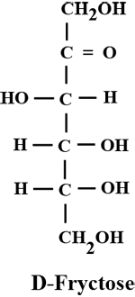
(C) Fructose is laevorotatory.
It rotates the plane of polarized light in an anticlockwise direction.
Thus,it is also called levulose and is named as $D-(-)$-fructose.
It rotates the plane of polarized light in an anticlockwise direction.
Thus,it is also called levulose and is named as $D-(-)$-fructose.
0 likes
View Solution64
EasyMCQ
Which one of the following is the reagent used to identify glucose?
A
Neutral ferric chloride
B
Chloroform and alcoholic $KOH$
C
Ammoniacal silver nitrate
D
Sodium ethoxide
Solution
(C) Glucose contains an aldehyde group $(-CHO)$ in its open-chain structure,which acts as a reducing agent.
Ammoniacal silver nitrate,also known as $Tollen's$ reagent,is used to identify aldehydes.
Glucose reacts with $Tollen's$ reagent to form a silver mirror,confirming the presence of the aldehyde group.
The reaction is: $R-CHO + 2[Ag(NH_3)_2]^+ + 3OH^- \rightarrow R-COO^- + 2Ag + 2H_2O + 4NH_3$.
Ammoniacal silver nitrate,also known as $Tollen's$ reagent,is used to identify aldehydes.
Glucose reacts with $Tollen's$ reagent to form a silver mirror,confirming the presence of the aldehyde group.
The reaction is: $R-CHO + 2[Ag(NH_3)_2]^+ + 3OH^- \rightarrow R-COO^- + 2Ag + 2H_2O + 4NH_3$.
0 likes
View Solution65
EasyMCQ
Sucrose on hydrolysis gives
A
Two molecules of glucose
B
Two molecules of fructose
C
One molecule each of glucose and fructose
D
One molecule each of glucose and mannose
Solution
(C) Sucrose is a disaccharide composed of $1$ unit of $\alpha-D-glucose$ and $1$ unit of $\beta-D-fructose$ linked by a glycosidic bond.
Upon hydrolysis,the glycosidic linkage breaks,yielding $1$ molecule of glucose and $1$ molecule of fructose.
Upon hydrolysis,the glycosidic linkage breaks,yielding $1$ molecule of glucose and $1$ molecule of fructose.
0 likes
View Solution66
EasyMCQ
Which of the following is a disaccharide?
A
Lactose
B
Starch
C
Cellulose
D
Glucose
Solution
(A) Disaccharides are oligosaccharides formed by the condensation of two monosaccharide units.
Lactose is a disaccharide composed of one molecule of $D$-glucose and one molecule of $D$-galactose.
Starch and cellulose are polysaccharides,while glucose is a monosaccharide.
Therefore,lactose is the correct answer.
Lactose is a disaccharide composed of one molecule of $D$-glucose and one molecule of $D$-galactose.
Starch and cellulose are polysaccharides,while glucose is a monosaccharide.
Therefore,lactose is the correct answer.
0 likes
View Solution67
EasyMCQ
Glucose cannot be classified as
A
$A$ hexose
B
$A$ carbohydrate
C
An oligosaccharide
D
An aldose
Solution
(C) Glucose contains just $1$ ring ($1$ carbohydrate unit) so it is a monosaccharide.
It is not an oligosaccharide.
Oligosaccharides contain $2-10$ carbohydrate units.
Therefore,glucose cannot be classified as an oligosaccharide.
It is not an oligosaccharide.
Oligosaccharides contain $2-10$ carbohydrate units.
Therefore,glucose cannot be classified as an oligosaccharide.
0 likes
View Solution68
DifficultMCQ
The reagent which forms a crystalline osazone derivative when reacted with glucose is:
A
Fehling solution
B
Phenylhydrazine
C
Benedict solution
D
Hydroxylamine
Solution
(B) $Glucose$ reacts with $3$ moles of phenylhydrazine $(C_6H_5NHNH_2)$ to form a crystalline derivative known as glucosazone.
The reaction is:
$CH_2OH(CHOH)_3CHO + 3C_6H_5NHNH_2 \rightarrow CH_2OH(CHOH)_3C(=NNHC_6H_5)CH=NNHC_6H_5 + C_6H_5NH_2 + NH_3 + 2H_2O$
The reaction is:
$CH_2OH(CHOH)_3CHO + 3C_6H_5NHNH_2 \rightarrow CH_2OH(CHOH)_3C(=NNHC_6H_5)CH=NNHC_6H_5 + C_6H_5NH_2 + NH_3 + 2H_2O$
0 likes
View Solution69
EasyMCQ
Canesugar on hydrolysis gives
A
Glucose and maltose
B
Glucose and lactose
C
Glucose and fructose
D
Only glucose
Solution
(C) The hydrolysis of canesugar (sucrose) yields an equimolar mixture of glucose and fructose.
$C_{12}H_{22}O_{11} + H_2O \xrightarrow{H^{+}} C_6H_{12}O_6 (\text{Glucose}) + C_6H_{12}O_6 (\text{Fructose})$
$C_{12}H_{22}O_{11} + H_2O \xrightarrow{H^{+}} C_6H_{12}O_6 (\text{Glucose}) + C_6H_{12}O_6 (\text{Fructose})$
0 likes
View Solution70
EasyMCQ
Glucose is a
A
Monosaccharide
B
Disaccharide
C
Trisaccharide
D
Polysaccharide
Solution
(A) Monosaccharides,also called simple sugar,are the simplest form of sugar and the most basic units of carbohydrates.
They cannot be further hydrolyzed to simpler chemical compounds.
Glucose is an important monosaccharide in that it provides both energy and structure to many organisms.
They cannot be further hydrolyzed to simpler chemical compounds.
Glucose is an important monosaccharide in that it provides both energy and structure to many organisms.
0 likes
View Solution71
EasyMCQ
$A$ carbohydrate that cannot be hydrolysed to simpler forms is called:
A
Disaccharide
B
Monosaccharide
C
Polysaccharide
D
Trisaccharide
Solution
(B) Monosaccharides are the simplest carbohydrates and cannot be hydrolysed into smaller,simpler carbohydrate units.
0 likes
View Solution72
EasyMCQ
If a monosaccharide contains an aldehyde group,it is known as:
A
Epimer
B
Osones
C
Osazone
D
Aldose
Solution
(D) monosaccharide containing an aldehyde group $(-CHO)$ is called an aldose.
In an aldose,the carbonyl group is located at the end of the carbon chain.
Conversely,a monosaccharide containing a ketone group $(C=O)$ is called a ketose.
In an aldose,the carbonyl group is located at the end of the carbon chain.
Conversely,a monosaccharide containing a ketone group $(C=O)$ is called a ketose.
0 likes
View Solution73
EasyMCQ
If a monosaccharide contains a keto group,it is known as:
A
Ketose
B
Osones
C
Epimer
D
Osazone
Solution
(A) Monosaccharides are classified based on the functional group present in their structure.
If a monosaccharide contains an aldehyde group $(-CHO)$,it is called an aldose.
If a monosaccharide contains a keto group $(>C=O)$,it is known as a ketose.
If a monosaccharide contains an aldehyde group $(-CHO)$,it is called an aldose.
If a monosaccharide contains a keto group $(>C=O)$,it is known as a ketose.
0 likes
View Solution74
MediumMCQ
The aqueous solution of a carbohydrate gives a dark blue colour with iodine. It is
A
Glucose
B
Fructose
C
Sucrose
D
Starch
Solution
(D) Starch is a polysaccharide that forms a complex with iodine,resulting in a characteristic dark blue colour.
$Starch + I_2 \to \text{Blue complex}$
$Starch + I_2 \to \text{Blue complex}$
0 likes
View Solution75
EasyMCQ
Which of the following carbohydrates is a disaccharide?
A
Glucose
B
Fructose
C
Raffinose
D
Maltose
Solution
(D) disaccharide is a carbohydrate that yields two molecules of monosaccharides on hydrolysis.
$Glucose$ and $Fructose$ are monosaccharides.
$Raffinose$ is a trisaccharide.
$Maltose$ is a disaccharide formed by the condensation of two $Glucose$ units linked by an $\alpha-1,4-glycosidic$ linkage.
$Glucose$ and $Fructose$ are monosaccharides.
$Raffinose$ is a trisaccharide.
$Maltose$ is a disaccharide formed by the condensation of two $Glucose$ units linked by an $\alpha-1,4-glycosidic$ linkage.
0 likes
View Solution76
EasyMCQ
Which of the following is a reducing sugar?
A
Glucose
B
Fructose
C
Galactose
D
All of these
Solution
(D) reducing sugar is a carbohydrate that possesses a free aldehyde or ketone group,which allows it to act as a reducing agent.
$Glucose$,$fructose$,and $galactose$ are all monosaccharides that contain a free carbonyl group (aldehyde in $glucose$ and $galactose$,and a ketone group in $fructose$ that can tautomerize to an aldehyde in alkaline solution).
Therefore,all of these are reducing sugars.
$Glucose$,$fructose$,and $galactose$ are all monosaccharides that contain a free carbonyl group (aldehyde in $glucose$ and $galactose$,and a ketone group in $fructose$ that can tautomerize to an aldehyde in alkaline solution).
Therefore,all of these are reducing sugars.
0 likes
View Solution77
EasyMCQ
Osazone formation involves only $2$ carbon atoms of glucose because of
A
Chelation
B
Oxidation
C
Reduction
D
Hydrolysis
Solution
(A) The formation of osazone involves the reaction of $D-glucose$ with $3$ molecules of phenylhydrazine.
First,$D-glucose$ reacts with one molecule of phenylhydrazine to form $D-glucose$ phenylhydrazone.
Second,the second molecule of phenylhydrazine acts as an oxidizing agent,oxidizing the $C-2$ hydroxyl group to a keto group.
Third,the third molecule of phenylhydrazine reacts with the newly formed keto group to form $D-glucosazone$.
The involvement of only the first two carbon atoms is due to the formation of a stable chelated structure (hydrogen bonding) between the phenylhydrazone group at $C-1$ and the imine group at $C-2$,which prevents further reaction with other hydroxyl groups.
First,$D-glucose$ reacts with one molecule of phenylhydrazine to form $D-glucose$ phenylhydrazone.
Second,the second molecule of phenylhydrazine acts as an oxidizing agent,oxidizing the $C-2$ hydroxyl group to a keto group.
Third,the third molecule of phenylhydrazine reacts with the newly formed keto group to form $D-glucosazone$.
The involvement of only the first two carbon atoms is due to the formation of a stable chelated structure (hydrogen bonding) between the phenylhydrazone group at $C-1$ and the imine group at $C-2$,which prevents further reaction with other hydroxyl groups.
0 likes
View Solution78
EasyMCQ
Glucose will show mutarotation when the solvent is
A
Acidic
B
Basic
C
Neutral
D
Amphoteric
Solution
(C) Mutarotation is the change in the optical rotation of a chiral center in solution due to the equilibrium between the $\alpha$ and $\beta$ anomers of glucose. This process is catalyzed by both acids and bases,but it also occurs spontaneously in a neutral solvent like water. Therefore,glucose shows mutarotation in a neutral solvent.
0 likes
View Solution79
EasyMCQ
Which of the following functional groups are present in $Glucose$ $(C_6H_{12}O_6)$?
A
One $-CHO$ group
B
Five $-OH$ groups
C
One primary alcoholic group
D
All are correct
Solution
(D) The structure of $Glucose$ is $CHO-(CHOH)_4-CH_2OH$.
$1$. It contains one aldehyde $(-CHO)$ group at $C_1$.
$2$. It contains five hydroxyl $(-OH)$ groups attached to different carbon atoms.
$3$. It contains one primary alcoholic group $(-CH_2OH)$ at $C_6$.
Therefore,all the given statements are correct.
$1$. It contains one aldehyde $(-CHO)$ group at $C_1$.
$2$. It contains five hydroxyl $(-OH)$ groups attached to different carbon atoms.
$3$. It contains one primary alcoholic group $(-CH_2OH)$ at $C_6$.
Therefore,all the given statements are correct.
0 likes
View Solution80
EasyMCQ
Carbohydrates are stored in the human body as
A
Glucose
B
Glycogen
C
Starch
D
Fructose
Solution
(B) Glycogen is a multi-branched polysaccharide of glucose that serves as a form of energy storage in animals and fungi.
This polysaccharide structure represents the main storage form of glucose in the human body.
This polysaccharide structure represents the main storage form of glucose in the human body.
0 likes
View Solution81
EasyMCQ
An example of a disaccharide made up of two units of the same monosaccharides is
A
Sucrose
B
Maltose
C
Lactose
D
None of these
Solution
(B) Maltose is a disaccharide composed of two units of glucose.
The hydrolysis of maltose is represented as:
$Maltose \xrightarrow{Hydrolysis} \text{Glucose} + \text{Glucose}$
The hydrolysis of maltose is represented as:
$Maltose \xrightarrow{Hydrolysis} \text{Glucose} + \text{Glucose}$
0 likes
View Solution82
EasyMCQ
The sugar present in fruits is
A
Fructose
B
Glucose
C
Sucrose
D
Galactose
Solution
(A) Fructose is a naturally occurring monosaccharide found in many fruits,which is why it is commonly known as fruit sugar.
0 likes
View Solution83
EasyMCQ
Carbohydrates are
A
Hydrates of carbon
B
Polyhydroxy aldehydes or ketones
C
Polyhydroxy acid compounds
D
None of these
Solution
(B) Carbohydrates are defined as optically active polyhydroxy aldehydes or polyhydroxy ketones,or compounds that produce such units on hydrolysis.
They are organic compounds organized in the form of aldehydes or ketones with multiple hydroxyl groups attached to the carbon chain.
The general empirical structure for carbohydrates is $(CH_2O)_n$.
They are organic compounds organized in the form of aldehydes or ketones with multiple hydroxyl groups attached to the carbon chain.
The general empirical structure for carbohydrates is $(CH_2O)_n$.
0 likes
View Solution84
EasyMCQ
Glucose and fructose are
A
Isotopes
B
Isotones
C
Isomers
D
Homologues of each other
Solution
(C) Glucose $(C_6H_{12}O_6)$ and fructose $(C_6H_{12}O_6)$ have the same molecular formula but different structural arrangements.
Therefore,they are classified as isomers.
Therefore,they are classified as isomers.
0 likes
View Solution85
EasyMCQ
Hydrolytic conversion of sucrose into glucose and fructose is known as
A
Induction
B
Saponification
C
Inversion
D
Esterification
Solution
(C) The hydrolysis of sucrose yields an equimolar mixture of $D-(+)$-glucose and $D-(-)$-fructose.
This process is called inversion because the optical rotation of the solution changes from dextrorotatory $(+)$ to levorotatory $(-)$ as the reaction proceeds.
The resulting mixture is known as invert sugar.
This process is called inversion because the optical rotation of the solution changes from dextrorotatory $(+)$ to levorotatory $(-)$ as the reaction proceeds.
The resulting mixture is known as invert sugar.
0 likes
View Solution86
EasyMCQ
Starch is a polymer of
A
Glucose
B
Fructose
C
Both $(a)$ and $(b)$
D
None of these
Solution
(A) Starch is a polysaccharide,which is a polymer of $\alpha$-glucose units.
It is formed by the condensation of glucose units linked by glycosidic bonds.
The general formula of starch is $(C_6H_{10}O_5)_n$.
It exists in two forms: amylose and amylopectin.
Amylose is a linear polymer of $\alpha$-$D$-glucose units linked by $\alpha-1,4$-glycosidic bonds.
Amylopectin is a branched polymer of $\alpha$-$D$-glucose units,where the main chain is linked by $\alpha-1,4$-glycosidic bonds and branching occurs via $\alpha-1,6$-glycosidic bonds.
It is formed by the condensation of glucose units linked by glycosidic bonds.
The general formula of starch is $(C_6H_{10}O_5)_n$.
It exists in two forms: amylose and amylopectin.
Amylose is a linear polymer of $\alpha$-$D$-glucose units linked by $\alpha-1,4$-glycosidic bonds.
Amylopectin is a branched polymer of $\alpha$-$D$-glucose units,where the main chain is linked by $\alpha-1,4$-glycosidic bonds and branching occurs via $\alpha-1,6$-glycosidic bonds.
0 likes
View Solution87
EasyMCQ
To become a carbohydrate,a compound must contain at least
A
$2$ carbons
B
$3$ carbons
C
$4$ carbons
D
$6$ carbons
Solution
(B) The correct answer is $(B)$.
Carbohydrates are polyhydroxy aldehydes or ketones or substances that yield these on hydrolysis.
The simplest carbohydrates are trioses,which contain $3$ carbon atoms.
For example,Glyceraldehyde $(HOCH_2-CH(OH)-CHO)$ is the simplest aldose sugar containing $3$ carbons.
Carbohydrates are polyhydroxy aldehydes or ketones or substances that yield these on hydrolysis.
The simplest carbohydrates are trioses,which contain $3$ carbon atoms.
For example,Glyceraldehyde $(HOCH_2-CH(OH)-CHO)$ is the simplest aldose sugar containing $3$ carbons.
0 likes
View Solution88
EasyMCQ
Lactose on hydrolysis gives
A
Two glucose molecules
B
Two galactose molecules
C
$A$ galactose molecule and a fructose molecule
D
$A$ galactose molecule and a glucose molecule
Solution
(D) Lactose is a disaccharide composed of $\beta-D$-galactose and $\beta-D$-glucose units linked by a $\beta-1,4$-glycosidic bond.
On hydrolysis,it breaks down into one molecule of $\beta-D$-galactose and one molecule of $\beta-D$-glucose.
On hydrolysis,it breaks down into one molecule of $\beta-D$-galactose and one molecule of $\beta-D$-glucose.
0 likes
View Solution89
EasyMCQ
An example of a non-reducing sugar is:
A
Cane sugar
B
Fructose
C
Lactose
D
Cellobiose
Solution
(A) non-reducing sugar is one that does not have a free aldehydic or ketonic group capable of acting as a reducing agent.
In cane sugar (sucrose),both the anomeric carbons of glucose and fructose are involved in the glycosidic linkage.
Therefore,there is no free aldehydic or ketonic group present.
In contrast,$Fructose$,$Lactose$,and $Cellobiose$ possess free functional groups or are capable of mutarotation to form them,making them reducing sugars.
Thus,cane sugar is a non-reducing sugar.
In cane sugar (sucrose),both the anomeric carbons of glucose and fructose are involved in the glycosidic linkage.
Therefore,there is no free aldehydic or ketonic group present.
In contrast,$Fructose$,$Lactose$,and $Cellobiose$ possess free functional groups or are capable of mutarotation to form them,making them reducing sugars.
Thus,cane sugar is a non-reducing sugar.
0 likes
View Solution90
EasyMCQ
Cellulose is a polymer of
A
$L$-fructose
B
$D$-mannose
C
$D$-glucose
D
Amylose
Solution
(C) Cellulose is a linear polysaccharide consisting of several hundred to many thousands of $D$-glucose units. These units are joined by $\beta$-glycosidic linkages between $C1$ of one glucose unit and $C4$ of the next.
0 likes
View Solution91
EasyMCQ
The intermediate compound formed in the conversion of $Starch$ to $Glucose$ is
A
Lactose
B
Sucrose
C
Maltose
D
Fructose
Solution
(C) $Starch$ $\xrightarrow{\text{Diastase}}$ $Maltose$ $\xrightarrow{\text{Maltase}}$ $Glucose$.
$Starch$ is a polysaccharide that is first hydrolyzed into the disaccharide $Maltose$ by the enzyme $Diastase$,and subsequently,$Maltose$ is hydrolyzed into $Glucose$ by the enzyme $Maltase$.
$Starch$ is a polysaccharide that is first hydrolyzed into the disaccharide $Maltose$ by the enzyme $Diastase$,and subsequently,$Maltose$ is hydrolyzed into $Glucose$ by the enzyme $Maltase$.
0 likes
View Solution92
MediumMCQ
Which of the following pentoses will be optically active?
$I$: $CHO-CH(OH)-CH(OH)-CH(OH)-CH_2OH$
$II$: $CHO-CH(OH)-CH(OH)-CH(OH)-CH_2OH$
$III$: $CHO-CH(OH)-CH(OH)-CH(OH)-CH_2OH$
$I$: $CHO-CH(OH)-CH(OH)-CH(OH)-CH_2OH$
$II$: $CHO-CH(OH)-CH(OH)-CH(OH)-CH_2OH$
$III$: $CHO-CH(OH)-CH(OH)-CH(OH)-CH_2OH$
A
All
B
$II$ and $III$
C
$I$
D
$II$
Solution
(A) Aldopentoses have the general formula $CHO-(CHOH)_3-CH_2OH$.
Since the two ends of the molecule ($CHO$ and $CH_2OH$ groups) are different,there is no possibility of a plane of symmetry in the open-chain structure.
Thus,all stereoisomers of aldopentoses are chiral and optically active.
Therefore,$I$,$II$,and $III$ are all optically active.
Since the two ends of the molecule ($CHO$ and $CH_2OH$ groups) are different,there is no possibility of a plane of symmetry in the open-chain structure.
Thus,all stereoisomers of aldopentoses are chiral and optically active.
Therefore,$I$,$II$,and $III$ are all optically active.
0 likes
View Solution93
DifficultMCQ
$\alpha-D$-glucose and $\beta-D$-glucose differ from each other due to the difference in the configuration of one of the carbons.
A
Size of hemiacetal ring
B
Number of $OH$ groups
C
Configuration
D
Conformation
Solution
(C) $\alpha-D$-glucose and $\beta-D$-glucose are anomers of each other.
Anomers are a type of stereoisomer that differ in configuration only at the anomeric carbon (the $C-1$ carbon in glucose).
Since they differ in the spatial arrangement of the $-OH$ group at the $C-1$ position,they are said to differ in their configuration.
Anomers are a type of stereoisomer that differ in configuration only at the anomeric carbon (the $C-1$ carbon in glucose).
Since they differ in the spatial arrangement of the $-OH$ group at the $C-1$ position,they are said to differ in their configuration.
0 likes
View Solution94
EasyMCQ
Which carbohydrate has the highest abundance in human blood?
A
$D-fructose$
B
$D-glucose$
C
Sucrose
D
Lactose
Solution
(B) Blood sugar,or $D-glucose$,is the main carbohydrate found in human blood.
It serves as the primary source of energy for the body's cells.
The human body contains approximately $5 \ L$ of blood,which typically contains about $4 \ g$ of dissolved glucose.
It serves as the primary source of energy for the body's cells.
The human body contains approximately $5 \ L$ of blood,which typically contains about $4 \ g$ of dissolved glucose.
0 likes
View Solution95
EasyMCQ
The formation of a silver mirror by $Glucose$ indicates that it acts as a/an:
A
Oxidising agent
B
Acid
C
Reducing agent
D
Salt of silver
Solution
(C) $Glucose$ contains an aldehyde group $(-CHO)$ which is capable of reducing $Tollens'$ reagent $([Ag(NH_3)_2]^+)$ to metallic silver $(Ag)$.
Since $Glucose$ reduces the $Tollens'$ reagent while itself getting oxidized to gluconic acid,it acts as a reducing agent.
Since $Glucose$ reduces the $Tollens'$ reagent while itself getting oxidized to gluconic acid,it acts as a reducing agent.
1 likes
View Solution96
EasyMCQ
The number of atoms in the cyclic structure of $D$-fructose is
A
$5$
B
$6$
C
$4$
D
$7$
Solution
(A) -fructose exists in a cyclic form known as fructofuranose.
In the cyclic structure of $D$-fructose,the ring consists of $4$ carbon atoms and $1$ oxygen atom.
Therefore,the total number of atoms in the cyclic ring is $4 + 1 = 5$.
In the cyclic structure of $D$-fructose,the ring consists of $4$ carbon atoms and $1$ oxygen atom.
Therefore,the total number of atoms in the cyclic ring is $4 + 1 = 5$.
0 likes
View Solution97
EasyMCQ
Glucose reacts with acetic anhydride to form
A
Mono-acetate
B
Tetra-acetate
C
Penta-acetate
D
Hexa-acetate
Solution
(C) Glucose contains five hydroxyl $(-OH)$ groups. When it reacts with acetic anhydride,all five $-OH$ groups are acetylated to form glucose penta-acetate. The reaction is as follows:
$CHO-(CHOH)_4-CH_2OH + 5(CH_3CO)_2O \rightarrow CHO-(CHOCOCH_3)_4-CH_2OCOCH_3 + 5CH_3COOH$
This confirms the presence of five hydroxyl groups in glucose.
$CHO-(CHOH)_4-CH_2OH + 5(CH_3CO)_2O \rightarrow CHO-(CHOCOCH_3)_4-CH_2OCOCH_3 + 5CH_3COOH$
This confirms the presence of five hydroxyl groups in glucose.
0 likes
View Solution98
EasyMCQ
Which of the following does not show any reducing test of aldehyde?
A
Sucrose
B
Fructose
C
Maltose
D
Lactose
Solution
(A) In sucrose,the two monosaccharide units are joined by an $\alpha-1, 2$-glycosidic bond.
Since sucrose does not have a free hemiacetal or hemiketal carbon,it cannot open to form an aldehyde or ketone group.
Therefore,it is a non-reducing sugar.
Since sucrose does not have a free hemiacetal or hemiketal carbon,it cannot open to form an aldehyde or ketone group.
Therefore,it is a non-reducing sugar.
0 likes
View Solution99
MediumMCQ
When amylases catalyse the hydrolysis of starch,the final product obtained is chiefly
A
Cellobiose
B
Glucose
C
Maltose
D
Sucrose
Solution
(C) The enzyme amylase acts as a catalyst for the hydrolysis of starch.
Starch is a polysaccharide composed of glucose units.
Amylase specifically breaks down starch into the disaccharide known as maltose.
Therefore,the final product obtained is $Maltose$.
Starch is a polysaccharide composed of glucose units.
Amylase specifically breaks down starch into the disaccharide known as maltose.
Therefore,the final product obtained is $Maltose$.
0 likes
View Solution100
EasyMCQ
Galactose is converted into glucose in
A
Mouth
B
Stomach
C
Liver
D
Intestine
Solution
(C) In the liver,galactose is converted to glucose-$6$-phosphate via the Leloir pathway to enter the glycolytic pathway.
0 likes
View SolutionBiomolecules — Carbohydrates · Frequently Asked Questions
1Are these Biomolecules questions useful for JEE and NEET?
Yes. All questions in this section are mapped to JEE Main and NEET exam patterns. Previous year questions from JEE Main, NEET, GUJCET and state-level exams are included with full solutions.
2Can I switch to Hindi or Gujarati for these questions?
Yes. Use the language tabs in the hero section or the sidebar to view the same questions and solutions in English, Hindi or Gujarati.
3How do I generate a question paper from this subtopic?
Use the Vedclass Exam Paper Generator — select the chapter and subtopic, set difficulty, and generate Sets A, B, C, D automatically. First 3 chapters of every subject are free.
Vedclass Products
For Students
Vedclass Test Series
Mock tests in real JEE/NEET style with performance analysis. 5-day free trial.
Start Free TrialFor Teachers
Exam Paper Generator
Generate Set A/B/C/D papers from this chapter in 2 minutes. 3 chapters free.
Try FreeFor Institutes
Online Exam Module
Live online exams with unlimited students, 360° analytics & white-label branding.
See DemoFor Teachers & Institutes
Generate a Biomolecules Exam Paper in 2 Minutes
Select subtopic & difficulty — Sets A, B, C, D auto-generated with No Repeat logic.
First 3 chapters of every subject are free — no payment required.