
A English
Carbohydrates Questions in English
Class 12 Chemistry · Biomolecules · Carbohydrates
808+
Questions
English
Language
100%
With Solutions
Showing 49 of 808 questions in English
701
EasyMCQ
Which reaction proves that all the six carbon atoms are linked in a straight chain in glucose?
A
Reaction with $Br_2$
B
Reaction with $NH_2OH$
C
Heating with $HI$
D
Reaction with $HCN$
Solution
(C) When glucose is heated with prolonged $HI$,it forms $n$-hexane $(CH_3-(CH_2)_4-CH_3)$.
This reaction confirms that all six carbon atoms in glucose are linked in a straight chain.
This reaction confirms that all six carbon atoms in glucose are linked in a straight chain.
0 likes
View Solution702
EasyMCQ
Why is glucose called gluco-pyranose?
A
Glucose is a ketohexose.
B
Glucose is an aldohexose.
C
Glucose is a cyclic compound containing $5$ carbon atoms and $1$ oxygen atom in the ring.
D
Glucose is a cyclic compound containing $6$ carbon atoms.
Solution
(C) The cyclic structure of glucose is called glucopyranose because it resembles the structure of the heterocyclic compound pyran,which contains a six-membered ring consisting of $5$ carbon atoms and $1$ oxygen atom. Therefore,the correct option is $C$.
0 likes
View Solution703
EasyMCQ
In which of the following compounds are all the monosaccharide units $NOT$ joined by a $C_1-O-C_4$ glycosidic linkage?
A
Maltose
B
Lactose
C
Cellulose
D
Amylopectin
Solution
(D) In $Maltose$,two $\alpha-D-glucose$ units are joined by a $C_1-C_4$ glycosidic linkage.
In $Lactose$,$\beta-D-galactose$ and $\beta-D-glucose$ are joined by a $C_1-C_4$ glycosidic linkage.
In $Cellulose$,$\beta-D-glucose$ units are joined by a $C_1-C_4$ glycosidic linkage.
In $Amylopectin$,it is a branched-chain polymer of $\alpha-D-glucose$ units. The linear chain is formed by $C_1-C_4$ glycosidic linkages,but the branching occurs due to $C_1-C_6$ glycosidic linkages. Therefore,not all units are joined by $C_1-C_4$ linkages.
In $Lactose$,$\beta-D-galactose$ and $\beta-D-glucose$ are joined by a $C_1-C_4$ glycosidic linkage.
In $Cellulose$,$\beta-D-glucose$ units are joined by a $C_1-C_4$ glycosidic linkage.
In $Amylopectin$,it is a branched-chain polymer of $\alpha-D-glucose$ units. The linear chain is formed by $C_1-C_4$ glycosidic linkages,but the branching occurs due to $C_1-C_6$ glycosidic linkages. Therefore,not all units are joined by $C_1-C_4$ linkages.
0 likes
View Solution704
EasyMCQ
Which of the following reactions indicates the linear structure of glucose?
A
$C_{6}H_{12}O_{6} \xrightarrow{(CH_{3}CO)_{2}O} \text{Glucose pentaacetate}$
B
$C_{6}H_{12}O_{6} \xrightarrow{HCN} \text{Cyanohydrin}$
C
$C_{6}H_{12}O_{6} \xrightarrow{HNO_{3}} \text{Saccharic acid}$
D
$C_{6}H_{12}O_{6} \xrightarrow{HI, \Delta} n-\text{hexane}$
Solution
(D) The reaction of glucose with $HI$ upon prolonged heating leads to the formation of $n-\text{hexane}$.
This reaction confirms that all $6$ carbon atoms in glucose are linked in a straight chain.
Therefore,the reaction $C_{6}H_{12}O_{6} \xrightarrow{HI, \Delta} n-\text{hexane}$ indicates the linear structure of glucose.
Thus,the correct option is $D$.
This reaction confirms that all $6$ carbon atoms in glucose are linked in a straight chain.
Therefore,the reaction $C_{6}H_{12}O_{6} \xrightarrow{HI, \Delta} n-\text{hexane}$ indicates the linear structure of glucose.
Thus,the correct option is $D$.
0 likes
View Solution705
EasyMCQ
How can you say that glucose is a cyclic compound?
A
Glucose undergoes Tollen's reaction
B
Glucose reacts with phenyl hydrazine
C
Glucose fails to react with sodium hydrogen sulphite
D
Glucose reacts with Nitric acid
Solution
(C) The open-chain structure of glucose contains an aldehyde group $(-CHO)$.
Typically,aldehydes react with sodium hydrogen sulphite $(NaHSO_3)$ to form addition products.
However,glucose does not react with $NaHSO_3$,which indicates that the aldehyde group is not free.
This suggests that the aldehyde group is involved in the formation of a cyclic hemiacetal structure,confirming that glucose exists as a cyclic compound in its stable form.
Typically,aldehydes react with sodium hydrogen sulphite $(NaHSO_3)$ to form addition products.
However,glucose does not react with $NaHSO_3$,which indicates that the aldehyde group is not free.
This suggests that the aldehyde group is involved in the formation of a cyclic hemiacetal structure,confirming that glucose exists as a cyclic compound in its stable form.
0 likes
View Solution706
EasyMCQ
How is glucose related to fructose?
A
Functional group isomerism
B
Rotamers
C
Position isomerism
D
Geometrical isomerism
Solution
(A) Glucose $(C_6H_{12}O_6)$ is an aldohexose,meaning it contains an aldehyde group $(-CHO)$.
Fructose $(C_6H_{12}O_6)$ is a ketohexose,meaning it contains a ketone group $(>C=O)$.
Since both have the same molecular formula but differ in the functional group present,they exhibit functional group isomerism.
Therefore,the correct option is $A$.
Fructose $(C_6H_{12}O_6)$ is a ketohexose,meaning it contains a ketone group $(>C=O)$.
Since both have the same molecular formula but differ in the functional group present,they exhibit functional group isomerism.
Therefore,the correct option is $A$.
0 likes
View Solution707
EasyMCQ
Which carbohydrate is present in the liver?
A
Glycogen
B
Amylose
C
Amylopectin
D
Cellulose
Solution
(A) The carbohydrate stored in the liver of animals is $Glycogen$.
It is often referred to as animal starch because its structure is similar to $Amylopectin$ and it serves as the primary storage form of glucose in animals.
It is often referred to as animal starch because its structure is similar to $Amylopectin$ and it serves as the primary storage form of glucose in animals.
0 likes
View Solution708
EasyMCQ
What is the hydrolysis product of $Lactose$?
A
$Glucose$ and $Glucose$
B
$Glucose$ and $Fructose$
C
$Galactose$ and $Glucose$
D
$Galactose$ and $Fructose$
Solution
(C) $Lactose$ is a disaccharide composed of two monosaccharide units.
Upon hydrolysis,$Lactose$ breaks down into one molecule of $D-(+)-Glucose$ and one molecule of $D-(+)-Galactose$.
The reaction is: $C_{12}H_{22}O_{11} + H_2O \rightarrow C_6H_{12}O_6 (Glucose) + C_6H_{12}O_6 (Galactose)$.
Upon hydrolysis,$Lactose$ breaks down into one molecule of $D-(+)-Glucose$ and one molecule of $D-(+)-Galactose$.
The reaction is: $C_{12}H_{22}O_{11} + H_2O \rightarrow C_6H_{12}O_6 (Glucose) + C_6H_{12}O_6 (Galactose)$.
0 likes
View Solution709
EasyMCQ
Which polysaccharide is highly branched?
A
Amylose
B
Glycogen
C
Cellulose
D
Amylopectin
Solution
(B) Glycogen is a storage polysaccharide in animals and is highly branched,similar in structure to amylopectin but with more frequent branching points (every $8-12$ glucose units).
Amylose is a linear polymer of $\alpha$-$D$-glucose.
Cellulose is a linear polymer of $\beta$-$D$-glucose.
Amylopectin is a branched polymer of $\alpha$-$D$-glucose,but it is less branched than glycogen.
Amylose is a linear polymer of $\alpha$-$D$-glucose.
Cellulose is a linear polymer of $\beta$-$D$-glucose.
Amylopectin is a branched polymer of $\alpha$-$D$-glucose,but it is less branched than glycogen.
0 likes
View Solution710
EasyMCQ
Which one acts as a non-reducing sugar?
A
glucose
B
lactose
C
sucrose
D
maltose
Solution
(C) sugar is considered non-reducing if it does not have a free hemiacetal or hemiketal group,meaning it cannot reduce Tollens' reagent or Fehling's solution.
Sucrose is a disaccharide composed of $D-(+)$-glucose and $D-(-)$-fructose joined by a glycosidic linkage between $C1$ of glucose and $C2$ of fructose.
Since both the anomeric carbons are involved in the glycosidic bond,sucrose does not have a free functional group to act as a reducing agent,making it a non-reducing sugar.
Sucrose is a disaccharide composed of $D-(+)$-glucose and $D-(-)$-fructose joined by a glycosidic linkage between $C1$ of glucose and $C2$ of fructose.
Since both the anomeric carbons are involved in the glycosidic bond,sucrose does not have a free functional group to act as a reducing agent,making it a non-reducing sugar.
0 likes
View Solution711
MediumMCQ
Sucrose is dextrorotatory but after hydrolysis the mixture shows laevorotation,this is because of
A
laevorotation of glucose is more than dextrorotation of fructose.
B
sucrose is a non-reducing sugar.
C
racemic mixture is formed.
D
laevorotation of fructose is more than dextrorotation of glucose.
Solution
(D) Sucrose is a disaccharide that is dextrorotatory $(+66.5^{\circ})$.
Upon hydrolysis,it yields an equimolar mixture of $D-(+)$-glucose and $D-(-)$-fructose.
The specific rotation of $D-(+)$-glucose is $+52.5^{\circ}$,while the specific rotation of $D-(-)$-fructose is $-92.4^{\circ}$.
Since the magnitude of the laevorotation of fructose $(-92.4^{\circ})$ is greater than the magnitude of the dextrorotation of glucose $(+52.5^{\circ})$,the resulting mixture is laevorotatory.
Therefore,the correct reason is that the laevorotation of fructose is more than the dextrorotation of glucose.
Upon hydrolysis,it yields an equimolar mixture of $D-(+)$-glucose and $D-(-)$-fructose.
The specific rotation of $D-(+)$-glucose is $+52.5^{\circ}$,while the specific rotation of $D-(-)$-fructose is $-92.4^{\circ}$.
Since the magnitude of the laevorotation of fructose $(-92.4^{\circ})$ is greater than the magnitude of the dextrorotation of glucose $(+52.5^{\circ})$,the resulting mixture is laevorotatory.
Therefore,the correct reason is that the laevorotation of fructose is more than the dextrorotation of glucose.
0 likes
View Solution712
EasyMCQ
The two forms of $D$-Glucopyranose are called
A
Diastereomers
B
Anomers
C
Epimers
D
Enantiomers
Solution
(B) The two forms of $D$-glucopyranose,known as $\alpha$-$D$-glucopyranose and $\beta$-$D$-glucopyranose,are called anomers.
These forms differ in their configuration only at the $C-1$ carbon atom,which is the anomeric carbon.
These forms differ in their configuration only at the $C-1$ carbon atom,which is the anomeric carbon.
0 likes
View Solution713
MediumMCQ
Match List-$I$ with List-$II$ for the following reaction pattern:
Glucose $\xrightarrow{\text{Reagent}}$ Product $\longrightarrow$ Structural prediction
Choose the correct answer from the options given below.
Glucose $\xrightarrow{\text{Reagent}}$ Product $\longrightarrow$ Structural prediction
| List-$I$ (Reagents) | List-$II$ (Structural prediction) |
|---|---|
| $a$. Acetic anhydride | $i$. Glucose has an aldehyde group |
| $b$. Bromine water | $ii$. Glucose has a straight chain of six carbon atoms |
| $c$. Hydroiodic acid | $iii$. Glucose has five hydroxyl groups |
| $d$. Hydrogen cyanide | $iv$. Glucose has a carbonyl group |
Choose the correct answer from the options given below.
A
$a-iv, b-iii, c-ii, d-i$
B
$a-iii, b-i, c-ii, d-iv$
C
$a-i, b-ii, c-iii, d-iv$
D
$a-iii, b-ii, c-i, d-iv$
Solution
(B) The reactions of glucose provide evidence for its structure:
$a$. Acetic anhydride reacts with glucose to form glucose pentaacetate,indicating the presence of $5$ hydroxyl groups $(iii)$.
$b$. Bromine water is a mild oxidizing agent that oxidizes the aldehyde group of glucose to gluconic acid,indicating the presence of an aldehyde group $(i)$.
$c$. Hydroiodic acid $(HI)$ reduces glucose to $n$-hexane,confirming that glucose has a straight chain of $6$ carbon atoms $(ii)$.
$d$. Hydrogen cyanide $(HCN)$ reacts with the carbonyl group of glucose to form a cyanohydrin,indicating the presence of a carbonyl group $(iv)$.
Therefore,the correct matching is $a-iii, b-i, c-ii, d-iv$.
$a$. Acetic anhydride reacts with glucose to form glucose pentaacetate,indicating the presence of $5$ hydroxyl groups $(iii)$.
$b$. Bromine water is a mild oxidizing agent that oxidizes the aldehyde group of glucose to gluconic acid,indicating the presence of an aldehyde group $(i)$.
$c$. Hydroiodic acid $(HI)$ reduces glucose to $n$-hexane,confirming that glucose has a straight chain of $6$ carbon atoms $(ii)$.
$d$. Hydrogen cyanide $(HCN)$ reacts with the carbonyl group of glucose to form a cyanohydrin,indicating the presence of a carbonyl group $(iv)$.
Therefore,the correct matching is $a-iii, b-i, c-ii, d-iv$.
0 likes
View Solution714
EasyMCQ
Which of the following gives a positive Fehling's solution test?
A
Sucrose
B
Glucose
C
Fats
D
Protein
Solution
(B) Glucose gives a positive Fehling's solution test.
This is because glucose is a reducing sugar,as it contains a free aldehyde group $(-CHO)$ in its open-chain structure,which can reduce $Cu^{2+}$ ions to $Cu^+$ ions.
This is because glucose is a reducing sugar,as it contains a free aldehyde group $(-CHO)$ in its open-chain structure,which can reduce $Cu^{2+}$ ions to $Cu^+$ ions.
0 likes
View Solution715
EasyMCQ
Glucose when reduced with $HI$ and red phosphorus gives
A
$n$-hexane
B
$n$-heptane
C
$n$-pentane
D
$n$-octane
Solution
(A) When glucose is heated with $HI$ and red phosphorus,it undergoes complete reduction to form $n$-hexane. The reaction is as follows:
$CHO-(CHOH)_4-CH_2OH \xrightarrow{HI/\text{red } P} CH_3-(CH_2)_4-CH_3$ ($n$-hexane).
This reaction confirms that glucose contains a straight chain of six carbon atoms.
$CHO-(CHOH)_4-CH_2OH \xrightarrow{HI/\text{red } P} CH_3-(CH_2)_4-CH_3$ ($n$-hexane).
This reaction confirms that glucose contains a straight chain of six carbon atoms.
0 likes
View Solution716
DifficultMCQ
$A$ diabetic person carries a packet of glucose with him always,because
A
glucose reduces the blood sugar level slowly
B
glucose increases the blood sugar level slowly
C
glucose reduces the blood sugar level
D
glucose increases the blood sugar level almost instantaneously
Solution
(D) Sometimes the blood sugar level of diabetic patients decreases suddenly.
Glucose is a simple sugar that is absorbed directly into the bloodstream.
Therefore,diabetic patients generally carry a packet of glucose,which can increase the blood sugar level almost instantaneously to prevent hypoglycemia.
Glucose is a simple sugar that is absorbed directly into the bloodstream.
Therefore,diabetic patients generally carry a packet of glucose,which can increase the blood sugar level almost instantaneously to prevent hypoglycemia.
0 likes
View Solution717
EasyMCQ
Which examples of carbohydrates exhibit $\alpha$-link,($\alpha$-glycosidic link) in their structure?
A
Maltose and Lactose
B
Amylose and Amylopectin
C
Cellulose and Glycogen
D
Glucose and Fructose
Solution
(B) The $\alpha$-glycosidic linkage is formed when the hydroxyl group on the $C1$ carbon of an $\alpha$-glucose molecule is involved in a glycosidic bond.
Starch is a polymer of $\alpha$-glucose and consists of two components: amylose and amylopectin.
Amylose is a linear chain of $\alpha$-$D$-glucose units linked by $\alpha(1 \to 4)$-glycosidic bonds.
Amylopectin is a branched chain of $\alpha$-$D$-glucose units with $\alpha(1 \to 4)$-glycosidic bonds in the linear chain and $\alpha(1 \to 6)$-glycosidic bonds at the branching points.
Therefore,both amylose and amylopectin exhibit $\alpha$-glycosidic linkages.
Starch is a polymer of $\alpha$-glucose and consists of two components: amylose and amylopectin.
Amylose is a linear chain of $\alpha$-$D$-glucose units linked by $\alpha(1 \to 4)$-glycosidic bonds.
Amylopectin is a branched chain of $\alpha$-$D$-glucose units with $\alpha(1 \to 4)$-glycosidic bonds in the linear chain and $\alpha(1 \to 6)$-glycosidic bonds at the branching points.
Therefore,both amylose and amylopectin exhibit $\alpha$-glycosidic linkages.
0 likes
View Solution718
EasyMCQ
$C_{1}-C_{4}$ glycosidic bond is not found in
A
maltose
B
sucrose
C
lactose
D
starch
Solution
(B) Sucrose does not contain a $C_{1}-C_{4}$ glycosidic linkage.
In sucrose,the glycosidic linkage is formed between $C_{1}$ of $\alpha$-glucose and $C_{2}$ of $\beta$-fructose.
Therefore,it is a $C_{1}-C_{2}$ linkage.
In sucrose,the glycosidic linkage is formed between $C_{1}$ of $\alpha$-glucose and $C_{2}$ of $\beta$-fructose.
Therefore,it is a $C_{1}-C_{2}$ linkage.
0 likes
View Solution719
EasyMCQ
The glycosidic linkage involved in linking the glucose units in the amylose part of starch is
A
$C_{1}-C_{4}$ $\beta$-linkage
B
$C_{1}-C_{6}$ $\alpha$-linkage
C
$C_{1}-C_{6}$ $\beta$-linkage
D
$C_{1}-C_{4}$ $\alpha$-linkage
Solution
(D) Amylose is a linear polymer of $\alpha-D-(+)$-glucose units.
These units are connected by $C_{1}-C_{4}$ glycosidic linkages.
Therefore,the correct option is $D$.
These units are connected by $C_{1}-C_{4}$ glycosidic linkages.
Therefore,the correct option is $D$.
0 likes
View Solution720
MediumMCQ
Glycogen is
A
a polymer of $\beta-D$-glucose units
B
a structural polysaccharide
C
structurally very much similar to amylopectin
D
structurally similar to amylopectin but extensively branched
Solution
(D) Glycogen is often referred to as animal starch because its structure is similar to amylopectin.
Both are polymers of $\alpha-D$-glucose units.
The primary difference is that glycogen is more highly branched than amylopectin.
While amylopectin has branching every $20-25$ glucose units,glycogen has branching every $10-14$ glucose units,making it more compact and extensively branched.
Both are polymers of $\alpha-D$-glucose units.
The primary difference is that glycogen is more highly branched than amylopectin.
While amylopectin has branching every $20-25$ glucose units,glycogen has branching every $10-14$ glucose units,making it more compact and extensively branched.
0 likes
View Solution721
EasyMCQ
Sucrose is not a reducing sugar since
A
it contains no free aldehyde or keto group adjacent to $ >CHOH $ group
B
it is built up of a fructose unit
C
it is optically active
D
it is chemically stable
Solution
(A) Carbohydrates that can reduce Tollen's reagent or Fehling's solution are called reducing sugars. All monosaccharides and most disaccharides (except sucrose) are reducing sugars.
In sucrose,the glycosidic linkage is formed between the $C1$ of glucose and $C2$ of fructose. Since both the anomeric carbons are involved in the linkage,there is no free aldehyde or keto group available to act as a reducing agent. Therefore,it fails to react with Tollen's reagent and Fehling's solution.
In sucrose,the glycosidic linkage is formed between the $C1$ of glucose and $C2$ of fructose. Since both the anomeric carbons are involved in the linkage,there is no free aldehyde or keto group available to act as a reducing agent. Therefore,it fails to react with Tollen's reagent and Fehling's solution.
0 likes
View Solution722
MediumMCQ
$\alpha$-maltose consists of
A
one $\alpha$-$D$-glucopyranose unit and one $\beta$-$D$-glucopyranose unit with $1-2$ glycosidic linkage
B
two $\alpha$-$D$-glucopyranose units with $1-2$ glycosidic linkage
C
two $\beta$-$D$-glucopyranose units with $1-4$ glycosidic linkage
D
two $\alpha$-$D$-glucopyranose units with $1-4$ glycosidic linkage
Solution
(D) Maltose is a disaccharide composed of two $\alpha$-$D$-glucopyranose units.
These two units are joined together by an $\alpha$-glycosidic linkage between the $C1$ of one glucose unit and the $C4$ of the other glucose unit,known as a $1-4$ glycosidic linkage.
These two units are joined together by an $\alpha$-glycosidic linkage between the $C1$ of one glucose unit and the $C4$ of the other glucose unit,known as a $1-4$ glycosidic linkage.
0 likes
View Solution723
EasyMCQ
The statement that is $NOT$ correct is
A
Carbohydrates are optically active.
B
Lactose has glycosidic linkage between $C_{4}$ of glucose and $C_{1}$ of galactose unit.
C
Aldose or ketose sugars in alkaline medium do not isomerize.
D
Pentaacetate of glucose does not react with hydroxylamine.
Solution
(C) The statement that aldose or ketose sugars in alkaline medium do not isomerize is incorrect.
In an alkaline medium,aldose and ketose sugars undergo a reversible isomerization process known as the $Lobry \ de \ Bruyn-van \ Ekenstein \ rearrangement$.
For example,in a dilute solution of $NaOH$,glucose (an aldose) undergoes isomerization to form an equilibrium mixture of $D$-glucose,$D$-mannose,and $D$-fructose.
Therefore,option $C$ is the incorrect statement.
In an alkaline medium,aldose and ketose sugars undergo a reversible isomerization process known as the $Lobry \ de \ Bruyn-van \ Ekenstein \ rearrangement$.
For example,in a dilute solution of $NaOH$,glucose (an aldose) undergoes isomerization to form an equilibrium mixture of $D$-glucose,$D$-mannose,and $D$-fructose.
Therefore,option $C$ is the incorrect statement.
0 likes
View Solution724
MediumMCQ
$\alpha-D-(+)$-glucose and $\beta-D-(+)$-glucose are
A
enantiomers
B
conformers
C
epimers
D
anomers
Solution
(D) $\alpha-D-(+)$-glucose and $\beta-D-(+)$-glucose are called anomers.
These are the two cyclic hemiacetal forms of glucose that differ only in the configuration of the hydroxyl group at $C1$.
These are the two cyclic hemiacetal forms of glucose that differ only in the configuration of the hydroxyl group at $C1$.
0 likes
View Solution725
MediumMCQ
The glycosidic linkage present in sucrose is between
A
$C-1$ of $\alpha$-glucose and $C-2$ of $\beta$-fructose
B
$C-1$ of $\alpha$-glucose and $C-4$ of $\alpha$-glucose
C
$C-1$ of $\beta$-galactose and $C-4$ of $\alpha$-glucose
D
$C-1$ of $\alpha$-glucose and $C-4$ of $\beta$-fructose
Solution
(A) Sucrose is a disaccharide composed of one molecule of $\alpha$-$D$-glucose and one molecule of $\beta$-$D$-fructose.
These two monosaccharide units are joined together by a glycosidic linkage between $C-1$ of $\alpha$-$D$-glucose and $C-2$ of $\beta$-$D$-fructose.
These two monosaccharide units are joined together by a glycosidic linkage between $C-1$ of $\alpha$-$D$-glucose and $C-2$ of $\beta$-$D$-fructose.
0 likes
View Solution726
EasyMCQ
The carbohydrate which does not react with ammoniacal $AgNO_3$ solution is
A
Sucrose
B
Maltose
C
Lactose
D
Fructose
Solution
(A) Ammoniacal $AgNO_3$ solution is known as Tollen's reagent,which is used to test for reducing sugars.
Reducing sugars contain a free aldehydic or ketonic group that can reduce $Ag^+$ to metallic silver.
$Sucrose$ is a non-reducing sugar because the glycosidic linkage involves the anomeric carbons of both glucose and fructose,leaving no free aldehydic or ketonic group.
$Maltose$,$Lactose$,and $Fructose$ are reducing sugars as they possess at least one free functional group capable of oxidation.
Reducing sugars contain a free aldehydic or ketonic group that can reduce $Ag^+$ to metallic silver.
$Sucrose$ is a non-reducing sugar because the glycosidic linkage involves the anomeric carbons of both glucose and fructose,leaving no free aldehydic or ketonic group.
$Maltose$,$Lactose$,and $Fructose$ are reducing sugars as they possess at least one free functional group capable of oxidation.
0 likes
View Solution727
MediumMCQ
Which of the following represents the correct structure of $\beta-D-(-)-$Fructofuranose?
A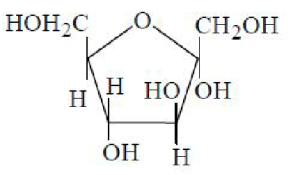
B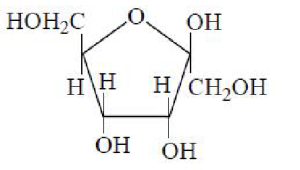
C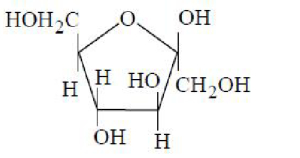
D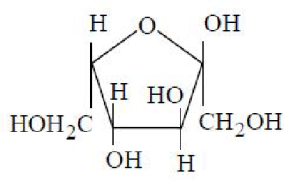
Solution
(A) The structure of $\beta-D-(-)-$Fructofuranose is a five-membered ring (furanose form) where the $-CH_2OH$ group at $C-2$ and the $-OH$ group at $C-2$ are in the $\beta$-configuration (the $-OH$ group is on the same side as the $-CH_2OH$ group at $C-5$).
In the Haworth projection of $\beta-D-(-)-$Fructofuranose:
$1$. The $C-2$ anomeric carbon has the $-OH$ group pointing upwards.
$2$. The $-CH_2OH$ group at $C-5$ also points upwards.
$3$. The $-OH$ groups at $C-3$ and $C-4$ point downwards and upwards respectively.
Comparing the given structures,option $A$ correctly represents the $\beta-D-(-)-$Fructofuranose configuration.
In the Haworth projection of $\beta-D-(-)-$Fructofuranose:
$1$. The $C-2$ anomeric carbon has the $-OH$ group pointing upwards.
$2$. The $-CH_2OH$ group at $C-5$ also points upwards.
$3$. The $-OH$ groups at $C-3$ and $C-4$ point downwards and upwards respectively.
Comparing the given structures,option $A$ correctly represents the $\beta-D-(-)-$Fructofuranose configuration.
0 likes
View Solution728
EasyMCQ
The number of $-OH$ groups in open chain and ring structures of $D$-glucose are respectively:
A
$4, 5$
B
$5, 5$
C
$5, 4$
D
$6, 5$
Solution
(B) In the open-chain structure of $D$-glucose $(CHO-(CHOH)_4-CH_2OH)$,there are $5$ hydroxyl $(-OH)$ groups.
In the cyclic (ring) structure of $D$-glucose (glucopyranose),one $-OH$ group is involved in the formation of the hemiacetal linkage,but it remains as an $-OH$ group (the anomeric hydroxyl group). Thus,there are still $5$ hydroxyl groups present in the ring structure.
In the cyclic (ring) structure of $D$-glucose (glucopyranose),one $-OH$ group is involved in the formation of the hemiacetal linkage,but it remains as an $-OH$ group (the anomeric hydroxyl group). Thus,there are still $5$ hydroxyl groups present in the ring structure.
0 likes
View Solution729
EasyMCQ
Carbohydrates are stored in plants and animals in which of the following forms respectively?
A
Glycogen,starch
B
Glycogen,glycogen
C
Starch,starch
D
Starch,glycogen
Solution
(D) Carbohydrates are stored in plants in the form of starch.
In animals,carbohydrates are stored in the form of glycogen.
Both starch and glycogen serve as energy reserves and are broken down during metabolism to release energy.
In animals,carbohydrates are stored in the form of glycogen.
Both starch and glycogen serve as energy reserves and are broken down during metabolism to release energy.
0 likes
View Solution730
EasyMCQ
Which of the following statements are true about carbohydrates?
$(i)$ Monosaccharides can be hydrolysed.
$(ii)$ The two monosaccharide units obtained on hydrolysis of a disaccharide can either be same or different.
$(iii)$ Polysaccharides are non-sweet in taste.
$(iv)$ All monosaccharides are not reducing sugars.
$(i)$ Monosaccharides can be hydrolysed.
$(ii)$ The two monosaccharide units obtained on hydrolysis of a disaccharide can either be same or different.
$(iii)$ Polysaccharides are non-sweet in taste.
$(iv)$ All monosaccharides are not reducing sugars.
A
$(i)$ and $(ii)$
B
$(ii)$ and $(iii)$
C
$(iii)$ and $(iv)$
D
$(i)$ and $(iv)$
Solution
(B) $(i)$ Monosaccharides are the simplest carbohydrates and cannot be further hydrolysed into smaller units. Thus,statement $(i)$ is false.
$(ii)$ Disaccharides yield two monosaccharide units upon hydrolysis,which can be identical or different. For example,sucrose yields glucose and fructose,while maltose yields two glucose units. Thus,statement $(ii)$ is true.
$(iii)$ Polysaccharides are complex polymers of many monosaccharide units and are generally tasteless (non-sweet). Thus,statement $(iii)$ is true.
$(iv)$ All monosaccharides are reducing sugars because they contain a free aldehyde or ketone group. Thus,statement $(iv)$ is false.
Therefore,statements $(ii)$ and $(iii)$ are correct.
$(ii)$ Disaccharides yield two monosaccharide units upon hydrolysis,which can be identical or different. For example,sucrose yields glucose and fructose,while maltose yields two glucose units. Thus,statement $(ii)$ is true.
$(iii)$ Polysaccharides are complex polymers of many monosaccharide units and are generally tasteless (non-sweet). Thus,statement $(iii)$ is true.
$(iv)$ All monosaccharides are reducing sugars because they contain a free aldehyde or ketone group. Thus,statement $(iv)$ is false.
Therefore,statements $(ii)$ and $(iii)$ are correct.
0 likes
View Solution731
MediumMCQ
Fructose reduces Tollen's reagent due to
A
primary alcoholic group
B
secondary alcoholic group
C
enolisation of fructose followed by conversion to aldehyde by base
D
asymmetric carbon atoms
Solution
(C) Tollen's reagent is $(AgNO_3 + NH_4OH)$ and it provides a basic medium. Fructose is a keto-hexose,yet it can reduce Tollen's reagent. This is because,in a basic medium,it undergoes enolisation and rearrangement (Lobry de-Bruyn-van Ekenstein transformation) to form an aldose (like $D$-glucose or $D$-mannose) which contains an aldehyde group. The equilibrium involves the formation of an enediol intermediate.
0 likes
View Solution732
EasyMCQ
Glycosidic linkage in carbohydrates is called
A
ester linkage
B
ether linkage
C
hydrogen bonding
D
amide linkage
Solution
(B) Oligosaccharides are formed by the linkage of two or more monosaccharide units through $O$-glycosidic bonds.
This linkage involves the formation of a $C-O-C$ bond between two sugar units,which is chemically classified as an ether linkage.
Thus,the correct option is $(B)$.
This linkage involves the formation of a $C-O-C$ bond between two sugar units,which is chemically classified as an ether linkage.
Thus,the correct option is $(B)$.
0 likes
View Solution733
MediumMCQ
Identify the correct set of monosaccharides present in sucrose $(X)$,lactose $(Y)$ and maltose $(Z)$.
A
| $X$ | $Y$ | $Z$ |
|---|---|---|
| glucose,fructose | galactose,glucose | glucose,fructose |
B
| $X$ | $Y$ | $Z$ |
|---|---|---|
| glucose,fructose | galactose,glucose | glucose,glucose |
C
| $X$ | $Y$ | $Z$ |
|---|---|---|
| glucose,glucose | galactose,glucose | glucose,glucose |
D
| $X$ | $Y$ | $Z$ |
|---|---|---|
| galactose,glucose | glucose,fructose | glucose,glucose |
Solution
(B) $(X) \longrightarrow$ Sucrose on hydrolysis gives glucose and fructose.
Sucrose $\longrightarrow$ glucose + fructose
$(Y) \longrightarrow$ Lactose on hydrolysis gives $D$-glucose and $D$-galactose.
Lactose $\longrightarrow$ $D$-glucose + $D$-galactose
$(Z) \longrightarrow$ Maltose on hydrolysis gives $2$ units of glucose.
Maltose $\longrightarrow$ glucose + glucose
Thus,the correct option is $(B)$.
Sucrose $\longrightarrow$ glucose + fructose
$(Y) \longrightarrow$ Lactose on hydrolysis gives $D$-glucose and $D$-galactose.
Lactose $\longrightarrow$ $D$-glucose + $D$-galactose
$(Z) \longrightarrow$ Maltose on hydrolysis gives $2$ units of glucose.
Maltose $\longrightarrow$ glucose + glucose
Thus,the correct option is $(B)$.
0 likes
View Solution734
EasyMCQ
$\beta-D-(-)-\text{fructofuranose}$ is:
A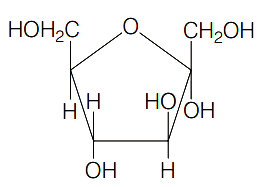
B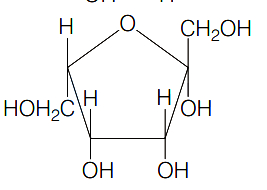
C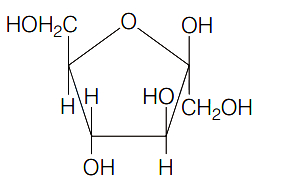
D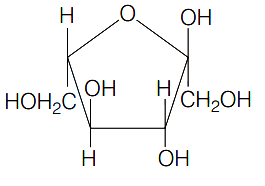
Solution
(C) The structure of $\beta-D-(-)-\text{fructofuranose}$ is characterized by a five-membered furanose ring.
In the $\beta$-anomer,the hydroxyl group $(-OH)$ at the anomeric carbon $(C-2)$ is on the same side as the $CH_2OH$ group at $C-5$.
Specifically,for $D$-fructose,the $CH_2OH$ group at $C-5$ is pointing upwards.
Therefore,in the $\beta$-anomer,the $-OH$ group at $C-2$ also points upwards.
Comparing the given options,the structure in option $C$ correctly represents this configuration.
In the $\beta$-anomer,the hydroxyl group $(-OH)$ at the anomeric carbon $(C-2)$ is on the same side as the $CH_2OH$ group at $C-5$.
Specifically,for $D$-fructose,the $CH_2OH$ group at $C-5$ is pointing upwards.
Therefore,in the $\beta$-anomer,the $-OH$ group at $C-2$ also points upwards.
Comparing the given options,the structure in option $C$ correctly represents this configuration.
0 likes
View Solution735
EasyMCQ
The Fischer projection formula of $L-(-)-glucose$ is:
A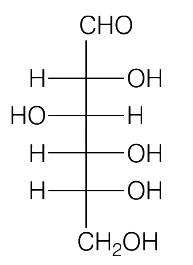
B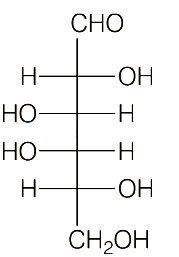
C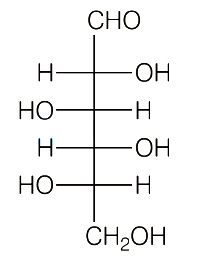
D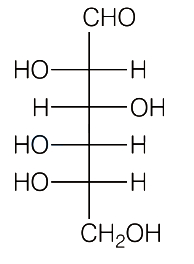
Solution
(D) The $D$ and $L$ configuration of monosaccharides is determined by the position of the $-OH$ group on the chiral carbon furthest from the carbonyl group (the $C-5$ carbon in glucose).
However,the question asks for the enantiomer of $D-(+)-glucose$,which is $L-(-)-glucose$.
In $D-(+)-glucose$,the $-OH$ groups are at positions: $C-2$ (right),$C-3$ (left),$C-4$ (right),and $C-5$ (right).
In $L-(-)-glucose$,the configuration at every chiral center is inverted compared to $D-glucose$.
Therefore,in $L-(-)-glucose$,the $-OH$ groups are at positions: $C-2$ (left),$C-3$ (right),$C-4$ (left),and $C-5$ (left).
This corresponds to the structure shown in option $D$.
However,the question asks for the enantiomer of $D-(+)-glucose$,which is $L-(-)-glucose$.
In $D-(+)-glucose$,the $-OH$ groups are at positions: $C-2$ (right),$C-3$ (left),$C-4$ (right),and $C-5$ (right).
In $L-(-)-glucose$,the configuration at every chiral center is inverted compared to $D-glucose$.
Therefore,in $L-(-)-glucose$,the $-OH$ groups are at positions: $C-2$ (left),$C-3$ (right),$C-4$ (left),and $C-5$ (left).
This corresponds to the structure shown in option $D$.
0 likes
View Solution736
EasyMCQ
The Fischer projection formula of $D-(-)$-fructose is:
A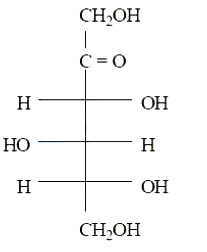
B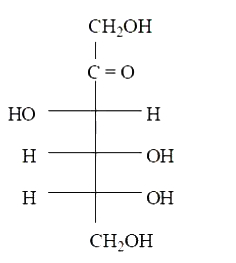
C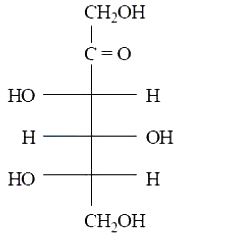
D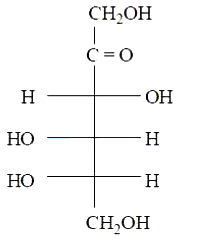
Solution
(B) -fructose is a ketohexose. Its open-chain structure has a ketone group at $C-2$. The configuration at the chiral centers $C-3, C-4,$ and $C-5$ is as follows:
At $C-3$,the $-OH$ group is on the left.
At $C-4$,the $-OH$ group is on the right.
At $C-5$,the $-OH$ group is on the right (which determines the $D$-configuration).
Comparing this with the given options,the structure in option $B$ matches the correct Fischer projection of $D$-fructose.
At $C-3$,the $-OH$ group is on the left.
At $C-4$,the $-OH$ group is on the right.
At $C-5$,the $-OH$ group is on the right (which determines the $D$-configuration).
Comparing this with the given options,the structure in option $B$ matches the correct Fischer projection of $D$-fructose.
0 likes
View Solution737
EasyMCQ
$\beta-D-(+)-$Glucopyranose is represented by which of the following structures?
A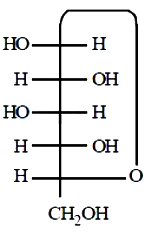
B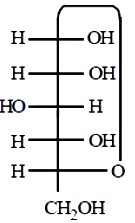
C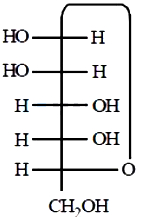
D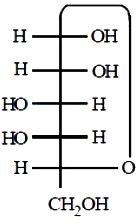
Solution
(A) The structure of $\beta-D-(+)-$glucopyranose in its Haworth or cyclic form is characterized by the orientation of the hydroxyl group at the anomeric carbon $(C_1)$.
In the $\beta$-anomer,the $-OH$ group at $C_1$ is on the same side as the $-CH_2OH$ group (upwards in the Haworth projection,or in the same relative configuration in the Fischer-like cyclic projection).
Specifically,for $D$-glucose,the configuration at $C_2, C_3, C_4,$ and $C_5$ follows the standard $D$-glucose pattern.
Comparing the given options,structure $A$ represents $\beta-D-(+)-$glucopyranose where the $-OH$ group at the anomeric carbon is oriented such that it corresponds to the $\beta$-configuration.
In the $\beta$-anomer,the $-OH$ group at $C_1$ is on the same side as the $-CH_2OH$ group (upwards in the Haworth projection,or in the same relative configuration in the Fischer-like cyclic projection).
Specifically,for $D$-glucose,the configuration at $C_2, C_3, C_4,$ and $C_5$ follows the standard $D$-glucose pattern.
Comparing the given options,structure $A$ represents $\beta-D-(+)-$glucopyranose where the $-OH$ group at the anomeric carbon is oriented such that it corresponds to the $\beta$-configuration.
0 likes
View Solution738
MediumMCQ
Which of the following statements is not correct for glucose?
A
Glucose does not give Schiff's test.
B
Glucose exists in two crystalline forms $\alpha-$ and $\beta-$.
C
The pentaacetate of glucose does not react with $NH_2OH$.
D
Glucose forms an addition product with $NaHSO_3$.
Solution
(D) The correct answer is $D$.
Glucose is an aldohexose containing a free aldehyde group,but it does not form an addition product with $NaHSO_3$ because the aldehyde group is involved in the formation of a cyclic hemiacetal structure.
Option $A$ is correct because glucose does not restore the pink color of Schiff's reagent.
Option $B$ is correct as glucose exists in $\alpha-$ and $\beta-$ anomeric forms.
Option $C$ is correct because the pentaacetate of glucose lacks a free $-OH$ group at the $C-1$ position,preventing the formation of the open-chain aldehyde required to react with $NH_2OH$.
Glucose is an aldohexose containing a free aldehyde group,but it does not form an addition product with $NaHSO_3$ because the aldehyde group is involved in the formation of a cyclic hemiacetal structure.
Option $A$ is correct because glucose does not restore the pink color of Schiff's reagent.
Option $B$ is correct as glucose exists in $\alpha-$ and $\beta-$ anomeric forms.
Option $C$ is correct because the pentaacetate of glucose lacks a free $-OH$ group at the $C-1$ position,preventing the formation of the open-chain aldehyde required to react with $NH_2OH$.
0 likes
View Solution739
MediumMCQ
When glucose is oxidized with nitric acid,the compound formed is:
A
Gluconic acid
B
$n-$hexanoic acid
C
Saccharic acid
D
Cyanohydrin
Solution
(C) When $D-(+)-$glucose is oxidized with strong oxidizing agents like nitric acid $(HNO_3)$,both the terminal aldehyde group $(-CHO)$ and the primary alcoholic group $(-CH_2OH)$ are oxidized to carboxylic acid groups $(-COOH)$.
This results in the formation of a dicarboxylic acid known as saccharic acid (also called glucaric acid).
The reaction is as follows:
$CHO-(CHOH)_4-CH_2OH + [O] \xrightarrow{HNO_3} COOH-(CHOH)_4-COOH$
Thus,the correct option is $C$.
This results in the formation of a dicarboxylic acid known as saccharic acid (also called glucaric acid).
The reaction is as follows:
$CHO-(CHOH)_4-CH_2OH + [O] \xrightarrow{HNO_3} COOH-(CHOH)_4-COOH$
Thus,the correct option is $C$.
0 likes
View Solution740
MediumMCQ
Statement $I$. Despite having an aldehyde group,glucose does not give the Schiff test.
Statement $II$. Glucose exists in $\alpha$ and $\beta$ crystalline forms.
Statement $II$. Glucose exists in $\alpha$ and $\beta$ crystalline forms.
A
Both statements $I$ and $II$ are incorrect.
B
Both statements $I$ and $II$ are correct.
C
Statement $I$ is correct but statement $II$ is incorrect.
D
Statement $I$ is incorrect but statement $II$ is correct.
Solution
(B) Glucose does not react with Schiff's reagent because the aldehyde group in glucose is not free; it is involved in the formation of a hemiacetal structure.
Glucose exists in two different crystalline anomeric forms,$\alpha-D$-glucose and $\beta-D$-glucose.
Thus,both statements $I$ and $II$ are correct.
Glucose exists in two different crystalline anomeric forms,$\alpha-D$-glucose and $\beta-D$-glucose.
Thus,both statements $I$ and $II$ are correct.
0 likes
View Solution741
MediumMCQ
Glucose does not react with which of the following?
A
$NH_2OH$
B
$HCN$
C
$Br_2 / H_2O$
D
$NaHSO_3$
Solution
(D) Glucose contains an aldehyde group $(-CHO)$,but it does not give all the characteristic reactions of aldehydes due to the formation of a cyclic hemiacetal structure.
Glucose reacts with $NH_2OH$ to form an oxime.
Glucose reacts with $HCN$ to form a cyanohydrin.
Glucose reacts with $Br_2 / H_2O$ (mild oxidizing agent) to form gluconic acid.
However,glucose does not react with $NaHSO_3$ (sodium bisulphite) to form a hydrogen sulphite addition product,which is a characteristic reaction of most aldehydes and ketones.
Glucose reacts with $NH_2OH$ to form an oxime.
Glucose reacts with $HCN$ to form a cyanohydrin.
Glucose reacts with $Br_2 / H_2O$ (mild oxidizing agent) to form gluconic acid.
However,glucose does not react with $NaHSO_3$ (sodium bisulphite) to form a hydrogen sulphite addition product,which is a characteristic reaction of most aldehydes and ketones.
0 likes
View Solution742
MediumMCQ
When glucose reacts with bromine water,the main product is
A
acetic acid
B
saccharic acid
C
glyceraldehyde
D
gluconic acid
Solution
(D) When glucose reacts with bromine water $(Br_2/H_2O)$,it undergoes mild oxidation of the aldehyde group to a carboxylic acid group,resulting in the formation of gluconic acid.
The reaction is as follows:
$CH_2OH(CHOH)_4CHO + [O] \xrightarrow{Br_2/H_2O} CH_2OH(CHOH)_4COOH$
Therefore,the correct option is $(D)$.
The reaction is as follows:
$CH_2OH(CHOH)_4CHO + [O] \xrightarrow{Br_2/H_2O} CH_2OH(CHOH)_4COOH$
Therefore,the correct option is $(D)$.
0 likes
View Solution743
EasyMCQ
Glucose on prolonged heating with $HI$ gives:
A
$n-$Hexane
B
$2-$Methyl pentane
C
Hexan$-1-$one
D
Hexan$-2-$one
Solution
(A) When glucose $(CHO(CHOH)_4CH_2OH)$ is heated with concentrated $HI$ for a prolonged period,the reduction of all hydroxyl groups and the aldehyde group occurs.
This reaction results in the formation of $n-$hexane $(CH_3(CH_2)_4CH_3)$,which indicates that all six carbon atoms in glucose are linked in a straight chain.
This reaction results in the formation of $n-$hexane $(CH_3(CH_2)_4CH_3)$,which indicates that all six carbon atoms in glucose are linked in a straight chain.
0 likes
View Solution744
MediumMCQ
The incorrect statement about amylose is
A
It is water soluble
B
In this $\alpha-D-(+)$-glucose units are held by $C-1$ to $C-4$ glycosidic linkages
C
It is a highly branched polymer of $\alpha-D-(+)$-glucose units
D
It is present in starch to an extent of $15-20 \%$
Solution
(C) Amylose is a linear polymer of $\alpha-D-(+)$-glucose units linked by $\alpha-1,4$-glycosidic linkages.
It is water-soluble and constitutes about $15-20 \%$ of starch.
Amylopectin,on the other hand,is a highly branched polymer of $\alpha-D-(+)$-glucose units.
Therefore,the statement that amylose is a highly branched polymer is incorrect.
It is water-soluble and constitutes about $15-20 \%$ of starch.
Amylopectin,on the other hand,is a highly branched polymer of $\alpha-D-(+)$-glucose units.
Therefore,the statement that amylose is a highly branched polymer is incorrect.
0 likes
View Solution745
MediumMCQ
Consider the following:
Statement-$I$ : Lactose is composed of $\alpha-D$-glucose and $\beta-D$-galactose.
Statement-$II$ : Lactose is a reducing sugar.
The correct answer is
Statement-$I$ : Lactose is composed of $\alpha-D$-glucose and $\beta-D$-galactose.
Statement-$II$ : Lactose is a reducing sugar.
The correct answer is
A
Both statement-$I$ and statement-$II$ are not correct
B
Both statement-$I$ and statement-$II$ are correct
C
Statement-$I$ is correct,but statement-$II$ is not correct
D
Statement-$I$ is not correct,but statement-$II$ is correct
Solution
(D) Statement-$I$ is incorrect because lactose is composed of $\beta-D$-galactose and $\beta-D$-glucose linked by a $\beta(1 \to 4)$ glycosidic bond.
Statement-$II$ is correct because lactose contains a hemiacetal group in the glucose unit,which allows it to undergo mutarotation and act as a reducing sugar.
Statement-$II$ is correct because lactose contains a hemiacetal group in the glucose unit,which allows it to undergo mutarotation and act as a reducing sugar.
0 likes
View Solution746
EasyMCQ
Consider the following statements:
Statement-$I$: Cane sugar is a disaccharide of $\alpha-D$-glucose and $\beta-D$-fructose.
Statement-$II$: Milk sugar is a disaccharide of $\beta-D$-glucose and $\beta-D$-galactose.
The correct answer is:
Statement-$I$: Cane sugar is a disaccharide of $\alpha-D$-glucose and $\beta-D$-fructose.
Statement-$II$: Milk sugar is a disaccharide of $\beta-D$-glucose and $\beta-D$-galactose.
The correct answer is:
A
Both statement-$I$ and statement-$II$ are correct
B
Both statement-$I$ and statement-$II$ are not correct
C
Statement-$I$ is correct,but statement-$II$ is not correct
D
Statement-$I$ is not correct,but statement-$II$ is correct
Solution
(C) Statement-$I$ is correct: Cane sugar (sucrose) is a disaccharide composed of $\alpha-D$-glucose and $\beta-D$-fructose linked by a glycosidic bond.
Statement-$II$ is incorrect: Milk sugar (lactose) is a disaccharide composed of $\beta-D$-galactose and $\beta-D$-glucose,not $\alpha-D$-glucose.
Therefore,Statement-$I$ is correct,but Statement-$II$ is not correct.
Statement-$II$ is incorrect: Milk sugar (lactose) is a disaccharide composed of $\beta-D$-galactose and $\beta-D$-glucose,not $\alpha-D$-glucose.
Therefore,Statement-$I$ is correct,but Statement-$II$ is not correct.
0 likes
View Solution747
MediumMCQ
Match the following:
| List-$I$ (Glycosidic linkage) | List-$II$ (Polysaccharide) |
|---|---|
| $A$. $\alpha-1,4$ | $I$. Amylose |
| $B$. $\beta-1,4$ | $II$. Cellulose |
| $C$. $\alpha-1,4, \alpha-1,6$ | $III$. Amylopectin |
A
$A-II, B-I, C-III$
B
$A-III, B-I, C-II$
C
$A-I, B-II, C-III$
D
$A-I, B-III, C-II$
Solution
(D) . Amylose is a linear polymer of $\alpha-D-glucose$ units linked by $\alpha-1,4$-glycosidic bonds. Thus,$A-I$.
$B$. Cellulose is a linear polymer of $\beta-D-glucose$ units linked by $\beta-1,4$-glycosidic bonds. Thus,$B-III$.
$C$. Amylopectin is a branched polymer of $\alpha-D-glucose$ units with $\alpha-1,4$-glycosidic bonds in the chain and $\alpha-1,6$-glycosidic bonds at the branching points. Thus,$C-II$.
Therefore,the correct matching is $A-I, B-III, C-II$.
$B$. Cellulose is a linear polymer of $\beta-D-glucose$ units linked by $\beta-1,4$-glycosidic bonds. Thus,$B-III$.
$C$. Amylopectin is a branched polymer of $\alpha-D-glucose$ units with $\alpha-1,4$-glycosidic bonds in the chain and $\alpha-1,6$-glycosidic bonds at the branching points. Thus,$C-II$.
Therefore,the correct matching is $A-I, B-III, C-II$.
0 likes
View Solution748
MediumMCQ
Which of the following do not reduce Tollens' reagent?
$a$) Fructose
$b$) Sucrose
$c$) Lactose
$d$) Cellulose
$a$) Fructose
$b$) Sucrose
$c$) Lactose
$d$) Cellulose
A
$a, b$
B
$b, d$
C
$a, c$
D
$c, d$
Solution
(B) Tollens' reagent is reduced by sugars that contain a free hemiacetal or hemiketal group,known as reducing sugars.
$a$) Fructose is a ketohexose that isomerizes to glucose and mannose in the presence of base,thus it acts as a reducing sugar.
$b$) Sucrose is a non-reducing sugar because the glycosidic linkage is between the anomeric carbons of glucose and fructose,leaving no free hemiacetal or hemiketal group.
$c$) Lactose is a reducing sugar as it contains a free hemiacetal group.
$d$) Cellulose is a polysaccharide consisting of $D$-glucose units linked by $\beta(1 \to 4)$ glycosidic bonds; it is a non-reducing sugar.
Therefore,sucrose and cellulose do not reduce Tollens' reagent.
$a$) Fructose is a ketohexose that isomerizes to glucose and mannose in the presence of base,thus it acts as a reducing sugar.
$b$) Sucrose is a non-reducing sugar because the glycosidic linkage is between the anomeric carbons of glucose and fructose,leaving no free hemiacetal or hemiketal group.
$c$) Lactose is a reducing sugar as it contains a free hemiacetal group.
$d$) Cellulose is a polysaccharide consisting of $D$-glucose units linked by $\beta(1 \to 4)$ glycosidic bonds; it is a non-reducing sugar.
Therefore,sucrose and cellulose do not reduce Tollens' reagent.
0 likes
View Solution749
MediumMCQ
Which one of the following is $NOT$ a disaccharide?
A
Sucrose
B
Fructose
C
Maltose
D
Lactose
Solution
(B) Monosaccharides: $A$ carbohydrate that cannot be hydrolysed further to give simpler units of polyhydroxy aldehyde or ketone is called a monosaccharide.
Examples: $Glucose$,$Fructose$,$Ribose$.
Disaccharides: The sugar formed when $2$ monosaccharides are joined by a glycosidic linkage.
Examples: $Sucrose$,$Lactose$,$Maltose$.
Since $Fructose$ is a monosaccharide,it is not a disaccharide.
Examples: $Glucose$,$Fructose$,$Ribose$.
Disaccharides: The sugar formed when $2$ monosaccharides are joined by a glycosidic linkage.
Examples: $Sucrose$,$Lactose$,$Maltose$.
Since $Fructose$ is a monosaccharide,it is not a disaccharide.
0 likes
View SolutionBiomolecules — Carbohydrates · Frequently Asked Questions
1Are these Biomolecules questions useful for JEE and NEET?
Yes. All questions in this section are mapped to JEE Main and NEET exam patterns. Previous year questions from JEE Main, NEET, GUJCET and state-level exams are included with full solutions.
2Can I switch to Hindi or Gujarati for these questions?
Yes. Use the language tabs in the hero section or the sidebar to view the same questions and solutions in English, Hindi or Gujarati.
3How do I generate a question paper from this subtopic?
Use the Vedclass Exam Paper Generator — select the chapter and subtopic, set difficulty, and generate Sets A, B, C, D automatically. First 3 chapters of every subject are free.
Vedclass Products
For Students
Vedclass Test Series
Mock tests in real JEE/NEET style with performance analysis. 5-day free trial.
Start Free TrialFor Teachers
Exam Paper Generator
Generate Set A/B/C/D papers from this chapter in 2 minutes. 3 chapters free.
Try FreeFor Institutes
Online Exam Module
Live online exams with unlimited students, 360° analytics & white-label branding.
See DemoFor Teachers & Institutes
Generate a Biomolecules Exam Paper in 2 Minutes
Select subtopic & difficulty — Sets A, B, C, D auto-generated with No Repeat logic.
First 3 chapters of every subject are free — no payment required.