
A English
Carbohydrates Questions in English
Class 12 Chemistry · Biomolecules · Carbohydrates
808+
Questions
English
Language
100%
With Solutions
Showing 47 of 808 questions in English
751
MediumMCQ
Which of the following is a correct statement?
A
Starch is a polymer of $\beta-D$-glucose
B
Amylose is a component of starch
C
Proteins are biopolymers of only one type of amino acids
D
Lactose is a disaccharide of $\alpha-D$-glucose and $\beta-D$-glucose
Solution
(B) Starch is a polymer of $\alpha-D$-glucose.
Amylose and Amylopectin are the two components of starch.
Lactose is a disaccharide composed of $\beta-D$-galactose and $\beta-D$-glucose.
Proteins are biopolymers composed of various types of amino acids.
Amylose and Amylopectin are the two components of starch.
Lactose is a disaccharide composed of $\beta-D$-galactose and $\beta-D$-glucose.
Proteins are biopolymers composed of various types of amino acids.
0 likes
View Solution752
EasyMCQ
Hydrolysis of which disaccharide in the presence of the enzyme maltase gives glucose only?
A
Sucrose
B
Cellulose
C
Lactose
D
Maltose
Solution
(D) The enzyme maltase specifically catalyzes the hydrolysis of maltose into two molecules of $D$-glucose.
$C_{12}H_{22}O_{11} + H_2O \xrightarrow{\text{maltase}} 2C_6H_{12}O_6$ (glucose).
$C_{12}H_{22}O_{11} + H_2O \xrightarrow{\text{maltase}} 2C_6H_{12}O_6$ (glucose).
0 likes
View Solution753
EasyMCQ
If sucrose is boiled with dilute $HCl$ in an alcoholic solution,the ratio in which glucose and fructose are formed is
A
$1: 1$
B
$1: 2$
C
$2: 1$
D
$4: 1$
Solution
(A) Sucrose is a disaccharide composed of one molecule of glucose and one molecule of fructose linked by a glycosidic bond.
Upon hydrolysis with dilute $HCl$,the glycosidic bond breaks to yield an equimolar mixture of glucose and fructose.
The chemical reaction is: $C_{12}H_{22}O_{11} + H_2O \xrightarrow{H^+} C_6H_{12}O_6 (\text{glucose}) + C_6H_{12}O_6 (\text{fructose})$.
Therefore,the ratio of glucose to fructose formed is $1: 1$.
Upon hydrolysis with dilute $HCl$,the glycosidic bond breaks to yield an equimolar mixture of glucose and fructose.
The chemical reaction is: $C_{12}H_{22}O_{11} + H_2O \xrightarrow{H^+} C_6H_{12}O_6 (\text{glucose}) + C_6H_{12}O_6 (\text{fructose})$.
Therefore,the ratio of glucose to fructose formed is $1: 1$.
0 likes
View Solution754
MediumMCQ
Identify the product of the following reaction: $(C_6H_{10}O_5)_n + nH_2O \xrightarrow[393 \ K, 2-3 \ atm]{H^+} ?$
A
Fructose
B
Glucose
C
Lactose
D
Maltose
Solution
(B) Starch is a polysaccharide. Upon acid-catalyzed hydrolysis,it yields the monosaccharide glucose.
Reaction:
$(C_6H_{10}O_5)_n + nH_2O \xrightarrow[393 \ K, 2-3 \ atm]{H^+} nC_6H_{12}O_6$ (Glucose)
Therefore,the product of the above reaction is glucose.
Reaction:
$(C_6H_{10}O_5)_n + nH_2O \xrightarrow[393 \ K, 2-3 \ atm]{H^+} nC_6H_{12}O_6$ (Glucose)
Therefore,the product of the above reaction is glucose.
0 likes
View Solution755
EasyMCQ
Glucose + ? $\longrightarrow$ Sucrose
A
Glucose
B
Fructose
C
Arabinose
D
Lactase
Solution
(B) Glucose + Fructose $\longrightarrow$ Sucrose.
Sucrose is a disaccharide,which is made of $\alpha-D$-glucose and $\beta-D$-fructose joined together by a $1, 2$-glycosidic linkage.
Sucrose is a disaccharide,which is made of $\alpha-D$-glucose and $\beta-D$-fructose joined together by a $1, 2$-glycosidic linkage.
0 likes
View Solution756
EasyMCQ
Which one of the following is the structure of lactose?
A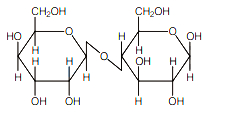
B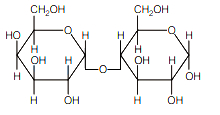
C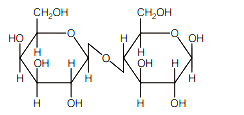
D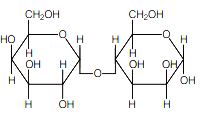
Solution
(A) Lactose is a disaccharide composed of $\beta-D-galactose$ and $\beta-D-glucose$ units.
These units are linked by a $\beta-1,4-glycosidic$ linkage.
The structure of lactose is correctly represented by the image $250769-$s,which shows the $\beta-1,4$ linkage between the $C-1$ of galactose and $C-4$ of glucose.
These units are linked by a $\beta-1,4-glycosidic$ linkage.
The structure of lactose is correctly represented by the image $250769-$s,which shows the $\beta-1,4$ linkage between the $C-1$ of galactose and $C-4$ of glucose.
0 likes
View Solution757
EasyMCQ
Reducing saccharides among the following are:
| Sucrose | Ribose | Maltose | Lactose | Cellulose |
| $1$ | $2$ | $3$ | $4$ | $5$ |
A
$2, 4, 5$
B
$1, 3, 4$
C
$2, 3, 5$
D
$2, 3, 4$
Solution
(D) Reducing saccharides are carbohydrates that can act as reducing agents because they contain a free aldehyde or ketone group in their open-chain form.
$1$. Sucrose: Non-reducing sugar.
$2$. Ribose: Reducing sugar (contains a free aldehyde group).
$3$. Maltose: Reducing sugar (contains a free hemiacetal group).
$4$. Lactose: Reducing sugar (contains a free hemiacetal group).
$5$. Cellulose: Non-reducing polysaccharide.
Therefore,the reducing saccharides are $2, 3, 4$.
$1$. Sucrose: Non-reducing sugar.
$2$. Ribose: Reducing sugar (contains a free aldehyde group).
$3$. Maltose: Reducing sugar (contains a free hemiacetal group).
$4$. Lactose: Reducing sugar (contains a free hemiacetal group).
$5$. Cellulose: Non-reducing polysaccharide.
Therefore,the reducing saccharides are $2, 3, 4$.
0 likes
View Solution758
EasyMCQ
Observe the following statements.
$I$. Sucrose has glycosidic linkage.
$II$. Cellulose is present in both plants and animals.
$III$. Lactose contains $D$-galactose and $D$-glucose units.
Which of the following statements are correct?
$I$. Sucrose has glycosidic linkage.
$II$. Cellulose is present in both plants and animals.
$III$. Lactose contains $D$-galactose and $D$-glucose units.
Which of the following statements are correct?
A
$(I), (II) \text{ and } (III)$
B
$(I) \text{ and } (II)$
C
$(II) \text{ and } (III)$
D
$(I) \text{ and } (III)$
Solution
(D) $I$. Sucrose is a disaccharide formed by the condensation of $D$-glucose and $D$-fructose,joined by a glycosidic linkage. This statement is correct.
$II$. Cellulose is a structural polysaccharide found exclusively in the cell walls of plants. It is not present in animals. This statement is incorrect.
$III$. Lactose is a disaccharide composed of $D$-galactose and $D$-glucose units linked by a $\beta$-glycosidic bond. This statement is correct.
Therefore,statements $I$ and $III$ are correct.
$II$. Cellulose is a structural polysaccharide found exclusively in the cell walls of plants. It is not present in animals. This statement is incorrect.
$III$. Lactose is a disaccharide composed of $D$-galactose and $D$-glucose units linked by a $\beta$-glycosidic bond. This statement is correct.
Therefore,statements $I$ and $III$ are correct.
0 likes
View Solution759
MediumMCQ
In $D-glucose$ $(X)$ and $D-fructose$ $(Y)$,which hydroxyl group participates in hemiacetal/hemiketal formation?
A
$C-5$ in both $X$ and $Y$
B
$C-5$ in $X$ and $C-6$ in $Y$
C
$C-6$ in $X$ and $C-5$ in $Y$
D
$C-4$ in both $X$ and $Y$
Solution
(A) In $D-glucose$ $(X)$,the hydroxyl group at $C-5$ attacks the aldehyde group at $C-1$ to form a six-membered pyranose ring (hemiacetal).
In $D-fructose$ $(Y)$,the hydroxyl group at $C-5$ attacks the ketone group at $C-2$ to form a five-membered furanose ring (hemiketal).
Therefore,in both cases,the hydroxyl group at $C-5$ participates in the ring formation.
In $D-fructose$ $(Y)$,the hydroxyl group at $C-5$ attacks the ketone group at $C-2$ to form a five-membered furanose ring (hemiketal).
Therefore,in both cases,the hydroxyl group at $C-5$ participates in the ring formation.
0 likes
View Solution760
MediumMCQ
Which of the following represents a nucleoside of $RNA$?
A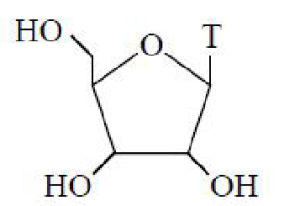
B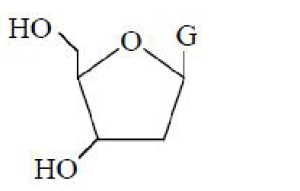
C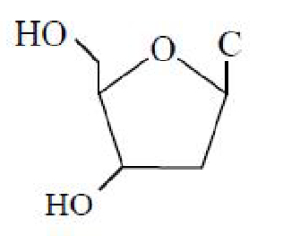
D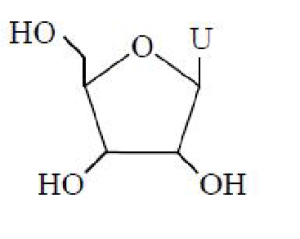
Solution
(D) nucleoside consists of a nitrogenous base attached to a pentose sugar.
In $RNA$,the pentose sugar is ribose,which has a hydroxyl $(-OH)$ group at both the $2'$ and $3'$ positions.
$RNA$ contains the nitrogenous bases Adenine $(A)$,Guanine $(G)$,Cytosine $(C)$,and Uracil $(U)$.
Thymine $(T)$ is found in $DNA$,not $RNA$.
Looking at the options:
Option $A$ has $T$ (Thymine),which is characteristic of $DNA$.
Option $B$ and $C$ show a deoxyribose sugar (missing the $-OH$ group at the $2'$ position),which is characteristic of $DNA$.
Option $D$ shows a ribose sugar (with $-OH$ groups at both $2'$ and $3'$ positions) attached to Uracil $(U)$,which is a characteristic nucleoside of $RNA$ (Uridine).
In $RNA$,the pentose sugar is ribose,which has a hydroxyl $(-OH)$ group at both the $2'$ and $3'$ positions.
$RNA$ contains the nitrogenous bases Adenine $(A)$,Guanine $(G)$,Cytosine $(C)$,and Uracil $(U)$.
Thymine $(T)$ is found in $DNA$,not $RNA$.
Looking at the options:
Option $A$ has $T$ (Thymine),which is characteristic of $DNA$.
Option $B$ and $C$ show a deoxyribose sugar (missing the $-OH$ group at the $2'$ position),which is characteristic of $DNA$.
Option $D$ shows a ribose sugar (with $-OH$ groups at both $2'$ and $3'$ positions) attached to Uracil $(U)$,which is a characteristic nucleoside of $RNA$ (Uridine).
0 likes
View Solution761
EasyMCQ
The sugar present in $DNA$ is:
A
$\beta-D-2-$ribose
B
$\beta-D-2-$deoxyribose
C
$\alpha-D-2-$ribose
D
$\alpha-D-2-$deoxyribose
Solution
(B) The sugar present in $DNA$ is $\beta-D-2-$deoxyribose.
In contrast,the sugar present in $RNA$ is $\beta-D-$ribose.
In contrast,the sugar present in $RNA$ is $\beta-D-$ribose.
0 likes
View Solution762
EasyMCQ
The synthetic detergent used in toothpaste is of type $X$. Animal starch is $Y$. $X$ and $Y$ respectively are:
A
Anionic,amylose
B
Non-ionic,cellulose
C
Anionic,glycogen
D
Cationic,amylopectin
Solution
(C) The synthetic detergent used in toothpaste is typically an anionic detergent,such as sodium lauryl sulfate.
Animal starch is known as glycogen,which is a polysaccharide that serves as the form of energy storage in animals.
Therefore,$X$ is anionic and $Y$ is glycogen.
Animal starch is known as glycogen,which is a polysaccharide that serves as the form of energy storage in animals.
Therefore,$X$ is anionic and $Y$ is glycogen.
0 likes
View Solution763
EasyMCQ
The artificial sweetener sucralose is $ . . . . .$.
A
$hexachloro$ derivative of sucrose
B
$trichloro$ derivative of sucrose
C
$pentachloro$ derivative of sucrose
D
$tetrachloro$ derivative of sucrose
Solution
(B) The artificial sweetener sucralose is a $trichloro$ derivative of sucrose.
It is stable at cooking temperatures and does not provide calories to the body.
It is stable at cooking temperatures and does not provide calories to the body.
0 likes
View Solution764
MediumMCQ
The total number of hydroxyl $(-OH)$ groups in saccharic acid is:
A
$3$
B
$2$
C
$4$
D
$5$
Solution
(C) Saccharic acid is also known as $(2R, 3S, 4S, 5S)-2,3,4,5-$tetrahydroxyhexanedioic acid.
Its chemical structure is $HOOC-(CHOH)_4-COOH$.
As shown in the structure,saccharic acid has four hydroxyl groups attached to the four central carbon atoms.
Therefore,the total number of hydroxyl groups is $4$.
Its chemical structure is $HOOC-(CHOH)_4-COOH$.
As shown in the structure,saccharic acid has four hydroxyl groups attached to the four central carbon atoms.
Therefore,the total number of hydroxyl groups is $4$.
0 likes
View Solution765
DifficultMCQ
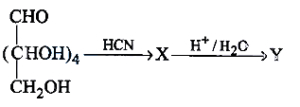
What is the $IUPAC$ name of the product $Y$ in the given reaction sequence?
A
$2,3,4,5,6,7$-hexahydroxyheptanoic acid
B
$2,3,4,5,6$-pentahydroxyhexanoic acid
C
$3,4,5$-trihydroxyheptanoic acid
D
$3,4,5$-trihydroxyhexanoic acid
Solution
(A) The reaction sequence is as follows:
$1$. Glucose reacts with $HCN$ to form a cyanohydrin $(X)$. The aldehyde group $(-CHO)$ is converted into a cyanohydrin group $(-CH(OH)CN)$.
$2$. The cyanohydrin $(X)$ undergoes acid-catalyzed hydrolysis $(H^+/H_2O)$ to convert the cyano group $(-CN)$ into a carboxylic acid group $(-COOH)$.
$3$. The starting material is glucose,which has $6$ carbon atoms. The addition of $HCN$ adds one carbon atom,resulting in a chain of $7$ carbon atoms.
$4$. The final product $Y$ is a heptanoic acid derivative with hydroxyl groups on carbons $2, 3, 4, 5, 6,$ and $7$. Thus,the $IUPAC$ name is $2,3,4,5,6,7$-hexahydroxyheptanoic acid.
$1$. Glucose reacts with $HCN$ to form a cyanohydrin $(X)$. The aldehyde group $(-CHO)$ is converted into a cyanohydrin group $(-CH(OH)CN)$.
$2$. The cyanohydrin $(X)$ undergoes acid-catalyzed hydrolysis $(H^+/H_2O)$ to convert the cyano group $(-CN)$ into a carboxylic acid group $(-COOH)$.
$3$. The starting material is glucose,which has $6$ carbon atoms. The addition of $HCN$ adds one carbon atom,resulting in a chain of $7$ carbon atoms.
$4$. The final product $Y$ is a heptanoic acid derivative with hydroxyl groups on carbons $2, 3, 4, 5, 6,$ and $7$. Thus,the $IUPAC$ name is $2,3,4,5,6,7$-hexahydroxyheptanoic acid.
0 likes
View Solution766
DifficultMCQ
Cellulose is a polysaccharide and is made of
A
$ \beta $-$D$-glucose units joined through $1,4$-glycosidic linkages
B
$ \alpha $-$D$-glucose units joined through $1,4$-glycosidic linkages
C
$ \alpha $-$D$-glucose units joined through $1,6$-glycosidic linkages
D
$ \beta $-$D$-glucose units joined through $1,6$-glycosidic linkages
Solution
(A) Cellulose is a linear polysaccharide composed of $ \beta $-$D$-glucose units joined through $1,4$-glycosidic linkages.
These glucose units are linked by glycosidic bonds between the $C_1$ carbon of one unit and the $C_4$ carbon of the adjacent unit,where the anomeric $C_1$ carbon maintains a $ \beta $-configuration.
These glucose units are linked by glycosidic bonds between the $C_1$ carbon of one unit and the $C_4$ carbon of the adjacent unit,where the anomeric $C_1$ carbon maintains a $ \beta $-configuration.
0 likes
View Solution767
EasyMCQ
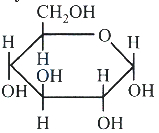
The Haworth projection shown below represents:
A
$\beta-D-(-)-$ Fructofuranose
B
$\beta-D-(+)-$ Glucopyranose
C
$\alpha-D-(-)-$ Fructofuranose
D
$\alpha-D-(+)-$ Glucopyranose
Solution
(D) The given structure is a six-membered ring containing an oxygen atom,which identifies it as a pyranose form.
In the Haworth projection of $D$-glucose,the anomeric carbon $(C1)$ has the $-OH$ group pointing downwards,which corresponds to the $\alpha-$configuration.
The other hydroxyl groups at $C2, C3,$ and $C4$ are arranged such that they match the structure of $D$-glucose.
Specifically,the $-OH$ at $C2$ is down,at $C3$ is up,and at $C4$ is down.
Therefore,the structure represents $\alpha-D-(+)-$ glucopyranose.
In the Haworth projection of $D$-glucose,the anomeric carbon $(C1)$ has the $-OH$ group pointing downwards,which corresponds to the $\alpha-$configuration.
The other hydroxyl groups at $C2, C3,$ and $C4$ are arranged such that they match the structure of $D$-glucose.
Specifically,the $-OH$ at $C2$ is down,at $C3$ is up,and at $C4$ is down.
Therefore,the structure represents $\alpha-D-(+)-$ glucopyranose.
0 likes
View Solution768
EasyMCQ
Assertion $(A)$: Both Glucose and Fructose have the same $D$-configuration.
Reason $(R)$: Both Glucose and Fructose are dextrorotatory.
The correct option among the following is:
Reason $(R)$: Both Glucose and Fructose are dextrorotatory.
The correct option among the following is:
A
$(A)$ is true,$(R)$ is true and $(R)$ is the correct explanation for $(A)$
B
$(A)$ is true,$(R)$ is true but $(R)$ is not the correct explanation for $(A)$
C
$(A)$ is true but $(R)$ is false
D
$(A)$ is false but $(R)$ is true
Solution
(C) - and $L$- configurations are relative configurations assigned with respect to $D(+)$-glyceraldehyde.
Both $D(+)$-glucose and $D(-)$-fructose have the same $D$-configuration because the hydroxyl group at the chiral carbon farthest from the carbonyl group is on the right side in their Fischer projection.
However,$D(+)$-glucose is dextrorotatory $(+)$,whereas $D(-)$-fructose is levorotatory $(-)$.
Therefore,Assertion $(A)$ is true,but Reason $(R)$ is false.
Both $D(+)$-glucose and $D(-)$-fructose have the same $D$-configuration because the hydroxyl group at the chiral carbon farthest from the carbonyl group is on the right side in their Fischer projection.
However,$D(+)$-glucose is dextrorotatory $(+)$,whereas $D(-)$-fructose is levorotatory $(-)$.
Therefore,Assertion $(A)$ is true,but Reason $(R)$ is false.
0 likes
View Solution769
MediumMCQ
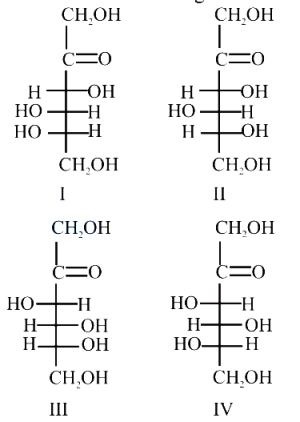
Consider the following structures. Which of the pairs represent $D$-fructose and $L$-fructose,respectively?
A
$II$ and $I$
B
$I$ and $III$
C
$III$ and $IV$
D
$II$ and $IV$
Solution
(D) The $D$ or $L$ configuration of a monosaccharide is determined by the position of the $-OH$ group on the chiral carbon furthest from the carbonyl group (the $C_5$ carbon in fructose).
If the $-OH$ group is on the right side,it is the $D$-isomer.
If the $-OH$ group is on the left side,it is the $L$-isomer.
Structure $II$ represents $D$-fructose because the $-OH$ group at $C_5$ is on the right.
Structure $IV$ represents $L$-fructose because the $-OH$ group at $C_5$ is on the left.
Therefore,the pair representing $D$-fructose and $L$-fructose is $II$ and $IV$.
If the $-OH$ group is on the right side,it is the $D$-isomer.
If the $-OH$ group is on the left side,it is the $L$-isomer.
Structure $II$ represents $D$-fructose because the $-OH$ group at $C_5$ is on the right.
Structure $IV$ represents $L$-fructose because the $-OH$ group at $C_5$ is on the left.
Therefore,the pair representing $D$-fructose and $L$-fructose is $II$ and $IV$.
0 likes
View Solution770
MediumMCQ
The structure of $\alpha-D$-Fructofuranose is
A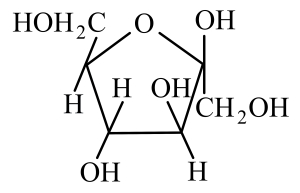
B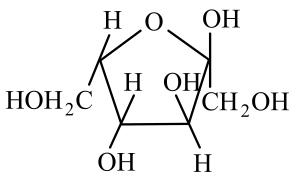
C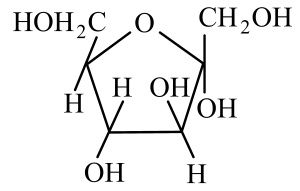
D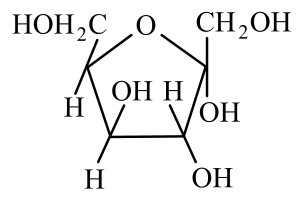
Solution
(C) $\alpha-D$-Fructofuranose is a monosaccharide. It has a five-membered furanose ring structure. In the $\alpha$-anomer,the hydroxyl group $(-OH)$ at the anomeric carbon $(C-2)$ is on the same side as the $-CH_2OH$ group at $C-5$ in the Haworth projection,or specifically,the $-OH$ group at $C-2$ is pointing downwards. The molecular formula is $C_6H_{12}O_6$. The correct structure is shown in the solution image.
0 likes
View Solution771
EasyMCQ
Which of the following are reducing sugars?
$(A)$ Sucrose,$(B)$ Maltose,$(C)$ Lactose,$(D)$ Fructose
$(A)$ Sucrose,$(B)$ Maltose,$(C)$ Lactose,$(D)$ Fructose
A
$A, B, C$
B
$A, B, D$
C
$A, C, D$
D
$B, C, D$
Solution
(D) Reducing sugars are those carbohydrates that contain a free hemiacetal or hemiketal group,which can act as a reducing agent.
$(A)$ Sucrose is a non-reducing sugar because both anomeric carbons are involved in the glycosidic linkage.
$(B)$ Maltose is a reducing sugar as it contains a free hemiacetal group.
$(C)$ Lactose is a reducing sugar as it contains a free hemiacetal group.
$(D)$ Fructose is a reducing sugar because it can tautomerize to glucose in alkaline solution due to the presence of an $\alpha$-hydroxy ketone group.
Therefore,$(B)$,$(C)$,and $(D)$ are reducing sugars.
$(A)$ Sucrose is a non-reducing sugar because both anomeric carbons are involved in the glycosidic linkage.
$(B)$ Maltose is a reducing sugar as it contains a free hemiacetal group.
$(C)$ Lactose is a reducing sugar as it contains a free hemiacetal group.
$(D)$ Fructose is a reducing sugar because it can tautomerize to glucose in alkaline solution due to the presence of an $\alpha$-hydroxy ketone group.
Therefore,$(B)$,$(C)$,and $(D)$ are reducing sugars.
0 likes
View Solution772
EasyMCQ
Which of the following carbohydrates has a glycosidic linkage?
A
Fructofuranose
B
Glucopyranose
C
Maltose
D
$\beta-D$-fructose
Solution
(C) glycosidic linkage is a type of covalent bond that joins a carbohydrate (sugar) molecule to another group,which may or may not be another carbohydrate.
Monosaccharides like Fructofuranose,Glucopyranose,and $\beta-D$-fructose do not contain glycosidic linkages because they are single sugar units.
Maltose is a disaccharide formed by the condensation of two $D$-glucose units.
In maltose,the two glucose residues are joined by an $\alpha-1,4$-glycosidic linkage between the $C-1$ of one glucose unit and the $C-4$ of the other.
Monosaccharides like Fructofuranose,Glucopyranose,and $\beta-D$-fructose do not contain glycosidic linkages because they are single sugar units.
Maltose is a disaccharide formed by the condensation of two $D$-glucose units.
In maltose,the two glucose residues are joined by an $\alpha-1,4$-glycosidic linkage between the $C-1$ of one glucose unit and the $C-4$ of the other.
0 likes
View Solution773
MediumMCQ
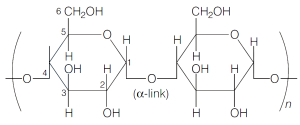
Which one of the following structures represents amylose?
A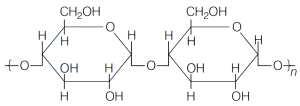
B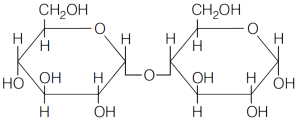
C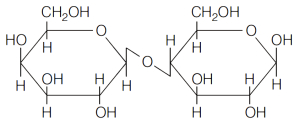
D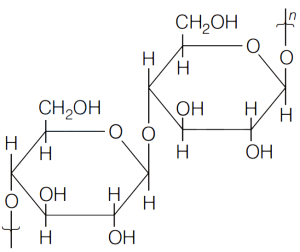
Solution
(A) Amylose is a polysaccharide composed of $\alpha-D$-glucose units linked together by $\alpha(1-4)$ glycosidic linkages.
Looking at the provided structures,the structure that correctly depicts the $\alpha(1-4)$ glycosidic linkage between two $\alpha-D$-glucose units in a repeating polymer chain is represented by option $A$.
Looking at the provided structures,the structure that correctly depicts the $\alpha(1-4)$ glycosidic linkage between two $\alpha-D$-glucose units in a repeating polymer chain is represented by option $A$.
0 likes
View Solution774
MediumMCQ
On prolonged heating with $HI$,glucose gives a compound '$C$',which can be obtained by Wurtz reaction using sodium metal and compound '$D$'. Identify '$D$'.
A
$CH_3CH_2CH_2Cl$
B
$CH_3CHClCH_3$
C
$CH_3CH(CH_3)CH_2Cl$
D
$CH_3C(Cl)(CH_3)_2$
Solution
(A) Glucose on prolonged heating with $HI$ gives $n$-hexane $(CH_3CH_2CH_2CH_2CH_2CH_3)$,which is compound '$C$'.
In the Wurtz reaction,two alkyl halide molecules react with sodium metal to form an alkane.
To obtain $n$-hexane $(C_6H_{14})$ via Wurtz reaction,the alkyl halide '$D$' must be $n$-propyl chloride $(CH_3CH_2CH_2Cl)$.
The reaction is: $2CH_3CH_2CH_2Cl + 2Na \rightarrow CH_3CH_2CH_2CH_2CH_2CH_3 + 2NaCl$.
In the Wurtz reaction,two alkyl halide molecules react with sodium metal to form an alkane.
To obtain $n$-hexane $(C_6H_{14})$ via Wurtz reaction,the alkyl halide '$D$' must be $n$-propyl chloride $(CH_3CH_2CH_2Cl)$.
The reaction is: $2CH_3CH_2CH_2Cl + 2Na \rightarrow CH_3CH_2CH_2CH_2CH_2CH_3 + 2NaCl$.
0 likes
View Solution775
MediumMCQ
The functional groups involved in the conversion of glucose to gluconic acid and gluconic acid to saccharic acid respectively are
A
$-CHO, >CHOH$
B
$-CHO, -CH_2OH$
C
$-CH_2OH, -CHO$
D
$-CH_2OH, >CHOH$
Solution
(B) Glucose $(CHO(CHOH)_4CH_2OH)$ on oxidation with mild oxidizing agents like $Br_2$ water gets converted to gluconic acid $(COOH(CHOH)_4CH_2OH)$. Here,the aldehyde group $(-CHO)$ is oxidized to a carboxylic acid group $(-COOH)$.
Gluconic acid $(COOH(CHOH)_4CH_2OH)$ on oxidation with strong oxidizing agents like $HNO_3$ gets converted to saccharic acid $(COOH(CHOH)_4COOH)$. Here,the primary alcoholic group $(-CH_2OH)$ is oxidized to a carboxylic acid group $(-COOH)$.
Thus,the functional groups involved in the respective conversions are $-CHO$ and $-CH_2OH$.
Gluconic acid $(COOH(CHOH)_4CH_2OH)$ on oxidation with strong oxidizing agents like $HNO_3$ gets converted to saccharic acid $(COOH(CHOH)_4COOH)$. Here,the primary alcoholic group $(-CH_2OH)$ is oxidized to a carboxylic acid group $(-COOH)$.
Thus,the functional groups involved in the respective conversions are $-CHO$ and $-CH_2OH$.
0 likes
View Solution776
MediumMCQ
The amount of sucrose needed to produce $1 \ mole$ of glucose using acid hydrolysis is (in $g$)
A
$360$
B
$180$
C
$342$
D
$171$
Solution
(C) The acid hydrolysis of sucrose is represented by the following chemical equation:
$C_{12}H_{22}O_{11} + H_2O \rightarrow C_6H_{12}O_6 \text{ (Glucose)} + C_6H_{12}O_6 \text{ (Fructose)}$
From the stoichiometry of the reaction,$1 \ mole$ of sucrose produces $1 \ mole$ of glucose and $1 \ mole$ of fructose.
The molar mass of sucrose $(C_{12}H_{22}O_{11})$ is calculated as: $(12 \times 12) + (22 \times 1) + (11 \times 16) = 144 + 22 + 176 = 342 \ g/mol$.
Therefore,to produce $1 \ mole$ of glucose,$1 \ mole$ of sucrose is required,which corresponds to $342 \ g$.
$C_{12}H_{22}O_{11} + H_2O \rightarrow C_6H_{12}O_6 \text{ (Glucose)} + C_6H_{12}O_6 \text{ (Fructose)}$
From the stoichiometry of the reaction,$1 \ mole$ of sucrose produces $1 \ mole$ of glucose and $1 \ mole$ of fructose.
The molar mass of sucrose $(C_{12}H_{22}O_{11})$ is calculated as: $(12 \times 12) + (22 \times 1) + (11 \times 16) = 144 + 22 + 176 = 342 \ g/mol$.
Therefore,to produce $1 \ mole$ of glucose,$1 \ mole$ of sucrose is required,which corresponds to $342 \ g$.
0 likes
View Solution777
MediumMCQ
Glucose on prolonged heating with $HI$ gives product $P$. The product $P$ is
A
$CH_2I(CHOH)_4CH_2OH$
B
$CHO(CHI)_4CH_2I$
C
$CH_3(CH_2)_4CH_3$
D
$CH_2I(CHI)_4CH_2I$
Solution
(C) According to the chemical properties of glucose,prolonged heating of glucose with $HI$ and red phosphorus at $100^{\circ} C$ results in the reduction of all hydroxyl groups and the aldehyde group to a straight-chain alkane,specifically $n$-hexane.
$CH_2OH(CHOH)_4CHO \xrightarrow{HI / \text{Red } P, 100^{\circ} C} CH_3(CH_2)_4CH_3$
The formation of $n$-hexane confirms that glucose has a straight-chain open structure.
$CH_2OH(CHOH)_4CHO \xrightarrow{HI / \text{Red } P, 100^{\circ} C} CH_3(CH_2)_4CH_3$
The formation of $n$-hexane confirms that glucose has a straight-chain open structure.
0 likes
View Solution778
EasyMCQ
Starch,when boiled with dilute sulphuric acid under high pressure,gives compound $A$. On prolonged heating with hydroiodic acid,$A$ gives compound $B$. What is the compound $B$?
A
$CH_3-(CH_2)_4-CH_3$
B
$HO-CH_2-(CHOH)_4-CHO$
C
$HOOC-(CHOH)_4-COOH$
D
$HO-CH_2-(CHOH)_4-COOH$
Solution
(A) Starch is a polysaccharide with the formula $(C_6H_{10}O_5)_n$.
When starch is boiled with dilute $H_2SO_4$ under high pressure,it undergoes hydrolysis to produce glucose $(A)$.
The reaction is: $(C_6H_{10}O_5)_n + nH_2O \xrightarrow{\text{dil. } H_2SO_4, \text{high pressure}} nC_6H_{12}O_6$.
Glucose $(C_6H_{12}O_6)$,on prolonged heating with hydroiodic acid $(HI)$,undergoes reduction to form $n$-hexane $(B)$,which is $CH_3-(CH_2)_4-CH_3$.
Therefore,the correct option is $A$.
When starch is boiled with dilute $H_2SO_4$ under high pressure,it undergoes hydrolysis to produce glucose $(A)$.
The reaction is: $(C_6H_{10}O_5)_n + nH_2O \xrightarrow{\text{dil. } H_2SO_4, \text{high pressure}} nC_6H_{12}O_6$.
Glucose $(C_6H_{12}O_6)$,on prolonged heating with hydroiodic acid $(HI)$,undergoes reduction to form $n$-hexane $(B)$,which is $CH_3-(CH_2)_4-CH_3$.
Therefore,the correct option is $A$.
0 likes
View Solution779
MediumMCQ
Which of the following statements support the cyclic form for glucose?
$(i)$ It does not give Schiff's test.
$(ii)$ It is found to exist in two different crystalline forms.
$(iii)$ It oxidises with nitric acid to give saccharic acid.
$(iv)$ Pentaacetate of glucose does not react with hydroxylamine.
$(i)$ It does not give Schiff's test.
$(ii)$ It is found to exist in two different crystalline forms.
$(iii)$ It oxidises with nitric acid to give saccharic acid.
$(iv)$ Pentaacetate of glucose does not react with hydroxylamine.
A
$(i)$,$(ii)$ and $(iv)$
B
$(i)$,$(iii)$ and $(iv)$
C
$(ii)$ and $(iii)$
D
$(i)$,$(ii)$ and $(iii)$
Solution
(A) The cyclic structure of glucose is supported by the following facts:
$(i)$ Glucose does not give Schiff's test because the $-CHO$ group is involved in hemiacetal formation and is not free.
$(ii)$ Glucose exists in two different crystalline forms ($\alpha$-$D$-glucose and $\beta$-$D$-glucose) due to the formation of an anomeric carbon.
$(iv)$ Pentaacetate of glucose does not react with hydroxylamine because the aldehyde group is not free (it is in the cyclic hemiacetal form).
Statement $(iii)$ describes the oxidation of glucose to saccharic acid,which is a property of the open-chain structure,not the cyclic structure.
Therefore,statements $(i)$,$(ii)$,and $(iv)$ support the cyclic structure of glucose.
$(i)$ Glucose does not give Schiff's test because the $-CHO$ group is involved in hemiacetal formation and is not free.
$(ii)$ Glucose exists in two different crystalline forms ($\alpha$-$D$-glucose and $\beta$-$D$-glucose) due to the formation of an anomeric carbon.
$(iv)$ Pentaacetate of glucose does not react with hydroxylamine because the aldehyde group is not free (it is in the cyclic hemiacetal form).
Statement $(iii)$ describes the oxidation of glucose to saccharic acid,which is a property of the open-chain structure,not the cyclic structure.
Therefore,statements $(i)$,$(ii)$,and $(iv)$ support the cyclic structure of glucose.
0 likes
View Solution780
EasyMCQ
The product$(s)$ formed when glucose reacts with a strong oxidising agent like $HNO_3$ is/are
A
$COOH(CHOH)_4 COOH$
B
$CO_2, H_2 O$
C
$COOH(CHOH)_4 CHO$
D
$CO, CO_2, H_2 O$
Solution
(A) When glucose is oxidised by a strong oxidising agent like $HNO_3$,both the terminal aldehyde group $(-CHO)$ and the primary alcoholic group $(-CH_2OH)$ are oxidised to carboxylic acid groups $(-COOH)$.
This results in the formation of a dicarboxylic acid known as saccharic acid or glucaric acid.
The reaction is represented as:
$CHO(CHOH)_4 CH_2OH + [O] \xrightarrow{Conc. HNO_3} COOH(CHOH)_4 COOH + H_2O$.
This results in the formation of a dicarboxylic acid known as saccharic acid or glucaric acid.
The reaction is represented as:
$CHO(CHOH)_4 CH_2OH + [O] \xrightarrow{Conc. HNO_3} COOH(CHOH)_4 COOH + H_2O$.
0 likes
View Solution781
EasyMCQ
Find the reagent that oxidizes glucose into saccharic acid.
A
$Br_2, H_2O$
B
$HI, \Delta$
C
$HNO_3$
D
$HCN$
Solution
(C) Glucose $(CHO(CHOH)_4CH_2OH)$ on oxidation with concentrated nitric acid $(HNO_3)$ gets oxidized to a dicarboxylic acid,which is known as saccharic acid (glucaric acid).
The reaction is as follows:
$CHO(CHOH)_4CH_2OH \xrightarrow{HNO_3} COOH(CHOH)_4COOH$
Thus,$HNO_3$ is the reagent that oxidizes glucose into saccharic acid.
Hence,option $(C)$ is the correct answer.
The reaction is as follows:
$CHO(CHOH)_4CH_2OH \xrightarrow{HNO_3} COOH(CHOH)_4COOH$
Thus,$HNO_3$ is the reagent that oxidizes glucose into saccharic acid.
Hence,option $(C)$ is the correct answer.
0 likes
View Solution782
MediumMCQ
$A$ carbohydrate $(A)$,when treated with dilute $HCl$ in alcoholic solution,gives two isomers $(B)$ and $(C)$. $B$ on reaction with bromine water gives a monocarboxylic acid '$Z$',and '$C$' is a ketohexose. What is $A$?
A
Starch
B
Maltose
C
Sucrose
D
Lactose
Solution
(C) The carbohydrate $(A)$ is $Sucrose$ $(C_{12}H_{22}O_{11})$.
Upon hydrolysis with dilute $HCl$,$Sucrose$ yields $D-(+)-Glucose$ and $D-(-)-Fructose$.
$Glucose$ $(B)$ is an aldose,which on reaction with bromine water $(Br_2/H_2O)$ is oxidized to gluconic acid $(Z)$,a monocarboxylic acid.
$Fructose$ $(C)$ is a ketohexose.
Thus,$(A)$ is $Sucrose$.
Upon hydrolysis with dilute $HCl$,$Sucrose$ yields $D-(+)-Glucose$ and $D-(-)-Fructose$.
$Glucose$ $(B)$ is an aldose,which on reaction with bromine water $(Br_2/H_2O)$ is oxidized to gluconic acid $(Z)$,a monocarboxylic acid.
$Fructose$ $(C)$ is a ketohexose.
Thus,$(A)$ is $Sucrose$.
0 likes
View Solution783
MediumMCQ
Maltose on hydrolysis gives two monosaccharide units. The incorrect statement about the monosaccharides formed is
A
Both are $\alpha-D$-glucose units only
B
One is $\alpha-D$-glucose and second one is $\beta-D$-fructose
C
Both are reducing sugars
D
In maltose,they are joined through $1,4$-glycosidic linkage
Solution
(B) Maltose is a disaccharide composed of two $\alpha-D$-glucose units linked by an $\alpha(1 \rightarrow 4)$-glycosidic bond.
Upon hydrolysis,maltose yields two molecules of $\alpha-D$-glucose.
Option $A$ is correct as both units are $\alpha-D$-glucose.
Option $B$ is incorrect because maltose does not contain fructose; it is composed of two glucose units.
Option $C$ is correct because both glucose units have a free anomeric carbon,making them reducing sugars.
Option $D$ is correct as the linkage is indeed $1,4$-glycosidic.
Therefore,the incorrect statement is $B$.
Upon hydrolysis,maltose yields two molecules of $\alpha-D$-glucose.
Option $A$ is correct as both units are $\alpha-D$-glucose.
Option $B$ is incorrect because maltose does not contain fructose; it is composed of two glucose units.
Option $C$ is correct because both glucose units have a free anomeric carbon,making them reducing sugars.
Option $D$ is correct as the linkage is indeed $1,4$-glycosidic.
Therefore,the incorrect statement is $B$.
0 likes
View Solution784
EasyMCQ
Two statements are given below.
Statement $I$: Milk sugar is a disaccharide of $\alpha-D$-galactose and $\beta-D$-glucose.
Statement $II$: Sucrose is a disaccharide of $\alpha-D$-glucose and $\beta-D$-fructose.
Correct answer is
Statement $I$: Milk sugar is a disaccharide of $\alpha-D$-galactose and $\beta-D$-glucose.
Statement $II$: Sucrose is a disaccharide of $\alpha-D$-glucose and $\beta-D$-fructose.
Correct answer is
A
Both statements $I$ and $II$ are correct
B
Both statements $I$ and $II$ are incorrect
C
Statement $I$ is correct but statement $II$ is incorrect
D
Statement $I$ is incorrect but statement $II$ is correct
Solution
(D) Lactose,i.e.,milk sugar,is composed of a $\beta-D$-galactose unit and an $\alpha-D$-glucose unit joined by a $\beta$-glycosidic linkage between $C-1$ of galactose and $C-4$ of the glucose unit. Thus,Statement $I$ is incorrect because it mentions $\alpha-D$-galactose instead of $\beta-D$-galactose.
Sucrose,i.e.,cane sugar,is composed of $\alpha-D$-glucose and $\beta-D$-fructose units. These units are joined by an $\alpha,\beta$-glycosidic linkage between $C-1$ of glucose and $C-2$ of fructose. Thus,Statement $II$ is correct.
Sucrose,i.e.,cane sugar,is composed of $\alpha-D$-glucose and $\beta-D$-fructose units. These units are joined by an $\alpha,\beta$-glycosidic linkage between $C-1$ of glucose and $C-2$ of fructose. Thus,Statement $II$ is correct.
0 likes
View Solution785
MediumMCQ
Which of the following is the incorrect statement about maltose?
A
It is a reducing sugar
B
It is composed of two $\alpha-D$-glucose units
C
It is composed of one $\beta-D$-glucose and one $\beta-D$-galactose unit
D
It has $1,4$-glycosidic linkage
Solution
(C) Maltose is a disaccharide composed of two $\alpha-D$-glucose units linked by an $\alpha-1,4$-glycosidic bond.
Since it has a free hemiacetal group,it acts as a reducing sugar.
Option $C$ is incorrect because it describes the composition of lactose,not maltose.
Since it has a free hemiacetal group,it acts as a reducing sugar.
Option $C$ is incorrect because it describes the composition of lactose,not maltose.
0 likes
View Solution786
EasyMCQ
Which of the following are reducing sugars?
$I$. Sucrose
$II$. Ribose
$III$. Lactose
$IV$. Fructose
$I$. Sucrose
$II$. Ribose
$III$. Lactose
$IV$. Fructose
A
$I$ and $II$
B
$II, III$ and $IV$
C
$II$ and $III$
D
$I, II$ and $IV$
Solution
(B) reducing sugar is a carbohydrate that can act as a reducing agent due to the presence of a free aldehyde or ketone group.
All monosaccharides,such as $Ribose$ and $Fructose$,are reducing sugars.
Among disaccharides,$Lactose$ is a reducing sugar because it contains a free hemiacetal group,whereas $Sucrose$ is a non-reducing sugar because its glycosidic linkage involves the anomeric carbons of both glucose and fructose units.
Therefore,$II$ (Ribose),$III$ (Lactose),and $IV$ (Fructose) are reducing sugars.
Hence,the correct option is $B$.
All monosaccharides,such as $Ribose$ and $Fructose$,are reducing sugars.
Among disaccharides,$Lactose$ is a reducing sugar because it contains a free hemiacetal group,whereas $Sucrose$ is a non-reducing sugar because its glycosidic linkage involves the anomeric carbons of both glucose and fructose units.
Therefore,$II$ (Ribose),$III$ (Lactose),and $IV$ (Fructose) are reducing sugars.
Hence,the correct option is $B$.
0 likes
View Solution787
EasyMCQ
Considering the facts that
$I$. sucrose forms glycosidic linkage between $C_1$ of glucose and $C_2$ of fructose,while
$II$. lactose forms glycosidic linkage between $C_1$ of galactose and $C_4$ of glucose.
Choose the correct statement.
$I$. sucrose forms glycosidic linkage between $C_1$ of glucose and $C_2$ of fructose,while
$II$. lactose forms glycosidic linkage between $C_1$ of galactose and $C_4$ of glucose.
Choose the correct statement.
A
Both sucrose and lactose are reducing sugars.
B
Both sucrose and lactose are non-reducing sugars.
C
Lactose forms glycosidic linkage between $C_1$ of galactose and $C_4$ of glucose.
D
Lactose is a reducing sugar and sucrose is a non-reducing sugar.
Solution
(D) Sucrose and lactose both are disaccharides.
In sucrose,the anomeric $C_1$ of $\alpha-D$-glucose and $C_2$ of $\beta-D$-fructose are involved in the $1,2$-glycosidic linkage,leaving no free anomeric carbon.
So,it is a non-reducing sugar.
In lactose,the anomeric $C_1$ of $\beta-D$-galactose is involved in the $1,4$-glycosidic linkage,but the anomeric $C_1$ of $\beta-D$-glucose remains free with an $-OH$ group,which exhibits reducing properties.
In sucrose,the anomeric $C_1$ of $\alpha-D$-glucose and $C_2$ of $\beta-D$-fructose are involved in the $1,2$-glycosidic linkage,leaving no free anomeric carbon.
So,it is a non-reducing sugar.
In lactose,the anomeric $C_1$ of $\beta-D$-galactose is involved in the $1,4$-glycosidic linkage,but the anomeric $C_1$ of $\beta-D$-glucose remains free with an $-OH$ group,which exhibits reducing properties.
0 likes
View Solution788
EasyMCQ
Which one of the following statements is correct?
A
Starch on complete hydrolysis gives fructose
B
Lactose on hydrolysis gives glucose and fructose
C
Glucose on slow oxidation to $CO_2$ and $H_2O$ by enzyme does not liberate energy
D
Cellulose is not digestible in human body
Solution
(D) Cellulose is a polysaccharide consisting of many glucose units linked by $(\beta)-1,4$-glycosidic bonds.
Human beings lack the specific enzyme (cellulase) required to break these $(\beta)-1,4$-glycosidic linkages.
Therefore,cellulose cannot be digested in the human body.
Option $A$ is incorrect because starch hydrolysis yields glucose.
Option $B$ is incorrect because lactose hydrolysis yields glucose and galactose.
Option $C$ is incorrect because the oxidation of glucose is an exothermic process that releases energy.
Human beings lack the specific enzyme (cellulase) required to break these $(\beta)-1,4$-glycosidic linkages.
Therefore,cellulose cannot be digested in the human body.
Option $A$ is incorrect because starch hydrolysis yields glucose.
Option $B$ is incorrect because lactose hydrolysis yields glucose and galactose.
Option $C$ is incorrect because the oxidation of glucose is an exothermic process that releases energy.
0 likes
View Solution789
EasyMCQ
Lactose is a disaccharide of
A
$\alpha-D$-glucose and $\alpha-D$-fructose
B
$\beta-D$-glucose and $\beta-D$-galactose
C
$\alpha-D$-glucose and $\beta-D$-ribose
D
$\alpha-D$-glucose and $\beta-D$-galactose
Solution
(B) Lactose is a disaccharide composed of $\beta-D(+)$-galactose and $\beta-D(+)$-glucose units.
These two monosaccharides are linked together by a $\beta-1,4$-glycosidic linkage.
It is a reducing sugar because the hemiacetal group at $C-1$ of the glucose unit is free.
These two monosaccharides are linked together by a $\beta-1,4$-glycosidic linkage.
It is a reducing sugar because the hemiacetal group at $C-1$ of the glucose unit is free.
0 likes
View Solution790
MediumMCQ
Hydrolysis of sucrose with dilute aqueous sulphuric acid yields
A
$1:1$ $D-(+)$-glucose; $D-(-)$-fructose
B
$1:2$ $D-(+)$-glucose; $D-(-)$-fructose
C
$1:1$ $D-(-)$-glucose; $D-(+)$-fructose
D
$1:2$ $D-(-)$-glucose; $D-(+)$-fructose
Solution
(A) Sucrose undergoes hydrolysis in the presence of dilute aqueous sulphuric acid to produce an equimolar mixture of $D-(+)$-glucose and $D-(-)$-fructose.
The chemical reaction is:
$C_{12}H_{22}O_{11} + H_2O \xrightarrow{H_2SO_4} C_6H_{12}O_6 + C_6H_{12}O_6$
($D-(+)$-glucose) ($D-(-)$-fructose)
The molar ratio of the products is $1:1$.
Sucrose is dextrorotatory,but the resulting mixture is laevorotatory because the specific rotation of $D-(-)$-fructose $(-92.4^{\circ})$ is greater in magnitude than that of $D-(+)$-glucose $(+52.7^{\circ})$.
The chemical reaction is:
$C_{12}H_{22}O_{11} + H_2O \xrightarrow{H_2SO_4} C_6H_{12}O_6 + C_6H_{12}O_6$
($D-(+)$-glucose) ($D-(-)$-fructose)
The molar ratio of the products is $1:1$.
Sucrose is dextrorotatory,but the resulting mixture is laevorotatory because the specific rotation of $D-(-)$-fructose $(-92.4^{\circ})$ is greater in magnitude than that of $D-(+)$-glucose $(+52.7^{\circ})$.
0 likes
View Solution791
MediumMCQ
Which of the following is present in $RNA$ only?
A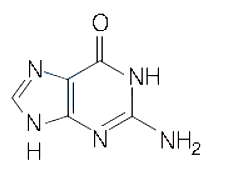
B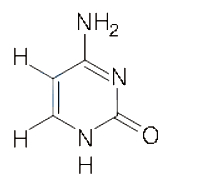
C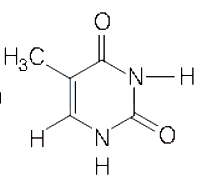
D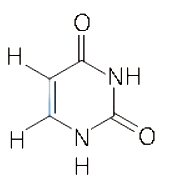
Solution
(D) The nitrogenous bases found in nucleic acids are Adenine $(A)$,Guanine $(G)$,Thymine $(T)$,Cytosine $(C)$,and Uracil $(U)$.
$DNA$ contains $A, G, T,$ and $C$.
$RNA$ contains $A, G, C,$ and $U$.
Uracil is present in $RNA$ instead of Thymine,which is found in $DNA$. Therefore,Uracil is present in $RNA$ only.
$DNA$ contains $A, G, T,$ and $C$.
$RNA$ contains $A, G, C,$ and $U$.
Uracil is present in $RNA$ instead of Thymine,which is found in $DNA$. Therefore,Uracil is present in $RNA$ only.
0 likes
View Solution792
MediumMCQ
From the following,the correct statements about polysaccharides are:
$(I)$ Starch is a polymer of $\alpha-D(+)$-glucose.
$(II)$ Amylose component of starch is not soluble in water.
$(III)$ Amylose is a branched chain polymer of $\alpha-D(+)$-glucose.
$(IV)$ Cellulose is a straight chain polymer of $\beta-D(+)$-glucose units.
$(I)$ Starch is a polymer of $\alpha-D(+)$-glucose.
$(II)$ Amylose component of starch is not soluble in water.
$(III)$ Amylose is a branched chain polymer of $\alpha-D(+)$-glucose.
$(IV)$ Cellulose is a straight chain polymer of $\beta-D(+)$-glucose units.
A
$I$ & $IV$ only
B
$II$ & $III$ only
C
$II$ & $IV$ only
D
$I$ & $III$ only
Solution
(A) Statement $(I)$ is correct: Starch is a polymer of $\alpha-D(+)$-glucose.
Statement $(II)$ is incorrect: Amylose is the water-soluble component of starch.
Statement $(III)$ is incorrect: Amylose is a long unbranched chain polymer of $\alpha-D(+)$-glucose.
Statement $(IV)$ is correct: Cellulose is a straight chain polymer of $\beta-D(+)$-glucose units.
Therefore,the correct statements are $(I)$ and $(IV)$.
Statement $(II)$ is incorrect: Amylose is the water-soluble component of starch.
Statement $(III)$ is incorrect: Amylose is a long unbranched chain polymer of $\alpha-D(+)$-glucose.
Statement $(IV)$ is correct: Cellulose is a straight chain polymer of $\beta-D(+)$-glucose units.
Therefore,the correct statements are $(I)$ and $(IV)$.
0 likes
View Solution793
MediumMCQ
Ribose and $2$-deoxyribose can be differentiated by
A
Fehling's reagent
B
Tollen's reagent
C
Barfoed's reagent
D
Osazone formation
Solution
(D) Ribose is an aldopentose that reacts with phenylhydrazine $(Ph-NH-NH_2)$ to form a characteristic osazone derivative.
In $2$-deoxyribose,the $-OH$ group at the $C-2$ position is replaced by a hydrogen atom.
The formation of an osazone requires the presence of an $\alpha$-hydroxy carbonyl group (or a group that can be oxidized to it).
Since $2$-deoxyribose lacks the $-OH$ group at the $C-2$ position,it cannot form the stable osazone structure under standard conditions,allowing it to be differentiated from ribose.
In $2$-deoxyribose,the $-OH$ group at the $C-2$ position is replaced by a hydrogen atom.
The formation of an osazone requires the presence of an $\alpha$-hydroxy carbonyl group (or a group that can be oxidized to it).
Since $2$-deoxyribose lacks the $-OH$ group at the $C-2$ position,it cannot form the stable osazone structure under standard conditions,allowing it to be differentiated from ribose.
0 likes
View Solution794
DifficultMCQ
In aqueous solution,glucose remains as:
A
Only in open chain form
B
Only in pyranose form
C
Only in furanose forms
D
In all three forms in equilibrium
Solution
(D) In an aqueous solution,glucose exists in a dynamic equilibrium between its open-chain form and two cyclic (pyranose) forms,known as $\alpha-D-(+)-glucopyranose$ and $\beta-D-(+)-glucopyranose$.
The equilibrium mixture consists of approximately $36\%$ of $\alpha$-anomer,$64\%$ of $\beta$-anomer,and a very small amount (about $0.02\%$) of the open-chain form.
Therefore,glucose exists in all three forms in equilibrium.
The equilibrium mixture consists of approximately $36\%$ of $\alpha$-anomer,$64\%$ of $\beta$-anomer,and a very small amount (about $0.02\%$) of the open-chain form.
Therefore,glucose exists in all three forms in equilibrium.
0 likes
View Solution795
EasyMCQ
Among the following statements about the molecules $X$ and $Y$,which one$(s)$ is/are correct?
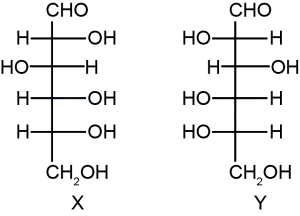
A
$X$ and $Y$ are diastereomers
B
$X$ and $Y$ are enantiomers
C
$X$ and $Y$ are both aldohexoses
D
$X$ is a $D$-sugar and $Y$ is an $L$-sugar
Solution
(B, C, D) Both the given molecules contain $6$ carbon atoms with an aldehyde group,so these are called aldohexoses.
In $X$,the $-OH$ group attached to the second-last carbon ($C$-$5$) is on the right-hand side,so it is a $D$-sugar.
In $Y$,the $-OH$ group attached to the second-last carbon ($C$-$5$) is on the left-hand side,so it is an $L$-sugar.
Since $X$ and $Y$ are non-superimposable mirror images of each other,they are enantiomers.
Therefore,statements $B$,$C$,and $D$ are correct.
In $X$,the $-OH$ group attached to the second-last carbon ($C$-$5$) is on the right-hand side,so it is a $D$-sugar.
In $Y$,the $-OH$ group attached to the second-last carbon ($C$-$5$) is on the left-hand side,so it is an $L$-sugar.
Since $X$ and $Y$ are non-superimposable mirror images of each other,they are enantiomers.
Therefore,statements $B$,$C$,and $D$ are correct.
0 likes
View Solution796
DifficultMCQ
From the given following ($A$ and $B$) cyclic structures,those which will not react with Tollen's reagent are :
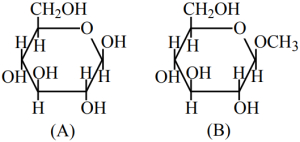
A
$B$ and $D$
B
$A$ and $D$
C
$A$ and $B$
D
Only $B$
Solution
(D) Tollen's reagent reacts with reducing sugars that possess a free anomeric $-OH$ group,which allows for mutarotation and the formation of an open-chain aldehyde form.
Structure $(A)$ is $\alpha$-$D$-glucopyranose,which has a free anomeric $-OH$ group at the $C1$ position,making it a reducing sugar that reacts with Tollen's reagent.
Structure $(B)$ is methyl $\alpha$-$D$-glucopyranoside,which is an acetal (the anomeric $-OH$ is replaced by an $-OCH_3$ group).
Since acetals cannot undergo mutarotation to form an open-chain aldehyde,they do not react with Tollen's reagent.
Therefore,only structure $(B)$ will not react with Tollen's reagent.
Structure $(A)$ is $\alpha$-$D$-glucopyranose,which has a free anomeric $-OH$ group at the $C1$ position,making it a reducing sugar that reacts with Tollen's reagent.
Structure $(B)$ is methyl $\alpha$-$D$-glucopyranoside,which is an acetal (the anomeric $-OH$ is replaced by an $-OCH_3$ group).
Since acetals cannot undergo mutarotation to form an open-chain aldehyde,they do not react with Tollen's reagent.
Therefore,only structure $(B)$ will not react with Tollen's reagent.
0 likes
View Solution797
DifficultMCQ
Structures of four disaccharides are given below. Among the given disaccharides,the non-reducing sugar is:
A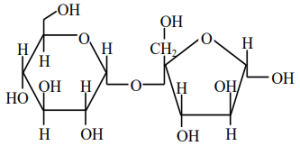
B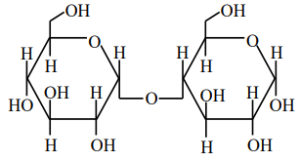
C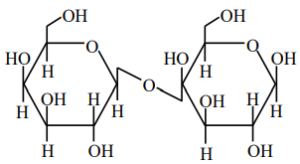
D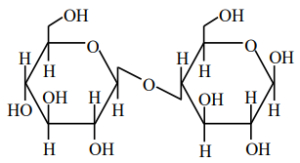
Solution
(A) sugar is non-reducing if it does not have a free hemiacetal or hemiketal group,meaning both anomeric carbons are involved in the glycosidic linkage.
In the structure shown in image $278743-a$ (sucrose),the glycosidic linkage is between the $C1$ of $\alpha-D-glucose$ and the $C2$ of $\beta-D-fructose$.
Since both anomeric carbons are involved in the linkage,there is no free hemiacetal group,making it a non-reducing sugar.
The other structures $(278743-b, 278743-c, 278743-d)$ contain at least one free anomeric carbon (hemiacetal group),making them reducing sugars.
In the structure shown in image $278743-a$ (sucrose),the glycosidic linkage is between the $C1$ of $\alpha-D-glucose$ and the $C2$ of $\beta-D-fructose$.
Since both anomeric carbons are involved in the linkage,there is no free hemiacetal group,making it a non-reducing sugar.
The other structures $(278743-b, 278743-c, 278743-d)$ contain at least one free anomeric carbon (hemiacetal group),making them reducing sugars.
0 likes
View SolutionBiomolecules — Carbohydrates · Frequently Asked Questions
1Are these Biomolecules questions useful for JEE and NEET?
Yes. All questions in this section are mapped to JEE Main and NEET exam patterns. Previous year questions from JEE Main, NEET, GUJCET and state-level exams are included with full solutions.
2Can I switch to Hindi or Gujarati for these questions?
Yes. Use the language tabs in the hero section or the sidebar to view the same questions and solutions in English, Hindi or Gujarati.
3How do I generate a question paper from this subtopic?
Use the Vedclass Exam Paper Generator — select the chapter and subtopic, set difficulty, and generate Sets A, B, C, D automatically. First 3 chapters of every subject are free.
Vedclass Products
For Students
Vedclass Test Series
Mock tests in real JEE/NEET style with performance analysis. 5-day free trial.
Start Free TrialFor Teachers
Exam Paper Generator
Generate Set A/B/C/D papers from this chapter in 2 minutes. 3 chapters free.
Try FreeFor Institutes
Online Exam Module
Live online exams with unlimited students, 360° analytics & white-label branding.
See DemoFor Teachers & Institutes
Generate a Biomolecules Exam Paper in 2 Minutes
Select subtopic & difficulty — Sets A, B, C, D auto-generated with No Repeat logic.
First 3 chapters of every subject are free — no payment required.