
A English
Carbohydrates Questions in English
Class 12 Chemistry · Biomolecules · Carbohydrates
808+
Questions
English
Language
100%
With Solutions
Showing 49 of 808 questions in English
601
EasyMCQ
Glucose gives a silver mirror with ammoniacal silver nitrate because it has:
A
aldehyde group
B
ester group
C
ketone group
D
alcoholic group
Solution
(A) Glucose gives a silver mirror test (Tollens' test) with ammoniacal silver nitrate due to the presence of the $-CHO$ (aldehyde) group in its open-chain structure.
$CH_2OH(CHOH)_4CHO + 2[Ag(NH_3)_2]^+ + 3OH^- \rightarrow CH_2OH(CHOH)_4COO^- + 2Ag(s) + 4NH_3 + 2H_2O$
The formation of metallic silver $(Ag)$ results in the silver mirror.
$CH_2OH(CHOH)_4CHO + 2[Ag(NH_3)_2]^+ + 3OH^- \rightarrow CH_2OH(CHOH)_4COO^- + 2Ag(s) + 4NH_3 + 2H_2O$
The formation of metallic silver $(Ag)$ results in the silver mirror.
0 likes
View Solution602
EasyMCQ
Which carbon atom of glucopyranose numbered from $C-1$ to $C-6$ is anomeric?
A
$C-5$
B
$C-6$
C
$C-2$
D
$C-1$
Solution
(D) In the cyclic structure of glucopyranose,the carbon atom that is part of the hemiacetal group is known as the anomeric carbon. This carbon is the one that was the carbonyl carbon (aldehyde group) in the open-chain form of glucose. In glucopyranose,this is the $C-1$ carbon,which is bonded to both an oxygen atom in the ring and a hydroxyl group $(-OH)$.
0 likes
View Solution603
EasyMCQ
What is the total number of $-OH$ groups present in a ribonucleoside?
A
$5$
B
$4$
C
$3$
D
$2$
Solution
(C) ribonucleoside consists of a ribose sugar molecule attached to a nitrogenous base.
In a ribose sugar $(C_5H_{10}O_5)$,there are $-OH$ groups at the $C_2$,$C_3$,and $C_5$ positions.
When the ribose sugar forms a nucleoside,the $-OH$ group at the $C_1$ position is replaced by the nitrogenous base.
Therefore,the remaining $-OH$ groups are at the $C_2$,$C_3$,and $C_5$ positions.
Thus,the total number of $-OH$ groups in a ribonucleoside is $3$.
In a ribose sugar $(C_5H_{10}O_5)$,there are $-OH$ groups at the $C_2$,$C_3$,and $C_5$ positions.
When the ribose sugar forms a nucleoside,the $-OH$ group at the $C_1$ position is replaced by the nitrogenous base.
Therefore,the remaining $-OH$ groups are at the $C_2$,$C_3$,and $C_5$ positions.
Thus,the total number of $-OH$ groups in a ribonucleoside is $3$.
0 likes
View Solution604
EasyMCQ
What is the total number of carbon atoms present in a sugar molecule of $RNA$ nucleotide?
A
$6$
B
$5$
C
$4$
D
$12$
Solution
(B) The sugar molecule present in an $RNA$ nucleotide is $\beta-D-ribose$.
This is a pentose sugar,which means it contains $5$ carbon atoms in its structure.
Therefore,the total number of carbon atoms in the sugar molecule of an $RNA$ nucleotide is $5$.
This is a pentose sugar,which means it contains $5$ carbon atoms in its structure.
Therefore,the total number of carbon atoms in the sugar molecule of an $RNA$ nucleotide is $5$.
0 likes
View Solution605
EasyMCQ
Which of the following carbohydrates produces glucose,galactose,and fructose on hydrolysis?
A
Maltose
B
Raffinose
C
Cellulose
D
Lactose
Solution
(B) Raffinose is a trisaccharide with the formula $C_{18}H_{32}O_{16}$.
On complete hydrolysis,it yields one molecule each of glucose,galactose,and fructose.
The reaction is: $C_{18}H_{32}O_{16} + 2H_2O$ $\rightarrow C_6H_{12}O_6 (\text{glucose}) + C_6H_{12}O_6 (\text{galactose}) + C_6H_{12}O_6 (\text{fructose})$.
On complete hydrolysis,it yields one molecule each of glucose,galactose,and fructose.
The reaction is: $C_{18}H_{32}O_{16} + 2H_2O$ $\rightarrow C_6H_{12}O_6 (\text{glucose}) + C_6H_{12}O_6 (\text{galactose}) + C_6H_{12}O_6 (\text{fructose})$.
0 likes
View Solution606
DifficultMCQ
Which of the following $n$ mole molecules of carbohydrate contains $2n$ mole molecules of galactose,$n$ moles of glucose,and $n$ moles of fructose upon hydrolysis?
A
Lactose
B
Raffinose
C
Amylose
D
Stachyose
Solution
(D) Stachyose is a tetrasaccharide with the molecular formula $C_{24}H_{42}O_{21}$.
Upon complete hydrolysis,one mole of stachyose yields two moles of galactose,one mole of glucose,and one mole of fructose.
Therefore,$n$ moles of stachyose will yield $2n$ moles of galactose,$n$ moles of glucose,and $n$ moles of fructose.
Upon complete hydrolysis,one mole of stachyose yields two moles of galactose,one mole of glucose,and one mole of fructose.
Therefore,$n$ moles of stachyose will yield $2n$ moles of galactose,$n$ moles of glucose,and $n$ moles of fructose.
0 likes
View Solution607
DifficultMCQ
Identify the molecular formula of laevulose.
A
$C_6H_{12}O_6$
B
$C_5H_{10}O_5$
C
$C_4H_8O_4$
D
$C_3H_6O_3$
Solution
(A) Fructose $(C_6H_{12}O_6)$ is a laevorotatory ketohexose.
It exhibits laevorotation with a specific rotation of $[\alpha]_D^{20} = -92.4^{\circ}$.
Due to this property,fructose is commonly referred to as laevulose.
It exhibits laevorotation with a specific rotation of $[\alpha]_D^{20} = -92.4^{\circ}$.
Due to this property,fructose is commonly referred to as laevulose.
0 likes
View Solution608
MediumMCQ
Which of the following statements is $CORRECT$ about saccharic acid?
A
It contains two carboxyl and four hydroxyl groups.
B
It contains one carboxyl group and five hydroxyl groups.
C
It contains two carboxyl groups and five hydroxyl groups.
D
It contains three carboxyl and two hydroxyl groups.
Solution
(A) Saccharic acid is formed by the oxidation of both the terminal $-CHO$ and $-CH_2OH$ groups of glucose to $-COOH$ groups.
The structure of saccharic acid is $HOOC-(CHOH)_4-COOH$.
It contains two carboxyl $(-COOH)$ groups at the ends and four hydroxyl $(-OH)$ groups attached to the carbon chain.
Therefore,the correct statement is that it contains two carboxyl and four hydroxyl groups.
The structure of saccharic acid is $HOOC-(CHOH)_4-COOH$.
It contains two carboxyl $(-COOH)$ groups at the ends and four hydroxyl $(-OH)$ groups attached to the carbon chain.
Therefore,the correct statement is that it contains two carboxyl and four hydroxyl groups.
0 likes
View Solution609
MediumMCQ
Identify the correct statement about glucose from the following.
A
It is an aldohexose.
B
It is a nonreducing sugar.
C
It contains three chiral carbon atoms.
D
Its ring structure is a hemiketal.
Solution
(A) Explanation:
- Glucose is an aldohexose,meaning it is a $6$-carbon sugar with an aldehyde group.
- It is a reducing sugar,not nonreducing,because it can reduce Fehling's solution and Tollens' reagent.
- It contains $4$ chiral carbon atoms,not $3$.
- The ring structure of glucose is a hemiacetal,not a hemiketal,because it forms from the reaction of an aldehyde group with a hydroxyl group.
- Glucose is an aldohexose,meaning it is a $6$-carbon sugar with an aldehyde group.
- It is a reducing sugar,not nonreducing,because it can reduce Fehling's solution and Tollens' reagent.
- It contains $4$ chiral carbon atoms,not $3$.
- The ring structure of glucose is a hemiacetal,not a hemiketal,because it forms from the reaction of an aldehyde group with a hydroxyl group.
0 likes
View Solution610
DifficultMCQ
What type of glycosidic linkages are developed when excess glucose is to be stored for future use in animals?
A
$\beta-1,4$ and $\alpha-1,4$
B
$\alpha-1,6$ and $\beta-1,4$
C
$\beta-1,6$ and $\beta-1,4$
D
$\alpha-1,4$ and $\alpha-1,6$
Solution
(D) In animals,excess glucose is stored as glycogen,which is a polysaccharide that serves as an energy reserve.
Glycogen has a highly branched structure consisting of glucose units.
Linear chains of glucose units are connected by $\alpha-1,4$-glycosidic linkages.
Branch points in the glycogen molecule are formed by $\alpha-1,6$-glycosidic linkages.
Glycogen has a highly branched structure consisting of glucose units.
Linear chains of glucose units are connected by $\alpha-1,4$-glycosidic linkages.
Branch points in the glycogen molecule are formed by $\alpha-1,6$-glycosidic linkages.
0 likes
View Solution611
EasyMCQ
What is the value of specific rotation exhibited by glucose molecule?
A
$+52.7^{\circ}$
B
$-92.4^{\circ}$
C
$+66.5^{\circ}$
D
$+40.3^{\circ}$
Solution
(A) The specific rotation of $D-(+)$-glucose in aqueous solution is $+52.7^{\circ}$.
This value is obtained after the process of mutarotation,where the equilibrium mixture of $\alpha-D$-glucose $(+112^{\circ})$ and $\beta-D$-glucose $(+19^{\circ})$ is formed.
This value is obtained after the process of mutarotation,where the equilibrium mixture of $\alpha-D$-glucose $(+112^{\circ})$ and $\beta-D$-glucose $(+19^{\circ})$ is formed.
0 likes
View Solution612
EasyMCQ
Which carbon atoms (numbered from $C_1$ to $C_6$) are involved in the formation of the ring structure of glucose?
A
$C_2$ and $C_5$
B
$C_1$ and $C_3$
C
$C_1$ and $C_4$
D
$C_1$ and $C_5$
Solution
(D) The ring structure of glucose is formed by the intramolecular hemiacetal formation.
This involves the reaction between the aldehyde group at $C_1$ and the hydroxyl group at $C_5$ to form a six-membered pyranose ring.
This involves the reaction between the aldehyde group at $C_1$ and the hydroxyl group at $C_5$ to form a six-membered pyranose ring.
0 likes
View Solution613
EasyMCQ
Identify the reagent that confirms the presence of five $-OH$ groups in glucose.
A
$NH_2OH$
B
$HCN$
C
dil. $HNO_3$
D
Acetic anhydride
Solution
(D) Glucose reacts with acetic anhydride to form glucose pentaacetate. The reaction is as follows:
$CHO-(CHOH)_4-CH_2OH + 5(CH_3CO)_2O \rightarrow CHO-(CHOCOCH_3)_4-CH_2OCOCH_3 + 5CH_3COOH$
This reaction confirms the presence of five hydroxyl $(-OH)$ groups in the glucose molecule.
$CHO-(CHOH)_4-CH_2OH + 5(CH_3CO)_2O \rightarrow CHO-(CHOCOCH_3)_4-CH_2OCOCH_3 + 5CH_3COOH$
This reaction confirms the presence of five hydroxyl $(-OH)$ groups in the glucose molecule.
0 likes
View Solution614
EasyMCQ
Which of the following is $NOT$ correct about fructose?
A
It is a ketohexose.
B
It is a reducing sugar.
C
It is laevorotatory.
D
Its ring structure is hemiacetal.
Solution
(D) The ring structure of fructose is a hemiketal,not a hemiacetal.
Fructose $(C_6H_{12}O_6)$ is a laevorotatory ketohexose.
It acts as a reducing sugar due to the presence of an $\alpha$-hydroxy ketone group which can tautomerize to an aldehyde in basic solution.
Fructose $(C_6H_{12}O_6)$ is a laevorotatory ketohexose.
It acts as a reducing sugar due to the presence of an $\alpha$-hydroxy ketone group which can tautomerize to an aldehyde in basic solution.
0 likes
View Solution615
MediumMCQ
Which of the following phenomena is $NOT$ explained by the open chain structure of glucose?
A
Formation of pentaacetate of glucose with acetic anhydride.
B
Formation of oxime with hydroxylamine.
C
Formation of silver mirror with Tollen's reagent.
D
Existence of $\alpha$ and $\beta$ forms of glucose.
Solution
(D) Glucose exists in two cyclic forms,$\alpha$ and $\beta$,which are formed by intramolecular hemiacetal formation between the aldehyde group and one of the alcoholic groups at $C-5$ within the molecule.
This cyclic structure is responsible for the mutarotation and the existence of two anomers.
Thus,the open chain structure of glucose does not explain the existence of $\alpha$ and $\beta$ forms of glucose.
This cyclic structure is responsible for the mutarotation and the existence of two anomers.
Thus,the open chain structure of glucose does not explain the existence of $\alpha$ and $\beta$ forms of glucose.
0 likes
View Solution616
EasyMCQ
What is the value of specific rotation exhibited by the fructose molecule?
A
$+52.7^{\circ}$
B
$-92.4^{\circ}$
C
$+66.5^{\circ}$
D
$-40.3^{\circ}$
Solution
(B) The specific rotation of $D$-fructose is $-92.4^{\circ}$.
Since the value is negative,it indicates that fructose is levorotatory,which is why it is commonly referred to as levulose.
Since the value is negative,it indicates that fructose is levorotatory,which is why it is commonly referred to as levulose.
0 likes
View Solution617
MediumMCQ
In which of the following carbohydrates does the molecular mass increase by $84 \ u$ after complete acetylation?
A
Aldotriose
B
Aldotetrose
C
Ketotetrose
D
Ketopentose
Solution
(A) In an acetylation reaction,the $H$ atom of an $(-OH)$ group is replaced by an acetyl group $(-COCH_3)$.
This results in an increase in molecular mass by $[(12+16+12+3 \times 1)-1] = 42 \ u$ per $-OH$ group.
Given the total increase in molecular mass is $84 \ u$.
Therefore,the number of $-OH$ groups $= \frac{84 \ u}{42 \ u} = 2$.
Among the given options,an aldotriose (e.g.,glyceraldehyde) contains two alcoholic $-OH$ groups,which upon acetylation will increase the molecular mass by $2 \times 42 \ u = 84 \ u$.
This results in an increase in molecular mass by $[(12+16+12+3 \times 1)-1] = 42 \ u$ per $-OH$ group.
Given the total increase in molecular mass is $84 \ u$.
Therefore,the number of $-OH$ groups $= \frac{84 \ u}{42 \ u} = 2$.
Among the given options,an aldotriose (e.g.,glyceraldehyde) contains two alcoholic $-OH$ groups,which upon acetylation will increase the molecular mass by $2 \times 42 \ u = 84 \ u$.
0 likes
View Solution618
EasyMCQ
Identify the non-reducing sugar from the following.
A
$Sucrose$
B
$Maltose$
C
$Lactose$
D
$Glucose$
Solution
(A) non-reducing sugar is a carbohydrate that does not have a free aldehyde or ketone group to act as a reducing agent.
$Sucrose$ is a disaccharide composed of $Glucose$ and $Fructose$ units linked by a glycosidic bond between their respective anomeric carbons ($C1$ of $Glucose$ and $C2$ of $Fructose$).
Since both anomeric carbons are involved in the glycosidic linkage,$Sucrose$ cannot open to form an aldehyde or ketone group,making it a non-reducing sugar.
$Maltose$,$Lactose$,and $Glucose$ all contain at least one free anomeric carbon,making them reducing sugars.
$Sucrose$ is a disaccharide composed of $Glucose$ and $Fructose$ units linked by a glycosidic bond between their respective anomeric carbons ($C1$ of $Glucose$ and $C2$ of $Fructose$).
Since both anomeric carbons are involved in the glycosidic linkage,$Sucrose$ cannot open to form an aldehyde or ketone group,making it a non-reducing sugar.
$Maltose$,$Lactose$,and $Glucose$ all contain at least one free anomeric carbon,making them reducing sugars.
0 likes
View Solution619
MediumMCQ
Which carbon atoms of fructose are bonded together through oxygen forming fructofuranose?
A
$2$ and $5$
B
$1$ and $6$
C
$1$ and $5$
D
$2$ and $6$
Solution
(A) Fructose is a ketohexose with the molecular formula $C_6H_{12}O_6$.
In its cyclic form,known as fructofuranose,the ring is formed by the reaction between the ketone group at $C-2$ and the hydroxyl group at $C-5$.
This creates a five-membered ring containing four carbon atoms and one oxygen atom.
Therefore,the $C-2$ and $C-5$ atoms are linked through an oxygen atom to form the furanose ring structure.
In its cyclic form,known as fructofuranose,the ring is formed by the reaction between the ketone group at $C-2$ and the hydroxyl group at $C-5$.
This creates a five-membered ring containing four carbon atoms and one oxygen atom.
Therefore,the $C-2$ and $C-5$ atoms are linked through an oxygen atom to form the furanose ring structure.
0 likes
View Solution620
MediumMCQ
Which among the following carbohydrate molecules is not further hydrolysed into smaller units?
A
Lactose
B
Stachyose
C
Raffinose
D
Ribose
Solution
(D) Ribose is a monosaccharide,therefore it cannot be further hydrolysed into smaller carbohydrate units.
0 likes
View Solution621
EasyMCQ
Which among the following sugars is called as laevulose?
A
Maltose
B
Galactose
C
Glucose
D
Fructose
Solution
(D) Fructose is a ketohexose that is levorotatory in nature,which is why it is commonly known as laevulose.
0 likes
View Solution622
EasyMCQ
What is the number of primary and secondary alcoholic groups respectively present in glucose?
A
$2,3$
B
$3,2$
C
$4,2$
D
$1,4$
Solution
(D) The structure of glucose is $CHO-(CHOH)_4-CH_2OH$.
In this structure,the $-CH_2OH$ group is a primary alcoholic group because the carbon atom is attached to only one other carbon atom.
There is $1$ such primary alcoholic group.
The four $-CHOH$ groups are secondary alcoholic groups because each carbon atom is attached to two other carbon atoms.
Thus,there are $4$ secondary alcoholic groups.
Therefore,the number of primary and secondary alcoholic groups is $1$ and $4$ respectively.
In this structure,the $-CH_2OH$ group is a primary alcoholic group because the carbon atom is attached to only one other carbon atom.
There is $1$ such primary alcoholic group.
The four $-CHOH$ groups are secondary alcoholic groups because each carbon atom is attached to two other carbon atoms.
Thus,there are $4$ secondary alcoholic groups.
Therefore,the number of primary and secondary alcoholic groups is $1$ and $4$ respectively.
0 likes
View Solution623
EasyMCQ
How many secondary hydroxyl groups are present in glucose?
A
$3$
B
$5$
C
$2$
D
$4$
Solution
(D) The open-chain structure of glucose is $CHO-(CHOH)_4-CH_2OH$.
In this structure,the four $-CHOH-$ groups are attached to two other carbon atoms,making the hydroxyl groups attached to these carbons secondary $(2^{\circ})$ hydroxyl groups.
The $-CH_2OH$ group at the end is a primary $(1^{\circ})$ hydroxyl group.
Therefore,there are $4$ secondary hydroxyl groups in glucose.
In this structure,the four $-CHOH-$ groups are attached to two other carbon atoms,making the hydroxyl groups attached to these carbons secondary $(2^{\circ})$ hydroxyl groups.
The $-CH_2OH$ group at the end is a primary $(1^{\circ})$ hydroxyl group.
Therefore,there are $4$ secondary hydroxyl groups in glucose.
0 likes
View Solution624
MediumMCQ
Which among the following carbohydrates is a trisaccharide?
A
Ribose
B
Raffinose
C
Glycogen
D
Stachyose
Solution
(B) trisaccharide is a carbohydrate that yields three monosaccharide units upon hydrolysis.
$Raffinose$ is a trisaccharide composed of galactose,glucose,and fructose units.
$Raffinose$ is a trisaccharide composed of galactose,glucose,and fructose units.
0 likes
View Solution625
EasyMCQ
The units of monosaccharide present in raffinose are
A
Two Galactose and one Fructose
B
Two Fructose and one Glucose
C
Two Glucose and one Fructose
D
Glucose,Fructose and Galactose (one unit of each)
Solution
(D) Raffinose is a trisaccharide with the molecular formula $C_{18}H_{32}O_{16}$. Upon hydrolysis,it yields one molecule of each of the following monosaccharides: $D$-Glucose,$D$-Fructose,and $D$-Galactose.
0 likes
View Solution626
EasyMCQ
Which of the following is an aldohexose?
A
Ribose
B
Glucose
C
Fructose
D
Threose
Solution
(B) An aldohexose is a monosaccharide containing six carbon atoms and an aldehyde group $(-CHO)$.
Glucose has the molecular formula $C_6H_{12}O_6$ and contains an aldehyde group at the $C-1$ position,making it an aldohexose.
Ribose is an aldopentose $(C_5H_{10}O_5)$.
Fructose is a ketohexose $(C_6H_{12}O_6)$ containing a ketone group.
Threose is an aldotetrose $(C_4H_8O_4)$.
Glucose has the molecular formula $C_6H_{12}O_6$ and contains an aldehyde group at the $C-1$ position,making it an aldohexose.
Ribose is an aldopentose $(C_5H_{10}O_5)$.
Fructose is a ketohexose $(C_6H_{12}O_6)$ containing a ketone group.
Threose is an aldotetrose $(C_4H_8O_4)$.
0 likes
View Solution627
MediumMCQ
Which of the following is a trisaccharide?
A
Stachyose
B
Sucrose
C
Raffinose
D
Ribose
Solution
(C) trisaccharide is a carbohydrate that yields three molecules of monosaccharides upon hydrolysis.
$1$. Stachyose is a tetrasaccharide,yielding four monosaccharide units.
$2$. Sucrose is a disaccharide,yielding two monosaccharide units.
$3$. Raffinose is a trisaccharide,yielding three monosaccharide units $(C_{18}H_{32}O_{16} + 2H_2O \longrightarrow 3C_6H_{12}O_6)$.
$4$. Ribose is a monosaccharide itself.
Therefore,the correct answer is Raffinose.
$1$. Stachyose is a tetrasaccharide,yielding four monosaccharide units.
$2$. Sucrose is a disaccharide,yielding two monosaccharide units.
$3$. Raffinose is a trisaccharide,yielding three monosaccharide units $(C_{18}H_{32}O_{16} + 2H_2O \longrightarrow 3C_6H_{12}O_6)$.
$4$. Ribose is a monosaccharide itself.
Therefore,the correct answer is Raffinose.
0 likes
View Solution628
MediumMCQ
Which of the following tests confirms the presence of an aldehydic group in glucose?
A
Formation of oxime when reacted with $NH_2OH$.
B
Formation of gluconic acid when reacted with $Br_2$ water.
C
Formation of saccharic acid when glucose and gluconic acid are treated with dilute $HNO_3$.
D
Formation of penta-acetate when treated with acetic anhydride.
Solution
(B) The reaction of glucose with $Br_2$ water (bromine water) is a mild oxidation reaction.
$Br_2$ water acts as a mild oxidizing agent that specifically oxidizes the aldehydic group $(-CHO)$ of glucose to a carboxylic acid group $(-COOH)$,resulting in the formation of gluconic acid.
This specific oxidation confirms the presence of an aldehydic group in the glucose molecule.
$Br_2$ water acts as a mild oxidizing agent that specifically oxidizes the aldehydic group $(-CHO)$ of glucose to a carboxylic acid group $(-COOH)$,resulting in the formation of gluconic acid.
This specific oxidation confirms the presence of an aldehydic group in the glucose molecule.
0 likes
View Solution629
DifficultMCQ
Identify glycosidic linkages for formation of chain and branches respectively in amylopectin.
A
$\beta-1, 6$ and $\alpha-1, 6$
B
$\alpha-1, 6$ and $\beta-1, 4$
C
$\beta-1, 4$ and $\alpha-1, 6$
D
$\alpha-1, 4$ and $\alpha-1, 6$
Solution
(D) Amylopectin is a branched-chain polymer of $\alpha-D-glucose$.
The linear chain of glucose units is formed by $\alpha-(1 \rightarrow 4)$ glycosidic linkages.
The branching points are formed by $\alpha-(1 \rightarrow 6)$ glycosidic linkages.
Therefore,the correct linkages for the chain and branches are $\alpha-(1 \rightarrow 4)$ and $\alpha-(1 \rightarrow 6)$ respectively.
The linear chain of glucose units is formed by $\alpha-(1 \rightarrow 4)$ glycosidic linkages.
The branching points are formed by $\alpha-(1 \rightarrow 6)$ glycosidic linkages.
Therefore,the correct linkages for the chain and branches are $\alpha-(1 \rightarrow 4)$ and $\alpha-(1 \rightarrow 6)$ respectively.
0 likes
View Solution630
EasyMCQ
Identify the false statement from the following.
A
Cellulose is a constituent of the cell wall in animal cells.
B
Starch is a common constituent of food grains.
C
Lactose is a constituent of milk.
D
Animals store polysaccharides in their body in the form of glycogen.
Solution
(A) The false statement is that cellulose is a constituent of cell walls in animal cells.
Cellulose is a polysaccharide that makes up the cell walls of plant cells,but it is not found in animal cells.
Cellulose is a polysaccharide that makes up the cell walls of plant cells,but it is not found in animal cells.
0 likes
View Solution631
MediumMCQ
Which of the following compounds is obtained when glucose is heated with $HI$ for a long time?
A
Glucose cyanohydrin
B
Glucose oxime
C
$n$-Hexane
D
Saccharic acid
Solution
(C) When glucose is heated with $HI$ for a long time,it undergoes reduction to form $n$-hexane.
The reaction is:
$CHO(CHOH)_4 CH_2 OH \xrightarrow{\Delta, HI} CH_3-(CH_2)_4-CH_3$
This reaction indicates that all six carbon atoms in glucose are linked in a straight chain.
The reaction is:
$CHO(CHOH)_4 CH_2 OH \xrightarrow{\Delta, HI} CH_3-(CH_2)_4-CH_3$
This reaction indicates that all six carbon atoms in glucose are linked in a straight chain.
0 likes
View Solution632
MediumMCQ
Identify $A$ in the following reaction:
$C_6H_{12}O_6 \xrightarrow{\text{dil. } HNO_3} A$
$C_6H_{12}O_6 \xrightarrow{\text{dil. } HNO_3} A$
A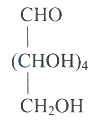
B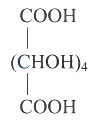
C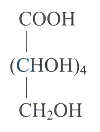
D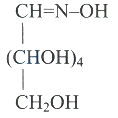
Solution
(B) When glucose $(C_6H_{12}O_6)$ is oxidized with dilute nitric acid $(HNO_3)$,both the terminal aldehyde group $(-CHO)$ and the primary alcoholic group $(-CH_2OH)$ are oxidized to carboxylic acid groups $(-COOH)$.
This results in the formation of saccharic acid (also known as glucaric acid),which is a dicarboxylic acid with the structure $COOH-(CHOH)_4-COOH$.
This results in the formation of saccharic acid (also known as glucaric acid),which is a dicarboxylic acid with the structure $COOH-(CHOH)_4-COOH$.
0 likes
View Solution633
EasyMCQ
Which carbon atom of glucose,numbered from $C-1$ to $C-6$,converts its functional group to a $-COOH$ group when heated with $Br_2$ water?
A
$C-1$
B
$C-2$
C
$C-3$
D
$C-6$
Solution
(A) Glucose contains an aldehyde group $(-CHO)$ at the $C-1$ position and a primary alcohol group $(-CH_2OH)$ at the $C-6$ position.
Bromine water $(Br_2-H_2O)$ is a mild oxidizing agent.
It selectively oxidizes the aldehyde group $(-CHO)$ of glucose to a carboxylic acid group $(-COOH)$,forming gluconic acid.
Therefore,the carbon atom at the $C-1$ position is converted to a $-COOH$ group.
Bromine water $(Br_2-H_2O)$ is a mild oxidizing agent.
It selectively oxidizes the aldehyde group $(-CHO)$ of glucose to a carboxylic acid group $(-COOH)$,forming gluconic acid.
Therefore,the carbon atom at the $C-1$ position is converted to a $-COOH$ group.
0 likes
View Solution634
DifficultMCQ
Which of the following reagents converts the $-CHO$ and $-CH_2OH$ groups of glucose to $-COOH$ groups?
A
Hydrogen cyanide
B
dil. nitric acid
C
Acetic anhydride
D
Hydroxyl amine
Solution
(B) Glucose contains an aldehyde group $(-CHO)$ at $C-1$ and a primary alcoholic group $(-CH_2OH)$ at $C-6$.
When glucose is treated with dilute nitric acid $(dil. HNO_3)$,it undergoes oxidation to form a dicarboxylic acid known as saccharic acid (or glucaric acid).
In this reaction,both the terminal aldehyde group and the primary alcoholic group are oxidized to carboxylic acid $(-COOH)$ groups.
The reaction is represented as:
$CHO-(CHOH)_4-CH_2OH + [O] \xrightarrow{dil. HNO_3} COOH-(CHOH)_4-COOH$
Thus,the correct reagent is dilute nitric acid.
When glucose is treated with dilute nitric acid $(dil. HNO_3)$,it undergoes oxidation to form a dicarboxylic acid known as saccharic acid (or glucaric acid).
In this reaction,both the terminal aldehyde group and the primary alcoholic group are oxidized to carboxylic acid $(-COOH)$ groups.
The reaction is represented as:
$CHO-(CHOH)_4-CH_2OH + [O] \xrightarrow{dil. HNO_3} COOH-(CHOH)_4-COOH$
Thus,the correct reagent is dilute nitric acid.
0 likes
View Solution635
MediumMCQ
Glucose and gluconic acid on oxidation with dilute nitric acid $(HNO_3)$ form saccharic acid. This reaction confirms that glucose contains:
A
four primary alcoholic groups
B
two primary alcoholic groups
C
one primary alcoholic group
D
five hydroxyl groups
Solution
(C) Glucose $(CHO-(CHOH)_4-CH_2OH)$ and gluconic acid $(COOH-(CHOH)_4-CH_2OH)$ both undergo oxidation with dilute $HNO_3$ to form saccharic acid $(COOH-(CHOH)_4-COOH)$.
In this reaction,the terminal primary alcoholic group $(-CH_2OH)$ is oxidized to a carboxylic acid group $(-COOH)$.
Since only one $-CH_2OH$ group is present in the glucose molecule and it gets converted to $-COOH$,this reaction confirms the presence of one primary alcoholic group in glucose.
In this reaction,the terminal primary alcoholic group $(-CH_2OH)$ is oxidized to a carboxylic acid group $(-COOH)$.
Since only one $-CH_2OH$ group is present in the glucose molecule and it gets converted to $-COOH$,this reaction confirms the presence of one primary alcoholic group in glucose.
0 likes
View Solution636
MediumMCQ
Identify the hydrolysis product of starch.
A
$Glucose$
B
$Fructose$
C
$Galactose$
D
$Ribose$
Solution
(A) Starch is a polysaccharide that acts as the main storage carbohydrate in plants.
Upon complete hydrolysis,starch breaks down into its monomeric units.
The monomeric unit of starch is $\alpha-D-glucose$.
Upon complete hydrolysis,starch breaks down into its monomeric units.
The monomeric unit of starch is $\alpha-D-glucose$.
0 likes
View Solution637
MediumMCQ
Which reagent oxidizes glucose to saccharic acid?
A
Dil. $HNO_3$
B
$NH_2OH$
C
$HCN$
D
$Br_2$ water
Solution
(A) Glucose $(CHO(CHOH)_4CH_2OH)$ on oxidation with strong oxidizing agents like dilute nitric acid $(HNO_3)$ gets oxidized to a dicarboxylic acid known as saccharic acid (or glucaric acid).
The reaction is:
$CHO(CHOH)_4CH_2OH + [O] \xrightarrow{\text{Dil. } HNO_3} COOH(CHOH)_4COOH$
Thus,dilute $HNO_3$ is the correct reagent.
The reaction is:
$CHO(CHOH)_4CH_2OH + [O] \xrightarrow{\text{Dil. } HNO_3} COOH(CHOH)_4COOH$
Thus,dilute $HNO_3$ is the correct reagent.
0 likes
View Solution638
MediumMCQ
Identify the reagent $R$ used in the following conversion: $\text{Glucose} \xrightarrow{R} n-\text{hexane}$
A
$HI, \Delta$
B
$NH_2OH$
C
$HCN$
D
$HNO_3$
Solution
(A) When glucose is heated with concentrated $HI$ (hydroiodic acid) for a long time,it undergoes reduction to form $n$-hexane.
This reaction confirms the presence of a straight chain of six carbon atoms in the glucose molecule.
The reaction is as follows:
$CHO-(CHOH)_4-CH_2OH \xrightarrow{HI, \Delta} CH_3-(CH_2)_4-CH_3$ (n-hexane).
This reaction confirms the presence of a straight chain of six carbon atoms in the glucose molecule.
The reaction is as follows:
$CHO-(CHOH)_4-CH_2OH \xrightarrow{HI, \Delta} CH_3-(CH_2)_4-CH_3$ (n-hexane).
0 likes
View Solution639
EasyMCQ
Which of the following reagents is used to identify the straight chain of glucose?
A
$HI$
B
Dil. $HNO_3$
C
$HCN$
D
Acetic anhydride
Solution
(A) When glucose is heated with $HI$ (hydroiodic acid) and red phosphorus,it undergoes reduction to form $n$-hexane $(CH_3(CH_2)_4CH_3)$.
This reaction confirms that the six carbon atoms in glucose are linked in a straight chain.
This reaction confirms that the six carbon atoms in glucose are linked in a straight chain.
0 likes
View Solution640
MediumMCQ
Which of the following compounds is obtained when glucose is treated with dilute nitric acid?
A
Glucose oxime
B
Gluconic acid
C
Saccharic acid
D
Glucose cyanohydrin
Solution
(C) When glucose is treated with dilute nitric acid $(HNO_3)$,both the aldehyde group $(-CHO)$ and the primary alcoholic group $(-CH_2OH)$ are oxidized to carboxylic acid groups $(-COOH)$.
This reaction results in the formation of a dicarboxylic acid known as saccharic acid (also called glucaric acid).
The reaction is represented as:
$CHO-(CHOH)_4-CH_2OH + [O] \xrightarrow{Dil. HNO_3} COOH-(CHOH)_4-COOH$
Thus,the correct product is saccharic acid.
This reaction results in the formation of a dicarboxylic acid known as saccharic acid (also called glucaric acid).
The reaction is represented as:
$CHO-(CHOH)_4-CH_2OH + [O] \xrightarrow{Dil. HNO_3} COOH-(CHOH)_4-COOH$
Thus,the correct product is saccharic acid.
0 likes
View Solution641
EasyMCQ
Which among the following reagents is used to obtain gluconic acid from glucose?
A
$dil. \ HNO_3$
B
Acetyl chloride
C
Bromine water
D
Acetic anhydride
Solution
(C) When glucose is treated with bromine water ($Br_2$ water),it undergoes mild oxidation.
In this reaction,the aldehydic group $(-CHO)$ of glucose is selectively oxidized to a carboxylic acid group $(-COOH)$,resulting in the formation of gluconic acid.
The reaction is:
$CHO(CHOH)_4CH_2OH + [O] \xrightarrow{Br_2/H_2O} COOH(CHOH)_4CH_2OH$
In this reaction,the aldehydic group $(-CHO)$ of glucose is selectively oxidized to a carboxylic acid group $(-COOH)$,resulting in the formation of gluconic acid.
The reaction is:
$CHO(CHOH)_4CH_2OH + [O] \xrightarrow{Br_2/H_2O} COOH(CHOH)_4CH_2OH$
0 likes
View Solution642
EasyMCQ
Which among the following reagents is used for the conversion of glucose to glucoxime?
A
$HCN$
B
$Br_2$ water
C
Hydroxylamine
D
Dilute $HNO_3$
Solution
(C) Glucose reacts with hydroxylamine $(NH_2OH)$ to form an oxime,which is known as glucoxime.
The reaction is:
$CHO(CHOH)_4CH_2OH + NH_2OH \rightarrow CH=NOH(CHOH)_4CH_2OH + H_2O$
Therefore,the reagent used is hydroxylamine.
The reaction is:
$CHO(CHOH)_4CH_2OH + NH_2OH \rightarrow CH=NOH(CHOH)_4CH_2OH + H_2O$
Therefore,the reagent used is hydroxylamine.
0 likes
View Solution643
EasyMCQ
Identify the number of oxygen atoms present in saccharic acid.
A
$8$
B
$12$
C
$4$
D
$6$
Solution
(A) The chemical formula of saccharic acid (also known as $D$-glucaric acid) is $C_6H_{10}O_8$.
Based on the structure provided:
- There are two $COOH$ groups,each containing $2$ oxygen atoms ($2 \times 2 = 4$ oxygen atoms).
- There are four $OH$ groups attached to the carbon chain,each containing $1$ oxygen atom ($4 \times 1 = 4$ oxygen atoms).
- Total number of oxygen atoms $= 4 + 4 = 8$.
Based on the structure provided:
- There are two $COOH$ groups,each containing $2$ oxygen atoms ($2 \times 2 = 4$ oxygen atoms).
- There are four $OH$ groups attached to the carbon chain,each containing $1$ oxygen atom ($4 \times 1 = 4$ oxygen atoms).
- Total number of oxygen atoms $= 4 + 4 = 8$.
0 likes
View Solution644
MediumMCQ
How many moles of acetic acid are obtained in the reaction when one mole of glucose is treated with excess acetic anhydride (in $moles$)?
A
$5$
B
$3$
C
$4$
D
$2$
Solution
(A) Glucose contains $5$ hydroxyl $(-OH)$ groups ($4$ secondary and $1$ primary).
When glucose reacts with excess acetic anhydride,all $5$ hydroxyl groups are acetylated to form glucose pentaacetate.
The reaction is as follows:
$CHO(CHOH)_4CH_2OH + 5(CH_3CO)_2O \xrightarrow{Pyridine} CHO(CHOCOCH_3)_4CH_2OCOCH_3 + 5CH_3COOH$
As shown in the reaction,$5$ moles of acetic acid $(CH_3COOH)$ are produced for every mole of glucose reacted.
When glucose reacts with excess acetic anhydride,all $5$ hydroxyl groups are acetylated to form glucose pentaacetate.
The reaction is as follows:
$CHO(CHOH)_4CH_2OH + 5(CH_3CO)_2O \xrightarrow{Pyridine} CHO(CHOCOCH_3)_4CH_2OCOCH_3 + 5CH_3COOH$
As shown in the reaction,$5$ moles of acetic acid $(CH_3COOH)$ are produced for every mole of glucose reacted.
0 likes
View Solution645
EasyMCQ
Which among the following compounds is obtained when glucose reacts with hydrogen cyanide?
A
$n$-Hexane
B
Glucose cyanohydrin
C
Gluconic acid
D
Saccharic acid
Solution
(B) The reaction of glucose with hydrogen cyanide $(HCN)$ is a nucleophilic addition reaction. The carbonyl group $(CHO)$ of glucose reacts with $HCN$ to form a cyanohydrin derivative known as glucose cyanohydrin. The reaction is represented as follows:
$CHO(CHOH)_4CH_2OH + HCN \rightarrow CN-CH(OH)(CHOH)_4CH_2OH$
$CHO(CHOH)_4CH_2OH + HCN \rightarrow CN-CH(OH)(CHOH)_4CH_2OH$
0 likes
View Solution646
EasyMCQ
What is the product obtained when $Br_{2}$ water reacts with glucose?
A
Gluconic acid
B
Saccharic acid
C
$1, 6-$ dibromo glucose
D
Bromohexane
Solution
(A) When glucose is treated with bromine water ($Br_{2}$ water),it undergoes mild oxidation.
The aldehydic group $(-CHO)$ of glucose is oxidized to a carboxylic acid group $(-COOH)$,while the secondary alcoholic groups remain unaffected.
This reaction produces gluconic acid.
The reaction is:
$CHO(CHOH)_{4}CH_{2}OH + [O] \xrightarrow{Br_{2}/H_{2}O} COOH(CHOH)_{4}CH_{2}OH$
(Glucose) $\rightarrow$ (Gluconic acid)
The aldehydic group $(-CHO)$ of glucose is oxidized to a carboxylic acid group $(-COOH)$,while the secondary alcoholic groups remain unaffected.
This reaction produces gluconic acid.
The reaction is:
$CHO(CHOH)_{4}CH_{2}OH + [O] \xrightarrow{Br_{2}/H_{2}O} COOH(CHOH)_{4}CH_{2}OH$
(Glucose) $\rightarrow$ (Gluconic acid)
0 likes
View Solution647
EasyMCQ
Which reagent among the following is used to confirm the presence of an aldehydic carbonyl group in glucose?
A
Acetic anhydride
B
Dilute Nitric acid
C
Bromine water
D
Hydroxylamine
Solution
(C)
When glucose is treated with bromine water ($Br_2$ water),it undergoes mild oxidation to form gluconic acid.
In this reaction,the aldehydic group $(-CHO)$ is selectively oxidized to a carboxylic acid group $(-COOH)$,while the secondary alcoholic groups remain unaffected.
This reaction confirms that the carbonyl group in glucose is an aldehydic group.
The reaction is:
$CHO(CHOH)_4CH_2OH + [O] \xrightarrow{Br_2/H_2O} COOH(CHOH)_4CH_2OH$
(Glucose $\rightarrow$ Gluconic acid)
When glucose is treated with bromine water ($Br_2$ water),it undergoes mild oxidation to form gluconic acid.
In this reaction,the aldehydic group $(-CHO)$ is selectively oxidized to a carboxylic acid group $(-COOH)$,while the secondary alcoholic groups remain unaffected.
This reaction confirms that the carbonyl group in glucose is an aldehydic group.
The reaction is:
$CHO(CHOH)_4CH_2OH + [O] \xrightarrow{Br_2/H_2O} COOH(CHOH)_4CH_2OH$
(Glucose $\rightarrow$ Gluconic acid)
0 likes
View Solution648
MediumMCQ
$A$ molecule of Stachyose contains how many carbon atoms?
A
$6$
B
$12$
C
$18$
D
$24$
Solution
(D) The chemical formula of Stachyose is $C_{24}H_{42}O_{21}$.
Therefore,a single molecule of Stachyose contains $24$ carbon atoms.
Therefore,a single molecule of Stachyose contains $24$ carbon atoms.
0 likes
View Solution649
DifficultMCQ
Glucose on oxidation with bromine water yields gluconic acid. This reaction confirms the presence of $-$
A
Six carbon atoms linked in straight chain
B
Secondary alcoholic group in glucose
C
Aldehyde group in glucose
D
Primary alcoholic in glucose
Solution
(C) Glucose $(C_6H_{12}O_6)$ on oxidation with mild oxidizing agent like bromine water ($Br_2$ water) yields gluconic acid $(COOH(CHOH)_4CH_2OH)$.
This reaction confirms the presence of an aldehyde group $(-CHO)$ in glucose,as bromine water is a mild oxidant that specifically oxidizes the aldehyde group to a carboxylic acid group without affecting the alcoholic groups.
This reaction confirms the presence of an aldehyde group $(-CHO)$ in glucose,as bromine water is a mild oxidant that specifically oxidizes the aldehyde group to a carboxylic acid group without affecting the alcoholic groups.
0 likes
View SolutionBiomolecules — Carbohydrates · Frequently Asked Questions
1Are these Biomolecules questions useful for JEE and NEET?
Yes. All questions in this section are mapped to JEE Main and NEET exam patterns. Previous year questions from JEE Main, NEET, GUJCET and state-level exams are included with full solutions.
2Can I switch to Hindi or Gujarati for these questions?
Yes. Use the language tabs in the hero section or the sidebar to view the same questions and solutions in English, Hindi or Gujarati.
3How do I generate a question paper from this subtopic?
Use the Vedclass Exam Paper Generator — select the chapter and subtopic, set difficulty, and generate Sets A, B, C, D automatically. First 3 chapters of every subject are free.
Vedclass Products
For Students
Vedclass Test Series
Mock tests in real JEE/NEET style with performance analysis. 5-day free trial.
Start Free TrialFor Teachers
Exam Paper Generator
Generate Set A/B/C/D papers from this chapter in 2 minutes. 3 chapters free.
Try FreeFor Institutes
Online Exam Module
Live online exams with unlimited students, 360° analytics & white-label branding.
See DemoFor Teachers & Institutes
Generate a Biomolecules Exam Paper in 2 Minutes
Select subtopic & difficulty — Sets A, B, C, D auto-generated with No Repeat logic.
First 3 chapters of every subject are free — no payment required.