
A English
Carbohydrates Questions in English
Class 12 Chemistry · Biomolecules · Carbohydrates
808+
Questions
English
Language
100%
With Solutions
Showing 50 of 808 questions in English
551
MediumMCQ
Given below are two statements. One is labelled as Assertion $A$ and the other is labelled as Reason $R$.
Assertion $A$: Amylose is insoluble in water.
Reason $R$: Amylose is a long linear molecule with more than $200$ glucose units.
In the light of the above statements,choose the correct answer from the options given below.
Assertion $A$: Amylose is insoluble in water.
Reason $R$: Amylose is a long linear molecule with more than $200$ glucose units.
In the light of the above statements,choose the correct answer from the options given below.
A
Both $A$ and $R$ are correct and $R$ is the correct explanation of $A$.
B
Both $A$ and $R$ are correct and $R$ is $NOT$ the correct explanation of $A$.
C
$A$ is correct but $R$ is not correct.
D
$A$ is not correct but $R$ is correct.
Solution
(D) Assertion $A$ states that Amylose is insoluble in water,which is incorrect because Amylose is a water-soluble component of starch.
Reason $R$ states that Amylose is a long linear molecule with more than $200$ glucose units,which is correct as it consists of $200$ to $1000$ $\alpha-D-(+)$-glucose units held by $\alpha$-glycosidic linkages.
Therefore,$A$ is incorrect but $R$ is correct.
Reason $R$ states that Amylose is a long linear molecule with more than $200$ glucose units,which is correct as it consists of $200$ to $1000$ $\alpha-D-(+)$-glucose units held by $\alpha$-glycosidic linkages.
Therefore,$A$ is incorrect but $R$ is correct.
0 likes
View Solution552
MediumMCQ
The reaction of $D$-glucose with ammoniacal $AgNO_3$ produces:
A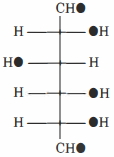
B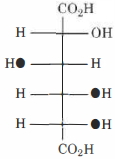
C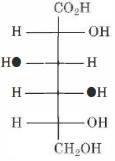
D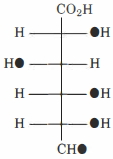
Solution
(C) The reaction of $D$-glucose with ammoniacal $AgNO_3$ (Tollen's reagent) is an oxidation reaction.
The aldehydic group $(-CHO)$ at the $C_1$ position of $D$-glucose is oxidized to a carboxylic acid group $(-COOH)$,forming $D$-gluconic acid.
This reaction confirms the presence of a free aldehydic group in glucose,making it a reducing sugar.
The correct structure corresponds to option $C$.
The aldehydic group $(-CHO)$ at the $C_1$ position of $D$-glucose is oxidized to a carboxylic acid group $(-COOH)$,forming $D$-gluconic acid.
This reaction confirms the presence of a free aldehydic group in glucose,making it a reducing sugar.
The correct structure corresponds to option $C$.
0 likes
View Solution553
DifficultMCQ
If $\alpha-D-(+)$-glucose is dissolved in water and kept for a few hours,the major constituent$(s)$ present in the solution is (are)
A
$\alpha-D-(+)$-glucose
B
mixture of $\beta-D-(+)$-glucose and open chain $D-(+)$-glucose
C
open chain $D-(+)$-glucose
D
mixture of $\alpha-D-(+)$-glucose and $\beta-D-(+)$-glucose
Solution
(D) When $\alpha-D-(+)$-glucose is dissolved in water,it undergoes mutarotation.
This process involves the conversion of $\alpha-D-(+)$-glucose into an open-chain structure,which then cyclizes to form $\beta-D-(+)$-glucose.
At equilibrium,the solution contains a mixture of both $\alpha-D-(+)$-glucose (approx. $36\%$) and $\beta-D-(+)$-glucose (approx. $64\%$),with only a negligible amount of the open-chain form.
Therefore,the major constituents present in the solution are $\alpha-D-(+)$-glucose and $\beta-D-(+)$-glucose.
This process involves the conversion of $\alpha-D-(+)$-glucose into an open-chain structure,which then cyclizes to form $\beta-D-(+)$-glucose.
At equilibrium,the solution contains a mixture of both $\alpha-D-(+)$-glucose (approx. $36\%$) and $\beta-D-(+)$-glucose (approx. $64\%$),with only a negligible amount of the open-chain form.
Therefore,the major constituents present in the solution are $\alpha-D-(+)$-glucose and $\beta-D-(+)$-glucose.
0 likes
View Solution554
MediumMCQ
Given the structure of $D-(+)$-glucose as shown below,identify the structure of $L-(-)$-glucose.
A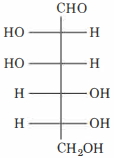
B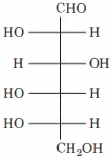
C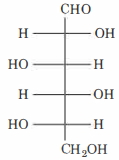
D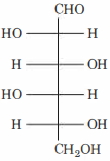
Solution
(B) and $L$ before the name of any compound commonly indicate the relative configuration. For assigning the configuration of monosaccharides,it is the lowest asymmetric carbon atom (chiral center) that is compared to glyceraldehyde. For glucose,if the $-OH$ group on the lowest asymmetric carbon $(C-5)$ is on the right side,it is assigned $D$-configuration. If the $-OH$ group is on the left side,it is assigned $L$-configuration. Both $D$ and $L$ configurations are non-superimposable mirror images of each other. Therefore,the structure of $L-(-)$-glucose is the mirror image of $D-(+)$-glucose.
0 likes
View Solution555
MediumMCQ
$D$-glucose upon treatment with bromine-water gives:
A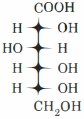
B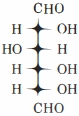
C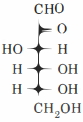
D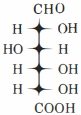
Solution
(A) -glucose is an aldose sugar. When it is treated with a mild oxidizing agent like bromine water ($Br_2$ water),the aldehyde group $(-CHO)$ is selectively oxidized to a carboxylic acid group $(-COOH)$ without affecting the secondary alcoholic groups. This reaction produces gluconic acid.
0 likes
View Solution556
DifficultMCQ
Match the structures in Row $I$ with their names in Row $II$.
Row $I$:
$(P)$ $\alpha-D-(+)-$Glucopyranose
$(Q)$ $\beta-D-(+)-$Glucopyranose
$(R)$ $\alpha-D-(-)-$Fructofuranose
$(S)$ $\beta-D-(-)-$Fructofuranose
Row $II$:
$(i)$ $\alpha-D-(-)-$Fructofuranose
$(ii)$ $\beta-D-(-)-$Fructofuranose
$(iii)$ $\alpha-D-(+)-$Glucopyranose
$(iv)$ $\beta-D-(+)-$Glucopyranose
Correct match is:
Row $I$:
$(P)$ $\alpha-D-(+)-$Glucopyranose
$(Q)$ $\beta-D-(+)-$Glucopyranose
$(R)$ $\alpha-D-(-)-$Fructofuranose
$(S)$ $\beta-D-(-)-$Fructofuranose
Row $II$:
$(i)$ $\alpha-D-(-)-$Fructofuranose
$(ii)$ $\beta-D-(-)-$Fructofuranose
$(iii)$ $\alpha-D-(+)-$Glucopyranose
$(iv)$ $\beta-D-(+)-$Glucopyranose
Correct match is:
A
$P$ $\rightarrow iv, Q$ $\rightarrow iii, R$ $\rightarrow i, S$ $\rightarrow ii$
B
$P$ $\rightarrow i, Q$ $\rightarrow ii, R$ $\rightarrow iii, S$ $\rightarrow iv$
C
$P$ $\rightarrow iii, Q$ $\rightarrow iv, R$ $\rightarrow ii, S$ $\rightarrow i$
D
$P$ $\rightarrow iii, Q$ $\rightarrow iv, R$ $\rightarrow i, S$ $\rightarrow ii$
Solution
(D) By analyzing the Haworth projections:
$(P)$ is $\alpha-D-(+)-$Glucopyranose,which matches $(iii)$.
$(Q)$ is $\beta-D-(+)-$Glucopyranose,which matches $(iv)$.
$(R)$ is $\alpha-D-(-)-$Fructofuranose,which matches $(i)$.
$(S)$ is $\beta-D-(-)-$Fructofuranose,which matches $(ii)$.
Therefore,the correct matching is $P$ $\rightarrow iii, Q$ $\rightarrow iv, R$ $\rightarrow i, S$ $\rightarrow ii$.
$(P)$ is $\alpha-D-(+)-$Glucopyranose,which matches $(iii)$.
$(Q)$ is $\beta-D-(+)-$Glucopyranose,which matches $(iv)$.
$(R)$ is $\alpha-D-(-)-$Fructofuranose,which matches $(i)$.
$(S)$ is $\beta-D-(-)-$Fructofuranose,which matches $(ii)$.
Therefore,the correct matching is $P$ $\rightarrow iii, Q$ $\rightarrow iv, R$ $\rightarrow i, S$ $\rightarrow ii$.
0 likes
View Solution557
MediumMCQ
Given below are two statements: one is labelled as Assertion $(A)$ and the other is labelled as Reason $(R)$.
Assertion $(A)$: Ketoses give Seliwanoff's test faster than Aldoses.
Reason $(R)$: Ketoses undergo $\beta$-elimination followed by formation of furfural.
In the light of the above statements,choose the correct answer from the options given below:
Assertion $(A)$: Ketoses give Seliwanoff's test faster than Aldoses.
Reason $(R)$: Ketoses undergo $\beta$-elimination followed by formation of furfural.
In the light of the above statements,choose the correct answer from the options given below:
A
$(A)$ is false but $(R)$ is true
B
Both $(A)$ and $(R)$ are true and $(R)$ is the correct explanation of $(A)$
C
$(A)$ is true but $(R)$ is false
D
Both $(A)$ and $(R)$ are true but $(R)$ is not the correct explanation of $(A)$
Solution
(C) Seliwanoff's test is a chemical test used to distinguish between aldose and ketose sugars.
Ketoses are more rapidly dehydrated in the presence of concentrated acid to form $5$-hydroxymethylfurfural compared to aldoses.
This intermediate then reacts with resorcinol to produce a cherry-red colored complex.
Therefore,Assertion $(A)$ is true.
However,the mechanism involves acid-catalyzed dehydration,not $\beta$-elimination to form furfural. Thus,Reason $(R)$ is false.
Ketoses are more rapidly dehydrated in the presence of concentrated acid to form $5$-hydroxymethylfurfural compared to aldoses.
This intermediate then reacts with resorcinol to produce a cherry-red colored complex.
Therefore,Assertion $(A)$ is true.
However,the mechanism involves acid-catalyzed dehydration,not $\beta$-elimination to form furfural. Thus,Reason $(R)$ is false.
0 likes
View Solution558
AdvancedMCQ
Compound $A$,$C_5H_{10}O_5$,gives a tetraacetate with $Ac_2O$ and oxidation of $A$ with $Br_2-H_2O$ gives an acid,$C_5H_{10}O_6$. Reduction of $A$ with $HI$ gives isopentane. The possible structure of $A$ is:
A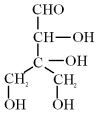
B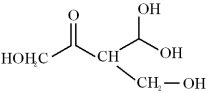
C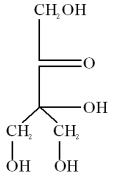
D
Solution
(A) $(i)$ Formation of a tetraacetate with $Ac_2O$ indicates that compound $A$ contains four $-OH$ groups.
$(ii)$ Oxidation of $A$ with $Br_2-H_2O$ yields an acid $C_5H_{10}O_6$,which confirms the presence of an aldehyde group $(-CHO)$ in $A$,as $Br_2-H_2O$ specifically oxidizes aldoses to aldonic acids.
$(iii)$ Reduction of $A$ with $HI$ gives isopentane $(2-methylbutane)$,which indicates the carbon skeleton is branched (isopentane structure).
$(iv)$ Combining these facts,the structure must be a branched pentose. The structure in option $A$ represents $2,3,4-trihydroxy-2-(hydroxymethyl)butanal$,which fits the molecular formula $C_5H_{10}O_5$ and the branched skeleton.
$(ii)$ Oxidation of $A$ with $Br_2-H_2O$ yields an acid $C_5H_{10}O_6$,which confirms the presence of an aldehyde group $(-CHO)$ in $A$,as $Br_2-H_2O$ specifically oxidizes aldoses to aldonic acids.
$(iii)$ Reduction of $A$ with $HI$ gives isopentane $(2-methylbutane)$,which indicates the carbon skeleton is branched (isopentane structure).
$(iv)$ Combining these facts,the structure must be a branched pentose. The structure in option $A$ represents $2,3,4-trihydroxy-2-(hydroxymethyl)butanal$,which fits the molecular formula $C_5H_{10}O_5$ and the branched skeleton.
0 likes
View Solution559
DifficultMCQ
The correct representation in $6-$membered pyranose form for the following sugar $[X]$ is
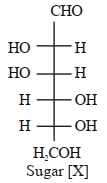
A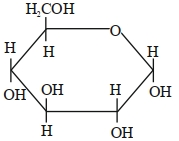
B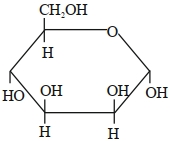
C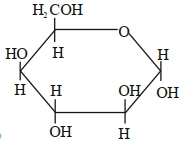
D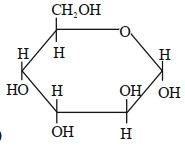
Solution
(A) The given Fischer projection of sugar $[X]$ is $D-$mannose. In $D-$mannose,the $-OH$ groups at $C-2$,$C-3$,$C-4$ and $C-5$ are on the left,left,right and right respectively in the Fischer projection. When converting to the Haworth structure,groups on the left side of the Fischer projection are placed above the ring,and groups on the right side are placed below the ring. For $\alpha -D-$mannopyranose,the $-OH$ group at the anomeric carbon $(C-1)$ is below the ring. Thus,the correct Haworth structure corresponds to option $A$.
0 likes
View Solution560
DifficultMCQ
$L$-isomer of tetrose $X$ $(C_4H_8O_4)$ gives positive Schiff's test and has two chiral carbons. On acetylation,$X$ yields triacetate. $X$ also undergoes the following reactions:
$X$ $\xrightarrow{HNO_3} A$ $\xrightarrow{NaBH_4} \underset{\text{Chiral compound}}{B}$
$X$ is $.......$.
$X$ $\xrightarrow{HNO_3} A$ $\xrightarrow{NaBH_4} \underset{\text{Chiral compound}}{B}$
$X$ is $.......$.
A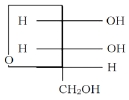
B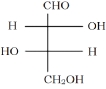
C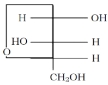
D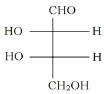
Solution
(B) $1$. $X$ is a tetrose $(C_4H_8O_4)$ with two chiral carbons and a $-CHO$ group (positive Schiff's test).
$2$. Acetylation yields a triacetate,confirming three $-OH$ groups.
$3$. The $L$-isomer of a tetrose with two chiral centers and the given reactivity corresponds to $L$-threose.
$4$. Oxidation of $L$-threose with $HNO_3$ gives $L$-tartaric acid $(A)$.
$5$. Reduction of $L$-tartaric acid with $NaBH_4$ gives a chiral compound $(B)$.
$6$. Based on the Fischer projection for $L$-threose,the correct structure is represented in option $B$.
$2$. Acetylation yields a triacetate,confirming three $-OH$ groups.
$3$. The $L$-isomer of a tetrose with two chiral centers and the given reactivity corresponds to $L$-threose.
$4$. Oxidation of $L$-threose with $HNO_3$ gives $L$-tartaric acid $(A)$.
$5$. Reduction of $L$-tartaric acid with $NaBH_4$ gives a chiral compound $(B)$.
$6$. Based on the Fischer projection for $L$-threose,the correct structure is represented in option $B$.
0 likes
View Solution561
DifficultMCQ
$D-(+)-\text{Glyceraldehyde} \xrightarrow[(ii) H_2O/H^{+}]{(i) HCN, (iii) HNO_3}$
The products formed in the above reaction are
The products formed in the above reaction are
A
Two optically active products
B
One optically active and one meso product
C
One optically inactive and one meso product.
D
Two optically inactive products
Solution
(B) The reaction of $D-(+)-\text{Glyceraldehyde}$ with $HCN$ followed by hydrolysis and oxidation with $HNO_3$ is a Kiliani-Fischer synthesis sequence.
$1$. The addition of $HCN$ to the aldehyde group of $D-(+)-\text{Glyceraldehyde}$ creates a new chiral center,resulting in two diastereomeric cyanohydrins.
$2$. Hydrolysis of these cyanohydrins converts the $-CN$ group into a $-COOH$ group,forming two diastereomeric aldonic acids.
$3$. Oxidation with $HNO_3$ further oxidizes the terminal $-CH_2OH$ group to a $-COOH$ group,resulting in two dicarboxylic acids (aldaric acids).
$4$. One of the resulting products is $meso-\text{tartaric acid}$ (or a derivative),which is optically inactive due to an internal plane of symmetry.
$5$. The other product is an optically active isomer (e.g.,$L-(+)-\text{tartaric acid}$ derivative).
Thus,the final products are one optically inactive $(meso)$ product and one optically active product.
$1$. The addition of $HCN$ to the aldehyde group of $D-(+)-\text{Glyceraldehyde}$ creates a new chiral center,resulting in two diastereomeric cyanohydrins.
$2$. Hydrolysis of these cyanohydrins converts the $-CN$ group into a $-COOH$ group,forming two diastereomeric aldonic acids.
$3$. Oxidation with $HNO_3$ further oxidizes the terminal $-CH_2OH$ group to a $-COOH$ group,resulting in two dicarboxylic acids (aldaric acids).
$4$. One of the resulting products is $meso-\text{tartaric acid}$ (or a derivative),which is optically inactive due to an internal plane of symmetry.
$5$. The other product is an optically active isomer (e.g.,$L-(+)-\text{tartaric acid}$ derivative).
Thus,the final products are one optically inactive $(meso)$ product and one optically active product.
0 likes
View Solution562
DifficultMCQ
Match List-$I$ with List-$II$.
Choose the correct answer from the options given below:
| List-$I$ (Biopolymer) | List-$II$ (Monomer) |
|---|---|
| $A$. Starch | $I$. nucleotide |
| $B$. Cellulose | $II$. $\alpha$-glucose |
| $C$. Nucleic acid | $III$. $\beta$-glucose |
| $D$. Protein | $IV$. $\alpha$-amino acid |
Choose the correct answer from the options given below:
A
$A-II, B-I, C-III, D-IV$
B
$A-IV, B-II, C-I, D-III$
C
$A-I, B-III, C-IV, D-II$
D
$A-II, B-III, C-I, D-IV$
Solution
(D) The correct matching is as follows:
$A$. Starch is a polymer of $\alpha$-glucose $(II)$.
$B$. Cellulose is a polymer of $\beta$-glucose $(III)$.
$C$. Nucleic acid is a polymer of nucleotides $(I)$.
$D$. Protein is a polymer of $\alpha$-amino acids $(IV)$.
Therefore,the correct sequence is $A-II, B-III, C-I, D-IV$.
$A$. Starch is a polymer of $\alpha$-glucose $(II)$.
$B$. Cellulose is a polymer of $\beta$-glucose $(III)$.
$C$. Nucleic acid is a polymer of nucleotides $(I)$.
$D$. Protein is a polymer of $\alpha$-amino acids $(IV)$.
Therefore,the correct sequence is $A-II, B-III, C-I, D-IV$.
0 likes
View Solution563
DifficultMCQ
Sugar which does not give reddish brown precipitate with Fehling's reagent is:
A
Sucrose
B
Lactose
C
Glucose
D
Maltose
Solution
(A) Fehling's reagent is used to detect the presence of reducing sugars.
Reducing sugars contain a free hemiacetal or hemiketal group,which allows them to act as reducing agents.
$Sucrose$ is a non-reducing sugar because it is a disaccharide formed by the linkage of $Glucose$ and $Fructose$ through their respective anomeric carbons,leaving no free hemiacetal group.
Therefore,$Sucrose$ does not give a reddish-brown precipitate with Fehling's reagent.
$Lactose$,$Glucose$,and $Maltose$ are all reducing sugars and will give a positive test.
Reducing sugars contain a free hemiacetal or hemiketal group,which allows them to act as reducing agents.
$Sucrose$ is a non-reducing sugar because it is a disaccharide formed by the linkage of $Glucose$ and $Fructose$ through their respective anomeric carbons,leaving no free hemiacetal group.
Therefore,$Sucrose$ does not give a reddish-brown precipitate with Fehling's reagent.
$Lactose$,$Glucose$,and $Maltose$ are all reducing sugars and will give a positive test.
0 likes
View Solution564
DifficultMCQ
Match List-$I$ with List-$II$:
Choose the correct answer from the options given below:
| List-$I$ | List-$II$ |
| $A$. Glucose/$NaHCO_3$/$\Delta$ | $I$. Gluconic acid |
| $B$. Glucose/$HNO_3$ | $II$. No reaction |
| $C$. Glucose/$HI$/$\Delta$ | $III$. $n$-hexane |
| $D$. Glucose/Bromine water | $IV$. Saccharic acid |
Choose the correct answer from the options given below:
A
$A-IV, B-I, C-III, D-II$
B
$A-II, B-IV, C-III, D-I$
C
$A-III, B-II, C-I, D-IV$
D
$A-I, B-IV, C-III, D-II$
Solution
(B) $1$. Glucose does not react with $NaHCO_3$ because it is not acidic enough to evolve $CO_2$ gas. Thus,$A-II$.
$2$. Glucose on oxidation with concentrated $HNO_3$ gives saccharic acid (glucaric acid). Thus,$B-IV$.
$3$. Glucose on prolonged heating with $HI$ gives $n$-hexane,indicating the presence of a straight chain of six carbon atoms. Thus,$C-III$.
$4$. Glucose on oxidation with bromine water gives gluconic acid. Thus,$D-I$.
Therefore,the correct matching is $A-II, B-IV, C-III, D-I$.
$2$. Glucose on oxidation with concentrated $HNO_3$ gives saccharic acid (glucaric acid). Thus,$B-IV$.
$3$. Glucose on prolonged heating with $HI$ gives $n$-hexane,indicating the presence of a straight chain of six carbon atoms. Thus,$C-III$.
$4$. Glucose on oxidation with bromine water gives gluconic acid. Thus,$D-I$.
Therefore,the correct matching is $A-II, B-IV, C-III, D-I$.
0 likes
View Solution565
EasyMCQ
Which of the following is the correct structure of $L$-Glucose?
A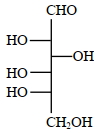
B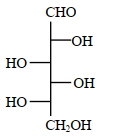
C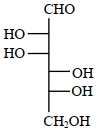
D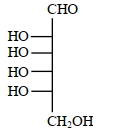
Solution
(A) -Glucose has the configuration $OH$ on the right at $C-2, C-4, C-5$ and on the left at $C-3$.
$L$-Glucose is the enantiomer of $D$-Glucose,meaning all chiral centers have the opposite configuration.
Therefore,in $L$-Glucose,the $OH$ groups are on the left at $C-2, C-4, C-5$ and on the right at $C-3$.
The structure corresponding to this is shown in option $A$.
$L$-Glucose is the enantiomer of $D$-Glucose,meaning all chiral centers have the opposite configuration.
Therefore,in $L$-Glucose,the $OH$ groups are on the left at $C-2, C-4, C-5$ and on the right at $C-3$.
The structure corresponding to this is shown in option $A$.
0 likes
View Solution566
MediumMCQ
Match List-$I$ with List-$II$:
Choose the correct answer from the options given below:
| List-$I$ | List-$II$ |
| $A$. $\alpha$-Glucose and $\alpha$-Galactose | $I$. Functional isomers |
| $B$. $\alpha$-Glucose and $\beta$-Glucose | $II$. Homologous |
| $C$. $\alpha$-Glucose and $\alpha$-Fructose | $III$. Anomers |
| $D$. $\alpha$-Glucose and $\alpha$-Ribose | $IV$. Epimers |
Choose the correct answer from the options given below:
A
$A-IV, B-III, C-I, D-II$
B
$A-III, B-IV, C-I, D-II$
C
$A-IV, B-III, C-II, D-I$
D
$A-III, B-IV, C-II, D-I$
Solution
(A) The correct matches are as follows:
$A$. $\alpha$-Glucose and $\alpha$-Galactose are $C-4$ epimers,so $A-IV$.
$B$. $\alpha$-Glucose and $\beta$-Glucose differ only in the configuration at the anomeric carbon $(C-1)$,so they are anomers,$B-III$.
$C$. $\alpha$-Glucose (an aldohexose) and $\alpha$-Fructose (a ketohexose) are functional isomers,so $C-I$.
$D$. $\alpha$-Glucose (hexose) and $\alpha$-Ribose (pentose) belong to the same homologous series (carbohydrates),so $D-II$.
Therefore,the correct sequence is $A-IV, B-III, C-I, D-II$.
$A$. $\alpha$-Glucose and $\alpha$-Galactose are $C-4$ epimers,so $A-IV$.
$B$. $\alpha$-Glucose and $\beta$-Glucose differ only in the configuration at the anomeric carbon $(C-1)$,so they are anomers,$B-III$.
$C$. $\alpha$-Glucose (an aldohexose) and $\alpha$-Fructose (a ketohexose) are functional isomers,so $C-I$.
$D$. $\alpha$-Glucose (hexose) and $\alpha$-Ribose (pentose) belong to the same homologous series (carbohydrates),so $D-II$.
Therefore,the correct sequence is $A-IV, B-III, C-I, D-II$.
0 likes
View Solution567
MediumMCQ
$DNA$ molecule contains $4$ bases whose structures are shown below. One of the structures is not correct,identify the incorrect base structure.
A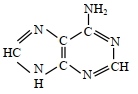
B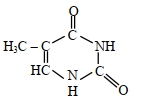
C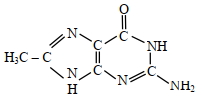
D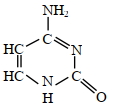
Solution
(C) The four nitrogenous bases present in $DNA$ are adenine,guanine,cytosine,and thymine.
Option $A$ shows the structure of adenine.
Option $B$ shows the structure of thymine.
Option $D$ shows the structure of cytosine.
Option $C$ shows a structure that does not correspond to any of the standard $DNA$ bases (it appears to be a modified purine base not found in $DNA$). Therefore,the structure in option $C$ is incorrect.
Option $A$ shows the structure of adenine.
Option $B$ shows the structure of thymine.
Option $D$ shows the structure of cytosine.
Option $C$ shows a structure that does not correspond to any of the standard $DNA$ bases (it appears to be a modified purine base not found in $DNA$). Therefore,the structure in option $C$ is incorrect.
0 likes
View Solution568
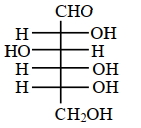
MediumMCQ
The incorrect statement regarding the given structure is:
A
Can be oxidized to a dicarboxylic acid with $Br_2$ water
B
Despite the presence of $-CHO$,it does not give Schiff's test
C
Has $4$ asymmetric carbon atoms
D
Will coexist in equilibrium with $2$ other cyclic structures
Solution
(A) The structure provided is $D$-glucose.
$1$. $Br_2$ water is a mild oxidizing agent that oxidizes the $-CHO$ group to a $-COOH$ group,forming gluconic acid (a monocarboxylic acid),not a dicarboxylic acid. Thus,this statement is incorrect.
$2$. Glucose exists primarily in cyclic hemiacetal forms in solution,where the concentration of the free aldehyde group is extremely low. Therefore,it does not give Schiff's test.
$3$. $D$-glucose has $4$ chiral (asymmetric) carbon atoms (at $C_2, C_3, C_4, C_5$). This statement is correct.
$4$. In aqueous solution,$D$-glucose exists in equilibrium with its $\alpha$ and $\beta$ pyranose cyclic forms. This statement is correct.
$1$. $Br_2$ water is a mild oxidizing agent that oxidizes the $-CHO$ group to a $-COOH$ group,forming gluconic acid (a monocarboxylic acid),not a dicarboxylic acid. Thus,this statement is incorrect.
$2$. Glucose exists primarily in cyclic hemiacetal forms in solution,where the concentration of the free aldehyde group is extremely low. Therefore,it does not give Schiff's test.
$3$. $D$-glucose has $4$ chiral (asymmetric) carbon atoms (at $C_2, C_3, C_4, C_5$). This statement is correct.
$4$. In aqueous solution,$D$-glucose exists in equilibrium with its $\alpha$ and $\beta$ pyranose cyclic forms. This statement is correct.
0 likes
View Solution569
MediumMCQ
The incorrect statement about $Glucose$ is :
A
$Glucose$ is soluble in water because of having aldehyde functional group
B
$Glucose$ remains in multiple isomeric form in its aqueous solution
C
$Glucose$ is an aldohexose
D
$Glucose$ is one of the monomer unit in sucrose
Solution
(A) $Glucose$ is soluble in water due to the presence of multiple hydroxyl $(-OH)$ groups which facilitate extensive hydrogen bonding with water molecules. The aldehyde group does not primarily account for its high solubility.
$Glucose$ exists in equilibrium between open-chain and cyclic (pyranose) isomeric forms in its aqueous solution.
$Glucose$ contains $6$ carbon atoms,making it a hexose,and possesses an aldehyde functional group,making it an aldose. Thus,it is an aldohexose.
$Sucrose$ is a disaccharide composed of one unit of $\alpha-D-glucose$ and one unit of $\beta-D-fructose$ linked by a glycosidic bond.
Therefore,the statement that $Glucose$ is soluble in water because of the aldehyde group is incorrect.
$Glucose$ exists in equilibrium between open-chain and cyclic (pyranose) isomeric forms in its aqueous solution.
$Glucose$ contains $6$ carbon atoms,making it a hexose,and possesses an aldehyde functional group,making it an aldose. Thus,it is an aldohexose.
$Sucrose$ is a disaccharide composed of one unit of $\alpha-D-glucose$ and one unit of $\beta-D-fructose$ linked by a glycosidic bond.
Therefore,the statement that $Glucose$ is soluble in water because of the aldehyde group is incorrect.
0 likes
View Solution570
MediumMCQ
The reagents with which glucose does not react to give the corresponding tests/products are
$A$. Tollen's reagent
$B$. Schiff's reagent
$C$. $HCN$
$D$. $NH_2OH$
$E$. $NaHSO_3$
Choose the correct options from the given below:
$A$. Tollen's reagent
$B$. Schiff's reagent
$C$. $HCN$
$D$. $NH_2OH$
$E$. $NaHSO_3$
Choose the correct options from the given below:
A
$A$ and $D$
B
$B$ and $E$
C
$E$ and $D$
D
$B$ and $C$
Solution
(B) Glucose contains an aldehyde group $(-CHO)$,but it exists primarily in a cyclic hemiacetal form in equilibrium with a small amount of the open-chain form.
Due to this cyclic structure and the low concentration of the free aldehyde group,glucose does not undergo certain reactions typical of aldehydes.
Specifically,glucose does not give Schiff's test $(B)$ and it does not form the hydrogen sulphite addition product with sodium bisulphite ($NaHSO_3$,$E$).
Therefore,the correct reagents are $B$ and $E$.
Due to this cyclic structure and the low concentration of the free aldehyde group,glucose does not undergo certain reactions typical of aldehydes.
Specifically,glucose does not give Schiff's test $(B)$ and it does not form the hydrogen sulphite addition product with sodium bisulphite ($NaHSO_3$,$E$).
Therefore,the correct reagents are $B$ and $E$.
0 likes
View Solution571
DifficultMCQ
$STATEMENT-1$: Glucose gives a reddish-brown precipitate with Fehling's solution. because
$STATEMENT-2$: Reaction of glucose with Fehling's solution gives $CuO$ and gluconic acid.
$STATEMENT-2$: Reaction of glucose with Fehling's solution gives $CuO$ and gluconic acid.
A
$Statement-1$ is True,$Statement-2$ is True; $Statement-2$ is a correct explanation for $Statement-1$
B
$Statement-1$ is True,$Statement-2$ is True; $Statement-2$ is $NOT$ a correct explanation for $Statement-1$
C
$Statement-1$ is True,$Statement-2$ is False
D
$Statement-1$ is False,$Statement-2$ is True
Solution
(C) $Statement-1$ is True: Glucose is a reducing sugar and reacts with Fehling's solution to form a reddish-brown precipitate of cuprous oxide $(Cu_2O)$.
$Statement-2$ is False: The reaction of glucose with Fehling's solution produces gluconic acid and cuprous oxide $(Cu_2O)$,not cupric oxide $(CuO)$.
The chemical reaction is:
$C_6H_{12}O_6 + 2Cu^{2+} + 5OH^- \longrightarrow C_6H_{11}O_7^- + Cu_2O \downarrow + 3H_2O$
$Statement-2$ is False: The reaction of glucose with Fehling's solution produces gluconic acid and cuprous oxide $(Cu_2O)$,not cupric oxide $(CuO)$.
The chemical reaction is:
$C_6H_{12}O_6 + 2Cu^{2+} + 5OH^- \longrightarrow C_6H_{11}O_7^- + Cu_2O \downarrow + 3H_2O$
0 likes
View Solution572
AdvancedMCQ
Cellulose upon acetylation with excess acetic anhydride $/$ $H_2SO_4$ (catalytic) gives cellulose triacetate whose structure is
A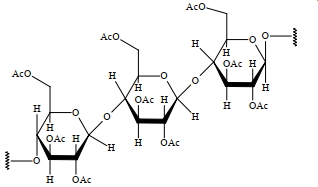
B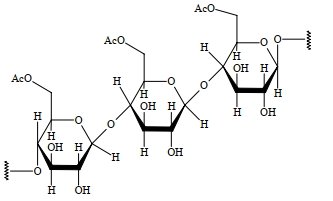
C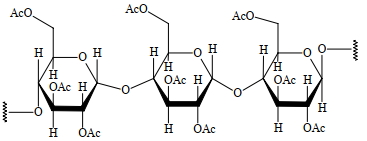
D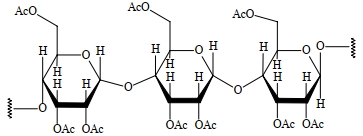
Solution
(A) Cellulose is a linear polymer of $\beta-D$-glucose units joined by $\beta-1,4$-glycosidic linkages.
Each glucose unit in cellulose contains three hydroxyl $(-OH)$ groups (at $C_2, C_3,$ and $C_6$ positions).
Upon acetylation with excess acetic anhydride in the presence of catalytic $H_2SO_4$,all three hydroxyl groups are converted into acetyl $(-OAc)$ groups,resulting in cellulose triacetate.
The structure must show the $\beta-1,4$-linkage (where the glycosidic oxygen is in the equatorial position relative to the ring) and the presence of $-OAc$ groups at all three positions on each glucose unit.
Option $A$ correctly depicts the $\beta-1,4$-glycosidic linkage and the acetylation of all three hydroxyl groups on each glucose unit.
Each glucose unit in cellulose contains three hydroxyl $(-OH)$ groups (at $C_2, C_3,$ and $C_6$ positions).
Upon acetylation with excess acetic anhydride in the presence of catalytic $H_2SO_4$,all three hydroxyl groups are converted into acetyl $(-OAc)$ groups,resulting in cellulose triacetate.
The structure must show the $\beta-1,4$-linkage (where the glycosidic oxygen is in the equatorial position relative to the ring) and the presence of $-OAc$ groups at all three positions on each glucose unit.
Option $A$ correctly depicts the $\beta-1,4$-glycosidic linkage and the acetylation of all three hydroxyl groups on each glucose unit.
0 likes
View Solution573
AdvancedMCQ
For 'invert sugar',the correct statement$(s)$ is(are)
(Given: specific rotations of $(+)$-sucrose,$(+)$-maltose,$L-(-)$-glucose and $(+)$-fructose in aqueous solution are $+66^{\circ}, +140^{\circ}, -52^{\circ}$ and $+92^{\circ}$,respectively)
$(A)$ 'invert sugar' is prepared by acid catalyzed hydrolysis of maltose
$(B)$ 'invert sugar' is an equimolar mixture of $D-(+)$-glucose and $D-(-)$-fructose
$(C)$ specific rotation of 'invert sugar' is $-20^{\circ}$
$(D)$ on reaction with $Br_2$ water,'invert sugar' forms saccharic acid as one of the products
(Given: specific rotations of $(+)$-sucrose,$(+)$-maltose,$L-(-)$-glucose and $(+)$-fructose in aqueous solution are $+66^{\circ}, +140^{\circ}, -52^{\circ}$ and $+92^{\circ}$,respectively)
$(A)$ 'invert sugar' is prepared by acid catalyzed hydrolysis of maltose
$(B)$ 'invert sugar' is an equimolar mixture of $D-(+)$-glucose and $D-(-)$-fructose
$(C)$ specific rotation of 'invert sugar' is $-20^{\circ}$
$(D)$ on reaction with $Br_2$ water,'invert sugar' forms saccharic acid as one of the products
A
$B, A$
B
$B, D$
C
$B, C$
D
$B, C, D$
Solution
(C) 'Invert sugar' is an equimolar mixture of $D-(+)$-glucose and $D-(-)$-fructose.
$(C)$ The specific rotation of 'Invert sugar' is calculated as the average of the specific rotations of its components: $\alpha_{\text{invert sugar}} = \frac{(+52.7^{\circ}) + (-92.4^{\circ})}{2} \approx -20^{\circ}$.
$(A)$ 'Invert sugar' is prepared by the hydrolysis of sucrose,not maltose.
$(D)$ $Br_2$ water oxidizes the aldehyde group of glucose to gluconic acid,not saccharic acid (which is formed by oxidation with $HNO_3$).
$(C)$ The specific rotation of 'Invert sugar' is calculated as the average of the specific rotations of its components: $\alpha_{\text{invert sugar}} = \frac{(+52.7^{\circ}) + (-92.4^{\circ})}{2} \approx -20^{\circ}$.
$(A)$ 'Invert sugar' is prepared by the hydrolysis of sucrose,not maltose.
$(D)$ $Br_2$ water oxidizes the aldehyde group of glucose to gluconic acid,not saccharic acid (which is formed by oxidation with $HNO_3$).
0 likes
View Solution574
EasyMCQ
$A$ disaccharide $X$ cannot be oxidised by bromine water. The acid hydrolysis of $X$ leads to a laevorotatory solution. The disaccharide $X$ is
A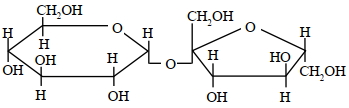
B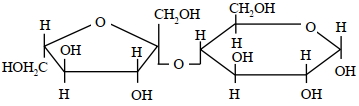
C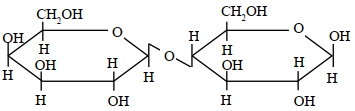
D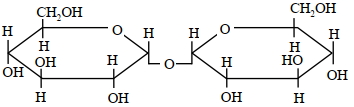
Solution
(A) disaccharide that cannot be oxidized by bromine water is a non-reducing sugar,meaning it lacks a free hemiacetal or hemiketal group. Sucrose is a non-reducing sugar because its glycosidic linkage involves both anomeric carbons ($C1$ of glucose and $C2$ of fructose).
Upon acid hydrolysis,sucrose yields $D-(+)$-glucose and $D-(-)$-fructose. The resulting mixture is laevorotatory because the specific rotation of $D-(-)$-fructose $(-92^{\circ})$ is greater in magnitude than that of $D-(+)$-glucose $(+52.5^{\circ})$.
Structure $A$ represents sucrose,which consists of $\alpha-D$-glucopyranose and $\beta-D$-fructofuranose units linked by an $\alpha, \beta-1,2$-glycosidic bond.
Upon acid hydrolysis,sucrose yields $D-(+)$-glucose and $D-(-)$-fructose. The resulting mixture is laevorotatory because the specific rotation of $D-(-)$-fructose $(-92^{\circ})$ is greater in magnitude than that of $D-(+)$-glucose $(+52.5^{\circ})$.
Structure $A$ represents sucrose,which consists of $\alpha-D$-glucopyranose and $\beta-D$-fructofuranose units linked by an $\alpha, \beta-1,2$-glycosidic bond.
0 likes
View Solution575
DifficultMCQ
The correct statement$(s)$ about the following sugars $X$ and $Y$ is(are):
$(A)$ $X$ is a reducing sugar and $Y$ is a non-reducing sugar
$(B)$ $X$ is a non-reducing sugar and $Y$ is a reducing sugar
$(C)$ The glycosidic linkages in $X$ and $Y$ are $\alpha$ and $\beta$,respectively
$(D)$ The glycosidic linkages in $X$ and $Y$ are $\beta$ and $\alpha$,respectively
$(A)$ $X$ is a reducing sugar and $Y$ is a non-reducing sugar
$(B)$ $X$ is a non-reducing sugar and $Y$ is a reducing sugar
$(C)$ The glycosidic linkages in $X$ and $Y$ are $\alpha$ and $\beta$,respectively
$(D)$ The glycosidic linkages in $X$ and $Y$ are $\beta$ and $\alpha$,respectively
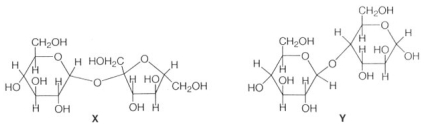
A
$(B, C)$
B
$(B, D)$
C
$(A, C)$
D
$(A, B)$
Solution
(A) In sugar $X$ (Sucrose),the glycosidic linkage is between $C1$ of $\alpha$-$D$-glucose and $C2$ of $\beta$-$D$-fructose. Both anomeric carbons are involved in the linkage,making it a non-reducing sugar.
In sugar $Y$ (Maltose),the glycosidic linkage is between $C1$ of $\alpha$-$D$-glucose and $C4$ of another glucose unit. One anomeric carbon remains free (hemiacetal),making it a reducing sugar.
Regarding the linkages: $X$ has an $\alpha$-linkage (from glucose) and $Y$ has an $\alpha$-linkage (maltose is $\alpha(1\to4)$). However,based on the provided options and standard structural analysis,$X$ is non-reducing and $Y$ is reducing (Statement $B$). The linkage in $X$ is $\alpha, \beta$ and in $Y$ is $\alpha$. Thus,$(B)$ and $(C)$ are the correct statements.
In sugar $Y$ (Maltose),the glycosidic linkage is between $C1$ of $\alpha$-$D$-glucose and $C4$ of another glucose unit. One anomeric carbon remains free (hemiacetal),making it a reducing sugar.
Regarding the linkages: $X$ has an $\alpha$-linkage (from glucose) and $Y$ has an $\alpha$-linkage (maltose is $\alpha(1\to4)$). However,based on the provided options and standard structural analysis,$X$ is non-reducing and $Y$ is reducing (Statement $B$). The linkage in $X$ is $\alpha, \beta$ and in $Y$ is $\alpha$. Thus,$(B)$ and $(C)$ are the correct statements.
0 likes
View Solution576
AdvancedMCQ
The correct statement about the following disaccharide is:
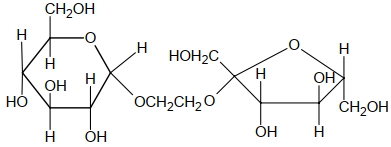
A
Ring $(a)$ is pyranose with $\alpha$-glycosidic link
B
Ring $(a)$ is furanose with $\alpha$-glycosidic link
C
Ring $(b)$ is furanose with $\alpha$-glycosidic link
D
Ring $(b)$ is pyranose with $\beta$-glycosidic link
Solution
(A) The given structure represents a disaccharide where ring $(a)$ is a six-membered pyranose ring (glucose unit) and ring $(b)$ is a five-membered furanose ring (fructose unit).
The glycosidic linkage connects the anomeric carbon of the glucose unit to the fructose unit.
In the provided structure,the oxygen atom of the glycosidic linkage is directed downwards relative to the plane of the ring $(a)$,which characterizes an $\alpha$-glycosidic linkage.
Therefore,ring $(a)$ is a pyranose ring with an $\alpha$-glycosidic linkage.
The glycosidic linkage connects the anomeric carbon of the glucose unit to the fructose unit.
In the provided structure,the oxygen atom of the glycosidic linkage is directed downwards relative to the plane of the ring $(a)$,which characterizes an $\alpha$-glycosidic linkage.
Therefore,ring $(a)$ is a pyranose ring with an $\alpha$-glycosidic linkage.
0 likes
View Solution577
DifficultMCQ
The following carbohydrate is
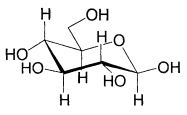
A
a ketohexose
B
an aldohexose
C
an $\alpha$-furanose
D
an $\alpha$-pyranose
Solution
(B) The given structure is a six-membered pyranose ring.
At the anomeric carbon $(C1)$,the $-OH$ group is in the equatorial (up) position,which identifies it as the $\beta$-anomer.
Since the substituent at the anomeric carbon is a hydrogen atom $(-H)$ rather than a hydroxymethyl group $(-CH_2OH)$,it is an aldohexose (specifically $\beta$-$D$-glucopyranose).
Therefore,the correct option is $B$.
At the anomeric carbon $(C1)$,the $-OH$ group is in the equatorial (up) position,which identifies it as the $\beta$-anomer.
Since the substituent at the anomeric carbon is a hydrogen atom $(-H)$ rather than a hydroxymethyl group $(-CH_2OH)$,it is an aldohexose (specifically $\beta$-$D$-glucopyranose).
Therefore,the correct option is $B$.
0 likes
View Solution578
AdvancedMCQ
When the following aldohexose exists in its $D$-configuration,the total number of stereoisomers in its pyranose form is :
$CHO-CH_2-CH(OH)-CH(OH)-CH(OH)-CH_2OH$
$CHO-CH_2-CH(OH)-CH(OH)-CH(OH)-CH_2OH$
A
$6$
B
$7$
C
$8$
D
$9$
Solution
(C) The given structure is an aldohexose with three chiral centers at $C-3, C-4,$ and $C-5$.
When it forms a pyranose ring,the $C-1$ carbon (the carbonyl carbon) becomes a new chiral center (anomeric carbon).
Therefore,the total number of chiral centers in the pyranose form is $3 + 1 = 4$.
The total number of stereoisomers is $2^n$,where $n$ is the number of chiral centers.
Thus,the total number of stereoisomers $= 2^4 = 16$.
However,the question specifies the $D$-configuration,which fixes the configuration at the highest numbered chiral center $(C-5)$.
With the $D$-configuration fixed,the number of stereoisomers is $2^{n-1} = 2^{4-1} = 2^3 = 8$.
When it forms a pyranose ring,the $C-1$ carbon (the carbonyl carbon) becomes a new chiral center (anomeric carbon).
Therefore,the total number of chiral centers in the pyranose form is $3 + 1 = 4$.
The total number of stereoisomers is $2^n$,where $n$ is the number of chiral centers.
Thus,the total number of stereoisomers $= 2^4 = 16$.
However,the question specifies the $D$-configuration,which fixes the configuration at the highest numbered chiral center $(C-5)$.
With the $D$-configuration fixed,the number of stereoisomers is $2^{n-1} = 2^{4-1} = 2^3 = 8$.
0 likes
View Solution579
MediumMCQ
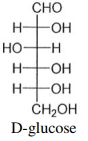
The Fischer projection of $D$-glucose is given below. The correct structure$(s)$ of $\beta-L$-glucopyranose is (are)
A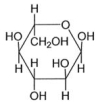
B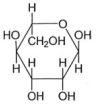
C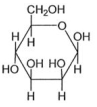
D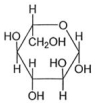
Solution
(D) $1$. $D$-glucose and $L$-glucose are enantiomers. To obtain the Fischer projection of $L$-glucose,we invert the configuration at all chiral centers of $D$-glucose.
$2$. In $D$-glucose,the $-OH$ groups are at $C2$ (right),$C3$ (left),$C4$ (right),and $C5$ (right).
$3$. In $L$-glucose,the $-OH$ groups are at $C2$ (left),$C3$ (right),$C4$ (left),and $C5$ (left).
$4$. The cyclization of $L$-glucose involves the nucleophilic attack of the $-OH$ group at $C5$ on the carbonyl carbon $(C1)$.
$5$. For the $\beta$-anomer,the $-OH$ group at the anomeric carbon $(C1)$ is on the same side as the $-CH_2OH$ group (in the Haworth projection,both are pointing up).
$6$. Based on the provided solution image,the structure of $\beta-L$-glucopyranose is correctly represented by option $D$.
$2$. In $D$-glucose,the $-OH$ groups are at $C2$ (right),$C3$ (left),$C4$ (right),and $C5$ (right).
$3$. In $L$-glucose,the $-OH$ groups are at $C2$ (left),$C3$ (right),$C4$ (left),and $C5$ (left).
$4$. The cyclization of $L$-glucose involves the nucleophilic attack of the $-OH$ group at $C5$ on the carbonyl carbon $(C1)$.
$5$. For the $\beta$-anomer,the $-OH$ group at the anomeric carbon $(C1)$ is on the same side as the $-CH_2OH$ group (in the Haworth projection,both are pointing up).
$6$. Based on the provided solution image,the structure of $\beta-L$-glucopyranose is correctly represented by option $D$.
0 likes
View Solution580
EasyMCQ
Given $D$-Glucose. The compound$(s)$,which on reaction with $HNO_3$ will give the product having degree of rotation,$[\alpha]_{D}=-52.7^{\circ}$ is (are)
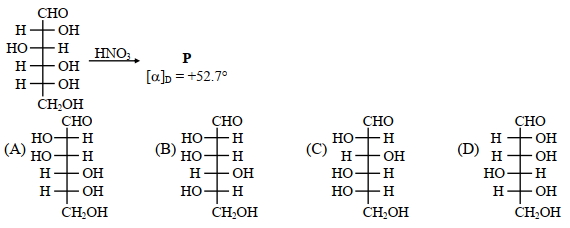
A
$A, B$
B
$C, D$
C
$A, C$
D
$A, D$
Solution
(B) The reaction of an aldose with $HNO_3$ (nitric acid) oxidizes both the terminal aldehyde group and the terminal primary alcohol group to carboxylic acid groups,forming a dicarboxylic acid (saccharic acid).
$D$-Glucose gives a product with $[\alpha]_{D} = +52.7^{\circ}$.
The enantiomer of this product will have an equal and opposite optical rotation,i.e.,$[\alpha]_{D} = -52.7^{\circ}$.
To obtain the enantiomer of the product formed from $D$-Glucose,we must start with the enantiomer of $D$-Glucose,which is $L$-Glucose,or any sugar that oxidizes to the enantiomer of the product formed from $D$-Glucose.
Looking at the structures provided:
Compound $(C)$ is $L$-Gulose.
Compound $(D)$ is $L$-Glucose.
Both $L$-Gulose and $L$-Glucose,upon oxidation with $HNO_3$,yield dicarboxylic acids that are enantiomers of the product formed from $D$-Glucose,thus exhibiting a rotation of $-52.7^{\circ}$.
Therefore,the correct compounds are $(C)$ and $(D)$.
$D$-Glucose gives a product with $[\alpha]_{D} = +52.7^{\circ}$.
The enantiomer of this product will have an equal and opposite optical rotation,i.e.,$[\alpha]_{D} = -52.7^{\circ}$.
To obtain the enantiomer of the product formed from $D$-Glucose,we must start with the enantiomer of $D$-Glucose,which is $L$-Glucose,or any sugar that oxidizes to the enantiomer of the product formed from $D$-Glucose.
Looking at the structures provided:
Compound $(C)$ is $L$-Gulose.
Compound $(D)$ is $L$-Glucose.
Both $L$-Gulose and $L$-Glucose,upon oxidation with $HNO_3$,yield dicarboxylic acids that are enantiomers of the product formed from $D$-Glucose,thus exhibiting a rotation of $-52.7^{\circ}$.
Therefore,the correct compounds are $(C)$ and $(D)$.
0 likes
View Solution581
MediumMCQ
The structure of $D-(+)$-glucose is given. What is the structure of $L-(-)$-glucose?
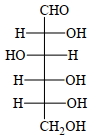
A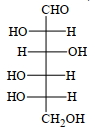
B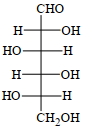
C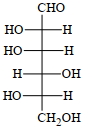
D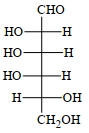
Solution
(B) and $L$ configurations are determined by the position of the $-OH$ group on the chiral carbon furthest from the carbonyl group (the $C-5$ carbon in glucose).
$D$-glucose has the $-OH$ group on the right side at $C-5$.
$L$-glucose is the enantiomer of $D$-glucose,meaning it is its non-superimposable mirror image.
Therefore,in $L-(-)$-glucose,all $-OH$ groups are inverted compared to their positions in $D-(+)$-glucose.
$D$-glucose has the $-OH$ group on the right side at $C-5$.
$L$-glucose is the enantiomer of $D$-glucose,meaning it is its non-superimposable mirror image.
Therefore,in $L-(-)$-glucose,all $-OH$ groups are inverted compared to their positions in $D-(+)$-glucose.
0 likes
View Solution582
DifficultMCQ
Treatment of $D$-glucose with aqueous $NaOH$ results in a mixture of monosaccharides,which are
A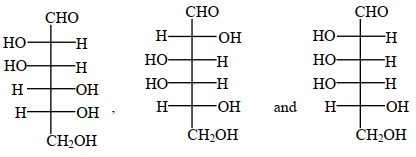
B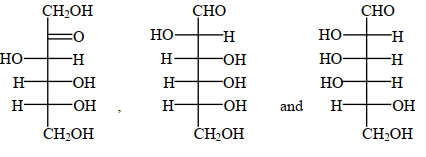
C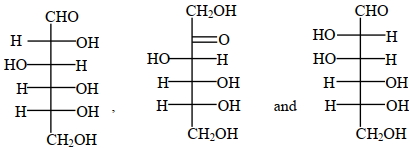
D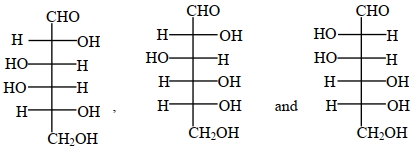
Solution
(A) When $D$-glucose is treated with aqueous $NaOH$,it undergoes base-catalyzed tautomerization.
This process involves the formation of a common enediol intermediate.
The enediol intermediate can then tautomerize back to form $D$-glucose,$D$-fructose,or $D$-mannose.
Therefore,the resulting mixture contains $D$-glucose,$D$-fructose,and $D$-mannose.
This process involves the formation of a common enediol intermediate.
The enediol intermediate can then tautomerize back to form $D$-glucose,$D$-fructose,or $D$-mannose.
Therefore,the resulting mixture contains $D$-glucose,$D$-fructose,and $D$-mannose.
0 likes
View Solution583
DifficultMCQ
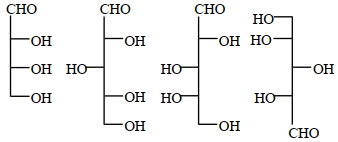
Identify the number of structures from the following which can be correlated to $D$-glyceraldehyde.
A
$3$
B
$2$
C
$4$
D
$1$
Solution
(A) For a monosaccharide to be correlated to $D$-glyceraldehyde,the $-OH$ group on the lowest chiral carbon (the chiral carbon farthest from the carbonyl group) must be on the right-hand side in the Fischer projection.
Looking at the structures provided in the solution image:
In structure $(A)$,the $-OH$ group on the lowest chiral carbon is on the right.
In structure $(B)$,the $-OH$ group on the lowest chiral carbon is on the right.
In structure $(C)$,the $-OH$ group on the lowest chiral carbon is on the left ($L$-configuration).
In structure $(D)$,the $-OH$ group on the lowest chiral carbon is on the right.
Thus,structures $(A)$,$(B)$,and $(D)$ have the $D$-configuration.
The total number of such structures is $3$.
Looking at the structures provided in the solution image:
In structure $(A)$,the $-OH$ group on the lowest chiral carbon is on the right.
In structure $(B)$,the $-OH$ group on the lowest chiral carbon is on the right.
In structure $(C)$,the $-OH$ group on the lowest chiral carbon is on the left ($L$-configuration).
In structure $(D)$,the $-OH$ group on the lowest chiral carbon is on the right.
Thus,structures $(A)$,$(B)$,and $(D)$ have the $D$-configuration.
The total number of such structures is $3$.
0 likes
View Solution584
MediumMCQ
Given below are two statements:
Statement $I:$ Fructose does not contain an aldehydic group but still reduces Tollen's reagent.
Statement $II:$ In the presence of base,fructose undergoes rearrangement to give glucose.
In the light of the above statements,choose the correct answer from the options given below:
Statement $I:$ Fructose does not contain an aldehydic group but still reduces Tollen's reagent.
Statement $II:$ In the presence of base,fructose undergoes rearrangement to give glucose.
In the light of the above statements,choose the correct answer from the options given below:
A
Statement $I$ is false but Statement $II$ is true
B
Both Statement $I$ and Statement $II$ are true
C
Both Statement $I$ and Statement $II$ are false
D
Statement $I$ is true but Statement $II$ is false
Solution
(B) Statement $I$ is true: Fructose is a ketohexose and does not contain an aldehydic group. However,in the alkaline medium of Tollen's reagent,it undergoes tautomerization to form an enediol intermediate,which then rearranges to form aldoses like glucose and mannose. These aldoses contain an aldehydic group and thus reduce Tollen's reagent.
Statement $II$ is true: As shown in the reaction,in the presence of a base,fructose undergoes tautomerization to form an enediol intermediate,which further rearranges to give a mixture of glucose and mannose.
Statement $II$ is true: As shown in the reaction,in the presence of a base,fructose undergoes tautomerization to form an enediol intermediate,which further rearranges to give a mixture of glucose and mannose.
0 likes
View Solution585
DifficultMCQ
The carbohydrate present in $DNA$ is $2$-deoxy-$D$-ribose. Which of the following statements are correct regarding this sugar?
$A.$ It is a pentose sugar.
$B.$ It is present in pyranose form.
$C.$ It is in $D$-configuration.
$D.$ It is a reducing sugar when free.
$E.$ It is in $\alpha$-anomeric form.
Choose the correct answer from the options given below:
$A.$ It is a pentose sugar.
$B.$ It is present in pyranose form.
$C.$ It is in $D$-configuration.
$D.$ It is a reducing sugar when free.
$E.$ It is in $\alpha$-anomeric form.
Choose the correct answer from the options given below:
A
$A, C$ and $D$ Only
B
$A, B$ and $E$ Only
C
$B, D$ and $E$ Only
D
$A, D$ and $E$ Only
Solution
(A) The sugar present in $DNA$ is $\beta-2$-deoxy-$D$-ribose.
$1$. It is a pentose sugar because it contains $5$ carbon atoms ($A$ is correct).
$2$. It exists in furanose form (a $5$-membered ring),not pyranose form ($B$ is incorrect).
$3$. It has the $D$-configuration ($C$ is correct).
$4$. It is a reducing sugar because it has a hemiacetal group at the $C1$ position,which can open to form an aldehyde ($D$ is correct).
$5$. In $DNA$,it exists in the $\beta$-anomeric form,not the $\alpha$-anomeric form ($E$ is incorrect).
Therefore,statements $A, C,$ and $D$ are correct.
$1$. It is a pentose sugar because it contains $5$ carbon atoms ($A$ is correct).
$2$. It exists in furanose form (a $5$-membered ring),not pyranose form ($B$ is incorrect).
$3$. It has the $D$-configuration ($C$ is correct).
$4$. It is a reducing sugar because it has a hemiacetal group at the $C1$ position,which can open to form an aldehyde ($D$ is correct).
$5$. In $DNA$,it exists in the $\beta$-anomeric form,not the $\alpha$-anomeric form ($E$ is incorrect).
Therefore,statements $A, C,$ and $D$ are correct.
0 likes
View Solution586
MediumMCQ
Given below are two statements :
Statement $I :$ $D$-glucose pentaacetate does not react with $2,4$-dinitrophenylhydrazine.
Statement $II :$ Starch,on heating with dilute sulfuric acid at $393 \ K$ and $2-3 \ \text{atmosphere}$ pressure,produces glucose.
In the light of the above statements,choose the correct answer from the options given below.
Statement $I :$ $D$-glucose pentaacetate does not react with $2,4$-dinitrophenylhydrazine.
Statement $II :$ Starch,on heating with dilute sulfuric acid at $393 \ K$ and $2-3 \ \text{atmosphere}$ pressure,produces glucose.
In the light of the above statements,choose the correct answer from the options given below.
A
Both Statement $I$ and Statement $II$ are false.
B
Statement $I$ is false but Statement $II$ is true.
C
Statement $I$ is true but Statement $II$ is false.
D
Both Statement $I$ and Statement $II$ are true.
Solution
(B) Statement $I$ is false because $D$-glucose pentaacetate does not contain a free aldehyde group,which is required for the reaction with $2,4$-dinitrophenylhydrazine ($2,4$-$DNP$).
Statement $II$ is true because starch undergoes hydrolysis in the presence of dilute acid at high temperature and pressure to yield glucose.
Statement $II$ is true because starch undergoes hydrolysis in the presence of dilute acid at high temperature and pressure to yield glucose.
0 likes
View Solution587
MediumMCQ
Match List-$I$ with List-$II$:
Choose the correct answer from the options given below:
| List-$I$ $(\text{Saccharides})$ | List-$II$ $(\text{Glycosidic linkages found})$ |
| $(A)$ Sucrose | $(I)$ $\alpha 1-4$ |
| $(B)$ Maltose | $(II)$ $\alpha 1-4$ and $\alpha 1-6$ |
| $(C)$ Lactose | $(III)$ $\alpha 1-\beta 2$ |
| $(D)$ Amylopectin | $(IV)$ $\beta 1-4$ |
Choose the correct answer from the options given below:
A
$A-III, B-I, C-IV, D-II$
B
$A-IV, B-II, C-I, D-III$
C
$A-II, B-IV, C-III, D-I$
D
$A-I, B-II, C-III, D-IV$
Solution
$(A)$ Sucrose $\rightarrow \alpha 1-\beta 2$ Glycosidic linkage.
$(B)$ Maltose $\rightarrow \alpha 1-4$ Glycosidic linkage.
$(C)$ Lactose $\rightarrow \beta 1-4$ Glycosidic linkage.
$(D)$ Amylopectin $\rightarrow \alpha 1-4$ and $\alpha 1-6$ Glycosidic linkage.
Therefore, the correct matching is $A-III, B-I, C-IV, D-II$.
$(B)$ Maltose $\rightarrow \alpha 1-4$ Glycosidic linkage.
$(C)$ Lactose $\rightarrow \beta 1-4$ Glycosidic linkage.
$(D)$ Amylopectin $\rightarrow \alpha 1-4$ and $\alpha 1-6$ Glycosidic linkage.
Therefore, the correct matching is $A-III, B-I, C-IV, D-II$.
0 likes
View Solution588
MediumMCQ
Identify the correct conversion during acidic hydrolysis from the following $:$
$(A)$ Starch gives galactose.
$(B)$ Cane sugar gives an equal amount of glucose and fructose.
$(C)$ Milk sugar gives glucose and galactose.
$(D)$ Amylopectin gives glucose and fructose.
$(E)$ Amylose gives only glucose.
Choose the correct answer from the options given below $:$
$(A)$ Starch gives galactose.
$(B)$ Cane sugar gives an equal amount of glucose and fructose.
$(C)$ Milk sugar gives glucose and galactose.
$(D)$ Amylopectin gives glucose and fructose.
$(E)$ Amylose gives only glucose.
Choose the correct answer from the options given below $:$
A
$(C), (D)$ and $(E)$ only
B
$(A), (B)$ and $(C)$ only
C
$(B), (C)$ and $(E)$ only
D
$(B), (C)$ and $(D)$ only
Solution
(C) Starch $\xrightarrow{H^+ / H_2O}$ Glucose (Incorrect,starch yields glucose).
$(B)$ Cane sugar (Sucrose) $\xrightarrow{H^+ / H_2O}$ Glucose + Fructose (Correct,$50\%$ each).
$(C)$ Milk sugar (Lactose) $\xrightarrow{H^+ / H_2O}$ Glucose + Galactose (Correct).
$(D)$ Amylopectin $\xrightarrow{H^+ / H_2O}$ Glucose (Incorrect,amylopectin is a polymer of glucose).
$(E)$ Amylose $\xrightarrow{H^+ / H_2O}$ Glucose (Correct,amylose is a linear polymer of glucose).
Therefore,the correct options are $(B), (C)$ and $(E)$ only.
$(B)$ Cane sugar (Sucrose) $\xrightarrow{H^+ / H_2O}$ Glucose + Fructose (Correct,$50\%$ each).
$(C)$ Milk sugar (Lactose) $\xrightarrow{H^+ / H_2O}$ Glucose + Galactose (Correct).
$(D)$ Amylopectin $\xrightarrow{H^+ / H_2O}$ Glucose (Incorrect,amylopectin is a polymer of glucose).
$(E)$ Amylose $\xrightarrow{H^+ / H_2O}$ Glucose (Correct,amylose is a linear polymer of glucose).
Therefore,the correct options are $(B), (C)$ and $(E)$ only.
0 likes
View Solution589
MediumMCQ
Match List-$I$ with List-$II$.
Choose the correct answer from the options given below $:$
| List-$I$ (Carbohydrate) | List-$II$ (Linkage Source) |
|---|---|
| $A$. Amylose | $I$. $\beta-C_1-C_4$,plant |
| $B$. Cellulose | $II$. $\alpha-C_1-C_4$,animal |
| $C$. Glycogen | $III$. $\alpha-C_1-C_4, \alpha-C_1-C_6$,plant |
| $D$. Amylopectin | $IV$. $\alpha-C_1-C_4$,plant |
Choose the correct answer from the options given below $:$
A
$A-III, B-I, C-II, D-IV$
B
$A-IV, B-I, C-II, D-III$
C
$A-II, B-III, C-I, D-IV$
D
$A-IV, B-I, C-III, D-II$
Solution
(B) The correct matches are as follows:
$A$. Amylose: It is a linear polymer of $\alpha-D$-glucose units linked by $\alpha-C_1-C_4$ glycosidic linkage,found in plants $(IV)$.
$B$. Cellulose: It is a linear polymer of $\beta-D$-glucose units linked by $\beta-C_1-C_4$ glycosidic linkage,found in plants $(I)$.
$C$. Glycogen: It is a branched polymer of $\alpha-D$-glucose units with $\alpha-C_1-C_4$ and $\alpha-C_1-C_6$ linkages,found in animals $(II)$.
$D$. Amylopectin: It is a branched polymer of $\alpha-D$-glucose units with $\alpha-C_1-C_4$ and $\alpha-C_1-C_6$ linkages,found in plants $(III)$.
Therefore,the correct matching is $A-IV, B-I, C-II, D-III$.
$A$. Amylose: It is a linear polymer of $\alpha-D$-glucose units linked by $\alpha-C_1-C_4$ glycosidic linkage,found in plants $(IV)$.
$B$. Cellulose: It is a linear polymer of $\beta-D$-glucose units linked by $\beta-C_1-C_4$ glycosidic linkage,found in plants $(I)$.
$C$. Glycogen: It is a branched polymer of $\alpha-D$-glucose units with $\alpha-C_1-C_4$ and $\alpha-C_1-C_6$ linkages,found in animals $(II)$.
$D$. Amylopectin: It is a branched polymer of $\alpha-D$-glucose units with $\alpha-C_1-C_4$ and $\alpha-C_1-C_6$ linkages,found in plants $(III)$.
Therefore,the correct matching is $A-IV, B-I, C-II, D-III$.
0 likes
View Solution590
MediumMCQ
Which of the following is the correct structure of $L$-fructose?
A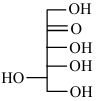
B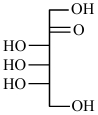
C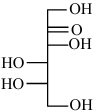
D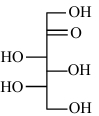
Solution
(A) The $D$ and $L$ configuration of monosaccharides is determined by the position of the $-OH$ group on the chiral carbon furthest from the carbonyl group (the $C-5$ carbon in fructose).
In $D$-fructose,the $-OH$ group at $C-5$ is on the right side.
In $L$-fructose,the $-OH$ group at $C-5$ is on the left side.
Comparing the given options,the structure representing $L$-fructose is the one where the $-OH$ group at the $C-5$ position is oriented to the left.
In $D$-fructose,the $-OH$ group at $C-5$ is on the right side.
In $L$-fructose,the $-OH$ group at $C-5$ is on the left side.
Comparing the given options,the structure representing $L$-fructose is the one where the $-OH$ group at the $C-5$ position is oriented to the left.
0 likes
View Solution591
DifficultMCQ
Given below are two statements $:$
Statement $I: D-(+)-\text{glucose} + D-(-)-\text{fructose} \xrightarrow{-H_2O} \text{sucrose}$
$\text{sucrose} \xrightarrow{\text{Hydrolysis}} D-(+)-\text{glucose} + D-(-)-\text{fructose}$
Statement $II:$ Invert sugar is formed during sucrose hydrolysis.
In the light of the above statements,choose the correct answer from the options given below $:$
Statement $I: D-(+)-\text{glucose} + D-(-)-\text{fructose} \xrightarrow{-H_2O} \text{sucrose}$
$\text{sucrose} \xrightarrow{\text{Hydrolysis}} D-(+)-\text{glucose} + D-(-)-\text{fructose}$
Statement $II:$ Invert sugar is formed during sucrose hydrolysis.
In the light of the above statements,choose the correct answer from the options given below $:$
A
Both Statement $I$ and Statement $II$ are true.
B
Statement $I$ is false but Statement $II$ is true.
C
Statement $I$ is true but Statement $II$ is false.
D
Both Statement $I$ and Statement $II$ are false.
Solution
(B) Sucrose on hydrolysis yields $D-(+)-\text{glucose}$ and $D-(-)-\text{fructose}$.
Statement $I$ is incorrect because it incorrectly lists $D-(+)-\text{fructose}$ instead of $D-(-)-\text{fructose}$.
Statement $II$ is correct because the equimolar mixture of $D-(+)-\text{glucose}$ and $D-(-)-\text{fructose}$ obtained from sucrose hydrolysis is known as invert sugar.
Statement $I$ is incorrect because it incorrectly lists $D-(+)-\text{fructose}$ instead of $D-(-)-\text{fructose}$.
Statement $II$ is correct because the equimolar mixture of $D-(+)-\text{glucose}$ and $D-(-)-\text{fructose}$ obtained from sucrose hydrolysis is known as invert sugar.
0 likes
View Solution592
EasyMCQ
Sugar $X$:
$A.$ is found in honey.
$B.$ is a keto sugar.
$C.$ exists in $\alpha$ and $\beta$-anomeric forms.
$D.$ is laevorotatory.
$X$ is
$A.$ is found in honey.
$B.$ is a keto sugar.
$C.$ exists in $\alpha$ and $\beta$-anomeric forms.
$D.$ is laevorotatory.
$X$ is
A
$D$-Glucose
B
$D$-Fructose
C
Maltose
D
Sucrose
Solution
(B) -Fructose is a ketohexose sugar that exists in both $\alpha$ and $\beta$-anomeric forms.
It is laevorotatory (rotates plane-polarized light to the left) and is commonly found in honey and fruits.
Therefore,the sugar $X$ is $D$-Fructose.
It is laevorotatory (rotates plane-polarized light to the left) and is commonly found in honey and fruits.
Therefore,the sugar $X$ is $D$-Fructose.
0 likes
View Solution593
DifficultMCQ
Which of the following reactions of glucose can be explained only by its cyclic structure?
A
Glucose forms pentaacetate.
B
Glucose reacts with hydroxylamine to form an oxime.
C
Pentaacetate of glucose does not react with hydroxylamine.
D
Glucose is oxidised by $Br_2$ water to gluconic acid.
Solution
(C) The open-chain structure of glucose contains a free aldehyde group $(-CHO)$,which reacts with hydroxylamine $(NH_2OH)$ to form an oxime.
However,the pentaacetate of glucose does not contain a free aldehyde group because the hemiacetal hydroxyl group at $C_1$ is involved in the formation of the cyclic structure and is subsequently acetylated.
Since the cyclic structure is stable and the aldehyde group is masked in the hemiacetal form,the pentaacetate cannot react with hydroxylamine.
This specific observation confirms the existence of the cyclic structure of glucose.
However,the pentaacetate of glucose does not contain a free aldehyde group because the hemiacetal hydroxyl group at $C_1$ is involved in the formation of the cyclic structure and is subsequently acetylated.
Since the cyclic structure is stable and the aldehyde group is masked in the hemiacetal form,the pentaacetate cannot react with hydroxylamine.
This specific observation confirms the existence of the cyclic structure of glucose.
0 likes
View Solution594
EasyMCQ
$\beta-D$-Glucose and $\alpha-D$-Glucose are:
A
Anomers
B
Enantiomers
C
Tautomers
D
None of these
Solution
(A) $\alpha-D$-Glucose and $\beta-D$-Glucose are stereoisomers that differ in configuration only at the $C-1$ carbon atom,which is the anomeric carbon.
Such isomers are specifically known as anomers.
Such isomers are specifically known as anomers.
0 likes
View Solution595
MediumMCQ
Which of the following is a reducing sugar?
A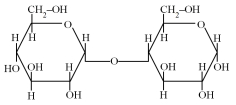
B
C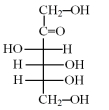
D
All of the above
Solution
(D) reducing sugar is a carbohydrate that possesses a free aldehyde or ketone group,or a hemiacetal/hemiketal group that can open to form such a group in solution.
$1$. Maltose (shown in option $A$) is a reducing sugar because it has a free hemiacetal group at the $C1$ position of one glucose unit.
$2$. Glucose (shown in option $B$) is an aldose and acts as a reducing sugar.
$3$. Fructose (shown in option $C$) is a ketose,but it undergoes tautomerization in alkaline solution to form glucose and mannose,thus acting as a reducing sugar.
Since all the given structures represent sugars that exhibit reducing properties,the correct answer is $D$.
$1$. Maltose (shown in option $A$) is a reducing sugar because it has a free hemiacetal group at the $C1$ position of one glucose unit.
$2$. Glucose (shown in option $B$) is an aldose and acts as a reducing sugar.
$3$. Fructose (shown in option $C$) is a ketose,but it undergoes tautomerization in alkaline solution to form glucose and mannose,thus acting as a reducing sugar.
Since all the given structures represent sugars that exhibit reducing properties,the correct answer is $D$.
0 likes
View Solution596
MediumMCQ
The given structures are $C_n$ epimers. What is $n$?
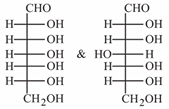
A
$3$
B
$4$
C
$2$
D
The given statement is wrong,they are not epimers
Solution
(B) Epimers are diastereomers that differ in configuration at only one stereogenic center.
In the given structures,the first molecule is $D$-glucose and the second molecule is $D$-galactose.
Numbering the carbon atoms starting from the aldehyde group $(CHO)$ as $C-1$:
$C-1$: $CHO$
$C-2$: $-OH$ on right
$C-3$: $-OH$ on right
$C-4$: $-OH$ on right (in glucose) vs $-OH$ on left (in galactose)
$C-5$: $-OH$ on right
$C-6$: $CH_2OH$
Since the configuration differs only at the $C-4$ position,they are $C-4$ epimers.
Therefore,$n = 4$.
In the given structures,the first molecule is $D$-glucose and the second molecule is $D$-galactose.
Numbering the carbon atoms starting from the aldehyde group $(CHO)$ as $C-1$:
$C-1$: $CHO$
$C-2$: $-OH$ on right
$C-3$: $-OH$ on right
$C-4$: $-OH$ on right (in glucose) vs $-OH$ on left (in galactose)
$C-5$: $-OH$ on right
$C-6$: $CH_2OH$
Since the configuration differs only at the $C-4$ position,they are $C-4$ epimers.
Therefore,$n = 4$.
0 likes
View Solution597
AdvancedMCQ
Which of the following is the structure of $\beta-D$-Glucopyranose?
A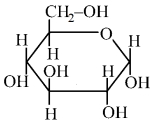
B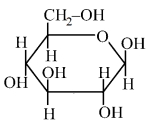
C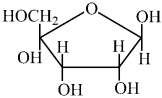
D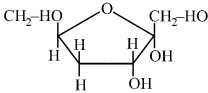
Solution
(A) In $\beta-D$-Glucopyranose,the $-OH$ group at the anomeric carbon $(C-1)$ is on the same side as the $-CH_2OH$ group at $C-5$. This means the $-OH$ group at $C-1$ is in the upward position (equatorial). Option $A$ represents this configuration correctly.
0 likes
View Solution598
MediumMCQ
Which of the following does not have a hemiacetal group $:-$
A
Glucose
B
Lactose
C
Maltose
D
Sucrose
Solution
(D) hemiacetal group is formed when an alcohol reacts with an aldehyde. In disaccharides,if the anomeric carbon of one monosaccharide unit is involved in a glycosidic linkage,it loses its hemiacetal nature.
$1$. Glucose is a monosaccharide and exists in equilibrium with its cyclic hemiacetal form.
$2$. Lactose and Maltose are reducing sugars because they contain one free anomeric carbon that retains the hemiacetal group.
$3$. Sucrose is a non-reducing sugar because the glycosidic linkage is formed between the anomeric carbons of both glucose and fructose units,thereby eliminating the hemiacetal group in both.
$1$. Glucose is a monosaccharide and exists in equilibrium with its cyclic hemiacetal form.
$2$. Lactose and Maltose are reducing sugars because they contain one free anomeric carbon that retains the hemiacetal group.
$3$. Sucrose is a non-reducing sugar because the glycosidic linkage is formed between the anomeric carbons of both glucose and fructose units,thereby eliminating the hemiacetal group in both.
0 likes
View Solution599
MediumMCQ
Which of the following will produce a silver mirror with Tollen's reagent (ammoniacal $AgNO_3$)?
A
$CH_3-CH_2-CHO$
B
$HCOOH$
C
Glucose
D
All of these
Solution
(D) Tollen's reagent is used to detect the presence of an aldehyde group or reducing sugars.
$1$. $CH_3-CH_2-CHO$ is an aldehyde (propanal),which gives a positive Tollen's test.
$2$. $HCOOH$ (formic acid) is a unique carboxylic acid that contains an aldehyde group $(H-C=O)$ and thus acts as a reducing agent,giving a positive Tollen's test.
$3$. Glucose is a reducing sugar because it contains a free aldehyde group in its open-chain structure,which gives a positive Tollen's test.
Since all the given options (except sucrose,which is a non-reducing sugar) can produce a silver mirror,the question implies identifying which of the listed options (excluding sucrose) react. However,given the options,$HCOOH$ and Glucose are definitely positive. Propanal is also positive. Therefore,all options except Sucrose are positive. Given the structure in option $A$ is propanal,all options $A, B, C$ are positive. Thus,the correct answer is $D$.
$1$. $CH_3-CH_2-CHO$ is an aldehyde (propanal),which gives a positive Tollen's test.
$2$. $HCOOH$ (formic acid) is a unique carboxylic acid that contains an aldehyde group $(H-C=O)$ and thus acts as a reducing agent,giving a positive Tollen's test.
$3$. Glucose is a reducing sugar because it contains a free aldehyde group in its open-chain structure,which gives a positive Tollen's test.
Since all the given options (except sucrose,which is a non-reducing sugar) can produce a silver mirror,the question implies identifying which of the listed options (excluding sucrose) react. However,given the options,$HCOOH$ and Glucose are definitely positive. Propanal is also positive. Therefore,all options except Sucrose are positive. Given the structure in option $A$ is propanal,all options $A, B, C$ are positive. Thus,the correct answer is $D$.
0 likes
View Solution600
EasyMCQ
Which one of the commercial products is used to grow microbes and in the preparation of ice-creams and jellies?
A
Agar
B
Algin
C
Carrageen
D
Pectose
Solution
(A) $Agar$ is a polysaccharide obtained from marine algae like $Gelidium$ and $Gracilaria$. It is widely used in laboratories as a culture medium to grow microbes and in the food industry for the preparation of ice-creams and jellies.
0 likes
View SolutionBiomolecules — Carbohydrates · Frequently Asked Questions
1Are these Biomolecules questions useful for JEE and NEET?
Yes. All questions in this section are mapped to JEE Main and NEET exam patterns. Previous year questions from JEE Main, NEET, GUJCET and state-level exams are included with full solutions.
2Can I switch to Hindi or Gujarati for these questions?
Yes. Use the language tabs in the hero section or the sidebar to view the same questions and solutions in English, Hindi or Gujarati.
3How do I generate a question paper from this subtopic?
Use the Vedclass Exam Paper Generator — select the chapter and subtopic, set difficulty, and generate Sets A, B, C, D automatically. First 3 chapters of every subject are free.
Vedclass Products
For Students
Vedclass Test Series
Mock tests in real JEE/NEET style with performance analysis. 5-day free trial.
Start Free TrialFor Teachers
Exam Paper Generator
Generate Set A/B/C/D papers from this chapter in 2 minutes. 3 chapters free.
Try FreeFor Institutes
Online Exam Module
Live online exams with unlimited students, 360° analytics & white-label branding.
See DemoFor Teachers & Institutes
Generate a Biomolecules Exam Paper in 2 Minutes
Select subtopic & difficulty — Sets A, B, C, D auto-generated with No Repeat logic.
First 3 chapters of every subject are free — no payment required.