
A English
Carbohydrates Questions in English
Class 12 Chemistry · Biomolecules · Carbohydrates
808+
Questions
English
Language
100%
With Solutions
Showing 50 of 808 questions in English
451
MediumMCQ
The pentose sugar in $DNA$ and $RNA$ has a ......... structure.
A
Open chain structure
B
Pyranose structure
C
Furanose structure
D
None of the above
0 likes
View Solution452
EasyMCQ
Which of the following is not a biopolymer?
A
Butyl rubber
B
Nucleic acid
C
Polysaccharide
D
Protein
Solution
(A) Biopolymers are polymers produced by living organisms. Examples include proteins,nucleic acids,and polysaccharides. Butyl rubber is a synthetic polymer produced by the copolymerization of isobutylene with a small amount of isoprene. Therefore,it is not a biopolymer.
0 likes
View Solution453
MediumMCQ
Which of the following is not a biopolymer?
A
Glycogen
B
Protein
C
Cellulose diacetate
D
Nucleic acid
Solution
(C) Biopolymers are polymers produced by living organisms. Examples include proteins,nucleic acids,and polysaccharides like glycogen and starch.
Cellulose diacetate is a semi-synthetic polymer derived from cellulose by chemical modification (acetylation).
Therefore,it is not classified as a natural biopolymer.
Cellulose diacetate is a semi-synthetic polymer derived from cellulose by chemical modification (acetylation).
Therefore,it is not classified as a natural biopolymer.
0 likes
View Solution454
MediumMCQ
Methyl-$\alpha-D$-glucoside and methyl-$\beta-D$-glucoside are
A
Epimers
B
Anomers
C
Enantiomers
D
Conformational diastereomers
Solution
(B) In methyl-$\alpha-D$-glucoside,the $-OCH_3$ group at the $C_1$ position is in the $\alpha$-configuration (trans to the $-CH_2OH$ group).
In methyl-$\beta-D$-glucoside,the $-OCH_3$ group at the $C_1$ position is in the $\beta$-configuration (cis to the $-CH_2OH$ group).
Since these two isomers differ in configuration only at the anomeric carbon $(C_1)$,they are classified as anomers.
In methyl-$\beta-D$-glucoside,the $-OCH_3$ group at the $C_1$ position is in the $\beta$-configuration (cis to the $-CH_2OH$ group).
Since these two isomers differ in configuration only at the anomeric carbon $(C_1)$,they are classified as anomers.
0 likes
View Solution455
MediumMCQ
The $\beta$ and $\alpha$ glucose have different specific rotations. When either is dissolved in water,their rotation changes until the same fixed value results. This is called:
A
epimerisation
B
racemisation
C
anomerisation
D
mutarotation
Solution
(D) The change in the specific optical rotation of an optically active compound in solution with time,until it reaches a constant equilibrium value,is known as mutarotation. $\alpha$-$D$-glucose and $\beta$-$D$-glucose undergo this process when dissolved in water.
0 likes
View Solution456
MediumMCQ
Fructose on reduction gives a mixture of two alcohols which are related as
A
diastereomers
B
epimers
C
both $(a)$ and $(b)$
D
anomers.
Solution
(C) Reduction of the ketonic group in fructose $(C-2)$ creates a new chiral center at $C-2$.
This results in the formation of two isomeric alcohols,specifically sorbitol and mannitol.
These two alcohols differ in configuration only at the $C-2$ position,making them $C-2$ epimers.
Since they are epimers and have the same molecular formula but different spatial arrangements,they are also classified as diastereomers.
Therefore,both $(a)$ and $(b)$ are correct.
This results in the formation of two isomeric alcohols,specifically sorbitol and mannitol.
These two alcohols differ in configuration only at the $C-2$ position,making them $C-2$ epimers.
Since they are epimers and have the same molecular formula but different spatial arrangements,they are also classified as diastereomers.
Therefore,both $(a)$ and $(b)$ are correct.
0 likes
View Solution457
MediumMCQ
Glucose molecule reacts with $X$ number of molecules of phenylhydrazine to yield osazone. The value of $X$ is
A
$3$
B
$2$
C
$1$
D
$4$
Solution
(A) One molecule of glucose reacts with $3$ molecules of phenylhydrazine to form glucosazone.
The reaction proceeds as follows:
$1.$ The first molecule of phenylhydrazine reacts with the aldehyde group at $C-1$ to form phenylhydrazone.
$2.$ The second molecule of phenylhydrazine oxidizes the secondary alcohol group at $C-2$ to a carbonyl group $(C=O)$.
$3.$ The third molecule of phenylhydrazine reacts with the newly formed carbonyl group at $C-2$ to yield the final osazone.
The reaction proceeds as follows:
$1.$ The first molecule of phenylhydrazine reacts with the aldehyde group at $C-1$ to form phenylhydrazone.
$2.$ The second molecule of phenylhydrazine oxidizes the secondary alcohol group at $C-2$ to a carbonyl group $(C=O)$.
$3.$ The third molecule of phenylhydrazine reacts with the newly formed carbonyl group at $C-2$ to yield the final osazone.
0 likes
View Solution458
AdvancedMCQ
For osazone formation,the effective structural unit necessary is:
A
$CH_2OCH_3-CO-$
B
$CH_2OH-CHOH-$
C
$CH_2OH-CHOCH_3-$
D
$CHO-CHOCH_3-$
Solution
(B) Osazone formation involves the reaction of phenylhydrazine with the first two carbon atoms of a reducing sugar.
The necessary structural unit is an $\alpha$-hydroxy carbonyl group,which is represented by the structure $-CHOH-CO-$ or $-CHOH-CHOH-$.
Among the given options,the structural unit $-CHOH-CHOH-$ (or similar $\alpha$-hydroxy carbonyl precursors) is essential for the reaction to proceed.
Option $(b)$ represents the $\alpha$-hydroxy carbonyl moiety found in sugars.
The necessary structural unit is an $\alpha$-hydroxy carbonyl group,which is represented by the structure $-CHOH-CO-$ or $-CHOH-CHOH-$.
Among the given options,the structural unit $-CHOH-CHOH-$ (or similar $\alpha$-hydroxy carbonyl precursors) is essential for the reaction to proceed.
Option $(b)$ represents the $\alpha$-hydroxy carbonyl moiety found in sugars.
0 likes
View Solution459
EasyMCQ
$\alpha - D - (+)$ glucose and $\beta - D - (+)$ glucose are
A
conformers
B
epimers
C
anomers
D
enantiomers
Solution
(C) Anomers are a special type of diastereomers that differ in configuration only at the $C-1$ carbon atom (the anomeric carbon).
Since $\alpha - D - (+)$ glucose and $\beta - D - (+)$ glucose differ in configuration specifically at the $C-1$ atom,they are classified as anomers.
Since $\alpha - D - (+)$ glucose and $\beta - D - (+)$ glucose differ in configuration specifically at the $C-1$ atom,they are classified as anomers.
0 likes
View Solution460
EasyMCQ
Assertion : Hydrolysis of sucrose is known as inversion of cane sugar.
Reason : Sucrose is a disaccharide.
Reason : Sucrose is a disaccharide.
A
If both Assertion and Reason are correct and the Reason is a correct explanation of the Assertion.
B
If both Assertion and Reason are correct but Reason is not a correct explanation of the Assertion.
C
If the Assertion is correct but Reason is incorrect.
D
If both the Assertion and Reason are incorrect.
Solution
(B) Sucrose is a disaccharide with a specific optical rotation of $+66.5^\circ$.
Upon hydrolysis,it yields $1 \ mole$ of $D-(+)$ glucose and $1 \ mole$ of $D-(-)$ fructose.
The resulting mixture is laevorotatory (net rotation is negative),which is why the process is known as the inversion of cane sugar.
While both statements are factually correct,the fact that sucrose is a disaccharide does not explain why its hydrolysis is called inversion; the explanation lies in the change of optical rotation from dextrorotatory to laevorotatory.
Upon hydrolysis,it yields $1 \ mole$ of $D-(+)$ glucose and $1 \ mole$ of $D-(-)$ fructose.
The resulting mixture is laevorotatory (net rotation is negative),which is why the process is known as the inversion of cane sugar.
While both statements are factually correct,the fact that sucrose is a disaccharide does not explain why its hydrolysis is called inversion; the explanation lies in the change of optical rotation from dextrorotatory to laevorotatory.
0 likes
View Solution461
EasyMCQ
Assertion : Sucrose undergoes mutarotation.
Reason : Sucrose is a disaccharide.
Reason : Sucrose is a disaccharide.
A
If both Assertion and Reason are correct and the Reason is a correct explanation of the Assertion.
B
If both Assertion and Reason are correct but Reason is not a correct explanation of the Assertion.
C
If the Assertion is correct but Reason is incorrect.
D
If both the Assertion and Reason are incorrect.
Solution
(D) Sucrose is a non-reducing sugar because it does not contain a free hemiacetal or hemiketal group.
Mutarotation is a property of reducing sugars that possess a free hemiacetal or hemiketal group,allowing them to exist in equilibrium between their $\alpha$ and $\beta$ anomeric forms.
Since sucrose lacks this free group,it does not undergo mutarotation.
Therefore,the Assertion is incorrect,while the Reason is correct.
Mutarotation is a property of reducing sugars that possess a free hemiacetal or hemiketal group,allowing them to exist in equilibrium between their $\alpha$ and $\beta$ anomeric forms.
Since sucrose lacks this free group,it does not undergo mutarotation.
Therefore,the Assertion is incorrect,while the Reason is correct.
0 likes
View Solution462
MediumMCQ
Assertion : Glycosides are hydrolyzed in acidic conditions.
Reason : Glycosides are acetals.
Reason : Glycosides are acetals.
A
If both Assertion and Reason are correct and the Reason is a correct explanation of the Assertion.
B
If both Assertion and Reason are correct but Reason is not a correct explanation of the Assertion.
C
If the Assertion is correct but Reason is incorrect.
D
If both the Assertion and Reason are incorrect.
Solution
(A) Glycosides are formed by the reaction of a sugar (like glucose) with an alcohol in the presence of an acid catalyst.
Structurally,glycosides are acetals (specifically,they are cyclic acetals formed from hemiacetals).
Because they are acetals,they are stable in basic conditions but are readily hydrolyzed back to the sugar and alcohol in acidic conditions.
Therefore,the Assertion is correct,and the Reason is correct and provides the correct explanation for the Assertion.
Structurally,glycosides are acetals (specifically,they are cyclic acetals formed from hemiacetals).
Because they are acetals,they are stable in basic conditions but are readily hydrolyzed back to the sugar and alcohol in acidic conditions.
Therefore,the Assertion is correct,and the Reason is correct and provides the correct explanation for the Assertion.
0 likes
View Solution463
MediumMCQ
Assertion : Sucrose is a non-reducing sugar.
Reason : It has glycosidic linkage.
Reason : It has glycosidic linkage.
A
If both Assertion and Reason are correct and the Reason is a correct explanation of the Assertion.
B
If both Assertion and Reason are correct but Reason is not a correct explanation of the Assertion.
C
If the Assertion is correct but Reason is incorrect.
D
If both the Assertion and Reason are incorrect.
Solution
(A) Sucrose is a disaccharide composed of glucose and fructose units joined by a glycosidic linkage between $C1$ of glucose and $C2$ of fructose.
Since both the anomeric carbons (the aldehyde group of glucose and the ketonic group of fructose) are involved in the formation of the glycosidic bond,there is no free aldehyde or ketonic group available to act as a reducing agent.
Therefore,sucrose is a non-reducing sugar.
Both statements are correct,and the presence of the glycosidic linkage (specifically the involvement of both anomeric carbons) explains why it is non-reducing.
Since both the anomeric carbons (the aldehyde group of glucose and the ketonic group of fructose) are involved in the formation of the glycosidic bond,there is no free aldehyde or ketonic group available to act as a reducing agent.
Therefore,sucrose is a non-reducing sugar.
Both statements are correct,and the presence of the glycosidic linkage (specifically the involvement of both anomeric carbons) explains why it is non-reducing.
0 likes
View Solution464
MediumMCQ
Assertion : Maltose is a reducing sugar which gives two moles of $D-$glucose on hydrolysis.
Reason : Maltose has $1,4-\beta-$glycosidic linkage.
Reason : Maltose has $1,4-\beta-$glycosidic linkage.
A
If both Assertion and Reason are correct and the Reason is a correct explanation of the Assertion.
B
If both Assertion and Reason are correct but Reason is not a correct explanation of the Assertion.
C
If the Assertion is correct but Reason is incorrect.
D
If both the Assertion and Reason are incorrect.
Solution
(C) Maltose is a disaccharide that acts as a reducing sugar because it contains a free hemiacetal group.
Upon hydrolysis,it yields two moles of $D-$glucose.
However,the glycosidic linkage in maltose is an $\alpha-1,4-$glycosidic linkage,not a $\beta-$linkage.
Therefore,the Assertion is correct,but the Reason is incorrect.
Upon hydrolysis,it yields two moles of $D-$glucose.
However,the glycosidic linkage in maltose is an $\alpha-1,4-$glycosidic linkage,not a $\beta-$linkage.
Therefore,the Assertion is correct,but the Reason is incorrect.
0 likes
View Solution465
DifficultMCQ
Assertion : Treatment of $D$-glucose with dilute alkali affords an equilibrium mixture consisting of $D$-mannose,$D$-fructose and starting substance $D$-glucose.
Reason : The reaction involves an intermediate in which hybridization of $C_2$ changes from $sp^3$ to $sp^2$.
Reason : The reaction involves an intermediate in which hybridization of $C_2$ changes from $sp^3$ to $sp^2$.
A
If both Assertion and Reason are correct and the Reason is a correct explanation of the Assertion.
B
If both Assertion and Reason are correct but Reason is not a correct explanation of the Assertion.
C
If the Assertion is correct but Reason is incorrect.
D
If both the Assertion and Reason are incorrect.
Solution
(A) The reaction of $D$-glucose with dilute alkali is known as the Lobry de Bruyn-van Ekenstein transformation.
This process involves the formation of an enediol intermediate.
During the formation of the enediol,the $C_2$ carbon atom changes its hybridization from $sp^3$ to $sp^2$.
This intermediate allows for the interconversion between glucose,mannose,and fructose.
Therefore,both the Assertion and the Reason are correct,and the Reason is the correct explanation of the Assertion.
This process involves the formation of an enediol intermediate.
During the formation of the enediol,the $C_2$ carbon atom changes its hybridization from $sp^3$ to $sp^2$.
This intermediate allows for the interconversion between glucose,mannose,and fructose.
Therefore,both the Assertion and the Reason are correct,and the Reason is the correct explanation of the Assertion.
0 likes
View Solution466
DifficultMCQ
Assertion: Glucose and fructose give the same osazone.
Reason: During osazone formation,stereochemistry only at $C_1$ and $C_2$ is destroyed.
Reason: During osazone formation,stereochemistry only at $C_1$ and $C_2$ is destroyed.
A
If both Assertion and Reason are correct and the Reason is a correct explanation of the Assertion.
B
If both Assertion and Reason are correct but Reason is not a correct explanation of the Assertion.
C
If the Assertion is correct but Reason is incorrect.
D
If both the Assertion and Reason are incorrect.
Solution
(A) Glucose and fructose differ only in the configuration at $C_1$ and $C_2$ atoms.
During the reaction with excess phenylhydrazine,the $C_1$ and $C_2$ atoms are involved in the formation of the osazone structure.
Since the stereochemistry at $C_3, C_4, C_5,$ and $C_6$ remains identical in both glucose and fructose,they yield the same osazone product.
Therefore,the Reason correctly explains the Assertion.
During the reaction with excess phenylhydrazine,the $C_1$ and $C_2$ atoms are involved in the formation of the osazone structure.
Since the stereochemistry at $C_3, C_4, C_5,$ and $C_6$ remains identical in both glucose and fructose,they yield the same osazone product.
Therefore,the Reason correctly explains the Assertion.
0 likes
View Solution467
MediumMCQ
Assertion : In the iodometric titration,starch is used as an indicator.
Reason : Starch is a polysaccharide.
Reason : Starch is a polysaccharide.
A
If both Assertion and Reason are correct and the Reason is a correct explanation of the Assertion.
B
If both Assertion and Reason are correct but Reason is not a correct explanation of the Assertion.
C
If the Assertion is correct but Reason is incorrect.
D
If both the Assertion and Reason are incorrect.
Solution
(B) Starch is used as an indicator in iodometric titration because it forms a deep blue-colored complex with $I_2$ (iodine).
Starch is indeed a polysaccharide,but this chemical property (being a polysaccharide) is not the reason why it acts as an indicator in this specific titration.
Therefore,both statements are correct,but the Reason is not the correct explanation for the Assertion.
Starch is indeed a polysaccharide,but this chemical property (being a polysaccharide) is not the reason why it acts as an indicator in this specific titration.
Therefore,both statements are correct,but the Reason is not the correct explanation for the Assertion.
0 likes
View Solution468
DifficultMCQ
The difference between amylose and amylopectin is
A
Amylopectin has $1 \rightarrow 4$ $\alpha$-linkage and $1 \rightarrow 6$ $\alpha$-linkage
B
Amylose has $1 \rightarrow 4$ $\alpha$-linkage and $1 \rightarrow 6$ $\beta$-linkage
C
Amylopectin has $1 \rightarrow 4$ $\alpha$-linkage and $1 \rightarrow 6$ $\beta$-linkage
D
Amylose is made up of glucose and galactose
Solution
(A) Amylose is a long unbranched chain of $\alpha-D$-glucose units held by $C_1-C_4$ glycosidic linkages.
Amylopectin is a branched-chain polymer of $\alpha-D$-glucose units in which the main chain is formed by $C_1-C_4$ glycosidic linkages,while branching occurs by $C_1-C_6$ glycosidic linkages.
Therefore,the correct statement is that amylopectin has both $1 \rightarrow 4$ $\alpha$-linkage and $1 \rightarrow 6$ $\alpha$-linkage.
Amylopectin is a branched-chain polymer of $\alpha-D$-glucose units in which the main chain is formed by $C_1-C_4$ glycosidic linkages,while branching occurs by $C_1-C_6$ glycosidic linkages.
Therefore,the correct statement is that amylopectin has both $1 \rightarrow 4$ $\alpha$-linkage and $1 \rightarrow 6$ $\alpha$-linkage.
0 likes
View Solution469
DifficultMCQ
Which of the following statements is correct?
A
Gluconic acid can form cyclic (acetal/hemiacetal) structure
B
Gluconic acid is a partial oxidation product of glucose
C
Gluconic acid is obtained by oxidation of glucose with $HNO_3$
D
Gluconic acid is a dicarboxylic acid
Solution
(B) Gluconic acid is formed by the mild oxidation of $D$-glucose using bromine water $(Br_2/H_2O)$.
This process oxidizes only the aldehyde group $(-CHO)$ to a carboxylic acid group $(-COOH)$,while the primary alcohol group $(-CH_2OH)$ remains unaffected.
Therefore,it is a partial oxidation product of glucose.
Option $A$ is incorrect as gluconic acid forms a lactone (cyclic ester) rather than a hemiacetal.
Option $C$ is incorrect because oxidation with $HNO_3$ produces saccharic acid (a dicarboxylic acid).
Option $D$ is incorrect because gluconic acid is a monocarboxylic acid.
This process oxidizes only the aldehyde group $(-CHO)$ to a carboxylic acid group $(-COOH)$,while the primary alcohol group $(-CH_2OH)$ remains unaffected.
Therefore,it is a partial oxidation product of glucose.
Option $A$ is incorrect as gluconic acid forms a lactone (cyclic ester) rather than a hemiacetal.
Option $C$ is incorrect because oxidation with $HNO_3$ produces saccharic acid (a dicarboxylic acid).
Option $D$ is incorrect because gluconic acid is a monocarboxylic acid.
0 likes
View Solution470
EasyMCQ
Two monomers in maltose are
A
$\alpha-D$-glucose and $\beta-D$-glucose
B
$\alpha-D$-glucose and $\alpha-D$-fructose
C
$\alpha-D$-glucose and $\alpha-D$-glucose
D
$\alpha-D$-glucose and $\alpha-D$-galactose
Solution
(C) Maltose is a disaccharide formed by the condensation of two molecules of $\alpha-D$-glucose.
These two glucose units are linked by an $\alpha-1,4$-glycosidic linkage.
These two glucose units are linked by an $\alpha-1,4$-glycosidic linkage.
0 likes
View Solution471
MediumMCQ
Which of the following statements is not true for glucose?
A
The pentaacetate of glucose does not react with hydroxylamine to give oxime.
B
Glucose gives Schiff's test for aldehyde.
C
Glucose exists in two crystalline forms $\alpha$ and $\beta$.
D
Glucose reacts with hydroxylamine to form oxime.
Solution
(B) Glucose contains an aldehyde group,but it does not give the Schiff's test because the aldehyde group is involved in hemiacetal formation with the $C-5$ hydroxyl group,resulting in a cyclic structure. Therefore,the statement that glucose gives Schiff's test is incorrect.
0 likes
View Solution472
Medium
Glucose or sucrose are soluble in water but cyclohexane or benzene (simple six-membered ring compounds) are insoluble in water. Explain.
Solution
(N/A) glucose molecule contains five $-OH$ groups,while a sucrose molecule contains eight $-OH$ groups. These $-OH$ groups allow glucose and sucrose to form extensive hydrogen bonds with water molecules,making them soluble. In contrast,cyclohexane and benzene are non-polar hydrocarbons that do not contain $-OH$ groups. Consequently,they cannot form hydrogen bonds with water,rendering them insoluble in water.
0 likes
View Solution473
Medium
What are the expected products of the hydrolysis of lactose?
Solution
(N/A) Lactose is a disaccharide composed of $\beta-D$-galactose and $\beta-D$-glucose units linked by a $\beta-1,4$-glycosidic bond.
Upon hydrolysis,lactose breaks down into its constituent monosaccharides:
$C_{12}H_{22}O_{11} (\text{Lactose}) + H_2O$ $\xrightarrow{H^+} C_6H_{12}O_6 (\beta-D-\text{galactose}) + C_6H_{12}O_6 (\beta-D-\text{glucose})$
Upon hydrolysis,lactose breaks down into its constituent monosaccharides:
$C_{12}H_{22}O_{11} (\text{Lactose}) + H_2O$ $\xrightarrow{H^+} C_6H_{12}O_6 (\beta-D-\text{galactose}) + C_6H_{12}O_6 (\beta-D-\text{glucose})$
0 likes
View Solution474
Difficult
How do you explain the absence of aldehyde group in the pentaacetate of $D$-glucose?
Solution
(N/A) -glucose exists in equilibrium between its open-chain form and cyclic hemiacetal forms. The open-chain form contains a free aldehydic $(-CHO)$ group,which reacts with hydroxylamine $(NH_2OH)$ to form an oxime.
However,when $D$-glucose is treated with acetic anhydride,all five hydroxyl $(-OH)$ groups are acetylated to form $D$-glucose pentaacetate. In this derivative,the hemiacetal hydroxyl group at $C-1$ is also converted into an ester group. Consequently,the pentaacetate cannot undergo ring-opening to form the open-chain aldehyde structure. Due to the absence of a free aldehydic group,$D$-glucose pentaacetate does not react with $NH_2OH$ to form an oxime.
However,when $D$-glucose is treated with acetic anhydride,all five hydroxyl $(-OH)$ groups are acetylated to form $D$-glucose pentaacetate. In this derivative,the hemiacetal hydroxyl group at $C-1$ is also converted into an ester group. Consequently,the pentaacetate cannot undergo ring-opening to form the open-chain aldehyde structure. Due to the absence of a free aldehydic group,$D$-glucose pentaacetate does not react with $NH_2OH$ to form an oxime.
0 likes
View Solution475
Medium
What are monosaccharides?
Solution
(N/A) Monosaccharides are the simplest form of carbohydrates that cannot be hydrolysed further into smaller polyhydroxy aldehyde or ketone units.
They are classified based on the number of carbon atoms and the functional group present.
$1$. If they contain an aldehyde group,they are called aldoses.
$2$. If they contain a keto group,they are called ketoses.
Additionally,they are classified as trioses,tetroses,pentoses,hexoses,or heptoses based on the number of carbon atoms ($3, 4, 5, 6, 7$ respectively). For example,a ketose with $3$ carbon atoms is a ketotriose,and an aldose with $3$ carbon atoms is an aldotriose.
They are classified based on the number of carbon atoms and the functional group present.
$1$. If they contain an aldehyde group,they are called aldoses.
$2$. If they contain a keto group,they are called ketoses.
Additionally,they are classified as trioses,tetroses,pentoses,hexoses,or heptoses based on the number of carbon atoms ($3, 4, 5, 6, 7$ respectively). For example,a ketose with $3$ carbon atoms is a ketotriose,and an aldose with $3$ carbon atoms is an aldotriose.
0 likes
View Solution476
Medium
What are reducing sugars?
Solution
(N/A) Reducing sugars are carbohydrates that reduce Fehling's solution and Tollen's reagent. All monosaccharides and disaccharides,excluding sucrose,are reducing sugars.
0 likes
View Solution477
Medium
Write two main functions of carbohydrates in plants.
Solution
(N/A) Two main functions of carbohydrates in plants are:
$i$. Polysaccharides such as starch serve as storage molecules.
$ii$. Cellulose,a polysaccharide,is used to build the cell wall.
$i$. Polysaccharides such as starch serve as storage molecules.
$ii$. Cellulose,a polysaccharide,is used to build the cell wall.
0 likes
View Solution478
Medium
Classify the following into monosaccharides and disaccharides:
Ribose,$2-$deoxyribose,maltose,galactose,fructose,and lactose.
Ribose,$2-$deoxyribose,maltose,galactose,fructose,and lactose.
Solution
(N/A) Monosaccharides are carbohydrates that cannot be hydrolyzed further into simpler polyhydroxy aldehydes or ketones. These include: Ribose,$2-$deoxyribose,galactose,and fructose.
Disaccharides are carbohydrates that yield two molecules of the same or different monosaccharides upon hydrolysis. These include: Maltose and lactose.
Disaccharides are carbohydrates that yield two molecules of the same or different monosaccharides upon hydrolysis. These include: Maltose and lactose.
0 likes
View Solution479
Medium
What do you understand by the term glycosidic linkage?
Solution
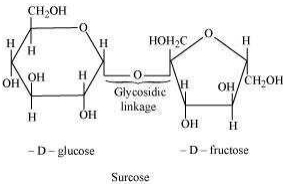
(N/A) Glycosidic linkage refers to the linkage formed between two monosaccharide units through an oxygen atom by the loss of a water molecule.
For example,in a sucrose molecule,two monosaccharide units,$\alpha-D-glucose$ and $\beta-D-fructose$,are joined together by a glycosidic linkage.
For example,in a sucrose molecule,two monosaccharide units,$\alpha-D-glucose$ and $\beta-D-fructose$,are joined together by a glycosidic linkage.
0 likes
View Solution480
Medium
What is glycogen? How is it different from starch?
Solution
(N/A) Glycogen is a polysaccharide that serves as the primary storage form of carbohydrates in animals.
Starch is a carbohydrate consisting of two components: amylose $(15-20 \%)$ and amylopectin $(80-85 \%)$.
Glycogen is structurally similar to amylopectin but is significantly more branched than amylopectin.
Starch is a carbohydrate consisting of two components: amylose $(15-20 \%)$ and amylopectin $(80-85 \%)$.
Glycogen is structurally similar to amylopectin but is significantly more branched than amylopectin.
0 likes
View Solution481
Medium
What are the hydrolysis products of $(i)$ sucrose and $(ii)$ lactose?
Solution
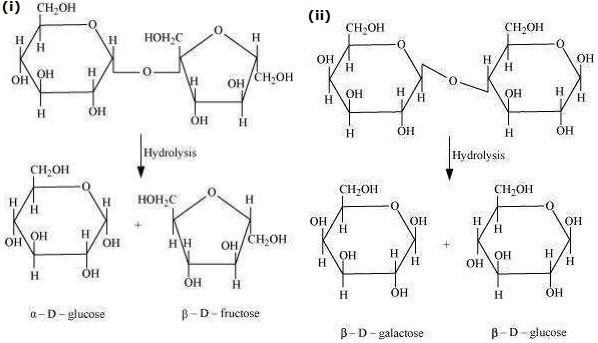
(N/A) $(i)$ On hydrolysis,sucrose gives one molecule of $\alpha-D$-glucose and one molecule of $\beta-D$-fructose.
$(ii)$ The hydrolysis of lactose gives $\beta-D$-galactose and $\beta-D$-glucose.
$(ii)$ The hydrolysis of lactose gives $\beta-D$-galactose and $\beta-D$-glucose.
0 likes
View Solution482
Medium
What is the basic structural difference between starch and cellulose?
Solution
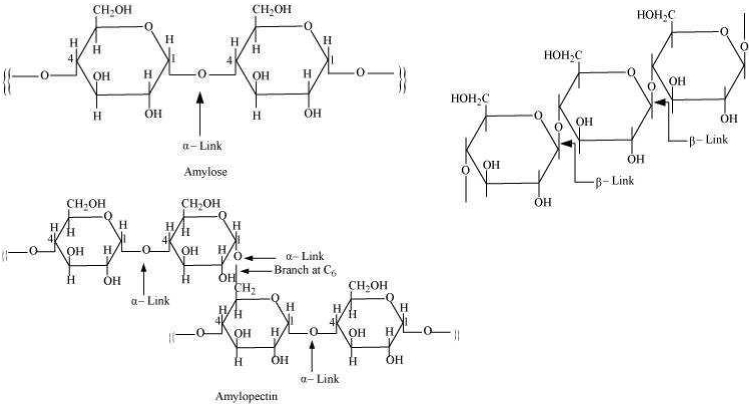
(N/A) Starch consists of two components: amylose and amylopectin.
Amylose is a long linear chain of $\alpha-D-(+)-$glucose units joined by $C1-C4$ glycosidic linkage ($\alpha-$link).
Amylopectin is a branched-chain polymer of $\alpha-D-$glucose units,in which the chain is formed by $C1-C4$ glycosidic linkage and the branching occurs by $C1-C6$ glycosidic linkage.
On the other hand,cellulose is a straight-chain polysaccharide of $\beta-D-$glucose units joined by $C1-C4$ glycosidic linkage ($\beta-$link).
Amylose is a long linear chain of $\alpha-D-(+)-$glucose units joined by $C1-C4$ glycosidic linkage ($\alpha-$link).
Amylopectin is a branched-chain polymer of $\alpha-D-$glucose units,in which the chain is formed by $C1-C4$ glycosidic linkage and the branching occurs by $C1-C6$ glycosidic linkage.
On the other hand,cellulose is a straight-chain polysaccharide of $\beta-D-$glucose units joined by $C1-C4$ glycosidic linkage ($\beta-$link).
0 likes
View Solution483
Difficult
What happens when $D-glucose$ is treated with the following reagents?
$(i)$ $HI$
$(ii)$ Bromine water
$(iii)$ $HNO_3$
$(i)$ $HI$
$(ii)$ Bromine water
$(iii)$ $HNO_3$
Solution
(N/A) $(i)$ When $D-glucose$ is heated with $HI$ for a long time,$n-hexane$ is formed.
$CHO-(CHOH)_4-CH_2OH \xrightarrow[\Delta]{HI} CH_3-CH_2-CH_2-CH_2-CH_2-CH_3$
$(ii)$ When $D-glucose$ is treated with $Br_2$ water,$D-gluconic$ acid is produced.
$CHO-(CHOH)_4-CH_2OH \xrightarrow{Br_2 \text{ water}} COOH-(CHOH)_4-CH_2OH$
$(iii)$ On being treated with $HNO_3$,$D-glucose$ gets oxidised to give saccharic acid (glucaric acid).
$CHO-(CHOH)_4-CH_2OH \xrightarrow{HNO_3} COOH-(CHOH)_4-COOH$
$CHO-(CHOH)_4-CH_2OH \xrightarrow[\Delta]{HI} CH_3-CH_2-CH_2-CH_2-CH_2-CH_3$
$(ii)$ When $D-glucose$ is treated with $Br_2$ water,$D-gluconic$ acid is produced.
$CHO-(CHOH)_4-CH_2OH \xrightarrow{Br_2 \text{ water}} COOH-(CHOH)_4-CH_2OH$
$(iii)$ On being treated with $HNO_3$,$D-glucose$ gets oxidised to give saccharic acid (glucaric acid).
$CHO-(CHOH)_4-CH_2OH \xrightarrow{HNO_3} COOH-(CHOH)_4-COOH$
0 likes
View Solution484
Medium
Enumerate the reactions of $D$-glucose which cannot be explained by its open chain structure.
Solution
(N/A) $(1)$ Aldehydes typically give $2, 4-DNP$ test,Schiff's test,and react with $NaHSO_3$ to form hydrogen sulphite addition products. However,$D$-glucose does not undergo these reactions.
$(2)$ The pentaacetate of $D$-glucose does not react with hydroxylamine $(NH_2OH)$. This indicates that a free $-CHO$ group is absent in the cyclic structure of glucose.
$(3)$ $D$-glucose exists in two crystalline forms,$\alpha$ and $\beta$. The $\alpha$-form $(m.p. = 419 \ K)$ crystallises from a concentrated solution at $303 \ K$,while the $\beta$-form $(m.p. = 423 \ K)$ crystallises from a hot saturated aqueous solution at $371 \ K$. This isomerism cannot be explained by the open chain structure.
$(2)$ The pentaacetate of $D$-glucose does not react with hydroxylamine $(NH_2OH)$. This indicates that a free $-CHO$ group is absent in the cyclic structure of glucose.
$(3)$ $D$-glucose exists in two crystalline forms,$\alpha$ and $\beta$. The $\alpha$-form $(m.p. = 419 \ K)$ crystallises from a concentrated solution at $303 \ K$,while the $\beta$-form $(m.p. = 423 \ K)$ crystallises from a hot saturated aqueous solution at $371 \ K$. This isomerism cannot be explained by the open chain structure.
0 likes
View Solution485
Difficult
Write a general note on carbohydrates. Give the classification of carbohydrates.
Solution
(N/A) Carbohydrates are primarily produced by plants and form a very large number of naturally occurring organic compounds. Some common examples are sugar,glucose,and starch. Most have the general formula $C_{x}(H_{2}O)_{y}$ and were historically considered hydrates of carbon. For example,glucose $(C_{6}H_{12}O_{6})$ fits this formula as $C_{6}(H_{2}O)_{6}$. However,not all compounds fitting this formula are carbohydrates (e.g.,acetic acid,$CH_{3}COOH$),and some carbohydrates do not fit this formula (e.g.,rhamnose,$C_{6}H_{12}O_{5}$).
Chemically,carbohydrates are defined as optically active polyhydroxy aldehydes or ketones,or compounds that produce such units on hydrolysis. They are also called saccharides. Those sweet in taste are called sugars (e.g.,sucrose,lactose).
Classification based on hydrolysis:
$1$. Monosaccharides: Simplest carbohydrates that cannot be hydrolyzed further. They contain $3$ to $7$ carbon atoms. They are called aldose if they contain an aldehyde group and ketose if they contain a ketone group.
$2$. Oligosaccharides: Carbohydrates that produce $2$ to $10$ monosaccharide units on hydrolysis. Disaccharides are the most common.
$3$. Polysaccharides: Carbohydrates that yield a large number ($100$ to $3000$) of monosaccharide units on hydrolysis (e.g.,starch,cellulose). They are non-sugars.
Carbohydrates are also classified as reducing or non-reducing sugars based on their ability to reduce Fehling's and Tollen's reagents.
Chemically,carbohydrates are defined as optically active polyhydroxy aldehydes or ketones,or compounds that produce such units on hydrolysis. They are also called saccharides. Those sweet in taste are called sugars (e.g.,sucrose,lactose).
Classification based on hydrolysis:
$1$. Monosaccharides: Simplest carbohydrates that cannot be hydrolyzed further. They contain $3$ to $7$ carbon atoms. They are called aldose if they contain an aldehyde group and ketose if they contain a ketone group.
| $Carbon \ atoms$ | $General \ term$ | $Aldehyde$ | $Ketone$ |
| $3$ | Triose | Aldotriose | Ketotriose |
| $4$ | Tetrose | Aldotetrose | Ketotetrose |
| $5$ | Pentose | Aldopentose | Ketopentose |
| $6$ | Hexose | Aldohexose | Ketohexose |
| $7$ | Heptose | Aldoheptose | Ketoheptose |
$2$. Oligosaccharides: Carbohydrates that produce $2$ to $10$ monosaccharide units on hydrolysis. Disaccharides are the most common.
$3$. Polysaccharides: Carbohydrates that yield a large number ($100$ to $3000$) of monosaccharide units on hydrolysis (e.g.,starch,cellulose). They are non-sugars.
Carbohydrates are also classified as reducing or non-reducing sugars based on their ability to reduce Fehling's and Tollen's reagents.
0 likes
View Solution486
Medium
Give the classification of monosaccharides.
Solution
(N/A) Monosaccharides are classified based on two criteria:
$1$. Based on the number of carbon atoms: If a monosaccharide contains $3$ carbon atoms,it is called a triose; $4$ carbon atoms,a tetrose; $5$ carbon atoms,a pentose; and $6$ carbon atoms,a hexose.
$2$. Based on the functional group present: If the monosaccharide contains an aldehyde group $(-CHO)$,it is called an aldose. If it contains a ketone group $(>C=O)$,it is called a ketose.
These two classifications are often combined,for example,an aldohexose (an aldehyde with $6$ carbons) or a ketopentose (a ketone with $5$ carbons).
$1$. Based on the number of carbon atoms: If a monosaccharide contains $3$ carbon atoms,it is called a triose; $4$ carbon atoms,a tetrose; $5$ carbon atoms,a pentose; and $6$ carbon atoms,a hexose.
$2$. Based on the functional group present: If the monosaccharide contains an aldehyde group $(-CHO)$,it is called an aldose. If it contains a ketone group $(>C=O)$,it is called a ketose.
These two classifications are often combined,for example,an aldohexose (an aldehyde with $6$ carbons) or a ketopentose (a ketone with $5$ carbons).
0 likes
View Solution487
Difficult
Write a note on the preparation and structure of glucose.
Solution
(N/A) Glucose occurs freely in nature as well as in a combined form. It is present in sweet fruits and honey. Ripe grapes contain glucose in large amounts and thus it is called "Grape Sugar".
Preparation of Glucose:
$(i)$ From cane sugar: The glucose and fructose are obtained in equal amounts when an alcoholic solution of cane sugar is boiled with dilute $HCl$ or $H_{2}SO_{4}$.
$C_{12}H_{22}O_{11} + H_{2}O \xrightarrow{H^{+}} C_{6}H_{12}O_{6} + C_{6}H_{12}O_{6}$
After completion of this reaction,alcohol is added in excess. Glucose,being insoluble in alcohol,precipitates and is filtered out,whereas fructose remains soluble.
$(ii)$ From Starch: Commercially,glucose is manufactured by the hydrolysis of starch by boiling it with dilute $H_{2}SO_{4}$ at $393 \ K$ and $2-3 \ atm$ pressure.
$(C_{6}H_{10}O_{5})_{n} + nH_{2}O \xrightarrow{H^{+}, 393 \ K, 2-3 \ atm} nC_{6}H_{12}O_{6}$
After hydrolysis,calcium carbonate is added to neutralize excess acid,forming $CaSO_{4}$ precipitates which are filtered. The filtrate is decolorized with charcoal and concentrated to obtain glucose crystals.
Structure of Glucose:
Glucose is an aldohexose with the open-chain structure: $CHO-(CHOH)_{4}-CH_{2}OH$.
Evidence for the structure includes the reaction with $HI$ to form $n$-hexane,indicating a straight chain of $6$ carbon atoms:
$CHO-(CHOH)_{4}-CH_{2}OH \xrightarrow{HI, \Delta} CH_{3}-CH_{2}-CH_{2}-CH_{2}-CH_{2}-CH_{3}$
Preparation of Glucose:
$(i)$ From cane sugar: The glucose and fructose are obtained in equal amounts when an alcoholic solution of cane sugar is boiled with dilute $HCl$ or $H_{2}SO_{4}$.
$C_{12}H_{22}O_{11} + H_{2}O \xrightarrow{H^{+}} C_{6}H_{12}O_{6} + C_{6}H_{12}O_{6}$
After completion of this reaction,alcohol is added in excess. Glucose,being insoluble in alcohol,precipitates and is filtered out,whereas fructose remains soluble.
$(ii)$ From Starch: Commercially,glucose is manufactured by the hydrolysis of starch by boiling it with dilute $H_{2}SO_{4}$ at $393 \ K$ and $2-3 \ atm$ pressure.
$(C_{6}H_{10}O_{5})_{n} + nH_{2}O \xrightarrow{H^{+}, 393 \ K, 2-3 \ atm} nC_{6}H_{12}O_{6}$
After hydrolysis,calcium carbonate is added to neutralize excess acid,forming $CaSO_{4}$ precipitates which are filtered. The filtrate is decolorized with charcoal and concentrated to obtain glucose crystals.
Structure of Glucose:
Glucose is an aldohexose with the open-chain structure: $CHO-(CHOH)_{4}-CH_{2}OH$.
Evidence for the structure includes the reaction with $HI$ to form $n$-hexane,indicating a straight chain of $6$ carbon atoms:
$CHO-(CHOH)_{4}-CH_{2}OH \xrightarrow{HI, \Delta} CH_{3}-CH_{2}-CH_{2}-CH_{2}-CH_{2}-CH_{3}$
0 likes
View Solution488
Advanced
Write a note on the cyclic structure of glucose.
Solution
(N/A) The open-chain structure of glucose fails to explain certain reactions,such as the fact that glucose does not form a Schiff's base with ammonia and does not give a $2,4-DNP$ test. This led to the proposal of a cyclic structure.
In the cyclic structure,the $-OH$ group at $C-5$ reacts with the aldehydic group at $C-1$ to form a six-membered hemiacetal ring,also known as a pyranose ring.
This reaction results in the formation of two anomeric forms of glucose:
$1$. $\alpha-D-(+)-glucose$: In this form,the $-OH$ group at $C-1$ is on the right side.
$2$. $\beta-D-(+)-glucose$: In this form,the $-OH$ group at $C-1$ is on the left side.
These two forms are called anomers,and the $C-1$ carbon is known as the anomeric carbon.
In the cyclic structure,the $-OH$ group at $C-5$ reacts with the aldehydic group at $C-1$ to form a six-membered hemiacetal ring,also known as a pyranose ring.
This reaction results in the formation of two anomeric forms of glucose:
$1$. $\alpha-D-(+)-glucose$: In this form,the $-OH$ group at $C-1$ is on the right side.
$2$. $\beta-D-(+)-glucose$: In this form,the $-OH$ group at $C-1$ is on the left side.
These two forms are called anomers,and the $C-1$ carbon is known as the anomeric carbon.
0 likes
View Solution489
Advanced
Write a note on the structure of fructose.
Solution
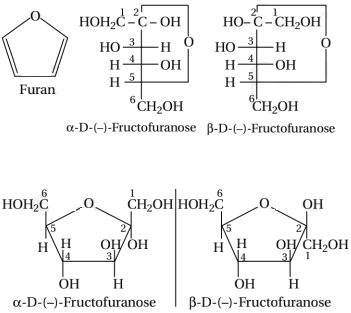
(N/A) Fructose is a ketohexose. It is obtained along with glucose by the hydrolysis of sucrose. It is a natural monosaccharide found in honey,fruits,and vegetables. The molecular formula of fructose is $C_{6}H_{12}O_{6}$. The reactions show that fructose is a six-carbon straight-chain compound with a ketonic group at carbon-$2$. It is naturally laevorotatory and belongs to the $D$-series. It is appropriately written as $D-(-)$-Fructose.
Fructose exists in two cyclic forms which are obtained by the addition of the $-OH$ group at the $C-5$ carbon to the ketonic group $(>C=O)$ at the second carbon. The ring thus formed is a five-membered ring and is named as furanose by analogy to the compound furan. Furan is a five-membered cyclic compound with one oxygen and four carbon atoms. Fructose shows mutarotation.
The Haworth structure of fructose is shown below:
(Image: $938-$s38)
Fructose exists in two cyclic forms which are obtained by the addition of the $-OH$ group at the $C-5$ carbon to the ketonic group $(>C=O)$ at the second carbon. The ring thus formed is a five-membered ring and is named as furanose by analogy to the compound furan. Furan is a five-membered cyclic compound with one oxygen and four carbon atoms. Fructose shows mutarotation.
The Haworth structure of fructose is shown below:
(Image: $938-$s38)
0 likes
View Solution490
Advanced
Write a note on Disaccharide compounds.
Solution
(N/A) Disaccharides are carbohydrates that yield two molecules of the same or different monosaccharides upon hydrolysis with dilute acids or enzymes.
They are formed by the condensation of two monosaccharide units,which are linked together by an oxide linkage known as a glycosidic linkage.
Common examples include sucrose,maltose,and lactose.
For instance,sucrose on hydrolysis gives one molecule of $\alpha-D$-glucose and one molecule of $\beta-D$-fructose. These two monosaccharides are held together by a glycosidic linkage between $C1$ of $\alpha-D$-glucose and $C2$ of $\beta-D$-fructose.
They are formed by the condensation of two monosaccharide units,which are linked together by an oxide linkage known as a glycosidic linkage.
Common examples include sucrose,maltose,and lactose.
For instance,sucrose on hydrolysis gives one molecule of $\alpha-D$-glucose and one molecule of $\beta-D$-fructose. These two monosaccharides are held together by a glycosidic linkage between $C1$ of $\alpha-D$-glucose and $C2$ of $\beta-D$-fructose.
0 likes
View Solution491
Advanced
Write a note on polysaccharides.
Solution
(N/A) Polysaccharides are long-chain carbohydrates formed by the polymerization of a large number of monosaccharide units joined together by glycosidic linkages.
$1$. They are the most commonly encountered carbohydrates in nature.
$2$. They mainly act as food storage or structural materials.
$3$. Starch is the main storage polysaccharide in plants,composed of amylose and amylopectin.
$4$. Cellulose is the main structural polysaccharide in plants,providing rigidity to cell walls.
$5$. Glycogen is the storage polysaccharide in animals,often referred to as animal starch.
$6$. They are generally non-reducing sugars and are insoluble in water.
$1$. They are the most commonly encountered carbohydrates in nature.
$2$. They mainly act as food storage or structural materials.
$3$. Starch is the main storage polysaccharide in plants,composed of amylose and amylopectin.
$4$. Cellulose is the main structural polysaccharide in plants,providing rigidity to cell walls.
$5$. Glycogen is the storage polysaccharide in animals,often referred to as animal starch.
$6$. They are generally non-reducing sugars and are insoluble in water.
0 likes
View Solution492
Medium
State the importance of carbohydrates.
Solution
(N/A) Carbohydrates are essential for life in both plants and animals. They form a major portion of our food. Honey has been used for a long time as an instant source of energy in the Ayurvedic system of medicine.
Carbohydrates are used as storage molecules,such as starch in plants and glycogen in animals. The cell wall of bacteria and plants is made of cellulose. We use cellulose in the form of wood for furniture and in the form of cotton fiber for clothing.
Carbohydrates provide raw materials for many important industries like textiles,paper,lacquers,and breweries.
Two aldo-pentoses,$D$-ribose and $2$-deoxy-$D$-ribose,are present in nucleic acids. Carbohydrates are also found in biological systems in combination with many proteins and lipids.
Carbohydrates are used as storage molecules,such as starch in plants and glycogen in animals. The cell wall of bacteria and plants is made of cellulose. We use cellulose in the form of wood for furniture and in the form of cotton fiber for clothing.
Carbohydrates provide raw materials for many important industries like textiles,paper,lacquers,and breweries.
Two aldo-pentoses,$D$-ribose and $2$-deoxy-$D$-ribose,are present in nucleic acids. Carbohydrates are also found in biological systems in combination with many proteins and lipids.
0 likes
View Solution493
Medium
Name the macromolecules that are chosen as drug targets.
Solution
(N/A) The macromolecules chosen as drug targets are carbohydrates,lipids,proteins,and nucleic acids.
0 likes
View Solution494
MediumMCQ
Provide the missing details in the following reactions:
$C_{12}H_{22}O_{11}$ $\xrightarrow{A = (?)} C_6H_{12}O_6$ $\xrightarrow{B = (?)} 2C_2H_5OH + 2CO_2$
$C_{12}H_{22}O_{11}$ $\xrightarrow{A = (?)} C_6H_{12}O_6$ $\xrightarrow{B = (?)} 2C_2H_5OH + 2CO_2$
A
$A = \text{Invertase}, B = \text{Zymase}$
B
$A = \text{Diastase}, B = \text{Zymase}$
C
$A = \text{Maltase}, B = \text{Invertase}$
D
$A = \text{Zymase}, B = \text{Invertase}$
Solution
(A) The reaction represents the fermentation of sucrose.
Step $1$: Sucrose $(C_{12}H_{22}O_{11})$ is hydrolyzed into glucose and fructose by the enzyme invertase $(A = \text{Invertase} + H_2O)$.
Step $2$: Glucose $(C_6H_{12}O_6)$ is converted into ethanol and carbon dioxide by the enzyme zymase $(B = \text{Zymase})$.
Therefore,the correct answer is $A = \text{Invertase}, B = \text{Zymase}$.
Step $1$: Sucrose $(C_{12}H_{22}O_{11})$ is hydrolyzed into glucose and fructose by the enzyme invertase $(A = \text{Invertase} + H_2O)$.
Step $2$: Glucose $(C_6H_{12}O_6)$ is converted into ethanol and carbon dioxide by the enzyme zymase $(B = \text{Zymase})$.
Therefore,the correct answer is $A = \text{Invertase}, B = \text{Zymase}$.
0 likes
View Solution495
Medium
Name the sugar present in milk. How many monosaccharide units are present in it? What are such oligosaccharides called?
Solution
(N/A) The sugar present in milk is lactose.
Lactose is a disaccharide composed of $D$-Galactose and $D$-Glucose units linked by a $\beta-C_1-O-C_4$ glycosidic linkage.
It contains $2$ monosaccharide units.
Oligosaccharides that yield $2$ monosaccharide units upon hydrolysis are called disaccharides.
Lactose is a disaccharide composed of $D$-Galactose and $D$-Glucose units linked by a $\beta-C_1-O-C_4$ glycosidic linkage.
It contains $2$ monosaccharide units.
Oligosaccharides that yield $2$ monosaccharide units upon hydrolysis are called disaccharides.
0 likes
View Solution496
Medium
How do you explain the presence of all the six carbon atoms in glucose in a straight chain?
Solution
When glucose is heated with $HI$ for a long time,it undergoes reduction to form $n$-hexane.
This reaction confirms that all six carbon atoms in glucose are linked in a straight chain.
The reaction is as follows:
$CHO-(CHOH)_4-CH_2OH \xrightarrow{HI, \Delta} CH_3-CH_2-CH_2-CH_2-CH_2-CH_3$ ($n$-Hexane)
This reaction confirms that all six carbon atoms in glucose are linked in a straight chain.
The reaction is as follows:
$CHO-(CHOH)_4-CH_2OH \xrightarrow{HI, \Delta} CH_3-CH_2-CH_2-CH_2-CH_2-CH_3$ ($n$-Hexane)
0 likes
View Solution497
Medium
Name the linkage connecting monosaccharide units in polysaccharides.
Solution
(N/A) In polysaccharides,the individual monosaccharide units are joined together by an oxide linkage formed by the loss of a water molecule. This specific type of linkage is known as a $glycosidic$ linkage.
0 likes
View Solution498
Medium
Under what conditions is glucose converted to gluconic acid and saccharic acid?
Solution
(N/A) Glucose is converted to gluconic acid when oxidized by $Br_{2}$ water $(Br_{2} / H_{2}O)$.
Glucose is converted to saccharic acid when oxidized by concentrated $HNO_{3}$.
Glucose is converted to saccharic acid when oxidized by concentrated $HNO_{3}$.
0 likes
View Solution499
MediumMCQ
Monosaccharides contain a carbonyl group and are hence classified as aldose or ketose. The number of carbon atoms present in the monosaccharide molecule is also considered for classification. In which class of monosaccharide will you place fructose?
A
$A$. Aldohexose
B
$B$. Aldo-pentose
C
$C$. Ketohexose
D
$D$. Ketopentose
Solution
(C) Fructose is a monosaccharide that contains $6$ carbon atoms and a ketone functional group at the $C-2$ position.
Therefore,it is classified as a ketohexose.
Therefore,it is classified as a ketohexose.
0 likes
View Solution500
Medium
The letters $'D'$ or $'L'$ before the name of a stereoisomer of a compound indicate the correlation of configuration of that particular stereoisomer. This refers to their relation with one of the isomers of glyceraldehyde. Predict whether the following compound has $'D'$ or $'L'$ configuration.
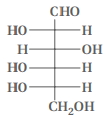
Solution
(B) To determine the $D$ or $L$ configuration of a carbohydrate,we look at the chiral carbon atom farthest from the carbonyl $(-CHO)$ group.
In the given structure,the farthest chiral carbon is the one adjacent to the $-CH_2OH$ group.
Since the $-OH$ group on this carbon is on the left-hand side,the compound has an $L$-configuration.
In the given structure,the farthest chiral carbon is the one adjacent to the $-CH_2OH$ group.
Since the $-OH$ group on this carbon is on the left-hand side,the compound has an $L$-configuration.
0 likes
View SolutionBiomolecules — Carbohydrates · Frequently Asked Questions
1Are these Biomolecules questions useful for JEE and NEET?
Yes. All questions in this section are mapped to JEE Main and NEET exam patterns. Previous year questions from JEE Main, NEET, GUJCET and state-level exams are included with full solutions.
2Can I switch to Hindi or Gujarati for these questions?
Yes. Use the language tabs in the hero section or the sidebar to view the same questions and solutions in English, Hindi or Gujarati.
3How do I generate a question paper from this subtopic?
Use the Vedclass Exam Paper Generator — select the chapter and subtopic, set difficulty, and generate Sets A, B, C, D automatically. First 3 chapters of every subject are free.
Vedclass Products
For Students
Vedclass Test Series
Mock tests in real JEE/NEET style with performance analysis. 5-day free trial.
Start Free TrialFor Teachers
Exam Paper Generator
Generate Set A/B/C/D papers from this chapter in 2 minutes. 3 chapters free.
Try FreeFor Institutes
Online Exam Module
Live online exams with unlimited students, 360° analytics & white-label branding.
See DemoFor Teachers & Institutes
Generate a Biomolecules Exam Paper in 2 Minutes
Select subtopic & difficulty — Sets A, B, C, D auto-generated with No Repeat logic.
First 3 chapters of every subject are free — no payment required.