
A English
Amino Acids and Proteins Questions in English
Class 12 Chemistry · Biomolecules · Amino Acids and Proteins
518+
Questions
English
Language
100%
With Solutions
Showing 50 of 518 questions in English
351
DifficultMCQ
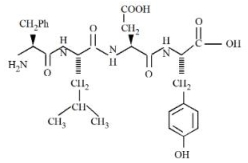
The following tetrapeptide can be represented as:
($F, L, D, Y, I, Q, P$ are one-letter codes for amino acids)
($F, L, D, Y, I, Q, P$ are one-letter codes for amino acids)
A
$FIQY$
B
$FLDY$
C
$YQLF$
D
$PLDY$
Solution
(B) By analyzing the structure of the tetrapeptide from the $N$-terminal to the $C$-terminal:
$1$. The first amino acid residue has a side chain $-CH_2Ph$,which corresponds to Phenylalanine $(F)$.
$2$. The second amino acid residue has a side chain $-CH_2CH(CH_3)_2$,which corresponds to Leucine $(L)$.
$3$. The third amino acid residue has a side chain $-CH_2COOH$,which corresponds to Aspartic acid $(D)$.
$4$. The fourth amino acid residue has a side chain $-CH_2(C_6H_4)OH$,which corresponds to Tyrosine $(Y)$.
Thus,the sequence is $F-L-D-Y$.
$1$. The first amino acid residue has a side chain $-CH_2Ph$,which corresponds to Phenylalanine $(F)$.
$2$. The second amino acid residue has a side chain $-CH_2CH(CH_3)_2$,which corresponds to Leucine $(L)$.
$3$. The third amino acid residue has a side chain $-CH_2COOH$,which corresponds to Aspartic acid $(D)$.
$4$. The fourth amino acid residue has a side chain $-CH_2(C_6H_4)OH$,which corresponds to Tyrosine $(Y)$.
Thus,the sequence is $F-L-D-Y$.
0 likes
View Solution352
DifficultMCQ
$A$ short peptide on complete hydrolysis produces $3$ moles of glycine $(G)$,$2$ moles of leucine $(L)$ and $2$ moles of valine $(V)$ per mole of peptide. The number of peptide linkages in it are $..............$.
A
$4$
B
$2$
C
$8$
D
$6$
Solution
(D) The total number of amino acid residues in the peptide is the sum of the moles of each amino acid produced upon hydrolysis.
Total amino acid residues $= 3 (G) + 2 (L) + 2 (V) = 7$.
For a peptide chain containing $n$ amino acid residues,the number of peptide linkages is given by $(n - 1)$.
Therefore,the number of peptide linkages $= 7 - 1 = 6$.
Total amino acid residues $= 3 (G) + 2 (L) + 2 (V) = 7$.
For a peptide chain containing $n$ amino acid residues,the number of peptide linkages is given by $(n - 1)$.
Therefore,the number of peptide linkages $= 7 - 1 = 6$.
0 likes
View Solution353
DifficultMCQ
$A$ protein '$X$' with a molecular weight of $70,000 \ u$,on hydrolysis gives amino acids. One of these amino acids is:
A
$NH_2-CH_2-CH(CH_3)-CH_2-CH_2-COOH$
B
$CH_3-CH(CH_3)-CH_2-CH(NH_2)-COOH$
C
$CH_3-CH(CH_3)-CH(NH_2)-CH_2-COOH$
D
$CH_3-C(CH_3)(NH_2)-CH_2-CH_2-COOH$
Solution
(B) Proteins are polymers of $\alpha$-amino acids. An $\alpha$-amino acid is one in which the amino group $(-NH_2)$ is attached to the carbon atom adjacent to the carboxylic acid group $(-COOH)$,i.e.,the $\alpha$-carbon.
In option $(B)$,the structure is $CH_3-CH(CH_3)-CH_2-CH(NH_2)-COOH$. Here,the $-NH_2$ group is attached to the carbon atom directly adjacent to the $-COOH$ group. This is the structure of the amino acid Leucine.
In the other options,the $-NH_2$ group is attached to a carbon atom further away from the $-COOH$ group,meaning they are not $\alpha$-amino acids.
In option $(B)$,the structure is $CH_3-CH(CH_3)-CH_2-CH(NH_2)-COOH$. Here,the $-NH_2$ group is attached to the carbon atom directly adjacent to the $-COOH$ group. This is the structure of the amino acid Leucine.
In the other options,the $-NH_2$ group is attached to a carbon atom further away from the $-COOH$ group,meaning they are not $\alpha$-amino acids.
0 likes
View Solution354
MediumMCQ
The incorrect statement about denaturation of proteins is
A
It results due to change of temperature and/or $pH$.
B
It results in loss of biological activity of proteins.
C
$A$ protein is formed from amino acids linked by peptide bonds.
D
Uncoiling of the helical structure takes place.
Solution
(C) Denaturation is a process that causes the loss of the secondary and tertiary structures of proteins,leading to the loss of their biological activity.
$1$. It is caused by changes in physical conditions such as temperature or chemical conditions like $pH$.
$2$. During this process,the helical structure of the protein uncoils.
$3$. Option $C$ describes the primary structure of a protein (formation from amino acids linked by peptide bonds),which remains intact during denaturation.
Therefore,the statement in option $C$ is incorrect regarding the process of denaturation.
$1$. It is caused by changes in physical conditions such as temperature or chemical conditions like $pH$.
$2$. During this process,the helical structure of the protein uncoils.
$3$. Option $C$ describes the primary structure of a protein (formation from amino acids linked by peptide bonds),which remains intact during denaturation.
Therefore,the statement in option $C$ is incorrect regarding the process of denaturation.
0 likes
View Solution355
MediumMCQ
Match List-$I$ with List-$II$
Choose the correct answer from the options given below :-
| List-$I$ Natural Amino acid | List-$II$ One Letter Code |
| $A$. Arginine | $I$. $D$ |
| $B$. Aspartic acid | $II$. $N$ |
| $C$. Asparagine | $III$. $A$ |
| $D$. Alanine | $IV$. $R$ |
Choose the correct answer from the options given below :-
A
$A-IV, B-I, C-III, D-II$
B
$A-I, B-III, C-IV, D-II$
C
$A-III, B-I, C-II, D-IV$
D
$A-IV, B-I, C-II, D-III$
Solution
(D) The one-letter codes for the given amino acids are as follows:
$A$. Arginine is represented by $R$.
$B$. Aspartic acid is represented by $D$.
$C$. Asparagine is represented by $N$.
$D$. Alanine is represented by $A$.
Therefore,the correct matching is $A-IV, B-I, C-II, D-III$.
$A$. Arginine is represented by $R$.
$B$. Aspartic acid is represented by $D$.
$C$. Asparagine is represented by $N$.
$D$. Alanine is represented by $A$.
Therefore,the correct matching is $A-IV, B-I, C-II, D-III$.
0 likes
View Solution356
MediumMCQ
Sulphur $(S)$ containing amino acids from the following are:
$(a)$ isoleucine
$(b)$ cysteine
$(c)$ lysine
$(d)$ methionine
$(e)$ glutamic acid
$(a)$ isoleucine
$(b)$ cysteine
$(c)$ lysine
$(d)$ methionine
$(e)$ glutamic acid
A
$a, d$
B
$b, d$
C
$b, c, e$
D
$a, b, c$
Solution
(B) The amino acids that contain sulphur in their side chains are cysteine and methionine.
$1$. Cysteine: Contains a thiol $(-SH)$ group.
$2$. Methionine: Contains a thioether $(-S-CH_3)$ group.
Therefore,the correct options are $(b)$ and $(d)$.
$1$. Cysteine: Contains a thiol $(-SH)$ group.
$2$. Methionine: Contains a thioether $(-S-CH_3)$ group.
Therefore,the correct options are $(b)$ and $(d)$.
0 likes
View Solution357
MediumMCQ
Match List-$I$ with List-$II$.
| List-$I$ (Natural amino acid) | List-$II$ (Code) |
|---|---|
| $A$. Glutamic acid | $I$. $Q$ |
| $B$. Glutamine | $II$. $W$ |
| $C$. Tyrosine | $III$. $E$ |
| $D$. Tryptophan | $IV$. $Y$ |
A
$A-II, B-I, C-IV, D-III$
B
$A-IV, B-III, C-I, D-II$
C
$A-III, B-I, C-IV, D-II$
D
$A-III, B-IV, C-I, D-II$
Solution
(C) The single-letter codes for amino acids are as follows:
$A$. Glutamic acid is represented by $E$ $(III)$.
$B$. Glutamine is represented by $Q$ $(I)$.
$C$. Tyrosine is represented by $Y$ $(IV)$.
$D$. Tryptophan is represented by $W$ $(II)$.
Therefore,the correct matching is $A-III, B-I, C-IV, D-II$.
$A$. Glutamic acid is represented by $E$ $(III)$.
$B$. Glutamine is represented by $Q$ $(I)$.
$C$. Tyrosine is represented by $Y$ $(IV)$.
$D$. Tryptophan is represented by $W$ $(II)$.
Therefore,the correct matching is $A-III, B-I, C-IV, D-II$.
0 likes
View Solution358
MediumMCQ
The one that does not stabilize $2^{\circ}$ and $3^{\circ}$ structures of proteins is
A
$H$-bonding
B
$-S-S-$ linkage
C
$-O-O-$ linkage
D
van der Waals forces
Solution
(C) The $2^{\circ}$ and $3^{\circ}$ structures of proteins are stabilized by various interactions including hydrogen bonding,disulphide linkages $(-S-S-)$,van der Waals forces,and electrostatic forces of attraction.
An $-O-O-$ linkage (peroxide linkage) is not a standard interaction involved in the stabilization of protein structures.
An $-O-O-$ linkage (peroxide linkage) is not a standard interaction involved in the stabilization of protein structures.
0 likes
View Solution359
MediumMCQ
Given below are two statements,one is labelled as Assertion $A$ and the other is labelled as Reason $R$.
Assertion $A$: $A$ solution of the product obtained by heating a mole of glycine with a mole of chlorine in the presence of red phosphorus generates a chiral carbon atom.
Reason $R$: $A$ molecule with $2$ chiral carbons is always optically active.
In the light of the above statements,choose the correct answer from the options given below:
Assertion $A$: $A$ solution of the product obtained by heating a mole of glycine with a mole of chlorine in the presence of red phosphorus generates a chiral carbon atom.
Reason $R$: $A$ molecule with $2$ chiral carbons is always optically active.
In the light of the above statements,choose the correct answer from the options given below:
A
$A$ is false but $R$ is true.
B
$A$ is true but $R$ is false.
C
Both $A$ and $R$ are true and $R$ is the correct explanation of $A$.
D
Both $A$ and $R$ are true and $R$ is $NOT$ the correct explanation of $A$.
Solution
(B) Assertion $A$: The reaction of glycine $(H_2N-CH_2-COOH)$ with $Cl_2$ in the presence of red phosphorus is the Hell-Volhard-Zelinsky $(HVZ)$ reaction. This reaction replaces an $\alpha$-hydrogen with a chlorine atom,resulting in $H_2N-CH(Cl)-COOH$ ($2$-chloro$-2-$aminoacetic acid). The central carbon atom is bonded to four different groups $(-H, -NH_2, -Cl, -COOH)$,making it a chiral carbon atom. Thus,Assertion $A$ is true.
Reason $R$: $A$ molecule with $2$ chiral carbons is not always optically active. For example,meso compounds contain chiral centers but are optically inactive due to an internal plane of symmetry. Thus,Reason $R$ is false.
Therefore,$A$ is true but $R$ is false.
Reason $R$: $A$ molecule with $2$ chiral carbons is not always optically active. For example,meso compounds contain chiral centers but are optically inactive due to an internal plane of symmetry. Thus,Reason $R$ is false.
Therefore,$A$ is true but $R$ is false.
0 likes
View Solution360
DifficultMCQ
In an oligopeptide named Alanyl-glycyl-phenyl-alanyl-isoleucine,the number of $sp^2$ hybridised carbons is $...........$.
A
$11$
B
$10$
C
$12$
D
$13$
Solution
(B) The oligopeptide structure contains $4$ carbonyl groups $(C=O)$,each contributing $1$ $sp^2$ hybridized carbon. Total carbons from carbonyl groups = $4 \times 1 = 4$.
Additionally,the phenyl ring (side chain of phenylalanine) contains $6$ $sp^2$ hybridized carbons.
Total number of $sp^2$ hybridized carbons = $4 + 6 = 10$.
Additionally,the phenyl ring (side chain of phenylalanine) contains $6$ $sp^2$ hybridized carbons.
Total number of $sp^2$ hybridized carbons = $4 + 6 = 10$.
0 likes
View Solution361
AdvancedMCQ
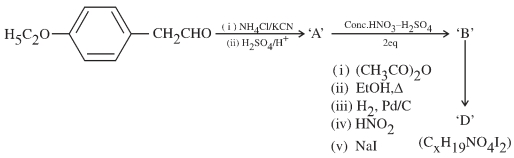
The value of $x$ in compound '$D$' is $.........$.
A
$14$
B
$15$
C
$13$
D
$12$
Solution
(B) The starting material is $4$-ethoxyphenylacetaldehyde.
$1$. Strecker synthesis: Reaction with $NH_4Cl/KCN$ followed by hydrolysis gives $4$-ethoxyphenylalanine ('$A$').
$2$. Nitration: Treatment with $Conc. HNO_3-H_2SO_4$ $(2 \ eq)$ introduces two nitro groups at the ortho positions relative to the ethoxy group,yielding $3,5$-dinitro-$4$-ethoxyphenylalanine ('$B$').
$3$. Acetylation: Reaction with $(CH_3CO)_2O$ protects the amino group as an acetamide.
$4$. Esterification: Reaction with $EtOH/\Delta$ converts the carboxylic acid to an ethyl ester.
$5$. Reduction: $H_2, Pd/C$ reduces the two nitro groups to amino groups.
$6$. Diazotization: $HNO_2$ converts the amino groups to diazonium salts.
$7$. Sandmeyer-like reaction: $NaI$ replaces the diazonium groups with iodine atoms.
The final product '$D$' is $3,5$-diiodo-$4$-ethoxyphenylalanine ethyl ester derivative.
The molecular formula is $C_{15}H_{19}NO_4I_2$.
Comparing this with $C_xH_{19}NO_4I_2$,we find $x = 15$.
$1$. Strecker synthesis: Reaction with $NH_4Cl/KCN$ followed by hydrolysis gives $4$-ethoxyphenylalanine ('$A$').
$2$. Nitration: Treatment with $Conc. HNO_3-H_2SO_4$ $(2 \ eq)$ introduces two nitro groups at the ortho positions relative to the ethoxy group,yielding $3,5$-dinitro-$4$-ethoxyphenylalanine ('$B$').
$3$. Acetylation: Reaction with $(CH_3CO)_2O$ protects the amino group as an acetamide.
$4$. Esterification: Reaction with $EtOH/\Delta$ converts the carboxylic acid to an ethyl ester.
$5$. Reduction: $H_2, Pd/C$ reduces the two nitro groups to amino groups.
$6$. Diazotization: $HNO_2$ converts the amino groups to diazonium salts.
$7$. Sandmeyer-like reaction: $NaI$ replaces the diazonium groups with iodine atoms.
The final product '$D$' is $3,5$-diiodo-$4$-ethoxyphenylalanine ethyl ester derivative.
The molecular formula is $C_{15}H_{19}NO_4I_2$.
Comparing this with $C_xH_{19}NO_4I_2$,we find $x = 15$.
0 likes
View Solution362
DifficultMCQ
The naturally occurring amino acid that contains only one basic functional group in its chemical structure is
A
arginine
B
lysine
C
asparagine
D
histidine
Solution
(C) The general structure of an amino acid contains one $-NH_2$ group and one $-COOH$ group.
$Arginine$,$Lysine$,and $Histidine$ are basic amino acids because they contain an additional basic functional group in their side chains.
$Asparagine$ $(Asn)$ has the side chain $-CH_2CONH_2$. The amide group $(-CONH_2)$ is neutral,not basic. Thus,$Asparagine$ contains only one basic amino group $(-NH_2)$ attached to the $\alpha$-carbon,making it the correct choice among the given options.
$Arginine$,$Lysine$,and $Histidine$ are basic amino acids because they contain an additional basic functional group in their side chains.
$Asparagine$ $(Asn)$ has the side chain $-CH_2CONH_2$. The amide group $(-CONH_2)$ is neutral,not basic. Thus,$Asparagine$ contains only one basic amino group $(-NH_2)$ attached to the $\alpha$-carbon,making it the correct choice among the given options.
0 likes
View Solution363
EasyMCQ
Which is not true for arginine?
A
It is a crystalline solid.
B
It is associated with more than one $pK_a$ values.
C
It has a fairly high melting point.
D
It has high solubility in benzene.
Solution
(D) Arginine is an amino acid that exists as a zwitterion in its solid state.
Due to the presence of ionic charges,it exhibits a high melting point and is a crystalline solid.
It is highly soluble in polar solvents like water but has low solubility in non-polar solvents like benzene.
Therefore,the statement that it has high solubility in benzene is incorrect.
Due to the presence of ionic charges,it exhibits a high melting point and is a crystalline solid.
It is highly soluble in polar solvents like water but has low solubility in non-polar solvents like benzene.
Therefore,the statement that it has high solubility in benzene is incorrect.
0 likes
View Solution364
DifficultMCQ
Which structure of protein remains intact after coagulation of egg white on boiling?
A
$Primary$
B
$Tertiary$
C
$Secondary$
D
$Quaternary$
Solution
(A) Boiling an egg causes denaturation of its protein.
During denaturation,the $Secondary$,$Tertiary$,and $Quaternary$ structures of the protein are disrupted due to the breaking of hydrogen bonds and other non-covalent interactions.
However,the $Primary$ structure,which consists of the specific sequence of amino acids held together by peptide bonds,remains intact.
During denaturation,the $Secondary$,$Tertiary$,and $Quaternary$ structures of the protein are disrupted due to the breaking of hydrogen bonds and other non-covalent interactions.
However,the $Primary$ structure,which consists of the specific sequence of amino acids held together by peptide bonds,remains intact.
0 likes
View Solution365
DifficultMCQ
Type of amino acids obtained by hydrolysis of proteins is :
A
$\beta$
B
$\alpha$
C
$\delta$
D
$\gamma$
Solution
(B) Proteins are natural polymers composed of $\alpha$-amino acids which are connected by peptide linkages.
Hence,proteins upon acidic hydrolysis produce $\alpha$-amino acids.
Hence,proteins upon acidic hydrolysis produce $\alpha$-amino acids.
0 likes
View Solution366
DifficultMCQ
The number of tripeptides formed by $3$ different amino acids using each amino acid once is.................
A
$4$
B
$5$
C
$6$
D
$7$
Solution
(C) Let the $3$ different amino acids be $A, B,$ and $C$.
Since each amino acid is used exactly once,the number of possible tripeptides is equivalent to the number of permutations of $3$ distinct items taken $3$ at a time.
This is calculated as $3! = 3 \times 2 \times 1 = 6$.
The possible combinations are: $ABC, ACB, BAC, BCA, CAB, CBA$.
Since each amino acid is used exactly once,the number of possible tripeptides is equivalent to the number of permutations of $3$ distinct items taken $3$ at a time.
This is calculated as $3! = 3 \times 2 \times 1 = 6$.
The possible combinations are: $ABC, ACB, BAC, BCA, CAB, CBA$.
0 likes
View Solution367
MediumMCQ
Which of the following gives a positive test with ninhydrin?
A
Cellulose
B
Starch
C
Polyvinyl chloride
D
Egg albumin
Solution
(D) The ninhydrin test is a chemical test used to detect the presence of amino acids or proteins.
When ninhydrin reacts with amino acids or proteins,it produces a characteristic purple or blue color (Ruhemann's purple).
Among the given options,$A$,$B$,and $C$ are carbohydrates or synthetic polymers that do not contain amino groups.
$Egg \text{ } albumin$ is a protein,which is a polymer of amino acids,and therefore it will give a positive ninhydrin test.
When ninhydrin reacts with amino acids or proteins,it produces a characteristic purple or blue color (Ruhemann's purple).
Among the given options,$A$,$B$,and $C$ are carbohydrates or synthetic polymers that do not contain amino groups.
$Egg \text{ } albumin$ is a protein,which is a polymer of amino acids,and therefore it will give a positive ninhydrin test.
0 likes
View Solution368
MediumMCQ
Coagulation of egg,on heating,is because of:
A
Denaturation of protein occurs
B
The secondary structure of protein remains unchanged
C
Breaking of the peptide linkage in the primary structure of protein occurs
D
Biological property of protein remains unchanged
Solution
(A) Coagulation of egg,on heating,leads to the loss of biological activity and the unfolding of the protein,which is known as denaturation of protein.
0 likes
View Solution369
MediumMCQ
The total number of carbon atoms present in tyrosine,an amino acid,is $................$
A
$8$
B
$7$
C
$6$
D
$9$
Solution
(D) The chemical structure of tyrosine is $HO-C_6H_4-CH_2-CH(NH_2)-COOH$.
Counting the carbon atoms:
$1$ carbon atom in the carboxylic acid group $(-COOH)$,
$1$ carbon atom in the alpha-carbon position $(-CH(NH_2)-)$,
$1$ carbon atom in the methylene bridge $(-CH_2-)$,
$6$ carbon atoms in the benzene ring.
Total number of carbon atoms $= 1 + 1 + 1 + 6 = 9$.
Counting the carbon atoms:
$1$ carbon atom in the carboxylic acid group $(-COOH)$,
$1$ carbon atom in the alpha-carbon position $(-CH(NH_2)-)$,
$1$ carbon atom in the methylene bridge $(-CH_2-)$,
$6$ carbon atoms in the benzene ring.
Total number of carbon atoms $= 1 + 1 + 1 + 6 = 9$.
0 likes
View Solution370
MediumMCQ
Total number of essential amino acids among the given list of amino acids is . . . .
Arginine,Phenylalanine,Aspartic acid,Cysteine,Histidine,Valine,Proline
Arginine,Phenylalanine,Aspartic acid,Cysteine,Histidine,Valine,Proline
A
$4$
B
$5$
C
$8$
D
$10$
Solution
(A) Essential amino acids are those that cannot be synthesized by the human body and must be obtained from the diet.
From the given list:
$1$. Arginine (Essential for children/semi-essential)
$2$. Phenylalanine (Essential)
$3$. Histidine (Essential)
$4$. Valine (Essential)
Aspartic acid,Cysteine,and Proline are non-essential amino acids.
Note: Arginine and Histidine are often classified as essential in the context of human nutrition.
Counting the essential amino acids from the list: Arginine,Phenylalanine,Histidine,and Valine.
Total count = $4$.
From the given list:
$1$. Arginine (Essential for children/semi-essential)
$2$. Phenylalanine (Essential)
$3$. Histidine (Essential)
$4$. Valine (Essential)
Aspartic acid,Cysteine,and Proline are non-essential amino acids.
Note: Arginine and Histidine are often classified as essential in the context of human nutrition.
Counting the essential amino acids from the list: Arginine,Phenylalanine,Histidine,and Valine.
Total count = $4$.
0 likes
View Solution371
AdvancedMCQ
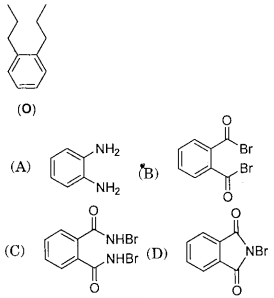
Treatment of compound $O$ ($1,2-$diethylbenzene) with $KMnO_4 / H^{+}$ gives $P$ (phthalic acid),which on heating with ammonia gives $Q$ (phthalamide). The compound $Q$ on treatment with $Br_2 / NaOH$ produces $R$ ($o-$phenylenediamine). On strong heating,$Q$ gives $S$ (phthalimide),which on further treatment with ethyl $2-$bromopropanoate in the presence of $KOH$ followed by acidification,gives a compound $T$.
$(1)$ The compound $R$ is
$(2)$ The compound $T$ is
$(A)$ glycine
$(B)$ alanine
$(C)$ valine
$(D)$ serine
Identify the correct options for $(1)$ and $(2)$.
$(1)$ The compound $R$ is
$(2)$ The compound $T$ is
$(A)$ glycine
$(B)$ alanine
$(C)$ valine
$(D)$ serine
Identify the correct options for $(1)$ and $(2)$.
A
$A, C$
B
$A, B$
C
$A, D$
D
$A, B, D$
Solution
(B) Step $1$: Oxidation of $1,2-$diethylbenzene $(O)$ with $KMnO_4 / H^+$ yields phthalic acid $(P)$.
Step $2$: Reaction of phthalic acid $(P)$ with ammonia followed by heating yields phthalamide $(Q)$.
Step $3$: Hofmann bromamide degradation of phthalamide $(Q)$ with $Br_2 / NaOH$ yields $o-$phenylenediamine $(R)$.
Step $4$: Heating phthalamide $(Q)$ yields phthalimide $(S)$.
Step $5$: Gabriel phthalimide synthesis using phthalimide $(S)$ and ethyl $2-$bromopropanoate followed by hydrolysis yields alanine $(T)$.
Thus,$R$ is $o-$phenylenediamine (not explicitly labeled as $A$-$D$ in the provided image options,but based on standard chemistry,$R$ is $o-$phenylenediamine) and $T$ is alanine $(B)$. Since the question asks to identify $R$ and $T$ from the options provided,and $T$ is clearly alanine $(B)$,the correct choice is $B$.
Step $2$: Reaction of phthalic acid $(P)$ with ammonia followed by heating yields phthalamide $(Q)$.
Step $3$: Hofmann bromamide degradation of phthalamide $(Q)$ with $Br_2 / NaOH$ yields $o-$phenylenediamine $(R)$.
Step $4$: Heating phthalamide $(Q)$ yields phthalimide $(S)$.
Step $5$: Gabriel phthalimide synthesis using phthalimide $(S)$ and ethyl $2-$bromopropanoate followed by hydrolysis yields alanine $(T)$.
Thus,$R$ is $o-$phenylenediamine (not explicitly labeled as $A$-$D$ in the provided image options,but based on standard chemistry,$R$ is $o-$phenylenediamine) and $T$ is alanine $(B)$. Since the question asks to identify $R$ and $T$ from the options provided,and $T$ is clearly alanine $(B)$,the correct choice is $B$.
0 likes
View Solution372
MediumMCQ
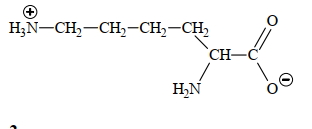
The total number of basic groups in the following form of lysine is:
A
$2$
B
$3$
C
$4$
D
$5$
Solution
(A) In the given structure of lysine,the basic groups are the amino group $(-NH_2)$ and the carboxylate ion $(-COO^-)$,which can act as a base by accepting a proton.
Therefore,there are $2$ basic groups present in this form of lysine.
Therefore,there are $2$ basic groups present in this form of lysine.
0 likes
View Solution373
AdvancedMCQ
The substituents $R_1$ and $R_2$ for nine peptides are listed in the table given below. How many of these peptides are positively charged at $pH = 7.0$?
| Peptide | $R_1$ | $R_2$ |
|---|---|---|
| $I$ | $H$ | $H$ |
| $II$ | $H$ | $CH_3$ |
| $III$ | $CH_2COOH$ | $H$ |
| $IV$ | $CH_2CONH_2$ | $(CH_2)_4NH_2$ |
| $V$ | $CH_2CONH_2$ | $CH_2CONH_2$ |
| $VI$ | $(CH_2)_4NH_2$ | $(CH_2)_4NH_2$ |
| $VII$ | $CH_2COOH$ | $CH_2CONH_2$ |
| $VIII$ | $CH_2OH$ | $(CH_2)_4NH_2$ |
| $IX$ | $(CH_2)_4NH_2$ | $CH_3$ |

A
$4$
B
$5$
C
$6$
D
$7$
Solution
(A) The given structure is a tetrapeptide with a terminal $-NH_3^+$ group and a terminal $-COO^-$ group. At $pH = 7.0$,the net charge depends on the side chains $R_1$ and $R_2$.
For a peptide to be positively charged at $pH = 7.0$,it must contain basic side chains (like $-(CH_2)_4NH_2$) that remain protonated,while acidic side chains (like $-CH_2COOH$) must be absent or balanced.
Let us analyze the side chains:
- $I$: $R_1=H, R_2=H$ (Neutral)
- $II$: $R_1=H, R_2=CH_3$ (Neutral)
- $III$: $R_1=CH_2COOH$ (Acidic),$R_2=H$ (Net negative charge)
- $IV$: $R_1=CH_2CONH_2$ (Neutral),$R_2=(CH_2)_4NH_2$ (Basic) $\rightarrow$ Positively charged
- $V$: $R_1=CH_2CONH_2, R_2=CH_2CONH_2$ (Neutral)
- $VI$: $R_1=(CH_2)_4NH_2, R_2=(CH_2)_4NH_2$ (Basic) $\rightarrow$ Positively charged
- $VII$: $R_1=CH_2COOH$ (Acidic),$R_2=CH_2CONH_2$ (Neutral) $\rightarrow$ Negatively charged
- $VIII$: $R_1=CH_2OH$ (Neutral),$R_2=(CH_2)_4NH_2$ (Basic) $\rightarrow$ Positively charged
- $IX$: $R_1=(CH_2)_4NH_2$ (Basic),$R_2=CH_3$ (Neutral) $\rightarrow$ Positively charged
The peptides $IV, VI, VIII,$ and $IX$ are positively charged at $pH = 7.0$. Thus,there are $4$ such peptides.
For a peptide to be positively charged at $pH = 7.0$,it must contain basic side chains (like $-(CH_2)_4NH_2$) that remain protonated,while acidic side chains (like $-CH_2COOH$) must be absent or balanced.
Let us analyze the side chains:
- $I$: $R_1=H, R_2=H$ (Neutral)
- $II$: $R_1=H, R_2=CH_3$ (Neutral)
- $III$: $R_1=CH_2COOH$ (Acidic),$R_2=H$ (Net negative charge)
- $IV$: $R_1=CH_2CONH_2$ (Neutral),$R_2=(CH_2)_4NH_2$ (Basic) $\rightarrow$ Positively charged
- $V$: $R_1=CH_2CONH_2, R_2=CH_2CONH_2$ (Neutral)
- $VI$: $R_1=(CH_2)_4NH_2, R_2=(CH_2)_4NH_2$ (Basic) $\rightarrow$ Positively charged
- $VII$: $R_1=CH_2COOH$ (Acidic),$R_2=CH_2CONH_2$ (Neutral) $\rightarrow$ Negatively charged
- $VIII$: $R_1=CH_2OH$ (Neutral),$R_2=(CH_2)_4NH_2$ (Basic) $\rightarrow$ Positively charged
- $IX$: $R_1=(CH_2)_4NH_2$ (Basic),$R_2=CH_3$ (Neutral) $\rightarrow$ Positively charged
The peptides $IV, VI, VIII,$ and $IX$ are positively charged at $pH = 7.0$. Thus,there are $4$ such peptides.
0 likes
View Solution374
DifficultMCQ
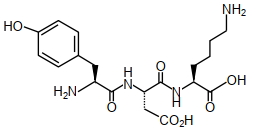
The structure of a peptide is given below. If the absolute values of the net charge of the peptide at $pH = 2$,$pH = 6$,and $pH = 11$ are $|z_1|$,$|z_2|$,and $|z_3|$,respectively,then what is $|z_1| + |z_2| + |z_3|$?
A
$3$
B
$2$
C
$4$
D
$5$
Solution
(D) The peptide is $Tyr-Asp-Lys$. The ionizable groups are the $N$-terminal $-NH_2$ $(pK_a \approx 9)$,the $C$-terminal $-COOH$ $(pK_a \approx 2)$,the side chain $-COOH$ of $Asp$ $(pK_a \approx 3.9)$,the side chain $-OH$ of $Tyr$ $(pK_a \approx 10)$,and the side chain $-NH_2$ of $Lys$ $(pK_a \approx 10.5)$.
At $pH = 2$: The $N$-terminal $-NH_2$ is protonated ($-NH_3^+$,$+1$),the $C$-terminal $-COOH$ is neutral $(0)$,the $Asp$ side chain $-COOH$ is neutral $(0)$,the $Tyr$ side chain $-OH$ is neutral $(0)$,and the $Lys$ side chain $-NH_2$ is protonated ($-NH_3^+$,$+1$). Net charge $z_1 = +2$,so $|z_1| = 2$.
At $pH = 6$: The $N$-terminal $-NH_2$ is protonated ($-NH_3^+$,$+1$),the $C$-terminal $-COOH$ is deprotonated ($-COO^-$,$-1$),the $Asp$ side chain $-COOH$ is deprotonated ($-COO^-$,$-1$),the $Tyr$ side chain $-OH$ is neutral $(0)$,and the $Lys$ side chain $-NH_2$ is protonated ($-NH_3^+$,$+1$). Net charge $z_2 = (+1) + (-1) + (-1) + (+1) = 0$,so $|z_2| = 0$.
At $pH = 11$: The $N$-terminal $-NH_2$ is neutral $(0)$,the $C$-terminal $-COOH$ is deprotonated ($-COO^-$,$-1$),the $Asp$ side chain $-COOH$ is deprotonated ($-COO^-$,$-1$),the $Tyr$ side chain $-OH$ is deprotonated ($-O^-$,$-1$),and the $Lys$ side chain $-NH_2$ is neutral $(0)$. Net charge $z_3 = (-1) + (-1) + (-1) = -3$,so $|z_3| = 3$.
Therefore,$|z_1| + |z_2| + |z_3| = 2 + 0 + 3 = 5$.
At $pH = 2$: The $N$-terminal $-NH_2$ is protonated ($-NH_3^+$,$+1$),the $C$-terminal $-COOH$ is neutral $(0)$,the $Asp$ side chain $-COOH$ is neutral $(0)$,the $Tyr$ side chain $-OH$ is neutral $(0)$,and the $Lys$ side chain $-NH_2$ is protonated ($-NH_3^+$,$+1$). Net charge $z_1 = +2$,so $|z_1| = 2$.
At $pH = 6$: The $N$-terminal $-NH_2$ is protonated ($-NH_3^+$,$+1$),the $C$-terminal $-COOH$ is deprotonated ($-COO^-$,$-1$),the $Asp$ side chain $-COOH$ is deprotonated ($-COO^-$,$-1$),the $Tyr$ side chain $-OH$ is neutral $(0)$,and the $Lys$ side chain $-NH_2$ is protonated ($-NH_3^+$,$+1$). Net charge $z_2 = (+1) + (-1) + (-1) + (+1) = 0$,so $|z_2| = 0$.
At $pH = 11$: The $N$-terminal $-NH_2$ is neutral $(0)$,the $C$-terminal $-COOH$ is deprotonated ($-COO^-$,$-1$),the $Asp$ side chain $-COOH$ is deprotonated ($-COO^-$,$-1$),the $Tyr$ side chain $-OH$ is deprotonated ($-O^-$,$-1$),and the $Lys$ side chain $-NH_2$ is neutral $(0)$. Net charge $z_3 = (-1) + (-1) + (-1) = -3$,so $|z_3| = 3$.
Therefore,$|z_1| + |z_2| + |z_3| = 2 + 0 + 3 = 5$.
0 likes
View Solution375
MediumMCQ
$A$ tetrapeptide has a $-COOH$ group on alanine. This produces glycine $(Gly)$,valine $(Val)$,phenylalanine $(Phe)$,and alanine $(Ala)$ on complete hydrolysis. For this tetrapeptide,the number of possible sequences (primary structures) with the $-NH_2$ group attached to a chiral center is:
A
$4$
B
$5$
C
$6$
D
$7$
Solution
(A) The tetrapeptide has alanine $(Ala)$ at the $C$-terminal position because the $-COOH$ group is on alanine.
The remaining three amino acids are glycine $(Gly)$,valine $(Val)$,and phenylalanine $(Phe)$.
For the $-NH_2$ group to be attached to a chiral center,the $N$-terminal amino acid must be chiral.
Glycine is achiral (optically inactive),so it cannot be at the $N$-terminal position.
Therefore,the $N$-terminal position can be occupied by either valine $(Val)$ or phenylalanine $(Phe)$.
If $Val$ is at the $N$-terminal,the possible sequences are:
$Val-Phe-Gly-Ala$
$Val-Gly-Phe-Ala$
If $Phe$ is at the $N$-terminal,the possible sequences are:
$Phe-Val-Gly-Ala$
$Phe-Gly-Val-Ala$
Total number of possible sequences = $2 + 2 = 4$.
The remaining three amino acids are glycine $(Gly)$,valine $(Val)$,and phenylalanine $(Phe)$.
For the $-NH_2$ group to be attached to a chiral center,the $N$-terminal amino acid must be chiral.
Glycine is achiral (optically inactive),so it cannot be at the $N$-terminal position.
Therefore,the $N$-terminal position can be occupied by either valine $(Val)$ or phenylalanine $(Phe)$.
If $Val$ is at the $N$-terminal,the possible sequences are:
$Val-Phe-Gly-Ala$
$Val-Gly-Phe-Ala$
If $Phe$ is at the $N$-terminal,the possible sequences are:
$Phe-Val-Gly-Ala$
$Phe-Gly-Val-Ala$
Total number of possible sequences = $2 + 2 = 4$.
0 likes
View Solution376
AdvancedMCQ
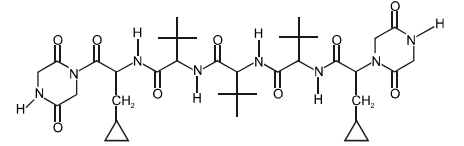
The total number of distinct naturally occurring amino acids obtained by complete acidic hydrolysis of the peptide shown below is
A
$1$
B
$2$
C
$3$
D
$4$
Solution
(A) Complete acidic hydrolysis of the given peptide breaks all amide bonds.
The peptide structure contains the following amino acid residues:
$1$. Glycine $(NH_2-CH_2-COOH)$
$2$. Cyclopropylalanine (an unnatural amino acid)
$3$. tert-Leucine (an unnatural amino acid)
Among these,only glycine is a naturally occurring amino acid.
Therefore,the total number of distinct naturally occurring amino acids obtained is $1$.
The peptide structure contains the following amino acid residues:
$1$. Glycine $(NH_2-CH_2-COOH)$
$2$. Cyclopropylalanine (an unnatural amino acid)
$3$. tert-Leucine (an unnatural amino acid)
Among these,only glycine is a naturally occurring amino acid.
Therefore,the total number of distinct naturally occurring amino acids obtained is $1$.
0 likes
View Solution377
AdvancedMCQ
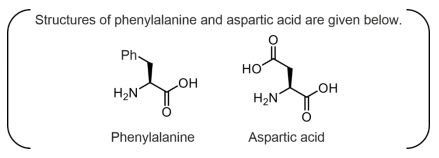
Aspartame,an artificial sweetener,is a dipeptide aspartyl phenylalanine methyl ester. The structure of aspartame is
A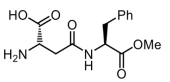
B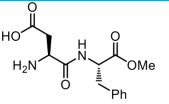
C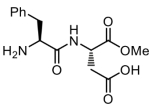
D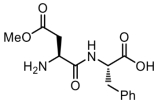
Solution
(C) Aspartame is a dipeptide formed from aspartic acid and phenylalanine. Specifically,it is the methyl ester of the dipeptide $L$-aspartyl-$L$-phenylalanine. The structure consists of the amino group of phenylalanine forming an amide bond with the carboxyl group of aspartic acid,and the carboxyl group of phenylalanine is esterified with methanol. The correct structure is shown in option $C$.
0 likes
View Solution378
MediumMCQ
The $\alpha-$helix and $\beta-$pleated sheet structures of protein are associated with its:
A
quaternary structure
B
primary structure
C
secondary structure
D
tertiary structure
Solution
(C) The $\alpha-$helix and $\beta-$pleated sheet are common types of secondary structures of proteins.
These structures are stabilized primarily by hydrogen bonds between the carbonyl oxygen and the amide hydrogen of the polypeptide backbone.
These structures are stabilized primarily by hydrogen bonds between the carbonyl oxygen and the amide hydrogen of the polypeptide backbone.
0 likes
View Solution379
MediumMCQ
Identify the essential amino acids from below $:$
$(A)$ Valine
$(B)$ Proline
$(C)$ Lysine
$(D)$ Threonine
$(E)$ Tyrosine
Choose the correct answer from the options given below $:$
$(A)$ Valine
$(B)$ Proline
$(C)$ Lysine
$(D)$ Threonine
$(E)$ Tyrosine
Choose the correct answer from the options given below $:$
A
$(A), (C)$ and $(D)$ only
B
$(A), (C)$ and $(E)$ only
C
$(B), (C)$ and $(E)$ only
D
$(C), (D)$ and $(E)$ only
Solution
(A) Essential amino acids are those that cannot be synthesized by the human body and must be obtained through the diet.
Among the given options,$(A)$ Valine,$(C)$ Lysine,and $(D)$ Threonine are essential amino acids.
Proline and Tyrosine are non-essential amino acids.
Among the given options,$(A)$ Valine,$(C)$ Lysine,and $(D)$ Threonine are essential amino acids.
Proline and Tyrosine are non-essential amino acids.
0 likes
View Solution380
MediumMCQ
Identify the correct statement among the following $:$
A
All naturally occurring amino acids except glycine contain one chiral centre.
B
All naturally occurring amino acids are optically active.
C
Glutamic acid is the only amino acid that contains a $-COOH$ group at the side chain.
D
Amino acid,cysteine easily undergoes dimerization due to the presence of a free $-SH$ group.
Solution
(D) $1$. Isoleucine and threonine have $2$ chiral centers,so option $A$ is incorrect.
$2$. Glycine is achiral and optically inactive,so option $B$ is incorrect.
$3$. Aspartic acid also contains a $-COOH$ group in its side chain,so option $C$ is incorrect.
$4$. Cysteine contains a free $-SH$ group,which can undergo oxidation to form a disulfide bond (cystine),leading to dimerization. Thus,option $D$ is correct.
$2$. Glycine is achiral and optically inactive,so option $B$ is incorrect.
$3$. Aspartic acid also contains a $-COOH$ group in its side chain,so option $C$ is incorrect.
$4$. Cysteine contains a free $-SH$ group,which can undergo oxidation to form a disulfide bond (cystine),leading to dimerization. Thus,option $D$ is correct.
0 likes
View Solution381
MediumMCQ
$A$ tetrapeptide $x$ on complete hydrolysis produced glycine $(Gly)$,alanine $(Ala)$,valine $(Val)$,and leucine $(Leu)$ in equimolar proportions. The number of possible tetrapeptide sequences involving each of these amino acids exactly once is:
A
$16$
B
$32$
C
$8$
D
$24$
Solution
(D) tetrapeptide is formed by the condensation of $4$ amino acids.
Since the tetrapeptide contains $4$ different amino acids $(Gly, Ala, Val, Leu)$ in equimolar proportions,each amino acid is present exactly once.
The number of different sequences (arrangements) possible for $4$ distinct items is given by the permutation formula $n!$.
Here,$n = 4$.
Number of sequences $= 4! = 4 \times 3 \times 2 \times 1 = 24$.
Since the tetrapeptide contains $4$ different amino acids $(Gly, Ala, Val, Leu)$ in equimolar proportions,each amino acid is present exactly once.
The number of different sequences (arrangements) possible for $4$ distinct items is given by the permutation formula $n!$.
Here,$n = 4$.
Number of sequences $= 4! = 4 \times 3 \times 2 \times 1 = 24$.
0 likes
View Solution382
MediumMCQ
Identify the pair of reactants that upon reaction,with elimination of $HCl$,will give rise to the dipeptide $Gly-Ala$.
A
$NH_2-CH_2-COCl$ and $NH_2-CH(CH_3)-COOH$
B
$NH_2-CH_2-COCl$ and $NH_3^+-CH(CH_3)-COCl$
C
$NH_2-CH_2-COOH$ and $NH_2-CH(CH_3)-COCl$
D
$NH_2-CH_2-COOH$ and $NH_2-CH(CH_3)-COOH$
Solution
(A) To form the dipeptide $Gly-Ala$ (Glycyl-Alanine),the amino group $(-NH_2)$ of the second amino acid $(Alanine)$ must attack the activated carboxyl group $(-COCl)$ of the first amino acid $(Glycine)$.
$Glycine$ is $NH_2-CH_2-COOH$. Its activated form is $NH_2-CH_2-COCl$.
$Alanine$ is $NH_2-CH(CH_3)-COOH$.
The reaction proceeds as follows:
$NH_2-CH_2-COCl + NH_2-CH(CH_3)-COOH \rightarrow NH_2-CH_2-CONH-CH(CH_3)-COOH + HCl$.
Thus,the correct pair of reactants is $NH_2-CH_2-COCl$ and $NH_2-CH(CH_3)-COOH$.
$Glycine$ is $NH_2-CH_2-COOH$. Its activated form is $NH_2-CH_2-COCl$.
$Alanine$ is $NH_2-CH(CH_3)-COOH$.
The reaction proceeds as follows:
$NH_2-CH_2-COCl + NH_2-CH(CH_3)-COOH \rightarrow NH_2-CH_2-CONH-CH(CH_3)-COOH + HCl$.
Thus,the correct pair of reactants is $NH_2-CH_2-COCl$ and $NH_2-CH(CH_3)-COOH$.
0 likes
View Solution383
DifficultMCQ
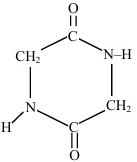
$A$ dipeptide,$X$ on complete hydrolysis gives $Y$ and $Z$. $Y$ on treatment with aqueous $HNO_2$ produces lactic acid. On the other hand,$Z$ on heating gives the following cyclic molecule.
Based on the information given,the dipeptide $X$ is:
Based on the information given,the dipeptide $X$ is:
A
$valine-glycine$
B
$alanine-glycine$
C
$valine-leucine$
D
$alanine-alanine$
Solution
(B) $1$. Hydrolysis of dipeptide $X$ yields two amino acids,$Y$ and $Z$.
$2$. $Y$ reacts with aqueous $HNO_2$ to form lactic acid $(CH_3CH(OH)COOH)$. This indicates that $Y$ is alanine $(CH_3CH(NH_2)COOH)$.
$3$. $Z$ on heating forms a cyclic molecule. The structure provided is $2,5-$diketopiperazine,which is formed by the dimerization of glycine $(NH_2CH_2COOH)$. Thus,$Z$ is glycine.
$4$. Therefore,the dipeptide $X$ is $alanine-glycine$.
$2$. $Y$ reacts with aqueous $HNO_2$ to form lactic acid $(CH_3CH(OH)COOH)$. This indicates that $Y$ is alanine $(CH_3CH(NH_2)COOH)$.
$3$. $Z$ on heating forms a cyclic molecule. The structure provided is $2,5-$diketopiperazine,which is formed by the dimerization of glycine $(NH_2CH_2COOH)$. Thus,$Z$ is glycine.
$4$. Therefore,the dipeptide $X$ is $alanine-glycine$.
0 likes
View Solution384
MediumMCQ
Given below are two statements $:$
Statement $(I):$ On hydrolysis,oligopeptides give rise to a fewer number of $\alpha$-amino acids,while proteins give rise to a large number of $\beta$-amino acids.
Statement $(II):$ Natural proteins are denatured by acids,which convert the water-soluble form of fibrous proteins to their water-insoluble form.
In the light of the above statements,choose the most appropriate answer from the options given below $:$
Statement $(I):$ On hydrolysis,oligopeptides give rise to a fewer number of $\alpha$-amino acids,while proteins give rise to a large number of $\beta$-amino acids.
Statement $(II):$ Natural proteins are denatured by acids,which convert the water-soluble form of fibrous proteins to their water-insoluble form.
In the light of the above statements,choose the most appropriate answer from the options given below $:$
A
Both statement $I$ and statement $II$ are correct
B
Statement $I$ is incorrect but Statement $II$ is correct
C
Both statement $I$ and statement $II$ are incorrect
D
Statement $I$ is correct but Statement $II$ is incorrect
Solution
(C) $(i)$ Proteins on hydrolysis yield a large number of $\alpha$-amino acids,not $\beta$-amino acids. Thus,Statement $(I)$ is incorrect.
$(ii)$ Fibrous proteins are generally insoluble in water. Denaturation involves the loss of biological activity and changes in the secondary and tertiary structures,but it does not involve the conversion of water-soluble fibrous proteins to water-insoluble forms in the manner described. Thus,Statement $(II)$ is also incorrect.
$(ii)$ Fibrous proteins are generally insoluble in water. Denaturation involves the loss of biological activity and changes in the secondary and tertiary structures,but it does not involve the conversion of water-soluble fibrous proteins to water-insoluble forms in the manner described. Thus,Statement $(II)$ is also incorrect.
0 likes
View Solution385
MediumMCQ
Choose the correct option for structures of $A$ and $B,$ respectively.
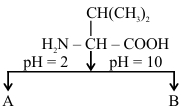
A
$H_3N^+-CH(CH(CH_3)_2)-COOH$ and $H_2N-CH(CH(CH_3)_2)-COO^-$
B
$H_2N-CH(CH(CH_3)_2)-COO^-$ and $H_3N^+-CH(CH(CH_3)_2)-COOH$
C
$H_2N-CH(CH(CH_3)_2)-COO^-$ and $H_3N^+-CH(CH(CH_3)_2)-COO^-$
D
$H_3N^+-CH(CH(CH_3)_2)-COO^-$ and $H_3N^+-CH(CH(CH_3)_2)-COOH$
Solution
(A) Amino acids are amphoteric in nature. In an acidic medium (low $pH$),the amino group $(-NH_2)$ gets protonated to form $-NH_3^+$.
Thus,at $pH = 2$,the structure $A$ is $H_3N^+-CH(CH(CH_3)_2)-COOH$.
In a basic medium (high $pH$),the carboxylic acid group $(-COOH)$ gets deprotonated to form $-COO^-$.
Thus,at $pH = 10$,the structure $B$ is $H_2N-CH(CH(CH_3)_2)-COO^-$.
Therefore,the correct option is $A$.
Thus,at $pH = 2$,the structure $A$ is $H_3N^+-CH(CH(CH_3)_2)-COOH$.
In a basic medium (high $pH$),the carboxylic acid group $(-COOH)$ gets deprotonated to form $-COO^-$.
Thus,at $pH = 10$,the structure $B$ is $H_2N-CH(CH(CH_3)_2)-COO^-$.
Therefore,the correct option is $A$.
0 likes
View Solution386
MediumMCQ
Which of the following statements is false?
A
All monosaccharides,whether aldose or ketose,are reducing sugars.
B
Both starch and cellulose are polymers of glucose.
C
During denaturation,$1^{\circ}$ and $2^{\circ}$ protein structures get destroyed,but $3^{\circ}$ structure remains the same.
D
In fibrous proteins,chains are held together by hydrogen bonds and disulphide bonds.
Solution
(C) During the denaturation of proteins,the $2^{\circ}$ and $3^{\circ}$ structures are destroyed due to the disruption of hydrogen bonds and other interactions,while the $1^{\circ}$ structure (the sequence of amino acids) remains intact. Therefore,the statement in option $C$ is false because it incorrectly claims that the $3^{\circ}$ structure remains the same while the $1^{\circ}$ structure is destroyed.
0 likes
View Solution387
MediumMCQ
The helical structure of protein is stabilized by$-$
A
Hydrogen bonds
B
Ether bonds
C
Peptide bonds
D
Dipeptide bonds
Solution
(A) The secondary structure of proteins,such as the $\alpha$-helix,is primarily stabilized by hydrogen bonds formed between the carbonyl oxygen $(-C=O)$ of one amino acid residue and the amide hydrogen $(-NH)$ of another amino acid residue located further along the polypeptide chain. While peptide bonds hold the primary structure together,hydrogen bonds are responsible for maintaining the specific helical conformation.
0 likes
View Solution388
EasyMCQ
The compound,which gives a positive ninhydrin test and a negative Benedict's solution test,is
A
a monosaccharide
B
a disaccharide
C
a lipid
D
a protein
Solution
(D) The ninhydrin test is a chemical test used to detect ammonia or primary and secondary amines. In biochemistry,it is specifically used to detect proteins and amino acids,which produce a characteristic blue or purple color.
Benedict's solution is used to detect reducing sugars (monosaccharides and some disaccharides).
Since proteins are not reducing sugars,they give a negative Benedict's test.
Therefore,a protein is the compound that gives a positive ninhydrin test and a negative Benedict's solution test.
Benedict's solution is used to detect reducing sugars (monosaccharides and some disaccharides).
Since proteins are not reducing sugars,they give a negative Benedict's test.
Therefore,a protein is the compound that gives a positive ninhydrin test and a negative Benedict's solution test.
0 likes
View Solution389
EasyMCQ
Identify a side chain $(R)$ group present in serine,an amino acid.
A
$CH_3-$
B
$H_3C-CH(OH)-$
C
$Me_2CH-$
D
$HO-CH_2-$
Solution
(D) The general structure of an $\alpha$-amino acid is $R-CH(NH_2)-COOH$.
For serine,the side chain $(R)$ is a hydroxymethyl group,which is represented as $HO-CH_2-$.
Therefore,the correct option is $D$.
For serine,the side chain $(R)$ is a hydroxymethyl group,which is represented as $HO-CH_2-$.
Therefore,the correct option is $D$.
0 likes
View Solution390
DifficultMCQ
Which from the following is an essential amino acid?
A
Tyrosine
B
Serine
C
Histidine
D
Glycine
Solution
(C) Essential amino acids are those that cannot be synthesized by the human body and must be obtained through the diet.
Among the given options,$Histidine$ is an essential amino acid.
$Tyrosine$,$Serine$,and $Glycine$ are non-essential amino acids as they can be synthesized by the body.
Among the given options,$Histidine$ is an essential amino acid.
$Tyrosine$,$Serine$,and $Glycine$ are non-essential amino acids as they can be synthesized by the body.
0 likes
View Solution391
EasyMCQ
Identify the neutral amino acid from the following list represented by three-letter symbols.
A
$Trp$
B
$Arg$
C
$Lys$
D
$Glu$
Solution
(A) Amino acids are classified as acidic,basic,or neutral based on the number of amino $(-NH_2)$ and carboxyl $(-COOH)$ groups present in their structure.
$1$. $Glu$ $(Glutamic \ acid)$ contains two $-COOH$ groups and one $-NH_2$ group,making it an acidic amino acid.
$2$. $Arg$ $(Arginine)$ and $Lys$ $(Lysine)$ contain more amino groups than carboxyl groups,making them basic amino acids.
$3$. $Trp$ $(Tryptophan)$ contains one $-NH_2$ group and one $-COOH$ group in its structure,making it a neutral amino acid.
Therefore,the correct option is $A$.
$1$. $Glu$ $(Glutamic \ acid)$ contains two $-COOH$ groups and one $-NH_2$ group,making it an acidic amino acid.
$2$. $Arg$ $(Arginine)$ and $Lys$ $(Lysine)$ contain more amino groups than carboxyl groups,making them basic amino acids.
$3$. $Trp$ $(Tryptophan)$ contains one $-NH_2$ group and one $-COOH$ group in its structure,making it a neutral amino acid.
Therefore,the correct option is $A$.
0 likes
View Solution392
EasyMCQ
Which amino acid from the following is $NOT$ synthesized in our body?
A
Tyrosine
B
Tryptophan
C
Glutamine
D
Glycine
Solution
(B) Amino acids that cannot be synthesized by the human body and must be obtained through the diet are called essential amino acids.
Among the given options,$Tryptophan$ is an essential amino acid.
Tyrosine,Glutamine,and Glycine are non-essential amino acids,meaning they can be synthesized by the human body.
Among the given options,$Tryptophan$ is an essential amino acid.
Tyrosine,Glutamine,and Glycine are non-essential amino acids,meaning they can be synthesized by the human body.
0 likes
View Solution393
EasyMCQ
Which of the following amino acids contains '$S$' in its side chain $(R)$?
A
Methionine
B
Lysine
C
Glutamic acid
D
Glycine
Solution
(A) The amino acids that contain sulfur in their side chain $(R)$ are Methionine and Cysteine.
Methionine has the side chain structure: $-CH_2-CH_2-S-CH_3$.
Cysteine has the side chain structure: $-CH_2-SH$.
Among the given options,Methionine is the correct answer.
Methionine has the side chain structure: $-CH_2-CH_2-S-CH_3$.
Cysteine has the side chain structure: $-CH_2-SH$.
Among the given options,Methionine is the correct answer.
0 likes
View Solution394
EasyMCQ
Which of the following amino acids contains a heterocyclic ring in its side chain $(R)$ group?
A
Threonine
B
Cysteine
C
Histidine
D
Valine
Solution
(C) The amino acid $Histidine$ contains an imidazole ring,which is a five-membered heterocyclic ring containing two nitrogen atoms in its side chain $(R)$ group.
Threonine contains a hydroxyl group $(-OH)$.
Cysteine contains a thiol group $(-SH)$.
Valine contains an isopropyl group $(-CH(CH_3)_2)$.
Therefore,the correct answer is $Histidine$.
Threonine contains a hydroxyl group $(-OH)$.
Cysteine contains a thiol group $(-SH)$.
Valine contains an isopropyl group $(-CH(CH_3)_2)$.
Therefore,the correct answer is $Histidine$.
0 likes
View Solution395
EasyMCQ
Which amino acid from the following contains $-CH_3$ as a side chain?
A
Leucine
B
Alanine
C
Serine
D
Valine
Solution
(B) The general structure of an amino acid is $R-CH(NH_2)-COOH$.
For Alanine,the side chain $R$ is a methyl group $(-CH_3)$.
Therefore,the structure of Alanine is $CH_3-CH(NH_2)-COOH$.
For Alanine,the side chain $R$ is a methyl group $(-CH_3)$.
Therefore,the structure of Alanine is $CH_3-CH(NH_2)-COOH$.
0 likes
View Solution396
EasyMCQ
Identify the acidic amino acid from the following list represented by three-letter symbols.
A
$Thr$
B
$Trp$
C
$His$
D
$Glu$
Solution
(D) Amino acids are classified as acidic,basic,or neutral based on the number of amino and carboxyl groups present in their structure.
An acidic amino acid contains more carboxyl $(-COOH)$ groups than amino $(-NH_2)$ groups.
Among the given options:
$Thr$ (Threonine) is a neutral amino acid.
$Trp$ (Tryptophan) is a neutral amino acid.
$His$ (Histidine) is a basic amino acid.
$Glu$ (Glutamic acid) contains two carboxyl groups and one amino group,making it an acidic amino acid.
Therefore,the correct option is $D$.
An acidic amino acid contains more carboxyl $(-COOH)$ groups than amino $(-NH_2)$ groups.
Among the given options:
$Thr$ (Threonine) is a neutral amino acid.
$Trp$ (Tryptophan) is a neutral amino acid.
$His$ (Histidine) is a basic amino acid.
$Glu$ (Glutamic acid) contains two carboxyl groups and one amino group,making it an acidic amino acid.
Therefore,the correct option is $D$.
0 likes
View Solution397
EasyMCQ
Identify the neutral amino acid from the following list represented by three-letter symbols.
A
$Arg$
B
$Asp$
C
$Leu$
D
$His$
Solution
(C) Amino acids are classified as acidic,basic,or neutral based on the number of amino $(-NH_2)$ and carboxyl $(-COOH)$ groups present in their structure.
$1$. $Arg$ $(Arginine)$ is a basic amino acid due to the presence of an extra amino group in its side chain.
$2$. $Asp$ $(Aspartic \ acid)$ is an acidic amino acid due to the presence of an extra carboxyl group in its side chain.
$3$. $Leu$ $(Leucine)$ is a neutral amino acid because it contains one amino group and one carboxyl group,and its side chain is non-polar and non-ionizable.
$4$. $His$ $(Histidine)$ is a basic amino acid.
Therefore,$Leu$ is the correct neutral amino acid.
$1$. $Arg$ $(Arginine)$ is a basic amino acid due to the presence of an extra amino group in its side chain.
$2$. $Asp$ $(Aspartic \ acid)$ is an acidic amino acid due to the presence of an extra carboxyl group in its side chain.
$3$. $Leu$ $(Leucine)$ is a neutral amino acid because it contains one amino group and one carboxyl group,and its side chain is non-polar and non-ionizable.
$4$. $His$ $(Histidine)$ is a basic amino acid.
Therefore,$Leu$ is the correct neutral amino acid.
0 likes
View Solution398
EasyMCQ
Identify the acidic amino acid from the following list represented by three-letter symbols.
A
$Arg$
B
$Lys$
C
$Met$
D
$Asp$
Solution
(D) Amino acids are classified as acidic,basic,or neutral based on the number of amino and carboxyl groups present in their structure.
An acidic amino acid contains more carboxyl groups $(-COOH)$ than amino groups $(-NH_2)$.
Among the given options:
$Arg$ $(Arginine)$ is a basic amino acid.
$Lys$ $(Lysine)$ is a basic amino acid.
$Met$ $(Methionine)$ is a neutral amino acid.
$Asp$ $(Aspartic \ acid)$ contains two carboxyl groups and one amino group,making it an acidic amino acid.
Therefore,the correct option is $D$.
An acidic amino acid contains more carboxyl groups $(-COOH)$ than amino groups $(-NH_2)$.
Among the given options:
$Arg$ $(Arginine)$ is a basic amino acid.
$Lys$ $(Lysine)$ is a basic amino acid.
$Met$ $(Methionine)$ is a neutral amino acid.
$Asp$ $(Aspartic \ acid)$ contains two carboxyl groups and one amino group,making it an acidic amino acid.
Therefore,the correct option is $D$.
0 likes
View Solution399
EasyMCQ
Identify the side chain $(R)$ group present in Leucine,an amino acid.
A
$H-$
B
$-CH_3$
C
$Me_2CH-$
D
$Me_2CH-CH_2-$
Solution
(D) The general structure of an amino acid is $R-CH(NH_2)-COOH$.
For Leucine,the side chain $(R)$ is an isobutyl group.
The structure of the isobutyl group is $(CH_3)_2CH-CH_2-$.
Therefore,the correct side chain for Leucine is $Me_2CH-CH_2-$.
For Leucine,the side chain $(R)$ is an isobutyl group.
The structure of the isobutyl group is $(CH_3)_2CH-CH_2-$.
Therefore,the correct side chain for Leucine is $Me_2CH-CH_2-$.
0 likes
View Solution400
MediumMCQ
Identify the essential amino acid from the following.
A
Glutamic acid
B
Proline
C
Cysteine
D
Histidine
Solution
(D) Essential amino acids are those that cannot be synthesized by the human body and must be obtained through the diet.
There are nine essential amino acids: $Histidine$,$Isoleucine$,$Leucine$,$Lysine$,$Methionine$,$Phenylalanine$,$Threonine$,$Tryptophan$,and $Valine$.
Among the given options,$Histidine$ is an essential amino acid.
There are nine essential amino acids: $Histidine$,$Isoleucine$,$Leucine$,$Lysine$,$Methionine$,$Phenylalanine$,$Threonine$,$Tryptophan$,and $Valine$.
Among the given options,$Histidine$ is an essential amino acid.
0 likes
View SolutionBiomolecules — Amino Acids and Proteins · Frequently Asked Questions
1Are these Biomolecules questions useful for JEE and NEET?
Yes. All questions in this section are mapped to JEE Main and NEET exam patterns. Previous year questions from JEE Main, NEET, GUJCET and state-level exams are included with full solutions.
2Can I switch to Hindi or Gujarati for these questions?
Yes. Use the language tabs in the hero section or the sidebar to view the same questions and solutions in English, Hindi or Gujarati.
3How do I generate a question paper from this subtopic?
Use the Vedclass Exam Paper Generator — select the chapter and subtopic, set difficulty, and generate Sets A, B, C, D automatically. First 3 chapters of every subject are free.
Vedclass Products
For Students
Vedclass Test Series
Mock tests in real JEE/NEET style with performance analysis. 5-day free trial.
Start Free TrialFor Teachers
Exam Paper Generator
Generate Set A/B/C/D papers from this chapter in 2 minutes. 3 chapters free.
Try FreeFor Institutes
Online Exam Module
Live online exams with unlimited students, 360° analytics & white-label branding.
See DemoFor Teachers & Institutes
Generate a Biomolecules Exam Paper in 2 Minutes
Select subtopic & difficulty — Sets A, B, C, D auto-generated with No Repeat logic.
First 3 chapters of every subject are free — no payment required.