
A English
Preparation of Amines Questions in English
Class 12 Chemistry · Amines · Preparation of Amines
223+
Questions
English
Language
100%
With Solutions
Showing 49 of 223 questions in English
101
DifficultMCQ
Choose the appropriate product for the following reaction: $CH_3CH_2CH_2CN \xrightarrow[2. H_3O^+]{1. LiAlH_4 (excess)} \text{Product}$
A
Butane
B
Butan$-1-$amine $(CH_3CH_2CH_2CH_2NH_2)$
C
Butan$-1-$ol
D
Butane$-1,1-$diamine
Solution
(B) The reaction of a nitrile $(R-CN)$ with excess $LiAlH_4$ followed by acidic workup $(H_3O^+)$ results in the reduction of the nitrile group to a primary amine $(R-CH_2NH_2)$.
In this case,the reactant is butanenitrile $(CH_3CH_2CH_2CN)$.
The reduction process is:
$CH_3CH_2CH_2CN \xrightarrow[2. H_3O^+]{1. LiAlH_4 (excess)} CH_3CH_2CH_2CH_2NH_2$
The product formed is butan$-1-$amine.
In this case,the reactant is butanenitrile $(CH_3CH_2CH_2CN)$.
The reduction process is:
$CH_3CH_2CH_2CN \xrightarrow[2. H_3O^+]{1. LiAlH_4 (excess)} CH_3CH_2CH_2CH_2NH_2$
The product formed is butan$-1-$amine.
0 likes
View Solution102
DifficultMCQ
$(X) C_4H_7OCl$ $\xrightarrow{NH_3} C_4H_9ON$ $\xrightarrow[KOH]{Br_2} CH_3CH_2CH_2NH_2;$ Compound $(X)$ is
A
Butanoyl chloride $(CH_3CH_2CH_2COCl)$
B
Isobutanoyl chloride $((CH_3)_2CHCOCl)$
C
$4-$chlorobutan$-2-$ol
D
$4-$chlorobutanal $(ClCH_2CH_2CH_2CHO)$
Solution
(A) The reaction sequence is as follows:
$1$. The final product is $CH_3CH_2CH_2NH_2$ (propan$-1-$amine),which is formed by the Hofmann bromamide degradation reaction.
$2$. The Hofmann bromamide degradation reaction converts an amide $(RCONH_2)$ into a primary amine $(RNH_2)$ with one carbon atom less.
$3$. Therefore,the intermediate amide must be butanamide $(CH_3CH_2CH_2CONH_2)$.
$4$. The amide is formed by the reaction of an acid chloride $(RCOCl)$ with ammonia $(NH_3)$.
$5$. Thus,the compound $(X)$ is butanoyl chloride $(CH_3CH_2CH_2COCl)$.
$1$. The final product is $CH_3CH_2CH_2NH_2$ (propan$-1-$amine),which is formed by the Hofmann bromamide degradation reaction.
$2$. The Hofmann bromamide degradation reaction converts an amide $(RCONH_2)$ into a primary amine $(RNH_2)$ with one carbon atom less.
$3$. Therefore,the intermediate amide must be butanamide $(CH_3CH_2CH_2CONH_2)$.
$4$. The amide is formed by the reaction of an acid chloride $(RCOCl)$ with ammonia $(NH_3)$.
$5$. Thus,the compound $(X)$ is butanoyl chloride $(CH_3CH_2CH_2COCl)$.
0 likes
View Solution103
MediumMCQ
Product $(A)$ is
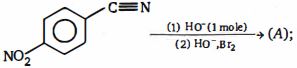
A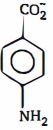
B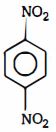
C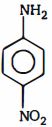
D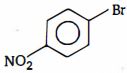
Solution
(D) The reaction sequence is as follows:
$1$. The starting material is $p$-nitrobenzonitrile $(O_2N-C_6H_4-CN)$.
$2$. Treatment with $1 \ mole$ of $HO^-$ (alkaline hydrolysis) converts the nitrile group $(-CN)$ into an amide group $(-CONH_2)$.
$3$. The resulting intermediate is $p$-nitrobenzamide $(O_2N-C_6H_4-CONH_2)$.
$4$. Subsequent treatment with $HO^-$ and $Br_2$ constitutes the Hofmann bromamide degradation reaction.
$5$. This reaction converts the amide group $(-CONH_2)$ into a primary amine group $(-NH_2)$,resulting in $p$-nitroaniline $(O_2N-C_6H_4-NH_2)$.
$6$. Thus,the final product $(A)$ is $p$-nitroaniline.
$1$. The starting material is $p$-nitrobenzonitrile $(O_2N-C_6H_4-CN)$.
$2$. Treatment with $1 \ mole$ of $HO^-$ (alkaline hydrolysis) converts the nitrile group $(-CN)$ into an amide group $(-CONH_2)$.
$3$. The resulting intermediate is $p$-nitrobenzamide $(O_2N-C_6H_4-CONH_2)$.
$4$. Subsequent treatment with $HO^-$ and $Br_2$ constitutes the Hofmann bromamide degradation reaction.
$5$. This reaction converts the amide group $(-CONH_2)$ into a primary amine group $(-NH_2)$,resulting in $p$-nitroaniline $(O_2N-C_6H_4-NH_2)$.
$6$. Thus,the final product $(A)$ is $p$-nitroaniline.
0 likes
View Solution104
DifficultMCQ
Consider the following sequence of reactions:
$PhCOOH$ $\xrightarrow[2. NH_3]{1. PCl_5} A$ $\xrightarrow[2. H_2/Ni]{1. P_4O_{10}, \text{heat}} B.$
The final product $(B)$ is:
$PhCOOH$ $\xrightarrow[2. NH_3]{1. PCl_5} A$ $\xrightarrow[2. H_2/Ni]{1. P_4O_{10}, \text{heat}} B.$
The final product $(B)$ is:
A
benzonitrile
B
benzylamine
C
aniline
D
benzamide
Solution
(B) $1.$ Reaction of $PhCOOH$ with $PCl_5$ followed by $NH_3$ yields benzamide $(PhCONH_2)$,which is product $A$.
$2.$ Dehydration of benzamide $(PhCONH_2)$ with $P_4O_{10}$ under heating gives benzonitrile $(PhCN)$.
$3.$ Catalytic hydrogenation of benzonitrile $(PhCN)$ with $H_2/Ni$ reduces the nitrile group to a primary amine,resulting in benzylamine $(PhCH_2NH_2)$,which is product $B$.
$2.$ Dehydration of benzamide $(PhCONH_2)$ with $P_4O_{10}$ under heating gives benzonitrile $(PhCN)$.
$3.$ Catalytic hydrogenation of benzonitrile $(PhCN)$ with $H_2/Ni$ reduces the nitrile group to a primary amine,resulting in benzylamine $(PhCH_2NH_2)$,which is product $B$.
0 likes
View Solution105
DifficultMCQ
$C_2H_5Br$ $\xrightarrow{AgCN} X$ $\xrightarrow{\text{Reduction}} Y$. Here $Y$ is
A
Ethyl methyl amine
B
$n$-propylamine
C
Isopropylamine
D
Ethylamine
Solution
(A) The reaction of ethyl bromide with $AgCN$ produces ethyl isocyanide as the major product because $AgCN$ is a covalent compound.
$C_2H_5Br + AgCN \rightarrow C_2H_5NC (X) + AgBr$
Reduction of isocyanides with reducing agents like $LiAlH_4$ or catalytic hydrogenation yields secondary amines.
$C_2H_5NC + 4[H] \rightarrow C_2H_5NHCH_3 (Y)$
Thus,$Y$ is ethyl methyl amine.
$C_2H_5Br + AgCN \rightarrow C_2H_5NC (X) + AgBr$
Reduction of isocyanides with reducing agents like $LiAlH_4$ or catalytic hydrogenation yields secondary amines.
$C_2H_5NC + 4[H] \rightarrow C_2H_5NHCH_3 (Y)$
Thus,$Y$ is ethyl methyl amine.
0 likes
View Solution106
DifficultMCQ
An aromatic compound $A$ having molecular formula $C_7H_6O_2$ on treating with aqueous ammonia and heating forms compound $B$. The compound $B$ on reaction with molecular bromine and potassium hydroxide provides compound $C$ having molecular formula $C_6H_7N$. The structure of $A$ is
A
Benzoic acid
B
$3-$($2$-furyl)acrylaldehyde
C
Salicylaldehyde
D
$4-$hydroxybenzaldehyde
Solution
(A) $1$. Compound $A$ is $C_7H_6O_2$. When treated with aqueous ammonia and heated,it forms compound $B$. This suggests $A$ is benzoic acid $(C_6H_5COOH)$,which reacts with $NH_3$ to form ammonium benzoate,and upon heating,it dehydrates to form benzamide $(C_6H_5CONH_2)$ as compound $B$.
$2$. Compound $B$ (benzamide,$C_6H_5CONH_2$) reacts with $Br_2$ and $KOH$ (Hofmann bromamide degradation) to form aniline $(C_6H_5NH_2)$ as compound $C$.
$3$. The molecular formula of aniline is $C_6H_7N$,which matches the given formula for $C$.
$4$. Therefore,compound $A$ is benzoic acid.
$2$. Compound $B$ (benzamide,$C_6H_5CONH_2$) reacts with $Br_2$ and $KOH$ (Hofmann bromamide degradation) to form aniline $(C_6H_5NH_2)$ as compound $C$.
$3$. The molecular formula of aniline is $C_6H_7N$,which matches the given formula for $C$.
$4$. Therefore,compound $A$ is benzoic acid.
0 likes
View Solution107
DifficultMCQ
Which of the following amines can be prepared by Gabriel phthalimide reaction?
A
$t-$butylamine
B
$n-$butylamine
C
neo-pentylamine
D
triethylamine
Solution
(B) The Gabriel phthalimide synthesis is used for the preparation of primary aliphatic amines.
In this reaction,potassium phthalimide reacts with an alkyl halide $(R-X)$ to form an $N-$alkylphthalimide,which on hydrolysis gives a primary amine $(R-NH_2)$.
This reaction involves an $S_N2$ mechanism. Therefore,it works best with primary alkyl halides.
Secondary and tertiary alkyl halides undergo elimination reactions instead of substitution,and aryl halides do not undergo this reaction due to the partial double bond character of the $C-X$ bond.
Among the given options,$n-$butylamine is a primary amine derived from a primary alkyl halide ($n-$butyl bromide),which readily undergoes $S_N2$ substitution.
$t-$butylamine (tertiary) and triethylamine (tertiary) cannot be prepared by this method.
Thus,the correct answer is $n-$butylamine.
In this reaction,potassium phthalimide reacts with an alkyl halide $(R-X)$ to form an $N-$alkylphthalimide,which on hydrolysis gives a primary amine $(R-NH_2)$.
This reaction involves an $S_N2$ mechanism. Therefore,it works best with primary alkyl halides.
Secondary and tertiary alkyl halides undergo elimination reactions instead of substitution,and aryl halides do not undergo this reaction due to the partial double bond character of the $C-X$ bond.
Among the given options,$n-$butylamine is a primary amine derived from a primary alkyl halide ($n-$butyl bromide),which readily undergoes $S_N2$ substitution.
$t-$butylamine (tertiary) and triethylamine (tertiary) cannot be prepared by this method.
Thus,the correct answer is $n-$butylamine.
0 likes
View Solution108
DifficultMCQ
Ethylamine $(C_2H_5NH_2)$ can be obtained from $N$-ethylphthalimide on treatment with:
A
$CaH_2$
B
$H_2O$
C
$NaBH_4$
D
$NH_2NH_2$
Solution
(D) The conversion of $N$-ethylphthalimide to ethylamine is the final step of the Gabriel phthalimide synthesis.
This reaction involves the hydrolysis of $N$-ethylphthalimide using an aqueous base (like $NaOH$) followed by acidification,or more commonly,treatment with hydrazine $(NH_2NH_2)$ to cleave the phthalimide ring and release the primary amine.
In the context of the provided options,$NH_2NH_2$ is the standard reagent used to liberate the primary amine from the $N$-substituted phthalimide.
This reaction involves the hydrolysis of $N$-ethylphthalimide using an aqueous base (like $NaOH$) followed by acidification,or more commonly,treatment with hydrazine $(NH_2NH_2)$ to cleave the phthalimide ring and release the primary amine.
In the context of the provided options,$NH_2NH_2$ is the standard reagent used to liberate the primary amine from the $N$-substituted phthalimide.
0 likes
View Solution109
DifficultMCQ
Which of the following is $NOT$ a correct method for the preparation of benzylamine $(C_6H_5CH_2NH_2)$ from cyanobenzene $(C_6H_5CN)$?
A
$i$. $HCl/H_2O$ $ii$. $NaBH_4$
B
$i$. $LiAlH_4$ $ii$. $H_3O^{+}$
C
$i$. $SnCl_2 + HCl(gas)$ $ii$. $NaBH_4$
D
$H_2/Ni$
Solution
(A) Cyanobenzene $(C_6H_5CN)$ can be reduced to benzylamine $(C_6H_5CH_2NH_2)$ using strong reducing agents like $LiAlH_4$ or catalytic hydrogenation $(H_2/Ni)$.
Option $A$ involves $HCl/H_2O$ (hydrolysis) which converts the nitrile to a carboxylic acid,and $NaBH_4$ is not strong enough to reduce nitriles to amines.
Option $C$ involves the Stephen reduction $(SnCl_2/HCl)$ which typically reduces nitriles to imines,and $NaBH_4$ is not the standard reagent to complete this specific conversion to a primary amine.
Therefore,options $A$ and $C$ are not standard methods for this preparation.
Option $A$ involves $HCl/H_2O$ (hydrolysis) which converts the nitrile to a carboxylic acid,and $NaBH_4$ is not strong enough to reduce nitriles to amines.
Option $C$ involves the Stephen reduction $(SnCl_2/HCl)$ which typically reduces nitriles to imines,and $NaBH_4$ is not the standard reagent to complete this specific conversion to a primary amine.
Therefore,options $A$ and $C$ are not standard methods for this preparation.
0 likes
View Solution110
MediumMCQ
$CH_3-COOH$ $\xrightarrow{NH_3} X$ $\xrightarrow{\Delta} Y$ $\xrightarrow{LiAlH_4} Z$; $Z$ is:
A
$CH_3-CH_2-OH$
B
$CH_3-NH_2$
C
$CH_3-OH$
D
$CH_3-CH_2-NH_2$
Solution
(D) The reaction sequence is as follows:
$CH_3-COOH + NH_3 \rightarrow CH_3-COONH_4 (X)$ (Ammonium acetate)
$CH_3-COONH_4 \xrightarrow{\Delta} CH_3-CONH_2 (Y) + H_2O$ (Acetamide)
$CH_3-CONH_2 \xrightarrow{LiAlH_4} CH_3-CH_2-NH_2 (Z)$ (Ethylamine)
Thus,$Z$ is $CH_3-CH_2-NH_2$ (Ethylamine).
$CH_3-COOH + NH_3 \rightarrow CH_3-COONH_4 (X)$ (Ammonium acetate)
$CH_3-COONH_4 \xrightarrow{\Delta} CH_3-CONH_2 (Y) + H_2O$ (Acetamide)
$CH_3-CONH_2 \xrightarrow{LiAlH_4} CH_3-CH_2-NH_2 (Z)$ (Ethylamine)
Thus,$Z$ is $CH_3-CH_2-NH_2$ (Ethylamine).
0 likes
View Solution111
DifficultMCQ
In the given reaction $C_6H_5-C(=O)-CH_3$ $\xrightarrow{NH_2OH/H^{+}} X$ $\xrightarrow{Na/C_2H_5OH} Y$. $Y$ will be:
A
$C_6H_5-CH(NH_2)-CH_3$
B
$C_6H_5-CH(CH_3)-NH-CH_3$
C
$C_6H_5-CO-NH-CH_3$
D
$CH_3-CO-NH-C_6H_5$
Solution
(A) Acetophenone reacts with hydroxylamine $(NH_2OH)$ in an acidic medium to form acetophenone oxime $(X)$.
The reduction of this oxime with sodium and ethanol $(Na/C_2H_5OH)$ yields $1$-phenylethanamine $(Y)$.
Reaction:
$C_6H_5-C(=O)-CH_3 + NH_2OH \xrightarrow{H^{+}} C_6H_5-C(=NOH)-CH_3 (X) + H_2O$
$C_6H_5-C(=NOH)-CH_3 \xrightarrow{Na/C_2H_5OH} C_6H_5-CH(NH_2)-CH_3 (Y)$
The reduction of this oxime with sodium and ethanol $(Na/C_2H_5OH)$ yields $1$-phenylethanamine $(Y)$.
Reaction:
$C_6H_5-C(=O)-CH_3 + NH_2OH \xrightarrow{H^{+}} C_6H_5-C(=NOH)-CH_3 (X) + H_2O$
$C_6H_5-C(=NOH)-CH_3 \xrightarrow{Na/C_2H_5OH} C_6H_5-CH(NH_2)-CH_3 (Y)$
0 likes
View Solution112
MediumMCQ
$CH_3CN \xrightarrow{Na + C_2H_5OH} x$. The compound $x$ is
A
$CH_3CONH_2$
B
$CH_3CH_2NH_2$
C
$C_2H_6$
D
$CH_3NHCH_3$
Solution
(B) The reaction of $CH_3CN$ (acetonitrile) with $Na + C_2H_5OH$ is a reduction reaction known as the $Mendius$ reduction.
In this reaction,the nitrile group $(-CN)$ is reduced to a primary amine $(-CH_2NH_2)$.
The chemical equation is: $CH_3CN + 4[H] \xrightarrow{Na/C_2H_5OH} CH_3CH_2NH_2$.
Thus,the product $x$ is $CH_3CH_2NH_2$ (ethylamine).
In this reaction,the nitrile group $(-CN)$ is reduced to a primary amine $(-CH_2NH_2)$.
The chemical equation is: $CH_3CN + 4[H] \xrightarrow{Na/C_2H_5OH} CH_3CH_2NH_2$.
Thus,the product $x$ is $CH_3CH_2NH_2$ (ethylamine).
0 likes
View Solution113
DifficultMCQ
Starting from propanoic acid,the following reactions were carried out: $CH_3-CH_2-COOH$ $\xrightarrow{SOCl_2} [X]$ $\xrightarrow[\Delta]{NH_3} [Y]$ $\xrightarrow[KOH]{Br_2} [Z]$. Product $[Z]$ will be?
A
$CH_3-CH_2-Br$
B
$CH_3-CH_2-NH_2$
C
$CH_3-CH_2-COBr$
D
$CH_3-CH_2-CH_2-NH_2$
Solution
(B) The reaction sequence is as follows:
$1.$ $CH_3-CH_2-COOH + SOCl_2 \rightarrow CH_3-CH_2-COCl + SO_2 + HCl$ (Formation of acid chloride $[X]$)
$2.$ $CH_3-CH_2-COCl + NH_3 \xrightarrow{\Delta} CH_3-CH_2-CONH_2 + HCl$ (Formation of amide $[Y]$)
$3.$ $CH_3-CH_2-CONH_2 + Br_2 + 4KOH \rightarrow CH_3-CH_2-NH_2 + K_2CO_3 + 2KBr + 2H_2O$ (Hoffmann Bromamide Degradation to form amine $[Z]$)
Thus,$[Z]$ is $CH_3-CH_2-NH_2$.
$1.$ $CH_3-CH_2-COOH + SOCl_2 \rightarrow CH_3-CH_2-COCl + SO_2 + HCl$ (Formation of acid chloride $[X]$)
$2.$ $CH_3-CH_2-COCl + NH_3 \xrightarrow{\Delta} CH_3-CH_2-CONH_2 + HCl$ (Formation of amide $[Y]$)
$3.$ $CH_3-CH_2-CONH_2 + Br_2 + 4KOH \rightarrow CH_3-CH_2-NH_2 + K_2CO_3 + 2KBr + 2H_2O$ (Hoffmann Bromamide Degradation to form amine $[Z]$)
Thus,$[Z]$ is $CH_3-CH_2-NH_2$.
0 likes
View Solution114
AdvancedMCQ
An aromatic compound '$A$' on treatment with aqueous ammonia and heating forms compound '$B$',which on heating with $Br_2$ and $KOH$ forms a compound $C$ of molecular formula $C_6H_7N$. The structures of compound $A, B$ and $C$ are respectively:
A
$C_6H_5CH_3$,$C_6H_5CONH_2$,$C_6H_5CH_2NH_2$
B
$C_6H_5CHO$,$C_6H_5CONHCH_3$,$C_6H_5CH_2NH_2$
C
$C_6H_5COOH$,$C_6H_5CONH_2$,$C_6H_5NH_2$
D
$C_6H_5COOH$,$C_6H_5NH-C_2H_5$,$C_6H_5NH_2$
Solution
(C) The reaction sequence is as follows:
$1$. Compound $A$ ($C_6H_5COOH$,benzoic acid) reacts with aqueous ammonia $(NH_3)$ followed by heating to form compound $B$ ($C_6H_5CONH_2$,benzamide).
$2$. Benzamide $(C_6H_5CONH_2)$ undergoes the Hofmann bromamide degradation reaction with $Br_2$ and $KOH$ to form compound $C$ ($C_6H_5NH_2$,aniline).
$3$. The molecular formula of aniline is $C_6H_7N$,which matches the given formula.
Therefore,the correct sequence is $A = C_6H_5COOH$,$B = C_6H_5CONH_2$,and $C = C_6H_5NH_2$.
$1$. Compound $A$ ($C_6H_5COOH$,benzoic acid) reacts with aqueous ammonia $(NH_3)$ followed by heating to form compound $B$ ($C_6H_5CONH_2$,benzamide).
$2$. Benzamide $(C_6H_5CONH_2)$ undergoes the Hofmann bromamide degradation reaction with $Br_2$ and $KOH$ to form compound $C$ ($C_6H_5NH_2$,aniline).
$3$. The molecular formula of aniline is $C_6H_7N$,which matches the given formula.
Therefore,the correct sequence is $A = C_6H_5COOH$,$B = C_6H_5CONH_2$,and $C = C_6H_5NH_2$.
0 likes
View Solution115
DifficultMCQ
$CH_3-CH_2-I$ $\xrightarrow{NaCN} A$ $\xrightarrow[Partial \ hydrolysis]{\Theta OH} B$ $\xrightarrow[Br_2]{NaOH} C$. Product $C$ is
A
$CH_3-COOH$
B
$CH_3-CH_2-CONH_2$
C
$CH_3-CH_2-NH_2$
D
$CH_3-NH_2$
Solution
(C) Step $1$: $CH_3-CH_2-I$ reacts with $NaCN$ to form $CH_3-CH_2-CN$ $(A)$ via nucleophilic substitution.
Step $2$: Partial hydrolysis of $CH_3-CH_2-CN$ $(A)$ in the presence of $\Theta OH$ yields $CH_3-CH_2-CONH_2$ $(B)$ (propanamide).
Step $3$: The reaction of $CH_3-CH_2-CONH_2$ $(B)$ with $Br_2$ and $NaOH$ is the Hofmann bromamide degradation reaction,which converts an amide into a primary amine with one carbon atom less.
Step $4$: The product $C$ is $CH_3-CH_2-NH_2$ (ethanamine).
Step $2$: Partial hydrolysis of $CH_3-CH_2-CN$ $(A)$ in the presence of $\Theta OH$ yields $CH_3-CH_2-CONH_2$ $(B)$ (propanamide).
Step $3$: The reaction of $CH_3-CH_2-CONH_2$ $(B)$ with $Br_2$ and $NaOH$ is the Hofmann bromamide degradation reaction,which converts an amide into a primary amine with one carbon atom less.
Step $4$: The product $C$ is $CH_3-CH_2-NH_2$ (ethanamine).
0 likes
View Solution116
DifficultMCQ
The product obtained by the reaction of ethyl chloride with potassium cyanide is reduced with sodium and alcohol to give ...............
A
Propylamine
B
Ethylamine
C
Diethylamine
D
Acetic acid
Solution
(A) The reaction proceeds in two steps:
$1$. Ethyl chloride $(C_2H_5Cl)$ reacts with potassium cyanide $(KCN)$ to form ethyl cyanide (propanenitrile): $C_2H_5Cl + KCN \rightarrow C_2H_5CN + KCl$.
$2$. The reduction of ethyl cyanide $(C_2H_5CN)$ with sodium $(Na)$ and alcohol $(C_2H_5OH)$ (Mendius reduction) yields propylamine ($C_2H_5CH_2NH_2$ or $CH_3CH_2CH_2NH_2$): $C_2H_5CN + 4[H] \xrightarrow{Na/C_2H_5OH} CH_3CH_2CH_2NH_2$.
$1$. Ethyl chloride $(C_2H_5Cl)$ reacts with potassium cyanide $(KCN)$ to form ethyl cyanide (propanenitrile): $C_2H_5Cl + KCN \rightarrow C_2H_5CN + KCl$.
$2$. The reduction of ethyl cyanide $(C_2H_5CN)$ with sodium $(Na)$ and alcohol $(C_2H_5OH)$ (Mendius reduction) yields propylamine ($C_2H_5CH_2NH_2$ or $CH_3CH_2CH_2NH_2$): $C_2H_5CN + 4[H] \xrightarrow{Na/C_2H_5OH} CH_3CH_2CH_2NH_2$.
0 likes
View Solution117
MediumMCQ
The best reagent for converting $2-$phenylpropanamide into $2-$phenylpropanamine is
A
Excess $H_2$
B
$Br_2$ in aqueous $NaOH$
C
Iodine in presence of red phosphorus
D
$LiAlH_4$ in ether
Solution
(D) The conversion of an amide $(R-CONH_2)$ to an amine $(R-CH_2NH_2)$ with the same number of carbon atoms is best achieved by reduction using $LiAlH_4$ in ether.
The reaction is as follows:
$C_6H_5-CH(CH_3)-CONH_2 \xrightarrow{LiAlH_4 / \text{ether}} C_6H_5-CH(CH_3)-CH_2NH_2$
Option $B$ ($Br_2$ in aqueous $NaOH$) is used for the Hofmann bromamide degradation reaction,which converts an amide to an amine with one carbon atom less than the parent amide.
The reaction is as follows:
$C_6H_5-CH(CH_3)-CONH_2 \xrightarrow{LiAlH_4 / \text{ether}} C_6H_5-CH(CH_3)-CH_2NH_2$
Option $B$ ($Br_2$ in aqueous $NaOH$) is used for the Hofmann bromamide degradation reaction,which converts an amide to an amine with one carbon atom less than the parent amide.
0 likes
View Solution118
DifficultMCQ
In a set of reactions,$m$-bromobenzoic acid gives a product $D$. Identify the product $D$.
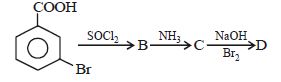
A
$3-$bromobenzenesulfonamide
B
$m$-aminobenzoic acid
C
$m$-bromoaniline
D
$m$-bromobenzamide
Solution
(C) The reaction sequence is as follows:
$1$. $m$-bromobenzoic acid reacts with $SOCl_2$ to form $m$-bromobenzoyl chloride $(B)$.
$2$. $m$-bromobenzoyl chloride reacts with $NH_3$ to form $m$-bromobenzamide $(C)$.
$3$. $m$-bromobenzamide undergoes the Hofmann bromamide degradation reaction with $NaOH$ and $Br_2$ to form $m$-bromoaniline $(D)$.
Therefore,the final product $D$ is $m$-bromoaniline.
$1$. $m$-bromobenzoic acid reacts with $SOCl_2$ to form $m$-bromobenzoyl chloride $(B)$.
$2$. $m$-bromobenzoyl chloride reacts with $NH_3$ to form $m$-bromobenzamide $(C)$.
$3$. $m$-bromobenzamide undergoes the Hofmann bromamide degradation reaction with $NaOH$ and $Br_2$ to form $m$-bromoaniline $(D)$.
Therefore,the final product $D$ is $m$-bromoaniline.
0 likes
View Solution119
MediumMCQ
Which of the following gives a primary amine on reduction?
A
$CH_3CH_2NO_2$
B
$CH_3CH_2-O-N=O$
C
$C_6H_5N=NC_6H_5$
D
$CH_3CH_2NC$
Solution
(A) The reduction of nitroalkanes $(R-NO_2)$ yields primary amines $(R-NH_2)$.
For example,$CH_3CH_2NO_2 + 6[H] \xrightarrow{Sn/HCl} CH_3CH_2NH_2 + 2H_2O$.
Option $B$ is an alkyl nitrite,which on reduction gives alcohol and ammonia.
Option $C$ is azobenzene,which on reduction gives aniline (a primary amine),but nitroalkanes are the standard textbook example for primary amine preparation via reduction.
Option $D$ is an isocyanide,which on reduction gives a secondary amine $(R-NH-CH_3)$.
For example,$CH_3CH_2NO_2 + 6[H] \xrightarrow{Sn/HCl} CH_3CH_2NH_2 + 2H_2O$.
Option $B$ is an alkyl nitrite,which on reduction gives alcohol and ammonia.
Option $C$ is azobenzene,which on reduction gives aniline (a primary amine),but nitroalkanes are the standard textbook example for primary amine preparation via reduction.
Option $D$ is an isocyanide,which on reduction gives a secondary amine $(R-NH-CH_3)$.
0 likes
View Solution120
Medium
Write chemical equations for the following reactions:
$(i)$ Reaction of ethanolic $NH_3$ with $C_2H_5-Cl$.
$(ii)$ Ammonolysis of benzyl chloride and reaction of amine so formed with two moles of $CH_3-Cl$.
$(i)$ Reaction of ethanolic $NH_3$ with $C_2H_5-Cl$.
$(ii)$ Ammonolysis of benzyl chloride and reaction of amine so formed with two moles of $CH_3-Cl$.
Solution
$(i)$ $C_2H_5-Cl + NH_3 (\text{ethanolic}) \xrightarrow{\Delta} C_2H_5-NH_2 + HCl$
$(ii)$ $C_6H_5-CH_2-Cl + NH_3 \rightarrow C_6H_5-CH_2-NH_2 + HCl$
$C_6H_5-CH_2-NH_2 + 2CH_3-Cl \rightarrow C_6H_5-CH_2-N(CH_3)_2 + 2HCl$
$(ii)$ $C_6H_5-CH_2-Cl + NH_3 \rightarrow C_6H_5-CH_2-NH_2 + HCl$
$C_6H_5-CH_2-NH_2 + 2CH_3-Cl \rightarrow C_6H_5-CH_2-N(CH_3)_2 + 2HCl$
0 likes
View Solution121
Medium
Write chemical equations for the following conversions:
$(i)$ $CH_3-CH_2-Cl$ into $CH_3-CH_2-CH_2-NH_2$
$(ii)$ $C_6H_5-CH_2-Cl$ into $C_6H_5-CH_2-CH_2-NH_2$
$(i)$ $CH_3-CH_2-Cl$ into $CH_3-CH_2-CH_2-NH_2$
$(ii)$ $C_6H_5-CH_2-Cl$ into $C_6H_5-CH_2-CH_2-NH_2$
Solution
(N/A) $(i)$ $CH_3-CH_2-Cl$ $\xrightarrow{Ethanolic \ NaCN} CH_3-CH_2-CN$ $\xrightarrow{H_2/Ni \ \text{or} \ LiAlH_4} CH_3-CH_2-CH_2-NH_2$
$(ii)$ $C_6H_5-CH_2-Cl$ $\xrightarrow{Ethanolic \ NaCN} C_6H_5-CH_2-CN$ $\xrightarrow{H_2/Ni \ \text{or} \ LiAlH_4} C_6H_5-CH_2-CH_2-NH_2$
$(ii)$ $C_6H_5-CH_2-Cl$ $\xrightarrow{Ethanolic \ NaCN} C_6H_5-CH_2-CN$ $\xrightarrow{H_2/Ni \ \text{or} \ LiAlH_4} C_6H_5-CH_2-CH_2-NH_2$
0 likes
View Solution122
Medium
Write the structures and $IUPAC$ names of:
$(i)$ the amide which gives propanamine by Hoffmann bromamide reaction
$(ii)$ the amine produced by the Hoffmann degradation of benzamide.
$(i)$ the amide which gives propanamine by Hoffmann bromamide reaction
$(ii)$ the amine produced by the Hoffmann degradation of benzamide.
Solution
(N/A) $(i)$ Propanamine contains three carbon atoms. Hoffmann bromamide degradation reaction involves the loss of one carbon atom from the amide group. Hence,the starting amide must contain four carbon atoms. The structure and $IUPAC$ name of the amide are:
$CH_3-CH_2-CH_2-CONH_2$ (Butanamide)
$(ii)$ Benzamide is an aromatic amide containing seven carbon atoms. Hoffmann degradation of benzamide removes the carbonyl carbon,resulting in an aromatic primary amine containing six carbon atoms $(C_6H_5NH_2)$. The product is aniline,also known as benzenamine.
$CH_3-CH_2-CH_2-CONH_2$ (Butanamide)
$(ii)$ Benzamide is an aromatic amide containing seven carbon atoms. Hoffmann degradation of benzamide removes the carbonyl carbon,resulting in an aromatic primary amine containing six carbon atoms $(C_6H_5NH_2)$. The product is aniline,also known as benzenamine.
0 likes
View Solution123
Difficult
Why cannot aromatic primary amines be prepared by Gabriel phthalimide synthesis?
Solution
(N/A) Gabriel phthalimide synthesis is used for the preparation of aliphatic primary amines. It involves nucleophilic substitution $(S_{N}2)$ of alkyl halides by the anion formed by the phthalimide.
However,aryl halides do not undergo nucleophilic substitution with the anion formed by the phthalimide because the carbon-halogen bond in aryl halides has partial double bond character and the electron-rich benzene ring repels the nucleophile.
Hence,aromatic primary amines cannot be prepared by this process.
However,aryl halides do not undergo nucleophilic substitution with the anion formed by the phthalimide because the carbon-halogen bond in aryl halides has partial double bond character and the electron-rich benzene ring repels the nucleophile.
Hence,aromatic primary amines cannot be prepared by this process.
0 likes
View Solution124
Medium
Explain the method of preparation for amine compounds by the reduction of nitro compounds.
Solution
(N/A) Reduction of nitro compounds: Nitro compounds are reduced to amines by passing hydrogen gas in the presence of finely divided nickel,palladium,or platinum,and also by reduction with metals in an acidic medium.
Reduction with iron scrap and hydrochloric acid is preferred because the $FeCl_2$ formed gets hydrolysed to release hydrochloric acid during the reaction. Thus,only a small amount of hydrochloric acid is required to initiate the reaction.
Nitroalkanes can also be similarly reduced to the corresponding alkanamines.
$CH_3CH_2NO_2 \xrightarrow[\text{ethanol}]{H_2 / Pd} CH_3CH_2NH_2$
Additionally,nitrobenzene can be reduced to aniline as follows:
$C_6H_5NO_2 \xrightarrow[\text{ethanol}]{H_2 / Pd} C_6H_5NH_2$
$C_6H_5NO_2 \xrightarrow{Sn + HCl \text{ or } Fe + HCl} C_6H_5NH_2$
Reduction with iron scrap and hydrochloric acid is preferred because the $FeCl_2$ formed gets hydrolysed to release hydrochloric acid during the reaction. Thus,only a small amount of hydrochloric acid is required to initiate the reaction.
Nitroalkanes can also be similarly reduced to the corresponding alkanamines.
$CH_3CH_2NO_2 \xrightarrow[\text{ethanol}]{H_2 / Pd} CH_3CH_2NH_2$
Additionally,nitrobenzene can be reduced to aniline as follows:
$C_6H_5NO_2 \xrightarrow[\text{ethanol}]{H_2 / Pd} C_6H_5NH_2$
$C_6H_5NO_2 \xrightarrow{Sn + HCl \text{ or } Fe + HCl} C_6H_5NH_2$
0 likes
View Solution125
Medium
Explain the ammonolysis of alkyl halide compounds.
Solution
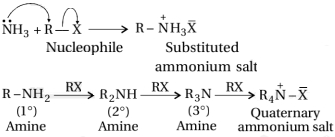
(N/A) The carbon-halogen bond in alkyl or benzyl halides can be easily cleaved by a nucleophile. Hence,an alkyl or benzyl halide on reaction with an ethanolic solution of ammonia undergoes a nucleophilic substitution reaction in which the halogen atom is replaced by an amino $(-NH_{2})$ group. This process of cleavage of the $C-X$ bond by an ammonia molecule is known as ammonolysis.
The reaction is carried out in a sealed tube at $373 \ K$. The primary amine thus obtained behaves as a nucleophile and can further react with alkyl halide to form secondary and tertiary amines,and finally a quaternary ammonium salt.
The free amine can be obtained from the ammonium salt by treatment with a strong base: $R-NH_{3}^{+}X^{-} + NaOH \rightarrow R-NH_{2} + H_{2}O + Na^{+}X^{-}$.
Ammonolysis has the disadvantage of yielding a mixture of primary,secondary,and tertiary amines and also a quaternary ammonium salt.
However,a primary amine is obtained as a major product by taking a large excess of ammonia.
The order of reactivity of halides with amines is $R-I > R-Br > R-Cl$.
The reaction is carried out in a sealed tube at $373 \ K$. The primary amine thus obtained behaves as a nucleophile and can further react with alkyl halide to form secondary and tertiary amines,and finally a quaternary ammonium salt.
The free amine can be obtained from the ammonium salt by treatment with a strong base: $R-NH_{3}^{+}X^{-} + NaOH \rightarrow R-NH_{2} + H_{2}O + Na^{+}X^{-}$.
Ammonolysis has the disadvantage of yielding a mixture of primary,secondary,and tertiary amines and also a quaternary ammonium salt.
However,a primary amine is obtained as a major product by taking a large excess of ammonia.
The order of reactivity of halides with amines is $R-I > R-Br > R-Cl$.
0 likes
View Solution126
Medium
Explain the method of preparation of amine compounds by the reduction of nitrile and amide compounds.
Solution
Reduction of nitriles: Nitriles on reduction with lithium aluminium hydride $(LiAlH_{4})$ or catalytic hydrogenation produce primary amines. This reaction is used for the ascent of the amine series,i.e.,for the preparation of amines containing one carbon atom more than the starting nitrile.
Reduction of amides: The amides on reduction with lithium aluminium hydride yield primary amines.
$R-C \equiv N \xrightarrow{H_{2}/Ni \text{ or } Na(Hg)/C_{2}H_{5}OH} R-CH_{2}-NH_{2}$
$CH_{3}-C \equiv N \xrightarrow{H_{2}/Ni \text{ or } Na(Hg)/C_{2}H_{5}OH} CH_{3}-CH_{2}-NH_{2}$
$R-CONH_{2} \xrightarrow{LiAlH_{4} / H_{2}O} R-CH_{2}-NH_{2}$
$CH_{3}-CONH_{2} \xrightarrow{LiAlH_{4} / H_{2}O} CH_{3}-CH_{2}-NH_{2}$
Reduction of amides: The amides on reduction with lithium aluminium hydride yield primary amines.
$R-C \equiv N \xrightarrow{H_{2}/Ni \text{ or } Na(Hg)/C_{2}H_{5}OH} R-CH_{2}-NH_{2}$
$CH_{3}-C \equiv N \xrightarrow{H_{2}/Ni \text{ or } Na(Hg)/C_{2}H_{5}OH} CH_{3}-CH_{2}-NH_{2}$
$R-CONH_{2} \xrightarrow{LiAlH_{4} / H_{2}O} R-CH_{2}-NH_{2}$
$CH_{3}-CONH_{2} \xrightarrow{LiAlH_{4} / H_{2}O} CH_{3}-CH_{2}-NH_{2}$
0 likes
View Solution127
Medium
Explain Gabriel phthalimide synthesis.
Solution
(N/A) Gabriel synthesis is used for the preparation of primary amines.
Phthalimide on treatment with ethanolic potassium hydroxide $(KOH)$ forms the potassium salt of phthalimide,which on heating with an alkyl halide $(R-X)$ followed by alkaline hydrolysis produces the corresponding primary amine $(R-NH_2)$.
The reaction sequence is as follows:
$1$. Phthalimide reacts with $KOH$ to form potassium phthalimide.
$2$. Potassium phthalimide reacts with alkyl halide $(R-X)$ to form $N$-alkylphthalimide.
$3$. $N$-alkylphthalimide undergoes alkaline hydrolysis to yield the primary amine $(R-NH_2)$ and phthalic acid (as a salt).
Aromatic primary amines cannot be prepared by this method because aryl halides do not undergo nucleophilic substitution with the anion formed by phthalimide.
Phthalimide on treatment with ethanolic potassium hydroxide $(KOH)$ forms the potassium salt of phthalimide,which on heating with an alkyl halide $(R-X)$ followed by alkaline hydrolysis produces the corresponding primary amine $(R-NH_2)$.
The reaction sequence is as follows:
$1$. Phthalimide reacts with $KOH$ to form potassium phthalimide.
$2$. Potassium phthalimide reacts with alkyl halide $(R-X)$ to form $N$-alkylphthalimide.
$3$. $N$-alkylphthalimide undergoes alkaline hydrolysis to yield the primary amine $(R-NH_2)$ and phthalic acid (as a salt).
Aromatic primary amines cannot be prepared by this method because aryl halides do not undergo nucleophilic substitution with the anion formed by phthalimide.
0 likes
View Solution128
Medium
Explain the Hoffmann bromamide degradation reaction.
Solution
Hoffmann developed a method for the preparation of primary amines by treating an amide with bromine in an aqueous or ethanolic solution of sodium hydroxide.
In this degradation reaction,migration of an alkyl or aryl group takes place from the carbonyl carbon of the amide to the nitrogen atom.
The amine so formed contains one carbon atom less than that present in the amide.
The general reaction is:
$R-CONH_2 + Br_2 + 4NaOH \rightarrow R-NH_2 + Na_2CO_3 + 2NaBr + 2H_2O$
Example:
$CH_3CONH_2 + Br_2 + 4NaOH \rightarrow CH_3NH_2 + Na_2CO_3 + 2NaBr + 2H_2O$
(Ethanamide to Methanamine)
In this degradation reaction,migration of an alkyl or aryl group takes place from the carbonyl carbon of the amide to the nitrogen atom.
The amine so formed contains one carbon atom less than that present in the amide.
The general reaction is:
$R-CONH_2 + Br_2 + 4NaOH \rightarrow R-NH_2 + Na_2CO_3 + 2NaBr + 2H_2O$
Example:
$CH_3CONH_2 + Br_2 + 4NaOH \rightarrow CH_3NH_2 + Na_2CO_3 + 2NaBr + 2H_2O$
(Ethanamide to Methanamine)
0 likes
View Solution129
Medium
Explain the reaction of diazotization with suitable examples.
Solution
(N/A) The conversion of primary aromatic amines into diazonium salts is known as diazotization. $C_6H_5NH_2 + NaNO_2 + 2HCl \xrightarrow{273-278 \ K} C_6H_5N_2^+Cl^- + NaCl + 2H_2O$.
Benzenediazonium chloride is prepared by the reaction of aniline with nitrous acid at $273-278 \ K$. Nitrous acid is produced in the reaction mixture by the reaction of sodium nitrite with hydrochloric acid.
Due to its instability,the diazonium salt is not generally stored and is used immediately after its preparation. Examples include benzenediazonium chloride and benzenediazonium hydrogen sulphate.
Benzenediazonium chloride is prepared by the reaction of aniline with nitrous acid at $273-278 \ K$. Nitrous acid is produced in the reaction mixture by the reaction of sodium nitrite with hydrochloric acid.
Due to its instability,the diazonium salt is not generally stored and is used immediately after its preparation. Examples include benzenediazonium chloride and benzenediazonium hydrogen sulphate.
0 likes
View Solution130
MediumMCQ
What is the best reagent to convert nitrile to primary amine?
A
$LiAlH_4$
B
$H_2 / Ni$
C
$Na / C_2H_5OH$
D
All of the above
Solution
(D) The reduction of nitriles $(R-CN)$ to primary amines $(R-CH_2NH_2)$ can be achieved using various reducing agents such as $LiAlH_4$,catalytic hydrogenation $(H_2 / Ni)$,or the Mendius reduction using sodium and alcohol $(Na / C_2H_5OH)$.
Therefore,all the listed reagents are effective for this conversion.
Therefore,all the listed reagents are effective for this conversion.
0 likes
View Solution131
Medium
Suggest a route by which the following conversion can be accomplished: Cyclohexanecarboxamide to $N$-methylcyclohexanamine.
Solution
(N/A) The conversion can be achieved in three steps:
$1$. $Hofmann$ bromamide degradation: Cyclohexanecarboxamide reacts with $Br_2/KOH$ to form cyclohexanamine.
$2$. Carbylamine reaction: Cyclohexanamine reacts with $CHCl_3/KOH$ to form cyclohexyl isocyanide.
$3$. Reduction: Cyclohexyl isocyanide is reduced using $H_2/Pd$ to yield $N$-methylcyclohexanamine.
$1$. $Hofmann$ bromamide degradation: Cyclohexanecarboxamide reacts with $Br_2/KOH$ to form cyclohexanamine.
$2$. Carbylamine reaction: Cyclohexanamine reacts with $CHCl_3/KOH$ to form cyclohexyl isocyanide.
$3$. Reduction: Cyclohexyl isocyanide is reduced using $H_2/Pd$ to yield $N$-methylcyclohexanamine.
0 likes
View Solution132
Medium
Identify $A$ and $B$ in the following reaction.
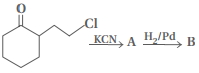
Solution
(A) The reaction proceeds in two steps:
$1$. The starting material is $2-(2-chloroethyl)cyclohexanone$. Treatment with $KCN$ leads to a nucleophilic substitution reaction where the $Cl^-$ ion is replaced by the $CN^-$ group,forming $A$,which is $3-(2-oxocyclohexyl)propanenitrile$.
$2$. The subsequent reduction of the nitrile group $(-CN)$ using $H_2/Pd$ (catalytic hydrogenation) reduces the nitrile to a primary amine $(-CH_2NH_2)$,forming $B$,which is $2-(3-aminopropyl)cyclohexanone$.
$1$. The starting material is $2-(2-chloroethyl)cyclohexanone$. Treatment with $KCN$ leads to a nucleophilic substitution reaction where the $Cl^-$ ion is replaced by the $CN^-$ group,forming $A$,which is $3-(2-oxocyclohexyl)propanenitrile$.
$2$. The subsequent reduction of the nitrile group $(-CN)$ using $H_2/Pd$ (catalytic hydrogenation) reduces the nitrile to a primary amine $(-CH_2NH_2)$,forming $B$,which is $2-(3-aminopropyl)cyclohexanone$.
0 likes
View Solution133
MediumMCQ
The most appropriate reagent for the conversion of $C_2H_5CN$ into $CH_3CH_2CH_2NH_2$ is:
A
$Na(CN)BH_3$
B
$LiAlH_4$
C
$NaBH_4$
D
$CaH_2$
Solution
(B) The conversion of a nitrile $(R-CN)$ to a primary amine $(R-CH_2-NH_2)$ involves the reduction of the cyano group.
$LiAlH_4$ (Lithium aluminium hydride) is a strong reducing agent capable of reducing nitriles to primary amines.
The reaction is:
$CH_3-CH_2-C \equiv N \xrightarrow{LiAlH_4} CH_3-CH_2-CH_2-NH_2$
Therefore,the correct reagent is $LiAlH_4$.
$LiAlH_4$ (Lithium aluminium hydride) is a strong reducing agent capable of reducing nitriles to primary amines.
The reaction is:
$CH_3-CH_2-C \equiv N \xrightarrow{LiAlH_4} CH_3-CH_2-CH_2-NH_2$
Therefore,the correct reagent is $LiAlH_4$.
0 likes
View Solution134
DifficultMCQ
Which of the following compounds can be prepared in good yield by Gabriel phthalimide synthesis?
A
Benzylamine
B
Aniline
C
$2-$Phenylethanamide
D
$N$-Methyl-ethanamine
Solution
(A) Gabriel phthalimide synthesis is used for the preparation of primary $(1^{\circ})$ aliphatic amines.
In this reaction,potassium phthalimide reacts with an alkyl halide to form an $N$-alkylphthalimide,which upon hydrolysis yields a primary aliphatic amine.
Aromatic amines (like aniline) cannot be prepared by this method because aryl halides do not undergo nucleophilic substitution with the phthalimide anion under these conditions.
Among the given options,benzylamine $(C_6H_5CH_2NH_2)$ is a primary aliphatic amine and can be prepared by this method using benzyl chloride as the alkylating agent.
In this reaction,potassium phthalimide reacts with an alkyl halide to form an $N$-alkylphthalimide,which upon hydrolysis yields a primary aliphatic amine.
Aromatic amines (like aniline) cannot be prepared by this method because aryl halides do not undergo nucleophilic substitution with the phthalimide anion under these conditions.
Among the given options,benzylamine $(C_6H_5CH_2NH_2)$ is a primary aliphatic amine and can be prepared by this method using benzyl chloride as the alkylating agent.
0 likes
View Solution135
MediumMCQ
Reaction of propanamide with ethanolic sodium hydroxide and bromine will give
A
Aniline
B
Ethylamine
C
Methylamine
D
Propylamine
Solution
(B) The reaction of an amide with bromine $(Br_2)$ in the presence of an aqueous or ethanolic solution of a strong base like sodium hydroxide $(NaOH)$ is known as the Hofmann bromamide degradation reaction.
In this reaction,the amide is converted into a primary amine containing one carbon atom less than the original amide.
The reaction for propanamide $(CH_3CH_2CONH_2)$ is:
$CH_3CH_2CONH_2 + Br_2 + 4NaOH \rightarrow CH_3CH_2NH_2 + Na_2CO_3 + 2NaBr + 2H_2O$
As shown in the reaction,propanamide ($3$ carbons) yields ethylamine ($2$ carbons).
In this reaction,the amide is converted into a primary amine containing one carbon atom less than the original amide.
The reaction for propanamide $(CH_3CH_2CONH_2)$ is:
$CH_3CH_2CONH_2 + Br_2 + 4NaOH \rightarrow CH_3CH_2NH_2 + Na_2CO_3 + 2NaBr + 2H_2O$
As shown in the reaction,propanamide ($3$ carbons) yields ethylamine ($2$ carbons).
0 likes
View Solution136
Medium
The total number of amines among the following which can be synthesized by Gabriel phthalimide synthesis is:
$(A)$ $(CH_3)_2CH-CH_2-NH_2$
$(B)$ $CH_3CH_2NH_2$
$(C)$ $C_6H_5-CH_2-NH_2$
$(D)$ $C_6H_5-NH_2$
$(A)$ $(CH_3)_2CH-CH_2-NH_2$
$(B)$ $CH_3CH_2NH_2$
$(C)$ $C_6H_5-CH_2-NH_2$
$(D)$ $C_6H_5-NH_2$
Solution
(A) Gabriel phthalimide synthesis is used for the preparation of primary $(1^{\circ})$ aliphatic amines.
$1$. $(CH_3)_2CH-CH_2-NH_2$ is a primary aliphatic amine. It can be synthesized by this method.
$2$. $CH_3CH_2NH_2$ is a primary aliphatic amine. It can be synthesized by this method.
$3$. $C_6H_5-CH_2-NH_2$ (benzylamine) is a primary amine where the $-NH_2$ group is attached to an aliphatic carbon. It can be synthesized by this method.
$4$. $C_6H_5-NH_2$ (aniline) is an aromatic amine. Aromatic primary amines cannot be prepared by Gabriel phthalimide synthesis because aryl halides do not undergo nucleophilic substitution with the anion formed by phthalimide.
Thus,there are $3$ such amines that can be synthesized by this method.
$1$. $(CH_3)_2CH-CH_2-NH_2$ is a primary aliphatic amine. It can be synthesized by this method.
$2$. $CH_3CH_2NH_2$ is a primary aliphatic amine. It can be synthesized by this method.
$3$. $C_6H_5-CH_2-NH_2$ (benzylamine) is a primary amine where the $-NH_2$ group is attached to an aliphatic carbon. It can be synthesized by this method.
$4$. $C_6H_5-NH_2$ (aniline) is an aromatic amine. Aromatic primary amines cannot be prepared by Gabriel phthalimide synthesis because aryl halides do not undergo nucleophilic substitution with the anion formed by phthalimide.
Thus,there are $3$ such amines that can be synthesized by this method.
0 likes
View Solution137
MediumMCQ
The total number of reagents from those given below,that can convert nitrobenzene into aniline is ..... . (Integer answer)
$I.$ $Sn/HCl$
$II.$ $Sn/NH_4OH$
$III.$ $Fe/HCl$
$IV.$ $Zn/HCl$
$V.$ $H_2-Pd$
$VI.$ $H_2-$ Raney Nickel
$I.$ $Sn/HCl$
$II.$ $Sn/NH_4OH$
$III.$ $Fe/HCl$
$IV.$ $Zn/HCl$
$V.$ $H_2-Pd$
$VI.$ $H_2-$ Raney Nickel
A
$3$
B
$4$
C
$5$
D
$6$
Solution
(C) Nitrobenzene can be reduced to aniline using various reducing agents:
$1.$ $Sn/HCl$: This is a standard reduction method for nitro compounds to amines.
$2.$ $Fe/HCl$: This is also a standard reduction method for nitro compounds to amines.
$3.$ $Zn/HCl$: This is a strong reducing agent that can reduce nitrobenzene to aniline.
$4.$ $H_2-Pd$: Catalytic hydrogenation effectively reduces the nitro group to an amino group.
$5.$ $H_2-$ Raney Nickel: Catalytic hydrogenation using Raney Nickel is also effective for this reduction.
$Sn/NH_4OH$ is not a standard reagent for this specific reduction.
Therefore,the reagents that can convert nitrobenzene into aniline are $I, III, IV, V,$ and $VI$.
The total number of such reagents is $5$.
$1.$ $Sn/HCl$: This is a standard reduction method for nitro compounds to amines.
$2.$ $Fe/HCl$: This is also a standard reduction method for nitro compounds to amines.
$3.$ $Zn/HCl$: This is a strong reducing agent that can reduce nitrobenzene to aniline.
$4.$ $H_2-Pd$: Catalytic hydrogenation effectively reduces the nitro group to an amino group.
$5.$ $H_2-$ Raney Nickel: Catalytic hydrogenation using Raney Nickel is also effective for this reduction.
$Sn/NH_4OH$ is not a standard reagent for this specific reduction.
Therefore,the reagents that can convert nitrobenzene into aniline are $I, III, IV, V,$ and $VI$.
The total number of such reagents is $5$.
0 likes
View Solution138
EasyMCQ
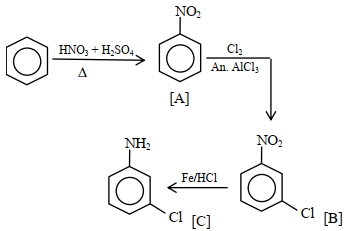
Identify the correct $A$,$B$,and $C$ in the reaction sequence given below:

A
$A = \text{Nitrobenzene}$,$B = m\text{-Chloronitrobenzene}$,$C = m\text{-Chloroaniline}$
B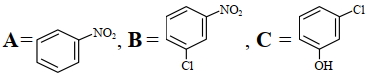
$A = \text{Nitrobenzene}$,$B = m\text{-Chloronitrobenzene}$,$C = m\text{-Chlorophenol}$
C
$A = \text{Nitrobenzene}$,$B = p\text{-Chloronitrobenzene}$,$C = p\text{-Chloroaniline}$
D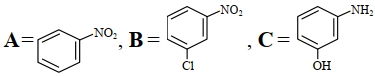
$A = \text{Nitrobenzene}$,$B = m\text{-Chloronitrobenzene}$,$C = m\text{-Chlorophenol}$
Solution
(A) $1$. The reaction of benzene with conc. $HNO_3$ and conc. $H_2SO_4$ (nitration) yields $A = \text{Nitrobenzene}$.
$2$. Nitrobenzene is a meta-directing group. Therefore,chlorination of nitrobenzene using $Cl_2$ and anhydrous $AlCl_3$ gives $B = m\text{-Chloronitrobenzene}$.
$3$. The reduction of the nitro group $(-NO_2)$ in $m\text{-Chloronitrobenzene}$ using $Fe/HCl$ yields $C = m\text{-Chloroaniline}$.
$2$. Nitrobenzene is a meta-directing group. Therefore,chlorination of nitrobenzene using $Cl_2$ and anhydrous $AlCl_3$ gives $B = m\text{-Chloronitrobenzene}$.
$3$. The reduction of the nitro group $(-NO_2)$ in $m\text{-Chloronitrobenzene}$ using $Fe/HCl$ yields $C = m\text{-Chloroaniline}$.
0 likes
View Solution139
DifficultMCQ
Given below are two statements,one is labeled as Assertion $(A)$ and other is labeled as Reason $(R).$
Assertion $(A):$ Gabriel phthalimide synthesis cannot be used to prepare aromatic primary amines.
Reason $(R) :$ Aryl halides do not undergo nucleophilic substitution reaction.
In the light of the above statements,choose the correct answer from the options given below.
Assertion $(A):$ Gabriel phthalimide synthesis cannot be used to prepare aromatic primary amines.
Reason $(R) :$ Aryl halides do not undergo nucleophilic substitution reaction.
In the light of the above statements,choose the correct answer from the options given below.
A
$(A)$ is true but $(R)$ is false
B
$(A)$ is false but $(R)$ is true
C
Both $(A)$ and $(R)$ are true but $(R)$ is not the correct explanation of $(A).$
D
Both $(A)$ and $(R)$ are true and $(R)$ is the correct explanation of $(A).$
Solution
(D) Gabriel phthalimide synthesis involves the nucleophilic substitution of an alkyl halide by the phthalimide anion via an $S_N2$ mechanism.
Aromatic primary amines cannot be prepared by this method because aryl halides do not undergo nucleophilic substitution reactions under these conditions due to the partial double bond character of the $C-X$ bond and the instability of the phenyl cation.
Therefore,both Assertion $(A)$ and Reason $(R)$ are true,and Reason $(R)$ is the correct explanation of Assertion $(A).$
Aromatic primary amines cannot be prepared by this method because aryl halides do not undergo nucleophilic substitution reactions under these conditions due to the partial double bond character of the $C-X$ bond and the instability of the phenyl cation.
Therefore,both Assertion $(A)$ and Reason $(R)$ are true,and Reason $(R)$ is the correct explanation of Assertion $(A).$
0 likes
View Solution140
DifficultMCQ
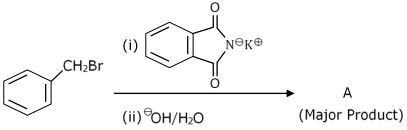
What is $A$ in the following reaction?
A
Phthalimide
B
Benzylamine
C
$N$-Benzylbenzamide
D
Benzyl alcohol
Solution
(B) The reaction shown is the $Gabriel \ phthalimide \ synthesis$.
In this reaction,potassium phthalimide reacts with benzyl bromide $(C_6H_5CH_2Br)$ to form $N$-benzylphthalimide.
Subsequent hydrolysis with $OH^-/H_2O$ yields benzylamine $(C_6H_5CH_2NH_2)$ and phthalic acid as the products.
Therefore,the major product $A$ is benzylamine.
In this reaction,potassium phthalimide reacts with benzyl bromide $(C_6H_5CH_2Br)$ to form $N$-benzylphthalimide.
Subsequent hydrolysis with $OH^-/H_2O$ yields benzylamine $(C_6H_5CH_2NH_2)$ and phthalic acid as the products.
Therefore,the major product $A$ is benzylamine.
0 likes
View Solution141
MediumMCQ
The conversion of propan$-1-$ol to $n-$butylamine involves the sequential addition of reagents. The correct sequential order of reagents is:
A
$(i) SOCl_2, (ii) KCN, (iii) H_2 / Ni \text{ or } Na(Hg) / C_2H_5OH$
B
$(i) HCl, (ii) H_2 / Ni \text{ or } Na(Hg) / C_2H_5OH$
C
$(i) SOCl_2, (ii) KCN, (iii) CH_3NH_2$
D
$(i) HCl, (ii) CH_3NH_2$
Solution
(A) The conversion of propan$-1-$ol $(CH_3CH_2CH_2OH)$ to $n-$butylamine $(CH_3CH_2CH_2CH_2NH_2)$ requires increasing the carbon chain length by one carbon atom.
Step $1$: Propan$-1-$ol reacts with $SOCl_2$ to form $1-$chloropropane $(CH_3CH_2CH_2Cl)$.
Step $2$: $1-$chloropropane reacts with $KCN$ (nucleophilic substitution) to form butanenitrile $(CH_3CH_2CH_2CN)$.
Step $3$: Butanenitrile is reduced using $H_2/Ni$ or $Na(Hg)/C_2H_5OH$ (Mendius reduction) to form $n-$butylamine $(CH_3CH_2CH_2CH_2NH_2)$.
Step $1$: Propan$-1-$ol reacts with $SOCl_2$ to form $1-$chloropropane $(CH_3CH_2CH_2Cl)$.
Step $2$: $1-$chloropropane reacts with $KCN$ (nucleophilic substitution) to form butanenitrile $(CH_3CH_2CH_2CN)$.
Step $3$: Butanenitrile is reduced using $H_2/Ni$ or $Na(Hg)/C_2H_5OH$ (Mendius reduction) to form $n-$butylamine $(CH_3CH_2CH_2CH_2NH_2)$.
0 likes
View Solution142
DifficultMCQ
An organic compound $A$ on reaction with $NH_{3}$ followed by heating gives compound $B$. Which on further strong heating gives compound $C$ $(C_{8}H_{5}NO_{2})$. Compound $C$ on sequential reaction with ethanolic $KOH$,alkyl chloride and hydrolysis with alkali gives a primary amine. The compound $A$ is.
A
Phthalaldehyde
B
Phthalaldehydic acid
C
Phthalic acid
D
Salicylaldehyde
Solution
(C) The reaction sequence described is the Gabriel phthalimide synthesis. \\
$1$. Compound $A$ is phthalic acid $(C_{6}H_{4}(COOH)_{2})$. \\
$2$. Reaction of phthalic acid with $NH_{3}$ followed by heating gives phthalimide $(C_{8}H_{5}NO_{2})$,which is compound $C$. The intermediate $B$ is phthalamide $(C_{6}H_{4}(CONH_{2})_{2})$. \\
$3$. Phthalimide $(C)$ reacts with ethanolic $KOH$ to form potassium phthalimide. \\
$4$. Potassium phthalimide reacts with alkyl chloride $(R-Cl)$ via $S_{N}2$ mechanism to form $N$-alkylphthalimide. \\
$5$. Hydrolysis of $N$-alkylphthalimide with alkali gives a primary amine $(RNH_{2})$ and phthalic acid. \\
Thus,compound $A$ is phthalic acid.
$1$. Compound $A$ is phthalic acid $(C_{6}H_{4}(COOH)_{2})$. \\
$2$. Reaction of phthalic acid with $NH_{3}$ followed by heating gives phthalimide $(C_{8}H_{5}NO_{2})$,which is compound $C$. The intermediate $B$ is phthalamide $(C_{6}H_{4}(CONH_{2})_{2})$. \\
$3$. Phthalimide $(C)$ reacts with ethanolic $KOH$ to form potassium phthalimide. \\
$4$. Potassium phthalimide reacts with alkyl chloride $(R-Cl)$ via $S_{N}2$ mechanism to form $N$-alkylphthalimide. \\
$5$. Hydrolysis of $N$-alkylphthalimide with alkali gives a primary amine $(RNH_{2})$ and phthalic acid. \\
Thus,compound $A$ is phthalic acid.
0 likes
View Solution143
DifficultMCQ
Consider the above reaction,the compound $A$ is
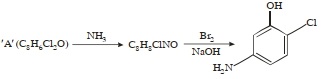
A
$4-$chloro$-2-$methylbenzoyl chloride
B
$3-$chloro$-4-$methylbenzoyl chloride
C
$4-$chloro$-3-$methylbenzoyl chloride
D
$3-$chloro$-4-$chloromethylbenzaldehyde
Solution
(A) The reaction sequence is as follows:
$1$. The starting material $A$ reacts with $NH_3$ to form an amide $(C_8H_8ClNO)$.
$2$. The amide then undergoes the Hofmann bromamide degradation reaction with $Br_2$ and $NaOH$ to form an amine.
$3$. Looking at the final product,which is $3-chloro-4-methylaniline$ (or a similar substituted aniline derivative),we can trace back the structure.
$4$. The final product has a $Cl$ group at the ortho position and a $CH_3$ group at the meta position relative to the $NH_2$ group.
$5$. The starting material $A$ must be $4-chloro-2-methylbenzoyl$ chloride,which upon reaction with $NH_3$ gives $4-chloro-2-methylbenzamide$,and subsequent Hofmann degradation yields $3-chloro-4-methylaniline$.
$1$. The starting material $A$ reacts with $NH_3$ to form an amide $(C_8H_8ClNO)$.
$2$. The amide then undergoes the Hofmann bromamide degradation reaction with $Br_2$ and $NaOH$ to form an amine.
$3$. Looking at the final product,which is $3-chloro-4-methylaniline$ (or a similar substituted aniline derivative),we can trace back the structure.
$4$. The final product has a $Cl$ group at the ortho position and a $CH_3$ group at the meta position relative to the $NH_2$ group.
$5$. The starting material $A$ must be $4-chloro-2-methylbenzoyl$ chloride,which upon reaction with $NH_3$ gives $4-chloro-2-methylbenzamide$,and subsequent Hofmann degradation yields $3-chloro-4-methylaniline$.
0 likes
View Solution144
MediumMCQ
The most suitable reagent for the conversion of $2-$phenylpropanamide into $1-$phenylethylamine is $....$
A
$H_{2}, Pd/C$
B
$Br_{2}, NaOH$
C
$LiAlH_{4}, Et_{2}O$
D
$NaBH_{4}, MeOH$
Solution
(B) The correct option is $B$. The conversion of $2-$phenylpropanamide into $1-$phenylethylamine involves the loss of a carbonyl carbon atom,which is characteristic of the Hofmann bromamide degradation reaction.
The reaction is as follows:
$CH_{3}CH(Ph)CONH_{2} + Br_{2} + 4NaOH \rightarrow CH_{3}CH(Ph)NH_{2} + Na_{2}CO_{3} + 2NaBr + 2H_{2}O$
In this reaction,the amide is treated with bromine in an aqueous or ethanolic solution of sodium hydroxide. The alkyl or aryl group migrates from the carbonyl carbon to the nitrogen atom,resulting in the formation of a primary amine with one carbon atom less than the starting amide.
The reaction is as follows:
$CH_{3}CH(Ph)CONH_{2} + Br_{2} + 4NaOH \rightarrow CH_{3}CH(Ph)NH_{2} + Na_{2}CO_{3} + 2NaBr + 2H_{2}O$
In this reaction,the amide is treated with bromine in an aqueous or ethanolic solution of sodium hydroxide. The alkyl or aryl group migrates from the carbonyl carbon to the nitrogen atom,resulting in the formation of a primary amine with one carbon atom less than the starting amide.
0 likes
View Solution145
MediumMCQ
In the following reaction,
$C_6H_5CONH_2 \xrightarrow{Br_2/KOH} \text{Major Product}$
the major product is
$C_6H_5CONH_2 \xrightarrow{Br_2/KOH} \text{Major Product}$
the major product is
A
Bromobenzene
B
$3-$Bromobenzoic acid
C
Aniline
D
$3-$Bromobenzamide
Solution
(C) The given reaction is the Hoffmann bromamide degradation reaction.
In this reaction,an amide $(RCONH_2)$ reacts with bromine $(Br_2)$ in the presence of a strong base like potassium hydroxide $(KOH)$ to form a primary amine $(RNH_2)$ with one carbon atom less than the starting amide.
The reaction for benzamide is:
$C_6H_5CONH_2 + Br_2 + 4KOH \rightarrow C_6H_5NH_2 + K_2CO_3 + 2KBr + 2H_2O$
Here,benzamide $(C_6H_5CONH_2)$ is converted into aniline $(C_6H_5NH_2)$.
Therefore,the major product is aniline.
In this reaction,an amide $(RCONH_2)$ reacts with bromine $(Br_2)$ in the presence of a strong base like potassium hydroxide $(KOH)$ to form a primary amine $(RNH_2)$ with one carbon atom less than the starting amide.
The reaction for benzamide is:
$C_6H_5CONH_2 + Br_2 + 4KOH \rightarrow C_6H_5NH_2 + K_2CO_3 + 2KBr + 2H_2O$
Here,benzamide $(C_6H_5CONH_2)$ is converted into aniline $(C_6H_5NH_2)$.
Therefore,the major product is aniline.
0 likes
View Solution146
DifficultMCQ
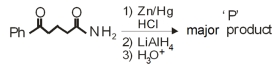
The major product '$P$' for the following sequence of reactions is:
A
$Ph-CH(OH)-(CH_2)_4-OH$
B
$Ph-CH(OH)-(CH_2)_4-NH_2$
C
$Ph-(CH_2)_5-NH_2$
D
$Ph-CH(OH)-(CH_2)_3-CH(OH)-NH_2$
Solution
(C) The starting material is $5-oxo-5-phenylpentanamide$ $(Ph-CO-(CH_2)_3-CONH_2)$.
Step $1$: Clemmensen reduction $(Zn/Hg, HCl)$ specifically reduces the ketone group to a methylene group $(-CH_2-)$ while leaving the amide group intact.
This yields $5-phenylpentanamide$ $(Ph-(CH_2)_4-CONH_2)$.
Step $2$ and $3$: Treatment with $LiAlH_4$ followed by acidic workup $(H_3O^+)$ reduces the amide group $(-CONH_2)$ to a primary amine $(-CH_2NH_2)$.
The final product is $5-phenylpentan-1-amine$ $(Ph-(CH_2)_5-NH_2)$.
Thus,the correct option is $C$.
Step $1$: Clemmensen reduction $(Zn/Hg, HCl)$ specifically reduces the ketone group to a methylene group $(-CH_2-)$ while leaving the amide group intact.
This yields $5-phenylpentanamide$ $(Ph-(CH_2)_4-CONH_2)$.
Step $2$ and $3$: Treatment with $LiAlH_4$ followed by acidic workup $(H_3O^+)$ reduces the amide group $(-CONH_2)$ to a primary amine $(-CH_2NH_2)$.
The final product is $5-phenylpentan-1-amine$ $(Ph-(CH_2)_5-NH_2)$.
Thus,the correct option is $C$.
0 likes
View Solution147
MediumMCQ
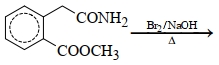
The major product formed in the following reaction is
A
B
C
D
Solution
(D) The reaction is a Hofmann bromamide degradation,which converts an amide $(-CONH_2)$ into a primary amine $(-NH_2)$.
In the given molecule,the $-CONH_2$ group is converted to $-NH_2$ by the action of $Br_2/NaOH$.
The resulting intermediate is an amino ester,which undergoes intramolecular cyclization (nucleophilic acyl substitution) to form a cyclic amide,known as a lactam.
The final product is $isoindolin-1-one$.
In the given molecule,the $-CONH_2$ group is converted to $-NH_2$ by the action of $Br_2/NaOH$.
The resulting intermediate is an amino ester,which undergoes intramolecular cyclization (nucleophilic acyl substitution) to form a cyclic amide,known as a lactam.
The final product is $isoindolin-1-one$.
0 likes
View Solution148
MediumMCQ
Number of isomeric aromatic amines with molecular formula $C_8H_{11}N$,which can be synthesized by Gabriel Phthalimide synthesis is $.........$.
A
$5$
B
$4$
C
$3$
D
$9$
Solution
(A) Gabriel Phthalimide synthesis is used for the preparation of primary aliphatic amines. It involves the reaction of potassium phthalimide with an alkyl halide followed by alkaline hydrolysis.
It cannot be used for the preparation of aromatic amines because aryl halides do not undergo nucleophilic substitution with the anion formed by phthalimide.
Therefore,only those amines with the formula $C_8H_{11}N$ that have the $-NH_2$ group attached to an aliphatic carbon (i.e.,primary aliphatic amines) can be synthesized by this method.
The isomers of $C_8H_{11}N$ that are primary aliphatic amines are:
$1$. $C_6H_5-CH_2-CH_2-NH_2$ ($2$-phenylethanamine)
$2$. $C_6H_5-CH(CH_3)-NH_2$ ($1$-phenylethanamine)
$3$. $o-CH_3-C_6H_4-CH_2-NH_2$ ($2$-methylbenzylamine)
$4$. $m-CH_3-C_6H_4-CH_2-NH_2$ ($3$-methylbenzylamine)
$5$. $p-CH_3-C_6H_4-CH_2-NH_2$ ($4$-methylbenzylamine)
There are $5$ such isomers that can be synthesized by this method.
It cannot be used for the preparation of aromatic amines because aryl halides do not undergo nucleophilic substitution with the anion formed by phthalimide.
Therefore,only those amines with the formula $C_8H_{11}N$ that have the $-NH_2$ group attached to an aliphatic carbon (i.e.,primary aliphatic amines) can be synthesized by this method.
The isomers of $C_8H_{11}N$ that are primary aliphatic amines are:
$1$. $C_6H_5-CH_2-CH_2-NH_2$ ($2$-phenylethanamine)
$2$. $C_6H_5-CH(CH_3)-NH_2$ ($1$-phenylethanamine)
$3$. $o-CH_3-C_6H_4-CH_2-NH_2$ ($2$-methylbenzylamine)
$4$. $m-CH_3-C_6H_4-CH_2-NH_2$ ($3$-methylbenzylamine)
$5$. $p-CH_3-C_6H_4-CH_2-NH_2$ ($4$-methylbenzylamine)
There are $5$ such isomers that can be synthesized by this method.
0 likes
View Solution149
MediumMCQ
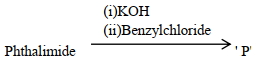
Phthalimide is made to undergo the following sequence of reactions. Total number of $\pi$ bonds present in product '$P$' is/are:
A
$7$
B
$8$
C
$9$
D
$10$
Solution
(B) $1$. Phthalimide reacts with $KOH$ to form potassium phthalimide.
$2$. Potassium phthalimide then undergoes an $S_N2$ reaction with benzyl chloride to form $N$-benzylphthalimide (product $P$).
$3$. The structure of $N$-benzylphthalimide contains a benzene ring ($3 \ \pi$ bonds),another benzene ring from the benzyl group ($3 \ \pi$ bonds),and two carbonyl groups ($C=O$,each having $1 \ \pi$ bond).
$4$. Total $\pi$ bonds = $3$ (phthalimide ring) + $3$ (benzyl ring) + $2$ ($C=O$ bonds) = $8$.
$2$. Potassium phthalimide then undergoes an $S_N2$ reaction with benzyl chloride to form $N$-benzylphthalimide (product $P$).
$3$. The structure of $N$-benzylphthalimide contains a benzene ring ($3 \ \pi$ bonds),another benzene ring from the benzyl group ($3 \ \pi$ bonds),and two carbonyl groups ($C=O$,each having $1 \ \pi$ bond).
$4$. Total $\pi$ bonds = $3$ (phthalimide ring) + $3$ (benzyl ring) + $2$ ($C=O$ bonds) = $8$.
0 likes
View SolutionAmines — Preparation of Amines · Frequently Asked Questions
1Are these Amines questions useful for JEE and NEET?
Yes. All questions in this section are mapped to JEE Main and NEET exam patterns. Previous year questions from JEE Main, NEET, GUJCET and state-level exams are included with full solutions.
2Can I switch to Hindi or Gujarati for these questions?
Yes. Use the language tabs in the hero section or the sidebar to view the same questions and solutions in English, Hindi or Gujarati.
3How do I generate a question paper from this subtopic?
Use the Vedclass Exam Paper Generator — select the chapter and subtopic, set difficulty, and generate Sets A, B, C, D automatically. First 3 chapters of every subject are free.
Vedclass Products
For Students
Vedclass Test Series
Mock tests in real JEE/NEET style with performance analysis. 5-day free trial.
Start Free TrialFor Teachers
Exam Paper Generator
Generate Set A/B/C/D papers from this chapter in 2 minutes. 3 chapters free.
Try FreeFor Institutes
Online Exam Module
Live online exams with unlimited students, 360° analytics & white-label branding.
See DemoFor Teachers & Institutes
Generate a Amines Exam Paper in 2 Minutes
Select subtopic & difficulty — Sets A, B, C, D auto-generated with No Repeat logic.
First 3 chapters of every subject are free — no payment required.