
A English
Preparation of Amines Questions in English
Class 12 Chemistry · Amines · Preparation of Amines
223+
Questions
English
Language
100%
With Solutions
Showing 20 of 223 questions in English
201
EasyMCQ
Gabriel phthalimide synthesis is used for the preparation of which of the following?
A
Aniline
B
Pyrrolidine
C
Triethylamine
D
Ethylamine
Solution
(D) Gabriel phthalimide synthesis is specifically used for the preparation of primary $(1^{\circ})$ aliphatic amines.
It involves the reaction of potassium phthalimide with an alkyl halide,followed by alkaline hydrolysis.
Since aryl halides do not undergo nucleophilic substitution with the phthalimide anion,aromatic amines (like aniline) cannot be prepared by this method.
Secondary and tertiary amines are also not prepared by this method.
Among the given options,ethylamine $(CH_3CH_2NH_2)$ is a primary aliphatic amine,whereas aniline is aromatic,and the others are secondary or tertiary amines.
It involves the reaction of potassium phthalimide with an alkyl halide,followed by alkaline hydrolysis.
Since aryl halides do not undergo nucleophilic substitution with the phthalimide anion,aromatic amines (like aniline) cannot be prepared by this method.
Secondary and tertiary amines are also not prepared by this method.
Among the given options,ethylamine $(CH_3CH_2NH_2)$ is a primary aliphatic amine,whereas aniline is aromatic,and the others are secondary or tertiary amines.
0 likes
View Solution202
EasyMCQ
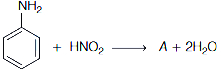
What will be the product $A$ in the reaction given below?
A
Phenol
B
Benzene diazonium salt
C
Benzene
D
Nitrobenzene
Solution
(B) The reaction of aniline with nitrous acid $(HNO_2)$ at low temperature $(273-278 \ K)$ is known as the diazotization reaction.
In this reaction,aniline reacts with $HNO_2$ (generated in situ from $NaNO_2$ and $HCl$) to form benzene diazonium chloride.
The chemical equation is:
$C_6H_5NH_2 + HNO_2 + HCl \xrightarrow{273-278 \ K} C_6H_5N_2^+Cl^- + 2H_2O$.
Thus,the product $A$ is benzene diazonium salt.
In this reaction,aniline reacts with $HNO_2$ (generated in situ from $NaNO_2$ and $HCl$) to form benzene diazonium chloride.
The chemical equation is:
$C_6H_5NH_2 + HNO_2 + HCl \xrightarrow{273-278 \ K} C_6H_5N_2^+Cl^- + 2H_2O$.
Thus,the product $A$ is benzene diazonium salt.
0 likes
View Solution203
DifficultMCQ
In the preparation of a $1^{\circ}$-amine from an alkyl halide,with simultaneous addition of one $-CH_2-$ group to the carbon chain,the reagent used as the source of nitrogen is
A
sodium amide,$NaNH_2$
B
sodium azide,$NaN_3$
C
potassium cyanide,$KCN$
D
potassium phthalimide,$C_6H_4(CO)_2N^{-}K^{+}$
Solution
(C) To prepare a $1^{\circ}$-amine from an alkyl halide with the simultaneous addition of one $-CH_2-$ group to the carbon chain,$KCN$ is used as the reagent.
The reaction proceeds as follows:
$1$. Nucleophilic substitution: $R-X + KCN \rightarrow R-CN + KX$
$2$. Reduction: $R-CN + 4[H] \rightarrow R-CH_2-NH_2$
$KCN$ provides the cyanide ion $(CN^-)$,which acts as a nucleophile to extend the carbon chain by one carbon atom,and subsequent reduction of the nitrile group yields the $1^{\circ}$-amine.
The reaction proceeds as follows:
$1$. Nucleophilic substitution: $R-X + KCN \rightarrow R-CN + KX$
$2$. Reduction: $R-CN + 4[H] \rightarrow R-CH_2-NH_2$
$KCN$ provides the cyanide ion $(CN^-)$,which acts as a nucleophile to extend the carbon chain by one carbon atom,and subsequent reduction of the nitrile group yields the $1^{\circ}$-amine.
0 likes
View Solution204
MediumMCQ
What are $X$ and $Y$ in the following reactions?
$X \xrightarrow[(ii) H_2O]{(i) LiAlH_4} R CH_2 NH_2 \xleftarrow{H_2 / Ni} Y$
$X \xrightarrow[(ii) H_2O]{(i) LiAlH_4} R CH_2 NH_2 \xleftarrow{H_2 / Ni} Y$
A
$RCOONH_4, RCH_2CN$
B
$RCN, RCONH_2$
C
$RNHCH_3, RCH_2NC$
D
$RCONH_2, RCN$
Solution
(D) In the given reaction,$X$ is $RCONH_2$ and $Y$ is $RCN$.
$LiAlH_4$ is a strong reducing agent that reduces amides $(RCONH_2)$ to primary amines $(RCH_2NH_2)$.
Catalytic hydrogenation of nitriles $(RCN)$ using $H_2/Ni$ also yields primary amines $(RCH_2NH_2)$.
$LiAlH_4$ is a strong reducing agent that reduces amides $(RCONH_2)$ to primary amines $(RCH_2NH_2)$.
Catalytic hydrogenation of nitriles $(RCN)$ using $H_2/Ni$ also yields primary amines $(RCH_2NH_2)$.
0 likes
View Solution205
EasyMCQ
What are $A$ and $B$ in the following reactions?
$A \xrightarrow{H_2 / Ni} R-CH_2-NH_2 \xleftarrow[ii) H_2O]{i) LiAlH_4} B$
$A \xrightarrow{H_2 / Ni} R-CH_2-NH_2 \xleftarrow[ii) H_2O]{i) LiAlH_4} B$
A
$A = R-CH_2-NC, B = R-CH=NOH$
B
$A = R-CH=NOH, B = R-CN$
C
$A = R-CONH_2, B = R-CH_2-NC$
D
$A = R-CN, B = R-CONH_2$
Solution
(D) and $B$ are precursors that can be reduced to form the primary amine $R-CH_2-NH_2$.
$1.$ Nitriles $(R-CN)$ undergo catalytic hydrogenation with $H_2/Ni$ to produce primary amines: $R-CN + 2H_2 \xrightarrow{Ni} R-CH_2-NH_2$
$2.$ Amides $(R-CONH_2)$ are reduced by $LiAlH_4$ followed by hydrolysis to produce primary amines: $R-CONH_2 \xrightarrow[ii) H_2O]{i) LiAlH_4} R-CH_2-NH_2$
Therefore,$A = R-CN$ and $B = R-CONH_2$.
$1.$ Nitriles $(R-CN)$ undergo catalytic hydrogenation with $H_2/Ni$ to produce primary amines: $R-CN + 2H_2 \xrightarrow{Ni} R-CH_2-NH_2$
$2.$ Amides $(R-CONH_2)$ are reduced by $LiAlH_4$ followed by hydrolysis to produce primary amines: $R-CONH_2 \xrightarrow[ii) H_2O]{i) LiAlH_4} R-CH_2-NH_2$
Therefore,$A = R-CN$ and $B = R-CONH_2$.
0 likes
View Solution206
EasyMCQ
Aniline is not the major product in one of the following reactions. Identify that reaction.
A
$C_6H_5OH + NH_3 \xrightarrow[300^{\circ}C]{ZnCl_2}$
B
$C_6H_5NO_2 + Zn \text{ powder } \xrightarrow{\text{alcoholic } KOH}$
C
$C_6H_5Cl + NH_3 \xrightarrow[Cu_2O]{200^{\circ}C, \text{high pressure}}$
D
$C_6H_5NO_2 + 6[H] \xrightarrow[HCl]{Fe + H_2O}$
Solution
(B) In the reaction of $C_6H_5NO_2$ with $Zn$ powder in the presence of alcoholic $KOH$,the major product is azoxybenzene or hydrazobenzene depending on conditions,not aniline.
$C_6H_5OH + NH_3 \xrightarrow[300^{\circ}C]{ZnCl_2}$ gives aniline.
$C_6H_5Cl + NH_3 \xrightarrow[Cu_2O]{200^{\circ}C, \text{high pressure}}$ gives aniline.
$C_6H_5NO_2 + 6[H] \xrightarrow[HCl]{Fe + H_2O}$ is the reduction of nitrobenzene to aniline.
Therefore,the reaction that does not produce aniline as the major product is $C_6H_5NO_2 + Zn \text{ powder } \xrightarrow{\text{alcoholic } KOH}$.
$C_6H_5OH + NH_3 \xrightarrow[300^{\circ}C]{ZnCl_2}$ gives aniline.
$C_6H_5Cl + NH_3 \xrightarrow[Cu_2O]{200^{\circ}C, \text{high pressure}}$ gives aniline.
$C_6H_5NO_2 + 6[H] \xrightarrow[HCl]{Fe + H_2O}$ is the reduction of nitrobenzene to aniline.
Therefore,the reaction that does not produce aniline as the major product is $C_6H_5NO_2 + Zn \text{ powder } \xrightarrow{\text{alcoholic } KOH}$.
0 likes
View Solution207
MediumMCQ
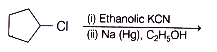
Identify the product formed in the following reaction sequence:
A
$1,4-$butanediamine
B
cyclopentylmethanamine
C
cyclopentanamine
D
$N$-methylpyrrolidine
Solution
(B) The reaction sequence is as follows:
$1$. The reaction of chlorocyclopentane with ethanolic $KCN$ undergoes a nucleophilic substitution $(S_N2)$ reaction to form cyclopentanecarbonitrile $(C_5H_9CN)$.
$2$. The reduction of the nitrile group $(-CN)$ using sodium amalgam $(Na(Hg))$ in the presence of ethanol $(C_2H_5OH)$ yields a primary amine. This is a standard reduction reaction for nitriles to primary amines,resulting in cyclopentylmethanamine $(C_5H_9CH_2NH_2)$.
$1$. The reaction of chlorocyclopentane with ethanolic $KCN$ undergoes a nucleophilic substitution $(S_N2)$ reaction to form cyclopentanecarbonitrile $(C_5H_9CN)$.
$2$. The reduction of the nitrile group $(-CN)$ using sodium amalgam $(Na(Hg))$ in the presence of ethanol $(C_2H_5OH)$ yields a primary amine. This is a standard reduction reaction for nitriles to primary amines,resulting in cyclopentylmethanamine $(C_5H_9CH_2NH_2)$.

0 likes
View Solution208
EasyMCQ
Identify $X$ and $Y$ in the following reactions:
$X \xrightarrow{H_2/Ni} CH_3CH_2CH_2NH_2 \xleftarrow{Br_2/NaOH} Y$
$X \xrightarrow{H_2/Ni} CH_3CH_2CH_2NH_2 \xleftarrow{Br_2/NaOH} Y$
A
$CH_3CH_2CH_2CN \quad CH_3CH_2CH_2CONH_2$
B
$CH_3CH_2CN \quad CH_3CH_2CH_2CONH_2$
C
$CH_3CH_2CH_2NC \quad CH_3CH_2CONHCH_3$
D
$CH_3CH_2CN \quad CH_3CH_2CONH_2$
Solution
(B) $1$. For the reaction $X \xrightarrow{H_2/Ni} CH_3CH_2CH_2NH_2$,the reduction of a nitrile $(R-CN)$ with $H_2/Ni$ adds four hydrogen atoms to produce a primary amine $(R-CH_2NH_2)$. To obtain $CH_3CH_2CH_2NH_2$ (propan$-1-$amine),$X$ must be $CH_3CH_2CN$ (propanenitrile).
$2$. For the reaction $Y \xrightarrow{Br_2/NaOH} CH_3CH_2CH_2NH_2$,this is the Hofmann bromamide degradation reaction,which converts an amide $(R-CONH_2)$ into a primary amine $(R-NH_2)$ with one less carbon atom. To obtain $CH_3CH_2CH_2NH_2$ (propan$-1-$amine),$Y$ must be $CH_3CH_2CH_2CONH_2$ (butanamide).
$3$. Therefore,$X = CH_3CH_2CN$ and $Y = CH_3CH_2CH_2CONH_2$.
$2$. For the reaction $Y \xrightarrow{Br_2/NaOH} CH_3CH_2CH_2NH_2$,this is the Hofmann bromamide degradation reaction,which converts an amide $(R-CONH_2)$ into a primary amine $(R-NH_2)$ with one less carbon atom. To obtain $CH_3CH_2CH_2NH_2$ (propan$-1-$amine),$Y$ must be $CH_3CH_2CH_2CONH_2$ (butanamide).
$3$. Therefore,$X = CH_3CH_2CN$ and $Y = CH_3CH_2CH_2CONH_2$.
0 likes
View Solution209
MediumMCQ
The major products $P$ and $Q$ from the following reactions are:

A
$P=C_6 H_5 CH_2 NH_2 \quad ; \quad Q=C_6 H_5 NH_2$
B
$P=C_6 H_5 NH_2 \quad ; \quad Q=C_6 H_5 CH_2 NH_2$
C
$P=C_6 H_5 CH_2 OH \quad ; \quad Q=C_6 H_5 NH_2$
D
$P=C_6 H_5 CN \quad ; \quad Q=C_6 H_5 Br$
Solution
(A) The reaction of benzamide $(C_6 H_5 CONH_2)$ with $LiAlH_4$ followed by hydrolysis is a reduction reaction that converts the amide group $(-CONH_2)$ into an amine group $(-CH_2 NH_2)$. Thus,$P$ is benzylamine $(C_6 H_5 CH_2 NH_2)$.
The reaction of benzamide $(C_6 H_5 CONH_2)$ with $Br_2 / NaOH$ is the Hofmann bromamide degradation reaction,which converts an amide into a primary amine with one carbon atom less. Thus,$Q$ is aniline $(C_6 H_5 NH_2)$.
Therefore,$P = C_6 H_5 CH_2 NH_2$ and $Q = C_6 H_5 NH_2$.
The reaction of benzamide $(C_6 H_5 CONH_2)$ with $Br_2 / NaOH$ is the Hofmann bromamide degradation reaction,which converts an amide into a primary amine with one carbon atom less. Thus,$Q$ is aniline $(C_6 H_5 NH_2)$.
Therefore,$P = C_6 H_5 CH_2 NH_2$ and $Q = C_6 H_5 NH_2$.
0 likes
View Solution210
EasyMCQ
Which of the following reactions are used in the preparation of aliphatic primary amines?
$I$. Gabriel-phthalimide reaction
$II$. Hoffmann Bromamide reaction
$III$. Carbylamine reaction
$IV$. Sandmeyer reaction
$I$. Gabriel-phthalimide reaction
$II$. Hoffmann Bromamide reaction
$III$. Carbylamine reaction
$IV$. Sandmeyer reaction
A
$II$ & $III$ only
B
$I$ & $II$ only
C
$III$ & $IV$ only
D
$I$ & $IV$ only
Solution
(B) Gabriel-phthalimide synthesis is a standard method for the preparation of pure primary aliphatic amines.
$II$. Hoffmann bromamide degradation reaction is used to convert an amide into a primary amine with one carbon atom less.
$III$. Carbylamine reaction is a test for primary amines,not a preparation method.
$IV$. Sandmeyer reaction is used to convert diazonium salts into aryl halides,not for preparing aliphatic amines.
Therefore,only $I$ and $II$ are used for the preparation of aliphatic primary amines.
$II$. Hoffmann bromamide degradation reaction is used to convert an amide into a primary amine with one carbon atom less.
$III$. Carbylamine reaction is a test for primary amines,not a preparation method.
$IV$. Sandmeyer reaction is used to convert diazonium salts into aryl halides,not for preparing aliphatic amines.
Therefore,only $I$ and $II$ are used for the preparation of aliphatic primary amines.
0 likes
View Solution211
MediumMCQ
What is $B$ in the given reaction?
$C_2H_5Br \xrightarrow{\text{excess } NH_3} A \xleftarrow{Br_2/KOH} B$
$C_2H_5Br \xrightarrow{\text{excess } NH_3} A \xleftarrow{Br_2/KOH} B$
A
Propanamide $(CH_3CH_2CONH_2)$
B
Acetamide $(CH_3CONH_2)$
C
$N$-methylpropanamide $(CH_3CH_2CONHCH_3)$
D
Propan$-2-$amine $(CH_3CH(NH_2)CH_3)$
Solution
(A) The reaction $C_2H_5Br \xrightarrow{\text{excess } NH_3} A$ represents the ammonolysis of an alkyl halide,where $A$ is ethylamine $(CH_3CH_2NH_2)$.
The reaction $B \xrightarrow{Br_2/KOH} A$ is the Hofmann bromamide degradation reaction,which converts an amide into a primary amine with one carbon atom less than the original amide.
Since $A$ is ethylamine $(CH_3CH_2NH_2)$,which has $2$ carbon atoms,the amide $B$ must have $3$ carbon atoms.
Therefore,$B$ is propanamide $(CH_3CH_2CONH_2)$.
The reaction $B \xrightarrow{Br_2/KOH} A$ is the Hofmann bromamide degradation reaction,which converts an amide into a primary amine with one carbon atom less than the original amide.
Since $A$ is ethylamine $(CH_3CH_2NH_2)$,which has $2$ carbon atoms,the amide $B$ must have $3$ carbon atoms.
Therefore,$B$ is propanamide $(CH_3CH_2CONH_2)$.
0 likes
View Solution212
DifficultMCQ
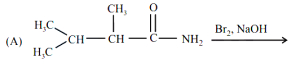
Among the following set of reactions,the most suitable method for preparing a secondary amine is:
A
Hoffmann bromamide degradation of an amide.
B
Reduction of a nitrile.
C
Reaction of an alkyl halide with an excess of ammonia.
D
Reaction of a primary amine with an alkyl halide.
Solution
(D) The preparation of a secondary amine is best achieved by the reaction of a primary amine with an alkyl halide.
This is a nucleophilic substitution reaction where the primary amine acts as a nucleophile and attacks the alkyl halide to form a secondary amine.
$R-NH_2 + R'-X \rightarrow R-NH-R' + HX$.
Option $A$ (Hoffmann bromamide degradation) produces a primary amine.
Option $B$ (Reduction of a nitrile) produces a primary amine.
Option $C$ (Reaction of an alkyl halide with excess ammonia) primarily produces a primary amine.
This is a nucleophilic substitution reaction where the primary amine acts as a nucleophile and attacks the alkyl halide to form a secondary amine.
$R-NH_2 + R'-X \rightarrow R-NH-R' + HX$.
Option $A$ (Hoffmann bromamide degradation) produces a primary amine.
Option $B$ (Reduction of a nitrile) produces a primary amine.
Option $C$ (Reaction of an alkyl halide with excess ammonia) primarily produces a primary amine.
0 likes
View Solution213
EasyMCQ
Which one of the following compounds undergoes Hoffmann degradation reaction?
A
$CH_3CN$
B
$CH_3CONHCH_3$
C
$CH_3CONH_2$
D
$CH_3NC$
Solution
(C) The Hoffmann bromamide degradation reaction is a method used to convert a primary amide into a primary amine containing one carbon atom less than the starting amide.
The general reaction is: $R-CONH_2 + Br_2 + 4KOH \rightarrow R-NH_2 + K_2CO_3 + 2KBr + 2H_2O$.
Among the given options,$CH_3CONH_2$ (acetamide) is the only primary amide. The other compounds are a nitrile $(CH_3CN)$,a secondary amide $(CH_3CONHCH_3)$,and an isocyanide $(CH_3NC)$.
Therefore,$CH_3CONH_2$ undergoes the Hoffmann degradation reaction.
The general reaction is: $R-CONH_2 + Br_2 + 4KOH \rightarrow R-NH_2 + K_2CO_3 + 2KBr + 2H_2O$.
Among the given options,$CH_3CONH_2$ (acetamide) is the only primary amide. The other compounds are a nitrile $(CH_3CN)$,a secondary amide $(CH_3CONHCH_3)$,and an isocyanide $(CH_3NC)$.
Therefore,$CH_3CONH_2$ undergoes the Hoffmann degradation reaction.
0 likes
View Solution214
EasyMCQ
Which of the following reactions can produce aniline as the main product?
A
$C_6H_5NO_2 + Zn / KOH$
B
$C_6H_5NO_2 + Zn / NH_4Cl$
C
$C_6H_5NO_2 + LiAlH_4$
D
$C_6H_5NO_2 + Zn / HCl$
Solution
(D) The reduction of nitrobenzene $(C_6H_5NO_2)$ in an acidic medium using $Zn / HCl$ results in the formation of aniline $(C_6H_5NH_2)$ as the main product.
The chemical reaction is:
$C_6H_5NO_2 + 6[H] \xrightarrow{Zn/HCl} C_6H_5NH_2 + 2H_2O$
The chemical reaction is:
$C_6H_5NO_2 + 6[H] \xrightarrow{Zn/HCl} C_6H_5NH_2 + 2H_2O$
0 likes
View Solution215
MediumMCQ
Aniline is not the major product in one of the following reactions. Identify that reaction.
A
$C_6H_5OH + NH_3 \xrightarrow[300^{\circ}C]{ZnCl_2} C_6H_5NH_2$
B
$C_6H_5NO_2 + Zn \text{ (powder)} \xrightarrow{\text{alcoholic } KOH}$
C
$C_6H_5Cl + NH_3 \xrightarrow[Cu_2O, \text{high pressure}]{200^{\circ}C} C_6H_5NH_2$
D
$C_6H_5NO_2 + 6[H] \xrightarrow{Fe + HCl} C_6H_5NH_2 + 2H_2O$
Solution
(B) In the reaction of nitrobenzene $(C_6H_5NO_2)$ with zinc powder in the presence of alcoholic $KOH$,the product formed is azoxybenzene or other reduction products depending on conditions,but not aniline as the major product.
Option $A$ is the ammonolysis of phenol.
Option $C$ is the reaction of chlorobenzene with ammonia (ammonolysis).
Option $D$ is the standard reduction of nitrobenzene to aniline using $Fe/HCl$.
Option $A$ is the ammonolysis of phenol.
Option $C$ is the reaction of chlorobenzene with ammonia (ammonolysis).
Option $D$ is the standard reduction of nitrobenzene to aniline using $Fe/HCl$.
0 likes
View Solution216
MediumMCQ
The starting material that produces pentanamine by the Hoffmann bromamide reaction is
A
$CH_3CH_2CH_2CH_2CN$
B
$CH_3CH_2CH_2CH_2CONH_2$
C
$CH_3CH_2CH_2CH_2NCO$
D
$CH_3CH_2CH_2CH_2CH_2CONH_2$
Solution
(D) The Hoffmann bromamide degradation reaction is used to prepare primary amines by treating an amide with bromine in an aqueous or ethanolic solution of sodium hydroxide.
In this reaction,the carbonyl carbon of the amide is removed as a carbonate,and the alkyl or aryl group migrates to the nitrogen atom.
As a result,the amine formed contains one carbon atom less than the starting amide.
To obtain pentanamine $(C_5H_{11}NH_2)$,which has $5$ carbon atoms,the starting amide must have $6$ carbon atoms,which is hexanamide $(CH_3CH_2CH_2CH_2CH_2CONH_2)$.
The reaction is:
$CH_3CH_2CH_2CH_2CH_2CONH_2 + Br_2 + 4NaOH \rightarrow CH_3CH_2CH_2CH_2CH_2NH_2 + 2NaBr + Na_2CO_3 + 2H_2O$
In this reaction,the carbonyl carbon of the amide is removed as a carbonate,and the alkyl or aryl group migrates to the nitrogen atom.
As a result,the amine formed contains one carbon atom less than the starting amide.
To obtain pentanamine $(C_5H_{11}NH_2)$,which has $5$ carbon atoms,the starting amide must have $6$ carbon atoms,which is hexanamide $(CH_3CH_2CH_2CH_2CH_2CONH_2)$.
The reaction is:
$CH_3CH_2CH_2CH_2CH_2CONH_2 + Br_2 + 4NaOH \rightarrow CH_3CH_2CH_2CH_2CH_2NH_2 + 2NaBr + Na_2CO_3 + 2H_2O$
0 likes
View Solution217
MediumMCQ
Consider the following set of reactions. What are $A$ and $B$ respectively?
$Y \xleftarrow{B} C_6H_5CN \xrightarrow{A} X$
($Y$ reacts with $2,4-DNP$)
($X$ dissolves in dil. $HCl$)
$Y \xleftarrow{B} C_6H_5CN \xrightarrow{A} X$
($Y$ reacts with $2,4-DNP$)
($X$ dissolves in dil. $HCl$)
A
$LiAlH_4, H_2O \quad ; H_2 / Ni$
B
$Na / Hg, C_2H_5OH \quad ; DIBAL-H, H_2O$
C
$DIBAL-H, H_2O \quad ; LiAlH_4, H_2O$
D
$Na / Hg, C_2H_5OH \quad ; H_2 / Ni$
Solution
(C) $1$. $X$ is formed from $C_6H_5CN$ and dissolves in dil. $HCl$. This indicates that $X$ is a basic compound,likely an amine $(C_6H_5CH_2NH_2)$. The reduction of nitrile to primary amine is achieved by $LiAlH_4$ followed by $H_2O$.
$2$. $Y$ is formed from $C_6H_5CN$ and reacts with $2,4-DNP$. This indicates that $Y$ is a carbonyl compound (aldehyde),$C_6H_5CHO$. The partial reduction of nitrile to aldehyde is achieved by $DIBAL-H$ followed by $H_2O$.
$3$. Therefore,$A = LiAlH_4, H_2O$ and $B = DIBAL-H, H_2O$.
$2$. $Y$ is formed from $C_6H_5CN$ and reacts with $2,4-DNP$. This indicates that $Y$ is a carbonyl compound (aldehyde),$C_6H_5CHO$. The partial reduction of nitrile to aldehyde is achieved by $DIBAL-H$ followed by $H_2O$.
$3$. Therefore,$A = LiAlH_4, H_2O$ and $B = DIBAL-H, H_2O$.
0 likes
View Solution218
MediumMCQ
Find the suitable method from the following to prepare primary amines without the loss of carbons.
A
Gabriel method
B
Alkylation method
C
Hoffmann bromamide method
D
Stephen method
Solution
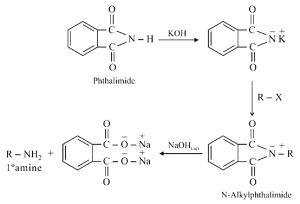
(A) Gabriel phthalimide synthesis is used for the preparation of aliphatic primary amines without the loss of carbons. It involves nucleophilic substitution $(S_{N}2)$ of alkyl halides by the anion formed by the phthalimide.
Phthalimide on treatment with ethanolic $KOH$ forms potassium salt of phthalimide which on heating with $RX$ followed by either alkaline hydrolysis or hydrazinolysis with hydrazine produces the corresponding $1^{\circ}$ amine.
Phthalimide on treatment with ethanolic $KOH$ forms potassium salt of phthalimide which on heating with $RX$ followed by either alkaline hydrolysis or hydrazinolysis with hydrazine produces the corresponding $1^{\circ}$ amine.
0 likes
View Solution219
EasyMCQ
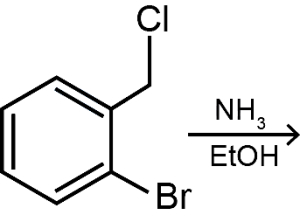
The product of the reaction is
A
$2-$bromobenzylamine
B
$3-$chloroaniline
C
$2-$bromo-$N$-methylaniline
D
$2-$ethoxybenzylamine
Solution
(A) The reaction involves the treatment of $2$-bromobenzyl chloride with ammonia $(NH_3)$ in ethanol $(EtOH)$. This is a nucleophilic substitution reaction $(S_N2)$ where the nucleophile $NH_3$ attacks the electrophilic carbon of the $-CH_2Cl$ group,displacing the chloride ion $(Cl^-)$. The bromine atom attached to the benzene ring is relatively inert towards nucleophilic substitution under these conditions. Therefore,the $-CH_2Cl$ group is converted into a $-CH_2NH_2$ group,resulting in the formation of $2$-bromobenzylamine.
0 likes
View Solution220
MediumMCQ
Select the reagents that reduce nitriles to primary amines:
$A$. $(i) \text{LiAlH}_4$; $(ii) \text{H}_2\text{O}$
$B$. $\text{Sn} + \text{HCl}$
$C$. $\text{H}_2/\text{Ni}$
$D$. $\text{Na(Hg)}/\text{C}_2\text{H}_5\text{OH}$
$E$. $\text{Br}_2/\text{aq. NaOH}$
Choose the correct answer from the options given below:
$A$. $(i) \text{LiAlH}_4$; $(ii) \text{H}_2\text{O}$
$B$. $\text{Sn} + \text{HCl}$
$C$. $\text{H}_2/\text{Ni}$
$D$. $\text{Na(Hg)}/\text{C}_2\text{H}_5\text{OH}$
$E$. $\text{Br}_2/\text{aq. NaOH}$
Choose the correct answer from the options given below:
A
$A, B$ and $C$ only
B
$A, D$ and $E$ only
C
$A, C$ and $D$ only
D
$B, D$ and $E$ only
Solution
(C) Nitriles $(R-C\equiv N)$ are reduced to primary amines $(R-CH_2-NH_2)$ using strong reducing agents.
$1$. $\text{LiAlH}_4$ (Lithium Aluminium Hydride) is a strong reducing agent that reduces nitriles to primary amines.
$2$. $\text{H}_2/\text{Ni}$ (Catalytic hydrogenation) also reduces nitriles to primary amines.
$3$. $\text{Na(Hg)}/\text{C}_2\text{H}_5\text{OH}$ is known as the Mendius reduction,which reduces nitriles to primary amines.
$4$. $\text{Sn} + \text{HCl}$ is primarily used for the reduction of nitro compounds to amines.
$5$. $\text{Br}_2/\text{aq. NaOH}$ is used for the Hofmann Bromamide degradation of amides to primary amines with one carbon atom less.
Therefore,the correct reagents are $A, C$,and $D$.
$1$. $\text{LiAlH}_4$ (Lithium Aluminium Hydride) is a strong reducing agent that reduces nitriles to primary amines.
$2$. $\text{H}_2/\text{Ni}$ (Catalytic hydrogenation) also reduces nitriles to primary amines.
$3$. $\text{Na(Hg)}/\text{C}_2\text{H}_5\text{OH}$ is known as the Mendius reduction,which reduces nitriles to primary amines.
$4$. $\text{Sn} + \text{HCl}$ is primarily used for the reduction of nitro compounds to amines.
$5$. $\text{Br}_2/\text{aq. NaOH}$ is used for the Hofmann Bromamide degradation of amides to primary amines with one carbon atom less.
Therefore,the correct reagents are $A, C$,and $D$.
0 likes
View SolutionAmines — Preparation of Amines · Frequently Asked Questions
1Are these Amines questions useful for JEE and NEET?
Yes. All questions in this section are mapped to JEE Main and NEET exam patterns. Previous year questions from JEE Main, NEET, GUJCET and state-level exams are included with full solutions.
2Can I switch to Hindi or Gujarati for these questions?
Yes. Use the language tabs in the hero section or the sidebar to view the same questions and solutions in English, Hindi or Gujarati.
3How do I generate a question paper from this subtopic?
Use the Vedclass Exam Paper Generator — select the chapter and subtopic, set difficulty, and generate Sets A, B, C, D automatically. First 3 chapters of every subject are free.
Vedclass Products
For Students
Vedclass Test Series
Mock tests in real JEE/NEET style with performance analysis. 5-day free trial.
Start Free TrialFor Teachers
Exam Paper Generator
Generate Set A/B/C/D papers from this chapter in 2 minutes. 3 chapters free.
Try FreeFor Institutes
Online Exam Module
Live online exams with unlimited students, 360° analytics & white-label branding.
See DemoFor Teachers & Institutes
Generate a Amines Exam Paper in 2 Minutes
Select subtopic & difficulty — Sets A, B, C, D auto-generated with No Repeat logic.
First 3 chapters of every subject are free — no payment required.