
A English
Preparation of Amines Questions in English
Class 12 Chemistry · Amines · Preparation of Amines
223+
Questions
English
Language
100%
With Solutions
Showing 48 of 223 questions in English
151
MediumMCQ
Identify the major product $C$ formed in the following reaction sequence:
$CH_3-CH_2-CH_2-I$ $\xrightarrow{NaCN} A$ $\xrightarrow[\text{Partial hydrolysis}]{OH^-} B$ $\xrightarrow{NaOH/Br_2} C \text{ (major)}$
$CH_3-CH_2-CH_2-I$ $\xrightarrow{NaCN} A$ $\xrightarrow[\text{Partial hydrolysis}]{OH^-} B$ $\xrightarrow{NaOH/Br_2} C \text{ (major)}$
A
butylamine
B
butanamide
C
$\alpha$-bromobutanoic acid
D
propylamine
Solution
(D) The reaction sequence is as follows:
$1$. $CH_3CH_2CH_2-I + NaCN \rightarrow CH_3CH_2CH_2-CN (A) + NaI$ (Nucleophilic substitution reaction).
$2$. $CH_3CH_2CH_2-CN + H_2O \xrightarrow{OH^-} CH_3CH_2CH_2-CONH_2 (B)$ (Partial hydrolysis of nitrile to amide).
$3$. $CH_3CH_2CH_2-CONH_2 + Br_2 + 4NaOH \rightarrow CH_3CH_2CH_2-NH_2 (C) + Na_2CO_3 + 2NaBr + 2H_2O$ (Hoffmann bromamide degradation reaction).
The final product $C$ is $CH_3CH_2CH_2-NH_2$,which is propylamine.
$1$. $CH_3CH_2CH_2-I + NaCN \rightarrow CH_3CH_2CH_2-CN (A) + NaI$ (Nucleophilic substitution reaction).
$2$. $CH_3CH_2CH_2-CN + H_2O \xrightarrow{OH^-} CH_3CH_2CH_2-CONH_2 (B)$ (Partial hydrolysis of nitrile to amide).
$3$. $CH_3CH_2CH_2-CONH_2 + Br_2 + 4NaOH \rightarrow CH_3CH_2CH_2-NH_2 (C) + Na_2CO_3 + 2NaBr + 2H_2O$ (Hoffmann bromamide degradation reaction).
The final product $C$ is $CH_3CH_2CH_2-NH_2$,which is propylamine.
0 likes
View Solution152
DifficultMCQ
The major product of the following reaction is:
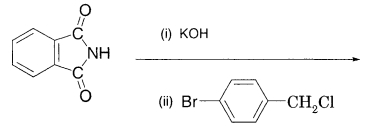
A
$N$-($4$-bromobenzyl)phthalimide
B
$N$-($4$-chloromethylphenyl)phthalimide
C
$2-$($4$-bromobenzyloxy)isoindole
D
$2-$($4$-chloromethylphenoxy)isoindole
Solution
(A) The reaction shown is the first step of the Gabriel phthalimide synthesis.
Phthalimide reacts with $KOH$ to form potassium phthalimide,which acts as a nucleophile.
This nucleophile then undergoes an $S_N2$ reaction with the alkyl halide,$4-bromobenzyl chloride$ $(Br-C_6H_4-CH_2Cl)$.
In $S_N2$ reactions,the nucleophile attacks the carbon atom attached to the leaving group.
Since the $CH_2Cl$ group is more reactive towards $S_N2$ than the aryl bromide ($C-Br$ bond),the nitrogen of the phthalimide attacks the $CH_2$ carbon,displacing the $Cl^-$ ion.
Therefore,the product is $N-(4-bromobenzyl)phthalimide$.
Phthalimide reacts with $KOH$ to form potassium phthalimide,which acts as a nucleophile.
This nucleophile then undergoes an $S_N2$ reaction with the alkyl halide,$4-bromobenzyl chloride$ $(Br-C_6H_4-CH_2Cl)$.
In $S_N2$ reactions,the nucleophile attacks the carbon atom attached to the leaving group.
Since the $CH_2Cl$ group is more reactive towards $S_N2$ than the aryl bromide ($C-Br$ bond),the nitrogen of the phthalimide attacks the $CH_2$ carbon,displacing the $Cl^-$ ion.
Therefore,the product is $N-(4-bromobenzyl)phthalimide$.
0 likes
View Solution153
MediumMCQ
The sequence from the following that would result in giving predominantly $3,4,5-$Tribromoaniline is $:$
A
Nitrobenzene $\xrightarrow[(ii) Sn, HCl]{(i) Br_2, acetic acid}$
B
Benzene $\xrightarrow[(ii) NH_3]{(i) Br_2, AlBr_3}$
C
$p-$Nitroaniline $\xrightarrow[(ii) NaNO_2, HCl, CuBr]{(i) Br_2(excess), acetic acid}$ $\xrightarrow[(iii) Sn, HCl]{}$
D
Aniline $\xrightarrow{Br_2, water}$
Solution
(C) To obtain $3,4,5-$Tribromoaniline,we start with $p-$nitroaniline.
$1.$ The amino group $(-NH_2)$ is a strong activating group,so treatment with excess $Br_2$ in acetic acid leads to bromination at the $2$ and $6$ positions relative to the $-NH_2$ group (which are the $3$ and $5$ positions relative to the $-NO_2$ group),yielding $2,6-$dibromo$-4-$nitroaniline.
$2.$ The amino group is then converted to a diazonium salt using $NaNO_2/HCl$.
$3.$ The diazonium group is replaced by a bromine atom using $CuBr$ (Sandmeyer reaction),resulting in $3,4,5-$tribromonitrobenzene.
$4.$ Finally,the nitro group $(-NO_2)$ is reduced to an amino group $(-NH_2)$ using $Sn/HCl$ to yield $3,4,5-$tribromoaniline.
$1.$ The amino group $(-NH_2)$ is a strong activating group,so treatment with excess $Br_2$ in acetic acid leads to bromination at the $2$ and $6$ positions relative to the $-NH_2$ group (which are the $3$ and $5$ positions relative to the $-NO_2$ group),yielding $2,6-$dibromo$-4-$nitroaniline.
$2.$ The amino group is then converted to a diazonium salt using $NaNO_2/HCl$.
$3.$ The diazonium group is replaced by a bromine atom using $CuBr$ (Sandmeyer reaction),resulting in $3,4,5-$tribromonitrobenzene.
$4.$ Finally,the nitro group $(-NO_2)$ is reduced to an amino group $(-NH_2)$ using $Sn/HCl$ to yield $3,4,5-$tribromoaniline.
0 likes
View Solution154
MediumMCQ
Predict the major product $P$ in the following sequence of reactions$-$
$(i)$ $HBr$,benzoyl peroxide
(ii) $KCN$
(iii) $Na(Hg)/C_2H_5OH$
[Image: $1-$methylcyclopentene reacting with the above reagents to form $P$]
$(i)$ $HBr$,benzoyl peroxide
(ii) $KCN$
(iii) $Na(Hg)/C_2H_5OH$
[Image: $1-$methylcyclopentene reacting with the above reagents to form $P$]
A
$1-$methyl$-2-$(aminomethyl)cyclopentane
B
$1-$methyl$-1-$(aminomethyl)cyclopentane
C
$1-$methyl$-2-$cyanocyclopentane
D
$1-$methyl$-1-$cyanocyclopentane
Solution
(A) Step $1$: Anti-Markovnikov addition of $HBr$ to $1$-methylcyclopentene in the presence of benzoyl peroxide gives $1$-bromo-$2$-methylcyclopentane.
Step $2$: Nucleophilic substitution $(S_N2)$ of the bromide with $KCN$ yields $1$-cyano-$2$-methylcyclopentane.
Step $3$: Reduction of the nitrile group $(-CN)$ using $Na(Hg)/C_2H_5OH$ (Mendius reduction) converts it into a primary amine $(-CH_2NH_2)$.
Thus,the final product $P$ is $1$-methyl-$2$-(aminomethyl)cyclopentane.
Step $2$: Nucleophilic substitution $(S_N2)$ of the bromide with $KCN$ yields $1$-cyano-$2$-methylcyclopentane.
Step $3$: Reduction of the nitrile group $(-CN)$ using $Na(Hg)/C_2H_5OH$ (Mendius reduction) converts it into a primary amine $(-CH_2NH_2)$.
Thus,the final product $P$ is $1$-methyl-$2$-(aminomethyl)cyclopentane.
0 likes
View Solution155
EasyMCQ
Compound $(D)$ is :
$CH_3CH_2COOH$ $\xrightarrow{SOCl_2} (B)$ $\xrightarrow[\Delta]{NH_3} (C)$ $\xrightarrow[Br_2]{KOH} (D)$
$CH_3CH_2COOH$ $\xrightarrow{SOCl_2} (B)$ $\xrightarrow[\Delta]{NH_3} (C)$ $\xrightarrow[Br_2]{KOH} (D)$
A
$CH_3CH_2NHCH_3$
B
$CH_3CH_2NH_2$
C
$CH_3CH_2CH_2NH_2$
D
$CH_3CH_2CONH_2$
Solution
(B) Step $1$: Reaction of propanoic acid with $SOCl_2$ gives propanoyl chloride $(B)$.
$CH_3CH_2COOH + SOCl_2 \rightarrow CH_3CH_2COCl + SO_2 + HCl$
Step $2$: Reaction of propanoyl chloride with $NH_3$ gives propanamide $(C)$.
$CH_3CH_2COCl + NH_3 \rightarrow CH_3CH_2CONH_2 + HCl$
Step $3$: Reaction of propanamide with $Br_2$ and $KOH$ is the Hofmann bromamide degradation reaction,which yields ethanamine $(D)$.
$CH_3CH_2CONH_2 + Br_2 + 4KOH \rightarrow CH_3CH_2NH_2 + K_2CO_3 + 2KBr + 2H_2O$
Thus,compound $(D)$ is $CH_3CH_2NH_2$.
$CH_3CH_2COOH + SOCl_2 \rightarrow CH_3CH_2COCl + SO_2 + HCl$
Step $2$: Reaction of propanoyl chloride with $NH_3$ gives propanamide $(C)$.
$CH_3CH_2COCl + NH_3 \rightarrow CH_3CH_2CONH_2 + HCl$
Step $3$: Reaction of propanamide with $Br_2$ and $KOH$ is the Hofmann bromamide degradation reaction,which yields ethanamine $(D)$.
$CH_3CH_2CONH_2 + Br_2 + 4KOH \rightarrow CH_3CH_2NH_2 + K_2CO_3 + 2KBr + 2H_2O$
Thus,compound $(D)$ is $CH_3CH_2NH_2$.
0 likes
View Solution156
MediumMCQ
Secondary amines can be prepared by $:-$
A
Reduction of nitriles
B
Reduction of $1^{\circ}$ amides
C
Reduction of nitro compounds
D
Reduction of isonitriles
Solution
(D) The reduction of isonitriles $(R-NC)$ using $H_2/Pd$ or $LiAlH_4$ yields secondary amines $(R-NH-CH_3)$.
$R-N \equiv C \xrightarrow{4[H]} R-NH-CH_3$
Therefore,the correct option is $D$.
$R-N \equiv C \xrightarrow{4[H]} R-NH-CH_3$
Therefore,the correct option is $D$.
0 likes
View Solution157
EasyMCQ
Identify the product obtained when nitroethane is treated with $Sn/HCl$ under ideal conditions.
A
Ethanamine
B
Acetamide
C
Formamide
D
Methanamine
Solution
(A) The reduction of nitroalkanes with $Sn/HCl$ (or $Fe/HCl$) is a standard method for the preparation of primary amines.
The reaction for nitroethane is:
$CH_3CH_2NO_2 + 6[H] \xrightarrow{Sn/HCl} CH_3CH_2NH_2 + 2H_2O$.
Thus,the product obtained is ethanamine.
The reaction for nitroethane is:
$CH_3CH_2NO_2 + 6[H] \xrightarrow{Sn/HCl} CH_3CH_2NH_2 + 2H_2O$.
Thus,the product obtained is ethanamine.
0 likes
View Solution158
MediumMCQ
Which of the following compounds is $NOT$ obtained at any stage of Gabriel phthalimide synthesis?
A
Potassium salt of phthalimide
B
$N$-alkyl phthalimide
C
Phthalic acid
D
Primary amine
Solution
(C) Gabriel phthalimide synthesis involves the following steps:
$1$. Phthalimide reacts with $alc. KOH$ to form the potassium salt of phthalimide.
$2$. The potassium salt of phthalimide reacts with an alkyl halide $(R-X)$ to form $N$-alkyl phthalimide.
$3$. $N$-alkyl phthalimide undergoes alkaline hydrolysis (using $NaOH_{(aq)}$) to yield a primary amine $(R-NH_2)$ and the sodium salt of phthalic acid (sodium phthalate).
Phthalic acid itself is not formed as a product; instead,its sodium salt is obtained. Therefore,phthalic acid is not obtained at any stage.
$1$. Phthalimide reacts with $alc. KOH$ to form the potassium salt of phthalimide.
$2$. The potassium salt of phthalimide reacts with an alkyl halide $(R-X)$ to form $N$-alkyl phthalimide.
$3$. $N$-alkyl phthalimide undergoes alkaline hydrolysis (using $NaOH_{(aq)}$) to yield a primary amine $(R-NH_2)$ and the sodium salt of phthalic acid (sodium phthalate).
Phthalic acid itself is not formed as a product; instead,its sodium salt is obtained. Therefore,phthalic acid is not obtained at any stage.
0 likes
View Solution159
EasyMCQ
Identify reagent '$A$' used in the following reaction:
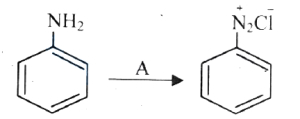
A
$\xrightarrow[\Delta]{\text{dil. } HCl}$
B
$\xrightarrow[\text{low temp.}]{NaNO_2+HCl}$
C
$\xrightarrow[\Delta]{H_3O^{+}}$
D
$NaOH, 623 \ K$
Solution
(B) The reaction shown is the conversion of aniline to benzene diazonium chloride.
This process is known as diazotisation.
Aniline reacts with nitrous acid $(HNO_2)$,which is generated in situ by the reaction of $NaNO_2$ and $HCl$ at a low temperature $(273-278 \ K)$,to form benzene diazonium chloride.
Therefore,the correct reagent '$A$' is $NaNO_2+HCl$ at low temperature.
This process is known as diazotisation.
Aniline reacts with nitrous acid $(HNO_2)$,which is generated in situ by the reaction of $NaNO_2$ and $HCl$ at a low temperature $(273-278 \ K)$,to form benzene diazonium chloride.
Therefore,the correct reagent '$A$' is $NaNO_2+HCl$ at low temperature.
0 likes
View Solution160
MediumMCQ
Identify the product '$B$' in the following sequence of reactions.
$CH_3Br$ $\xrightarrow{KCN} A$ $\xrightarrow{Na / C_2H_5OH} B$
$CH_3Br$ $\xrightarrow{KCN} A$ $\xrightarrow{Na / C_2H_5OH} B$
A
Methyl cyanide
B
Ethyl amine
C
Methyl amine
D
Ethyl cyanide
Solution
(B) Step $1$: $CH_3Br$ reacts with $KCN$ to form methyl cyanide $(CH_3CN)$ as product $A$.
$CH_3Br + KCN \rightarrow CH_3CN + KBr$
Step $2$: Methyl cyanide $(CH_3CN)$ undergoes reduction with $Na / C_2H_5OH$ (Mendius reduction) to form ethyl amine $(CH_3CH_2NH_2)$ as product $B$.
$CH_3CN + 4[H] \xrightarrow{Na / C_2H_5OH} CH_3CH_2NH_2$
Therefore,the product $B$ is ethyl amine.
$CH_3Br + KCN \rightarrow CH_3CN + KBr$
Step $2$: Methyl cyanide $(CH_3CN)$ undergoes reduction with $Na / C_2H_5OH$ (Mendius reduction) to form ethyl amine $(CH_3CH_2NH_2)$ as product $B$.
$CH_3CN + 4[H] \xrightarrow{Na / C_2H_5OH} CH_3CH_2NH_2$
Therefore,the product $B$ is ethyl amine.
0 likes
View Solution161
EasyMCQ
Aniline is treated with $NaNO_2 + HCl$ at low temperature to form:
A
$2-$Aminophenol
B
Benzaldehyde
C
Benzene
D
Benzenediazonium chloride
Solution
(D) When aniline $(C_6H_5NH_2)$ reacts with nitrous acid $(HNO_2)$,which is generated in situ by the reaction of $NaNO_2$ and $HCl$ at a low temperature of $273-278 \ K$,it undergoes a diazotization reaction.
This reaction converts the amino group $(-NH_2)$ into a diazonium group $(-N_2^+Cl^-)$,resulting in the formation of benzenediazonium chloride $(C_6H_5N_2^+Cl^-)$.
This reaction converts the amino group $(-NH_2)$ into a diazonium group $(-N_2^+Cl^-)$,resulting in the formation of benzenediazonium chloride $(C_6H_5N_2^+Cl^-)$.
0 likes
View Solution162
EasyMCQ
Identify '$A$' in the following reaction: $A \xrightarrow[\text{ether}]{LiAlH_4} \text{Ethanamine}$
A
$C_2H_5CN$
B
$CH_3CONH_2$
C
$C_2H_5CONH_2$
D
$CH_3NO_2$
Solution
(B) $LiAlH_4$ is a strong reducing agent that reduces amides to corresponding amines.
The reaction is: $CH_3CONH_2 \xrightarrow[\text{ether}]{LiAlH_4} CH_3CH_2NH_2$ (Ethanamine).
Thus,the reactant '$A$' is acetamide $(CH_3CONH_2)$.
The reaction is: $CH_3CONH_2 \xrightarrow[\text{ether}]{LiAlH_4} CH_3CH_2NH_2$ (Ethanamine).
Thus,the reactant '$A$' is acetamide $(CH_3CONH_2)$.
0 likes
View Solution163
MediumMCQ
Identify '$B$' in the following conversions:
$CH_3Br$ $\xrightarrow{KCN} A$ $\xrightarrow{Na / C_2H_5OH} B$
$CH_3Br$ $\xrightarrow{KCN} A$ $\xrightarrow{Na / C_2H_5OH} B$
A
$CH_3CN$
B
$CH_3OC_2H_5$
C
$CH_3ONa$
D
$CH_3CH_2NH_2$
Solution
(D) Step $1$: Reaction of $CH_3Br$ with $KCN$ gives methyl cyanide $(CH_3CN)$ as $A$.
$CH_3Br + KCN \rightarrow CH_3CN + KBr$
Step $2$: Reduction of methyl cyanide $(CH_3CN)$ with $Na / C_2H_5OH$ (Mendius reduction) yields ethylamine $(CH_3CH_2NH_2)$ as $B$.
$CH_3CN + 4[H] \xrightarrow{Na / C_2H_5OH} CH_3CH_2NH_2$
$CH_3Br + KCN \rightarrow CH_3CN + KBr$
Step $2$: Reduction of methyl cyanide $(CH_3CN)$ with $Na / C_2H_5OH$ (Mendius reduction) yields ethylamine $(CH_3CH_2NH_2)$ as $B$.
$CH_3CN + 4[H] \xrightarrow{Na / C_2H_5OH} CH_3CH_2NH_2$
0 likes
View Solution164
MediumMCQ
Which of the following conversions requires the reagent $Sn / HCl$?
A
$R-CONH_2 \rightarrow R-CH_2-NH_2$
B
$R-C \equiv N \rightarrow R-CH_2-NH_2$
C
$R-NO_2 \rightarrow R-NH_2 + 2H_2O$
D
$R-CONH_2 \rightarrow R-NH_2$
Solution
(C) The reagent $Sn / HCl$ is a common reducing agent used to reduce nitro compounds $(R-NO_2)$ to primary amines $(R-NH_2)$.
The balanced chemical equation for the reduction of a nitroalkane is:
$R-NO_2 + 6[H] \xrightarrow{Sn / HCl} R-NH_2 + 2H_2O$.
The balanced chemical equation for the reduction of a nitroalkane is:
$R-NO_2 + 6[H] \xrightarrow{Sn / HCl} R-NH_2 + 2H_2O$.
0 likes
View Solution165
EasyMCQ
Identify the Gabriel phthalimide synthesis reaction from the reactants and reagents used in it.
A
$R-CN + [H] \underset{\text{ether}}{\stackrel{LiAlH_4}{\longrightarrow}} R-CH_2NH_2$
B
$R-CONH_2 + [H] \underset{\text{ether}}{\stackrel{LiAlH_4}{\longrightarrow}} R-CH_2NH_2$
C
$R-CONH_2 + Br_2 + 4 NaOH_{\text{(aq.)}} \stackrel{\Delta}{\longrightarrow} R-NH_2 + Na_2CO_3 + 2NaBr + 2H_2O$
D
Phthalimide + $KOH$ (alc.) $\rightarrow$ $N$-potassiophthalimide $\xrightarrow{R-X}$ $N$-alkylphthalimide $\xrightarrow{NaOH_{\text{(aq.)}}}$ Phthalic acid (salt) + $R-NH_2$
Solution
(D) The Gabriel phthalimide synthesis is a method used for the preparation of primary aliphatic amines. The reaction involves the following steps:
$1$. Phthalimide reacts with ethanolic $KOH$ to form potassium phthalimide.
$2$. Potassium phthalimide reacts with an alkyl halide $(R-X)$ to form $N$-alkylphthalimide.
$3$. $N$-alkylphthalimide undergoes alkaline hydrolysis (using $NaOH_{\text{(aq.)}}$) to yield the corresponding primary amine $(R-NH_2)$ and sodium phthalate.
$1$. Phthalimide reacts with ethanolic $KOH$ to form potassium phthalimide.
$2$. Potassium phthalimide reacts with an alkyl halide $(R-X)$ to form $N$-alkylphthalimide.
$3$. $N$-alkylphthalimide undergoes alkaline hydrolysis (using $NaOH_{\text{(aq.)}}$) to yield the corresponding primary amine $(R-NH_2)$ and sodium phthalate.
0 likes
View Solution166
EasyMCQ
Which among the following statements is $NOT$ true about Gabriel phthalimide synthesis?
A
In this method,the formation of $N$-alkyl phthalimide is involved.
B
In this method,sodium phthalate is also obtained.
C
This method is useful for the preparation of aromatic amines.
D
In this method,the potassium salt of phthalimide is formed as an intermediate product.
Solution
(C) Gabriel phthalimide synthesis is used for the preparation of primary aliphatic amines.
It cannot be used for the preparation of aromatic amines because aryl halides do not undergo nucleophilic substitution with the anion formed by phthalimide due to the partial double bond character of the $C-X$ bond and the instability of the phenyl cation.
It cannot be used for the preparation of aromatic amines because aryl halides do not undergo nucleophilic substitution with the anion formed by phthalimide due to the partial double bond character of the $C-X$ bond and the instability of the phenyl cation.
0 likes
View Solution167
MediumMCQ
Identify product $B$ in the following reaction:
Acetanilide $\xrightarrow[conc. H_2SO_4]{conc. HNO_3}$ $A$ $\xrightarrow{H^+ \text{ or } OH^-}$ $B$
Acetanilide $\xrightarrow[conc. H_2SO_4]{conc. HNO_3}$ $A$ $\xrightarrow{H^+ \text{ or } OH^-}$ $B$
A
$p$-nitroaniline
B
$o$-nitroacetanilide
C
Aniline
D
Nitrobenzene
Solution
(A) $1$. The reaction of acetanilide with a nitrating mixture $(conc. HNO_3 + conc. H_2SO_4)$ leads to electrophilic aromatic substitution,primarily yielding $p$-nitroacetanilide as product $A$ due to the steric hindrance at the ortho position.
$2$. The subsequent step involves the hydrolysis of the amide group $(-NHCOCH_3)$ in $p$-nitroacetanilide using acid $(H^+)$ or base $(OH^-)$.
$3$. This hydrolysis converts the $-NHCOCH_3$ group back into an amino group $(-NH_2)$,resulting in the formation of $p$-nitroaniline as product $B$.
$2$. The subsequent step involves the hydrolysis of the amide group $(-NHCOCH_3)$ in $p$-nitroacetanilide using acid $(H^+)$ or base $(OH^-)$.
$3$. This hydrolysis converts the $-NHCOCH_3$ group back into an amino group $(-NH_2)$,resulting in the formation of $p$-nitroaniline as product $B$.
0 likes
View Solution168
MediumMCQ
Identify product $B$ obtained in the following reaction: $CH_{3}CH_{2}NO_{2}$ $\xrightarrow[\Delta]{HNO_{2}} A$ $\xrightarrow{LiAlH_{4}} \text{ether} B$
A
Ethanoic acid
B
Ethanal
C
Ethanol
D
Ethanamine
Solution
(D) The reaction sequence is: $CH_{3}CH_{2}NO_{2}$ $\xrightarrow[\Delta]{HNO_{2}} A$ $\xrightarrow{LiAlH_{4}} B$.
Nitroalkanes like nitroethane $(CH_{3}CH_{2}NO_{2})$ react with nitrous acid $(HNO_{2})$ to form nitrolic acids or pseudonitroles. However,in the context of standard organic synthesis problems,the reduction of a nitro group $(NO_{2})$ using $LiAlH_{4}$ yields a primary amine.
$A$ is the nitro compound $CH_{3}CH_{2}NO_{2}$.
Reduction of $CH_{3}CH_{2}NO_{2}$ with $LiAlH_{4}$ gives $CH_{3}CH_{2}NH_{2}$.
Therefore,$B$ is $CH_{3}CH_{2}NH_{2}$ (Ethanamine).
Nitroalkanes like nitroethane $(CH_{3}CH_{2}NO_{2})$ react with nitrous acid $(HNO_{2})$ to form nitrolic acids or pseudonitroles. However,in the context of standard organic synthesis problems,the reduction of a nitro group $(NO_{2})$ using $LiAlH_{4}$ yields a primary amine.
$A$ is the nitro compound $CH_{3}CH_{2}NO_{2}$.
Reduction of $CH_{3}CH_{2}NO_{2}$ with $LiAlH_{4}$ gives $CH_{3}CH_{2}NH_{2}$.
Therefore,$B$ is $CH_{3}CH_{2}NH_{2}$ (Ethanamine).
0 likes
View Solution169
MediumMCQ
Which of the following amines cannot be prepared by Gabriel phthalimide synthesis?
A
Ethylamine
B
Sec-butylamine
C
Aniline
D
Isopropylamine
Solution
(C) Gabriel phthalimide synthesis is used for the preparation of aliphatic primary amines.
It involves the nucleophilic substitution of an alkyl halide with the phthalimide anion.
Aromatic primary amines,such as $Aniline$,cannot be prepared by this method because aryl halides do not undergo nucleophilic substitution with the phthalimide anion under these conditions.
It involves the nucleophilic substitution of an alkyl halide with the phthalimide anion.
Aromatic primary amines,such as $Aniline$,cannot be prepared by this method because aryl halides do not undergo nucleophilic substitution with the phthalimide anion under these conditions.
0 likes
View Solution170
MediumMCQ
Ketoxime on reduction with sodium in ethanol forms
A
$1^{\circ}$ amine
B
$2^{\circ}$ amine
C
$1^{\circ}$ and $2^{\circ}$ amine
D
$3^{\circ}$ amine
Solution
(A) The reduction of ketoximes $(R_2C=NOH)$ using sodium $(Na)$ in ethanol $(C_2H_5OH)$ is a standard method for the preparation of primary amines ($1^{\circ}$ amines).
For example,acetoxime $(CH_3-C(=NOH)-CH_3)$ upon reduction with $Na/C_2H_5OH$ yields isopropylamine $(CH_3-CH(NH_2)-CH_3)$,which is a $1^{\circ}$ amine.
For example,acetoxime $(CH_3-C(=NOH)-CH_3)$ upon reduction with $Na/C_2H_5OH$ yields isopropylamine $(CH_3-CH(NH_2)-CH_3)$,which is a $1^{\circ}$ amine.
0 likes
View Solution171
EasyMCQ
Which of the following reagents is used in the Mendius reduction reaction of alkyl cyanide?
A
$Sn / HCl$
B
$LiAlH_4 / \text{Ether}$
C
$Na-Hg / H_2O$
D
$Na / C_2H_5OH$
Solution
(D) The Mendius reduction involves the reduction of nitriles (alkyl cyanides) to primary amines using sodium $(Na)$ in ethanol $(C_2H_5OH)$.
The reaction is represented as:
$R-C \equiv N + 4[H] \xrightarrow{Na / C_2H_5OH} R-CH_2-NH_2$ (primary amine).
The reaction is represented as:
$R-C \equiv N + 4[H] \xrightarrow{Na / C_2H_5OH} R-CH_2-NH_2$ (primary amine).
0 likes
View Solution172
MediumMCQ
Which of the following type of amines is obtained by alkylation of phthalimide?
A
$Ar-NH_2$
B
$R-NH_2$
C
$(R)_3N$
D
$R-NH-R$
Solution
(B) The reaction of phthalimide with an alkyl halide in the presence of a base followed by alkaline hydrolysis is known as the Gabriel phthalimide synthesis.
This method is specifically used for the preparation of primary aliphatic amines $(R-NH_2)$.
It cannot be used for the preparation of aromatic amines $(Ar-NH_2)$ because aryl halides do not undergo nucleophilic substitution with the phthalimide anion.
This method is specifically used for the preparation of primary aliphatic amines $(R-NH_2)$.
It cannot be used for the preparation of aromatic amines $(Ar-NH_2)$ because aryl halides do not undergo nucleophilic substitution with the phthalimide anion.
0 likes
View Solution173
MediumMCQ
When acetamide is treated with $Br_{2}$ and caustic soda,the product formed is
A
$N$-bromamide
B
bromoacetic acid
C
methanamine
D
ethanamine
Solution
(C) Amides react with bromine and caustic soda to give their corresponding primary amines. This reaction is known as Hofmann's bromamide degradation reaction.
The chemical equation is:
$CH_{3}CONH_{2} + Br_{2} + 4KOH \xrightarrow{343K} CH_{3}NH_{2} + 2KBr + K_{2}CO_{3} + 2H_{2}O$
Thus,acetamide $(CH_{3}CONH_{2})$ gives methanamine $(CH_{3}NH_{2})$.
The chemical equation is:
$CH_{3}CONH_{2} + Br_{2} + 4KOH \xrightarrow{343K} CH_{3}NH_{2} + 2KBr + K_{2}CO_{3} + 2H_{2}O$
Thus,acetamide $(CH_{3}CONH_{2})$ gives methanamine $(CH_{3}NH_{2})$.
0 likes
View Solution174
EasyMCQ
Identify the product '$A$' obtained in the following reaction.
$N$-alkyl phthalimide $\xrightarrow[\text{sodium phthalate } + A]{NaOH_{(aq)}}$
$N$-alkyl phthalimide $\xrightarrow[\text{sodium phthalate } + A]{NaOH_{(aq)}}$
A
Primary amine
B
Amide
C
Phenol
D
Benzoic acid
Solution
(A) The reaction shown is the alkaline hydrolysis of $N$-alkyl phthalimide,which is a step in the Gabriel phthalimide synthesis.
The reaction is: $N$-alkyl phthalimide + $2NaOH_{(aq)} \rightarrow \text{Sodium phthalate} + R-NH_2$ (Primary amine).
Therefore,the product '$A$' is a primary amine.
The reaction is: $N$-alkyl phthalimide + $2NaOH_{(aq)} \rightarrow \text{Sodium phthalate} + R-NH_2$ (Primary amine).
Therefore,the product '$A$' is a primary amine.
0 likes
View Solution175
MediumMCQ
What is the number of moles of $H$ atoms required to prepare one mole of ethylamine from one mole of acetamide?
A
$2$
B
$4$
C
$3$
D
$1$
Solution
(B) The reduction of acetamide $(CH_3CONH_2)$ to ethylamine $(CH_3CH_2NH_2)$ using a strong reducing agent like $LiAlH_4$ or $Na/C_2H_5OH$ is represented by the following chemical equation:
$CH_3CONH_2 + 4[H] \xrightarrow{LiAlH_4/ether} CH_3CH_2NH_2 + H_2O$
From the stoichiometry of the reaction,it is clear that $4$ moles of nascent hydrogen $([H])$ are required to reduce $1$ mole of acetamide to $1$ mole of ethylamine.
Therefore,the correct option is $B$.
$CH_3CONH_2 + 4[H] \xrightarrow{LiAlH_4/ether} CH_3CH_2NH_2 + H_2O$
From the stoichiometry of the reaction,it is clear that $4$ moles of nascent hydrogen $([H])$ are required to reduce $1$ mole of acetamide to $1$ mole of ethylamine.
Therefore,the correct option is $B$.
0 likes
View Solution176
EasyMCQ
Which of the following is Mendius reduction?
A
$R-CONH_2 \xrightarrow[\Delta]{Br_2, KOH_{(aq)}} R-NH_2$
B
$R-NH_2 \xrightarrow{RX \text{ (excess)}} R_4N^+X^-$
C
$R_4N^+X^- \xrightarrow[\Delta]{\text{Moist } Ag_2O} \text{Alkene} + R_3N$
D
$R-CN \xrightarrow[\text{or } LiAlH_4]{Na / CH_3OH} R-CH_2NH_2$
Solution
(D) The correct answer is $D$.
Mendius reduction involves the reduction of nitriles $(R-CN)$ to primary amines $(R-CH_2NH_2)$ using reducing agents like sodium in ethanol or methanol ($Na / C_2H_5OH$ or $Na / CH_3OH$) or lithium aluminum hydride $(LiAlH_4)$.
Explanation of other options:
- $A$: This is Hofmann bromamide degradation,where an amide $(R-CONH_2)$ reacts with bromine and alkali to form a primary amine.
- $B$: This is the $N$-alkylation of amines,where an amine reacts with excess alkyl halide to form a quaternary ammonium salt.
- $C$: This is Hofmann elimination,where a quaternary ammonium hydroxide undergoes thermal decomposition to form an alkene and a tertiary amine.
Mendius reduction involves the reduction of nitriles $(R-CN)$ to primary amines $(R-CH_2NH_2)$ using reducing agents like sodium in ethanol or methanol ($Na / C_2H_5OH$ or $Na / CH_3OH$) or lithium aluminum hydride $(LiAlH_4)$.
Explanation of other options:
- $A$: This is Hofmann bromamide degradation,where an amide $(R-CONH_2)$ reacts with bromine and alkali to form a primary amine.
- $B$: This is the $N$-alkylation of amines,where an amine reacts with excess alkyl halide to form a quaternary ammonium salt.
- $C$: This is Hofmann elimination,where a quaternary ammonium hydroxide undergoes thermal decomposition to form an alkene and a tertiary amine.
0 likes
View Solution177
MediumMCQ
Which of the following statements is $NOT$ correct regarding Mendius reduction?
A
It is useful for the preparation of $R-NH_2$.
B
In this,alkyl cyanides are reduced.
C
In this,sodium and ethanol are used for reduction.
D
In this method,one carbon atom is lost in the form of $CO_2$.
Solution
(D) Mendius reduction is a chemical reaction that involves the reduction of alkyl cyanides (nitriles) to primary amines using sodium in ethanol $(Na/C_2H_5OH)$.
The reaction is represented as: $R-CN + 4[H] \xrightarrow{Na/C_2H_5OH} R-CH_2NH_2$.
This reaction does not involve the loss of a carbon atom as $CO_2$.
Therefore,the statement that one carbon atom is lost as $CO_2$ is incorrect.
The reaction is represented as: $R-CN + 4[H] \xrightarrow{Na/C_2H_5OH} R-CH_2NH_2$.
This reaction does not involve the loss of a carbon atom as $CO_2$.
Therefore,the statement that one carbon atom is lost as $CO_2$ is incorrect.
0 likes
View Solution178
EasyMCQ
Alkyl cyanides on reduction by sodium and ethanol give primary amines. This reaction is called as
A
Wolff-Kishner reduction
B
Hell-Volhard-Zelinsky reaction
C
Mendius reduction
D
Clemmensen reduction
Solution
(C)
Primary amines can be obtained by the reduction of alkyl cyanide with sodium and ethanol. The chemical reaction is:
$R-C \equiv N + 4[H] \xrightarrow{Na/ethanol} R-CH_2-NH_2$
This reaction is known as Mendius reduction.
Primary amines can be obtained by the reduction of alkyl cyanide with sodium and ethanol. The chemical reaction is:
$R-C \equiv N + 4[H] \xrightarrow{Na/ethanol} R-CH_2-NH_2$
This reaction is known as Mendius reduction.
0 likes
View Solution179
EasyMCQ
What is the number of primary amines possible for the compound having molecular formula $C_4H_{11}N$?
A
$3$
B
$2$
C
$1$
D
$4$
Solution
(D) The molecular formula $C_4H_{11}N$ corresponds to a saturated amine. Primary amines have the general structure $R-NH_2$.
For a $C_4$ alkyl group,the possible primary amines are:
$1$. $CH_3-CH_2-CH_2-CH_2-NH_2$ (butan-$1$-amine)
$2$. $CH_3-CH_2-CH(CH_3)-NH_2$ (butan-$2$-amine)
$3$. $(CH_3)_2CH-CH_2-NH_2$ ($2$-methylpropan-$1$-amine)
$4$. $(CH_3)_3C-NH_2$ ($2$-methylpropan-$2$-amine)
Thus,there are $4$ possible primary amines.
For a $C_4$ alkyl group,the possible primary amines are:
$1$. $CH_3-CH_2-CH_2-CH_2-NH_2$ (butan-$1$-amine)
$2$. $CH_3-CH_2-CH(CH_3)-NH_2$ (butan-$2$-amine)
$3$. $(CH_3)_2CH-CH_2-NH_2$ ($2$-methylpropan-$1$-amine)
$4$. $(CH_3)_3C-NH_2$ ($2$-methylpropan-$2$-amine)
Thus,there are $4$ possible primary amines.
0 likes
View Solution180
MediumMCQ
How many primary amines are possible for the formula $C_4H_{11}N$?
A
$2$
B
$4$
C
$1$
D
$3$
Solution
(B) primary amine has the general structure $R-NH_2$. For the molecular formula $C_4H_{11}N$,the alkyl group $R$ must be $C_4H_9$.
The possible isomers for the butyl group $(C_4H_9-)$ are:
$1$. $n$-butylamine: $CH_3CH_2CH_2CH_2NH_2$
$2$. Isobutylamine: $(CH_3)_2CHCH_2NH_2$
$3$. sec-butylamine: $CH_3CH_2CH(NH_2)CH_3$
$4$. tert-butylamine: $(CH_3)_3CNH_2$
Thus,there are $4$ possible primary amines.
The possible isomers for the butyl group $(C_4H_9-)$ are:
$1$. $n$-butylamine: $CH_3CH_2CH_2CH_2NH_2$
$2$. Isobutylamine: $(CH_3)_2CHCH_2NH_2$
$3$. sec-butylamine: $CH_3CH_2CH(NH_2)CH_3$
$4$. tert-butylamine: $(CH_3)_3CNH_2$
Thus,there are $4$ possible primary amines.
0 likes
View Solution181
DifficultMCQ
Identify $B$ in the following conversion: $CH_3-I$ $\xrightarrow{KCN} A$ $\xrightarrow{Na / C_2H_5OH} B$
A
$CH_3-CH_2-CN$
B
$CH_3-CH_2-CH_3$
C
$CH_3-NH-C_2H_5$
D
$CH_3-CH_2-NH_2$
Solution
(D) is methyl cyanide $(CH_3-CN)$ formed by the nucleophilic substitution of $CH_3-I$ with $KCN$.
The reduction of $CH_3-CN$ using $Na / C_2H_5OH$ is known as the Mendius reduction,which produces ethylamine $(CH_3-CH_2-NH_2)$ as product $B$.
$CH_3-I + KCN \rightarrow CH_3-CN (A) + KI$
$CH_3-CN + 4[H] \xrightarrow{Na / C_2H_5OH} CH_3-CH_2-NH_2 (B)$
The reduction of $CH_3-CN$ using $Na / C_2H_5OH$ is known as the Mendius reduction,which produces ethylamine $(CH_3-CH_2-NH_2)$ as product $B$.
$CH_3-I + KCN \rightarrow CH_3-CN (A) + KI$
$CH_3-CN + 4[H] \xrightarrow{Na / C_2H_5OH} CH_3-CH_2-NH_2 (B)$
0 likes
View Solution182
MediumMCQ
Identify product '$B$' in the following reaction.
$CH_3-I + KCN$ $\longrightarrow A$ $\xrightarrow[C_2H_5OH]{Na} B$
$CH_3-I + KCN$ $\longrightarrow A$ $\xrightarrow[C_2H_5OH]{Na} B$
A
$CH_3OH$
B
$CH_3NO_2$
C
$CH_3ONa$
D
$CH_3CH_2NH_2$
Solution
(D) Step $1$: The reaction of methyl iodide $(CH_3I)$ with alcoholic $KCN$ is a nucleophilic substitution reaction $(S_N2)$ which yields methyl cyanide $(CH_3CN)$ as product $A$.
$CH_3-I + KCN \rightarrow CH_3-CN + KI$
Step $2$: The reduction of methyl cyanide $(CH_3CN)$ with sodium $(Na)$ in the presence of ethanol $(C_2H_5OH)$ is known as Mendius reduction,which produces ethylamine $(CH_3CH_2NH_2)$ as product $B$.
$CH_3-CN + 4[H] \xrightarrow[C_2H_5OH]{Na} CH_3-CH_2-NH_2$
$CH_3-I + KCN \rightarrow CH_3-CN + KI$
Step $2$: The reduction of methyl cyanide $(CH_3CN)$ with sodium $(Na)$ in the presence of ethanol $(C_2H_5OH)$ is known as Mendius reduction,which produces ethylamine $(CH_3CH_2NH_2)$ as product $B$.
$CH_3-CN + 4[H] \xrightarrow[C_2H_5OH]{Na} CH_3-CH_2-NH_2$
0 likes
View Solution183
MediumMCQ
Identify '$Y$' in the following reaction.
$CH_3Br$ $\xrightarrow{KCN} X$ $\xrightarrow{Na / C_2H_5OH} Y$
$CH_3Br$ $\xrightarrow{KCN} X$ $\xrightarrow{Na / C_2H_5OH} Y$
A
$CH_3-CH_2-NH_2$
B
$CH_3-O^-Na^+$
C
$CH_3-O-C_2H_5$
D
$CH_3CN$
Solution
(A) Step $1$: Reaction of $CH_3Br$ with $KCN$ is a nucleophilic substitution reaction.
$CH_3Br + KCN \rightarrow CH_3CN + KBr$
Here,$X$ is $CH_3CN$ (methyl cyanide or acetonitrile).
Step $2$: Reduction of $CH_3CN$ with $Na / C_2H_5OH$ (Mendius reduction) yields a primary amine.
$CH_3CN + 4[H] \xrightarrow{Na / C_2H_5OH} CH_3-CH_2-NH_2$
Thus,$Y$ is $CH_3-CH_2-NH_2$ (ethylamine).
$CH_3Br + KCN \rightarrow CH_3CN + KBr$
Here,$X$ is $CH_3CN$ (methyl cyanide or acetonitrile).
Step $2$: Reduction of $CH_3CN$ with $Na / C_2H_5OH$ (Mendius reduction) yields a primary amine.
$CH_3CN + 4[H] \xrightarrow{Na / C_2H_5OH} CH_3-CH_2-NH_2$
Thus,$Y$ is $CH_3-CH_2-NH_2$ (ethylamine).
0 likes
View Solution184
MediumMCQ
Identify $A$ and $B$ in the following reaction.
$CH_3Br$ $\xrightarrow{AgNO_2} A$ $\xrightarrow{Sn / HCl} B$
$CH_3Br$ $\xrightarrow{AgNO_2} A$ $\xrightarrow{Sn / HCl} B$
A
$CH_3NO_2$ and $CH_3Cl$
B
$CH_3NO_2$ and $CH_3NH_2$
C
$CH_3NH_2$ and $CH_3Cl$
D
$CH_3NH_2$ and $CH_3CH_2NO_2$
Solution
(B) The reaction of $CH_3Br$ with $AgNO_2$ is a nucleophilic substitution reaction that yields nitromethane $(A = CH_3NO_2)$.
$CH_3Br + AgNO_2 \rightarrow CH_3NO_2 + AgBr$
Reduction of nitromethane with $Sn / HCl$ (a reducing agent) converts the nitro group $(-NO_2)$ into an amine group $(-NH_2)$,yielding methanamine $(B = CH_3NH_2)$.
$CH_3NO_2 + 6[H] \xrightarrow{Sn / HCl} CH_3NH_2 + 2H_2O$
$CH_3Br + AgNO_2 \rightarrow CH_3NO_2 + AgBr$
Reduction of nitromethane with $Sn / HCl$ (a reducing agent) converts the nitro group $(-NO_2)$ into an amine group $(-NH_2)$,yielding methanamine $(B = CH_3NH_2)$.
$CH_3NO_2 + 6[H] \xrightarrow{Sn / HCl} CH_3NH_2 + 2H_2O$
0 likes
View Solution185
MediumMCQ
Identify product $B$ in the following reaction: $CH_3Br + AgNO_2$ $\longrightarrow A$ $\xrightarrow{Sn / HCl} B$
A
$CH_3NO_2$
B
$CH_3NH_2$
C
$CH_3Cl$
D
$CH_3OH$
Solution
(B) The reaction proceeds as follows:
$1$. $CH_3Br$ reacts with $AgNO_2$ to form nitromethane $(A)$ as the major product: $CH_3Br + AgNO_2 \longrightarrow CH_3NO_2 + AgBr$.
$2$. Nitromethane $(CH_3NO_2)$ is then reduced by $Sn / HCl$ (a reducing agent) to form methylamine $(B)$: $CH_3NO_2 + 6[H] \xrightarrow{Sn / HCl} CH_3NH_2 + 2H_2O$.
Therefore,product $B$ is $CH_3NH_2$.
$1$. $CH_3Br$ reacts with $AgNO_2$ to form nitromethane $(A)$ as the major product: $CH_3Br + AgNO_2 \longrightarrow CH_3NO_2 + AgBr$.
$2$. Nitromethane $(CH_3NO_2)$ is then reduced by $Sn / HCl$ (a reducing agent) to form methylamine $(B)$: $CH_3NO_2 + 6[H] \xrightarrow{Sn / HCl} CH_3NH_2 + 2H_2O$.
Therefore,product $B$ is $CH_3NH_2$.
0 likes
View Solution186
EasyMCQ
When alkyl halide is boiled with a large excess of alcoholic ammonia,it forms:
A
primary amine
B
tertiary amine
C
secondary amine
D
quaternary ammonium salt
Solution
(A) When an alkyl halide $(R-X)$ is reacted with an excess of alcoholic ammonia $(NH_3)$,the reaction is an ammonolysis reaction.
Since ammonia is in large excess,the probability of the alkyl halide molecule colliding with an ammonia molecule is much higher than colliding with the formed amine.
Therefore,the reaction stops at the formation of the primary amine $(R-NH_2)$:
$R-X + NH_3 (\text{alc.}) \xrightarrow{\Delta} R-NH_2 + HX$
Thus,the correct option is $A$.
Since ammonia is in large excess,the probability of the alkyl halide molecule colliding with an ammonia molecule is much higher than colliding with the formed amine.
Therefore,the reaction stops at the formation of the primary amine $(R-NH_2)$:
$R-X + NH_3 (\text{alc.}) \xrightarrow{\Delta} R-NH_2 + HX$
Thus,the correct option is $A$.
0 likes
View Solution187
MediumMCQ
$Cl-CH_2-COONa$ on boiling with aqueous sodium nitrite gives:
A
Nitromethane
B
$\alpha$-chloronitromethane
C
Nitroethane
D
Acetyl chloride
Solution
(A) The reaction of sodium $\alpha$-chloroacetate with aqueous sodium nitrite involves the substitution of the chlorine atom by the nitro group,followed by decarboxylation upon boiling with water.
The reaction proceeds as follows:
$Cl-CH_2-COONa + NaNO_2 \rightarrow O_2N-CH_2-COONa + NaCl$
Then,the intermediate $O_2N-CH_2-COONa$ undergoes decarboxylation in the presence of water:
$O_2N-CH_2-COONa + H_2O \rightarrow CH_3NO_2 + NaHCO_3$
Thus,the final product is nitromethane $(CH_3NO_2)$.
The reaction proceeds as follows:
$Cl-CH_2-COONa + NaNO_2 \rightarrow O_2N-CH_2-COONa + NaCl$
Then,the intermediate $O_2N-CH_2-COONa$ undergoes decarboxylation in the presence of water:
$O_2N-CH_2-COONa + H_2O \rightarrow CH_3NO_2 + NaHCO_3$
Thus,the final product is nitromethane $(CH_3NO_2)$.
0 likes
View Solution188
EasyMCQ
Identify the product obtained when bromoethane is heated with excess of alcoholic ammonia under pressure.
A
Ethanol
B
Nitro ethane
C
Ethanamine
D
Ethene
Solution
(C) When bromoethane $(CH_3CH_2Br)$ is heated with an excess of alcoholic ammonia,it undergoes a nucleophilic substitution reaction (ammonolysis) to form ethanamine $(CH_3CH_2NH_2)$ as the primary product.
$CH_3CH_2Br + NH_3 (\text{excess}) \rightarrow CH_3CH_2NH_2 + HBr$
Since ammonia is in excess,the reaction stops at the primary amine stage.
$CH_3CH_2Br + NH_3 (\text{excess}) \rightarrow CH_3CH_2NH_2 + HBr$
Since ammonia is in excess,the reaction stops at the primary amine stage.
0 likes
View Solution189
MediumMCQ
Which of the following reaction/s does not yield an amine?
$I. R-X + NH_3 \xrightarrow{\Delta} \text{(alc)}$
$II. R-C \equiv N \xrightarrow{H_2/Ni \text{ or } Na(Hg)/C_2H_5OH}$
$III. R-C \equiv N + H_2O \xrightarrow{H^+}$
$IV. R-CONH_2 + 4[H] \xrightarrow{i) LiAlH_4, ii) H_3O^+}$
$I. R-X + NH_3 \xrightarrow{\Delta} \text{(alc)}$
$II. R-C \equiv N \xrightarrow{H_2/Ni \text{ or } Na(Hg)/C_2H_5OH}$
$III. R-C \equiv N + H_2O \xrightarrow{H^+}$
$IV. R-CONH_2 + 4[H] \xrightarrow{i) LiAlH_4, ii) H_3O^+}$
A
Both $I$ and $III$
B
Only $II$
C
Only $III$
D
Both $II$ and $IV$
Solution
(C) Let us analyze each reaction:
$I.$ Ammonolysis of alkyl halides $(R-X + NH_3 \rightarrow R-NH_2)$ yields amines.
$II.$ Reduction of nitriles $(R-C \equiv N + 4[H] \rightarrow R-CH_2NH_2)$ yields primary amines.
$III.$ Acidic hydrolysis of nitriles $(R-C \equiv N + 2H_2O + H^+ \rightarrow R-COOH + NH_4^+)$ yields carboxylic acids,not amines.
$IV.$ Reduction of amides $(R-CONH_2 + 4[H] \rightarrow R-CH_2NH_2 + H_2O)$ yields primary amines.
Therefore,only reaction $III$ does not yield an amine.
$I.$ Ammonolysis of alkyl halides $(R-X + NH_3 \rightarrow R-NH_2)$ yields amines.
$II.$ Reduction of nitriles $(R-C \equiv N + 4[H] \rightarrow R-CH_2NH_2)$ yields primary amines.
$III.$ Acidic hydrolysis of nitriles $(R-C \equiv N + 2H_2O + H^+ \rightarrow R-COOH + NH_4^+)$ yields carboxylic acids,not amines.
$IV.$ Reduction of amides $(R-CONH_2 + 4[H] \rightarrow R-CH_2NH_2 + H_2O)$ yields primary amines.
Therefore,only reaction $III$ does not yield an amine.
0 likes
View Solution190
EasyMCQ
In the following sequence of reactions,the compound $A$ is:
$A$ $\xrightarrow{\text{Reduction}} B$ $\xrightarrow{HNO_2} CH_3CH_2OH$
$A$ $\xrightarrow{\text{Reduction}} B$ $\xrightarrow{HNO_2} CH_3CH_2OH$
A
Propane nitrile
B
Ethane nitrile
C
$CH_3NO_2$
D
$CH_3NC$
Solution
(B) The given reaction sequence is:
$CH_3CN$ $\xrightarrow{\text{Reduction}} CH_3CH_2NH_2$ $\xrightarrow{HNO_2} CH_3CH_2OH$
Here,$A$ is $CH_3CN$ (ethane nitrile),$B$ is $CH_3CH_2NH_2$ (ethylamine),and the final product is ethanol.
Therefore,the compound $A$ is ethane nitrile.
$CH_3CN$ $\xrightarrow{\text{Reduction}} CH_3CH_2NH_2$ $\xrightarrow{HNO_2} CH_3CH_2OH$
Here,$A$ is $CH_3CN$ (ethane nitrile),$B$ is $CH_3CH_2NH_2$ (ethylamine),and the final product is ethanol.
Therefore,the compound $A$ is ethane nitrile.
0 likes
View Solution191
MediumMCQ
Which one of the following reagents is used to obtain an amine by heating it with an amide?
A
$Br_{2}$ in aqueous $KOH$
B
$Br_{2}$ in alcoholic $KOH$
C
$Cl_{2}$ in sodium
D
Sodium in ether
Solution
(A) The reaction described is the Hofmann bromamide degradation reaction.
In this reaction,an amide is treated with bromine $(Br_{2})$ and an aqueous solution of a strong base like potassium hydroxide $(KOH)$ to produce a primary amine.
The reaction is as follows:
$R-CONH_{2} + Br_{2} + 4KOH \rightarrow R-NH_{2} + K_{2}CO_{3} + 2KBr + 2H_{2}O$
This reaction is used to decrease the carbon chain length by one carbon atom,which is removed as a carbonate ion $(CO_{3}^{2-})$.
In this reaction,an amide is treated with bromine $(Br_{2})$ and an aqueous solution of a strong base like potassium hydroxide $(KOH)$ to produce a primary amine.
The reaction is as follows:
$R-CONH_{2} + Br_{2} + 4KOH \rightarrow R-NH_{2} + K_{2}CO_{3} + 2KBr + 2H_{2}O$
This reaction is used to decrease the carbon chain length by one carbon atom,which is removed as a carbonate ion $(CO_{3}^{2-})$.
0 likes
View Solution192
MediumMCQ
Hofmann's bromamide reaction is used to convert:
A
acid to alcohol
B
alcohol to acid
C
amide to amine
D
amine to amide
Solution
(C) Hofmann's bromamide reaction is a degradation reaction used to convert a primary amide into a primary amine with one carbon atom less than the original amide.
The general chemical equation is:
$RCONH_{2} + Br_{2} + 4KOH \longrightarrow RNH_{2} + K_{2}CO_{3} + 2KBr + 2H_{2}O$
Thus,the reaction converts $\text{Amide} \longrightarrow \text{Amine}$.
The general chemical equation is:
$RCONH_{2} + Br_{2} + 4KOH \longrightarrow RNH_{2} + K_{2}CO_{3} + 2KBr + 2H_{2}O$
Thus,the reaction converts $\text{Amide} \longrightarrow \text{Amine}$.
0 likes
View Solution193
EasyMCQ
The method by which aniline cannot be prepared is
A
Nitration of benzene followed by reduction with $Sn$ and conc. $HCl$
B
Degradation of benzamide with bromine in alkaline solution
C
Reduction of nitrobenzene with $H_2 / Pd$ in ethanol
D
Potassium salt of phthalimide treated with chlorobenzene followed by hydrolysis with aqueous $NaOH$ solution
Solution
(D) Aryl halides,such as chlorobenzene,do not undergo nucleophilic substitution reactions with potassium phthalimide under ordinary conditions because the $C-Cl$ bond in chlorobenzene has partial double bond character and the electron-rich benzene ring repels the nucleophile.
Therefore,the Gabriel phthalimide synthesis cannot be used for the preparation of aniline.
Thus,method $(d)$ is incorrect for the preparation of aniline.
Therefore,the Gabriel phthalimide synthesis cannot be used for the preparation of aniline.
Thus,method $(d)$ is incorrect for the preparation of aniline.
0 likes
View Solution194
MediumMCQ
Gabriel phthalimide synthesis is used in the preparation of primary amines from phthalimide. Which of the following reagents is not used during the process?
A
$KOH$
B
$NaOH$
C
$HCl$
D
Alkyl Halides
Solution
(C) Gabriel phthalimide synthesis is a method used to prepare pure primary amines.
$1$. Phthalimide is reacted with alcoholic $KOH$ to form potassium phthalimide.
$2$. Potassium phthalimide is then reacted with an alkyl halide to form $N$-alkyl phthalimide.
$3$. Finally,$N$-alkyl phthalimide undergoes alkaline hydrolysis using aqueous $NaOH$ to yield the primary amine and phthalic acid (as a salt).
$HCl$ is not used in this process as the final step requires basic hydrolysis to release the amine.
$1$. Phthalimide is reacted with alcoholic $KOH$ to form potassium phthalimide.
$2$. Potassium phthalimide is then reacted with an alkyl halide to form $N$-alkyl phthalimide.
$3$. Finally,$N$-alkyl phthalimide undergoes alkaline hydrolysis using aqueous $NaOH$ to yield the primary amine and phthalic acid (as a salt).
$HCl$ is not used in this process as the final step requires basic hydrolysis to release the amine.
0 likes
View Solution195
EasyMCQ
The correct sequence of reactions to be performed to convert benzene into $m$-bromoaniline is
A
bromination,nitration,reduction
B
reduction,nitration,bromination
C
nitration,reduction,bromination
D
nitration,bromination,reduction
Solution
(D) The first step is nitration because the nitro group $(-NO_2)$ is a meta-directing group,which is required to place the bromine atom at the $m$-position relative to the amino group.
Next,bromination of nitrobenzene is performed to introduce the bromine atom at the $m$-position.
Finally,the reduction of the nitro group to an amino group $(-NH_2)$ yields $m$-bromoaniline.
The reaction sequence is:
Benzene $\xrightarrow{\text{nitration}}$ Nitrobenzene $\xrightarrow{\text{bromination}}$ $m$-Bromonitrobenzene $\xrightarrow{\text{reduction}}$ $m$-Bromoaniline
Next,bromination of nitrobenzene is performed to introduce the bromine atom at the $m$-position.
Finally,the reduction of the nitro group to an amino group $(-NH_2)$ yields $m$-bromoaniline.
The reaction sequence is:
Benzene $\xrightarrow{\text{nitration}}$ Nitrobenzene $\xrightarrow{\text{bromination}}$ $m$-Bromonitrobenzene $\xrightarrow{\text{reduction}}$ $m$-Bromoaniline
0 likes
View Solution196
MediumMCQ
Benzyl amine can be prepared from which of the following reactions?
A
$C_6H_5Cl \xrightarrow{CH_3NH_2}$
B
$C_6H_5CH_2Cl \xrightarrow[\text{(ii) } H_2/Ni]{\text{(i) } AgCN}$
C
$C_6H_5CONH_2 \xrightarrow{NaOH/Br_2}$
D
$C_6H_5CONH_2 \xrightarrow[\text{(ii) } H_2O]{\text{(i) } LiAlH_4}$
Solution
(D) Benzyl amine is $C_6H_5CH_2NH_2$.
Option $A$ gives $N$-methylaniline.
Option $B$ gives benzyl isocyanide followed by reduction to $C_6H_5CH_2NHCH_3$.
Option $C$ is the Hofmann bromamide degradation,which gives aniline $(C_6H_5NH_2)$.
Option $D$ is the reduction of benzamide $(C_6H_5CONH_2)$ using $LiAlH_4$,which yields benzyl amine $(C_6H_5CH_2NH_2)$.
Option $A$ gives $N$-methylaniline.
Option $B$ gives benzyl isocyanide followed by reduction to $C_6H_5CH_2NHCH_3$.
Option $C$ is the Hofmann bromamide degradation,which gives aniline $(C_6H_5NH_2)$.
Option $D$ is the reduction of benzamide $(C_6H_5CONH_2)$ using $LiAlH_4$,which yields benzyl amine $(C_6H_5CH_2NH_2)$.
0 likes
View Solution197
MediumMCQ
What are $X$ and $Y$ respectively in the following reactions?
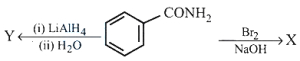
A
$C_6H_5NH_2$ and $C_6H_5NH_2$
B
$C_6H_5NH_2$ and $C_6H_5CH_2NH_2$
C
$C_6H_5CH_2NH_2$ and $C_6H_5CH_2NH_2$
D
$C_6H_5CH_2NH_2$ and $C_6H_5NH_2$
Solution
(B) The given reaction involves two different chemical transformations of benzamide $(C_6H_5CONH_2)$:
$1$. Reaction with $LiAlH_4$ followed by $H_2O$: This is a reduction reaction. $LiAlH_4$ reduces the amide group $(-CONH_2)$ to an amine group $(-CH_2NH_2)$. Thus,$Y$ is benzylamine $(C_6H_5CH_2NH_2)$.
$2$. Reaction with $Br_2$ and $NaOH$: This is the Hoffmann bromamide degradation reaction. It converts an amide $(-CONH_2)$ into a primary amine with one carbon atom less $(-NH_2)$. Thus,$X$ is aniline $(C_6H_5NH_2)$.
Therefore,$X$ is $C_6H_5NH_2$ and $Y$ is $C_6H_5CH_2NH_2$.
$1$. Reaction with $LiAlH_4$ followed by $H_2O$: This is a reduction reaction. $LiAlH_4$ reduces the amide group $(-CONH_2)$ to an amine group $(-CH_2NH_2)$. Thus,$Y$ is benzylamine $(C_6H_5CH_2NH_2)$.
$2$. Reaction with $Br_2$ and $NaOH$: This is the Hoffmann bromamide degradation reaction. It converts an amide $(-CONH_2)$ into a primary amine with one carbon atom less $(-NH_2)$. Thus,$X$ is aniline $(C_6H_5NH_2)$.
Therefore,$X$ is $C_6H_5NH_2$ and $Y$ is $C_6H_5CH_2NH_2$.
0 likes
View Solution198
EasyMCQ
Which of the following amines cannot be prepared by the Gabriel phthalimide synthesis method?
A
Ethylamine
B
Benzylamine
C
Phenylamine
D
Propylamine
Solution
(C) Gabriel phthalimide synthesis is used for the preparation of primary aliphatic amines.
It cannot be used for the preparation of aromatic primary amines (like Phenylamine or Aniline) because the aryl halides do not undergo nucleophilic substitution reaction with the potassium phthalimide salt easily due to the partial double bond character of the $C-X$ bond in aryl halides.
It cannot be used for the preparation of aromatic primary amines (like Phenylamine or Aniline) because the aryl halides do not undergo nucleophilic substitution reaction with the potassium phthalimide salt easily due to the partial double bond character of the $C-X$ bond in aryl halides.
0 likes
View SolutionAmines — Preparation of Amines · Frequently Asked Questions
1Are these Amines questions useful for JEE and NEET?
Yes. All questions in this section are mapped to JEE Main and NEET exam patterns. Previous year questions from JEE Main, NEET, GUJCET and state-level exams are included with full solutions.
2Can I switch to Hindi or Gujarati for these questions?
Yes. Use the language tabs in the hero section or the sidebar to view the same questions and solutions in English, Hindi or Gujarati.
3How do I generate a question paper from this subtopic?
Use the Vedclass Exam Paper Generator — select the chapter and subtopic, set difficulty, and generate Sets A, B, C, D automatically. First 3 chapters of every subject are free.
Vedclass Products
For Students
Vedclass Test Series
Mock tests in real JEE/NEET style with performance analysis. 5-day free trial.
Start Free TrialFor Teachers
Exam Paper Generator
Generate Set A/B/C/D papers from this chapter in 2 minutes. 3 chapters free.
Try FreeFor Institutes
Online Exam Module
Live online exams with unlimited students, 360° analytics & white-label branding.
See DemoFor Teachers & Institutes
Generate a Amines Exam Paper in 2 Minutes
Select subtopic & difficulty — Sets A, B, C, D auto-generated with No Repeat logic.
First 3 chapters of every subject are free — no payment required.