
A English
Preparation Questions in English
Class 12 Chemistry · 8-1.Aldehydes and Ketones · Preparation
328+
Questions
English
Language
100%
With Solutions
Showing 24 of 328 questions in English
301
DifficultMCQ
Among the following reagents,which one can convert an ester into an aldehyde?
A
$AlH(i-Bu)_2$
B
$Sn + HCl$
C
$H_2 / Pd, BaSO_4$
D
$DIBAL-H$
Solution
(D) $DIBAL$-$H$ stands for diisobutylaluminium hydride,which has the formula $(i-Bu)_2AlH$.
It is a selective reducing agent that reduces esters to aldehydes at low temperatures (typically $-78 \ ^\circ C$).
Therefore,the correct reagent is $DIBAL-H$.
Hence,the correct option is $(d)$.
It is a selective reducing agent that reduces esters to aldehydes at low temperatures (typically $-78 \ ^\circ C$).
Therefore,the correct reagent is $DIBAL-H$.
Hence,the correct option is $(d)$.
0 likes
View Solution302
MediumMCQ
Conversion of esters to aldehydes can be accomplished by
A
Stephen reduction
B
Rosenmund reduction
C
Reduction with lithium aluminium hydride
D
Reduction with diisobutyl aluminium hydride
Solution
(D) $DIBAL-H$ (Diisobutylaluminium hydride) is a selective reducing agent.
It is specifically used for the partial reduction of esters to aldehydes at low temperatures (typically $195 \ K$ to $203 \ K$),preventing further reduction to primary alcohols.
It is specifically used for the partial reduction of esters to aldehydes at low temperatures (typically $195 \ K$ to $203 \ K$),preventing further reduction to primary alcohols.
0 likes
View Solution303
EasyMCQ
$R-CN \xrightarrow[(ii) H_3O^{+}]{(i) SnCl_2 + HCl} R-CHO$
What is the name of the above reaction?
What is the name of the above reaction?
A
Rosenmund
B
Williamson
C
Stephen
D
Kolbe
Solution
(C) The reaction of nitriles $(R-CN)$ with stannous chloride $(SnCl_2)$ in the presence of hydrochloric acid $(HCl)$,followed by hydrolysis $(H_3O^+)$,yields an aldehyde $(R-CHO)$. This specific reduction method is known as the Stephen's reaction.
The mechanism involves the formation of an imine hydrochloride intermediate,which is subsequently hydrolyzed to the corresponding aldehyde:
$R-C \equiv N + SnCl_2 + 2HCl \rightarrow R-CH=NH \cdot HCl$
$R-CH=NH \cdot HCl + H_2O \rightarrow R-CHO + NH_4Cl$
The mechanism involves the formation of an imine hydrochloride intermediate,which is subsequently hydrolyzed to the corresponding aldehyde:
$R-C \equiv N + SnCl_2 + 2HCl \rightarrow R-CH=NH \cdot HCl$
$R-CH=NH \cdot HCl + H_2O \rightarrow R-CHO + NH_4Cl$
0 likes
View Solution304
EasyMCQ
Which of the following compounds is the reactant in Rosenmund's reduction?
A
$CH_3CO_2H$
B
$CH_3CHO$
C
$CH_3CH_2Cl$
D
$CH_3COCl$
Solution
(D) Rosenmund's reduction involves the catalytic hydrogenation of an acid chloride (acid halide) to an aldehyde using $Pd$ supported on $BaSO_4$ (Lindlar's catalyst).
The reaction is: $CH_3COCl + H_2 \xrightarrow{Pd/BaSO_4} CH_3CHO + HCl$.
The reaction is: $CH_3COCl + H_2 \xrightarrow{Pd/BaSO_4} CH_3CHO + HCl$.
0 likes
View Solution305
DifficultMCQ
Which of the following reactions will give benzophenone as the major product?
$(A)$ Benzoyl chloride $+$ Benzene $+ AlCl_3$ (anhydrous)
$(B)$ Benzoyl chloride $+$ Phenylmagnesium bromide (excess)
$(C)$ Benzoyl chloride $+$ Diphenyl cadmium
$(A)$ Benzoyl chloride $+$ Benzene $+ AlCl_3$ (anhydrous)
$(B)$ Benzoyl chloride $+$ Phenylmagnesium bromide (excess)
$(C)$ Benzoyl chloride $+$ Diphenyl cadmium
A
$A$ and $C$ only
B
$B$ and $C$ only
C
$A$ and $B$ only
D
$A, B$ and $C$
Solution
(A) Reaction $(A)$ is a Friedel-Crafts acylation reaction where benzene reacts with benzoyl chloride in the presence of anhydrous $AlCl_3$ to form benzophenone $(C_6H_5COC_6H_5)$.
Reaction $(B)$ involves the reaction of benzoyl chloride with excess phenylmagnesium bromide followed by hydrolysis,which yields triphenylmethanol $( (C_6H_5)_3COH )$.
Reaction $(C)$ involves the reaction of benzoyl chloride with diphenyl cadmium $( (C_6H_5)_2Cd )$,which is a standard method to prepare ketones from acid chlorides,yielding benzophenone.
Therefore,reactions $(A)$ and $(C)$ produce benzophenone as the major product.
Reaction $(B)$ involves the reaction of benzoyl chloride with excess phenylmagnesium bromide followed by hydrolysis,which yields triphenylmethanol $( (C_6H_5)_3COH )$.
Reaction $(C)$ involves the reaction of benzoyl chloride with diphenyl cadmium $( (C_6H_5)_2Cd )$,which is a standard method to prepare ketones from acid chlorides,yielding benzophenone.
Therefore,reactions $(A)$ and $(C)$ produce benzophenone as the major product.
0 likes
View Solution306
DifficultMCQ
The major product obtained in the reaction of isobutylbenzene with acetic anhydride in the presence of anhydrous $AlCl_3$ is:
A
$p-$isobutylacetophenone
B
acetophenone
C
$m-$isobutylacetophenone
D
$o-$isobutylacetophenone
Solution
(A) The reaction is a Friedel-Crafts acylation,which involves the electrophilic aromatic substitution of an arene with an acylating agent (like acetic anhydride) in the presence of a Lewis acid catalyst such as anhydrous $AlCl_3$.
In isobutylbenzene,the isobutyl group $(-CH_2CH(CH_3)_2)$ is an ortho/para-directing group due to its electron-donating inductive effect.
Due to steric hindrance caused by the bulky isobutyl group at the ortho position,the electrophile (acetyl cation,$CH_3CO^+$) preferentially attacks the less hindered para position.
Therefore,the major product formed is $p-$isobutylacetophenone.
In isobutylbenzene,the isobutyl group $(-CH_2CH(CH_3)_2)$ is an ortho/para-directing group due to its electron-donating inductive effect.
Due to steric hindrance caused by the bulky isobutyl group at the ortho position,the electrophile (acetyl cation,$CH_3CO^+$) preferentially attacks the less hindered para position.
Therefore,the major product formed is $p-$isobutylacetophenone.
0 likes
View Solution307
DifficultMCQ
The major product obtained in the reaction of bromobenzene with $Mg$ in dry ether followed by the reaction with benzonitrile and hydrolysis is
A
acetophenone
B
benzophenone
C
phenyl benzoate
D
benzoic acid
Solution
(B) Step $1$: Bromobenzene reacts with $Mg$ in dry ether to form phenylmagnesium bromide $(C_6H_5MgBr)$,which is a Grignard reagent.
Step $2$: Phenylmagnesium bromide reacts with benzonitrile $(C_6H_5CN)$ to form an intermediate imine salt.
Step $3$: Acidic hydrolysis of the intermediate imine salt yields benzophenone $(C_6H_5COC_6H_5)$ as the final product.
Step $2$: Phenylmagnesium bromide reacts with benzonitrile $(C_6H_5CN)$ to form an intermediate imine salt.
Step $3$: Acidic hydrolysis of the intermediate imine salt yields benzophenone $(C_6H_5COC_6H_5)$ as the final product.
0 likes
View Solution308
MediumMCQ
$H_2 + CO +$ alkene $\xrightarrow{\text{catalyst}} 1^\circ$ alcohol. What is the stable intermediate and the nature of the reaction?
A
acid,reduction
B
aldehyde,oxidation
C
aldehyde,reduction
D
alcohol,oxidation
Solution
(B) The reaction described is the hydroformylation (or oxo process) of an alkene.
Taking the alkene as $R-CH=CH_2$,the catalyst used is $Co_2(CO)_8$.
In the first step,the alkene reacts with $CO$ and $H_2$ to form an aldehyde as a stable intermediate.
The conversion of an alkene to an aldehyde involves the addition of a formyl group $(-CHO)$,which is an oxidation process relative to the alkene.
Subsequently,the aldehyde undergoes hydrogenation to form a primary alcohol.
The reaction sequence is: $R-CH=CH_2 + CO + H_2$ $\xrightarrow{Co_2(CO)_8} R-CH_2-CH_2-CHO$ $\xrightarrow{H_2} R-CH_2-CH_2-CH_2OH$.
Thus,the stable intermediate is an aldehyde and the nature of the initial step is oxidation.
Taking the alkene as $R-CH=CH_2$,the catalyst used is $Co_2(CO)_8$.
In the first step,the alkene reacts with $CO$ and $H_2$ to form an aldehyde as a stable intermediate.
The conversion of an alkene to an aldehyde involves the addition of a formyl group $(-CHO)$,which is an oxidation process relative to the alkene.
Subsequently,the aldehyde undergoes hydrogenation to form a primary alcohol.
The reaction sequence is: $R-CH=CH_2 + CO + H_2$ $\xrightarrow{Co_2(CO)_8} R-CH_2-CH_2-CHO$ $\xrightarrow{H_2} R-CH_2-CH_2-CH_2OH$.
Thus,the stable intermediate is an aldehyde and the nature of the initial step is oxidation.
0 likes
View Solution309
DifficultMCQ
What is $Z$ in the following reaction sequence?
$C_6H_5NH_2$ $\xrightarrow[(i) NaNO_2 + HCl / 273 \ K]{(ii) H_3PO_2 + H_2O}$ $\xrightarrow[(iii) CO, HCl, \text{anhydrous } AlCl_3/CuCl]{} Z$
$C_6H_5NH_2$ $\xrightarrow[(i) NaNO_2 + HCl / 273 \ K]{(ii) H_3PO_2 + H_2O}$ $\xrightarrow[(iii) CO, HCl, \text{anhydrous } AlCl_3/CuCl]{} Z$
A
$C_6H_5CO_2H$
B
$C_6H_5OH$
C
$C_6H_5CHO$
D
$C_6H_6$
Solution
(C) Step $1$: Aniline $(C_6H_5NH_2)$ reacts with $NaNO_2 + HCl$ at $273 \ K$ to form benzene diazonium chloride $(C_6H_5N_2^+Cl^-)$.
Step $2$: Benzene diazonium chloride reacts with $H_3PO_2 + H_2O$ to form benzene $(C_6H_6)$.
Step $3$: Benzene reacts with $CO + HCl$ in the presence of anhydrous $AlCl_3/CuCl$ (Gattermann-Koch reaction) to form benzaldehyde $(C_6H_5CHO)$.
Therefore,$Z$ is $C_6H_5CHO$.
Step $2$: Benzene diazonium chloride reacts with $H_3PO_2 + H_2O$ to form benzene $(C_6H_6)$.
Step $3$: Benzene reacts with $CO + HCl$ in the presence of anhydrous $AlCl_3/CuCl$ (Gattermann-Koch reaction) to form benzaldehyde $(C_6H_5CHO)$.
Therefore,$Z$ is $C_6H_5CHO$.
0 likes
View Solution310
EasyMCQ
The reagents/chemicals $X$ and $Y$ that convert cyanobenzene to a Schiff's base are:
A
$(i) \text{ DIBAL-H}, NH_2OH; (ii) H_2O$
B
$DIBAL-H, H_2O$
C
$LAH, CH_3OH$
D
$H_3O^+$
Solution
(B) The conversion of cyanobenzene (benzonitrile) to a Schiff's base involves two main steps:
$1$. Reduction of cyanobenzene to benzaldehyde using $DIBAL-H$ followed by hydrolysis $(H_2O)$.
$2$. Reaction of benzaldehyde with an amine (like aniline) to form a Schiff's base $(R-CH=N-R')$.
Given the options,the primary reagents for the reduction step are $DIBAL-H$ and $H_2O$.
$1$. Reduction of cyanobenzene to benzaldehyde using $DIBAL-H$ followed by hydrolysis $(H_2O)$.
$2$. Reaction of benzaldehyde with an amine (like aniline) to form a Schiff's base $(R-CH=N-R')$.
Given the options,the primary reagents for the reduction step are $DIBAL-H$ and $H_2O$.
0 likes
View Solution311
MediumMCQ
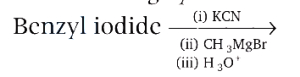
The molecular formula of the final product of the following synthetic scheme is:
A
$C_9 H_{12} O$
B
$C_{10} H_{14} O$
C
$C_{10} H_{15} N$
D
$C_9 H_{10} O$
Solution
(D) Step $1$: Benzyl iodide $(C_6H_5CH_2I)$ reacts with $KCN$ to form benzyl cyanide $(C_6H_5CH_2CN)$.
Step $2$: Benzyl cyanide reacts with methylmagnesium bromide $(CH_3MgBr)$ to form an imine intermediate $(C_6H_5CH_2C(CH_3)=NMgBr)$.
Step $3$: Acidic hydrolysis $(H_3O^+)$ of the imine intermediate yields phenylacetone $(C_6H_5CH_2COCH_3)$.
The molecular formula of phenylacetone is $C_{10}H_{12}O$. However,reviewing the options provided,let us re-evaluate the structure. The product is $C_6H_5-CH_2-CO-CH_3$. Counting the atoms: $6$ (ring) $+ 1$ (methylene) $+ 1$ (carbonyl) $+ 1$ (methyl) $= 9$ carbons. Wait,$C_6H_5-CH_2-CO-CH_3$ has $6+1+1+1 = 9$ carbons. Let us re-count: $C_6H_5$ $(6C, 5H)$ $+ CH_2$ $(1C, 2H)$ $+ CO$ $(1C)$ $+ CH_3$ $(1C, 3H)$. Total: $C_9H_{10}O$. Thus,the correct option is $D$.
Step $2$: Benzyl cyanide reacts with methylmagnesium bromide $(CH_3MgBr)$ to form an imine intermediate $(C_6H_5CH_2C(CH_3)=NMgBr)$.
Step $3$: Acidic hydrolysis $(H_3O^+)$ of the imine intermediate yields phenylacetone $(C_6H_5CH_2COCH_3)$.
The molecular formula of phenylacetone is $C_{10}H_{12}O$. However,reviewing the options provided,let us re-evaluate the structure. The product is $C_6H_5-CH_2-CO-CH_3$. Counting the atoms: $6$ (ring) $+ 1$ (methylene) $+ 1$ (carbonyl) $+ 1$ (methyl) $= 9$ carbons. Wait,$C_6H_5-CH_2-CO-CH_3$ has $6+1+1+1 = 9$ carbons. Let us re-count: $C_6H_5$ $(6C, 5H)$ $+ CH_2$ $(1C, 2H)$ $+ CO$ $(1C)$ $+ CH_3$ $(1C, 3H)$. Total: $C_9H_{10}O$. Thus,the correct option is $D$.
0 likes
View Solution312
DifficultMCQ
The major products $P$ and $Q$ in the following reactions are:
$C_6H_5-CH=NOH$ $\xrightarrow{(i) (CH_3CO)_2O} P$ $\xrightarrow{(i) CH_3MgI, (ii) H_3O^+} Q$
$C_6H_5-CH=NOH$ $\xrightarrow{(i) (CH_3CO)_2O} P$ $\xrightarrow{(i) CH_3MgI, (ii) H_3O^+} Q$
A
$P$ = $C_6H_5-CN$,$Q$ = $C_6H_5-CO-CH_3$
B
$P$ = $C_6H_5-CONH_2$,$Q$ = $C_6H_5-CO-CH_3$
C
$P$ = $C_6H_5-CHO$,$Q$ = $C_6H_5-CH(OH)-CH_3$
D
$P$ = $C_6H_5-CN$,$Q$ = $C_6H_5-CH(OH)-CH_3$
Solution
(A) Step $1$: The reaction of benzaldehyde oxime $(C_6H_5-CH=NOH)$ with acetic anhydride $((CH_3CO)_2O)$ causes dehydration to form benzonitrile $(P = C_6H_5-CN)$.
Step $2$: The reaction of benzonitrile $(C_6H_5-CN)$ with methylmagnesium iodide $(CH_3MgI)$ followed by acid hydrolysis $(H_3O^+)$ is a standard method to prepare ketones. The Grignard reagent attacks the nitrile carbon to form an imine intermediate,which upon hydrolysis yields acetophenone $(Q = C_6H_5-CO-CH_3)$.
Step $2$: The reaction of benzonitrile $(C_6H_5-CN)$ with methylmagnesium iodide $(CH_3MgI)$ followed by acid hydrolysis $(H_3O^+)$ is a standard method to prepare ketones. The Grignard reagent attacks the nitrile carbon to form an imine intermediate,which upon hydrolysis yields acetophenone $(Q = C_6H_5-CO-CH_3)$.
0 likes
View Solution313
MediumMCQ
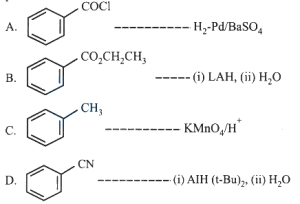
In which of the following pairs is the reactant correctly matched with the reagent that would form benzaldehyde as the product?
A
$A$ & $C$ only
B
$C$ & $D$ only
C
$A$ & $D$ only
D
$B$ & $C$ only
Solution
(C) Let us analyze each reaction:
$A$. Benzoyl chloride $(C_6H_5COCl)$ reacts with $H_2-Pd/BaSO_4$ (Rosenmund reduction) to form benzaldehyde $(C_6H_5CHO)$. This is correct.
$B$. Ethyl benzoate $(C_6H_5COOCH_2CH_3)$ reacts with $LiAlH_4$ followed by $H_2O$ to form benzyl alcohol $(C_6H_5CH_2OH)$. This is incorrect.
$C$. Toluene $(C_6H_5CH_3)$ reacts with $KMnO_4/H^+$ to form benzoic acid $(C_6H_5COOH)$. This is incorrect.
$D$. Benzonitrile $(C_6H_5CN)$ reacts with $DIBAL-H$ (or $AlH(i-Bu)_2$) followed by $H_2O$ to form benzaldehyde $(C_6H_5CHO)$. This is correct.
Therefore,the pairs $A$ and $D$ correctly form benzaldehyde.
$A$. Benzoyl chloride $(C_6H_5COCl)$ reacts with $H_2-Pd/BaSO_4$ (Rosenmund reduction) to form benzaldehyde $(C_6H_5CHO)$. This is correct.
$B$. Ethyl benzoate $(C_6H_5COOCH_2CH_3)$ reacts with $LiAlH_4$ followed by $H_2O$ to form benzyl alcohol $(C_6H_5CH_2OH)$. This is incorrect.
$C$. Toluene $(C_6H_5CH_3)$ reacts with $KMnO_4/H^+$ to form benzoic acid $(C_6H_5COOH)$. This is incorrect.
$D$. Benzonitrile $(C_6H_5CN)$ reacts with $DIBAL-H$ (or $AlH(i-Bu)_2$) followed by $H_2O$ to form benzaldehyde $(C_6H_5CHO)$. This is correct.
Therefore,the pairs $A$ and $D$ correctly form benzaldehyde.
0 likes
View Solution314
MediumMCQ
The structure of $PCC$ is
A
$C_6 H_5 \stackrel{\oplus}{N} HCrO_2 Cl^{\ominus}$
B
$C_6 H_5 \stackrel{\oplus}{N} HCrO_3 Cl^{\ominus}$
C
$C_5 H_5 \stackrel{\oplus}{N} HCrO_2 Cl^{\ominus}$
D
$C_5 H_5 \stackrel{\oplus}{N} HCrO_3 Cl^{\ominus}$
Solution
(D) Pyridinium chlorochromate $(PCC)$ is formed by the reaction of pyridine with chlorochromic acid,which is obtained by dissolving chromium trioxide $(CrO_3)$ in aqueous $HCl$.
The chemical formula of pyridine is $C_5H_5N$.
When pyridine is protonated,it forms the pyridinium cation,$C_5H_5NH^{\oplus}$.
The chlorochromate anion is $CrO_3Cl^{\ominus}$.
Therefore,the structure of $PCC$ is $C_5H_5NH^{\oplus} CrO_3Cl^{\ominus}$.
The chemical formula of pyridine is $C_5H_5N$.
When pyridine is protonated,it forms the pyridinium cation,$C_5H_5NH^{\oplus}$.
The chlorochromate anion is $CrO_3Cl^{\ominus}$.
Therefore,the structure of $PCC$ is $C_5H_5NH^{\oplus} CrO_3Cl^{\ominus}$.
0 likes
View Solution315
MediumMCQ
The correct set of reagents which convert acetylene to but$-2-$enal are
A
$H_2SO_4, NaOH$
B
$H_2O / Hg^{2+} / H^{+}$,dil. $NaOH$
C
$H_2O / H^{+}$,conc. $NaOH$
D
$H_2O, KMnO_4 / OH^{-}$
Solution
(B) The conversion of acetylene $(HC \equiv CH)$ to but$-2-$enal $(CH_3-CH=CH-CHO)$ involves two main steps:
$1$. Hydration of acetylene using $H_2O / Hg^{2+} / H^{+}$ gives acetaldehyde $(CH_3CHO)$.
$2$. Aldol condensation of two molecules of acetaldehyde in the presence of dilute $NaOH$ yields but$-2-$enal.
Reaction: $2CH_3CHO \xrightarrow{dil. NaOH} CH_3-CH=CH-CHO + H_2O$.
Thus,the correct set of reagents is $H_2O / Hg^{2+} / H^{+}$ followed by dil. $NaOH$.
Hence,$(B)$ is the correct answer.
$1$. Hydration of acetylene using $H_2O / Hg^{2+} / H^{+}$ gives acetaldehyde $(CH_3CHO)$.
$2$. Aldol condensation of two molecules of acetaldehyde in the presence of dilute $NaOH$ yields but$-2-$enal.
Reaction: $2CH_3CHO \xrightarrow{dil. NaOH} CH_3-CH=CH-CHO + H_2O$.
Thus,the correct set of reagents is $H_2O / Hg^{2+} / H^{+}$ followed by dil. $NaOH$.
Hence,$(B)$ is the correct answer.
0 likes
View Solution316
DifficultMCQ
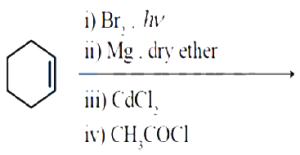
The major product formed in the following reaction scheme is
A
$1-$(cyclohex$-2-$en$-1-$yl)ethanol
B
$1-$(cyclohex$-2-$en$-1-$yl)ethanol
C
$2-$(cyclohex$-2-$en$-1-$yl)propan$-2-$ol
D
$1-$(cyclohex$-2-$en$-1-$yl)ethanone
Solution
(D) The reaction sequence is as follows:
$1$. Allylic bromination of cyclohexene with $Br_2$ in the presence of $h\nu$ gives $3$-bromocyclohexene.
$2$. Formation of Grignard reagent: $3$-bromocyclohexene reacts with $Mg$ in dry ether to form $3$-cyclohexenylmagnesium bromide.
$3$. Reaction with $CdCl_2$: The Grignard reagent reacts with $CdCl_2$ to form an organocadmium compound,$(C_6H_9)_2Cd$.
$4$. Reaction with $CH_3COCl$: The organocadmium compound reacts with acetyl chloride $(CH_3COCl)$ to form a ketone,$1$-(cyclohex$-2-$en$-1-$yl)ethanone.
Thus,the final product is $1$-(cyclohex$-2-$en$-1-$yl)ethanone.
$1$. Allylic bromination of cyclohexene with $Br_2$ in the presence of $h\nu$ gives $3$-bromocyclohexene.
$2$. Formation of Grignard reagent: $3$-bromocyclohexene reacts with $Mg$ in dry ether to form $3$-cyclohexenylmagnesium bromide.
$3$. Reaction with $CdCl_2$: The Grignard reagent reacts with $CdCl_2$ to form an organocadmium compound,$(C_6H_9)_2Cd$.
$4$. Reaction with $CH_3COCl$: The organocadmium compound reacts with acetyl chloride $(CH_3COCl)$ to form a ketone,$1$-(cyclohex$-2-$en$-1-$yl)ethanone.
Thus,the final product is $1$-(cyclohex$-2-$en$-1-$yl)ethanone.
0 likes
View Solution317
DifficultMCQ
An organic compound $X$ gives a red precipitate on heating with Fehling's solution. Which one of the following reactions yields $X$ as a major product?
A
$HCHO \xrightarrow[(ii) H_2O]{(i) CH_3MgI} X$
B
$C_2H_5Br + AgOH \xrightarrow{\Delta} X$
C
$2 C_2H_5Br + Ag_2O \xrightarrow{\Delta} X$
D
$C_2H_2 + H_2O \xrightarrow[1 \% HgSO_4, 60^{\circ}C]{40 \% H_2SO_4} X$
Solution
(D) The organic compound $X$ gives a red precipitate with Fehling's solution,which indicates that $X$ is an aliphatic aldehyde (specifically,acetaldehyde,$CH_3CHO$).
Reaction $D$ is the hydration of acetylene $(C_2H_2)$ in the presence of $40 \% H_2SO_4$ and $1 \% HgSO_4$ at $60^{\circ}C$,which yields acetaldehyde $(CH_3CHO)$ as the major product.
$C_2H_2 + H_2O \xrightarrow[1 \% HgSO_4, 60^{\circ}C]{40 \% H_2SO_4} CH_3CHO$ (Acetaldehyde)
Acetaldehyde reacts with Fehling's solution upon heating to form a red precipitate of cuprous oxide $(Cu_2O)$.
Reaction $D$ is the hydration of acetylene $(C_2H_2)$ in the presence of $40 \% H_2SO_4$ and $1 \% HgSO_4$ at $60^{\circ}C$,which yields acetaldehyde $(CH_3CHO)$ as the major product.
$C_2H_2 + H_2O \xrightarrow[1 \% HgSO_4, 60^{\circ}C]{40 \% H_2SO_4} CH_3CHO$ (Acetaldehyde)
Acetaldehyde reacts with Fehling's solution upon heating to form a red precipitate of cuprous oxide $(Cu_2O)$.
0 likes
View Solution318
MediumMCQ
The reaction of benzene with $CO$ and $HCl$ in the presence of anhydrous $AlCl_3$ gives a compound $X$. $X$ can also be obtained from which of the following reactions?
A
Benzonitrile reacting with $(i) \ LiAlH_4$ $(ii) \ H_3O^+$
B
Toluene reacting with $KMnO_4 | OH^-$ and heat
C
Benzoyl chloride reacting with $H_2-Pd$ and $BaSO_4$
D
Benzyl alcohol reacting with $CrO_3-H_2SO_4$
Solution
(C) The reaction of benzene with $CO$ and $HCl$ in the presence of anhydrous $AlCl_3$ is the Gattermann-Koch reaction,which produces benzaldehyde $(C_6H_5CHO)$. Thus,$X$ is benzaldehyde.
Let us analyze the given options:
$A$: Benzonitrile $(C_6H_5CN)$ on reduction with $LiAlH_4$ gives benzylamine $(C_6H_5CH_2NH_2)$.
$B$: Toluene $(C_6H_5CH_3)$ on oxidation with $KMnO_4 | OH^-$ gives benzoic acid $(C_6H_5COOH)$.
$C$: Benzoyl chloride $(C_6H_5COCl)$ on reduction with $H_2-Pd$ and $BaSO_4$ (Rosenmund reduction) gives benzaldehyde $(C_6H_5CHO)$.
$D$: Benzyl alcohol $(C_6H_5CH_2OH)$ on oxidation with $CrO_3-H_2SO_4$ (Jones reagent) gives benzoic acid $(C_6H_5COOH)$.
Therefore,benzaldehyde is obtained in reaction $C$.
Let us analyze the given options:
$A$: Benzonitrile $(C_6H_5CN)$ on reduction with $LiAlH_4$ gives benzylamine $(C_6H_5CH_2NH_2)$.
$B$: Toluene $(C_6H_5CH_3)$ on oxidation with $KMnO_4 | OH^-$ gives benzoic acid $(C_6H_5COOH)$.
$C$: Benzoyl chloride $(C_6H_5COCl)$ on reduction with $H_2-Pd$ and $BaSO_4$ (Rosenmund reduction) gives benzaldehyde $(C_6H_5CHO)$.
$D$: Benzyl alcohol $(C_6H_5CH_2OH)$ on oxidation with $CrO_3-H_2SO_4$ (Jones reagent) gives benzoic acid $(C_6H_5COOH)$.
Therefore,benzaldehyde is obtained in reaction $C$.
0 likes
View Solution319
MediumMCQ
What is $X$ in the following reaction sequence?
$Toluene \xrightarrow[ii. HNO_3/H_2SO_4]{i. CrO_2Cl_2/CS_2, H_3O^+} X$
$Toluene \xrightarrow[ii. HNO_3/H_2SO_4]{i. CrO_2Cl_2/CS_2, H_3O^+} X$
A
$3-$Nitrobenzoic acid
B
$4-$Chloromethylnitrobenzene
C
$3-$Nitrobenzoyl chloride
D
$3-$Nitrobenzaldehyde
Solution
(D) The reaction sequence is as follows:
$1$. The first step is the Etard reaction,where toluene is oxidized to benzaldehyde using chromyl chloride $(CrO_2Cl_2)$ in the presence of carbon disulfide $(CS_2)$,followed by hydrolysis with $H_3O^+$.
$2$. The second step is the nitration of benzaldehyde using a nitrating mixture $(HNO_3/H_2SO_4)$.
$3$. The $-CHO$ group is a meta-directing group,so the nitro group $(-NO_2)$ will be introduced at the meta-position relative to the aldehyde group.
$4$. Thus,the final product $X$ is $3$-nitrobenzaldehyde.
$1$. The first step is the Etard reaction,where toluene is oxidized to benzaldehyde using chromyl chloride $(CrO_2Cl_2)$ in the presence of carbon disulfide $(CS_2)$,followed by hydrolysis with $H_3O^+$.
$2$. The second step is the nitration of benzaldehyde using a nitrating mixture $(HNO_3/H_2SO_4)$.
$3$. The $-CHO$ group is a meta-directing group,so the nitro group $(-NO_2)$ will be introduced at the meta-position relative to the aldehyde group.
$4$. Thus,the final product $X$ is $3$-nitrobenzaldehyde.
0 likes
View Solution320
EasyMCQ
The main reactants involved in the Etard reaction are:
A
$Toluene + CrO_2Cl_2$
B
$Toluene + CrO_3 + (CH_3CO)_2O$
C
$Toluene + Cl_2 / hv$
D
$Benzene + CO + HCl$ (Anhydrous $AlCl_3$)
Solution
(A) In the Etard reaction,chromyl chloride $(CrO_2Cl_2)$ oxidises the methyl group of toluene to a chromium complex in the presence of a solvent like $CS_2$ or $CCl_4$.
This chromium complex,upon subsequent hydrolysis with water $(H_3O^+)$,yields benzaldehyde as the final product.
This chromium complex,upon subsequent hydrolysis with water $(H_3O^+)$,yields benzaldehyde as the final product.
0 likes
View Solution321
MediumMCQ
In the reaction $RMgBr + HC(OEt)_3 \xrightarrow{Ether, H_3O^{+}} P$,the product $P$ is
A
$RCHO$
B
$R_2CHOEt$
C
$R_3CH$
D
$RCH(OEt)_2$
Solution
(A) The reaction of a Grignard reagent $(RMgBr)$ with triethyl orthoformate $(HC(OEt)_3)$ proceeds via a nucleophilic substitution mechanism.
$1$. The nucleophilic $R^-$ group from the Grignard reagent attacks the electrophilic carbon of the triethyl orthoformate,displacing one ethoxide group $(-OEt)$ to form an acetal intermediate,$RCH(OEt)_2$.
$2$. Upon acidic hydrolysis $(H_3O^{+})$,the acetal intermediate undergoes hydrolysis to yield an aldehyde $(RCHO)$ as the final product $P$.
$1$. The nucleophilic $R^-$ group from the Grignard reagent attacks the electrophilic carbon of the triethyl orthoformate,displacing one ethoxide group $(-OEt)$ to form an acetal intermediate,$RCH(OEt)_2$.
$2$. Upon acidic hydrolysis $(H_3O^{+})$,the acetal intermediate undergoes hydrolysis to yield an aldehyde $(RCHO)$ as the final product $P$.
0 likes
View Solution322
DifficultMCQ
$L$ $\xrightarrow[(ii) H_3O^{\oplus}]{(i) PhMgBr} M$ $\xrightarrow{CrO_3 / H^{\oplus}} N$ $\xrightarrow{Ph_3P=CH_2} Ph_2C=CH_2$
$L$ in the above sequence of reaction is/are (where $L \neq M \neq N$)
$L$ in the above sequence of reaction is/are (where $L \neq M \neq N$)
A
Benzaldehyde
B
Methyl benzoate
C
Benzoyl chloride
D
Benzonitrile
Solution
(A) The final product is $Ph_2C=CH_2$ ($1$,$1$-diphenylethene).
The last step is a Wittig reaction: $N + Ph_3P=CH_2 \rightarrow Ph_2C=CH_2$. This implies $N$ must be benzophenone $(Ph_2C=O)$.
The step $M \xrightarrow{CrO_3 / H^{\oplus}} N$ is an oxidation of a secondary alcohol to a ketone. Thus,$M$ is diphenylmethanol $(Ph_2CHOH)$.
The first step is the Grignard reaction: $L \xrightarrow[(ii) H_3O^{\oplus}]{(i) PhMgBr} Ph_2CHOH$.
Benzaldehyde $(PhCHO)$ reacts with $PhMgBr$ followed by hydrolysis to give diphenylmethanol $(Ph_2CHOH)$.
Therefore,$L$ is benzaldehyde.
The last step is a Wittig reaction: $N + Ph_3P=CH_2 \rightarrow Ph_2C=CH_2$. This implies $N$ must be benzophenone $(Ph_2C=O)$.
The step $M \xrightarrow{CrO_3 / H^{\oplus}} N$ is an oxidation of a secondary alcohol to a ketone. Thus,$M$ is diphenylmethanol $(Ph_2CHOH)$.
The first step is the Grignard reaction: $L \xrightarrow[(ii) H_3O^{\oplus}]{(i) PhMgBr} Ph_2CHOH$.
Benzaldehyde $(PhCHO)$ reacts with $PhMgBr$ followed by hydrolysis to give diphenylmethanol $(Ph_2CHOH)$.
Therefore,$L$ is benzaldehyde.
0 likes
View Solution323
EasyMCQ
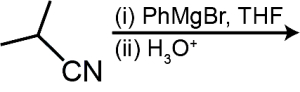
For the reaction below,the structure of the product $Q$ is:
A
$3-$methyl$-1-$phenylbutan$-1-$ol
B
$3-$methyl$-1-$phenylbutan$-1-$one
C
$2-$methyl$-2-$phenylpropanenitrile
D
$3-$methyl$-1-$phenylbut$-1-$en$-1-$amine
Solution
(B) The reaction of an alkyl nitrile with a Grignard reagent $(PhMgBr)$ followed by acidic hydrolysis $(H_3O^+)$ proceeds as follows:
$1$. The nucleophilic phenyl group $(Ph^-)$ from $PhMgBr$ attacks the electrophilic carbon of the nitrile group $(-CN)$ to form an imine salt intermediate.
$2$. Upon acidic hydrolysis $(H_3O^+)$,the imine salt is converted into an imine,which is unstable and further hydrolyzes to form a ketone.
$3$. The reaction sequence is: $R-CN + PhMgBr$ $\rightarrow R-C(Ph)=N-MgBr$ $\xrightarrow{H_3O^+} R-C(Ph)=NH$ $\xrightarrow{H_3O^+} R-C(=O)Ph$.
$4$. In this case,$R$ is an isopropyl group,so the final product is $3$-methyl-$1$-phenylbutan-$1$-one.
$1$. The nucleophilic phenyl group $(Ph^-)$ from $PhMgBr$ attacks the electrophilic carbon of the nitrile group $(-CN)$ to form an imine salt intermediate.
$2$. Upon acidic hydrolysis $(H_3O^+)$,the imine salt is converted into an imine,which is unstable and further hydrolyzes to form a ketone.
$3$. The reaction sequence is: $R-CN + PhMgBr$ $\rightarrow R-C(Ph)=N-MgBr$ $\xrightarrow{H_3O^+} R-C(Ph)=NH$ $\xrightarrow{H_3O^+} R-C(=O)Ph$.
$4$. In this case,$R$ is an isopropyl group,so the final product is $3$-methyl-$1$-phenylbutan-$1$-one.
0 likes
View Solution324
DifficultMCQ
Match List-$I$ with List-$II$.
Choose the correct answer from the options given below:
| List-$I$ (Reagents) | List-$II$ (Reaction Name) |
|---|---|
| $A$. $H_2, Pd-BaSO_4$ | $I$. Etard Reaction |
| $B$. $SnCl_2, HCl$ | $II$. Rosenmund Reduction |
| $C$. $CrO_2Cl_2, CS_2$ | $III$. Gatterman-Koch Reaction |
| $D$. $CO, HCl, \text{Anhyd. } AlCl_3$ | $IV$. Stephen Reaction |
Choose the correct answer from the options given below:
A
$A-II, B-III, C-IV, D-I$
B
$A-IV, B-III, C-I, D-II$
C
$A-IV, B-I, C-II, D-III$
D
$A-II, B-IV, C-I, D-III$
Solution
(D) The correct matches are as follows:
$A$. $H_2, Pd-BaSO_4$ is used in the Rosenmund reduction to convert acid chlorides to aldehydes $(A-II)$.
$B$. $SnCl_2, HCl$ is used in the Stephen reaction to reduce nitriles to imines,which are then hydrolyzed to aldehydes $(B-IV)$.
$C$. $CrO_2Cl_2, CS_2$ is used in the Etard reaction to oxidize toluene to benzaldehyde $(C-I)$.
$D$. $CO, HCl, \text{Anhyd. } AlCl_3$ is used in the Gatterman-Koch reaction to form benzaldehyde from benzene $(D-III)$.
Therefore,the correct sequence is $A-II, B-IV, C-I, D-III$.
$A$. $H_2, Pd-BaSO_4$ is used in the Rosenmund reduction to convert acid chlorides to aldehydes $(A-II)$.
$B$. $SnCl_2, HCl$ is used in the Stephen reaction to reduce nitriles to imines,which are then hydrolyzed to aldehydes $(B-IV)$.
$C$. $CrO_2Cl_2, CS_2$ is used in the Etard reaction to oxidize toluene to benzaldehyde $(C-I)$.
$D$. $CO, HCl, \text{Anhyd. } AlCl_3$ is used in the Gatterman-Koch reaction to form benzaldehyde from benzene $(D-III)$.
Therefore,the correct sequence is $A-II, B-IV, C-I, D-III$.
0 likes
View Solution8-1.Aldehydes and Ketones — Preparation · Frequently Asked Questions
1Are these 8-1.Aldehydes and Ketones questions useful for JEE and NEET?
Yes. All questions in this section are mapped to JEE Main and NEET exam patterns. Previous year questions from JEE Main, NEET, GUJCET and state-level exams are included with full solutions.
2Can I switch to Hindi or Gujarati for these questions?
Yes. Use the language tabs in the hero section or the sidebar to view the same questions and solutions in English, Hindi or Gujarati.
3How do I generate a question paper from this subtopic?
Use the Vedclass Exam Paper Generator — select the chapter and subtopic, set difficulty, and generate Sets A, B, C, D automatically. First 3 chapters of every subject are free.
Vedclass Products
For Students
Vedclass Test Series
Mock tests in real JEE/NEET style with performance analysis. 5-day free trial.
Start Free TrialFor Teachers
Exam Paper Generator
Generate Set A/B/C/D papers from this chapter in 2 minutes. 3 chapters free.
Try FreeFor Institutes
Online Exam Module
Live online exams with unlimited students, 360° analytics & white-label branding.
See DemoFor Teachers & Institutes
Generate a 8-1.Aldehydes and Ketones Exam Paper in 2 Minutes
Select subtopic & difficulty — Sets A, B, C, D auto-generated with No Repeat logic.
First 3 chapters of every subject are free — no payment required.