
A English
Pollination Questions in English
Class 12 Biology · Sexual Reproduction in Flowering Plants · Pollination
270+
Questions
English
Language
100%
With Solutions
Showing 50 of 270 questions in English
151
MediumMCQ
In how many genera is pollination by water observed?
A
$20$
B
$30$
C
$32$
D
$40$
Solution
(B) Pollination by water is quite rare in flowering plants and is limited to about $30$ genera,mostly monocotyledons. Examples include Vallisneria and Hydrilla.
0 likes
View Solution152
MediumMCQ
In which of the following plants is pollination by water most commonly observed?
A
Dicotyledons
B
Aquatic monocotyledons
C
Gymnosperms
D
Algae
Solution
(B) Pollination by water is quite rare in flowering plants and is limited to about $30$ genera,mostly monocotyledons. Examples include $Vallisneria$ and $Hydrilla$. Therefore,it is most commonly observed in aquatic monocotyledons.
0 likes
View Solution153
MediumMCQ
In which aquatic plant does pollination occur through biotic agents?
A
Zostera
B
Vallisneria
C
Water lily
D
Hydrilla
Solution
(C) In most aquatic plants like $Hydrilla$ and $Vallisneria$,pollination occurs through water (hydrophily). However,in many aquatic plants such as water hyacinth and water lily,the flowers emerge above the level of water and are pollinated by insects or wind,which are biotic agents. $Zostera$ is a marine seagrass that is pollinated by water.
0 likes
View Solution154
MediumMCQ
In which of the following marine grasses does pollination occur via an abiotic agent?
A
Eichhornia
B
Vallisneria
C
Hydrilla
D
Zostera
Solution
(D) Pollination in aquatic plants occurs through abiotic agents like water.
$Eichhornia$ (water hyacinth) and $Hydrilla$ are freshwater plants,and in $Eichhornia$,pollination occurs via insects or wind.
$Vallisneria$ is also a freshwater plant where pollination occurs via water.
$Zostera$ is a marine seagrass where pollination occurs via water (hydrophily).
Therefore,the correct answer is $Zostera$.
$Eichhornia$ (water hyacinth) and $Hydrilla$ are freshwater plants,and in $Eichhornia$,pollination occurs via insects or wind.
$Vallisneria$ is also a freshwater plant where pollination occurs via water.
$Zostera$ is a marine seagrass where pollination occurs via water (hydrophily).
Therefore,the correct answer is $Zostera$.
0 likes
View Solution155
MediumMCQ
Pollination in water hyacinth $(Eichhornia)$ occurs through which of the following?
A
Water
B
Wind
C
Insects
D
Both $B$ and $C$
Solution
(D) In water hyacinth $(Eichhornia)$ and water lily,the flowers emerge above the level of water.
Although these are aquatic plants,pollination is not carried out by water.
Instead,the flowers are pollinated by insects or wind,similar to most of the land plants.
Therefore,the correct answer is $D$ (Both $B$ and $C$).
Although these are aquatic plants,pollination is not carried out by water.
Instead,the flowers are pollinated by insects or wind,similar to most of the land plants.
Therefore,the correct answer is $D$ (Both $B$ and $C$).
0 likes
View Solution156
MediumMCQ
How many of the following plants are pollinated by wind?
$Vallisneria$,$Eichhornia$ (Water Hyacinth),$Hydrilla$,Water Lily
$Vallisneria$,$Eichhornia$ (Water Hyacinth),$Hydrilla$,Water Lily
A
One
B
Two
C
Three
D
Zero
Solution
(B) In the given list of plants:
$1$. $Vallisneria$: Pollinated by water (epihydrophily).
$2$. $Eichhornia$ (Water Hyacinth): Pollinated by insects or wind.
$3$. $Hydrilla$: Pollinated by water (hypohydrophily).
$4$. Water Lily: Pollinated by insects or wind.
Among these,$Vallisneria$ and $Hydrilla$ are strictly hydrophilous (water-pollinated). $Eichhornia$ and Water Lily are aquatic plants,but their flowers emerge above the water level and are pollinated by insects or wind. Therefore,two plants ($Eichhornia$ and Water Lily) can be pollinated by wind.
$1$. $Vallisneria$: Pollinated by water (epihydrophily).
$2$. $Eichhornia$ (Water Hyacinth): Pollinated by insects or wind.
$3$. $Hydrilla$: Pollinated by water (hypohydrophily).
$4$. Water Lily: Pollinated by insects or wind.
Among these,$Vallisneria$ and $Hydrilla$ are strictly hydrophilous (water-pollinated). $Eichhornia$ and Water Lily are aquatic plants,but their flowers emerge above the water level and are pollinated by insects or wind. Therefore,two plants ($Eichhornia$ and Water Lily) can be pollinated by wind.
0 likes
View Solution157
MediumMCQ
How many of the following plants undergo pollination by water?
Maize,Wheat,Vallisneria,Water lily,Hibiscus,Water hyacinth,Hydrilla,Zostera
Maize,Wheat,Vallisneria,Water lily,Hibiscus,Water hyacinth,Hydrilla,Zostera
A
One
B
Two
C
Three
D
Four
Solution
(C) Pollination by water (hydrophily) is quite rare in flowering plants and is limited to about $30$ genera,mostly monocotyledons.
$1$. Maize: Pollinated by wind (anemophily).
$2$. Wheat: Pollinated by wind (anemophily).
$3$. Vallisneria: Pollinated by water (hydrophily).
$4$. Water lily: Pollinated by insects or wind (not water).
$5$. Hibiscus: Pollinated by insects (entomophily).
$6$. Water hyacinth: Pollinated by insects or wind (not water).
$7$. Hydrilla: Pollinated by water (hydrophily).
$8$. Zostera: Pollinated by water (hydrophily).
Therefore,the plants pollinated by water are Vallisneria,Hydrilla,and Zostera. The total count is $3$.
$1$. Maize: Pollinated by wind (anemophily).
$2$. Wheat: Pollinated by wind (anemophily).
$3$. Vallisneria: Pollinated by water (hydrophily).
$4$. Water lily: Pollinated by insects or wind (not water).
$5$. Hibiscus: Pollinated by insects (entomophily).
$6$. Water hyacinth: Pollinated by insects or wind (not water).
$7$. Hydrilla: Pollinated by water (hydrophily).
$8$. Zostera: Pollinated by water (hydrophily).
Therefore,the plants pollinated by water are Vallisneria,Hydrilla,and Zostera. The total count is $3$.
0 likes
View Solution158
MediumMCQ
In which plant is pollen released at the water surface and carried passively by water currents to achieve pollination?
A
Sea grasses
B
Vallisneria
C
Water lily
D
Hydrilla
Solution
(B) In $Vallisneria$,the female flower reaches the surface of the water by a long stalk,and the male flowers or pollen grains are released on to the surface of the water. They are carried passively by water currents to reach the female flowers. This is a classic example of epihydrophily (pollination at the water surface). In contrast,$Hydrilla$ and sea grasses are also pollinated by water,but $Vallisneria$ is the specific example cited in $NCERT$ for pollination at the water surface.
0 likes
View Solution159
MediumMCQ
In which aquatic plant are long pedicels observed?
A
Water lily
B
Water hyacinth
C
Vallisneria
D
All of the above
Solution
(C) In $Vallisneria$,the female flower reaches the surface of the water by a long,coiled pedicel to facilitate pollination. The male flowers or pollen grains are released on to the surface of the water and are carried by water currents to reach the female flower. Therefore,the correct answer is $Vallisneria$.
0 likes
View Solution160
MediumMCQ
In which plant are the female flowers submerged in water?
A
Maize
B
Vallisneria
C
Hydrilla
D
Zostera
Solution
(D) In $Zostera$ (a marine seagrass),the female flowers remain submerged in water. The pollen grains are long,ribbon-like,and are carried passively inside the water to reach the stigma of the submerged female flowers. In contrast,in $Vallisneria$,the female flower reaches the surface of the water for pollination.
0 likes
View Solution161
MediumMCQ
In which of the following plants are the pollen grains long and ribbon-like?
A
Sea grasses
B
Water hyacinth
C
Cotton
D
Rose
Solution
(A) In hydrophilous (water-pollinated) plants,pollen grains often exhibit specific adaptations to facilitate pollination in an aquatic environment.
In many sea grasses (e.g.,$Zostera$),the pollen grains are long and ribbon-like.
This shape allows them to be carried passively by water currents to reach the stigma of the female flower.
Therefore,the correct option is $A$.
In many sea grasses (e.g.,$Zostera$),the pollen grains are long and ribbon-like.
This shape allows them to be carried passively by water currents to reach the stigma of the female flower.
Therefore,the correct option is $A$.
0 likes
View Solution162
MediumMCQ
In plant species where pollen grains are covered by a mucilaginous layer to protect them from moisture,which agent is responsible for pollination?
A
Wind
B
Water
C
Beetles
D
Hummingbirds
Solution
(B) In many aquatic plants,such as $Hydrilla$ and $Vallisneria$,pollination occurs through water. To protect the pollen grains from wetting and decay due to moisture,they are covered by a mucilaginous (sticky) layer. This adaptation ensures the viability of the pollen during transport through the water medium.
0 likes
View Solution163
MediumMCQ
Some flowers produce foul odors to attract which of the following pollinators?
A
Sunbirds
B
Beetles
C
Moths
D
Primates
Solution
(B) In the process of pollination,certain flowers have evolved to produce foul or unpleasant odors to attract specific pollinators.
These odors mimic the smell of decaying organic matter or dung.
Beetles and flies are the primary pollinators attracted to such foul-smelling flowers.
Therefore,the correct option is $B$.
These odors mimic the smell of decaying organic matter or dung.
Beetles and flies are the primary pollinators attracted to such foul-smelling flowers.
Therefore,the correct option is $B$.
0 likes
View Solution164
MediumMCQ
Which of the following animals acts as a pollinator?
A
Lemur
B
Whale
C
Polar bear
D
Tortoise
Solution
(A) Pollination is the process of transfer of pollen grains from the anther to the stigma of a flower. While insects are the most common pollinators,several animals also act as pollinators. Among the given options,lemurs are known to act as pollinators for certain plants,such as the traveler's palm ($Ravenala$ $madagascariensis$). Whales,polar bears,and tortoises do not play a significant role as pollinators in natural ecosystems.
0 likes
View Solution165
MediumMCQ
Among the following organisms,how many are insect pollinators?
Hummingbird,Ant,Moth,Honeybee,Peacock,Chameleon,Wasps
Hummingbird,Ant,Moth,Honeybee,Peacock,Chameleon,Wasps
A
One
B
Two
C
Three
D
Four
Solution
(D) Pollination is the transfer of pollen grains from the anther to the stigma of a flower. Insects are common biotic pollinators.
$1$. Hummingbird: Bird pollinator (ornithophily).
$2$. Ant: Insect pollinator (myrmecophily).
$3$. Moth: Insect pollinator (phalaenophily).
$4$. Honeybee: Insect pollinator (melittophily).
$5$. Peacock: Not a pollinator.
$6$. Chameleon: Not a pollinator.
$7$. Wasps: Insect pollinator (sphecophily).
The insect pollinators in the given list are Ant,Moth,Honeybee,and Wasps.
Therefore,there are $4$ insect pollinators.
$1$. Hummingbird: Bird pollinator (ornithophily).
$2$. Ant: Insect pollinator (myrmecophily).
$3$. Moth: Insect pollinator (phalaenophily).
$4$. Honeybee: Insect pollinator (melittophily).
$5$. Peacock: Not a pollinator.
$6$. Chameleon: Not a pollinator.
$7$. Wasps: Insect pollinator (sphecophily).
The insect pollinators in the given list are Ant,Moth,Honeybee,and Wasps.
Therefore,there are $4$ insect pollinators.
0 likes
View Solution166
MediumMCQ
Which are the most dominant biotic pollinators?
A
Beetles
B
Hummingbirds
C
Bees
D
Bats
Solution
(C) Among the various biotic agents of pollination,insects are the most dominant. Among insects,bees are considered the most important and dominant pollinators for the majority of flowering plants. They are attracted to flowers by nectar and pollen,which serve as their food source.
0 likes
View Solution167
MediumMCQ
What are the characteristics of pollen grains in flowers pollinated by gecko lizards?
A
Non-sticky
B
Long
C
Ribbon-like
D
Sticky
Solution
(D) Pollination by lizards is known as $Sauro-phily$. In flowers pollinated by geckos or other lizards,the pollen grains are typically sticky. This stickiness allows the pollen grains to adhere easily to the body of the lizard as it moves across the flower to feed on nectar,facilitating cross-pollination.
0 likes
View Solution168
MediumMCQ
Which plant provides a safe place for pollinators to lay eggs as a floral reward?
A
Amorphophallus
B
Beans
C
Eucalyptus
D
Cotton
Solution
(A) In some species,floral rewards are provided in the form of safe places to lay eggs. $A$ classic example is the relationship between the moth and the plant $Amorphophallus$. The flower of $Amorphophallus$ is the tallest flower,reaching a height of about $6 \ feet$. The moth deposits its eggs in the floral chamber,and in return,the flower gets pollinated by the moth.
0 likes
View Solution169
MediumMCQ
Where do moths lay their eggs?
A
In the cavity of the anther
B
On the stigma
C
In the ovarian cavity
D
On the petal
Solution
(C) Certain species of moths,such as the Yucca moth,have a symbiotic relationship with specific flowering plants. The moth lays its eggs in the ovarian cavity of the flower,where the seeds develop. While doing so,the moth also facilitates pollination by depositing pollen on the stigma of the flower,ensuring the development of seeds which the larvae will eventually feed upon.
0 likes
View Solution170
MediumMCQ
When do the larvae of moths emerge from the eggs?
A
When seed development begins
B
When the seed matures
C
When seed germination occurs
D
When a new plant is formed from the seed
Solution
(A) In the case of certain moths (e.g.,Yucca moth) that have a symbiotic relationship with specific plants (e.g.,Yucca plant),the moth lays its eggs in the locule of the ovary. The larvae of the moth emerge from the eggs only when the seeds start to develop. This synchronization ensures that the larvae have a food source (the developing seeds) while the plant benefits from the moth's pollination services.
0 likes
View Solution171
MediumMCQ
Which of the following statements is incorrect?
A
In $Zostera$,flowers are usually submerged in water.
B
In maize,pollen grains are usually light and non-sticky.
C
Water hyacinth and water lily are pollinated only by wind.
D
The height of the flower of $Amorphophallus$ is $6$ feet.
Solution
(C) The correct answer is $C$.
$1$. In $Zostera$ (sea grasses),flowers remain submerged in water,and pollination occurs underwater.
$2$. In maize,pollen grains are light and non-sticky to facilitate wind pollination.
$3$. In water hyacinth and water lily,the flowers emerge above the water level and are pollinated by insects or wind,not by water.
$4$. $Amorphophallus$ (the giant lily) provides a safe place to lay eggs and its flower height is about $6$ feet.
$1$. In $Zostera$ (sea grasses),flowers remain submerged in water,and pollination occurs underwater.
$2$. In maize,pollen grains are light and non-sticky to facilitate wind pollination.
$3$. In water hyacinth and water lily,the flowers emerge above the water level and are pollinated by insects or wind,not by water.
$4$. $Amorphophallus$ (the giant lily) provides a safe place to lay eggs and its flower height is about $6$ feet.
0 likes
View Solution172
MediumMCQ
What is not required for the production of seeds in peanut $(Arachis \text{ } hypogaea)$?
A
Pollinators
B
Cleistogamous flowers
C
Self-pollination
D
Anther and stigma being in close proximity
Solution
(A) Peanut $(Arachis \text{ } hypogaea)$ exhibits cleistogamy, where the flowers do not open at all.
In such flowers, the anthers and stigmas lie in very close proximity to each other.
When anthers dehisce in the flower buds, pollen grains come in contact with the stigma to effect pollination.
Since the flowers are closed, there is no need for external agents like pollinators (insects, wind, etc.) to facilitate the transfer of pollen.
Therefore, pollinators are not required for seed production in peanuts.
In such flowers, the anthers and stigmas lie in very close proximity to each other.
When anthers dehisce in the flower buds, pollen grains come in contact with the stigma to effect pollination.
Since the flowers are closed, there is no need for external agents like pollinators (insects, wind, etc.) to facilitate the transfer of pollen.
Therefore, pollinators are not required for seed production in peanuts.
0 likes
View Solution173
EasyMCQ
What is meant by $Entomophily$?
A
Wind pollination
B
Insect pollination
C
Water pollination
D
All of the above
Solution
(B) $Entomophily$ is a type of biotic pollination where pollen grains are transferred from the anther to the stigma of a flower by insects.
In this process,insects such as bees,butterflies,moths,and beetles act as pollinators.
Therefore,$Entomophily$ refers to insect pollination.
In this process,insects such as bees,butterflies,moths,and beetles act as pollinators.
Therefore,$Entomophily$ refers to insect pollination.
0 likes
View Solution174
EasyMCQ
Ornithophily refers to pollination by:
A
Water
B
Insects
C
Birds
D
Reptiles
Solution
(C) Ornithophily is a type of biotic pollination where the transfer of pollen grains from the anther to the stigma of a flower is mediated by birds.
Flowers pollinated by birds are often brightly colored (usually red,orange,or yellow),tubular,and produce copious amounts of nectar to attract avian pollinators like hummingbirds,sunbirds,and honeyeaters.
Flowers pollinated by birds are often brightly colored (usually red,orange,or yellow),tubular,and produce copious amounts of nectar to attract avian pollinators like hummingbirds,sunbirds,and honeyeaters.
0 likes
View Solution175
EasyMCQ
For which of the following plants are honey bees $NOT$ pollinators?
A
Sunflower
B
Zostera
C
Brassica
D
Apple
Solution
(B) Honey bees are important pollinators for many crop plants like sunflower,Brassica (mustard),and apple. $Zostera$ is a marine angiosperm (sea grass) that undergoes hydrophily,meaning pollination occurs through water. Therefore,honey bees are not pollinators for $Zostera$.
0 likes
View Solution176
MediumMCQ
Which of the following is not observed as a pollinator for orchid flowers?
A
Insects
B
Bees
C
Wasps
D
Birds
Solution
(D) Orchid flowers exhibit a wide diversity of floral patterns,many of which have evolved to attract specific pollinators. The most common pollinators for orchids are insects,specifically bees and wasps,which are attracted by the flower's shape,color,and scent. Birds are generally not the primary pollinators for the majority of orchid species,as these flowers are specifically adapted for insect-mediated pollination (entomophily). Therefore,$D$ is the correct answer.
0 likes
View Solution177
MediumMCQ
Which plant exhibits 'sexual deceit' in its floral structure for pollination?
A
Maize
B
Mediterranean Orchid
C
Fig
D
Sunflower
Solution
(B) The Mediterranean Orchid (Ophrys) employs a mechanism known as 'sexual deceit' to ensure pollination.
One petal of the flower bears an uncanny resemblance to the female of a specific bee species in size,color,and markings.
The male bee is attracted to the flower,perceiving it as a female,and attempts to copulate with it.
During this process,pollen grains from the flower get dusted on the bee's body,which are then transferred to another flower when the bee repeats the process,thus facilitating pollination.
One petal of the flower bears an uncanny resemblance to the female of a specific bee species in size,color,and markings.
The male bee is attracted to the flower,perceiving it as a female,and attempts to copulate with it.
During this process,pollen grains from the flower get dusted on the bee's body,which are then transferred to another flower when the bee repeats the process,thus facilitating pollination.
0 likes
View Solution178
EasyMCQ
Which of the following is incorrect for wind-pollinated plants?
A
Pollen grains are light and non-sticky
B
Well-exposed stamens and stigma
C
Many ovules in each ovary
D
Flowers are small and not brightly coloured
Solution
(C) Wind-pollinated plants typically exhibit specific adaptations to ensure efficient pollination. These include light and non-sticky pollen grains to be easily carried by wind currents,well-exposed stamens and stigmas to facilitate pollen release and capture,and small,inconspicuous,non-brightly coloured flowers. However,wind-pollinated flowers usually possess a single ovule in each ovary,making the statement 'Many ovules in each ovary' incorrect.
0 likes
View Solution179
EasyMCQ
Pollination is
A
Transfer of gametes on stigma
B
Transfer of male gametes on stigma
C
Transfer of female gametes on stigma
D
Fusion of male and female gametes
Solution
(B) Pollination is defined as the transfer of pollen grains (which contain the male gametes) from the anther to the stigma of a flower.
This process is essential for fertilization in flowering plants.
Pollination can occur through various agents such as wind,water,animals,and insects.
This process is essential for fertilization in flowering plants.
Pollination can occur through various agents such as wind,water,animals,and insects.
0 likes
View Solution180
MediumMCQ
Even in the absence of pollinating agents,seed-setting is assured in:
A
Zostera
B
Salvia
C
Fig
D
Commelina
Solution
(D) Seed-setting is assured in plants that exhibit cleistogamy.
Cleistogamous flowers do not open at all,ensuring that the anthers and stigma lie close to each other.
When anthers dehisce in the flower buds,pollen grains come in contact with the stigma to effect pollination.
Thus,even in the absence of pollinating agents,seed-set is guaranteed.
$Commelina$ produces both chasmogamous and cleistogamous flowers,making it the correct answer.
Cleistogamous flowers do not open at all,ensuring that the anthers and stigma lie close to each other.
When anthers dehisce in the flower buds,pollen grains come in contact with the stigma to effect pollination.
Thus,even in the absence of pollinating agents,seed-set is guaranteed.
$Commelina$ produces both chasmogamous and cleistogamous flowers,making it the correct answer.
0 likes
View Solution181
EasyMCQ
Which of the following is pollinated by water?
A
Viola
B
Yucca
C
Oxalis
D
Zostera
Solution
(D) Pollination by water is known as hydrophily. It is quite rare in flowering plants and is limited to about $30$ genera,mostly monocotyledons. $Zostera$ (sea grass) is a marine angiosperm that exhibits hydrophily. In $Zostera$,the pollen grains are long and ribbon-like,and they are carried passively inside the water. In contrast,$Viola$,$Oxalis$,and $Yucca$ are pollinated by biotic agents like insects.
0 likes
View Solution182
MediumMCQ
Insect-pollinated flowers are:
A
Nectar-producing
B
Colourful
C
Fragrance-producing
D
All of these
Solution
(D) The majority of insect-pollinated flowers are large,colourful,fragrant,and rich in nectar to attract insects for the process of pollination.
0 likes
View Solution183
MediumMCQ
Pollination by insects is known as:
A
Entomophily
B
Chiropterophily
C
Anemophily
D
Ornithophily
Solution
(A) Pollination is the process of transferring pollen grains from the anther to the stigma of the same flower or a different flower.
Different agencies involved in cross-pollination are classified as follows:
$1$. Insects: Entomophily
$2$. Wind: Anemophily
$3$. Water: Hydrophily
$4$. Birds: Ornithophily
$5$. Bats: Chiropterophily
Therefore,pollination by insects is called Entomophily.
Different agencies involved in cross-pollination are classified as follows:
$1$. Insects: Entomophily
$2$. Wind: Anemophily
$3$. Water: Hydrophily
$4$. Birds: Ornithophily
$5$. Bats: Chiropterophily
Therefore,pollination by insects is called Entomophily.
0 likes
View Solution184
MediumMCQ
Ornithophily refers to the pollination by which of the following?
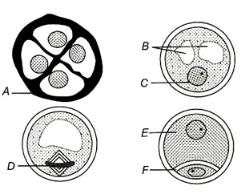
A
Insects
B
Birds
C
Snails
D
Bats
Solution
(B) Ornithophily is a type of biotic pollination where the transfer of pollen grains from the anther to the stigma is carried out by birds.
Entomophily refers to pollination by insects.
Malacophily refers to pollination by snails or slugs.
Chiropterophily refers to pollination by bats.
Entomophily refers to pollination by insects.
Malacophily refers to pollination by snails or slugs.
Chiropterophily refers to pollination by bats.
0 likes
View Solution185
MediumMCQ
The pollens are released in large numbers to ensure:
A
Cleistogamy
B
Xenogamy
C
Siphonogamy
D
Oogamy
Solution
(B) In plants where pollination occurs via abiotic agents like wind or water,a significant amount of pollen is wasted during the process. To compensate for this loss and ensure successful fertilization,these plants produce a very large number of pollen grains. This strategy is particularly essential for $Xenogamy$ (cross-pollination) to increase the probability of pollen reaching the stigma of another flower.
0 likes
View Solution186
MediumMCQ
In nature,cleistogamous flowers are
A
Self-pollinated
B
Insect-pollinated
C
Wind-pollinated
D
Bird-pollinated
Solution
(A) Cleistogamous flowers are those that do not open at all.
Because the flowers remain closed,the anthers and stigma lie close to each other.
When anthers dehisce in the closed flower,pollen grains come in contact with the stigma to effect pollination.
Thus,cleistogamous flowers are invariably autogamous (self-pollinated) as there is no chance of cross-pollination.
Examples include $Commelina$,$Viola$ (common pansy),and $Oxalis$.
Because the flowers remain closed,the anthers and stigma lie close to each other.
When anthers dehisce in the closed flower,pollen grains come in contact with the stigma to effect pollination.
Thus,cleistogamous flowers are invariably autogamous (self-pollinated) as there is no chance of cross-pollination.
Examples include $Commelina$,$Viola$ (common pansy),and $Oxalis$.
0 likes
View Solution187
MediumMCQ
Wind-pollinated flowers have long,well-exposed stigmas. This statement is:
A
True
B
False
C
Sometimes $(a)$ and sometimes $(b)$
D
Neither $(a)$ nor $(b)$
Solution
(A) The statement is True.
In wind-pollinated flowers (anemophily),the stigmas are often large,feathery,and well-exposed to trap airborne pollen grains efficiently.
Since there is no biotic agent to carry the pollen,these adaptations increase the probability of successful pollination.
In wind-pollinated flowers (anemophily),the stigmas are often large,feathery,and well-exposed to trap airborne pollen grains efficiently.
Since there is no biotic agent to carry the pollen,these adaptations increase the probability of successful pollination.
0 likes
View Solution188
MediumMCQ
Pollination is defined as:
A
Shedding of pollens
B
Maturing of anther
C
Transfer of pollen grains from the anther to the stigma of a flower
D
Formation of pollen grains
Solution
(C) Pollination is the process of transfer of pollen grains from the anther to the stigma of a flower. It is a crucial step in the sexual reproduction of flowering plants,enabling fertilization.
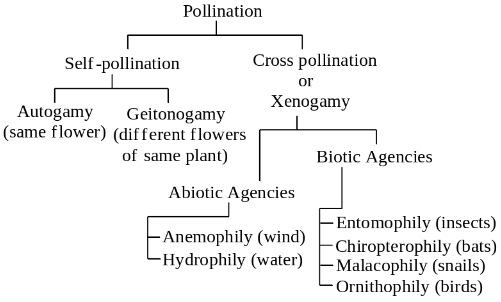
0 likes
View Solution189
MediumMCQ
Type of pollination in Commelina is
A
Autogamy
B
Geitonogamy
C
Xenogamy
D
None of these
Solution
(A) Cleistogamous flowers do not open at all, ensuring that only self-pollination occurs within the flower. In $Commelina$ $\text{benghalensis}$, the plant produces both chasmogamous and cleistogamous flowers. The underground flowers are specifically cleistogamous, where autogamy (a type of self-pollination) takes place.
0 likes
View Solution190
MediumMCQ
Which of the following is a water-pollinated plant?
A
Vallisneria
B
Hydrilla
C
Zostera
D
All of these
Solution
(D) Water pollination (hydrophily) is a rare mode of pollination in flowering plants.
Examples of water-pollinated plants include freshwater species like $Vallisneria$ and $Hydrilla$,as well as marine seagrasses such as $Zostera$.
It is important to note that not all aquatic plants use water for pollination.
In many aquatic plants,such as water hyacinth and water lily,the flowers emerge above the water level and are pollinated by insects or wind,similar to most land plants.
Examples of water-pollinated plants include freshwater species like $Vallisneria$ and $Hydrilla$,as well as marine seagrasses such as $Zostera$.
It is important to note that not all aquatic plants use water for pollination.
In many aquatic plants,such as water hyacinth and water lily,the flowers emerge above the water level and are pollinated by insects or wind,similar to most land plants.
0 likes
View Solution191
MediumMCQ
Characteristics of wind-pollinated pollen grains are that they are:
A
Non-sticky
B
Light
C
Produced in large numbers
D
All of these
Solution
(D) Wind-pollinated pollen grains possess specific adaptations to facilitate dispersal by air currents.
$1$. They are non-sticky so they do not clump together.
$2$. They are light in weight to be easily carried by the wind.
$3$. They are produced in very large numbers to compensate for the high wastage during the pollination process.
$1$. They are non-sticky so they do not clump together.
$2$. They are light in weight to be easily carried by the wind.
$3$. They are produced in very large numbers to compensate for the high wastage during the pollination process.
0 likes
View Solution192
EasyMCQ
Pollination by snail and slug is called
A
Ornithophily
B
Chiropterophily
C
Entomophily
D
Malacophily
Solution
(D) Pollination by snails and slugs is known as malacophily.
- $Ornithophily$ refers to pollination by birds.
- $Chiropterophily$ refers to pollination by bats.
- $Entomophily$ refers to pollination by insects.
- $Malacophily$ refers to pollination by mollusks,such as snails and slugs.
- $Ornithophily$ refers to pollination by birds.
- $Chiropterophily$ refers to pollination by bats.
- $Entomophily$ refers to pollination by insects.
- $Malacophily$ refers to pollination by mollusks,such as snails and slugs.
0 likes
View Solution193
MediumMCQ
In chasmogamy,pollination takes place in:
A
Open flower
B
Closed flower
C
Large flower
D
Geitonogamy flower
Solution
(A) Chasmogamy is a type of pollination in which the flowers remain open,exposing their reproductive organs (anthers and stigma) to the environment.
This is in contrast to cleistogamy,where pollination occurs within closed flowers.
In chasmogamous flowers,cross-pollination or self-pollination can occur because the reproductive parts are accessible to external agents like wind,water,or insects.
This is in contrast to cleistogamy,where pollination occurs within closed flowers.
In chasmogamous flowers,cross-pollination or self-pollination can occur because the reproductive parts are accessible to external agents like wind,water,or insects.
0 likes
View Solution194
MediumMCQ
Aquatic plants like water-hyacinth and water lily are pollinated by
A
Water
B
Air
C
Insect
D
Both $(b)$ and $(c)$
Solution
(D) In many aquatic plants such as water-hyacinth and water lily,the flowers emerge above the level of water and are pollinated by insects or wind. Even though these plants are aquatic,they do not use water as a medium for pollination. Therefore,the correct answer is both $(b)$ and $(c)$.
0 likes
View Solution195
MediumMCQ
Which one of the following is not a correct explanation of cross-pollination?
A
The pollen grains are transferred from one flower to another flower situated on the same plant.
B
The pollen grains are transferred from one flower to another flower,of another plant of the same species.
C
Both $A$ and $B$.
D
The pollen grains of the flower are transferred to the stigma of the same flower.
Solution
(D) Cross-pollination is the transfer of pollen grains from the anther of one flower to the stigma of another flower.
Option $D$ describes self-pollination (autogamy),where pollen grains are transferred to the stigma of the same flower.
Option $A$ describes geitonogamy,which is functionally cross-pollination but genetically self-pollination.
Option $B$ describes xenogamy,which is true cross-pollination.
Since the question asks for the incorrect explanation of cross-pollination,option $D$ is the correct answer because it defines self-pollination.
Option $D$ describes self-pollination (autogamy),where pollen grains are transferred to the stigma of the same flower.
Option $A$ describes geitonogamy,which is functionally cross-pollination but genetically self-pollination.
Option $B$ describes xenogamy,which is true cross-pollination.
Since the question asks for the incorrect explanation of cross-pollination,option $D$ is the correct answer because it defines self-pollination.
0 likes
View Solution196
MediumMCQ
An interesting modification of flower shape for insect pollination occurs in some orchids in which a male insect mistakes the pattern on the orchid flower for the female of his species and tries to copulate with it,thereby pollinating the flower. This phenomenon is called
A
Pseudoparthenocarpy
B
Mimicry
C
Pseudopollination
D
Pseudocopulation
Solution
(D) Pseudocopulation describes behaviors similar to copulation that serve a reproductive function for one or more or both the participants but do not involve actual sexual union between the individuals.
In this specific case,the orchid flower mimics the female insect in shape,color,and scent.
The male insect,deceived by this resemblance,attempts to mate with the flower.
During this process,the insect picks up or deposits pollen,thereby facilitating pollination.
This is a classic example of sexual deception in plant-pollinator interactions.
In this specific case,the orchid flower mimics the female insect in shape,color,and scent.
The male insect,deceived by this resemblance,attempts to mate with the flower.
During this process,the insect picks up or deposits pollen,thereby facilitating pollination.
This is a classic example of sexual deception in plant-pollinator interactions.
0 likes
View Solution197
MediumMCQ
Choose the mismatched option.
A
Wind - Cannabis - Anemophily
B
Water - Zostera - Hydrophily
C
Insect - Salvia - Entomophily
D
Birds - Adansonia - Ornithophily
Solution
(D) Pollination by birds is known as $Ornithophily$.
$Adansonia$ (Baobab) is typically pollinated by bats,which is known as $Chiropterophily$.
$Cannabis$ is pollinated by wind $(Anemophily)$.
$Zostera$ is a marine angiosperm pollinated by water $(Hydrophily)$.
$Salvia$ is pollinated by insects $(Entomophily)$.
Therefore,the option $D$ is mismatched because $Adansonia$ is pollinated by bats,not birds.
$Adansonia$ (Baobab) is typically pollinated by bats,which is known as $Chiropterophily$.
$Cannabis$ is pollinated by wind $(Anemophily)$.
$Zostera$ is a marine angiosperm pollinated by water $(Hydrophily)$.
$Salvia$ is pollinated by insects $(Entomophily)$.
Therefore,the option $D$ is mismatched because $Adansonia$ is pollinated by bats,not birds.
0 likes
View Solution198
MediumMCQ
Xenogamy or cross-pollination is performed by
$I$. Abiotic agencies
$II$. Biotic agencies
$III$. Insects only
Select the correct option for the given question.
$I$. Abiotic agencies
$II$. Biotic agencies
$III$. Insects only
Select the correct option for the given question.
A
$I$ and $III$
B
$II$ and $III$
C
Only $III$
D
$I$ and $II$
Solution
(D) Xenogamy is a type of cross-pollination where pollen grains are transferred from the anther of one flower to the stigma of another flower on a different plant of the same species.
This process requires external agents for the transfer of pollen grains.
These agents can be classified into two main categories:
$1$. Abiotic agencies: These include non-living factors like wind $(Anemophily)$ and water $(Hydrophily)$.
$2$. Biotic agencies: These include living organisms such as insects $(Entomophily)$,birds $(Ornithophily)$,bats $(Chiropterophily)$,etc.
Since both abiotic and biotic agencies can facilitate cross-pollination,both $I$ and $II$ are correct. $III$ is incorrect because insects are only one type of biotic agent,not the only agents responsible for cross-pollination.
Therefore,the correct option is $D$ ($I$ and $II$).
This process requires external agents for the transfer of pollen grains.
These agents can be classified into two main categories:
$1$. Abiotic agencies: These include non-living factors like wind $(Anemophily)$ and water $(Hydrophily)$.
$2$. Biotic agencies: These include living organisms such as insects $(Entomophily)$,birds $(Ornithophily)$,bats $(Chiropterophily)$,etc.
Since both abiotic and biotic agencies can facilitate cross-pollination,both $I$ and $II$ are correct. $III$ is incorrect because insects are only one type of biotic agent,not the only agents responsible for cross-pollination.
Therefore,the correct option is $D$ ($I$ and $II$).
0 likes
View Solution199
MediumMCQ
The diagram given below depicts:
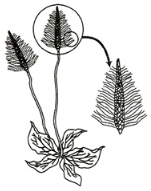
A
Wind pollinated plant
B
Well exposed stamen
C
Compact inflorescence
D
All of these
Solution
(D) The diagram shows a plant with a compact inflorescence and well-exposed stamens. These are characteristic features of wind-pollinated plants (anemophily). Since options $A$,$B$,and $C$ are all correct descriptions of the features shown in the diagram,the correct answer is $D$.
0 likes
View Solution200
MediumMCQ
The diagram below depicts a flower with:
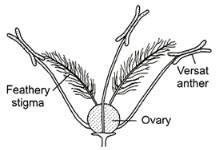
A
Air pollination
B
Ornithophily
C
Water pollination
D
Hybridization
Solution
(A) The provided diagram shows a flower with a feathery stigma and versatile anthers.
These are characteristic adaptations of wind-pollinated (anemophilous) plants.
Feathery stigmas help in trapping airborne pollen grains efficiently,while versatile anthers allow the anthers to swing freely in the wind to release pollen.
These are characteristic adaptations of wind-pollinated (anemophilous) plants.
Feathery stigmas help in trapping airborne pollen grains efficiently,while versatile anthers allow the anthers to swing freely in the wind to release pollen.
0 likes
View SolutionSexual Reproduction in Flowering Plants — Pollination · Frequently Asked Questions
1Are these Sexual Reproduction in Flowering Plants questions useful for JEE and NEET?
Yes. All questions in this section are mapped to JEE Main and NEET exam patterns. Previous year questions from JEE Main, NEET, GUJCET and state-level exams are included with full solutions.
2Can I switch to Hindi or Gujarati for these questions?
Yes. Use the language tabs in the hero section or the sidebar to view the same questions and solutions in English, Hindi or Gujarati.
3How do I generate a question paper from this subtopic?
Use the Vedclass Exam Paper Generator — select the chapter and subtopic, set difficulty, and generate Sets A, B, C, D automatically. First 3 chapters of every subject are free.
Vedclass Products
For Students
Vedclass Test Series
Mock tests in real JEE/NEET style with performance analysis. 5-day free trial.
Start Free TrialFor Teachers
Exam Paper Generator
Generate Set A/B/C/D papers from this chapter in 2 minutes. 3 chapters free.
Try FreeFor Institutes
Online Exam Module
Live online exams with unlimited students, 360° analytics & white-label branding.
See DemoFor Teachers & Institutes
Generate a Sexual Reproduction in Flowering Plants Exam Paper in 2 Minutes
Select subtopic & difficulty — Sets A, B, C, D auto-generated with No Repeat logic.
First 3 chapters of every subject are free — no payment required.