
A English
Pollination Questions in English
Class 12 Biology · Sexual Reproduction in Flowering Plants · Pollination
270+
Questions
English
Language
100%
With Solutions
Showing 50 of 270 questions in English
201
MediumMCQ
Geitonogamy is
A
Genetically autogamous
B
Ecologically autogamous
C
Genetically allogamous
D
Functionally autogamous
Solution
(A) Geitonogamy involves the transfer of pollen grains from the anther to the stigma of another flower on the same plant.
Since the pollen grains and the ovule belong to the same plant,they are genetically identical.
Therefore,geitonogamy is genetically similar to autogamy (self-pollination),making it genetically autogamous.
Since the pollen grains and the ovule belong to the same plant,they are genetically identical.
Therefore,geitonogamy is genetically similar to autogamy (self-pollination),making it genetically autogamous.
0 likes
View Solution202
MediumMCQ
Which of the following plants provides a safe place to insects for laying eggs?
A
Sage plant
B
Amorphophallus
C
Ophrys
D
Mango
Solution
(B) Some plants provide floral rewards to their pollinators in the form of safe places to lay eggs.
$Amorphophallus$ (the tallest flower) provides this service to its pollinator.
Therefore,the correct option is $B$.
$Amorphophallus$ (the tallest flower) provides this service to its pollinator.
Therefore,the correct option is $B$.
0 likes
View Solution203
MediumMCQ
Examples of water-pollinated flowers are:
A
Zostera,Lotus,water lily
B
Lotus,Vallisneria,Hydrilla
C
Potamogeton,Vallisneria,Lotus
D
Vallisneria,Hydrilla,Zostera
Solution
(D) Pollination by water is quite rare in flowering plants and is limited to about $30$ genera,mostly monocotyledons.
Examples of water-pollinated plants include $Vallisneria$ and $Hydrilla$ (freshwater) and $Zostera$ (marine seagrass).
In $Vallisneria$,the female flower reaches the surface of the water by a long stalk,while in $Zostera$,the flowers remain submerged.
$Lotus$ and $water lily$ are aquatic plants,but their flowers emerge above the water level and are pollinated by insects or wind,not by water.
Examples of water-pollinated plants include $Vallisneria$ and $Hydrilla$ (freshwater) and $Zostera$ (marine seagrass).
In $Vallisneria$,the female flower reaches the surface of the water by a long stalk,while in $Zostera$,the flowers remain submerged.
$Lotus$ and $water lily$ are aquatic plants,but their flowers emerge above the water level and are pollinated by insects or wind,not by water.
0 likes
View Solution204
MediumMCQ
Which of the following is not a characteristic feature of insect-pollinated flowers?
A
Fragrance
B
Nectaries
C
Foul odour
D
Mucilaginous covering on pollen grains
Solution
(D) Insect-pollinated flowers (entomophilous) typically possess features like bright colours,fragrance,and nectar to attract insects. Some flowers also produce a foul odour to attract specific pollinators like flies and beetles. However,a mucilaginous covering on pollen grains is a characteristic feature of hydrophilous (water-pollinated) plants,such as $Hydrilla$ or $Vallisneria$,which protects the pollen from wetting.
0 likes
View Solution205
MediumMCQ
What is the characteristic of 'pollen robbers'?
A
Consume pollen or nectar without aiding in pollination
B
Are effective in bringing about pollination
C
Do not visit flowers for pollen
D
Take pollen from other insects
Solution
(A) Pollen robbers are animals or insects that visit flowers to consume pollen or nectar but do not contribute to the pollination process. Because they do not transfer pollen from the anther to the stigma,they are considered 'robbers' rather than pollinators. Therefore,they consume resources without providing any reproductive benefit to the plant.
0 likes
View Solution206
MediumMCQ
Which type of flowers always produce seeds even in the absence of pollinators?
A
Chasmogamous flowers
B
Cleistogamous flowers
C
Bisexual flowers
D
Unisexual flowers
Solution
(B) Cleistogamous flowers are those that do not open at all.
Because the flowers remain closed,the anthers and stigma lie very close to each other.
When anthers dehisce in the closed flower,pollen grains come in contact with the stigma to effect pollination.
Thus,cleistogamous flowers are invariably autogamous as there is no chance of cross-pollination.
This ensures seed set even in the absence of pollinators.
Because the flowers remain closed,the anthers and stigma lie very close to each other.
When anthers dehisce in the closed flower,pollen grains come in contact with the stigma to effect pollination.
Thus,cleistogamous flowers are invariably autogamous as there is no chance of cross-pollination.
This ensures seed set even in the absence of pollinators.
0 likes
View Solution207
MediumMCQ
The type of pollination which brings genetically different types of pollen on the stigma is
A
Autogamy
B
Xenogamy
C
Geitonogamy
D
Cleistogamy
Solution
(B) Xenogamy is the type of pollination that involves the transfer of pollen grains from the anther to the stigma of a different plant of the same species.
Because the pollen comes from a different plant,it brings genetically different types of pollen to the stigma,which promotes genetic variation in the offspring.
Because the pollen comes from a different plant,it brings genetically different types of pollen to the stigma,which promotes genetic variation in the offspring.
0 likes
View Solution208
MediumMCQ
Feathery stigma and versatile anthers are characteristic of
A
Wind pollinated flowers
B
Insect pollinated flowers
C
Water pollinated flowers
D
Bat pollinated flowers
Solution
(A) Flowers pollinated by wind (anemophily) possess specific adaptations to facilitate the dispersal and capture of pollen grains.
$1$. Feathery stigmas are adapted to trap airborne pollen grains efficiently.
$2$. Versatile anthers are loosely attached to the filament,allowing them to sway easily in the wind and release pollen grains into the air.
Therefore,these characteristics are typical of wind-pollinated flowers.
$1$. Feathery stigmas are adapted to trap airborne pollen grains efficiently.
$2$. Versatile anthers are loosely attached to the filament,allowing them to sway easily in the wind and release pollen grains into the air.
Therefore,these characteristics are typical of wind-pollinated flowers.
0 likes
View Solution209
MediumMCQ
Hydrophily is limited to $30$ genera which are mostly
A
Gymnosperms
B
Monocots
C
Dicots
D
More than one option is correct
Solution
(B) Hydrophily,or pollination by water,is a relatively rare mode of pollination in flowering plants.
It is limited to about $30$ genera,most of which are monocotyledons (monocots).
Examples include aquatic plants like $Vallisneria$ and $Hydrilla$.
Therefore,the correct option is $B$.
It is limited to about $30$ genera,most of which are monocotyledons (monocots).
Examples include aquatic plants like $Vallisneria$ and $Hydrilla$.
Therefore,the correct option is $B$.
0 likes
View Solution210
MediumMCQ
Common floral rewards provided by plants to pollinators are:
A
Nectar and pollen
B
Pollen and enzymes
C
Hormones and nectar
D
All of these
Solution
(A) To sustain animal visitors,flowers have to provide rewards to the animals. Nectar and pollen grains are the usual floral rewards. For harvesting the rewards from the flower,the animal visitor comes in contact with the anthers and the stigma. The body of the animal gets a coating of pollen grains,which are generally sticky in animal-pollinated flowers. When the animal carrying pollen on its body comes in contact with the stigma,it brings about pollination.
0 likes
View Solution211
MediumMCQ
$A$ : Geitonogamy helps in maintaining homozygosity and superiority of the race indefinitely.
$R$ : It is functionally,ecologically and genetically cross-pollination.
$R$ : It is functionally,ecologically and genetically cross-pollination.
A
Assertion and Reason both are correct and Reason is the correct explanation of Assertion.
B
Assertion and Reason both are correct but Reason is not the correct explanation of Assertion.
C
Assertion is correct,but Reason is incorrect.
D
Both Assertion and Reason are incorrect.
Solution
(D) Geitonogamy is the transfer of pollen grains from the anther to the stigma of another flower of the same plant.
Genetically,it is similar to autogamy (self-pollination) because the pollen grains come from the same plant,thus it helps in maintaining homozygosity.
Ecologically and functionally,it is cross-pollination because it requires a pollinating agent to transfer the pollen grains.
Therefore,the Assertion is incorrect because it claims geitonogamy maintains superiority indefinitely (which is a feature of self-pollination leading to inbreeding depression),and the Reason is incorrect because it claims geitonogamy is genetically cross-pollination.
Genetically,it is similar to autogamy (self-pollination) because the pollen grains come from the same plant,thus it helps in maintaining homozygosity.
Ecologically and functionally,it is cross-pollination because it requires a pollinating agent to transfer the pollen grains.
Therefore,the Assertion is incorrect because it claims geitonogamy maintains superiority indefinitely (which is a feature of self-pollination leading to inbreeding depression),and the Reason is incorrect because it claims geitonogamy is genetically cross-pollination.
0 likes
View Solution212
MediumMCQ
Pollination in Ophrys (a Mediterranean orchid) occurs by
A
Insect through clip mechanism
B
Insect through trap door mechanism
C
Insect through pseudocopulation mechanism
D
Insect through lever mechanism
Solution
(C) Pollination in Ophrys (an orchid) occurs by an insect (specifically a bee) through the pseudocopulation mechanism.
In this process,one petal of the orchid flower bears an uncanny resemblance to the female of the bee species in size,color,and markings.
The male bee is attracted to the flower,perceiving it as a female,and attempts to copulate with it.
During this attempt,pollen grains are transferred to the bee's body,which are then carried to another flower,facilitating pollination.
This phenomenon is a classic example of 'sexual deceit'.
In this process,one petal of the orchid flower bears an uncanny resemblance to the female of the bee species in size,color,and markings.
The male bee is attracted to the flower,perceiving it as a female,and attempts to copulate with it.
During this attempt,pollen grains are transferred to the bee's body,which are then carried to another flower,facilitating pollination.
This phenomenon is a classic example of 'sexual deceit'.
0 likes
View Solution213
MediumMCQ
Which term is used for the transfer of pollen grains from the anther of one plant to the stigma of a different plant,where genetically different types of pollen grains are brought to the stigma during pollination?
A
Geitonogamy
B
Xenogamy
C
Chasmogamy
D
Cleistogamy
Solution
(B) The transfer of pollen grains from the anther to the stigma of a different plant is known as $Xenogamy$ (cross-pollination).
In $Xenogamy$,the pollen grains come from a genetically different plant,which leads to the introduction of genetic variation in the offspring.
$Geitonogamy$ involves the transfer of pollen grains from the anther to the stigma of another flower on the same plant,which is genetically similar to autogamy.
$Chasmogamy$ and $Cleistogamy$ refer to the state of the flower (open or closed) during pollination,not the genetic source of the pollen.
In $Xenogamy$,the pollen grains come from a genetically different plant,which leads to the introduction of genetic variation in the offspring.
$Geitonogamy$ involves the transfer of pollen grains from the anther to the stigma of another flower on the same plant,which is genetically similar to autogamy.
$Chasmogamy$ and $Cleistogamy$ refer to the state of the flower (open or closed) during pollination,not the genetic source of the pollen.
0 likes
View Solution214
DifficultMCQ
Identify the incorrect statement related to Pollination:
A
Pollination by wind is more common amongst abiotic pollination
B
Flowers produce foul odours to attract flies and beetles to get pollinated
C
Moths and butterflies are the most dominant pollinating agents among insects
D
Pollination by water is quite rare in flowering plants
Solution
(C) The correct answer is $C$.
Among the insects,bees are the most dominant pollinating agents,not moths and butterflies.
Statement $A$ is correct because wind pollination is the most common form of abiotic pollination.
Statement $B$ is correct as many flowers produce foul odors to attract specific pollinators like flies and beetles.
Statement $D$ is correct because pollination by water is limited to about $30$ genera,mostly monocotyledons,making it quite rare in flowering plants.
Among the insects,bees are the most dominant pollinating agents,not moths and butterflies.
Statement $A$ is correct because wind pollination is the most common form of abiotic pollination.
Statement $B$ is correct as many flowers produce foul odors to attract specific pollinators like flies and beetles.
Statement $D$ is correct because pollination by water is limited to about $30$ genera,mostly monocotyledons,making it quite rare in flowering plants.
0 likes
View Solution215
MediumMCQ
Pollination is defined as ........
A
The transfer of pollen grains from the anther to the stigma of a pistil.
B
The transfer of pollen grains from the stigma to the anther of a pistil.
C
The transfer of pollen grains from the anther to the ovary of a pistil.
D
The transfer of pollen grains from the pistil to the anther of a stamen.
Solution
(A) Pollination is the process of transfer of pollen grains from the anther to the stigma of a pistil. This is a crucial step in the sexual reproduction of flowering plants,as it allows the male gametes to reach the female reproductive organs for fertilization.
0 likes
View Solution216
MediumMCQ
In this type of flower,pollination occurs before the flower opens.
A
Chasmogamous flower
B
Unisexual flower
C
Cleistogamous flower
D
All of the above
Solution
(C) Cleistogamous flowers are those that do not open at all.
In these flowers,the anthers and stigma lie very close to each other.
When anthers dehisce in the flower buds,pollen grains come in contact with the stigma to effect pollination.
Thus,cleistogamous flowers are invariably autogamous as there is no chance of cross-pollination landing on the stigma.
In these flowers,the anthers and stigma lie very close to each other.
When anthers dehisce in the flower buds,pollen grains come in contact with the stigma to effect pollination.
Thus,cleistogamous flowers are invariably autogamous as there is no chance of cross-pollination landing on the stigma.
0 likes
View Solution217
MediumMCQ
In which type of flower does self-pollination always occur?
A
Bisexual flower
B
Chasmogamous flower
C
Cleistogamous flower
D
Unisexual flower
Solution
(C) Cleistogamous flowers are those that do not open at all.
In these flowers,the anthers and stigma lie close to each other.
When anthers dehisce in the flower buds,pollen grains come in contact with the stigma to effect pollination.
Thus,cleistogamous flowers are invariably autogamous (self-pollinating) as there is no chance of cross-pollination.
In these flowers,the anthers and stigma lie close to each other.
When anthers dehisce in the flower buds,pollen grains come in contact with the stigma to effect pollination.
Thus,cleistogamous flowers are invariably autogamous (self-pollinating) as there is no chance of cross-pollination.
0 likes
View Solution218
MediumMCQ
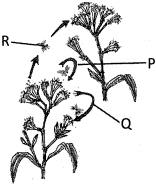
Identify the types of pollination $P, Q$ and $R$ in the given figure.
$\quad\quad\quad P \quad\quad Q \quad\quad R$
$\quad\quad\quad P \quad\quad Q \quad\quad R$
A
Xenogamy $\quad$ Geitonogamy $\quad$ Autogamy
B
Geitonogamy $\quad$ Xenogamy $\quad$ Autogamy
C
Autogamy $\quad$ Xenogamy $\quad$ Geitonogamy
D
Autogamy $\quad$ Geitonogamy $\quad$ Xenogamy
Solution
(D) Based on the provided figure:
$P$ represents Autogamy,where pollen grains are transferred from the anther to the stigma of the same flower.
$Q$ represents Geitonogamy,where pollen grains are transferred from the anther of one flower to the stigma of another flower on the same plant.
$R$ represents Xenogamy,where pollen grains are transferred from the anther of one flower to the stigma of another flower on a different plant of the same species.
$P$ represents Autogamy,where pollen grains are transferred from the anther to the stigma of the same flower.
$Q$ represents Geitonogamy,where pollen grains are transferred from the anther of one flower to the stigma of another flower on the same plant.
$R$ represents Xenogamy,where pollen grains are transferred from the anther of one flower to the stigma of another flower on a different plant of the same species.
0 likes
View Solution219
EasyMCQ
The transfer of pollen grains from the anther to the stigma of another flower of the same plant is known as:
A
Geitonogamy
B
Autogamy
C
Xenogamy
D
None of these
Solution
(A) The transfer of pollen grains from the anther to the stigma of another flower of the same plant is called $Geitonogamy$.
Although $Geitonogamy$ is functionally cross-pollination involving a pollinating agent,genetically it is similar to $Autogamy$ since the pollen grains come from the same plant.
Although $Geitonogamy$ is functionally cross-pollination involving a pollinating agent,genetically it is similar to $Autogamy$ since the pollen grains come from the same plant.
0 likes
View Solution220
MediumMCQ
Which type of pollination has the highest probability of introducing genetic variation?
A
Autogamy
B
Geitonogamy
C
Xenogamy
D
None of these
Solution
(C) Genetic variation is introduced when there is a recombination of genetic material from two different plants.
$1$. Autogamy involves self-pollination within the same flower,resulting in no genetic variation.
$2$. Geitonogamy involves pollination between two flowers of the same plant,which is genetically similar to self-pollination.
$3$. Xenogamy (cross-pollination) involves the transfer of pollen grains from the anther of one flower to the stigma of another flower on a different plant of the same species.
$4$. Since the pollen and the ovule come from genetically different plants,Xenogamy leads to the highest probability of genetic variation.
$1$. Autogamy involves self-pollination within the same flower,resulting in no genetic variation.
$2$. Geitonogamy involves pollination between two flowers of the same plant,which is genetically similar to self-pollination.
$3$. Xenogamy (cross-pollination) involves the transfer of pollen grains from the anther of one flower to the stigma of another flower on a different plant of the same species.
$4$. Since the pollen and the ovule come from genetically different plants,Xenogamy leads to the highest probability of genetic variation.
0 likes
View Solution221
MediumMCQ
Geitonogamy is genetically similar to ......... and functionally similar to ......... .
A
Autogamy,Xenogamy
B
Xenogamy,Autogamy
C
Autogamy,Autogamy
D
Xenogamy,Xenogamy
Solution
(A) Geitonogamy involves the transfer of pollen grains from the anther to the stigma of another flower of the same plant.
Since the pollen grains come from the same plant,it is genetically similar to autogamy (self-pollination) because the genetic makeup of the pollen and the ovule is identical.
However,it is functionally similar to xenogamy (cross-pollination) because it requires a pollinating agent to transfer the pollen grains from one flower to another.
Since the pollen grains come from the same plant,it is genetically similar to autogamy (self-pollination) because the genetic makeup of the pollen and the ovule is identical.
However,it is functionally similar to xenogamy (cross-pollination) because it requires a pollinating agent to transfer the pollen grains from one flower to another.
0 likes
View Solution222
MediumMCQ
Select the incorrect statement from the following.
A
Most plants use abiotic pollinators for pollination.
B
In both wind and water pollination, the probability of pollen grains coming in contact with the stigma is very low.
C
The number of pollen grains is very large compared to the number of ovules.
D
Abiotic agents are wind and water, while biotic agents are animals.
Solution
(A) The correct answer is $A$.
In flowering plants, the majority of plants (about $80\%$) use biotic agents (animals like bees, butterflies, birds, bats, etc.) for pollination.
Only a small proportion of plants use abiotic agents like wind and water.
Therefore, the statement that 'most plants use abiotic pollinators' is incorrect.
Statements $B$, $C$, and $D$ are scientifically accurate descriptions of pollination processes.
In flowering plants, the majority of plants (about $80\%$) use biotic agents (animals like bees, butterflies, birds, bats, etc.) for pollination.
Only a small proportion of plants use abiotic agents like wind and water.
Therefore, the statement that 'most plants use abiotic pollinators' is incorrect.
Statements $B$, $C$, and $D$ are scientifically accurate descriptions of pollination processes.
0 likes
View Solution223
MediumMCQ
Select the incorrect statement for wind pollination (anemophily).
A
Pollen grains are light and non-sticky.
B
Large,feathery stigmas are present to easily trap wind-borne pollen grains.
C
Wind-pollinated flowers often have numerous ovules.
D
Stamens are well-exposed.
Solution
(C) The incorrect statement for wind pollination (anemophily) is that 'Wind-pollinated flowers often have numerous ovules'.
In wind-pollinated plants,the ovary usually contains only a single ovule (e.g.,wheat,corn,grass).
Therefore,option $C$ is incorrect.
All other options describe adaptations for wind pollination: pollen grains are light and non-sticky to be easily carried by wind,stigmas are large and feathery to trap pollen,and stamens are well-exposed to release pollen into the air currents.
In wind-pollinated plants,the ovary usually contains only a single ovule (e.g.,wheat,corn,grass).
Therefore,option $C$ is incorrect.
All other options describe adaptations for wind pollination: pollen grains are light and non-sticky to be easily carried by wind,stigmas are large and feathery to trap pollen,and stamens are well-exposed to release pollen into the air currents.
0 likes
View Solution224
MediumMCQ
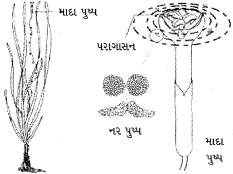
Which type of pollination occurs in the plant shown below?
A
Entomophily
B
Anemophily
C
Ornithophily
D
Hydrophily
Solution
(D) The image shows the plant $Vallisneria$,which is a submerged aquatic plant.
In $Vallisneria$,pollination occurs through water,which is known as Hydrophily.
The female flower reaches the surface of the water by a long stalk,and the male flowers or pollen grains are released on to the surface of the water.
They are carried passively by water currents to reach the female flowers.
Therefore,the correct option is $D$.
In $Vallisneria$,pollination occurs through water,which is known as Hydrophily.
The female flower reaches the surface of the water by a long stalk,and the male flowers or pollen grains are released on to the surface of the water.
They are carried passively by water currents to reach the female flowers.
Therefore,the correct option is $D$.
0 likes
View Solution225
MediumMCQ
Which of the following plants are pollinated by water?
$I -$ Vallisneria,$II -$ Eichhornia,
$III -$ Water lily,$IV -$ Zostera,$V -$ Hydrilla
$I -$ Vallisneria,$II -$ Eichhornia,
$III -$ Water lily,$IV -$ Zostera,$V -$ Hydrilla
A
$I, II, III, IV, V$
B
$I, IV, V$
C
$I, II, IV, V$
D
$I, II, III, V$
Solution
(B) Pollination by water (hydrophily) is quite rare in flowering plants and is limited to about $30$ genera,mostly monocotyledons.
$I -$ Vallisneria is a freshwater plant that exhibits hydrophily.
$II -$ Eichhornia (Water hyacinth) and $III -$ Water lily are aquatic plants,but their flowers emerge above the water level and are pollinated by insects or wind,not by water.
$IV -$ Zostera is a marine seagrass that exhibits hydrophily.
$V -$ Hydrilla is a freshwater plant that exhibits hydrophily.
Therefore,the plants pollinated by water are Vallisneria $(I)$,Zostera $(IV)$,and Hydrilla $(V)$.
$I -$ Vallisneria is a freshwater plant that exhibits hydrophily.
$II -$ Eichhornia (Water hyacinth) and $III -$ Water lily are aquatic plants,but their flowers emerge above the water level and are pollinated by insects or wind,not by water.
$IV -$ Zostera is a marine seagrass that exhibits hydrophily.
$V -$ Hydrilla is a freshwater plant that exhibits hydrophily.
Therefore,the plants pollinated by water are Vallisneria $(I)$,Zostera $(IV)$,and Hydrilla $(V)$.
0 likes
View Solution226
MediumMCQ
In which of the following is pollination by water observed?
A
Limited to about $30$ genera
B
Limited to about $50$ species
C
Limited to about $30$ species
D
Limited to about $50$ genera
Solution
(A) Pollination by water is quite rare in flowering plants and is limited to about $30$ genera,mostly monocotyledons. Examples include $Vallisneria$ and $Hydrilla$.
0 likes
View Solution227
MediumMCQ
Select the correct option for pollination in $Zostera$.
A
Female flowers remain submerged in water,and pollen grains are released inside the water.
B
Pollen grains are long and ribbon-like,and they are carried passively inside the water.
C
Pollen grains are covered by mucilage to protect them from wetting.
D
All of the above.
Solution
(D) $Zostera$ is a marine angiosperm (sea grass) that exhibits hydrophily (pollination by water). The process involves the following characteristics:
$1$. Female flowers remain submerged in water,and pollen grains are released inside the water.
$2$. Pollen grains are long and ribbon-like,which allows them to be carried passively by water currents.
$3$. Pollen grains are often covered by a mucilaginous covering to protect them from wetting.
Therefore,all the given options are correct.
$1$. Female flowers remain submerged in water,and pollen grains are released inside the water.
$2$. Pollen grains are long and ribbon-like,which allows them to be carried passively by water currents.
$3$. Pollen grains are often covered by a mucilaginous covering to protect them from wetting.
Therefore,all the given options are correct.
0 likes
View Solution228
MediumMCQ
Select the incorrect option regarding pollination in $Vallisneria$.
A
Female flowers reach the surface of water by long stalks.
B
Male flowers or pollen grains are released onto the surface of water.
C
Male flowers or pollen grains are actively transported by water currents.
D
$Vallisneria$ is a monocotyledonous plant.
Solution
(C) In $Vallisneria$,pollination occurs through water (epihydrophily).
$1$. The female flower reaches the surface of the water by a long,coiled stalk.
$2$. The male flowers or pollen grains are released onto the surface of the water.
$3$. They are carried passively by water currents to reach the female flowers.
$4$. Option $C$ is incorrect because the transport of male flowers or pollen grains is passive,not active.
$5$. $Vallisneria$ is indeed a monocotyledonous plant,so option $D$ is correct.
$1$. The female flower reaches the surface of the water by a long,coiled stalk.
$2$. The male flowers or pollen grains are released onto the surface of the water.
$3$. They are carried passively by water currents to reach the female flowers.
$4$. Option $C$ is incorrect because the transport of male flowers or pollen grains is passive,not active.
$5$. $Vallisneria$ is indeed a monocotyledonous plant,so option $D$ is correct.
0 likes
View Solution229
EasyMCQ
Which is the most dominant pollinator among animals?
A
Birds
B
Wasps
C
Moths
D
Bees
Solution
(D) Among all the animal pollinators,insects are the most dominant group. Within the insect group,bees are considered the most dominant and important pollinators for a wide variety of flowering plants. They are highly efficient at transferring pollen grains from the anther to the stigma of flowers.
0 likes
View Solution230
EasyMCQ
Flowers produce foul odors to attract which of the following pollinators?
A
Flies and beetles
B
Honeybees and beetles
C
Flies and honeybees
D
Sunbirds and hummingbirds
Solution
(A) Many plants that are pollinated by flies and beetles produce foul odors to attract these specific pollinators. These odors mimic the smell of decaying organic matter or dung,which attracts insects that feed on or lay eggs in such materials. This process is known as sapromyophily.
0 likes
View Solution231
MediumMCQ
Which of the following represents an obligate mutualism required for pollination?
A
Algae and Fungi
B
Moth and Yucca
C
Sea Anemone and Hermit Crab
D
All of the above
Solution
(B) Obligate mutualism refers to a relationship where both species are completely dependent on each other for survival or reproduction.
In the case of the $Yucca$ plant and the $Pronuba$ moth,the moth cannot complete its life cycle without the $Yucca$ flower,as it lays its eggs in the ovary of the flower.
Conversely,the $Yucca$ plant cannot be pollinated by any other agent except this specific moth.
Therefore,this is a classic example of obligate mutualism required for pollination.
In the case of the $Yucca$ plant and the $Pronuba$ moth,the moth cannot complete its life cycle without the $Yucca$ flower,as it lays its eggs in the ovary of the flower.
Conversely,the $Yucca$ plant cannot be pollinated by any other agent except this specific moth.
Therefore,this is a classic example of obligate mutualism required for pollination.
0 likes
View Solution232
MediumMCQ
Which plant employs 'sexual deceit' to ensure pollination?
A
Mediterranean orchid
B
Fig
C
Lichen
D
Mango
Solution
(A) The Mediterranean orchid,$Ophrys$,employs a mechanism known as 'sexual deceit' to ensure pollination.
One petal of the flower bears an uncanny resemblance to the female of a bee species in size,color,and markings.
The male bee perceives the flower as a female and attempts to copulate with it.
During this process,pollen grains from the flower get dusted on the male bee's body.
When the bee repeats this behavior with another flower,it facilitates cross-pollination.
One petal of the flower bears an uncanny resemblance to the female of a bee species in size,color,and markings.
The male bee perceives the flower as a female and attempts to copulate with it.
During this process,pollen grains from the flower get dusted on the male bee's body.
When the bee repeats this behavior with another flower,it facilitates cross-pollination.
0 likes
View Solution233
MediumMCQ
One petal of the orchid flower bears an uncanny resemblance to the female bee in size,colour,and markings. Which part of the flower is this?
A
Sepal
B
Petal
C
Stamen
D
Pistil
Solution
(B) The orchid $Ophrys$ exhibits a fascinating example of co-evolution. One of its petals has evolved to resemble the female bee in size,colour,and markings. This phenomenon is known as sexual deceit. The male bee is attracted to the orchid petal,mistaking it for a female bee,and attempts to copulate with it. During this process,pollen grains are dusted on the male bee's body,which are then transferred to another flower when the bee visits it,thus facilitating pollination.
0 likes
View Solution234
MediumMCQ
What is the function of tassels in the corn cob?
A
To protect seeds
B
To attract insects
C
To trap pollen grains
D
To disperse pollen grains
Solution
(C) In a corn cob,the tassels represent the elongated stigma and style of the female flowers. These thread-like structures hang out of the cob and wave in the wind to trap pollen grains,which are carried by the wind for pollination.
0 likes
View Solution235
MediumMCQ
Large,colourful,fragrant flowers with nectar are seen in
A
Wind pollinated plants
B
Insect pollinated plants
C
Bird pollinated plants
D
Bat pollinated plants
Solution
(B) Large,colourful,and fragrant flowers that produce nectar are specific adaptations to attract biotic pollinators,particularly insects. These features ensure that insects visit the flowers to collect nectar,thereby facilitating pollination. Therefore,such flowers are characteristic of insect-pollinated plants.
0 likes
View Solution236
MediumMCQ
Identify the set of correct statements:
$A$. The flowers of Vallisneria are colourful and produce nectar.
$B$. The flowers of water lily are not pollinated by water.
$C$. In most of water-pollinated species,the pollen grains are protected from wetting.
$D$. Pollen grains of some hydrophytes are long and ribbon like.
$E$. In some hydrophytes,the pollen grains are carried passively inside water.
Choose the correct answer from the options given below.
$A$. The flowers of Vallisneria are colourful and produce nectar.
$B$. The flowers of water lily are not pollinated by water.
$C$. In most of water-pollinated species,the pollen grains are protected from wetting.
$D$. Pollen grains of some hydrophytes are long and ribbon like.
$E$. In some hydrophytes,the pollen grains are carried passively inside water.
Choose the correct answer from the options given below.
A
$A, B, C$ and $D$ only
B
$A, C, D$ and $E$ only
C
$B, C, D$ and $E$ only
D
$C, D$ and $E$ only
Solution
(C) Statement $A$ is incorrect because the flowers of $Vallisneria$ are small,inconspicuous,and do not produce nectar.
Statement $B$ is correct because $Water$ $lily$ (Nymphaea) is pollinated by insects or wind,not by water.
Statement $C$ is correct because in most water-pollinated species,pollen grains are protected from wetting by a mucilaginous covering.
Statement $D$ is correct because in some hydrophytes like $Zostera$,pollen grains are long and ribbon-like.
Statement $E$ is correct because in many hydrophytes,pollen grains are carried passively by water currents.
Therefore,statements $B, C, D,$ and $E$ are correct.
Statement $B$ is correct because $Water$ $lily$ (Nymphaea) is pollinated by insects or wind,not by water.
Statement $C$ is correct because in most water-pollinated species,pollen grains are protected from wetting by a mucilaginous covering.
Statement $D$ is correct because in some hydrophytes like $Zostera$,pollen grains are long and ribbon-like.
Statement $E$ is correct because in many hydrophytes,pollen grains are carried passively by water currents.
Therefore,statements $B, C, D,$ and $E$ are correct.
1 likes
View Solution237
MediumMCQ
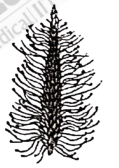
Identify the correct description about the given figure:
A
Water pollinated flowers showing stamens with mucilaginous covering.
B
Cleistogamous flowers showing autogamy.
C
Compact inflorescence showing complete autogamy.
D
Wind pollinated plant inflorescence showing flowers with well exposed stamens.
Solution
(D) The given diagram represents a wind-pollinated plant inflorescence.
Wind-pollinated flowers typically possess well-exposed stamens to allow pollen grains to be easily dispersed by wind currents.
They often have a compact inflorescence to increase the efficiency of pollen release.
Since the stamens are well-exposed,they are adapted for cross-pollination rather than complete autogamy.
Wind-pollinated flowers typically possess well-exposed stamens to allow pollen grains to be easily dispersed by wind currents.
They often have a compact inflorescence to increase the efficiency of pollen release.
Since the stamens are well-exposed,they are adapted for cross-pollination rather than complete autogamy.
0 likes
View Solution238
DifficultMCQ
Given below are two statements:
Statement $I$: Fig fruit is a non-vegetarian fruit as it has enclosed fig wasps in it.
Statement $II$: Fig wasp and fig tree exhibit mutual relationship as fig wasp completes its life cycle in fig fruit and fig fruit gets pollinated by fig wasp.
In the light of the above statements,choose the most appropriate answer from the options given below:
Statement $I$: Fig fruit is a non-vegetarian fruit as it has enclosed fig wasps in it.
Statement $II$: Fig wasp and fig tree exhibit mutual relationship as fig wasp completes its life cycle in fig fruit and fig fruit gets pollinated by fig wasp.
In the light of the above statements,choose the most appropriate answer from the options given below:
A
Both statement $I$ and statement $II$ are correct
B
Both statement $I$ and statement $II$ are incorrect
C
Statement $I$ is correct but statement $II$ is incorrect
D
Statement $I$ is incorrect but statement $II$ is correct
Solution
(A) Statement $I$ is correct. The fig fruit (syconium) often contains the remains of the female fig wasp that entered to lay eggs,which are then digested by the plant's enzymes,making it technically 'non-vegetarian' in a biological sense.
Statement $II$ is correct. This is a classic example of obligate mutualism. The fig tree provides a protected environment and food for the wasp larvae,while the wasp ensures the pollination of the fig flowers,which is essential for the tree's reproduction.
Statement $II$ is correct. This is a classic example of obligate mutualism. The fig tree provides a protected environment and food for the wasp larvae,while the wasp ensures the pollination of the fig flowers,which is essential for the tree's reproduction.
0 likes
View Solution239
EasyMCQ
Statement-$I$: Pollination by water is quite rare in flowering plants and is limited to about $30$ genera.
Statement-$II$: Hydrophytes pollen grains are protected from wetting by a mucilaginous covering.
Statement-$II$: Hydrophytes pollen grains are protected from wetting by a mucilaginous covering.
A
Only statement $I$ is correct.
B
Only statement $II$ is correct.
C
Statement $I$ and $II$ both are correct.
D
Statement $I$ and $II$ both are incorrect.
Solution
(C) Statement-$I$ is correct: Pollination by water is indeed rare in flowering plants,occurring in only about $30$ genera,mostly monocotyledons.
Statement-$II$ is correct: In many aquatic plants (hydrophytes),the pollen grains are protected from wetting by a mucilaginous covering (mucilage sheath),which prevents them from decaying or losing viability in water.
Statement-$II$ is correct: In many aquatic plants (hydrophytes),the pollen grains are protected from wetting by a mucilaginous covering (mucilage sheath),which prevents them from decaying or losing viability in water.
0 likes
View Solution240
MediumMCQ
Which of the following statements is not true?
A
Flowers pollinated by flies and beetles secrete a foul odour to attract them.
B
Nymphaea and Water hyacinth are hydrophytes but are entomophilous plants.
C
Yucca,an angiosperm,is pollinated by Pronuba.
D
Pollination by water is a common phenomenon in flowering plants.
Solution
(D) Pollination by water is quite rare in flowering plants and is limited to about $30$ genera,mostly monocotyledons. In most aquatic plants such as water hyacinth and water lily (Nymphaea),the flowers emerge above the level of water and are pollinated by insects or wind,similar to most land plants. Therefore,the statement that pollination by water is a common phenomenon is incorrect.
0 likes
View Solution241
MediumMCQ
Statement-$I$ :- Animals are attracted to flowers by colour or/and fragrance.
Statement-$II$ :- To sustain animal visits,the flowers have to provide rewards to the animals.
Statement-$II$ :- To sustain animal visits,the flowers have to provide rewards to the animals.
A
Both statement $(I)$ and $(II)$ are incorrect.
B
Both statement $(I)$ and $(II)$ are correct.
C
Statement $(I)$ is correct but statement $(II)$ is incorrect.
D
Statement $(I)$ is incorrect but statement $(II)$ is correct.
Solution
(B) Statement-$I$ is correct because biotic pollinators like insects,birds,and bats are attracted to flowers primarily through visual cues (colour) and olfactory cues (fragrance).
Statement-$II$ is correct because,for sustained pollination,flowers must offer floral rewards to the visiting animals. These rewards typically include nectar (a sugar-rich fluid) and pollen grains (a protein-rich food source). Without these rewards,pollinators would not visit the flowers repeatedly.
Statement-$II$ is correct because,for sustained pollination,flowers must offer floral rewards to the visiting animals. These rewards typically include nectar (a sugar-rich fluid) and pollen grains (a protein-rich food source). Without these rewards,pollinators would not visit the flowers repeatedly.
0 likes
View Solution242
MediumMCQ
Flowers,which have a single ovule in the ovary and are packed into an inflorescence,are usually pollinated by$-$
A
Water
B
Bees
C
Wind
D
Bats
Solution
(C) Flowers that are pollinated by wind (anemophily) exhibit specific adaptations to ensure successful pollination.
$1$. These flowers often have a single ovule in each ovary to produce a single seed per fruit.
$2$. They are typically packed into an inflorescence to increase the chances of pollen capture from the air.
$3$. Common examples include grasses,where the flowers are small,inconspicuous,and produce a large amount of light,non-sticky pollen grains that can be easily carried by wind currents.
$1$. These flowers often have a single ovule in each ovary to produce a single seed per fruit.
$2$. They are typically packed into an inflorescence to increase the chances of pollen capture from the air.
$3$. Common examples include grasses,where the flowers are small,inconspicuous,and produce a large amount of light,non-sticky pollen grains that can be easily carried by wind currents.
0 likes
View Solution243
EasyMCQ
Which type of pollination is more common amongst abiotic pollinations?
A
By wind
B
By insects
C
By water
D
By birds
Solution
(A) Pollination is categorized into biotic (involving living organisms) and abiotic (involving non-living factors) agents.
Among abiotic agents,wind and water are the two primary types.
Wind pollination,also known as anemophily,is significantly more common than water pollination (hydrophily) in flowering plants.
Water pollination is quite rare and limited to about $30$ genera,mostly monocotyledons.
Therefore,pollination by wind is the most common form of abiotic pollination.
Among abiotic agents,wind and water are the two primary types.
Wind pollination,also known as anemophily,is significantly more common than water pollination (hydrophily) in flowering plants.
Water pollination is quite rare and limited to about $30$ genera,mostly monocotyledons.
Therefore,pollination by wind is the most common form of abiotic pollination.
0 likes
View Solution244
EasyMCQ
Comparatively,a large amount of pollen grains are wasted during
A
hydrophily
B
ornithophily
C
anemophily
D
chiropterophily
Solution
(C) In wind pollination $(anemophily)$,pollen grains are released in huge quantities because the process is non-directional and random.
Only a tiny fraction of these pollen grains successfully reaches a receptive stigma,which leads to a significant wastage of pollen grains compared to biotic pollination methods.
Only a tiny fraction of these pollen grains successfully reaches a receptive stigma,which leads to a significant wastage of pollen grains compared to biotic pollination methods.
0 likes
View Solution245
EasyMCQ
The pollen grains transferred from one flower to another in plants through biotic agency is about . . . . . . %.
A
$20$
B
$30$
C
$60$
D
$80$
Solution
(D) In flowering plants,pollination occurs through various agents,which are categorized into abiotic (wind and water) and biotic (animals,insects,birds,etc.) agencies.
Biotic agents are the most common pollinators for the majority of flowering plants.
According to botanical studies and $NCERT$,a vast majority of flowering plants (approximately $80 \%$) use biotic agents for the transfer of pollen grains from one flower to another.
Therefore,the correct percentage is $80 \%$.
Biotic agents are the most common pollinators for the majority of flowering plants.
According to botanical studies and $NCERT$,a vast majority of flowering plants (approximately $80 \%$) use biotic agents for the transfer of pollen grains from one flower to another.
Therefore,the correct percentage is $80 \%$.
0 likes
View Solution246
EasyMCQ
Given below are two statements. Based on them,select the correct option given below.
Statement $I$: As an adaptation in chiropterophilous flowers,a large amount of edible pollen grains are produced.
Statement $II$: The Baobab tree is an example of anemophily.
Statement $I$: As an adaptation in chiropterophilous flowers,a large amount of edible pollen grains are produced.
Statement $II$: The Baobab tree is an example of anemophily.
A
Both Statement $I$ and Statement $II$ are correct.
B
Both Statement $I$ and Statement $II$ are incorrect.
C
Statement $I$ is correct but Statement $II$ is incorrect.
D
Statement $I$ is incorrect but Statement $II$ is correct.
Solution
(C) Statement $I$ is correct: Chiropterophilous flowers (pollinated by bats) often produce large amounts of edible pollen and nectar as a reward to attract bats.
Statement $II$ is incorrect: The Baobab tree $(Adansonia)$ is a classic example of chiropterophily (pollination by bats),not anemophily (pollination by wind).
Statement $II$ is incorrect: The Baobab tree $(Adansonia)$ is a classic example of chiropterophily (pollination by bats),not anemophily (pollination by wind).
0 likes
View Solution247
EasyMCQ
Match the type of pollination given in Column-$I$ with its pollinating agent from Column-$II$.
| Column-$I$ | Column-$II$ |
| $i$. Ornithophily | $a$. Bat |
| $ii$. Entomophily | $b$. Wind |
| $iii$. Anemophily | $c$. Bird |
| $iv$. Chiropterophily | $d$. Insect |
A
$i-b, ii-c, iii-d, iv-a$
B
$i-c, ii-a, iii-d, iv-b$
C
$i-d, ii-c, iii-b, iv-a$
D
$i-c, ii-d, iii-b, iv-a$
Solution
(D) The correct matches are as follows:
$i$. Ornithophily: Pollination by birds $(c)$.
$ii$. Entomophily: Pollination by insects $(d)$.
$iii$. Anemophily: Pollination by wind $(b)$.
$iv$. Chiropterophily: Pollination by bats $(a)$.
Therefore,the correct sequence is $i-c, ii-d, iii-b, iv-a$.
$i$. Ornithophily: Pollination by birds $(c)$.
$ii$. Entomophily: Pollination by insects $(d)$.
$iii$. Anemophily: Pollination by wind $(b)$.
$iv$. Chiropterophily: Pollination by bats $(a)$.
Therefore,the correct sequence is $i-c, ii-d, iii-b, iv-a$.
0 likes
View Solution248
EasyMCQ
Akash went on a field visit and collected some flowers like rice,corn,Potamogeton,Halogaris,Salvia,and Kigelia. How many anemophilous flowers did he collect?
A
$3$
B
$2$
C
$6$
D
$4$
Solution
(D) Anemophilous flowers are those pollinated by wind.
$1$. Rice ($Oryza$ $sativa$): Anemophilous.
$2$. Corn ($Zea$ $mays$): Anemophilous.
$3$. Potamogeton: Anemophilous (aquatic plant pollinated by wind).
$4$. Halogaris: Anemophilous.
$5$. Salvia: Entomophilous (pollinated by insects).
$6$. Kigelia: Chiropterophilous (pollinated by bats).
Therefore,there are $4$ anemophilous flowers in the collection.
$1$. Rice ($Oryza$ $sativa$): Anemophilous.
$2$. Corn ($Zea$ $mays$): Anemophilous.
$3$. Potamogeton: Anemophilous (aquatic plant pollinated by wind).
$4$. Halogaris: Anemophilous.
$5$. Salvia: Entomophilous (pollinated by insects).
$6$. Kigelia: Chiropterophilous (pollinated by bats).
Therefore,there are $4$ anemophilous flowers in the collection.
0 likes
View Solution249
EasyMCQ
In which of the following plants does the male flower float on the surface of water?
A
Potamogeton
B
Zostera
C
Water lily
D
Vallisneria
Solution
(D) In $Vallisneria$,the female flower reaches the surface of the water by a long stalk,while the male flowers or pollen grains are released on to the surface of the water. They are carried passively by water currents to reach the female flower. This is a classic example of epihydrophily.
0 likes
View Solution250
EasyMCQ
Match the correct type of pollination in Column $II$ for the plants in Column $I$.
| Column $I$ | Column $II$ |
| $a$. $Bombax$ | $i$. Entomophily |
| $b$. $Zostera$ | $ii$. Epihydrophily |
| $c$. $Vallisneria$ | $iii$. Hypohydrophily |
| $d$. $Cestrum$ | $iv$. Chiropterophily |
| $e$. $Anthocephalus$ | $v$. Ornithophily |
A
$a-iv, b-iii, c-ii, d-i, e-v$
B
$a-iv, b-v, c-i, d-iii, e-ii$
C
$a-v, b-i, c-ii, d-iii, e-iv$
D
$a-v, b-iii, c-ii, d-i, e-iv$
Solution
(A) The correct matches are as follows:
$1$. $Bombax$ (Silk cotton tree) is pollinated by bats,known as Chiropterophily $(a-iv)$.
$2$. $Zostera$ (Sea grass) is a marine plant pollinated underwater,known as Hypohydrophily $(b-iii)$.
$3$. $Vallisneria$ is a freshwater plant where pollination occurs at the water surface,known as Epihydrophily $(c-ii)$.
$4$. $Cestrum$ (Night-blooming jasmine) is pollinated by insects,known as Entomophily $(d-i)$.
$5$. $Anthocephalus$ (Kadamba tree) is pollinated by birds,known as Ornithophily $(e-v)$.
Thus,the correct sequence is $a-iv, b-iii, c-ii, d-i, e-v$.
$1$. $Bombax$ (Silk cotton tree) is pollinated by bats,known as Chiropterophily $(a-iv)$.
$2$. $Zostera$ (Sea grass) is a marine plant pollinated underwater,known as Hypohydrophily $(b-iii)$.
$3$. $Vallisneria$ is a freshwater plant where pollination occurs at the water surface,known as Epihydrophily $(c-ii)$.
$4$. $Cestrum$ (Night-blooming jasmine) is pollinated by insects,known as Entomophily $(d-i)$.
$5$. $Anthocephalus$ (Kadamba tree) is pollinated by birds,known as Ornithophily $(e-v)$.
Thus,the correct sequence is $a-iv, b-iii, c-ii, d-i, e-v$.
0 likes
View SolutionSexual Reproduction in Flowering Plants — Pollination · Frequently Asked Questions
1Are these Sexual Reproduction in Flowering Plants questions useful for JEE and NEET?
Yes. All questions in this section are mapped to JEE Main and NEET exam patterns. Previous year questions from JEE Main, NEET, GUJCET and state-level exams are included with full solutions.
2Can I switch to Hindi or Gujarati for these questions?
Yes. Use the language tabs in the hero section or the sidebar to view the same questions and solutions in English, Hindi or Gujarati.
3How do I generate a question paper from this subtopic?
Use the Vedclass Exam Paper Generator — select the chapter and subtopic, set difficulty, and generate Sets A, B, C, D automatically. First 3 chapters of every subject are free.
Vedclass Products
For Students
Vedclass Test Series
Mock tests in real JEE/NEET style with performance analysis. 5-day free trial.
Start Free TrialFor Teachers
Exam Paper Generator
Generate Set A/B/C/D papers from this chapter in 2 minutes. 3 chapters free.
Try FreeFor Institutes
Online Exam Module
Live online exams with unlimited students, 360° analytics & white-label branding.
See DemoFor Teachers & Institutes
Generate a Sexual Reproduction in Flowering Plants Exam Paper in 2 Minutes
Select subtopic & difficulty — Sets A, B, C, D auto-generated with No Repeat logic.
First 3 chapters of every subject are free — no payment required.