
A English
Pollination Questions in English
Class 12 Biology · Sexual Reproduction in Flowering Plants · Pollination
270+
Questions
English
Language
100%
With Solutions
Showing 50 of 270 questions in English
51
EasyMCQ
What type of pollination occurs in $Capsella$?
A
Entomophily
B
Anemophily
C
Hydrophily
D
None of these
Solution
(A) $Capsella$ is a genus of flowering plants in the family $Brassicaceae$.
These plants produce flowers that are typically attractive to insects,which act as pollinators.
Pollination by insects is known as Entomophily.
Therefore,$Capsella$ exhibits Entomophily.
These plants produce flowers that are typically attractive to insects,which act as pollinators.
Pollination by insects is known as Entomophily.
Therefore,$Capsella$ exhibits Entomophily.
0 likes
View Solution52
EasyMCQ
Pollination by wind is known as ....
A
Anemophily
B
Hydrophily
C
Zoophily
D
Entomophily
Solution
(A) Pollination is the transfer of pollen grains from the anther to the stigma of a flower.
When pollination occurs through the agency of wind,it is termed as $Anemophily$.
$Hydrophily$ refers to pollination by water.
$Zoophily$ refers to pollination by animals.
$Entomophily$ refers to pollination by insects.
When pollination occurs through the agency of wind,it is termed as $Anemophily$.
$Hydrophily$ refers to pollination by water.
$Zoophily$ refers to pollination by animals.
$Entomophily$ refers to pollination by insects.
0 likes
View Solution53
EasyMCQ
Which of the following types of pollination is a form of self-pollination?
A
Geitonogamy
B
Xenogamy
C
Chasmogamy
D
Autogamy
Solution
(D) Autogamy is a type of self-pollination in which pollen grains are transferred from the anther to the stigma of the same flower.
Geitonogamy involves the transfer of pollen grains from the anther to the stigma of another flower on the same plant,which is genetically similar to self-pollination but functionally cross-pollination.
Xenogamy involves the transfer of pollen grains from the anther to the stigma of a different plant,which is true cross-pollination.
Chasmogamy refers to pollination in open flowers,which can be either self or cross-pollination.
Geitonogamy involves the transfer of pollen grains from the anther to the stigma of another flower on the same plant,which is genetically similar to self-pollination but functionally cross-pollination.
Xenogamy involves the transfer of pollen grains from the anther to the stigma of a different plant,which is true cross-pollination.
Chasmogamy refers to pollination in open flowers,which can be either self or cross-pollination.
0 likes
View Solution54
EasyMCQ
Anemophily type of pollination is observed in......
A
Salvia
B
Bottle brush
C
Vallisneria
D
Coconut
Solution
(D) Anemophily is the process of pollination by wind.
Plants that are pollinated by wind typically produce light,non-sticky pollen grains and have well-exposed stamens to allow the pollen to be easily dispersed by wind currents.
Among the given options:
$A$. Salvia is pollinated by insects (entomophily).
$B$. Bottle brush is pollinated by birds (ornithophily).
$C$. Vallisneria is pollinated by water (hydrophily).
$D$. Coconut (Cocos nucifera) is a classic example of a plant that undergoes wind pollination (anemophily).
Therefore,the correct option is $D$.
Plants that are pollinated by wind typically produce light,non-sticky pollen grains and have well-exposed stamens to allow the pollen to be easily dispersed by wind currents.
Among the given options:
$A$. Salvia is pollinated by insects (entomophily).
$B$. Bottle brush is pollinated by birds (ornithophily).
$C$. Vallisneria is pollinated by water (hydrophily).
$D$. Coconut (Cocos nucifera) is a classic example of a plant that undergoes wind pollination (anemophily).
Therefore,the correct option is $D$.
0 likes
View Solution55
MediumMCQ
Maize is an excellent example of $......$.
A
Anemophily (wind pollination)
B
Ornithophily (bird pollination)
C
Entomophily (insect pollination)
D
Hydrophily (water pollination)
Solution
(A) Maize $(Zea \ mays)$ is a classic example of wind pollination,also known as $Anemophily$.
In maize,the pollen grains are light,non-sticky,and produced in large quantities to be easily carried by wind currents.
The stigmas and styles are long and feathery to trap the wind-borne pollen grains efficiently.
Therefore,the correct option is $A$.
In maize,the pollen grains are light,non-sticky,and produced in large quantities to be easily carried by wind currents.
The stigmas and styles are long and feathery to trap the wind-borne pollen grains efficiently.
Therefore,the correct option is $A$.
0 likes
View Solution56
MediumMCQ
The process where pollen grains from a flower reach the stigma of a flower on a different plant is called:
A
Geitonogamy
B
Xenogamy
C
Autogamy
D
Homogamy
Solution
(B) The transfer of pollen grains from the anther to the stigma of a flower on a different plant is known as $Xenogamy$ (cross-pollination).
$Autogamy$ refers to the transfer of pollen grains from the anther to the stigma of the same flower.
$Geitonogamy$ refers to the transfer of pollen grains from the anther to the stigma of another flower on the same plant.
$Homogamy$ refers to the condition where the anther and stigma of a flower mature at the same time.
$Autogamy$ refers to the transfer of pollen grains from the anther to the stigma of the same flower.
$Geitonogamy$ refers to the transfer of pollen grains from the anther to the stigma of another flower on the same plant.
$Homogamy$ refers to the condition where the anther and stigma of a flower mature at the same time.
0 likes
View Solution57
EasyMCQ
Pollination in $Yucca$ plant is carried out by:
A
Honey bee
B
Butterflies
C
Moths
D
Birds
Solution
(C) Pollination in the $Yucca$ plant is a classic example of an obligate mutualistic relationship.
This plant is pollinated exclusively by a specific species of moth,known as the $Yucca$ moth ($Tegeticula$ $yuccasella$).
The moth deposits its eggs into the locule of the ovary of the flower and simultaneously collects pollen to pollinate the stigma,ensuring the development of seeds which serve as food for the developing moth larvae.
Therefore,the correct answer is $C$ (Moths).
This plant is pollinated exclusively by a specific species of moth,known as the $Yucca$ moth ($Tegeticula$ $yuccasella$).
The moth deposits its eggs into the locule of the ovary of the flower and simultaneously collects pollen to pollinate the stigma,ensuring the development of seeds which serve as food for the developing moth larvae.
Therefore,the correct answer is $C$ (Moths).
0 likes
View Solution58
MediumMCQ
The $"Trap door mechanism"$ in pollination is observed in:
A
Salvia
B
Aristolochia
C
Ficus
D
Yucca
Solution
(B) The $"Trap door mechanism"$ is a specialized pollination strategy found in the genus $Aristolochia$.
In this mechanism,the flowers have a tubular perianth that acts as a trap for small insects like flies.
Once the insects enter the flower,they are unable to escape due to downward-pointing hairs inside the tube.
After pollination occurs,the hairs wither,allowing the insects to escape,often covered in pollen.
In this mechanism,the flowers have a tubular perianth that acts as a trap for small insects like flies.
Once the insects enter the flower,they are unable to escape due to downward-pointing hairs inside the tube.
After pollination occurs,the hairs wither,allowing the insects to escape,often covered in pollen.
0 likes
View Solution59
EasyMCQ
Anemophily (pollination by wind) is observed in . . . . . . .
A
Salvia
B
Bottle brush
C
Vallisneria
D
Coconut
Solution
(D) Anemophily is a form of pollination whereby pollen is distributed by wind.
In $Salvia$, pollination occurs via insects (entomophily).
In $Bottle \text{ } brush$ $(Callistemon)$, pollination occurs via birds (ornithophily).
In $Vallisneria$, pollination occurs via water (hydrophily).
In $Coconut$ $(Cocos \text{ } nucifera)$, the flowers are small, light, and produced in large numbers, which are adaptations for wind pollination (anemophily).
In $Salvia$, pollination occurs via insects (entomophily).
In $Bottle \text{ } brush$ $(Callistemon)$, pollination occurs via birds (ornithophily).
In $Vallisneria$, pollination occurs via water (hydrophily).
In $Coconut$ $(Cocos \text{ } nucifera)$, the flowers are small, light, and produced in large numbers, which are adaptations for wind pollination (anemophily).
0 likes
View Solution60
MediumMCQ
Plants with ovaries having only a single ovule or a few ovules are generally pollinated by ........
A
Bees
B
Butterflies
C
Birds
D
Wind
Solution
(D) In plants where the ovary contains only a single ovule or a few ovules,the flowers are typically pollinated by wind (anemophily).
This is because wind pollination is non-directional and inefficient,so plants often produce a large number of pollen grains to ensure fertilization.
Examples include grasses,wheat,and rice,where the flowers are small,inconspicuous,and often lack nectar or fragrance,which are characteristics of wind-pollinated flowers.
This is because wind pollination is non-directional and inefficient,so plants often produce a large number of pollen grains to ensure fertilization.
Examples include grasses,wheat,and rice,where the flowers are small,inconspicuous,and often lack nectar or fragrance,which are characteristics of wind-pollinated flowers.
0 likes
View Solution61
MediumMCQ
Wind-pollinated flowers are characterized by:
A
Small,brightly colored flowers producing large amounts of pollen.
B
Small,producing large numbers of dry pollen grains.
C
Large,producing nectar and large amounts of pollen.
D
Small,producing nectar and dry pollen grains.
Solution
(B) Wind-pollinated flowers (anemophilous flowers) exhibit specific adaptations to facilitate pollination by wind.
$1$. They are typically small and inconspicuous,as they do not need to attract pollinators.
$2$. They produce a very large number of pollen grains to compensate for the high wastage during wind dispersal.
$3$. The pollen grains are light and non-sticky (dry) so that they can be easily transported by wind currents.
$4$. They generally do not produce nectar or fragrance,as these are meant to attract biotic pollinators.
$1$. They are typically small and inconspicuous,as they do not need to attract pollinators.
$2$. They produce a very large number of pollen grains to compensate for the high wastage during wind dispersal.
$3$. The pollen grains are light and non-sticky (dry) so that they can be easily transported by wind currents.
$4$. They generally do not produce nectar or fragrance,as these are meant to attract biotic pollinators.
0 likes
View Solution62
EasyMCQ
The transfer of pollen grains from the anther of one flower to the stigma of another flower of the same plant is called:
A
Xenogamy
B
Geitonogamy
C
Cleistogamy
D
Autogamy
Solution
(B) The transfer of pollen grains from the anther of one flower to the stigma of another flower of the same plant is known as $Geitonogamy$.
Although $Geitonogamy$ is functionally cross-pollination involving a pollinating agent,genetically it is similar to $Autogamy$ because the pollen grains come from the same plant.
$Xenogamy$ involves the transfer of pollen grains from the anther to the stigma of a different plant.
$Autogamy$ is the transfer of pollen grains within the same flower.
Therefore,the correct option is $B$.
Although $Geitonogamy$ is functionally cross-pollination involving a pollinating agent,genetically it is similar to $Autogamy$ because the pollen grains come from the same plant.
$Xenogamy$ involves the transfer of pollen grains from the anther to the stigma of a different plant.
$Autogamy$ is the transfer of pollen grains within the same flower.
Therefore,the correct option is $B$.
0 likes
View Solution63
EasyMCQ
The nectar of fragrant flowers is.......
A
Honey-rich.
B
Waxy.
C
Sugar-rich.
D
Vitamin-rich.
Solution
(C) Nectar is a sugary fluid secreted by plants,especially within flowers,to encourage pollination by insects and other animals. Honey bees collect this nectar,which is primarily composed of sugars (sucrose,glucose,and fructose),and process it into honey. Therefore,the nectar of fragrant flowers is sugar-rich.
0 likes
View Solution64
EasyMCQ
In angiosperms,pollination is carried out by which of the following?
A
Insects
B
Birds
C
Wind
D
All of the above
Solution
(D) Pollination is the process of transfer of pollen grains from the anther to the stigma of a pistil.
In angiosperms,pollination is achieved through various agents,which are categorized into abiotic and biotic agents.
Abiotic agents include wind (anemophily) and water (hydrophily).
Biotic agents include animals such as insects (entomophily),birds (ornithophily),bats (chiropterophily),and other small mammals.
Since insects,birds,and wind are all recognized agents of pollination in angiosperms,the correct answer is 'All of the above'.
In angiosperms,pollination is achieved through various agents,which are categorized into abiotic and biotic agents.
Abiotic agents include wind (anemophily) and water (hydrophily).
Biotic agents include animals such as insects (entomophily),birds (ornithophily),bats (chiropterophily),and other small mammals.
Since insects,birds,and wind are all recognized agents of pollination in angiosperms,the correct answer is 'All of the above'.
0 likes
View Solution65
MediumMCQ
Pollination in this group occurs through wind,insects,and birds.
A
Angiosperms
B
Gymnosperms
C
Bryophytes
D
Pteridophytes
Solution
(A) Pollination is the process of transfer of pollen grains from the anther to the stigma of a pistil.
In $Angiosperms$ (flowering plants),pollination is highly evolved and occurs through various biotic agents like insects,birds,bats,and abiotic agents like wind and water.
$Gymnosperms$ are primarily wind-pollinated (anemophilous).
$Bryophytes$ and $Pteridophytes$ require water for fertilization and do not produce seeds or flowers,thus they do not exhibit pollination in the same sense as seed plants.
In $Angiosperms$ (flowering plants),pollination is highly evolved and occurs through various biotic agents like insects,birds,bats,and abiotic agents like wind and water.
$Gymnosperms$ are primarily wind-pollinated (anemophilous).
$Bryophytes$ and $Pteridophytes$ require water for fertilization and do not produce seeds or flowers,thus they do not exhibit pollination in the same sense as seed plants.
0 likes
View Solution66
MediumMCQ
Attractants and rewards are required for
A
entomophily
B
hydrophily
C
cleistogamy
D
anemophily
Solution
(A) : Entomophily is the most common type of zoophily where pollination takes place through the agency of insects.
Entomophilous flowers are brightly coloured and secrete nectar to attract visiting insects.
Anemophily (wind pollination) and hydrophily (water pollination) do not require attractants or rewards due to the involvement of abiotic pollinating agents.
Cleistogamy is self-pollination in closed flowers.
Entomophilous flowers are brightly coloured and secrete nectar to attract visiting insects.
Anemophily (wind pollination) and hydrophily (water pollination) do not require attractants or rewards due to the involvement of abiotic pollinating agents.
Cleistogamy is self-pollination in closed flowers.
0 likes
View Solution67
MediumMCQ
Flowers which have a single ovule in the ovary and are packed into an inflorescence are usually pollinated by:
A
bee
B
wind
C
bat
D
water
Solution
(B) The correct answer is $B$. Flowers that possess a single ovule in each ovary and are arranged in a compact inflorescence are typical adaptations for wind pollination (anemophily). This arrangement helps in the efficient dispersal of pollen grains by wind currents.
0 likes
View Solution68
MediumMCQ
Pollination in water hyacinth and water lily is brought about by the agency of
A
water
B
insects or wind
C
birds
D
bats
Solution
(B) The correct answer is $B$. In many aquatic plants,such as water hyacinth $(Eichhornia)$ and water lily $(Nymphaea)$,the flowers emerge above the level of water. Because these flowers are not submerged,pollination is not carried out by water. Instead,these plants are pollinated by insects or wind,similar to most land plants.
0 likes
View Solution69
MediumMCQ
Which of the following are the important floral rewards to the animal pollinators?
A
Floral fragrance and calcium crystals
B
Protein pellicle and stigmatic exudates
C
Colour and large size of flower
D
Nectar and pollen grains
Solution
(D) To sustain animal visits,flowers provide rewards to the animals. The most common floral rewards are nectar and pollen grains. Nectar is a sugary fluid that provides energy,while pollen grains are rich in nutrients and serve as a protein source for many pollinators. Therefore,the correct option is $(d)$.
0 likes
View Solution70
MediumMCQ
Animal vectors are required for pollination in
A
Vallisneria
B
mulberry
C
cucumber
D
maize
Solution
(C) $Vallisneria$ undergoes pollination by water (hydrophily).
$Mulberry$ and $maize$ undergo pollination by wind (anemophily).
$Cucumber$ belongs to the family $Cucurbitaceae$,which typically requires biotic agents like insects (entomophily) for pollination.
Therefore,animal vectors are required for pollination in $cucumber$.
$Mulberry$ and $maize$ undergo pollination by wind (anemophily).
$Cucumber$ belongs to the family $Cucurbitaceae$,which typically requires biotic agents like insects (entomophily) for pollination.
Therefore,animal vectors are required for pollination in $cucumber$.
0 likes
View Solution71
MediumMCQ
Plants with ovaries having only one or a few ovules are generally pollinated by
A
bees
B
butterflies
C
birds
D
wind
Solution
(D) : Anemophily is an abiotic means of pollination by wind. Since it is non-directional,it is a wasteful process because the pollen reaching the stigma via wind is a hit-or-miss affair.
During the transit of pollen through wind,a considerable amount of pollen is lost because it never reaches a proper stigma.
To compensate for this loss,anemophilous plants produce enormous quantities of pollen.
Anemophily is also associated with a reduction in the number of ovules per ovary.
Some models predict that plants benefit from numerous inexpensive flowers distributed throughout the inflorescence,each with a single ovule or a few ovules.
In grasses,there is just one ovule per ovary to increase the probability of successful pollination of each ovule.
During the transit of pollen through wind,a considerable amount of pollen is lost because it never reaches a proper stigma.
To compensate for this loss,anemophilous plants produce enormous quantities of pollen.
Anemophily is also associated with a reduction in the number of ovules per ovary.
Some models predict that plants benefit from numerous inexpensive flowers distributed throughout the inflorescence,each with a single ovule or a few ovules.
In grasses,there is just one ovule per ovary to increase the probability of successful pollination of each ovule.
0 likes
View Solution72
MediumMCQ
Which one of the following pollinations is autogamous?
A
Geitonogamy
B
Xenogamy
C
Chasmogamy
D
Cleistogamy
Solution
(D) : Autogamy is a type of pollination where pollen grains from the anthers of a flower are transferred to the stigma of the same flower.
Cleistogamy, homogamy, and bud pollination are methods of autogamy.
Cleistogamy occurs in flowers that do not open, ensuring complete self-pollination.
Examples include $Commelina \text{ } bengalensis$, $Oxalis$, and $Viola$.
Cleistogamy, homogamy, and bud pollination are methods of autogamy.
Cleistogamy occurs in flowers that do not open, ensuring complete self-pollination.
Examples include $Commelina \text{ } bengalensis$, $Oxalis$, and $Viola$.
0 likes
View Solution73
EasyMCQ
Wind pollination is common in
A
legumes
B
lilies
C
grasses
D
orchids
Solution
(C) $Anemophily$ is the process of pollination where pollen grains are transferred by wind. In this type of pollination, flowers are typically small, inconspicuous, and produce a large quantity of lightweight, non-sticky pollen grains. $Grasses$ are classic examples of plants that exhibit wind pollination.
0 likes
View Solution74
EasyMCQ
Transfer of pollen grains from the anther to the stigma of another flower of the same plant is called
A
xenogamy
B
geitonogamy
C
karyogamy
D
autogamy
Solution
(B) The correct answer is $B$.
Geitonogamy is the transfer of pollen grains from the anther to the stigma of another flower on the same plant.
Although geitonogamy is functionally cross-pollination involving a pollinating agent,genetically it is similar to autogamy since the pollen grains come from the same plant.
$A$: Xenogamy is the transfer of pollen grains from the anther to the stigma of a different plant.
$C$: Karyogamy is the fusion of two nuclei.
$D$: Autogamy is the transfer of pollen grains from the anther to the stigma of the same flower.
Geitonogamy is the transfer of pollen grains from the anther to the stigma of another flower on the same plant.
Although geitonogamy is functionally cross-pollination involving a pollinating agent,genetically it is similar to autogamy since the pollen grains come from the same plant.
$A$: Xenogamy is the transfer of pollen grains from the anther to the stigma of a different plant.
$C$: Karyogamy is the fusion of two nuclei.
$D$: Autogamy is the transfer of pollen grains from the anther to the stigma of the same flower.
0 likes
View Solution75
MediumMCQ
Wind pollinated flowers are
A
small,brightly coloured,producing large number of pollen grains
B
small,producing large number of dry pollen grains
C
large producing abundant nectar and pollen
D
small,producing nectar and dry pollen.
Solution
(B) : Pollination by wind is called anemophily,and plants that utilize this method are called anemophilous plants.
Anemophilous flowers are typically small and inconspicuous.
They produce a large number of pollen grains that are small,dry,and lightweight,allowing them to be carried over long distances (up to $1300 \ km$) by the wind.
The stigma is often feathery or brush-like to effectively trap airborne pollen.
These flowers do not produce nectar or scent,as they do not need to attract biotic pollinators.
Grasses are common examples of anemophilous plants.
Anemophilous flowers are typically small and inconspicuous.
They produce a large number of pollen grains that are small,dry,and lightweight,allowing them to be carried over long distances (up to $1300 \ km$) by the wind.
The stigma is often feathery or brush-like to effectively trap airborne pollen.
These flowers do not produce nectar or scent,as they do not need to attract biotic pollinators.
Grasses are common examples of anemophilous plants.
0 likes
View Solution76
MediumMCQ
Which type of pollen grains are required for wind pollination?
A
Sticky and light
B
Sticky and heavy
C
Non-sticky and heavy
D
Non-sticky and light
Solution
(D) Wind pollination,also known as anemophily,requires specific adaptations in pollen grains to facilitate transport by air currents.
$1$. The pollen grains must be light so that they can be easily carried by the wind.
$2$. They must be non-sticky (dry) so that they do not clump together and can remain airborne for long distances.
$3$. Therefore,the correct characteristics are non-sticky and light.
$1$. The pollen grains must be light so that they can be easily carried by the wind.
$2$. They must be non-sticky (dry) so that they do not clump together and can remain airborne for long distances.
$3$. Therefore,the correct characteristics are non-sticky and light.
0 likes
View Solution77
MediumMCQ
............. pollination is quite common in grasses.
A
Water
B
Wind
C
Insect
D
Animal
Solution
(B) In grasses,the flowers are small,inconspicuous,and lack nectar or scent,which makes them unattractive to insects or animals.
To ensure pollination,they produce a large amount of lightweight,dry pollen grains that can be easily carried by air currents.
This type of pollination,where pollen is transferred by wind,is known as anemophily or wind pollination.
Therefore,wind pollination is quite common in grasses.
To ensure pollination,they produce a large amount of lightweight,dry pollen grains that can be easily carried by air currents.
This type of pollination,where pollen is transferred by wind,is known as anemophily or wind pollination.
Therefore,wind pollination is quite common in grasses.
0 likes
View Solution78
EasyMCQ
Transfer of pollen to the stigma of another flower of the same plant is called.
A
Autogamy
B
Xenogamy
C
Geitonogamy
D
None of the above
Solution
(C) The transfer of pollen grains from the anther to the stigma of another flower of the same plant is known as $Geitonogamy$.
Although $Geitonogamy$ is functionally cross-pollination involving a pollinating agent,genetically it is similar to $Autogamy$ because the pollen grains come from the same plant.
$Autogamy$ refers to the transfer of pollen from the anther to the stigma of the same flower.
$Xenogamy$ refers to the transfer of pollen from the anther to the stigma of a different plant.
Although $Geitonogamy$ is functionally cross-pollination involving a pollinating agent,genetically it is similar to $Autogamy$ because the pollen grains come from the same plant.
$Autogamy$ refers to the transfer of pollen from the anther to the stigma of the same flower.
$Xenogamy$ refers to the transfer of pollen from the anther to the stigma of a different plant.
0 likes
View Solution79
MediumMCQ
Autogamy means....
A
Pollination is achieved within the same flower
B
Transfer of pollen grains from the anther to the stigma of another flower of same plant
C
Transfer of pollen grains from anther to the stigma of a different plant
D
None of the above
Solution
(A) Autogamy is a type of self-pollination where pollination is achieved within the same flower.
In this process,pollen grains are transferred from the anther to the stigma of the same flower.
This ensures genetic uniformity and is common in plants like $Viola$,$Oxalis$,and $Commelina$ (chasmogamous and cleistogamous flowers).
In this process,pollen grains are transferred from the anther to the stigma of the same flower.
This ensures genetic uniformity and is common in plants like $Viola$,$Oxalis$,and $Commelina$ (chasmogamous and cleistogamous flowers).
0 likes
View Solution80
MediumMCQ
Identify the insect-pollinated plant from the following options.
A
Maize
B
Zostera
C
Hydrilla
D
Water hyacinth
Solution
(D) Pollination is the process of transfer of pollen grains from the anther to the stigma of a pistil.
$1$. Maize is pollinated by wind (anemophily).
$2$. Zostera is a marine seagrass pollinated by water (hydrophily).
$3$. Hydrilla is a freshwater plant pollinated by water (hydrophily).
$4$. Water hyacinth (Eichhornia) is a freshwater plant,but its flowers emerge above the water level and are pollinated by insects or wind (entomophily or anemophily).
Therefore,among the given options,Water hyacinth is the correct answer as it is pollinated by insects.
$1$. Maize is pollinated by wind (anemophily).
$2$. Zostera is a marine seagrass pollinated by water (hydrophily).
$3$. Hydrilla is a freshwater plant pollinated by water (hydrophily).
$4$. Water hyacinth (Eichhornia) is a freshwater plant,but its flowers emerge above the water level and are pollinated by insects or wind (entomophily or anemophily).
Therefore,among the given options,Water hyacinth is the correct answer as it is pollinated by insects.
0 likes
View Solution81
MediumMCQ
Which are the characteristics of insect-pollinated flowers?
A
Rich in nectar,colourful,fragrant,large in size
B
Absent of nectar,colourful,fragrant,large size
C
Rich in nectar,colourful,small size,without fragrance
D
Absent of nectar,colourful,without fragrance,small size
Solution
(A) Insect-pollinated flowers (entomophilous flowers) have specific adaptations to attract pollinators.
$1$. They are generally large,colourful,and fragrant to attract insects.
$2$. They produce nectar as a reward for the pollinators.
$3$. The pollen grains are often sticky or spiny to adhere to the body of the insect.
Therefore,the correct characteristics are that they are rich in nectar,colourful,fragrant,and large in size.
$1$. They are generally large,colourful,and fragrant to attract insects.
$2$. They produce nectar as a reward for the pollinators.
$3$. The pollen grains are often sticky or spiny to adhere to the body of the insect.
Therefore,the correct characteristics are that they are rich in nectar,colourful,fragrant,and large in size.
0 likes
View Solution82
MediumMCQ
Identify the water-pollinated plant.
A
Yucca
B
Vallisneria
C
Amorphophallus
D
Tobacco
Solution
(B) Pollination by water (hydrophily) is quite rare in flowering plants and is limited to about $30$ genera,mostly monocotyledons.
$Vallisneria$ is a classic example of a submerged aquatic plant that exhibits hydrophily.
In $Vallisneria$,the female flower reaches the surface of the water by a long stalk,and the male flowers or pollen grains are released on to the surface of the water,which are then carried passively by water currents to the female flowers.
$Yucca$ is pollinated by a moth,$Amorphophallus$ provides floral rewards (safe places to lay eggs) for pollinators,and $Tobacco$ is pollinated by insects.
$Vallisneria$ is a classic example of a submerged aquatic plant that exhibits hydrophily.
In $Vallisneria$,the female flower reaches the surface of the water by a long stalk,and the male flowers or pollen grains are released on to the surface of the water,which are then carried passively by water currents to the female flowers.
$Yucca$ is pollinated by a moth,$Amorphophallus$ provides floral rewards (safe places to lay eggs) for pollinators,and $Tobacco$ is pollinated by insects.
0 likes
View Solution83
MediumMCQ
Flowers of insect-pollinated plants are....
A
Fragrant and lack nectar
B
Large,clustered,and colourless
C
Colourful,fragrant,and rich in nectar
D
Bisexual,lack nectar,and colourless
Solution
(C) Insect-pollinated flowers (entomophilous flowers) have evolved specific adaptations to attract pollinators.
$1$. They are generally large,colourful,and fragrant to attract insects.
$2$. They produce nectar as a reward for the pollinators.
$3$. The pollen grains are often sticky or spiny to adhere to the bodies of insects.
Therefore,option $C$ is the correct description.
$1$. They are generally large,colourful,and fragrant to attract insects.
$2$. They produce nectar as a reward for the pollinators.
$3$. The pollen grains are often sticky or spiny to adhere to the bodies of insects.
Therefore,option $C$ is the correct description.
0 likes
View Solution84
MediumMCQ
It grows in a watery environment,but pollination occurs through insects or air.
A
Vallisneria
B
Hydrilla
C
Zostera
D
Water hyacinth
Solution
(D) In many aquatic plants,such as Water hyacinth and Water lily,the flowers emerge above the level of water and are pollinated by insects or wind in a similar fashion as most of the land plants.
$Vallisneria$ and $Hydrilla$ are freshwater plants that undergo hydrophily (pollination by water).
$Zostera$ is a marine seagrass that also undergoes hydrophily.
Therefore,Water hyacinth is the correct answer as it grows in water but is pollinated by insects or air.
$Vallisneria$ and $Hydrilla$ are freshwater plants that undergo hydrophily (pollination by water).
$Zostera$ is a marine seagrass that also undergoes hydrophily.
Therefore,Water hyacinth is the correct answer as it grows in water but is pollinated by insects or air.
0 likes
View Solution85
MediumMCQ
Which of the following statements is correct regarding maize?
A
It is not a wind-pollinated plant.
B
It possesses large and feathery stigmas.
C
It does not possess ovules.
D
It has mucous-layered pollen grains.
Solution
(B) Maize $(Zea \, mays)$ is a classic example of a wind-pollinated (anemophilous) plant.
Wind-pollinated plants typically exhibit the following characteristics:
$1$. Pollen grains are light and non-sticky so that they can be transported in wind currents.
$2$. They often possess well-exposed stamens for easy dispersal of pollen.
$3$. They have large, often feathery stigmas to easily trap airborne pollen grains.
$4$. Flowers are usually small and inconspicuous.
Therefore, the statement that maize possesses large and feathery stigmas is correct.
Wind-pollinated plants typically exhibit the following characteristics:
$1$. Pollen grains are light and non-sticky so that they can be transported in wind currents.
$2$. They often possess well-exposed stamens for easy dispersal of pollen.
$3$. They have large, often feathery stigmas to easily trap airborne pollen grains.
$4$. Flowers are usually small and inconspicuous.
Therefore, the statement that maize possesses large and feathery stigmas is correct.
0 likes
View Solution86
EasyMCQ
The transfer of pollen grains from the anther to the stigma of another flower of the same plant is known as:
A
Geitonogamy
B
Xenogamy
C
Autogamy
D
Apomixis
Solution
(A) The transfer of pollen grains from the anther to the stigma of another flower of the same plant is called $Geitonogamy$.
$Geitonogamy$ is functionally cross-pollination involving a pollinating agent,but genetically it is similar to $Autogamy$ because the pollen grains come from the same plant.
$Autogamy$ refers to the transfer of pollen grains from the anther to the stigma of the same flower.
$Xenogamy$ refers to the transfer of pollen grains from the anther to the stigma of a different plant.
$Apomixis$ is a form of asexual reproduction that mimics sexual reproduction,where seeds are formed without fertilization.
$Geitonogamy$ is functionally cross-pollination involving a pollinating agent,but genetically it is similar to $Autogamy$ because the pollen grains come from the same plant.
$Autogamy$ refers to the transfer of pollen grains from the anther to the stigma of the same flower.
$Xenogamy$ refers to the transfer of pollen grains from the anther to the stigma of a different plant.
$Apomixis$ is a form of asexual reproduction that mimics sexual reproduction,where seeds are formed without fertilization.
0 likes
View Solution87
MediumMCQ
In which plant does pollination occur by a moth?
A
Zostera
B
Coconut
C
Yucca
D
Hydrilla
Solution
(C) Pollination in $Yucca$ plant occurs specifically by a moth of the genus $Tegeticula$.
This is a classic example of an obligate mutualistic relationship where the moth deposits its eggs in the locule of the ovary and,in return,the flower gets pollinated by the moth.
The moth cannot complete its life cycle without the $Yucca$ plant,and the $Yucca$ plant cannot be pollinated without the moth.
This is a classic example of an obligate mutualistic relationship where the moth deposits its eggs in the locule of the ovary and,in return,the flower gets pollinated by the moth.
The moth cannot complete its life cycle without the $Yucca$ plant,and the $Yucca$ plant cannot be pollinated without the moth.
0 likes
View Solution88
MediumMCQ
What is indicated by $A$ and $B$ in the given diagram?
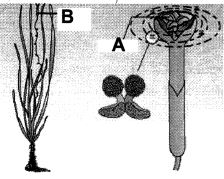
A
$A$ - Stigma,$B$ - Male flower
B
$A$ - Stigma,$B$ - Female flower
C
$A$ - Stigma,$B$ - Male flower
D
$A$ - Stigma,$B$ - Female flower
Solution
(A) The provided diagram illustrates the process of pollination in a submerged aquatic plant,specifically *Hydrilla* or *Vallisneria*.
In this diagram,$A$ points to the stigma of the female flower,which is adapted to receive pollen grains floating on the water surface.
$B$ points to the male flower,which is released from the plant and floats on the surface of the water to reach the female flower.
Therefore,$A$ represents the stigma and $B$ represents the male flower.
In this diagram,$A$ points to the stigma of the female flower,which is adapted to receive pollen grains floating on the water surface.
$B$ points to the male flower,which is released from the plant and floats on the surface of the water to reach the female flower.
Therefore,$A$ represents the stigma and $B$ represents the male flower.
0 likes
View Solution89
MediumMCQ
Identify the correct statement regarding the structure shown in the image:
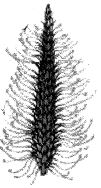
A
Fertilization occurs in it.
B
It attracts insects.
C
Pollination occurs due to it (wind).
D
It is a plant canopy.
Solution
(C) The image shows a wind-pollinated inflorescence (likely a grass spikelet).
In wind-pollinated plants,the flowers are small,inconspicuous,and lack nectar or bright colors to attract insects.
The feathery stigmas are adapted to trap pollen grains carried by the wind.
Therefore,pollination occurs due to wind (an abiotic agent) in such structures.
In wind-pollinated plants,the flowers are small,inconspicuous,and lack nectar or bright colors to attract insects.
The feathery stigmas are adapted to trap pollen grains carried by the wind.
Therefore,pollination occurs due to wind (an abiotic agent) in such structures.
0 likes
View Solution90
MediumMCQ
Which of the following are the dominant biotic pollinating agents?
A
Rodents
B
Bees
C
Bats
D
None
Solution
(B) Among the various biotic agents of pollination,insects are the most dominant.
Specifically,bees are the most important and dominant biotic pollinating agents in nature.
They are responsible for the pollination of a vast majority of flowering plants,including many agricultural crops.
Specifically,bees are the most important and dominant biotic pollinating agents in nature.
They are responsible for the pollination of a vast majority of flowering plants,including many agricultural crops.
0 likes
View Solution91
EasyMCQ
Identify the wind-pollinated plant.
A
Grass
B
Hydrilla
C
Vallisneria
D
Bryophytes
Solution
(A) Wind pollination,also known as anemophily,is a common mode of pollination in grasses.
$1$. Grasses are typically wind-pollinated,where light and non-sticky pollen grains are produced in large quantities to be carried by wind currents.
$2$. $Hydrilla$ and $Vallisneria$ are examples of water-pollinated (hydrophily) plants.
$3$. $Bryophytes$ are non-vascular land plants that do not produce flowers or seeds,and thus do not undergo pollination in the same sense as angiosperms.
$1$. Grasses are typically wind-pollinated,where light and non-sticky pollen grains are produced in large quantities to be carried by wind currents.
$2$. $Hydrilla$ and $Vallisneria$ are examples of water-pollinated (hydrophily) plants.
$3$. $Bryophytes$ are non-vascular land plants that do not produce flowers or seeds,and thus do not undergo pollination in the same sense as angiosperms.
0 likes
View Solution92
MediumMCQ
Transfer of pollen grains from the anther to the stigma of the same flower. Which kind of pollination is it?
A
Autogamy
B
Geitonogamy
C
Xenogamy
D
Cross pollination
Solution
(A) Pollination is the transfer of pollen grains from the anther to the stigma of a flower.
When the transfer of pollen grains occurs from the anther to the stigma of the same flower,it is known as $Autogamy$ (self-pollination).
$Geitonogamy$ involves the transfer of pollen grains from the anther to the stigma of another flower on the same plant.
$Xenogamy$ involves the transfer of pollen grains from the anther to the stigma of a different plant.
Therefore,the correct answer is $Autogamy$.
When the transfer of pollen grains occurs from the anther to the stigma of the same flower,it is known as $Autogamy$ (self-pollination).
$Geitonogamy$ involves the transfer of pollen grains from the anther to the stigma of another flower on the same plant.
$Xenogamy$ involves the transfer of pollen grains from the anther to the stigma of a different plant.
Therefore,the correct answer is $Autogamy$.
0 likes
View Solution93
MediumMCQ
Which is functionally cross-pollination involving a pollination agent,but genetically it is similar to autogamy?
A
Autogamy
B
Geitonogamy
C
Xenogamy
D
$A, B, C$ all
Solution
(B) Geitonogamy is the transfer of pollen grains from the anther to the stigma of another flower of the same plant.
Functionally,it involves a pollinating agent (like insects or wind),similar to cross-pollination (Xenogamy).
However,genetically,since the pollen grains come from the same plant,the offspring are genetically identical to the parent,which is similar to autogamy (self-pollination).
Functionally,it involves a pollinating agent (like insects or wind),similar to cross-pollination (Xenogamy).
However,genetically,since the pollen grains come from the same plant,the offspring are genetically identical to the parent,which is similar to autogamy (self-pollination).
0 likes
View Solution94
MediumMCQ
This is the only type of pollination which,during pollination,brings genetically different types of pollen grains to the stigma.
A
Geitonogamy
B
Xenogamy
C
$A$ and $B$ both
D
Autogamy
Solution
(B) Pollination is the transfer of pollen grains from the anther to the stigma of a flower.
$1$. Autogamy is the transfer of pollen grains from the anther to the stigma of the same flower,resulting in genetically identical offspring.
$2$. Geitonogamy is the transfer of pollen grains from the anther to the stigma of another flower on the same plant. Genetically,it is similar to autogamy because the pollen comes from the same plant.
$3$. Xenogamy is the transfer of pollen grains from the anther to the stigma of a different plant. This brings genetically different types of pollen grains to the stigma,leading to cross-pollination and genetic variation.
Therefore,Xenogamy is the only type of pollination among the options that brings genetically different pollen grains to the stigma.
$1$. Autogamy is the transfer of pollen grains from the anther to the stigma of the same flower,resulting in genetically identical offspring.
$2$. Geitonogamy is the transfer of pollen grains from the anther to the stigma of another flower on the same plant. Genetically,it is similar to autogamy because the pollen comes from the same plant.
$3$. Xenogamy is the transfer of pollen grains from the anther to the stigma of a different plant. This brings genetically different types of pollen grains to the stigma,leading to cross-pollination and genetic variation.
Therefore,Xenogamy is the only type of pollination among the options that brings genetically different pollen grains to the stigma.
0 likes
View Solution95
MediumMCQ
Choose the correct sentences regarding pollination.
$(I)$ Majority of flowering plants use a range of animals as pollinating agents.
$(II)$ Among the animals,insects,particularly bees,are the dominant biotic pollinating agents.
$(III)$ Majority of insect-pollinated flowers are large,colourful,fragrant,and rich in nectar.
$(IV)$ The body of the animal gets a coating of pollen grains,which are generally sticky in animal-pollinated flowers.
$(I)$ Majority of flowering plants use a range of animals as pollinating agents.
$(II)$ Among the animals,insects,particularly bees,are the dominant biotic pollinating agents.
$(III)$ Majority of insect-pollinated flowers are large,colourful,fragrant,and rich in nectar.
$(IV)$ The body of the animal gets a coating of pollen grains,which are generally sticky in animal-pollinated flowers.
A
Only $I$ and $II$
B
Only $III$ and $IV$
C
Only $I$ and $IV$
D
Only $II$ and $III$
Solution
(C) Statement $(I)$ is correct: Most flowering plants rely on various animals for pollination.
Statement $(II)$ is incorrect: While insects are the dominant biotic pollinators,bees are the most common,not flies.
Statement $(III)$ is incorrect: Insect-pollinated flowers are typically large,colourful,fragrant,and nectar-rich to attract pollinators,not small and less colourful.
Statement $(IV)$ is correct: Pollen grains in animal-pollinated flowers are generally sticky,allowing them to adhere to the animal's body.
Therefore,statements $(I)$ and $(IV)$ are correct.
Statement $(II)$ is incorrect: While insects are the dominant biotic pollinators,bees are the most common,not flies.
Statement $(III)$ is incorrect: Insect-pollinated flowers are typically large,colourful,fragrant,and nectar-rich to attract pollinators,not small and less colourful.
Statement $(IV)$ is correct: Pollen grains in animal-pollinated flowers are generally sticky,allowing them to adhere to the animal's body.
Therefore,statements $(I)$ and $(IV)$ are correct.
0 likes
View Solution96
MediumMCQ
Which is an incorrect statement for wind-pollinated plants?
A
They often possess well-exposed stamens so that the pollens are easily dispersed into wind currents.
B
Large,often feathery stigma to easily trap air-borne pollen grains.
C
Pollen grains are light and sticky.
D
Wind pollination is quite common in grasses.
Solution
(C) Wind-pollinated plants (anemophilous plants) exhibit specific adaptations for efficient pollination.
$1$. Pollen grains must be light and non-sticky so that they can be easily transported by wind currents.
$2$. Option $C$ states that pollen grains are light and sticky,which is incorrect because sticky pollen is a characteristic of insect-pollinated plants (entomophilous),not wind-pollinated ones.
$3$. Wind-pollinated plants have well-exposed stamens $(A)$,large feathery stigmas to trap pollen $(B)$,and this method is very common in grasses $(D)$.
$1$. Pollen grains must be light and non-sticky so that they can be easily transported by wind currents.
$2$. Option $C$ states that pollen grains are light and sticky,which is incorrect because sticky pollen is a characteristic of insect-pollinated plants (entomophilous),not wind-pollinated ones.
$3$. Wind-pollinated plants have well-exposed stamens $(A)$,large feathery stigmas to trap pollen $(B)$,and this method is very common in grasses $(D)$.
0 likes
View Solution97
EasyMCQ
Which of the following is the most dominant pollinator for pollination in flowering plants?
A
Butterfly
B
Sunbird
C
Wasps
D
Honey bees
Solution
(D) In the context of biotic pollination,insects are the most common pollinating agents. Among all the biotic agents,bees (specifically honey bees) are considered the most dominant pollinators. They visit a wide variety of flowers to collect nectar and pollen,facilitating cross-pollination effectively.
0 likes
View Solution98
MediumMCQ
In figs,pollination is done only by ...............,not by any other organism.
A
Bees
B
Red butterfly
C
Wasp
D
Water
Solution
(C) Pollination in fig species is a classic example of mutualism (co-evolution). The fig tree is pollinated only by its specific species of wasp (Agaonidae family). The wasp uses the fig fruit as an oviposition site (to lay eggs) and in the process of entering the syconium (fig inflorescence),it transfers pollen grains,thereby ensuring pollination. This is an obligate relationship where neither the fig nor the wasp can complete their life cycle without the other.
0 likes
View Solution99
MediumMCQ
Which of the following is dispersed during the process of pollination?
A
Flower
B
Ovary
C
Ovule
D
Pollen grain
Solution
(D) Pollination is defined as the transfer of pollen grains from the anther to the stigma of a pistil.
During this process,the pollen grains are released from the anther and dispersed by various agents like wind,water,or animals to reach the stigma.
Therefore,pollen grains are the structures that are dispersed during pollination.
During this process,the pollen grains are released from the anther and dispersed by various agents like wind,water,or animals to reach the stigma.
Therefore,pollen grains are the structures that are dispersed during pollination.
0 likes
View Solution100
MediumMCQ
Pollination occurs in ...........
A
Bryophytes and Angiosperms
B
Pteridophytes and Angiosperms
C
Angiosperms and Gymnosperms
D
Angiosperms and Fungi
Solution
(C) Pollination is the process of transfer of pollen grains from the anther to the stigma of a pistil. This process is a characteristic feature of seed-bearing plants that produce pollen. Both $Angiosperms$ (flowering plants) and $Gymnosperms$ (naked-seed plants) produce pollen grains and undergo pollination to facilitate fertilization. Therefore,pollination occurs in $Angiosperms$ and $Gymnosperms$.
0 likes
View SolutionSexual Reproduction in Flowering Plants — Pollination · Frequently Asked Questions
1Are these Sexual Reproduction in Flowering Plants questions useful for JEE and NEET?
Yes. All questions in this section are mapped to JEE Main and NEET exam patterns. Previous year questions from JEE Main, NEET, GUJCET and state-level exams are included with full solutions.
2Can I switch to Hindi or Gujarati for these questions?
Yes. Use the language tabs in the hero section or the sidebar to view the same questions and solutions in English, Hindi or Gujarati.
3How do I generate a question paper from this subtopic?
Use the Vedclass Exam Paper Generator — select the chapter and subtopic, set difficulty, and generate Sets A, B, C, D automatically. First 3 chapters of every subject are free.
Vedclass Products
For Students
Vedclass Test Series
Mock tests in real JEE/NEET style with performance analysis. 5-day free trial.
Start Free TrialFor Teachers
Exam Paper Generator
Generate Set A/B/C/D papers from this chapter in 2 minutes. 3 chapters free.
Try FreeFor Institutes
Online Exam Module
Live online exams with unlimited students, 360° analytics & white-label branding.
See DemoFor Teachers & Institutes
Generate a Sexual Reproduction in Flowering Plants Exam Paper in 2 Minutes
Select subtopic & difficulty — Sets A, B, C, D auto-generated with No Repeat logic.
First 3 chapters of every subject are free — no payment required.