
A English
Pollination Questions in English
Class 12 Biology · Sexual Reproduction in Flowering Plants · Pollination
270+
Questions
English
Language
100%
With Solutions
Showing 48 of 270 questions in English
101
MediumMCQ
Which is the main pollinator in agricultural crops?
A
Butterflies
B
Flies
C
Moths
D
Bees
Solution
(D) Bees ($Apis$ species) are considered the most important and efficient pollinators for a wide variety of agricultural crops. They visit flowers to collect nectar and pollen,facilitating cross-pollination,which significantly increases crop yield and quality. While other insects like butterflies,flies,and moths also act as pollinators,bees are the primary agents in most agricultural ecosystems.
0 likes
View Solution102
MediumMCQ
Which of the following characteristics are typically observed in bird-pollinated flowers (ornithophily)?
A
Blue-colored flowers with nectar glands at the base of the petals.
B
Red and sweet-scented flowers containing nectar glands.
C
Bright red-colored flowers with a dense inflorescence.
D
White flowers that are highly fragrant.
Solution
(C) Bird-pollinated flowers,known as ornithophilous flowers,exhibit specific adaptations to attract birds.
$1$. Birds have a keen sense of color,particularly for bright colors like red,orange,and yellow.
$2$. These flowers are typically large,tubular,or funnel-shaped to accommodate the bird's beak.
$3$. They produce copious amounts of nectar to reward the pollinators.
$4$. Unlike insect-pollinated flowers,bird-pollinated flowers usually lack a strong scent,as birds have a poor sense of smell.
$5$. Therefore,bright red-colored flowers with a dense inflorescence are characteristic of bird pollination.
$1$. Birds have a keen sense of color,particularly for bright colors like red,orange,and yellow.
$2$. These flowers are typically large,tubular,or funnel-shaped to accommodate the bird's beak.
$3$. They produce copious amounts of nectar to reward the pollinators.
$4$. Unlike insect-pollinated flowers,bird-pollinated flowers usually lack a strong scent,as birds have a poor sense of smell.
$5$. Therefore,bright red-colored flowers with a dense inflorescence are characteristic of bird pollination.
0 likes
View Solution103
MediumMCQ
In which of the following is pollination by wind observed?
A
Salvia
B
Bottlebrush
C
Vallisneria
D
Coconut
Solution
(D) Pollination by wind is known as $Anemophily$.
$Salvia$ is pollinated by insects $(Entomophily)$.
$Bottlebrush$ is pollinated by birds $(Ornithophily)$.
$Vallisneria$ is pollinated by water $(Hydrophily)$.
$Coconut$ is a wind-pollinated plant where flowers are small and pollen grains are light and non-sticky to be easily carried by wind currents.
$Salvia$ is pollinated by insects $(Entomophily)$.
$Bottlebrush$ is pollinated by birds $(Ornithophily)$.
$Vallisneria$ is pollinated by water $(Hydrophily)$.
$Coconut$ is a wind-pollinated plant where flowers are small and pollen grains are light and non-sticky to be easily carried by wind currents.
0 likes
View Solution104
MediumMCQ
Wind-pollinated flowers are .......
A
Small,brightly colored,and produce a large number of pollen grains.
B
Small,and produce a large number of dry pollen grains.
C
Large,produce a large number of pollen grains and abundant nectar.
D
Small,and produce nectar and pollen grains.
Solution
(B) Wind-pollinated flowers (anemophilous flowers) exhibit specific adaptations to facilitate pollination by wind.
$1$. They are typically small and inconspicuous,as they do not need to attract pollinators with bright colors or nectar.
$2$. They produce a very large number of pollen grains to compensate for the high wastage during wind dispersal.
$3$. The pollen grains are light and non-sticky (dry) so that they can be easily transported by wind currents.
$4$. Therefore,the correct description is that they are small and produce a large number of dry pollen grains.
$1$. They are typically small and inconspicuous,as they do not need to attract pollinators with bright colors or nectar.
$2$. They produce a very large number of pollen grains to compensate for the high wastage during wind dispersal.
$3$. The pollen grains are light and non-sticky (dry) so that they can be easily transported by wind currents.
$4$. Therefore,the correct description is that they are small and produce a large number of dry pollen grains.
0 likes
View Solution105
EasyMCQ
In which of the following does autogamy occur?
A
Xenogamy
B
Chasmogamy
C
Cleistogamy
D
Geitonogamy
Solution
(C) Autogamy is a type of self-pollination where pollen grains are transferred from the anther to the stigma of the same flower.
Cleistogamous flowers are flowers that do not open at all.
In such flowers,the anthers and stigmas lie close to each other.
When anthers dehisce in the flower buds,pollen grains come in contact with the stigma to effect pollination.
Thus,cleistogamy ensures autogamy.
Cleistogamous flowers are flowers that do not open at all.
In such flowers,the anthers and stigmas lie close to each other.
When anthers dehisce in the flower buds,pollen grains come in contact with the stigma to effect pollination.
Thus,cleistogamy ensures autogamy.
0 likes
View Solution106
EasyMCQ
In which of the following is wind pollination common?
A
Lotus
B
Grasses
C
Orchids
D
Legumes
Solution
(B) Wind pollination,also known as $Anemophily$,is a common mode of pollination in many flowering plants.
In grasses,the flowers are small,inconspicuous,and produce a large amount of lightweight,non-sticky pollen grains that are easily carried by the wind.
Additionally,the stigmas are often feathery to trap the pollen grains floating in the air.
Lotus is typically pollinated by insects,while orchids and legumes also rely primarily on biotic agents like insects for pollination.
In grasses,the flowers are small,inconspicuous,and produce a large amount of lightweight,non-sticky pollen grains that are easily carried by the wind.
Additionally,the stigmas are often feathery to trap the pollen grains floating in the air.
Lotus is typically pollinated by insects,while orchids and legumes also rely primarily on biotic agents like insects for pollination.
0 likes
View Solution107
MediumMCQ
In which of the following plants does seed formation occur even in the absence of pollinators?
A
Commelina
B
Zostera
C
Salvia
D
Ficus
Solution
(A) The correct answer is $Commelina$.
$Commelina$ produces two types of flowers: chasmogamous flowers (which are open) and cleistogamous flowers (which remain closed).
Cleistogamous flowers do not open at all,and the anthers and stigma lie very close to each other.
When anthers dehisce in the flower buds,pollen grains come in contact with the stigma to effect pollination.
Thus,cleistogamous flowers are invariably autogamous as there is no chance of cross-pollination landing on the stigma.
These flowers produce assured seed-set even in the absence of pollinators.
$Commelina$ produces two types of flowers: chasmogamous flowers (which are open) and cleistogamous flowers (which remain closed).
Cleistogamous flowers do not open at all,and the anthers and stigma lie very close to each other.
When anthers dehisce in the flower buds,pollen grains come in contact with the stigma to effect pollination.
Thus,cleistogamous flowers are invariably autogamous as there is no chance of cross-pollination landing on the stigma.
These flowers produce assured seed-set even in the absence of pollinators.
0 likes
View Solution108
EasyMCQ
What is the advantage of cleistogamy?
A
Higher genetic variability
B
Production of a large number of offspring
C
No dependence on pollinators
D
Vivipary
Solution
(C) Cleistogamy is a condition in which flowers do not open at all.
In such flowers,the anthers and stigma lie close to each other.
When anthers dehisce in the flower buds,pollen grains come in contact with the stigma to effect pollination.
Thus,cleistogamous flowers are invariably autogamous as there is no chance of cross-pollination.
The primary advantage of this mechanism is that it ensures seed set even in the absence of pollinators.
In such flowers,the anthers and stigma lie close to each other.
When anthers dehisce in the flower buds,pollen grains come in contact with the stigma to effect pollination.
Thus,cleistogamous flowers are invariably autogamous as there is no chance of cross-pollination.
The primary advantage of this mechanism is that it ensures seed set even in the absence of pollinators.
0 likes
View Solution109
MediumMCQ
Geitonogamy involves:
A
Fertilization of a flower of the same plant by pollen grains.
B
Fertilization of the same flower by pollen grains.
C
Fertilization of a flower by pollen grains from another flower of the same species.
D
Fertilization of a flower by pollen grains from a flower of a different species.
Solution
(A) Geitonogamy is a type of pollination where pollen grains from the anther of one flower are transferred to the stigma of another flower borne on the same plant.
Although it is functionally cross-pollination involving a pollinating agent,genetically it is similar to self-pollination because the pollen grains come from the same plant.
Although it is functionally cross-pollination involving a pollinating agent,genetically it is similar to self-pollination because the pollen grains come from the same plant.
0 likes
View Solution110
MediumMCQ
In water hyacinth $(Eichhornia)$ and water lily,pollination occurs by which of the following agents?
A
Water
B
Insects and wind
C
Birds
D
Bats
Solution
(B) In many aquatic plants like water hyacinth $(Eichhornia)$ and water lily,the flowers emerge above the level of water.
These flowers are pollinated by insects or wind,similar to most of the land plants.
Even though these plants are aquatic,they do not utilize water as a medium for pollination because their flowers are raised above the water surface.
These flowers are pollinated by insects or wind,similar to most of the land plants.
Even though these plants are aquatic,they do not utilize water as a medium for pollination because their flowers are raised above the water surface.
0 likes
View Solution111
MediumMCQ
Attractants and rewards are required for ............ .
A
Anemophily (Wind pollination)
B
Entomophily (Insect pollination)
C
Hydrophily (Water pollination)
D
Cleistogamy
Solution
(B) In plants,biotic agents like insects,birds,and bats are attracted to flowers by specific features such as bright colors,fragrance,and nectar (rewards). This process is known as entomophily or biotic pollination. Wind (anemophily) and water (hydrophily) pollinated flowers do not require such attractants or rewards as they rely on physical forces for pollen transfer. Cleistogamous flowers are closed and do not require pollinators at all. Therefore,attractants and rewards are essential for insect pollination.
0 likes
View Solution112
MediumMCQ
Which one of the following plants shows a very close relationship with a species of moth,where none of the two can complete its life cycle without the other?
A
$Yucca$
B
$Hydrilla$
C
$Banana$
D
$Viola$
Solution
(A) The plant $Yucca$ exhibits a mutualistic relationship with a specific species of moth $(Tegeticula)$.
In this relationship,the moth deposits its eggs in the locule of the ovary of the $Yucca$ flower.
In exchange,the moth pollinates the $Yucca$ flower while moving around it.
The larvae of the moth hatch from the eggs as the seeds develop.
Neither the $Yucca$ plant nor the moth can complete their life cycles without each other,making this an obligate mutualism.
In this relationship,the moth deposits its eggs in the locule of the ovary of the $Yucca$ flower.
In exchange,the moth pollinates the $Yucca$ flower while moving around it.
The larvae of the moth hatch from the eggs as the seeds develop.
Neither the $Yucca$ plant nor the moth can complete their life cycles without each other,making this an obligate mutualism.
0 likes
View Solution113
MediumMCQ
Plants of which one of the following groups of genera are pollinated by the same agency?
A
$Triticum$,$Cocos$,$Mangifera$
B
$Ficus$,$Kigelia$,$Casuarina$
C
$Salvia$,$Morus$,$Euphorbia$
D
$Bombax$,$Butea$,$Bauhinia$
Solution
(C) Pollination is the transfer of pollen grains from the anther to the stigma of a flower. Different plants use different agencies for pollination.
$1$. $Triticum$ (wheat) is pollinated by wind (anemophily),$Cocos$ (coconut) by wind or insects,and $Mangifera$ (mango) by insects.
$2$. $Ficus$ is pollinated by wasps,$Kigelia$ by bats,and $Casuarina$ by wind.
$3$. $Salvia$,$Morus$,and $Euphorbia$ are all pollinated by insects (entomophily).
$4$. $Bombax$,$Butea$,and $Bauhinia$ are primarily pollinated by birds (ornithophily).
Therefore,the correct group is $Salvia$,$Morus$,and $Euphorbia$.
$1$. $Triticum$ (wheat) is pollinated by wind (anemophily),$Cocos$ (coconut) by wind or insects,and $Mangifera$ (mango) by insects.
$2$. $Ficus$ is pollinated by wasps,$Kigelia$ by bats,and $Casuarina$ by wind.
$3$. $Salvia$,$Morus$,and $Euphorbia$ are all pollinated by insects (entomophily).
$4$. $Bombax$,$Butea$,and $Bauhinia$ are primarily pollinated by birds (ornithophily).
Therefore,the correct group is $Salvia$,$Morus$,and $Euphorbia$.
0 likes
View Solution114
MediumMCQ
Geitonogamy involves
A
fertilization of a flower by the pollen from another flower of the same plant
B
fertilization of a flower by the pollen from the same flower
C
fertilization of a flower by the pollen from a flower of another plant in the same population
D
fertilization of a flower by the pollen from a flower of another plant belonging to a distant population
Solution
(A) Geitonogamy is a type of pollination where pollen grains are transferred from the anther of one flower to the stigma of another flower on the same plant. Although it is functionally cross-pollination involving a pollinating agent,genetically it is similar to self-pollination because the pollen grains come from the same plant.
0 likes
View Solution115
MediumMCQ
Assertion : Insects visit flowers to gather honey.
Reason : Attraction of flowers prevents the insects from damaging other parts of the plant.
Reason : Attraction of flowers prevents the insects from damaging other parts of the plant.
A
If both Assertion and Reason are correct and the Reason is a correct explanation of the Assertion.
B
If both Assertion and Reason are correct but Reason is not a correct explanation of the Assertion.
C
If the Assertion is correct but Reason is incorrect.
D
If both the Assertion and Reason are incorrect.
Solution
(D) The Assertion is incorrect because insects visit flowers primarily to collect nectar,which they later process into honey,and pollen. They do not visit flowers specifically to 'gather honey' as it is a product they make themselves.
The Reason is also incorrect because the primary evolutionary purpose of floral attraction (color,scent,nectar) is to facilitate pollination by attracting pollinators,not to prevent damage to other plant parts.
The Reason is also incorrect because the primary evolutionary purpose of floral attraction (color,scent,nectar) is to facilitate pollination by attracting pollinators,not to prevent damage to other plant parts.
0 likes
View Solution116
DifficultMCQ
Assertion: $Chasmogamous$ flowers require pollinating agents.
Reason: $Cleistogamous$ flowers do not expose their sex organs.
Reason: $Cleistogamous$ flowers do not expose their sex organs.
A
If both Assertion and Reason are correct and the Reason is a correct explanation of the Assertion.
B
If both Assertion and Reason are correct but Reason is not a correct explanation of the Assertion.
C
If the Assertion is correct but Reason is incorrect.
D
If both the Assertion and Reason are incorrect.
Solution
(A) The majority of angiosperms bear $Chasmogamous$ flowers,which means the flowers expose their mature anthers and stigma to the pollinating agents. Therefore,they require external agents for pollination.
$Cleistogamous$ flowers are those that do not open at all,meaning their anthers and stigma lie close to each other. When anthers dehisce in the closed flower buds,pollen grains come in contact with the stigma to effect pollination. Thus,they do not expose their sex organs and do not require pollinating agents.
Since both statements are correct and the reason explains why $Chasmogamous$ flowers (which do expose their sex organs) require agents while $Cleistogamous$ flowers do not,the correct option is $A$.
$Cleistogamous$ flowers are those that do not open at all,meaning their anthers and stigma lie close to each other. When anthers dehisce in the closed flower buds,pollen grains come in contact with the stigma to effect pollination. Thus,they do not expose their sex organs and do not require pollinating agents.
Since both statements are correct and the reason explains why $Chasmogamous$ flowers (which do expose their sex organs) require agents while $Cleistogamous$ flowers do not,the correct option is $A$.
0 likes
View Solution117
MediumMCQ
Most of the desert plants bloom during night time because
A
their blooming is controlled by low temperature
B
they are sensitive to the phases of moon
C
the desert insects eat away flowers during day time
D
the desert insects are active during night time.
Solution
(D) In desert conditions,most of the activity of plants and animals occurs during the night due to the extremely high temperatures during the day.
As a result,desert insects are active and pollinate flowers at night.
To attract these nocturnal pollinators,most desert plants bloom during the night.
As a result,desert insects are active and pollinate flowers at night.
To attract these nocturnal pollinators,most desert plants bloom during the night.
0 likes
View Solution118
MediumMCQ
What type of pollination takes place in $Vallisneria$?
A
Pollination occurs in submerged condition by water.
B
Flowers emerge above surface of water,and pollination occurs by insects.
C
Flowers emerge above water surface,and pollen is carried by wind.
D
Male flowers are carried by water currents to female flowers at surface of water.
Solution
(D) In $Vallisneria$,the female flower reaches the surface of the water by a long,coiled stalk.
The male flowers or pollen grains are released on to the surface of the water.
They are carried passively by water currents to reach the female flowers at the surface of the water.
This is a specialized mechanism of hydrophily.
The male flowers or pollen grains are released on to the surface of the water.
They are carried passively by water currents to reach the female flowers at the surface of the water.
This is a specialized mechanism of hydrophily.
0 likes
View Solution119
Easy
What are chasmogamous flowers? Can cross-pollination occur in cleistogamous flowers? Give reasons for your answer.
Solution
(N/A) Chasmogamous flowers are those flowers which have exposed anthers and stigmata,similar to the flowers of other species,allowing for both self-pollination and cross-pollination.
Cross-pollination cannot occur in cleistogamous flowers.
Reasons:
$1$. Cleistogamous flowers never open at all,meaning the reproductive parts remain enclosed within the flower bud.
$2$. In these flowers,the anthers and stigmata lie very close to each other.
$3$. Due to these structural constraints,only self-pollination (autogamy) is possible,and there is no chance of cross-pollination.
Cross-pollination cannot occur in cleistogamous flowers.
Reasons:
$1$. Cleistogamous flowers never open at all,meaning the reproductive parts remain enclosed within the flower bud.
$2$. In these flowers,the anthers and stigmata lie very close to each other.
$3$. Due to these structural constraints,only self-pollination (autogamy) is possible,and there is no chance of cross-pollination.
0 likes
View Solution120
Medium
What is pollination? Describe its types.
Solution
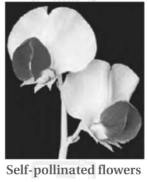
(N/A) Pollination is the mechanism by which pollen grains,shed from the anther,are transferred to the stigma of a pistil. Since male and female gametes in flowering plants are non-motile,they must be brought together for fertilisation to occur.
Depending on the source of pollen,pollination is divided into three types:
$(1)$ Autogamy: In this type,pollination is achieved within the same flower. Pollen grains are transferred from the anther to the stigma of the same flower. This requires synchrony in pollen release and stigma receptivity,and the anthers and stigma must lie close to each other. It is common in bisexual flowers.
$(2)$ Geitonogamy: This involves the transfer of pollen grains from the anther to the stigma of another flower of the same plant. Although it is functionally cross-pollination involving a pollinating agent,genetically it is similar to autogamy since the pollen grains come from the same plant.
$(3)$ Xenogamy: This involves the transfer of pollen grains from the anther to the stigma of a different plant. This is the only type of pollination which brings genetically different types of pollen grains to the stigma during pollination.
Depending on the source of pollen,pollination is divided into three types:
$(1)$ Autogamy: In this type,pollination is achieved within the same flower. Pollen grains are transferred from the anther to the stigma of the same flower. This requires synchrony in pollen release and stigma receptivity,and the anthers and stigma must lie close to each other. It is common in bisexual flowers.
$(2)$ Geitonogamy: This involves the transfer of pollen grains from the anther to the stigma of another flower of the same plant. Although it is functionally cross-pollination involving a pollinating agent,genetically it is similar to autogamy since the pollen grains come from the same plant.
$(3)$ Xenogamy: This involves the transfer of pollen grains from the anther to the stigma of a different plant. This is the only type of pollination which brings genetically different types of pollen grains to the stigma during pollination.
0 likes
View Solution121
Medium
Mention the agents of pollination and explain pollination by wind.
Solution
(N/A) Plants use two abiotic (wind and water) and one biotic (animals) agents to achieve pollination. The majority of plants use biotic agents for pollination.
Only a small proportion of plants use abiotic agents. Pollen grains coming in contact with the stigma is a chance factor in both wind and water pollination. To compensate for the uncertainties and associated loss of pollen grains,the flowers produce an enormous amount of pollen when compared to the number of ovules available for pollination. Each type of plant possesses specific characteristics as per its agent of pollination.
Pollination by wind (Anemophily): Pollination by wind is more common amongst abiotic pollinations.
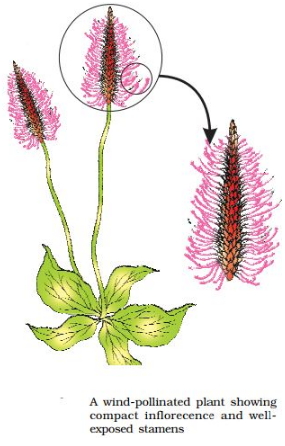
Wind pollination requires that the pollen grains are light and non-sticky so that they can be transported in wind currents.
They often possess well-exposed stamens and large,often feathery stigmas to easily trap air-borne pollen grains.
Wind-pollinated flowers often have a single ovule in each ovary and numerous flowers packed into an inflorescence; a familiar example is the corn cob. The tassels we see are nothing but the stigma and style which wave in the wind to trap pollen grains. Wind pollination is quite common in grasses.
Only a small proportion of plants use abiotic agents. Pollen grains coming in contact with the stigma is a chance factor in both wind and water pollination. To compensate for the uncertainties and associated loss of pollen grains,the flowers produce an enormous amount of pollen when compared to the number of ovules available for pollination. Each type of plant possesses specific characteristics as per its agent of pollination.
Pollination by wind (Anemophily): Pollination by wind is more common amongst abiotic pollinations.
Wind pollination requires that the pollen grains are light and non-sticky so that they can be transported in wind currents.
They often possess well-exposed stamens and large,often feathery stigmas to easily trap air-borne pollen grains.
Wind-pollinated flowers often have a single ovule in each ovary and numerous flowers packed into an inflorescence; a familiar example is the corn cob. The tassels we see are nothing but the stigma and style which wave in the wind to trap pollen grains. Wind pollination is quite common in grasses.
0 likes
View Solution122
Medium
Write a note on the characteristics of plants pollinated by water.
Solution
(N/A) Pollination by water is quite rare in flowering plants,as most aquatic plants rely on insects or wind for pollination.
Key characteristics and mechanisms include:
$1$. Rare occurrence: Water pollination is limited to about $30$ genera,mostly monocotyledons.
$2$. Examples: Includes freshwater plants like $Vallisneria$ and $Hydrilla$,and marine seagrasses like $Zostera$.
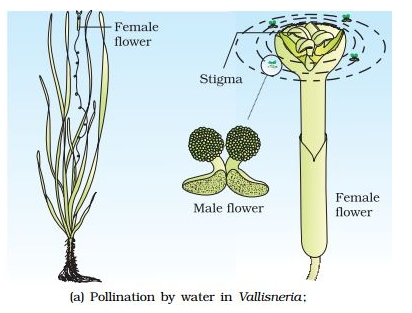
$3$. Surface pollination: In $Vallisneria$,the female flower reaches the water surface via a long,coiled stalk. Male flowers or pollen grains are released onto the water surface and carried passively by water currents to reach the female flower's stigma.
$4$. Submerged pollination: In seagrasses,flowers remain submerged. Pollen grains are long and ribbon-like,allowing them to be carried passively within the water to reach the stigma.
$5$. Protection: In most water-pollinated species,pollen grains are protected from wetting by a mucilaginous covering.
$6$. Floral traits: Flowers pollinated by water (like those pollinated by wind) are generally not very colourful and do not produce nectar.
Key characteristics and mechanisms include:
$1$. Rare occurrence: Water pollination is limited to about $30$ genera,mostly monocotyledons.
$2$. Examples: Includes freshwater plants like $Vallisneria$ and $Hydrilla$,and marine seagrasses like $Zostera$.
$3$. Surface pollination: In $Vallisneria$,the female flower reaches the water surface via a long,coiled stalk. Male flowers or pollen grains are released onto the water surface and carried passively by water currents to reach the female flower's stigma.
$4$. Submerged pollination: In seagrasses,flowers remain submerged. Pollen grains are long and ribbon-like,allowing them to be carried passively within the water to reach the stigma.
$5$. Protection: In most water-pollinated species,pollen grains are protected from wetting by a mucilaginous covering.
$6$. Floral traits: Flowers pollinated by water (like those pollinated by wind) are generally not very colourful and do not produce nectar.
0 likes
View Solution123
Medium
Explain pollination by animals with examples in detail.
Solution
(N/A) Some animals are also responsible for pollination.
Bees,butterflies,flies,beetles,wasps,ants,moths,birds (sunbirds and hummingbirds),and bats are the common pollinating agents.
Among the animals,insects,particularly bees,are the dominant biotic pollinating agents. Even larger animals such as some primates (lemurs),arboreal (tree-dwelling) rodents,or even reptiles (gecko lizard and garden lizard) have also been reported as pollinators in some species.
Often,flowers of animal-pollinated plants are specifically adapted for a particular species of animal.
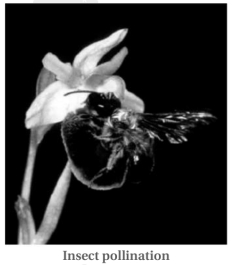
Majority of insect-pollinated flowers are large,colourful,fragrant,and rich in nectar.
When the flowers are small,a number of flowers are clustered into an inflorescence to make them conspicuous. Animals are attracted to flowers by colour and/or fragrance.
Flowers pollinated by flies and beetles secrete foul odours to attract these animals.
To sustain animal visits,the flowers have to provide rewards to the animals. Nectar and pollen grains are the usual floral rewards to the animals. For harvesting the rewards from the flower,the animal visitor comes in contact with the anthers and the stigma. The body of the animal gets a coating of pollen grains.
The pollen grains of flowers pollinated by animals are generally sticky. When the animal carrying pollen on its body comes in contact with the stigma,it brings about pollination.
Bees,butterflies,flies,beetles,wasps,ants,moths,birds (sunbirds and hummingbirds),and bats are the common pollinating agents.
Among the animals,insects,particularly bees,are the dominant biotic pollinating agents. Even larger animals such as some primates (lemurs),arboreal (tree-dwelling) rodents,or even reptiles (gecko lizard and garden lizard) have also been reported as pollinators in some species.
Often,flowers of animal-pollinated plants are specifically adapted for a particular species of animal.
Majority of insect-pollinated flowers are large,colourful,fragrant,and rich in nectar.
When the flowers are small,a number of flowers are clustered into an inflorescence to make them conspicuous. Animals are attracted to flowers by colour and/or fragrance.
Flowers pollinated by flies and beetles secrete foul odours to attract these animals.
To sustain animal visits,the flowers have to provide rewards to the animals. Nectar and pollen grains are the usual floral rewards to the animals. For harvesting the rewards from the flower,the animal visitor comes in contact with the anthers and the stigma. The body of the animal gets a coating of pollen grains.
The pollen grains of flowers pollinated by animals are generally sticky. When the animal carrying pollen on its body comes in contact with the stigma,it brings about pollination.
0 likes
View Solution124
Medium
Define the following terms:
$(i)$ Ovule
$(ii)$ Pollination
$(i)$ Ovule
$(ii)$ Pollination
Solution
(N/A) $(i)$ In flowering plants,the megaspore mother cell differentiates from one of the cells of the nucellus. The nucellus is protected by envelopes,and this composite structure is called an ovule.
$(ii)$ Pollen grains,after dispersal from the anthers,are carried by wind or various other agencies to the stigma of a pistil. This process is termed as pollination.
$(ii)$ Pollen grains,after dispersal from the anthers,are carried by wind or various other agencies to the stigma of a pistil. This process is termed as pollination.
0 likes
View Solution125
Easy
Definitions / Explanation:
$1.$ Geitonogamy
$2.$ Coleorrhiza
$1.$ Geitonogamy
$2.$ Coleorrhiza
Solution
(N/A) $1.$ Geitonogamy: Transfer of pollen grains from the anther to the stigma of another flower of the same plant. Although geitonogamy is functionally cross-pollination involving a pollinating agent,genetically it is similar to autogamy since the pollen grains come from the same plant.
$2.$ Coleorrhiza: At its lower end,the embryonal axis has the radicle and root cap enclosed in an undifferentiated sheath called coleorrhiza.
$2.$ Coleorrhiza: At its lower end,the embryonal axis has the radicle and root cap enclosed in an undifferentiated sheath called coleorrhiza.
0 likes
View Solution126
Medium
How is pollination carried out in water plants?
Solution
(N/A) In many aquatic plants,flowers emerging above the water surface are pollinated by wind or insects.
$(b)$ In some aquatic plants,pollination occurs below the water surface,which is called $Hypohydrophily$ (e.g.,$Ceratophyllum$).
$(c)$ In other aquatic plants,if pollination occurs on the surface of the water,it is called $Epihydrophily$ (e.g.,$Vallisneria$).
$(b)$ In some aquatic plants,pollination occurs below the water surface,which is called $Hypohydrophily$ (e.g.,$Ceratophyllum$).
$(c)$ In other aquatic plants,if pollination occurs on the surface of the water,it is called $Epihydrophily$ (e.g.,$Vallisneria$).
0 likes
View Solution127
EasyMCQ
Explain the process of pollination in the Mediterranean orchid, $Ophrys$.
A
Self-pollination
B
Wind pollination
C
Sexual deceit
D
Water pollination
Solution
(C) The Mediterranean orchid, $Ophrys$, employs a strategy known as $sexual \text{ } deceit$ to ensure pollination.
One petal of the flower bears an uncanny resemblance to the female of a specific species of bee in terms of size, color, and markings.
The male bee perceives the flower as a female and attempts to copulate with it, a process known as $pseudocopulation$.
During this attempt, pollen grains from the flower get dusted on the body of the male bee.
When the same bee visits another flower of the same species and repeats this behavior, it transfers the pollen to that flower, thereby facilitating cross-pollination.
One petal of the flower bears an uncanny resemblance to the female of a specific species of bee in terms of size, color, and markings.
The male bee perceives the flower as a female and attempts to copulate with it, a process known as $pseudocopulation$.
During this attempt, pollen grains from the flower get dusted on the body of the male bee.
When the same bee visits another flower of the same species and repeats this behavior, it transfers the pollen to that flower, thereby facilitating cross-pollination.
0 likes
View Solution128
Medium
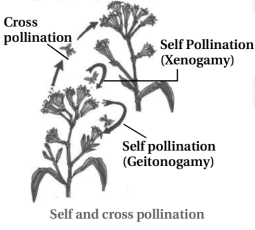
What are the possible types of pollination in chasmogamous flowers? Give reasons.
Solution
(N/A) Chasmogamous flowers are flowers which are open,exposing their anthers and stigmas. Due to this exposure,they can undergo both self-pollination and cross-pollination.
$(A)$ Self-pollination (Autogamy): In this type,pollination occurs within the same flower. Pollen grains are transferred from the anther to the stigma of the same flower. This is possible in chasmogamous flowers if the anthers and stigma mature at the same time (homogamy) or are positioned close to each other.
$(B)$ Cross-pollination (Allogamy): This involves the transfer of pollen grains from the anther of one flower to the stigma of another flower. It is of two types:
$(i)$ Geitonogamy: Transfer of pollen grains from the anther to the stigma of another flower on the same plant. Functionally,it is cross-pollination involving a pollinating agent,but genetically,it is similar to autogamy because the pollen grains come from the same plant.
$(ii)$ Xenogamy: Transfer of pollen grains from the anther of one flower to the stigma of a flower on a different plant of the same species. This is the only type of pollination that brings genetically different types of pollen grains to the stigma.
$(A)$ Self-pollination (Autogamy): In this type,pollination occurs within the same flower. Pollen grains are transferred from the anther to the stigma of the same flower. This is possible in chasmogamous flowers if the anthers and stigma mature at the same time (homogamy) or are positioned close to each other.
$(B)$ Cross-pollination (Allogamy): This involves the transfer of pollen grains from the anther of one flower to the stigma of another flower. It is of two types:
$(i)$ Geitonogamy: Transfer of pollen grains from the anther to the stigma of another flower on the same plant. Functionally,it is cross-pollination involving a pollinating agent,but genetically,it is similar to autogamy because the pollen grains come from the same plant.
$(ii)$ Xenogamy: Transfer of pollen grains from the anther of one flower to the stigma of a flower on a different plant of the same species. This is the only type of pollination that brings genetically different types of pollen grains to the stigma.
0 likes
View Solution129
Medium
Explain self-pollination in cleistogamous flowers.
Solution
(N/A) Cleistogamous flowers are those that do not open at all. In such flowers,the anthers and stigmas lie very close to each other. When anthers dehisce in the flower buds,pollen grains come in contact with the stigma to effect pollination. Thus,cleistogamous flowers produce assured seed-set even in the absence of pollinators,as there is no chance of cross-pollination.
0 likes
View Solution130
Easy
Match the columns:
| Column $I$ | Column $II$ |
| $(a)$ Anemophily | $(1)$ By water |
| $(b)$ Hydrophily | $(2)$ By wind |
| $(c)$ Zoophily | $(3)$ By insects |
| $(d)$ Entomophily | $(4)$ By animals |
Solution
(A) The correct matches are as follows:
$1$. Anemophily $(a)$ refers to pollination by wind $(2)$.
$2$. Hydrophily $(b)$ refers to pollination by water $(1)$.
$3$. Zoophily $(c)$ refers to pollination by animals $(4)$.
$4$. Entomophily $(d)$ refers to pollination by insects $(3)$.
Therefore, the correct sequence is $(a-2, b-1, c-4, d-3)$.
$1$. Anemophily $(a)$ refers to pollination by wind $(2)$.
$2$. Hydrophily $(b)$ refers to pollination by water $(1)$.
$3$. Zoophily $(c)$ refers to pollination by animals $(4)$.
$4$. Entomophily $(d)$ refers to pollination by insects $(3)$.
Therefore, the correct sequence is $(a-2, b-1, c-4, d-3)$.
0 likes
View Solution131
MediumMCQ
In water hyacinth and water lily,pollination takes place by
A
insects and water
B
Insects or wind
C
water currents only
D
wind and water
Solution
(B) In both water hyacinth and water lily,the flowers emerge above the level of water. Therefore,they are not pollinated by water. Instead,pollination is carried out by insects or wind,which is a common feature in many aquatic plants.
0 likes
View Solution132
MediumMCQ
In $Eichhornia$ (water hyacinth) and $Nymphaea$ (water lily),pollination occurs by:
A
Insects or wind
B
Water currents only
C
Wind and water
D
Insects and water
Solution
(A) In many aquatic plants such as $Eichhornia$ (water hyacinth) and $Nymphaea$ (water lily),the flowers emerge above the level of water and are pollinated by insects or wind,similar to most of the land plants. Although these plants are aquatic,they do not use water as a medium for pollination. Therefore,the correct option is $A$.
0 likes
View Solution133
MediumMCQ
During the process of pollination,pollen grains are transferred to which part of the flower?
A
Anther
B
Stigma
C
Petal
D
Sepal
Solution
(B) Pollination is defined as the transfer of pollen grains from the anther to the stigma of a pistil.
In flowering plants,the stigma acts as the landing platform for pollen grains,which is essential for the process of fertilization to occur.
In flowering plants,the stigma acts as the landing platform for pollen grains,which is essential for the process of fertilization to occur.
0 likes
View Solution134
MediumMCQ
Based on the $\underline{x}$ of pollen grains,pollination can be divided into $\underline{y}$ types.
A
$x-$source,$y-3$
B
$x-$size,$y-2$
C
$x-$structure,$y-3$
D
$x-$color,$y-2$
Solution
(A) Pollination is the process of transfer of pollen grains from the anther to the stigma of a pistil. Based on the source of pollen grains,pollination is divided into three types:
$1$. Autogamy: Transfer of pollen grains from the anther to the stigma of the same flower.
$2$. Geitonogamy: Transfer of pollen grains from the anther to the stigma of another flower of the same plant.
$3$. Xenogamy: Transfer of pollen grains from the anther to the stigma of a different plant.
Therefore,$x$ refers to the source of pollen and $y$ is $3$.
$1$. Autogamy: Transfer of pollen grains from the anther to the stigma of the same flower.
$2$. Geitonogamy: Transfer of pollen grains from the anther to the stigma of another flower of the same plant.
$3$. Xenogamy: Transfer of pollen grains from the anther to the stigma of a different plant.
Therefore,$x$ refers to the source of pollen and $y$ is $3$.
0 likes
View Solution135
MediumMCQ
In which type of pollination does the transfer of pollen grains from the anther to the stigma of the same flower occur?
A
Autogamy
B
Xenogamy
C
Geitonogamy
D
All of the above
Solution
(A) Autogamy is a type of pollination in which pollen grains are transferred from the anther to the stigma of the same flower.
This process ensures self-pollination within a single bisexual flower.
Geitonogamy involves the transfer of pollen to the stigma of another flower on the same plant.
Xenogamy involves the transfer of pollen to the stigma of a flower on a different plant.
This process ensures self-pollination within a single bisexual flower.
Geitonogamy involves the transfer of pollen to the stigma of another flower on the same plant.
Xenogamy involves the transfer of pollen to the stigma of a flower on a different plant.
0 likes
View Solution136
MediumMCQ
What is required for self-pollination (autogamy)?
A
Synchrony between pollen release and pollen tube formation
B
Anther and stigma should be placed at a distance
C
Synchrony between anther and style
D
Synchrony between pollen release and stigma receptivity
Solution
(D) For self-pollination (autogamy) to occur in flowers,it is essential that the pollen grains are released at the same time the stigma becomes receptive. This synchrony ensures that the pollen grains can land on the stigma and successfully germinate. Additionally,the anther and stigma should be placed close to each other to facilitate the transfer of pollen.
0 likes
View Solution137
MediumMCQ
Which flowers never open?
A
Chasmogamous flowers of Viola
B
Chasmogamous flowers of Abutilon
C
Rose
D
Cleistogamous flowers of Commelina
Solution
(D) Cleistogamous flowers are those that do not open at all. In such flowers,the anthers and stigma lie close to each other. When anthers dehisce in the flower buds,pollen grains come in contact with the stigma to effect pollination. Thus,cleistogamous flowers are invariably autogamous as there is no chance of cross-pollination. Examples include Commelina,Viola,and Oxalis.
0 likes
View Solution138
MediumMCQ
Which of the following is $NOT$ a characteristic of cleistogamous flowers?
A
Anthers and stigmas lie very close to each other.
B
They never open.
C
They exhibit geitonogamy.
D
They exhibit autogamy.
Solution
(C) Cleistogamous flowers are flowers that do not open at all.
Because the flowers remain closed,the anthers and stigmas are brought very close to each other,which ensures self-pollination or autogamy.
Since pollination occurs within the same flower without any external agent,geitonogamy (which involves the transfer of pollen from one flower to another on the same plant) is not possible in cleistogamous flowers.
Therefore,exhibiting geitonogamy is not a characteristic of cleistogamous flowers.
Because the flowers remain closed,the anthers and stigmas are brought very close to each other,which ensures self-pollination or autogamy.
Since pollination occurs within the same flower without any external agent,geitonogamy (which involves the transfer of pollen from one flower to another on the same plant) is not possible in cleistogamous flowers.
Therefore,exhibiting geitonogamy is not a characteristic of cleistogamous flowers.
0 likes
View Solution139
MediumMCQ
What is not required for seed formation in cleistogamous flowers?
A
Pollen grains
B
Pollinating agents
C
Pollination
D
Stigma
Solution
(B) Cleistogamous flowers are flowers that do not open at all.
In these flowers,the anthers and stigma lie very close to each other.
When anthers dehisce in the flower buds,pollen grains come in contact with the stigma to effect pollination.
Since the flowers are closed,they do not depend on external pollinating agents (like insects,wind,or water) for the transfer of pollen.
Therefore,pollinating agents are not required for seed formation in cleistogamous flowers.
In these flowers,the anthers and stigma lie very close to each other.
When anthers dehisce in the flower buds,pollen grains come in contact with the stigma to effect pollination.
Since the flowers are closed,they do not depend on external pollinating agents (like insects,wind,or water) for the transfer of pollen.
Therefore,pollinating agents are not required for seed formation in cleistogamous flowers.
0 likes
View Solution140
MediumMCQ
What type of pollination occurs in cleistogamous flowers?
A
Autogamy
B
Geitonogamy
C
Xenogamy
D
Both $A$ and $B$
Solution
(A) Cleistogamous flowers are flowers that do not open at all.
Because the flowers remain closed,the anthers and stigma lie very close to each other.
When the anthers dehisce in the closed flower,pollen grains come in contact with the stigma of the same flower,resulting in autogamy.
Since there is no chance of cross-pollination,cleistogamous flowers produce assured seed-set even in the absence of pollinators.
Because the flowers remain closed,the anthers and stigma lie very close to each other.
When the anthers dehisce in the closed flower,pollen grains come in contact with the stigma of the same flower,resulting in autogamy.
Since there is no chance of cross-pollination,cleistogamous flowers produce assured seed-set even in the absence of pollinators.
0 likes
View Solution141
MediumMCQ
Which of the following is genetically self-pollination but functionally cross-pollination?
A
Autogamy
B
Geitonogamy
C
Xenogamy
D
Both $A$ and $B$
Solution
(B) Geitonogamy is the transfer of pollen grains from the anther to the stigma of another flower of the same plant.
Since the pollen grains come from the same plant,it is genetically similar to autogamy (self-pollination).
However,since it involves a pollinating agent to transfer pollen to a different flower,it is functionally cross-pollination.
Since the pollen grains come from the same plant,it is genetically similar to autogamy (self-pollination).
However,since it involves a pollinating agent to transfer pollen to a different flower,it is functionally cross-pollination.
0 likes
View Solution142
MediumMCQ
In which of the following flowers does self-pollination not occur?
A
Bisexual flower
B
Unisexual flower
C
Cleistogamous flower
D
Flower containing both androecium and gynoecium
Solution
(B) Self-pollination is the transfer of pollen grains from the anther to the stigma of the same flower or another flower of the same plant.
Unisexual flowers are those that contain either only stamens (staminate) or only pistils (pistillate).
Because a unisexual flower lacks one of the two essential reproductive organs,it is physically impossible for self-pollination to occur within that single flower.
Bisexual flowers,cleistogamous flowers,and flowers containing both androecium and gynoecium are all capable of self-pollination.
Unisexual flowers are those that contain either only stamens (staminate) or only pistils (pistillate).
Because a unisexual flower lacks one of the two essential reproductive organs,it is physically impossible for self-pollination to occur within that single flower.
Bisexual flowers,cleistogamous flowers,and flowers containing both androecium and gynoecium are all capable of self-pollination.
0 likes
View Solution143
MediumMCQ
In which of the following types of pollination does pollen grain with different genetic makeup land on the stigma?
A
Xenogamy
B
Autogamy
C
Geitonogamy
D
Both $B$ and $C$
Solution
(A) Pollination is the transfer of pollen grains from the anther to the stigma of a flower.
$1$. Autogamy: Pollination occurs within the same flower. The pollen grains and the stigma are genetically identical.
$2$. Geitonogamy: Pollination occurs between two different flowers of the same plant. Since they belong to the same plant,the genetic makeup of the pollen grains is the same as the stigma.
$3$. Xenogamy: Pollination occurs between two different plants of the same species. The pollen grains from one plant land on the stigma of a flower on a different plant. This results in the transfer of pollen grains with different genetic makeup,leading to genetic variation in the offspring.
$1$. Autogamy: Pollination occurs within the same flower. The pollen grains and the stigma are genetically identical.
$2$. Geitonogamy: Pollination occurs between two different flowers of the same plant. Since they belong to the same plant,the genetic makeup of the pollen grains is the same as the stigma.
$3$. Xenogamy: Pollination occurs between two different plants of the same species. The pollen grains from one plant land on the stigma of a flower on a different plant. This results in the transfer of pollen grains with different genetic makeup,leading to genetic variation in the offspring.
0 likes
View Solution144
MediumMCQ
Which of the following is an abiotic pollinating agent?
A
Insects
B
Bats
C
Bees
D
Water
Solution
(D) Pollination is the transfer of pollen grains from the anther to the stigma of a flower. Agents of pollination are classified into two categories: biotic and abiotic.
Biotic agents include living organisms such as insects (entomophily),birds (ornithophily),and bats (chiropterophily).
Abiotic agents include non-living factors such as wind (anemophily) and water (hydrophily).
Among the given options,insects,bats,and bees are biotic agents,while water is an abiotic agent.
Biotic agents include living organisms such as insects (entomophily),birds (ornithophily),and bats (chiropterophily).
Abiotic agents include non-living factors such as wind (anemophily) and water (hydrophily).
Among the given options,insects,bats,and bees are biotic agents,while water is an abiotic agent.
0 likes
View Solution145
MediumMCQ
Which of the following is the most common abiotic pollinating agent in plants?
A
Water
B
Wind
C
Animals
D
Special chemicals
Solution
(B) Among all agents of pollination,biotic agents (animals) are the most common. However,among abiotic agents,wind pollination (anemophily) is much more common than water pollination (hydrophily). In the context of general pollination,biotic agents are the most dominant. If the question specifically refers to abiotic agents,wind is the most common. Given the options provided,wind is the most frequent agent of pollination among the choices listed that are commonly discussed in this context.
0 likes
View Solution146
MediumMCQ
What are the requirements for anemophily (wind pollination)?
A
Feathery stigma
B
Exposed stamens
C
Lightweight pollen grains
D
All of the above
Solution
(D) Anemophily or wind pollination is a common abiotic pollination mechanism. To ensure effective pollination by wind,plants exhibit specific adaptations:
$1$. Pollen grains must be light and non-sticky so that they can be easily transported by wind currents.
$2$. Stamens are often well-exposed so that the pollen is easily dispersed into the wind.
$3$. The stigma is often large and feathery to trap airborne pollen grains efficiently.
Since all these features are adaptations for wind pollination,the correct answer is $D$.
$1$. Pollen grains must be light and non-sticky so that they can be easily transported by wind currents.
$2$. Stamens are often well-exposed so that the pollen is easily dispersed into the wind.
$3$. The stigma is often large and feathery to trap airborne pollen grains efficiently.
Since all these features are adaptations for wind pollination,the correct answer is $D$.
0 likes
View Solution147
MediumMCQ
In which of the following plants is pollination by wind common?
A
Viola
B
Grasses
C
Sunflower
D
Abutilon
Solution
(B) Pollination by wind,also known as $Anemophily$,is a common abiotic pollination mechanism.
In grasses,flowers are typically small,inconspicuous,and lack nectar or scent,which are adaptations for wind pollination.
The pollen grains are light and non-sticky so that they can be transported in wind currents.
Stigmas are often large and feathery to easily trap airborne pollen grains.
Therefore,grasses are the most common example of wind-pollinated plants among the given options.
In grasses,flowers are typically small,inconspicuous,and lack nectar or scent,which are adaptations for wind pollination.
The pollen grains are light and non-sticky so that they can be transported in wind currents.
Stigmas are often large and feathery to easily trap airborne pollen grains.
Therefore,grasses are the most common example of wind-pollinated plants among the given options.
0 likes
View Solution148
MediumMCQ
Which of the following is the least common agent of pollination?
A
Bees
B
Insects
C
Water
D
Wind
Solution
(C) Pollination is the transfer of pollen grains from the anther to the stigma of a flower.
Among the various abiotic and biotic agents,water is a very limited mode of pollination.
It is restricted to only about $30$ genera,mostly monocotyledons (e.g.,Vallisneria,Hydrilla).
In contrast,biotic agents like insects (especially bees) are the most dominant pollinators for the majority of flowering plants.
Therefore,water is considered the least common agent of pollination compared to wind and insects.
Among the various abiotic and biotic agents,water is a very limited mode of pollination.
It is restricted to only about $30$ genera,mostly monocotyledons (e.g.,Vallisneria,Hydrilla).
In contrast,biotic agents like insects (especially bees) are the most dominant pollinators for the majority of flowering plants.
Therefore,water is considered the least common agent of pollination compared to wind and insects.
1 likes
View SolutionSexual Reproduction in Flowering Plants — Pollination · Frequently Asked Questions
1Are these Sexual Reproduction in Flowering Plants questions useful for JEE and NEET?
Yes. All questions in this section are mapped to JEE Main and NEET exam patterns. Previous year questions from JEE Main, NEET, GUJCET and state-level exams are included with full solutions.
2Can I switch to Hindi or Gujarati for these questions?
Yes. Use the language tabs in the hero section or the sidebar to view the same questions and solutions in English, Hindi or Gujarati.
3How do I generate a question paper from this subtopic?
Use the Vedclass Exam Paper Generator — select the chapter and subtopic, set difficulty, and generate Sets A, B, C, D automatically. First 3 chapters of every subject are free.
Vedclass Products
For Students
Vedclass Test Series
Mock tests in real JEE/NEET style with performance analysis. 5-day free trial.
Start Free TrialFor Teachers
Exam Paper Generator
Generate Set A/B/C/D papers from this chapter in 2 minutes. 3 chapters free.
Try FreeFor Institutes
Online Exam Module
Live online exams with unlimited students, 360° analytics & white-label branding.
See DemoFor Teachers & Institutes
Generate a Sexual Reproduction in Flowering Plants Exam Paper in 2 Minutes
Select subtopic & difficulty — Sets A, B, C, D auto-generated with No Repeat logic.
First 3 chapters of every subject are free — no payment required.