
A English
Mix Examples-Sexual Reproduction in Flowering Plants Questions in English
Class 12 Biology · Sexual Reproduction in Flowering Plants · Mix Examples-Sexual Reproduction in Flowering Plants
354+
Questions
English
Language
100%
With Solutions
Showing 50 of 354 questions in English
151
Easy
Differentiate between microsporogenesis and megasporogenesis. Which type of cell division occurs during these events? Name the structures formed at the end of these two events.
Solution
(N/A)
Both events (microsporogenesis and megasporogenesis) involve the process of meiosis or reduction division,which results in the formation of haploid cells from diploid mother cells.
Microsporogenesis results in the formation of haploid microspores (pollen grains) from a diploid microspore mother cell $(MMC)$.
Megasporogenesis results in the formation of haploid megaspores from a diploid megaspore mother cell $(MMC)$.
| Microsporogenesis | Megasporogenesis |
|---|---|
| $1$. It is the process of the formation of microspore tetrads from a microspore mother cell through meiosis. | $1$. It is the process of the formation of four megaspores from a megaspore mother cell in the nucellus region through meiosis. |
| $2$. It occurs inside the pollen sac of the anther. | $2$. It occurs inside the ovule. |
Both events (microsporogenesis and megasporogenesis) involve the process of meiosis or reduction division,which results in the formation of haploid cells from diploid mother cells.
Microsporogenesis results in the formation of haploid microspores (pollen grains) from a diploid microspore mother cell $(MMC)$.
Megasporogenesis results in the formation of haploid megaspores from a diploid megaspore mother cell $(MMC)$.
0 likes
View Solution152
Easy
Arrange the following terms in the correct developmental sequence: Pollen grain, sporogenous tissue, microspore tetrad, pollen mother cell, male gametes.
Solution
(A) The correct developmental sequence is as follows:
$Sporogenous \text{ } tissue \rightarrow Pollen \text{ } mother \text{ } cell \rightarrow Microspore \text{ } tetrad \rightarrow Pollen \text{ } grain \rightarrow Male \text{ } gametes$
$1$. During the development of the microsporangium, each cell of the $sporogenous \text{ } tissue$ acts as a $pollen \text{ } mother \text{ } cell$ $(PMC)$.
$2$. Each $PMC$ undergoes meiosis (microsporogenesis) to form a $microspore \text{ } tetrad$, which consists of four haploid microspores.
$3$. As the anther matures and dehydrates, these microspores dissociate and develop into individual $pollen \text{ } grains$.
$4$. Finally, the $pollen \text{ } grain$ undergoes mitosis to produce $male \text{ } gametes$.
$Sporogenous \text{ } tissue \rightarrow Pollen \text{ } mother \text{ } cell \rightarrow Microspore \text{ } tetrad \rightarrow Pollen \text{ } grain \rightarrow Male \text{ } gametes$
$1$. During the development of the microsporangium, each cell of the $sporogenous \text{ } tissue$ acts as a $pollen \text{ } mother \text{ } cell$ $(PMC)$.
$2$. Each $PMC$ undergoes meiosis (microsporogenesis) to form a $microspore \text{ } tetrad$, which consists of four haploid microspores.
$3$. As the anther matures and dehydrates, these microspores dissociate and develop into individual $pollen \text{ } grains$.
$4$. Finally, the $pollen \text{ } grain$ undergoes mitosis to produce $male \text{ } gametes$.
0 likes
View Solution153
Medium
Provide information about pre-fertilization structures and events in flowering plants.
Solution
(N/A) Pre-fertilization events involve several hormonal and structural changes that lead to the differentiation and development of the floral primordium.
$1$. Floral Primordium Development: Hormonal changes trigger the growth of the floral primordium.
$2$. Reproductive Structures: Within the flower,the male reproductive organ,the $androecium$ (stamen),and the female reproductive organ,the $gynoecium$ (pistil),differentiate and develop.
$3$. Gametogenesis: This involves the formation of male gametes (microsporogenesis) and female gametes (megasporogenesis).
$4$. Variation: The number and length of stamens are variable in flowers of different species,reflecting the diversity in reproductive strategies.
$1$. Floral Primordium Development: Hormonal changes trigger the growth of the floral primordium.
$2$. Reproductive Structures: Within the flower,the male reproductive organ,the $androecium$ (stamen),and the female reproductive organ,the $gynoecium$ (pistil),differentiate and develop.
$3$. Gametogenesis: This involves the formation of male gametes (microsporogenesis) and female gametes (megasporogenesis).
$4$. Variation: The number and length of stamens are variable in flowers of different species,reflecting the diversity in reproductive strategies.
0 likes
View Solution154
Medium
Differentiate between Stamen and Pistil.
Solution
(N/A)
| Stamen | Pistil |
|---|---|
| $1$. It is the male reproductive organ of a flower. | $1$. It is the female reproductive organ of a flower. |
| $2$. It is a unit component of the Androecium. | $2$. It is a unit component of the Gynoecium. |
| $3$. It is associated with the production of microspores. | $3$. It is associated with the production of megaspores. |
| $4$. Its structure is composed of an anther,a filament,and a connective. | $4$. Its structure is composed of an ovary,a style,and a stigma. |
| $5$. It produces pollen grains. | $5$. It produces ovules containing the embryo sac. |
0 likes
View Solution155
Medium
Give differences: Anther and Ovary.
Solution
(N/A)
| Anther | Ovary |
| $(1)$ It is the terminal part of the stamen. | $(1)$ It is the basal part of the pistil. |
| $(2)$ Pollen grains are produced in it. | $(2)$ Ovules are produced in it. |
| $(3)$ It facilitates the production of male gametes. | $(3)$ It facilitates the production of female gametes. |
| $(4)$ Pollen grains are released by the dehiscence of the anther. | $(4)$ No dehiscence of the ovary occurs. |
| $(5)$ Neither fruits nor seeds are formed from it. | $(5)$ Fruits and seeds are formed from it after fertilization. |
0 likes
View Solution156
Easy
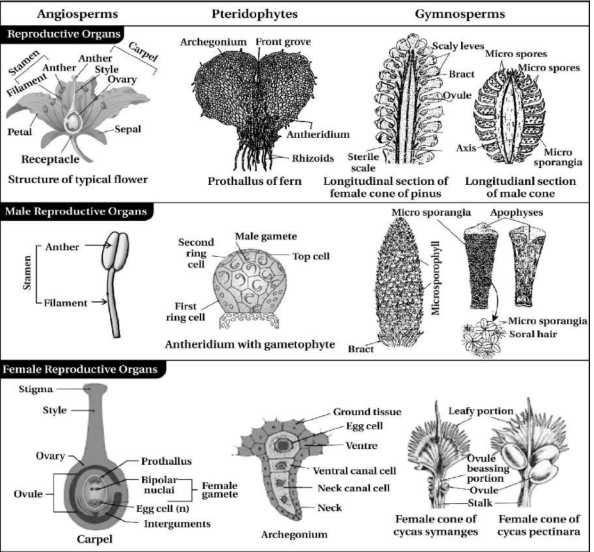
The male and female reproductive organs of several pteridophytes and gymnosperms are comparable to floral structures of angiosperms. Make an attempt to compare the various reproductive parts of pteridophytes and gymnosperms with reproductive structures of angiosperms.
Solution
(N/A) The comparison of reproductive structures across these plant groups can be summarized as follows:
$1$. Male Reproductive Organs:
- Angiosperms: The stamen consists of an anther and a filament,which produces microspores (pollen grains).
- Pteridophytes: The antheridium produces male gametes (antherozoids).
- Gymnosperms: The male cone (strobili) consists of microsporophylls bearing microsporangia,which produce microspores.
$2$. Female Reproductive Organs:
- Angiosperms: The carpel (pistil) consists of stigma,style,and ovary containing ovules,which house the egg cell.
- Pteridophytes: The archegonium is the female sex organ that produces the egg cell.
- Gymnosperms: The female cone (strobili) consists of megasporophylls bearing ovules,which contain the female gametophyte and egg cell.
$1$. Male Reproductive Organs:
- Angiosperms: The stamen consists of an anther and a filament,which produces microspores (pollen grains).
- Pteridophytes: The antheridium produces male gametes (antherozoids).
- Gymnosperms: The male cone (strobili) consists of microsporophylls bearing microsporangia,which produce microspores.
$2$. Female Reproductive Organs:
- Angiosperms: The carpel (pistil) consists of stigma,style,and ovary containing ovules,which house the egg cell.
- Pteridophytes: The archegonium is the female sex organ that produces the egg cell.
- Gymnosperms: The female cone (strobili) consists of megasporophylls bearing ovules,which contain the female gametophyte and egg cell.
0 likes
View Solution157
MediumMCQ
Select the correct option for the following statements:
$(i)$ In the embryo sac of angiosperms,the synergids and antipodals degenerate / do not degenerate after fertilization.
$(ii)$ In the leaves of dicotyledonous plants,parallel / reticulate venation is observed.
$(i)$ In the embryo sac of angiosperms,the synergids and antipodals degenerate / do not degenerate after fertilization.
$(ii)$ In the leaves of dicotyledonous plants,parallel / reticulate venation is observed.
A
Degenerate,Reticulate
B
Do not degenerate,Parallel
C
Degenerate,Parallel
D
Do not degenerate,Reticulate
Solution
(A) $(i)$ After fertilization,the synergids and antipodal cells in the embryo sac of angiosperms degenerate as they have completed their role in the fertilization process.
$(ii)$ Dicotyledonous plants are characterized by the presence of reticulate venation in their leaves,where veins form a network-like structure.
$(ii)$ Dicotyledonous plants are characterized by the presence of reticulate venation in their leaves,where veins form a network-like structure.
0 likes
View Solution158
MediumMCQ
Rearrange the following events of sexual reproduction in the sequence in which they occur in a flowering plant: embryogenesis, fertilisation, gametogenesis, pollination.
A
Gametogenesis, pollination, fertilisation, embryogenesis
B
Pollination, gametogenesis, fertilisation, embryogenesis
C
Gametogenesis, fertilisation, pollination, embryogenesis
D
Embryogenesis, fertilisation, pollination, gametogenesis
Solution
(A) The sequence of events in sexual reproduction in flowering plants is as follows:
$1$. $\text{Gametogenesis}$: The process of formation of male and female gametes.
$2$. $\text{Pollination}$: The transfer of pollen grains from the anther to the stigma.
$3$. $\text{Fertilisation}$: The fusion of male and female gametes to form a zygote.
$4$. $\text{Embryogenesis}$: The development of the embryo from the zygote.
Therefore, the correct sequence is $\text{Gametogenesis} \rightarrow \text{Pollination} \rightarrow \text{Fertilisation} \rightarrow \text{Embryogenesis}$.
$1$. $\text{Gametogenesis}$: The process of formation of male and female gametes.
$2$. $\text{Pollination}$: The transfer of pollen grains from the anther to the stigma.
$3$. $\text{Fertilisation}$: The fusion of male and female gametes to form a zygote.
$4$. $\text{Embryogenesis}$: The development of the embryo from the zygote.
Therefore, the correct sequence is $\text{Gametogenesis} \rightarrow \text{Pollination} \rightarrow \text{Fertilisation} \rightarrow \text{Embryogenesis}$.
0 likes
View Solution159
Medium
The probability of fruit set in a self-pollinated bisexual flower of a plant is far greater than in a dioecious plant. Explain.
Solution
(N/A) In a self-pollinated bisexual flower,the male and female reproductive organs are present within the same flower,ensuring pollination and subsequent fruit set even in the absence of external pollinators.
In contrast,dioecious plants have male and female flowers on separate individuals. This separation necessitates the presence of external pollinating agents (such as wind,water,or insects) to transfer pollen from the male plant to the female plant.
Therefore,the dependency on external factors makes fruit set in dioecious plants less certain compared to self-pollinated bisexual flowers.
In contrast,dioecious plants have male and female flowers on separate individuals. This separation necessitates the presence of external pollinating agents (such as wind,water,or insects) to transfer pollen from the male plant to the female plant.
Therefore,the dependency on external factors makes fruit set in dioecious plants less certain compared to self-pollinated bisexual flowers.
0 likes
View Solution160
Medium
Is there a relationship between the size of an organism and its life span? Give two examples in support of your answer.
Solution
(N/A) Life spans of organisms are not necessarily correlated with their sizes.
$1$. The sizes of crows and parrots are not very different,yet their life spans show a wide difference. The life span of a crow is $15$ years,while that of a parrot is $140$ years.
$2$. $A$ mango tree has a much shorter life span ($200$ years) as compared to a peepal tree ($2500$ years).
$1$. The sizes of crows and parrots are not very different,yet their life spans show a wide difference. The life span of a crow is $15$ years,while that of a parrot is $140$ years.
$2$. $A$ mango tree has a much shorter life span ($200$ years) as compared to a peepal tree ($2500$ years).
0 likes
View Solution161
Medium
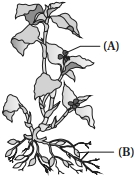
In the figure given below,the plant bears two different types of flowers marked '$A$' and '$B$'. Identify the types of flowers and state the type of pollination that will occur in them.
Solution
(N/A) '$A$' is a chasmogamous flower,while '$B$' is a cleistogamous flower.
$A$ bisexual flower which normally opens is called a chasmogamous flower. Cleistogamous flowers do not open at all.
Cleistogamous flowers are invariably autogamous as there is no chance of cross-pollen landing on the stigma.
In a normal flower which opens and exposes the anthers and stigma,complete autogamy is rather rare. Chasmogamous flowers may show autogamy,geitonogamy,or xenogamy.
$A$ bisexual flower which normally opens is called a chasmogamous flower. Cleistogamous flowers do not open at all.
Cleistogamous flowers are invariably autogamous as there is no chance of cross-pollen landing on the stigma.
In a normal flower which opens and exposes the anthers and stigma,complete autogamy is rather rare. Chasmogamous flowers may show autogamy,geitonogamy,or xenogamy.
0 likes
View Solution162
Medium
In haploid organisms that undergo sexual reproduction,name the stage in the life cycle when meiosis occurs. Give reasons for your answer.
Solution
(N/A) In haploid organisms,the stage in the life cycle where meiosis occurs is the $zygote$ stage.
Reasons:
$(i)$ In haploid organisms,the body is haploid $(n)$,so gametes are produced by mitosis,not meiosis.
$(ii)$ The fusion of male and female haploid gametes results in the formation of a diploid $(2n)$ zygote.
$(iii)$ Since the organism must return to the haploid state to continue its life cycle,the diploid zygote undergoes meiosis to produce haploid spores or cells. Examples include $Chlamydomonas$ and $Ulothrix$.
Reasons:
$(i)$ In haploid organisms,the body is haploid $(n)$,so gametes are produced by mitosis,not meiosis.
$(ii)$ The fusion of male and female haploid gametes results in the formation of a diploid $(2n)$ zygote.
$(iii)$ Since the organism must return to the haploid state to continue its life cycle,the diploid zygote undergoes meiosis to produce haploid spores or cells. Examples include $Chlamydomonas$ and $Ulothrix$.
0 likes
View Solution163
Medium
List the changes observed in an angiosperm flower subsequent to pollination and fertilisation.
Solution
(N/A) Following pollination and fertilisation in an angiosperm flower,the following post-fertilisation changes occur:
$1$. The sepals,petals,and stamens usually wither and fall off,although the sepals may sometimes persist.
$2$. The zygote develops into the embryo.
$3$. The primary endosperm nucleus $(PEN)$ develops into the endosperm,which provides nourishment to the developing embryo.
$4$. The ovule matures into the seed.
$5$. The ovary matures into the fruit.
$6$. The ovary wall develops into the pericarp (fruit wall).
$1$. The sepals,petals,and stamens usually wither and fall off,although the sepals may sometimes persist.
$2$. The zygote develops into the embryo.
$3$. The primary endosperm nucleus $(PEN)$ develops into the endosperm,which provides nourishment to the developing embryo.
$4$. The ovule matures into the seed.
$5$. The ovary matures into the fruit.
$6$. The ovary wall develops into the pericarp (fruit wall).
0 likes
View Solution164
Medium
Although sexual reproduction is a long-drawn,energy-intensive complex form of reproduction,many groups of organisms in Kingdom Animalia and Plantae prefer this mode of reproduction. Give at least three reasons for this.
Solution
(N/A) Sexual reproduction generates genetic variation in the offspring.
$(b)$ Since gamete formation involves meiosis,genetic recombination occurs during crossing over (meiosis-$I$),which leads to variation in the $DNA$ of gametes.
$(c)$ Organisms produced through sexual reproduction have better chances of survival in a changing environment due to the presence of diverse traits.
$(b)$ Since gamete formation involves meiosis,genetic recombination occurs during crossing over (meiosis-$I$),which leads to variation in the $DNA$ of gametes.
$(c)$ Organisms produced through sexual reproduction have better chances of survival in a changing environment due to the presence of diverse traits.
0 likes
View Solution165
MediumMCQ
Rose plants produce large,attractive bisexual flowers but they seldom produce fruits. On the other hand,a tomato plant produces plenty of fruits though they have small flowers. Analyze the reasons for the failure of fruit formation in rose.
A
Rose flowers are sterile.
B
Rose flowers are often highly modified (double flowers) where stamens are converted into petals.
C
Rose flowers lack ovules.
D
Rose flowers are strictly self-pollinating.
Solution
(B) The primary reason for the failure of fruit formation in many cultivated rose varieties is that they are often 'double-flowered' cultivars.
In these varieties,the stamens (male reproductive organs) have been evolutionarily or artificially modified into additional petals through selective breeding.
Because the stamens are absent or non-functional,there is no production of pollen grains.
Without pollen grains,pollination cannot occur,and consequently,fertilization does not take place.
Since fruit formation is a post-fertilization event (where the ovary develops into a fruit),the absence of fertilization leads to the failure of fruit development.
In these varieties,the stamens (male reproductive organs) have been evolutionarily or artificially modified into additional petals through selective breeding.
Because the stamens are absent or non-functional,there is no production of pollen grains.
Without pollen grains,pollination cannot occur,and consequently,fertilization does not take place.
Since fruit formation is a post-fertilization event (where the ovary develops into a fruit),the absence of fertilization leads to the failure of fruit development.
0 likes
View Solution166
Medium
Is the presence of a large number of chromosomes in an organism a hindrance to sexual reproduction? Justify your answer by giving suitable reasons.
Solution
(N/A) The presence of a large number of chromosomes in an organism is not a hindrance to sexual reproduction.
Sexual reproduction involves the fusion of gametes,which are formed through meiosis.
During meiosis,the chromosome number is halved,ensuring that the offspring receive the correct number of chromosomes from each parent.
For example,the butterfly has $380$ chromosomes,yet it reproduces sexually without any difficulty.
Therefore,the absolute number of chromosomes does not determine the ability of an organism to reproduce sexually.
Sexual reproduction involves the fusion of gametes,which are formed through meiosis.
During meiosis,the chromosome number is halved,ensuring that the offspring receive the correct number of chromosomes from each parent.
For example,the butterfly has $380$ chromosomes,yet it reproduces sexually without any difficulty.
Therefore,the absolute number of chromosomes does not determine the ability of an organism to reproduce sexually.
0 likes
View Solution167
Advanced
Rose plants produce large,attractive bisexual flowers but they seldom produce fruits. On the other hand,a tomato plant produces plenty of fruits though it has small flowers. Analyse the reasons for the failure of fruit formation in roses.
Solution
(N/A) The failure of fruit formation in roses can be attributed to several biological factors:
$(a)$ Rose plants may not produce viable pollen grains.
$(b)$ Rose plants may lack functional egg cells.
$(c)$ Rose plants may possess abortive ovules.
$(d)$ As many cultivated roses are hybrids,the meiotic process may be abnormal,leading to the production of non-viable gametes.
$(e)$ Self-incompatibility,where the plant rejects its own pollen.
$(f)$ Presence of internal physiological or chemical barriers that inhibit pollen tube growth or prevent successful fertilization.
$(a)$ Rose plants may not produce viable pollen grains.
$(b)$ Rose plants may lack functional egg cells.
$(c)$ Rose plants may possess abortive ovules.
$(d)$ As many cultivated roses are hybrids,the meiotic process may be abnormal,leading to the production of non-viable gametes.
$(e)$ Self-incompatibility,where the plant rejects its own pollen.
$(f)$ Presence of internal physiological or chemical barriers that inhibit pollen tube growth or prevent successful fertilization.
0 likes
View Solution168
Medium
Give differences: Male gametophytic stage and Female gametophytic stage.
Solution
(N/A)
| Male gametophytic stage | Female gametophytic stage |
| $(1)$ Formed by mitotic division of microspores. | $(1)$ Formed by mitotic division of megaspores. |
| $(2)$ Pollen tube development occurs. | $(2)$ Embryo sac formation occurs within the ovule. |
| $(3)$ Produces vegetative and generative cells from the pollen nucleus. | $(3)$ Produces an $8$-nucleate and $7$-celled structure (embryo sac) via nuclear divisions. |
0 likes
View Solution169
Medium
Give differences: Microsporogenesis and Megasporogenesis.
Solution
(N/A)
| Microsporogenesis | Megasporogenesis |
|---|---|
| $1$. This process occurs in the anther. | $1$. This process occurs in the ovule (within the ovary). |
| $2$. Meiotic division of the pollen mother cell $(PMC)$ forms a microspore tetrad. | $2$. Meiotic division of the megaspore mother cell $(MMC)$ forms a megaspore tetrad. |
| $3$. Four functional microspores are usually produced from a tetrad. | $3$. Usually,only one functional megaspore is produced; the other three degenerate. |
| $4$. It leads to the formation of male gametophytes (pollen grains). | $4$. It leads to the formation of the female gametophyte (embryo sac). |
0 likes
View Solution170
MediumMCQ
Indicate the stages where meiosis and mitosis occur $(1, 2$ or $3)$ in the flow chart: Megaspore mother cell $\xrightarrow{1}$ Megaspores $\xrightarrow{2}$ Embryo sac $\xrightarrow{3}$ Egg.
A
$1 = \text{Meiosis}, 2 = \text{Mitosis}, 3 = \text{None}$
B
$1 = \text{Mitosis}, 2 = \text{Meiosis}, 3 = \text{Mitosis}$
C
$1 = \text{Meiosis}, 2 = \text{Mitosis}, 3 = \text{Mitosis}$
D
$1 = \text{Mitosis}, 2 = \text{Mitosis}, 3 = \text{Meiosis}$
Solution
(A) The process of female gametophyte development involves the following steps:
$1$. The diploid Megaspore Mother Cell $(2n)$ undergoes Meiosis to produce four haploid megaspores. This corresponds to stage $1$.
$2$. The functional megaspore undergoes three successive rounds of Mitosis to form an $8$-nucleate embryo sac. This corresponds to stage $2$.
$3$. The differentiation of the egg cell within the embryo sac does not involve further cell division (mitosis or meiosis) from the embryo sac stage; the egg is already formed as part of the egg apparatus. Thus,stage $3$ does not represent a division step.
Therefore,the correct sequence is $1 = \text{Meiosis}$ and $2 = \text{Mitosis}$.
$1$. The diploid Megaspore Mother Cell $(2n)$ undergoes Meiosis to produce four haploid megaspores. This corresponds to stage $1$.
$2$. The functional megaspore undergoes three successive rounds of Mitosis to form an $8$-nucleate embryo sac. This corresponds to stage $2$.
$3$. The differentiation of the egg cell within the embryo sac does not involve further cell division (mitosis or meiosis) from the embryo sac stage; the egg is already formed as part of the egg apparatus. Thus,stage $3$ does not represent a division step.
Therefore,the correct sequence is $1 = \text{Meiosis}$ and $2 = \text{Mitosis}$.
0 likes
View Solution171
Medium
Differentiate between Microsporogenesis and Megasporogenesis.
Solution
(N/A)
| Microsporogenesis | Megasporogenesis |
| $1$. It occurs in the anther. | $1$. It occurs in the ovule. |
| $2$. Microspore mother cells undergo meiosis to form a microspore tetrad. | $2$. Megaspore mother cells undergo meiosis to form a linear tetrad of megaspores. |
| $3$. Four functional microspores (pollen grains) are formed from one microspore mother cell. | $3$. Generally,only one functional megaspore is formed from one megaspore mother cell,while the other three degenerate. |
| $4$. It leads to the formation of male gametophytes. | $4$. It leads to the formation of the female gametophyte (embryo sac). |
0 likes
View Solution172
Medium
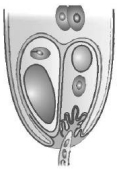
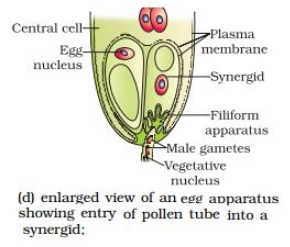
In the figure given below,label the following parts: male gametes,egg cell,polar nuclei,synergid,and pollen tube.
Solution
(N/A) Based on the provided diagram of the egg apparatus showing the entry of the pollen tube into a synergid,the parts are labeled as follows:
$1$. Male gametes: These are the two small,dark-stained structures located inside the pollen tube.
$2$. Egg cell: This is the large cell located within the egg apparatus,containing the egg nucleus.
$3$. Polar nuclei: These are the two nuclei located in the central cell of the embryo sac.
$4$. Synergid: These are the two specialized cells flanking the egg cell,which guide the pollen tube.
$5$. Pollen tube: This is the tubular structure entering the embryo sac through the filiform apparatus of one of the synergids.
$1$. Male gametes: These are the two small,dark-stained structures located inside the pollen tube.
$2$. Egg cell: This is the large cell located within the egg apparatus,containing the egg nucleus.
$3$. Polar nuclei: These are the two nuclei located in the central cell of the embryo sac.
$4$. Synergid: These are the two specialized cells flanking the egg cell,which guide the pollen tube.
$5$. Pollen tube: This is the tubular structure entering the embryo sac through the filiform apparatus of one of the synergids.
0 likes
View Solution173
Easy
Explain the importance of sexual reproduction in plants.
Solution
(N/A) Sexual reproduction in plants is essential for the following reasons:
$1$. It leads to the formation of fruits and seeds,which are the end products of sexual reproduction.
$2$. The diverse structures of inflorescences,flowers,and floral parts represent a wide range of adaptations that facilitate pollination and fertilization.
$3$. The vibrant colors,scents,and perfumes of flowers are evolutionary adaptations designed to attract pollinators,thereby ensuring the success of sexual reproduction.
$4$. It promotes genetic variation within a population,which is crucial for adaptation and survival in changing environments.
$1$. It leads to the formation of fruits and seeds,which are the end products of sexual reproduction.
$2$. The diverse structures of inflorescences,flowers,and floral parts represent a wide range of adaptations that facilitate pollination and fertilization.
$3$. The vibrant colors,scents,and perfumes of flowers are evolutionary adaptations designed to attract pollinators,thereby ensuring the success of sexual reproduction.
$4$. It promotes genetic variation within a population,which is crucial for adaptation and survival in changing environments.
0 likes
View Solution174
Medium
Give the differences between Microsporangium and Megasporangium.
Solution
(N/A)
| Microsporangium | Megasporangium |
|---|---|
| $(1)$ It is a sac-like structure located within the anther. | $(1)$ It is a multi-layered structure,also known as the ovule. |
| $(2)$ It functions as a cavity where pollen grains develop. | $(2)$ It is a structure located within the ovary of the flower. |
| $(3)$ The innermost layer,the tapetum,provides nourishment to the developing pollen grains. | $(3)$ It contains the embryo sac; after fertilization,it develops into a seed. |
0 likes
View Solution175
Medium
Differentiate between:
$(a)$ Bract and Bracteole
$(b)$ Pulvinus and Petiole
$(c)$ Pedicel and Peduncle
$(d)$ Spike and Spadix
$(e)$ Stamen and Staminode
$(f)$ Pollen and Pollinium
$(a)$ Bract and Bracteole
$(b)$ Pulvinus and Petiole
$(c)$ Pedicel and Peduncle
$(d)$ Spike and Spadix
$(e)$ Stamen and Staminode
$(f)$ Pollen and Pollinium
Solution
(N/A) Bract: It is a leaf-like structure in whose axil a flower is produced. They can be small,scaly,green,or colored; generally,they are single.
$\rightarrow$ Bracteole: It is a small,bract-like structure produced on the pedicel of a flower.
$(b)$ Pulvinus: It is the swollen base of the leaf stalk (petiole) found in many legumes,which helps in leaf movement.
$\rightarrow$ Petiole: It is a cylindrical or semi-cylindrical stalk-like structure that connects the leaf base to the leaf lamina.
$(c)$ Pedicel: The stalk of an individual flower is called a pedicel.
$\rightarrow$ Peduncle: The main axis of an inflorescence that bears flowers is called a peduncle.
$(d)$ Spike: An inflorescence with sessile (stalkless) flowers arranged on an elongated axis,e.g.,$Achyranthus$.
$\rightarrow$ Spadix: An inflorescence where the axis is fleshy and bears sessile unisexual flowers. The female flowers are at the base,and male flowers are above them. The entire axis is often protected by a large bract called a spathe,e.g.,$Colocasia$,banana.
$(e)$ Stamen: The male reproductive organ of a flower,consisting of a filament and an anther.
$\rightarrow$ Staminode: $A$ sterile or non-functional stamen is called a staminode.
$(f)$ Pollen: The microspores produced in the anther of angiosperms are known as pollen grains.
$\rightarrow$ Pollinium: $A$ coherent mass of pollen grains found in the anther of certain plants like $Calotropis$.
$\rightarrow$ Bracteole: It is a small,bract-like structure produced on the pedicel of a flower.
$(b)$ Pulvinus: It is the swollen base of the leaf stalk (petiole) found in many legumes,which helps in leaf movement.
$\rightarrow$ Petiole: It is a cylindrical or semi-cylindrical stalk-like structure that connects the leaf base to the leaf lamina.
$(c)$ Pedicel: The stalk of an individual flower is called a pedicel.
$\rightarrow$ Peduncle: The main axis of an inflorescence that bears flowers is called a peduncle.
$(d)$ Spike: An inflorescence with sessile (stalkless) flowers arranged on an elongated axis,e.g.,$Achyranthus$.
$\rightarrow$ Spadix: An inflorescence where the axis is fleshy and bears sessile unisexual flowers. The female flowers are at the base,and male flowers are above them. The entire axis is often protected by a large bract called a spathe,e.g.,$Colocasia$,banana.
$(e)$ Stamen: The male reproductive organ of a flower,consisting of a filament and an anther.
$\rightarrow$ Staminode: $A$ sterile or non-functional stamen is called a staminode.
$(f)$ Pollen: The microspores produced in the anther of angiosperms are known as pollen grains.
$\rightarrow$ Pollinium: $A$ coherent mass of pollen grains found in the anther of certain plants like $Calotropis$.
0 likes
View Solution176
MediumMCQ
Identify the plant parts that consist of two generations,one within the other:
$(a)$ Pollen grains inside the anther
$(b)$ Germinated pollen grain with two male gametes
$(c)$ Seed inside the fruit
$(d)$ Embryo sac inside the ovule
$(a)$ Pollen grains inside the anther
$(b)$ Germinated pollen grain with two male gametes
$(c)$ Seed inside the fruit
$(d)$ Embryo sac inside the ovule
A
$(a)$ and $(d)$
B
$(a)$ only
C
$(a), (b)$ and $(c)$
D
$(c)$ and $(d)$
Solution
(A) In plants,the sporophyte generation is diploid $(2n)$ and the gametophyte generation is haploid $(n)$.
$(a)$ Pollen grains (male gametophyte,$n$) develop inside the anther (part of the sporophyte,$2n$). Thus,this represents two generations.
$(b)$ $A$ germinated pollen grain is a single generation (male gametophyte).
$(c)$ $A$ seed contains an embryo (new sporophyte) and endosperm/seed coat (parental sporophyte tissues). While it involves different generations,the question specifically refers to the gametophyte within the sporophyte structure.
$(d)$ The embryo sac (female gametophyte,$n$) develops inside the ovule (part of the sporophyte,$2n$). Thus,this represents two generations.
Therefore,$(a)$ and $(d)$ are the correct examples of one generation within another.
$(a)$ Pollen grains (male gametophyte,$n$) develop inside the anther (part of the sporophyte,$2n$). Thus,this represents two generations.
$(b)$ $A$ germinated pollen grain is a single generation (male gametophyte).
$(c)$ $A$ seed contains an embryo (new sporophyte) and endosperm/seed coat (parental sporophyte tissues). While it involves different generations,the question specifically refers to the gametophyte within the sporophyte structure.
$(d)$ The embryo sac (female gametophyte,$n$) develops inside the ovule (part of the sporophyte,$2n$). Thus,this represents two generations.
Therefore,$(a)$ and $(d)$ are the correct examples of one generation within another.
0 likes
View Solution177
EasyMCQ
Which of the following plant parts consist of two generations - one within the other?
A
$(a)$ Pollen grains inside the anther
B
$(b)$ Germinated pollen grain with two male gametes
C
$(c)$ Seed inside the fruit
D
$(d)$ Embryo sac inside the ovule
Solution
(B) In plants,the sporophyte generation is diploid $(2n)$ and the gametophyte generation is haploid $(n)$.
$(a)$ Pollen grains (gametophyte) are inside the anther (sporophyte). This represents two generations.
$(b)$ Germinated pollen grain is a single generation (gametophyte).
$(c)$ Seed (new sporophyte) is inside the fruit (parent sporophyte). This represents two generations.
$(d)$ Embryo sac (gametophyte) is inside the ovule (sporophyte). This represents two generations.
Therefore,$(a), (c),$ and $(d)$ consist of two generations,one within the other.
$(a)$ Pollen grains (gametophyte) are inside the anther (sporophyte). This represents two generations.
$(b)$ Germinated pollen grain is a single generation (gametophyte).
$(c)$ Seed (new sporophyte) is inside the fruit (parent sporophyte). This represents two generations.
$(d)$ Embryo sac (gametophyte) is inside the ovule (sporophyte). This represents two generations.
Therefore,$(a), (c),$ and $(d)$ consist of two generations,one within the other.
0 likes
View Solution178
EasyMCQ
How does vegetative propagation occur in Agave?
A
Rhizome
B
Bulbil
C
Leaf bud
D
Node
Solution
(B) In $Agave$,vegetative propagation occurs through specialized fleshy buds known as $Bulbils$. These $Bulbils$ develop in the inflorescence and,upon falling to the ground,germinate to form new plants.
0 likes
View Solution179
EasyMCQ
Which organism possesses the highest number of chromosomes?
A
Human
B
Butterfly
C
Ophioglossum
D
Apple
Solution
(C) The organism with the highest number of chromosomes among the given options is $Ophioglossum$ (a fern).
It has a diploid chromosome number $(2n)$ of $1260$.
In comparison,humans have $46$ chromosomes,butterflies have $380$,and apples have $34$ chromosomes.
It has a diploid chromosome number $(2n)$ of $1260$.
In comparison,humans have $46$ chromosomes,butterflies have $380$,and apples have $34$ chromosomes.
0 likes
View Solution180
MediumMCQ
In which type of plants is the senescent phase not clearly defined?
A
Annuals
B
Biennials
C
Perennials
D
Both $A$ and $B$
Solution
(C) The life cycle of organisms consists of three phases: juvenile phase,reproductive phase,and senescent phase.
In annual and biennial plants,these phases are clearly defined as they complete their life cycle within one or two years.
However,in perennial plants,the transition between these phases is not clearly defined,as they can flower and fruit repeatedly over many years.
In annual and biennial plants,these phases are clearly defined as they complete their life cycle within one or two years.
However,in perennial plants,the transition between these phases is not clearly defined,as they can flower and fruit repeatedly over many years.
0 likes
View Solution181
EasyMCQ
Which plant flowers once every $12$ years?
A
Strobilanthes kunthiana
B
Bamboo
C
Coconut
D
Wheat
Solution
(A) The plant $Strobilanthes$ $kunthiana$ (Neelakuranji) is known for its unique flowering cycle.
It flowers once every $12$ years.
This phenomenon was observed in the hilly regions of Kerala, Karnataka, and Tamil Nadu, where it bloomed in large numbers during September-October $2006$ and subsequently in $2018$.
It flowers once every $12$ years.
This phenomenon was observed in the hilly regions of Kerala, Karnataka, and Tamil Nadu, where it bloomed in large numbers during September-October $2006$ and subsequently in $2018$.
0 likes
View Solution182
EasyMCQ
In which year did the last flowering of Neelakurinji $(Strobilanthes \text{ kunthiana})$ occur?
A
$2004$
B
$2016$
C
$2010$
D
$2018$
Solution
(D) Neelakurinji $(Strobilanthes \text{ kunthiana})$ is a plant that flowers once every $12$ years.
It flowered in the year $2006$ and then in $2018$.
Therefore, the last major flowering event before the current cycle was in $2018$.
It flowered in the year $2006$ and then in $2018$.
Therefore, the last major flowering event before the current cycle was in $2018$.
0 likes
View Solution183
EasyMCQ
What is the number of chromosomes in a meiocyte of a potato plant?
A
$24$
B
$48$
C
$46$
D
$20$
Solution
(B) meiocyte is a cell that undergoes meiosis to produce gametes.
In a potato plant ($Solanum$ $tuberosum$),the diploid number of chromosomes $(2n)$ is $48$.
Since a meiocyte is a diploid cell,it contains $48$ chromosomes.
Therefore,the correct option is $B$.
In a potato plant ($Solanum$ $tuberosum$),the diploid number of chromosomes $(2n)$ is $48$.
Since a meiocyte is a diploid cell,it contains $48$ chromosomes.
Therefore,the correct option is $B$.
0 likes
View Solution184
EasyMCQ
In which states were tourists attracted due to the mass flowering of $Strobilanthes$ $kunthiana$ (Neelakurinji)?
A
Kerala,Bengal,Telangana
B
Kerala,Karnataka,Telangana
C
Telangana,Tamil Nadu,Andhra Pradesh
D
Kerala,Karnataka,Tamil Nadu
Solution
(D) $Strobilanthes$ $kunthiana$ (Neelakurinji) flowers once in $12$ years.
Mass flowering of this plant occurred in the hilly areas of Kerala,Karnataka,and Tamil Nadu.
This phenomenon attracted a large number of tourists to these regions.
Mass flowering of this plant occurred in the hilly areas of Kerala,Karnataka,and Tamil Nadu.
This phenomenon attracted a large number of tourists to these regions.
0 likes
View Solution185
EasyMCQ
Gametes are generally ...... .
A
Haploid
B
Diploid
C
Triploid
D
Tetraploid
Solution
(A) Gametes are the reproductive cells produced by organisms that undergo sexual reproduction. In most organisms, gametes are $Haploid$ $(n)$, meaning they contain a single set of chromosomes. This ensures that when two gametes fuse during fertilization, the resulting zygote becomes $Diploid$ $(2n)$, restoring the original chromosome number of the species.
0 likes
View Solution186
EasyMCQ
If a plant bears only staminate flowers, what is it called?
A
Monoecious
B
Dioecious
C
Bisexual
D
Staminate
Solution
(B) plant that bears only staminate flowers (male flowers) is referred to as a $staminate$ or $male$ plant. In the context of sexual reproduction in plants, if a plant species produces only male flowers on one individual and only female flowers on another, the condition is known as $dioecious$. Therefore, a plant bearing only staminate flowers is a $dioecious$ plant.
0 likes
View Solution187
EasyMCQ
Select the correct option that represents the organisms in descending order based on the number of chromosomes present in their meiocytes.
A
Rat $\rightarrow$ Dog $\rightarrow$ Cat $\rightarrow$ Onion
B
Cat $\rightarrow$ Dog $\rightarrow$ Onion $\rightarrow$ Rat
C
Dog $\rightarrow$ Cat $\rightarrow$ Onion $\rightarrow$ Rat
D
Dog $\rightarrow$ Rat $\rightarrow$ Cat $\rightarrow$ Onion
Solution
(D) To determine the correct order,we must look at the chromosome number in the meiocytes $(2n)$ of the given organisms:
$1$. Dog ($Canis$ $lupus$ $familiaris$): $2n = 78$
$2$. Rat ($Rattus$ $rattus$): $2n = 42$
$3$. Cat ($Felis$ $catus$): $2n = 38$
$4$. Onion ($Allium$ $cepa$): $2n = 16$
Comparing these values: $78 > 42 > 38 > 16$.
Therefore,the descending order is: Dog $\rightarrow$ Rat $\rightarrow$ Cat $\rightarrow$ Onion.
$1$. Dog ($Canis$ $lupus$ $familiaris$): $2n = 78$
$2$. Rat ($Rattus$ $rattus$): $2n = 42$
$3$. Cat ($Felis$ $catus$): $2n = 38$
$4$. Onion ($Allium$ $cepa$): $2n = 16$
Comparing these values: $78 > 42 > 38 > 16$.
Therefore,the descending order is: Dog $\rightarrow$ Rat $\rightarrow$ Cat $\rightarrow$ Onion.
0 likes
View Solution188
EasyMCQ
In which of the following plants is 'dioecy' observed?
A
Marchantia
B
Pea
C
Papaya
D
Date palm
Solution
(C) Dioecy refers to the condition where male and female reproductive organs are present on separate individuals.
In the given options, both $Papaya$ and $Date \text{ } palm$ are dioecious plants.
However, in many standard biology textbooks, $Papaya$ is the most commonly cited example for dioecy.
$Marchantia$ is also dioecious (thalli are male or female), but $Papaya$ is the classic example of a dioecious angiosperm.
Since the question asks for a plant, and both $C$ and $D$ are technically correct, $Papaya$ is frequently the preferred answer in competitive examinations.
In the given options, both $Papaya$ and $Date \text{ } palm$ are dioecious plants.
However, in many standard biology textbooks, $Papaya$ is the most commonly cited example for dioecy.
$Marchantia$ is also dioecious (thalli are male or female), but $Papaya$ is the classic example of a dioecious angiosperm.
Since the question asks for a plant, and both $C$ and $D$ are technically correct, $Papaya$ is frequently the preferred answer in competitive examinations.
0 likes
View Solution189
EasyMCQ
In which of the following organisms is internal fertilization observed?
A
Angiosperms
B
Amphibians
C
Bony fishes
D
Algae
Solution
(A) Internal fertilization is a process where the fusion of male and female gametes occurs inside the body of the female organism.
Among the given options,Angiosperms (flowering plants) exhibit internal fertilization,where the pollen tube delivers the male gametes to the embryo sac within the ovule.
Amphibians,bony fishes,and most algae typically exhibit external fertilization,where gametes are released into the surrounding water medium.
Among the given options,Angiosperms (flowering plants) exhibit internal fertilization,where the pollen tube delivers the male gametes to the embryo sac within the ovule.
Amphibians,bony fishes,and most algae typically exhibit external fertilization,where gametes are released into the surrounding water medium.
0 likes
View Solution190
MediumMCQ
In which of the following organisms does the formation of the zygote $NOT$ occur inside the body?
A
Mammals
B
Angiosperms and Gymnosperms
C
Reptiles
D
Bony fishes
Solution
(D) The formation of a zygote can occur either inside the body of the organism (internal fertilization) or outside the body (external fertilization).
In mammals,reptiles,angiosperms,and gymnosperms,fertilization is internal,meaning the zygote is formed inside the female body.
In most bony fishes,fertilization is external,where both the male and female release their gametes into the surrounding water medium. Consequently,the zygote is formed outside the body in the external environment.
In mammals,reptiles,angiosperms,and gymnosperms,fertilization is internal,meaning the zygote is formed inside the female body.
In most bony fishes,fertilization is external,where both the male and female release their gametes into the surrounding water medium. Consequently,the zygote is formed outside the body in the external environment.
0 likes
View Solution191
EasyMCQ
In which of the following organisms are the male gametes non-motile?
A
Algae
B
Bryophytes
C
Humans
D
Seed-bearing plants
Solution
(D) In most organisms,male gametes are motile and female gametes are stationary. However,in seed-bearing plants (gymnosperms and angiosperms),the male gametes are non-motile. They are carried to the female gamete through the process of pollination and the formation of a pollen tube.
0 likes
View Solution192
EasyMCQ
Match the following columns:
| Column-$I$ | Column-$II$ |
|---|---|
| $(a)$ Zygote | $(1)$ Seed |
| $(b)$ Ovule | $(2)$ Seed coat |
| $(c)$ Ovary | $(3)$ Embryo |
| $(d)$ Integument | $(4)$ Fruit |
A
$a-3, b-1, c-4, d-2$
B
$a-3, b-4, c-1, d-2$
C
$a-1, b-3, c-2, d-4$
D
$a-4, b-2, c-1, d-3$
Solution
(A) After fertilization in angiosperms,the following changes occur:
$1$. The Zygote develops into the Embryo $(a-3)$.
$2$. The Ovule matures to form the Seed $(b-1)$.
$3$. The Ovary develops into the Fruit $(c-4)$.
$4$. The Integument of the ovule hardens to form the Seed coat $(d-2)$.
Therefore,the correct matching is $a-3, b-1, c-4, d-2$.
$1$. The Zygote develops into the Embryo $(a-3)$.
$2$. The Ovule matures to form the Seed $(b-1)$.
$3$. The Ovary develops into the Fruit $(c-4)$.
$4$. The Integument of the ovule hardens to form the Seed coat $(d-2)$.
Therefore,the correct matching is $a-3, b-1, c-4, d-2$.
0 likes
View Solution193
MediumMCQ
Identify the incorrect statement.
A
All algae undergo internal fertilization.
B
Cell division increases the number of cells in the developing embryo.
C
In algae and fungi,the zygote develops a thick wall and undergoes a period of rest before germination.
D
After fertilization,the sepals,petals,and stamens of the flower wither and fall off.
Solution
(A) The correct answer is $A$.
In many algae,fertilization is external,occurring in the surrounding water medium,not internal.
Option $B$ is correct because the zygote undergoes cell division (mitosis) to develop into an embryo,increasing cell count.
Option $C$ is correct as zygotes in algae and fungi often develop thick-walled structures to survive unfavorable conditions.
Option $D$ is correct as these floral parts usually wither and fall off after fertilization in most angiosperms.
In many algae,fertilization is external,occurring in the surrounding water medium,not internal.
Option $B$ is correct because the zygote undergoes cell division (mitosis) to develop into an embryo,increasing cell count.
Option $C$ is correct as zygotes in algae and fungi often develop thick-walled structures to survive unfavorable conditions.
Option $D$ is correct as these floral parts usually wither and fall off after fertilization in most angiosperms.
0 likes
View Solution194
MediumMCQ
In which of the following organisms does the zygote undergo meiosis?
A
Chara
B
Coconut
C
Mango
D
Papaya
Solution
(A) In many organisms belonging to the algae and fungi groups,the zygote develops a thick wall that is resistant to desiccation and damage. It undergoes a period of rest before germination. In these organisms,the zygote undergoes meiosis to form haploid spores,which then grow into haploid individuals. Among the given options,$Chara$ is an alga,and therefore,its zygote undergoes meiosis. In contrast,coconut,mango,and papaya are angiosperms (seed plants) where the zygote undergoes mitosis to develop into an embryo.
0 likes
View Solution195
MediumMCQ
How many meiotic divisions are required to produce the pollen grains necessary for the formation of $800$ wheat seeds?
A
$100$
B
$200$
C
$400$
D
$800$
Solution
(B) In angiosperms,one microspore mother cell $(MMC)$ undergoes meiosis to produce $4$ microspores (pollen grains).
To form $800$ seeds,$800$ pollen grains are required for fertilization.
Since $1$ $MMC$ produces $4$ pollen grains,the number of $MMC$s required is $800 / 4 = 200$.
Each $MMC$ undergoes one meiotic division to produce these $4$ pollen grains.
Therefore,$200$ meiotic divisions are required.
To form $800$ seeds,$800$ pollen grains are required for fertilization.
Since $1$ $MMC$ produces $4$ pollen grains,the number of $MMC$s required is $800 / 4 = 200$.
Each $MMC$ undergoes one meiotic division to produce these $4$ pollen grains.
Therefore,$200$ meiotic divisions are required.
0 likes
View Solution196
MediumMCQ
What is the viability period of pollen grains in members of the families $Rosaceae$,$Leguminosae$,and $Solanaceae$?
A
For minutes
B
For hours
C
For days
D
For months
Solution
(D) The viability of pollen grains varies greatly among different plant species.
In some cereals like rice and wheat,pollen grains lose viability within $30$ minutes of their release.
However,in members of some families like $Rosaceae$,$Leguminosae$,and $Solanaceae$,the pollen grains maintain their viability for several months.
Therefore,the correct option is $D$.
In some cereals like rice and wheat,pollen grains lose viability within $30$ minutes of their release.
However,in members of some families like $Rosaceae$,$Leguminosae$,and $Solanaceae$,the pollen grains maintain their viability for several months.
Therefore,the correct option is $D$.
0 likes
View Solution197
MediumMCQ
Pollen grains can be stored for a long period in $......$ at $......$ $^oC$.
A
Liquid nitrogen,$196$ $^oC$
B
Liquid nitrogen,$-196$ $^oC$
C
Liquid $CO_2$,$186$ $^oC$
D
Liquid $CO_2$,$-186$ $^oC$
Solution
(B) Pollen grains are stored for long periods in liquid nitrogen at $-196$ $^oC$ for cryopreservation.
This technique is used in pollen banks to maintain the viability of pollen grains for breeding programs and conservation of genetic diversity.
This technique is used in pollen banks to maintain the viability of pollen grains for breeding programs and conservation of genetic diversity.
0 likes
View Solution198
MediumMCQ
How many of the following plants have a single ovule in their ovary?
Wheat,Papaya,Orchid,Paddy,Mango
Wheat,Papaya,Orchid,Paddy,Mango
A
$3$
B
$2$
C
$4$
D
$1$
Solution
(A) In flowering plants,the number of ovules in an ovary can vary.
$1$. Wheat ($Triticum$ $aestivum$): Contains a single ovule.
$2$. Papaya ($Carica$ $papaya$): Contains many ovules.
$3$. Orchid ($Orchidaceae$ family): Contains many ovules.
$4$. Paddy ($Oryza$ $sativa$): Contains a single ovule.
$5$. Mango ($Mangifera$ $indica$): Contains a single ovule.
Thus,Wheat,Paddy,and Mango have a single ovule in their ovary.
The total count is $3$.
$1$. Wheat ($Triticum$ $aestivum$): Contains a single ovule.
$2$. Papaya ($Carica$ $papaya$): Contains many ovules.
$3$. Orchid ($Orchidaceae$ family): Contains many ovules.
$4$. Paddy ($Oryza$ $sativa$): Contains a single ovule.
$5$. Mango ($Mangifera$ $indica$): Contains a single ovule.
Thus,Wheat,Paddy,and Mango have a single ovule in their ovary.
The total count is $3$.
0 likes
View Solution199
MediumMCQ
What is the ploidy of $MMC$,antipodal cell,central cell,and egg cell,respectively?
A
$2n, n, 2n, n$
B
$n, n, n, 2n$
C
$2n, n, 2n, n$
D
$n, n, 2n, n$
Solution
(C) The ploidy levels are as follows:
$1$. $MMC$ (Megaspore Mother Cell) is diploid $(2n)$.
$2$. Antipodal cells are haploid $(n)$ as they are part of the mature embryo sac.
$3$. The central cell contains two polar nuclei before fusion,making it diploid $(2n)$ in the mature embryo sac.
$4$. The egg cell is haploid $(n)$.
Therefore,the sequence is $2n, n, 2n, n$.
$1$. $MMC$ (Megaspore Mother Cell) is diploid $(2n)$.
$2$. Antipodal cells are haploid $(n)$ as they are part of the mature embryo sac.
$3$. The central cell contains two polar nuclei before fusion,making it diploid $(2n)$ in the mature embryo sac.
$4$. The egg cell is haploid $(n)$.
Therefore,the sequence is $2n, n, 2n, n$.
0 likes
View Solution200
MediumMCQ
Which of the following plants does not produce cleistogamous flowers?
A
Viola
B
Oxalis
C
Commelina
D
Tulsi
Solution
(D) Cleistogamous flowers are flowers that do not open at all. In such flowers,the anthers and stigma lie close to each other. When anthers dehisce in the flower buds,pollen grains come in contact with the stigma to effect pollination. Thus,cleistogamous flowers are invariably autogamous as there is no chance of cross-pollination landing on the stigma. Viola,Oxalis,and Commelina are classic examples of plants that produce both chasmogamous and cleistogamous flowers. Tulsi ($Ocimum$ $sanctum$) does not produce cleistogamous flowers.
0 likes
View SolutionSexual Reproduction in Flowering Plants — Mix Examples-Sexual Reproduction in Flowering Plants · Frequently Asked Questions
1Are these Sexual Reproduction in Flowering Plants questions useful for JEE and NEET?
Yes. All questions in this section are mapped to JEE Main and NEET exam patterns. Previous year questions from JEE Main, NEET, GUJCET and state-level exams are included with full solutions.
2Can I switch to Hindi or Gujarati for these questions?
Yes. Use the language tabs in the hero section or the sidebar to view the same questions and solutions in English, Hindi or Gujarati.
3How do I generate a question paper from this subtopic?
Use the Vedclass Exam Paper Generator — select the chapter and subtopic, set difficulty, and generate Sets A, B, C, D automatically. First 3 chapters of every subject are free.
Vedclass Products
For Students
Vedclass Test Series
Mock tests in real JEE/NEET style with performance analysis. 5-day free trial.
Start Free TrialFor Teachers
Exam Paper Generator
Generate Set A/B/C/D papers from this chapter in 2 minutes. 3 chapters free.
Try FreeFor Institutes
Online Exam Module
Live online exams with unlimited students, 360° analytics & white-label branding.
See DemoFor Teachers & Institutes
Generate a Sexual Reproduction in Flowering Plants Exam Paper in 2 Minutes
Select subtopic & difficulty — Sets A, B, C, D auto-generated with No Repeat logic.
First 3 chapters of every subject are free — no payment required.