
A English
Mix Examples-Sexual Reproduction in Flowering Plants Questions in English
Class 12 Biology · Sexual Reproduction in Flowering Plants · Mix Examples-Sexual Reproduction in Flowering Plants
354+
Questions
English
Language
100%
With Solutions
Showing 50 of 354 questions in English
51
MediumMCQ
Which of the following statements is incorrect?
A
Unisexuality of flowers promotes cross-pollination.
B
Male gametophytes were developed by Guha and Maheshwari.
C
Morphological barriers are absent in Gloriosa flowers.
D
All of the above
0 likes
View Solution52
MediumMCQ
Identify the correct sequence of events in the life cycle of a flowering plant.
A
Meiosis $\rightarrow$ Microsporogenesis $\rightarrow$ Pollination $\rightarrow$ Syngamy
B
Pollination $\rightarrow$ Meiosis $\rightarrow$ Microsporogenesis $\rightarrow$ Syngamy
C
Microsporogenesis $\rightarrow$ Pollination $\rightarrow$ Meiosis $\rightarrow$ Syngamy
D
Microsporogenesis $\rightarrow$ Meiosis $\rightarrow$ Pollination $\rightarrow$ Syngamy
Solution
(D) The correct sequence of events in the life cycle of a flowering plant is as follows:
$1$. Microsporogenesis: The process of formation of microspores from a pollen mother cell through meiosis.
$2$. Meiosis: This is the reductional division that occurs during microsporogenesis to produce haploid microspores.
$3$. Pollination: The transfer of pollen grains from the anther to the stigma of a pistil.
$4$. Syngamy: The fusion of male and female gametes to form a diploid zygote.
Therefore,the sequence is Microsporogenesis $\rightarrow$ Meiosis $\rightarrow$ Pollination $\rightarrow$ Syngamy.
$1$. Microsporogenesis: The process of formation of microspores from a pollen mother cell through meiosis.
$2$. Meiosis: This is the reductional division that occurs during microsporogenesis to produce haploid microspores.
$3$. Pollination: The transfer of pollen grains from the anther to the stigma of a pistil.
$4$. Syngamy: The fusion of male and female gametes to form a diploid zygote.
Therefore,the sequence is Microsporogenesis $\rightarrow$ Meiosis $\rightarrow$ Pollination $\rightarrow$ Syngamy.
0 likes
View Solution53
MediumMCQ
Synergids are helpful in . . . . . . .
A
Entry of pollen tube into the embryo sac
B
Formation of endosperm
C
Nutrition to the embryo sac
D
Both $A$ and $C$
Solution
(D) Synergids are specialized cells present in the embryo sac of angiosperms.
They possess a special cellular thickening at the micropylar tip called the filiform apparatus.
The filiform apparatus plays a crucial role in guiding the entry of the pollen tube into the synergids.
Additionally,synergids are involved in the absorption of nutrients from the surrounding nucellus and their transport to the embryo sac,thereby providing nutrition.
Therefore,both the entry of the pollen tube and the provision of nutrition are functions associated with synergids.
They possess a special cellular thickening at the micropylar tip called the filiform apparatus.
The filiform apparatus plays a crucial role in guiding the entry of the pollen tube into the synergids.
Additionally,synergids are involved in the absorption of nutrients from the surrounding nucellus and their transport to the embryo sac,thereby providing nutrition.
Therefore,both the entry of the pollen tube and the provision of nutrition are functions associated with synergids.
0 likes
View Solution54
MediumMCQ
How many meiotic divisions are required for the formation of $200$ seeds in Capsella?
A
$200$
B
$400$
C
$250$
D
$300$
Solution
(C) In angiosperms like Capsella,one seed is formed from one ovule.
For the formation of one seed,one megaspore mother cell undergoes meiosis to produce $4$ megaspores,out of which $3$ degenerate and $1$ becomes functional to form the embryo sac. Thus,$1$ meiotic division is required for the female gametophyte.
For the male gametophyte,one microspore mother cell undergoes meiosis to produce $4$ microspores (pollen grains). Thus,$1/4$ meiotic division is required for one pollen grain.
Total meiotic divisions required for $1$ seed = $1$ (for female) + $1/4$ (for male) = $5/4$ divisions.
For $200$ seeds,total meiotic divisions = $200 \times (5/4) = 250$.
For the formation of one seed,one megaspore mother cell undergoes meiosis to produce $4$ megaspores,out of which $3$ degenerate and $1$ becomes functional to form the embryo sac. Thus,$1$ meiotic division is required for the female gametophyte.
For the male gametophyte,one microspore mother cell undergoes meiosis to produce $4$ microspores (pollen grains). Thus,$1/4$ meiotic division is required for one pollen grain.
Total meiotic divisions required for $1$ seed = $1$ (for female) + $1/4$ (for male) = $5/4$ divisions.
For $200$ seeds,total meiotic divisions = $200 \times (5/4) = 250$.
0 likes
View Solution55
EasyMCQ
Bisexual flowers which never open are known as:
A
Autogamy
B
Allogamy
C
Cleistogamy
D
None of these
Solution
(C) Cleistogamous flowers are bisexual flowers that do not open at all.
In these flowers,the anthers and stigma lie close to each other.
When anthers dehisce in the flower buds,pollen grains come in contact with the stigma to effect pollination.
Thus,cleistogamous flowers are invariably autogamous as there is no chance of cross-pollination.
In these flowers,the anthers and stigma lie close to each other.
When anthers dehisce in the flower buds,pollen grains come in contact with the stigma to effect pollination.
Thus,cleistogamous flowers are invariably autogamous as there is no chance of cross-pollination.
0 likes
View Solution56
MediumMCQ
In which of the following are the haploid,diploid,and triploid conditions respectively found?
A
Antipodal cells,Nucellus,Endosperm
B
Ovule,Nucellus,Endosperm
C
Endosperm,Nucellus,Synergids
D
Antipodal cells,Zygote,Synergids and Integuments
Solution
(A) $1$. Haploid $(n)$ condition: Antipodal cells are part of the embryo sac and are formed after meiosis,hence they are haploid.
$2$. Diploid $(2n)$ condition: The Nucellus consists of diploid cells that provide nutrition to the developing embryo sac.
$3$. Triploid $(3n)$ condition: The Endosperm is formed by the fusion of one male gamete with two polar nuclei (triple fusion),resulting in a triploid structure.
$2$. Diploid $(2n)$ condition: The Nucellus consists of diploid cells that provide nutrition to the developing embryo sac.
$3$. Triploid $(3n)$ condition: The Endosperm is formed by the fusion of one male gamete with two polar nuclei (triple fusion),resulting in a triploid structure.
0 likes
View Solution57
MediumMCQ
Which of the following pairs of structures in plants possess a haploid number of chromosomes?
A
Nucellus and Antipodal cells
B
Egg nucleus and Secondary nucleus
C
Megaspore mother cells and Antipodal cells
D
Egg cells and Antipodal cells
Solution
(D) In angiosperms,the $n$ (haploid) structures are those formed after meiosis or those that are part of the gametophyte generation.
$1$. The $Nucellus$ is a diploid $(2n)$ tissue of the ovule.
$2$. The $Megaspore$ $mother$ $cell$ is diploid $(2n)$.
$3$. The $Secondary$ $nucleus$ is diploid $(2n)$ as it is formed by the fusion of two polar nuclei.
$4$. The $Egg$ $cell$ is haploid $(n)$ and the $Antipodal$ $cells$ are also haploid $(n)$ as they are part of the embryo sac (female gametophyte).
Therefore,the pair consisting of the egg cell and antipodal cells represents haploid structures.
$1$. The $Nucellus$ is a diploid $(2n)$ tissue of the ovule.
$2$. The $Megaspore$ $mother$ $cell$ is diploid $(2n)$.
$3$. The $Secondary$ $nucleus$ is diploid $(2n)$ as it is formed by the fusion of two polar nuclei.
$4$. The $Egg$ $cell$ is haploid $(n)$ and the $Antipodal$ $cells$ are also haploid $(n)$ as they are part of the embryo sac (female gametophyte).
Therefore,the pair consisting of the egg cell and antipodal cells represents haploid structures.
0 likes
View Solution58
MediumMCQ
In angiosperms,when pollen grains influence the endosperm,what is it called?
A
Metaxenia
B
Nemec phenomenon
C
Xenia
D
Mesogamy
Solution
(C) The phenomenon where the effect of pollen grains is observed on the endosperm tissue is known as $Xenia$. This occurs because the male gamete fuses with the polar nuclei to form the triploid endosperm,and the genetic contribution of the pollen can influence the characteristics of the endosperm (such as color or texture). $Metaxenia$ refers to the effect of pollen on maternal tissues outside the embryo sac,while $Nemec$ $phenomenon$ refers to the presence of endosperm-like tissue in the embryo sac of certain species.
0 likes
View Solution59
MediumMCQ
Cleistogamous flowers are found in ....
A
Viola
B
Oxalis
C
Commelina
D
All of the above
Solution
(D) Cleistogamous flowers are flowers that do not open at all. In such flowers,the anthers and stigma lie close to each other. When anthers dehisce in the flower buds,pollen grains come in contact with the stigma to effect pollination. Thus,cleistogamous flowers are invariably autogamous as there is no chance of cross-pollination. Examples of plants that produce cleistogamous flowers include $Viola$ (common pansy),$Oxalis$,and $Commelina$. Therefore,the correct option is $D$.
0 likes
View Solution60
EasyMCQ
In which plant was the pollen tube discovered by $G.B.M.C.$?
A
Capsella
B
Parthenium
C
Portulaca
D
None of these
Solution
(C) The pollen tube was first discovered by $G.B. Amici$ (often referred to as $G.B.M.C.$ in some contexts) in the year $1824$.
He observed the growth of the pollen tube in the stigma and style of the plant $Portulaca$ $oleracea$.
He observed the growth of the pollen tube in the stigma and style of the plant $Portulaca$ $oleracea$.
0 likes
View Solution61
EasyMCQ
What type of gametes are found in $Capsella$?
A
Flagellated
B
Motile
C
Non-motile
D
None of these
Solution
(C) $Capsella$ is an angiosperm (flowering plant).
In angiosperms,the male gametes are non-motile and are carried to the egg cell by the pollen tube.
The female gamete (egg cell) is also non-motile.
Therefore,the gametes in $Capsella$ are non-motile.
In angiosperms,the male gametes are non-motile and are carried to the egg cell by the pollen tube.
The female gamete (egg cell) is also non-motile.
Therefore,the gametes in $Capsella$ are non-motile.
0 likes
View Solution62
MediumMCQ
After anther culture,some diploid plants are observed along with haploid plants. Which of the following parts induces the origin of the diploid plants?
A
Vegetative cells of pollen grains
B
Exine of pollen wall
C
Cells of the anther wall
D
Generative cells of pollen grains
Solution
(C) In anther culture,haploid plants are typically produced from the microspores (pollen grains) which are haploid.
However,the presence of diploid plants indicates that they did not originate from the haploid microspores.
Instead,these diploid plants arise from the somatic cells of the anther wall (such as the tapetum,middle layers,or endothecium).
Since these cells are part of the sporophytic tissue of the parent plant,they are diploid $(2n)$ and can regenerate into diploid plants through tissue culture techniques.
However,the presence of diploid plants indicates that they did not originate from the haploid microspores.
Instead,these diploid plants arise from the somatic cells of the anther wall (such as the tapetum,middle layers,or endothecium).
Since these cells are part of the sporophytic tissue of the parent plant,they are diploid $(2n)$ and can regenerate into diploid plants through tissue culture techniques.
0 likes
View Solution63
MediumMCQ
In an embryo sac,the $n, 2n, 3n$ conditions are respectively found in:
A
Egg cell,antipodal cells,endosperm
B
Nucellus,endosperm,egg cell
C
Antipodal cells,zygote,endosperm
D
Endosperm,nucellus,egg cell
Solution
(C) In an angiosperm embryo sac:
$1$. The $n$ (haploid) condition is found in cells like the egg cell,synergids,and antipodal cells.
$2$. The $2n$ (diploid) condition is found in the zygote (formed by the fusion of the egg cell and a male gamete).
$3$. The $3n$ (triploid) condition is found in the primary endosperm nucleus $(PEN)$,which develops into the endosperm.
Therefore,the sequence $n, 2n, 3n$ corresponds to antipodal cells (or egg cell),zygote,and endosperm.
$1$. The $n$ (haploid) condition is found in cells like the egg cell,synergids,and antipodal cells.
$2$. The $2n$ (diploid) condition is found in the zygote (formed by the fusion of the egg cell and a male gamete).
$3$. The $3n$ (triploid) condition is found in the primary endosperm nucleus $(PEN)$,which develops into the endosperm.
Therefore,the sequence $n, 2n, 3n$ corresponds to antipodal cells (or egg cell),zygote,and endosperm.
0 likes
View Solution64
MediumMCQ
Pollen grains of many species cause severe allergies and bronchial afflictions in some people,often leading to chronic respiratory disorders such as .....
A
Asthma
B
Bronchitis
C
Both $A$ and $B$
D
Emphysema
Solution
(C) Pollen grains from many species,such as Parthenium (carrot grass),are known to cause severe allergies and bronchial afflictions in humans. These allergic reactions can lead to chronic respiratory disorders such as asthma and bronchitis. Therefore,both asthma and bronchitis are correct consequences of such pollen-induced respiratory issues.
0 likes
View Solution65
DifficultMCQ
The number of meiotic divisions required to produce $40$ seeds in $Capsella$ is:
A
$50$
B
$40$
C
$80$
D
$20$
Solution
(A) In angiosperms like $Capsella$,each seed is formed from a fertilized ovule.
One meiotic division in a microspore mother cell produces $4$ functional pollen grains.
One meiotic division in a megaspore mother cell produces $1$ functional egg cell (as $3$ degenerate).
To produce $1$ seed,we need $1$ male gamete and $1$ female gamete.
For $40$ seeds,we need $40$ male gametes and $40$ female gametes.
Number of meiotic divisions for male gametes = $40 / 4 = 10$.
Number of meiotic divisions for female gametes = $40 / 1 = 40$.
Total meiotic divisions = $10 + 40 = 50$.
One meiotic division in a microspore mother cell produces $4$ functional pollen grains.
One meiotic division in a megaspore mother cell produces $1$ functional egg cell (as $3$ degenerate).
To produce $1$ seed,we need $1$ male gamete and $1$ female gamete.
For $40$ seeds,we need $40$ male gametes and $40$ female gametes.
Number of meiotic divisions for male gametes = $40 / 4 = 10$.
Number of meiotic divisions for female gametes = $40 / 1 = 40$.
Total meiotic divisions = $10 + 40 = 50$.
0 likes
View Solution66
DifficultMCQ
What is the number of meiotic divisions required to produce $100$ seeds in the family Cyperaceae?
A
$100$
B
$125$
C
$150$
D
$200$
Solution
(B) In angiosperms,one meiotic division produces $4$ microspores (pollen grains) and $1$ functional megaspore (embryo sac).
For the formation of $1$ seed,$1$ male gamete and $1$ female gamete are required.
In the family Cyperaceae,the formation of $1$ seed requires $1$ meiotic division for the male gamete and $1$ meiotic division for the female gamete (since only $1$ out of $4$ megaspores is functional,but in Cyperaceae,all $4$ microspores are functional,yet the female side requires $1$ meiosis per seed).
Total meiotic divisions = $n + n/4$ is the standard formula for general angiosperms,but for Cyperaceae,the female side requires $1$ meiosis per seed $(100)$ and the male side requires $100/4 = 25$ meiosis.
Total = $100 + 25 = 125$.
For the formation of $1$ seed,$1$ male gamete and $1$ female gamete are required.
In the family Cyperaceae,the formation of $1$ seed requires $1$ meiotic division for the male gamete and $1$ meiotic division for the female gamete (since only $1$ out of $4$ megaspores is functional,but in Cyperaceae,all $4$ microspores are functional,yet the female side requires $1$ meiosis per seed).
Total meiotic divisions = $n + n/4$ is the standard formula for general angiosperms,but for Cyperaceae,the female side requires $1$ meiosis per seed $(100)$ and the male side requires $100/4 = 25$ meiosis.
Total = $100 + 25 = 125$.
0 likes
View Solution67
MediumMCQ
Which types of cells undergo meiosis in a flower?
A
Microspore mother cell and megaspore mother cell
B
Ovule and stamen
C
Tapetal cells
D
Placental cells
Solution
(A) In flowering plants,meiosis occurs during the formation of spores.
$1$. The microspore mother cells $(MMC)$ in the anther undergo meiosis to produce microspores.
$2$. The megaspore mother cell $(MMC)$ in the ovule undergoes meiosis to produce megaspores.
Therefore,both microspore mother cells and megaspore mother cells are the cells that undergo meiosis.
$1$. The microspore mother cells $(MMC)$ in the anther undergo meiosis to produce microspores.
$2$. The megaspore mother cell $(MMC)$ in the ovule undergoes meiosis to produce megaspores.
Therefore,both microspore mother cells and megaspore mother cells are the cells that undergo meiosis.
0 likes
View Solution68
MediumMCQ
What is a $Pollen-embryo$?
A
Embryo-like structure from pollen
B
Development of pollen within the embryo sac
C
Development of embryo sac from pollen
D
Fusion of pollen and embryo sac
Solution
(A) $Pollen-embryo$ (or $Pollen-embryoid$) refers to an embryo-like structure that develops from a pollen grain (microspore) through the process of androgenesis. In this process,the microspore,instead of developing into a male gametophyte,undergoes repeated divisions to form a mass of cells resembling an embryo,which can eventually develop into a haploid plant.
0 likes
View Solution69
MediumMCQ
If the roots of a flowering plant contain $24$ chromosomes,how many chromosomes will its gametes contain?
A
$24$
B
$12$
C
$4$
D
$8$
Solution
(B) Root cells of a flowering plant are diploid $(2n)$ in nature.
Given that the number of chromosomes in root cells is $2n = 24$.
Gametes are haploid $(n)$ cells produced through meiosis.
Therefore,the number of chromosomes in the gametes will be $n = 24 / 2 = 12$.
Thus,the correct option is $B$.
Given that the number of chromosomes in root cells is $2n = 24$.
Gametes are haploid $(n)$ cells produced through meiosis.
Therefore,the number of chromosomes in the gametes will be $n = 24 / 2 = 12$.
Thus,the correct option is $B$.
0 likes
View Solution70
MediumMCQ
Cleistogamous flowers are found in:
A
Solanaceae
B
Malvaceae
C
Cruciferae
D
Liliaceae
Solution
(A) Cleistogamous flowers are flowers that do not open at all. In such flowers,the anthers and stigma lie close to each other. When anthers dehisce in the flower buds,pollen grains come in contact with the stigma to effect pollination. Thus,cleistogamous flowers are invariably autogamous as there is no chance of cross-pollination. This condition is commonly observed in plants like $Commelina$,$Viola$ (common pansy),and $Oxalis$. Among the given options,$Commelina$ belongs to the family $Commelinaceae$,but in the context of standard botanical questions regarding floral morphology and pollination types,$Commelina$ is often associated with the study of cleistogamy. However,if we look at the provided options,$Commelina$ is not listed,but $Commelina$ is a classic example. Re-evaluating the question context,$Commelina$ is the correct answer. Since the options provided are family names,and $Commelina$ belongs to $Commelinaceae$,the question might be slightly misaligned with the options. However,$Commelina$ is the standard answer for cleistogamy.
0 likes
View Solution71
MediumMCQ
In which of the following pairs of plant structures are haploid chromosomes found?
A
Megaspore mother cell and antipodal cells
B
Egg cell nucleus and secondary nucleus
C
Nucellus and antipodal cells
D
Egg cell and antipodal cells
Solution
(D) In angiosperms,the $n$ (haploid) and $2n$ (diploid) status of structures is as follows:
$1$. Megaspore mother cell $(MMC)$ is $2n$ (diploid).
$2$. Antipodal cells are $n$ (haploid).
$3$. Egg cell is $n$ (haploid).
$4$. Secondary nucleus (or central cell nucleus) is $2n$ (diploid).
$5$. Nucellus is $2n$ (diploid).
Therefore,both the egg cell and the antipodal cells are haploid $(n)$.
$1$. Megaspore mother cell $(MMC)$ is $2n$ (diploid).
$2$. Antipodal cells are $n$ (haploid).
$3$. Egg cell is $n$ (haploid).
$4$. Secondary nucleus (or central cell nucleus) is $2n$ (diploid).
$5$. Nucellus is $2n$ (diploid).
Therefore,both the egg cell and the antipodal cells are haploid $(n)$.
0 likes
View Solution72
MediumMCQ
Which of the following statements is incorrect?
A
When pollen grains are shed,they are in a two-celled stage and double fertilization cannot occur.
B
The vegetative cell is larger than the generative cell.
C
In some plants,pollen grains remain viable for months.
D
The intine is made of cellulose and pectin.
Solution
(A) Statement $A$ is incorrect because double fertilization is a characteristic feature of angiosperms,which occurs after the pollen grain reaches the stigma and forms a pollen tube. The shedding of pollen in a two-celled stage (vegetative and generative cell) does not prevent double fertilization; rather,the generative cell divides into two male gametes during the growth of the pollen tube. Statement $B$ is correct as the vegetative cell is larger and has abundant food reserves. Statement $C$ is correct as pollen viability varies from minutes to months depending on the species. Statement $D$ is correct as the intine is the inner wall of the pollen grain composed of cellulose and pectin.
0 likes
View Solution73
EasyMCQ
What is cryopreservation?
A
Storage of living organisms using chemicals
B
Storage using gases
C
Storage at extremely low temperatures
D
Storage at extremely high temperatures
Solution
(C) Cryopreservation is a technique used to preserve biological materials such as pollen grains, seeds, or tissues at extremely low temperatures.
This process typically involves storing the material in liquid nitrogen at $-196^{\circ}C$.
At this temperature, the metabolic activities of the cells are suspended, allowing the material to be stored for long periods without losing its viability.
This process typically involves storing the material in liquid nitrogen at $-196^{\circ}C$.
At this temperature, the metabolic activities of the cells are suspended, allowing the material to be stored for long periods without losing its viability.
0 likes
View Solution74
MediumMCQ
Which of the following plants produce seeds and possess a pollen tube?
A
Angiosperms
B
Pteridophytes
C
Gymnosperms
D
Siphonogama
Solution
(D) Plants that produce seeds are known as Spermatophytes,which include Gymnosperms and Angiosperms.
In these groups,the male gametes are non-motile and are carried to the female gamete through a pollen tube.
This condition is known as Siphonogamy.
Since both Gymnosperms and Angiosperms exhibit this trait,and 'Siphonogama' is a collective term used to describe seed-bearing plants that utilize pollen tubes for fertilization,it is the most comprehensive answer.
In these groups,the male gametes are non-motile and are carried to the female gamete through a pollen tube.
This condition is known as Siphonogamy.
Since both Gymnosperms and Angiosperms exhibit this trait,and 'Siphonogama' is a collective term used to describe seed-bearing plants that utilize pollen tubes for fertilization,it is the most comprehensive answer.
0 likes
View Solution75
EasyMCQ
The zygote is:
A
$A$ single cell that initiates the life of a multicellular organism.
B
$A$ structure formed by the fusion of male and female gametes.
C
The first diploid cell produced through sexual reproduction.
D
All of the above.
Solution
(D) The zygote is the first structure formed by the process of fertilization in sexually reproducing organisms.
$1$. It is formed by the fusion of male and female gametes,hence it is diploid $(2n)$.
$2$. In multicellular organisms,this single cell divides to form the entire organism,making it the cell that initiates life.
Therefore,all the given options are correct.
$1$. It is formed by the fusion of male and female gametes,hence it is diploid $(2n)$.
$2$. In multicellular organisms,this single cell divides to form the entire organism,making it the cell that initiates life.
Therefore,all the given options are correct.
0 likes
View Solution76
EasyMCQ
In multicellular organisms, life begins with a .......... .
A
Ovum
B
Sperm
C
Zygote
D
Embryo
Solution
(C) In multicellular organisms, sexual reproduction involves the fusion of male and female gametes (sperm and ovum).
This process of fertilization results in the formation of a single-celled structure known as the $Zygote$.
Since all multicellular organisms start their life cycle from this single cell, the $Zygote$ is considered the starting point of life for such organisms.
This process of fertilization results in the formation of a single-celled structure known as the $Zygote$.
Since all multicellular organisms start their life cycle from this single cell, the $Zygote$ is considered the starting point of life for such organisms.
0 likes
View Solution77
MediumMCQ
$A$: The life of all organisms begins with a single cell,the zygote.
$R$: The genetic material in the cell is responsible for inheritance.
$R$: The genetic material in the cell is responsible for inheritance.
A
$A$ and $R$ are both true and $R$ is the correct explanation of $A$.
B
$A$ and $R$ are both true,but $R$ is not the correct explanation of $A$.
C
$A$ is true and $R$ is false.
D
$A$ is false and $R$ is true.
Solution
(B) Assertion $(A)$ is true because all sexually reproducing organisms start their life as a single-celled zygote.
Reason $(R)$ is true because genetic material $(DNA)$ carries hereditary information from parents to offspring.
However,the reason $(R)$ does not explain why life begins with a zygote; it explains the mechanism of inheritance. Therefore,$R$ is not the correct explanation of $A$.
Reason $(R)$ is true because genetic material $(DNA)$ carries hereditary information from parents to offspring.
However,the reason $(R)$ does not explain why life begins with a zygote; it explains the mechanism of inheritance. Therefore,$R$ is not the correct explanation of $A$.
0 likes
View Solution78
MediumMCQ
What is meant by $Totipotency$?
A
The ability of a $Zygote$ to produce an entire organism.
B
The ability of $Gametes$ to produce an entire organism.
C
The ability of any cell of the body to produce an entire organism.
D
The ability of a $Fertilized \text{ } Egg$ to produce an entire organism.
Solution
(A) $Totipotency$ is the genetic potential of a plant or animal cell to produce an entire organism.
In plants, this is a common phenomenon where a single somatic cell can differentiate into all types of cells and eventually form a complete plant.
In animals, true $Totipotency$ is generally restricted to the $Zygote$ (the fertilized egg) and early embryonic cells.
Therefore, the most accurate definition in a biological context refers to the capacity of a cell, specifically the $Zygote$, to develop into a complete organism.
In plants, this is a common phenomenon where a single somatic cell can differentiate into all types of cells and eventually form a complete plant.
In animals, true $Totipotency$ is generally restricted to the $Zygote$ (the fertilized egg) and early embryonic cells.
Therefore, the most accurate definition in a biological context refers to the capacity of a cell, specifically the $Zygote$, to develop into a complete organism.
0 likes
View Solution79
MediumMCQ
Statement $P$: Seeds of some plants like orchids do not contain stored food.
Statement $Q$: The embryo present in their seeds is extracted and grown in a culture medium.
Statement $Q$: The embryo present in their seeds is extracted and grown in a culture medium.
A
Both Statement $P$ and Statement $Q$ are incorrect.
B
Statement $P$ is correct. Statement $Q$ is incorrect.
C
Both Statement $P$ and Statement $Q$ are correct.
D
Statement $P$ is incorrect. Statement $Q$ is correct.
Solution
(C) Orchid seeds are extremely small and lack endosperm or significant stored food reserves,making them dependent on mycorrhizal fungi for germination in nature. Statement $P$ is correct.
Due to the lack of stored food,these seeds are difficult to germinate under normal conditions. In laboratory settings,the embryos are extracted from the seeds and grown in a nutrient-rich culture medium (tissue culture) to ensure successful development. Statement $Q$ is correct.
Therefore,both statements are correct.
Due to the lack of stored food,these seeds are difficult to germinate under normal conditions. In laboratory settings,the embryos are extracted from the seeds and grown in a nutrient-rich culture medium (tissue culture) to ensure successful development. Statement $Q$ is correct.
Therefore,both statements are correct.
0 likes
View Solution80
MediumMCQ
Which of the following animals is produced without fertilization?
A
Honey bee
B
Hen
C
Roundworm
D
Pig
Solution
(A) In honey bees,the process of development of an organism from an unfertilized egg is known as parthenogenesis.
Specifically,the male honey bee (drone) develops from an unfertilized egg laid by the queen bee.
This is a haploid individual $(n)$ produced without fertilization,whereas females (queen and worker bees) develop from fertilized eggs $(2n)$.
Specifically,the male honey bee (drone) develops from an unfertilized egg laid by the queen bee.
This is a haploid individual $(n)$ produced without fertilization,whereas females (queen and worker bees) develop from fertilized eggs $(2n)$.
0 likes
View Solution81
EasyMCQ
The cell that undergoes meiosis is called:
A
Androcyte
B
Meiocyte
C
Zygote
D
Zoospore
Solution
(B) cell that undergoes meiosis is specifically termed a $Meiocyte$.
Meiocytes are diploid $(2n)$ cells in sexually reproducing organisms that divide by meiosis to produce haploid $(n)$ gametes.
$Androcyte$ refers to a cell that produces sperm in some plants.
$Zygote$ is the diploid cell formed by the fusion of two gametes.
$Zoospore$ is a motile asexual spore.
Meiocytes are diploid $(2n)$ cells in sexually reproducing organisms that divide by meiosis to produce haploid $(n)$ gametes.
$Androcyte$ refers to a cell that produces sperm in some plants.
$Zygote$ is the diploid cell formed by the fusion of two gametes.
$Zoospore$ is a motile asexual spore.
0 likes
View Solution82
EasyMCQ
How many meiotic divisions are required to produce $100$ pollen grains in wheat?
A
$25$
B
$50$
C
$100$
D
$125$
Solution
(A) In angiosperms,one microspore mother cell $(MMC)$ undergoes meiosis to produce $4$ microspores (pollen grains).
Therefore,to produce $n$ pollen grains,the number of meiotic divisions required is $n/4$.
For $100$ pollen grains,the number of meiotic divisions required is $100 / 4 = 25$.
Thus,$25$ meiotic divisions are needed.
Therefore,to produce $n$ pollen grains,the number of meiotic divisions required is $n/4$.
For $100$ pollen grains,the number of meiotic divisions required is $100 / 4 = 25$.
Thus,$25$ meiotic divisions are needed.
0 likes
View Solution83
EasyMCQ
Statement $(X)$: Endosperm is formed before fertilization.
Statement $(Y)$: Double fertilization is observed.
Statement $(Y)$: Double fertilization is observed.
A
Statements $(X)$ and $(Y)$ are both true,but $(Y)$ is not the correct explanation for $(X)$.
B
Statements $(X)$ and $(Y)$ are both true,and $(Y)$ is the correct explanation for $(X)$.
C
Statements $(X)$ and $(Y)$ are both false.
D
Statement $(X)$ is true and Statement $(Y)$ is false.
Solution
(C) Statement $(X)$ is false because in Angiosperms,the endosperm is formed after fertilization through the process of triple fusion.
Statement $(Y)$ is false in the context of the statement $(X)$ because double fertilization is a characteristic feature of Angiosperms,not Gymnosperms.
In Gymnosperms,the endosperm is haploid and formed before fertilization,but they do not exhibit double fertilization.
In Angiosperms,the endosperm is triploid and formed after fertilization,and they do exhibit double fertilization.
Since neither statement correctly describes the biological process for a single group in the context provided,both statements are considered false.
Statement $(Y)$ is false in the context of the statement $(X)$ because double fertilization is a characteristic feature of Angiosperms,not Gymnosperms.
In Gymnosperms,the endosperm is haploid and formed before fertilization,but they do not exhibit double fertilization.
In Angiosperms,the endosperm is triploid and formed after fertilization,and they do exhibit double fertilization.
Since neither statement correctly describes the biological process for a single group in the context provided,both statements are considered false.
0 likes
View Solution84
MediumMCQ
In the gametophytic phase -
A
Haploid cells undergo meiosis.
B
Diploid cells undergo meiosis.
C
Both $(A)$ and $(B)$.
D
Both $(A)$ and $(B)$ triploid cells undergo meiosis.
Solution
(B) The gametophytic phase in plants is haploid $(n)$.
Meiosis is a reductional division that can only occur in cells that are at least diploid $(2n)$ to produce haploid cells.
Since the gametophyte is already haploid $(n)$,it cannot undergo meiosis.
Instead,the gametophyte produces gametes through mitosis.
Therefore,none of the options provided describe a process that occurs in the gametophytic phase.
However,if the question implies which cell type undergoes meiosis in the life cycle,it is the diploid $(2n)$ zygote or spore mother cell.
Given the options,the question is technically flawed,but in the context of typical biology questions,meiosis occurs in diploid cells.
Meiosis is a reductional division that can only occur in cells that are at least diploid $(2n)$ to produce haploid cells.
Since the gametophyte is already haploid $(n)$,it cannot undergo meiosis.
Instead,the gametophyte produces gametes through mitosis.
Therefore,none of the options provided describe a process that occurs in the gametophytic phase.
However,if the question implies which cell type undergoes meiosis in the life cycle,it is the diploid $(2n)$ zygote or spore mother cell.
Given the options,the question is technically flawed,but in the context of typical biology questions,meiosis occurs in diploid cells.
0 likes
View Solution85
EasyMCQ
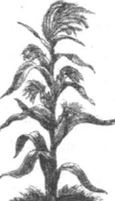
Which plant is shown in the given figure?
A
Sunflower
B
Maize
C
Rice
D
Pearl millet
Solution
(B) The figure shows a maize plant $(Zea \ mays)$.
Maize is a monoecious plant,meaning it bears both male and female flowers on the same individual plant.
The male inflorescence (tassel) is located at the apex,while the female inflorescence (ear) is located in the leaf axils.
Therefore,the correct option is $B$.
Maize is a monoecious plant,meaning it bears both male and female flowers on the same individual plant.
The male inflorescence (tassel) is located at the apex,while the female inflorescence (ear) is located in the leaf axils.
Therefore,the correct option is $B$.
0 likes
View Solution86
MediumMCQ
Assertion $(A)$: Death is a meaningful event.
Reason $(R)$: Death limits the number of individuals of each species and returns the materials of the body,formed by life elements,back to the environment.
Reason $(R)$: Death limits the number of individuals of each species and returns the materials of the body,formed by life elements,back to the environment.
A
$A$ and $R$ are both true,and $R$ is the correct explanation of $A$.
B
$A$ is true and $R$ is false.
C
$A$ and $R$ are both true,but $R$ is not the correct explanation of $A$.
D
$A$ is false and $R$ is true.
Solution
(A) Death is considered a meaningful event in biology because it plays a crucial role in the ecosystem.
It prevents overpopulation by limiting the number of individuals of a species.
Furthermore,it facilitates the recycling of nutrients.
When an organism dies,the complex organic materials of its body are broken down by decomposers,returning essential elements back to the environment to be reused by other living organisms.
Therefore,both the assertion and the reason are correct,and the reason provides the correct explanation for why death is considered meaningful.
It prevents overpopulation by limiting the number of individuals of a species.
Furthermore,it facilitates the recycling of nutrients.
When an organism dies,the complex organic materials of its body are broken down by decomposers,returning essential elements back to the environment to be reused by other living organisms.
Therefore,both the assertion and the reason are correct,and the reason provides the correct explanation for why death is considered meaningful.
0 likes
View Solution87
MediumMCQ
Assertion $(S)$: Death is a meaningful event.
Reason $(R)$: Death keeps the number of organisms of each species limited.
$(A)$ Both $S$ and $R$ are true,$R$ is the correct explanation of $S$.
$(B)$ Both $S$ and $R$ are true,but $R$ is not the correct explanation of $S$.
$(C)$ $S$ is true and $R$ is false.
$(D)$ $S$ is false and $R$ is true.
Reason $(R)$: Death keeps the number of organisms of each species limited.
$(A)$ Both $S$ and $R$ are true,$R$ is the correct explanation of $S$.
$(B)$ Both $S$ and $R$ are true,but $R$ is not the correct explanation of $S$.
$(C)$ $S$ is true and $R$ is false.
$(D)$ $S$ is false and $R$ is true.
A
$A$
B
$B$
C
$C$
D
$D$
Solution
(A) Death is considered a meaningful biological event because it is an essential part of the life cycle of organisms.
It ensures the continuity of life by preventing overpopulation and allowing for the replacement of older generations with newer,potentially better-adapted individuals.
By keeping the population size of each species within the carrying capacity of the ecosystem,death plays a crucial role in maintaining ecological balance.
Therefore,both the assertion and the reason are true,and the reason correctly explains why death is a meaningful event.
It ensures the continuity of life by preventing overpopulation and allowing for the replacement of older generations with newer,potentially better-adapted individuals.
By keeping the population size of each species within the carrying capacity of the ecosystem,death plays a crucial role in maintaining ecological balance.
Therefore,both the assertion and the reason are true,and the reason correctly explains why death is a meaningful event.
0 likes
View Solution88
MediumMCQ
Which one of the following statements is correct?
A
The seed in grasses is not endospermic.
B
Mango is a parthenocarpic fruit.
C
$A$ proteinaceous aleurone layer is present in maize grain.
D
$A$ sterile pistil is called a staminode.
Solution
(C) is the correct statement.
$1$. Grass seeds (like maize,wheat) are endospermic (albuminous).
$2$. Mango is a drupe fruit,not a parthenocarpic fruit.
$3$. In maize grain,the outer covering of endosperm is separated by a proteinaceous layer called the aleurone layer. This layer is rich in proteins and enzymes that help in the mobilization of stored nutrients during germination.
$4$. $A$ sterile pistil is called a pistillode,whereas a sterile stamen is called a staminode.
$1$. Grass seeds (like maize,wheat) are endospermic (albuminous).
$2$. Mango is a drupe fruit,not a parthenocarpic fruit.
$3$. In maize grain,the outer covering of endosperm is separated by a proteinaceous layer called the aleurone layer. This layer is rich in proteins and enzymes that help in the mobilization of stored nutrients during germination.
$4$. $A$ sterile pistil is called a pistillode,whereas a sterile stamen is called a staminode.
0 likes
View Solution89
EasyMCQ
Match column $I$ with column $II$ and select the correct option using the codes given below.
| Column-$I$ | Column-$II$ |
| $(A)$ Pistils fused together | $(i)$ Gametogenesis |
| $(B)$ Formation of gametes | $(ii)$ Pistillate |
| $(C)$ Hyphae of higher Ascomycetes | $(iii)$ Syncarpous |
| $(D)$ Unisexual female flower | $(iv)$ Dikaryotic |
A
$A-(iv), B-(iii), C-(i), D-(ii)$
B
$A-(ii), B-(i), C-(iv), D-(iii)$
C
$A-(i), B-(ii), C-(iv), D-(iii)$
D
$A-(iii), B-(i), C-(iv), D-(ii)$
Solution
(D) The correct matches are as follows:
$(A)$ Pistils fused together are termed as $\text{Syncarpous}$ $(iii)$.
$(B)$ The process of formation of gametes is known as $\text{Gametogenesis}$ $(i)$.
$(C)$ The hyphae of higher $\text{Ascomycetes}$ undergo a $\text{Dikaryotic}$ phase $(iv)$.
$(D)$ $A$ unisexual female flower is referred to as $\text{Pistillate}$ $(ii)$.
Therefore, the correct sequence is $A-(iii), B-(i), C-(iv), D-(ii)$.
$(A)$ Pistils fused together are termed as $\text{Syncarpous}$ $(iii)$.
$(B)$ The process of formation of gametes is known as $\text{Gametogenesis}$ $(i)$.
$(C)$ The hyphae of higher $\text{Ascomycetes}$ undergo a $\text{Dikaryotic}$ phase $(iv)$.
$(D)$ $A$ unisexual female flower is referred to as $\text{Pistillate}$ $(ii)$.
Therefore, the correct sequence is $A-(iii), B-(i), C-(iv), D-(ii)$.
0 likes
View Solution90
MediumMCQ
Which one of the following statements is not true?
A
Pollen grains of many species cause severe allergies.
B
Stored pollen in liquid nitrogen can be used in the crop breeding programmes.
C
Tapetum helps in the dehiscence of anther.
D
Exine of pollen grains is made up of sporopollenin.
Solution
(C) : The statement that "Tapetum helps in the dehiscence of anther" is incorrect.
$1$. Tapetum is the innermost layer of the microsporangium wall, which provides nourishment to the developing pollen grains.
$2$. The dehiscence of the anther is primarily facilitated by the endothecium layer, which develops fibrous thickenings of $\alpha$-cellulose that help in the release of pollen grains.
$3$. Pollen grains of many species (e.g., Parthenium) cause severe allergies.
$4$. Pollen grains can be stored for years in liquid nitrogen $(-196^{\circ}C)$ for use in crop breeding programmes.
$5$. The exine of pollen grains is composed of sporopollenin, which is one of the most resistant organic materials known.
$1$. Tapetum is the innermost layer of the microsporangium wall, which provides nourishment to the developing pollen grains.
$2$. The dehiscence of the anther is primarily facilitated by the endothecium layer, which develops fibrous thickenings of $\alpha$-cellulose that help in the release of pollen grains.
$3$. Pollen grains of many species (e.g., Parthenium) cause severe allergies.
$4$. Pollen grains can be stored for years in liquid nitrogen $(-196^{\circ}C)$ for use in crop breeding programmes.
$5$. The exine of pollen grains is composed of sporopollenin, which is one of the most resistant organic materials known.
0 likes
View Solution91
MediumMCQ
In angiosperms,microsporogenesis and megasporogenesis
A
involve meiosis
B
occur in ovule
C
occur in anther
D
form gametes without further divisions.
Solution
(A) : In angiosperms,microsporogenesis,i.e.,the formation of microspores (or pollen grains),occurs by the meiotic divisions of diploid microspore mother cells (or pollen mother cells). Microsporogenesis takes place in the anther.
Megasporogenesis,i.e.,the formation of megaspores,occurs by the meiotic divisions of diploid megaspore mother cells. Megasporogenesis takes place in the ovule.
Both processes involve meiosis to reduce the chromosome number from diploid $(2n)$ to haploid $(n)$.
Megasporogenesis,i.e.,the formation of megaspores,occurs by the meiotic divisions of diploid megaspore mother cells. Megasporogenesis takes place in the ovule.
Both processes involve meiosis to reduce the chromosome number from diploid $(2n)$ to haploid $(n)$.
0 likes
View Solution92
MediumMCQ
Which one of the following may require pollinators,but is genetically similar to autogamy?
A
Apogamy
B
Cleistogamy
C
Geitonogamy
D
Xenogamy
Solution
(C) $Geitonogamy$ involves the transfer of pollen grains from the anther of one flower to the stigma of another flower on the same plant.
Since the pollen must travel from one flower to another,it requires a pollinating agent (like insects,wind,or water).
However,it is genetically similar to $autogamy$ because both flowers belong to the same plant and therefore share the same genotype.
Since the pollen must travel from one flower to another,it requires a pollinating agent (like insects,wind,or water).
However,it is genetically similar to $autogamy$ because both flowers belong to the same plant and therefore share the same genotype.
0 likes
View Solution93
MediumMCQ
Which one of the following statements is not true?
A
The flowers pollinated by flies and bats secrete foul odour to attract them.
B
Honey is made by bees by digesting pollen collected from flowers.
C
Pollen grains are rich in nutrients and they are used in the form of tablets and syrups.
D
Pollen grains of some plants cause severe allergies and bronchial afflictions in some people.
Solution
(B) : Honey is made from nectar through a process of regurgitation and evaporation. Honeybees transform saccharides (carbohydrates) into honey by regurgitating it a number of times,until it is partially digested. The bees perform the regurgitation and digestion as a group. After the last regurgitation,the aqueous solution still has high water content; the process continues by evaporation of much of the water and enzymatic transformation. Honey is produced by bees as a food source,not by digesting pollen.
0 likes
View Solution94
MediumMCQ
Pollen tablets are available in the market for
A
in vitro fertilization
B
breeding programmes
C
supplementing food
D
$ex-situ$ conservation
Solution
(C) The correct answer is $(C)$. Pollen grains are rich in nutrients,containing proteins $(7-26 \%)$,carbohydrates $(24-48 \%)$,and fats $(0.9-14.5 \%)$.
They are consumed as food supplements in the form of tablets or syrups to improve overall health.
Additionally,they are used to enhance the performance of athletes and racehorses.
They are consumed as food supplements in the form of tablets or syrups to improve overall health.
Additionally,they are used to enhance the performance of athletes and racehorses.
0 likes
View Solution95
MediumMCQ
The advantage of cleistogamy is
A
no dependence on pollinators
B
vivipary
C
higher genetic variability
D
more vigorous offspring
Solution
(A) : Cleistogamy is the process of pollination and fertilization occurring before the flower opens. In such flowers,the anther and stigma lie in close proximity. When anthers dehisce within the flower buds,pollen grains come in contact with the stigma to effect pollination. Thus,cleistogamous flowers are invariably autogamous as there is no chance of cross-pollen landing on the stigma. Cleistogamous flowers produce assured seed-set even in the absence of pollinators.
0 likes
View Solution96
MediumMCQ
Which one of the following statements is correct?
A
Cleistogamous flowers are always autogamous.
B
Xenogamy occurs only by wind pollination.
C
Chasmogamous flowers do not open at all.
D
Geitonogamy involves the pollen and stigma of flowers of different plants.
Solution
(A) : In cleistogamy,flowers never open,so there is no alternative to self-pollination. It is invariably autogamous.
$B$: Xenogamy is the transfer of pollen grains from the anther to the stigma of a different plant. It can occur by various agents like wind,water,insects,and animals.
$C$: Chasmogamous flowers are those that expose their mature anthers and stigmas to the environment.
$D$: Geitonogamy is the transfer of pollen grains from the anther to the stigma of another flower on the same plant. Genetically,it is self-pollination,but ecologically,it involves a pollinating agent.
$B$: Xenogamy is the transfer of pollen grains from the anther to the stigma of a different plant. It can occur by various agents like wind,water,insects,and animals.
$C$: Chasmogamous flowers are those that expose their mature anthers and stigmas to the environment.
$D$: Geitonogamy is the transfer of pollen grains from the anther to the stigma of another flower on the same plant. Genetically,it is self-pollination,but ecologically,it involves a pollinating agent.
0 likes
View Solution97
MediumMCQ
Even in the absence of pollinating agents,seed setting is assured in
A
Commelina
B
Zostera
C
Salvia
D
fig
Solution
(A) : Some plants such as $Viola$ (common pansy),$Oxalis$,and $Commelina$ produce two types of flowers: chasmogamous flowers,which are similar to flowers of other species with exposed anthers and stigma,and cleistogamous flowers,which do not open at all.
In such cleistogamous flowers,the anthers and stigma lie very close to each other.
When anthers dehisce in the flower buds,pollen grains come in contact with the stigma to effect pollination.
Thus,cleistogamous flowers are invariably autogamous as there is no chance of cross-pollen landing on the stigma.
Therefore,cleistogamous flowers produce assured seed-set even in the absence of pollinators.
In such cleistogamous flowers,the anthers and stigma lie very close to each other.
When anthers dehisce in the flower buds,pollen grains come in contact with the stigma to effect pollination.
Thus,cleistogamous flowers are invariably autogamous as there is no chance of cross-pollen landing on the stigma.
Therefore,cleistogamous flowers produce assured seed-set even in the absence of pollinators.
1 likes
View Solution98
MediumMCQ
Which one of the following statements is wrong?
A
When pollen is shed at two-celled stage,double fertilization does not take place.
B
Vegetative cell is larger than generative cell.
C
Pollen grains in some plants remain viable for months.
D
Intine is made up of cellulose and pectin.
Solution
(A) : In $60\%$ of flowering plants,the pollen grains are shed at the two-celled stage (tube cell + generative cell).
Further development of the male gametophyte (pollen grain) occurs on the stigma.
The pollen grain gives rise to a pollen tube,which absorbs nourishment from the cells of the style for its growth.
The generative cell divides to give rise to two male gametes.
Out of these,one fuses with the egg to form a diploid zygote (syngamy),whereas the second male gamete fuses with the two polar nuclei or the diploid secondary nucleus of the central cell to form the primary endosperm nucleus (triple fusion).
These two acts of fertilization occur in the same embryo sac and are collectively referred to as double fertilization.
Therefore,the statement that double fertilization does not take place when pollen is shed at the two-celled stage is incorrect.
Further development of the male gametophyte (pollen grain) occurs on the stigma.
The pollen grain gives rise to a pollen tube,which absorbs nourishment from the cells of the style for its growth.
The generative cell divides to give rise to two male gametes.
Out of these,one fuses with the egg to form a diploid zygote (syngamy),whereas the second male gamete fuses with the two polar nuclei or the diploid secondary nucleus of the central cell to form the primary endosperm nucleus (triple fusion).
These two acts of fertilization occur in the same embryo sac and are collectively referred to as double fertilization.
Therefore,the statement that double fertilization does not take place when pollen is shed at the two-celled stage is incorrect.
0 likes
View Solution99
MediumMCQ
Examine the figures $(A-D)$ given below and select the right option out of $(A-D)$,in which all the four structures $A, B, C$ and $D$ are identified correctly.
A
$A$: Rhizome,$B$: Sporangiophore,$C$: Polar cell,$D$: Globule
B
$A$: Runner,$B$: Archegoniophore,$C$: Synergid,$D$: Antheridium
C
$A$: Offset,$B$: Antheridiophore,$C$: Antipodals,$D$: Oogonium
D
$A$: Sucker,$B$: Seta,$C$: Megaspore mother cell,$D$: Gemma cup
Solution
(C) The correct identification of the structures is as follows:
$A$ represents the offset of water hyacinth $(Eichhornia)$,which is a vegetative propagule.
$B$ represents the antheridiophore of $Marchantia$,a male reproductive structure in liverworts.
$C$ represents the antipodal cells found at the chalazal end of the mature embryo sac in angiosperms.
$D$ represents the oogonium,which is the female sex organ in the green alga $Chara$.
Therefore,option $C$ is the correct choice.
$A$ represents the offset of water hyacinth $(Eichhornia)$,which is a vegetative propagule.
$B$ represents the antheridiophore of $Marchantia$,a male reproductive structure in liverworts.
$C$ represents the antipodal cells found at the chalazal end of the mature embryo sac in angiosperms.
$D$ represents the oogonium,which is the female sex organ in the green alga $Chara$.
Therefore,option $C$ is the correct choice.
0 likes
View Solution100
MediumMCQ
Which one of the following pairs of plant structures has a haploid $(n)$ number of chromosomes?
A
Nucellus and antipodal cells
B
Egg nucleus and secondary nucleus
C
Megaspore mother cell and antipodal cells
D
Egg cell and antipodal cells
Solution
(D) In angiosperms,the $n$ (haploid) structures are those formed after meiosis or those that are part of the gametophyte generation.
$1$. The egg cell is a female gamete,which is haploid $(n)$.
$2$. Antipodal cells are part of the embryo sac and are also haploid $(n)$.
$3$. Nucellus and megaspore mother cells are diploid $(2n)$ as they are part of the sporophytic tissue.
$4$. The secondary nucleus is diploid $(2n)$ because it is formed by the fusion of two polar nuclei.
Therefore,the pair consisting of the egg cell and antipodal cells represents structures that are both haploid $(n)$.
$1$. The egg cell is a female gamete,which is haploid $(n)$.
$2$. Antipodal cells are part of the embryo sac and are also haploid $(n)$.
$3$. Nucellus and megaspore mother cells are diploid $(2n)$ as they are part of the sporophytic tissue.
$4$. The secondary nucleus is diploid $(2n)$ because it is formed by the fusion of two polar nuclei.
Therefore,the pair consisting of the egg cell and antipodal cells represents structures that are both haploid $(n)$.
0 likes
View SolutionSexual Reproduction in Flowering Plants — Mix Examples-Sexual Reproduction in Flowering Plants · Frequently Asked Questions
1Are these Sexual Reproduction in Flowering Plants questions useful for JEE and NEET?
Yes. All questions in this section are mapped to JEE Main and NEET exam patterns. Previous year questions from JEE Main, NEET, GUJCET and state-level exams are included with full solutions.
2Can I switch to Hindi or Gujarati for these questions?
Yes. Use the language tabs in the hero section or the sidebar to view the same questions and solutions in English, Hindi or Gujarati.
3How do I generate a question paper from this subtopic?
Use the Vedclass Exam Paper Generator — select the chapter and subtopic, set difficulty, and generate Sets A, B, C, D automatically. First 3 chapters of every subject are free.
Vedclass Products
For Students
Vedclass Test Series
Mock tests in real JEE/NEET style with performance analysis. 5-day free trial.
Start Free TrialFor Teachers
Exam Paper Generator
Generate Set A/B/C/D papers from this chapter in 2 minutes. 3 chapters free.
Try FreeFor Institutes
Online Exam Module
Live online exams with unlimited students, 360° analytics & white-label branding.
See DemoFor Teachers & Institutes
Generate a Sexual Reproduction in Flowering Plants Exam Paper in 2 Minutes
Select subtopic & difficulty — Sets A, B, C, D auto-generated with No Repeat logic.
First 3 chapters of every subject are free — no payment required.