
A English
Mix Examples-Sexual Reproduction in Flowering Plants Questions in English
Class 12 Biology · Sexual Reproduction in Flowering Plants · Mix Examples-Sexual Reproduction in Flowering Plants
354+
Questions
English
Language
100%
With Solutions
Showing 50 of 354 questions in English
201
MediumMCQ
What is most commonly observed in plants bearing bisexual flowers?
A
Xenogamy
B
Geitonogamy
C
Autogamy
D
None of these
Solution
(C) In plants bearing bisexual flowers,the male and female reproductive organs are present in the same flower.
This proximity facilitates self-pollination,which is known as $Autogamy$.
While other forms of pollination like $Geitonogamy$ and $Xenogamy$ can occur,$Autogamy$ is the most common phenomenon observed in such plants due to the structural arrangement of the floral parts.
This proximity facilitates self-pollination,which is known as $Autogamy$.
While other forms of pollination like $Geitonogamy$ and $Xenogamy$ can occur,$Autogamy$ is the most common phenomenon observed in such plants due to the structural arrangement of the floral parts.
0 likes
View Solution202
MediumMCQ
Select the option that represents the correct sequence of events in the process of fertilization in flowering plants:
$(I)$ Movement of male gametes towards the egg cell and central cell
$(II)$ Formation of pollen tube
$(III)$ Dehiscence of anther
$(IV)$ Germination of pollen grain
$(V)$ Fusion of nuclei (Syngamy and Triple Fusion)
$(VI)$ Entry of male gametes into the synergid
$(VII)$ Deposition of compatible pollen on the stigma
$(I)$ Movement of male gametes towards the egg cell and central cell
$(II)$ Formation of pollen tube
$(III)$ Dehiscence of anther
$(IV)$ Germination of pollen grain
$(V)$ Fusion of nuclei (Syngamy and Triple Fusion)
$(VI)$ Entry of male gametes into the synergid
$(VII)$ Deposition of compatible pollen on the stigma
A
$II, VI, V, VI, I, III, IV$
B
$III, IV, II, I, VI, V, VII$
C
$III, VII, IV, II, VI, I, V$
D
$II, VI, IV, V, VII, I, III$
Solution
(C) The correct sequence of events in the fertilization process of flowering plants is as follows:
$1$. $(III)$ Dehiscence of anther: Pollen grains are released from the anther.
$2$. $(VII)$ Deposition of compatible pollen on the stigma: Pollen grains land on the receptive stigma.
$3$. $(IV)$ Germination of pollen grain: Pollen grains germinate to form a pollen tube.
$4$. $(II)$ Formation of pollen tube: The pollen tube grows through the style towards the ovary.
$5$. $(VI)$ Entry of male gametes into the synergid: The pollen tube enters the ovule through the synergid.
$6$. $(I)$ Movement of male gametes towards the egg cell and central cell: Male gametes are released and move towards their targets.
$7$. $(V)$ Fusion of nuclei: Syngamy (fusion with egg) and Triple fusion (fusion with central cell) occur.
Therefore,the correct sequence is $III, VII, IV, II, VI, I, V$.
$1$. $(III)$ Dehiscence of anther: Pollen grains are released from the anther.
$2$. $(VII)$ Deposition of compatible pollen on the stigma: Pollen grains land on the receptive stigma.
$3$. $(IV)$ Germination of pollen grain: Pollen grains germinate to form a pollen tube.
$4$. $(II)$ Formation of pollen tube: The pollen tube grows through the style towards the ovary.
$5$. $(VI)$ Entry of male gametes into the synergid: The pollen tube enters the ovule through the synergid.
$6$. $(I)$ Movement of male gametes towards the egg cell and central cell: Male gametes are released and move towards their targets.
$7$. $(V)$ Fusion of nuclei: Syngamy (fusion with egg) and Triple fusion (fusion with central cell) occur.
Therefore,the correct sequence is $III, VII, IV, II, VI, I, V$.
0 likes
View Solution203
MediumMCQ
Which of the following processes occur simultaneously?
$(i)$ Ovule $\rightarrow$ Seed
$(ii)$ Ovary $\rightarrow$ Fruit
$(iii)$ $MMC$ $\rightarrow$ Megaspore
$(iv)$ $PMC$ $\rightarrow$ Pollen grain
$(i)$ Ovule $\rightarrow$ Seed
$(ii)$ Ovary $\rightarrow$ Fruit
$(iii)$ $MMC$ $\rightarrow$ Megaspore
$(iv)$ $PMC$ $\rightarrow$ Pollen grain
A
$(i)$ and $(ii)$
B
$(iii)$ and $(i)$
C
$(iii)$ and $(iv)$
D
$(ii)$ and $(iv)$
Solution
(A) In angiosperms,after fertilization,the ovary develops into the fruit and the ovule develops into the seed simultaneously.
$(i)$ Ovule $\rightarrow$ Seed: This is a post-fertilization change.
$(ii)$ Ovary $\rightarrow$ Fruit: This is also a post-fertilization change occurring alongside seed formation.
$(iii)$ $MMC$ (Megaspore Mother Cell) $\rightarrow$ Megaspore: This occurs before fertilization (megasporogenesis).
$(iv)$ $PMC$ (Pollen Mother Cell) $\rightarrow$ Pollen grain: This occurs before fertilization (microsporogenesis).
Therefore,processes $(i)$ and $(ii)$ occur simultaneously.
$(i)$ Ovule $\rightarrow$ Seed: This is a post-fertilization change.
$(ii)$ Ovary $\rightarrow$ Fruit: This is also a post-fertilization change occurring alongside seed formation.
$(iii)$ $MMC$ (Megaspore Mother Cell) $\rightarrow$ Megaspore: This occurs before fertilization (megasporogenesis).
$(iv)$ $PMC$ (Pollen Mother Cell) $\rightarrow$ Pollen grain: This occurs before fertilization (microsporogenesis).
Therefore,processes $(i)$ and $(ii)$ occur simultaneously.
0 likes
View Solution204
MediumMCQ
Match the following columns:
| List-$I$ | List-$II$ |
| $(a)$ Stamen | $(i)$ Microsporangium |
| $(b)$ Pistil | $(ii)$ Microsporophyll |
| $(c)$ Anther | $(iii)$ Megasporangium |
| $(d)$ Ovule | $(iv)$ Megasporophyll |
A
$a-iv, b-ii, c-iii, d-i$
B
$a-ii, b-iv, c-i, d-iii$
C
$a-iii, b-i, c-iv, d-ii$
D
$a-i, b-iii, c-iv, d-ii$
Solution
(B) The correct matching is as follows:
$(a)$ Stamen is the male reproductive organ, also known as the microsporophyll. Hence, $(a-ii)$.
$(b)$ Pistil is the female reproductive organ, also known as the megasporophyll. Hence, $(b-iv)$.
$(c)$ Anther is the part of the stamen that contains the pollen sacs, which are the microsporangia. Hence, $(c-i)$.
$(d)$ Ovule is the structure within the ovary that develops into a seed, which is the megasporangium. Hence, $(d-iii)$.
Therefore, the correct sequence is $(a-ii, b-iv, c-i, d-iii)$.
$(a)$ Stamen is the male reproductive organ, also known as the microsporophyll. Hence, $(a-ii)$.
$(b)$ Pistil is the female reproductive organ, also known as the megasporophyll. Hence, $(b-iv)$.
$(c)$ Anther is the part of the stamen that contains the pollen sacs, which are the microsporangia. Hence, $(c-i)$.
$(d)$ Ovule is the structure within the ovary that develops into a seed, which is the megasporangium. Hence, $(d-iii)$.
Therefore, the correct sequence is $(a-ii, b-iv, c-i, d-iii)$.
0 likes
View Solution205
MediumMCQ
Match the following columns:
| Column-$I$ | Column-$II$ |
| $(a)$ Sporopollenin | $(1)$ Spindle-shaped nucleus |
| $(b)$ Cellulose,Pectin | $(2)$ Exine |
| $(c)$ Vegetative cell | $(3)$ Intine |
| $(d)$ Generative cell | $(4)$ Irregularly shaped nucleus |
A
$a-3, b-2, c-4, d-1$
B
$a-2, b-3, c-1, d-4$
C
$a-4, b-1, c-2, d-3$
D
$a-2, b-3, c-4, d-1$
Solution
(D) The correct matching is as follows:
$(a)$ Sporopollenin is the most resistant organic material known,which forms the outer layer of pollen grain called the Exine $(a-2)$.
$(b)$ The inner wall of the pollen grain is called the Intine,which is thin and made up of cellulose and pectin $(b-3)$.
$(c)$ The vegetative cell is bigger,has abundant food reserve,and a large irregularly shaped nucleus $(c-4)$.
$(d)$ The generative cell is small and floats in the cytoplasm of the vegetative cell. It is spindle-shaped with dense cytoplasm and a nucleus $(d-1)$.
Therefore,the correct sequence is $a-2, b-3, c-4, d-1$.
$(a)$ Sporopollenin is the most resistant organic material known,which forms the outer layer of pollen grain called the Exine $(a-2)$.
$(b)$ The inner wall of the pollen grain is called the Intine,which is thin and made up of cellulose and pectin $(b-3)$.
$(c)$ The vegetative cell is bigger,has abundant food reserve,and a large irregularly shaped nucleus $(c-4)$.
$(d)$ The generative cell is small and floats in the cytoplasm of the vegetative cell. It is spindle-shaped with dense cytoplasm and a nucleus $(d-1)$.
Therefore,the correct sequence is $a-2, b-3, c-4, d-1$.
0 likes
View Solution206
MediumMCQ
Match the following columns:
| Column-$I$ | Column-$II$ |
|---|---|
| $(a)$ Maize | $(1)$ Entomophily |
| $(b)$ Hydrilla | $(2)$ Anemophily |
| $(c)$ Water Lily | $(3)$ Hydrophily |
| $(d)$ Yucca | $(4)$ Entomophily and Anemophily |
A
$a-2, b-3, c-4, d-1$
B
$a-1, b-3, c-2, d-4$
C
$a-2, b-4, c-3, d-1$
D
$a-3, b-2, c-4, d-1$
Solution
(A) The correct matches are as follows:
$(a)$ Maize: It is pollinated by wind,known as Anemophily $(2)$.
$(b)$ Hydrilla: It is a submerged aquatic plant pollinated by water,known as Hydrophily $(3)$.
$(c)$ Water Lily: Although it is an aquatic plant,its flowers emerge above the water level and are pollinated by insects or wind,known as Entomophily and Anemophily $(4)$.
$(d)$ Yucca: It has a specific symbiotic relationship with the moth Pronuba for pollination,known as Entomophily $(1)$.
Therefore,the correct sequence is $a-2, b-3, c-4, d-1$.
$(a)$ Maize: It is pollinated by wind,known as Anemophily $(2)$.
$(b)$ Hydrilla: It is a submerged aquatic plant pollinated by water,known as Hydrophily $(3)$.
$(c)$ Water Lily: Although it is an aquatic plant,its flowers emerge above the water level and are pollinated by insects or wind,known as Entomophily and Anemophily $(4)$.
$(d)$ Yucca: It has a specific symbiotic relationship with the moth Pronuba for pollination,known as Entomophily $(1)$.
Therefore,the correct sequence is $a-2, b-3, c-4, d-1$.
0 likes
View Solution207
MediumMCQ
Match the following columns:
| Column-$I$ | Column-$II$ |
|---|---|
| $(a)$ Zygote | $(1)$ Endosperm |
| $(b)$ $PEN$ | $(2)$ Embryo |
| $(c)$ Ovule | $(3)$ Fruit |
| $(d)$ Ovary | $(4)$ Seed |
A
$a-3, b-1, c-2, d-4$
B
$a-3, b-2, c-1, d-4$
C
$a-4, b-2, c-1, d-3$
D
$a-2, b-1, c-4, d-3$
Solution
(D) In angiosperms,post-fertilization changes occur as follows:
$1$. The Zygote $(a)$ develops into the Embryo $(2)$.
$2$. The Primary Endosperm Nucleus $(PEN)$ $(b)$ develops into the Endosperm $(1)$,which provides nutrition to the developing embryo.
$3$. The Ovule $(c)$ matures into the Seed $(4)$ after fertilization.
$4$. The Ovary $(d)$ matures into the Fruit $(3)$ after fertilization.
Therefore,the correct matching is $a-2, b-1, c-4, d-3$.
$1$. The Zygote $(a)$ develops into the Embryo $(2)$.
$2$. The Primary Endosperm Nucleus $(PEN)$ $(b)$ develops into the Endosperm $(1)$,which provides nutrition to the developing embryo.
$3$. The Ovule $(c)$ matures into the Seed $(4)$ after fertilization.
$4$. The Ovary $(d)$ matures into the Fruit $(3)$ after fertilization.
Therefore,the correct matching is $a-2, b-1, c-4, d-3$.
0 likes
View Solution208
MediumMCQ
Match the following columns:
| Column-$I$ | Column-$II$ |
| $(a)$ $PEN$ | $(1)$ Heart-shaped stage |
| $(b)$ $PEC$ | $(2)$ Coconut water |
| $(c)$ Cotyledon | $(3)$ White kernel of coconut |
| $(d)$ Dicot embryo | $(4)$ Scutellum |
A
$a-3, b-2, c-4, d-1$
B
$a-2, b-3, c-4, d-1$
C
$a-1, b-2, c-4, d-3$
D
$a-4, b-2, c-1, d-3$
Solution
$(A)$ The correct matching is as follows:
$(a)$ $PEN$ (Primary Endosperm Nucleus) develops into the white kernel of coconut, which is cellular endosperm $(a-3)$.
$(b)$ $PEC$ (Primary Endosperm Cell) gives rise to coconut water, which is free-nuclear endosperm $(b-2)$.
$(c)$ Cotyledon in monocots is known as Scutellum $(c-4)$.
$(d)$ Dicot embryo development passes through a heart-shaped stage $(d-1)$.
Therefore, the correct sequence is $a-3, b-2, c-4, d-1$.
$(a)$ $PEN$ (Primary Endosperm Nucleus) develops into the white kernel of coconut, which is cellular endosperm $(a-3)$.
$(b)$ $PEC$ (Primary Endosperm Cell) gives rise to coconut water, which is free-nuclear endosperm $(b-2)$.
$(c)$ Cotyledon in monocots is known as Scutellum $(c-4)$.
$(d)$ Dicot embryo development passes through a heart-shaped stage $(d-1)$.
Therefore, the correct sequence is $a-3, b-2, c-4, d-1$.
0 likes
View Solution209
MediumMCQ
Select the incorrect statement from the following.
A
Seeds are the final product of sexual reproduction.
B
Corolla and calyx are not the reproductive organs of a plant.
C
Androecium and gynoecium are accessory whorls.
D
Each lobe of an anther contains two microsporangia.
Solution
(C) $1$. Seeds are indeed the final product of sexual reproduction in angiosperms.
$2$. Calyx and corolla are accessory whorls,not reproductive organs.
$3$. Androecium (stamen) and gynoecium (pistil) are the reproductive whorls,not accessory whorls. Therefore,statement $C$ is incorrect.
$4$. $A$ typical angiosperm anther is dithecous,meaning it has two lobes,and each lobe contains two microsporangia,totaling four microsporangia.
$2$. Calyx and corolla are accessory whorls,not reproductive organs.
$3$. Androecium (stamen) and gynoecium (pistil) are the reproductive whorls,not accessory whorls. Therefore,statement $C$ is incorrect.
$4$. $A$ typical angiosperm anther is dithecous,meaning it has two lobes,and each lobe contains two microsporangia,totaling four microsporangia.
0 likes
View Solution210
MediumMCQ
Select the option that represents the correct statement.
A
The viability of pollen grains depends on the prevailing temperature and humidity.
B
The viability of pollen grains of Rosaceae is less than that of wheat.
C
Pollen grains can be stored for years in liquid nitrogen at $-196^{\circ}C$.
D
The exine of the pollen grain is made of cellulose.
Solution
(A) $1$. The viability of pollen grains is highly dependent on the prevailing temperature and humidity of the environment.
$2$. In some cereals like wheat and rice,pollen grains lose viability within $30$ minutes of their release,whereas in some members of Rosaceae,Leguminosae,and Solanaceae,they maintain viability for months.
$3$. Pollen grains can be stored for years in liquid nitrogen at $-196^{\circ}C$ (cryopreservation).
$4$. The exine of the pollen grain is made of sporopollenin,which is one of the most resistant organic materials known,not cellulose.
Therefore,option $A$ and $C$ are both factually correct statements. However,in standard textbook contexts,the dependence on environmental factors is a fundamental property. Given the options,$A$ is a correct statement.
$2$. In some cereals like wheat and rice,pollen grains lose viability within $30$ minutes of their release,whereas in some members of Rosaceae,Leguminosae,and Solanaceae,they maintain viability for months.
$3$. Pollen grains can be stored for years in liquid nitrogen at $-196^{\circ}C$ (cryopreservation).
$4$. The exine of the pollen grain is made of sporopollenin,which is one of the most resistant organic materials known,not cellulose.
Therefore,option $A$ and $C$ are both factually correct statements. However,in standard textbook contexts,the dependence on environmental factors is a fundamental property. Given the options,$A$ is a correct statement.
0 likes
View Solution211
MediumMCQ
Identify the false statement.
A
For self-pollination,the anther and stigma must be close to each other.
B
Cleistogamous flowers of Viola,Oxalis,and Commelina produce only self-pollinated seeds.
C
Geitonogamy is not observed in dioecious plants.
D
Geitonogamy is genetically similar to autogamy.
Solution
(B) $1$. Statement $A$ is true: For autogamy (self-pollination) to occur,the anther and stigma must be in close proximity.
$2$. Statement $B$ is false: The plants $Viola$,$Oxalis$,and $Commelina$ produce two types of flowers: chasmogamous and cleistogamous. Cleistogamous flowers do not open at all,ensuring self-pollination. The option incorrectly lists $Zostera$ instead of $Oxalis$ or $Commelina$ and generalizes the entire plant as cleistogamous.
$3$. Statement $C$ is true: Dioecious plants (e.g.,papaya) have separate male and female plants,so geitonogamy (transfer of pollen from anther to stigma of another flower on the same plant) cannot occur.
$4$. Statement $D$ is true: Geitonogamy involves pollen transfer between flowers of the same plant,meaning the genetic makeup of the pollen and the ovule is identical,similar to autogamy.
$2$. Statement $B$ is false: The plants $Viola$,$Oxalis$,and $Commelina$ produce two types of flowers: chasmogamous and cleistogamous. Cleistogamous flowers do not open at all,ensuring self-pollination. The option incorrectly lists $Zostera$ instead of $Oxalis$ or $Commelina$ and generalizes the entire plant as cleistogamous.
$3$. Statement $C$ is true: Dioecious plants (e.g.,papaya) have separate male and female plants,so geitonogamy (transfer of pollen from anther to stigma of another flower on the same plant) cannot occur.
$4$. Statement $D$ is true: Geitonogamy involves pollen transfer between flowers of the same plant,meaning the genetic makeup of the pollen and the ovule is identical,similar to autogamy.
0 likes
View Solution212
MediumMCQ
Which of the following statements is incorrect?
A
The ovaries of orchids and watermelons contain many ovules.
B
In Papaver (poppy),the carpels are free (apocarpous).
C
The ovule is attached to the placenta by means of a stalk called the funicle.
D
The nucellus is a mass of cells enclosed within the integuments.
Solution
(B) $1$. Orchids and watermelons have many ovules in their ovaries,which is a correct statement.
$2$. In $Papaver$ (poppy),the gynoecium is multicarpellary and syncarpous (fused carpels),not apocarpous. Therefore,the statement that carpels are free is incorrect.
$3$. The ovule is indeed attached to the placenta by a stalk called the funicle,which is a correct statement.
$4$. The nucellus is the central mass of tissue in an ovule,which is protected by one or two protective envelopes called integuments,making this statement correct.
$2$. In $Papaver$ (poppy),the gynoecium is multicarpellary and syncarpous (fused carpels),not apocarpous. Therefore,the statement that carpels are free is incorrect.
$3$. The ovule is indeed attached to the placenta by a stalk called the funicle,which is a correct statement.
$4$. The nucellus is the central mass of tissue in an ovule,which is protected by one or two protective envelopes called integuments,making this statement correct.
0 likes
View Solution213
MediumMCQ
Select the incorrect statement.
A
Hummingbirds and sunbirds are pollinators for some plants.
B
Floral nectar is a reward for pollinators.
C
Animals are the pollinators for the majority of flowering plants.
D
Moths and Yucca plants can complete their life cycles without each other.
Solution
(D) The correct answer is $D$. The relationship between the moth and the $Yucca$ plant is an example of obligate mutualism. The moth deposits its eggs in the locule of the ovary of the $Yucca$ flower,and in return,the flower gets pollinated by the moth. The larvae of the moth come out of the eggs as the seeds start developing. Neither the moth nor the $Yucca$ plant can complete their life cycles without each other. Therefore,the statement that they can complete their life cycles without each other is incorrect.
0 likes
View Solution214
MediumMCQ
Identify '$P$','$Q$','$R$','$S$',and '$T$' in the given figure.
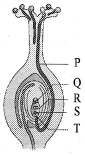
A
Pollen tube,Antipodal cells,Polar nuclei,Egg cell,Synergid
B
Pollen tube,Synergids,Polar nuclei,Egg cell,Antipodal cells
C
Pollen grain,Synergids,Egg cell,Antipodal cells,Polar nuclei
D
Pollen grain,Antipodal cells,Egg cell,Synergids,Polar nuclei
Solution
(A) Based on the structure of the mature embryo sac and the process of pollen tube entry into the ovule:
$1$. '$P$' represents the Pollen tube,which carries male gametes to the embryo sac.
$2$. '$Q$' represents the Antipodal cells,which are located at the chalazal end.
$3$. '$R$' represents the Polar nuclei,located in the central cell.
$4$. '$S$' represents the Egg cell,which is part of the egg apparatus.
$5$. '$T$' represents the Synergids,which guide the pollen tube into the embryo sac.
Therefore,the correct sequence is Pollen tube,Antipodal cells,Polar nuclei,Egg cell,Synergid.
$1$. '$P$' represents the Pollen tube,which carries male gametes to the embryo sac.
$2$. '$Q$' represents the Antipodal cells,which are located at the chalazal end.
$3$. '$R$' represents the Polar nuclei,located in the central cell.
$4$. '$S$' represents the Egg cell,which is part of the egg apparatus.
$5$. '$T$' represents the Synergids,which guide the pollen tube into the embryo sac.
Therefore,the correct sequence is Pollen tube,Antipodal cells,Polar nuclei,Egg cell,Synergid.
0 likes
View Solution215
MediumMCQ
Which of the following is not a post-fertilization event?
A
Ovule $\rightarrow$ Seed
B
Ovary $\rightarrow$ Fruit
C
Zygote $\rightarrow$ Embryo
D
Megaspore $\rightarrow$ Embryo sac
Solution
(D) Post-fertilization events are the changes that occur in the flower after the process of fertilization is completed.
These include the transformation of the ovule into a seed,the ovary into a fruit,and the zygote into an embryo.
However,the transformation of a megaspore into an embryo sac is a pre-fertilization event,as it occurs during the development of the female gametophyte before fertilization takes place.
Therefore,the correct answer is $D$.
These include the transformation of the ovule into a seed,the ovary into a fruit,and the zygote into an embryo.
However,the transformation of a megaspore into an embryo sac is a pre-fertilization event,as it occurs during the development of the female gametophyte before fertilization takes place.
Therefore,the correct answer is $D$.
0 likes
View Solution216
EasyMCQ
Which plant has the longest pollen tube?
A
Maize
B
Hibiscus
C
Coconut
D
Peepal
Solution
(A) The length of the pollen tube depends on the distance it must travel through the style to reach the ovule. In $Zea mays$ (Maize), the style is extremely long (the silk of the corn), and the pollen tube must grow through this entire length to reach the ovary. Therefore, maize has the longest pollen tube among the given options.
0 likes
View Solution217
MediumMCQ
Which of the following plant families has $polysiphonous$ pollen grains?
A
Leguminosae
B
Malvaceae
C
Cucurbitaceae
D
Both $B$ and $C$
Solution
(D) $Polysiphonous$ pollen grains are those from which more than one pollen tube emerges during germination.
In the plant families $Malvaceae$ and $Cucurbitaceae$,$polysiphonous$ pollen grains are commonly observed.
Therefore,the correct option is $D$.
In the plant families $Malvaceae$ and $Cucurbitaceae$,$polysiphonous$ pollen grains are commonly observed.
Therefore,the correct option is $D$.
0 likes
View Solution218
MediumMCQ
Identify the false statement.
A
Water hyacinth flowers are light purple in color.
B
Water hyacinth is an aquatic weed.
C
Water hyacinth was introduced in India due to its pollutant-indicator property.
D
Water hyacinth causes an imbalance in the ecosystem dynamics of water bodies.
Solution
(C) Water hyacinth $(Eichhornia \text{ } crassipes)$ was introduced in India primarily because of its beautiful flowers and leaf shape, not because of its pollutant-indicator property. It is an invasive aquatic weed that grows rapidly in water bodies, causing an imbalance in the ecosystem dynamics by depleting dissolved oxygen, which leads to the death of fishes and other aquatic organisms. Therefore, statement $C$ is false.
0 likes
View Solution219
EasyMCQ
Male and female gametophytes do not have an independent free-living existence in
A
Bryophytes
B
Pteridophytes
C
Algae
D
Angiosperms
Solution
(D) In $Angiosperms$,the male and female gametophytes are highly reduced and are dependent on the sporophyte for their nutrition and development. They do not have an independent free-living existence. In contrast,in $Bryophytes$,$Pteridophytes$,and $Algae$,the gametophytic phase is often free-living and independent.
0 likes
View Solution220
MediumMCQ
Non-viable seeds are produced by
A
Somatic embryogenesis
B
Apomixis
C
Hybridisation
D
Parthenocarpy
Solution
(C) Non-viable seeds are often produced as a result of $Hybridisation$ in plants. When two genetically distinct varieties are crossed, the resulting $F_1$ generation may sometimes produce seeds that lack a functional embryo or possess endosperm abnormalities, rendering them non-viable. In contrast, $Apomixis$ produces viable seeds without fertilization, $Parthenocarpy$ typically results in seedless fruits, and $Somatic$ $\text{embryogenesis}$ is a technique used for clonal propagation where embryos are derived from somatic cells.
0 likes
View Solution221
EasyMCQ
Reproductive parts of an angiospermic plant are
A
Stamen
B
Pistil
C
Both $(A)$ and $(B)$
D
Shoot
Solution
(C) In angiosperms,the flower bears the male and female sex organs.
The male sex organ is the stamen,also known as the androecium. It consists of an anther lobe and a filament. The anther produces pollen grains.
The female sex organ is the carpel,also known as the pistil or gynoecium. It consists of three parts: the style,stigma,and ovary.
The male sex organ is the stamen,also known as the androecium. It consists of an anther lobe and a filament. The anther produces pollen grains.
The female sex organ is the carpel,also known as the pistil or gynoecium. It consists of three parts: the style,stigma,and ovary.
0 likes
View Solution222
MediumMCQ
Angiospermic plants are characterised by:
$I.$ Double fertilisation
$II.$ Triploid endosperm
$III.$ Diploid endosperm
Choose the correct option from the following regarding the above statements.
$I.$ Double fertilisation
$II.$ Triploid endosperm
$III.$ Diploid endosperm
Choose the correct option from the following regarding the above statements.
A
$I$ and $II$ are correct
B
$I$ and $III$ are correct
C
$II$ and $III$ are correct
D
$I, II$ and $III$ are correct
Solution
(A) Double fertilisation is a characteristic feature of angiosperms,discovered by $SG$ Nawaschin in $1898$.
In double fertilisation,one male gamete fuses with the egg cell (ovum) to form a diploid zygote $(2n)$.
The second male gamete fuses with the diploid secondary nucleus (central cell) to form the triploid primary endosperm nucleus $(3n)$,which develops into the triploid endosperm.
The endosperm provides nutrition to the developing embryo.
Therefore,statements $I$ and $II$ are correct.
In double fertilisation,one male gamete fuses with the egg cell (ovum) to form a diploid zygote $(2n)$.
The second male gamete fuses with the diploid secondary nucleus (central cell) to form the triploid primary endosperm nucleus $(3n)$,which develops into the triploid endosperm.
The endosperm provides nutrition to the developing embryo.
Therefore,statements $I$ and $II$ are correct.
0 likes
View Solution223
MediumMCQ
Which of the following is incorrect with respect to angiosperms?
A
Endosperm - Triploid
B
Megaspore - Diploid
C
Pollen grain - Haploid
D
Synergid - Haploid
Solution
(B) In angiosperms,the megaspore mother cell $(MMC)$ is diploid $(2n)$.
It undergoes meiosis to produce four megaspores,which are haploid $(n)$ in nature.
Therefore,the statement 'Megaspore - Diploid' is incorrect.
Endosperm is formed by triple fusion and is triploid $(3n)$.
Pollen grains are haploid $(n)$ gametophytes.
Synergids are part of the embryo sac and are haploid $(n)$.
It undergoes meiosis to produce four megaspores,which are haploid $(n)$ in nature.
Therefore,the statement 'Megaspore - Diploid' is incorrect.
Endosperm is formed by triple fusion and is triploid $(3n)$.
Pollen grains are haploid $(n)$ gametophytes.
Synergids are part of the embryo sac and are haploid $(n)$.
0 likes
View Solution224
MediumMCQ
Identify the wrong statements.
A
The ovule develops into seed.
B
The ovary develops into fruit.
C
The triple nucleus develops into endosperm.
D
Double fertilisation is the fusion of male gamete with egg.
Solution
(D) Double fertilisation was discovered by $SG$ Nawaschin $(1898)$ and Guignard in $Lilium$ and $Fritillaria$. Double fertilisation is a characteristic feature restricted to angiosperms.
When the pollen tube enters the ovule,it releases two male gametes into the embryo sac.
$(i)$ Generative Fertilisation: Fusion of one male gamete with the egg cell to form a diploid zygote $(2n)$.
$(ii)$ Vegetative Fertilisation (Triple Fusion): Fusion of the second male gamete with the diploid secondary nucleus (formed by two polar nuclei) to form the primary endosperm nucleus $(PEN)$,which develops into the triploid endosperm $(3n)$.
Statement $D$ is incorrect because double fertilisation encompasses both syngamy (fusion with egg) and triple fusion (fusion with polar nuclei),not just the fusion of a male gamete with the egg.
When the pollen tube enters the ovule,it releases two male gametes into the embryo sac.
$(i)$ Generative Fertilisation: Fusion of one male gamete with the egg cell to form a diploid zygote $(2n)$.
$(ii)$ Vegetative Fertilisation (Triple Fusion): Fusion of the second male gamete with the diploid secondary nucleus (formed by two polar nuclei) to form the primary endosperm nucleus $(PEN)$,which develops into the triploid endosperm $(3n)$.
Statement $D$ is incorrect because double fertilisation encompasses both syngamy (fusion with egg) and triple fusion (fusion with polar nuclei),not just the fusion of a male gamete with the egg.
0 likes
View Solution225
MediumMCQ
Which of the following cells of the embryo sac degenerate after fertilisation in angiosperms?
A
Synergids
B
Polar nuclei
C
Antipodal cells
D
Both $(a)$ and $(c)$
Solution
(D) In angiosperms,after the process of double fertilisation,the egg cell develops into a zygote and the central cell develops into the primary endosperm cell. The synergids and antipodal cells do not participate in the formation of the embryo or endosperm and consequently degenerate after fertilisation.
0 likes
View Solution226
MediumMCQ
Flowering plants are more successful than other members of the plant world because
A
They are large and have a good vascular tissue system
B
They carry out a variety of pollination mechanisms
C
The protected plant embryo can survive in the period of unfavourable conditions
D
All of these
Solution
(D) Flowering plants (Angiosperms) are considered the most successful group of plants due to several evolutionary advantages:
$1$. They possess a highly developed vascular system (xylem and phloem) for efficient transport of water and nutrients.
$2$. They exhibit a wide variety of pollination mechanisms,including biotic (insects,birds,bats) and abiotic (wind,water) agents,which ensures successful reproduction.
$3$. The seeds are protected within fruits,and the embryo is well-protected,allowing it to survive during periods of unfavourable environmental conditions.
$1$. They possess a highly developed vascular system (xylem and phloem) for efficient transport of water and nutrients.
$2$. They exhibit a wide variety of pollination mechanisms,including biotic (insects,birds,bats) and abiotic (wind,water) agents,which ensures successful reproduction.
$3$. The seeds are protected within fruits,and the embryo is well-protected,allowing it to survive during periods of unfavourable environmental conditions.
0 likes
View Solution227
MediumMCQ
Which one of the following is an example of cleistogamy?
A
Sunflower
B
Vallisneria
C
Commelina
D
Calotropis
Solution
(C) Cleistogamy is a phenomenon where bisexual flowers do not open at all.
In these flowers,the anthers and stigma lie close to each other.
When anthers dehisce in the flower buds,pollen grains come in contact with the stigma to effect pollination.
Thus,cleistogamous flowers are invariably autogamous as there is no chance of cross-pollination.
$Commelina$ $benghalensis$ is a classic example of a plant that produces both chasmogamous and cleistogamous flowers.
In these flowers,the anthers and stigma lie close to each other.
When anthers dehisce in the flower buds,pollen grains come in contact with the stigma to effect pollination.
Thus,cleistogamous flowers are invariably autogamous as there is no chance of cross-pollination.
$Commelina$ $benghalensis$ is a classic example of a plant that produces both chasmogamous and cleistogamous flowers.
0 likes
View Solution228
EasyMCQ
Which one of the following is a monocarpic tree?
A
Borassus flabellifer
B
Corypha umbraculifera
C
Phoenix dactylifera
D
Elaeis guineensis
Solution
(B) monocarpic plant is one that flowers and produces fruit only once in its lifetime,after which it dies.
Among the given options,$Corypha$ $umbraculifera$ (Talipot palm) is a well-known example of a monocarpic tree.
While $Borassus$ $flabellifer$ is polycarpic,$Corypha$ $umbraculifera$ flowers only once after a long vegetative period (often $30-80$ years) and then dies.
Among the given options,$Corypha$ $umbraculifera$ (Talipot palm) is a well-known example of a monocarpic tree.
While $Borassus$ $flabellifer$ is polycarpic,$Corypha$ $umbraculifera$ flowers only once after a long vegetative period (often $30-80$ years) and then dies.
0 likes
View Solution229
EasyMCQ
Which of the following pairs of families possess pollinia?
A
Orchidaceae and Apocynaceae
B
Orchidaceae and Asclepiadaceae
C
Asclepiadaceae and Mimosaceae
D
Asclepiadaceae and Apocynaceae
Solution
(B) Pollinia are coherent masses of pollen grains found in certain plant families.
These structures are characteristic features of the families $Orchidaceae$ and $Asclepiadaceae$.
In these families,the pollen grains are transferred as a single unit during pollination.
These structures are characteristic features of the families $Orchidaceae$ and $Asclepiadaceae$.
In these families,the pollen grains are transferred as a single unit during pollination.
0 likes
View Solution230
EasyMCQ
$Strobilanthus$ $kunthiana$ is also called:
A
Neelakuranji
B
Peelakuranji
C
Hara Kuranji
D
Violet Kuranji
Solution
(A) $Strobilanthus$ $kunthiana$ is commonly known as $Neelakuranji$ in the local language.
It is found in the hilly regions of Kerala,Karnataka,and Tamil Nadu.
This plant exhibits a unique flowering pattern,blooming once every $12$ years.
The last mass flowering event occurred in $2006$,which resulted in a massive quantity of blue flowers,covering the hills in a blue carpet and attracting many tourists.
It is found in the hilly regions of Kerala,Karnataka,and Tamil Nadu.
This plant exhibits a unique flowering pattern,blooming once every $12$ years.
The last mass flowering event occurred in $2006$,which resulted in a massive quantity of blue flowers,covering the hills in a blue carpet and attracting many tourists.
0 likes
View Solution231
EasyMCQ
Animals that give birth to young ones are known as:
A
Oviparous
B
Ovoviviparous
C
Viviparous
D
Both $(B)$ and $(C)$
Solution
(C) Animals that give birth to young ones are called viviparous.
In viviparous animals,the development of the embryo takes place inside the female body,and the mother gives birth to fully developed young ones.
Oviparous animals are those that lay eggs.
Ovoviviparous animals are those where eggs develop inside the mother's body,but the embryo derives nutrition from the egg yolk rather than directly from the mother,and they eventually hatch or are delivered as young ones.
In viviparous animals,the development of the embryo takes place inside the female body,and the mother gives birth to fully developed young ones.
Oviparous animals are those that lay eggs.
Ovoviviparous animals are those where eggs develop inside the mother's body,but the embryo derives nutrition from the egg yolk rather than directly from the mother,and they eventually hatch or are delivered as young ones.
0 likes
View Solution232
EasyMCQ
Who worked on embryological aspects and popularized the use of embryological characters in taxonomy?
A
$P$. Guha
B
$P$. Maheshwari
C
Ivanovsky
D
$D$. Graaf
Solution
(B) Prof. $P. Maheshwari$ was a renowned Indian botanist who made significant contributions to plant embryology.
He extensively studied the embryological aspects of angiosperms and emphasized the importance of embryological characters in the classification of plants (taxonomy).
His work helped in establishing embryology as a vital tool for understanding evolutionary relationships among plant groups.
He extensively studied the embryological aspects of angiosperms and emphasized the importance of embryological characters in the classification of plants (taxonomy).
His work helped in establishing embryology as a vital tool for understanding evolutionary relationships among plant groups.
0 likes
View Solution233
MediumMCQ
Product of sexual reproduction generally generates:
A
Prolonged dormancy
B
New genetic combination leading to variation
C
Large biomass
D
Longer viability of seeds
Solution
(B) Sexual reproduction involves the fusion of male and female gametes,which are formed through meiosis.
During meiosis,processes like crossing over and independent assortment occur,leading to genetic recombination.
This results in offspring that are genetically distinct from their parents and from each other.
Therefore,the primary outcome of sexual reproduction is the creation of new genetic combinations that lead to variation within a population.
During meiosis,processes like crossing over and independent assortment occur,leading to genetic recombination.
This results in offspring that are genetically distinct from their parents and from each other.
Therefore,the primary outcome of sexual reproduction is the creation of new genetic combinations that lead to variation within a population.
0 likes
View Solution234
MediumMCQ
Offspring produced by sexual reproduction exhibit more variation than those produced by asexual reproduction because
A
Sexual reproduction is a lengthy process
B
Gametes of parents have quantitatively different genetic composition
C
Genetic material comes from two parents of the same species
D
Greater amount of $DNA$ is involved in sexual reproduction
Solution
(C) Sexual reproduction is characterized by genetic recombination and the fusion of gametes from two different parents.
Due to genetic recombination and independent assortment during meiosis,the progeny exhibit significant variations compared to their parents.
In sexual reproduction,the genetic material is contributed by two parents of the same species,leading to a unique combination of traits in the offspring.
In contrast,asexual reproduction involves only one individual,resulting in offspring that are genetically identical to the parent (clones).
Due to genetic recombination and independent assortment during meiosis,the progeny exhibit significant variations compared to their parents.
In sexual reproduction,the genetic material is contributed by two parents of the same species,leading to a unique combination of traits in the offspring.
In contrast,asexual reproduction involves only one individual,resulting in offspring that are genetically identical to the parent (clones).
0 likes
View Solution235
EasyMCQ
The condition in which male and female reproductive parts are present on different plants is called:
A
Heterothallic
B
Dioecious
C
Unisexual
D
All of these
Solution
(D) The condition where male and female reproductive organs are present on separate individual plants is known as dioecious.
In fungi and some lower plants,this condition is referred to as heterothallic.
Since the plants bear only one type of reproductive organ (either male or female),they are also described as unisexual.
Therefore,all these terms are used to describe the condition where sexes are separate.
In fungi and some lower plants,this condition is referred to as heterothallic.
Since the plants bear only one type of reproductive organ (either male or female),they are also described as unisexual.
Therefore,all these terms are used to describe the condition where sexes are separate.
0 likes
View Solution236
EasyMCQ
Which of the following is correct about $NeelaKuranji$?
A
Last time it flowered in $Sept-Oct, 2006$.
B
Next time it will flower in $Sept-Oct, 2018$.
C
It is found in Kerala,Tamil Nadu,and Karnataka.
D
All of the above.
Solution
(D) All statements are correct.
$Strobilanthes kunthiana$,commonly known as $NeelaKuranji$,is a plant species found in the hilly regions of Kerala,Tamil Nadu,and Karnataka.
It exhibits a unique flowering cycle,blooming once every $12$ years.
The last recorded mass flowering occurred in $Sept-Oct, 2006$,and the subsequent cycle occurred in $Sept-Oct, 2018$.
During this period,the flowers cover the hills in a blue hue,attracting a large number of tourists.
$Strobilanthes kunthiana$,commonly known as $NeelaKuranji$,is a plant species found in the hilly regions of Kerala,Tamil Nadu,and Karnataka.
It exhibits a unique flowering cycle,blooming once every $12$ years.
The last recorded mass flowering occurred in $Sept-Oct, 2006$,and the subsequent cycle occurred in $Sept-Oct, 2018$.
During this period,the flowers cover the hills in a blue hue,attracting a large number of tourists.
0 likes
View Solution237
EasyMCQ
The condition in which both male and female reproductive organs are found on the same plant is called:
A
Unisexual
B
Bisexual
C
Monoecious
D
Both $(b)$ and $(c)$
Solution
(D) The condition where both male and female reproductive organs are present on the same plant is referred to as 'bisexual' or 'monoecious'.
In botanical terminology,the term 'monoecious' is specifically used to describe plants where both male and female flowers are borne on the same individual.
The term 'bisexual' is also used to describe flowers that contain both stamens and carpels,or plants that possess such flowers.
Therefore,both terms are applicable to this condition.
In botanical terminology,the term 'monoecious' is specifically used to describe plants where both male and female flowers are borne on the same individual.
The term 'bisexual' is also used to describe flowers that contain both stamens and carpels,or plants that possess such flowers.
Therefore,both terms are applicable to this condition.
0 likes
View Solution238
EasyMCQ
Bamboo species flower only in
A
$50-100\; \text{years}$
B
$25-50\; \text{years}$
C
$75-100\; \text{years}$
D
$60-80\; \text{years}$
Solution
$(A)$ Bamboo is a monocarpic plant, meaning it reproduces only once in its lifetime.
It typically flowers after a period of $50-100\; \text{years}$ of growth.
After the flowering and fruiting process, the plant dies.
It typically flowers after a period of $50-100\; \text{years}$ of growth.
After the flowering and fruiting process, the plant dies.
0 likes
View Solution239
MediumMCQ
$Statement\; 1$: Zygote is the link between two generations.
$Statement\; 2$: Zygote is the product of two gametes and the producer of the next generation.
$Statement\; 2$: Zygote is the product of two gametes and the producer of the next generation.
A
$Statement\; 1$ is True,$Statement\; 2$ is True; $Statement\; 2$ is the correct explanation for $Statement\; 1$.
B
$Statement\; 1$ is True,$Statement\; 2$ is True; $Statement\; 2$ is not the correct explanation for $Statement\; 1$.
C
$Statement\; 1$ is True,$Statement\; 2$ is False.
D
$Statement\; 1$ is False,$Statement\; 2$ is True.
Solution
$(A)$ The zygote is a diploid cell formed by the fusion of two haploid gametes (male and female) during fertilization.
It serves as the vital link between two generations because it carries the genetic material from the parents to the offspring.
Since the zygote develops into the new organism, which will eventually produce gametes for the next generation, it is considered the product of the current generation and the producer of the next.
Therefore, $Statement\; 2$ correctly explains why the zygote acts as a link between generations as stated in $Statement\; 1$.
It serves as the vital link between two generations because it carries the genetic material from the parents to the offspring.
Since the zygote develops into the new organism, which will eventually produce gametes for the next generation, it is considered the product of the current generation and the producer of the next.
Therefore, $Statement\; 2$ correctly explains why the zygote acts as a link between generations as stated in $Statement\; 1$.
0 likes
View Solution240
MediumMCQ
$Statement\; 1$: Zygote is a single cell.
$Statement\; 2$: Two haploid cells fuse to form two diploid cells.
$Statement\; 2$: Two haploid cells fuse to form two diploid cells.
A
$Statement\; 1$ is True,$Statement\; 2$ is True; $Statement\; 2$ is the correct explanation for $Statement\; 1$.
B
$Statement\; 1$ is True,$Statement\; 2$ is True; $Statement\; 2$ is not the correct explanation for $Statement\; 1$.
C
$Statement\; 1$ is True,$Statement\; 2$ is False.
D
$Statement\; 1$ is False,$Statement\; 2$ is True.
Solution
(C) $Statement\; 1$ is True because a zygote is formed by the fusion of two gametes,resulting in a single-celled structure.
$Statement\; 2$ is False because the fusion of two haploid cells $(n + n)$ results in the formation of a single diploid cell $(2n)$,not two diploid cells.
$Statement\; 2$ is False because the fusion of two haploid cells $(n + n)$ results in the formation of a single diploid cell $(2n)$,not two diploid cells.
0 likes
View Solution241
MediumMCQ
Match the following columns:
| Column-$I$ | Column-$II$ |
|---|---|
| $(A)$ Clone | $(1)$ Agamospermy |
| $(B)$ Plant apomixis | $(2)$ Scion |
| $(C)$ Grafting | $(3)$ Callus |
| $(D)$ Tissue culture | $(4)$ Flower |
| $(E)$ Inflorescence | $(5)$ Ramet |
A
$A-5, B-1, C-2, D-3, E-4$
B
$A-5, B-1, C-3, D-2, E-4$
C
$A-1, B-2, C-3, D-4, E-4$
D
$A-5, B-2, C-3, D-4, E-4$
Solution
(A) The correct matching is as follows:
$(A)$ Clone: $A$ clone is a group of genetically identical individuals,often referred to as a $Ramet$ $(5)$.
$(B)$ Plant apomixis: This is a form of asexual reproduction that mimics sexual reproduction,such as $Agamospermy$ $(1)$.
$(C)$ Grafting: This technique involves joining two plants,where the upper part is called the $Scion$ $(2)$.
$(D)$ Tissue culture: This process involves the growth of cells or tissues in a sterile medium,often resulting in an undifferentiated mass called $Callus$ $(3)$.
$(E)$ Inflorescence: This refers to the arrangement of flowers on the floral axis,which is a $Flower$ $(4)$ bearing structure.
Therefore,the correct sequence is $A-5, B-1, C-2, D-3, E-4$.
$(A)$ Clone: $A$ clone is a group of genetically identical individuals,often referred to as a $Ramet$ $(5)$.
$(B)$ Plant apomixis: This is a form of asexual reproduction that mimics sexual reproduction,such as $Agamospermy$ $(1)$.
$(C)$ Grafting: This technique involves joining two plants,where the upper part is called the $Scion$ $(2)$.
$(D)$ Tissue culture: This process involves the growth of cells or tissues in a sterile medium,often resulting in an undifferentiated mass called $Callus$ $(3)$.
$(E)$ Inflorescence: This refers to the arrangement of flowers on the floral axis,which is a $Flower$ $(4)$ bearing structure.
Therefore,the correct sequence is $A-5, B-1, C-2, D-3, E-4$.
0 likes
View Solution242
MediumMCQ
Events in the diagram are (in sequential order)
A
Fission of gametes $\rightarrow$ new individual $\rightarrow$ zygote
B
Fusion of gametes $\rightarrow$ zygote $\rightarrow$ new individual (cell $2n$)
C
Fission of gametes $\rightarrow$ zygote $\rightarrow$ new individual (cell $2n$)
D
Stages in the gametogenesis
Solution
(B) The given diagram illustrates the process of sexual reproduction.
First,the fusion of male and female gametes occurs (syngamy).
Second,the formation of a zygote takes place,where the two nuclei fuse into a single diploid $(2n)$ nucleus.
Third,the zygote develops into a new individual (cell $2n$),representing the completion of the fertilization process.
First,the fusion of male and female gametes occurs (syngamy).
Second,the formation of a zygote takes place,where the two nuclei fuse into a single diploid $(2n)$ nucleus.
Third,the zygote develops into a new individual (cell $2n$),representing the completion of the fertilization process.
0 likes
View Solution243
EasyMCQ
Give the ploidy of the following structures in angiospermic plants: Zygote,Endosperm,and Ovum.
A
$n, n, 2n$
B
$2n, 2n, n$
C
$2n, 3n, n$
D
$2n, n, 2n$
Solution
(C) In angiospermic plants:
$1$. The $Zygote$ is formed by the fusion of a male gamete $(n)$ and an ovum $(n)$,resulting in a diploid structure $(2n)$.
$2$. The $Endosperm$ is formed by the process of triple fusion involving two polar nuclei $(n+n)$ and one male gamete $(n)$,resulting in a triploid structure $(3n)$.
$3$. The $Ovum$ (egg cell) is a haploid gamete produced after meiosis,represented as $(n)$.
$1$. The $Zygote$ is formed by the fusion of a male gamete $(n)$ and an ovum $(n)$,resulting in a diploid structure $(2n)$.
$2$. The $Endosperm$ is formed by the process of triple fusion involving two polar nuclei $(n+n)$ and one male gamete $(n)$,resulting in a triploid structure $(3n)$.
$3$. The $Ovum$ (egg cell) is a haploid gamete produced after meiosis,represented as $(n)$.
0 likes
View Solution244
MediumMCQ
From the processes given below,how many are associated with post-fertilisation events?
A
Syngamy,gamete transfer
B
Gametogenesis,cell division
C
Cell differentiation,gametic fusion
D
Embryogenesis,$PEN$ formation
Solution
(D) Post-fertilisation events occur after the fusion of gametes (syngamy) to form a zygote.
$1$. Embryogenesis: The process of development of an embryo from the zygote.
$2$. $PEN$ (Primary Endosperm Nucleus) formation: In angiosperms,the fusion of the male gamete with the two polar nuclei (triple fusion) results in the formation of the $PEN$.
Both embryogenesis and $PEN$ formation are characteristic post-fertilisation events.
$1$. Embryogenesis: The process of development of an embryo from the zygote.
$2$. $PEN$ (Primary Endosperm Nucleus) formation: In angiosperms,the fusion of the male gamete with the two polar nuclei (triple fusion) results in the formation of the $PEN$.
Both embryogenesis and $PEN$ formation are characteristic post-fertilisation events.
0 likes
View Solution245
EasyMCQ
Which of the following statements is true regarding $Strobilanthus \; kunthiana$ (Neelakuranji)?
A
Shows flowering once in $12 \; \text{months}$.
B
Transformed hilly tracks of Kerala, Karnataka, and Tamil Nadu into blue stretches.
C
Showed flowering during November-December $2006$.
D
It is an annual plant.
Solution
(B) $Strobilanthus \; kunthiana$ (Neelakuranji) is a monocarpic plant that flowers once every $12 \; \text{years}$.
It is famous for transforming the hilly regions of Kerala, Karnataka, and Tamil Nadu into vast blue stretches during its mass flowering event.
The last recorded mass flowering occurred between September and October $2006$.
Therefore, statement $B$ is the correct description of this phenomenon.
It is famous for transforming the hilly regions of Kerala, Karnataka, and Tamil Nadu into vast blue stretches during its mass flowering event.
The last recorded mass flowering occurred between September and October $2006$.
Therefore, statement $B$ is the correct description of this phenomenon.
0 likes
View Solution246
MediumMCQ
Self-fertilization is seen in:
A
Unisexual flower of papaya
B
Bisexual flower of pea
C
Unisexual flower of date palm
D
Bisexual flower of coconut
Solution
(B) Self-fertilization occurs in plants where both male and female reproductive organs are present in the same flower, known as bisexual flowers.
In the case of the pea plant $(Pisum sativum)$, the flowers are bisexual and exhibit a phenomenon called cleistogamy (bud pollination), where the flower remains closed, ensuring that pollen grains from the anther fall directly onto the stigma of the same flower, leading to self-fertilization.
In the case of the pea plant $(Pisum sativum)$, the flowers are bisexual and exhibit a phenomenon called cleistogamy (bud pollination), where the flower remains closed, ensuring that pollen grains from the anther fall directly onto the stigma of the same flower, leading to self-fertilization.
0 likes
View Solution247
EasyMCQ
Choose the correct sequence for the different stages in the life cycle of rice.
A
Juvenile phase $\rightarrow$ Recovery phase $\rightarrow$ Flowering phase $\rightarrow$ Senescence
B
Juvenile phase $\rightarrow$ Interflowering phase $\rightarrow$ Reproductive phase
C
Juvenile phase $\rightarrow$ Reproductive phase $\rightarrow$ Senescence
D
Juvenile phase $\rightarrow$ Senescence $\rightarrow$ Interflowering phase
Solution
(C) The life cycle of an organism,particularly a plant like rice,typically consists of three main phases:
$1$. Juvenile phase: The period of growth from germination to the development of the capacity to reproduce.
$2$. Reproductive phase: The period during which the plant produces flowers,fruits,and seeds.
$3$. Senescence: The final stage of the life cycle characterized by aging,leading to the death of the organism.
Therefore,the correct sequence is Juvenile phase $\rightarrow$ Reproductive phase $\rightarrow$ Senescence.
$1$. Juvenile phase: The period of growth from germination to the development of the capacity to reproduce.
$2$. Reproductive phase: The period during which the plant produces flowers,fruits,and seeds.
$3$. Senescence: The final stage of the life cycle characterized by aging,leading to the death of the organism.
Therefore,the correct sequence is Juvenile phase $\rightarrow$ Reproductive phase $\rightarrow$ Senescence.
0 likes
View Solution248
MediumMCQ
Choose the odd one with respect to the flowering and fruiting pattern.
A
Rice,Wheat
B
Marigold,Maize
C
Pea,Rice
D
Mango,Apple
Solution
(D) The flowering and fruiting patterns in plants are classified based on their life cycle duration:
$1$. Annuals: These plants complete their life cycle (flowering and fruiting) within a single season or year (e.g.,Rice,Wheat,Marigold,Maize,Pea).
$2$. Perennials: These plants live for many years and flower/fruit repeatedly over several seasons (e.g.,Mango,Apple).
In the given options,$A$,$B$,and $C$ consist of annual plants. Option $D$ consists of perennial plants. Therefore,$D$ is the odd one out.
$1$. Annuals: These plants complete their life cycle (flowering and fruiting) within a single season or year (e.g.,Rice,Wheat,Marigold,Maize,Pea).
$2$. Perennials: These plants live for many years and flower/fruit repeatedly over several seasons (e.g.,Mango,Apple).
In the given options,$A$,$B$,and $C$ consist of annual plants. Option $D$ consists of perennial plants. Therefore,$D$ is the odd one out.
0 likes
View Solution249
MediumMCQ
Choose the odd one with respect to the medium through which male gametes are transferred.
A
Algae, Bryophytes
B
Pteridophytes, Algae
C
Simple plants, Bryophytes
D
Gymnosperms, Angiosperms
Solution
(D) In $Algae$, $Bryophytes$, and $Pteridophytes$, water acts as the medium for the transfer of male gametes.
In $Gymnosperms$ and $Angiosperms$, male gametes are transferred through a pollen tube, which is a specialized structure, not water.
Therefore, $Gymnosperms$ and $Angiosperms$ form the odd pair.
In $Gymnosperms$ and $Angiosperms$, male gametes are transferred through a pollen tube, which is a specialized structure, not water.
Therefore, $Gymnosperms$ and $Angiosperms$ form the odd pair.
0 likes
View Solution250
MediumMCQ
Select the incorrect statement.
A
Zygote is a thick-walled diploid sexual spore.
B
Flowers are bisexual in sweet potato.
C
Ulothrix shows external fertilisation.
D
The nucule in Chara has a cap of five coronary cells.
Solution
(A) The incorrect statement is that the zygote is a thick-walled diploid sexual spore. In many organisms,especially algae like $Ulothrix$ and $Spirogyra$,the zygote develops a thick wall to survive unfavourable conditions,but in general biological terminology,the zygote is often thin-walled during its initial formation. However,specifically in the context of $Chara$,the nucule (female sex organ) is indeed protected by five spirally twisted tube cells and capped by five coronary cells. $Ulothrix$ exhibits external fertilisation. Sweet potato flowers are bisexual. Therefore,the statement regarding the zygote being a thick-walled spore is considered incorrect in the context of general definitions where it is described as a single-celled diploid structure.
0 likes
View SolutionSexual Reproduction in Flowering Plants — Mix Examples-Sexual Reproduction in Flowering Plants · Frequently Asked Questions
1Are these Sexual Reproduction in Flowering Plants questions useful for JEE and NEET?
Yes. All questions in this section are mapped to JEE Main and NEET exam patterns. Previous year questions from JEE Main, NEET, GUJCET and state-level exams are included with full solutions.
2Can I switch to Hindi or Gujarati for these questions?
Yes. Use the language tabs in the hero section or the sidebar to view the same questions and solutions in English, Hindi or Gujarati.
3How do I generate a question paper from this subtopic?
Use the Vedclass Exam Paper Generator — select the chapter and subtopic, set difficulty, and generate Sets A, B, C, D automatically. First 3 chapters of every subject are free.
Vedclass Products
For Students
Vedclass Test Series
Mock tests in real JEE/NEET style with performance analysis. 5-day free trial.
Start Free TrialFor Teachers
Exam Paper Generator
Generate Set A/B/C/D papers from this chapter in 2 minutes. 3 chapters free.
Try FreeFor Institutes
Online Exam Module
Live online exams with unlimited students, 360° analytics & white-label branding.
See DemoFor Teachers & Institutes
Generate a Sexual Reproduction in Flowering Plants Exam Paper in 2 Minutes
Select subtopic & difficulty — Sets A, B, C, D auto-generated with No Repeat logic.
First 3 chapters of every subject are free — no payment required.