
A English
Mix Examples-Sexual Reproduction in Flowering Plants Questions in English
Class 12 Biology · Sexual Reproduction in Flowering Plants · Mix Examples-Sexual Reproduction in Flowering Plants
354+
Questions
English
Language
100%
With Solutions
Showing 50 of 354 questions in English
251
MediumMCQ
Choose the correct option with respect to the following structures:
| Structure | Cellular structure | Flagella | Wall |
|---|---|---|---|
| $(a)$ Zoospore | Unicellular | Present | Absent |
| $(b)$ Conidia | Unicellular | Absent | Present |
| $(c)$ Gamete | Unicellular | Can be present | Can be present |
A
$(a)$ and $(b)$
B
$(b)$ and $(c)$
C
$(a)$ and $(c)$
D
$(b)$ only
Solution
(B) $1$. Zoospores are motile,unicellular asexual reproductive structures that possess flagella and lack a rigid cell wall.
$2$. Conidia are non-motile,unicellular asexual reproductive structures that lack flagella and possess a cell wall.
$3$. Gametes are unicellular haploid cells that may or may not possess flagella (e.g.,isogametes in Chlamydomonas are flagellated) and may or may not have a protective wall.
$4$. Comparing the table provided in the question with biological facts: Row $(b)$ (Conidia) is correctly described as unicellular,flagella absent,and wall present. Row $(c)$ (Gamete) is correctly described as unicellular,flagella can be present,and wall can be present. Row $(a)$ is incorrect because zoospores lack a cell wall.
$5$. Therefore,$(b)$ and $(c)$ are the correct descriptions.
$2$. Conidia are non-motile,unicellular asexual reproductive structures that lack flagella and possess a cell wall.
$3$. Gametes are unicellular haploid cells that may or may not possess flagella (e.g.,isogametes in Chlamydomonas are flagellated) and may or may not have a protective wall.
$4$. Comparing the table provided in the question with biological facts: Row $(b)$ (Conidia) is correctly described as unicellular,flagella absent,and wall present. Row $(c)$ (Gamete) is correctly described as unicellular,flagella can be present,and wall can be present. Row $(a)$ is incorrect because zoospores lack a cell wall.
$5$. Therefore,$(b)$ and $(c)$ are the correct descriptions.
0 likes
View Solution252
MediumMCQ
Which of the following plants produce non-motile male gametes?
A
Ulothrix,Marchantia
B
Strobilanthus,Chara
C
Spirogyra,Ulothrix
D
Mangifera,Pinus
Solution
(D) In $Mangifera$ (Angiosperms) and $Pinus$ (Gymnosperms),the male gametes are non-motile.
$1$. $Mangifera$ is an angiosperm,and in angiosperms,pollen grains carry non-motile male gametes to the ovule through a pollen tube.
$2$. $Pinus$ is a gymnosperm,and in gymnosperms,male gametes are also non-motile and are transported via pollen tubes.
$3$. In contrast,algae like $Ulothrix$,$Chara$,and $Spirogyra$ typically produce motile male gametes (antherozoids) that require water for fertilization.
$1$. $Mangifera$ is an angiosperm,and in angiosperms,pollen grains carry non-motile male gametes to the ovule through a pollen tube.
$2$. $Pinus$ is a gymnosperm,and in gymnosperms,male gametes are also non-motile and are transported via pollen tubes.
$3$. In contrast,algae like $Ulothrix$,$Chara$,and $Spirogyra$ typically produce motile male gametes (antherozoids) that require water for fertilization.
0 likes
View Solution253
MediumMCQ
Select the correct option with respect to the chromosome number in the sexual life cycle of an apple $(2n = 34)$.
A
Megasporocyte $- 34$; Microspore $- 17$; $PEN - 51$
B
Oosphere $- 34$; Nucellus $- 34$; Pollen grain $- 17$
C
Meiospore $- 34$; Microspore $- 17$; Embryo $- 34$
D
Meiocyte $- 34$; Sporocyte $- 34$; Pollen tetrad $- 34$
Solution
(A) In an apple,the diploid chromosome number $(2n)$ is $34$.
$1$. Megasporocyte is a diploid cell $(2n)$,so it has $34$ chromosomes.
$2$. Microspore is a haploid cell $(n)$,so it has $17$ chromosomes.
$3$. Primary Endosperm Nucleus $(PEN)$ is a triploid structure $(3n)$,so it has $3 \times 17 = 51$ chromosomes.
Therefore,the correct option is $A$.
$1$. Megasporocyte is a diploid cell $(2n)$,so it has $34$ chromosomes.
$2$. Microspore is a haploid cell $(n)$,so it has $17$ chromosomes.
$3$. Primary Endosperm Nucleus $(PEN)$ is a triploid structure $(3n)$,so it has $3 \times 17 = 51$ chromosomes.
Therefore,the correct option is $A$.
0 likes
View Solution254
MediumMCQ
Choose the correct option with respect to the type of division during gamete formation and the type of division in the zygote for organisms having a haplontic life cycle,respectively.
A
Mitosis,mitosis
B
Meiosis,meiosis
C
Mitosis,meiosis
D
Meiosis,mitosis
Solution
(C) In organisms with a haplontic life cycle,the main plant body is haploid $(n)$.
Since the organism is already haploid,it produces gametes through mitosis.
The fusion of gametes results in a diploid $(2n)$ zygote.
To restore the haploid state,the zygote undergoes meiosis to produce haploid spores,which then develop into the haploid organism.
Since the organism is already haploid,it produces gametes through mitosis.
The fusion of gametes results in a diploid $(2n)$ zygote.
To restore the haploid state,the zygote undergoes meiosis to produce haploid spores,which then develop into the haploid organism.
0 likes
View Solution255
EasyMCQ
Which of the following represents the correct sequence of phases in the life cycle of wheat? [where $J$ - Juvenile phase,$R$ - Reproductive phase,$I$ - Interflowering period,$G$ - Gap phase,$S$ - Senescence,$V$ - Vegetative phase]
A
$V \rightarrow I \rightarrow R \rightarrow G \rightarrow S$
B
$J \rightarrow R \rightarrow G \rightarrow R \rightarrow S$
C
$J \rightarrow R \rightarrow S$
D
$V \rightarrow R \rightarrow S \rightarrow G$
Solution
(C) The life cycle of an annual plant like wheat consists of three primary phases:
$1$. Juvenile phase $(J)$: The period of growth from germination to the development of vegetative structures.
$2$. Reproductive phase $(R)$: The period where the plant produces flowers and seeds.
$3$. Senescence $(S)$: The final stage of the life cycle characterized by aging and death.
Therefore,the correct sequence is $J \rightarrow R \rightarrow S$.
$1$. Juvenile phase $(J)$: The period of growth from germination to the development of vegetative structures.
$2$. Reproductive phase $(R)$: The period where the plant produces flowers and seeds.
$3$. Senescence $(S)$: The final stage of the life cycle characterized by aging and death.
Therefore,the correct sequence is $J \rightarrow R \rightarrow S$.
0 likes
View Solution256
MediumMCQ
The vital link that ensures continuity of species between organisms of one generation and the next is represented by all of the following,except:
A
Zygospore
B
Oospore
C
Zygote
D
Oosphere
Solution
(D) The zygote is the vital link that ensures the continuity of species between organisms of one generation and the next. It is a diploid $(2n)$ cell formed by the fusion of male and female gametes. Zygospore and Oospore are also diploid structures formed after fertilization in certain organisms. However,Oosphere is the female gamete (egg cell),which is haploid $(n)$. Therefore,it does not represent the link between generations in the same way as a zygote.
0 likes
View Solution257
MediumMCQ
Choose the correct option from the following statements.
$I$. During embryogenesis,the zygote undergoes mitotic cell division.
$II$. In organisms with a diplontic life cycle,the zygote divides by meiotic cell division.
$III$. The pericarp (fruit wall) develops from the ovary wall after fertilization.
$IV$. In brinjal,sepals remain attached to the fruit even after fertilization.
$I$. During embryogenesis,the zygote undergoes mitotic cell division.
$II$. In organisms with a diplontic life cycle,the zygote divides by meiotic cell division.
$III$. The pericarp (fruit wall) develops from the ovary wall after fertilization.
$IV$. In brinjal,sepals remain attached to the fruit even after fertilization.
A
$I$,$II$ are incorrect but $III$,$IV$ are correct
B
$III$,$IV$ are incorrect but $II$,$III$ are correct
C
$I$,$IV$ are incorrect but $II$,$III$ are correct
D
$II$,$III$ are incorrect but $I$,$IV$ are correct
Solution
(D) Statement $I$ is correct: During embryogenesis,the zygote undergoes mitotic cell division to form an embryo.
Statement $II$ is incorrect: In organisms with a diplontic life cycle (like humans),the zygote undergoes mitosis to develop into a diploid individual. Meiosis occurs during gametogenesis,not in the zygote.
Statement $III$ is incorrect: The pericarp (fruit wall) develops from the ovary wall,not from the integuments of the ovule. The integuments of the ovule develop into the seed coat.
Statement $IV$ is correct: In some plants like brinjal (Solanum melongena),the calyx (sepals) remains persistent and attached to the fruit even after fertilization.
Therefore,statements $I$ and $IV$ are correct,while $II$ and $III$ are incorrect.
Statement $II$ is incorrect: In organisms with a diplontic life cycle (like humans),the zygote undergoes mitosis to develop into a diploid individual. Meiosis occurs during gametogenesis,not in the zygote.
Statement $III$ is incorrect: The pericarp (fruit wall) develops from the ovary wall,not from the integuments of the ovule. The integuments of the ovule develop into the seed coat.
Statement $IV$ is correct: In some plants like brinjal (Solanum melongena),the calyx (sepals) remains persistent and attached to the fruit even after fertilization.
Therefore,statements $I$ and $IV$ are correct,while $II$ and $III$ are incorrect.
0 likes
View Solution258
MediumMCQ
$A$: The higher organisms must evolve a special mechanism for gamete transfer.
$R$: Male and female gametes are formed in different individuals.
$R$: Male and female gametes are formed in different individuals.
A
Assertion and Reason both are correct and Reason is the correct explanation of Assertion.
B
Assertion and Reason both are correct but Reason is not the correct explanation of Assertion.
C
Assertion is correct,but Reason is incorrect.
D
Both Assertion and Reason are incorrect.
Solution
(A) In most higher organisms,the male and female gametes are produced in different individuals (dioecious).
Since the gametes are formed in separate bodies,they cannot meet by chance or simple diffusion.
Therefore,these organisms must evolve a special mechanism for the transfer of male gametes to the female gametes to facilitate fertilization.
Thus,both the Assertion and the Reason are correct,and the Reason provides the correct explanation for the Assertion.
Since the gametes are formed in separate bodies,they cannot meet by chance or simple diffusion.
Therefore,these organisms must evolve a special mechanism for the transfer of male gametes to the female gametes to facilitate fertilization.
Thus,both the Assertion and the Reason are correct,and the Reason provides the correct explanation for the Assertion.
0 likes
View Solution259
MediumMCQ
Find out the odd one.
A
Micropyle
B
Embryo sac
C
Nucellus
D
Pollen grain
Solution
(D) The $Pollen$ $\text{grain}$ is the male reproductive unit of an angiospermic plant.
In contrast, the $Micropyle$, $Embryo$ $\text{sac}$, and $Nucellus$ are all components of the ovule, which is the female reproductive part of the plant.
Therefore, the $Pollen$ $\text{grain}$ is the odd one out.
In contrast, the $Micropyle$, $Embryo$ $\text{sac}$, and $Nucellus$ are all components of the ovule, which is the female reproductive part of the plant.
Therefore, the $Pollen$ $\text{grain}$ is the odd one out.
0 likes
View Solution260
MediumMCQ
If the root of a flowering plant has $24$ chromosomes,then how many chromosomes does its gamete have?
A
$24$
B
$12$
C
$4$
D
$8$
Solution
(B) The root cells of a flowering plant are diploid $(2n = 24)$.
Gametes are haploid cells produced through meiosis,which reduces the chromosome number by half.
Therefore,the number of chromosomes in the gamete is $n = 24 / 2 = 12$.
Gametes are haploid cells produced through meiosis,which reduces the chromosome number by half.
Therefore,the number of chromosomes in the gamete is $n = 24 / 2 = 12$.
0 likes
View Solution261
MediumMCQ
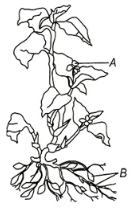
Identify the type of flower $A$ and $B$ in the given diagram.
A
$A-Cleistogamous; B-Chasmogamous$
B
$A-Homogamous; B-Heterogamous$
C
$A-Chasmogamous; B-Cleistogamous$
D
$A-Heterogamous; B-Homogamous$
Solution
$A$ represents Chasmogamous flowers, which are open flowers with exposed anthers and stigma, allowing for cross-pollination or self-pollination.
$B$ represents Cleistogamous flowers, which are closed flowers that do not open at all. In such flowers, the anthers and stigma lie close to each other. When anthers dehisce in the closed flower, pollen grains come in contact with the stigma to effect pollination. Thus, cleistogamous flowers are invariably autogamous as there is no chance of cross-pollination landing on the stigma.
$B$ represents Cleistogamous flowers, which are closed flowers that do not open at all. In such flowers, the anthers and stigma lie close to each other. When anthers dehisce in the closed flower, pollen grains come in contact with the stigma to effect pollination. Thus, cleistogamous flowers are invariably autogamous as there is no chance of cross-pollination landing on the stigma.
0 likes
View Solution262
MediumMCQ
For a gene, if $AA = \text{male plant}$ and $BB = \text{female plant}$, find out the genotype of the endosperm and the embryo.
A
$AAB, BBA$
B
$AAB, AB$
C
$ABB, AB$
D
$BBA, AAB$
Solution
(C) $1$. Endosperm Genotype: Endosperm is formed by the fusion of one male gamete $(A)$ and two polar nuclei $(BB)$. Therefore, the genotype of the endosperm is $ABB$.
$2$. Embryo Genotype: The embryo is formed by the fusion of one male gamete $(A)$ and one female gamete $(B)$. Therefore, the genotype of the embryo is $AB$.
$2$. Embryo Genotype: The embryo is formed by the fusion of one male gamete $(A)$ and one female gamete $(B)$. Therefore, the genotype of the embryo is $AB$.
0 likes
View Solution263
MediumMCQ
Which of the following are devices for self-pollination?
A
Dicliny or unisexuality
B
Dichogamy
C
Heterostyly
D
None of these
Solution
(D) Autogamy (self-pollination) involves the transfer of pollen grains from the anther to the stigma of the same flower.
Devices that promote self-pollination include:
$1$. Bisexuality: Presence of both male and female reproductive organs in the same flower.
$2$. Homogamy: Maturation of anthers and stigma at the same time.
$3$. Cleistogamy: Flowers remain closed,ensuring self-pollination.
Dicliny (unisexuality),dichogamy,and heterostyly are devices that promote cross-pollination (allogamy) by preventing self-pollination.
Therefore,none of the given options are devices for self-pollination.
Devices that promote self-pollination include:
$1$. Bisexuality: Presence of both male and female reproductive organs in the same flower.
$2$. Homogamy: Maturation of anthers and stigma at the same time.
$3$. Cleistogamy: Flowers remain closed,ensuring self-pollination.
Dicliny (unisexuality),dichogamy,and heterostyly are devices that promote cross-pollination (allogamy) by preventing self-pollination.
Therefore,none of the given options are devices for self-pollination.
0 likes
View Solution264
MediumMCQ
Which of the following is incorrect in angiosperm?
A
Pollen grain - Haploid
B
Megaspore - Diploid
C
Synergid - Haploid
D
Endosperm - Triploid
Solution
(B) In angiosperms,the $Megaspore$ $Mother$ $Cell$ $(MMC)$ is diploid $(2n)$.
It undergoes meiosis to produce four megaspores,which are haploid $(n)$.
Therefore,the statement '$Megaspore$ - $Diploid$' is incorrect because megaspores are haploid.
Pollen grains are haploid $(n)$,synergids are haploid $(n)$,and the endosperm formed after double fertilization is triploid $(3n)$.
It undergoes meiosis to produce four megaspores,which are haploid $(n)$.
Therefore,the statement '$Megaspore$ - $Diploid$' is incorrect because megaspores are haploid.
Pollen grains are haploid $(n)$,synergids are haploid $(n)$,and the endosperm formed after double fertilization is triploid $(3n)$.
0 likes
View Solution265
MediumMCQ
Which one of the following statements is not true?
A
Pollen grains are released from anthers at $2$-celled state
B
Sporogenous cell directly behaves as the megaspore mother cell
C
Megaspore divides twice to form an eight nucleate embryo sac
D
Egg and synergids always lie near the micropylar end of ovule
Solution
(C) The statement in option $C$ is incorrect because the functional megaspore undergoes three successive mitotic divisions to form an eight-nucleate embryo sac,not two.
$1$. Pollen grains are typically released at the $2$-celled stage in most angiosperms.
$2$. In many species,a sporogenous cell directly functions as the megaspore mother cell $(MMC)$.
$3$. The functional megaspore undergoes three rounds of free nuclear mitosis to produce $8$ nuclei,which then organize into the embryo sac.
$4$. The egg apparatus,consisting of the egg cell and two synergids,is always located at the micropylar end.
$1$. Pollen grains are typically released at the $2$-celled stage in most angiosperms.
$2$. In many species,a sporogenous cell directly functions as the megaspore mother cell $(MMC)$.
$3$. The functional megaspore undergoes three rounds of free nuclear mitosis to produce $8$ nuclei,which then organize into the embryo sac.
$4$. The egg apparatus,consisting of the egg cell and two synergids,is always located at the micropylar end.
0 likes
View Solution266
MediumMCQ
Long silky hairs on the cob of maize are:
A
Anthers
B
Style
C
Stigma
D
Both $(b)$ and $(c)$
Solution
(D) In maize,the cob represents the female inflorescence.
The long,silky,thread-like structures that protrude from the cob are the elongated styles and stigmas.
These structures are adapted to catch wind-borne pollen grains,which is essential for fertilization in wind-pollinated plants like maize.
The long,silky,thread-like structures that protrude from the cob are the elongated styles and stigmas.
These structures are adapted to catch wind-borne pollen grains,which is essential for fertilization in wind-pollinated plants like maize.
0 likes
View Solution267
MediumMCQ
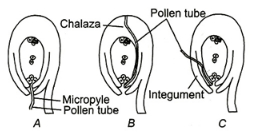
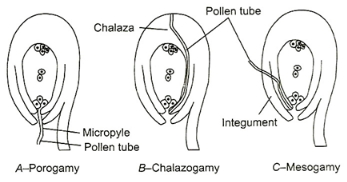
Identify the correct modes of entry of the pollen tube in the diagrams given below.
A
$A-Mesogamy, B-Chalazogamy, C-Porogamy$
B
$A-Chalazogamy, B-Porogamy, C-Mesogamy$
C
$A-Porogamy, B-Chalazogamy, C-Mesogamy$
D
$A-Porogamy, B-Mesogamy, C-Chalazogamy$
Solution
(C) The modes of entry of the pollen tube into the ovule are as follows:
$(i)$ Porogamy: The entry of the pollen tube takes place through the micropyle,e.g.,Lily.
$(ii)$ Chalazogamy: The entry of the pollen tube takes place through the chalazal end,e.g.,Casuarina,Juglans.
$(iii)$ Mesogamy: The entry of the pollen tube takes place through the integuments,e.g.,Cucurbita,Populus.
Based on the provided diagrams:
- Diagram $A$ shows the pollen tube entering through the micropyle,which is Porogamy.
- Diagram $B$ shows the pollen tube entering through the chalaza,which is Chalazogamy.
- Diagram $C$ shows the pollen tube entering through the integuments,which is Mesogamy.
Therefore,the correct sequence is $A-Porogamy, B-Chalazogamy, C-Mesogamy$.
$(i)$ Porogamy: The entry of the pollen tube takes place through the micropyle,e.g.,Lily.
$(ii)$ Chalazogamy: The entry of the pollen tube takes place through the chalazal end,e.g.,Casuarina,Juglans.
$(iii)$ Mesogamy: The entry of the pollen tube takes place through the integuments,e.g.,Cucurbita,Populus.
Based on the provided diagrams:
- Diagram $A$ shows the pollen tube entering through the micropyle,which is Porogamy.
- Diagram $B$ shows the pollen tube entering through the chalaza,which is Chalazogamy.
- Diagram $C$ shows the pollen tube entering through the integuments,which is Mesogamy.
Therefore,the correct sequence is $A-Porogamy, B-Chalazogamy, C-Mesogamy$.
0 likes
View Solution268
DifficultMCQ
What is the ratio of equational divisions that take place in Cycas and angiosperms respectively,leading to the formation of male gametes from pollen grains?
A
$3: 2$
B
$3: 1$
C
$2: 1$
D
$2: 3$
Solution
(C) In $Cycas$,the pollen grain undergoes two equational divisions to produce male gametes. The first division produces a prothallial cell and an antheridial cell,and the second division of the antheridial cell produces the tube cell and the generative cell,which eventually forms two male gametes. Thus,$2$ divisions are involved.
In angiosperms,the microspore (pollen grain) undergoes one mitotic (equational) division to form a vegetative cell and a generative cell. The generative cell then undergoes one more mitotic division to form two male gametes. However,the question specifically asks for the divisions leading to the formation of male gametes from the pollen grain. In angiosperms,the generative cell divides once to form two male gametes,totaling $1$ division from the generative stage.
Therefore,the ratio of equational divisions in $Cycas$ to angiosperms is $2: 1$.
In angiosperms,the microspore (pollen grain) undergoes one mitotic (equational) division to form a vegetative cell and a generative cell. The generative cell then undergoes one more mitotic division to form two male gametes. However,the question specifically asks for the divisions leading to the formation of male gametes from the pollen grain. In angiosperms,the generative cell divides once to form two male gametes,totaling $1$ division from the generative stage.
Therefore,the ratio of equational divisions in $Cycas$ to angiosperms is $2: 1$.
0 likes
View Solution269
MediumMCQ
Which of the following indicates the correct names of $A, B, C$ and $D$ regions in the given diagram?

A
$A - \text{Male gametes}, B - \text{Antipodals}, C - \text{Egg cell}, D - \text{Pollen tube}$
B
$A - \text{Synergids}, B - \text{Secondary nucleus}, C - \text{Egg apparatus}, D - \text{Integuments}$
C
$A - \text{Antipodals}, B - \text{Male gametes}, C - \text{Zygote}, D - \text{Micropyle}$
D
$A - \text{Secondary nucleus}, B - \text{Synergids}, C - \text{Egg cell}, D - \text{Integuments}$
Solution
(A) Based on the provided diagram of the embryo sac during fertilization:
$A$ represents the male gametes released from the pollen tube.
$B$ represents the antipodal cells located at the chalazal end.
$C$ represents the egg cell.
$D$ represents the pollen tube entering through the micropyle.
Therefore, the correct identification is $A - \text{Male gametes}, B - \text{Antipodals}, C - \text{Egg cell}, D - \text{Pollen tube}$.
$A$ represents the male gametes released from the pollen tube.
$B$ represents the antipodal cells located at the chalazal end.
$C$ represents the egg cell.
$D$ represents the pollen tube entering through the micropyle.
Therefore, the correct identification is $A - \text{Male gametes}, B - \text{Antipodals}, C - \text{Egg cell}, D - \text{Pollen tube}$.
0 likes
View Solution270
MediumMCQ
If a stem has $2n = 10$ chromosomes,find out the number of chromosomes in:
$A$ - Endosperm
$B$ - Egg cell
$C$ - Polar nuclei
$A$ - Endosperm
$B$ - Egg cell
$C$ - Polar nuclei
A
$15, 15, 20$
B
$10, 15, 20$
C
$15, 5, 10$
D
$10, 5, 15$
Solution
(C) Given,the diploid number of chromosomes in the stem is $2n = 10$. Therefore,the haploid number $(n)$ is $10 / 2 = 5$.
$A$ - Endosperm is triploid $(3n)$. Thus,$3 \times 5 = 15$ chromosomes.
$B$ - The egg cell is haploid $(n)$. Thus,$1 \times 5 = 5$ chromosomes.
$C$ - Each polar nucleus is haploid $(n)$. Thus,$1 \times 5 = 5$ chromosomes. However,in the central cell,there are two polar nuclei,making the total $2n = 10$ chromosomes.
Therefore,the sequence is $15, 5, 10$.
$A$ - Endosperm is triploid $(3n)$. Thus,$3 \times 5 = 15$ chromosomes.
$B$ - The egg cell is haploid $(n)$. Thus,$1 \times 5 = 5$ chromosomes.
$C$ - Each polar nucleus is haploid $(n)$. Thus,$1 \times 5 = 5$ chromosomes. However,in the central cell,there are two polar nuclei,making the total $2n = 10$ chromosomes.
Therefore,the sequence is $15, 5, 10$.
0 likes
View Solution271
MediumMCQ
Study the following statements and choose the correct option.
$I-$ Tapetum nourishes the developing pollen grains.
$II-$ Hilum represents the junction between ovule and funicle.
$III-$ In aquatic plants such as water hyacinth and water lily,pollination is by water.
$IV-$ The primary endosperm nucleus is triploid.
$I-$ Tapetum nourishes the developing pollen grains.
$II-$ Hilum represents the junction between ovule and funicle.
$III-$ In aquatic plants such as water hyacinth and water lily,pollination is by water.
$IV-$ The primary endosperm nucleus is triploid.
A
$I$ and $II$ are correct but $III$ and $IV$ are incorrect.
B
$I, II$ and $IV$ are correct but $III$ is incorrect.
C
$II, III$ and $IV$ are correct but $I$ is incorrect.
D
$I$ and $IV$ are correct but $II$ and $III$ are incorrect.
Solution
(B) Statement $I$ is correct: The tapetum is the innermost layer of the microsporangium wall that provides nourishment to the developing pollen grains.
Statement $II$ is correct: The hilum is the point of attachment where the body of the ovule fuses with the funicle.
Statement $III$ is incorrect: In many aquatic plants like water hyacinth and water lily,the flowers emerge above the water level and are pollinated by insects or wind,not by water.
Statement $IV$ is correct: The primary endosperm nucleus $(PEN)$ is formed by the fusion of two polar nuclei and one male gamete,making it triploid $(3n)$.
Statement $II$ is correct: The hilum is the point of attachment where the body of the ovule fuses with the funicle.
Statement $III$ is incorrect: In many aquatic plants like water hyacinth and water lily,the flowers emerge above the water level and are pollinated by insects or wind,not by water.
Statement $IV$ is correct: The primary endosperm nucleus $(PEN)$ is formed by the fusion of two polar nuclei and one male gamete,making it triploid $(3n)$.
0 likes
View Solution272
MediumMCQ
Pollen allergy is caused by pollens of
A
Rose
B
Clematis
C
Parthenium
D
Sunflower
Solution
(C) Pollen allergy,also known as hay fever,is a common allergic reaction to pollen grains released by various plants.
Among the given options,$Parthenium$ (also known as carrot grass) is a well-known invasive weed that was introduced into India as a contaminant with imported wheat.
It is notorious for causing severe pollen allergy and respiratory issues in humans.
While other plants like roses and sunflowers produce pollen,they are typically insect-pollinated (entomophilous) and produce larger,stickier pollen grains that are less likely to become airborne compared to the wind-pollinated (anemophilous) pollen of $Parthenium$.
Among the given options,$Parthenium$ (also known as carrot grass) is a well-known invasive weed that was introduced into India as a contaminant with imported wheat.
It is notorious for causing severe pollen allergy and respiratory issues in humans.
While other plants like roses and sunflowers produce pollen,they are typically insect-pollinated (entomophilous) and produce larger,stickier pollen grains that are less likely to become airborne compared to the wind-pollinated (anemophilous) pollen of $Parthenium$.
0 likes
View Solution273
MediumMCQ
The pollen viability period of rice and pea respectively,is
A
$30$ minutes and several months
B
Several months and $30$ minutes
C
Few days and few months
D
Few days in both the cases
Solution
(A) Pollen viability is the period during which pollen grains remain capable of germinating and fertilizing the ovule.
In some cereals like rice ($Oryza$ $sativa$) and wheat,pollen grains lose viability within $30$ minutes of their release.
In contrast,in members of some families like $Leguminosae$ (e.g.,pea),$Solanaceae$,and $Rosaceae$,the pollen grains maintain viability for several months.
Therefore,the correct sequence for rice and pea is $30$ minutes and several months,respectively.
In some cereals like rice ($Oryza$ $sativa$) and wheat,pollen grains lose viability within $30$ minutes of their release.
In contrast,in members of some families like $Leguminosae$ (e.g.,pea),$Solanaceae$,and $Rosaceae$,the pollen grains maintain viability for several months.
Therefore,the correct sequence for rice and pea is $30$ minutes and several months,respectively.
0 likes
View Solution274
EasyMCQ
Cryopreservation means storing of products in
A
Liquid nitrogen
B
Liquid oxygen
C
Liquid hydrogen
D
Liquid helium
Solution
(A) Cryopreservation is a technique used to preserve biological materials such as pollen grains,seeds,or tissues by keeping them at extremely low temperatures.
This process involves storing the materials in liquid nitrogen at a temperature of $-196^{\circ} C$.
This process involves storing the materials in liquid nitrogen at a temperature of $-196^{\circ} C$.
0 likes
View Solution275
MediumMCQ
Choose the odd one with respect to the gynoecium.
A
Gynoecium represents the female reproductive part of a flower.
B
The gynoecium may be syncarpous or apocarpous.
C
The number of ovules in papaya and mango is one.
D
The ovules are attached to the placenta.
Solution
(C) The correct answer is $C$. In papaya,the number of ovules is many,whereas in mango,the number of ovule is one. Therefore,the statement that the number of ovules in papaya and mango is one is incorrect.
0 likes
View Solution276
MediumMCQ
Which of the following statements is applicable to all flowering plants?
A
Monosiphonous pollen tube
B
Non-motile and morphologically dissimilar gametes
C
Presence of pollinium
D
Division of generative cell after pollination
Solution
(B) In all angiosperms (flowering plants),the male gametes are non-motile and are morphologically dissimilar to the female gamete (oogamy).
$A$ is incorrect because some plants have polysiphonous pollen tubes.
$C$ is incorrect because pollinia are specific to families like Orchidaceae and Asclepiadaceae.
$D$ is incorrect because in many plants,the generative cell divides into two male gametes before pollination (two-celled stage).
$A$ is incorrect because some plants have polysiphonous pollen tubes.
$C$ is incorrect because pollinia are specific to families like Orchidaceae and Asclepiadaceae.
$D$ is incorrect because in many plants,the generative cell divides into two male gametes before pollination (two-celled stage).
0 likes
View Solution277
MediumMCQ
Which statement is incorrect?
A
Intine is the inner wall of pollen grain and exhibits a fascinating array of patterns and designs.
B
The mature pollen grain has two cells: the bigger is the vegetative cell and the smaller is the generative cell,which floats in the cytoplasm of the vegetative cell.
C
Carrot grass pollen causes pollen allergy.
D
Pollen grains of pea and rose maintain viability for months.
Solution
(A) The statement in option $A$ is incorrect because the $Exine$ (outer wall),not the $Intine$ (inner wall),exhibits a fascinating array of patterns and designs.
$Intine$ is a thin,continuous layer made of cellulose and pectin.
$Exine$ is made of sporopollenin and is responsible for the patterns.
Options $B$,$C$,and $D$ are scientifically correct statements regarding pollen grain structure,allergy,and viability respectively.
$Intine$ is a thin,continuous layer made of cellulose and pectin.
$Exine$ is made of sporopollenin and is responsible for the patterns.
Options $B$,$C$,and $D$ are scientifically correct statements regarding pollen grain structure,allergy,and viability respectively.
0 likes
View Solution278
MediumMCQ
An angiospermic plant has $24$ chromosomes in its leaf cells. The number of chromosomes present in the synergid,pollen grain,nucellus,and endosperm will be respectively:
A
$12, 12, 12, 72$
B
$8, 8, 12, 36$
C
$12, 12, 24, 36$
D
$12, 12, 12, 36$
Solution
(C) The leaf cells are diploid $(2n)$. Given $2n = 24$,therefore the haploid number $(n)$ is $12$.
$1$. Synergid cells are haploid $(n)$,so they contain $12$ chromosomes.
$2$. Pollen grains are haploid $(n)$,so they contain $12$ chromosomes.
$3$. Nucellus cells are diploid $(2n)$,so they contain $24$ chromosomes.
$4$. Endosperm in angiosperms is triploid $(3n)$,so it contains $3 \times 12 = 36$ chromosomes.
Thus,the sequence is $12, 12, 24, 36$.
$1$. Synergid cells are haploid $(n)$,so they contain $12$ chromosomes.
$2$. Pollen grains are haploid $(n)$,so they contain $12$ chromosomes.
$3$. Nucellus cells are diploid $(2n)$,so they contain $24$ chromosomes.
$4$. Endosperm in angiosperms is triploid $(3n)$,so it contains $3 \times 12 = 36$ chromosomes.
Thus,the sequence is $12, 12, 24, 36$.
0 likes
View Solution279
MediumMCQ
$A$: Restitutional nucleus can be observed in endothecium cells.
$R$: Endothecium cells are usually triploid.
$R$: Endothecium cells are usually triploid.
A
Assertion and Reason both are correct and Reason is the correct explanation of Assertion.
B
Assertion and Reason both are correct but Reason is not the correct explanation of Assertion.
C
Assertion is correct,but Reason is incorrect.
D
Both Assertion and Reason are incorrect.
Solution
(D) The statement $A$ is incorrect because a restitutional nucleus is typically observed in the tapetum cells,not the endothecium cells. During the development of the microsporangium,tapetal cells often undergo endomitosis or nuclear fusion,leading to polyploidy and the formation of a restitutional nucleus.
The statement $R$ is also incorrect because endothecium cells are diploid $(2n)$ in nature,derived from the primary parietal layer of the microsporangium. They are not triploid $(3n)$.
Therefore,both Assertion and Reason are incorrect.
The statement $R$ is also incorrect because endothecium cells are diploid $(2n)$ in nature,derived from the primary parietal layer of the microsporangium. They are not triploid $(3n)$.
Therefore,both Assertion and Reason are incorrect.
0 likes
View Solution280
MediumMCQ
$A$: Formation of a mature male gametophyte requires one meiotic and two mitotic divisions in $60\%$ of angiosperms.
$R$: Pollination occurs in a two-celled condition in the majority of angiosperms.
$R$: Pollination occurs in a two-celled condition in the majority of angiosperms.
A
Assertion and Reason both are correct and Reason is the correct explanation of Assertion.
B
Assertion and Reason both are correct but Reason is not the correct explanation of Assertion.
C
Assertion is correct,but Reason is incorrect.
D
Both Assertion and Reason are incorrect.
Solution
(D) In $60\%$ of angiosperms,pollen grains are shed at the two-celled stage. The formation of a mature male gametophyte involves one meiotic division (to form microspores) and two mitotic divisions (one to form vegetative and generative cells,and another to divide the generative cell into two male gametes). Therefore,the Assertion is incorrect because it mentions only one mitotic division. The Reason is also incorrect because,in the majority of angiosperms,pollination occurs at the two-celled stage,not the three-celled stage. Thus,both statements are incorrect.
0 likes
View Solution281
MediumMCQ
$A$: More than one pollen tube can enter an embryo sac.
$R$: Double fertilization can occur by contribution of gametes from different pollen.
$R$: Double fertilization can occur by contribution of gametes from different pollen.
A
Assertion and Reason both are correct and Reason is the correct explanation of Assertion.
B
Assertion and Reason both are correct but Reason is not the correct explanation of Assertion.
C
Assertion is correct,but Reason is incorrect.
D
Both Assertion and Reason are incorrect.
Solution
(C) The phenomenon where more than one pollen tube enters the embryo sac is known as polysiphony. While usually only one pollen tube enters,in some species,multiple tubes can reach the embryo sac,although only one participates in fertilization. Thus,the Assertion is correct.
Double fertilization is a unique process in angiosperms involving the fusion of one male gamete with the egg cell (syngamy) and the other with the two polar nuclei (triple fusion). This process requires two male gametes from the same pollen tube. Double fertilization cannot occur by the contribution of gametes from different pollen tubes. Therefore,the Reason is incorrect.
Double fertilization is a unique process in angiosperms involving the fusion of one male gamete with the egg cell (syngamy) and the other with the two polar nuclei (triple fusion). This process requires two male gametes from the same pollen tube. Double fertilization cannot occur by the contribution of gametes from different pollen tubes. Therefore,the Reason is incorrect.
0 likes
View Solution282
MediumMCQ
$A$: Growth of the male gametophyte is completed over the female reproductive organ.
$R$: The $2$-celled stage of the partial male gametophyte is developed in-situ.
$R$: The $2$-celled stage of the partial male gametophyte is developed in-situ.
A
Assertion and Reason both are correct and Reason is the correct explanation of Assertion.
B
Assertion and Reason both are correct but Reason is not the correct explanation of Assertion.
C
Assertion is correct,but Reason is incorrect.
D
Both Assertion and Reason are incorrect.
Solution
(A) In angiosperms,the pollen grain represents the partially developed male gametophyte.
It is typically released from the anther at the $2$-celled stage (vegetative cell and generative cell) in about $60\%$ of angiosperms.
Since the development is only partial at the time of release,the remaining growth of the male gametophyte (including the formation of the pollen tube and the division of the generative cell into two male gametes) occurs on the stigma of the female reproductive organ.
Therefore,both the Assertion and the Reason are correct,and the Reason correctly explains why the growth must be completed on the female reproductive organ.
It is typically released from the anther at the $2$-celled stage (vegetative cell and generative cell) in about $60\%$ of angiosperms.
Since the development is only partial at the time of release,the remaining growth of the male gametophyte (including the formation of the pollen tube and the division of the generative cell into two male gametes) occurs on the stigma of the female reproductive organ.
Therefore,both the Assertion and the Reason are correct,and the Reason correctly explains why the growth must be completed on the female reproductive organ.
0 likes
View Solution283
MediumMCQ
$A$ : Continued self-pollination checks inbreeding depression.
$R$ : Pollen release and stigma receptivity are synchronised.
$R$ : Pollen release and stigma receptivity are synchronised.
A
Assertion and Reason both are correct and also correct explanation.
B
Assertion and Reason both are correct but not explanation of assertion.
C
Assertion is correct,but Reason is incorrect.
D
Both Assertion and Reason are incorrect.
Solution
(D) Assertion $(A)$ is incorrect because continued self-pollination leads to inbreeding depression,not checks it. Inbreeding depression is the reduction in fitness and vigor due to the accumulation of harmful recessive alleles in a population.
Reason $(R)$ is correct because in many self-pollinating plants,pollen release and stigma receptivity are synchronized to ensure successful self-pollination.
Therefore,the correct option is $D$.
Reason $(R)$ is correct because in many self-pollinating plants,pollen release and stigma receptivity are synchronized to ensure successful self-pollination.
Therefore,the correct option is $D$.
0 likes
View Solution284
MediumMCQ
Sexual reproduction leads to
A
Genetic recombination
B
Polyploidy
C
Aneuploidy
D
Euploidy
Solution
(A) Sexual reproduction involves the process of meiosis,which is essential for the formation of gametes.
During the prophase-$I$ stage of meiosis,specifically in the pachytene sub-stage,crossing over occurs between non-sister chromatids of homologous chromosomes.
This process of crossing over results in the exchange of genetic material,leading to genetic recombination.
Therefore,sexual reproduction is a significant source of genetic variation in a population.
During the prophase-$I$ stage of meiosis,specifically in the pachytene sub-stage,crossing over occurs between non-sister chromatids of homologous chromosomes.
This process of crossing over results in the exchange of genetic material,leading to genetic recombination.
Therefore,sexual reproduction is a significant source of genetic variation in a population.
0 likes
View Solution285
EasyMCQ
Triticum vulgare has been found to be presently evolved as
A
Diploid
B
Tetraploid
C
Pentaploid
D
Hexaploid
Solution
(D) The common bread wheat ($Triticum$ $aestivum$ $=$ $T.$ $vulgare$) is an allohexaploid.
It contains three distinct genomes ($A$,$B$,and $D$),each present in two copies,resulting in a total of $6n$ chromosomes.
Its somatic chromosome complement is represented as $AA\, BB\, DD$.
It contains three distinct genomes ($A$,$B$,and $D$),each present in two copies,resulting in a total of $6n$ chromosomes.
Its somatic chromosome complement is represented as $AA\, BB\, DD$.
0 likes
View Solution286
MediumMCQ
In plant $A$,$2n = 12$ and in plant $B$,$2n = 16$. Then the ploidy number (total chromosome number) of the hybrid plant resulting from cross-breeding is:
A
$7$
B
$21$
C
$14$
D
$28$
Solution
(C) In a cross-breeding experiment,the gametes from each parent combine to form the zygote.
For plant $A$ $(2n = 12)$,the gamete $(n)$ will have $n = 6$ chromosomes.
For plant $B$ $(2n = 16)$,the gamete $(n)$ will have $n = 8$ chromosomes.
The hybrid plant (zygote) formed by the fusion of these gametes will have a chromosome number equal to the sum of the haploid sets: $6 + 8 = 14$.
Therefore,the chromosome number of the hybrid plant is $14$.
For plant $A$ $(2n = 12)$,the gamete $(n)$ will have $n = 6$ chromosomes.
For plant $B$ $(2n = 16)$,the gamete $(n)$ will have $n = 8$ chromosomes.
The hybrid plant (zygote) formed by the fusion of these gametes will have a chromosome number equal to the sum of the haploid sets: $6 + 8 = 14$.
Therefore,the chromosome number of the hybrid plant is $14$.
0 likes
View Solution287
MediumMCQ
Which of the following plants is monoecious?
A
Carica papaya
B
Marchantia polymorpha
C
Chara
D
Cycas circinalis
Solution
(C) monoecious plant is one that bears both male and female reproductive structures on the same individual plant.
In the given options:
$1$. $Carica$ $papaya$ (Papaya) is dioecious,meaning male and female flowers are on separate plants.
$2$. $Marchantia$ $polymorpha$ is dioecious,as the male and female thalli are separate.
$3$. $Chara$ is a monoecious alga,where both the male sex organ (antheridium) and the female sex organ (oogonium) are present on the same plant body.
$4$. $Cycas$ $circinalis$ is dioecious,with male and female cones on separate plants.
Therefore,$Chara$ is the correct answer.
In the given options:
$1$. $Carica$ $papaya$ (Papaya) is dioecious,meaning male and female flowers are on separate plants.
$2$. $Marchantia$ $polymorpha$ is dioecious,as the male and female thalli are separate.
$3$. $Chara$ is a monoecious alga,where both the male sex organ (antheridium) and the female sex organ (oogonium) are present on the same plant body.
$4$. $Cycas$ $circinalis$ is dioecious,with male and female cones on separate plants.
Therefore,$Chara$ is the correct answer.
0 likes
View Solution288
MediumMCQ
In some members of which of the following pairs of families,pollen grains retain their viability for months after release?
A
Poaceae; Rosaceae
B
Poaceae; Leguminosae
C
Poaceae; Solanaceae
D
Rosaceae; Leguminosae
Solution
(D) The period for which pollen grains remain viable is highly variable and depends on the prevailing temperature and humidity.
In some cereals such as rice and wheat,pollen grains lose viability within $30$ minutes of their release.
In contrast,in some members of the families $Solanaceae$,$Rosaceae$,and $Leguminosae$,pollen grains maintain their viability for several months.
Therefore,among the given options,the pair $Rosaceae$ and $Leguminosae$ correctly represents families where pollen grains can remain viable for months.
In some cereals such as rice and wheat,pollen grains lose viability within $30$ minutes of their release.
In contrast,in some members of the families $Solanaceae$,$Rosaceae$,and $Leguminosae$,pollen grains maintain their viability for several months.
Therefore,among the given options,the pair $Rosaceae$ and $Leguminosae$ correctly represents families where pollen grains can remain viable for months.
0 likes
View Solution289
EasyMCQ
Name the plants which exhibit unusual flowering phenomena.
A
Bamboo species
B
Strobilanthes kunthiana (Neelakuranji)
C
Both $A$ and $B$
D
None of the above
Solution
(C) - Some bamboo species flower only once in their lifetime,generally after $50$-$100$ years,produce a large number of fruits,and then die.
- $Strobilanthes$ $kunthiana$ (Neelakuranji) flowers once in $12$ years. Its mass flowering transforms large tracts of hilly areas in Kerala,Karnataka,and Tamil Nadu into blue stretches and attracts a large number of tourists.
- $Strobilanthes$ $kunthiana$ (Neelakuranji) flowers once in $12$ years. Its mass flowering transforms large tracts of hilly areas in Kerala,Karnataka,and Tamil Nadu into blue stretches and attracts a large number of tourists.
0 likes
View Solution290
Medium
Explain post-fertilization events.
Solution
(N/A) Post-fertilization events are the events in sexual reproduction that occur after the formation of the zygote.
$1$. Zygote formation: In organisms like fungi and algae,the zygote develops a thick wall that is resistant to damage and desiccation,allowing it to undergo a period of rest before germination.
The further development of the zygote depends on the life cycle of the organism and the environment in which it survives.
In all sexually reproducing organisms,a diploid zygote is formed as a result of fertilization,which eventually develops into a new organism.
$2$. Embryogenesis: The process of development of an embryo from the zygote is called embryogenesis. This process involves cell division (mitosis) and cell differentiation.
Cell division increases the number of cells,while cell differentiation helps these cells undergo modifications to form specialized tissues and organs,leading to a fully developed organism.
Depending on whether the zygote develops inside or outside the body of the female parent,animals are classified as oviparous or viviparous.
Oviparous animals (e.g.,amphibians,fishes,birds,reptiles) lay eggs that develop into new organisms. In many oviparous animals like birds and reptiles,the fertilized eggs are covered by a hard calcareous shell (cleidoic eggs).
Viviparous animals (e.g.,mammals) give birth to their young ones.
$3$. Post-fertilization changes in flowering plants: The zygote is formed inside the ovule. After fertilization,the sepals,petals,and stamens of the flower usually wither and fall off.
The zygote develops into the embryo,the ovules develop into seeds,and the ovary develops into the fruit.
The ovary wall develops into a protective layer called the pericarp.
$1$. Zygote formation: In organisms like fungi and algae,the zygote develops a thick wall that is resistant to damage and desiccation,allowing it to undergo a period of rest before germination.
The further development of the zygote depends on the life cycle of the organism and the environment in which it survives.
In all sexually reproducing organisms,a diploid zygote is formed as a result of fertilization,which eventually develops into a new organism.
$2$. Embryogenesis: The process of development of an embryo from the zygote is called embryogenesis. This process involves cell division (mitosis) and cell differentiation.
Cell division increases the number of cells,while cell differentiation helps these cells undergo modifications to form specialized tissues and organs,leading to a fully developed organism.
Depending on whether the zygote develops inside or outside the body of the female parent,animals are classified as oviparous or viviparous.
Oviparous animals (e.g.,amphibians,fishes,birds,reptiles) lay eggs that develop into new organisms. In many oviparous animals like birds and reptiles,the fertilized eggs are covered by a hard calcareous shell (cleidoic eggs).
Viviparous animals (e.g.,mammals) give birth to their young ones.
$3$. Post-fertilization changes in flowering plants: The zygote is formed inside the ovule. After fertilization,the sepals,petals,and stamens of the flower usually wither and fall off.
The zygote develops into the embryo,the ovules develop into seeds,and the ovary develops into the fruit.
The ovary wall develops into a protective layer called the pericarp.
0 likes
View Solution291
Medium
Give a scientific reason: Variations are expected in sexually reproducing plants.
Solution
(N/A) Sexual reproduction involves the formation of gametes in the gonads,meiosis,and the fusion of gametes.
These processes produce variations due to new combinations of genes resulting from crossing over,the random segregation of chromosomes,and the random fusion of gametes.
Consequently,daughter offspring are genetically different from their parents.
Thus,sexual reproduction serves as a primary source of variation within a population.
These processes produce variations due to new combinations of genes resulting from crossing over,the random segregation of chromosomes,and the random fusion of gametes.
Consequently,daughter offspring are genetically different from their parents.
Thus,sexual reproduction serves as a primary source of variation within a population.
0 likes
View Solution292
DifficultMCQ
Given below are two statements:
Statement $I$: Cleistogamous flowers are invariably autogamous.
Statement $II$: Cleistogamy is disadvantageous as there is no chance for cross-pollination.
In the light of the above statements,choose the correct answer from the options given below:
Statement $I$: Cleistogamous flowers are invariably autogamous.
Statement $II$: Cleistogamy is disadvantageous as there is no chance for cross-pollination.
In the light of the above statements,choose the correct answer from the options given below:
A
Both Statement $I$ and Statement $II$ are incorrect.
B
Statement $I$ is correct but Statement $II$ is incorrect.
C
Statement $I$ is incorrect but Statement $II$ is correct.
D
Both Statement $I$ and Statement $II$ are correct.
Solution
(D) Statement $I$ is correct: Cleistogamous flowers do not open at all. Therefore,the anthers and stigma lie close to each other,and when anthers dehisce in the flower buds,pollen grains come in contact with the stigma to effect pollination. Thus,they are invariably autogamous.
Statement $II$ is correct: Cleistogamy ensures seed set even in the absence of pollinators. However,it is considered disadvantageous because it prevents cross-pollination,which limits genetic variation and the potential for evolutionary adaptation.
Statement $II$ is correct: Cleistogamy ensures seed set even in the absence of pollinators. However,it is considered disadvantageous because it prevents cross-pollination,which limits genetic variation and the potential for evolutionary adaptation.
0 likes
View Solution293
MediumMCQ
Match the following terms related to Gymnosperms/Angiosperms (as per standard botanical terminology) with their respective structures:
| Column-$I$ | Column-$II$ |
| $P$. Pistil/Megasporophyll | $I$. Megasporophyll |
| $Q$. Ovule | $II$. Megasporangium |
| $R$. Embryo sac | $III$. Female gametophyte |
A
$(P-II), (Q-I), (R-III)$
B
$(P-I), (Q-II), (R-III)$
C
$(P-III), (Q-I), (R-II)$
D
$(P-III), (Q-II), (R-I)$
Solution
(B) The correct matching is as follows:
$P$. Pistil (or Megasporophyll in gymnosperms) corresponds to $I$. Megasporophyll.
$Q$. Ovule corresponds to $II$. Megasporangium.
$R$. Embryo sac corresponds to $III$. Female gametophyte.
Therefore, the correct sequence is $(P-I), (Q-II), (R-III)$.
$P$. Pistil (or Megasporophyll in gymnosperms) corresponds to $I$. Megasporophyll.
$Q$. Ovule corresponds to $II$. Megasporangium.
$R$. Embryo sac corresponds to $III$. Female gametophyte.
Therefore, the correct sequence is $(P-I), (Q-II), (R-III)$.
0 likes
View Solution294
MediumMCQ
Identify the haploid and diploid structures from the following list:
$I$ - Megaspore mother cell
$II$ - Microspore mother cell
$III$ - Egg cell
$IV$ - Male gamete
$V$ - Synergid
$VI$ - Embryo
$VII$ - Antipodal cell
$VIII$ - Zygote
$IX$ - Megaspore
$X$ - Microspore
Select the correct grouping for Haploid and Diploid structures.
$I$ - Megaspore mother cell
$II$ - Microspore mother cell
$III$ - Egg cell
$IV$ - Male gamete
$V$ - Synergid
$VI$ - Embryo
$VII$ - Antipodal cell
$VIII$ - Zygote
$IX$ - Megaspore
$X$ - Microspore
Select the correct grouping for Haploid and Diploid structures.
A
$III, IV, V, VII, IX, X \quad \quad I, II, VI, VIII$
B
$I, II, III, IV, V, VII \quad \quad VI, VIII, IX, X$
C
$I, II, VI, VIII \quad \quad III, IV, V, VII, IX, X$
D
$VI, VIII, IX, X \quad \quad I, II, III, IV, V, VII$
Solution
(A) To determine the ploidy of the given structures:
$1$. Haploid $(n)$ structures:
- Egg cell $(III)$
- Male gamete $(IV)$
- Synergid $(V)$
- Antipodal cell $(VII)$
- Megaspore $(IX)$
- Microspore $(X)$
$2$. Diploid $(2n)$ structures:
- Megaspore mother cell $(I)$
- Microspore mother cell $(II)$
- Embryo $(VI)$
- Zygote $(VIII)$
Therefore,the haploid structures are $(III, IV, V, VII, IX, X)$ and the diploid structures are $(I, II, VI, VIII)$.
$1$. Haploid $(n)$ structures:
- Egg cell $(III)$
- Male gamete $(IV)$
- Synergid $(V)$
- Antipodal cell $(VII)$
- Megaspore $(IX)$
- Microspore $(X)$
$2$. Diploid $(2n)$ structures:
- Megaspore mother cell $(I)$
- Microspore mother cell $(II)$
- Embryo $(VI)$
- Zygote $(VIII)$
Therefore,the haploid structures are $(III, IV, V, VII, IX, X)$ and the diploid structures are $(I, II, VI, VIII)$.
0 likes
View Solution295
MediumMCQ
Match the following columns:
| Column-$I$ (Pre-fertilization) | Column-$II$ (Post-fertilization) |
| $P$. Ovule | $I$. Fruit |
| $Q$. Ovary | $II$. Seed |
| $R$. Integument | $III$. Seed coat |
| $S$. Ovary wall | $IV$. Pericarp |
A
$(P-II), (Q-I), (R-III), (S-IV)$
B
$(P-I), (Q-II), (R-IV), (S-III)$
C
$(P-II), (Q-I), (R-IV), (S-III)$
D
$(P-I), (Q-II), (R-III), (S-IV)$
Solution
(A) In flowering plants, after the process of double fertilization, the floral parts undergo significant changes:
$1$. The $P$. Ovule develops into the $II$. Seed.
$2$. The $Q$. Ovary matures into the $I$. Fruit.
$3$. The $R$. Integument (covering of the ovule) hardens to form the $III$. Seed coat.
$4$. The $S$. Ovary wall transforms into the $IV$. Pericarp (fruit wall).
Therefore, the correct matching is $(P-II), (Q-I), (R-III), (S-IV)$.
$1$. The $P$. Ovule develops into the $II$. Seed.
$2$. The $Q$. Ovary matures into the $I$. Fruit.
$3$. The $R$. Integument (covering of the ovule) hardens to form the $III$. Seed coat.
$4$. The $S$. Ovary wall transforms into the $IV$. Pericarp (fruit wall).
Therefore, the correct matching is $(P-II), (Q-I), (R-III), (S-IV)$.
0 likes
View Solution296
MediumMCQ
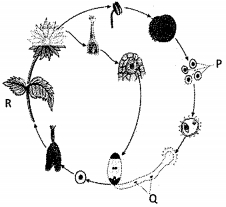
The life cycle of an angiosperm is given below. What are $P, Q$ and $R$?
$P \quad Q \quad R$
$P \quad Q \quad R$
A
Gametes $\quad$ Microspores $\quad$ Sporophyte
B
Microspores $\quad$ Gametes $\quad$ Sporophyte
C
Microspores $\quad$ Gametes $\quad$ Gametophyte
D
Gametes $\quad$ Microspores $\quad$ Gametophyte
Solution
(B) In the life cycle of an angiosperm:
$1$. $P$ represents Microspores, which are produced after meiosis in the anther.
$2$. $Q$ represents Gametes (male gametes), which are involved in fertilization.
$3$. $R$ represents the Sporophyte (the mature flowering plant), which is the dominant phase in the life cycle of angiosperms.
Therefore, the correct sequence is $P = \text{Microspores}, Q = \text{Gametes}, R = \text{Sporophyte}$.
$1$. $P$ represents Microspores, which are produced after meiosis in the anther.
$2$. $Q$ represents Gametes (male gametes), which are involved in fertilization.
$3$. $R$ represents the Sporophyte (the mature flowering plant), which is the dominant phase in the life cycle of angiosperms.
Therefore, the correct sequence is $P = \text{Microspores}, Q = \text{Gametes}, R = \text{Sporophyte}$.
0 likes
View Solution297
MediumMCQ
Select the incorrect statement from the following:
A
After fertilization,the ovule develops into a seed.
B
After fertilization,the ovary develops into a fruit.
C
The ovary always contains only one ovule.
D
The ovule is attached to the placenta within the ovary.
Solution
(C) In flowering plants,after fertilization,the ovule matures into a seed and the ovary matures into a fruit. The ovule is attached to the placenta within the ovary. However,the number of ovules in an ovary varies significantly among different plant species. While some ovaries contain only one ovule (e.g.,wheat,paddy,mango),many others contain multiple ovules (e.g.,papaya,watermelon,orchids). Therefore,the statement that the ovary always contains only one ovule is incorrect.
0 likes
View Solution298
EasyMCQ
Select the correct option for unusual flowering patterns.
A
Bamboo - Flowers once in $50-100$ years,producing a large number of fruits.
Strobilanthes kunthiana (Neelakuranji) - Flowers once every $12$ years.
Strobilanthes kunthiana (Neelakuranji) - Flowers once every $12$ years.
B
Bamboo - Flowers once every $12$ years.
Strobilanthes kunthiana (Neelakuranji) - Flowers once in $50-100$ years,producing a large number of fruits.
Strobilanthes kunthiana (Neelakuranji) - Flowers once in $50-100$ years,producing a large number of fruits.
C
Bamboo - Flowers every $50$ years.
Strobilanthes kunthiana (Neelakuranji) - Flowers every $100$ years.
Strobilanthes kunthiana (Neelakuranji) - Flowers every $100$ years.
D
Bamboo - Flowers every $100$ years.
Strobilanthes kunthiana (Neelakuranji) - Flowers every $50$ years.
Strobilanthes kunthiana (Neelakuranji) - Flowers every $50$ years.
Solution
(A) In the plant kingdom,some species exhibit unusual flowering patterns:
$1$. Bamboo species flower only once in their lifetime,generally after $50-100$ years,producing a large number of fruits and then dying.
$2$. Strobilanthes kunthiana (Neelakuranji) flowers once every $12$ years.
Therefore,option $A$ correctly describes these biological phenomena.
$1$. Bamboo species flower only once in their lifetime,generally after $50-100$ years,producing a large number of fruits and then dying.
$2$. Strobilanthes kunthiana (Neelakuranji) flowers once every $12$ years.
Therefore,option $A$ correctly describes these biological phenomena.
0 likes
View Solution299
EasyMCQ
Select the correct option for $Strobilanthus$ $kunthiana$ (Neelakurinji).
A
It is found in the hilly regions of Kerala,Tamil Nadu,and Karnataka.
B
Its flowers are blue in color.
C
It flowered during September-October $2006$.
D
All of the above.
Solution
(D) $Strobilanthus$ $kunthiana$ (Neelakurinji) is a plant that flowers once in $12$ years.
It is native to the shola forests in the Western Ghats of India,specifically in the hilly regions of Kerala,Tamil Nadu,and Karnataka.
The flowers are distinctively blue in color.
It was observed to flower en masse during September-October $2006$.
Therefore,all the given statements are correct.
It is native to the shola forests in the Western Ghats of India,specifically in the hilly regions of Kerala,Tamil Nadu,and Karnataka.
The flowers are distinctively blue in color.
It was observed to flower en masse during September-October $2006$.
Therefore,all the given statements are correct.
0 likes
View Solution300
MediumMCQ
Choose the correct option regarding gametes.
A
Gametes are formed by either mitosis or meiosis.
B
Gametes are always haploid.
C
Gametes fuse to form a zygote.
D
All of the above.
Solution
(D) Gametes are specialized reproductive cells.
$1$. In organisms with a haploid plant body,gametes are produced by mitosis,whereas in diploid organisms,they are produced by meiosis.
$2$. Gametes are always haploid $(n)$ regardless of the ploidy of the parent organism.
$3$. The fusion of male and female gametes results in the formation of a diploid zygote $(2n)$.
Therefore,all the given statements are correct.
$1$. In organisms with a haploid plant body,gametes are produced by mitosis,whereas in diploid organisms,they are produced by meiosis.
$2$. Gametes are always haploid $(n)$ regardless of the ploidy of the parent organism.
$3$. The fusion of male and female gametes results in the formation of a diploid zygote $(2n)$.
Therefore,all the given statements are correct.
0 likes
View SolutionSexual Reproduction in Flowering Plants — Mix Examples-Sexual Reproduction in Flowering Plants · Frequently Asked Questions
1Are these Sexual Reproduction in Flowering Plants questions useful for JEE and NEET?
Yes. All questions in this section are mapped to JEE Main and NEET exam patterns. Previous year questions from JEE Main, NEET, GUJCET and state-level exams are included with full solutions.
2Can I switch to Hindi or Gujarati for these questions?
Yes. Use the language tabs in the hero section or the sidebar to view the same questions and solutions in English, Hindi or Gujarati.
3How do I generate a question paper from this subtopic?
Use the Vedclass Exam Paper Generator — select the chapter and subtopic, set difficulty, and generate Sets A, B, C, D automatically. First 3 chapters of every subject are free.
Vedclass Products
For Students
Vedclass Test Series
Mock tests in real JEE/NEET style with performance analysis. 5-day free trial.
Start Free TrialFor Teachers
Exam Paper Generator
Generate Set A/B/C/D papers from this chapter in 2 minutes. 3 chapters free.
Try FreeFor Institutes
Online Exam Module
Live online exams with unlimited students, 360° analytics & white-label branding.
See DemoFor Teachers & Institutes
Generate a Sexual Reproduction in Flowering Plants Exam Paper in 2 Minutes
Select subtopic & difficulty — Sets A, B, C, D auto-generated with No Repeat logic.
First 3 chapters of every subject are free — no payment required.