
A English
Double Fertilisation Questions in English
Class 12 Biology · Sexual Reproduction in Flowering Plants · Double Fertilisation
143+
Questions
English
Language
100%
With Solutions
Showing 43 of 143 questions in English
101
EasyMCQ
Life begins in all sexually reproducing organisms from:
A
Single-celled zygote
B
Double-celled zygote
C
Haploid zygote
D
From gametes
Solution
(A) In all sexually reproducing organisms,life begins from a single-celled zygote.
When a haploid male gamete $(n)$ fuses with a haploid female gamete $(n)$,they form a diploid $(2n)$ single-celled structure known as the zygote.
This zygote serves as the vital link that ensures the continuity of species between organisms of one generation and the next.
Therefore,the zygote is the first cell of a new individual.
When a haploid male gamete $(n)$ fuses with a haploid female gamete $(n)$,they form a diploid $(2n)$ single-celled structure known as the zygote.
This zygote serves as the vital link that ensures the continuity of species between organisms of one generation and the next.
Therefore,the zygote is the first cell of a new individual.
0 likes
View Solution102
EasyMCQ
The fusion of male and female gametes is called:
A
Syngamy
B
Fertilization
C
Both $(a)$ and $(b)$
D
Heterogamy
Solution
(C) The fusion of male and female gametes results in the formation of a diploid zygote.
This process is known as syngamy.
In biological terminology,the terms syngamy and fertilization are often used interchangeably to describe this fusion event.
This process is known as syngamy.
In biological terminology,the terms syngamy and fertilization are often used interchangeably to describe this fusion event.
0 likes
View Solution103
EasyMCQ
In flowering plants,the zygote is formed:
A
Inside the ovule
B
Inside the archegonium
C
In water
D
More than one option is correct
Solution
(A) In flowering plants (Angiosperms),the process of fertilization occurs within the embryo sac,which is located inside the ovule. The fusion of the male gamete and the egg cell results in the formation of a zygote. Therefore,the zygote is formed inside the ovule.
0 likes
View Solution104
MediumMCQ
Which of the following features cannot be shown by the structure which is the vital link between two generations ensuring continuity of species?
A
$(a), (b)$ and $(e)$
B
$(a), (b)$ and $(d)$
C
$(b)$ and $(c)$
D
$(d)$ and $(e)$
Solution
(C) The vital link between two generations that ensures the continuity of species is the $Zygote$.
$1$. The $Zygote$ is a single-celled structure,so it cannot be multicelled $(b)$.
$2$. The $Zygote$ is diploid $(2n)$,meaning it contains two sets of chromosomes,so it cannot have only one set of chromosomes $(c)$.
$3$. The $Zygote$ is formed by the fusion of gametes and is not a $Meiocyte$ (a cell that undergoes meiosis) $(d)$.
$4$. The $Zygote$ is generally not thick-walled $(a)$ or a resting stage $(e)$ in most organisms,although some zygotes (like in algae or fungi) may develop a thick wall to survive unfavorable conditions.
However,based on standard biological definitions,the $Zygote$ is $1n$ (haploid) in some organisms,but it is fundamentally a $2n$ structure in sexual reproduction. The features it cannot show are being multicelled $(b)$,having one set of chromosomes $(c)$,being a $Meiocyte$ $(d)$,and being a resting stage $(e)$ (in the context of active development). The most appropriate combination of features that the $Zygote$ does not possess is $(b), (c), (d),$ and $(e)$. Given the options,$(b)$ and $(c)$ are the most definitive characteristics it lacks.
$1$. The $Zygote$ is a single-celled structure,so it cannot be multicelled $(b)$.
$2$. The $Zygote$ is diploid $(2n)$,meaning it contains two sets of chromosomes,so it cannot have only one set of chromosomes $(c)$.
$3$. The $Zygote$ is formed by the fusion of gametes and is not a $Meiocyte$ (a cell that undergoes meiosis) $(d)$.
$4$. The $Zygote$ is generally not thick-walled $(a)$ or a resting stage $(e)$ in most organisms,although some zygotes (like in algae or fungi) may develop a thick wall to survive unfavorable conditions.
However,based on standard biological definitions,the $Zygote$ is $1n$ (haploid) in some organisms,but it is fundamentally a $2n$ structure in sexual reproduction. The features it cannot show are being multicelled $(b)$,having one set of chromosomes $(c)$,being a $Meiocyte$ $(d)$,and being a resting stage $(e)$ (in the context of active development). The most appropriate combination of features that the $Zygote$ does not possess is $(b), (c), (d),$ and $(e)$. Given the options,$(b)$ and $(c)$ are the most definitive characteristics it lacks.
0 likes
View Solution105
MediumMCQ
Double fertilization is the fusion of
A
Two eggs
B
Two eggs and polar nuclei
C
One male gamete with egg and other with synergid
D
One male gamete with egg and other with secondary nucleus
Solution
(D) Double fertilization was discovered by $S. G. Nawaschin$ $(1898)$ and $Guignard$ in $Lilium$ and $Fritillaria$. Double fertilization is a characteristic feature restricted only to angiosperms.
When the pollen tube enters the ovule,it releases two male gametes into the embryo sac. These gametes fuse with two different structures in the same female gametophyte:
$1.$ Syngamy: Fusion of one male gamete with the egg cell to form a diploid zygote $(2n)$.
$2.$ Triple Fusion: Fusion of the second male gamete with the two polar nuclei (or the secondary nucleus) to form the primary endosperm nucleus $(PEN)$,which is triploid $(3n)$.
When the pollen tube enters the ovule,it releases two male gametes into the embryo sac. These gametes fuse with two different structures in the same female gametophyte:
$1.$ Syngamy: Fusion of one male gamete with the egg cell to form a diploid zygote $(2n)$.
$2.$ Triple Fusion: Fusion of the second male gamete with the two polar nuclei (or the secondary nucleus) to form the primary endosperm nucleus $(PEN)$,which is triploid $(3n)$.
0 likes
View Solution106
MediumMCQ
The number of female nuclei involved in double fertilization is
A
$2$
B
$3$
C
$4$
D
$1$
Solution
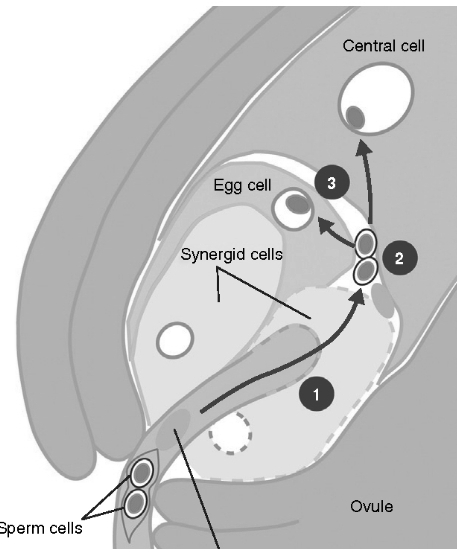
(B) Double fertilization involves two processes: syngamy and triple fusion.
$1$. Syngamy: One male gamete fuses with the egg cell (one female nucleus).
$2$. Triple fusion: The second male gamete fuses with two polar nuclei (two female nuclei) present in the central cell.
Therefore,the total number of female nuclei involved is $1$ (egg cell) + $2$ (polar nuclei) = $3$ female nuclei.
$1$. Syngamy: One male gamete fuses with the egg cell (one female nucleus).
$2$. Triple fusion: The second male gamete fuses with two polar nuclei (two female nuclei) present in the central cell.
Therefore,the total number of female nuclei involved is $1$ (egg cell) + $2$ (polar nuclei) = $3$ female nuclei.
0 likes
View Solution107
MediumMCQ
Fertilization of the egg takes place inside:
A
Anther
B
Stigma
C
Pollen tube
D
Embryo sac
Solution
(D) In angiosperms,fertilization occurs within the embryo sac. The pollen tube enters the embryo sac and releases two male gametes. One male gamete fuses with the egg cell (syngamy) to form a zygote,while the other fuses with the two polar nuclei to form the primary endosperm nucleus. Since the egg cell is located within the embryo sac,the fertilization process is completed inside it.
0 likes
View Solution108
EasyMCQ
Double fertilization was discovered by
A
Nawaschin
B
Strasburger
C
Emerson
D
None of these
Solution
(A) Double fertilization is a characteristic feature of angiosperms. It was discovered by $S.G. Nawaschin$ in $1898$ in the plants $Lilium$ and $Fritillaria$. During this process, one male gamete fuses with the egg cell to form a zygote (syngamy), and the other male gamete fuses with the two polar nuclei to form the primary endosperm nucleus (triple fusion).
0 likes
View Solution109
MediumMCQ
Which one of the following would not lead to the formation of clones?
A
Double fertilization
B
Apomixis
C
Vegetative reproduction
D
Tissue culture
Solution
(A) clone is an individual genetically identical to its parent,produced through asexual means such as apomixis,vegetative reproduction,or tissue culture.
Double fertilization is a characteristic feature of angiosperms involving the fusion of two male gametes with the egg cell and the central cell,respectively.
Since double fertilization is a part of sexual reproduction,it involves meiosis and genetic recombination,which leads to genetic variation rather than the formation of clones.
It was discovered by $Nawaschin$ in $1898$.
Double fertilization is a characteristic feature of angiosperms involving the fusion of two male gametes with the egg cell and the central cell,respectively.
Since double fertilization is a part of sexual reproduction,it involves meiosis and genetic recombination,which leads to genetic variation rather than the formation of clones.
It was discovered by $Nawaschin$ in $1898$.
0 likes
View Solution110
MediumMCQ
$PEC$ (Primary Endosperm Cell) is formed:
A
After triple fusion
B
Before triple fusion
C
At the time of syngamy
D
Always persisted
Solution
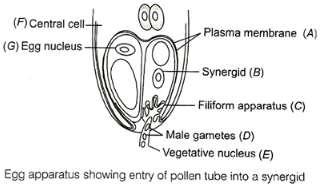
(A) The Primary Endosperm Cell $(PEC)$ is formed as a result of triple fusion.
During double fertilization in angiosperms,one male gamete fuses with the egg cell to form a diploid zygote (syngamy).
The second male gamete fuses with the two polar nuclei located in the central cell to form a triploid Primary Endosperm Nucleus $(PEN)$.
This process of fusion of three haploid nuclei is known as triple fusion.
Following this fusion,the central cell,which contains the $PEN$,is referred to as the Primary Endosperm Cell $(PEC)$.
During double fertilization in angiosperms,one male gamete fuses with the egg cell to form a diploid zygote (syngamy).
The second male gamete fuses with the two polar nuclei located in the central cell to form a triploid Primary Endosperm Nucleus $(PEN)$.
This process of fusion of three haploid nuclei is known as triple fusion.
Following this fusion,the central cell,which contains the $PEN$,is referred to as the Primary Endosperm Cell $(PEC)$.
0 likes
View Solution111
MediumMCQ
The genotype of the endosperm is $ZZA$. Find out the genotype of the male and female plant,respectively.
A
$ZZ, AA$
B
$ZA, ZA$
C
$AA, ZZ$
D
$ZAA, ZZA$
Solution
(C) In angiosperms,the endosperm is formed by the fusion of two polar nuclei (from the female gametophyte) and one male gamete (from the pollen grain).
This process is known as triple fusion,resulting in a triploid $(3n)$ structure.
Given the endosperm genotype is $ZZA$,it implies that the two polar nuclei contributed $ZZ$ and the male gamete contributed $A$.
Since the polar nuclei are derived from the female plant,the female plant must have a genotype of $ZZ$.
Since the male gamete is derived from the male plant,the male plant must have a genotype of $AA$.
This process is known as triple fusion,resulting in a triploid $(3n)$ structure.
Given the endosperm genotype is $ZZA$,it implies that the two polar nuclei contributed $ZZ$ and the male gamete contributed $A$.
Since the polar nuclei are derived from the female plant,the female plant must have a genotype of $ZZ$.
Since the male gamete is derived from the male plant,the male plant must have a genotype of $AA$.
0 likes
View Solution112
MediumMCQ
Which of the following is not true for double fertilization?
A
Discovered by Nawaschin
B
Male gamete and secondary nucleus fused to form endosperm nucleus
C
Endosperm nucleus is diploid
D
Endosperm nucleus provides nutrition to embryo
Solution
(C) Double fertilization is a characteristic feature of angiosperms. It was discovered by $S. G. Nawaschin$ in $1898$.
In double fertilization,one male gamete fuses with the egg cell to form a diploid zygote,and the second male gamete fuses with the diploid secondary nucleus to form the triploid primary endosperm nucleus $(PEN)$.
Since the secondary nucleus is diploid $(2n)$ and the male gamete is haploid $(n)$,the resulting primary endosperm nucleus is triploid $(3n)$.
Therefore,the statement that the endosperm nucleus is diploid is incorrect.
The endosperm provides nutrition to the developing embryo.
In double fertilization,one male gamete fuses with the egg cell to form a diploid zygote,and the second male gamete fuses with the diploid secondary nucleus to form the triploid primary endosperm nucleus $(PEN)$.
Since the secondary nucleus is diploid $(2n)$ and the male gamete is haploid $(n)$,the resulting primary endosperm nucleus is triploid $(3n)$.
Therefore,the statement that the endosperm nucleus is diploid is incorrect.
The endosperm provides nutrition to the developing embryo.
0 likes
View Solution113
MediumMCQ
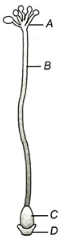
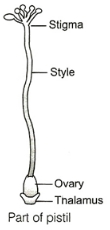
In the given diagram of a pistil,in which part does fertilization take place?
A
$D$
B
$C$
C
$B$
D
$A$
Solution
(B) Fertilization is the process in which the fusion of male and female gametes occurs. In flowering plants,this process takes place within the embryo sac,which is located inside the ovary $(C)$. Therefore,the ovary is the site where fertilization occurs.
0 likes
View Solution114
MediumMCQ
Identify $A, B, C$ and $D$ from the given diagram representing double fertilization in flowering plants.
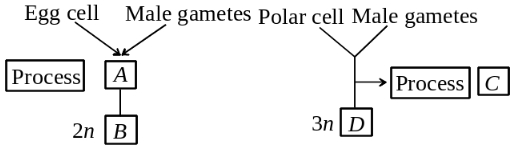
A
$A-$Syngamy,$B-$Embryo,$C-$Triple fusion,$D-$Endosperm
B
$A-$Endosperm,$B-$Syngamy,$C-$Embryo,$D-$Triple fusion
C
$A-$Endosperm,$B-$Triple fusion,$C-$Syngamy,$D-$Embryo
D
$A-$Endosperm,$B-$Triple fusion,$C-$Embryo,$D-$Syngamy
Solution
(A) In flowering plants,double fertilization involves two processes:
$1$. Syngamy: The fusion of one male gamete with the egg cell to form a diploid $(2n)$ zygote,which subsequently develops into an embryo $(B)$. Thus,$A$ is Syngamy and $B$ is Embryo.
$2$. Triple Fusion: The fusion of the second male gamete with two polar nuclei (or the central cell) to form a triploid $(3n)$ primary endosperm nucleus,which develops into the endosperm $(C)$. Thus,the process is Triple fusion $(C)$ and the product is Endosperm $(D)$.
Therefore,$A-$Syngamy,$B-$Embryo,$C-$Triple fusion,$D-$Endosperm.
$1$. Syngamy: The fusion of one male gamete with the egg cell to form a diploid $(2n)$ zygote,which subsequently develops into an embryo $(B)$. Thus,$A$ is Syngamy and $B$ is Embryo.
$2$. Triple Fusion: The fusion of the second male gamete with two polar nuclei (or the central cell) to form a triploid $(3n)$ primary endosperm nucleus,which develops into the endosperm $(C)$. Thus,the process is Triple fusion $(C)$ and the product is Endosperm $(D)$.
Therefore,$A-$Syngamy,$B-$Embryo,$C-$Triple fusion,$D-$Endosperm.
0 likes
View Solution115
MediumMCQ
Syngamy and triple fusion is called ... $A$ ... The central cell becomes ... $B$ ... develops into ... $C$ ... and zygote develops into ... $D$ ...
$A, B, C, D$ in the above statement are
$A, B, C, D$ in the above statement are
A
$A-Fusion, B-haploid, C-diploid cell, D-embryo$
B
$A-double fertilization, B-PEN, C-endosperm, D-embryo$
C
$A-embryo, B-endosperm, C-PEN, D-diploid cell$
D
$A-PEN, B-endosperm, C-syngamy, D-fertilisation$
Solution
(B) In angiosperms,the process involving both syngamy (fusion of male gamete with egg) and triple fusion (fusion of male gamete with two polar nuclei) is collectively known as double fertilization $(A)$.
After triple fusion,the central cell becomes the Primary Endosperm Nucleus $(PEN)$ $(B)$.
The $PEN$ subsequently develops into the endosperm $(C)$,which provides nutrition to the developing embryo.
The zygote,formed by syngamy,develops into the embryo $(D)$.
After triple fusion,the central cell becomes the Primary Endosperm Nucleus $(PEN)$ $(B)$.
The $PEN$ subsequently develops into the endosperm $(C)$,which provides nutrition to the developing embryo.
The zygote,formed by syngamy,develops into the embryo $(D)$.
0 likes
View Solution116
MediumMCQ
The total number of nuclei involved in double fertilization in angiosperms is
A
Two
B
Three
C
Four
D
Five
Solution
(D) Double fertilization in angiosperms involves two distinct processes: syngamy and triple fusion.
$1$. Syngamy: One male gamete $(n)$ fuses with the egg cell $(n)$ to form a diploid zygote (2n). This involves $2$ nuclei.
$2$. Triple Fusion: The second male gamete $(n)$ fuses with the two polar nuclei (n + n) present in the central cell to form the primary endosperm nucleus $(PEN)$ (3n). This involves $3$ nuclei.
Therefore,the total number of nuclei involved in double fertilization is $2 + 3 = 5$.
$1$. Syngamy: One male gamete $(n)$ fuses with the egg cell $(n)$ to form a diploid zygote (2n). This involves $2$ nuclei.
$2$. Triple Fusion: The second male gamete $(n)$ fuses with the two polar nuclei (n + n) present in the central cell to form the primary endosperm nucleus $(PEN)$ (3n). This involves $3$ nuclei.
Therefore,the total number of nuclei involved in double fertilization is $2 + 3 = 5$.
0 likes
View Solution117
MediumMCQ
The role of triple fusion in angiosperms is to produce
A
Cotyledons
B
$PEN$
C
Endocarp
D
Seed
Solution
(B) In angiosperms,double fertilization involves two processes: syngamy and triple fusion.
Triple fusion occurs when one of the two male gametes fuses with the two polar nuclei (or the secondary nucleus) located in the central cell of the embryo sac.
Since the male gamete is $n$ and the two polar nuclei are $n + n$,the resulting structure is triploid $(3n)$.
This structure is known as the Primary Endosperm Nucleus $(PEN)$.
The $PEN$ subsequently develops into the endosperm,which provides nourishment to the developing embryo.
Triple fusion occurs when one of the two male gametes fuses with the two polar nuclei (or the secondary nucleus) located in the central cell of the embryo sac.
Since the male gamete is $n$ and the two polar nuclei are $n + n$,the resulting structure is triploid $(3n)$.
This structure is known as the Primary Endosperm Nucleus $(PEN)$.
The $PEN$ subsequently develops into the endosperm,which provides nourishment to the developing embryo.
0 likes
View Solution118
MediumMCQ
The central cell after triple fusion becomes the
A
$PEC$
B
$PEN$
C
Endosperm
D
Embryo
Solution
(A) During double fertilization,the central cell contains two haploid polar nuclei.
One male gamete fuses with these two polar nuclei to form a triploid nucleus,which is known as the Primary Endosperm Nucleus $(PEN)$.
The entire central cell,after this fusion,is referred to as the Primary Endosperm Cell $(PEC)$.
One male gamete fuses with these two polar nuclei to form a triploid nucleus,which is known as the Primary Endosperm Nucleus $(PEN)$.
The entire central cell,after this fusion,is referred to as the Primary Endosperm Cell $(PEC)$.
0 likes
View Solution119
MediumMCQ
The diploid and triploid products of double fertilization,respectively,are:
A
Zygote and primary endosperm nucleus
B
Endosperm and cotyledons
C
Embryo and perisperm
D
Zygote and scutellum
Solution
(A) Double fertilization involves two processes: syngamy and triple fusion.
$1$. Syngamy: The fusion of one male gamete $(n)$ with the egg cell $(n)$ results in the formation of a diploid $(2n)$ Zygote.
$2$. Triple fusion: The fusion of the second male gamete $(n)$ with two polar nuclei $(n + n)$ results in the formation of a triploid $(3n)$ Primary Endosperm Nucleus $(PEN)$.
Therefore,the diploid product is the Zygote and the triploid product is the Primary Endosperm Nucleus $(PEN)$.
$1$. Syngamy: The fusion of one male gamete $(n)$ with the egg cell $(n)$ results in the formation of a diploid $(2n)$ Zygote.
$2$. Triple fusion: The fusion of the second male gamete $(n)$ with two polar nuclei $(n + n)$ results in the formation of a triploid $(3n)$ Primary Endosperm Nucleus $(PEN)$.
Therefore,the diploid product is the Zygote and the triploid product is the Primary Endosperm Nucleus $(PEN)$.
0 likes
View Solution120
MediumMCQ
$A$: Triple fusion is associated with sexual reproduction in all spermatophytes.
$R$: It is required to form the definitive nucleus as nutritive tissue.
$R$: It is required to form the definitive nucleus as nutritive tissue.
A
Assertion and Reason both are correct and Reason is the correct explanation of Assertion.
B
Assertion and Reason both are correct but Reason is not the correct explanation of Assertion.
C
Assertion is correct,but Reason is incorrect.
D
Both Assertion and Reason are incorrect.
Solution
(D) Triple fusion is a characteristic feature unique to angiosperms (flowering plants) and does not occur in gymnosperms,even though both are spermatophytes.
Therefore,the Assertion is incorrect.
Triple fusion involves the fusion of one male gamete with two polar nuclei (or a secondary nucleus) to form the primary endosperm nucleus $(PEN)$,which develops into the endosperm,not a 'definitive nucleus' as nutritive tissue.
Thus,the Reason is also incorrect.
Therefore,the Assertion is incorrect.
Triple fusion involves the fusion of one male gamete with two polar nuclei (or a secondary nucleus) to form the primary endosperm nucleus $(PEN)$,which develops into the endosperm,not a 'definitive nucleus' as nutritive tissue.
Thus,the Reason is also incorrect.
0 likes
View Solution121
MediumMCQ
What is the ploidy of the Primary Endosperm Nucleus $(PEN)$ in angiosperms?
A
Haploid
B
Diploid
C
Triploid
D
Tetraploid
Solution
(C) In angiosperms,the process of double fertilization occurs.
One male gamete $(n)$ fuses with the two polar nuclei $(n + n)$ present in the central cell of the embryo sac.
This process is known as triple fusion.
As a result of triple fusion,the Primary Endosperm Nucleus $(PEN)$ is formed,which is triploid $(3n)$.
One male gamete $(n)$ fuses with the two polar nuclei $(n + n)$ present in the central cell of the embryo sac.
This process is known as triple fusion.
As a result of triple fusion,the Primary Endosperm Nucleus $(PEN)$ is formed,which is triploid $(3n)$.
0 likes
View Solution122
MediumMCQ
The phenomenon of double fertilization is called so because the two male gametes fuse with ........ and ........ respectively.
A
Egg cell,secondary nucleus
B
Egg cell,synergid
C
Egg cell,antipodal cell
D
Synergid,antipodal cell
Solution
(A) In angiosperms,double fertilization involves two fusion events:
$1$. Syngamy: One male gamete fuses with the egg cell to form a diploid zygote $(2n)$.
$2$. Triple Fusion: The second male gamete fuses with the two polar nuclei (or the secondary nucleus) to form the primary endosperm nucleus $(PEN)$,which is triploid $(3n)$.
Thus,the two male gametes fuse with the egg cell and the secondary nucleus,respectively.
$1$. Syngamy: One male gamete fuses with the egg cell to form a diploid zygote $(2n)$.
$2$. Triple Fusion: The second male gamete fuses with the two polar nuclei (or the secondary nucleus) to form the primary endosperm nucleus $(PEN)$,which is triploid $(3n)$.
Thus,the two male gametes fuse with the egg cell and the secondary nucleus,respectively.
0 likes
View Solution123
MediumMCQ
How many gametes are involved in double fertilization?
A
$2$
B
$3$
C
$4$
D
$5$
Solution
(D) Double fertilization is a characteristic feature of angiosperms.
It involves two distinct fusion events:
$1$. Syngamy: One male gamete fuses with the egg cell to form a diploid zygote $(n + n = 2n)$.
$2$. Triple Fusion: The second male gamete fuses with the two polar nuclei (or the secondary nucleus) to form the primary endosperm nucleus $(n + n + n = 3n)$.
Since two male gametes are involved in these processes,the total number of gametes participating is $2$ (male gametes) + $1$ (egg cell) + $2$ (polar nuclei) = $5$ gametes in total.
It involves two distinct fusion events:
$1$. Syngamy: One male gamete fuses with the egg cell to form a diploid zygote $(n + n = 2n)$.
$2$. Triple Fusion: The second male gamete fuses with the two polar nuclei (or the secondary nucleus) to form the primary endosperm nucleus $(n + n + n = 3n)$.
Since two male gametes are involved in these processes,the total number of gametes participating is $2$ (male gametes) + $1$ (egg cell) + $2$ (polar nuclei) = $5$ gametes in total.
0 likes
View Solution124
MediumMCQ
The following figure shows a mature embryo sac. Where do the male gametes fuse?
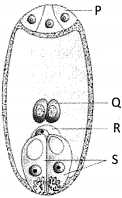
A
$P$ and $Q$
B
$P$ and $R$
C
$Q$ and $R$
D
$Q$ and $S$
Solution
(C) In the mature embryo sac,double fertilization occurs.
One male gamete fuses with the egg cell (labeled $R$) to form a diploid zygote.
The other male gamete fuses with the two polar nuclei (labeled $Q$) to form the primary endosperm nucleus $(PEN)$.
Therefore,the male gametes fuse at $Q$ and $R$.
One male gamete fuses with the egg cell (labeled $R$) to form a diploid zygote.
The other male gamete fuses with the two polar nuclei (labeled $Q$) to form the primary endosperm nucleus $(PEN)$.
Therefore,the male gametes fuse at $Q$ and $R$.
0 likes
View Solution125
MediumMCQ
Double fertilization is defined as ........
A
One male gamete fuses with the egg cell and one male gamete fuses with the secondary nucleus
B
Two male gametes fuse with the egg cell
C
Two male gametes fuse with the secondary nucleus
D
One male gamete fuses with the egg cell and one male gamete fuses with the synergid
Solution
(A) Double fertilization is a characteristic feature of angiosperms.
It involves two fusion events:
$1$. Syngamy: One male gamete fuses with the egg cell to form a diploid zygote $(2n)$.
$2$. Triple Fusion: The second male gamete fuses with the two polar nuclei (or the secondary nucleus) to form the primary endosperm nucleus $(PEN)$,which is triploid $(3n)$.
Thus,the correct description is that one male gamete fuses with the egg cell and one male gamete fuses with the secondary nucleus.
It involves two fusion events:
$1$. Syngamy: One male gamete fuses with the egg cell to form a diploid zygote $(2n)$.
$2$. Triple Fusion: The second male gamete fuses with the two polar nuclei (or the secondary nucleus) to form the primary endosperm nucleus $(PEN)$,which is triploid $(3n)$.
Thus,the correct description is that one male gamete fuses with the egg cell and one male gamete fuses with the secondary nucleus.
0 likes
View Solution126
MediumMCQ
Fusion of egg and male gamete $- P$
Fusion of secondary nuclei and male gamete $- Q$
Select the correct option for $P$ and $Q$.
$\quad\quad P \quad\quad\quad Q$
Fusion of secondary nuclei and male gamete $- Q$
Select the correct option for $P$ and $Q$.
$\quad\quad P \quad\quad\quad Q$
A
Syngamy $\quad\quad$ Triple fusion
B
Triple fusion $\quad\quad$ Syngamy
C
Syngamy $\quad\quad$ Syngamy
D
Triple fusion $\quad\quad$ Triple fusion
Solution
(A) In angiosperms,double fertilization involves two processes:
$1$. Syngamy: The fusion of the male gamete with the egg cell to form a diploid zygote $(P = \text{Syngamy})$.
$2$. Triple fusion: The fusion of the second male gamete with the two polar nuclei (secondary nucleus) to form a triploid primary endosperm nucleus $(Q = \text{Triple fusion})$.
Therefore,the correct option is $A$.
$1$. Syngamy: The fusion of the male gamete with the egg cell to form a diploid zygote $(P = \text{Syngamy})$.
$2$. Triple fusion: The fusion of the second male gamete with the two polar nuclei (secondary nucleus) to form a triploid primary endosperm nucleus $(Q = \text{Triple fusion})$.
Therefore,the correct option is $A$.
0 likes
View Solution127
MediumMCQ
In angiosperms,the haploid,diploid,and triploid structures of a fertilized embryo sac sequentially are:
A
Synergids,antipodals and polar nuclei
B
Synergids,primary endosperm nucleus and zygote
C
Antipodals,synergids,and primary endosperm nucleus
D
Synergids,zygote and primary endosperm nucleus
Solution
(D) Synergids are cells of the female gametophyte and are therefore haploid $(n)$.
Zygote is formed by the fusion of a male gamete $(n)$ and an egg cell $(n)$,making it diploid $(2n)$.
Primary endosperm nucleus $(PEN)$ is formed by the fusion of a diploid secondary nucleus $(2n)$ with a male gamete $(n)$,making it triploid $(3n)$.
Thus,the sequence of haploid,diploid,and triploid structures is Synergids,Zygote,and Primary endosperm nucleus.
Zygote is formed by the fusion of a male gamete $(n)$ and an egg cell $(n)$,making it diploid $(2n)$.
Primary endosperm nucleus $(PEN)$ is formed by the fusion of a diploid secondary nucleus $(2n)$ with a male gamete $(n)$,making it triploid $(3n)$.
Thus,the sequence of haploid,diploid,and triploid structures is Synergids,Zygote,and Primary endosperm nucleus.
0 likes
View Solution128
EasyMCQ
The number of gametes taking part in double fertilization is $:-$
A
$3$
B
$4$
C
$2$
D
$5$
Solution
(A) Double fertilization is a characteristic feature of angiosperms.
It involves two fusion events:
$1$. Syngamy: One male gamete fuses with the egg cell to form a diploid zygote $(2n)$.
$2$. Triple fusion: The second male gamete fuses with the two polar nuclei (or the secondary nucleus) to form a primary endosperm nucleus $(PEN)$,which is triploid $(3n)$.
Thus,a total of $3$ gametes are involved: two male gametes and one egg cell (the polar nuclei are considered part of the female gametophyte structure,but the fusion involves $3$ haploid nuclei in total,specifically $2$ male gametes and $1$ egg cell for syngamy,and $1$ male gamete and $2$ polar nuclei for triple fusion).
However,in terms of distinct gametic cells participating,there are $2$ male gametes and $1$ egg cell,totaling $3$ gametes.
It involves two fusion events:
$1$. Syngamy: One male gamete fuses with the egg cell to form a diploid zygote $(2n)$.
$2$. Triple fusion: The second male gamete fuses with the two polar nuclei (or the secondary nucleus) to form a primary endosperm nucleus $(PEN)$,which is triploid $(3n)$.
Thus,a total of $3$ gametes are involved: two male gametes and one egg cell (the polar nuclei are considered part of the female gametophyte structure,but the fusion involves $3$ haploid nuclei in total,specifically $2$ male gametes and $1$ egg cell for syngamy,and $1$ male gamete and $2$ polar nuclei for triple fusion).
However,in terms of distinct gametic cells participating,there are $2$ male gametes and $1$ egg cell,totaling $3$ gametes.
0 likes
View Solution129
MediumMCQ
How many haploid nuclei are present in a mature pollen grain at the time of its release or when it reaches the stigma/micropyle?
A
$1$
B
$2$
C
$3$
D
$4$
Solution
(C) In most angiosperms,pollen grains are shed at the $2$-celled stage. These $2$ cells consist of one vegetative cell and one generative cell. The generative cell later divides to form $2$ male gametes. Therefore,at the time of fertilization (when the pollen tube reaches the micropyle),the pollen grain contains $3$ haploid nuclei: $1$ vegetative nucleus and $2$ male gamete nuclei.
0 likes
View Solution130
MediumMCQ
How many male gametes participate in triple fusion and double fertilization,respectively?
A
$1$ and $2$
B
$2$ and $3$
C
$1$ and $3$
D
$3$ and $5$
Solution
(A) In angiosperms,double fertilization involves two main processes:
$1$. Syngamy: One male gamete fuses with the egg cell to form a diploid zygote.
$2$. Triple fusion: The second male gamete fuses with the two polar nuclei (or the secondary nucleus) to form the primary endosperm nucleus $(PEN)$.
Therefore,in triple fusion,$1$ male gamete is involved.
In double fertilization (which is the sum of syngamy and triple fusion),a total of $2$ male gametes are involved.
Thus,the correct sequence is $1$ and $2$.
$1$. Syngamy: One male gamete fuses with the egg cell to form a diploid zygote.
$2$. Triple fusion: The second male gamete fuses with the two polar nuclei (or the secondary nucleus) to form the primary endosperm nucleus $(PEN)$.
Therefore,in triple fusion,$1$ male gamete is involved.
In double fertilization (which is the sum of syngamy and triple fusion),a total of $2$ male gametes are involved.
Thus,the correct sequence is $1$ and $2$.
0 likes
View Solution131
EasyMCQ
After double fertilization in angiosperms,the products of syngamy and triple fusion are . . . . . . and . . . . . . respectively.
A
diploid embryo and triploid endosperm
B
diploid embryo and diploid endosperm
C
triploid embryo and haploid endosperm
D
triploid embryo and diploid endosperm
Solution
(A) Syngamy involves the fusion of a haploid female gamete $(n)$ and a haploid male gamete $(n)$ to form a diploid zygote $(2n)$,which develops into the embryo.
Triple fusion involves the fusion of the second haploid male gamete $(n)$ with the diploid secondary nucleus $(2n)$ to form the Primary Endosperm Nucleus ($PEN$,$3n$),which develops into the triploid endosperm $(3n)$.
Triple fusion involves the fusion of the second haploid male gamete $(n)$ with the diploid secondary nucleus $(2n)$ to form the Primary Endosperm Nucleus ($PEN$,$3n$),which develops into the triploid endosperm $(3n)$.
0 likes
View Solution132
EasyMCQ
Double fertilization in angiosperms was first discovered by $S.G. \text{Nawaschin}$ in . . . . . . plants.
A
Lilium
B
sunflower
C
wheat
D
mango
Solution
(A) Double fertilization is a characteristic feature of angiosperms. It was first discovered by $S.G. \text{Nawaschin}$ in $1898$ in the plants $Lilium$ and $Fritillaria$. In this process,one male gamete fuses with the egg cell to form a zygote (syngamy),and the other male gamete fuses with the two polar nuclei to form the primary endosperm nucleus (triple fusion).
0 likes
View Solution133
EasyMCQ
Which character of angiosperms helped in their dominance on earth?
A
Formation of seeds
B
Formation of endosperm
C
Double fertilization
D
Presence of xylem vessels
Solution
(C) The dominance of angiosperms on Earth is primarily attributed to the process of $Double \ fertilization$.
Double fertilization involves the fusion of one male gamete with the egg cell to form a zygote and the other male gamete with the central cell to form the primary endosperm nucleus $(PEN)$.
This process ensures the development of a nutritive tissue called endosperm,which provides nourishment to the developing embryo.
Furthermore,it leads to the formation of seeds enclosed within fruits,which protects the embryo and aids in dispersal,contributing significantly to their evolutionary success.
Double fertilization involves the fusion of one male gamete with the egg cell to form a zygote and the other male gamete with the central cell to form the primary endosperm nucleus $(PEN)$.
This process ensures the development of a nutritive tissue called endosperm,which provides nourishment to the developing embryo.
Furthermore,it leads to the formation of seeds enclosed within fruits,which protects the embryo and aids in dispersal,contributing significantly to their evolutionary success.
0 likes
View Solution134
EasyMCQ
In angiosperms, the fusion of a male gamete with the secondary nucleus is considered as "second fertilization" because
A
it is the fusion of two nuclei.
B
the secondary nucleus is a sister nucleus of the egg.
C
it takes place in the embryo sac.
D
it involves the fusion of a male gamete with two polar nuclei (or the secondary nucleus formed by their fusion) to form the primary endosperm nucleus $(PEN)$.
Solution
(D) In angiosperms, the process of double fertilization involves two fusion events.
$1$. Syngamy: The fusion of one male gamete with the egg cell to form a diploid zygote.
$2$. Triple Fusion: The fusion of the second male gamete with the two polar nuclei (or the secondary nucleus) to form a triploid primary endosperm nucleus $(PEN)$.
Because this second fusion event involves three haploid nuclei (two polar nuclei and one male gamete), it is often referred to as "triple fusion" or the "second fertilization" event in the embryo sac.
$1$. Syngamy: The fusion of one male gamete with the egg cell to form a diploid zygote.
$2$. Triple Fusion: The fusion of the second male gamete with the two polar nuclei (or the secondary nucleus) to form a triploid primary endosperm nucleus $(PEN)$.
Because this second fusion event involves three haploid nuclei (two polar nuclei and one male gamete), it is often referred to as "triple fusion" or the "second fertilization" event in the embryo sac.
0 likes
View Solution135
EasyMCQ
In an angiosperm,a female plant having $2n = 24$ is crossed with a male plant having $2n = 12$. What will be the chromosome number of the endosperm?
A
$12$
B
$18$
C
$24$
D
$30$
Solution
(D) In angiosperms,the endosperm is formed by the process of triple fusion,which involves the fusion of a diploid secondary nucleus and a haploid male gamete.
$1$. The female plant has $2n = 24$,so its gamete (egg cell and polar nuclei) will have $n = 12$ chromosomes.
$2$. The male plant has $2n = 12$,so its gamete (male gamete) will have $n = 6$ chromosomes.
$3$. The secondary nucleus is formed by the fusion of two polar nuclei,each having $n = 12$ chromosomes,resulting in a diploid secondary nucleus with $2n = 24$ chromosomes.
$4$. During double fertilization,the diploid secondary nucleus $(2n = 24)$ fuses with one haploid male gamete $(n = 6)$ to form the triploid endosperm $(3n = 30)$.
$1$. The female plant has $2n = 24$,so its gamete (egg cell and polar nuclei) will have $n = 12$ chromosomes.
$2$. The male plant has $2n = 12$,so its gamete (male gamete) will have $n = 6$ chromosomes.
$3$. The secondary nucleus is formed by the fusion of two polar nuclei,each having $n = 12$ chromosomes,resulting in a diploid secondary nucleus with $2n = 24$ chromosomes.
$4$. During double fertilization,the diploid secondary nucleus $(2n = 24)$ fuses with one haploid male gamete $(n = 6)$ to form the triploid endosperm $(3n = 30)$.
0 likes
View Solution136
EasyMCQ
The $CORRECT$ sequence of events during double fertilization in Angiosperms is
A
Triple fusion,syngamy,porogamy
B
Syngamy,triple fusion,porogamy
C
Porogamy,syngamy,triple fusion
D
Syngamy,porogamy,triple fusion
Solution
(C) The process of double fertilization in Angiosperms involves the following steps:
$1$. $Porogamy$: The entry of the pollen tube into the ovule through the micropyle.
$2$. $Syngamy$: The fusion of one male gamete with the egg cell to form a diploid zygote.
$3$. $Triple$ fusion: The fusion of the second male gamete with the two polar nuclei (or the secondary nucleus) to form the primary endosperm nucleus $(PEN)$.
Therefore, the correct sequence is $Porogamy$, $Syngamy$, $Triple$ fusion.
$1$. $Porogamy$: The entry of the pollen tube into the ovule through the micropyle.
$2$. $Syngamy$: The fusion of one male gamete with the egg cell to form a diploid zygote.
$3$. $Triple$ fusion: The fusion of the second male gamete with the two polar nuclei (or the secondary nucleus) to form the primary endosperm nucleus $(PEN)$.
Therefore, the correct sequence is $Porogamy$, $Syngamy$, $Triple$ fusion.
0 likes
View Solution137
EasyMCQ
Syngamy results in
A
Diploid zygote
B
Triploid zygote
C
Diploid endosperm
D
Triploid endosperm
Solution
(A) Syngamy is the process of fusion of a male gamete $(n)$ with a female gamete $(n)$ to form a diploid zygote $(2n)$.
This process is a fundamental part of fertilization in both plants and animals.
In angiosperms,syngamy is one of the two events of double fertilization,the other being triple fusion which results in the formation of a triploid primary endosperm nucleus $(3n)$.
This process is a fundamental part of fertilization in both plants and animals.
In angiosperms,syngamy is one of the two events of double fertilization,the other being triple fusion which results in the formation of a triploid primary endosperm nucleus $(3n)$.
0 likes
View Solution138
EasyMCQ
In flowering plants,'triple fusion' is the combination of . . . . . . .
A
Two polar nuclei + One male gamete
B
Two antipodal cells + One male gamete
C
Two synergids + One male gamete
D
Egg cell + Two male gametes
Solution
(A) In flowering plants,the process of double fertilization involves two events: syngamy and triple fusion. During triple fusion,one of the two male gametes released from the pollen tube fuses with the two polar nuclei (or the secondary nucleus) located in the central cell of the embryo sac. This fusion involves three haploid nuclei,hence it is called 'triple fusion'. This process results in the formation of the primary endosperm nucleus $(PEN)$,which is triploid $(3n)$.
0 likes
View Solution139
EasyMCQ
Primary Endosperm Nucleus $(PEN)$ is . . . . . . .
A
Haploid
B
Diploid
C
Triploid
D
Tetraploid
Solution
(C) In angiosperms,the process of double fertilization involves the fusion of one male gamete $(n)$ with two polar nuclei $(n + n)$ or a secondary nucleus $(2n)$ present in the central cell.
This fusion results in the formation of the Primary Endosperm Nucleus $(PEN)$,which is $3n$ or triploid.
Therefore,the correct option is $C$.
This fusion results in the formation of the Primary Endosperm Nucleus $(PEN)$,which is $3n$ or triploid.
Therefore,the correct option is $C$.
0 likes
View Solution140
EasyMCQ
The ploidy level in an egg cell is . . . . . . and in the endosperm is . . . . . . .
A
Haploid,Diploid
B
Diploid,Haploid
C
Diploid,Triploid
D
Haploid,Triploid
Solution
(D) In angiosperms,the egg cell is a female gamete formed through meiosis,so it is haploid $(n)$.
The endosperm is formed by the fusion of one male gamete $(n)$ with two polar nuclei $(n + n)$,a process known as triple fusion,resulting in a triploid $(3n)$ structure.
Therefore,the egg cell is haploid and the endosperm is triploid.
The endosperm is formed by the fusion of one male gamete $(n)$ with two polar nuclei $(n + n)$,a process known as triple fusion,resulting in a triploid $(3n)$ structure.
Therefore,the egg cell is haploid and the endosperm is triploid.
0 likes
View Solution141
EasyMCQ
Which pair of the following cells in the embryo sac are destined to change their ploidy after fertilization?
A
Egg cell and central cell
B
Antipodals and synergids
C
Synergids and egg cell
D
Central cell and antipodals
Solution
(A) The correct answer is $A$.
In the embryo sac, the $Egg$ $cell$ is haploid $(n)$ before fertilization and becomes a diploid $(2n)$ zygote after fertilization.
The $Central$ $cell$ contains two polar nuclei (each $n$) and is effectively diploid $(2n)$ before fertilization; after fusion with a male gamete $(n)$, it becomes a triploid $(3n)$ primary endosperm nucleus $(PEN)$.
$Synergids$ and $Antipodals$ are haploid cells that degenerate after fertilization without undergoing a change in ploidy.
In the embryo sac, the $Egg$ $cell$ is haploid $(n)$ before fertilization and becomes a diploid $(2n)$ zygote after fertilization.
The $Central$ $cell$ contains two polar nuclei (each $n$) and is effectively diploid $(2n)$ before fertilization; after fusion with a male gamete $(n)$, it becomes a triploid $(3n)$ primary endosperm nucleus $(PEN)$.
$Synergids$ and $Antipodals$ are haploid cells that degenerate after fertilization without undergoing a change in ploidy.
0 likes
View Solution142
EasyMCQ
Primary endosperm nucleus is formed by the fusion of:
A
Two polar nuclei and two male gametes
B
Two polar nuclei and one male gamete
C
Ovum and male gamete
D
One polar nucleus and male gamete
Solution
(B) The correct answer is $B$.
In angiosperms,the process of double fertilization involves two events: syngamy and triple fusion.
The primary endosperm nucleus $(PEN)$ is formed by the fusion of two haploid polar nuclei (which form the diploid secondary nucleus) and one haploid male gamete.
Since this process involves the fusion of three haploid nuclei,it is termed as triple fusion.
This results in the formation of a triploid $(3n)$ primary endosperm nucleus.
In angiosperms,the process of double fertilization involves two events: syngamy and triple fusion.
The primary endosperm nucleus $(PEN)$ is formed by the fusion of two haploid polar nuclei (which form the diploid secondary nucleus) and one haploid male gamete.
Since this process involves the fusion of three haploid nuclei,it is termed as triple fusion.
This results in the formation of a triploid $(3n)$ primary endosperm nucleus.
0 likes
View Solution143
EasyMCQ
Which cell of the female gametophyte is involved in the formation of primary endosperm nucleus $(PEN)$ after fertilisation?
A
Antipodals
B
Synergids
C
Egg cell
D
Central cell
Solution
(D) During double fertilisation in angiosperms,one male gamete fuses with the egg cell to form a zygote (syngamy).
Another male gamete fuses with the two polar nuclei located in the central cell to form the primary endosperm nucleus $(PEN)$.
This process is known as triple fusion.
Therefore,the central cell is the cell of the female gametophyte that is involved in the formation of the $PEN$.
Another male gamete fuses with the two polar nuclei located in the central cell to form the primary endosperm nucleus $(PEN)$.
This process is known as triple fusion.
Therefore,the central cell is the cell of the female gametophyte that is involved in the formation of the $PEN$.
0 likes
View SolutionSexual Reproduction in Flowering Plants — Double Fertilisation · Frequently Asked Questions
1Are these Sexual Reproduction in Flowering Plants questions useful for JEE and NEET?
Yes. All questions in this section are mapped to JEE Main and NEET exam patterns. Previous year questions from JEE Main, NEET, GUJCET and state-level exams are included with full solutions.
2Can I switch to Hindi or Gujarati for these questions?
Yes. Use the language tabs in the hero section or the sidebar to view the same questions and solutions in English, Hindi or Gujarati.
3How do I generate a question paper from this subtopic?
Use the Vedclass Exam Paper Generator — select the chapter and subtopic, set difficulty, and generate Sets A, B, C, D automatically. First 3 chapters of every subject are free.
Vedclass Products
For Students
Vedclass Test Series
Mock tests in real JEE/NEET style with performance analysis. 5-day free trial.
Start Free TrialFor Teachers
Exam Paper Generator
Generate Set A/B/C/D papers from this chapter in 2 minutes. 3 chapters free.
Try FreeFor Institutes
Online Exam Module
Live online exams with unlimited students, 360° analytics & white-label branding.
See DemoFor Teachers & Institutes
Generate a Sexual Reproduction in Flowering Plants Exam Paper in 2 Minutes
Select subtopic & difficulty — Sets A, B, C, D auto-generated with No Repeat logic.
First 3 chapters of every subject are free — no payment required.