
A English
Double Fertilisation Questions in English
Class 12 Biology · Sexual Reproduction in Flowering Plants · Double Fertilisation
143+
Questions
English
Language
100%
With Solutions
Showing 49 of 143 questions in English
51
EasyMCQ
Which of the following is responsible for the beginning of the life of an organism?
A
Zygote
B
Cell
C
Tissue
D
Germ layer
Solution
(A) The life of all sexually reproducing organisms begins as a single cell called the $Zygote$.
This $Zygote$ is formed by the fusion of male and female gametes during fertilization.
It contains the complete genetic blueprint necessary for the development of the entire organism.
This $Zygote$ is formed by the fusion of male and female gametes during fertilization.
It contains the complete genetic blueprint necessary for the development of the entire organism.
0 likes
View Solution52
EasyMCQ
In which of the following plants does double fertilization occur?
A
Gymnosperms
B
Pteridophytes
C
Angiosperms
D
Bryophytes
Solution
(C) Double fertilization is a characteristic feature of $Angiosperms$ (flowering plants).
It involves two fusion events:
$1$. Syngamy: One male gamete fuses with the egg cell to form a diploid zygote $(2n)$.
$2$. Triple fusion: The second male gamete fuses with the two polar nuclei (or secondary nucleus) to form the primary endosperm nucleus $(PEN)$,which is triploid $(3n)$.
This process ensures the development of the embryo and the formation of nutritive tissue (endosperm) for the developing seed.
It involves two fusion events:
$1$. Syngamy: One male gamete fuses with the egg cell to form a diploid zygote $(2n)$.
$2$. Triple fusion: The second male gamete fuses with the two polar nuclei (or secondary nucleus) to form the primary endosperm nucleus $(PEN)$,which is triploid $(3n)$.
This process ensures the development of the embryo and the formation of nutritive tissue (endosperm) for the developing seed.
0 likes
View Solution53
EasyMCQ
Which group of plants exhibits the characteristic of double fertilization?
A
Angiosperms
B
Algae
C
Gymnosperms
D
Bryophytes
Solution
(A) Double fertilization is a unique and defining characteristic of $Angiosperms$ (flowering plants).
In this process, one male gamete fuses with the egg cell to form a diploid zygote $(syngamy)$, and the second male gamete fuses with the two polar nuclei to form a triploid primary endosperm nucleus $(triple \text{ } fusion)$.
Together, these two events are known as double fertilization.
In this process, one male gamete fuses with the egg cell to form a diploid zygote $(syngamy)$, and the second male gamete fuses with the two polar nuclei to form a triploid primary endosperm nucleus $(triple \text{ } fusion)$.
Together, these two events are known as double fertilization.
0 likes
View Solution54
MediumMCQ
Assertion $(A)$: In roses,the endosperm is formed after fertilization.
Reason $(R)$: Double fertilization is observed in angiosperms.
Reason $(R)$: Double fertilization is observed in angiosperms.
A
$A$ and $R$ are both true,and $R$ is the correct explanation of $A$.
B
$A$ and $R$ are both true,but $R$ is not the correct explanation of $A$.
C
$A$ is true,but $R$ is false.
D
$A$ is false,but $R$ is true.
Solution
(A) Assertion $(A)$ is true: In angiosperms like roses,the endosperm is formed by the fusion of a male gamete with two polar nuclei (triple fusion),which occurs only after fertilization.
Reason $(R)$ is true: Double fertilization (syngamy and triple fusion) is a unique characteristic feature of angiosperms.
Explanation: The formation of the endosperm is a direct result of the triple fusion process,which is a part of the double fertilization event. Therefore,$R$ is the correct explanation of $A$.
Reason $(R)$ is true: Double fertilization (syngamy and triple fusion) is a unique characteristic feature of angiosperms.
Explanation: The formation of the endosperm is a direct result of the triple fusion process,which is a part of the double fertilization event. Therefore,$R$ is the correct explanation of $A$.
0 likes
View Solution55
EasyMCQ
In which of the following plants does the endosperm form after fertilization?
A
Pinus
B
Sunflower
C
Thuja
D
Nephrolepis
Solution
(B) In angiosperms,the endosperm is formed as a result of double fertilization,specifically through the fusion of one male gamete with two polar nuclei (triple fusion).
Sunflower $(Helianthus \ annuus)$ is an angiosperm.
In gymnosperms like Pinus and Thuja,the endosperm is haploid and forms before fertilization.
Nephrolepis is a pteridophyte and does not produce seeds or endosperm.
Sunflower $(Helianthus \ annuus)$ is an angiosperm.
In gymnosperms like Pinus and Thuja,the endosperm is haploid and forms before fertilization.
Nephrolepis is a pteridophyte and does not produce seeds or endosperm.
0 likes
View Solution56
EasyMCQ
What type of fertilization is observed in the plant shown in the figure?
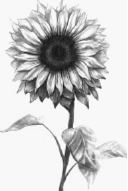
A
Single fertilization
B
Double fertilization
C
Normal fertilization
D
None of these
Solution
(B) The plant shown in the figure is a sunflower,which belongs to the group of Angiosperms (flowering plants).
Angiosperms are characterized by a unique process known as double fertilization.
In this process,one male gamete fuses with the egg cell to form a diploid zygote (syngamy),and the other male gamete fuses with the two polar nuclei to form a triploid primary endosperm nucleus (triple fusion).
Therefore,double fertilization is the characteristic feature of angiosperms.
Angiosperms are characterized by a unique process known as double fertilization.
In this process,one male gamete fuses with the egg cell to form a diploid zygote (syngamy),and the other male gamete fuses with the two polar nuclei to form a triploid primary endosperm nucleus (triple fusion).
Therefore,double fertilization is the characteristic feature of angiosperms.
0 likes
View Solution57
EasyMCQ
Double fertilisation is exhibited by
A
algae
B
fungi
C
angiosperms
D
gymnosperms
Solution
(C) The correct answer is $C$. Double fertilisation is a unique and characteristic feature of angiosperms.
In this process,two male gametes are released into the embryo sac.
One male gamete fuses with the egg cell to form a diploid zygote,which develops into the embryo.
The second male gamete fuses with the secondary nucleus (or two polar nuclei) to form the primary endosperm nucleus $(PEN)$,which is triploid $(3n)$ and develops into the endosperm.
In this process,two male gametes are released into the embryo sac.
One male gamete fuses with the egg cell to form a diploid zygote,which develops into the embryo.
The second male gamete fuses with the secondary nucleus (or two polar nuclei) to form the primary endosperm nucleus $(PEN)$,which is triploid $(3n)$ and develops into the endosperm.
0 likes
View Solution58
EasyMCQ
...... is the vital link that ensures continuity of species between organisms of one generation and the next generation.
A
Male gamete
B
Female gamete
C
Embryo
D
Zygote
Solution
(D) The $Zygote$ is the vital link that ensures the continuity of species between organisms of one generation and the next.
It is a diploid cell formed by the fusion of two haploid gametes (male and female) during the process of fertilization.
This single-celled $Zygote$ contains the genetic material from both parents, which then undergoes repeated mitotic divisions to develop into a new individual, thereby maintaining the continuity of the species.
It is a diploid cell formed by the fusion of two haploid gametes (male and female) during the process of fertilization.
This single-celled $Zygote$ contains the genetic material from both parents, which then undergoes repeated mitotic divisions to develop into a new individual, thereby maintaining the continuity of the species.
0 likes
View Solution59
MediumMCQ
Double fertilization is the fusion of:
A
One male gamete with egg and the other with the secondary nucleus
B
One male gamete with egg and the other with a synergid
C
Two eggs and antipodal cells with pollen nuclei
D
Two eggs
Solution
(A) Double fertilization is a characteristic feature of angiosperms.
It involves two fusion events:
$1$. Syngamy: One male gamete fuses with the egg cell to form a diploid zygote $(n + n = 2n)$.
$2$. Triple Fusion: The second male gamete fuses with the two polar nuclei (or the secondary nucleus) to form the primary endosperm nucleus $(PEN)$,which is triploid $(n + 2n = 3n)$.
Together,these two processes are known as double fertilization.
It involves two fusion events:
$1$. Syngamy: One male gamete fuses with the egg cell to form a diploid zygote $(n + n = 2n)$.
$2$. Triple Fusion: The second male gamete fuses with the two polar nuclei (or the secondary nucleus) to form the primary endosperm nucleus $(PEN)$,which is triploid $(n + 2n = 3n)$.
Together,these two processes are known as double fertilization.
0 likes
View Solution60
MediumMCQ
How many nuclei are present in the embryo sac after fertilization?
A
$7$
B
$10$
C
$9$
D
$8$
Solution
(A) Before fertilization, a mature embryo sac (polygonum type) contains $7$ cells and $8$ nuclei.
After fertilization, the following events occur:
$1$. The egg cell fuses with one male gamete to form a diploid zygote $(2n)$, which contains $1$ nucleus.
$2$. The central cell, which contains two polar nuclei, fuses with the second male gamete to form a primary endosperm nucleus $(PEN)$, which is triploid $(3n)$ and contains $1$ nucleus.
$3$. The three antipodal cells and two synergids usually degenerate.
However, the question asks for the total number of nuclei present in the embryo sac structure. The $PEN$ ($1$ nucleus) and the zygote ($1$ nucleus) are present. The degenerating synergids and antipodal cells still contain their nuclei for a period. Specifically, the $PEN$ is $1$ nucleus, the zygote is $1$ nucleus, the $3$ antipodal cells have $3$ nuclei, and the $2$ synergids have $2$ nuclei.
Total nuclei = $1 (PEN) + 1 (Zygote) + 3 (Antipodals) + 2 (Synergids) = 7$ nuclei.
After fertilization, the following events occur:
$1$. The egg cell fuses with one male gamete to form a diploid zygote $(2n)$, which contains $1$ nucleus.
$2$. The central cell, which contains two polar nuclei, fuses with the second male gamete to form a primary endosperm nucleus $(PEN)$, which is triploid $(3n)$ and contains $1$ nucleus.
$3$. The three antipodal cells and two synergids usually degenerate.
However, the question asks for the total number of nuclei present in the embryo sac structure. The $PEN$ ($1$ nucleus) and the zygote ($1$ nucleus) are present. The degenerating synergids and antipodal cells still contain their nuclei for a period. Specifically, the $PEN$ is $1$ nucleus, the zygote is $1$ nucleus, the $3$ antipodal cells have $3$ nuclei, and the $2$ synergids have $2$ nuclei.
Total nuclei = $1 (PEN) + 1 (Zygote) + 3 (Antipodals) + 2 (Synergids) = 7$ nuclei.
0 likes
View Solution61
MediumMCQ
In double fertilization,after entering ..... of the synergids,the pollen tube releases ..... male gametes into the cytoplasm of the synergids.
A
Two,one
B
One,two
C
Three,two
D
Two,three
Solution
(B) During the process of double fertilization in angiosperms,the pollen tube enters one of the synergids through the filiform apparatus.
Upon entering the synergid,the pollen tube ruptures and releases two male gametes into the cytoplasm of that synergid.
One male gamete fuses with the egg cell to form a zygote (syngamy),and the other male gamete fuses with the two polar nuclei to form the primary endosperm nucleus (triple fusion).
Therefore,the correct sequence is that the pollen tube enters one synergid and releases two male gametes.
Upon entering the synergid,the pollen tube ruptures and releases two male gametes into the cytoplasm of that synergid.
One male gamete fuses with the egg cell to form a zygote (syngamy),and the other male gamete fuses with the two polar nuclei to form the primary endosperm nucleus (triple fusion).
Therefore,the correct sequence is that the pollen tube enters one synergid and releases two male gametes.
0 likes
View Solution62
EasyMCQ
Double fertilization is characteristic of
A
Gymnosperm
B
Angiosperm
C
Algae
D
Bryophyte
Solution
(B) Double fertilization is a unique and defining characteristic of $Angiosperms$ (flowering plants).
In this process, one male gamete fuses with the egg cell to form a diploid zygote $(syngamy)$, and the second male gamete fuses with the two polar nuclei to form a triploid primary endosperm nucleus $(triple \text{ } fusion)$.
This combined process of syngamy and triple fusion is known as double fertilization.
In this process, one male gamete fuses with the egg cell to form a diploid zygote $(syngamy)$, and the second male gamete fuses with the two polar nuclei to form a triploid primary endosperm nucleus $(triple \text{ } fusion)$.
This combined process of syngamy and triple fusion is known as double fertilization.
0 likes
View Solution63
MediumMCQ
Which of the following is present in all angiosperms without exception?
A
Presence of vessels
B
Double fertilization
C
Secondary growth
D
Autotrophic nutrition
Solution
(B) Double fertilization is a unique and defining characteristic of angiosperms (flowering plants). It involves the fusion of one male gamete with the egg cell to form a zygote (syngamy) and the fusion of another male gamete with the two polar nuclei to form the primary endosperm nucleus (triple fusion). This process is universal in all angiosperms. Vessels are absent in some primitive angiosperms,secondary growth is absent in monocots,and while most angiosperms are autotrophic,some are parasitic (e.g.,Cuscuta),making double fertilization the only exceptionless feature among the choices.
0 likes
View Solution64
EasyMCQ
Syngamy refers to . .
A
Fusion of gametes
B
Fusion of cytoplasm
C
Fusion of two similar spores
D
Fusion of two dissimilar spores
Solution
(A) Syngamy is the process of fusion of two haploid gametes to form a diploid zygote. This is a fundamental event in sexual reproduction. Therefore,the correct definition is the fusion of gametes.
0 likes
View Solution65
MediumMCQ
Double fertilization is the fusion of:
A
Two egg cells
B
Two egg cells and polar nuclei and pollen nuclei
C
One male gamete with egg cell and another with synergid cell
D
One male gamete with egg cell and another with secondary nucleus
Solution
(D) Double fertilization is a characteristic feature of angiosperms.
It involves two fusion events:
$1$. Syngamy: One male gamete fuses with the egg cell to form a diploid zygote $(n + n = 2n)$.
$2$. Triple Fusion: The second male gamete fuses with the two polar nuclei (or the secondary nucleus) to form a triploid primary endosperm nucleus $(n + 2n = 3n)$.
Thus,double fertilization is the fusion of one male gamete with the egg cell and another male gamete with the secondary nucleus.
It involves two fusion events:
$1$. Syngamy: One male gamete fuses with the egg cell to form a diploid zygote $(n + n = 2n)$.
$2$. Triple Fusion: The second male gamete fuses with the two polar nuclei (or the secondary nucleus) to form a triploid primary endosperm nucleus $(n + 2n = 3n)$.
Thus,double fertilization is the fusion of one male gamete with the egg cell and another male gamete with the secondary nucleus.
0 likes
View Solution66
EasyMCQ
Who discovered double fertilization and triple fusion?
A
Hofmeister
B
Nawaschin and Guignard
C
Leeuwenhoek
D
Strasburger
Solution
(B) Double fertilization and triple fusion were discovered by $S.G. \text{Nawaschin}$ and $L. \text{Guignard}$ in $1898$ in the plants $Lilium$ and $Fritillaria$.
Double fertilization involves the fusion of one male gamete with the egg cell to form a diploid zygote,and the fusion of the second male gamete with two polar nuclei to form the primary endosperm nucleus (triple fusion).
Double fertilization involves the fusion of one male gamete with the egg cell to form a diploid zygote,and the fusion of the second male gamete with two polar nuclei to form the primary endosperm nucleus (triple fusion).
0 likes
View Solution67
MediumMCQ
In angiosperms,triple fusion is required for the formation of which of the following?
A
Embryo
B
Endosperm
C
Seed coat
D
Fruit wall
Solution
(B) In angiosperms,the process of double fertilization involves two events: syngamy and triple fusion.
Syngamy involves the fusion of one male gamete with the egg cell to form a diploid zygote $(2n)$,which develops into the embryo.
Triple fusion involves the fusion of the second male gamete $(n)$ with two polar nuclei $(n+n)$ or the secondary nucleus $(2n)$ to form the primary endosperm nucleus $(PEN)$ which is triploid $(3n)$.
The $PEN$ subsequently develops into the endosperm,which provides nourishment to the developing embryo.
Therefore,triple fusion is essential for the formation of the endosperm.
Syngamy involves the fusion of one male gamete with the egg cell to form a diploid zygote $(2n)$,which develops into the embryo.
Triple fusion involves the fusion of the second male gamete $(n)$ with two polar nuclei $(n+n)$ or the secondary nucleus $(2n)$ to form the primary endosperm nucleus $(PEN)$ which is triploid $(3n)$.
The $PEN$ subsequently develops into the endosperm,which provides nourishment to the developing embryo.
Therefore,triple fusion is essential for the formation of the endosperm.
0 likes
View Solution68
MediumMCQ
What is required to initiate the development of endosperm in angiosperms after double fertilization?
A
One polar nucleus and one male gamete
B
Two polar nuclei and one male gamete
C
Four or more polar nuclei and one male gamete
D
All of the above types of fusions in various angiosperms
Solution
(B) In angiosperms,double fertilization involves two processes: syngamy and triple fusion.
During triple fusion,one male gamete $(n)$ fuses with two polar nuclei $(n + n)$ or the secondary nucleus $(2n)$ present in the central cell.
This fusion results in the formation of the Primary Endosperm Nucleus $(PEN)$,which is triploid $(3n)$.
This $PEN$ subsequently develops into the endosperm,which provides nourishment to the developing embryo.
During triple fusion,one male gamete $(n)$ fuses with two polar nuclei $(n + n)$ or the secondary nucleus $(2n)$ present in the central cell.
This fusion results in the formation of the Primary Endosperm Nucleus $(PEN)$,which is triploid $(3n)$.
This $PEN$ subsequently develops into the endosperm,which provides nourishment to the developing embryo.
0 likes
View Solution69
EasyMCQ
Double fertilization is observed in .............
A
Gymnosperms
B
Algae
C
Fungi
D
Angiosperms
Solution
(D) Double fertilization is a characteristic feature of $Angiosperms$ (flowering plants).
In this process, one male gamete fuses with the egg cell to form a diploid zygote $(syngamy)$, and the second male gamete fuses with the two polar nuclei to form a triploid primary endosperm nucleus $(triple \text{ } fusion)$.
Together, these two events are known as double fertilization.
In this process, one male gamete fuses with the egg cell to form a diploid zygote $(syngamy)$, and the second male gamete fuses with the two polar nuclei to form a triploid primary endosperm nucleus $(triple \text{ } fusion)$.
Together, these two events are known as double fertilization.
0 likes
View Solution70
MediumMCQ
Double fertilization is
A
Fusion of one male gamete with two polar nuclei
B
Fusion of two male gametes of a pollen tube with two different eggs
C
Fusion of two male gametes with one egg
D
Syngamy and triple fusion
Solution
(D) Double fertilization is a characteristic feature of angiosperms.
It involves two distinct fusion events:
$1$. Syngamy: One male gamete fuses with the egg cell to form a diploid zygote $(2n)$.
$2$. Triple fusion: The second male gamete fuses with the two polar nuclei (or the secondary nucleus) to form a primary endosperm nucleus $(PEN)$,which is triploid $(3n)$.
Therefore,double fertilization is the combination of syngamy and triple fusion.
It involves two distinct fusion events:
$1$. Syngamy: One male gamete fuses with the egg cell to form a diploid zygote $(2n)$.
$2$. Triple fusion: The second male gamete fuses with the two polar nuclei (or the secondary nucleus) to form a primary endosperm nucleus $(PEN)$,which is triploid $(3n)$.
Therefore,double fertilization is the combination of syngamy and triple fusion.
0 likes
View Solution71
MediumMCQ
What is the fate of the male gametes discharged in the synergid?
A
One fuses with the egg,other$(s)$ degenerate$(s)$ in the synergid.
B
All fuse with the egg.
C
One fuses with the egg,other$(s)$ fuse$(s)$ with synergid nucleus.
D
One fuses with the egg and other fuses with central cell nuclei.
Solution
(D) In angiosperms,the process of double fertilization occurs.
After the pollen tube enters the synergid,it releases two male gametes into the cytoplasm of the synergid.
One male gamete moves towards the egg cell and fuses with its nucleus to form a diploid zygote $(n + n = 2n)$,a process known as syngamy.
The second male gamete moves towards the two polar nuclei located in the central cell and fuses with them to form a triploid primary endosperm nucleus $(PEN)$ $(n + n + n = 3n)$,a process known as triple fusion.
Thus,one male gamete fuses with the egg and the other fuses with the central cell nuclei.
After the pollen tube enters the synergid,it releases two male gametes into the cytoplasm of the synergid.
One male gamete moves towards the egg cell and fuses with its nucleus to form a diploid zygote $(n + n = 2n)$,a process known as syngamy.
The second male gamete moves towards the two polar nuclei located in the central cell and fuses with them to form a triploid primary endosperm nucleus $(PEN)$ $(n + n + n = 3n)$,a process known as triple fusion.
Thus,one male gamete fuses with the egg and the other fuses with the central cell nuclei.
0 likes
View Solution72
MediumMCQ
Assertion: Double fertilization is a characteristic feature of angiosperms.
Reason: Double fertilization involves two fusions.
Reason: Double fertilization involves two fusions.
A
If both Assertion and Reason are correct and the Reason is a correct explanation of the Assertion.
B
If both Assertion and Reason are correct but Reason is not a correct explanation of the Assertion.
C
If the Assertion is correct but Reason is incorrect.
D
If both the Assertion and Reason are incorrect.
Solution
(A) Double fertilization is a unique and characteristic feature of angiosperms.
It involves two distinct fusion events:
$1$. Syngamy: One male gamete fuses with the egg cell to form a diploid zygote $(2n)$.
$2$. Triple Fusion: The second male gamete fuses with the two polar nuclei (or the diploid secondary nucleus) to form the primary endosperm nucleus $(PEN)$,which is triploid $(3n)$.
Since the process is defined by these two specific fusion events,the Reason correctly explains the Assertion.
It involves two distinct fusion events:
$1$. Syngamy: One male gamete fuses with the egg cell to form a diploid zygote $(2n)$.
$2$. Triple Fusion: The second male gamete fuses with the two polar nuclei (or the diploid secondary nucleus) to form the primary endosperm nucleus $(PEN)$,which is triploid $(3n)$.
Since the process is defined by these two specific fusion events,the Reason correctly explains the Assertion.
0 likes
View Solution73
Medium
Differentiate between the following:
$(i)$ Red algae and brown algae
$(ii)$ Liverworts and moss
$(iii)$ Homosporous and heterosporous pteridophytes
$(iv)$ Syngamy and triple fusion
$(i)$ Red algae and brown algae
$(ii)$ Liverworts and moss
$(iii)$ Homosporous and heterosporous pteridophytes
$(iv)$ Syngamy and triple fusion
Solution
(N/A) $(i)$ Red algae and brown algae
$(ii)$ Liverworts and moss
$(iii)$ Homosporous and heterosporous pteridophytes
$(iv)$ Syngamy and triple fusion
| $(1)$ Red algae belong to class Rhodophyceae. | $(1)$ Brown algae belong to class Phaeophyceae. |
| $(2)$ Stored food is floridean starch. | $(2)$ Stored food is mannitol or laminarin. |
| $(3)$ Pigments are chlorophyll $a, d$ and phycoerythrin. | $(3)$ Pigments are chlorophyll $a, c$ and fucoxanthin. |
| $(4)$ Cell wall contains cellulose,pectin,and phycocolloids. | $(4)$ Cell wall contains cellulose and algin. |
| $(5)$ Flagella are absent. | $(5)$ Two flagella are present. |
$(ii)$ Liverworts and moss
| $(1)$ Rhizoids are unicellular. | $(1)$ Rhizoids are multicellular. |
| $(2)$ Scales are often present. | $(2)$ Scales are absent. |
| $(3)$ Thalloid body with dichotomous branching. | $(3)$ Foliage body with lateral branching. |
| $(4)$ Gemma cups are present. | $(4)$ Gemma cups are absent. |
| $(5)$ Sporophyte has little photosynthetic tissue. | $(5)$ Sporophyte has abundant photosynthetic tissue. |
$(iii)$ Homosporous and heterosporous pteridophytes
| $(1)$ Produce spores of the same type. | $(1)$ Produce two types of spores: microspores and megaspores. |
| $(2)$ Produce bisexual gametophytes. | $(2)$ Produce unisexual gametophytes. |
$(iv)$ Syngamy and triple fusion
| $(1)$ Fusion of male gamete with egg. | $(1)$ Fusion of male gamete with secondary nucleus. |
| $(2)$ Forms a diploid zygote. | $(2)$ Forms a triploid primary endosperm nucleus. |
0 likes
View Solution74
EasyMCQ
What is double fertilization in Angiosperms?
A
Fusion of two male gametes with one egg cell.
B
Fusion of one male gamete with the egg and another with the central cell (syngamy and triple fusion).
C
Fusion of two male gametes with two polar nuclei.
D
Fusion of one male gamete with two synergids.
Solution
(B) Double fertilization is a unique process characteristic of Angiosperms. It involves two distinct fusion events:
$1$. Syngamy: One male gamete fuses with the egg cell to form a diploid zygote $(2n)$.
$2$. Triple Fusion: The second male gamete fuses with the two polar nuclei (or the secondary nucleus) in the central cell to form a triploid primary endosperm nucleus ($PEN$,$3n$).
Together,these two processes are known as double fertilization.
$1$. Syngamy: One male gamete fuses with the egg cell to form a diploid zygote $(2n)$.
$2$. Triple Fusion: The second male gamete fuses with the two polar nuclei (or the secondary nucleus) in the central cell to form a triploid primary endosperm nucleus ($PEN$,$3n$).
Together,these two processes are known as double fertilization.
0 likes
View Solution75
Easy
What is triple fusion? Where and how does it take place? Name the nuclei involved in triple fusion.
Solution
(N/A) Triple fusion is the fusion of one male gamete with two polar nuclei inside the embryo sac of an angiosperm.
This process takes place inside the central cell of the embryo sac.
When pollen grains land on the stigma,they germinate to form a pollen tube that grows through the style and enters the ovule. The pollen tube enters one of the synergids and releases two male gametes. One male gamete fuses with the egg cell to form a diploid zygote (syngamy). The second male gamete moves towards the central cell and fuses with the two polar nuclei to form a triploid primary endosperm nucleus $(PEN)$. This process is called triple fusion because it involves the fusion of three haploid nuclei. It leads to the development of the endosperm.
The nuclei involved are one male gamete nucleus and two polar nuclei.
This process takes place inside the central cell of the embryo sac.
When pollen grains land on the stigma,they germinate to form a pollen tube that grows through the style and enters the ovule. The pollen tube enters one of the synergids and releases two male gametes. One male gamete fuses with the egg cell to form a diploid zygote (syngamy). The second male gamete moves towards the central cell and fuses with the two polar nuclei to form a triploid primary endosperm nucleus $(PEN)$. This process is called triple fusion because it involves the fusion of three haploid nuclei. It leads to the development of the endosperm.
The nuclei involved are one male gamete nucleus and two polar nuclei.
0 likes
View Solution76
Medium
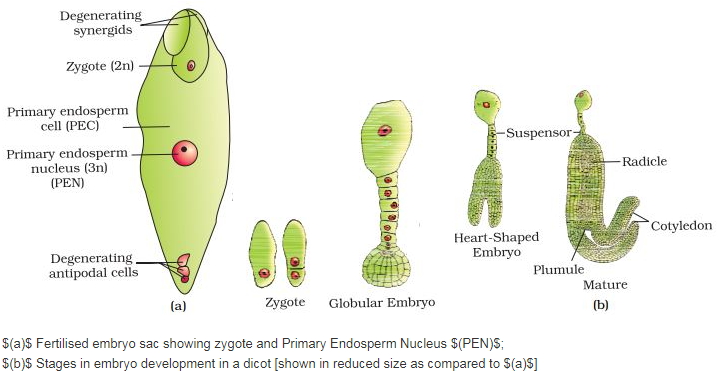
Explain double fertilisation in angiosperms.
Solution
(N/A) Double fertilisation is a complex fertilization mechanism unique to angiosperms.
$1$. Pollen deposition and tube growth: After pollination,the pollen grain germinates on the stigma to form a pollen tube. This tube grows through the style and enters the ovary,eventually reaching the ovule. Two male gametes are carried within the pollen tube.
$2$. Entry into the embryo sac: Upon entering one of the synergids,the pollen tube releases the two male gametes into the cytoplasm of the synergid.
$3$. Syngamy: One of the male gametes moves towards the egg cell and fuses with its nucleus. This fusion is called syngamy,resulting in the formation of a diploid zygote $(2n)$.
$4$. Triple fusion: The other male gamete moves towards the two polar nuclei located in the central cell and fuses with them. This fusion of three haploid nuclei $(n + n + n)$ is termed triple fusion,resulting in a triploid primary endosperm nucleus ($PEN$,$3n$).
$5$. Conclusion: Since both syngamy and triple fusion occur within the embryo sac,the process is known as double fertilisation. The central cell,after triple fusion,becomes the Primary Endosperm Cell $(PEC)$ and develops into the endosperm,while the zygote develops into the embryo.
$1$. Pollen deposition and tube growth: After pollination,the pollen grain germinates on the stigma to form a pollen tube. This tube grows through the style and enters the ovary,eventually reaching the ovule. Two male gametes are carried within the pollen tube.
$2$. Entry into the embryo sac: Upon entering one of the synergids,the pollen tube releases the two male gametes into the cytoplasm of the synergid.
$3$. Syngamy: One of the male gametes moves towards the egg cell and fuses with its nucleus. This fusion is called syngamy,resulting in the formation of a diploid zygote $(2n)$.
$4$. Triple fusion: The other male gamete moves towards the two polar nuclei located in the central cell and fuses with them. This fusion of three haploid nuclei $(n + n + n)$ is termed triple fusion,resulting in a triploid primary endosperm nucleus ($PEN$,$3n$).
$5$. Conclusion: Since both syngamy and triple fusion occur within the embryo sac,the process is known as double fertilisation. The central cell,after triple fusion,becomes the Primary Endosperm Cell $(PEC)$ and develops into the endosperm,while the zygote develops into the embryo.
0 likes
View Solution77
Medium
Define/Explain: Double Fertilisation.
Solution
(N/A) $\rightarrow$ In angiosperms,out of the two male gametes,one male gamete fuses with the egg cell to form a diploid zygote (syngamy),while the other male gamete fuses with the two polar nuclei (or diploid secondary nucleus) to form a triploid primary endosperm nucleus $(PEN)$ (triple fusion).
$\rightarrow$ Since two types of fusion events occur in the embryo sac,this process is known as double fertilisation.
$\rightarrow$ This phenomenon is a unique characteristic of angiosperms.
$\rightarrow$ Since two types of fusion events occur in the embryo sac,this process is known as double fertilisation.
$\rightarrow$ This phenomenon is a unique characteristic of angiosperms.
0 likes
View Solution78
EasyMCQ
What is the full form of $PEN$?
A
Primary Embryo Nucleus
B
Primary Endosperm Nucleus
C
Post Endosperm Nucleus
D
Primary Endosperm Node
Solution
(B) In angiosperms,during the process of double fertilization,one of the male gametes fuses with the two polar nuclei located in the central cell to form a triploid $(3n)$ structure known as the Primary Endosperm Nucleus $(PEN)$.
This nucleus subsequently develops into the endosperm,which provides nourishment to the developing embryo.
This nucleus subsequently develops into the endosperm,which provides nourishment to the developing embryo.
0 likes
View Solution79
Easy
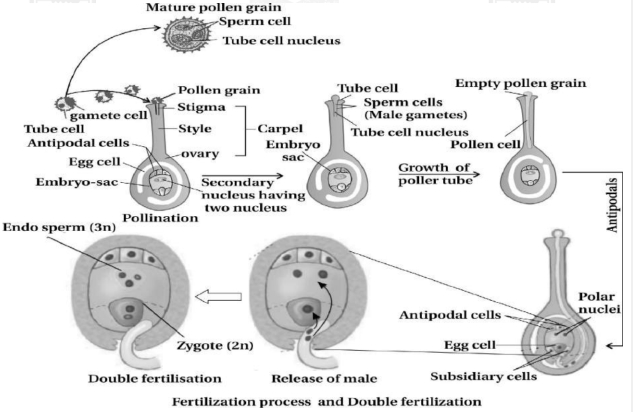
Explain why sexual reproduction in angiosperms is said to take place through double fertilization and triple fusion? Also,provide a labelled diagram of the embryo sac to explain the phenomenon.
Solution
(N/A) In angiosperms,the process of fertilization involves two distinct fusion events:
$1$. Syngamy (Fertilization): One of the two male gametes released by the pollen tube fuses with the egg cell to form a diploid zygote $(2n)$.
$2$. Triple Fusion: The second male gamete fuses with the two polar nuclei (or the secondary nucleus) located in the central cell to form a triploid Primary Endosperm Nucleus ($PEN$,$3n$).
Since these two fusion events occur simultaneously in the embryo sac,the process is collectively known as double fertilization. Following these events,the zygote develops into an embryo,and the $PEN$ develops into the endosperm,which provides nourishment to the developing embryo.
$1$. Syngamy (Fertilization): One of the two male gametes released by the pollen tube fuses with the egg cell to form a diploid zygote $(2n)$.
$2$. Triple Fusion: The second male gamete fuses with the two polar nuclei (or the secondary nucleus) located in the central cell to form a triploid Primary Endosperm Nucleus ($PEN$,$3n$).
Since these two fusion events occur simultaneously in the embryo sac,the process is collectively known as double fertilization. Following these events,the zygote develops into an embryo,and the $PEN$ develops into the endosperm,which provides nourishment to the developing embryo.
0 likes
View Solution80
Medium
What is meant by double fertilization? Explain.
Solution
(N/A) $\rightarrow$ After pollination,the pollen grain germinates on the stigma,and the pollen tube grows through the style to reach the ovule.
$\rightarrow$ The pollen tube enters the embryo sac and releases two male gametes.
$\rightarrow$ One male gamete fuses with the egg cell to form a diploid zygote,a process known as $Syngamy$.
$\rightarrow$ The second male gamete fuses with the two polar nuclei (or the diploid secondary nucleus) to form a triploid primary endosperm nucleus $(PEN)$,a process known as $Triple$ $Fusion$.
$\rightarrow$ Since two types of fusions occur within the embryo sac,this phenomenon is called $Double$ $Fertilization$,which is a unique characteristic of angiosperms.
$\rightarrow$ The pollen tube enters the embryo sac and releases two male gametes.
$\rightarrow$ One male gamete fuses with the egg cell to form a diploid zygote,a process known as $Syngamy$.
$\rightarrow$ The second male gamete fuses with the two polar nuclei (or the diploid secondary nucleus) to form a triploid primary endosperm nucleus $(PEN)$,a process known as $Triple$ $Fusion$.
$\rightarrow$ Since two types of fusions occur within the embryo sac,this phenomenon is called $Double$ $Fertilization$,which is a unique characteristic of angiosperms.
0 likes
View Solution81
Medium
Give scientific reasons: Two types of fusions,syngamy and triple fusion,take place in the embryo sac.
Solution
(N/A) After entering one of the synergids,the pollen tube releases the two male gametes into the cytoplasm of the synergid.
One of the male gametes moves towards the egg cell and fuses with its nucleus,thus completing the $syngamy$. This results in the formation of a diploid cell,the $zygote$.
The other male gamete moves towards the two polar nuclei located in the central cell and fuses with them to produce a triploid $primary$ $endosperm$ $nucleus$ $(PEN)$.
As this involves the fusion of three haploid nuclei,it is termed $triple$ $fusion$.
Since two types of fusions,$syngamy$ and $triple$ $fusion$,take place in an embryo sac,the phenomenon is termed $double$ $fertilisation$.
One of the male gametes moves towards the egg cell and fuses with its nucleus,thus completing the $syngamy$. This results in the formation of a diploid cell,the $zygote$.
The other male gamete moves towards the two polar nuclei located in the central cell and fuses with them to produce a triploid $primary$ $endosperm$ $nucleus$ $(PEN)$.
As this involves the fusion of three haploid nuclei,it is termed $triple$ $fusion$.
Since two types of fusions,$syngamy$ and $triple$ $fusion$,take place in an embryo sac,the phenomenon is termed $double$ $fertilisation$.
0 likes
View Solution82
Medium
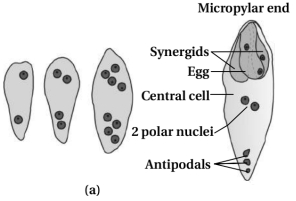
Which is the triploid tissue in a fertilised ovule? How is the triploid condition achieved?
Solution
(N/A) The triploid tissue in a fertilised ovule is the Primary Endosperm Nucleus $(PEN)$,which develops into the endosperm.
This triploid condition is achieved through a process called triple fusion.
During this process,one of the male gametes (haploid,$n$) fuses with the two polar nuclei (each haploid,$n$) present in the central cell.
This fusion of three haploid nuclei $(n + n + n)$ results in a triploid $(3n)$ nucleus.
This triploid condition is achieved through a process called triple fusion.
During this process,one of the male gametes (haploid,$n$) fuses with the two polar nuclei (each haploid,$n$) present in the central cell.
This fusion of three haploid nuclei $(n + n + n)$ results in a triploid $(3n)$ nucleus.
0 likes
View Solution83
MediumMCQ
What is the function of the two male gametes produced by each pollen grain in angiosperms?
A
One fuses with the egg cell to form a zygote,and the other fuses with the polar nuclei to form the primary endosperm nucleus.
B
Both fuse with the egg cell to form a diploid zygote.
C
Both fuse with the polar nuclei to form a tetraploid endosperm.
D
One fuses with the synergids and the other with the antipodal cells.
Solution
(A) In angiosperms,each pollen grain produces two male gametes.
$1$. The first male gamete fuses with the egg cell (syngamy) to form a diploid zygote $(2n)$,which eventually develops into an embryo.
$2$. The second male gamete fuses with the two polar nuclei (or the secondary nucleus) in the central cell to form the primary endosperm nucleus $(PEN)$,which is triploid $(3n)$. This process is known as triple fusion.
Together,syngamy and triple fusion constitute the process of double fertilization.
$1$. The first male gamete fuses with the egg cell (syngamy) to form a diploid zygote $(2n)$,which eventually develops into an embryo.
$2$. The second male gamete fuses with the two polar nuclei (or the secondary nucleus) in the central cell to form the primary endosperm nucleus $(PEN)$,which is triploid $(3n)$. This process is known as triple fusion.
Together,syngamy and triple fusion constitute the process of double fertilization.
0 likes
View Solution84
MediumMCQ
The zygote is formed by which process?
A
Syngamy
B
Amitosis
C
Mitosis
D
Differentiation
Solution
(A) The process of fusion of a male gamete with an egg cell (female gamete) is known as $Syngamy$. This fusion results in the formation of a diploid cell called the $Zygote$. This is a key event in sexual reproduction.
0 likes
View Solution85
MediumMCQ
What is the full form of $PEN$?
A
Primary Embryonic Nucleus
B
Primary Embryo Nucleus
C
Primary Endosperm Cell
D
Primary Endosperm Nucleus
Solution
(D) In angiosperms,during double fertilization,one of the male gametes fuses with the two polar nuclei located in the central cell to form a triploid $(3n)$ structure known as the Primary Endosperm Nucleus $(PEN)$.
This process is called triple fusion.
The $PEN$ subsequently develops into the endosperm,which provides nourishment to the developing embryo.
This process is called triple fusion.
The $PEN$ subsequently develops into the endosperm,which provides nourishment to the developing embryo.
0 likes
View Solution86
MediumMCQ
Select the correct option regarding $PEN$.
A
$n$
B
$2n$
C
$3n$
D
$4n$
Solution
(C) In angiosperms,the process of double fertilization involves the fusion of one male gamete with two polar nuclei to form the Primary Endosperm Nucleus $(PEN)$.
Since the male gamete is haploid $(n)$ and the two polar nuclei are also haploid $(n + n)$,their fusion results in a triploid $(3n)$ structure.
Therefore,the ploidy level of $PEN$ is $3n$.
Since the male gamete is haploid $(n)$ and the two polar nuclei are also haploid $(n + n)$,their fusion results in a triploid $(3n)$ structure.
Therefore,the ploidy level of $PEN$ is $3n$.
0 likes
View Solution87
MediumMCQ
What is formed when a male gamete fuses with the nucleus of the egg cell?
A
$PEN$
B
Zygote
C
$PEC$
D
Embryo
Solution
(B) In angiosperms,double fertilization occurs. One male gamete fuses with the egg cell (syngamy) to form a diploid zygote $(2n)$. The other male gamete fuses with the two polar nuclei (triple fusion) to form the Primary Endosperm Nucleus $(PEN)$. Thus,the fusion of a male gamete with the egg cell nucleus results in the formation of a zygote.
0 likes
View Solution88
MediumMCQ
What is triple fusion?
A
Fusion of three triploid nuclei
B
Fusion of three haploid nuclei
C
Fusion of three diploid nuclei
D
Fusion of one triploid nucleus with two diploid nuclei
Solution
(B) Triple fusion is a key event in the process of double fertilization in angiosperms.
It involves the fusion of one male gamete $(n)$ with two polar nuclei (or a secondary nucleus formed by the fusion of two polar nuclei,each $n$) present in the central cell.
Since the male gamete is haploid $(n)$ and the two polar nuclei are also haploid $(n + n)$,their fusion results in the formation of a triploid $(3n)$ primary endosperm nucleus $(PEN)$.
Therefore,it is the fusion of three haploid nuclei.
It involves the fusion of one male gamete $(n)$ with two polar nuclei (or a secondary nucleus formed by the fusion of two polar nuclei,each $n$) present in the central cell.
Since the male gamete is haploid $(n)$ and the two polar nuclei are also haploid $(n + n)$,their fusion results in the formation of a triploid $(3n)$ primary endosperm nucleus $(PEN)$.
Therefore,it is the fusion of three haploid nuclei.
0 likes
View Solution89
MediumMCQ
In double fertilization,the male gametes fuse with the nuclei of which cells?
A
Synergid and egg cell
B
Egg cell and antipodal cell
C
Antipodal cell and synergid
D
Egg cell and central cell
Solution
(D) In angiosperms,double fertilization involves two fusion events:
$1$. Syngamy: One male gamete fuses with the egg cell to form a diploid zygote $(2n)$.
$2$. Triple Fusion: The second male gamete fuses with the two polar nuclei (or the secondary nucleus) present in the central cell to form the primary endosperm nucleus ($PEN$,$3n$).
Therefore,the male gametes fuse with the nuclei of the egg cell and the central cell.
$1$. Syngamy: One male gamete fuses with the egg cell to form a diploid zygote $(2n)$.
$2$. Triple Fusion: The second male gamete fuses with the two polar nuclei (or the secondary nucleus) present in the central cell to form the primary endosperm nucleus ($PEN$,$3n$).
Therefore,the male gametes fuse with the nuclei of the egg cell and the central cell.
0 likes
View Solution90
MediumMCQ
Where does the process of fertilization occur in flowering plants?
A
Anther
B
Style
C
$PMC$
D
Female gametophyte
Solution
(D) In flowering plants (angiosperms),the process of fertilization occurs within the embryo sac,which is the female gametophyte located inside the ovule.
$1$. The pollen tube enters the ovule through the micropyle.
$2$. It then enters one of the synergids.
$3$. The two male gametes are released into the cytoplasm of the synergid.
$4$. One male gamete fuses with the egg cell (syngamy) to form a zygote,and the other fuses with the two polar nuclei (triple fusion) to form the primary endosperm nucleus $(PEN)$.
Therefore,the site of fertilization is the female gametophyte.
$1$. The pollen tube enters the ovule through the micropyle.
$2$. It then enters one of the synergids.
$3$. The two male gametes are released into the cytoplasm of the synergid.
$4$. One male gamete fuses with the egg cell (syngamy) to form a zygote,and the other fuses with the two polar nuclei (triple fusion) to form the primary endosperm nucleus $(PEN)$.
Therefore,the site of fertilization is the female gametophyte.
0 likes
View Solution91
MediumMCQ
In which plants is double fertilization observed?
A
Angiosperms
B
Bryophytes
C
Pteridophytes
D
Gymnosperms
Solution
(A) Double fertilization is a unique and characteristic feature of $Angiosperms$ (flowering plants).
In this process, one male gamete fuses with the egg cell to form a diploid zygote $(Syngamy)$, and the other male gamete fuses with the two polar nuclei to form a triploid primary endosperm nucleus $(Triple \text{ } Fusion)$.
Together, these two events are known as double fertilization.
In this process, one male gamete fuses with the egg cell to form a diploid zygote $(Syngamy)$, and the other male gamete fuses with the two polar nuclei to form a triploid primary endosperm nucleus $(Triple \text{ } Fusion)$.
Together, these two events are known as double fertilization.
0 likes
View Solution92
MediumMCQ
Which cell is formed by triple fusion?
A
$MMC$
B
$PEC$
C
$PMC$
D
Zygote
Solution
(B) In angiosperms,double fertilization involves two processes: syngamy and triple fusion.
Triple fusion occurs when one male gamete $(n)$ fuses with two polar nuclei or the secondary nucleus $(2n)$ present in the central cell.
This fusion results in the formation of the Primary Endosperm Cell $(PEC)$,which is triploid $(3n)$.
Therefore,the correct answer is $PEC$.
Triple fusion occurs when one male gamete $(n)$ fuses with two polar nuclei or the secondary nucleus $(2n)$ present in the central cell.
This fusion results in the formation of the Primary Endosperm Cell $(PEC)$,which is triploid $(3n)$.
Therefore,the correct answer is $PEC$.
0 likes
View Solution93
MediumMCQ
Select the incorrect statement.
A
In wheat and maize,the endosperm is persistent.
B
Bean seeds have two cotyledons.
C
The radicle is covered by a root cap.
D
Triple fusion is observed in all plants.
Solution
(D) The correct answer is $D$.
Triple fusion is a characteristic feature of angiosperms (flowering plants) only,where one male gamete fuses with two polar nuclei to form the primary endosperm nucleus $(PEN)$.
It is not observed in gymnosperms,pteridophytes,bryophytes,or algae.
Therefore,the statement that triple fusion is observed in all plants is incorrect.
Wheat and maize are monocots where the endosperm persists in the mature seed.
Bean seeds are dicots and possess two cotyledons.
The radicle is protected by a root cap in all root systems.
Triple fusion is a characteristic feature of angiosperms (flowering plants) only,where one male gamete fuses with two polar nuclei to form the primary endosperm nucleus $(PEN)$.
It is not observed in gymnosperms,pteridophytes,bryophytes,or algae.
Therefore,the statement that triple fusion is observed in all plants is incorrect.
Wheat and maize are monocots where the endosperm persists in the mature seed.
Bean seeds are dicots and possess two cotyledons.
The radicle is protected by a root cap in all root systems.
0 likes
View Solution94
MediumMCQ
Triple fusion in angiosperms is the fusion of the second male gamete with:
A
Two polar nuclei (secondary nucleus)
B
Two antipodal cells
C
One antipodal cell
D
Antipodal cell and one synergid cell
Solution
(A) During fertilisation in angiosperms,one male gamete fuses with the egg cell to form a diploid zygote,a process known as syngamy.
The second male gamete fuses with the two polar nuclei (or the secondary nucleus) located in the central cell to form the primary endosperm nucleus $(PEN)$.
This fusion of three haploid nuclei is called triple fusion.
Together,syngamy and triple fusion constitute the process of double fertilisation.
The second male gamete fuses with the two polar nuclei (or the secondary nucleus) located in the central cell to form the primary endosperm nucleus $(PEN)$.
This fusion of three haploid nuclei is called triple fusion.
Together,syngamy and triple fusion constitute the process of double fertilisation.
0 likes
View Solution95
MediumMCQ
In angiospermic fertilisation,one male gamete fuses with the egg to form $A$,and this event is called $B$. Identify $A$ and $B$ and choose the correct option.
A
$A$-endosperm; $B$-syngamy
B
$A$-zygote; $B$-syngamy
C
$A$-embryo; $B$-triple fusion
D
$A$-endosperm; $B$-triple fusion
Solution
(B) In angiospermic sexual reproduction,the process of syngamy involves the fusion of one male gamete with the egg cell to form a diploid zygote $(2n)$.
This event is specifically termed as syngamy or generative fertilisation.
Therefore,$A$ is the zygote and $B$ is syngamy.
This event is specifically termed as syngamy or generative fertilisation.
Therefore,$A$ is the zygote and $B$ is syngamy.
0 likes
View Solution96
MediumMCQ
Choose the incorrect statement.
A
Double fertilisation is unique to gymnosperms and monocotyledons.
B
$Sequoia$,a gymnosperm,is one of the tallest trees.
C
Phaeophyceae members possess chlorophyll-$a$,$c$,carotenoids and xanthophylls.
D
Gametophyte of Moss consists of two stages namely,protonema stage and leafy stage.
Solution
(A) Double fertilisation is a characteristic feature of angiosperms,not gymnosperms. It involves syngamy (true fertilisation) and triple fusion. It was first demonstrated by $Nawaschin$ in $Fritillaria$ and $Lilium$. Therefore,the statement that it is unique to gymnosperms and monocotyledons is incorrect.
0 likes
View Solution97
EasyMCQ
An event unique to angiosperms is
A
Double fertilization
B
Sexual reproduction
C
Pollination
D
Spore formation
Solution
(A) Double fertilization is a process in which one male gamete fuses with the egg cell to form a zygote,and the second male gamete fuses with the two polar nuclei to form the primary endosperm nucleus $(PEN)$. This phenomenon is exclusive to angiosperms and is not observed in any other group of plants.
0 likes
View Solution98
MediumMCQ
$Eucalyptus$ is different from $Cedrus$ in the presence of
A
Syngamy
B
Seeds
C
Archegonia
D
Triple fusion
Solution
(D) $Eucalyptus$ is an angiosperm,which is characterized by the process of double fertilization,including triple fusion. In contrast,$Cedrus$ is a gymnosperm,which lacks triple fusion and does not produce flowers or fruits. Therefore,the presence of triple fusion is a distinguishing feature of $Eucalyptus$ compared to $Cedrus$.
0 likes
View Solution99
EasyMCQ
Endosperm is the result of
A
Single fertilisation
B
Partial fertilisation
C
Double fertilisation
D
Triple fertilisation
Solution
(D) Endosperm is formed as a result of double fertilisation,specifically through the process of triple fusion where one male gamete fuses with two polar nuclei to form the Primary Endosperm Nucleus $(PEN)$.
Endosperm provides nourishment to the developing embryo during seed development.
In plants such as bean,gram,and pea,the endosperm is not present in the mature seed because it is completely consumed during seed development. Such seeds are called non-endospermic or exalbuminous seeds.
In monocots and castor bean (a dicot),the embryo does not consume all the endosperm during seed development,so it persists in the mature seeds. Such seeds are called endospermic or albuminous seeds.
Endosperm provides nourishment to the developing embryo during seed development.
In plants such as bean,gram,and pea,the endosperm is not present in the mature seed because it is completely consumed during seed development. Such seeds are called non-endospermic or exalbuminous seeds.
In monocots and castor bean (a dicot),the embryo does not consume all the endosperm during seed development,so it persists in the mature seeds. Such seeds are called endospermic or albuminous seeds.
0 likes
View SolutionSexual Reproduction in Flowering Plants — Double Fertilisation · Frequently Asked Questions
1Are these Sexual Reproduction in Flowering Plants questions useful for JEE and NEET?
Yes. All questions in this section are mapped to JEE Main and NEET exam patterns. Previous year questions from JEE Main, NEET, GUJCET and state-level exams are included with full solutions.
2Can I switch to Hindi or Gujarati for these questions?
Yes. Use the language tabs in the hero section or the sidebar to view the same questions and solutions in English, Hindi or Gujarati.
3How do I generate a question paper from this subtopic?
Use the Vedclass Exam Paper Generator — select the chapter and subtopic, set difficulty, and generate Sets A, B, C, D automatically. First 3 chapters of every subject are free.
Vedclass Products
For Students
Vedclass Test Series
Mock tests in real JEE/NEET style with performance analysis. 5-day free trial.
Start Free TrialFor Teachers
Exam Paper Generator
Generate Set A/B/C/D papers from this chapter in 2 minutes. 3 chapters free.
Try FreeFor Institutes
Online Exam Module
Live online exams with unlimited students, 360° analytics & white-label branding.
See DemoFor Teachers & Institutes
Generate a Sexual Reproduction in Flowering Plants Exam Paper in 2 Minutes
Select subtopic & difficulty — Sets A, B, C, D auto-generated with No Repeat logic.
First 3 chapters of every subject are free — no payment required.