
A English
Multiple alleles Questions in English
Class 12 Biology · Principles of Inheritance and Variation · Multiple alleles
100+
Questions
English
Language
100%
With Solutions
Showing 50 of 100 questions in English
51
MediumMCQ
Identify the incorrect statement regarding the gene '$I$' that controls the $ABO$ blood grouping.
A
The gene '$I$' has three alleles.
B
$A$ person possesses only two of the three alleles.
C
When $I^A$ and $I^B$ are present together,they express the same type of sugar.
D
The allele '$i$' does not produce any type of sugar.
Solution
(C) The gene '$I$' controls the $ABO$ blood grouping and exists in three allelic forms: $I^A$,$I^B$,and $i$.
Since humans are diploid organisms,each individual possesses only two of these three alleles.
The alleles $I^A$ and $I^B$ produce different types of sugar polymers on the surface of red blood cells,whereas the allele '$i$' does not produce any sugar.
Therefore,the statement that $I^A$ and $I^B$ express the same type of sugar is incorrect,as they are codominant and produce different sugars.
Since humans are diploid organisms,each individual possesses only two of these three alleles.
The alleles $I^A$ and $I^B$ produce different types of sugar polymers on the surface of red blood cells,whereas the allele '$i$' does not produce any sugar.
Therefore,the statement that $I^A$ and $I^B$ express the same type of sugar is incorrect,as they are codominant and produce different sugars.
0 likes
View Solution52
Easy
Define/Explain: Multiple Allelism.
Solution
(N/A) Multiple allelism refers to the presence of more than two alleles for a single gene locus within a population. Although a single diploid individual can only carry a maximum of two alleles at a specific locus,the population as a whole exhibits multiple variations of that gene. $A$ classic example of this phenomenon is the $ABO$ blood group system in humans,where the gene $I$ exists in three allelic forms: $I^A$,$I^B$,and $i$.
0 likes
View Solution53
MediumMCQ
The gene $I$ that controls the $ABO$ blood grouping produces antigens on the surface of red blood cells. What are these antigens made of?
A
Protein
B
Polysaccharide
C
Lipid
D
Nucleic acid
Solution
(B) The gene $I$ controls the $ABO$ blood grouping in humans. This gene has three alleles: $I^A$,$I^B$,and $i$. The alleles $I^A$ and $I^B$ produce specific sugar polymers (polysaccharides) on the surface of the plasma membrane of red blood cells,which act as antigens. The allele $i$ does not produce any sugar. Therefore,these antigens are composed of polysaccharides.
0 likes
View Solution54
MediumMCQ
In which of the following phenomena can both dominance and codominance be observed?
A
Blood grouping
B
Snapdragon plant
C
Mendelian dihybrid cross
D
All of the above
Solution
(A) In human $ABO$ blood grouping,the gene $I$ has three alleles: $I^A$,$I^B$,and $i$.
$I^A$ and $I^B$ are dominant over $i$,which shows the phenomenon of dominance.
When $I^A$ and $I^B$ are present together,both express themselves equally,which is the phenomenon of codominance.
Therefore,human blood grouping is the correct example where both dominance and codominance are observed.
$I^A$ and $I^B$ are dominant over $i$,which shows the phenomenon of dominance.
When $I^A$ and $I^B$ are present together,both express themselves equally,which is the phenomenon of codominance.
Therefore,human blood grouping is the correct example where both dominance and codominance are observed.
0 likes
View Solution55
MediumMCQ
Determine the number of possible phenotypes in the $ABO$ blood grouping system.
A
$3$
B
$6$
C
$4$
D
$5$
Solution
(C) In the $ABO$ blood grouping system,the inheritance is controlled by the gene $I$. The gene $I$ has three alleles: $I^A$,$I^B$,and $i$.
Because there are three alleles,the possible genotypes are $I^A I^A$,$I^A i$,$I^B I^B$,$I^B i$,$I^A I^B$,and $ii$ (total $6$ genotypes).
However,the phenotypes are determined by the expression of these alleles. The alleles $I^A$ and $I^B$ are dominant over $i$,and $I^A$ and $I^B$ are codominant with each other.
- Genotypes $I^A I^A$ and $I^A i$ result in blood type $A$.
- Genotypes $I^B I^B$ and $I^B i$ result in blood type $B$.
- Genotype $I^A I^B$ results in blood type $AB$.
- Genotype $ii$ results in blood type $O$.
Thus,there are $4$ possible phenotypes: $A$,$B$,$AB$,and $O$.
Because there are three alleles,the possible genotypes are $I^A I^A$,$I^A i$,$I^B I^B$,$I^B i$,$I^A I^B$,and $ii$ (total $6$ genotypes).
However,the phenotypes are determined by the expression of these alleles. The alleles $I^A$ and $I^B$ are dominant over $i$,and $I^A$ and $I^B$ are codominant with each other.
- Genotypes $I^A I^A$ and $I^A i$ result in blood type $A$.
- Genotypes $I^B I^B$ and $I^B i$ result in blood type $B$.
- Genotype $I^A I^B$ results in blood type $AB$.
- Genotype $ii$ results in blood type $O$.
Thus,there are $4$ possible phenotypes: $A$,$B$,$AB$,and $O$.
0 likes
View Solution56
MediumMCQ
Which of the following characteristics can be expressed by $3$ alleles?
A
Incomplete dominance
B
Blood group
C
Dihybrid cross
D
Pleiotropy
Solution
(B) The $ABO$ blood grouping system in humans is a classic example of multiple allelism.
It is controlled by the gene $I$ (Isoagglutinogen).
The gene $I$ has $3$ alleles: $I^A$,$I^B$,and $i$.
These $3$ alleles determine the blood type of an individual based on the combinations present (e.g.,$I^A I^A$,$I^A i$,$I^B I^B$,$I^B i$,$I^A I^B$,and $ii$).
It is controlled by the gene $I$ (Isoagglutinogen).
The gene $I$ has $3$ alleles: $I^A$,$I^B$,and $i$.
These $3$ alleles determine the blood type of an individual based on the combinations present (e.g.,$I^A I^A$,$I^A i$,$I^B I^B$,$I^B i$,$I^A I^B$,and $ii$).
0 likes
View Solution57
MediumMCQ
If both parents have blood group $AB$, which blood group cannot be found in their child?
A
$A, B, AB$
B
$A, B$
C
$O$
D
$AB$
Solution
(C) The blood group of an individual is determined by the $ABO$ gene, which has three alleles: $I^A$, $I^B$, and $i$.
Parents with blood group $AB$ have the genotype $I^A I^B$.
When these parents produce gametes, each gamete will carry either the $I^A$ allele or the $I^B$ allele.
Possible combinations for the offspring are:
$I^A \times I^A = I^A I^A$ (Blood group $A$)
$I^A \times I^B = I^A I^B$ (Blood group $AB$)
$I^B \times I^A = I^A I^B$ (Blood group $AB$)
$I^B \times I^B = I^B I^B$ (Blood group $B$)
Thus, the possible blood groups for the children are $A$, $B$, and $AB$.
The blood group $O$ (genotype $ii$) cannot be produced because neither parent carries the recessive $i$ allele.
Parents with blood group $AB$ have the genotype $I^A I^B$.
When these parents produce gametes, each gamete will carry either the $I^A$ allele or the $I^B$ allele.
Possible combinations for the offspring are:
$I^A \times I^A = I^A I^A$ (Blood group $A$)
$I^A \times I^B = I^A I^B$ (Blood group $AB$)
$I^B \times I^A = I^A I^B$ (Blood group $AB$)
$I^B \times I^B = I^B I^B$ (Blood group $B$)
Thus, the possible blood groups for the children are $A$, $B$, and $AB$.
The blood group $O$ (genotype $ii$) cannot be produced because neither parent carries the recessive $i$ allele.
0 likes
View Solution58
MediumMCQ
In which of the following can multiple alleles be observed?
A
Codominance
B
Incomplete dominance
C
$ABO$ blood grouping
D
All of the above
Solution
(C) Multiple alleles refer to the existence of more than two alleles for a single gene locus within a population.
In the case of the $ABO$ blood grouping system in humans,the gene $I$ exists in three allelic forms: $I^A$,$I^B$,and $i$.
Since there are three alleles ($I^A$,$I^B$,and $i$) controlling a single trait (blood type),this is a classic example of multiple alleles.
Codominance and incomplete dominance are patterns of inheritance,but they do not define the presence of multiple alleles.
In the case of the $ABO$ blood grouping system in humans,the gene $I$ exists in three allelic forms: $I^A$,$I^B$,and $i$.
Since there are three alleles ($I^A$,$I^B$,and $i$) controlling a single trait (blood type),this is a classic example of multiple alleles.
Codominance and incomplete dominance are patterns of inheritance,but they do not define the presence of multiple alleles.
0 likes
View Solution59
MediumMCQ
If a man with blood group $A$ marries a woman with blood group $AB$,which of the following offspring would indicate that the man is heterozygous for blood group $A$?
A
$AB$
B
$A$
C
$B$
D
$O$
Solution
(C) The genotype of a man with blood group $A$ can be either homozygous $(I^A I^A)$ or heterozygous $(I^A i)$.
The genotype of a woman with blood group $AB$ is $I^A I^B$.
If the man is homozygous $(I^A I^A)$,the possible offspring genotypes are $I^A I^A$ (blood group $A$) and $I^A I^B$ (blood group $AB$).
If the man is heterozygous $(I^A i)$,the possible offspring genotypes are $I^A I^A$ (blood group $A$),$I^A I^B$ (blood group $AB$),$I^A i$ (blood group $A$),and $I^B i$ (blood group $B$).
Therefore,the presence of an offspring with blood group $B$ $(I^B i)$ confirms that the father must carry the recessive allele $i$,meaning he is heterozygous $(I^A i)$.
The genotype of a woman with blood group $AB$ is $I^A I^B$.
If the man is homozygous $(I^A I^A)$,the possible offspring genotypes are $I^A I^A$ (blood group $A$) and $I^A I^B$ (blood group $AB$).
If the man is heterozygous $(I^A i)$,the possible offspring genotypes are $I^A I^A$ (blood group $A$),$I^A I^B$ (blood group $AB$),$I^A i$ (blood group $A$),and $I^B i$ (blood group $B$).
Therefore,the presence of an offspring with blood group $B$ $(I^B i)$ confirms that the father must carry the recessive allele $i$,meaning he is heterozygous $(I^A i)$.
0 likes
View Solution60
MediumMCQ
Which of the following characteristics is true for the control of blood groups in humans?
A
$I^A$ and $I^B$ are two recessive alleles.
B
Three alleles $I^A$,$I^B$,and $i$ are involved.
C
All three alleles $I^A$,$I^B$,and $i$ are homozygous.
D
All three alleles $I^A$,$I^B$,and $i$ are dominant.
Solution
(B) In humans,the $ABO$ blood grouping is controlled by the gene $I$.
This gene has three alleles: $I^A$,$I^B$,and $i$.
$I^A$ and $I^B$ produce different forms of sugar polymers on the plasma membrane of red blood cells,while $i$ does not produce any sugar.
$I^A$ and $I^B$ are dominant over $i$,but $I^A$ and $I^B$ show codominance when present together.
Therefore,the correct characteristic is that three alleles $I^A$,$I^B$,and $i$ are involved in the control of blood groups.
This gene has three alleles: $I^A$,$I^B$,and $i$.
$I^A$ and $I^B$ produce different forms of sugar polymers on the plasma membrane of red blood cells,while $i$ does not produce any sugar.
$I^A$ and $I^B$ are dominant over $i$,but $I^A$ and $I^B$ show codominance when present together.
Therefore,the correct characteristic is that three alleles $I^A$,$I^B$,and $i$ are involved in the control of blood groups.
0 likes
View Solution61
MediumMCQ
If a man with blood group $A$ marries a woman with blood group $AB$, and their first child has blood group $B$, what is the genotype of the child?
A
$I^A I^B$
B
$I^A i$
C
$I^A I^A$
D
$I^B i$
Solution
(D) The father has blood group $A$, which can have the genotype $I^A I^A$ or $I^A i$.
The mother has blood group $AB$, which has the genotype $I^A I^B$.
The child has blood group $B$, which must have the genotype $I^B I^B$ or $I^B i$.
Since the child has blood group $B$, they must have inherited the $I^B$ allele from the mother.
To have blood group $B$, the child must have inherited an $i$ allele from the father (since the father cannot pass on an $I^B$ allele).
Therefore, the father's genotype must be $I^A i$.
The cross is $I^A i \times I^A I^B$.
The possible genotypes for the offspring are $I^A I^A$, $I^A I^B$, $I^A i$, and $I^B i$.
The child with blood group $B$ must have the genotype $I^B i$.
The mother has blood group $AB$, which has the genotype $I^A I^B$.
The child has blood group $B$, which must have the genotype $I^B I^B$ or $I^B i$.
Since the child has blood group $B$, they must have inherited the $I^B$ allele from the mother.
To have blood group $B$, the child must have inherited an $i$ allele from the father (since the father cannot pass on an $I^B$ allele).
Therefore, the father's genotype must be $I^A i$.
The cross is $I^A i \times I^A I^B$.
The possible genotypes for the offspring are $I^A I^A$, $I^A I^B$, $I^A i$, and $I^B i$.
The child with blood group $B$ must have the genotype $I^B i$.
0 likes
View Solution62
MediumMCQ
How many alleles determine the $A, B, AB,$ and $O$ blood groups in humans?
A
$1$
B
$2$
C
$3$
D
$6$
Solution
(C) The $ABO$ blood grouping in humans is controlled by the gene $I$.
This gene has three alleles: $I^A, I^B,$ and $i$.
- The alleles $I^A$ and $I^B$ produce slightly different forms of the sugar polymer on the surface of red blood cells,while the allele $i$ does not produce any sugar.
- Because there are three different alleles involved in determining the phenotype,this is an example of multiple allelism.
- Therefore,the correct number of alleles is $3$.
This gene has three alleles: $I^A, I^B,$ and $i$.
- The alleles $I^A$ and $I^B$ produce slightly different forms of the sugar polymer on the surface of red blood cells,while the allele $i$ does not produce any sugar.
- Because there are three different alleles involved in determining the phenotype,this is an example of multiple allelism.
- Therefore,the correct number of alleles is $3$.
0 likes
View Solution63
MediumMCQ
In the $ABO$ blood grouping system,what are the number of possible phenotypes and genotypes,respectively?
A
$4, 6$
B
$6, 4$
C
$3, 6$
D
$6, 3$
Solution
(A) In the $ABO$ blood grouping system,the inheritance is controlled by the gene $I$ which has three alleles: $I^A, I^B,$ and $i$.
$1$. Phenotypes: The possible blood groups are $A, B, AB,$ and $O$. Thus,there are $4$ possible phenotypes.
$2$. Genotypes: The possible combinations of these three alleles are $I^AI^A, I^Ai, I^BI^B, I^Bi, I^AI^B,$ and $ii$. Thus,there are $6$ possible genotypes.
Therefore,the number of phenotypes is $4$ and the number of genotypes is $6$.
$1$. Phenotypes: The possible blood groups are $A, B, AB,$ and $O$. Thus,there are $4$ possible phenotypes.
$2$. Genotypes: The possible combinations of these three alleles are $I^AI^A, I^Ai, I^BI^B, I^Bi, I^AI^B,$ and $ii$. Thus,there are $6$ possible genotypes.
Therefore,the number of phenotypes is $4$ and the number of genotypes is $6$.
0 likes
View Solution64
MediumMCQ
Fill in the missing terms in the following statement: $ABO$ blood grouping explains codominance through ....... and dominance through .........
A
$I^A i, I^A I^A$
B
$I^A I^B, I^A I^A$
C
$I^A I^B, I^B i$
D
$I^A I^B, i i$
Solution
(C) In $ABO$ blood grouping,the gene $I$ has three alleles: $I^A, I^B,$ and $i$.
When $I^A$ and $I^B$ are present together,both express themselves equally,which is an example of codominance $(I^A I^B)$.
When $I^A$ or $I^B$ is present with $i$,the allele $i$ is recessive,and $I^A$ or $I^B$ shows dominance over $i$ (e.g.,$I^A i$ or $I^B i$).
Therefore,codominance is explained by $I^A I^B$ and dominance is explained by $I^B i$ (or $I^A i$).
When $I^A$ and $I^B$ are present together,both express themselves equally,which is an example of codominance $(I^A I^B)$.
When $I^A$ or $I^B$ is present with $i$,the allele $i$ is recessive,and $I^A$ or $I^B$ shows dominance over $i$ (e.g.,$I^A i$ or $I^B i$).
Therefore,codominance is explained by $I^A I^B$ and dominance is explained by $I^B i$ (or $I^A i$).
0 likes
View Solution65
MediumMCQ
The blood group of the father is $A$ and the blood group of the mother is $B$. Predict the possible blood groups of the progeny.
A
$A, AB$
B
$A, B, AB, O$
C
$B, AB$
D
$O, A, B$
Solution
(B) The inheritance of $ABO$ blood groups is controlled by the gene $I$. The gene $I$ has three alleles: $I^A, I^B,$ and $i$.
If the father has blood group $A$, his genotype can be $I^A I^A$ or $I^A i$.
If the mother has blood group $B$, her genotype can be $I^B I^B$ or $I^B i$.
Considering the heterozygous condition $(I^A i \times I^B i)$, the possible genotypes of the progeny are $I^A I^B$ $(AB)$, $I^A i$ $(A)$, $I^B i$ $(B)$, and $ii$ $(O)$.
Therefore, the possible blood groups of the progeny are $A, B, AB,$ and $O$.
If the father has blood group $A$, his genotype can be $I^A I^A$ or $I^A i$.
If the mother has blood group $B$, her genotype can be $I^B I^B$ or $I^B i$.
Considering the heterozygous condition $(I^A i \times I^B i)$, the possible genotypes of the progeny are $I^A I^B$ $(AB)$, $I^A i$ $(A)$, $I^B i$ $(B)$, and $ii$ $(O)$.
Therefore, the possible blood groups of the progeny are $A, B, AB,$ and $O$.
0 likes
View Solution66
MediumMCQ
Sometimes,there are more than two alleles for a given chromosome locus. In this case,a trait is said to be governed by:
A
Codominance
B
Pseudodominance
C
Incomplete dominance
D
Multiple alleles
Solution
(D) When more than two alleles exist for a specific gene locus within a population,the phenomenon is known as $Multiple \ alleles$.
This occurs because while an individual can only carry two alleles,the population as a whole can possess several variations of a gene,leading to a wider range of possible phenotypes.
This occurs because while an individual can only carry two alleles,the population as a whole can possess several variations of a gene,leading to a wider range of possible phenotypes.
0 likes
View Solution67
MediumMCQ
Mother is homozygous for blood group $B$,and father has blood group $A$ (genotype unknown). Therefore,the possible blood groups in the progeny are:
A
$AB$ and $B$ possible
B
$AB$ and $A$ possible
C
$A$ and $B$ possible
D
$O$ possible
Solution
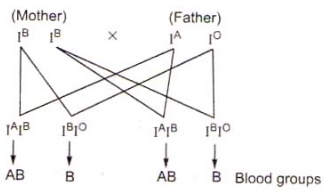
(A) The mother is homozygous for blood group $B$,so her genotype is $I^B I^B$. The father has blood group $A$,which could be homozygous $(I^A I^A)$ or heterozygous $(I^A I^O)$.
If the father is $I^A I^A$,the cross is $I^B I^B \times I^A I^A$,resulting in $I^A I^B$ (blood group $AB$).
If the father is $I^A I^O$,the cross is $I^B I^B \times I^A I^O$,resulting in $I^A I^B$ (blood group $AB$) and $I^B I^O$ (blood group $B$).
Combining these possibilities,the progeny can have blood groups $AB$ and $B$.
If the father is $I^A I^A$,the cross is $I^B I^B \times I^A I^A$,resulting in $I^A I^B$ (blood group $AB$).
If the father is $I^A I^O$,the cross is $I^B I^B \times I^A I^O$,resulting in $I^A I^B$ (blood group $AB$) and $I^B I^O$ (blood group $B$).
Combining these possibilities,the progeny can have blood groups $AB$ and $B$.
0 likes
View Solution68
MediumMCQ
The $ABO$ blood group is controlled by:
A
$I$-gene
B
$c$-gene
C
$B$-gene
D
$n$-gene
Solution
(A) The $ABO$ blood group in humans is controlled by the $I$ gene.
This gene exists in three allelic forms: $I^A$,$I^B$,and $i$.
- The alleles $I^A$ and $I^B$ produce slightly different forms of the sugar polymer that protrudes from the surface of the plasma membrane of red blood cells.
- The allele $i$ does not produce any sugar.
- Because humans are diploid organisms,each person possesses any two of the three $I$ gene alleles.
This gene exists in three allelic forms: $I^A$,$I^B$,and $i$.
- The alleles $I^A$ and $I^B$ produce slightly different forms of the sugar polymer that protrudes from the surface of the plasma membrane of red blood cells.
- The allele $i$ does not produce any sugar.
- Because humans are diploid organisms,each person possesses any two of the three $I$ gene alleles.
0 likes
View Solution69
MediumMCQ
The plasma membrane of the red blood cells has ...$A$... polymers that protrude from its surface and the kind of sugar is controlled by the gene. The gene $I$ has three alleles ...$B$... The alleles and produce a slightly different form of the sugars,while allele $i$ doesn't produce any ...$C$...
Choose the correct option for $A, B$ and $C$.
Choose the correct option for $A, B$ and $C$.
A
$A-$protein,$B-I^{A} I^{B} I^{O}$,$C-$protein
B
$A-$protein,$B-I^{A} I^{B} I^{O}$,$C-$sugar
C
$A-$sugar,$B-I^{A} I^{B} I^{O}$,$C-$protein
D
$A-$sugar,$B-I^{A} I^{B} I^{O}$,$C-$sugar
Solution
(D) The plasma membrane of red blood cells has sugar polymers that protrude from its surface.
The kind of sugar is controlled by the gene $I$.
The gene $I$ has three alleles: $I^{A}, I^{B},$ and $i$.
The alleles $I^{A}$ and $I^{B}$ produce a slightly different form of the sugar,while the allele $i$ does not produce any sugar.
Therefore,$A$ is sugar,$B$ is $I^{A}, I^{B}, i$ (often represented as $I^{A}, I^{B}, I^{O}$),and $C$ is sugar.
The correct option is $D$.
The kind of sugar is controlled by the gene $I$.
The gene $I$ has three alleles: $I^{A}, I^{B},$ and $i$.
The alleles $I^{A}$ and $I^{B}$ produce a slightly different form of the sugar,while the allele $i$ does not produce any sugar.
Therefore,$A$ is sugar,$B$ is $I^{A}, I^{B}, i$ (often represented as $I^{A}, I^{B}, I^{O}$),and $C$ is sugar.
The correct option is $D$.
0 likes
View Solution70
MediumMCQ
$A$ man of blood group-$A$ marries a woman of blood group-$B$. Both of them are heterozygous for their blood group. The chances of their first child having blood group $AB$ will be: (in $, \%$)
A
$25$
B
$50$
C
$75$
D
$100$
Solution
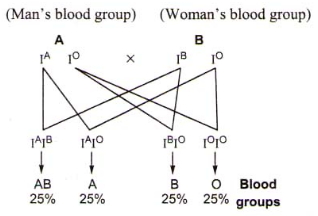
(A) The man is heterozygous for blood group-$A$,so his genotype is $I^A I^O$.
The woman is heterozygous for blood group-$B$,so her genotype is $I^B I^O$.
When these two individuals cross $(I^A I^O \times I^B I^O)$,the possible genotypes of the offspring are:
$1. I^A I^B$ (Blood group $AB$)
$2. I^A I^O$ (Blood group $A$)
$3. I^B I^O$ (Blood group $B$)
$4. I^O I^O$ (Blood group $O$)
Each genotype has a probability of $25\, \%$. Therefore,the chance of the first child having blood group $AB$ is $25\, \%$.
The woman is heterozygous for blood group-$B$,so her genotype is $I^B I^O$.
When these two individuals cross $(I^A I^O \times I^B I^O)$,the possible genotypes of the offspring are:
$1. I^A I^B$ (Blood group $AB$)
$2. I^A I^O$ (Blood group $A$)
$3. I^B I^O$ (Blood group $B$)
$4. I^O I^O$ (Blood group $O$)
Each genotype has a probability of $25\, \%$. Therefore,the chance of the first child having blood group $AB$ is $25\, \%$.
0 likes
View Solution71
MediumMCQ
How many phenotypes and genotypes are possible in $ABO$ blood group systems?
A
Four,five
B
Four,six
C
Four,seven
D
Three,four
Solution
(B) The correct answer is $B$ (Four,six).
$ABO$ blood groups in humans are controlled by the gene $I$. The gene $I$ has three alleles: $I^{A}$,$I^{B}$,and $i$.
$1.$ The alleles $I^{A}$ and $I^{B}$ produce slightly different forms of sugar,while the allele $i$ does not produce any sugar.
$2.$ Because humans are diploid,each individual possesses any two of these three alleles. This results in the following six possible genotypes: $I^{A}I^{A}$,$I^{A}i$,$I^{B}I^{B}$,$I^{B}i$,$I^{A}I^{B}$,and $ii$.
$3.$ Due to the dominance relationships ($I^{A}$ and $I^{B}$ are dominant over $i$,and $I^{A}$ and $I^{B}$ are codominant with each other),these six genotypes result in four distinct phenotypes: $A$,$B$,$AB$,and $O$.
$ABO$ blood groups in humans are controlled by the gene $I$. The gene $I$ has three alleles: $I^{A}$,$I^{B}$,and $i$.
$1.$ The alleles $I^{A}$ and $I^{B}$ produce slightly different forms of sugar,while the allele $i$ does not produce any sugar.
$2.$ Because humans are diploid,each individual possesses any two of these three alleles. This results in the following six possible genotypes: $I^{A}I^{A}$,$I^{A}i$,$I^{B}I^{B}$,$I^{B}i$,$I^{A}I^{B}$,and $ii$.
$3.$ Due to the dominance relationships ($I^{A}$ and $I^{B}$ are dominant over $i$,and $I^{A}$ and $I^{B}$ are codominant with each other),these six genotypes result in four distinct phenotypes: $A$,$B$,$AB$,and $O$.
| Genotype of Offspring | Blood Type of Offspring |
| $I^{A}I^{A}$ | $A$ |
| $I^{A}i$ | $A$ |
| $I^{B}I^{B}$ | $B$ |
| $I^{B}i$ | $B$ |
| $I^{A}I^{B}$ | $AB$ |
| $ii$ | $O$ |
0 likes
View Solution72
EasyMCQ
In humans,four phenotypes of blood groups are due to the presence of antigen-$A$ and antigen-$B$ on the $RBC$. The chromosome that carries the gene controlling these antigens is:
A
$X$-chromosome
B
$21^{\text{st}}$ chromosome
C
$9^{\text{th}}$ chromosome
D
$7^{\text{th}}$ chromosome
Solution
(C) The $ABO$ blood grouping in humans is controlled by the gene $I$ (isoagglutinogen). This gene $I$ is located on the $9^{\text{th}}$ chromosome. The gene $I$ has three alleles: $I^A$,$I^B$,and $i$. The combination of these alleles determines the phenotype of the blood group ($A$,$B$,$AB$,or $O$).
0 likes
View Solution73
MediumMCQ
What will be the possible blood groups in children from parents with $B$ and $AB$ blood groups?
A
$A, O$
B
$A, B, AB \;\&\; O$
C
$A, B, AB$
D
$B, O$
Solution
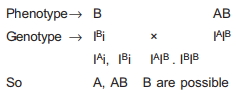
(C) The blood group of parents are $B$ and $AB$.
If the parent with blood group $B$ is heterozygous $(I^Bi)$ and the parent with blood group $AB$ is $(I^AI^B)$,the cross is as follows:
$I^Bi \times I^AI^B$
Gametes: $(I^B, i)$ and $(I^A, I^B)$
Possible genotypes of offspring: $I^AI^B$ $(AB)$,$I^BI^B$ $(B)$,$I^Ai$ $(A)$,$I^Bi$ $(B)$.
Thus,the possible blood groups in children are $A, B,$ and $AB$.
If the parent with blood group $B$ is heterozygous $(I^Bi)$ and the parent with blood group $AB$ is $(I^AI^B)$,the cross is as follows:
$I^Bi \times I^AI^B$
Gametes: $(I^B, i)$ and $(I^A, I^B)$
Possible genotypes of offspring: $I^AI^B$ $(AB)$,$I^BI^B$ $(B)$,$I^Ai$ $(A)$,$I^Bi$ $(B)$.
Thus,the possible blood groups in children are $A, B,$ and $AB$.
0 likes
View Solution74
MediumMCQ
Progeny with blood group '$O$' cannot be obtained in which of the following crosses?
A
$A \times A$
B
$A \times B$
C
$O \times AB$
D
$B \times B$
Solution
(C) The blood group '$O$' is determined by the genotype $ii$.
In the cross $O \times AB$,the parents have genotypes $ii$ and $I^A I^B$ respectively.
The gametes produced are $i$ from the $O$ parent and $I^A$ or $I^B$ from the $AB$ parent.
The resulting offspring will have genotypes $I^A i$ (blood group $A$) or $I^B i$ (blood group $B$).
Therefore,it is impossible to obtain an offspring with blood group '$O$' $(ii)$ from this cross.
In the cross $O \times AB$,the parents have genotypes $ii$ and $I^A I^B$ respectively.
The gametes produced are $i$ from the $O$ parent and $I^A$ or $I^B$ from the $AB$ parent.
The resulting offspring will have genotypes $I^A i$ (blood group $A$) or $I^B i$ (blood group $B$).
Therefore,it is impossible to obtain an offspring with blood group '$O$' $(ii)$ from this cross.
0 likes
View Solution75
Difficult
Explain Multiple Alleles and the concept of Dominance with an example.
Solution
(N/A) $1$. Multiple Alleles: In this case,more than two,i.e.,three or more alleles are present governing the same character. Multiple alleles can be found only when population studies are conducted.
$2$. Dominance: Dominance is not an autonomous feature of a gene or the product that it has information for. It depends on the gene product and the production of a particular phenotype from this product,as well as the particular phenotype that we choose to examine.
$3$. Example (Starch synthesis in pea seeds): Starch synthesis in pea seeds is controlled by one gene with two alleles ($B$ and $b$).
- $BB$ homozygotes synthesize starch effectively,producing large starch grains (Round seeds).
- $bb$ homozygotes have lower efficiency,producing smaller starch grains (Wrinkled seeds).
- Heterozygotes $(Bb)$ produce round seeds,suggesting $B$ is dominant for seed shape.
- However,the starch grains in $Bb$ seeds are of intermediate size. Thus,if starch grain size is the phenotype,the alleles show incomplete dominance.
- This demonstrates that dominance depends on the phenotype chosen for examination.
$2$. Dominance: Dominance is not an autonomous feature of a gene or the product that it has information for. It depends on the gene product and the production of a particular phenotype from this product,as well as the particular phenotype that we choose to examine.
$3$. Example (Starch synthesis in pea seeds): Starch synthesis in pea seeds is controlled by one gene with two alleles ($B$ and $b$).
- $BB$ homozygotes synthesize starch effectively,producing large starch grains (Round seeds).
- $bb$ homozygotes have lower efficiency,producing smaller starch grains (Wrinkled seeds).
- Heterozygotes $(Bb)$ produce round seeds,suggesting $B$ is dominant for seed shape.
- However,the starch grains in $Bb$ seeds are of intermediate size. Thus,if starch grain size is the phenotype,the alleles show incomplete dominance.
- This demonstrates that dominance depends on the phenotype chosen for examination.
0 likes
View Solution76
MediumMCQ
In Mendel's monohybrid cross,$T$ and $t$ are ......... of each other.
A
Genes
B
Factors
C
Alleles
D
All of the above
Solution
(C) In Mendel's experiments,the traits are controlled by discrete units called factors.
These factors occur in pairs.
When these factors represent two different forms of the same gene,they are referred to as alleles.
In the case of height,$T$ (tall) and $t$ (dwarf) are two different forms of the same gene,hence they are alleles of each other.
These factors occur in pairs.
When these factors represent two different forms of the same gene,they are referred to as alleles.
In the case of height,$T$ (tall) and $t$ (dwarf) are two different forms of the same gene,hence they are alleles of each other.
0 likes
View Solution77
MediumMCQ
Which of the following is an example of multiple alleles?
A
$ABO$ blood grouping
B
Flower color in snapdragon
C
Coat color in cattle
D
All of the above
Solution
(A) Multiple alleles refer to the presence of more than two alternative forms of a gene in a population.
$ABO$ blood grouping in humans is a classic example of multiple alleles,where the gene $I$ exists in three allelic forms: $I^A$,$I^B$,and $i$.
Flower color in snapdragon ($Antirrhinum$ $sp.$) is an example of incomplete dominance.
Coat color in cattle is an example of codominance.
Therefore,only $ABO$ blood grouping represents multiple alleles.
$ABO$ blood grouping in humans is a classic example of multiple alleles,where the gene $I$ exists in three allelic forms: $I^A$,$I^B$,and $i$.
Flower color in snapdragon ($Antirrhinum$ $sp.$) is an example of incomplete dominance.
Coat color in cattle is an example of codominance.
Therefore,only $ABO$ blood grouping represents multiple alleles.
0 likes
View Solution78
MediumMCQ
In $ABO$ blood grouping,there are $P$ genotypes and $Q$ phenotypes.
$\quad P \quad\quad Q$
$\quad P \quad\quad Q$
A
$6 \quad\quad 6$
B
$4 \quad\quad 4$
C
$6 \quad\quad 4$
D
$4 \quad\quad 6$
Solution
(C) In $ABO$ blood grouping,the inheritance is controlled by the gene $I$. The gene $I$ has three alleles: $I^A, I^B,$ and $i$.
Because there are three alleles,the possible genotypes are $I^A I^A, I^A i, I^B I^B, I^B i, I^A I^B,$ and $ii$. Thus,there are $6$ genotypes.
The possible phenotypes are $A, B, AB,$ and $O$. Thus,there are $4$ phenotypes.
Therefore,$P = 6$ and $Q = 4$.
Because there are three alleles,the possible genotypes are $I^A I^A, I^A i, I^B I^B, I^B i, I^A I^B,$ and $ii$. Thus,there are $6$ genotypes.
The possible phenotypes are $A, B, AB,$ and $O$. Thus,there are $4$ phenotypes.
Therefore,$P = 6$ and $Q = 4$.
0 likes
View Solution79
MediumMCQ
$A$ male with heterozygous blood group $B$ and a female with homozygous blood group $A$ have offspring. What are the possible genotypes and phenotypes in their progeny?
A
$2, 2$
B
$4, 4$
C
$4, 2$
D
$2, 4$
Solution
(A) The genotype of a male with heterozygous blood group $B$ is $I^B i$.
The genotype of a female with homozygous blood group $A$ is $I^A I^A$.
Crossing these: $I^A I^A \times I^B i$.
The resulting genotypes are $I^A I^B$ and $I^A i$.
$1$. Genotypes: $I^A I^B$ ($AB$ blood group) and $I^A i$ ($A$ blood group). There are $2$ distinct genotypes.
$2$. Phenotypes: $AB$ blood group and $A$ blood group. There are $2$ distinct phenotypes.
Therefore,the number of genotypes is $2$ and the number of phenotypes is $2$.
The genotype of a female with homozygous blood group $A$ is $I^A I^A$.
Crossing these: $I^A I^A \times I^B i$.
The resulting genotypes are $I^A I^B$ and $I^A i$.
$1$. Genotypes: $I^A I^B$ ($AB$ blood group) and $I^A i$ ($A$ blood group). There are $2$ distinct genotypes.
$2$. Phenotypes: $AB$ blood group and $A$ blood group. There are $2$ distinct phenotypes.
Therefore,the number of genotypes is $2$ and the number of phenotypes is $2$.
0 likes
View Solution80
MediumMCQ
What are the products of the $I^A$ and $I^B$ alleles?
A
Protein
B
Carbohydrate
C
Lipid
D
Nucleic acid
Solution
(B) The $I^A$ and $I^B$ alleles code for enzymes (glycosyltransferases) that add specific sugar molecules to the surface of red blood cells.
These sugar molecules are carbohydrates (specifically,oligosaccharides) that act as antigens on the surface of the plasma membrane of red blood cells.
Therefore,the products of these alleles are carbohydrates.
These sugar molecules are carbohydrates (specifically,oligosaccharides) that act as antigens on the surface of the plasma membrane of red blood cells.
Therefore,the products of these alleles are carbohydrates.
0 likes
View Solution81
EasyMCQ
On which chromosome are the genes for the $ABO$ blood group located?
A
Third
B
Seventh
C
Ninth
D
Twentieth
Solution
(C) The $ABO$ blood group system in humans is controlled by the $I$ gene. This gene is located on the long arm of chromosome number $9$ $(9q34.2)$. The gene has three alleles: $I^A$,$I^B$,and $i$.
0 likes
View Solution82
MediumMCQ
$A$ couple has four children with blood groups $A, AB, A,$ and $O$ respectively. What are the genotypes of the parents' blood groups?
A
$I^B i$ and $I^A I^B$
B
$I^A I^B$ and $ii$
C
$I^A i$ and $I^B I^B$
D
$I^A i$ and $I^B i$
Solution
(D) The blood groups of the children are $A, AB, A,$ and $O$.
For a child to have blood group $O$ $(ii)$,both parents must contribute an $i$ allele. Thus,both parents must be heterozygous.
For a child to have blood group $AB$ $(I^A I^B)$,one parent must contribute $I^A$ and the other must contribute $I^B$.
Combining these requirements,the parents must have genotypes $I^A i$ (Blood group $A$) and $I^B i$ (Blood group $B$).
Cross: $I^A i \times I^B i$ results in offspring with genotypes $I^A I^B$ $(AB)$,$I^A i$ $(A)$,$I^B i$ $(B)$,and $ii$ $(O)$.
Since the children include $A, AB,$ and $O$,the parents must be $I^A i$ and $I^B i$.
For a child to have blood group $O$ $(ii)$,both parents must contribute an $i$ allele. Thus,both parents must be heterozygous.
For a child to have blood group $AB$ $(I^A I^B)$,one parent must contribute $I^A$ and the other must contribute $I^B$.
Combining these requirements,the parents must have genotypes $I^A i$ (Blood group $A$) and $I^B i$ (Blood group $B$).
Cross: $I^A i \times I^B i$ results in offspring with genotypes $I^A I^B$ $(AB)$,$I^A i$ $(A)$,$I^B i$ $(B)$,and $ii$ $(O)$.
Since the children include $A, AB,$ and $O$,the parents must be $I^A i$ and $I^B i$.
0 likes
View Solution83
MediumMCQ
In which of the following crosses will the offspring show the greatest diversity in phenotypes?
A
$I^A i$ and $I^B i$
B
$I^A I^A$ and $I^B i$
C
$I^A I^B$ and $ii$
D
$I^A i$ and $I^A I^B$
Solution
(A) To determine the greatest phenotypic diversity,we analyze the possible blood types for each cross:
$1$. $I^A i \times I^B i$: Offspring can be $I^A I^B$ $(AB)$,$I^A i$ $(A)$,$I^B i$ $(B)$,and $ii$ $(O)$. This results in $4$ distinct phenotypes.
$2$. $I^A I^A \times I^B i$: Offspring can be $I^A I^B$ $(AB)$ and $I^A i$ $(A)$. This results in $2$ distinct phenotypes.
$3$. $I^A I^B \times ii$: Offspring can be $I^A i$ $(A)$ and $I^B i$ $(B)$. This results in $2$ distinct phenotypes.
$4$. $I^A i \times I^A I^B$: Offspring can be $I^A I^A$ $(A)$,$I^A i$ $(A)$,$I^A I^B$ $(AB)$,and $I^B i$ $(B)$. This results in $3$ distinct phenotypes.
Therefore,the cross $I^A i \times I^B i$ produces the maximum number of phenotypes $(4)$.
$1$. $I^A i \times I^B i$: Offspring can be $I^A I^B$ $(AB)$,$I^A i$ $(A)$,$I^B i$ $(B)$,and $ii$ $(O)$. This results in $4$ distinct phenotypes.
$2$. $I^A I^A \times I^B i$: Offspring can be $I^A I^B$ $(AB)$ and $I^A i$ $(A)$. This results in $2$ distinct phenotypes.
$3$. $I^A I^B \times ii$: Offspring can be $I^A i$ $(A)$ and $I^B i$ $(B)$. This results in $2$ distinct phenotypes.
$4$. $I^A i \times I^A I^B$: Offspring can be $I^A I^A$ $(A)$,$I^A i$ $(A)$,$I^A I^B$ $(AB)$,and $I^B i$ $(B)$. This results in $3$ distinct phenotypes.
Therefore,the cross $I^A i \times I^B i$ produces the maximum number of phenotypes $(4)$.
0 likes
View Solution84
MediumMCQ
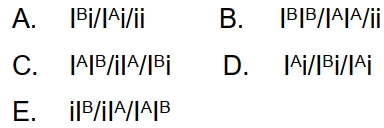
As per the $ABO$ blood grouping system,the blood group of the father is $B^{+}$,the mother is $A^{+}$,and the child is $O^{+}$. Their respective genotypes can be:
Choose the most appropriate answer from the options given below:
$A. I^Bi / I^Ai / ii$
$B. I^BI^B / I^AI^A / ii$
$C. I^AI^B / iI^A / I^Bi$
$D. I^Ai / I^Bi / I^Ai$
$E. iI^B / iI^A / I^AI^B$
Choose the most appropriate answer from the options given below:
$A. I^Bi / I^Ai / ii$
$B. I^BI^B / I^AI^A / ii$
$C. I^AI^B / iI^A / I^Bi$
$D. I^Ai / I^Bi / I^Ai$
$E. iI^B / iI^A / I^AI^B$
A
$B$ only
B
$C, B$ only
C
$D, E$ only
D
$A$ only
Solution
(D) In the $ABO$ blood grouping system,the alleles are $I^A, I^B,$ and $i$.
For a child to have blood group $O$ (genotype $ii$),they must inherit one $i$ allele from each parent.
Therefore,the father (blood group $B$) must have the genotype $I^Bi$ and the mother (blood group $A$) must have the genotype $I^Ai$.
Looking at the provided options:
$A$ represents $I^Bi$ (Father),$I^Ai$ (Mother),and $ii$ (Child),which is consistent with the blood groups given.
Thus,only option $A$ is correct.
For a child to have blood group $O$ (genotype $ii$),they must inherit one $i$ allele from each parent.
Therefore,the father (blood group $B$) must have the genotype $I^Bi$ and the mother (blood group $A$) must have the genotype $I^Ai$.
Looking at the provided options:
$A$ represents $I^Bi$ (Father),$I^Ai$ (Mother),and $ii$ (Child),which is consistent with the blood groups given.
Thus,only option $A$ is correct.
0 likes
View Solution85
EasyMCQ
The following table is regarding $ABO$ blood group. Identify $W, X, Y, Z$.
| Genotype | Blood group |
| $I^{A} I^{A}$ | $A$ |
| $W$ | $A$ |
| $I^{B} I^{B}$ | $B$ |
| $X$ | $B$ |
| $I^{A} I^{B}$ | $Y$ |
| $Z$ | $O$ |
A
$W \rightarrow I^{A} I^0, X \rightarrow I^{B} I^0, Y \rightarrow I^0 I^0, Z \rightarrow AB$
B
$W \rightarrow I^{A} I^0, X \rightarrow I^{B} I^0, Y \rightarrow AB, Z \rightarrow I^0 I^0$
C
$W \rightarrow I^{B} I^0, X \rightarrow I^{A} I^0, Y \rightarrow AB, Z \rightarrow I^0 I^0$
D
$W \rightarrow I^{B} I^{A}, X \rightarrow I^{A} I^{A}, Y \rightarrow AB, Z \rightarrow I^0 I^0$
Solution
(B) In the $ABO$ blood group system,the gene $I$ has three alleles: $I^A, I^B,$ and $i$ (or $I^0$).
$1$. For blood group $A$,the genotypes are $I^A I^A$ or $I^A i$. Thus,$W = I^A i$ (or $I^A I^0$).
$2$. For blood group $B$,the genotypes are $I^B I^B$ or $I^B i$. Thus,$X = I^B i$ (or $I^B I^0$).
$3$. For the genotype $I^A I^B$,both alleles are expressed equally,resulting in blood group $AB$. Thus,$Y = AB$.
$4$. For blood group $O$,the genotype is $ii$ (or $I^0 I^0$). Thus,$Z = I^0 I^0$.
Therefore,the correct identification is $W \rightarrow I^A I^0, X \rightarrow I^B I^0, Y \rightarrow AB, Z \rightarrow I^0 I^0$.
$1$. For blood group $A$,the genotypes are $I^A I^A$ or $I^A i$. Thus,$W = I^A i$ (or $I^A I^0$).
$2$. For blood group $B$,the genotypes are $I^B I^B$ or $I^B i$. Thus,$X = I^B i$ (or $I^B I^0$).
$3$. For the genotype $I^A I^B$,both alleles are expressed equally,resulting in blood group $AB$. Thus,$Y = AB$.
$4$. For blood group $O$,the genotype is $ii$ (or $I^0 I^0$). Thus,$Z = I^0 I^0$.
Therefore,the correct identification is $W \rightarrow I^A I^0, X \rightarrow I^B I^0, Y \rightarrow AB, Z \rightarrow I^0 I^0$.
0 likes
View Solution86
MediumMCQ
Which one of the following blood groups is expressed in both homozygous and heterozygous conditions?
A
Only $A$
B
Only $B$
C
$A$ and $B$
D
$O$
Solution
(C) In the $ABO$ blood grouping system,the alleles $I^A$ and $I^B$ are dominant over the allele $i$.
- Blood group $A$ is expressed in homozygous $(I^A I^A)$ and heterozygous $(I^A i)$ conditions.
- Blood group $B$ is expressed in homozygous $(I^B I^B)$ and heterozygous $(I^B i)$ conditions.
- Blood group $O$ is only expressed in the homozygous $(ii)$ condition.
- Therefore,both blood groups $A$ and $B$ are expressed in both homozygous and heterozygous conditions.
- Blood group $A$ is expressed in homozygous $(I^A I^A)$ and heterozygous $(I^A i)$ conditions.
- Blood group $B$ is expressed in homozygous $(I^B I^B)$ and heterozygous $(I^B i)$ conditions.
- Blood group $O$ is only expressed in the homozygous $(ii)$ condition.
- Therefore,both blood groups $A$ and $B$ are expressed in both homozygous and heterozygous conditions.
0 likes
View Solution87
MediumMCQ
With respect to $\text{ABO}$ blood groups,how many genotypes and phenotypes,respectively,are possible in the human population?
A
$6 \ \& \ 4$
B
$4 \ \& \ 6$
C
$3 \ \& \ 4$
D
$4 \ \& \ 3$
Solution
(A) The $\text{ABO}$ blood grouping in humans is controlled by the gene $I$. The gene $I$ has three alleles: $I^A$,$I^B$,and $i$.
Since there are three alleles,the possible genotypes are determined by the combinations of these alleles taken two at a time (including homozygotes). These are: $I^A I^A$,$I^A i$,$I^B I^B$,$I^B i$,$I^A I^B$,and $ii$. Thus,there are $6$ possible genotypes.
The phenotypes are determined by the expression of these alleles. $I^A$ and $I^B$ are dominant over $i$,and $I^A$ and $I^B$ are codominant with each other. The possible phenotypes are: Blood group $A$ (from $I^A I^A$ or $I^A i$),Blood group $B$ (from $I^B I^B$ or $I^B i$),Blood group $AB$ (from $I^A I^B$),and Blood group $O$ (from $ii$). Thus,there are $4$ possible phenotypes.
Therefore,the number of genotypes is $6$ and the number of phenotypes is $4$.
Since there are three alleles,the possible genotypes are determined by the combinations of these alleles taken two at a time (including homozygotes). These are: $I^A I^A$,$I^A i$,$I^B I^B$,$I^B i$,$I^A I^B$,and $ii$. Thus,there are $6$ possible genotypes.
The phenotypes are determined by the expression of these alleles. $I^A$ and $I^B$ are dominant over $i$,and $I^A$ and $I^B$ are codominant with each other. The possible phenotypes are: Blood group $A$ (from $I^A I^A$ or $I^A i$),Blood group $B$ (from $I^B I^B$ or $I^B i$),Blood group $AB$ (from $I^A I^B$),and Blood group $O$ (from $ii$). Thus,there are $4$ possible phenotypes.
Therefore,the number of genotypes is $6$ and the number of phenotypes is $4$.
0 likes
View Solution88
MediumMCQ
Which of the following characteristics represent 'Inheritance' of blood group in humans $:-$
$(a)$ $ABO$ blood groups are controlled by the gene $I$.
$(b)$ Plasma membrane of the red blood cells has sugar polymers that protrude from its surface.
$(c)$ The gene $I$ has three alleles i.e.,$I^A, I^B$ and $i$. Each diploid person possesses any two alleles of gene $I$.
$(d)$ There are six different possible combinations of three alleles of gene $I$.
$(e)$ '$O$' blood group is not possible in the progeny of '$AB$' blood group parents.
$(a)$ $ABO$ blood groups are controlled by the gene $I$.
$(b)$ Plasma membrane of the red blood cells has sugar polymers that protrude from its surface.
$(c)$ The gene $I$ has three alleles i.e.,$I^A, I^B$ and $i$. Each diploid person possesses any two alleles of gene $I$.
$(d)$ There are six different possible combinations of three alleles of gene $I$.
$(e)$ '$O$' blood group is not possible in the progeny of '$AB$' blood group parents.
A
Only $a$ and $e$
B
Only $b, c$ and $d$
C
Only $b$ and $d$
D
Only $a, c$ and $e$
Solution
(A) Let's analyze each statement:
$(a)$ $ABO$ blood groups are indeed controlled by the gene $I$. This is correct.
$(b)$ The plasma membrane of red blood cells has sugar polymers that protrude from its surface,not amino polymers. This is incorrect.
$(c)$ The gene $I$ has three alleles $(I^A, I^B, i)$. However,a diploid person only possesses any two of these alleles,not all three. This is incorrect.
$(d)$ There are six possible genotypes for the three alleles $(I^A I^A, I^A i, I^B I^B, I^B i, I^A I^B, ii)$. This is incorrect as the statement claims eight.
$(e)$ Parents with '$AB$' blood group $(I^A I^B)$ can produce children with '$A$','$B$',or '$AB$' blood groups,but not '$O$' $(ii)$. This is correct.
Therefore,statements $(a)$ and $(e)$ are correct.
$(a)$ $ABO$ blood groups are indeed controlled by the gene $I$. This is correct.
$(b)$ The plasma membrane of red blood cells has sugar polymers that protrude from its surface,not amino polymers. This is incorrect.
$(c)$ The gene $I$ has three alleles $(I^A, I^B, i)$. However,a diploid person only possesses any two of these alleles,not all three. This is incorrect.
$(d)$ There are six possible genotypes for the three alleles $(I^A I^A, I^A i, I^B I^B, I^B i, I^A I^B, ii)$. This is incorrect as the statement claims eight.
$(e)$ Parents with '$AB$' blood group $(I^A I^B)$ can produce children with '$A$','$B$',or '$AB$' blood groups,but not '$O$' $(ii)$. This is correct.
Therefore,statements $(a)$ and $(e)$ are correct.
0 likes
View Solution89
EasyMCQ
Considering the concept of multiple alleles,one individual can have only . . . . . . alleles for that character.
A
one
B
two
C
three
D
four
Solution
(B) Multiple alleles refer to the existence of more than two alternative forms of a gene within a population.
However,because an individual is a diploid organism,they possess only two homologous chromosomes.
Therefore,any single individual can carry only two alleles for a specific character at a given locus,even if many more alleles exist in the population.
For example,in the $ABO$ blood grouping system,there are three alleles $(I^A, I^B, i)$,but an individual can only possess two of these.
However,because an individual is a diploid organism,they possess only two homologous chromosomes.
Therefore,any single individual can carry only two alleles for a specific character at a given locus,even if many more alleles exist in the population.
For example,in the $ABO$ blood grouping system,there are three alleles $(I^A, I^B, i)$,but an individual can only possess two of these.
0 likes
View Solution90
EasyMCQ
In humans,multiple alleles are seen controlling the inheritance of which of the following?
A
Sickle cell anaemia
B
Blood groups
C
Colour blindness
D
Thalassemia
Solution
(B) The $ABO$ blood group system in humans is a classic example of multiple alleles. It is determined by three alleles: $I^A$,$I^B$,and $i$. The presence of different combinations of these three alleles results in four different blood types: $A$,$B$,$AB$,and $O$.
0 likes
View Solution91
EasyMCQ
If the father has $AB$ blood group and mother has $A$ blood group,then the children born to them will have the following blood groups $EXCEPT$ . . . . . . .
A
$AB$
B
$A$
C
$O$
D
$B$
Solution
(C) The father has blood group $AB$,which means his genotype is $I^A I^B$. The mother has blood group $A$,which means her genotype can be either $I^A I^A$ or $I^A i$.
If the mother is $I^A I^A$,the possible offspring genotypes are $I^A I^A$ (Blood group $A$) and $I^A I^B$ (Blood group $AB$).
If the mother is $I^A i$,the possible offspring genotypes are $I^A I^A$ (Blood group $A$),$I^A i$ (Blood group $A$),$I^A I^B$ (Blood group $AB$),and $I^B i$ (Blood group $B$).
In both cases,the allele $i$ (which is required for blood group $O$ genotype $ii$) cannot be formed because the father does not carry the $i$ allele. Therefore,it is impossible for the children to have blood group $O$.
If the mother is $I^A I^A$,the possible offspring genotypes are $I^A I^A$ (Blood group $A$) and $I^A I^B$ (Blood group $AB$).
If the mother is $I^A i$,the possible offspring genotypes are $I^A I^A$ (Blood group $A$),$I^A i$ (Blood group $A$),$I^A I^B$ (Blood group $AB$),and $I^B i$ (Blood group $B$).
In both cases,the allele $i$ (which is required for blood group $O$ genotype $ii$) cannot be formed because the father does not carry the $i$ allele. Therefore,it is impossible for the children to have blood group $O$.
0 likes
View Solution92
EasyMCQ
How many of the following genotypes possibly represent normal wings in Drosophila?
$(i)$ $Vg^{+} Vg^{+}$
(ii) $Vg^{+} vg^{ni}$
(iii) $Vg^{+} vg^{no}$
(iv) $Vg^{+} vg^{st}$
$(v)$ $Vg^{+} vg$
$(i)$ $Vg^{+} Vg^{+}$
(ii) $Vg^{+} vg^{ni}$
(iii) $Vg^{+} vg^{no}$
(iv) $Vg^{+} vg^{st}$
$(v)$ $Vg^{+} vg$
A
$(i)$,(ii) and (iii) only
B
$(i)$ and (ii) only
C
Only $(i)$
D
$(i)$,(ii),(iii),(iv) and $(v)$
Solution
(D) In $Drosophila$,the wild-type allele for wing shape is denoted as $Vg^{+}$.
This wild-type allele is dominant over all other mutant alleles (such as $vg^{ni}$,$vg^{no}$,$vg^{st}$,and $vg$).
Since all the given genotypes contain at least one $Vg^{+}$ allele,they will all express the dominant wild-type phenotype,which is normal wings.
Therefore,all five genotypes represent normal wings in $Drosophila$.
This wild-type allele is dominant over all other mutant alleles (such as $vg^{ni}$,$vg^{no}$,$vg^{st}$,and $vg$).
Since all the given genotypes contain at least one $Vg^{+}$ allele,they will all express the dominant wild-type phenotype,which is normal wings.
Therefore,all five genotypes represent normal wings in $Drosophila$.
0 likes
View Solution93
EasyMCQ
If the blood group of the mother is $A$ and the blood group of the father is $O$,what may be the blood group of the progeny?
A
$A, AB, B, O$
B
$A$ or $B$
C
$A$ or $O$
D
Only blood group $A$
Solution
(C) The blood group of the mother is $A$,which can have the genotype $I^A I^A$ or $I^A i$. The blood group of the father is $O$,which has the genotype $ii$.
If the mother is $I^A I^A$,the progeny will have genotypes $I^A i$ (Blood group $A$).
If the mother is $I^A i$,the progeny will have genotypes $I^A i$ (Blood group $A$) and $ii$ (Blood group $O$).
Therefore,the possible blood groups of the progeny are $A$ or $O$.
If the mother is $I^A I^A$,the progeny will have genotypes $I^A i$ (Blood group $A$).
If the mother is $I^A i$,the progeny will have genotypes $I^A i$ (Blood group $A$) and $ii$ (Blood group $O$).
Therefore,the possible blood groups of the progeny are $A$ or $O$.
0 likes
View Solution94
EasyMCQ
The blood group of Rameshbhai is $B$ and his daughter's blood group is $AB$. What will be the blood group of his wife?
A
$B$ or $O$
B
$A$ or $AB$
C
$A$ or $B$
D
$A$ or $O$
Solution
(B) The blood group of Rameshbhai is $B$,which means his genotype can be either $I^B I^B$ or $I^B i$.
The daughter's blood group is $AB$,which means her genotype is $I^A I^B$.
Since the daughter must inherit one allele from each parent,she must have received the $I^A$ allele from her mother and the $I^B$ allele from her father.
Therefore,the mother must possess at least one $I^A$ allele.
Possible blood groups for the mother that contain the $I^A$ allele are $A$ ($I^A I^A$ or $I^A i$) or $AB$ $(I^A I^B)$.
The daughter's blood group is $AB$,which means her genotype is $I^A I^B$.
Since the daughter must inherit one allele from each parent,she must have received the $I^A$ allele from her mother and the $I^B$ allele from her father.
Therefore,the mother must possess at least one $I^A$ allele.
Possible blood groups for the mother that contain the $I^A$ allele are $A$ ($I^A I^A$ or $I^A i$) or $AB$ $(I^A I^B)$.
0 likes
View Solution95
EasyMCQ
If the father gives $I^B$ allele and the mother gives $I^A$ allele,state the genotype and blood group of the offspring.
A
$I^A I^B - AB$
B
$I^A I^B - A$
C
$I^A I^B - B$
D
$I^A I^A - AB$
Solution
(A) In human blood group inheritance,the $ABO$ blood group system is controlled by the gene $I$. The gene $I$ has three alleles: $I^A$,$I^B$,and $i$.
When the father contributes the $I^B$ allele and the mother contributes the $I^A$ allele,the resulting genotype of the offspring is $I^A I^B$.
According to the principle of codominance,both $I^A$ and $I^B$ alleles are expressed equally in the presence of each other.
Therefore,the individual with the genotype $I^A I^B$ will have blood group $AB$.
When the father contributes the $I^B$ allele and the mother contributes the $I^A$ allele,the resulting genotype of the offspring is $I^A I^B$.
According to the principle of codominance,both $I^A$ and $I^B$ alleles are expressed equally in the presence of each other.
Therefore,the individual with the genotype $I^A I^B$ will have blood group $AB$.
0 likes
View Solution96
EasyMCQ
What is the possible blood group of children whose parents are heterozygous for $A$ and $B$ blood groups?
A
$A$,$B$ only
B
$A$,$B$,$AB$ and $O$
C
$AB$ only
D
$A$,$B$ and $AB$ only
Solution
(B) The correct answer is $B$.
Parents are heterozygous for blood groups $A$ and $B$,meaning their genotypes are $I^A i$ and $I^B i$.
When these parents cross,the possible combinations of alleles in the offspring are:
$1. I^A I^B$ (Blood group $AB$)
$2. I^A i$ (Blood group $A$)
$3. I^B i$ (Blood group $B$)
$4. ii$ (Blood group $O$)
Therefore,the children can have any of the four blood groups: $A, B, AB,$ or $O$.
Parents are heterozygous for blood groups $A$ and $B$,meaning their genotypes are $I^A i$ and $I^B i$.
When these parents cross,the possible combinations of alleles in the offspring are:
$1. I^A I^B$ (Blood group $AB$)
$2. I^A i$ (Blood group $A$)
$3. I^B i$ (Blood group $B$)
$4. ii$ (Blood group $O$)
Therefore,the children can have any of the four blood groups: $A, B, AB,$ or $O$.
0 likes
View Solution97
EasyMCQ
The genotypes of a husband and wife are $I^A I^B$ and $I^A I^O$. Among the blood types of their children,how many different genotypes and phenotypes are possible?
A
$3$ genotypes; $3$ phenotypes
B
$4$ genotypes; $3$ phenotypes
C
$4$ phenotypes; $3$ genotypes
D
$4$ phenotypes; $4$ genotypes
Solution
(B) The genotypes of the parents are $I^A I^B$ (husband) and $I^A I^O$ (wife).
To find the possible genotypes of the offspring,we perform a Punnett square cross:
- $I^A$ from father $\times$ $I^A$ from mother $\rightarrow$ $I^A I^A$ (Blood type $A$)
- $I^A$ from father $\times$ $I^O$ from mother $\rightarrow$ $I^A I^O$ (Blood type $A$)
- $I^B$ from father $\times$ $I^A$ from mother $\rightarrow$ $I^A I^B$ (Blood type $AB$)
- $I^B$ from father $\times$ $I^O$ from mother $\rightarrow$ $I^B I^O$ (Blood type $B$)
Possible genotypes: $I^A I^A, I^A I^O, I^A I^B, I^B I^O$ (Total $4$ genotypes).
Possible phenotypes: Blood type $A$,Blood type $AB$,Blood type $B$ (Total $3$ phenotypes).
Therefore,the correct answer is $4$ genotypes and $3$ phenotypes.
To find the possible genotypes of the offspring,we perform a Punnett square cross:
- $I^A$ from father $\times$ $I^A$ from mother $\rightarrow$ $I^A I^A$ (Blood type $A$)
- $I^A$ from father $\times$ $I^O$ from mother $\rightarrow$ $I^A I^O$ (Blood type $A$)
- $I^B$ from father $\times$ $I^A$ from mother $\rightarrow$ $I^A I^B$ (Blood type $AB$)
- $I^B$ from father $\times$ $I^O$ from mother $\rightarrow$ $I^B I^O$ (Blood type $B$)
Possible genotypes: $I^A I^A, I^A I^O, I^A I^B, I^B I^O$ (Total $4$ genotypes).
Possible phenotypes: Blood type $A$,Blood type $AB$,Blood type $B$ (Total $3$ phenotypes).
Therefore,the correct answer is $4$ genotypes and $3$ phenotypes.
0 likes
View Solution98
EasyMCQ
$A$ man with blood group $A$ marries a woman having blood group $B$. The maximum possible blood groups among their progenies are
A
$A, B, AB, O$
B
$AB$ only
C
$A, B, AB$
D
$A, B$
Solution
(A) The inheritance of $ABO$ blood groups is controlled by the gene $I$. The gene $I$ has three alleles: $I^A, I^B,$ and $i$.
If the man is heterozygous $(I^Ai)$ and the woman is heterozygous $(I^Bi)$,the cross is $I^Ai \times I^Bi$.
The possible genotypes of the offspring are $I^AI^B$ (blood group $AB$),$I^Ai$ (blood group $A$),$I^Bi$ (blood group $B$),and $ii$ (blood group $O$).
Therefore,the maximum possible blood groups among their children are $A, B, AB,$ and $O$.
If the man is heterozygous $(I^Ai)$ and the woman is heterozygous $(I^Bi)$,the cross is $I^Ai \times I^Bi$.
The possible genotypes of the offspring are $I^AI^B$ (blood group $AB$),$I^Ai$ (blood group $A$),$I^Bi$ (blood group $B$),and $ii$ (blood group $O$).
Therefore,the maximum possible blood groups among their children are $A, B, AB,$ and $O$.
0 likes
View Solution99
EasyMCQ
The offspring produced from a marriage have only $O$ or $A$ blood groups. Of the genotypes given below,the possible genotypes of the parents would be
A
$I^{A}I^{A}$ and $I^{O}I^{O}$
B
$I^{A}I^{O}$ and $I^{O}I^{O}$
C
$I^{A}I^{A}$ and $I^{A}I^{O}$
D
$I^{O}I^{O}$ and $I^{O}I^{O}$
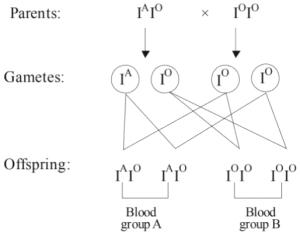
Solution
(B) The correct option is $(B) I^{A}I^{O}$ and $I^{O}I^{O}$.
For the offspring to have only $A$ or $O$ blood groups,one parent must have the genotype $I^{A}I^{O}$ (blood group $A$) and the other must have $I^{O}I^{O}$ (blood group $O$).
When these parents are crossed,the possible genotypes of the offspring are $I^{A}I^{O}$ (blood group $A$) and $I^{O}I^{O}$ (blood group $O$).
This confirms that the offspring will only possess blood groups $A$ or $O$.
For the offspring to have only $A$ or $O$ blood groups,one parent must have the genotype $I^{A}I^{O}$ (blood group $A$) and the other must have $I^{O}I^{O}$ (blood group $O$).
When these parents are crossed,the possible genotypes of the offspring are $I^{A}I^{O}$ (blood group $A$) and $I^{O}I^{O}$ (blood group $O$).
This confirms that the offspring will only possess blood groups $A$ or $O$.
0 likes
View Solution100
MediumMCQ
What is the probability of having children with '$O$' blood group,where both mother and father are heterozygous for '$A$' and '$B$' blood group,respectively?
A
$(1)$ $0$%
B
$(2)$ $50$%
C
$(3)$ $25$%
D
$(4)$ $75$%
Solution
(C) The mother is heterozygous for blood group '$A$',represented by the genotype $I^A i$.
The father is heterozygous for blood group '$B$',represented by the genotype $I^B i$.
Performing the genetic cross: $(I^A i) \times (I^B i)$.
The possible offspring genotypes are:
$1$. $I^A I^B$ (Blood group $AB$)
$2$. $I^A i$ (Blood group $A$)
$3$. $I^B i$ (Blood group $B$)
$4$. $ii$ (Blood group $O$)
Out of the four possible outcomes,only one results in blood group '$O$'.
Therefore,the probability of having a child with blood group '$O$' is $\frac{1}{4} = 25\%$.
The father is heterozygous for blood group '$B$',represented by the genotype $I^B i$.
Performing the genetic cross: $(I^A i) \times (I^B i)$.
The possible offspring genotypes are:
$1$. $I^A I^B$ (Blood group $AB$)
$2$. $I^A i$ (Blood group $A$)
$3$. $I^B i$ (Blood group $B$)
$4$. $ii$ (Blood group $O$)
Out of the four possible outcomes,only one results in blood group '$O$'.
Therefore,the probability of having a child with blood group '$O$' is $\frac{1}{4} = 25\%$.
0 likes
View SolutionPrinciples of Inheritance and Variation — Multiple alleles · Frequently Asked Questions
1Are these Principles of Inheritance and Variation questions useful for JEE and NEET?
Yes. All questions in this section are mapped to JEE Main and NEET exam patterns. Previous year questions from JEE Main, NEET, GUJCET and state-level exams are included with full solutions.
2Can I switch to Hindi or Gujarati for these questions?
Yes. Use the language tabs in the hero section or the sidebar to view the same questions and solutions in English, Hindi or Gujarati.
3How do I generate a question paper from this subtopic?
Use the Vedclass Exam Paper Generator — select the chapter and subtopic, set difficulty, and generate Sets A, B, C, D automatically. First 3 chapters of every subject are free.
Vedclass Products
For Students
Vedclass Test Series
Mock tests in real JEE/NEET style with performance analysis. 5-day free trial.
Start Free TrialFor Teachers
Exam Paper Generator
Generate Set A/B/C/D papers from this chapter in 2 minutes. 3 chapters free.
Try FreeFor Institutes
Online Exam Module
Live online exams with unlimited students, 360° analytics & white-label branding.
See DemoFor Teachers & Institutes
Generate a Principles of Inheritance and Variation Exam Paper in 2 Minutes
Select subtopic & difficulty — Sets A, B, C, D auto-generated with No Repeat logic.
First 3 chapters of every subject are free — no payment required.