
A English
Mendelism Questions in English
Class 12 Biology · Principles of Inheritance and Variation · Mendelism
354+
Questions
English
Language
100%
With Solutions
Showing 49 of 354 questions in English
51
MediumMCQ
Which of the following is considered as a recessive character of Mendel?
A
Round seed
B
Wrinkled seed
C
Axial flower
D
Green pod
Solution
(B) According to Mendel's experiments on pea plants,the traits are classified into dominant and recessive characters.
$(a)$ Round seed is a dominant character.
$(b)$ Wrinkled seed is a recessive character.
$(c)$ Axial flower position is a dominant character.
$(d)$ Green pod color is a dominant character.
Therefore,the correct option is $B$.
$(a)$ Round seed is a dominant character.
$(b)$ Wrinkled seed is a recessive character.
$(c)$ Axial flower position is a dominant character.
$(d)$ Green pod color is a dominant character.
Therefore,the correct option is $B$.
0 likes
View Solution52
MediumMCQ
$A$ heterozygous purple flower is crossed with a recessive white flower. What is the ratio of the progeny?
A
All purple
B
All white
C
$50\%$ purple,$50\%$ white
D
$75\%$ purple,$25\%$ white
Solution
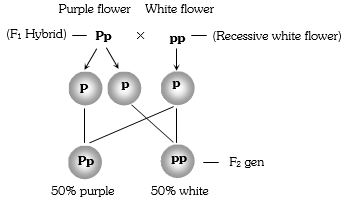
(C) This is a test cross where a heterozygous individual $(Pp)$ is crossed with a homozygous recessive individual $(pp)$.
The gametes produced by the heterozygous purple flower $(Pp)$ are $P$ and $p$.
The gametes produced by the recessive white flower $(pp)$ are only $p$.
When these gametes fuse,the resulting genotypes are:
$P \times p = Pp$ (Purple flower)
$p \times p = pp$ (White flower)
Thus,the progeny consists of $50\%$ purple flowers $(Pp)$ and $50\%$ white flowers $(pp)$.
The gametes produced by the heterozygous purple flower $(Pp)$ are $P$ and $p$.
The gametes produced by the recessive white flower $(pp)$ are only $p$.
When these gametes fuse,the resulting genotypes are:
$P \times p = Pp$ (Purple flower)
$p \times p = pp$ (White flower)
Thus,the progeny consists of $50\%$ purple flowers $(Pp)$ and $50\%$ white flowers $(pp)$.
0 likes
View Solution53
MediumMCQ
Pure tall plants are crossed with pure dwarf plants. In the $F_1$ generation,all plants were tall. These tall plants of the $F_1$ generation were selfed,and the ratio of tall to dwarf plants obtained was $3:1$. This is called:
A
Dominance
B
Inheritance
C
Co-dominance
D
Heredity
Solution
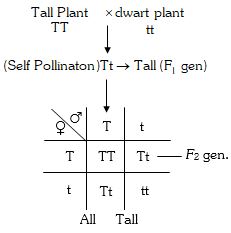
(A) The phenomenon described is the Law of Dominance.
In a cross between pure tall $(TT)$ and pure dwarf $(tt)$ plants,the $F_1$ generation consists of heterozygous tall plants $(Tt)$.
When these $F_1$ plants are self-pollinated,the $F_2$ generation exhibits a phenotypic ratio of $3:1$ (tall to dwarf).
This occurs because the allele for tallness $(T)$ is dominant over the allele for dwarfness $(t)$,masking its expression in the heterozygous state. This observation is a fundamental aspect of Mendel's Law of Dominance.
In a cross between pure tall $(TT)$ and pure dwarf $(tt)$ plants,the $F_1$ generation consists of heterozygous tall plants $(Tt)$.
When these $F_1$ plants are self-pollinated,the $F_2$ generation exhibits a phenotypic ratio of $3:1$ (tall to dwarf).
This occurs because the allele for tallness $(T)$ is dominant over the allele for dwarfness $(t)$,masking its expression in the heterozygous state. This observation is a fundamental aspect of Mendel's Law of Dominance.
0 likes
View Solution54
MediumMCQ
Which plant is used as a model system in the study of plant genetics?
A
Arabidopsis thaliana
B
Pisum sativum
C
Cicer arietinum
D
Ocimum sanctum
Solution
(A) $Arabidopsis thaliana$ is widely used as a model organism in plant genetics and molecular biology.
Its genome is small,it has a short life cycle,and it is easy to grow in laboratory conditions,making it ideal for genetic studies.
Its genome is small,it has a short life cycle,and it is easy to grow in laboratory conditions,making it ideal for genetic studies.
0 likes
View Solution55
MediumMCQ
Alleles are forms of:
A
Genes
B
Chromosomes
C
$DNA$
D
None of these
Solution
(A) Alleles are defined as alternative forms of a single gene that occupy the same locus on a homologous chromosome. For example,in the pea plant,the gene for stem height has two alleles: $T$ (for tall) and $t$ (for dwarf). Since the options provided do not explicitly state 'genes' as the primary definition (as alleles are specific versions of genes),and the provided option $(a)$ is 'Genes',the most accurate answer is that alleles are alternative forms of genes.
0 likes
View Solution56
EasyMCQ
The characters chosen by Mendel are located on how many chromosomes?
A
$4$
B
$14$
C
$7$
D
$49$
Solution
(A) Mendel studied $7$ pairs of contrasting traits in pea plants. These genes are located on $4$ different chromosomes of the pea plant $(Pisum \text{ } sativum)$.
Specifically, the genes for seed coat color and cotyledon color are located on chromosome $1$.
The genes for pod form, flower position, and stem length are located on chromosome $4$.
The gene for pod color is located on chromosome $5$.
The gene for seed form is located on chromosome $7$.
Specifically, the genes for seed coat color and cotyledon color are located on chromosome $1$.
The genes for pod form, flower position, and stem length are located on chromosome $4$.
The gene for pod color is located on chromosome $5$.
The gene for seed form is located on chromosome $7$.
0 likes
View Solution57
MediumMCQ
Mendel was lucky, because
A
He was born in Austria which is a nice country
B
He used pea plant for his experiment which is rich in protein
C
The genes for different characters are located on different chromosomes in $Pisum \text{ } sativum$
D
The $Pisum \text{ } sativum$ is a short-lived plant
Solution
(C) Gregor Mendel's success in his experiments was largely due to his choice of the garden pea plant $(Pisum \text{ } sativum)$.
One of the key reasons for his success was that the seven pairs of contrasting traits he studied were located on different chromosomes, or were so far apart on the same chromosome that they showed independent assortment.
This lack of linkage allowed him to formulate the Law of Independent Assortment, which would have been much more complex to derive if the genes were linked.
One of the key reasons for his success was that the seven pairs of contrasting traits he studied were located on different chromosomes, or were so far apart on the same chromosome that they showed independent assortment.
This lack of linkage allowed him to formulate the Law of Independent Assortment, which would have been much more complex to derive if the genes were linked.
0 likes
View Solution58
MediumMCQ
Two allelic genes are located on
A
The same chromosomes
B
Two homologous chromosomes
C
Two non-homologous chromosomes
D
Any two chromosomes
Solution
(B) Alleles are a pair of genes located at corresponding positions (loci) on a pair of homologous chromosomes.
These genes occupy the same locus on each homologous chromosome and interact to determine a particular trait.
These genes occupy the same locus on each homologous chromosome and interact to determine a particular trait.
0 likes
View Solution59
EasyMCQ
Which of the following is an inherited trait in man?
A
$FSH$
B
$LH$
C
$TSH$
D
$Rh$
Solution
(D) An inherited trait is a characteristic that is passed from parents to offspring through genes.
$FSH$ (Follicle Stimulating Hormone),$LH$ (Luteinizing Hormone),and $TSH$ (Thyroid Stimulating Hormone) are hormones produced by the endocrine system and are not inherited traits.
$Rh$ factor (Rhesus factor) is an inherited protein found on the surface of red blood cells. It is determined by genetics and follows Mendelian inheritance patterns.
$FSH$ (Follicle Stimulating Hormone),$LH$ (Luteinizing Hormone),and $TSH$ (Thyroid Stimulating Hormone) are hormones produced by the endocrine system and are not inherited traits.
$Rh$ factor (Rhesus factor) is an inherited protein found on the surface of red blood cells. It is determined by genetics and follows Mendelian inheritance patterns.
0 likes
View Solution60
MediumMCQ
Organisms that are phenotypically similar but genotypically different are said to be:
A
Heterozygous
B
Monozygous
C
Multizygous
D
Homozygous
Solution
(A) Organisms that exhibit the same physical appearance (phenotype) but possess different genetic compositions (genotype) are referred to as heterozygous for the trait in question.
For example,in a Mendelian cross involving tall plants,both $TT$ (homozygous dominant) and $Tt$ (heterozygous) plants appear tall phenotypically.
However,the $Tt$ plant is genotypically different from the $TT$ plant,making it heterozygous.
For example,in a Mendelian cross involving tall plants,both $TT$ (homozygous dominant) and $Tt$ (heterozygous) plants appear tall phenotypically.
However,the $Tt$ plant is genotypically different from the $TT$ plant,making it heterozygous.
0 likes
View Solution61
MediumMCQ
$A$ recessive mutant is one which:
A
Is not expressed
B
Is rarely expressed
C
Is expressed only in homozygous and hemizygous state
D
Is expressed only in heterozygous state
Solution
(C) recessive allele or mutant trait is one that does not manifest its phenotype in the presence of a dominant allele.
It is expressed only when the individual is homozygous for the recessive allele (e.g.,$aa$) or hemizygous (e.g.,genes on the $X$ chromosome in males,where only one allele is present).
Therefore,the correct condition for the expression of a recessive mutant is the homozygous or hemizygous state.
It is expressed only when the individual is homozygous for the recessive allele (e.g.,$aa$) or hemizygous (e.g.,genes on the $X$ chromosome in males,where only one allele is present).
Therefore,the correct condition for the expression of a recessive mutant is the homozygous or hemizygous state.
0 likes
View Solution62
EasyMCQ
When an allele fails to express itself in the presence of another allele, the former is said to be
A
Recessive
B
Dominant
C
Codominant
D
Complementary
Solution
(A) In genetics, when two different alleles of a gene are present in a heterozygous individual, the allele that expresses its phenotype is called the $Dominant$ allele. The allele that is masked or fails to express its phenotype in the presence of the dominant allele is known as the $Recessive$ allele. Therefore, the allele that fails to express itself is termed $Recessive$.
0 likes
View Solution63
EasyMCQ
An organism which receives identical alleles of a particular gene from both parents is called:
A
Heterozygote
B
Holometabolous
C
Homo sapiens
D
Homozygote
Solution
(D) An organism that receives identical alleles of a particular gene from both parents is known as a $Homozygote$.
$Homozygotic$ individuals are considered 'true-breeders'.
When crossed with each other,they produce only one type of gamete because they possess two identical alleles for a specific trait.
$Homozygotic$ individuals are considered 'true-breeders'.
When crossed with each other,they produce only one type of gamete because they possess two identical alleles for a specific trait.
0 likes
View Solution64
EasyMCQ
Mendel's laws were first published in the year
A
$1875$
B
$1890$
C
$1928$
D
$1866$
Solution
(D) Gregor Mendel published his research findings on the inheritance of traits in $1866$.
His work was titled "Experiments on Plant Hybrids" and was published in the "Annual Proceedings of the Natural History Society of Brunn".
His work was titled "Experiments on Plant Hybrids" and was published in the "Annual Proceedings of the Natural History Society of Brunn".
0 likes
View Solution65
MediumMCQ
Which of the following characters is dominant in a pea plant?
A
Wrinkled seeds and tall plants
B
Red flowers and dwarf plants
C
Both $(a)$ and $(b)$
D
Neither $(a)$ nor $(b)$
Solution
(D) In $Pisum \text{ } sativum$ (pea plant), the dominant traits are round seeds, yellow seeds, violet flowers, green pods, inflated pods, axial flowers, and tall plants.
Wrinkled seeds are recessive, and dwarf plants are recessive.
Red flowers are not a standard trait in Mendel's pea plant experiments (violet is dominant, white is recessive).
Therefore, neither option $(a)$ nor $(b)$ represents a combination of dominant traits.
Wrinkled seeds are recessive, and dwarf plants are recessive.
Red flowers are not a standard trait in Mendel's pea plant experiments (violet is dominant, white is recessive).
Therefore, neither option $(a)$ nor $(b)$ represents a combination of dominant traits.
0 likes
View Solution66
MediumMCQ
The segregation of paired hereditary factors that Mendel postulated occurs during
A
Anaphase of first meiotic division
B
Metaphase of second meiotic division
C
During interphase between two meiotic divisions
D
Prophase of first meiotic division
Solution
(A) Mendel's Law of Segregation states that the two alleles of a gene pair segregate from each other during the formation of gametes.
This process occurs during the $Anaphase-I$ of meiosis,where homologous chromosomes separate and move to opposite poles,ensuring that each gamete receives only one of the two alleles.
This process occurs during the $Anaphase-I$ of meiosis,where homologous chromosomes separate and move to opposite poles,ensuring that each gamete receives only one of the two alleles.
0 likes
View Solution67
MediumMCQ
$A$ recessive gene is one which
A
Occurs less frequently than a dominant one
B
Occurs only in heterozygotes
C
Produces large amounts of $RNA$
D
Produces very less or no $mRNA$
Solution
(D) recessive gene is one that is unable to synthesize a functional polypeptide or enzyme,and therefore,it is not expressed phenotypically in the presence of a dominant allele.
In many cases,a recessive gene fails to transcribe $mRNA$ or produces a non-functional or significantly reduced amount of $mRNA$,leading to the absence of the corresponding protein product.
In many cases,a recessive gene fails to transcribe $mRNA$ or produces a non-functional or significantly reduced amount of $mRNA$,leading to the absence of the corresponding protein product.
0 likes
View Solution68
EasyMCQ
$A$ study of heredity and hereditary characters is called as
A
Genetics
B
Eugenics
C
Euthenics
D
Cytology
Solution
(A) The study of heredity and the variation of inherited characteristics is known as $Genetics$.
$Genetics$ is the branch of biology that deals with the mechanisms of heredity,the process by which traits are passed from parents to their offspring,ensuring that offspring resemble their parents.
$Genetics$ is the branch of biology that deals with the mechanisms of heredity,the process by which traits are passed from parents to their offspring,ensuring that offspring resemble their parents.
0 likes
View Solution69
EasyMCQ
The genetic ratio is termed as:
A
Dominant
B
Genotype
C
Phenotype
D
Alleles
Solution
(B) The genetic constitution of an organism is known as its $Genotype$. The ratio derived from the genetic makeup of individuals in a population or a cross is called the $Genotypic$ ratio. In contrast,the $Phenotype$ refers to the observable physical or biochemical characteristics of an organism,and the $Phenotypic$ ratio is based on these observable traits.
0 likes
View Solution70
EasyMCQ
$A$ gene is said to be dominant,if
A
It is never expressed in any condition
B
It is expressed only in heterozygous condition
C
It expresses its effect only in homozygous stage
D
It is expressed both in homozygous and heterozygous conditions
Solution
(D) gene is defined as dominant if it expresses its phenotypic effect in both the homozygous $(AA)$ and heterozygous $(Aa)$ conditions. In a heterozygous state,the dominant allele masks the expression of the recessive allele.
0 likes
View Solution71
MediumMCQ
In $Pisum$ $sativum$,there are $14$ chromosomes. How many pairs with different chromosomal composition can be prepared?
A
$14$
B
$7$
C
$2^{14}$
D
$2^7$
Solution
(B) In $Pisum$ $sativum$,the diploid number of chromosomes is $2n = 14$.
Therefore,the haploid number of chromosomes is $n = 7$.
Each pair of homologous chromosomes consists of one chromosome from the male parent and one from the female parent.
Since there are $7$ pairs of homologous chromosomes,and each pair can be represented by two distinct chromosomal compositions (one from each parent),the total number of different chromosomal combinations that can be formed during gamete production is $2^n$.
Substituting $n = 7$,we get $2^7 = 128$.
However,the question asks for the number of pairs with different chromosomal composition,which refers to the $7$ homologous pairs present in the organism.
Therefore,the haploid number of chromosomes is $n = 7$.
Each pair of homologous chromosomes consists of one chromosome from the male parent and one from the female parent.
Since there are $7$ pairs of homologous chromosomes,and each pair can be represented by two distinct chromosomal compositions (one from each parent),the total number of different chromosomal combinations that can be formed during gamete production is $2^n$.
Substituting $n = 7$,we get $2^7 = 128$.
However,the question asks for the number of pairs with different chromosomal composition,which refers to the $7$ homologous pairs present in the organism.
0 likes
View Solution72
EasyMCQ
An inherited factor that determines a biological characteristic of an organism is called
A
Gene
B
Chromosome
C
Allele
D
Chromatid
Solution
(A) The correct answer is $A$.
$A$ gene is defined as the functional unit of inheritance.
It is a specific segment of $DNA$ that contains the instructions for synthesizing a protein or an $RNA$ molecule,thereby determining a specific biological characteristic or trait in an organism.
$A$ gene is defined as the functional unit of inheritance.
It is a specific segment of $DNA$ that contains the instructions for synthesizing a protein or an $RNA$ molecule,thereby determining a specific biological characteristic or trait in an organism.
0 likes
View Solution73
MediumMCQ
Genes are
A
Morphological units
B
Hereditary units
C
Functional units
D
All units
Solution
(B) Genes are the fundamental units of heredity.
They carry the genetic information from parents to offspring.
They determine both the physical and physiological characteristics of an organism.
Therefore,they are known as hereditary units.
They carry the genetic information from parents to offspring.
They determine both the physical and physiological characteristics of an organism.
Therefore,they are known as hereditary units.
0 likes
View Solution74
EasyMCQ
The term 'gene' was coined by
A
Mendel
B
Johannsen
C
Khorana
D
Kornberg
Solution
(B) The term 'gene' was coined by Wilhelm Johannsen in $1909$.
He used this term to describe the physical and functional units of heredity,which were previously referred to as 'factors' or 'determiners' by Gregor Mendel.
He used this term to describe the physical and functional units of heredity,which were previously referred to as 'factors' or 'determiners' by Gregor Mendel.
0 likes
View Solution75
EasyMCQ
Substances known as 'heredity carriers' are
A
Ribosomes
B
Genes
C
Enzymes
D
Hormones
Solution
(B) $Genes$ are known as 'heredity carriers' because they are the functional units of inheritance.
They consist of specific sequences of $DNA$ that encode for proteins or functional $RNA$ molecules.
These units transmit genetic information from parents to offspring, thereby determining the hereditary traits of an organism.
They consist of specific sequences of $DNA$ that encode for proteins or functional $RNA$ molecules.
These units transmit genetic information from parents to offspring, thereby determining the hereditary traits of an organism.
0 likes
View Solution76
EasyMCQ
The branch of zoology dealing with the study of similarities and differences between individuals related by descent is known as:
A
Genetics
B
Eugenics
C
Evolution
D
Ecology
Solution
(A) Genetics is the branch of biology that deals with the study of heredity and the variation of inherited characteristics. It specifically focuses on the similarities and differences between individuals who are related by descent,explaining how traits are passed from parents to offspring and why variations occur.
0 likes
View Solution77
EasyMCQ
Pure line breed refers to
A
Heterozygosity only
B
Homozygosity only
C
Heterozygosity and linkage
D
Homozygosity and self-assortment
Solution
(B) pure line breed refers to a population of individuals that are genetically identical and homozygous for the traits of interest.
This is achieved through continuous self-pollination over several generations.
As a result,the individuals exhibit homozygosity for all their alleles,ensuring that the offspring will consistently show the same traits as the parents.
This is achieved through continuous self-pollination over several generations.
As a result,the individuals exhibit homozygosity for all their alleles,ensuring that the offspring will consistently show the same traits as the parents.
0 likes
View Solution78
EasyMCQ
Genetic traits are the result of ........
A
Chromosomes
B
Genes
C
Blood
D
Placenta
Solution
(B) Genetic traits are the characteristics of an organism that are passed from parents to offspring. These traits are determined by $Genes$,which are the functional units of heredity located on $Chromosomes$. $Genes$ contain the instructions for synthesizing proteins,which ultimately manifest as physical or physiological traits in an organism.
0 likes
View Solution79
MediumMCQ
The seven pairs of contrasting traits in pea plants studied by Mendel were actually located on how many chromosomes?
A
Seven chromosomes
B
Six chromosomes
C
Four chromosomes
D
Five chromosomes
Solution
(C) Gregor Mendel studied $7$ pairs of contrasting traits in pea plants ($Pisum$ $sativum$).
These traits are controlled by genes located on $4$ specific chromosomes of the pea plant.
Specifically,these genes are located on chromosome numbers $1, 4, 5,$ and $7$ of the pea plant's genome.
Therefore,the correct answer is $4$ chromosomes.
These traits are controlled by genes located on $4$ specific chromosomes of the pea plant.
Specifically,these genes are located on chromosome numbers $1, 4, 5,$ and $7$ of the pea plant's genome.
Therefore,the correct answer is $4$ chromosomes.
0 likes
View Solution80
MediumMCQ
$A$ disease is caused by a dominant gene,but it shows only $20\%$ penetrance. $A$ heterozygous man marries a homozygous normal woman. What proportion of the children in the population is expected to have the disease?
A
$1/5$
B
$1/20$
C
$1/10$
D
$1/2$
Solution
(C) Let the dominant gene causing the disease be $A$ and the normal recessive allele be $a$.
The man is heterozygous $(Aa)$ and the woman is homozygous normal $(aa)$.
The cross is $Aa \times aa$.
The offspring genotypes are $50\% Aa$ and $50\% aa$.
Only the individuals with the genotype $Aa$ carry the dominant gene for the disease.
The probability of a child having the genotype $Aa$ is $1/2$.
Since the penetrance of the gene is $20\%$ (or $1/5$),only $20\%$ of the individuals with the genotype $Aa$ will express the disease.
Therefore,the proportion of children expected to have the disease is $1/2 \times 1/5 = 1/10$.
The man is heterozygous $(Aa)$ and the woman is homozygous normal $(aa)$.
The cross is $Aa \times aa$.
The offspring genotypes are $50\% Aa$ and $50\% aa$.
Only the individuals with the genotype $Aa$ carry the dominant gene for the disease.
The probability of a child having the genotype $Aa$ is $1/2$.
Since the penetrance of the gene is $20\%$ (or $1/5$),only $20\%$ of the individuals with the genotype $Aa$ will express the disease.
Therefore,the proportion of children expected to have the disease is $1/2 \times 1/5 = 1/10$.
0 likes
View Solution81
EasyMCQ
Select the incorrect statement regarding Gregor Mendel.
A
He conducted hybridization experiments on garden peas for seven years.
B
He was the first to use statistical analysis and mathematical logic for biological problems.
C
The sample size in his experiments was small.
D
He used true-breeding pea lines to perform artificial cross-pollination experiments.
Solution
(C) Gregor Mendel conducted his hybridization experiments on garden peas $(Pisum \text{ } sativum)$ for seven years $(1856-1863)$.
He was the first to apply statistical analysis and mathematical logic to biological problems, which provided a credible foundation for his findings.
He used true-breeding pea lines for his artificial cross-pollination experiments.
However, the statement that his sample size was small is incorrect. Mendel ensured a large sampling size, which gave greater credibility to his data and minimized the impact of chance variations.
He was the first to apply statistical analysis and mathematical logic to biological problems, which provided a credible foundation for his findings.
He used true-breeding pea lines for his artificial cross-pollination experiments.
However, the statement that his sample size was small is incorrect. Mendel ensured a large sampling size, which gave greater credibility to his data and minimized the impact of chance variations.
0 likes
View Solution82
EasyMCQ
The term $Gene$ was coined by.....
A
Mendel
B
Hugo de Vries
C
Morgan
D
Johannsen
Solution
(D) The term $Gene$ was coined by the Danish botanist $Wilhelm \ Johannsen$ in $1909$.
He used this term to replace the term '$factor$' or '$determinant$' which was originally used by $Gregor \ Mendel$ to describe the units of heredity.
He used this term to replace the term '$factor$' or '$determinant$' which was originally used by $Gregor \ Mendel$ to describe the units of heredity.
0 likes
View Solution83
MediumMCQ
What is a $Genotype$?
A
The genetic constitution of many organisms
B
The genetic constitution of plastids
C
The genetic constitution of germ cells
D
The genetic constitution of an individual
Solution
(D) The $Genotype$ refers to the entire genetic makeup of an individual organism. It represents the specific set of alleles present in the $DNA$ of an organism,which determines its hereditary characteristics. While the $Phenotype$ refers to the observable physical or biochemical characteristics,the $Genotype$ is the underlying genetic code that influences these traits.
0 likes
View Solution84
MediumMCQ
In humans,right-handedness is dominant over left-handedness. What can be expected for the children of two left-handed parents?
A
Only left-handed
B
Only right-handed
C
Both left-handed and right-handed
D
Neither left-handed nor right-handed
Solution
(A) In humans,right-handedness is a dominant trait,while left-handedness is a recessive trait.
Let $R$ represent the dominant allele for right-handedness and $r$ represent the recessive allele for left-handedness.
$A$ left-handed individual must have the genotype $rr$ because the recessive trait is only expressed in the homozygous condition.
If both parents are left-handed,their genotypes are $rr$ and $rr$.
When these parents produce offspring,the only possible combination of alleles is $rr$ (as each parent can only contribute an $r$ allele).
Therefore,all children will have the genotype $rr$,which corresponds to the left-handed phenotype.
Thus,all children will be left-handed.
Let $R$ represent the dominant allele for right-handedness and $r$ represent the recessive allele for left-handedness.
$A$ left-handed individual must have the genotype $rr$ because the recessive trait is only expressed in the homozygous condition.
If both parents are left-handed,their genotypes are $rr$ and $rr$.
When these parents produce offspring,the only possible combination of alleles is $rr$ (as each parent can only contribute an $r$ allele).
Therefore,all children will have the genotype $rr$,which corresponds to the left-handed phenotype.
Thus,all children will be left-handed.
0 likes
View Solution85
EasyMCQ
How many types of gametes can be produced by an organism with the genotype $AABBCC$?
A
One
B
Two
C
Four
D
Eight
Solution
(A) The number of different types of gametes produced by an organism can be calculated using the formula $2^n$,where $n$ is the number of heterozygous gene pairs.
In the given genotype $AABBCC$,all three gene pairs ($AA$,$BB$,and $CC$) are homozygous.
Therefore,the number of heterozygous gene pairs $n = 0$.
Using the formula,the number of gamete types = $2^0 = 1$.
The only type of gamete produced will be $ABC$.
In the given genotype $AABBCC$,all three gene pairs ($AA$,$BB$,and $CC$) are homozygous.
Therefore,the number of heterozygous gene pairs $n = 0$.
Using the formula,the number of gamete types = $2^0 = 1$.
The only type of gamete produced will be $ABC$.
0 likes
View Solution86
EasyMCQ
Which of the following traits studied by Mendel is a recessive trait in garden pea?
A
Axial flower position
B
Green seed color
C
Green pod color
D
Inflated pod shape
Solution
(B) Mendel studied $7$ pairs of contrasting traits in garden pea $(Pisum \text{ } sativum)$.
In seed color, yellow is dominant and green is recessive.
In flower position, axial is dominant and terminal is recessive.
In pod color, green is dominant and yellow is recessive.
In pod shape, inflated is dominant and constricted is recessive.
Therefore, among the given options, green seed color is the recessive trait.
In seed color, yellow is dominant and green is recessive.
In flower position, axial is dominant and terminal is recessive.
In pod color, green is dominant and yellow is recessive.
In pod shape, inflated is dominant and constricted is recessive.
Therefore, among the given options, green seed color is the recessive trait.
0 likes
View Solution87
DifficultMCQ
If Mendel had studied $7$ pairs of traits in a plant with $12$ chromosomes instead of $14$,then:
A
He would not have been able to discover the Law of Independent Assortment.
B
He would not have been able to discover linkage.
C
He would have been able to discover crossing over.
D
He would not have been able to observe dominance.
Solution
(A) Mendel studied $7$ pairs of contrasting traits in pea plants ($Pisum$ $sativum$),which has a diploid chromosome number of $2n = 14$.
These $7$ traits are located on different chromosomes or are far apart on the same chromosome,allowing them to assort independently.
If the plant had only $12$ chromosomes $(2n = 12)$,the $7$ pairs of traits would have to be located on these $12$ chromosomes.
Since there are more traits than chromosome pairs,some of these traits would inevitably be located on the same chromosome.
Genes located on the same chromosome show linkage and do not follow the Law of Independent Assortment.
Therefore,if Mendel had used such a plant,he would not have been able to discover the Law of Independent Assortment.
These $7$ traits are located on different chromosomes or are far apart on the same chromosome,allowing them to assort independently.
If the plant had only $12$ chromosomes $(2n = 12)$,the $7$ pairs of traits would have to be located on these $12$ chromosomes.
Since there are more traits than chromosome pairs,some of these traits would inevitably be located on the same chromosome.
Genes located on the same chromosome show linkage and do not follow the Law of Independent Assortment.
Therefore,if Mendel had used such a plant,he would not have been able to discover the Law of Independent Assortment.
0 likes
View Solution88
MediumMCQ
Which trait did Mendel $NOT$ select for his experiments?
A
Plant height
B
Plant color
C
Pod shape
D
Pod color
Solution
(B) Mendel selected $7$ pairs of contrasting traits in pea plants $(Pisum \text{ } sativum)$ for his experiments. These include:
$1$. Stem height (Tall/Dwarf)
$2$. Flower color (Violet/White)
$3$. Flower position (Axial/Terminal)
$4$. Pod shape (Inflated/Constricted)
$5$. Pod color (Green/Yellow)
$6$. Seed shape (Round/Wrinkled)
$7$. Seed color (Yellow/Green).
'Plant color' was not one of the traits studied by Mendel. Therefore, the correct option is $B$.
$1$. Stem height (Tall/Dwarf)
$2$. Flower color (Violet/White)
$3$. Flower position (Axial/Terminal)
$4$. Pod shape (Inflated/Constricted)
$5$. Pod color (Green/Yellow)
$6$. Seed shape (Round/Wrinkled)
$7$. Seed color (Yellow/Green).
'Plant color' was not one of the traits studied by Mendel. Therefore, the correct option is $B$.
0 likes
View Solution89
MediumMCQ
In Mendel's experiments,wrinkled pea seeds are produced due to the accumulation of sugar instead of starch. This is caused by the absence of which enzyme?
A
Amylase
B
Invertase
C
Diastase
D
Starch branching enzyme
Solution
(D) In pea plants,the gene for seed shape controls the synthesis of starch.
When the starch branching enzyme $(SBE)$ is absent or non-functional,starch synthesis is inefficient,leading to the accumulation of intermediate sugar molecules.
These sugar molecules increase the osmotic pressure within the seed,causing it to absorb more water.
As the seed matures and loses water,the high sugar content causes it to shrink,resulting in a wrinkled phenotype.
Therefore,the wrinkled seed shape is a direct consequence of the absence of the starch branching enzyme.
When the starch branching enzyme $(SBE)$ is absent or non-functional,starch synthesis is inefficient,leading to the accumulation of intermediate sugar molecules.
These sugar molecules increase the osmotic pressure within the seed,causing it to absorb more water.
As the seed matures and loses water,the high sugar content causes it to shrink,resulting in a wrinkled phenotype.
Therefore,the wrinkled seed shape is a direct consequence of the absence of the starch branching enzyme.
0 likes
View Solution90
MediumMCQ
$A$ test cross in plants and Drosophila involves crossing between:
A
Two genotypes with dominant traits
B
Two genotypes with recessive traits
C
Two $F_1$ hybrids
D
An $F_1$ hybrid and an individual with a recessive genotype
Solution
(D) test cross is a genetic cross between an individual with a dominant phenotype (whose genotype is unknown) and an individual that is homozygous recessive for the trait.
In $F_1$ hybrids,the genotype is heterozygous. By crossing this $F_1$ hybrid with a homozygous recessive individual,we can determine the genotype of the $F_1$ hybrid.
Therefore,the correct definition of a test cross is the crossing of an $F_1$ hybrid with a recessive genotype individual.
In $F_1$ hybrids,the genotype is heterozygous. By crossing this $F_1$ hybrid with a homozygous recessive individual,we can determine the genotype of the $F_1$ hybrid.
Therefore,the correct definition of a test cross is the crossing of an $F_1$ hybrid with a recessive genotype individual.
0 likes
View Solution91
MediumMCQ
Which of the following traits of garden pea studied by Mendel is a recessive trait?
A
Axial flower position
B
Green seed color
C
Green pod color
D
Round seed shape
Solution
(B) Mendel studied $7$ pairs of contrasting traits in garden peas.
According to his observations,the recessive traits are:
$1$. Wrinkled seed shape
$2$. Green seed color
$3$. White flower color
$4$. Constricted pod shape
$5$. Yellow pod color
$6$. Terminal flower position
$7$. Dwarf plant height.
Among the given options,'Green seed color' is a recessive trait,whereas 'Axial flower position','Green pod color',and 'Round seed shape' are dominant traits.
According to his observations,the recessive traits are:
$1$. Wrinkled seed shape
$2$. Green seed color
$3$. White flower color
$4$. Constricted pod shape
$5$. Yellow pod color
$6$. Terminal flower position
$7$. Dwarf plant height.
Among the given options,'Green seed color' is a recessive trait,whereas 'Axial flower position','Green pod color',and 'Round seed shape' are dominant traits.
0 likes
View Solution92
MediumMCQ
Mendelism is the genetics of $.....$.
A
Haploid
B
Diploid
C
Prokaryotic
D
All of the above
Solution
(B) Mendelism refers to the principles of inheritance discovered by Gregor Mendel. These principles are based on the study of organisms that reproduce sexually, which are typically $Diploid$ $(2n)$. In $Diploid$ organisms, alleles exist in pairs, allowing for the observation of dominant and recessive traits, which is the foundation of Mendelian genetics. Haploid organisms do not follow these patterns in the same way, and prokaryotes reproduce asexually, making Mendelism inapplicable to them. Therefore, Mendelism is the genetics of $Diploid$ organisms.
0 likes
View Solution93
EasyMCQ
Out of the seven pairs of contrasting traits studied by Mendel in pea plants,how many traits were based on color?
A
$1$
B
$2$
C
$3$
D
$4$
Solution
(C) Mendel studied seven pairs of contrasting traits in pea plants. These are:
$1$. Stem height (Tall/Dwarf)
$2$. Flower color (Violet/White) - Color based
$3$. Flower position (Axial/Terminal)
$4$. Pod shape (Inflated/Constricted)
$5$. Pod color (Green/Yellow) - Color based
$6$. Seed shape (Round/Wrinkled)
$7$. Seed color (Yellow/Green) - Color based
Out of these seven traits,three traits are based on color: Flower color,Pod color,and Seed color. Therefore,the correct answer is $3$.
$1$. Stem height (Tall/Dwarf)
$2$. Flower color (Violet/White) - Color based
$3$. Flower position (Axial/Terminal)
$4$. Pod shape (Inflated/Constricted)
$5$. Pod color (Green/Yellow) - Color based
$6$. Seed shape (Round/Wrinkled)
$7$. Seed color (Yellow/Green) - Color based
Out of these seven traits,three traits are based on color: Flower color,Pod color,and Seed color. Therefore,the correct answer is $3$.
0 likes
View Solution94
EasyMCQ
The concepts of genotype and phenotype were first introduced by:
A
Bateson
B
Johannsen
C
Sutton and Boveri
D
Punnett
Solution
(B) The terms 'genotype' and 'phenotype' were coined by the Danish botanist Wilhelm Johannsen in $1909$.
'Genotype' refers to the genetic makeup of an organism,while 'phenotype' refers to the observable physical or biochemical characteristics of an organism,determined by both genetic makeup and environmental influences.
'Genotype' refers to the genetic makeup of an organism,while 'phenotype' refers to the observable physical or biochemical characteristics of an organism,determined by both genetic makeup and environmental influences.
0 likes
View Solution95
EasyMCQ
Which scientist worked on garden peas before Mendel?
A
Gosse
B
Kolreuter
C
Bateson
D
Maupertuis
Solution
(B) Joseph Gottlieb Kolreuter $(1733-1806)$ was a German botanist who conducted extensive experiments on plant hybridization, specifically using garden peas $(Pisum \text{ } sativum)$, long before Gregor Mendel. He was the first to demonstrate that offspring inherit traits from both parents.
0 likes
View Solution96
MediumMCQ
The cross used to determine the genotype of a plant showing a dominant phenotype is known as:
A
Pedigree analysis
B
Reciprocal cross
C
Test cross
D
Dihybrid cross
Solution
(C) $Test \ cross$ is a genetic cross between an individual with a dominant phenotype (whose genotype is unknown) and a homozygous recessive individual.
If the offspring show both dominant and recessive traits, the parent with the dominant phenotype is heterozygous.
If all offspring show the dominant trait, the parent with the dominant phenotype is homozygous dominant.
Therefore, a $Test \ cross$ is used to determine the genotype of an organism showing a dominant phenotype.
If the offspring show both dominant and recessive traits, the parent with the dominant phenotype is heterozygous.
If all offspring show the dominant trait, the parent with the dominant phenotype is homozygous dominant.
Therefore, a $Test \ cross$ is used to determine the genotype of an organism showing a dominant phenotype.
0 likes
View Solution97
MediumMCQ
If a gene is dominant,then ................
A
It expresses itself only in the homozygous condition.
B
It expresses itself only in the heterozygous condition.
C
It expresses itself in both homozygous and heterozygous conditions.
D
It does not express itself in any condition.
Solution
(C) dominant gene is defined as an allele that expresses its phenotype even in the presence of a different allele (heterozygous condition) or when two identical alleles are present (homozygous condition).
In a diploid organism,if the genotype is $AA$ (homozygous dominant) or $Aa$ (heterozygous),the dominant trait will be expressed.
Therefore,the dominant gene expresses itself in both homozygous and heterozygous conditions.
In a diploid organism,if the genotype is $AA$ (homozygous dominant) or $Aa$ (heterozygous),the dominant trait will be expressed.
Therefore,the dominant gene expresses itself in both homozygous and heterozygous conditions.
0 likes
View Solution98
EasyMCQ
$A$ factor that cannot express its effect in the presence of another is called.....
A
Codominance
B
Supplementary
C
Complementary
D
Recessive
Solution
(D) In genetics,a factor or allele that is masked by the presence of another allele (the dominant allele) and cannot express its phenotype in the heterozygous condition is known as a recessive factor or recessive allele. The dominant allele expresses itself,while the recessive allele remains hidden unless it is in a homozygous state.
0 likes
View Solution99
EasyMCQ
$A$ cross between two individuals with the same genotype or phenotype,where the source of gametes is reversed in one cross compared to the other,is known as ....
A
Test cross
B
Reciprocal cross
C
Dihybrid cross
D
Back cross
Solution
(B) $Reciprocal$ $cross$ is a breeding experiment designed to test the role of parental sex on a given inheritance pattern.
In this type of cross,two crosses are performed:
$1$. In the first cross,a male of genotype $A$ is crossed with a female of genotype $B$.
$2$. In the second cross,a female of genotype $A$ is crossed with a male of genotype $B$.
Since the source of gametes (sex) is reversed in the two crosses,it is called a $Reciprocal$ $cross$.
In this type of cross,two crosses are performed:
$1$. In the first cross,a male of genotype $A$ is crossed with a female of genotype $B$.
$2$. In the second cross,a female of genotype $A$ is crossed with a male of genotype $B$.
Since the source of gametes (sex) is reversed in the two crosses,it is called a $Reciprocal$ $cross$.
0 likes
View SolutionPrinciples of Inheritance and Variation — Mendelism · Frequently Asked Questions
1Are these Principles of Inheritance and Variation questions useful for JEE and NEET?
Yes. All questions in this section are mapped to JEE Main and NEET exam patterns. Previous year questions from JEE Main, NEET, GUJCET and state-level exams are included with full solutions.
2Can I switch to Hindi or Gujarati for these questions?
Yes. Use the language tabs in the hero section or the sidebar to view the same questions and solutions in English, Hindi or Gujarati.
3How do I generate a question paper from this subtopic?
Use the Vedclass Exam Paper Generator — select the chapter and subtopic, set difficulty, and generate Sets A, B, C, D automatically. First 3 chapters of every subject are free.
Vedclass Products
For Students
Vedclass Test Series
Mock tests in real JEE/NEET style with performance analysis. 5-day free trial.
Start Free TrialFor Teachers
Exam Paper Generator
Generate Set A/B/C/D papers from this chapter in 2 minutes. 3 chapters free.
Try FreeFor Institutes
Online Exam Module
Live online exams with unlimited students, 360° analytics & white-label branding.
See DemoFor Teachers & Institutes
Generate a Principles of Inheritance and Variation Exam Paper in 2 Minutes
Select subtopic & difficulty — Sets A, B, C, D auto-generated with No Repeat logic.
First 3 chapters of every subject are free — no payment required.