
A English
Incomplete dominance Questions in English
Class 12 Biology · Principles of Inheritance and Variation · Incomplete dominance
86+
Questions
English
Language
100%
With Solutions
Showing 36 of 86 questions in English
51
Medium
$A$ plant with red flowers was crossed with another plant with yellow flowers. If $F_1$ showed all flowers orange in colour,explain the inheritance.
Solution
(N/A) This phenomenon is known as incomplete dominance. In this case,the $F_1$ generation does not resemble either of the two parents; instead,it exhibits an intermediate phenotype (orange) that is a blend of the two parental traits (red and yellow). This occurs because neither allele is completely dominant over the other,resulting in the expression of an intermediate trait in the heterozygous condition.
0 likes
View Solution52
MediumMCQ
Which of the following phenomena follows the phenotypic ratio of a Mendelian monohybrid cross but deviates from the genotypic ratio?
A
Dihybrid cross
B
Monohybrid cross
C
Incomplete dominance
D
Linkage
Solution
(C) In a standard Mendelian monohybrid cross,the phenotypic ratio is $3:1$ and the genotypic ratio is $1:2:1$.
In the case of incomplete dominance (e.g.,in $Antirrhinum$ $majus$ or snapdragon),the phenotypic ratio of the $F_2$ generation is $1:2:1$ (red:pink:white).
The genotypic ratio in incomplete dominance is also $1:2:1$ (homozygous dominant:heterozygous:homozygous recessive).
However,the question asks for a phenomenon that follows the Mendelian phenotypic ratio $(3:1)$ but deviates from the genotypic ratio.
Actually,incomplete dominance is characterized by the phenotypic ratio becoming $1:2:1$,which matches the genotypic ratio.
Therefore,the correct answer is $C$.
In the case of incomplete dominance (e.g.,in $Antirrhinum$ $majus$ or snapdragon),the phenotypic ratio of the $F_2$ generation is $1:2:1$ (red:pink:white).
The genotypic ratio in incomplete dominance is also $1:2:1$ (homozygous dominant:heterozygous:homozygous recessive).
However,the question asks for a phenomenon that follows the Mendelian phenotypic ratio $(3:1)$ but deviates from the genotypic ratio.
Actually,incomplete dominance is characterized by the phenotypic ratio becoming $1:2:1$,which matches the genotypic ratio.
Therefore,the correct answer is $C$.
0 likes
View Solution53
MediumMCQ
In the phenomenon of incomplete dominance observed in $Antirrhinum$ $majus$ (Snapdragon),what is the phenotypic ratio of the progeny in the $F_2$ generation?
A
$3 : 1$
B
$1 : 1$
C
$1 : 2 : 1$
D
$1 : 1 : 1 : 1$
Solution
(C) In incomplete dominance,the dominant allele does not completely mask the effect of the recessive allele.
In $Antirrhinum$ $majus$ (Snapdragon),when a red-flowered plant $(RR)$ is crossed with a white-flowered plant $(rr)$,the $F_1$ generation produces pink-flowered plants $(Rr)$.
When these $F_1$ pink-flowered plants $(Rr)$ are self-pollinated to obtain the $F_2$ generation,the resulting phenotypic ratio is $1$ (Red) : $2$ (Pink) : $1$ (White).
Thus,the phenotypic ratio in the $F_2$ generation is $1 : 2 : 1$,which is identical to the genotypic ratio.
In $Antirrhinum$ $majus$ (Snapdragon),when a red-flowered plant $(RR)$ is crossed with a white-flowered plant $(rr)$,the $F_1$ generation produces pink-flowered plants $(Rr)$.
When these $F_1$ pink-flowered plants $(Rr)$ are self-pollinated to obtain the $F_2$ generation,the resulting phenotypic ratio is $1$ (Red) : $2$ (Pink) : $1$ (White).
Thus,the phenotypic ratio in the $F_2$ generation is $1 : 2 : 1$,which is identical to the genotypic ratio.
0 likes
View Solution54
MediumMCQ
In the case of incomplete dominance,what will be the proportion of progeny with the $Rr$ genotype in the $F_2$ generation (in $\%$)?
A
$50$
B
$25$
C
$75$
D
$100$
Solution
(A) In incomplete dominance,the cross between two heterozygous parents $(Rr \times Rr)$ results in an $F_2$ generation with a genotypic ratio of $1RR : 2Rr : 1rr$.
Here,$RR$ represents the homozygous dominant phenotype,$Rr$ represents the intermediate phenotype (heterozygous),and $rr$ represents the homozygous recessive phenotype.
The total number of parts in the ratio is $1 + 2 + 1 = 4$.
The proportion of the $Rr$ genotype is $2/4$,which simplifies to $1/2$ or $50 \%$.
Here,$RR$ represents the homozygous dominant phenotype,$Rr$ represents the intermediate phenotype (heterozygous),and $rr$ represents the homozygous recessive phenotype.
The total number of parts in the ratio is $1 + 2 + 1 = 4$.
The proportion of the $Rr$ genotype is $2/4$,which simplifies to $1/2$ or $50 \%$.
0 likes
View Solution55
MediumMCQ
The presence of the $Bb$ gene in pea plants results in intermediate-sized starch grains. Which phenomenon does this represent?
A
Dominance
B
Incomplete dominance
C
Codominance
D
Pleiotropy
Solution
(B) In pea plants, the gene for starch synthesis has two alleles, $B$ and $b$.
$BB$ homozygotes produce large starch grains, while $bb$ homozygotes produce small starch grains.
However, the $Bb$ heterozygotes produce intermediate-sized starch grains.
Since the phenotype of the heterozygote is intermediate between the two homozygous phenotypes, this is an example of $Incomplete \text{ } dominance$.
$BB$ homozygotes produce large starch grains, while $bb$ homozygotes produce small starch grains.
However, the $Bb$ heterozygotes produce intermediate-sized starch grains.
Since the phenotype of the heterozygote is intermediate between the two homozygous phenotypes, this is an example of $Incomplete \text{ } dominance$.
0 likes
View Solution56
MediumMCQ
In which plant does the inheritance of flower color not follow Mendelian principles?
A
Pea
B
Snapdragon
C
Lathyrus odoratus
D
All of the above
Solution
(B) The inheritance of flower color in $Snapdragon$ ($Antirrhinum$ $sp.$) exhibits $Incomplete$ $dominance$, where the $F_1$ generation shows an intermediate phenotype (pink) instead of the dominant trait (red). This deviates from the Mendelian principle of $Dominance$, where the $F_1$ hybrid usually resembles the dominant parent. Therefore, $Snapdragon$ is the correct answer.
0 likes
View Solution57
MediumMCQ
When the progeny obtained in the $F_1$ generation shows the expression of both genes present in its genotype, but the expression is not complete, which of the following characteristics can be applied?
A
Monohybrid cross
B
Dihybrid cross
C
Incomplete dominance
D
Codominance
Solution
(C) In $Incomplete \text{ } dominance$, the $F_1$ generation does not resemble either of the two parents and is in between the two.
In this phenomenon, the dominant allele does not completely mask the effect of the recessive allele, resulting in an intermediate phenotype.
For example, in $Mirabilis \text{ } jalapa$ (four o'clock plant), a cross between red and white flowers produces pink flowers in the $F_1$ generation.
In this phenomenon, the dominant allele does not completely mask the effect of the recessive allele, resulting in an intermediate phenotype.
For example, in $Mirabilis \text{ } jalapa$ (four o'clock plant), a cross between red and white flowers produces pink flowers in the $F_1$ generation.
0 likes
View Solution58
MediumMCQ
Which of the following phenomena is observed in the plant $Mirabilis \text{ } jalapa$?
A
Monohybrid cross
B
Test cross
C
Incomplete dominance
D
Codominance
Solution
(C) In $Mirabilis \text{ } jalapa$ (Four O'clock plant), when a red-flowered plant $(RR)$ is crossed with a white-flowered plant $(rr)$, the $F_1$ generation produces pink-flowered plants $(Rr)$.
This happens because the dominant allele is not completely dominant over the recessive allele, resulting in an intermediate phenotype.
This phenomenon is known as incomplete dominance.
This happens because the dominant allele is not completely dominant over the recessive allele, resulting in an intermediate phenotype.
This phenomenon is known as incomplete dominance.
0 likes
View Solution59
MediumMCQ
What is the phenotypic ratio obtained in the $F_2$ generation of a snapdragon plant in a monohybrid cross?
A
All plants are pink
B
Red : Pink : White $(1:2:1)$
C
Red : White $(3:1)$
D
Both $a$ and $b$
Solution
(B) स्नैपड्रैगन (एंटीराइनम प्रजाति) में अपूर्ण प्रभाविता (Incomplete dominance) देखी जाती है।
जब लाल पुष्प वाले पौधे $(RR)$ और सफेद पुष्प वाले पौधे $(rr)$ के बीच संकरण कराया जाता है,तो $F_1$ पीढ़ी में सभी पौधे गुलाबी पुष्प $(Rr)$ वाले प्राप्त होते हैं।
जब $F_1$ पीढ़ी के पौधों का स्व-परागण कराया जाता है,तो $F_2$ पीढ़ी में जीनप्ररूपी अनुपात $RR : Rr : rr$ यानी $1:2:1$ प्राप्त होता है।
अपूर्ण प्रभाविता में,लक्षणप्ररूपी अनुपात (phenotypic ratio) भी जीनप्ररूपी अनुपात के समान ही $1:2:1$ (लाल : गुलाबी : सफेद) होता है।
जब लाल पुष्प वाले पौधे $(RR)$ और सफेद पुष्प वाले पौधे $(rr)$ के बीच संकरण कराया जाता है,तो $F_1$ पीढ़ी में सभी पौधे गुलाबी पुष्प $(Rr)$ वाले प्राप्त होते हैं।
जब $F_1$ पीढ़ी के पौधों का स्व-परागण कराया जाता है,तो $F_2$ पीढ़ी में जीनप्ररूपी अनुपात $RR : Rr : rr$ यानी $1:2:1$ प्राप्त होता है।
अपूर्ण प्रभाविता में,लक्षणप्ररूपी अनुपात (phenotypic ratio) भी जीनप्ररूपी अनुपात के समान ही $1:2:1$ (लाल : गुलाबी : सफेद) होता है।
0 likes
View Solution60
MediumMCQ
In $Antirrhinum$ (Snapdragon),a cross between a white-flowered recessive plant $(ww)$ and a red-flowered dominant plant $(RR)$ results in $180$ plants in the $F_2$ generation. How many of these plants will have the same genotype as the parents?
A
$180$
B
$45$
C
$90$
D
All plants will be different from the parents.
0 likes
View Solution61
MediumMCQ
In the case of incomplete dominance,what will be the ratio of genotype and phenotype in the $F_2$ generation?
A
Identical
B
Different
C
$25 \%$ similar to parents
D
None of these
Solution
(A) In incomplete dominance,the heterozygous offspring exhibit a phenotype that is intermediate between the two homozygous parents.
In the $F_2$ generation obtained by self-pollination of the $F_1$ generation,the phenotypic ratio is $1:2:1$ (e.g.,Red : Pink : White).
Similarly,the genotypic ratio is also $1:2:1$ (e.g.,$RR : Rr : rr$).
Therefore,in incomplete dominance,the genotypic and phenotypic ratios in the $F_2$ generation are identical $(1:2:1)$.
In the $F_2$ generation obtained by self-pollination of the $F_1$ generation,the phenotypic ratio is $1:2:1$ (e.g.,Red : Pink : White).
Similarly,the genotypic ratio is also $1:2:1$ (e.g.,$RR : Rr : rr$).
Therefore,in incomplete dominance,the genotypic and phenotypic ratios in the $F_2$ generation are identical $(1:2:1)$.
0 likes
View Solution62
MediumMCQ
In $Antirrhinum$ (snapdragon) plants,what is the phenotypic ratio of pink,red,and white flowers respectively in the $F_2$ generation due to incomplete dominance?
A
$1 : 2 : 1$
B
$1 : 1 : 2$
C
$2 : 1 : 1$
D
$3 : 1 : 2$
Solution
(C) In incomplete dominance,the dominant allele does not completely mask the recessive allele.
In $Antirrhinum$ (snapdragon),the cross between red $(RR)$ and white $(rr)$ flowers results in pink $(Rr)$ flowers in the $F_1$ generation.
When $F_1$ plants $(Rr)$ are self-pollinated,the $F_2$ generation shows the following genotypes: $1 RR$ (red) : $2 Rr$ (pink) : $1 rr$ (white).
Thus,the phenotypic ratio of red,pink,and white flowers is $1 : 2 : 1$.
Since the question asks for the ratio of pink,red,and white flowers respectively,the ratio remains $2 : 1 : 1$ based on the order provided in the question.
In $Antirrhinum$ (snapdragon),the cross between red $(RR)$ and white $(rr)$ flowers results in pink $(Rr)$ flowers in the $F_1$ generation.
When $F_1$ plants $(Rr)$ are self-pollinated,the $F_2$ generation shows the following genotypes: $1 RR$ (red) : $2 Rr$ (pink) : $1 rr$ (white).
Thus,the phenotypic ratio of red,pink,and white flowers is $1 : 2 : 1$.
Since the question asks for the ratio of pink,red,and white flowers respectively,the ratio remains $2 : 1 : 1$ based on the order provided in the question.
0 likes
View Solution63
MediumMCQ
Which of the following plants does $NOT$ exhibit incomplete dominance?
A
Mirabilis jalapa
B
Snapdragon
C
Antirrhinum majus
D
None of these
Solution
(D) Incomplete dominance is a phenomenon where the dominant allele does not completely mask the effect of the recessive allele, resulting in a third phenotype that is an intermediate of the two parents.
$Mirabilis$ $jalapa$ (Four o'clock plant) and $Antirrhinum$ $majus$ (Snapdragon/Dog flower) are classic examples of incomplete dominance.
Since both $Mirabilis$ $jalapa$ and $Antirrhinum$ $majus$ (which is the scientific name for Snapdragon/Dog flower) exhibit incomplete dominance, none of the given options represent a plant that does not show this trait.
Therefore, the correct answer is $D$.
$Mirabilis$ $jalapa$ (Four o'clock plant) and $Antirrhinum$ $majus$ (Snapdragon/Dog flower) are classic examples of incomplete dominance.
Since both $Mirabilis$ $jalapa$ and $Antirrhinum$ $majus$ (which is the scientific name for Snapdragon/Dog flower) exhibit incomplete dominance, none of the given options represent a plant that does not show this trait.
Therefore, the correct answer is $D$.
0 likes
View Solution64
MediumMCQ
In which cross will you get the most pink flowers?
A
Red $\times$ red
B
Red $\times$ pink
C
Pink $\times$ pink
D
Red $\times$ white
Solution
(D) In incomplete dominance,the pink flower is the intermediate phenotype resulting from the heterozygous condition $(Rr)$.
When we cross a homozygous red flower $(RR)$ with a homozygous white flower $(rr)$:
$RR \times rr \rightarrow Rr$ (Pink).
In this cross,$100\%$ of the progeny are pink $(Rr)$.
In contrast,a cross between two pink flowers $(Rr \times Rr)$ results in a phenotypic ratio of $1:2:1$ (Red:Pink:White),where only $50\%$ of the offspring are pink. Therefore,the cross between red and white produces the highest proportion of pink flowers.
When we cross a homozygous red flower $(RR)$ with a homozygous white flower $(rr)$:
$RR \times rr \rightarrow Rr$ (Pink).
In this cross,$100\%$ of the progeny are pink $(Rr)$.
In contrast,a cross between two pink flowers $(Rr \times Rr)$ results in a phenotypic ratio of $1:2:1$ (Red:Pink:White),where only $50\%$ of the offspring are pink. Therefore,the cross between red and white produces the highest proportion of pink flowers.
0 likes
View Solution65
MediumMCQ
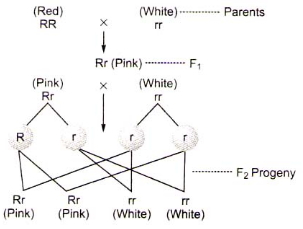
In Mirabilis,a hybrid for red $(RR)$ and white $(rr)$ flower produces pink $(Rr)$ flower. $A$ plant with pink flower is crossed with a white flower,the expected phenotypic ratio is
A
Red : pink : white $(1: 2: 1)$
B
Pink : white $(1: 1)$
C
Red : pink $(1: 1)$
D
Red : white $(3: 1)$
Solution
(B) Mirabilis jalapa exhibits incomplete dominance,where the heterozygous condition $(Rr)$ results in a pink phenotype instead of red.
When a pink-flowered plant $(Rr)$ is crossed with a white-flowered plant $(rr)$,the gametes produced by the pink plant are $R$ and $r$,while the white plant produces only $r$ gametes.
The resulting offspring genotypes are $Rr$ (pink) and $rr$ (white) in a $1: 1$ ratio.
Therefore,the expected phenotypic ratio is $1$ pink : $1$ white.
When a pink-flowered plant $(Rr)$ is crossed with a white-flowered plant $(rr)$,the gametes produced by the pink plant are $R$ and $r$,while the white plant produces only $r$ gametes.
The resulting offspring genotypes are $Rr$ (pink) and $rr$ (white) in a $1: 1$ ratio.
Therefore,the expected phenotypic ratio is $1$ pink : $1$ white.
0 likes
View Solution66
MediumMCQ
Genotypic and phenotypic ratios remain the same in
A
Sex-linked genes
B
Pseudoallelic genes
C
Intermediate inheritance
D
Dominance and recessive genes
Solution
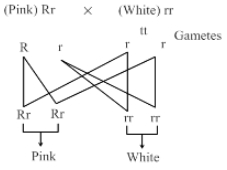
(C) Intermediate inheritance,also known as incomplete dominance,is a phenomenon where the phenotypic and genotypic ratios in the $F_2$ generation are identical,both being $1:2:1$.
In this type of inheritance,the dominant allele does not completely mask the recessive allele,resulting in an intermediate phenotype in the heterozygote.
Classic examples include the four o'clock plant $(Mirabilis \ jalapa)$ and snapdragon $(Antirrhinum \ majus)$.
In this type of inheritance,the dominant allele does not completely mask the recessive allele,resulting in an intermediate phenotype in the heterozygote.
Classic examples include the four o'clock plant $(Mirabilis \ jalapa)$ and snapdragon $(Antirrhinum \ majus)$.
0 likes
View Solution67
MediumMCQ
In garden pea,starch is synthesised effectively in
A
Heterozygous round seeded plants
B
Homozygous round seeded plants
C
Wrinkled seeded plants
D
Pure and hybrid round seeded plants
Solution
(B) In garden pea,the gene for seed shape ($B$ for round and $b$ for wrinkled) also controls starch synthesis.
$BB$ (homozygous round) plants produce large starch grains and are round.
$bb$ (wrinkled) plants produce small starch grains and are wrinkled.
$Bb$ (heterozygous) plants produce intermediate-sized starch grains and appear round.
Since $BB$ plants produce the largest starch grains,starch is synthesised most effectively in homozygous round seeded plants.
$BB$ (homozygous round) plants produce large starch grains and are round.
$bb$ (wrinkled) plants produce small starch grains and are wrinkled.
$Bb$ (heterozygous) plants produce intermediate-sized starch grains and appear round.
Since $BB$ plants produce the largest starch grains,starch is synthesised most effectively in homozygous round seeded plants.
0 likes
View Solution68
MediumMCQ
When a pink flowered Antirrhinum plant is test crossed,then the phenotypic ratio in the resulting progenies is
A
$1 \text{ Red} : 1 \text{ White}$
B
$3 \text{ Red} : 1 \text{ White}$
C
$2 \text{ Pink} : 1 \text{ White}$
D
$1 \text{ Pink} : 1 \text{ White}$
Solution
(D) In Antirrhinum (snapdragon),flower color exhibits incomplete dominance.
Genotype $RR$ produces red flowers,$rr$ produces white flowers,and the heterozygous genotype $Rr$ produces pink flowers.
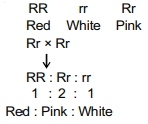
$A$ test cross involves crossing an individual with a recessive parent. Here,the recessive parent is white-flowered $(rr)$.
The cross is: Pink $(Rr)$ $\times$ White $(rr)$.
The gametes produced by $Rr$ are $R$ and $r$,and by $rr$ is $r$.
The resulting progenies are:
$Rr$ (Pink) and $rr$ (White).
Thus,the phenotypic ratio is $1 \text{ Pink} : 1 \text{ White}$.
Genotype $RR$ produces red flowers,$rr$ produces white flowers,and the heterozygous genotype $Rr$ produces pink flowers.
$A$ test cross involves crossing an individual with a recessive parent. Here,the recessive parent is white-flowered $(rr)$.
The cross is: Pink $(Rr)$ $\times$ White $(rr)$.
The gametes produced by $Rr$ are $R$ and $r$,and by $rr$ is $r$.
The resulting progenies are:
$Rr$ (Pink) and $rr$ (White).
Thus,the phenotypic ratio is $1 \text{ Pink} : 1 \text{ White}$.
0 likes
View Solution69
MediumMCQ
In incomplete dominance,
A
Dominant trait is completely expressed in $F_{1}$ generation
B
Phenotypic and genotypic ratio are different
C
Two dominant alleles are needed to express the complete dominant trait
D
$F_{1}$ individuals have the equal traits of both parents
Solution
(D) In incomplete dominance,the dominant allele does not completely mask the effect of the recessive allele.
As a result,the $F_{1}$ generation exhibits a phenotype that is an intermediate blend of the two parental traits.
For example,in $Antirrhinum$ $majus$ (snapdragon),a cross between red $(RR)$ and white $(rr)$ flowers results in pink $(Rr)$ flowers in the $F_{1}$ generation.
In the $F_{2}$ generation,the genotypic ratio is $1:2:1$ $(RR:Rr:rr)$ and the phenotypic ratio is also $1:2:1$ (Red:Pink:White).
Therefore,the phenotypic and genotypic ratios are identical in incomplete dominance,which contradicts option $B$.
However,looking at the options provided,option $D$ is the most accurate description because the $F_{1}$ phenotype is an intermediate expression resulting from the influence of both alleles.
As a result,the $F_{1}$ generation exhibits a phenotype that is an intermediate blend of the two parental traits.
For example,in $Antirrhinum$ $majus$ (snapdragon),a cross between red $(RR)$ and white $(rr)$ flowers results in pink $(Rr)$ flowers in the $F_{1}$ generation.
In the $F_{2}$ generation,the genotypic ratio is $1:2:1$ $(RR:Rr:rr)$ and the phenotypic ratio is also $1:2:1$ (Red:Pink:White).
Therefore,the phenotypic and genotypic ratios are identical in incomplete dominance,which contradicts option $B$.
However,looking at the options provided,option $D$ is the most accurate description because the $F_{1}$ phenotype is an intermediate expression resulting from the influence of both alleles.
0 likes
View Solution70
MediumMCQ
$A$ : In snapdragon, $F_{1}$ plants do not have red or white flowers.
$R$ : It is intermediate inheritance with neither of the two alleles of a gene being dominant over each other.
$R$ : It is intermediate inheritance with neither of the two alleles of a gene being dominant over each other.
A
Assertion and Reason both are correct and Reason is the correct explanation of Assertion.
B
Assertion and Reason both are correct but Reason is not the correct explanation of Assertion.
C
Assertion is correct, but Reason is incorrect.
D
Both Assertion and Reason are incorrect.
Solution
(A) In snapdragon $(Antirrhinum \, sp.)$, the inheritance of flower color shows incomplete dominance.
When a homozygous red-flowered plant $(RR)$ is crossed with a homozygous white-flowered plant $(rr)$, the $F_{1}$ generation produces pink-flowered plants $(Rr)$.
This happens because neither of the two alleles is completely dominant over the other, resulting in an intermediate phenotype.
Therefore, both the Assertion and the Reason are correct, and the Reason is the correct explanation of the Assertion.
When a homozygous red-flowered plant $(RR)$ is crossed with a homozygous white-flowered plant $(rr)$, the $F_{1}$ generation produces pink-flowered plants $(Rr)$.
This happens because neither of the two alleles is completely dominant over the other, resulting in an intermediate phenotype.
Therefore, both the Assertion and the Reason are correct, and the Reason is the correct explanation of the Assertion.
0 likes
View Solution71
MediumMCQ
Pure red flower $\times$ Pure white flower $=$ Pink flower. This is an example of:
A
Complete dominance
B
Codominance
C
Incomplete dominance
D
Polygenic inheritance
Solution
(C) Incomplete dominance is a phenomenon where the dominant allele does not completely mask the effects of the recessive allele, resulting in a phenotype that is a blend of both parents.
In the case of $Mirabilis$ $jalapa$ (Four o'clock plant), when a pure red-flowered plant $(RR)$ is crossed with a pure white-flowered plant $(rr)$, the $F_1$ generation produces pink-flowered plants $(Rr)$.
This intermediate phenotype indicates that neither allele is completely dominant over the other, which is the definition of incomplete dominance.
In the case of $Mirabilis$ $jalapa$ (Four o'clock plant), when a pure red-flowered plant $(RR)$ is crossed with a pure white-flowered plant $(rr)$, the $F_1$ generation produces pink-flowered plants $(Rr)$.
This intermediate phenotype indicates that neither allele is completely dominant over the other, which is the definition of incomplete dominance.
0 likes
View Solution72
MediumMCQ
The phenotypic ratio of incomplete dominance is $P$.
The genotypic ratio of incomplete dominance is $Q$.
Choose the correct option for $P$ and $Q$.
$P \quad \quad Q$
The genotypic ratio of incomplete dominance is $Q$.
Choose the correct option for $P$ and $Q$.
$P \quad \quad Q$
A
$1: 2: 1 \quad \quad 3: 1$
B
$1: 2: 1 \quad \quad 1: 2: 1$
C
$3: 1 \quad \quad 3: 1$
D
$3: 1 \quad \quad 1: 2: 1$
Solution
(B) Incomplete dominance is a phenomenon where the dominant allele does not completely mask the recessive allele,resulting in an intermediate phenotype in the heterozygote.
For a monohybrid cross involving incomplete dominance (e.g.,flower color in Mirabilis jalapa),the $F_2$ generation shows both phenotypic and genotypic ratios as $1: 2: 1$.
- The phenotypic ratio is $1$ (Red) : $2$ (Pink) : $1$ (White) = $1: 2: 1$.
- The genotypic ratio is $1$ $(RR)$ : $2$ $(Rr)$ : $1$ $(rr)$ = $1: 2: 1$.
Therefore,both $P$ and $Q$ are $1: 2: 1$.
For a monohybrid cross involving incomplete dominance (e.g.,flower color in Mirabilis jalapa),the $F_2$ generation shows both phenotypic and genotypic ratios as $1: 2: 1$.
- The phenotypic ratio is $1$ (Red) : $2$ (Pink) : $1$ (White) = $1: 2: 1$.
- The genotypic ratio is $1$ $(RR)$ : $2$ $(Rr)$ : $1$ $(rr)$ = $1: 2: 1$.
Therefore,both $P$ and $Q$ are $1: 2: 1$.
0 likes
View Solution73
MediumMCQ
In incomplete dominance,which ratio does not match with Mendel's monohybrid cross?
A
Genotypic ratio
B
Phenotypic ratio
C
Both
D
None
Solution
(B) In Mendel's monohybrid cross,the phenotypic ratio is $3:1$ and the genotypic ratio is $1:2:1$.
In incomplete dominance (e.g.,in $Antirrhinum$ $majus$),the phenotypic ratio is $1:2:1$ and the genotypic ratio is $1:2:1$.
Since the phenotypic ratio in incomplete dominance $(1:2:1)$ differs from the phenotypic ratio in Mendel's monohybrid cross $(3:1)$,the phenotypic ratio does not match.
In incomplete dominance (e.g.,in $Antirrhinum$ $majus$),the phenotypic ratio is $1:2:1$ and the genotypic ratio is $1:2:1$.
Since the phenotypic ratio in incomplete dominance $(1:2:1)$ differs from the phenotypic ratio in Mendel's monohybrid cross $(3:1)$,the phenotypic ratio does not match.
0 likes
View Solution74
MediumMCQ
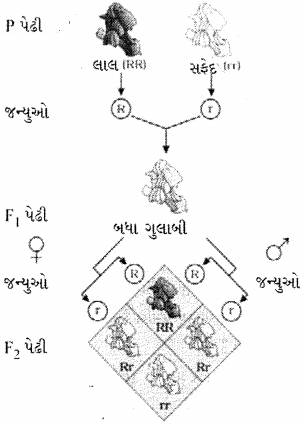
What does the given experiment demonstrate?
A
Complete dominance
B
Incomplete dominance
C
Co-dominance
D
Linkage
Solution
(B) The given experiment shows a cross between red-flowered $(RR)$ and white-flowered $(rr)$ plants of $Antirrhinum$ $sp.$ (Snapdragon).
In the $F_1$ generation,all plants are pink $(Rr)$,which is an intermediate phenotype between red and white.
In the $F_2$ generation,the phenotypic ratio is $1:2:1$ (Red:Pink:White),which is identical to the genotypic ratio.
This phenomenon,where the dominant allele does not completely mask the recessive allele,resulting in an intermediate phenotype,is known as Incomplete dominance.
In the $F_1$ generation,all plants are pink $(Rr)$,which is an intermediate phenotype between red and white.
In the $F_2$ generation,the phenotypic ratio is $1:2:1$ (Red:Pink:White),which is identical to the genotypic ratio.
This phenomenon,where the dominant allele does not completely mask the recessive allele,resulting in an intermediate phenotype,is known as Incomplete dominance.
0 likes
View Solution75
MediumMCQ
The synthesis of starch in pea seeds is controlled by a single gene. This gene has two alleles,$B$ and $b$. If the size of the starch grain is considered as the phenotype,what type of inheritance does this represent?
A
Complete dominance
B
Codominance
C
Incomplete dominance
D
Multiple alleles
Solution
(C) In pea plants,the gene controlling starch synthesis has two alleles,$B$ and $b$.
$BB$ homozygotes produce large starch grains,while $bb$ homozygotes produce small starch grains.
However,the heterozygotes $(Bb)$ produce starch grains of intermediate size.
Since the phenotype of the heterozygote is intermediate between the phenotypes of the two homozygotes,this is an example of incomplete dominance.
$BB$ homozygotes produce large starch grains,while $bb$ homozygotes produce small starch grains.
However,the heterozygotes $(Bb)$ produce starch grains of intermediate size.
Since the phenotype of the heterozygote is intermediate between the phenotypes of the two homozygotes,this is an example of incomplete dominance.
0 likes
View Solution76
MediumMCQ
$A$ pink flowered Snapdragon plant was crossed with a red flowered Snapdragon plant. What type of phenotype/s is/are expected in the progeny?
A
Red flowered as well as pink flowered plants
B
Only pink flowered plants
C
Red,Pink as well as white flowered plants
D
Only red flowered plants
Solution
(A) In Snapdragon $(Antirrhinum \text{ } majus)$, flower color exhibits incomplete dominance. The genotype for red flowers is $RR$, white flowers is $rr$, and pink flowers is $Rr$.
The resulting progeny genotypes are $50\% \text{ } RR$ (Red) and $50\% \text{ } Rr$ (Pink).
Therefore, the expected phenotypes in the progeny are red flowered and pink flowered plants.
| Gametes | $R$ | $r$ |
| $R$ | $RR$ (Red) | $Rr$ (Pink) |
| $R$ | $RR$ (Red) | $Rr$ (Pink) |
The resulting progeny genotypes are $50\% \text{ } RR$ (Red) and $50\% \text{ } Rr$ (Pink).
Therefore, the expected phenotypes in the progeny are red flowered and pink flowered plants.
0 likes
View Solution77
MediumMCQ
In the inheritance of size of starch grain in $Pisum$ $sativum$,the $F_1$ had a phenotype that $:-$
A
Resemble both of the parents
B
Resemble none of the parents
C
Resemble either one of the parents
D
Intermediate size
Solution
(D) In $Pisum$ $sativum$ (pea plant),the size of starch grains is controlled by a single gene with two alleles ($B$ and $b$).
$BB$ homozygotes produce large starch grains,while $bb$ homozygotes produce small starch grains.
When these are crossed,the $F_1$ heterozygotes $(Bb)$ produce starch grains of intermediate size.
This phenomenon is an example of incomplete dominance,where the phenotype of the heterozygote is intermediate between the phenotypes of the two homozygous parents.
$BB$ homozygotes produce large starch grains,while $bb$ homozygotes produce small starch grains.
When these are crossed,the $F_1$ heterozygotes $(Bb)$ produce starch grains of intermediate size.
This phenomenon is an example of incomplete dominance,where the phenotype of the heterozygote is intermediate between the phenotypes of the two homozygous parents.
0 likes
View Solution78
EasyMCQ
Which of these statements is incorrect?
A
Incomplete dominance is a phenomenon where one allele masks the expression of another allele in heterozygous individuals.
B
In a cross between true-breeding red-flowered $(RR)$ and true-breeding white-flowered plants $(rr)$ of snapdragon,the $F_1$ generation will be pink $(Rr).$
C
Dominance is a phenomenon where one allele masks the expression of another allele in heterozygous individuals.
D
$A$ recessive allele may produce a non-functional enzyme or no enzyme at all.
Solution
(A) The correct answer is $A$.
Incomplete dominance is a phenomenon in which the $F_1$ phenotype is intermediate between the two parental phenotypes,rather than one allele completely masking the other.
Option $A$ describes the definition of complete dominance,not incomplete dominance.
Option $B$ is correct as snapdragon exhibits incomplete dominance,resulting in pink flowers in the $F_1$ generation.
Option $C$ is the correct definition of dominance.
Option $D$ is correct because recessive alleles often code for non-functional enzymes or no enzyme,leading to the recessive trait.
Incomplete dominance is a phenomenon in which the $F_1$ phenotype is intermediate between the two parental phenotypes,rather than one allele completely masking the other.
Option $A$ describes the definition of complete dominance,not incomplete dominance.
Option $B$ is correct as snapdragon exhibits incomplete dominance,resulting in pink flowers in the $F_1$ generation.
Option $C$ is the correct definition of dominance.
Option $D$ is correct because recessive alleles often code for non-functional enzymes or no enzyme,leading to the recessive trait.
0 likes
View Solution79
MediumMCQ
In pea plant,genotype $(Bb)$ shows $-$
A
Round seed with large sized starch grain
B
Round seed with intermediate sized starch grain
C
Round seed with small sized starch grain
D
Wrinkled seed with small sized starch
Solution
(B) The genotype $(Bb)$ in pea plants exhibits the phenomenon of incomplete dominance regarding starch grain size.
While the shape of the seed is controlled by the gene $B$ (where $B$ is dominant for round and $b$ is recessive for wrinkled),the size of the starch grains is controlled by the same gene.
In the homozygous condition,$BB$ produces large starch grains,and $bb$ produces small starch grains.
In the heterozygous condition $(Bb)$,the starch grains are of intermediate size.
Therefore,the genotype $(Bb)$ results in round seeds with intermediate-sized starch grains.
While the shape of the seed is controlled by the gene $B$ (where $B$ is dominant for round and $b$ is recessive for wrinkled),the size of the starch grains is controlled by the same gene.
In the homozygous condition,$BB$ produces large starch grains,and $bb$ produces small starch grains.
In the heterozygous condition $(Bb)$,the starch grains are of intermediate size.
Therefore,the genotype $(Bb)$ results in round seeds with intermediate-sized starch grains.
0 likes
View Solution80
MediumMCQ
In a cross between male and female pea plants,both are heterozygous for round seeds,what percentage of the progeny will be having intermediate sized starch grains (in $\%$)?
A
$25$
B
$50$
C
$0$
D
$100$
Solution
(B) The inheritance of starch grain size in pea plants is an example of incomplete dominance.
Let $B$ represent the allele for large starch grains and $b$ represent the allele for small starch grains.
The genotype $BB$ produces large starch grains,$bb$ produces small starch grains,and the heterozygous genotype $Bb$ produces intermediate sized starch grains.
When both parents are heterozygous $(Bb \times Bb)$,the phenotypic ratio of the progeny is $1:2:1$ $(BB:Bb:bb)$.
Here,$25\%$ of the progeny will be $BB$ (large),$50\%$ will be $Bb$ (intermediate),and $25\%$ will be $bb$ (small).
Therefore,$50\%$ of the progeny will have intermediate sized starch grains.
Let $B$ represent the allele for large starch grains and $b$ represent the allele for small starch grains.
The genotype $BB$ produces large starch grains,$bb$ produces small starch grains,and the heterozygous genotype $Bb$ produces intermediate sized starch grains.
When both parents are heterozygous $(Bb \times Bb)$,the phenotypic ratio of the progeny is $1:2:1$ $(BB:Bb:bb)$.
Here,$25\%$ of the progeny will be $BB$ (large),$50\%$ will be $Bb$ (intermediate),and $25\%$ will be $bb$ (small).
Therefore,$50\%$ of the progeny will have intermediate sized starch grains.
0 likes
View Solution81
MediumMCQ
Choose the incorrect statement regarding incomplete dominance $:-$
A
$F_1$ had a phenotype that did not resemble either of the two parents
B
The inheritance of flower colour in the dog flower/snapdragon is a good example to understand incomplete dominance.
C
When two pink flowered snapdragon plants are crossed,it results only red flowered plants
D
When two true-breeding snapdragon plants,red $\&$ white,are crossed,it results in red,white,$\&$ pink flowered plants in the $F_2$ generation.
Solution
(C) Incomplete dominance is a phenomenon where the dominant allele does not completely mask the effect of the recessive allele,resulting in an intermediate phenotype in the $F_1$ generation.
In snapdragon ($Antirrhinum$ $sp.$),the cross between red $(RR)$ and white $(rr)$ flowers produces pink $(Rr)$ flowers in the $F_1$ generation.
When two pink $(Rr)$ plants are crossed,the $F_2$ generation shows a phenotypic ratio of $1$ Red $(RR)$ : $2$ Pink $(Rr)$ : $1$ White $(rr)$.
Therefore,option $C$ is incorrect because crossing two pink flowered plants results in red,pink,and white flowered plants,not only red flowered plants.
In snapdragon ($Antirrhinum$ $sp.$),the cross between red $(RR)$ and white $(rr)$ flowers produces pink $(Rr)$ flowers in the $F_1$ generation.
When two pink $(Rr)$ plants are crossed,the $F_2$ generation shows a phenotypic ratio of $1$ Red $(RR)$ : $2$ Pink $(Rr)$ : $1$ White $(rr)$.
Therefore,option $C$ is incorrect because crossing two pink flowered plants results in red,pink,and white flowered plants,not only red flowered plants.
0 likes
View Solution82
EasyMCQ
In incomplete dominance,each of the parental traits reappears in the $F_2$ generation by . . . . . . %.
A
$75$
B
$100$
C
$25$
D
$50$
Solution
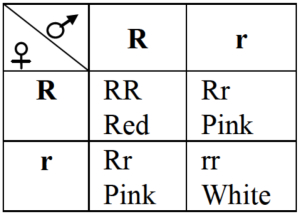
(C) In incomplete dominance,a cross between two homozygous parents (e.g.,Red $RR$ and White $rr$) results in a heterozygous $F_1$ generation with an intermediate phenotype (Pink $Rr$).
When the $F_1$ generation $(Rr)$ is self-crossed,the $F_2$ generation shows a phenotypic ratio of $1:2:1$ (Red:Pink:White).
From the Punnett square:
- Red $(RR)$: $1/4$ or $25\%$
- Pink $(Rr)$: $2/4$ or $50\%$
- White $(rr)$: $1/4$ or $25\%$
Thus,each of the parental traits (Red and White) reappears in the $F_2$ generation with a frequency of $25\%$.
When the $F_1$ generation $(Rr)$ is self-crossed,the $F_2$ generation shows a phenotypic ratio of $1:2:1$ (Red:Pink:White).
From the Punnett square:
- Red $(RR)$: $1/4$ or $25\%$
- Pink $(Rr)$: $2/4$ or $50\%$
- White $(rr)$: $1/4$ or $25\%$
Thus,each of the parental traits (Red and White) reappears in the $F_2$ generation with a frequency of $25\%$.
0 likes
View Solution83
EasyMCQ
When two homozygous plants with red and white flowers are crossed, their offsprings show pink flowers. This indicates that the alleles of the gene for flower colour shows . . . . . . .
A
Incomplete dominance
B
Epistasis
C
Complete dominance
D
Co-dominance
Solution
(A) Incomplete dominance is a phenomenon where the dominant allele does not completely mask the effect of the recessive allele.
As a result, the heterozygous offspring exhibit an intermediate phenotype that is a blend of the two parental traits.
In this case, the cross between red $(RR)$ and white $(rr)$ flowers results in pink $(Rr)$ flowers, which is a classic example of incomplete dominance, commonly observed in plants like $Mirabilis$ \text{ } $jalapa$ (Four o'clock plant).
As a result, the heterozygous offspring exhibit an intermediate phenotype that is a blend of the two parental traits.
In this case, the cross between red $(RR)$ and white $(rr)$ flowers results in pink $(Rr)$ flowers, which is a classic example of incomplete dominance, commonly observed in plants like $Mirabilis$ \text{ } $jalapa$ (Four o'clock plant).
0 likes
View Solution84
EasyMCQ
In Mirabilis jalapa,when red and white varieties are crossed,the hybrid obtained will be . . . . . . pink. (in $\%$)
A
$25$
B
$50$
C
$75$
D
$100$
Solution
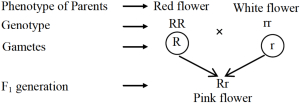
(D) In $Mirabilis$ $jalapa$ (Four $O$'clock plant),the inheritance of flower color exhibits incomplete dominance.
When a homozygous red-flowered plant $(RR)$ is crossed with a homozygous white-flowered plant $(rr)$,all the $F_1$ hybrid offspring have the genotype $Rr$.
Due to incomplete dominance,the $Rr$ genotype results in a pink phenotype rather than red or white.
Therefore,$100\%$ of the $F_1$ hybrids obtained from this cross will be pink.
When a homozygous red-flowered plant $(RR)$ is crossed with a homozygous white-flowered plant $(rr)$,all the $F_1$ hybrid offspring have the genotype $Rr$.
Due to incomplete dominance,the $Rr$ genotype results in a pink phenotype rather than red or white.
Therefore,$100\%$ of the $F_1$ hybrids obtained from this cross will be pink.
0 likes
View Solution85
EasyMCQ
Which characteristic feature of the Dog flower (Snapdragon) plant shows incomplete dominance?
A
Colour of the flower
B
Seed colour
C
Height of the plant
D
Seed shape
Solution
(A) Incomplete dominance is a phenomenon where the dominant allele does not completely mask the effects of the recessive allele, resulting in an intermediate phenotype in the heterozygote.
In the Dog flower plant $(Antirrhinum \text{ } majus)$, the cross between a red-flowered plant $(RR)$ and a white-flowered plant $(rr)$ results in pink-flowered offspring $(Rr)$ in the $F_1$ generation.
This intermediate pink colour demonstrates incomplete dominance, as neither the red nor the white trait is completely dominant over the other.
In the Dog flower plant $(Antirrhinum \text{ } majus)$, the cross between a red-flowered plant $(RR)$ and a white-flowered plant $(rr)$ results in pink-flowered offspring $(Rr)$ in the $F_1$ generation.
This intermediate pink colour demonstrates incomplete dominance, as neither the red nor the white trait is completely dominant over the other.
0 likes
View Solution86
EasyMCQ
The genotype ratio of incomplete dominance is
A
$3$:$1$
B
$1$:$2$:$1$
C
$1$:$1$:$2$
D
$9$:$3$:$3$:$1$
Solution
(B) The correct answer is $B$ $(1:2:1)$.
In incomplete dominance,the phenotypic and genotypic ratios are identical.
For a cross between two heterozygous individuals (e.g.,$Rr \times Rr$),the resulting offspring follow the ratio $1$ (homozygous dominant) : $2$ (heterozygous) : $1$ (homozygous recessive).
Thus,the genotypic ratio is $1:2:1$.
In incomplete dominance,the phenotypic and genotypic ratios are identical.
For a cross between two heterozygous individuals (e.g.,$Rr \times Rr$),the resulting offspring follow the ratio $1$ (homozygous dominant) : $2$ (heterozygous) : $1$ (homozygous recessive).
Thus,the genotypic ratio is $1:2:1$.
0 likes
View SolutionPrinciples of Inheritance and Variation — Incomplete dominance · Frequently Asked Questions
1Are these Principles of Inheritance and Variation questions useful for JEE and NEET?
Yes. All questions in this section are mapped to JEE Main and NEET exam patterns. Previous year questions from JEE Main, NEET, GUJCET and state-level exams are included with full solutions.
2Can I switch to Hindi or Gujarati for these questions?
Yes. Use the language tabs in the hero section or the sidebar to view the same questions and solutions in English, Hindi or Gujarati.
3How do I generate a question paper from this subtopic?
Use the Vedclass Exam Paper Generator — select the chapter and subtopic, set difficulty, and generate Sets A, B, C, D automatically. First 3 chapters of every subject are free.
Vedclass Products
For Students
Vedclass Test Series
Mock tests in real JEE/NEET style with performance analysis. 5-day free trial.
Start Free TrialFor Teachers
Exam Paper Generator
Generate Set A/B/C/D papers from this chapter in 2 minutes. 3 chapters free.
Try FreeFor Institutes
Online Exam Module
Live online exams with unlimited students, 360° analytics & white-label branding.
See DemoFor Teachers & Institutes
Generate a Principles of Inheritance and Variation Exam Paper in 2 Minutes
Select subtopic & difficulty — Sets A, B, C, D auto-generated with No Repeat logic.
First 3 chapters of every subject are free — no payment required.