
A English
Population Interactions Questions in English
Class 12 Biology · Organisms and Populations · Population Interactions
365+
Questions
English
Language
100%
With Solutions
Showing 50 of 365 questions in English
101
MediumMCQ
Which of the following is correctly categorized as a parasite?
A
Female Anopheles mosquito bites and sucks blood from humans.
B
Human embryo developing in the uterus and obtaining nutrition from the mother.
C
Head louse living on the human scalp and laying eggs on human hair.
D
Cuckoo laying eggs in the crow's nest.
Solution
(C) Parasitism is a biological interaction where one organism (the parasite) lives on or inside another organism (the host) and derives nutrients at the expense of the host.
$A$. Female Anopheles mosquito is a vector,not a parasite,as it does not live on or inside the host permanently.
$B$. The human embryo is not a parasite; it is a developing offspring receiving nutrition through the placenta.
$C$. Head louse ($Pediculus$ $humanus$ $capitis$) is an ectoparasite that lives on the human scalp and feeds on blood,causing irritation and harm to the host.
$D$. Cuckoo laying eggs in a crow's nest is an example of brood parasitism,but the question specifically asks for the organism categorized as a parasite in a standard sense. However,in the context of biological interactions,the head louse is the most direct example of an ectoparasite.
$A$. Female Anopheles mosquito is a vector,not a parasite,as it does not live on or inside the host permanently.
$B$. The human embryo is not a parasite; it is a developing offspring receiving nutrition through the placenta.
$C$. Head louse ($Pediculus$ $humanus$ $capitis$) is an ectoparasite that lives on the human scalp and feeds on blood,causing irritation and harm to the host.
$D$. Cuckoo laying eggs in a crow's nest is an example of brood parasitism,but the question specifically asks for the organism categorized as a parasite in a standard sense. However,in the context of biological interactions,the head louse is the most direct example of an ectoparasite.
0 likes
View Solution102
MediumMCQ
The association of a sea anemone living on the shell of a hermit crab is known as:
A
Amensalism
B
Ectoparasitism
C
Commensalism
D
Mutualism
Solution
(D) The association between a sea anemone and a hermit crab is a classic example of $Commensalism$.
In this relationship, the sea anemone gets the benefit of mobility and access to food particles left by the hermit crab, while the hermit crab receives protection from predators due to the stinging tentacles of the sea anemone.
However, since both species benefit from this interaction, it is often classified as $Mutualism$ (specifically $Protocooperation$ or $Facultative \text{ } Mutualism$) in many biological contexts.
Given the standard options provided in $NCERT$ biology, this interaction is typically categorized as $Mutualism$ because both organisms derive a positive benefit.
In this relationship, the sea anemone gets the benefit of mobility and access to food particles left by the hermit crab, while the hermit crab receives protection from predators due to the stinging tentacles of the sea anemone.
However, since both species benefit from this interaction, it is often classified as $Mutualism$ (specifically $Protocooperation$ or $Facultative \text{ } Mutualism$) in many biological contexts.
Given the standard options provided in $NCERT$ biology, this interaction is typically categorized as $Mutualism$ because both organisms derive a positive benefit.
0 likes
View Solution103
MediumMCQ
In which of the following interactions are both organisms negatively affected?
A
Mutualism
B
Competition
C
Predation
D
Parasitism
Solution
(B) In biological interactions,different types of relationships exist between organisms.
$1$. Mutualism $(+, +)$: Both species benefit.
$2$. Competition $(-, -)$: Both species are negatively affected because they compete for the same limited resources.
$3$. Predation $(+, -)$: The predator benefits,while the prey is harmed.
$4$. Parasitism $(+, -)$: The parasite benefits,while the host is harmed.
Therefore,in competition,both organisms are negatively affected.
$1$. Mutualism $(+, +)$: Both species benefit.
$2$. Competition $(-, -)$: Both species are negatively affected because they compete for the same limited resources.
$3$. Predation $(+, -)$: The predator benefits,while the prey is harmed.
$4$. Parasitism $(+, -)$: The parasite benefits,while the host is harmed.
Therefore,in competition,both organisms are negatively affected.
0 likes
View Solution104
MediumMCQ
If the '$+$' sign is used for a beneficial interaction,the '$-$' sign for a detrimental interaction,and the '$0$' sign for a neutral interaction,then which population interaction is represented by '$+$' and '$-$'?
A
Commensalism
B
Parasitism
C
Mutualism
D
Amensalism
Solution
(B) In population interactions,the '$+$' and '$-$' interaction signifies that one species benefits while the other is harmed.
This specific interaction is known as Parasitism or Predation.
Among the given options,Parasitism $(+,-)$ fits this description.
Commensalism is $(+,0)$,Mutualism is $(+,+)$,and Amensalism is $(-,0)$.
This specific interaction is known as Parasitism or Predation.
Among the given options,Parasitism $(+,-)$ fits this description.
Commensalism is $(+,0)$,Mutualism is $(+,+)$,and Amensalism is $(-,0)$.
0 likes
View Solution105
EasyMCQ
Who proposed the Competitive Exclusion Principle?
A
Mac Arthur
B
Verhulst and Pearl
C
$C$. Darwin
D
$G$. $F$. Gause
Solution
(D) The Competitive Exclusion Principle,also known as Gause's Law,was proposed by the Russian ecologist $G$. $F$. Gause.
This principle states that two species competing for the same limiting resource cannot coexist at constant population values.
When two species compete for the exact same resources,one will eventually outcompete the other,leading to the extinction or evolutionary shift of the less competitive species.
This principle states that two species competing for the same limiting resource cannot coexist at constant population values.
When two species compete for the exact same resources,one will eventually outcompete the other,leading to the extinction or evolutionary shift of the less competitive species.
0 likes
View Solution106
MediumMCQ
What does Gause's Competitive Exclusion Principle state?
A
Competition for similar resources eliminates species with different food preferences.
B
Two species competing for the same limiting resources cannot coexist at constant population values.
C
Larger organisms exclude smaller organisms through competition.
D
Species with higher abundance exclude species with lower abundance through competition.
Solution
(B) Gause's Competitive Exclusion Principle states that two species competing for the same limiting resources cannot coexist indefinitely if other ecological factors are constant.
If two species occupy the same niche and compete for the same resources,the more efficient species will eventually eliminate the other species from that habitat.
Therefore,the correct statement is that two species competing for the same limiting resources cannot coexist at constant population values.
If two species occupy the same niche and compete for the same resources,the more efficient species will eventually eliminate the other species from that habitat.
Therefore,the correct statement is that two species competing for the same limiting resources cannot coexist at constant population values.
0 likes
View Solution107
EasyMCQ
Mycorrhiza is an example of which of the following?
A
Fungistasis
B
Amensalism
C
Antibiosis
D
Mutualism
Solution
(D) Mycorrhiza is a symbiotic association between a fungus and the roots of higher plants.
In this association,the fungus helps the plant in the absorption of essential nutrients like phosphorus from the soil,while the plant provides carbohydrates (food) to the fungus.
Since both organisms benefit from this interaction,it is classified as $Mutualism$.
In this association,the fungus helps the plant in the absorption of essential nutrients like phosphorus from the soil,while the plant provides carbohydrates (food) to the fungus.
Since both organisms benefit from this interaction,it is classified as $Mutualism$.
0 likes
View Solution108
MediumMCQ
Which one of the following population interactions is widely used in medical science for the production of antibiotics?
A
Parasitism
B
Commensalism
C
Amensalism
D
Mutualism
Solution
(C) Amensalism is a type of population interaction where one species is harmed while the other remains unaffected.
Antibiotics are chemical substances produced by some microorganisms (like fungi or bacteria) that inhibit or kill the growth of other microorganisms.
For example,the mold $Penicillium$ produces penicillin,which inhibits the growth of bacteria.
In this interaction,the bacteria are harmed,while the $Penicillium$ mold is not significantly affected by the presence of the bacteria,making it a classic example of amensalism.
Antibiotics are chemical substances produced by some microorganisms (like fungi or bacteria) that inhibit or kill the growth of other microorganisms.
For example,the mold $Penicillium$ produces penicillin,which inhibits the growth of bacteria.
In this interaction,the bacteria are harmed,while the $Penicillium$ mold is not significantly affected by the presence of the bacteria,making it a classic example of amensalism.
0 likes
View Solution109
MediumMCQ
The presence of flagellated protozoans in the gut of termites is an example of:
A
Symbiosis
B
Parasitism
C
Antibiosis
D
Commensalism
Solution
(A) The presence of flagellated protozoans in the gut of termites is an example of symbiosis (mutualism).
In this type of association,both partners are mutually benefited from each other.
Termites are dependent on the protozoa for the digestion of cellulose in their food,while the protozoa receive shelter and nutrients from the termite host.
In this type of association,both partners are mutually benefited from each other.
Termites are dependent on the protozoa for the digestion of cellulose in their food,while the protozoa receive shelter and nutrients from the termite host.
0 likes
View Solution110
DifficultMCQ
Assertion : Animals adopt different strategies to survive in hostile environments.
Reason : Praying mantis is green in colour which merges with plant foliage.
Reason : Praying mantis is green in colour which merges with plant foliage.
A
If both Assertion and Reason are correct and the Reason is a correct explanation of the Assertion.
B
If both Assertion and Reason are correct but Reason is not a correct explanation of the Assertion.
C
If the Assertion is correct but Reason is incorrect.
D
If both the Assertion and Reason are incorrect.
Solution
(A) Animals often adopt various strategies to survive in hostile environments,such as camouflage,mimicry,or warning coloration.
Camouflage is a strategy where an organism blends with its surroundings to remain unnoticed by predators or prey.
The Praying mantis is green in colour,which allows it to merge with plant foliage (camouflage),thereby protecting it from predators and helping it hunt.
Since the Praying mantis's green colour is a specific example of a strategy used to survive in a hostile environment,the Reason correctly explains the Assertion.
Camouflage is a strategy where an organism blends with its surroundings to remain unnoticed by predators or prey.
The Praying mantis is green in colour,which allows it to merge with plant foliage (camouflage),thereby protecting it from predators and helping it hunt.
Since the Praying mantis's green colour is a specific example of a strategy used to survive in a hostile environment,the Reason correctly explains the Assertion.
0 likes
View Solution111
MediumMCQ
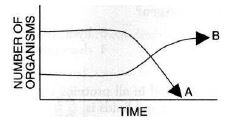
The graph below shows the changes in two populations of herbivores in a grassy field. $A$ possible reason for these changes is that
A
all of the plant populations in this habitat decreased.
B
population $B$ competed more successfully for food than population $A$ did.
C
population $A$ produced more offspring than population $B$ did.
D
population $A$ consumed the members of population $B$.
Solution
(B) The graph illustrates a classic case of competitive exclusion. As population $B$ increases,population $A$ decreases over time. This suggests that both populations are competing for the same limited resource (e.g.,grass). Since population $B$ is better adapted or more efficient at utilizing this resource,it outcompetes population $A$,leading to a decline in the number of individuals in population $A$.
0 likes
View Solution112
MediumMCQ
$A$ scorpion stalks,kills,and then eats a spider. Based on its behavior,which ecological terms describe the scorpion?
A
producer,herbivore,decomposer
B
producer,carnivore,heterotroph
C
predator,carnivore,consumer
D
predator,autotroph,herbivore
Solution
(C) scorpion is a $predator$ because it stalks,kills,and eats its prey.
Since it feeds on a spider (another animal),it is classified as a $carnivore$.
Because it ingests organic food rather than producing it,it is a $consumer$.
In contrast,a $producer$ is an $autotroph$ that synthesizes its own food from inorganic substances,a $decomposer$ breaks down dead organic matter,and a $herbivore$ feeds exclusively on plants.
Since it feeds on a spider (another animal),it is classified as a $carnivore$.
Because it ingests organic food rather than producing it,it is a $consumer$.
In contrast,a $producer$ is an $autotroph$ that synthesizes its own food from inorganic substances,a $decomposer$ breaks down dead organic matter,and a $herbivore$ feeds exclusively on plants.
0 likes
View Solution113
MediumMCQ
Carnivorous animals, such as lions and leopards, occupy the same niche, but lions predate mostly on larger animals while leopards take smaller ones. This mechanism of competition is referred to as:
A
Character displacement
B
Altruism
C
Resource partitioning
D
Competitive exclusion
Solution
(C) The phenomenon described is known as $Resource \text{ } partitioning$.
When two species compete for the same resource, they may evolve mechanisms to avoid direct competition to coexist.
By feeding on different sizes of prey, lions and leopards reduce competition for food, allowing them to occupy the same habitat.
This strategy of dividing resources to minimize competition is a classic example of $Resource \text{ } partitioning$.
When two species compete for the same resource, they may evolve mechanisms to avoid direct competition to coexist.
By feeding on different sizes of prey, lions and leopards reduce competition for food, allowing them to occupy the same habitat.
This strategy of dividing resources to minimize competition is a classic example of $Resource \text{ } partitioning$.
0 likes
View Solution114
EasyMCQ
Between which among the following,the relationship is not an example of commensalism?
A
Orchid and the tree on which it grows
B
Cattle Egret and grazing cattle
C
Sea Anemone and Clown fish
D
Female wasp and fig species
Solution
(D) Commensalism is an interaction in which one species benefits and the other is neither harmed nor benefited.
$A$. Orchid and the tree: This is an example of commensalism where the orchid (epiphyte) gets support,while the tree is unaffected.
$B$. Cattle Egret and grazing cattle: This is an example of commensalism where the egret gets insects stirred up by cattle,while the cattle are unaffected.
$C$. Sea Anemone and Clown fish: This is an example of commensalism where the clown fish gets protection from predators by living among the stinging tentacles of the sea anemone,while the anemone is unaffected.
$D$. Female wasp and fig species: This is an example of mutualism (obligatory),not commensalism. The wasp pollinates the fig,and the fig provides a place for the wasp to lay eggs and food for the developing larvae.
$A$. Orchid and the tree: This is an example of commensalism where the orchid (epiphyte) gets support,while the tree is unaffected.
$B$. Cattle Egret and grazing cattle: This is an example of commensalism where the egret gets insects stirred up by cattle,while the cattle are unaffected.
$C$. Sea Anemone and Clown fish: This is an example of commensalism where the clown fish gets protection from predators by living among the stinging tentacles of the sea anemone,while the anemone is unaffected.
$D$. Female wasp and fig species: This is an example of mutualism (obligatory),not commensalism. The wasp pollinates the fig,and the fig provides a place for the wasp to lay eggs and food for the developing larvae.
0 likes
View Solution115
Medium
Name important defence mechanisms in plants against herbivory.
Solution
(N/A) Plants have evolved various morphological and chemical mechanisms to protect themselves against herbivory.
Morphological defence mechanisms:
$1$. $Opuntia$ (cactus) leaves are modified into sharp spines (thorns) to deter herbivores.
$2$. $Acacia$ plants possess sharp thorns to discourage herbivores from feeding.
$3$. Some plants have spiny leaf margins or sharp edges to prevent herbivory.
Chemical defence mechanisms:
$1$. $Calotropis$ weeds produce toxic cardiac glycosides,which are fatal if ingested by herbivores.
$2$. Plants produce various chemical substances like nicotine,caffeine,quinine,and opium as a part of their self-defence strategy against grazers and browsers.
Morphological defence mechanisms:
$1$. $Opuntia$ (cactus) leaves are modified into sharp spines (thorns) to deter herbivores.
$2$. $Acacia$ plants possess sharp thorns to discourage herbivores from feeding.
$3$. Some plants have spiny leaf margins or sharp edges to prevent herbivory.
Chemical defence mechanisms:
$1$. $Calotropis$ weeds produce toxic cardiac glycosides,which are fatal if ingested by herbivores.
$2$. Plants produce various chemical substances like nicotine,caffeine,quinine,and opium as a part of their self-defence strategy against grazers and browsers.
0 likes
View Solution116
EasyMCQ
An orchid plant is growing on the branch of a mango tree. How do you describe this interaction between the orchid and the mango tree?
A
Mutualism
B
Commensalism
C
Parasitism
D
Competition
Solution
(B) An orchid growing on the branch of a mango tree is an epiphyte.
Epiphytes are plants that grow on other plants but do not derive nutrition from them.
Therefore,the relationship between a mango tree and an orchid is an example of commensalism,where one species benefits while the other remains unaffected.
In this interaction,the orchid benefits by receiving support,while the mango tree remains unaffected.
Epiphytes are plants that grow on other plants but do not derive nutrition from them.
Therefore,the relationship between a mango tree and an orchid is an example of commensalism,where one species benefits while the other remains unaffected.
In this interaction,the orchid benefits by receiving support,while the mango tree remains unaffected.
0 likes
View Solution117
Easy
Define the following terms and give one example for each:
$(a)$ Commensalism
$(b)$ Parasitism
$(c)$ Camouflage
$(d)$ Mutualism
$(e)$ Interspecific competition
$(a)$ Commensalism
$(b)$ Parasitism
$(c)$ Camouflage
$(d)$ Mutualism
$(e)$ Interspecific competition
Solution
(N/A) Commensalism: Commensalism is an interaction between two species in which one species gets benefited while the other remains unaffected. An orchid growing on the branches of a mango tree and barnacles attached to the body of whales are examples of commensalism.
$(b)$ Parasitism: It is an interaction between two species in which one species (usually smaller) gets positively affected,while the other species (usually larger) is negatively affected. An example of this is the liver fluke. The liver fluke is a parasite that lives inside the liver of the host body and derives nutrition from it. Hence,the parasite is benefited as it derives nutrition,while the host is negatively affected as the parasite reduces the host's fitness.
$(c)$ Camouflage: It is a strategy adapted by prey species to escape their predators. Organisms are cryptically coloured so that they can easily mingle in their surroundings and escape their predators. Many species of frogs and insects camouflage in their surroundings to escape their predators.
$(d)$ Mutualism: It is an interaction between two species in which both species involved are benefited. For example,lichens show a mutual symbiotic relationship between fungi and blue-green algae,where both are equally benefited from each other.
$(e)$ Interspecific competition: It is an interaction between individuals of different species where both species get negatively affected. For example,the competition between flamingos and resident fishes in South American lakes for common food resources,i.e.,zooplankton.
$(b)$ Parasitism: It is an interaction between two species in which one species (usually smaller) gets positively affected,while the other species (usually larger) is negatively affected. An example of this is the liver fluke. The liver fluke is a parasite that lives inside the liver of the host body and derives nutrition from it. Hence,the parasite is benefited as it derives nutrition,while the host is negatively affected as the parasite reduces the host's fitness.
$(c)$ Camouflage: It is a strategy adapted by prey species to escape their predators. Organisms are cryptically coloured so that they can easily mingle in their surroundings and escape their predators. Many species of frogs and insects camouflage in their surroundings to escape their predators.
$(d)$ Mutualism: It is an interaction between two species in which both species involved are benefited. For example,lichens show a mutual symbiotic relationship between fungi and blue-green algae,where both are equally benefited from each other.
$(e)$ Interspecific competition: It is an interaction between individuals of different species where both species get negatively affected. For example,the competition between flamingos and resident fishes in South American lakes for common food resources,i.e.,zooplankton.
0 likes
View Solution118
EasyMCQ
Select the statement which explains best parasitism.
A
One organism is benefited.
B
Both the organisms are benefited.
C
One organism is benefited,other is not affected.
D
One organism is benefited,other is affected.
Solution
(D) The correct answer is $D$. Parasitism is an interaction between two species in which one species (the parasite) derives benefit while the other species (the host) is harmed.
In this interaction,the parasite obtains nourishment and shelter from the host,which directly reduces the host's fitness and causes it harm.
For example,ticks and lice on the human body are parasites that benefit by feeding on human blood,while the human host is harmed by this interaction.
In this interaction,the parasite obtains nourishment and shelter from the host,which directly reduces the host's fitness and causes it harm.
For example,ticks and lice on the human body are parasites that benefit by feeding on human blood,while the human host is harmed by this interaction.
0 likes
View Solution119
Easy
Provide general information about population interactions and describe the outcomes observed between two different species due to various interactions.
Solution
(N/A) There is no natural habitat that is completely isolated; therefore, such a situation is inconceivable. For any species, the minimum requirement is at least one other species to serve as food. Even plants, which produce their own food, cannot survive alone; they require soil microbes to break down organic matter and return inorganic nutrients for absorption. Furthermore, without animal agents, how would plants manage pollination?
It is clear that in nature, animals, plants, and microbes do not and cannot live in isolation but interact in various ways to form a biological community. Even in minimal communities, there are many interacting linkages, although not all are easily visible.
Interspecific interactions arise from the interaction of populations of two different species. These interactions can be beneficial, detrimental, or neutral (neither beneficial nor harmful) to one or both species. Beneficial interactions are represented by a '$+$' sign, detrimental by a '$-$' sign, and neutral by a '$0$' sign. Let us look at all possible outcomes of interspecific interactions (Table).
In these interactions, both species benefit in Mutualism, and both are harmed in Competition. In both Parasitism and Predation, only one species benefits (the parasite and predator, respectively), while the interaction is detrimental to the other species (the host and prey, respectively). An interaction where one species benefits and the other is neither harmed nor benefited is called Commensalism. Conversely, in Amensalism, one species is harmed while the other remains unaffected.
It is clear that in nature, animals, plants, and microbes do not and cannot live in isolation but interact in various ways to form a biological community. Even in minimal communities, there are many interacting linkages, although not all are easily visible.
Interspecific interactions arise from the interaction of populations of two different species. These interactions can be beneficial, detrimental, or neutral (neither beneficial nor harmful) to one or both species. Beneficial interactions are represented by a '$+$' sign, detrimental by a '$-$' sign, and neutral by a '$0$' sign. Let us look at all possible outcomes of interspecific interactions (Table).
| Species $A$ | Species $B$ | Name of Interaction |
| $+$ | $+$ | Mutualism |
| $-$ | $-$ | Competition |
| $+$ | $-$ | Predation |
| $+$ | $-$ | Parasitism |
| $+$ | $0$ | Commensalism |
| $-$ | $0$ | Amensalism |
In these interactions, both species benefit in Mutualism, and both are harmed in Competition. In both Parasitism and Predation, only one species benefits (the parasite and predator, respectively), while the interaction is detrimental to the other species (the host and prey, respectively). An interaction where one species benefits and the other is neither harmed nor benefited is called Commensalism. Conversely, in Amensalism, one species is harmed while the other remains unaffected.
0 likes
View Solution120
Easy
Explain predation with a suitable example.
Solution
(N/A) Predation can be thought of as nature's way of transferring energy fixed by plants to higher trophic levels. When we think of predator and prey,the tiger and the deer are quite obvious examples,but the sparrow eating any seed is no less a predator.
Although animals eating plants are categorized separately as herbivores,they are not very different from predators in a broad ecological context.
Besides acting as conduits for energy transfer across trophic levels,predators play other important roles. They keep prey populations under control. In the absence of predators,prey species could achieve very high population densities and cause ecosystem instability. When certain exotic species are introduced into a geographical area,they become invasive and spread fast because the invaded land does not have its natural predators. The prickly pear cactus introduced into Australia in the early $1920$s caused havoc by spreading rapidly into millions of hectares of rangeland. Finally,the invasive cactus could be brought under control only after a cactus-feeding predator (a moth) from its natural habitat was introduced. Biological control methods adopted in agricultural pest control are based on the ability of the predator to regulate prey population.
Predators also help in maintaining species diversity in a community by reducing the intensity of competition among competing prey species. In the rocky intertidal communities of the American Pacific Coast,the starfish $Pisaster$ is an important predator. In a field experiment,when all the starfish were removed from an enclosed intertidal area,more than $10$ species of invertebrates became extinct within a year because of interspecific competition.
If a predator is too efficient and overexploits its prey,then the prey might become extinct and,following it,the predator will also become extinct for lack of food. This is the reason why predators in nature are 'prudent'.
Prey species have evolved various defenses to lessen the impact of predation. Some species of insects and frogs are cryptically coloured (camouflaged) to avoid being detected easily by the predator. Some are poisonous and therefore avoid being eaten by the predator.
Although animals eating plants are categorized separately as herbivores,they are not very different from predators in a broad ecological context.
Besides acting as conduits for energy transfer across trophic levels,predators play other important roles. They keep prey populations under control. In the absence of predators,prey species could achieve very high population densities and cause ecosystem instability. When certain exotic species are introduced into a geographical area,they become invasive and spread fast because the invaded land does not have its natural predators. The prickly pear cactus introduced into Australia in the early $1920$s caused havoc by spreading rapidly into millions of hectares of rangeland. Finally,the invasive cactus could be brought under control only after a cactus-feeding predator (a moth) from its natural habitat was introduced. Biological control methods adopted in agricultural pest control are based on the ability of the predator to regulate prey population.
Predators also help in maintaining species diversity in a community by reducing the intensity of competition among competing prey species. In the rocky intertidal communities of the American Pacific Coast,the starfish $Pisaster$ is an important predator. In a field experiment,when all the starfish were removed from an enclosed intertidal area,more than $10$ species of invertebrates became extinct within a year because of interspecific competition.
If a predator is too efficient and overexploits its prey,then the prey might become extinct and,following it,the predator will also become extinct for lack of food. This is the reason why predators in nature are 'prudent'.
Prey species have evolved various defenses to lessen the impact of predation. Some species of insects and frogs are cryptically coloured (camouflaged) to avoid being detected easily by the predator. Some are poisonous and therefore avoid being eaten by the predator.
0 likes
View Solution121
Easy
Describe competition.
Solution
(N/A) When $Darwin$ spoke of the struggle for existence and survival of the fittest in nature,he was convinced that interspecific competition is a potent force in organic evolution. It is generally believed that competition occurs when closely related species compete for the same resources that are limiting,but this is not entirely true. Firstly,totally unrelated species could also compete for the same resource.
For instance,in some shallow South American lakes,visiting flamingoes and resident fishes compete for their common food,the zooplankton in the lake. Secondly,resources need not be limiting for competition to occur; in interference competition,the feeding efficiency of one species might be reduced due to the interfering and inhibitory presence of the other species,even if resources (food and space) are abundant.
Therefore,competition is best defined as a process in which the fitness of one species (measured in terms of its '$r$',the intrinsic rate of increase) is significantly lower in the presence of another species.
It is relatively easy to demonstrate in laboratory experiments,as $Gause$ and other experimental ecologists did,that when resources are limited,the competitively superior species will eventually eliminate the other species,but evidence for such competitive exclusion occurring in nature is not always conclusive. Strong and persuasive circumstantial evidence does exist,however,in some cases.
The $Abingdon$ tortoise in $Galapagos$ Islands became extinct within a decade after goats were introduced on the island,apparently due to the greater browsing efficiency of the goats. Another evidence for the occurrence of competition in nature comes from what is called 'competitive release'.
$A$ species whose distribution is restricted to a small geographical area because of the presence of a competitively superior species is found to expand its distributional range dramatically when the competing species is experimentally removed.
$Connell$'s elegant field experiments showed that on the rocky sea coasts of $Scotland$,the larger and competitively superior barnacle $Balanus$ dominates the intertidal area and excludes the smaller barnacle $Chthamalus$ from that zone. In general,herbivores and plants appear to be more adversely affected by competition than carnivores.
$Gause$'s 'Competitive Exclusion Principle' states that two closely related species competing for the same resources cannot co-exist indefinitely and the competitively inferior one will be eliminated eventually. This may be true if resources are limited,but not otherwise.
For instance,in some shallow South American lakes,visiting flamingoes and resident fishes compete for their common food,the zooplankton in the lake. Secondly,resources need not be limiting for competition to occur; in interference competition,the feeding efficiency of one species might be reduced due to the interfering and inhibitory presence of the other species,even if resources (food and space) are abundant.
Therefore,competition is best defined as a process in which the fitness of one species (measured in terms of its '$r$',the intrinsic rate of increase) is significantly lower in the presence of another species.
It is relatively easy to demonstrate in laboratory experiments,as $Gause$ and other experimental ecologists did,that when resources are limited,the competitively superior species will eventually eliminate the other species,but evidence for such competitive exclusion occurring in nature is not always conclusive. Strong and persuasive circumstantial evidence does exist,however,in some cases.
The $Abingdon$ tortoise in $Galapagos$ Islands became extinct within a decade after goats were introduced on the island,apparently due to the greater browsing efficiency of the goats. Another evidence for the occurrence of competition in nature comes from what is called 'competitive release'.
$A$ species whose distribution is restricted to a small geographical area because of the presence of a competitively superior species is found to expand its distributional range dramatically when the competing species is experimentally removed.
$Connell$'s elegant field experiments showed that on the rocky sea coasts of $Scotland$,the larger and competitively superior barnacle $Balanus$ dominates the intertidal area and excludes the smaller barnacle $Chthamalus$ from that zone. In general,herbivores and plants appear to be more adversely affected by competition than carnivores.
$Gause$'s 'Competitive Exclusion Principle' states that two closely related species competing for the same resources cannot co-exist indefinitely and the competitively inferior one will be eliminated eventually. This may be true if resources are limited,but not otherwise.
0 likes
View Solution122
Medium
Explain the concept of parasitism with various examples.
Solution
(N/A) Parasitism is a mode of life that ensures free lodging and meals,so it is not surprising that parasitism has evolved in so many taxonomic groups from plants to higher vertebrates.
Many parasites have evolved to be host-specific (they parasitize only a single species of host). In such cases,both host and parasite tend to co-evolve; that is,if the host evolves special mechanisms for rejecting or resisting the parasite,the parasite has to evolve mechanisms to counteract and neutralize them,in order to be successful with the same host species.
In accordance with their lifestyles,parasites have evolved special adaptations such as the loss of unnecessary sense organs,the presence of adhesive organs or suckers to cling to the host,loss of the digestive system,and high reproductive capacity. The life cycles of parasites are often complex,involving one or two intermediate hosts or vectors to facilitate parasitization of their primary host.
For example,the human liver fluke (a trematode parasite) depends on two intermediate hosts (a snail and a fish) to complete its life cycle. The malaria parasite needs a vector (mosquito) to spread to other hosts. The majority of parasites harm the host; they may reduce the survival,growth,and reproduction of the host and reduce its population density.
They might render the host physically weak,making them more vulnerable to predation. Do you believe that an ideal parasite should be able to thrive without harming its host?
Parasites that feed on the external surface of the host organism are called ectoparasites. The most familiar examples are lice on humans and ticks on dogs. Many marine fish are infested with ectoparasitic copepods. Cuscuta,a parasitic plant that is commonly found growing on hedge plants,has lost its chlorophyll and leaves in the course of evolution. It derives its nutrition from the host plant which it parasitizes. Female mosquitoes are not considered parasites,although they need our blood for reproduction.
In contrast,endoparasites are those that live inside the host's body at different sites (liver,kidney,lungs,red blood cells,etc.). The life cycles of endoparasites are more complex because of their extreme specialization. Their morphological and anatomical features are greatly simplified while emphasizing their reproductive potential.
Brood parasitism in birds is a fascinating example of parasitism in which the parasitic bird lays its eggs in the nest of its host and lets the host incubate them. During the course of evolution,the eggs of the parasitic bird have evolved to resemble the host's eggs in size and color to reduce the chances of the host bird detecting the foreign eggs and ejecting them from the nest. Observe the cuckoo (koel) in your garden during the breeding season (spring to summer) and watch the process of brood parasitism.
Many parasites have evolved to be host-specific (they parasitize only a single species of host). In such cases,both host and parasite tend to co-evolve; that is,if the host evolves special mechanisms for rejecting or resisting the parasite,the parasite has to evolve mechanisms to counteract and neutralize them,in order to be successful with the same host species.
In accordance with their lifestyles,parasites have evolved special adaptations such as the loss of unnecessary sense organs,the presence of adhesive organs or suckers to cling to the host,loss of the digestive system,and high reproductive capacity. The life cycles of parasites are often complex,involving one or two intermediate hosts or vectors to facilitate parasitization of their primary host.
For example,the human liver fluke (a trematode parasite) depends on two intermediate hosts (a snail and a fish) to complete its life cycle. The malaria parasite needs a vector (mosquito) to spread to other hosts. The majority of parasites harm the host; they may reduce the survival,growth,and reproduction of the host and reduce its population density.
They might render the host physically weak,making them more vulnerable to predation. Do you believe that an ideal parasite should be able to thrive without harming its host?
Parasites that feed on the external surface of the host organism are called ectoparasites. The most familiar examples are lice on humans and ticks on dogs. Many marine fish are infested with ectoparasitic copepods. Cuscuta,a parasitic plant that is commonly found growing on hedge plants,has lost its chlorophyll and leaves in the course of evolution. It derives its nutrition from the host plant which it parasitizes. Female mosquitoes are not considered parasites,although they need our blood for reproduction.
In contrast,endoparasites are those that live inside the host's body at different sites (liver,kidney,lungs,red blood cells,etc.). The life cycles of endoparasites are more complex because of their extreme specialization. Their morphological and anatomical features are greatly simplified while emphasizing their reproductive potential.
Brood parasitism in birds is a fascinating example of parasitism in which the parasitic bird lays its eggs in the nest of its host and lets the host incubate them. During the course of evolution,the eggs of the parasitic bird have evolved to resemble the host's eggs in size and color to reduce the chances of the host bird detecting the foreign eggs and ejecting them from the nest. Observe the cuckoo (koel) in your garden during the breeding season (spring to summer) and watch the process of brood parasitism.
0 likes
View Solution123
Easy
Describe commensalism.
Solution
(N/A) Commensalism is a type of population interaction between two species where one species benefits and the other is neither harmed nor benefited.
In this interaction,the species that benefits is called the commensal,while the other species remains unaffected.
Examples include:
$1$. An orchid growing as an epiphyte on a mango branch,where the orchid gets support and sunlight,while the mango tree is unaffected.
$2$. Barnacles growing on the back of a whale,which gain a place to live and access to moving water for food,while the whale is neither harmed nor helped.
In this interaction,the species that benefits is called the commensal,while the other species remains unaffected.
Examples include:
$1$. An orchid growing as an epiphyte on a mango branch,where the orchid gets support and sunlight,while the mango tree is unaffected.
$2$. Barnacles growing on the back of a whale,which gain a place to live and access to moving water for food,while the whale is neither harmed nor helped.
0 likes
View Solution124
Easy
Explain mutualism with various examples.
Solution
(N/A) Mutualism is a type of population interaction where both interacting species benefit from each other.
$1$. Lichens: This is a symbiotic association between fungi and algae or cyanobacteria. The fungus provides protection and minerals,while the alga provides food through photosynthesis.
$2$. Mycorrhizae: This is an association between fungi and the roots of higher plants. The fungi help the plant absorb water and nutrients,while the plant provides carbohydrates to the fungi.
$3$. Plant-Pollinator Interaction: Plants provide nectar and pollen as food rewards to pollinators (insects,birds,bats),and in return,the pollinators facilitate cross-pollination for the plants.
$4$. Fig and Wasp: The fig species is pollinated only by its partner wasp species. The wasp uses the fig fruit as an oviposition site and also feeds on some developing seeds,while the fig gets pollinated in the process.
$1$. Lichens: This is a symbiotic association between fungi and algae or cyanobacteria. The fungus provides protection and minerals,while the alga provides food through photosynthesis.
$2$. Mycorrhizae: This is an association between fungi and the roots of higher plants. The fungi help the plant absorb water and nutrients,while the plant provides carbohydrates to the fungi.
$3$. Plant-Pollinator Interaction: Plants provide nectar and pollen as food rewards to pollinators (insects,birds,bats),and in return,the pollinators facilitate cross-pollination for the plants.
$4$. Fig and Wasp: The fig species is pollinated only by its partner wasp species. The wasp uses the fig fruit as an oviposition site and also feeds on some developing seeds,while the fig gets pollinated in the process.
0 likes
View Solution125
MediumMCQ
What is the interaction between two species called?
A
Intraspecific interaction
B
Interspecific interaction
C
Commensalism
D
Mutualism
Solution
(B) The interaction between two different species is called $Interspecific$ $interaction$.
These interactions arise from the interaction of populations of two different species. They could be beneficial,detrimental,or neutral to one of the species or both.
These interactions arise from the interaction of populations of two different species. They could be beneficial,detrimental,or neutral to one of the species or both.
0 likes
View Solution126
Easy
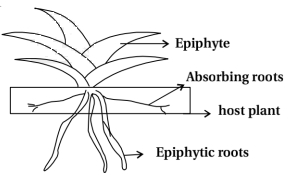
What is commensalism?
Solution
Commensalism is a type of population interaction in which one species benefits and the other species is neither harmed nor benefited.
In this interaction,the species that benefits is called the commensal,while the other species remains unaffected.
For example,an orchid growing as an epiphyte on the branches of a mango tree benefits by getting support and exposure to light,while the mango tree is neither harmed nor benefited by the presence of the orchid.
In this interaction,the species that benefits is called the commensal,while the other species remains unaffected.
For example,an orchid growing as an epiphyte on the branches of a mango tree benefits by getting support and exposure to light,while the mango tree is neither harmed nor benefited by the presence of the orchid.
0 likes
View Solution127
EasyMCQ
Name the association in which one species produces a poisonous substance or a change in environmental conditions that is harmful to another species.
A
Amensalism
B
Commensalism
C
Mutualism
D
Parasitism
Solution
(A) The interaction is known as $Amensalism$. It is also referred to as $Antibiosis$.
In this interaction,one species produces a chemical substance or alters environmental conditions that are harmful to another species,while the first species remains unaffected.
For example,$Penicillium$ $notatum$ (a blue mold) secretes $Penicillin$,an antibiotic that kills bacteria.
The adversely affected species is called the $amensal$,while the species that causes the harm is called the $inhibitor$.
In the case of $Penicillium$ and bacteria,the bacteria are harmed,while the fungus remains unaffected. The fungus can survive regardless of the presence or absence of the bacteria.
In this interaction,one species produces a chemical substance or alters environmental conditions that are harmful to another species,while the first species remains unaffected.
For example,$Penicillium$ $notatum$ (a blue mold) secretes $Penicillin$,an antibiotic that kills bacteria.
The adversely affected species is called the $amensal$,while the species that causes the harm is called the $inhibitor$.
In the case of $Penicillium$ and bacteria,the bacteria are harmed,while the fungus remains unaffected. The fungus can survive regardless of the presence or absence of the bacteria.
0 likes
View Solution128
EasyMCQ
What are the organisms that feed on plant sap and other plant parts called?
A
Carnivores
B
Phytophagous
C
Detritivores
D
Omnivores
Solution
(B) Organisms that feed on plant sap and other plant parts are known as $Phytophagous$ organisms.
These organisms derive their nutrition directly from plant tissues or fluids.
Examples include aphids,which feed on plant sap,and various insects that consume leaves or stems.
These organisms derive their nutrition directly from plant tissues or fluids.
Examples include aphids,which feed on plant sap,and various insects that consume leaves or stems.
0 likes
View Solution129
Medium
Give a suitable example for commensalism.
Solution
(N/A) Commensalism is a type of population interaction in which one species benefits and the other is neither harmed nor benefited.
An example of commensalism is the association between cattle egrets and grazing cattle.
The cattle egret always forages close to where the cattle are grazing because the cattle,as they move,flush out insects from the vegetation that otherwise might be difficult for the egrets to find and catch.
In this interaction,the cattle egret benefits by getting food,while the cattle are neither harmed nor benefited.
An example of commensalism is the association between cattle egrets and grazing cattle.
The cattle egret always forages close to where the cattle are grazing because the cattle,as they move,flush out insects from the vegetation that otherwise might be difficult for the egrets to find and catch.
In this interaction,the cattle egret benefits by getting food,while the cattle are neither harmed nor benefited.
0 likes
View Solution130
Easy
Define ectoparasite and endoparasite and give suitable examples.
Solution
(N/A) Ectoparasites are organisms that live on the external surface of the host body and derive nutrients from it.
Examples of ectoparasites include lice on humans and ticks on dogs.
Endoparasites are organisms that live inside the host body at various sites such as the liver,kidney,lungs,or within red blood cells.
An example of an endoparasite is the human liver fluke (a trematode parasite).
Examples of ectoparasites include lice on humans and ticks on dogs.
Endoparasites are organisms that live inside the host body at various sites such as the liver,kidney,lungs,or within red blood cells.
An example of an endoparasite is the human liver fluke (a trematode parasite).
0 likes
View Solution131
Easy
What is brood parasitism? Explain with the help of an example.
Solution
(N/A) Brood parasitism is a type of parasitism in which a parasitic bird lays its eggs in the nest of a host bird,allowing the host to incubate and raise the parasitic offspring.
$\Rightarrow$ Example: The common cuckoo ($Cuculus$ $canorus$) is a classic example of a brood parasite. It lays its eggs in the nest of a crow ($Corvus$ $splendens$).
$\Rightarrow$ During the course of evolution,the eggs of the parasitic bird have evolved to resemble the host's eggs in size and color. This adaptation reduces the chances of the host bird detecting the foreign eggs and ejecting them from the nest.
$\Rightarrow$ Example: The common cuckoo ($Cuculus$ $canorus$) is a classic example of a brood parasite. It lays its eggs in the nest of a crow ($Corvus$ $splendens$).
$\Rightarrow$ During the course of evolution,the eggs of the parasitic bird have evolved to resemble the host's eggs in size and color. This adaptation reduces the chances of the host bird detecting the foreign eggs and ejecting them from the nest.
0 likes
View Solution132
EasyMCQ
In an association of two animal species,one is a termite which feeds on wood and the other is a protozoan $Trichonympha$ present in the gut of the termite. What type of association do they establish?
A
Commensalism
B
Mutualism
C
Parasitism
D
Amensalism
Solution
(B) The association between the termite and the protozoan $Trichonympha$ is an example of mutualism.
$Trichonympha$ (a flagellated protozoan) resides in the gut of the termite,where it receives a protected environment and a constant supply of food.
In return,$Trichonympha$ secretes enzymes (cellulases) that help the termite digest the cellulose present in the wood it consumes.
Since both species benefit from this interaction,it is classified as mutualism.
$Trichonympha$ (a flagellated protozoan) resides in the gut of the termite,where it receives a protected environment and a constant supply of food.
In return,$Trichonympha$ secretes enzymes (cellulases) that help the termite digest the cellulose present in the wood it consumes.
Since both species benefit from this interaction,it is classified as mutualism.
0 likes
View Solution133
Easy
Lianas are vascular plants rooted in the ground and maintain erectness of their stem by making use of other trees for support. They do not maintain direct physiological relation with those trees. Discuss the type of association the lianas have with the trees.
Solution
(N/A) The association between lianas and the trees they use for support is known as $Commensalism$.
In this type of interaction,one species benefits while the other remains unaffected.
Lianas benefit by gaining structural support to reach sunlight,which is essential for their growth and photosynthesis.
The host trees are neither harmed nor benefited by the presence of the lianas,as the lianas do not derive nutrients or water from the host trees.
In this type of interaction,one species benefits while the other remains unaffected.
Lianas benefit by gaining structural support to reach sunlight,which is essential for their growth and photosynthesis.
The host trees are neither harmed nor benefited by the presence of the lianas,as the lianas do not derive nutrients or water from the host trees.
0 likes
View Solution134
Medium
Give one example for each of the following types:
$(a)$ Migratory animal
$(b)$ Camouflaged animal
$(c)$ Predator animal
$(d)$ Biological control agent
$(e)$ Phytophagous animal
$(f)$ Chemical defense agent
$(a)$ Migratory animal
$(b)$ Camouflaged animal
$(c)$ Predator animal
$(d)$ Biological control agent
$(e)$ Phytophagous animal
$(f)$ Chemical defense agent
Solution
(N/A) Migratory animal: Siberian Crane.
$(b)$ Camouflaged animal: Chameleon.
$(c)$ Predator animal: Tiger.
$(d)$ Biological control agent: Gambusia fish (used to control mosquito larvae).
$(e)$ Phytophagous animal: Locust.
$(f)$ Chemical defense agent: Cardiac glycosides produced by Calotropis.
$(b)$ Camouflaged animal: Chameleon.
$(c)$ Predator animal: Tiger.
$(d)$ Biological control agent: Gambusia fish (used to control mosquito larvae).
$(e)$ Phytophagous animal: Locust.
$(f)$ Chemical defense agent: Cardiac glycosides produced by Calotropis.
0 likes
View Solution135
Medium
Fill in the blanks:
| Species $A$ | Species $B$ | Type of Interaction | Example |
|---|---|---|---|
| $+$ | $-$ | $(a)$ | $(b)$ |
| $+$ | $+$ | $(c)$ | $(d)$ |
| $+$ | $(e)$ | Commensalism | $(f)$ |
Solution
(A) Parasitism: In this interaction,one species benefits $(+)$ while the other is harmed $(-)$.
$(b)$ Cuscuta: It is a parasitic plant that derives nutrition from the host plant.
$(c)$ Mutualism: In this interaction,both species benefit $(+)$.
$(d)$ Lichen: It represents a mutualistic relationship between algae and fungi.
$(e)$ $0$: In commensalism,one species benefits $(+)$ and the other is neither harmed nor benefited $(0)$.
$(f)$ Orchid on mango branch: The orchid (epiphyte) gets support,while the mango tree is unaffected.
$(b)$ Cuscuta: It is a parasitic plant that derives nutrition from the host plant.
$(c)$ Mutualism: In this interaction,both species benefit $(+)$.
$(d)$ Lichen: It represents a mutualistic relationship between algae and fungi.
$(e)$ $0$: In commensalism,one species benefits $(+)$ and the other is neither harmed nor benefited $(0)$.
$(f)$ Orchid on mango branch: The orchid (epiphyte) gets support,while the mango tree is unaffected.
0 likes
View Solution136
Easy
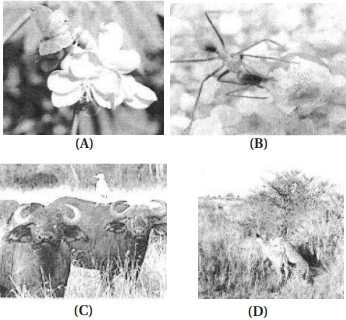
Observe the set of $4$ figures $A$,$B$,$C$ and $D$ and answer the following questions:
$(i)$ Which one of the figures shows mutualism?
$(ii)$ What kind of association is shown in $D$?
$(iii)$ Name the organisms and the association in $C$.
$(iv)$ What role is the insect performing in $B$?
$(i)$ Which one of the figures shows mutualism?
$(ii)$ What kind of association is shown in $D$?
$(iii)$ Name the organisms and the association in $C$.
$(iv)$ What role is the insect performing in $B$?
Solution
(N/A) $(i)$ Figure $A$ shows mutualism (plant and pollinator insect).
$(ii)$ Figure $D$ shows predation (leopard killing and eating a deer).
$(iii)$ Figure $C$ shows commensalism (cattle egret and grazing cattle).
$(iv)$ In figure $B$,the insect is performing phytophagy (feeding on the plant sap/nectar).
$(ii)$ Figure $D$ shows predation (leopard killing and eating a deer).
$(iii)$ Figure $C$ shows commensalism (cattle egret and grazing cattle).
$(iv)$ In figure $B$,the insect is performing phytophagy (feeding on the plant sap/nectar).
0 likes
View Solution137
Easy
Discuss the various types of positive interactions between species.
Solution
(N/A) Positive interactions are those in which at least one species benefits and none are harmed. These are primarily categorized into two types:
$1$. Mutualism: In this interaction,both participating species benefit from each other.
Examples include:
- Lichens: $A$ symbiotic association between algae and fungi.
- Mycorrhizae: $A$ symbiotic association between fungi and the roots of higher plants (e.g.,$Pinus$ roots).
$2$. Commensalism: This is an interaction where one species benefits,while the other is neither benefited nor harmed.
Examples include:
- An orchid growing as an epiphyte on the branch of a tree.
- Barnacles growing on the back of a whale.
Summary of Positive Population Interactions:
$1$. Mutualism: In this interaction,both participating species benefit from each other.
Examples include:
- Lichens: $A$ symbiotic association between algae and fungi.
- Mycorrhizae: $A$ symbiotic association between fungi and the roots of higher plants (e.g.,$Pinus$ roots).
$2$. Commensalism: This is an interaction where one species benefits,while the other is neither benefited nor harmed.
Examples include:
- An orchid growing as an epiphyte on the branch of a tree.
- Barnacles growing on the back of a whale.
Summary of Positive Population Interactions:
| Species $A$ | Species $B$ | Nature of Interaction |
| $+$ | $+$ | Mutualism |
| $+$ | $0$ | Commensalism |
0 likes
View Solution138
Medium
In an aquarium,two herbivorous species of fish are living together and feeding on phytoplanktons. As per the Gause's Principle,one of the species is to be eliminated in due course of time,but both are surviving well in the aquarium. Give possible reasons.
Solution
(N/A) According to Gause's Competitive Exclusion Principle,two closely related species competing for the same resources cannot coexist indefinitely,and the competitively inferior one will eventually be eliminated.
However,in the given scenario,both species are surviving. Possible reasons include:
$1$. Resource Partitioning: The species may have evolved mechanisms to feed at different times of the day or at different depths of the aquarium,thereby reducing direct competition.
$2$. Abundance of Resources: If the supply of phytoplanktons is abundant and exceeds the combined demand of both fish populations,competition is minimized,allowing coexistence.
$3$. Niche Differentiation: Each species may occupy a slightly different ecological niche,even if they share the same food source,which prevents total competitive exclusion.
However,in the given scenario,both species are surviving. Possible reasons include:
$1$. Resource Partitioning: The species may have evolved mechanisms to feed at different times of the day or at different depths of the aquarium,thereby reducing direct competition.
$2$. Abundance of Resources: If the supply of phytoplanktons is abundant and exceeds the combined demand of both fish populations,competition is minimized,allowing coexistence.
$3$. Niche Differentiation: Each species may occupy a slightly different ecological niche,even if they share the same food source,which prevents total competitive exclusion.
0 likes
View Solution139
Medium
While living in and on the host species, the animal parasite has evolved certain adaptations. Describe these adaptations with examples.
Solution
(N/A) In accordance with their lifestyles, parasites have evolved special adaptations to survive within or on their hosts.
$1$. Loss of unnecessary sense organs: Since parasites live in a stable environment within the host, they often lose complex sensory organs that are not required.
$2$. Presence of adhesive organs or suckers: These structures help the parasite to cling firmly to the host. For example, $Taenia$ (tapeworm) possesses suckers and hooks for attachment.
$3$. Loss of digestive system: Many endoparasites, such as the $tapeworm$, absorb nutrients directly from the host's body through their body surface, leading to the reduction or loss of a complex digestive system.
$4$. High reproductive capacity: To ensure the survival of the species despite the high mortality rate of offspring, parasites often exhibit an extremely high reproductive capacity. For example, $Ascaris$ (roundworm) produces a massive number of eggs.
$5$. Complex life cycles: The life cycles of many parasites are complex, often involving one or two intermediate hosts or vectors to facilitate the infection of the primary host.
$1$. Loss of unnecessary sense organs: Since parasites live in a stable environment within the host, they often lose complex sensory organs that are not required.
$2$. Presence of adhesive organs or suckers: These structures help the parasite to cling firmly to the host. For example, $Taenia$ (tapeworm) possesses suckers and hooks for attachment.
$3$. Loss of digestive system: Many endoparasites, such as the $tapeworm$, absorb nutrients directly from the host's body through their body surface, leading to the reduction or loss of a complex digestive system.
$4$. High reproductive capacity: To ensure the survival of the species despite the high mortality rate of offspring, parasites often exhibit an extremely high reproductive capacity. For example, $Ascaris$ (roundworm) produces a massive number of eggs.
$5$. Complex life cycles: The life cycles of many parasites are complex, often involving one or two intermediate hosts or vectors to facilitate the infection of the primary host.
0 likes
View Solution140
EasyMCQ
Explain commensalism with the example of an egret and cattle.
A
Commensalism is a type of interaction where one species benefits and the other is harmed.
B
Commensalism is a type of interaction where both species benefit.
C
Commensalism is a type of interaction where one species benefits and the other is neither harmed nor benefited.
D
Commensalism is a type of interaction where one species is harmed and the other is neither harmed nor benefited.
Solution
(C) Commensalism is an interaction between two species where one species benefits and the other remains unaffected (neither harmed nor benefited).
In the case of cattle egrets and grazing cattle,the egret benefits because the cattle,while grazing,stir up and flush out insects from the vegetation that might otherwise be difficult for the egrets to find and catch.
The cattle are not significantly affected by the presence of the egrets,making this a classic example of commensalism.
In the case of cattle egrets and grazing cattle,the egret benefits because the cattle,while grazing,stir up and flush out insects from the vegetation that might otherwise be difficult for the egrets to find and catch.
The cattle are not significantly affected by the presence of the egrets,making this a classic example of commensalism.
0 likes
View Solution141
MediumMCQ
Why can the moth and the $Yucca$ plant not complete their life cycles without each other?
A
They share a mutualistic relationship where the moth provides pollination and the plant provides a site for egg-laying.
B
The moth is the only predator of the $Yucca$ plant.
C
The $Yucca$ plant provides nutrients directly to the adult moth.
D
The moth feeds on the leaves of the $Yucca$ plant.
Solution
(A) specific mutualistic relationship exists between the moth and the $Yucca$ plant,where both species cannot complete their life cycles without each other.
The moth deposits its eggs in the locule of the ovary of the $Yucca$ flower,and in return,the flower gets pollinated by the moth.
The larvae of the moth come out of the eggs only when the seeds start to develop.
The moth deposits its eggs in the locule of the ovary of the $Yucca$ flower,and in return,the flower gets pollinated by the moth.
The larvae of the moth come out of the eggs only when the seeds start to develop.
0 likes
View Solution142
MediumMCQ
Select the appropriate option for the relationship between $Yucca$ and the moth.
A
Parasitism
B
Mutualism
C
Commensalism
D
Independent life cycle
Solution
(B) The relationship between $Yucca$ plant and its pollinator moth is an example of $Mutualism$ (or $Obligate$ $Mutualism$).
In this relationship,the moth deposits its eggs in the locule of the $Yucca$ ovary,and in return,the moth pollinates the $Yucca$ flower.
Neither the plant nor the moth can complete their life cycles without each other,as the moth larvae feed on the developing seeds while the plant relies on the moth for pollination.
In this relationship,the moth deposits its eggs in the locule of the $Yucca$ ovary,and in return,the moth pollinates the $Yucca$ flower.
Neither the plant nor the moth can complete their life cycles without each other,as the moth larvae feed on the developing seeds while the plant relies on the moth for pollination.
0 likes
View Solution143
MediumMCQ
The interaction between an orchid and a mango tree represents which of the following?
A
Commensalism
B
Mutualism
C
Parasitism
D
Symbiosis
Solution
(A) The interaction between an orchid (an epiphyte) and a mango tree is an example of $Commensalism$.
In this interaction, the orchid grows on the branches of the mango tree to get better access to sunlight and moisture.
The orchid benefits from this association by getting support, while the mango tree is neither harmed nor benefited.
Therefore, this is a $+/0$ interaction, which is defined as $Commensalism$.
In this interaction, the orchid grows on the branches of the mango tree to get better access to sunlight and moisture.
The orchid benefits from this association by getting support, while the mango tree is neither harmed nor benefited.
Therefore, this is a $+/0$ interaction, which is defined as $Commensalism$.
0 likes
View Solution144
MediumMCQ
Which of the following interactions is represented by the $(-, +)$ relationship between species $A$ and species $B$ respectively?
A
Mutualism
B
Predation
C
Commensalism
D
Amensalism
Solution
(B) In ecological interactions, the $(-, +)$ relationship indicates that species $A$ is harmed $(-)$ and species $B$ is benefited $(+)$.
This specific interaction is known as $Predation$ or $Parasitism$.
In $Predation$, the predator benefits $(+)$ while the prey is harmed $(-)$.
In $Parasitism$, the parasite benefits $(+)$ while the host is harmed $(-)$.
Among the given options, $Predation$ fits the $(-, +)$ interaction model.
This specific interaction is known as $Predation$ or $Parasitism$.
In $Predation$, the predator benefits $(+)$ while the prey is harmed $(-)$.
In $Parasitism$, the parasite benefits $(+)$ while the host is harmed $(-)$.
Among the given options, $Predation$ fits the $(-, +)$ interaction model.
0 likes
View Solution145
MediumMCQ
In biological interactions,what does the interaction type $(+, 0)$ represent?
A
Mutualism
B
Amensalism
C
Commensalism
D
Predation
Solution
(C) In population interactions,the symbol $(+, 0)$ indicates that one species benefits $(+)$ while the other species is neither harmed nor benefited $(0)$. This type of interaction is known as Commensalism. In this relationship,one organism gains an advantage,while the other remains unaffected.
0 likes
View Solution146
MediumMCQ
Amensalism represents which of the following interactions?
A
$(+,+)$
B
$(-,-)$
C
$(+,0)$
D
$(-,0)$
Solution
(D) Amensalism is a type of population interaction between two species where one species is harmed $((-))$ and the other species remains unaffected $((0))$.
Therefore,the interaction is represented as $(- , 0)$.
Therefore,the interaction is represented as $(- , 0)$.
0 likes
View Solution147
MediumMCQ
Which of the following interactions results in a negative effect (harm) for both interacting species?
A
Mutualism
B
Competition
C
Predation
D
Parasitism
Solution
(B) In biological population interactions,the effect on species is denoted as '+' for benefit,'-' for harm,and '$0$' for no effect.
$1$. Mutualism $(+, +)$: Both species benefit.
$2$. Competition $(-, -)$: Both species are harmed because they compete for the same limited resources.
$3$. Predation $(+, -)$: The predator benefits,while the prey is harmed.
$4$. Parasitism $(+, -)$: The parasite benefits,while the host is harmed.
Therefore,competition is the interaction where both species suffer a negative effect.
$1$. Mutualism $(+, +)$: Both species benefit.
$2$. Competition $(-, -)$: Both species are harmed because they compete for the same limited resources.
$3$. Predation $(+, -)$: The predator benefits,while the prey is harmed.
$4$. Parasitism $(+, -)$: The parasite benefits,while the host is harmed.
Therefore,competition is the interaction where both species suffer a negative effect.
0 likes
View Solution148
DifficultMCQ
Herbivores,which are an integral part of the ecosystem's food chain,can be ecologically considered as:
A
Organisms showing mutualism
B
Predators
C
Organisms showing competition
D
Cannot be classified
Solution
(B) In ecology,a predator is defined as an organism that consumes another living organism (the prey) for energy. Since herbivores consume plants (which are living organisms) to obtain energy,they are ecologically classified as predators. This is because the interaction between a herbivore and a plant is a form of predation,where the herbivore acts as the predator and the plant acts as the prey.
0 likes
View Solution149
MediumMCQ
Which of the following is most commonly cited as a predator?
A
Australian Acacia
B
Prickly pear cactus
C
Pisaster starfish
D
None of these
Solution
(C) In ecological studies,the $Pisaster$ starfish is a classic example used to demonstrate the importance of predation in maintaining species diversity. In the rocky intertidal communities of the American Pacific Coast,the $Pisaster$ starfish acts as a keystone predator. When it was experimentally removed from an enclosed intertidal area,more than $10$ species of invertebrates became extinct within a year due to interspecific competition. Thus,it is most commonly cited as a predator that regulates prey populations and maintains community structure.
0 likes
View Solution150
MediumMCQ
What is the primary role of predators in an ecosystem?
A
To maintain ecological balance in the ecosystem.
B
To maintain biodiversity by reducing competition among prey species.
C
To increase the intensity of interspecific competition.
D
To promote the growth of local species through excessive predation.
Solution
(B) Predators play a crucial role in maintaining ecological balance. They act as conduits for energy transfer across trophic levels. Furthermore,they help maintain species diversity in a community by reducing the intensity of competition among competing prey species. For example,in the rocky intertidal communities of the American Pacific Coast,the starfish $Pisaster$ is an important predator. In a field experiment,when all the starfish were removed from an enclosed intertidal area,more than $10$ species of invertebrates became extinct within a year,species of invertebrates became extinct because of interspecific competition.
0 likes
View SolutionOrganisms and Populations — Population Interactions · Frequently Asked Questions
1Are these Organisms and Populations questions useful for JEE and NEET?
Yes. All questions in this section are mapped to JEE Main and NEET exam patterns. Previous year questions from JEE Main, NEET, GUJCET and state-level exams are included with full solutions.
2Can I switch to Hindi or Gujarati for these questions?
Yes. Use the language tabs in the hero section or the sidebar to view the same questions and solutions in English, Hindi or Gujarati.
3How do I generate a question paper from this subtopic?
Use the Vedclass Exam Paper Generator — select the chapter and subtopic, set difficulty, and generate Sets A, B, C, D automatically. First 3 chapters of every subject are free.
Vedclass Products
For Students
Vedclass Test Series
Mock tests in real JEE/NEET style with performance analysis. 5-day free trial.
Start Free TrialFor Teachers
Exam Paper Generator
Generate Set A/B/C/D papers from this chapter in 2 minutes. 3 chapters free.
Try FreeFor Institutes
Online Exam Module
Live online exams with unlimited students, 360° analytics & white-label branding.
See DemoFor Teachers & Institutes
Generate a Organisms and Populations Exam Paper in 2 Minutes
Select subtopic & difficulty — Sets A, B, C, D auto-generated with No Repeat logic.
First 3 chapters of every subject are free — no payment required.