
A English
Mix Examples- Organisms and Populations Questions in English
Class 12 Biology · Organisms and Populations · Mix Examples- Organisms and Populations
36+
Questions
English
Language
100%
With Solutions
Showing 36 of 36 questions in English
1
MediumMCQ
The significance of the study of population is to understand:
A
The consequences of uncontrolled population only
B
The benefits of planned family
C
The population growth,distribution,and density
D
All of the above
Solution
(D) The study of population,often referred to as demography,is essential for understanding various aspects of human society.
It encompasses the analysis of population growth rates,which helps in predicting future trends.
It involves studying the distribution of people across different geographical areas.
It includes calculating population density to understand resource utilization.
Furthermore,it helps in evaluating the consequences of uncontrolled population growth and the benefits of implementing planned family strategies.
Therefore,all the mentioned aspects are significant components of population studies.
It encompasses the analysis of population growth rates,which helps in predicting future trends.
It involves studying the distribution of people across different geographical areas.
It includes calculating population density to understand resource utilization.
Furthermore,it helps in evaluating the consequences of uncontrolled population growth and the benefits of implementing planned family strategies.
Therefore,all the mentioned aspects are significant components of population studies.
0 likes
View Solution2
EasyMCQ
According to the $1991$ census,the maximum percentage of population increase was in which state?
A
Assam
B
Punjab
C
Nagaland
D
Goa
Solution
(C) According to the $1991$ census,Nagaland recorded the highest population growth rate of $56.86\%$.
In the $2001$ census,the growth rate for Nagaland was recorded at $64.41\%.$
In the $2001$ census,the growth rate for Nagaland was recorded at $64.41\%.$
0 likes
View Solution3
MediumMCQ
Which of the following is an omnivore?
A
Frog
B
Lion
C
Deer
D
Human
Solution
(D) An omnivore is an organism that consumes both plants and animals as its primary food source.
$A$. Frog: Carnivore (insectivore).
$B$. Lion: Carnivore.
$C$. Deer: Herbivore.
$D$. Human: Omnivore,as humans consume both plant-based foods and animal products.
$A$. Frog: Carnivore (insectivore).
$B$. Lion: Carnivore.
$C$. Deer: Herbivore.
$D$. Human: Omnivore,as humans consume both plant-based foods and animal products.
0 likes
View Solution4
MediumMCQ
Which of the following levels is not conceptual in terms of size?
A
Landscape
B
Populations
C
Organ systems
D
Community
Solution
(C) In biological organization, levels are categorized based on their physical existence and scale.
$Organ$ $systems$ are physical, tangible biological entities composed of organs working together within an organism.
In contrast, $Landscape$, $Populations$, and $Community$ are ecological levels that are often considered conceptual or abstract constructs used to describe interactions and distributions over space and time, rather than discrete physical objects with a fixed size like an organ system.
$Organ$ $systems$ are physical, tangible biological entities composed of organs working together within an organism.
In contrast, $Landscape$, $Populations$, and $Community$ are ecological levels that are often considered conceptual or abstract constructs used to describe interactions and distributions over space and time, rather than discrete physical objects with a fixed size like an organ system.
0 likes
View Solution5
MediumMCQ
Death is important because it ......
A
Kills living organisms.
B
Makes living elements recyclable.
C
Controls population growth.
D
Both $(B)$ and $(C)$.
Solution
(D) Death is a natural process that plays a crucial role in the ecosystem.
$1$. It ensures the recycling of nutrients by breaking down organic matter into simpler forms,making elements available for other living organisms.
$2$. It also helps in maintaining ecological balance by regulating the population size of various species within a habitat.
Therefore,both statements $(B)$ and $(C)$ are correct.
$1$. It ensures the recycling of nutrients by breaking down organic matter into simpler forms,making elements available for other living organisms.
$2$. It also helps in maintaining ecological balance by regulating the population size of various species within a habitat.
Therefore,both statements $(B)$ and $(C)$ are correct.
0 likes
View Solution6
EasyMCQ
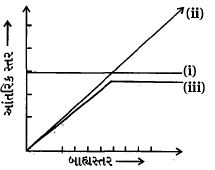
The figure given below is a diagrammatic representation of the response of organisms to abiotic factors. What do $(i)$,$(ii)$ and $(iii)$ represent respectively?
A
$(i)$-regulator,$(ii)$-conformer,$(iii)$-partial regulator
B
$(i)$-regulator,$(ii)$-partial regulator,$(iii)$-conformer
C
$(i)$-partial regulator,$(ii)$-regulator,$(iii)$-conformer
D
$(i)$-conformer,$(ii)$-regulator,$(iii)$-partial regulator
Solution
(A) The correct answer is $(A)$.
$(i)$ Represents a regulator: These organisms maintain a constant internal environment (homeostasis) despite changes in the external environment.
$(ii)$ Represents a conformer: These organisms cannot maintain a constant internal environment; their internal body conditions change in direct proportion to the external environmental conditions.
$(iii)$ Represents a partial regulator: These organisms can regulate their internal environment only over a limited range of environmental conditions,beyond which they act as conformers.
$(i)$ Represents a regulator: These organisms maintain a constant internal environment (homeostasis) despite changes in the external environment.
$(ii)$ Represents a conformer: These organisms cannot maintain a constant internal environment; their internal body conditions change in direct proportion to the external environmental conditions.
$(iii)$ Represents a partial regulator: These organisms can regulate their internal environment only over a limited range of environmental conditions,beyond which they act as conformers.
0 likes
View Solution7
MediumMCQ
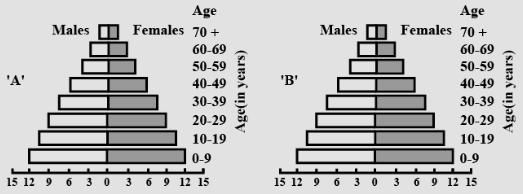
$A$ country with a high rate of population growth took measures to reduce it. The figure below shows age-sex pyramids of populations $A$ and $B$ twenty years apart. Select the correct interpretation about them.
A
$B$ is the earlier pyramid and shows a stabilized growth rate.
B
$B$ is more recent,showing that the population is very young.
C
$A$ is the earlier pyramid and no change has occurred in the growth rate.
D
$A$ is more recent and shows a slight reduction in the growth rate.
Solution
(D) The correct answer is $D$.
$1$. An age-sex pyramid with a broad base indicates a rapidly growing population,as it shows a high proportion of individuals in the pre-reproductive age group ($0-9$ years).
$2$. Comparing the two pyramids,pyramid $B$ has a wider base compared to pyramid $A$. This indicates that pyramid $B$ represents the population twenty years ago (the earlier state) when the growth rate was higher.
$3$. Pyramid $A$ has a relatively narrower base compared to $B$,indicating a reduction in the proportion of the youngest age group. This reflects the impact of measures taken to reduce population growth over the twenty-year period.
$4$. Therefore,$A$ is the more recent pyramid,and it shows a slight reduction in the growth rate compared to $B$.
$1$. An age-sex pyramid with a broad base indicates a rapidly growing population,as it shows a high proportion of individuals in the pre-reproductive age group ($0-9$ years).
$2$. Comparing the two pyramids,pyramid $B$ has a wider base compared to pyramid $A$. This indicates that pyramid $B$ represents the population twenty years ago (the earlier state) when the growth rate was higher.
$3$. Pyramid $A$ has a relatively narrower base compared to $B$,indicating a reduction in the proportion of the youngest age group. This reflects the impact of measures taken to reduce population growth over the twenty-year period.
$4$. Therefore,$A$ is the more recent pyramid,and it shows a slight reduction in the growth rate compared to $B$.
0 likes
View Solution8
MediumMCQ
Match the following and select the correct option.
| $A.$ Earthworm | $(i)$ Pioneer species |
| $B.$ Succession | $(ii)$ Detritivore |
| $C.$ Ecosystem service | $(iii)$ Natality |
| $D.$ Population growth | $(iv)$ Pollination |
A
$A-(i), B-(ii), C-(iii), D-(iv)$
B
$A-(iv), B-(i), C-(iii), D-(ii)$
C
$A-(iii), B-(ii), C-(iv), D-(i)$
D
$A-(ii), B-(i), C-(iv), D-(iii)$
Solution
(D) The correct matching is as follows:
$A.$ Earthworm is a detritivore, as it feeds on decaying organic matter $(A-ii)$.
$B.$ Succession is the process of development of a community, and pioneer species are the first organisms to colonize a barren area $(B-i)$.
$C.$ Ecosystem service refers to the benefits humans obtain from ecosystems, such as pollination $(C-iv)$.
$D.$ Population growth is characterized by factors like natality (birth rate) and mortality (death rate) $(D-iii)$.
Therefore, the correct sequence is $A-ii, B-i, C-iv, D-iii$.
$A.$ Earthworm is a detritivore, as it feeds on decaying organic matter $(A-ii)$.
$B.$ Succession is the process of development of a community, and pioneer species are the first organisms to colonize a barren area $(B-i)$.
$C.$ Ecosystem service refers to the benefits humans obtain from ecosystems, such as pollination $(C-iv)$.
$D.$ Population growth is characterized by factors like natality (birth rate) and mortality (death rate) $(D-iii)$.
Therefore, the correct sequence is $A-ii, B-i, C-iv, D-iii$.
0 likes
View Solution9
MediumMCQ
Consider the following statements $(A-D)$ each with one or two blanks.
$(A)$ Bears go into $ . . . . . . (1) . . . . . . $ during winter to $ . . . . . . (2) . . . . . . $ cold weather.
$(B)$ $A$ conical age pyramid with a broad base represents $ . . . . . . (3) . . . . . . $ human population.
$(C)$ $A$ wasp pollinating a fig flower is an example of $ . . . . . . (4) . . . . . . $.
$(D)$ An area with high levels of species richness is known as $ . . . . . . (5) . . . . . . $.
Which one of the following options gives the correct fill-ups for the respective blank numbers from $(1)$ to $(5)$ in the statements?
$(A)$ Bears go into $ . . . . . . (1) . . . . . . $ during winter to $ . . . . . . (2) . . . . . . $ cold weather.
$(B)$ $A$ conical age pyramid with a broad base represents $ . . . . . . (3) . . . . . . $ human population.
$(C)$ $A$ wasp pollinating a fig flower is an example of $ . . . . . . (4) . . . . . . $.
$(D)$ An area with high levels of species richness is known as $ . . . . . . (5) . . . . . . $.
Which one of the following options gives the correct fill-ups for the respective blank numbers from $(1)$ to $(5)$ in the statements?
A
$(3) - \text{stable}, (4) - \text{commensalism}, (5) - \text{marsh}$
B
$(1) - \text{aestivation}, (2) - \text{escape}, (3) - \text{stable}, (4) - \text{mutualism}$
C
$(3) - \text{expanding}, (4) - \text{commensalism}, (5) - \text{biodiversity park}$
D
$(1) - \text{hibernation}, (2) - \text{escape}, (3) - \text{expanding}, (5) - \text{hotspot}$
Solution
(D) The correct sequence is:
$(1)$ Bears undergo $hibernation$ (winter sleep) to escape the harsh cold weather.
$(2)$ The term used is $escape$.
$(3)$ $A$ conical age pyramid with a broad base indicates a large number of young individuals, which represents an $expanding$ population.
$(4)$ $A$ wasp pollinating a fig flower is a classic example of $mutualism$ (obligate relationship).
$(5)$ An area with high levels of species richness and high degree of endemism is known as a $biodiversity hotspot$.
Therefore, option $(D)$ is the correct choice.
$(1)$ Bears undergo $hibernation$ (winter sleep) to escape the harsh cold weather.
$(2)$ The term used is $escape$.
$(3)$ $A$ conical age pyramid with a broad base indicates a large number of young individuals, which represents an $expanding$ population.
$(4)$ $A$ wasp pollinating a fig flower is a classic example of $mutualism$ (obligate relationship).
$(5)$ An area with high levels of species richness and high degree of endemism is known as a $biodiversity hotspot$.
Therefore, option $(D)$ is the correct choice.
0 likes
View Solution10
MediumMCQ
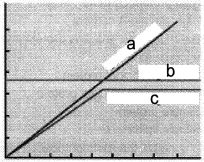
The figure given below is a diagrammatic representation of the response of organisms to abiotic factors. What do $(a)$,$(b)$,and $(c)$ represent respectively?
$(a)$ $(b)$ $(c)$
$(a)$ $(b)$ $(c)$
A
Regulator,Partial regulator,Conformer
B
Partial regulator,Regulator,Conformer
C
Regulator,Conformer,Partial regulator
D
Conformer,Regulator,Partial regulator
Solution
(D) In the diagrammatic representation of the response of organisms to abiotic factors:
- $(a)$ represents a 'Conformer',as the internal body environment changes in direct proportion to the external abiotic environment.
- $(b)$ represents a 'Regulator',as the organism maintains a constant internal environment despite changes in the external environment.
- $(c)$ represents a 'Partial regulator',as the organism can regulate its internal environment only up to a certain limit,after which it conforms to the external environment.
- $(a)$ represents a 'Conformer',as the internal body environment changes in direct proportion to the external abiotic environment.
- $(b)$ represents a 'Regulator',as the organism maintains a constant internal environment despite changes in the external environment.
- $(c)$ represents a 'Partial regulator',as the organism can regulate its internal environment only up to a certain limit,after which it conforms to the external environment.
0 likes
View Solution11
MediumMCQ
$X$ - In deep-sea hydrothermal vents,the average temperature is between $25^{\circ}C$ to $30^{\circ}C$.
$Y$ - Reptiles and amphibians are eurythermal.
$Y$ - Reptiles and amphibians are eurythermal.
A
$X-Y$ correct
B
$X-Y$ incorrect
C
$X$ - correct,$Y$ - incorrect
D
$X$ - incorrect,$Y$ - correct
Solution
(B) Statement $X$ is incorrect because deep-sea hydrothermal vents are characterized by extremely high temperatures,often exceeding $300^{\circ}C$ to $400^{\circ}C$,not $25^{\circ}C$ to $30^{\circ}C$.
Statement $Y$ is incorrect because reptiles and amphibians are ectotherms and are generally stenothermal,meaning they can only tolerate a narrow range of temperatures. Eurythermal organisms are those that can tolerate a wide range of temperatures.
Statement $Y$ is incorrect because reptiles and amphibians are ectotherms and are generally stenothermal,meaning they can only tolerate a narrow range of temperatures. Eurythermal organisms are those that can tolerate a wide range of temperatures.
0 likes
View Solution12
MediumMCQ
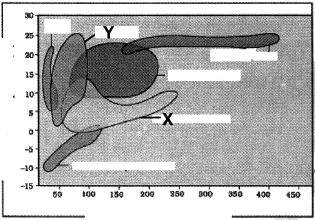
Identify $X$ and $Y$ in the given figure,which represents the biome distribution with respect to mean annual temperature and mean annual precipitation.
A
$X$ = temperate forest,$Y$ = tropical forest
B
$X$ = arctic and alpine tundra,$Y$ = desert
C
$X$ = coniferous forest,$Y$ = grassland
D
$X$ = tropical forest,$Y$ = coniferous forest
Solution
(A) The provided figure is a standard biome distribution graph based on mean annual temperature (y-axis) and mean annual precipitation (x-axis) as found in the $NCERT$ Biology textbook for Class $12$.
By analyzing the graph:
$1$. The region labeled $X$ corresponds to the 'temperate forest' biome,which typically has moderate temperature and precipitation levels.
$2$. The region labeled $Y$ corresponds to the 'tropical forest' biome,which is characterized by high mean annual temperature and high mean annual precipitation.
Therefore,the correct identification is $X$ = temperate forest and $Y$ = tropical forest.
By analyzing the graph:
$1$. The region labeled $X$ corresponds to the 'temperate forest' biome,which typically has moderate temperature and precipitation levels.
$2$. The region labeled $Y$ corresponds to the 'tropical forest' biome,which is characterized by high mean annual temperature and high mean annual precipitation.
Therefore,the correct identification is $X$ = temperate forest and $Y$ = tropical forest.
0 likes
View Solution13
MediumMCQ
Countries with high population growth rates have taken measures to reduce them. The figure below shows the age pyramids of populations. Which of the following is a correct interpretation for their status after $20$ years?
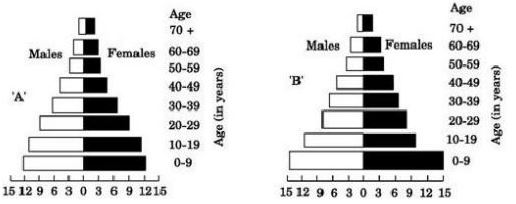
A
$A$ is more modern and shows a slight reduction in the growth rate.
B
$B$ is the earlier pyramid and shows stable growth.
C
$B$ is more modern and its population is very young.
D
$A$ is the earlier pyramid and there is no change in growth.
Solution
(A) In an age pyramid,a broad base indicates a high proportion of young individuals (pre-reproductive age),which signifies a rapidly growing population.
Pyramid $B$ has a very broad base compared to pyramid $A$,indicating that $B$ represents a population with a higher growth rate (an earlier stage of demographic transition).
Pyramid $A$ has a relatively narrower base,indicating a reduction in the proportion of young individuals,which suggests that the population is moving towards a more stable or slower growth rate (a more modern stage).
Therefore,$A$ represents a more modern population structure compared to $B$.
Pyramid $B$ has a very broad base compared to pyramid $A$,indicating that $B$ represents a population with a higher growth rate (an earlier stage of demographic transition).
Pyramid $A$ has a relatively narrower base,indicating a reduction in the proportion of young individuals,which suggests that the population is moving towards a more stable or slower growth rate (a more modern stage).
Therefore,$A$ represents a more modern population structure compared to $B$.
0 likes
View Solution14
MediumMCQ
The given diagram represents the response of organisms to abiotic factors. What do $i, ii,$ and $iii$ represent respectively?
| $i$ | $ii$ | $iii$ |
| $i$ | $ii$ | $iii$ |
A
Conformers,Regulators,Partial regulators
B
Regulators,Conformers,Partial regulators
C
Partial regulators,Regulators,Conformers
D
Regulators,Partial regulators,Conformers
Solution
(B) In the given graph:
$i$ represents 'Regulators' because they maintain a constant internal environment regardless of external changes.
$ii$ represents 'Conformers' because their internal body environment changes in direct proportion to the external environment.
$iii$ represents 'Partial regulators' because they can regulate their internal environment only up to a certain limit of external environmental conditions,beyond which they conform.
$i$ represents 'Regulators' because they maintain a constant internal environment regardless of external changes.
$ii$ represents 'Conformers' because their internal body environment changes in direct proportion to the external environment.
$iii$ represents 'Partial regulators' because they can regulate their internal environment only up to a certain limit of external environmental conditions,beyond which they conform.
0 likes
View Solution15
MediumMCQ
What type of human population is represented by the given age pyramid?
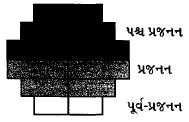
A
Declining population
B
Stable population
C
Expanding population
D
Extinct population
Solution
(A) The given age pyramid shows a narrow base of pre-reproductive individuals compared to the reproductive and post-reproductive age groups.
This shape indicates that the number of younger individuals is smaller than the number of older individuals.
Such a structure is characteristic of a declining population,where the birth rate is lower than the death rate.
This shape indicates that the number of younger individuals is smaller than the number of older individuals.
Such a structure is characteristic of a declining population,where the birth rate is lower than the death rate.
0 likes
View Solution16
MediumMCQ
The figure given below is a diagrammatic representation of the response of organisms to abiotic factors. What do $a$,$b$,and $c$ represent respectively?
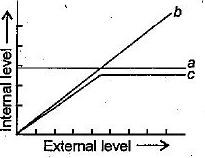
A
$a \to$ regulator,$b \to$ conformer,$c \to$ partial regulator
B
$a \to$ regulator,$b \to$ partial regulator,$c \to$ conformer
C
$a \to$ partial regulator,$b \to$ regulator,$c \to$ conformer
D
$a \to$ conformer,$b \to$ regulator,$c \to$ partial regulator
Solution
(A) In the provided graph,the $x$-axis represents the external level and the $y$-axis represents the internal level of organisms.
Line $a$ shows a constant internal level regardless of changes in the external level,which represents a regulator.
Line $b$ shows that the internal level changes in direct proportion to the external level,which represents a conformer.
Line $c$ shows that the organism can regulate its internal level only up to a certain point,after which it conforms to the external environment,representing a partial regulator.
Therefore,$a$ is a regulator,$b$ is a conformer,and $c$ is a partial regulator.
Line $a$ shows a constant internal level regardless of changes in the external level,which represents a regulator.
Line $b$ shows that the internal level changes in direct proportion to the external level,which represents a conformer.
Line $c$ shows that the organism can regulate its internal level only up to a certain point,after which it conforms to the external environment,representing a partial regulator.
Therefore,$a$ is a regulator,$b$ is a conformer,and $c$ is a partial regulator.
0 likes
View Solution17
Medium
Comment on the following figures: $I, II$ and $III$. Here,$A, B, C, D, G, P, Q, R, S$ represent different species.
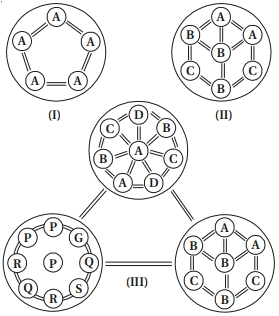
Solution
(N/A) Fig. $I$: It represents a single population where all individuals belong to the same species,i.e.,$A$. These individuals interact among themselves and with their environment,which is known as intraspecific interaction.
Fig. $II$: It represents a community containing three populations of species $A, B$ and $C$. These populations interact with each other and their environment,which is known as interspecific interaction.
Fig. $III$: It represents a biome. It consists of multiple communities (represented by the circles) that are in different stages of development or ecological succession. All these communities exist within the same environment and interact with each other and their surroundings.
Fig. $II$: It represents a community containing three populations of species $A, B$ and $C$. These populations interact with each other and their environment,which is known as interspecific interaction.
Fig. $III$: It represents a biome. It consists of multiple communities (represented by the circles) that are in different stages of development or ecological succession. All these communities exist within the same environment and interact with each other and their surroundings.
0 likes
View Solution18
Easy
Match the columns:
| Column-$I$ | Column-$II$ |
|---|---|
| $(a)$ Earthworm | $(i)$ Birth-rate |
| $(b)$ Succession | $(ii)$ Pioneer species |
| $(c)$ Population rise | $(iii)$ Pollination |
| $(d)$ Ecological services | $(iv)$ Saprotrophs |
Solution
(A-IV, B-II, C-I, D-III) The correct matches are as follows:
$(a)$ Earthworm is a saprotroph,which helps in the breakdown of detritus $(a-iv)$.
$(b)$ Succession involves pioneer species that colonize a barren area $(b-ii)$.
$(c)$ Population rise is directly influenced by the birth-rate $(c-i)$.
$(d)$ Ecological services include processes like pollination provided by ecosystems $(d-iii)$.
Therefore,the correct sequence is $(a-iv, b-ii, c-i, d-iii)$.
$(a)$ Earthworm is a saprotroph,which helps in the breakdown of detritus $(a-iv)$.
$(b)$ Succession involves pioneer species that colonize a barren area $(b-ii)$.
$(c)$ Population rise is directly influenced by the birth-rate $(c-i)$.
$(d)$ Ecological services include processes like pollination provided by ecosystems $(d-iii)$.
Therefore,the correct sequence is $(a-iv, b-ii, c-i, d-iii)$.
0 likes
View Solution19
MediumMCQ
Which process allows organisms to protect themselves during stressful environmental conditions?
A
Migration
B
Suspension (Dormancy)
C
Both $A$ and $B$
D
Migration of animals from Delhi to Shimla-Manali during summer
Solution
(C) Organisms respond to stressful environmental conditions through various mechanisms to maintain homeostasis.
$1$. Migration: Organisms move away temporarily from the stressful habitat to a more hospitable area and return when the stressful period is over (e.g.,birds migrating).
$2$. Suspension: Organisms develop thick-walled spores (in bacteria,fungi,and lower plants) or undergo dormancy/hibernation/aestivation (in animals) to survive unfavorable conditions.
Since both migration and suspension are strategies used by organisms to cope with stress,the correct answer is $A$ and $B$ both.
$1$. Migration: Organisms move away temporarily from the stressful habitat to a more hospitable area and return when the stressful period is over (e.g.,birds migrating).
$2$. Suspension: Organisms develop thick-walled spores (in bacteria,fungi,and lower plants) or undergo dormancy/hibernation/aestivation (in animals) to survive unfavorable conditions.
Since both migration and suspension are strategies used by organisms to cope with stress,the correct answer is $A$ and $B$ both.
0 likes
View Solution20
MediumMCQ
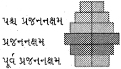
The given human population age pyramid represents..........
A
Expanding population
B
Stable population
C
Declining population
D
Growing population
Solution
(C) The age pyramid shown in the image has a narrow base,which indicates a smaller number of individuals in the pre-reproductive age group compared to the reproductive and post-reproductive age groups. This type of pyramid is characteristic of a declining population,where the birth rate is lower than the death rate,leading to a decrease in the overall population size over time.
0 likes
View Solution21
MediumMCQ
Which of the following parameters is not constant for any population?
A
Growth rate
B
Population size
C
Predation rate
D
Both $B$ and $C$
Solution
(D) Population attributes are characteristics that change over time due to various factors.
$1$. Population size (or density) is not a static parameter; it fluctuates due to changes in birth rates,death rates,immigration,and emigration.
$2$. Predation rate is also not constant as it depends on the availability of prey and the density of predators,which vary over time.
$3$. Growth rate is a derived parameter that depends on the aforementioned factors and is also dynamic.
Since both population size and predation rate are dynamic and not constant,the correct answer is $D$.
$1$. Population size (or density) is not a static parameter; it fluctuates due to changes in birth rates,death rates,immigration,and emigration.
$2$. Predation rate is also not constant as it depends on the availability of prey and the density of predators,which vary over time.
$3$. Growth rate is a derived parameter that depends on the aforementioned factors and is also dynamic.
Since both population size and predation rate are dynamic and not constant,the correct answer is $D$.
0 likes
View Solution22
MediumMCQ
Match Column-$I$ with Column-$II$ and select the correct option.
| Column-$I$ | Column-$II$ |
| $(a)$ Mutualism | $(i)$ Potent force of organic evolution |
| $(b)$ Orchid | $(ii)$ Negative interaction |
| $(c)$ Parasitism | $(iii)$ Beneficial interaction |
| $(d)$ Competition | $(iv)$ No harm to the host |
A
$(a-iii), (b-iv), (c-ii), (d-i)$
B
$(a-iv), (b-iii), (c-i), (d-ii)$
C
$(a-ii), (b-i), (c-iii), (d-iv)$
D
$(a-i), (b-ii), (c-iv), (d-iii)$
Solution
(A) The correct matching is as follows:
$(a)$ Mutualism is a $(+ , +)$ interaction where both species benefit,hence it is a beneficial interaction $(iii)$.
$(b)$ Orchid is an epiphyte that grows on a tree (host) without harming it,representing commensalism $(iv)$.
$(c)$ Parasitism is a $(+ , -)$ interaction where the parasite benefits and the host is harmed,often considered a negative interaction $(ii)$.
$(d)$ Competition is a $(- , -)$ interaction where both species are harmed,and it is considered a potent force of organic evolution $(i)$ as it drives natural selection.
Therefore,the correct sequence is $(a-iii), (b-iv), (c-ii), (d-i)$.
$(a)$ Mutualism is a $(+ , +)$ interaction where both species benefit,hence it is a beneficial interaction $(iii)$.
$(b)$ Orchid is an epiphyte that grows on a tree (host) without harming it,representing commensalism $(iv)$.
$(c)$ Parasitism is a $(+ , -)$ interaction where the parasite benefits and the host is harmed,often considered a negative interaction $(ii)$.
$(d)$ Competition is a $(- , -)$ interaction where both species are harmed,and it is considered a potent force of organic evolution $(i)$ as it drives natural selection.
Therefore,the correct sequence is $(a-iii), (b-iv), (c-ii), (d-i)$.
0 likes
View Solution23
MediumMCQ
Read the given statements and identify the correct and incorrect ones.
$(1)$ The exponential growth curve can be calculated using the formula $N_t = N_0 e^{rt}$.
$(2)$ Bamboo and salmon fish show the production of offspring only once during their entire lifespan.
$(3)$ In the amensalism type of interaction,one species is harmed and the other species receives no benefit or harm.
$(4)$ $A$ competitively superior species eliminates the inferior species in a habitat.
$(1)$ The exponential growth curve can be calculated using the formula $N_t = N_0 e^{rt}$.
$(2)$ Bamboo and salmon fish show the production of offspring only once during their entire lifespan.
$(3)$ In the amensalism type of interaction,one species is harmed and the other species receives no benefit or harm.
$(4)$ $A$ competitively superior species eliminates the inferior species in a habitat.
A
$T, T, T, T$
B
$T, T, F, T$
C
$F, F, F, F$
D
$T, F, T, F$
Solution
(B) Statement $(1)$ is correct: The exponential growth model is represented by the equation $N_t = N_0 e^{rt}$,where $N_t$ is the population density at time $t$,$N_0$ is the population density at time zero,$r$ is the intrinsic rate of natural increase,and $e$ is the base of natural logarithms.
Statement $(2)$ is correct: Many organisms like bamboo and Pacific salmon fish breed only once in their lifetime.
Statement $(3)$ is incorrect: Amensalism is an interaction where one species is harmed $(-)$ and the other is unaffected $(0)$. The statement incorrectly describes the interaction as one species benefiting,which is not the case.
Statement $(4)$ is correct: According to Gause's Competitive Exclusion Principle,two closely related species competing for the same resources cannot coexist indefinitely,and the competitively superior one will eventually eliminate the inferior one.
Therefore,the sequence of truth values is $T, T, F, T$.
Statement $(2)$ is correct: Many organisms like bamboo and Pacific salmon fish breed only once in their lifetime.
Statement $(3)$ is incorrect: Amensalism is an interaction where one species is harmed $(-)$ and the other is unaffected $(0)$. The statement incorrectly describes the interaction as one species benefiting,which is not the case.
Statement $(4)$ is correct: According to Gause's Competitive Exclusion Principle,two closely related species competing for the same resources cannot coexist indefinitely,and the competitively superior one will eventually eliminate the inferior one.
Therefore,the sequence of truth values is $T, T, F, T$.
0 likes
View Solution24
MediumMCQ
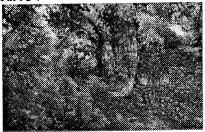
Which major biome of India is represented in the given figure?
A
Desert
B
Sea coast
C
Tropical rainforest
D
Deciduous forest
Solution
(D) The provided image depicts a forest environment characterized by trees that shed their leaves annually,which is a typical feature of a deciduous forest biome in India. In India,tropical deciduous forests are the most widespread type of forest,often referred to as monsoon forests. These forests are found in regions receiving rainfall between $70$ and $200$ cm. Therefore,the correct option is $D$.
0 likes
View Solution25
MediumMCQ
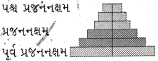
Identify the type of age pyramid for the human population shown in the image and state what it represents.
A
Stable population
B
Expanding population
C
Declining population
D
Migratory population
Solution
(B) The given age pyramid shows a broad base of pre-reproductive individuals,followed by a narrower reproductive stage and an even narrower post-reproductive stage.
This triangular shape indicates that the number of pre-reproductive individuals is significantly higher than the reproductive and post-reproductive individuals.
Such a distribution is characteristic of an expanding or growing population,where the birth rate is high and the population size is increasing over time.
This triangular shape indicates that the number of pre-reproductive individuals is significantly higher than the reproductive and post-reproductive individuals.
Such a distribution is characteristic of an expanding or growing population,where the birth rate is high and the population size is increasing over time.
0 likes
View Solution26
MediumMCQ
Which of the following statements is correct?
$I.$ In a population,birth rate and death rate refer to per capita births and deaths,respectively.
$II.$ In nature,we rarely find isolated single individuals of any species.
$III.$ The size of a population for any species is a stable phenomenon.
$IV.$ Ecological effects of any factors on population growth are generally reflected in its size/population density.
$I.$ In a population,birth rate and death rate refer to per capita births and deaths,respectively.
$II.$ In nature,we rarely find isolated single individuals of any species.
$III.$ The size of a population for any species is a stable phenomenon.
$IV.$ Ecological effects of any factors on population growth are generally reflected in its size/population density.
A
$I$ and $II$
B
$II$ and $III$
C
$I, II$ and $III$
D
$I, II$ and $IV$
Solution
(D) Statement $I$ is correct: Birth rate and death rate are defined as per capita births and deaths in a population.
Statement $II$ is correct: Individuals of a species usually live in groups or populations rather than in isolation.
Statement $III$ is incorrect: Population size is a dynamic phenomenon that changes constantly due to factors like natality,mortality,immigration,and emigration.
Statement $IV$ is correct: The cumulative effect of various ecological factors on population growth is ultimately reflected in changes to the population density or size.
Therefore,statements $I, II,$ and $IV$ are correct.
Statement $II$ is correct: Individuals of a species usually live in groups or populations rather than in isolation.
Statement $III$ is incorrect: Population size is a dynamic phenomenon that changes constantly due to factors like natality,mortality,immigration,and emigration.
Statement $IV$ is correct: The cumulative effect of various ecological factors on population growth is ultimately reflected in changes to the population density or size.
Therefore,statements $I, II,$ and $IV$ are correct.
0 likes
View Solution27
MediumMCQ
$A$: Population ecology is a link between ecology,population genetics,and evolution.
$R$: Natural selection operates at the population level to evolve desired traits.
$R$: Natural selection operates at the population level to evolve desired traits.
A
Assertion and Reason both are correct and Reason is the correct explanation of Assertion.
B
Assertion and Reason both are correct but Reason is not the correct explanation of Assertion.
C
Assertion is correct,but Reason is incorrect.
D
Both Assertion and Reason are incorrect.
Solution
(A) Population ecology provides the framework for understanding how ecological factors influence genetic variation and evolutionary processes within a group of individuals.
Natural selection acts on the phenotypic variations present within a population,leading to changes in allele frequencies over generations,which is the fundamental mechanism of evolution.
Since evolution occurs through changes in the genetic makeup of populations over time,population ecology is indeed a vital link between ecology and evolutionary biology.
Therefore,both the Assertion and the Reason are correct,and the Reason provides the correct explanation for the Assertion.
Natural selection acts on the phenotypic variations present within a population,leading to changes in allele frequencies over generations,which is the fundamental mechanism of evolution.
Since evolution occurs through changes in the genetic makeup of populations over time,population ecology is indeed a vital link between ecology and evolutionary biology.
Therefore,both the Assertion and the Reason are correct,and the Reason provides the correct explanation for the Assertion.
0 likes
View Solution28
MediumMCQ
$A$: Different ecotypes of a species,despite being genotypically different,are interfertile.
$R$: They are locally natural selections from a pool of genetic variations found in the gene pool of a species.
$R$: They are locally natural selections from a pool of genetic variations found in the gene pool of a species.
A
Assertion and Reason both are correct and Reason is the correct explanation of Assertion.
B
Assertion and Reason both are correct but Reason is not the correct explanation of Assertion.
C
Assertion is correct,but Reason is incorrect.
D
Both Assertion and Reason are incorrect.
Solution
(A) Ecotypes are populations of a species that are adapted to specific local environmental conditions.
Although they possess different genotypes due to local adaptation,they belong to the same species and are therefore capable of interbreeding (interfertile).
This is because they originate from the same gene pool of the species,representing different combinations of genetic variations that have been selected by natural selection in different habitats.
Thus,both the Assertion and the Reason are correct,and the Reason provides a valid explanation for why ecotypes remain interfertile despite genotypic differences.
Although they possess different genotypes due to local adaptation,they belong to the same species and are therefore capable of interbreeding (interfertile).
This is because they originate from the same gene pool of the species,representing different combinations of genetic variations that have been selected by natural selection in different habitats.
Thus,both the Assertion and the Reason are correct,and the Reason provides a valid explanation for why ecotypes remain interfertile despite genotypic differences.
0 likes
View Solution29
MediumMCQ
Which of the following phenomena does not play a significant role in the maintenance of homeostasis in an ecosystem?
A
Carrying capacity
B
Biotic potential
C
Self-regulation
D
Feedback
Solution
(B) Homeostasis in an ecosystem refers to the ability of the system to maintain a stable internal environment despite external changes.
$1$. Carrying capacity represents the maximum population size an environment can sustain,which acts as a regulatory mechanism.
$2$. Self-regulation and feedback mechanisms (both positive and negative) are essential for maintaining ecological balance.
$3$. Biotic potential refers to the maximum reproductive capacity of an organism under ideal environmental conditions. It is an intrinsic growth rate and does not directly function as a mechanism to maintain ecosystem homeostasis.
$1$. Carrying capacity represents the maximum population size an environment can sustain,which acts as a regulatory mechanism.
$2$. Self-regulation and feedback mechanisms (both positive and negative) are essential for maintaining ecological balance.
$3$. Biotic potential refers to the maximum reproductive capacity of an organism under ideal environmental conditions. It is an intrinsic growth rate and does not directly function as a mechanism to maintain ecosystem homeostasis.
0 likes
View Solution30
MediumMCQ
Match List-$I$ with List-$II$.
Choose the correct answer from the options given below.
| List-$I$ | List-$II$ |
| $(a)$ Allen's Rule | $(i)$ Kangaroo rat |
| $(b)$ Physiological adaptation | $(ii)$ Desert lizard |
| $(c)$ Behavioural adaptation | $(iii)$ Marine fish at depth |
| $(d)$ Biochemical adaptation | $(iv)$ Polar seal |
Choose the correct answer from the options given below.
A
$(iv)-(ii)-(iii)-(i)$
B
$(iv)-(i)-(iii)-(ii)$
C
$(iv)-(i)-(ii)-(iii)$
D
$(iv)-(iii)-(ii)-(i)$
Solution
(B) Allen's Rule states that mammals from colder climates generally have shorter ears and limbs to minimize heat loss,exemplified by the Polar seal $(iv)$.
$(b)$ Physiological adaptation: The Kangaroo rat $(i)$ in North American deserts is capable of meeting all its water requirements through its internal fat oxidation,a classic physiological adaptation.
$(c)$ Behavioural adaptation: Desert lizards $(ii)$ manage their body temperature by basking in the sun when cold and moving into the shade when it is too hot,which is a behavioural response.
$(d)$ Biochemical adaptation: Marine fish $(iii)$ living at great depths in the ocean possess special enzymes and biochemical pathways to survive under extreme high-pressure conditions.
Therefore,the correct matching is $(a)-(iv), (b)-(i), (c)-(ii), (d)-(iii)$.
$(b)$ Physiological adaptation: The Kangaroo rat $(i)$ in North American deserts is capable of meeting all its water requirements through its internal fat oxidation,a classic physiological adaptation.
$(c)$ Behavioural adaptation: Desert lizards $(ii)$ manage their body temperature by basking in the sun when cold and moving into the shade when it is too hot,which is a behavioural response.
$(d)$ Biochemical adaptation: Marine fish $(iii)$ living at great depths in the ocean possess special enzymes and biochemical pathways to survive under extreme high-pressure conditions.
Therefore,the correct matching is $(a)-(iv), (b)-(i), (c)-(ii), (d)-(iii)$.
0 likes
View Solution31
Medium
Match the columns:
| Column-$I$ | Column-$II$ |
|---|---|
| $(a)$ Cacti | $(i)$ Leguminous plants |
| $(b)$ Shade loving plants | $(ii)$ Commensalism |
| $(c)$ Halophytes | $(iii)$ Pioneer community |
| $(d)$ Crustose lichen | $(iv)$ Plants growing in saline environment |
| $(e)$ Interspecific interaction | $(v)$ Xerophytes |
| $(f)$ Rhizobium | $(vi)$ Sciophytes |
Solution
(A) The correct matches are as follows:
$(a)$ Cacti are xerophytes,so $(a-v)$.
$(b)$ Shade-loving plants are known as sciophytes,so $(b-vi)$.
$(c)$ Halophytes are plants that grow in saline environments,so $(c-iv)$.
$(d)$ Crustose lichens are the pioneer community in primary succession on bare rocks,so $(d-iii)$.
$(e)$ Commensalism is a type of interspecific interaction,so $(e-ii)$.
$(f)$ Rhizobium is a nitrogen-fixing bacterium found in the root nodules of leguminous plants,so $(f-i)$.
Therefore,the correct sequence is $(a-v, b-vi, c-iv, d-iii, e-ii, f-i)$.
$(a)$ Cacti are xerophytes,so $(a-v)$.
$(b)$ Shade-loving plants are known as sciophytes,so $(b-vi)$.
$(c)$ Halophytes are plants that grow in saline environments,so $(c-iv)$.
$(d)$ Crustose lichens are the pioneer community in primary succession on bare rocks,so $(d-iii)$.
$(e)$ Commensalism is a type of interspecific interaction,so $(e-ii)$.
$(f)$ Rhizobium is a nitrogen-fixing bacterium found in the root nodules of leguminous plants,so $(f-i)$.
Therefore,the correct sequence is $(a-v, b-vi, c-iv, d-iii, e-ii, f-i)$.
0 likes
View Solution32
Medium
Match the following columns regarding physiological adaptations in organisms:
| Column-$I$ | Column-$II$ |
|---|---|
| $(a)$ Diapause | $(i)$ Inactive stage during summer |
| $(b)$ Hibernation | $(ii)$ Inactive stage during winter |
| $(c)$ Dormancy | $(iii)$ Temporary suspension of development |
| $(d)$ Aestivation | $(iv)$ Reduced metabolic state during unfavorable conditions |
Solution
(A) The correct matching based on biological definitions is:
$(a)$ Diapause: $(iii)$ Temporary suspension of development (often seen in zooplankton).
$(b)$ Hibernation: $(ii)$ Inactive stage during winter (e.g.,bears).
$(c)$ Dormancy: $(iv)$ Reduced metabolic state during unfavorable conditions (often used for seeds/plants).
$(d)$ Aestivation: $(i)$ Inactive stage during summer (e.g.,snails/fish).
Therefore,the correct sequence is $(a-iii, b-ii, c-iv, d-i)$.
$(a)$ Diapause: $(iii)$ Temporary suspension of development (often seen in zooplankton).
$(b)$ Hibernation: $(ii)$ Inactive stage during winter (e.g.,bears).
$(c)$ Dormancy: $(iv)$ Reduced metabolic state during unfavorable conditions (often used for seeds/plants).
$(d)$ Aestivation: $(i)$ Inactive stage during summer (e.g.,snails/fish).
Therefore,the correct sequence is $(a-iii, b-ii, c-iv, d-i)$.
0 likes
View Solution33
MediumMCQ
Match List-$I$ with List-$II$.
Choose the correct answer from the options given below:
| List-$I$ | List-$II$ |
| $A$. Logistic growth | $I$. Unlimited resource availability condition |
| $B$. Exponential growth | $II$. Limited resource availability condition |
| $C$. Expanding age pyramid | $III$. The percent individuals of pre-reproductive age is largest followed by reproductive and post-reproductive age groups |
| $D$. Stable age pyramid | $IV$. The percent individuals of pre-reproductive and reproductive age group are same |
Choose the correct answer from the options given below:
A
$A-II, B-I, C-III, D-IV$
B
$A-II, B-IV, C-III, D-I$
C
$A-II, B-III, C-I, D-IV$
D
$A-II, B-IV, C-I, D-III$
Solution
(B) Logistic growth occurs when there is limited resource availability, leading to a sigmoid curve.
Exponential growth occurs when there is unlimited resource availability, leading to a $J$-shaped curve.
An expanding age pyramid represents a growing population where the percentage of individuals in the pre-reproductive age group is the largest, followed by the reproductive and post-reproductive age groups.
$A$ stable age pyramid represents a stable population where the percentage of individuals in the pre-reproductive and reproductive age groups are approximately the same.
Therefore, the correct matching is $A-II, B-I, C-III, D-IV$.
Exponential growth occurs when there is unlimited resource availability, leading to a $J$-shaped curve.
An expanding age pyramid represents a growing population where the percentage of individuals in the pre-reproductive age group is the largest, followed by the reproductive and post-reproductive age groups.
$A$ stable age pyramid represents a stable population where the percentage of individuals in the pre-reproductive and reproductive age groups are approximately the same.
Therefore, the correct matching is $A-II, B-I, C-III, D-IV$.
0 likes
View Solution34
MediumMCQ
Match the column-$I$ with column-$II$ and select the correct option given:-
| Column-$I$ | Column-$II$ |
| $A$. $J$-shape curve | $(i)$ Sigmoid curve |
| $B$. Verhulst-Pearl logistic growth | $(ii)$ Breed only once in their lifetime |
| $C$. Extinction of Abingdon tortoise | $(iii)$ Competition for same resources |
| $D$. Pacific salmon fish and Bamboo | $(iv)$ Resources unlimited |
A
$A-(ii), B-(i), C-(iii), D-(iv)$
B
$A-(iv), B-(i), C-(iii), D-(ii)$
C
$A-(iv), B-(ii), C-(iii), D-(i)$
D
$A-(iii), B-(i), C-(iv), D-(ii)$
Solution
(B) The correct matches are as follows:
$1$. $J$-shape curve represents exponential growth,which occurs when resources are unlimited $(A-iv)$.
$2$. Verhulst-Pearl logistic growth is represented by a sigmoid curve $(B-i)$.
$3$. The extinction of the Abingdon tortoise in the Galapagos Islands occurred due to competition for the same resources with goats $(C-iii)$.
$4$. Pacific salmon fish and Bamboo are examples of organisms that breed only once in their lifetime $(D-ii)$.
Therefore,the correct sequence is $A-(iv), B-(i), C-(iii), D-(ii)$.
$1$. $J$-shape curve represents exponential growth,which occurs when resources are unlimited $(A-iv)$.
$2$. Verhulst-Pearl logistic growth is represented by a sigmoid curve $(B-i)$.
$3$. The extinction of the Abingdon tortoise in the Galapagos Islands occurred due to competition for the same resources with goats $(C-iii)$.
$4$. Pacific salmon fish and Bamboo are examples of organisms that breed only once in their lifetime $(D-ii)$.
Therefore,the correct sequence is $A-(iv), B-(i), C-(iii), D-(ii)$.
0 likes
View Solution35
EasyMCQ
Match List $I$ with List $II$.
| $A$. Natality | $I$. $\frac{dN}{dt} = rN$ |
| $B$. Exponential growth | $II$. Death rate |
| $C$. Mortality | $III$. Birth rate |
| $D$. Logistic growth | $IV$. $\frac{dN}{dt} = rN \left[1 - \frac{N}{K}\right]$ |
A
$(A) - (III), (B) - (IV), (C) - (II), (D) - (I)$
B
$(A) - (III), (B) - (I), (C) - (II), (D) - (IV)$
C
$(A) - (II), (B) - (I), (C) - (III), (D) - (IV)$
D
$(A) - (III), (B) - (II), (C) - (IV), (D) - (I)$
Solution
(B) The correct matches are as follows:
$(A)$ Natality refers to the birth rate in a population,which corresponds to $(III)$.
$(B)$ Exponential growth is represented by the equation $\frac{dN}{dt} = rN$,which corresponds to $(I)$.
$(C)$ Mortality refers to the death rate in a population,which corresponds to $(II)$.
$(D)$ Logistic growth is represented by the equation $\frac{dN}{dt} = rN \left[1 - \frac{N}{K}\right]$,which corresponds to $(IV)$.
Therefore,the correct sequence is $(A) - (III), (B) - (I), (C) - (II), (D) - (IV)$.
$(A)$ Natality refers to the birth rate in a population,which corresponds to $(III)$.
$(B)$ Exponential growth is represented by the equation $\frac{dN}{dt} = rN$,which corresponds to $(I)$.
$(C)$ Mortality refers to the death rate in a population,which corresponds to $(II)$.
$(D)$ Logistic growth is represented by the equation $\frac{dN}{dt} = rN \left[1 - \frac{N}{K}\right]$,which corresponds to $(IV)$.
Therefore,the correct sequence is $(A) - (III), (B) - (I), (C) - (II), (D) - (IV)$.
0 likes
View Solution36
EasyMCQ
Match the ecological hierarchy given in Column-$I$ with their explanation in Column-$II$. Choose the correct answer from options given below.
| Column-$I$ | Column-$II$ |
| $a$. Organism | $i$. Flora and fauna of a specific climatic zone. |
| $b$. Population | $ii$. Populations of different species of an area. |
| $c$. Community | $iii$. Organisms of same kind inhabiting an area. |
| $d$. Biome | $iv$. Basic unit of hierarchy. |
A
$a-iv, b-iii, c-ii, d-i$
B
$a-i, b-ii, c-iii, d-iv$
C
$a-iii, b-iv, c-i, d-ii$
D
$a-iv, b-iii, c-ii, d-i$
Solution
(A) The ecological hierarchy is defined as follows:
$a$. Organism: It is the basic unit of ecological hierarchy. Thus,$a-iv$.
$b$. Population: It consists of individuals of the same species inhabiting a specific area. Thus,$b-iii$.
$c$. Community: It consists of populations of different species living in a specific area. Thus,$c-ii$.
$d$. Biome: It represents the large-scale flora and fauna of a specific climatic zone. Thus,$d-i$.
Therefore,the correct matching is $a-iv, b-iii, c-ii, d-i$.
$a$. Organism: It is the basic unit of ecological hierarchy. Thus,$a-iv$.
$b$. Population: It consists of individuals of the same species inhabiting a specific area. Thus,$b-iii$.
$c$. Community: It consists of populations of different species living in a specific area. Thus,$c-ii$.
$d$. Biome: It represents the large-scale flora and fauna of a specific climatic zone. Thus,$d-i$.
Therefore,the correct matching is $a-iv, b-iii, c-ii, d-i$.
0 likes
View SolutionOrganisms and Populations — Mix Examples- Organisms and Populations · Frequently Asked Questions
1Are these Organisms and Populations questions useful for JEE and NEET?
Yes. All questions in this section are mapped to JEE Main and NEET exam patterns. Previous year questions from JEE Main, NEET, GUJCET and state-level exams are included with full solutions.
2Can I switch to Hindi or Gujarati for these questions?
Yes. Use the language tabs in the hero section or the sidebar to view the same questions and solutions in English, Hindi or Gujarati.
3How do I generate a question paper from this subtopic?
Use the Vedclass Exam Paper Generator — select the chapter and subtopic, set difficulty, and generate Sets A, B, C, D automatically. First 3 chapters of every subject are free.
Vedclass Products
For Students
Vedclass Test Series
Mock tests in real JEE/NEET style with performance analysis. 5-day free trial.
Start Free TrialFor Teachers
Exam Paper Generator
Generate Set A/B/C/D papers from this chapter in 2 minutes. 3 chapters free.
Try FreeFor Institutes
Online Exam Module
Live online exams with unlimited students, 360° analytics & white-label branding.
See DemoFor Teachers & Institutes
Generate a Organisms and Populations Exam Paper in 2 Minutes
Select subtopic & difficulty — Sets A, B, C, D auto-generated with No Repeat logic.
First 3 chapters of every subject are free — no payment required.