
A English
Population Interactions Questions in English
Class 12 Biology · Organisms and Populations · Population Interactions
365+
Questions
English
Language
100%
With Solutions
Showing 48 of 365 questions in English
51
MediumMCQ
Which of the following is a correct pair?
A
Lichen - Mutualism between algae and fungi
B
Root nodules - Mutualism between roots of leguminous plants and Rhizobium
C
Mycorrhiza - Mutualism between roots of higher plants and fungi
D
All of the above
Solution
(D) Mutualism is a type of symbiotic interaction where both organisms benefit from each other.
$A$. Lichens represent a symbiotic association between algae (phycobiont) and fungi (mycobiont),where both partners benefit.
$B$. Root nodules in leguminous plants contain the bacterium $Rhizobium$,which fixes atmospheric nitrogen for the plant,while the plant provides nutrients and shelter to the bacteria.
$C$. Mycorrhiza is a symbiotic association between fungi and the roots of higher plants,where the fungus helps in the absorption of phosphorus and water,and the plant provides carbohydrates to the fungus.
Since all the given pairs represent correct examples of mutualism,the correct option is $D$.
$A$. Lichens represent a symbiotic association between algae (phycobiont) and fungi (mycobiont),where both partners benefit.
$B$. Root nodules in leguminous plants contain the bacterium $Rhizobium$,which fixes atmospheric nitrogen for the plant,while the plant provides nutrients and shelter to the bacteria.
$C$. Mycorrhiza is a symbiotic association between fungi and the roots of higher plants,where the fungus helps in the absorption of phosphorus and water,and the plant provides carbohydrates to the fungus.
Since all the given pairs represent correct examples of mutualism,the correct option is $D$.
0 likes
View Solution52
MediumMCQ
What type of interaction is observed between fragrant flowers and bees?
A
Mutualism
B
Parasitism
C
Commensalism
D
Amensalism
Solution
(A) The interaction between fragrant flowers and bees is an example of $Mutualism$ (or $Mutualism$ symbiosis).
In this relationship, both species benefit: the bees obtain nectar and pollen as food, while the flowers benefit from the pollination services provided by the bees as they move from flower to flower.
In this relationship, both species benefit: the bees obtain nectar and pollen as food, while the flowers benefit from the pollination services provided by the bees as they move from flower to flower.
0 likes
View Solution53
EasyMCQ
What kind of interrelationships exist between organisms in the biosphere?
A
Direct
B
Indirect
C
Biological
D
Both $(A)$ and $(B)$
Solution
(D) In the biosphere,organisms interact with each other in various ways. These interactions can be direct,such as predation,competition,or mutualism,where organisms physically interact or directly affect each other's survival. They can also be indirect,where the presence or activity of one organism influences another through changes in the environment or by affecting a third organism (e.g.,a predator affecting a plant population by controlling a herbivore). Therefore,both direct and indirect relationships are fundamental to ecological dynamics.
0 likes
View Solution54
EasyMCQ
The praying mantis is a good example of:
A
camouflage
B
Mullerian mimicry
C
warning colouration
D
social insects
Solution
(A) The correct answer is $A$. The praying mantis exhibits the phenomenon of camouflage,where it blends into its surroundings to match the background. This adaptation helps the insect to hide from predators and effectively hunt its prey.
0 likes
View Solution55
MediumMCQ
Mycorrhizae are an example of
A
amensalism
B
antibiosis
C
mutualism
D
fungistasis
Solution
(C) Mycorrhizae represent a mutualistic symbiotic association between fungi and the roots of higher plants. In this relationship,the fungus helps the plant in the absorption of essential nutrients like phosphorus from the soil,while the plant provides the fungus with carbohydrates and a habitat. Since both organisms benefit from this interaction,it is classified as mutualism.
0 likes
View Solution56
MediumMCQ
If $'+'$ sign is assigned to beneficial interaction,$'-'$ sign to detrimental and $'O'$ sign to neutral interaction,then the population interaction represented by $'+, -'$ refers to
A
mutualism
B
amensalism
C
commensalism
D
parasitism
Solution
(D) The population interaction represented by $'+, -'$ is known as parasitism.
In this interaction,one species (the parasite) benefits $('+')$ while the other species (the host) is harmed $('-')$.
Parasitism is an association in which one organism (the parasite) lives on (ectoparasitism) or in (endoparasitism) the body of another organism (host),from which it obtains its nutrients.
This association is beneficial for the parasites as they get a continuous supply of nutrients from their host and are able to rapidly multiply their numbers.
However,it is detrimental for the host organism as parasitic infection leads to various complications and diseases in the host body,which may also be fatal to the host under certain circumstances.
In this interaction,one species (the parasite) benefits $('+')$ while the other species (the host) is harmed $('-')$.
Parasitism is an association in which one organism (the parasite) lives on (ectoparasitism) or in (endoparasitism) the body of another organism (host),from which it obtains its nutrients.
This association is beneficial for the parasites as they get a continuous supply of nutrients from their host and are able to rapidly multiply their numbers.
However,it is detrimental for the host organism as parasitic infection leads to various complications and diseases in the host body,which may also be fatal to the host under certain circumstances.
0 likes
View Solution57
MediumMCQ
The principle of competitive exclusion was stated by
A
$C$. Darwin
B
$G$.$F$. Gause
C
Mac Arthur
D
Verhulst and Pearl
Solution
(B) : Two or more species with closely similar niche requirements cannot exist indefinitely in the same area as sooner or later they come into competition for possession of it. This is called as Gause's competitive exclusion principle,which states that an ecological niche cannot be simultaneously and completely occupied by established populations of more than one species. Two species can live in the same habitat but not in the same niche. The more similar the two niches are,the more severe the competition is.
0 likes
View Solution58
MediumMCQ
Gause's principle of competitive exclusion states that
A
no two species can occupy the same niche indefinitely for the same limiting resources
B
larger organisms exclude smaller ones through competition
C
more abundant species will exclude the less abundant species through competition
D
competition for the same resources exclude species having different food preferences.
Solution
(A) : Two or more species with closely similar niche requirements cannot exist indefinitely in the same area as sooner or later they come into competition for possession of it.
This is called Gause's competitive exclusion principle,which states that an ecological niche cannot be simultaneously and completely occupied by established populations of more than one species.
Two species can live in the same habitat but not in the same niche.
The more similar the two niches are,the more severe the competition is.
This is called Gause's competitive exclusion principle,which states that an ecological niche cannot be simultaneously and completely occupied by established populations of more than one species.
Two species can live in the same habitat but not in the same niche.
The more similar the two niches are,the more severe the competition is.
0 likes
View Solution59
MediumMCQ
In which of the following interactions are both partners adversely affected?
A
Parasitism
B
Mutualism
C
Competition
D
Predation
Solution
(C) : Competition is the rivalry between two or more organisms for obtaining the same resources such as food,light,water,space,shelter,mate,etc. In this interaction,both species involved are adversely affected as they compete for limited resources.
0 likes
View Solution60
MediumMCQ
The following graph depicts changes in two populations ($A$ and $B$) of herbivores in a grassy field. $A$ possible reason for these changes is that
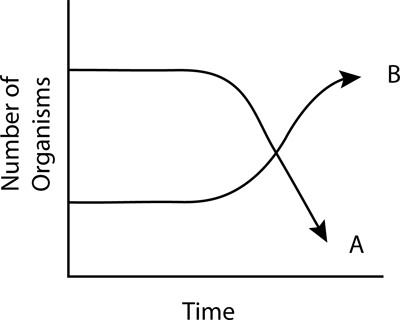
A
population $A$ produced more offspring than population $B$
B
population $A$ consumed the members of population $B$
C
both plant populations in this habitat decreased
D
population $B$ competed more successfully for food than population $A$
Solution
(D) The correct answer is $(d)$.
Both populations are herbivorous,thus they do not consume each other.
If the food sources for these populations $A$ and $B$ had decreased,both populations would have declined.
If population $A$ had produced more offspring,the graph for population $A$ would have shown an increase.
Based on the graph,population $B$ is more successful in competing for limited resources than population $A$. This interspecific competition leads to an increase in the number of organisms in population $B$ while the number of organisms in population $A$ decreases.
Both populations are herbivorous,thus they do not consume each other.
If the food sources for these populations $A$ and $B$ had decreased,both populations would have declined.
If population $A$ had produced more offspring,the graph for population $A$ would have shown an increase.
Based on the graph,population $B$ is more successful in competing for limited resources than population $A$. This interspecific competition leads to an increase in the number of organisms in population $B$ while the number of organisms in population $A$ decreases.
0 likes
View Solution61
MediumMCQ
$A$ sedentary sea anemone gets attached to the shell lining of a hermit crab. The association is:
A
commensalism
B
amensalism
C
ectoparasitism
D
symbiosis
Solution
(D) The correct answer is $D$.
Sea anemone attaches itself to the shell of a hermit crab.
This association is a classic example of mutualism,which is a type of symbiosis.
The sea anemone provides camouflage and protection to the hermit crab using its stinging cells (nematocysts).
In return,the hermit crab provides mobility to the sea anemone,allowing it to reach new food sources.
Since both organisms derive benefit from this interaction,it is classified as symbiosis (mutualism).
Sea anemone attaches itself to the shell of a hermit crab.
This association is a classic example of mutualism,which is a type of symbiosis.
The sea anemone provides camouflage and protection to the hermit crab using its stinging cells (nematocysts).
In return,the hermit crab provides mobility to the sea anemone,allowing it to reach new food sources.
Since both organisms derive benefit from this interaction,it is classified as symbiosis (mutualism).
0 likes
View Solution62
EasyMCQ
$Cuscuta$ is an example of
A
ectoparasitism
B
brood parasitism
C
predation
D
endoparasitism
Solution
(A) $Cuscuta$ is a total stem parasite which is a classic example of ectoparasitism.
It is commonly found growing on hedge plants.
During the course of evolution,it has lost its chlorophyll and leaves.
It attaches and wraps itself around the stem of the host plant and produces haustoria that are inserted into the vascular system of the host.
The parasitic plant absorbs all the nutrients from the host plant with the help of these haustoria.
$Cuscuta$ is also known to derive the flower-inducing hormone,florigen,from the host.
It is commonly found growing on hedge plants.
During the course of evolution,it has lost its chlorophyll and leaves.
It attaches and wraps itself around the stem of the host plant and produces haustoria that are inserted into the vascular system of the host.
The parasitic plant absorbs all the nutrients from the host plant with the help of these haustoria.
$Cuscuta$ is also known to derive the flower-inducing hormone,florigen,from the host.
0 likes
View Solution63
MediumMCQ
Which one of the following is categorised as a parasite in the true sense?
A
The female Anopheles bites and sucks blood from humans.
B
Human foetus developing inside the uterus draws nourishment from the mother.
C
Head louse living on the human scalp as well as laying eggs on human hair.
D
The cuckoo (koel) lays its eggs in a crow's nest.
Solution
(C) : Parasitism is an interaction between two species where one species (the parasite) depends on the other species (the host) for food and shelter. The parasite lives on (ectoparasite) or inside (endoparasite) the body of the host and derives nutrients from it. The head louse living on the human scalp is a classic example of an ectoparasite as it lives on the host and derives nutrition directly from it.
0 likes
View Solution64
MediumMCQ
Which one of the following is most appropriately defined?
A
Host is an organism which provides food to another organism.
B
Amensalism is a relationship in which one species is benefitted whereas the other is unaffected.
C
Predator is an organism that catches and kills other organism for food.
D
Parasite is an organism which always lives inside the body of other organism and may kill it.
Solution
(C) : Predation is an interaction between members of two species in which members of one species capture,kill,and eat up members of other species.
Host is a term specifically related to parasitism,where the host provides nourishment and shelter to the parasite.
Amensalism is an interspecies interaction in which one species is harmed,whereas the other one is unaffected.
Parasitic organisms can live either on the surface of their host (ectoparasites) or inside their body (endoparasites).
Host is a term specifically related to parasitism,where the host provides nourishment and shelter to the parasite.
Amensalism is an interspecies interaction in which one species is harmed,whereas the other one is unaffected.
Parasitic organisms can live either on the surface of their host (ectoparasites) or inside their body (endoparasites).
0 likes
View Solution65
MediumMCQ
$A$ high density of elephant population in an area can result in
A
intraspecific competition
B
interspecific competition
C
predation on one another
D
mutualism
Solution
(A) : Competition is rivalry for obtaining the same resource.
Competition is of two types: intraspecific and interspecific.
Intraspecific competition is the competition amongst members of the same species for a common resource,such as food,space,and mates.
Therefore,if the density of an elephant population in an area increases,it will lead to intraspecific competition.
This competition results in the establishment of territories,which may force individuals to move out to secure shelter,mates,and food for the remaining population.
Competition is of two types: intraspecific and interspecific.
Intraspecific competition is the competition amongst members of the same species for a common resource,such as food,space,and mates.
Therefore,if the density of an elephant population in an area increases,it will lead to intraspecific competition.
This competition results in the establishment of territories,which may force individuals to move out to secure shelter,mates,and food for the remaining population.
0 likes
View Solution66
MediumMCQ
Niche overlap indicates
A
mutualism between two species
B
active cooperation between two species
C
two different parasites on the same host
D
sharing of one or more resources between the two species.
Solution
(D) : An ecological niche is the specific part of a habitat occupied by individuals of a species,which is defined by its range of tolerance,range of movement,microclimate,type of food and its availability,shelter,type of predator,and timing of activity.
An ecological niche is typically occupied by a single species.
Niche overlap occurs when two or more species share one or more limited resources for which they compete.
For example,both owls and cats may feed on shrews and mice,leading to a niche overlap because they utilize the same food resource,even if their broader habitats differ.
An ecological niche is typically occupied by a single species.
Niche overlap occurs when two or more species share one or more limited resources for which they compete.
For example,both owls and cats may feed on shrews and mice,leading to a niche overlap because they utilize the same food resource,even if their broader habitats differ.
0 likes
View Solution67
MediumMCQ
Study the four statements $(i-iv)$ given below and select the two correct ones out of them.
$(i)$ $A$ lion eating a deer and a sparrow feeding on grains are ecologically similar in being consumers.
$(ii)$ Predator star fish $Pisaster$ helps in maintaining species diversity of some invertebrates.
$(iii)$ Predators ultimately lead to the extinction of prey species.
$(iv)$ Production of chemicals such as nicotine,strychnine by the plants are metabolic disorders.
The two correct statements are
$(i)$ $A$ lion eating a deer and a sparrow feeding on grains are ecologically similar in being consumers.
$(ii)$ Predator star fish $Pisaster$ helps in maintaining species diversity of some invertebrates.
$(iii)$ Predators ultimately lead to the extinction of prey species.
$(iv)$ Production of chemicals such as nicotine,strychnine by the plants are metabolic disorders.
The two correct statements are
A
$(ii)$ and $(iii)$
B
$(iii)$ and $(iv)$
C
$(i)$ and $(iv)$
D
$(i)$ and $(ii)$
Solution
(D) Statement $(i)$ is correct because both lions and sparrows are consumers; lions are carnivores and sparrows are primary consumers (herbivores).
Statement $(ii)$ is correct because the predator starfish $Pisaster$ is a classic example of a keystone species that maintains species diversity in intertidal communities by preventing any one species from monopolizing resources.
Statement $(iii)$ is incorrect because predators do not typically lead to the extinction of prey; instead,they maintain prey populations at stable levels and promote species diversity.
Statement $(iv)$ is incorrect because chemicals like nicotine and strychnine are secondary metabolites produced by plants as defense mechanisms against herbivores,not metabolic disorders.
Statement $(ii)$ is correct because the predator starfish $Pisaster$ is a classic example of a keystone species that maintains species diversity in intertidal communities by preventing any one species from monopolizing resources.
Statement $(iii)$ is incorrect because predators do not typically lead to the extinction of prey; instead,they maintain prey populations at stable levels and promote species diversity.
Statement $(iv)$ is incorrect because chemicals like nicotine and strychnine are secondary metabolites produced by plants as defense mechanisms against herbivores,not metabolic disorders.
0 likes
View Solution68
MediumMCQ
The relationship between two organisms or species in which both partners derive benefit from each other is known as:
A
Parasitism
B
Predation
C
Competition
D
Mutualism
Solution
(D) Mutualism is a type of population interaction in which both interacting species benefit from each other.
In this relationship,both organisms provide resources or services to one another,which enhances their survival or reproductive success.
Examples include lichens (a symbiotic association between algae and fungi) and the relationship between mycorrhizae and plant roots.
In this relationship,both organisms provide resources or services to one another,which enhances their survival or reproductive success.
Examples include lichens (a symbiotic association between algae and fungi) and the relationship between mycorrhizae and plant roots.
0 likes
View Solution69
MediumMCQ
Killing an organism for feeding is known as:
A
Predation
B
Parasitism
C
Symbiosis
D
Mutualism
Solution
(A) Predation is a biological interaction where one organism,the predator,kills and eats another organism,the prey,for food.
In this interaction,the predator benefits while the prey is harmed.
Parasitism involves one organism living on or inside another without necessarily killing it immediately.
Mutualism and Symbiosis are interactions where both organisms benefit.
In this interaction,the predator benefits while the prey is harmed.
Parasitism involves one organism living on or inside another without necessarily killing it immediately.
Mutualism and Symbiosis are interactions where both organisms benefit.
0 likes
View Solution70
MediumMCQ
The Monarch butterfly is not eaten by predators because of:
A
Rough skin
B
Bitter taste (distasteful)
C
Foul smell
D
Colouration
Solution
(B) The Monarch butterfly is highly distasteful to its predator (birds) because of a special chemical that it acquires during its caterpillar stage by feeding on a poisonous weed. This chemical makes the butterfly taste bitter,which acts as a defense mechanism against predators. This is a classic example of chemical defense in nature.
0 likes
View Solution71
MediumMCQ
Gause's law is related to:
A
Predation
B
Parasitism
C
Competition
D
Mutualism
Solution
(C) Gause's law,also known as the $Competitive \ Exclusion \ Principle$,states that two species competing for the same limiting resource cannot coexist at constant population values. If two species have identical ecological niches,one will inevitably outcompete the other,leading to the extinction of the less fit species in that specific environment. Therefore,it is fundamentally related to $Competition$.
0 likes
View Solution72
MediumMCQ
$A$ cuckoo laying eggs in the nest of other species of birds is an example of
A
Ectoparasitism
B
Endoparasitism
C
Brood parasitism
D
Amensalism
Solution
(C) Brood parasitism is a fascinating example of parasitism in birds in which the parasitic bird lays its eggs in the nest of its host and lets the host incubate them.
During the course of evolution,the eggs of the parasitic bird have evolved to resemble the host's eggs in size and color to reduce the chances of the host bird detecting the foreign eggs and ejecting them from the nest.
The cuckoo ($Cuculus$ $canorus$) is a classic example of a bird that practices brood parasitism by laying its eggs in the nest of a crow.
During the course of evolution,the eggs of the parasitic bird have evolved to resemble the host's eggs in size and color to reduce the chances of the host bird detecting the foreign eggs and ejecting them from the nest.
The cuckoo ($Cuculus$ $canorus$) is a classic example of a bird that practices brood parasitism by laying its eggs in the nest of a crow.
0 likes
View Solution73
MediumMCQ
Which kind of relationship is seen between a mango tree and an orchid that grows on the branch of the mango tree?
A
Parasitism
B
Amensalism
C
Mutualism
D
Commensalism
Solution
(D) The relationship between an orchid growing on the branch of a mango tree is an example of $Commensalism$.
In this interaction,the orchid (epiphyte) gets support and access to sunlight and moisture from the mango tree.
The orchid benefits from this association,while the mango tree is neither harmed nor benefited.
Since one species benefits and the other remains unaffected,this type of population interaction is classified as $Commensalism$.
In this interaction,the orchid (epiphyte) gets support and access to sunlight and moisture from the mango tree.
The orchid benefits from this association,while the mango tree is neither harmed nor benefited.
Since one species benefits and the other remains unaffected,this type of population interaction is classified as $Commensalism$.
0 likes
View Solution74
MediumMCQ
What is the relationship between the $Ophrys$ orchid and the male bee?
A
Mutualism
B
Commensalism
C
Parasitism
D
Competition
Solution
(A) The relationship between the $Ophrys$ orchid and the male bee is an example of sexual deceit,which is a form of mutualism.
In this interaction,one petal of the $Ophrys$ orchid bears an uncanny resemblance to the female of the bee in size,color,and markings.
The male bee is attracted to what it perceives as a female,'pseudocopulates' with the flower,and during this process,pollen grains are dusted onto the bee's body.
When the same bee pseudocopulates with another flower,it transfers the pollen to it,thus facilitating pollination.
Since the orchid benefits from pollination and the bee is not harmed (though it is deceived),this is a specialized form of mutualism where the orchid has evolved to ensure pollination by a specific species.
In this interaction,one petal of the $Ophrys$ orchid bears an uncanny resemblance to the female of the bee in size,color,and markings.
The male bee is attracted to what it perceives as a female,'pseudocopulates' with the flower,and during this process,pollen grains are dusted onto the bee's body.
When the same bee pseudocopulates with another flower,it transfers the pollen to it,thus facilitating pollination.
Since the orchid benefits from pollination and the bee is not harmed (though it is deceived),this is a specialized form of mutualism where the orchid has evolved to ensure pollination by a specific species.
0 likes
View Solution75
MediumMCQ
Choose the incorrect pair.
A
Mycorrhiza - symbiosis
B
Koel and crow - parasitism
C
Ticks attached on dogs - amensalism
D
Prickly pear cactus and moth - predation
Solution
(C) The correct answer is $C$.
$1$. Mycorrhiza is a classic example of symbiosis (mutualism) between fungi and plant roots.
$2$. The Koel laying eggs in a crow's nest is a well-known example of brood parasitism.
$3$. Ticks attached to dogs represent ectoparasitism,where the tick benefits and the dog is harmed. Amensalism is an interaction where one species is harmed and the other is unaffected. Therefore,this pair is incorrect.
$4$. The introduction of the prickly pear cactus in Australia and its subsequent control by the moth is a standard example of predation (or herbivory).
$1$. Mycorrhiza is a classic example of symbiosis (mutualism) between fungi and plant roots.
$2$. The Koel laying eggs in a crow's nest is a well-known example of brood parasitism.
$3$. Ticks attached to dogs represent ectoparasitism,where the tick benefits and the dog is harmed. Amensalism is an interaction where one species is harmed and the other is unaffected. Therefore,this pair is incorrect.
$4$. The introduction of the prickly pear cactus in Australia and its subsequent control by the moth is a standard example of predation (or herbivory).
0 likes
View Solution76
MediumMCQ
Which of the following are examples of commensalism?
$(1)$ Monarch butterfly and bird
$(2)$ Orchid and mango
$(3)$ Fish and flamingo
$(4)$ Calotropis and cattle
$(5)$ Cattle egret and grazing cattle
$(1)$ Monarch butterfly and bird
$(2)$ Orchid and mango
$(3)$ Fish and flamingo
$(4)$ Calotropis and cattle
$(5)$ Cattle egret and grazing cattle
A
$1$ and $4$
B
$4$ and $5$
C
$3$ and $4$
D
$2$ and $5$
Solution
(D) Commensalism is an interaction between two species where one species benefits and the other is neither harmed nor benefited.
$(1)$ Monarch butterfly and bird: This is an example of predation or defense (the butterfly is distasteful to the bird).
$(2)$ Orchid and mango: The orchid (epiphyte) grows on the mango tree branch,gaining support and access to sunlight without harming the tree. This is commensalism.
$(3)$ Fish and flamingo: This is not a standard example of commensalism.
$(4)$ Calotropis and cattle: Calotropis produces cardiac glycosides,which protect it from herbivores like cattle. This is an example of plant defense.
$(5)$ Cattle egret and grazing cattle: The egret feeds on insects flushed out by the cattle as they graze. The cattle are not affected,while the egret benefits. This is commensalism.
Therefore,$(2)$ and $(5)$ are examples of commensalism.
$(1)$ Monarch butterfly and bird: This is an example of predation or defense (the butterfly is distasteful to the bird).
$(2)$ Orchid and mango: The orchid (epiphyte) grows on the mango tree branch,gaining support and access to sunlight without harming the tree. This is commensalism.
$(3)$ Fish and flamingo: This is not a standard example of commensalism.
$(4)$ Calotropis and cattle: Calotropis produces cardiac glycosides,which protect it from herbivores like cattle. This is an example of plant defense.
$(5)$ Cattle egret and grazing cattle: The egret feeds on insects flushed out by the cattle as they graze. The cattle are not affected,while the egret benefits. This is commensalism.
Therefore,$(2)$ and $(5)$ are examples of commensalism.
0 likes
View Solution77
MediumMCQ
In the following,which interaction is indicated by $+/-$?
A
Predation,competition
B
Parasitism,predation
C
Commensalism,amensalism
D
Mutualism,parasitism
Solution
(B) In ecological interactions,the $+/-$ notation indicates that one species benefits $(+)$ while the other species is harmed $(-)$.
$1$. Predation: The predator benefits $(+)$ by consuming the prey,while the prey is harmed $(-)$.
$2$. Parasitism: The parasite benefits $(+)$ by obtaining nutrients from the host,while the host is harmed $(-)$.
Therefore,both predation and parasitism are represented by the $+/-$ interaction.
$1$. Predation: The predator benefits $(+)$ by consuming the prey,while the prey is harmed $(-)$.
$2$. Parasitism: The parasite benefits $(+)$ by obtaining nutrients from the host,while the host is harmed $(-)$.
Therefore,both predation and parasitism are represented by the $+/-$ interaction.
0 likes
View Solution78
MediumMCQ
Which of the following is not a predator?
A
Deer
B
Lion
C
Sparrow
D
Algae
Solution
(D) Predation is a biological interaction where one organism,the predator,kills and eats another organism,the prey.
$A$. Deer is a herbivore that feeds on plants.
$B$. Lion is a carnivore that hunts and kills other animals (prey).
$C$. Sparrow is an omnivore that feeds on seeds and insects (predation on insects).
$D$. Algae are autotrophic organisms that produce their own food through photosynthesis. They do not hunt or kill other organisms for food,thus they are not predators.
$A$. Deer is a herbivore that feeds on plants.
$B$. Lion is a carnivore that hunts and kills other animals (prey).
$C$. Sparrow is an omnivore that feeds on seeds and insects (predation on insects).
$D$. Algae are autotrophic organisms that produce their own food through photosynthesis. They do not hunt or kill other organisms for food,thus they are not predators.
0 likes
View Solution79
MediumMCQ
Choose the correct group for commensalism from the following:
$(a)$ The cattle egret and grazing cattle
$(b)$ Barnacle balanus and Barnacle chathamalus
$(c)$ Goat and Abingdon turtle from Galapagos island
$(d)$ Barnacles growing on the back of whale
$(a)$ The cattle egret and grazing cattle
$(b)$ Barnacle balanus and Barnacle chathamalus
$(c)$ Goat and Abingdon turtle from Galapagos island
$(d)$ Barnacles growing on the back of whale
A
$b$ and $c$
B
$c$ and $d$
C
$b$ and $d$
D
$a$ and $d$
Solution
(D) Commensalism is an interaction between two species where one species benefits and the other is neither harmed nor benefited.
$(a)$ Cattle egret and grazing cattle: The egret benefits by catching insects flushed out by the cattle,while the cattle are unaffected. This is commensalism.
$(b)$ Barnacle balanus and Barnacle chathamalus: This is an example of competition (specifically competitive exclusion).
$(c)$ Goat and Abingdon turtle: This is an example of competition for food resources.
$(d)$ Barnacles on the back of a whale: The barnacles benefit by getting a substrate for attachment and access to food-rich currents,while the whale is neither harmed nor benefited. This is commensalism.
Therefore,$(a)$ and $(d)$ represent commensalism.
$(a)$ Cattle egret and grazing cattle: The egret benefits by catching insects flushed out by the cattle,while the cattle are unaffected. This is commensalism.
$(b)$ Barnacle balanus and Barnacle chathamalus: This is an example of competition (specifically competitive exclusion).
$(c)$ Goat and Abingdon turtle: This is an example of competition for food resources.
$(d)$ Barnacles on the back of a whale: The barnacles benefit by getting a substrate for attachment and access to food-rich currents,while the whale is neither harmed nor benefited. This is commensalism.
Therefore,$(a)$ and $(d)$ represent commensalism.
0 likes
View Solution80
MediumMCQ
Choose the correct statement regarding population interactions.
A
In mutualism,both organisms are harmed.
B
In parasitism,both organisms are benefited.
C
In competition,both organisms are harmed.
D
In amensalism,both organisms are benefited.
Solution
(C) In population interactions,different species interact in various ways:
$1$. Mutualism $(+, +)$: Both species benefit from the interaction.
$2$. Competition $(-, -)$: Both species are harmed because they compete for the same limited resources.
$3$. Parasitism $(+, -)$: One species (parasite) benefits,while the other (host) is harmed.
$4$. Amensalism $(-, 0)$: One species is harmed,while the other remains unaffected.
Therefore,the statement 'In competition,both organisms get harmed' is correct.
$1$. Mutualism $(+, +)$: Both species benefit from the interaction.
$2$. Competition $(-, -)$: Both species are harmed because they compete for the same limited resources.
$3$. Parasitism $(+, -)$: One species (parasite) benefits,while the other (host) is harmed.
$4$. Amensalism $(-, 0)$: One species is harmed,while the other remains unaffected.
Therefore,the statement 'In competition,both organisms get harmed' is correct.
0 likes
View Solution81
MediumMCQ
Barnacles growing on the back of a whale is an example of .........
A
Parasitism
B
Amensalism
C
Predation
D
Commensalism
Solution
(D) Commensalism is a type of population interaction in which one species benefits and the other species is neither harmed nor benefited.
In the case of barnacles growing on the back of a whale,the barnacles get a place to attach and are transported to new feeding grounds by the whale,which benefits them.
The whale,however,is neither harmed nor benefited by the presence of the barnacles.
Therefore,this interaction is classified as Commensalism.
In the case of barnacles growing on the back of a whale,the barnacles get a place to attach and are transported to new feeding grounds by the whale,which benefits them.
The whale,however,is neither harmed nor benefited by the presence of the barnacles.
Therefore,this interaction is classified as Commensalism.
0 likes
View Solution82
MediumMCQ
Choose the incorrect sentence.
A
Lichens represent a mutualistic relationship between a fungus and cyanobacteria.
B
The mycorrhizae are associations between algae and the roots of higher plants.
C
Fig species can be pollinated only by wasp species and no other species.
D
Predators do not eat the monarch butterfly because it is highly distasteful to its predator.
Solution
(B) The correct answer is $B$.
Mycorrhizae are symbiotic associations between fungi and the roots of higher plants,not algae.
Lichens $(A)$ are indeed mutualistic associations between fungi and algae or cyanobacteria.
Fig species and wasp species $(C)$ exhibit a highly specific obligate mutualism where the fig is pollinated only by its partner wasp.
The monarch butterfly $(D)$ is distasteful to its predators due to a special chemical it acquires during its caterpillar stage,which is a classic example of co-evolutionary defense.
Mycorrhizae are symbiotic associations between fungi and the roots of higher plants,not algae.
Lichens $(A)$ are indeed mutualistic associations between fungi and algae or cyanobacteria.
Fig species and wasp species $(C)$ exhibit a highly specific obligate mutualism where the fig is pollinated only by its partner wasp.
The monarch butterfly $(D)$ is distasteful to its predators due to a special chemical it acquires during its caterpillar stage,which is a classic example of co-evolutionary defense.
0 likes
View Solution83
MediumMCQ
What is the type of interaction between a sucker fish (Remora) and a shark?
A
Mutualism
B
Commensalism
C
Predation
D
Parasitism
Solution
(B) The interaction between a sucker fish $(Remora)$ and a shark is an example of $Commensalism$.
In this relationship,the $Remora$ fish attaches itself to the shark to obtain food scraps and transportation without harming or benefiting the shark.
$Commensalism$ is a type of population interaction where one species benefits while the other remains unaffected ($+/0$ interaction).
In this relationship,the $Remora$ fish attaches itself to the shark to obtain food scraps and transportation without harming or benefiting the shark.
$Commensalism$ is a type of population interaction where one species benefits while the other remains unaffected ($+/0$ interaction).
0 likes
View Solution84
MediumMCQ
What type of relationship is observed between insect-pollinated flowers and their pollinators?
A
Mutualism
B
Commensalism
C
Cooperation
D
Co-evolution
Solution
(D) The relationship between insect-pollinated flowers and their pollinators is a classic example of $Mutualism$ (a type of positive interaction where both species benefit).
However,in the context of evolutionary biology,this relationship often leads to $Co-evolution$.
$Co-evolution$ refers to the process where two or more species reciprocally affect each other's evolution.
In the case of flowers and pollinators,the flowers evolve specific traits (like shape,color,and scent) to attract specific pollinators,while the pollinators evolve specific morphological traits (like proboscis length) to access the nectar,ensuring a tight evolutionary link.
However,in the context of evolutionary biology,this relationship often leads to $Co-evolution$.
$Co-evolution$ refers to the process where two or more species reciprocally affect each other's evolution.
In the case of flowers and pollinators,the flowers evolve specific traits (like shape,color,and scent) to attract specific pollinators,while the pollinators evolve specific morphological traits (like proboscis length) to access the nectar,ensuring a tight evolutionary link.
0 likes
View Solution85
MediumMCQ
Two different species cannot coexist in the same niche for a long time. This rule is known as .......
A
Allen's rule
B
Gause's principle
C
Dollo's law
D
Weismann's theory
Solution
(B) The principle stated in the question is known as the $Gause's$ Competitive Exclusion Principle.
According to this principle, two species competing for the same limiting resources cannot coexist indefinitely.
The species that is more efficient at utilizing the resources will eventually eliminate the other species from that niche.
Therefore, the correct option is $B$.
According to this principle, two species competing for the same limiting resources cannot coexist indefinitely.
The species that is more efficient at utilizing the resources will eventually eliminate the other species from that niche.
Therefore, the correct option is $B$.
0 likes
View Solution86
MediumMCQ
The phenomenon where organisms resemble other organisms to escape from predators is called .........
A
Mimicry
B
Adaptation
C
Homology
D
Analogy
Solution
(A) The phenomenon where an organism evolves to resemble another organism (often a dangerous or unpalatable species) to avoid predation is known as $Mimicry$. This is a survival strategy used by many insects and animals to deceive their predators.
0 likes
View Solution87
MediumMCQ
Competition for light,nutrients,and space is most severe between:
A
Closely related organisms growing in different niches.
B
Closely related organisms growing in the same area/niche.
C
Distantly related organisms growing in the same habitat.
D
Distantly related organisms growing in different niches.
Solution
(B) Competition occurs when organisms share the same limited resources.
According to Gause's Competitive Exclusion Principle,two species competing for the same limiting resources cannot coexist at constant population values.
Competition is most severe between closely related species because they have similar requirements for food,light,nutrients,and space.
When these organisms occupy the same area or niche,the struggle for survival becomes intense,leading to competitive exclusion or character displacement.
According to Gause's Competitive Exclusion Principle,two species competing for the same limiting resources cannot coexist at constant population values.
Competition is most severe between closely related species because they have similar requirements for food,light,nutrients,and space.
When these organisms occupy the same area or niche,the struggle for survival becomes intense,leading to competitive exclusion or character displacement.
0 likes
View Solution88
MediumMCQ
The relationship between algae and fungi in a lichen is known as:
A
Mutualism
B
Parasitism
C
Commensalism
D
Protocooperation
Solution
(A) In a lichen,the algal component (phycobiont) and the fungal component (mycobiont) live in a symbiotic association called mutualism.
In this relationship,the algae provide food through photosynthesis,while the fungi provide protection,anchorage,and absorption of minerals and water for the algae.
Both organisms benefit from this association,which is the definition of mutualism.
In this relationship,the algae provide food through photosynthesis,while the fungi provide protection,anchorage,and absorption of minerals and water for the algae.
Both organisms benefit from this association,which is the definition of mutualism.
0 likes
View Solution89
MediumMCQ
What is the term for an interaction where both organisms benefit and are essential for each other's survival?
A
Mutualism
B
Commensalism
C
Amensalism
D
Both $A$ and $B$
Solution
(A) Mutualism is a type of population interaction in which both interacting species benefit from each other. In many cases,this relationship is obligate,meaning the organisms are essential for each other's survival (e.g.,lichens,mycorrhizae). Commensalism is an interaction where one species benefits and the other is neither harmed nor benefited. Therefore,the correct term for a mutually beneficial interaction essential for survival is Mutualism.
0 likes
View Solution90
DifficultMCQ
The orchid $Ophrys$ employs 'sexual deceit' to get pollinated by a species of bee. One petal of its flower bears an uncanny resemblance to the female of the bee in size,colour,and markings. The male bee perceives it as the female and attempts to copulate with the flower. During this process,pollen grains are dusted on the male bee's body. What is this phenomenon called?
A
Mimicry
B
Pseudocopulation
C
Pseudopollination
D
Pseudoapogamy
Solution
(B) The phenomenon described is $Pseudocopulation$.
In this interaction,the orchid $Ophrys$ mimics the female bee in terms of morphology,colour,and pheromones.
The male bee,deceived by this resemblance,attempts to mate with the flower,which is termed as $Pseudocopulation$.
As a result of this attempt,the bee inadvertently picks up or deposits pollen,facilitating pollination for the orchid.
In this interaction,the orchid $Ophrys$ mimics the female bee in terms of morphology,colour,and pheromones.
The male bee,deceived by this resemblance,attempts to mate with the flower,which is termed as $Pseudocopulation$.
As a result of this attempt,the bee inadvertently picks up or deposits pollen,facilitating pollination for the orchid.
0 likes
View Solution91
DifficultMCQ
Two closely related species competing for the same resources cannot coexist indefinitely. This principle is known as:
A
Allen's Rule
B
Mendel's Law
C
Gause's Competitive Exclusion Principle
D
Weismann's Theory
Solution
(C) Gause's Competitive Exclusion Principle states that two species competing for the same limiting resources cannot coexist at constant population values. If other ecological factors remain constant,the species that is more efficiently able to utilize the resources will eventually lead to the local extinction of the other species.
0 likes
View Solution92
MediumMCQ
Which of the following pairs is correctly matched?
A
Cuscuta - Parasite
B
Dischidia - Insectivorous
C
Opuntia - Predator
D
Capsella - Hydrophyte
Solution
(A) The correct pair is $Cuscuta - Parasite$.
$Cuscuta$ (dodder) is a parasitic plant that lacks chlorophyll and derives its nutrition from the host plant.
$Dischidia$ is an epiphytic plant, not insectivorous.
$Opuntia$ is a xerophyte, not a predator.
$Capsella$ is a terrestrial plant, not a hydrophyte.
$Cuscuta$ (dodder) is a parasitic plant that lacks chlorophyll and derives its nutrition from the host plant.
$Dischidia$ is an epiphytic plant, not insectivorous.
$Opuntia$ is a xerophyte, not a predator.
$Capsella$ is a terrestrial plant, not a hydrophyte.
0 likes
View Solution93
MediumMCQ
What type of relationship is observed between insect-pollinated plants and their pollinators?
A
Mutualism
B
Commensalism
C
Cooperation
D
Co-evolution
Solution
(A) The relationship between insect-pollinated plants and their pollinators is a classic example of $Mutualism$ (also known as $Mutualism$ or $Symbiosis$).
In this interaction,both species benefit: the plant receives pollination services,which are essential for reproduction,and the pollinator receives a reward,typically in the form of nectar or pollen as a food source.
While $Co-evolution$ occurs as a result of this long-term interaction,the fundamental ecological relationship defined by the benefit to both parties is $Mutualism$.
In this interaction,both species benefit: the plant receives pollination services,which are essential for reproduction,and the pollinator receives a reward,typically in the form of nectar or pollen as a food source.
While $Co-evolution$ occurs as a result of this long-term interaction,the fundamental ecological relationship defined by the benefit to both parties is $Mutualism$.
0 likes
View Solution94
MediumMCQ
Mycorrhiza is an example of which of the following?
A
Endoparasitism
B
Decomposers
C
Mutualism
D
Ectoparasitism
Solution
(C) Mycorrhiza is a symbiotic association between a fungus and the roots of higher plants.
In this relationship,the fungus helps the plant in the absorption of essential nutrients like phosphorus from the soil,while the plant provides carbohydrates and shelter to the fungus.
Since both organisms benefit from this interaction,it is a classic example of mutualism (symbiosis).
In this relationship,the fungus helps the plant in the absorption of essential nutrients like phosphorus from the soil,while the plant provides carbohydrates and shelter to the fungus.
Since both organisms benefit from this interaction,it is a classic example of mutualism (symbiosis).
0 likes
View Solution95
MediumMCQ
Animals have evolved various innate mechanisms to avoid predators. Some examples are given below. Select the incorrect example.
A
Puffer fish inflating their body by swallowing air.
B
Color change in moths.
C
Venomous fangs in snakes.
D
Color change in chameleons.
Solution
(B) Predator avoidance mechanisms are adaptations that help organisms survive.
$1$. Puffer fish inflate their bodies to appear larger and harder to swallow.
$2$. Chameleons change color to camouflage with their surroundings.
$3$. Venomous fangs in snakes are primarily used for hunting prey or defense against predators.
$4$. Color change in moths is not a standard mechanism for predator avoidance; while some moths use mimicry or cryptic coloration,the ability to actively change color like a chameleon is not a characteristic trait of moths. Therefore,option $B$ is the incorrect example.
$1$. Puffer fish inflate their bodies to appear larger and harder to swallow.
$2$. Chameleons change color to camouflage with their surroundings.
$3$. Venomous fangs in snakes are primarily used for hunting prey or defense against predators.
$4$. Color change in moths is not a standard mechanism for predator avoidance; while some moths use mimicry or cryptic coloration,the ability to actively change color like a chameleon is not a characteristic trait of moths. Therefore,option $B$ is the incorrect example.
0 likes
View Solution96
MediumMCQ
The praying mantis is a good example of which of the following?
A
Aposematic coloration
B
Social insects
C
Camouflage
D
Mullerian mimicry
Solution
(C) The praying mantis is a classic example of $Camouflage$ (also known as $Crypsis$).
It possesses a body structure and coloration that allows it to blend perfectly with its surroundings,such as leaves or twigs.
This adaptation helps the praying mantis to hide from its predators and also to ambush its prey effectively.
$Aposematic coloration$ refers to warning signals (like bright colors) used by toxic animals,which is not the case for the praying mantis.
$Social insects$ refer to species like bees or ants that live in colonies,which does not apply to the solitary praying mantis.
$Mullerian mimicry$ involves two or more unpalatable species resembling each other,which is not the primary adaptation of the praying mantis.
It possesses a body structure and coloration that allows it to blend perfectly with its surroundings,such as leaves or twigs.
This adaptation helps the praying mantis to hide from its predators and also to ambush its prey effectively.
$Aposematic coloration$ refers to warning signals (like bright colors) used by toxic animals,which is not the case for the praying mantis.
$Social insects$ refer to species like bees or ants that live in colonies,which does not apply to the solitary praying mantis.
$Mullerian mimicry$ involves two or more unpalatable species resembling each other,which is not the primary adaptation of the praying mantis.
0 likes
View Solution97
MediumMCQ
Resource partitioning represents:
A
Active cooperation between two species.
B
Two different parasites on the same host.
C
Sharing of resources between two species.
D
Mutualism between two species.
Solution
(C) Resource partitioning is an evolutionary adaptation that allows two species to coexist in the same habitat by utilizing different resources or using the same resource at different times or in different ways. This reduces interspecific competition. Therefore,it represents the sharing of resources between two species to avoid competition.
0 likes
View Solution98
MediumMCQ
High density of elephants in a specific area is a result of which of the following?
A
Intraspecific competition
B
Interspecific competition
C
Predation
D
Mutualism
Solution
(A) High population density of a single species,such as elephants in a specific area,is primarily influenced by the availability of resources and the interactions within that population.
Intraspecific competition occurs between members of the same species for limited resources like food,water,and space.
When elephants live in high density,they compete with each other for these resources,which is a key factor in regulating their population size and distribution.
Therefore,intraspecific competition is the correct answer.
Intraspecific competition occurs between members of the same species for limited resources like food,water,and space.
When elephants live in high density,they compete with each other for these resources,which is a key factor in regulating their population size and distribution.
Therefore,intraspecific competition is the correct answer.
0 likes
View SolutionOrganisms and Populations — Population Interactions · Frequently Asked Questions
1Are these Organisms and Populations questions useful for JEE and NEET?
Yes. All questions in this section are mapped to JEE Main and NEET exam patterns. Previous year questions from JEE Main, NEET, GUJCET and state-level exams are included with full solutions.
2Can I switch to Hindi or Gujarati for these questions?
Yes. Use the language tabs in the hero section or the sidebar to view the same questions and solutions in English, Hindi or Gujarati.
3How do I generate a question paper from this subtopic?
Use the Vedclass Exam Paper Generator — select the chapter and subtopic, set difficulty, and generate Sets A, B, C, D automatically. First 3 chapters of every subject are free.
Vedclass Products
For Students
Vedclass Test Series
Mock tests in real JEE/NEET style with performance analysis. 5-day free trial.
Start Free TrialFor Teachers
Exam Paper Generator
Generate Set A/B/C/D papers from this chapter in 2 minutes. 3 chapters free.
Try FreeFor Institutes
Online Exam Module
Live online exams with unlimited students, 360° analytics & white-label branding.
See DemoFor Teachers & Institutes
Generate a Organisms and Populations Exam Paper in 2 Minutes
Select subtopic & difficulty — Sets A, B, C, D auto-generated with No Repeat logic.
First 3 chapters of every subject are free — no payment required.