
A English
Gene regulation Questions in English
Class 12 Biology · Molecular Basis of Inheritance · Gene regulation
177+
Questions
English
Language
100%
With Solutions
Showing 50 of 177 questions in English
101
MediumMCQ
In the $Lac$ operon,to which component does the inducer bind to switch the system 'on'?
A
Operator
B
Promoter
C
Repressor
D
Structural gene
Solution
(C) In the $Lac$ operon,the repressor protein is synthesized in an active form that binds to the operator region,preventing $RNA$ polymerase from transcribing the structural genes.
When an inducer (lactose/allolactose) is present,it binds to the repressor protein.
This binding causes a conformational change in the repressor,rendering it inactive.
The inactive repressor can no longer bind to the operator,allowing $RNA$ polymerase to access the promoter and initiate transcription,thus switching the operon 'on'.
When an inducer (lactose/allolactose) is present,it binds to the repressor protein.
This binding causes a conformational change in the repressor,rendering it inactive.
The inactive repressor can no longer bind to the operator,allowing $RNA$ polymerase to access the promoter and initiate transcription,thus switching the operon 'on'.
0 likes
View Solution102
MediumMCQ
Which of the following does not act as an inducer in the $lac$ operon?
A
Glucose
B
Galactose
C
Lactose
D
Both $A$ and $B$
Solution
(D) In the $lac$ operon,$lactose$ acts as the inducer.
When $lactose$ is present in the medium,it enters the cell and is converted into $allolactose$ by a small amount of $\beta-galactosidase$ enzyme.
$Allolactose$ binds to the repressor protein,preventing it from binding to the operator region,thereby allowing transcription to proceed.
$Glucose$ and $galactose$ do not act as inducers for the $lac$ operon.
Therefore,both $A$ and $B$ do not act as inducers.
When $lactose$ is present in the medium,it enters the cell and is converted into $allolactose$ by a small amount of $\beta-galactosidase$ enzyme.
$Allolactose$ binds to the repressor protein,preventing it from binding to the operator region,thereby allowing transcription to proceed.
$Glucose$ and $galactose$ do not act as inducers for the $lac$ operon.
Therefore,both $A$ and $B$ do not act as inducers.
0 likes
View Solution103
MediumMCQ
Which of the following is a regulatory gene?
A
$i$ gene
B
$Lac \,z$ gene
C
$Lac \,y$ gene
D
$Lac \,a$ gene
Solution
(A) In the $Lac$ operon model,the $i$ gene codes for the repressor protein.
This repressor protein binds to the operator region and prevents transcription of the structural genes.
Therefore,the $i$ gene is known as the regulatory gene.
The $Lac \,z$,$Lac \,y$,and $Lac \,a$ genes are structural genes that code for $\beta$-galactosidase,permease,and transacetylase,respectively.
This repressor protein binds to the operator region and prevents transcription of the structural genes.
Therefore,the $i$ gene is known as the regulatory gene.
The $Lac \,z$,$Lac \,y$,and $Lac \,a$ genes are structural genes that code for $\beta$-galactosidase,permease,and transacetylase,respectively.
0 likes
View Solution104
MediumMCQ
Which enzyme is responsible for the transport of lactose into the cell?
A
$\beta$-galactosidase
B
Transacetylase
C
Permease
D
Repressor
Solution
(C) In the $lac$ operon,the structural gene $lacY$ codes for the enzyme permease.
Permease increases the permeability of the cell membrane to $\beta$-galactosides like lactose.
Therefore,it is responsible for the active transport of lactose from the external medium into the cell.
$\beta$-galactosidase $(lacZ)$ is responsible for the hydrolysis of lactose into glucose and galactose.
Transacetylase $(lacA)$ transfers an acetyl group to $\beta$-galactosides.
The repressor protein is encoded by the $i$ gene and regulates the transcription of the operon.
Permease increases the permeability of the cell membrane to $\beta$-galactosides like lactose.
Therefore,it is responsible for the active transport of lactose from the external medium into the cell.
$\beta$-galactosidase $(lacZ)$ is responsible for the hydrolysis of lactose into glucose and galactose.
Transacetylase $(lacA)$ transfers an acetyl group to $\beta$-galactosides.
The repressor protein is encoded by the $i$ gene and regulates the transcription of the operon.
0 likes
View Solution105
MediumMCQ
Why can glucose and galactose not act as inducers for the $lac$ operon?
A
Because they bind to the repressor.
B
Because they are not transported into the cell.
C
Because they cannot bind to the repressor.
D
Because they bind to the promoter.
Solution
(C) In the $lac$ operon,the inducer is $allolactose$,which is an isomer of lactose.
For an inducer to function in the $lac$ operon,it must be able to bind to the repressor protein,thereby preventing the repressor from binding to the operator region.
Glucose and galactose are monosaccharides that do not possess the structural configuration required to bind to the $lac$ repressor protein.
Therefore,they cannot induce the expression of the $lac$ operon genes.
For an inducer to function in the $lac$ operon,it must be able to bind to the repressor protein,thereby preventing the repressor from binding to the operator region.
Glucose and galactose are monosaccharides that do not possess the structural configuration required to bind to the $lac$ repressor protein.
Therefore,they cannot induce the expression of the $lac$ operon genes.
0 likes
View Solution106
MediumMCQ
Match Column-$I$ with Column-$II$:
| Column-$I$ | Column-$II$ |
|---|---|
| $(i)$ Operator site | $(a)$ Codes for enzyme (protein) |
| $(ii)$ Promoter site | $(b)$ Codes for repressor |
| $(iii)$ Structural gene | $(c)$ Binding site for $RNA$ polymerase |
| $(iv)$ Regulator gene | $(d)$ Binding site for repressor |
A
$i-d, ii-c, iii-b, iv-a$
B
$i-c, ii-d, iii-a, iv-b$
C
$i-d, ii-c, iii-a, iv-b$
D
$i-c, ii-d, iii-b, iv-a$
Solution
(C) The $lac$ operon model explains gene regulation in prokaryotes:
$1$. $(i)$ Operator site $(d)$: The operator is the $DNA$ sequence where the repressor protein binds to prevent transcription.
$2$. $(ii)$ Promoter site $(c)$: The promoter is the $DNA$ sequence where $RNA$ polymerase binds to initiate transcription.
$3$. $(iii)$ Structural gene $(a)$: These genes (like $lacZ, lacY, lacA$) code for the enzymes (proteins) required for metabolic pathways.
$4$. $(iv)$ Regulator gene $(b)$: The regulator gene (or $i$-gene) codes for the repressor protein,which regulates the expression of the operon.
Therefore,the correct matching is $(i-d, ii-c, iii-a, iv-b)$.
$1$. $(i)$ Operator site $(d)$: The operator is the $DNA$ sequence where the repressor protein binds to prevent transcription.
$2$. $(ii)$ Promoter site $(c)$: The promoter is the $DNA$ sequence where $RNA$ polymerase binds to initiate transcription.
$3$. $(iii)$ Structural gene $(a)$: These genes (like $lacZ, lacY, lacA$) code for the enzymes (proteins) required for metabolic pathways.
$4$. $(iv)$ Regulator gene $(b)$: The regulator gene (or $i$-gene) codes for the repressor protein,which regulates the expression of the operon.
Therefore,the correct matching is $(i-d, ii-c, iii-a, iv-b)$.
0 likes
View Solution107
MediumMCQ
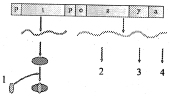
What does '$1$' represent in the given figure?
A
Inducer
B
Repressor
C
Regulatory gene
D
$m-RNA$
Solution
(A) The provided figure represents the $lac$ operon model. In this model,the $i$ gene codes for the repressor protein. This repressor protein binds to the operator region to prevent transcription. When an inducer (like lactose) is present,it binds to the repressor protein,changing its conformation so it can no longer bind to the operator. Thus,'$1$' represents the inducer molecule.
0 likes
View Solution108
MediumMCQ
What does '$2$' represent in the given figure?
A
Permease
B
Operator
C
Transacetylase
D
$\beta$-galactosidase
Solution
(D) The provided figure represents the $lac$ operon model.
In the $lac$ operon,the structural genes are $z$,$y$,and $a$.
- Gene $z$ codes for $\beta$-galactosidase.
- Gene $y$ codes for permease.
- Gene $a$ codes for transacetylase.
In the diagram,the labels $2$,$3$,and $4$ correspond to the products of genes $z$,$y$,and $a$ respectively.
Therefore,'$2$' represents $\beta$-galactosidase.
In the $lac$ operon,the structural genes are $z$,$y$,and $a$.
- Gene $z$ codes for $\beta$-galactosidase.
- Gene $y$ codes for permease.
- Gene $a$ codes for transacetylase.
In the diagram,the labels $2$,$3$,and $4$ correspond to the products of genes $z$,$y$,and $a$ respectively.
Therefore,'$2$' represents $\beta$-galactosidase.
0 likes
View Solution109
MediumMCQ
What does '$3$' represent in the given figure?
A
Transacetylase
B
$m-RNA$
C
Repressor
D
Permease
Solution
(D) The given figure represents the $lac$ operon model.
In the $lac$ operon,the structural genes are $z$,$y$,and $a$.
- Gene $z$ codes for $\beta$-galactosidase (represented by $2$ in the figure).
- Gene $y$ codes for permease (represented by $3$ in the figure).
- Gene $a$ codes for transacetylase (represented by $4$ in the figure).
Therefore,'$3$' represents permease.
In the $lac$ operon,the structural genes are $z$,$y$,and $a$.
- Gene $z$ codes for $\beta$-galactosidase (represented by $2$ in the figure).
- Gene $y$ codes for permease (represented by $3$ in the figure).
- Gene $a$ codes for transacetylase (represented by $4$ in the figure).
Therefore,'$3$' represents permease.
0 likes
View Solution110
MediumMCQ
What does '$4$' represent in the given figure?
A
Transacetylase
B
Permease
C
Translation
D
Promoter
Solution
(A) The given figure represents the $lac$ operon model.
In the $lac$ operon,the structural genes are $z$,$y$,and $a$.
- The gene '$z$' codes for $\beta$-galactosidase $(2)$.
- The gene '$y$' codes for permease $(3)$.
- The gene '$a$' codes for transacetylase $(4)$.
Therefore,'$4$' represents transacetylase.
In the $lac$ operon,the structural genes are $z$,$y$,and $a$.
- The gene '$z$' codes for $\beta$-galactosidase $(2)$.
- The gene '$y$' codes for permease $(3)$.
- The gene '$a$' codes for transacetylase $(4)$.
Therefore,'$4$' represents transacetylase.
0 likes
View Solution111
MediumMCQ
Which of the following switches off the $lac$ operon?
A
Structural gene
B
Regulator gene
C
Operator gene
D
Promoter gene
Solution
(B) The $lac$ operon is regulated by a repressor protein.
This repressor protein is encoded by the regulator gene,known as the $lacI$ gene.
In the absence of an inducer (like lactose),the repressor protein binds to the operator gene,thereby preventing $RNA$ polymerase from transcribing the structural genes.
Thus,the regulator gene is responsible for switching off the $lac$ operon.
This repressor protein is encoded by the regulator gene,known as the $lacI$ gene.
In the absence of an inducer (like lactose),the repressor protein binds to the operator gene,thereby preventing $RNA$ polymerase from transcribing the structural genes.
Thus,the regulator gene is responsible for switching off the $lac$ operon.
0 likes
View Solution112
MediumMCQ
The lactose operon produces which enzymes?
A
$b$-galactosidase,permease and glycogen synthetase.
B
$b$-galactosidase,permease and transacetylase.
C
permease,glycogen synthetase and transacetylase.
D
$b$-galactosidase,permease and phosphoglucose isomerase.
Solution
(B) The lactose operon (model proposed by Jacob and Monod) produces three structural enzymes: $b$-galactosidase $(z)$,permease $(y)$,and transacetylase $(a)$.
$b$-galactosidase $(z)$ is responsible for the hydrolysis of lactose into glucose and galactose.
Permease $(y)$ is required for the transport of lactose into the cell.
Transacetylase $(a)$ transfers an acetyl group from acetyl-$CoA$ to $b$-galactosides.
$b$-galactosidase $(z)$ is responsible for the hydrolysis of lactose into glucose and galactose.
Permease $(y)$ is required for the transport of lactose into the cell.
Transacetylase $(a)$ transfers an acetyl group from acetyl-$CoA$ to $b$-galactosides.
0 likes
View Solution113
MediumMCQ
In $Escherichia \ coli$,$lac$ operon is induced by
A
$lactose$
B
$promoter \; gene$
C
$\beta-galactosidase$
D
$I-gene$
Solution
(A) The inducer for the $lac$ operon of $Escherichia \ coli$ is $lactose$ (specifically,$allolactose$,which is a metabolite of $lactose$).
Normally,the $lac$ operon remains in an inactive state because the repressor protein binds to the operator gene,preventing transcription.
When $lactose$ is present in the medium,it acts as an inducer.
It binds to the repressor protein,causing a conformational change that prevents the repressor from binding to the operator gene.
Consequently,the $RNA$ polymerase enzyme is free to bind to the promoter and transcribe the structural genes.
Normally,the $lac$ operon remains in an inactive state because the repressor protein binds to the operator gene,preventing transcription.
When $lactose$ is present in the medium,it acts as an inducer.
It binds to the repressor protein,causing a conformational change that prevents the repressor from binding to the operator gene.
Consequently,the $RNA$ polymerase enzyme is free to bind to the promoter and transcribe the structural genes.
0 likes
View Solution114
MediumMCQ
Lac operon is:
A
arabinose operon
B
repressible operon
C
inducible operon
D
overlapping genes
Solution
(C) The $Lac$ operon is an example of an inducible operon system.
An inducible operon is a genetic regulatory system that is normally switched off (repressed) because a repressor protein binds to the operator.
However,it becomes operational (switched on) in the presence of an inducer (such as lactose or allolactose),which binds to the repressor and prevents it from binding to the operator,thereby allowing transcription to proceed.
An inducible operon is a genetic regulatory system that is normally switched off (repressed) because a repressor protein binds to the operator.
However,it becomes operational (switched on) in the presence of an inducer (such as lactose or allolactose),which binds to the repressor and prevents it from binding to the operator,thereby allowing transcription to proceed.
0 likes
View Solution115
MediumMCQ
Operon is a
A
sequence of three nitrogen bases determining a single amino acid.
B
set of closely placed genes regulating a metabolic pathway in prokaryotes.
C
segment of $DNA$ specifying a polypeptide.
D
gene responsible for switching on and switching off other genes.
Solution
(B) An operon is a functional unit of $DNA$ containing a cluster of genes under the control of a single promoter.
It consists of structural genes,an operator,and a promoter.
Operons are primarily found in prokaryotes,where they regulate metabolic pathways by coordinating the expression of genes involved in the same process.
Therefore,it is a set of closely placed genes regulating a metabolic pathway in prokaryotes.
It consists of structural genes,an operator,and a promoter.
Operons are primarily found in prokaryotes,where they regulate metabolic pathways by coordinating the expression of genes involved in the same process.
Therefore,it is a set of closely placed genes regulating a metabolic pathway in prokaryotes.
0 likes
View Solution116
MediumMCQ
Which of the following would you expect to find in an inducible system?
A
$A$ repressor protein,which is bound to $DNA$ in the absence of any other factor.
B
$A$ repressor protein,which is bound to $DNA$ in the presence of a corepressor.
C
An activator protein,which is bound to $DNA$ in the absence of any other factor.
D
An activator protein,which is bound to $DNA$ only in the absence of an inhibitor.
Solution
(A) In an inducible operon system,such as the $lac$ operon,the gene expression is normally 'off'.
This is because a repressor protein is constitutively synthesized and binds to the operator region of the $DNA$ in the absence of an inducer (the substrate).
When the inducer is present,it binds to the repressor,causing a conformational change that prevents the repressor from binding to the $DNA$,thereby allowing transcription to proceed.
Therefore,in the absence of any other factor (like an inducer),the repressor protein remains bound to the $DNA$.
This is because a repressor protein is constitutively synthesized and binds to the operator region of the $DNA$ in the absence of an inducer (the substrate).
When the inducer is present,it binds to the repressor,causing a conformational change that prevents the repressor from binding to the $DNA$,thereby allowing transcription to proceed.
Therefore,in the absence of any other factor (like an inducer),the repressor protein remains bound to the $DNA$.
0 likes
View Solution117
MediumMCQ
What effect would you expect if gene expression of the $lac$ operon were completely repressed?
A
The cell would be more efficient without 'wasting' the energy required for the low level of $Lac Z$,$Lac Y$,and $Lac A$ gene expression.
B
Allolactose would accumulate within the cell and become toxic.
C
Lactose would not be converted into the inducer and the operon could not be induced.
D
All of the above
Solution
(C) In the $lac$ operon,a basal or low level of $Lac Z$ expression is essential even in the absence of lactose. This low level of $\beta$-galactosidase enzyme is required to convert lactose into allolactose,which acts as the inducer. If the gene expression were completely repressed,lactose could not be converted into the inducer,and therefore,the operon could never be induced even in the presence of lactose.
0 likes
View Solution118
MediumMCQ
In $lac$ operon,the regulator gene codes for
A
Aporepressor
B
Corepressor
C
Inactive repressor
D
Active repressor
Solution
(D) In the $lac$ operon,the regulator gene ($i$ gene) codes for a protein known as the repressor protein.
This repressor protein is synthesized in an active form that can bind to the operator region of the operon.
When the repressor binds to the operator,it prevents $RNA$ polymerase from transcribing the structural genes,thereby keeping the operon in an 'off' state.
Therefore,the regulator gene codes for an active repressor.
This repressor protein is synthesized in an active form that can bind to the operator region of the operon.
When the repressor binds to the operator,it prevents $RNA$ polymerase from transcribing the structural genes,thereby keeping the operon in an 'off' state.
Therefore,the regulator gene codes for an active repressor.
0 likes
View Solution119
MediumMCQ
Mark the incorrect option with respect to the $lac$ operon.
A
Is under positive as well as negative control
B
Controls catabolic pathway
C
Shows feedback repression
D
Discovered by Jacob and Monod
Solution
(C) The $lac$ operon is an inducible operon that regulates the catabolism of lactose in $E. coli$.
$1$. It is under both negative control (by the repressor protein) and positive control (by the $CAP-cAMP$ complex).
$2$. It controls a catabolic pathway,as it breaks down lactose into glucose and galactose.
$3$. It was discovered by $François$ $Jacob$ and $Jacques$ $Monod$ in $1961$.
$4$. The $lac$ operon does not show feedback repression; rather,it shows substrate induction (the presence of lactose induces the expression of the operon). Therefore,option $C$ is incorrect.
$1$. It is under both negative control (by the repressor protein) and positive control (by the $CAP-cAMP$ complex).
$2$. It controls a catabolic pathway,as it breaks down lactose into glucose and galactose.
$3$. It was discovered by $François$ $Jacob$ and $Jacques$ $Monod$ in $1961$.
$4$. The $lac$ operon does not show feedback repression; rather,it shows substrate induction (the presence of lactose induces the expression of the operon). Therefore,option $C$ is incorrect.
0 likes
View Solution120
MediumMCQ
In the $lac$ operon,the $lac$ $mRNA$:
A
Has several initiation and termination codons
B
Forms four different enzymes
C
Is not transcribed in the presence of lactose
D
Is involved in an anabolic reaction
Solution
(A) The $lac$ operon is a polycistronic unit,meaning a single $mRNA$ molecule encodes multiple proteins. Specifically,the $lac$ $mRNA$ encodes three enzymes: $\beta$-galactosidase $(lacZ)$,permease $(lacY)$,and transacetylase $(lacA)$. Because it is polycistronic,the $lac$ $mRNA$ contains multiple initiation and termination codons to facilitate the translation of these distinct polypeptide chains.
0 likes
View Solution121
MediumMCQ
The accessibility of promoter regions of bacterial $DNA$ in many cases is regulated by the interaction of proteins with sequences termed:
A
Regulators
B
Structural genes
C
Inhibitor genes
D
Operators
Solution
(D) In bacterial gene regulation,specifically in the operon model,the accessibility of the promoter region to $RNA$ polymerase is controlled by the interaction of regulatory proteins (repressors) with specific $DNA$ sequences known as operators. When a repressor protein binds to the operator,it physically blocks $RNA$ polymerase from transcribing the structural genes,thereby preventing the synthesis of $mRNA$.
0 likes
View Solution122
MediumMCQ
Which statement is correct for homeotic genes?
A
Control is exerted through homeodomain proteins
B
Mutation in these genes does not result in the conversion of one body part into another
C
Such genes have been studied extensively in humans
D
Control oncogenesis process
Solution
(A) Homeotic genes are master regulatory genes that control the body plan of an embryo along the anterior-posterior axis.
These genes encode transcription factors that contain a specific $DNA$-binding domain known as the $homeodomain$.
Mutations in homeotic genes can lead to homeotic transformations,where one body part is replaced by another (e.g.,legs growing where antennae should be in $Drosophila$).
While they are conserved across many species,they were first and most extensively studied in $Drosophila$ $melanogaster$,not humans.
They are involved in developmental patterning,not primarily in the control of oncogenesis.
These genes encode transcription factors that contain a specific $DNA$-binding domain known as the $homeodomain$.
Mutations in homeotic genes can lead to homeotic transformations,where one body part is replaced by another (e.g.,legs growing where antennae should be in $Drosophila$).
While they are conserved across many species,they were first and most extensively studied in $Drosophila$ $melanogaster$,not humans.
They are involved in developmental patterning,not primarily in the control of oncogenesis.
0 likes
View Solution123
MediumMCQ
Which of the following statements is correct regarding the repressor of the $lac$-operon?
A
It is a tetrameric protein.
B
It has a molecular weight of $16,000$.
C
It has only one binding site.
D
It is synthesized by the regulator gene ($i$-gene).
Solution
(A) The repressor protein of the $lac$-operon is synthesized by the regulator gene ($i$-gene).
It functions as a tetramer,meaning it consists of four identical subunits.
Each subunit has a molecular weight of approximately $38,000$ Daltons,making the total molecular weight of the tetramer significantly higher than $16,000$.
The repressor protein contains two distinct binding sites: one for the operator region and one for the inducer (allolactose).
Therefore,the statement that it is a tetrameric protein is correct.
It functions as a tetramer,meaning it consists of four identical subunits.
Each subunit has a molecular weight of approximately $38,000$ Daltons,making the total molecular weight of the tetramer significantly higher than $16,000$.
The repressor protein contains two distinct binding sites: one for the operator region and one for the inducer (allolactose).
Therefore,the statement that it is a tetrameric protein is correct.
0 likes
View Solution124
MediumMCQ
In the tryptophan operon,which of the following statements is correct?
A
Non-proteinaceous aporepressor is synthesised by the $R$-gene.
B
Normally,chorismic acid is not converted into tryptophan.
C
Repression is mostly connected with a catabolic pathway.
D
Enzymes produced by structural genes are normally present in the cell.
Solution
(D) The tryptophan $(trp)$ operon is an example of a repressible operon involved in an anabolic pathway (biosynthesis of tryptophan).
$1$. The $R$-gene (regulatory gene) produces an inactive protein called an aporepressor,which is proteinaceous,not non-proteinaceous. Thus,option $A$ is incorrect.
$2$. In the presence of tryptophan (the corepressor),the aporepressor becomes active and binds to the operator,preventing the conversion of chorismic acid to tryptophan. However,under normal conditions (when tryptophan is absent),the operon is active,and chorismic acid is converted into tryptophan. Thus,option $B$ is incorrect.
$3$. The $trp$ operon is an anabolic pathway (building up molecules),not a catabolic pathway. Thus,option $C$ is incorrect.
$4$. In the absence of tryptophan,the structural genes are transcribed and translated to produce enzymes that are normally present in the cell to facilitate the synthesis of tryptophan. Thus,option $D$ is the correct statement.
$1$. The $R$-gene (regulatory gene) produces an inactive protein called an aporepressor,which is proteinaceous,not non-proteinaceous. Thus,option $A$ is incorrect.
$2$. In the presence of tryptophan (the corepressor),the aporepressor becomes active and binds to the operator,preventing the conversion of chorismic acid to tryptophan. However,under normal conditions (when tryptophan is absent),the operon is active,and chorismic acid is converted into tryptophan. Thus,option $B$ is incorrect.
$3$. The $trp$ operon is an anabolic pathway (building up molecules),not a catabolic pathway. Thus,option $C$ is incorrect.
$4$. In the absence of tryptophan,the structural genes are transcribed and translated to produce enzymes that are normally present in the cell to facilitate the synthesis of tryptophan. Thus,option $D$ is the correct statement.
0 likes
View Solution125
MediumMCQ
$A$: Operator gene is functional when it is not blocked by repressor.
$R$: Regulator gene produces active protein only which acts on operon system in $E. coli$.
$R$: Regulator gene produces active protein only which acts on operon system in $E. coli$.
A
Assertion and Reason both are correct and Reason is the correct explanation of Assertion.
B
Assertion and Reason both are correct but Reason is not the correct explanation of Assertion.
C
Assertion is correct,but Reason is incorrect.
D
Both Assertion and Reason are incorrect.
Solution
(C) The Assertion is correct because the operator gene acts as a switch; when the repressor protein binds to it,transcription is blocked. When the repressor is absent or inactivated,the operator is free,allowing $RNA$ polymerase to transcribe the structural genes.
The Reason is incorrect because the regulator gene produces a repressor protein,which can be either active or inactive depending on the operon type (inducible or repressible). It does not produce 'only active protein' that acts on the system; rather,the repressor's activity is modulated by inducers or corepressors.
The Reason is incorrect because the regulator gene produces a repressor protein,which can be either active or inactive depending on the operon type (inducible or repressible). It does not produce 'only active protein' that acts on the system; rather,the repressor's activity is modulated by inducers or corepressors.
0 likes
View Solution126
MediumMCQ
$A$: $Lac$ operon exerts negative control only.
$R$: The operator is occupied by aporepressor during regulation.
$R$: The operator is occupied by aporepressor during regulation.
A
Assertion and Reason both are correct and Reason is the correct explanation of Assertion.
B
Assertion and Reason both are correct but Reason is not the correct explanation of Assertion.
C
Assertion is correct,but Reason is incorrect.
D
Both Assertion and Reason are incorrect.
Solution
(D) The $Lac$ operon exhibits both negative and positive control.
In negative control,the repressor protein binds to the operator to inhibit transcription.
In positive control,the $CAP$ (Catabolite Activator Protein) binds to the promoter to enhance transcription.
Therefore,Assertion $A$ is incorrect because it states that the $Lac$ operon exerts only negative control.
Reason $R$ is also incorrect because the operator is occupied by the active repressor protein,not the aporepressor (which is an inactive form of the repressor).
In negative control,the repressor protein binds to the operator to inhibit transcription.
In positive control,the $CAP$ (Catabolite Activator Protein) binds to the promoter to enhance transcription.
Therefore,Assertion $A$ is incorrect because it states that the $Lac$ operon exerts only negative control.
Reason $R$ is also incorrect because the operator is occupied by the active repressor protein,not the aporepressor (which is an inactive form of the repressor).
0 likes
View Solution127
MediumMCQ
An environmental agent that triggers transcription from an operon is a:
A
Depressor
B
Inducer
C
Regulator
D
Controlling element
Solution
(B) In the context of gene regulation,an operon is a cluster of genes under the control of a single promoter.
An $Inducer$ is a small molecule that triggers the transcription of an operon by binding to the repressor protein.
When the $Inducer$ binds to the repressor,it changes the shape of the repressor,preventing it from binding to the operator region.
This allows $RNA$ polymerase to bind to the promoter and initiate transcription.
For example,in the $lac$ operon,lactose acts as the $Inducer$.
An $Inducer$ is a small molecule that triggers the transcription of an operon by binding to the repressor protein.
When the $Inducer$ binds to the repressor,it changes the shape of the repressor,preventing it from binding to the operator region.
This allows $RNA$ polymerase to bind to the promoter and initiate transcription.
For example,in the $lac$ operon,lactose acts as the $Inducer$.
0 likes
View Solution128
MediumMCQ
Differentiation of organs and tissues in a developing organism is associated with:
A
Developmental mutations
B
Differential expression of genes
C
Lethal mutations
D
Deletion of genes
Solution
(B) Differentiation of organs and tissues in a developing organism is associated with the differential expression of genes.
In the regulation of gene expression,chromosomal proteins play an important role.
Chromosomal proteins are of two types: histones and non-histones.
The regulation of gene expression involves a complex interaction between histones and non-histone proteins,which determines which genes are transcribed in specific cell types.
In the regulation of gene expression,chromosomal proteins play an important role.
Chromosomal proteins are of two types: histones and non-histones.
The regulation of gene expression involves a complex interaction between histones and non-histone proteins,which determines which genes are transcribed in specific cell types.
0 likes
View Solution129
MediumMCQ
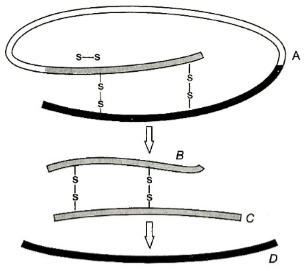
The diagram below shows a diagrammatic sketch of the maturation of insulin. Select the correct set of names labeled $A, B, C$,and $D$.
A
$A-A$-peptide,$B-B$-peptide,$C$-Proinsulin,$D$-Free $C$-Peptide
B
$A$-Proinsulin,$B$-$A$ peptide,$C$-$B$ peptide,$D$-free $C$-Peptide
C
$A$-Free $C$-Peptide,$B$-$A$-peptide,$C$-$B$-peptide,$D$-Proinsulin
D
$A$-$A$-peptide,$B$-$B$-peptide,$C$-Free $C$-peptide,$D$-Proinsulin
Solution
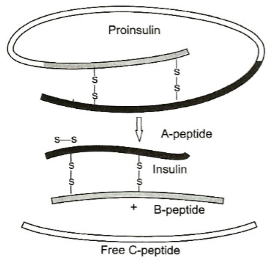
(B) The correct labeling is: $A$-Proinsulin,$B$-$A$ peptide,$C$-$B$ peptide,$D$-free $C$-Peptide.
Proinsulin is synthesized as a pro-hormone containing an extra stretch called the $C$-peptide. During the maturation process,this $C$-peptide is removed to form mature insulin,which consists of two short polypeptide chains,$A$ and $B$,linked together by disulfide bridges.
Proinsulin is synthesized as a pro-hormone containing an extra stretch called the $C$-peptide. During the maturation process,this $C$-peptide is removed to form mature insulin,which consists of two short polypeptide chains,$A$ and $B$,linked together by disulfide bridges.
0 likes
View Solution130
DifficultMCQ
Transposons can be used during which one of the following?
A
Gene silencing
B
Autoradiography
C
Gene sequencing
D
Polymerase Chain Reaction
Solution
(A) Transposons,also known as 'jumping genes',are $DNA$ sequences that can change their position within a genome.
They are widely used in molecular biology for 'transposon tagging' or 'transposon-mediated mutagenesis'.
In the context of gene function analysis,transposons are used to disrupt specific genes to study their effects,which is a fundamental technique in gene silencing (specifically,insertional mutagenesis leading to loss-of-function).
Therefore,they are effectively used in gene silencing studies to determine the function of unknown genes.
They are widely used in molecular biology for 'transposon tagging' or 'transposon-mediated mutagenesis'.
In the context of gene function analysis,transposons are used to disrupt specific genes to study their effects,which is a fundamental technique in gene silencing (specifically,insertional mutagenesis leading to loss-of-function).
Therefore,they are effectively used in gene silencing studies to determine the function of unknown genes.
0 likes
View Solution131
DifficultMCQ
In an $E. coli$ strain,the $i$ gene gets mutated such that its product cannot bind the inducer molecule. If the growth medium is provided with lactose,what will be the outcome?
A
$z, y, a$ genes will be transcribed
B
$z, y, a$ genes will not be translated
C
$RNA$ polymerase will bind the promoter region
D
Only $z$ gene will get transcribed
Solution
(B) In the $lac$ operon,the $i$ gene codes for a repressor protein.
Normally,the repressor protein binds to the operator region and prevents $RNA$ polymerase from transcribing the structural genes $(z, y, a)$.
When lactose (the inducer) is present,it binds to the repressor protein,causing a conformational change that prevents the repressor from binding to the operator.
In this specific case,the mutated $i$ gene produces a repressor that cannot bind the inducer (lactose).
Therefore,the repressor remains bound to the operator regardless of the presence of lactose.
As a result,the $RNA$ polymerase is blocked from transcribing the structural genes $(z, y, a)$.
Since transcription does not occur,the genes will not be translated into proteins.
Normally,the repressor protein binds to the operator region and prevents $RNA$ polymerase from transcribing the structural genes $(z, y, a)$.
When lactose (the inducer) is present,it binds to the repressor protein,causing a conformational change that prevents the repressor from binding to the operator.
In this specific case,the mutated $i$ gene produces a repressor that cannot bind the inducer (lactose).
Therefore,the repressor remains bound to the operator regardless of the presence of lactose.
As a result,the $RNA$ polymerase is blocked from transcribing the structural genes $(z, y, a)$.
Since transcription does not occur,the genes will not be translated into proteins.
0 likes
View Solution132
MediumMCQ
Structural gene is monocistronic $- P$
Structural gene is polycistronic $- Q$
Select the correct option for $P$ and $Q$.
$\quad\quad\quad P \quad\quad Q$
Structural gene is polycistronic $- Q$
Select the correct option for $P$ and $Q$.
$\quad\quad\quad P \quad\quad Q$
A
$Macaca \quad\quad Bacillus$
B
$Bacillus \quad\quad Macaca$
C
$Macropus \quad\quad Saccharomyces$
D
$Saccharomyces \quad\quad Macropus$
Solution
(A) In eukaryotes,structural genes are typically monocistronic,meaning one gene encodes one polypeptide chain. $Macaca$ (macaque monkey) and $Macropus$ (kangaroo) are eukaryotes.
In prokaryotes,structural genes are typically polycistronic,meaning one gene encodes multiple polypeptide chains. $Bacillus$ is a prokaryotic bacterium.
$Saccharomyces$ (yeast) is a unicellular eukaryote,and thus its structural genes are also monocistronic.
Therefore,$P$ (monocistronic) can be $Saccharomyces$ or $Macaca$,and $Q$ (polycistronic) must be a prokaryote like $Bacillus$.
Matching the options,option $A$ represents $P$ as $Macaca$ (eukaryote) and $Q$ as $Bacillus$ (prokaryote),which is correct.
In prokaryotes,structural genes are typically polycistronic,meaning one gene encodes multiple polypeptide chains. $Bacillus$ is a prokaryotic bacterium.
$Saccharomyces$ (yeast) is a unicellular eukaryote,and thus its structural genes are also monocistronic.
Therefore,$P$ (monocistronic) can be $Saccharomyces$ or $Macaca$,and $Q$ (polycistronic) must be a prokaryote like $Bacillus$.
Matching the options,option $A$ represents $P$ as $Macaca$ (eukaryote) and $Q$ as $Bacillus$ (prokaryote),which is correct.
0 likes
View Solution133
MediumMCQ
In eukaryotic organisms,gene expression regulation cannot occur at which of the following levels?
A
Transcriptional level
B
Replication level
C
Translational level
D
Transport of $mRNA$ from the nucleus to the cytoplasm
Solution
(B) In eukaryotic organisms,gene expression is regulated at several levels:
$1$. Transcriptional level (formation of primary transcript).
$2$. Processing level (regulation of splicing).
$3$. Transport of $mRNA$ from the nucleus to the cytoplasm.
$4$. Translational level.
Replication is the process of $DNA$ duplication and is not a level of gene expression regulation.
$1$. Transcriptional level (formation of primary transcript).
$2$. Processing level (regulation of splicing).
$3$. Transport of $mRNA$ from the nucleus to the cytoplasm.
$4$. Translational level.
Replication is the process of $DNA$ duplication and is not a level of gene expression regulation.
0 likes
View Solution134
EasyMCQ
Select the correct option for $\beta$-galactosidase.
A
$H_2O + \text{Lactose} \rightarrow \text{Glucose} + \text{Galactose}$
B
$H_2O + \text{Galactose} \rightarrow \text{Glucose} + \text{Lactose}$
C
$H_2O + \text{Lactose} \rightarrow \text{Galactose} + \text{Maltose}$
D
$H_2O + \text{Maltose} \rightarrow \text{Glucose} + \text{Glucose}$
Solution
(A) The enzyme $\beta$-galactosidase is encoded by the $lacZ$ gene in the $lac$ operon.
It catalyzes the hydrolysis of the disaccharide lactose into its constituent monosaccharides,glucose and galactose.
The chemical reaction is: $H_2O + \text{Lactose} \xrightarrow{\beta\text{-galactosidase}} \text{Glucose} + \text{Galactose}$.
It catalyzes the hydrolysis of the disaccharide lactose into its constituent monosaccharides,glucose and galactose.
The chemical reaction is: $H_2O + \text{Lactose} \xrightarrow{\beta\text{-galactosidase}} \text{Glucose} + \text{Galactose}$.
0 likes
View Solution135
MediumMCQ
What is the location of the product of the $Lac \, y$ gene?
A
Cytoplasm
B
Cell membrane
C
Nucleus
D
Cell wall
Solution
(B) In the $lac$ operon,the $Lac \, y$ gene codes for the enzyme $permease$.
$Permease$ is a membrane-bound protein that facilitates the transport of $lactose$ from the external environment into the cell.
Therefore,the product of the $Lac \, y$ gene is located in the cell membrane.
$Permease$ is a membrane-bound protein that facilitates the transport of $lactose$ from the external environment into the cell.
Therefore,the product of the $Lac \, y$ gene is located in the cell membrane.
0 likes
View Solution136
EasyMCQ
In the $lac$ operon,which of the following acts as an inducer?
A
Lactose
B
Lactase
C
Glucose
D
Galactose
Solution
(A) In the $lac$ operon,the regulator gene produces a repressor protein that binds to the operator region,preventing transcription.
When lactose is present in the medium,it acts as an inducer.
Lactose binds to the repressor protein,causing a conformational change that prevents the repressor from binding to the operator.
This allows $RNA$ polymerase to transcribe the structural genes,thereby initiating the expression of the $lac$ operon.
When lactose is present in the medium,it acts as an inducer.
Lactose binds to the repressor protein,causing a conformational change that prevents the repressor from binding to the operator.
This allows $RNA$ polymerase to transcribe the structural genes,thereby initiating the expression of the $lac$ operon.
0 likes
View Solution137
EasyMCQ
Which gene produces the lactose repressor?
A
$Lac \,i$
B
$Lac \,a$
C
$Lac \,y$
D
$Lac \,z$
Solution
(A) In the $Lac$ operon,the $Lac \,i$ gene codes for the repressor protein.
This repressor protein binds to the operator region and prevents transcription of the structural genes in the absence of the inducer (lactose).
Therefore,the correct option is $Lac \,i$.
This repressor protein binds to the operator region and prevents transcription of the structural genes in the absence of the inducer (lactose).
Therefore,the correct option is $Lac \,i$.
0 likes
View Solution138
DifficultMCQ
In the $lac$ operon,if a nonsense mutation occurs in the $lac\, y$ gene,which enzymes will be synthesized?
A
$\beta$-galactosidase
B
$\beta$-galactosidase and permease
C
$\beta$-galactosidase,permease,and transacetylase
D
None of the above
Solution
(A) The $lac$ operon consists of three structural genes: $lac\, z$,$lac\, y$,and $lac\, a$.
$lac\, z$ codes for $\beta$-galactosidase,$lac\, y$ codes for permease,and $lac\, a$ codes for transacetylase.
$A$ nonsense mutation in a gene introduces a premature stop codon,leading to the termination of translation for that specific polypeptide.
Since $lac$ operon genes are transcribed as a single polycistronic mRNA,a mutation in $lac\, y$ will prevent the synthesis of functional permease.
However,the translation of the upstream gene $lac\, z$ is unaffected,so $\beta$-galactosidase will still be synthesized.
The downstream gene $lac\, a$ translation is typically affected by the nonsense mutation in the upstream $lac\, y$ gene due to the nature of polycistronic translation.
Therefore,only $\beta$-galactosidase will be synthesized.
$lac\, z$ codes for $\beta$-galactosidase,$lac\, y$ codes for permease,and $lac\, a$ codes for transacetylase.
$A$ nonsense mutation in a gene introduces a premature stop codon,leading to the termination of translation for that specific polypeptide.
Since $lac$ operon genes are transcribed as a single polycistronic mRNA,a mutation in $lac\, y$ will prevent the synthesis of functional permease.
However,the translation of the upstream gene $lac\, z$ is unaffected,so $\beta$-galactosidase will still be synthesized.
The downstream gene $lac\, a$ translation is typically affected by the nonsense mutation in the upstream $lac\, y$ gene due to the nature of polycistronic translation.
Therefore,only $\beta$-galactosidase will be synthesized.
0 likes
View Solution139
MediumMCQ
Which of the following binds to the repressor,causing the repressor and the operator to dissociate from each other?
A
Inducer
B
Promoter
C
$RNA$ polymerase
D
All of the above
Solution
(A) In the $lac$ operon model,the repressor protein is synthesized in an active form that binds to the operator region,preventing $RNA$ polymerase from transcribing the structural genes.
When an inducer (such as lactose or allolactose) is present,it binds to the repressor protein.
This binding causes a conformational change in the repressor protein,rendering it inactive.
As a result,the inactive repressor can no longer bind to the operator,allowing $RNA$ polymerase to access the promoter and initiate transcription.
When an inducer (such as lactose or allolactose) is present,it binds to the repressor protein.
This binding causes a conformational change in the repressor protein,rendering it inactive.
As a result,the inactive repressor can no longer bind to the operator,allowing $RNA$ polymerase to access the promoter and initiate transcription.
0 likes
View Solution140
EasyMCQ
What are promoter,operator,and structural genes?
A
Sequences of $DNA$
B
Sequences of $mRNA$
C
Proteins
D
Sequences of $rRNA$
Solution
(A) In the context of the $lac$ operon or any operon model,the promoter,operator,and structural genes are specific segments of the $DNA$ molecule.
$1$. The promoter is the site where $RNA$ polymerase binds to initiate transcription.
$2$. The operator acts as a switch that controls the access of $RNA$ polymerase to the structural genes.
$3$. Structural genes are the segments of $DNA$ that code for specific polypeptides or enzymes.
Therefore,all these components are sequences of $DNA$.
$1$. The promoter is the site where $RNA$ polymerase binds to initiate transcription.
$2$. The operator acts as a switch that controls the access of $RNA$ polymerase to the structural genes.
$3$. Structural genes are the segments of $DNA$ that code for specific polypeptides or enzymes.
Therefore,all these components are sequences of $DNA$.
0 likes
View Solution141
MediumMCQ
Which of the following pairs does not exhibit complementarity?
A
Operator and repressor protein
B
Inducer and repressor protein
C
$DNA$ template and $mRNA$
D
$mRNA$ and protein
Solution
(D) Complementarity refers to the specific base-pairing or structural interaction where two molecules fit together like a lock and key or through hydrogen bonding.
$1$. $DNA$ template and $mRNA$ exhibit complementarity through base pairing $(A-U, T-A, C-G, G-C)$.
$2$. The operator sequence and repressor protein exhibit complementarity,as the repressor protein binds specifically to the operator site.
$3$. The inducer and repressor protein exhibit complementarity,as the inducer binds to the repressor to change its conformation.
$4$. $mRNA$ and protein do not exhibit complementarity. $mRNA$ is a sequence of nucleotides that codes for amino acids,while the protein is a sequence of amino acids. The relationship between them is governed by the genetic code (codons),not by physical complementarity or base pairing.
$1$. $DNA$ template and $mRNA$ exhibit complementarity through base pairing $(A-U, T-A, C-G, G-C)$.
$2$. The operator sequence and repressor protein exhibit complementarity,as the repressor protein binds specifically to the operator site.
$3$. The inducer and repressor protein exhibit complementarity,as the inducer binds to the repressor to change its conformation.
$4$. $mRNA$ and protein do not exhibit complementarity. $mRNA$ is a sequence of nucleotides that codes for amino acids,while the protein is a sequence of amino acids. The relationship between them is governed by the genetic code (codons),not by physical complementarity or base pairing.
0 likes
View Solution142
MediumMCQ
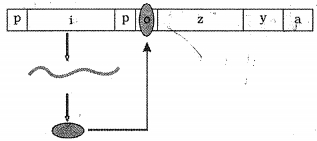
What does the given figure represent?
A
Switch off lac operon
B
Switch on lac operon
C
Switch off val operon
D
Switch on val operon
Solution
(A) The provided figure shows the $lac$ operon in a repressed state.
In the absence of an inducer (lactose),the repressor protein produced by the $i$ gene binds to the operator $(o)$ region.
This binding prevents $RNA$ polymerase from transcribing the structural genes $(z, y, a)$.
Since the transcription is blocked,this state is referred to as the 'switch off' state of the $lac$ operon.
In the absence of an inducer (lactose),the repressor protein produced by the $i$ gene binds to the operator $(o)$ region.
This binding prevents $RNA$ polymerase from transcribing the structural genes $(z, y, a)$.
Since the transcription is blocked,this state is referred to as the 'switch off' state of the $lac$ operon.
0 likes
View Solution143
MediumMCQ
In the given diagram of the lac operon,which one is the inducer?
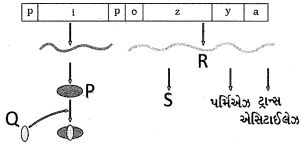
A
$P$
B
$Q$
C
$R$
D
$S$
Solution
(B) In the lac operon model,the gene '$i$' codes for the repressor protein $(P)$.
The inducer is lactose (or allolactose),which binds to the repressor protein to prevent it from binding to the operator region.
In the provided diagram,'$Q$' represents the inducer molecule that interacts with the repressor protein '$P$' to inhibit its binding to the operator.
Therefore,'$Q$' is the inducer.
The inducer is lactose (or allolactose),which binds to the repressor protein to prevent it from binding to the operator region.
In the provided diagram,'$Q$' represents the inducer molecule that interacts with the repressor protein '$P$' to inhibit its binding to the operator.
Therefore,'$Q$' is the inducer.
0 likes
View Solution144
MediumMCQ
During $DNA$ transcription,$mRNA$ is usually single-stranded. However,sometimes an $RNA$ molecule is produced that is complementary to the $mRNA$. This is called ...... and its function is to ...... .
A
antisense $RNA,$ block translation
B
antisense $RNA,$ block transcription
C
antisense $RNA,$ promote translation
D
sense $RNA,$ promote transcription
Solution
(A) During the process of gene regulation,an $RNA$ molecule that is complementary to the $mRNA$ strand is known as antisense $RNA$.
This antisense $RNA$ binds to the complementary $mRNA$ sequence,forming a double-stranded structure.
This binding prevents the ribosome from accessing the $mRNA$,thereby blocking the process of translation.
Therefore,the correct option is $A$.
This antisense $RNA$ binds to the complementary $mRNA$ sequence,forming a double-stranded structure.
This binding prevents the ribosome from accessing the $mRNA$,thereby blocking the process of translation.
Therefore,the correct option is $A$.
0 likes
View Solution145
MediumMCQ
In $lac$ operon,$z$ gene codes for:
A
$\beta$-galactosidase
B
Permease
C
Repressor
D
Transacetylase
Solution
(A) In the $lac$ operon,the structural genes are $z$,$y$,and $a$.
$1$. The $z$ gene codes for $\beta$-galactosidase,which is responsible for the hydrolysis of lactose into galactose and glucose.
$2$. The $y$ gene codes for permease,which increases the permeability of the cell to $\beta$-galactosides.
$3$. The $a$ gene codes for transacetylase.
Therefore,the $z$ gene codes for $\beta$-galactosidase.
$1$. The $z$ gene codes for $\beta$-galactosidase,which is responsible for the hydrolysis of lactose into galactose and glucose.
$2$. The $y$ gene codes for permease,which increases the permeability of the cell to $\beta$-galactosides.
$3$. The $a$ gene codes for transacetylase.
Therefore,the $z$ gene codes for $\beta$-galactosidase.
0 likes
View Solution146
MediumMCQ
Match List-$I$ with List-$II$:
Choose the correct answer from the options given below:
| List-$I$ | List-$II$ |
| $a$. In lac operon $i$ gene codes for | $i$. Transacetylase |
| $b$. In lac operon $z$ gene codes for | $ii$. Permease |
| $c$. In lac operon $y$ gene codes for | $iii$. $\beta$-galactosidase |
| $d$. In lac operon $a$ gene codes for | $iv$. Repressor |
Choose the correct answer from the options given below:
A
$(a)-(iii), (b)-(ii), (c)-(i), (d)-(iv)$
B
$(a)-(iv), (b)-(iii), (c)-(ii), (d)-(i)$
C
$(a)-(iv), (b)-(i), (c)-(iii), (d)-(ii)$
D
$(a)-(iii), (b)-(i), (c)-(iv), (d)-(ii)$
Solution
(B) In the $lac$ operon model, the genes have specific functions:
$1$. The $i$ gene codes for the repressor protein, which regulates the operon.
$2$. The $z$ gene codes for $\beta$-galactosidase, which is responsible for the hydrolysis of lactose into galactose and glucose.
$3$. The $y$ gene codes for permease, which increases the permeability of the cell to $\beta$-galactosides.
$4$. The $a$ gene codes for transacetylase, which transfers an acetyl group to $\beta$-galactosides.
Therefore, the correct matching is: $a-iv, b-iii, c-ii, d-i$.
$1$. The $i$ gene codes for the repressor protein, which regulates the operon.
$2$. The $z$ gene codes for $\beta$-galactosidase, which is responsible for the hydrolysis of lactose into galactose and glucose.
$3$. The $y$ gene codes for permease, which increases the permeability of the cell to $\beta$-galactosides.
$4$. The $a$ gene codes for transacetylase, which transfers an acetyl group to $\beta$-galactosides.
Therefore, the correct matching is: $a-iv, b-iii, c-ii, d-i$.
0 likes
View Solution147
MediumMCQ
Match List-$I$ with List-$II$.
Choose the correct answer from the options given below:
| List-$I$ | List-$II$ |
|---|---|
| $A$. Gene $a$ | $I$. $\beta$-galactosidase |
| $B$. Gene $y$ | $II$. Transacetylase |
| $C$. Gene $i$ | $III$. Permease |
| $D$. Gene $z$ | $IV$. Repressor protein |
Choose the correct answer from the options given below:
A
$A-II, B-III, C-IV, D-I$
B
$A-II, B-I, C-IV, D-III$
C
$A-III, B-II, C-IV, D-I$
D
$A-I, B-III, C-IV, D-II$
Solution
(A) In the $lac$ operon model,the structural genes and the regulator gene have specific functions:
$1$. Gene $z$: Codes for the enzyme $\beta$-galactosidase,which is responsible for the hydrolysis of lactose into galactose and glucose.
$2$. Gene $y$: Codes for the enzyme permease,which increases the permeability of the cell to $\beta$-galactosides.
$3$. Gene $a$: Codes for the enzyme transacetylase.
$4$. Gene $i$: Codes for the repressor protein,which binds to the operator region to prevent transcription in the absence of an inducer.
Therefore,the correct matching is: $A-II, B-III, C-IV, D-I$.
$1$. Gene $z$: Codes for the enzyme $\beta$-galactosidase,which is responsible for the hydrolysis of lactose into galactose and glucose.
$2$. Gene $y$: Codes for the enzyme permease,which increases the permeability of the cell to $\beta$-galactosides.
$3$. Gene $a$: Codes for the enzyme transacetylase.
$4$. Gene $i$: Codes for the repressor protein,which binds to the operator region to prevent transcription in the absence of an inducer.
Therefore,the correct matching is: $A-II, B-III, C-IV, D-I$.
0 likes
View Solution148
MediumMCQ
The lactose present in the growth medium of bacteria is transported to the cell by the action of
A
Acetylase
B
Permease
C
Polymerase
D
Beta-galactosidase
Solution
(B) The $y$ gene of the $lac$ operon codes for the enzyme permease.
Permease increases the permeability of the bacterial cell membrane to $\beta$-galactosides,including lactose.
Therefore,the lactose present in the growth medium is transported into the cell by the action of permease.
Permease increases the permeability of the bacterial cell membrane to $\beta$-galactosides,including lactose.
Therefore,the lactose present in the growth medium is transported into the cell by the action of permease.
0 likes
View Solution149
MediumMCQ
In the $lac$ operon model,lactose molecules function as:
A
Inducers which bind with operator gene
B
Repressors which bind with operator gene
C
Inducers which bind with repressor protein
D
Co-repressors which bind with repressor protein
Solution
(C) In the $lac$ operon model,the repressor protein is synthesized by the $i$-gene.
In the absence of the inducer (lactose),the repressor protein binds to the operator region and prevents $RNA$ polymerase from transcribing the operon.
When lactose is present,it acts as an inducer.
Lactose binds to the repressor protein,causing a conformational change that prevents the repressor from binding to the operator.
This allows $RNA$ polymerase to access the promoter and transcribe the structural genes.
Therefore,lactose functions as an inducer that binds with the repressor protein.
In the absence of the inducer (lactose),the repressor protein binds to the operator region and prevents $RNA$ polymerase from transcribing the operon.
When lactose is present,it acts as an inducer.
Lactose binds to the repressor protein,causing a conformational change that prevents the repressor from binding to the operator.
This allows $RNA$ polymerase to access the promoter and transcribe the structural genes.
Therefore,lactose functions as an inducer that binds with the repressor protein.
0 likes
View Solution150
MediumMCQ
Which of the following statements concerning the regulatory gene $(i)$,associated with the $lac$ operon are incorrect?
$(I.)$ $\text{mRNA}$ is transcribed from the $i$ gene whether lactose is present or not.
$(II.)$ $\text{mRNA}$ is transcribed from the $i$ gene only when the lactose is present.
$(III.)$ $\text{mRNA}$ is transcribed from the $i$ gene only when the lactose is not present.
$(IV.)$ Lactose inhibits the translation of $i$ gene $\text{mRNA}$.
$(I.)$ $\text{mRNA}$ is transcribed from the $i$ gene whether lactose is present or not.
$(II.)$ $\text{mRNA}$ is transcribed from the $i$ gene only when the lactose is present.
$(III.)$ $\text{mRNA}$ is transcribed from the $i$ gene only when the lactose is not present.
$(IV.)$ Lactose inhibits the translation of $i$ gene $\text{mRNA}$.
A
Only $I$ and $II$
B
Only $II$ and $III$
C
Only $III$ and $IV$
D
Only $II, III$ and $IV$
Solution
(D) The regulatory gene $(i)$ in the $lac$ operon codes for the repressor protein.
This gene is constitutive,meaning it is expressed continuously at a low level regardless of the presence or absence of the inducer (lactose).
Therefore,statement $(I)$ is correct because $\text{mRNA}$ is transcribed from the $i$ gene in both conditions.
Statements $(II)$ and $(III)$ are incorrect because they suggest the gene is regulated by the presence of lactose,which is false.
Statement $(IV)$ is incorrect because lactose acts as an inducer that binds to the repressor protein,not by inhibiting the translation of the $i$ gene $\text{mRNA}$.
Since the question asks for the incorrect statements,$(II)$,$(III)$,and $(IV)$ are the incorrect ones.
This gene is constitutive,meaning it is expressed continuously at a low level regardless of the presence or absence of the inducer (lactose).
Therefore,statement $(I)$ is correct because $\text{mRNA}$ is transcribed from the $i$ gene in both conditions.
Statements $(II)$ and $(III)$ are incorrect because they suggest the gene is regulated by the presence of lactose,which is false.
Statement $(IV)$ is incorrect because lactose acts as an inducer that binds to the repressor protein,not by inhibiting the translation of the $i$ gene $\text{mRNA}$.
Since the question asks for the incorrect statements,$(II)$,$(III)$,and $(IV)$ are the incorrect ones.
0 likes
View SolutionMolecular Basis of Inheritance — Gene regulation · Frequently Asked Questions
1Are these Molecular Basis of Inheritance questions useful for JEE and NEET?
Yes. All questions in this section are mapped to JEE Main and NEET exam patterns. Previous year questions from JEE Main, NEET, GUJCET and state-level exams are included with full solutions.
2Can I switch to Hindi or Gujarati for these questions?
Yes. Use the language tabs in the hero section or the sidebar to view the same questions and solutions in English, Hindi or Gujarati.
3How do I generate a question paper from this subtopic?
Use the Vedclass Exam Paper Generator — select the chapter and subtopic, set difficulty, and generate Sets A, B, C, D automatically. First 3 chapters of every subject are free.
Vedclass Products
For Students
Vedclass Test Series
Mock tests in real JEE/NEET style with performance analysis. 5-day free trial.
Start Free TrialFor Teachers
Exam Paper Generator
Generate Set A/B/C/D papers from this chapter in 2 minutes. 3 chapters free.
Try FreeFor Institutes
Online Exam Module
Live online exams with unlimited students, 360° analytics & white-label branding.
See DemoFor Teachers & Institutes
Generate a Molecular Basis of Inheritance Exam Paper in 2 Minutes
Select subtopic & difficulty — Sets A, B, C, D auto-generated with No Repeat logic.
First 3 chapters of every subject are free — no payment required.