
A English
Gene regulation Questions in English
Class 12 Biology · Molecular Basis of Inheritance · Gene regulation
177+
Questions
English
Language
100%
With Solutions
Showing 50 of 177 questions in English
51
EasyMCQ
The one gene-one enzyme hypothesis was postulated by
A
Beadle and Tatum
B
$R$. Franklin
C
Hershey and Chase
D
$A$. Garrod
Solution
(A) The correct answer is $A$.
In $1941$,George Beadle and Edward Tatum proposed the one gene-one enzyme hypothesis.
This hypothesis states that each gene is responsible for the synthesis of a specific enzyme that controls a particular metabolic step in an organism.
This work laid the foundation for biochemical genetics,for which they were awarded the Nobel Prize in $1958$.
Later,this theory was refined to the one gene-one polypeptide hypothesis,as many enzymes are composed of multiple polypeptide chains,and one gene typically codes for one polypeptide.
In $1941$,George Beadle and Edward Tatum proposed the one gene-one enzyme hypothesis.
This hypothesis states that each gene is responsible for the synthesis of a specific enzyme that controls a particular metabolic step in an organism.
This work laid the foundation for biochemical genetics,for which they were awarded the Nobel Prize in $1958$.
Later,this theory was refined to the one gene-one polypeptide hypothesis,as many enzymes are composed of multiple polypeptide chains,and one gene typically codes for one polypeptide.
0 likes
View Solution52
MediumMCQ
Which enzyme is the expression product of the $y$ gene in the $lac$-operon?
A
Beta-galactosidase
B
Permease
C
Transacetylase
D
Lactase
Solution
(B) In the $lac$-operon model,the structural genes are $z$,$y$,and $a$.
$1$. The $z$ gene codes for $\beta$-galactosidase,which is responsible for the hydrolysis of lactose into glucose and galactose.
$2$. The $y$ gene codes for permease,which increases the permeability of the cell to $\beta$-galactosides like lactose.
$3$. The $a$ gene codes for transacetylase,which transfers an acetyl group to $\beta$-galactosides.
Therefore,the expression of the $y$ gene results in the production of permease.
$1$. The $z$ gene codes for $\beta$-galactosidase,which is responsible for the hydrolysis of lactose into glucose and galactose.
$2$. The $y$ gene codes for permease,which increases the permeability of the cell to $\beta$-galactosides like lactose.
$3$. The $a$ gene codes for transacetylase,which transfers an acetyl group to $\beta$-galactosides.
Therefore,the expression of the $y$ gene results in the production of permease.
0 likes
View Solution53
MediumMCQ
At what level does gene expression not occur?
A
Formation of primary transcript
B
Processing level
C
Translation level
D
Replication level
Solution
(D) In eukaryotes,the regulation of gene expression can be exerted at various levels:
$1$. Transcriptional level (formation of primary transcript).
$2$. Processing level (regulation of splicing).
$3$. Transport of mRNA from nucleus to the cytoplasm.
$4$. Translational level.
Replication is the process of $DNA$ duplication and is not a level of gene expression regulation. Therefore,the correct option is $D$.
$1$. Transcriptional level (formation of primary transcript).
$2$. Processing level (regulation of splicing).
$3$. Transport of mRNA from nucleus to the cytoplasm.
$4$. Translational level.
Replication is the process of $DNA$ duplication and is not a level of gene expression regulation. Therefore,the correct option is $D$.
0 likes
View Solution54
MediumMCQ
Which enzyme$(s)$ is/are responsible for the transformation of lactose to galactose and glucose in the $E. coli$ culture medium?
A
$B$-galactosidase
B
Permease
C
Transacetylase
D
All of the above
Solution
(A) In the $lac$ operon of $E. coli$,the $lacZ$ gene codes for the enzyme $B$-galactosidase.
This enzyme is responsible for the hydrolysis of the disaccharide lactose into its monomeric units,galactose and glucose.
Permease (coded by $lacY$) facilitates the entry of lactose into the cell,and Transacetylase (coded by $lacA$) is involved in the detoxification of the cell,but only $B$-galactosidase performs the specific transformation of lactose into galactose and glucose.
This enzyme is responsible for the hydrolysis of the disaccharide lactose into its monomeric units,galactose and glucose.
Permease (coded by $lacY$) facilitates the entry of lactose into the cell,and Transacetylase (coded by $lacA$) is involved in the detoxification of the cell,but only $B$-galactosidase performs the specific transformation of lactose into galactose and glucose.
0 likes
View Solution55
MediumMCQ
In the $lac$ operon,which gene is responsible for coding the repressor protein?
A
$i$-gene
B
$z$-gene
C
$y$-gene
D
$a$-gene
Solution
(A) In the $lac$ operon model,the $i$-gene codes for the repressor protein.
This repressor protein binds to the operator region ($o$-gene) and prevents $RNA$ polymerase from transcribing the operon in the absence of an inducer (lactose).
The $z$-gene codes for $\beta$-galactosidase,the $y$-gene codes for permease,and the $a$-gene codes for transacetylase.
This repressor protein binds to the operator region ($o$-gene) and prevents $RNA$ polymerase from transcribing the operon in the absence of an inducer (lactose).
The $z$-gene codes for $\beta$-galactosidase,the $y$-gene codes for permease,and the $a$-gene codes for transacetylase.
0 likes
View Solution56
EasyMCQ
$Y$ gene in $lac$ operon is responsible for .....
A
Codes for $\beta$-galactosidase
B
Primarily responsible for hydrolysis of the disaccharide
C
Encodes for transacetylase
D
Codes for permease
Solution
(D) In the $lac$ operon,there are three structural genes: $lacZ$,$lacY$,and $lacA$.
$1$. The $lacZ$ gene codes for $\beta$-galactosidase,which is responsible for the hydrolysis of lactose into glucose and galactose.
$2$. The $lacY$ gene codes for permease,which increases the permeability of the cell to $\beta$-galactosides like lactose.
$3$. The $lacA$ gene codes for transacetylase.
Therefore,the $Y$ gene is responsible for coding for permease.
$1$. The $lacZ$ gene codes for $\beta$-galactosidase,which is responsible for the hydrolysis of lactose into glucose and galactose.
$2$. The $lacY$ gene codes for permease,which increases the permeability of the cell to $\beta$-galactosides like lactose.
$3$. The $lacA$ gene codes for transacetylase.
Therefore,the $Y$ gene is responsible for coding for permease.
0 likes
View Solution57
MediumMCQ
Which of the following acts as an inducer for the $lac$ operon in $Escherichia$ $coli$?
A
Lactose
B
Promoter gene
C
$\beta$-galactosidase
D
$i$ gene
Solution
(A) In the $lac$ operon of $Escherichia$ $coli$,the $i$ gene codes for a repressor protein that binds to the operator region and prevents transcription.
When lactose is present in the medium,it enters the cell and is converted into its isomer,allolactose.
Allolactose acts as an inducer by binding to the repressor protein,which changes the shape of the repressor so that it can no longer bind to the operator.
This allows $RNA$ polymerase to transcribe the structural genes,thus lactose (or its isomer allolactose) acts as the inducer for the $lac$ operon.
When lactose is present in the medium,it enters the cell and is converted into its isomer,allolactose.
Allolactose acts as an inducer by binding to the repressor protein,which changes the shape of the repressor so that it can no longer bind to the operator.
This allows $RNA$ polymerase to transcribe the structural genes,thus lactose (or its isomer allolactose) acts as the inducer for the $lac$ operon.
0 likes
View Solution58
MediumMCQ
Wild-type $E. coli$ cells are grown in a normal medium containing glucose. They are then transferred to a medium containing only lactose as the sugar source. Which of the following changes will occur?
A
The $lac$ operon is repressed.
B
All operons are induced.
C
The $lac$ operon is induced.
D
$E. coli$ cells stop dividing.
Solution
(C) In $E. coli$,the $lac$ operon is responsible for the metabolism of lactose.
When glucose is present,the $lac$ operon is repressed because glucose is the preferred energy source.
When glucose is removed and only lactose is provided,lactose acts as an inducer.
It binds to the repressor protein,preventing it from binding to the operator region.
This allows $RNA$ polymerase to transcribe the structural genes,thereby inducing the $lac$ operon.
When glucose is present,the $lac$ operon is repressed because glucose is the preferred energy source.
When glucose is removed and only lactose is provided,lactose acts as an inducer.
It binds to the repressor protein,preventing it from binding to the operator region.
This allows $RNA$ polymerase to transcribe the structural genes,thereby inducing the $lac$ operon.
0 likes
View Solution59
MediumMCQ
Genes that are involved in turning on or off the transcription of a set of structural genes are called:
A
Polymorphic genes
B
Operator genes
C
Reductant genes
D
Regulatory genes
Solution
(D) Regulatory genes are responsible for controlling the expression of other genes by producing proteins (repressors or activators) that bind to specific $DNA$ sequences. These proteins regulate the transcription of structural genes,effectively turning them on or off. This mechanism is a fundamental part of operon models,such as the $lac$ operon in $E. coli$.
0 likes
View Solution60
MediumMCQ
In a negative operon,
A
a co-repressor binds to the repressor.
B
a co-repressor does not bind to the repressor.
C
a co-repressor binds to the inducer.
D
$cAMP$ has a negative effect on the $lac$ operon.
Solution
(A) In a negative operon system,the regulator gene produces a repressor protein that binds to the operator to prevent transcription. In a repressible negative operon,the repressor is initially inactive. $A$ co-repressor molecule binds to the inactive repressor,activating it so that it can bind to the operator and block transcription. Therefore,the correct statement is that a co-repressor binds to the repressor.
0 likes
View Solution61
MediumMCQ
During lactose metabolism in $E. coli$,the repressor protein binds to the ...........
A
Regulatory gene
B
Operator gene
C
Structural gene
D
Promoter gene
Solution
(B) In the $lac$ operon model of $E. coli$,the $i$ gene codes for a repressor protein.
This repressor protein is constitutively synthesized and binds to the operator region $(O)$ in the absence of the inducer (lactose).
By binding to the operator,it prevents $RNA$ polymerase from transcribing the structural genes $(z, y, a)$.
Therefore,the repressor protein binds to the operator gene.
This repressor protein is constitutively synthesized and binds to the operator region $(O)$ in the absence of the inducer (lactose).
By binding to the operator,it prevents $RNA$ polymerase from transcribing the structural genes $(z, y, a)$.
Therefore,the repressor protein binds to the operator gene.
0 likes
View Solution62
MediumMCQ
Jacob and Monod studied lactose metabolism in $E. coli$ and proposed the operon concept. The operon concept is applicable to:
A
All prokaryotes
B
All prokaryotes and some eukaryotes
C
All prokaryotes and all eukaryotes
D
All prokaryotes and some protozoans
Solution
(A) The operon model,proposed by Jacob and Monod,describes a coordinated unit of gene expression in bacteria.
It consists of a set of structural genes,an operator,and a promoter.
This mechanism of gene regulation is a fundamental characteristic of prokaryotic organisms.
While some operon-like structures (such as polycistronic transcription) have been identified in certain eukaryotes (like $C. elegans$),the classic operon model is primarily and universally applicable to all prokaryotes.
It consists of a set of structural genes,an operator,and a promoter.
This mechanism of gene regulation is a fundamental characteristic of prokaryotic organisms.
While some operon-like structures (such as polycistronic transcription) have been identified in certain eukaryotes (like $C. elegans$),the classic operon model is primarily and universally applicable to all prokaryotes.
0 likes
View Solution63
MediumMCQ
In the $lac$ operon, what does the term "$lac$" refer to?
A
Lac insect
B
$1,00,000$ (a number)
C
Lactose
D
Laccase
Solution
(C) The $lac$ operon is a classic example of an inducible operon in $E. coli$ that regulates the metabolism of lactose.
In the term "$lac$ operon", "$lac$" stands for lactose.
The operon consists of genes that code for enzymes required to transport and break down lactose into glucose and galactose when lactose is present in the medium.
In the term "$lac$ operon", "$lac$" stands for lactose.
The operon consists of genes that code for enzymes required to transport and break down lactose into glucose and galactose when lactose is present in the medium.
0 likes
View Solution64
MediumMCQ
The differentiation of organs and tissues in a developing organism is associated with which of the following?
A
Developmental mutations
B
Differential expression of genes
C
Harmful mutations
D
Loss of genes
Solution
(B) In a developing organism,all cells contain the same set of genomic $DNA$.
However,different cells differentiate into specific tissues and organs because they express different sets of genes.
This process is known as the differential expression of genes,which is regulated by various transcription factors and epigenetic mechanisms.
Therefore,the correct answer is $B$.
However,different cells differentiate into specific tissues and organs because they express different sets of genes.
This process is known as the differential expression of genes,which is regulated by various transcription factors and epigenetic mechanisms.
Therefore,the correct answer is $B$.
0 likes
View Solution65
MediumMCQ
Human gene expression is regulated when steroid molecules bind to:
A
Transfer $RNA$
B
Messenger $RNA$
C
Specific $DNA$ sequences
D
Ribosomes
Solution
(C) Steroid hormones are lipophilic molecules that can easily cross the plasma membrane of the cell.
Once inside the cytoplasm or nucleus,they bind to specific intracellular receptor proteins.
This hormone-receptor complex then acts as a transcription factor by binding to specific $DNA$ sequences (hormone response elements) in the promoter region of target genes.
This binding regulates the transcription of these genes,thereby controlling gene expression.
Once inside the cytoplasm or nucleus,they bind to specific intracellular receptor proteins.
This hormone-receptor complex then acts as a transcription factor by binding to specific $DNA$ sequences (hormone response elements) in the promoter region of target genes.
This binding regulates the transcription of these genes,thereby controlling gene expression.
0 likes
View Solution66
MediumMCQ
Select two statements out of the four given statements $(i-iv)$ with respect to the $lac$ operon.
$(i)$ Glucose or galactose binds with the repressor and inactivates it.
$(ii)$ In the absence of lactose,the repressor binds with the operator.
$(iii)$ The $Z$-gene codes for permease.
$(iv)$ It was elucidated by Francois Jacob and Jacques Monod.
$(i)$ Glucose or galactose binds with the repressor and inactivates it.
$(ii)$ In the absence of lactose,the repressor binds with the operator.
$(iii)$ The $Z$-gene codes for permease.
$(iv)$ It was elucidated by Francois Jacob and Jacques Monod.
A
$(i)$ and $(iii)$
B
$(i)$ and $(iv)$
C
$(ii)$ and $(iv)$
D
$(i)$ and $(ii)$
Solution
(C) The $lac$ operon model was proposed by Francois Jacob and Jacques Monod,making statement $(iv)$ correct.
In the absence of lactose,the repressor protein binds to the operator region,preventing $RNA$ polymerase from transcribing the structural genes,making statement $(ii)$ correct.
Statement $(i)$ is incorrect because it is lactose (the inducer),not glucose or galactose,that binds to the repressor.
Statement $(iii)$ is incorrect because the $Z$-gene codes for $\beta$-galactosidase,while the $Y$-gene codes for permease.
Therefore,statements $(ii)$ and $(iv)$ are correct.
In the absence of lactose,the repressor protein binds to the operator region,preventing $RNA$ polymerase from transcribing the structural genes,making statement $(ii)$ correct.
Statement $(i)$ is incorrect because it is lactose (the inducer),not glucose or galactose,that binds to the repressor.
Statement $(iii)$ is incorrect because the $Z$-gene codes for $\beta$-galactosidase,while the $Y$-gene codes for permease.
Therefore,statements $(ii)$ and $(iv)$ are correct.
0 likes
View Solution67
DifficultMCQ
In the $lac$ operon,which enzyme$(s)$ will be produced in the cell if there is a nonsense mutation in the $lac$ $y$ gene?
A
$\beta$-galactosidase
B
Lactose permease
C
Transacetylase
D
$\beta$-galactosidase and transacetylase
Solution
(A) The $lac$ operon consists of three structural genes: $lac$ $z$,$lac$ $y$,and $lac$ $a$.
$lac$ $z$ codes for $\beta$-galactosidase,$lac$ $y$ codes for lactose permease,and $lac$ $a$ codes for transacetylase.
$A$ nonsense mutation in the $lac$ $y$ gene introduces a premature stop codon,which terminates the translation of the lactose permease protein.
Since the genes in the $lac$ operon are transcribed as a single polycistronic mRNA,the mutation in $lac$ $y$ prevents the translation of downstream genes ($lac$ $a$) due to the premature termination of the ribosome.
However,the $lac$ $z$ gene is located upstream of the $lac$ $y$ gene and is translated independently before the ribosome reaches the mutated $lac$ $y$ site.
Therefore,only $\beta$-galactosidase (encoded by $lac$ $z$) will be produced,while lactose permease and transacetylase will not be produced.
$lac$ $z$ codes for $\beta$-galactosidase,$lac$ $y$ codes for lactose permease,and $lac$ $a$ codes for transacetylase.
$A$ nonsense mutation in the $lac$ $y$ gene introduces a premature stop codon,which terminates the translation of the lactose permease protein.
Since the genes in the $lac$ operon are transcribed as a single polycistronic mRNA,the mutation in $lac$ $y$ prevents the translation of downstream genes ($lac$ $a$) due to the premature termination of the ribosome.
However,the $lac$ $z$ gene is located upstream of the $lac$ $y$ gene and is translated independently before the ribosome reaches the mutated $lac$ $y$ site.
Therefore,only $\beta$-galactosidase (encoded by $lac$ $z$) will be produced,while lactose permease and transacetylase will not be produced.
0 likes
View Solution68
EasyMCQ
What is the structural gene equivalent to?
A
Neutron
B
Cistron
C
Operon
D
Recon
Solution
(B) In molecular genetics,a structural gene is a gene that codes for any $RNA$ or protein product other than a regulatory factor. The term $Cistron$ is used to describe a segment of $DNA$ that codes for a single polypeptide chain. Therefore,a structural gene is equivalent to a $Cistron$.
0 likes
View Solution69
MediumMCQ
Which of the following is required as an inducer for the expression of the $lac$ operon?
A
Galactose
B
Lactose
C
Lactose and Galactose
D
Glucose
Solution
(B) The $lac$ operon is an inducible operon that regulates the metabolism of lactose in $E. coli$.
In the absence of lactose,the repressor protein binds to the operator region,preventing $RNA$ polymerase from transcribing the structural genes.
When lactose is present in the medium,it enters the cell and is converted into its isomer,allolactose,by a small amount of $\beta$-galactosidase enzyme.
Allolactose acts as an inducer by binding to the repressor protein,which causes a conformational change in the repressor,rendering it unable to bind to the operator.
This allows $RNA$ polymerase to transcribe the structural genes $(lacZ, lacY, lacA)$,thus expressing the operon.
Therefore,lactose is the inducer for the $lac$ operon.
In the absence of lactose,the repressor protein binds to the operator region,preventing $RNA$ polymerase from transcribing the structural genes.
When lactose is present in the medium,it enters the cell and is converted into its isomer,allolactose,by a small amount of $\beta$-galactosidase enzyme.
Allolactose acts as an inducer by binding to the repressor protein,which causes a conformational change in the repressor,rendering it unable to bind to the operator.
This allows $RNA$ polymerase to transcribe the structural genes $(lacZ, lacY, lacA)$,thus expressing the operon.
Therefore,lactose is the inducer for the $lac$ operon.
0 likes
View Solution70
MediumMCQ
All of the following are part of an operon except:
A
a promoter
B
an operator
C
an enhancer
D
structural genes
Solution
(C) An operon is a functional unit of $DNA$ in bacteria and phages,consisting of a cluster of genes under the control of a single promoter.
An operon typically includes:
$1$. Structural genes: These code for the proteins or enzymes required for a metabolic pathway.
$2$. $A$ promoter: The site where $RNA$ polymerase binds to initiate transcription.
$3$. An operator: $A$ segment of $DNA$ that acts as a switch,where a repressor protein binds to prevent transcription.
Enhancers are regulatory $DNA$ sequences that increase the rate of transcription,but they are primarily associated with eukaryotic gene regulation,not prokaryotic operons.
An operon typically includes:
$1$. Structural genes: These code for the proteins or enzymes required for a metabolic pathway.
$2$. $A$ promoter: The site where $RNA$ polymerase binds to initiate transcription.
$3$. An operator: $A$ segment of $DNA$ that acts as a switch,where a repressor protein binds to prevent transcription.
Enhancers are regulatory $DNA$ sequences that increase the rate of transcription,but they are primarily associated with eukaryotic gene regulation,not prokaryotic operons.
2 likes
View Solution71
EasyMCQ
Select the $correct$ match:
A
Francois Jacob and Jacques Monod - $Lac\,operon$
B
Alec Jeffreys - $Streptococcus\,pneumoniae$
C
Matthew Meselson and $F$. Stahl - $Pisum\,sativum$
D
Alfred Hershey and Martha Chase - $TMV$
Solution
(A) $1$. Francois Jacob and Jacques Monod proposed the $Lac\,operon$ model in $1961$ to explain gene regulation in $E. coli$.
$2$. Alec Jeffreys is known for developing $DNA$ fingerprinting,not for $Streptococcus\,pneumoniae$ (which was studied by Frederick Griffith).
$3$. Matthew Meselson and $F$. Stahl provided experimental evidence for the semi-conservative replication of $DNA$ in $E. coli$,not $Pisum\,sativum$ (which was studied by Gregor Mendel).
$4$. Alfred Hershey and Martha Chase conducted experiments with bacteriophages to prove that $DNA$ is the genetic material,not $TMV$ (Tobacco Mosaic Virus).
$2$. Alec Jeffreys is known for developing $DNA$ fingerprinting,not for $Streptococcus\,pneumoniae$ (which was studied by Frederick Griffith).
$3$. Matthew Meselson and $F$. Stahl provided experimental evidence for the semi-conservative replication of $DNA$ in $E. coli$,not $Pisum\,sativum$ (which was studied by Gregor Mendel).
$4$. Alfred Hershey and Martha Chase conducted experiments with bacteriophages to prove that $DNA$ is the genetic material,not $TMV$ (Tobacco Mosaic Virus).
0 likes
View Solution72
MediumMCQ
Match the following genes of the $Lac$ operon with their respective products.
Select the correct option.
| $(a)\; i$ gene | $(i)\; \beta-\text{galactosidase}$ |
| $(b)\; z$ gene | $(ii)\; \text{Permease}$ |
| $(c)\; a$ gene | $(iii)\; \text{Repressor}$ |
| $(d)\; y$ gene | $(iv)\; \text{Transacetylase}$ |
Select the correct option.
A
$(i), (iii), (ii), (iv)$
B
$(iii), (i), (ii), (iv)$
C
$(iii), (i), (iv), (ii)$
D
$(iii), (iv), (i), (ii)$
Solution
(C) In the $Lac$ operon:
$1$. The $i$ gene codes for the repressor protein,which regulates the operon.
$2$. The $z$ gene codes for $\beta-\text{galactosidase}$,which hydrolyzes lactose into glucose and galactose.
$3$. The $y$ gene codes for permease,which increases the permeability of the cell to $\beta-\text{galactosides}$.
$4$. The $a$ gene codes for transacetylase,which transfers an acetyl group to $\beta-\text{galactosides}$.
Matching these:
$(a) - (iii)$
$(b) - (i)$
$(c) - (iv)$
$(d) - (ii)$
Therefore,the correct sequence is $(iii), (i), (iv), (ii)$.
$1$. The $i$ gene codes for the repressor protein,which regulates the operon.
$2$. The $z$ gene codes for $\beta-\text{galactosidase}$,which hydrolyzes lactose into glucose and galactose.
$3$. The $y$ gene codes for permease,which increases the permeability of the cell to $\beta-\text{galactosides}$.
$4$. The $a$ gene codes for transacetylase,which transfers an acetyl group to $\beta-\text{galactosides}$.
Matching these:
$(a) - (iii)$
$(b) - (i)$
$(c) - (iv)$
$(d) - (ii)$
Therefore,the correct sequence is $(iii), (i), (iv), (ii)$.
0 likes
View Solution73
Medium
In the medium where $E$. coli was growing, lactose was added, which induced the lac operon. Then, why does the lac operon shut down some time after the addition of lactose in the medium?
Solution
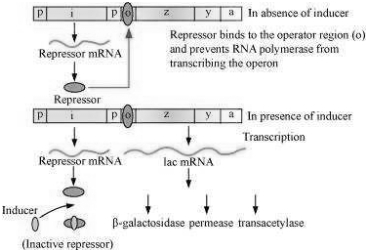
(N/A) The lac operon is a segment of $DNA$ consisting of three structural genes $(z, y, a)$, an operator gene, a promoter gene, and a regulator gene. It functions in a coordinated manner to metabolize lactose into glucose and galactose.
In the lac operon, lactose acts as an inducer. It binds to the repressor protein and inactivates it. Once the repressor is inactivated, $RNA$ polymerase can bind to the promoter region and initiate transcription. Consequently, the three structural genes express their products, and the respective enzymes ($\beta$-galactosidase, permease, and transacetylase) are produced.
These enzymes act on lactose, metabolizing it into glucose and galactose. After some time, as the level of the inducer (lactose) decreases due to its consumption by the enzymes, the repressor protein is no longer inactivated. The regulator gene synthesizes the active repressor, which binds to the operator gene and prevents $RNA$ polymerase from transcribing the operon. Thus, transcription is stopped. This type of regulation is known as negative regulation.
In the lac operon, lactose acts as an inducer. It binds to the repressor protein and inactivates it. Once the repressor is inactivated, $RNA$ polymerase can bind to the promoter region and initiate transcription. Consequently, the three structural genes express their products, and the respective enzymes ($\beta$-galactosidase, permease, and transacetylase) are produced.
These enzymes act on lactose, metabolizing it into glucose and galactose. After some time, as the level of the inducer (lactose) decreases due to its consumption by the enzymes, the repressor protein is no longer inactivated. The regulator gene synthesizes the active repressor, which binds to the operator gene and prevents $RNA$ polymerase from transcribing the operon. Thus, transcription is stopped. This type of regulation is known as negative regulation.
0 likes
View Solution74
Medium
How is gene expression regulated in eukaryotes?
Solution
(N/A) Gene expression results in the formation of a polypeptide.
In eukaryotes,regulation can be exerted at various levels:
$(i)$ Transcriptional level (formation of primary transcript).
$(ii)$ Processing level (regulation of splicing).
$(iii)$ Transport of $mRNA$ from the nucleus to the cytoplasm.
$(iv)$ Translational level.
Genes in a cell are expressed to perform a specific function or a set of functions.
For example,the enzyme $\beta$-galactosidase in $E. coli$ hydrolyzes lactose into galactose and glucose. However,if lactose is absent in the medium,the synthesis of $\beta$-galactosidase is not required.
Thus,metabolic,physiological,or environmental conditions regulate gene expression.
In eukaryotes,regulation can be exerted at various levels:
$(i)$ Transcriptional level (formation of primary transcript).
$(ii)$ Processing level (regulation of splicing).
$(iii)$ Transport of $mRNA$ from the nucleus to the cytoplasm.
$(iv)$ Translational level.
Genes in a cell are expressed to perform a specific function or a set of functions.
For example,the enzyme $\beta$-galactosidase in $E. coli$ hydrolyzes lactose into galactose and glucose. However,if lactose is absent in the medium,the synthesis of $\beta$-galactosidase is not required.
Thus,metabolic,physiological,or environmental conditions regulate gene expression.
0 likes
View Solution75
Medium
Describe the regulation of gene expression in prokaryotes with an example.
Solution
(N/A) In prokaryotes,the regulation of gene expression is primarily achieved by controlling the rate of transcriptional initiation.
The activity of $RNA$ polymerase at a given promoter in a transcription unit is regulated by the interaction with accessory proteins,which affect the ability to recognize start sites.
These regulatory proteins can act both positively (activators) and negatively (repressors).
The accessibility of promoter regions in prokaryotic $DNA$ is,in many cases,regulated by the interaction of proteins with specific sequences termed $operators$.
In most cases,the operator is located adjacent to the promoter element. Each operon has its specific operator and specific repressor. For example,the $lac$ operator is present only in the $lac$ operon and it interacts specifically with the $lac$ repressor.
The activity of $RNA$ polymerase at a given promoter in a transcription unit is regulated by the interaction with accessory proteins,which affect the ability to recognize start sites.
These regulatory proteins can act both positively (activators) and negatively (repressors).
The accessibility of promoter regions in prokaryotic $DNA$ is,in many cases,regulated by the interaction of proteins with specific sequences termed $operators$.
In most cases,the operator is located adjacent to the promoter element. Each operon has its specific operator and specific repressor. For example,the $lac$ operator is present only in the $lac$ operon and it interacts specifically with the $lac$ repressor.
0 likes
View Solution76
Medium
Write a short note on the lac operon.
Solution
(N/A) Francois Jacob and Jacque Monod in $1961$ were the first to propose the concept of transcriptionally regulated systems by a common promoter and regulatory genes.
Such an arrangement is referred to as an operon,e.g.,lac (lactose) operon,trp (tryptophan) operon,ara (arabinose) operon,his (histidine) operon,and val (valine) operon.
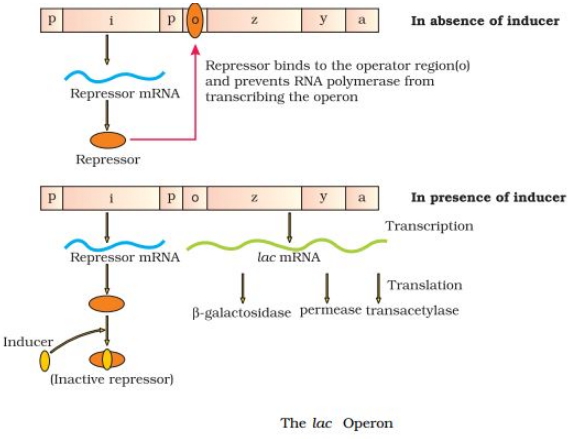
Structure of the lac operon: The lac operon consists of one regulatory gene (the $i$ gene—here the term $i$ does not refer to inducer,rather it is derived from the word inhibitor) and three structural genes ($z$,$y$,and $a$).
The $i$ gene codes for the repressor of the lac operon.
The $z$ gene codes for beta-galactosidase ($\beta$-gal),which is primarily responsible for the hydrolysis of the disaccharide,lactose,into its monomeric units,galactose and glucose.
The $y$ gene codes for permease,which increases the permeability of the cell to $\beta$-galactosides.
The $a$ gene encodes a transacetylase.
Hence,all three gene products in the lac operon are required for the metabolism of lactose.
In most other operons as well,the genes present in the operon are needed together to function in the same or related metabolic pathway.
Lactose is the substrate for the enzyme beta-galactosidase,and it regulates the switching on and off of the operon.
Hence,it is termed as an inducer.
Such an arrangement is referred to as an operon,e.g.,lac (lactose) operon,trp (tryptophan) operon,ara (arabinose) operon,his (histidine) operon,and val (valine) operon.
Structure of the lac operon: The lac operon consists of one regulatory gene (the $i$ gene—here the term $i$ does not refer to inducer,rather it is derived from the word inhibitor) and three structural genes ($z$,$y$,and $a$).
The $i$ gene codes for the repressor of the lac operon.
The $z$ gene codes for beta-galactosidase ($\beta$-gal),which is primarily responsible for the hydrolysis of the disaccharide,lactose,into its monomeric units,galactose and glucose.
The $y$ gene codes for permease,which increases the permeability of the cell to $\beta$-galactosides.
The $a$ gene encodes a transacetylase.
Hence,all three gene products in the lac operon are required for the metabolism of lactose.
In most other operons as well,the genes present in the operon are needed together to function in the same or related metabolic pathway.
Lactose is the substrate for the enzyme beta-galactosidase,and it regulates the switching on and off of the operon.
Hence,it is termed as an inducer.
0 likes
View Solution77
Medium
Explain the contribution of the scientists: François Jacob and Jacques Monod.
Solution
(N/A) François Jacob,a geneticist,and Jacques Monod,a biochemist,were the first to elucidate the mechanism of gene regulation in bacteria. They proposed the $Lac$ operon model in $1961$. This model explains how the expression of genes involved in lactose metabolism is regulated by the presence or absence of lactose in the environment. Their work provided a fundamental understanding of how genes are switched 'on' or 'off' in response to environmental stimuli,which is a cornerstone of molecular biology.
0 likes
View Solution78
MediumMCQ
$A$ low level of expression of lac operon occurs at all the time. Can you explain the logic behind this phenomenon?
A
To maintain basal metabolism
B
To allow the entry of lactose into the cell
C
To prevent the accumulation of glucose
D
To regulate the synthesis of repressor protein
Solution
(B) In the complete absence of expression of the $lac$ operon,the enzyme permease will not be synthesized.
Permease is essential for the transport of lactose from the medium into the cell.
If lactose cannot be transported into the cell,it cannot act as an inducer.
Consequently,it cannot bind to the repressor protein to relieve the $lac$ operon from its repressed state.
Therefore,a basal (low) level of expression is required to allow the initial entry of lactose into the cell.
Permease is essential for the transport of lactose from the medium into the cell.
If lactose cannot be transported into the cell,it cannot act as an inducer.
Consequently,it cannot bind to the repressor protein to relieve the $lac$ operon from its repressed state.
Therefore,a basal (low) level of expression is required to allow the initial entry of lactose into the cell.
0 likes
View Solution79
Medium
Define an operon,give an example,and explain an inducible operon.
Solution
(N/A) An operon is a functional unit of $DNA$ in bacteria that consists of a cluster of genes under the control of a single promoter. These genes are transcribed together into a single polycistronic mRNA molecule. Examples include the $lac$ operon,$trp$ operon,$ara$ operon,$his$ operon,and $val$ operon.
An inducible operon is a system that is usually turned 'off' but can be switched 'on' in the presence of a specific molecule called an inducer. The $lac$ operon is a classic example of an inducible operon.
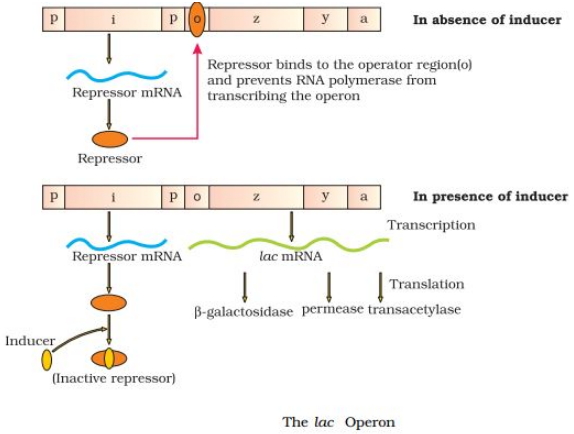
The $lac$ operon consists of one regulatory gene (the $i$ gene,which codes for a repressor protein) and three structural genes ($z$,$y$,and $a$).
$1$. In the absence of an inducer (lactose),the repressor protein binds to the operator region $(o)$,preventing $RNA$ polymerase from transcribing the structural genes.
$2$. In the presence of an inducer (allolactose),the inducer binds to the repressor protein,rendering it inactive. The inactive repressor cannot bind to the operator,allowing $RNA$ polymerase to transcribe the structural genes ($z$,$y$,and $a$).
The $z$ gene codes for $\beta$-galactosidase,which hydrolyzes lactose into glucose and galactose. The $y$ gene codes for permease,which increases the cell's permeability to $\beta$-galactosides. The $a$ gene encodes transacetylase.
An inducible operon is a system that is usually turned 'off' but can be switched 'on' in the presence of a specific molecule called an inducer. The $lac$ operon is a classic example of an inducible operon.
The $lac$ operon consists of one regulatory gene (the $i$ gene,which codes for a repressor protein) and three structural genes ($z$,$y$,and $a$).
$1$. In the absence of an inducer (lactose),the repressor protein binds to the operator region $(o)$,preventing $RNA$ polymerase from transcribing the structural genes.
$2$. In the presence of an inducer (allolactose),the inducer binds to the repressor protein,rendering it inactive. The inactive repressor cannot bind to the operator,allowing $RNA$ polymerase to transcribe the structural genes ($z$,$y$,and $a$).
The $z$ gene codes for $\beta$-galactosidase,which hydrolyzes lactose into glucose and galactose. The $y$ gene codes for permease,which increases the cell's permeability to $\beta$-galactosides. The $a$ gene encodes transacetylase.
0 likes
View Solution80
Medium
Write an explanatory note on gene expression.
Solution
(N/A) Gene expression is the process by which the information encoded in a gene is used to synthesize a functional gene product,typically a polypeptide.
Gene regulation is the mechanism of switching 'off' and 'on' genes depending upon the requirements of the cells and the stage of development.
The regulation of gene expression may occur at various levels:
In eukaryotes,it takes place at the following levels:
$(i)$ Transcriptional level: Formation of primary transcript.
$(ii)$ Processing level: Regulation of splicing.
$(iii)$ Transport of $mRNA$: From the nucleus to the cytoplasm.
$(iv)$ Translational level: Protein synthesis.
In prokaryotes,gene expression is primarily regulated by controlling the rate of initiation of transcription.
Genes in a cell are expressed to perform a particular function or a set of functions.
The metabolic,physiological,or environmental conditions regulate the expression of genes.
The development and differentiation of an embryo into an adult organism are also a result of the coordinated regulation of the expression of several sets of genes.
In a transcription unit,the activity of $RNA$ polymerase at a given promoter is regulated by the interaction with accessory proteins,which affect its ability to recognize start sites.
The accessibility of promoter regions of prokaryotic $DNA$ is often regulated by the interaction of proteins with sequences termed as operators.
The operator region is adjacent to the promoter elements in most operons,and in most cases,the sequences of the operator bind a repressor protein.
Each operon has its specific operator and specific repressor; for example,the $lac$ operator is present only in the $lac$ operon and interacts only with the $lac$ repressor.
Gene regulation is the mechanism of switching 'off' and 'on' genes depending upon the requirements of the cells and the stage of development.
The regulation of gene expression may occur at various levels:
In eukaryotes,it takes place at the following levels:
$(i)$ Transcriptional level: Formation of primary transcript.
$(ii)$ Processing level: Regulation of splicing.
$(iii)$ Transport of $mRNA$: From the nucleus to the cytoplasm.
$(iv)$ Translational level: Protein synthesis.
In prokaryotes,gene expression is primarily regulated by controlling the rate of initiation of transcription.
Genes in a cell are expressed to perform a particular function or a set of functions.
The metabolic,physiological,or environmental conditions regulate the expression of genes.
The development and differentiation of an embryo into an adult organism are also a result of the coordinated regulation of the expression of several sets of genes.
In a transcription unit,the activity of $RNA$ polymerase at a given promoter is regulated by the interaction with accessory proteins,which affect its ability to recognize start sites.
The accessibility of promoter regions of prokaryotic $DNA$ is often regulated by the interaction of proteins with sequences termed as operators.
The operator region is adjacent to the promoter elements in most operons,and in most cases,the sequences of the operator bind a repressor protein.
Each operon has its specific operator and specific repressor; for example,the $lac$ operator is present only in the $lac$ operon and interacts only with the $lac$ repressor.
0 likes
View Solution81
Easy
Provide definitions/explanations for the following terms: Splicing and Operator gene.
Solution
(N/A) $(1)$ Splicing: The primary transcripts (pre-$mRNA$) contain both exons (coding sequences) and introns (non-coding sequences) and are non-functional. Splicing is the process by which introns are removed and exons are joined together in a defined order to form mature functional $mRNA$.
$(2)$ Operator gene: It is a segment of $DNA$ that acts as a switch for the operon. It provides a binding site for the repressor protein. When the repressor is bound to the operator,it blocks the passage of $RNA$ polymerase from the promoter to the structural genes,thereby controlling the activity of the structural genes.
$(2)$ Operator gene: It is a segment of $DNA$ that acts as a switch for the operon. It provides a binding site for the repressor protein. When the repressor is bound to the operator,it blocks the passage of $RNA$ polymerase from the promoter to the structural genes,thereby controlling the activity of the structural genes.
0 likes
View Solution82
Easy
Define the following terms: Regulator gene and Promoter gene.
Solution
(N/A) $(1)$ Regulator gene: It controls the activity of the operator gene by producing repressor molecules.
$(2)$ Promoter gene: It is an initiation point for transcription and serves as the binding site for $RNA$ polymerase.
$(2)$ Promoter gene: It is an initiation point for transcription and serves as the binding site for $RNA$ polymerase.
0 likes
View Solution83
MediumMCQ
In which of the following are monocistronic genes found?
A
$BGA$
B
$PPLO$
C
Animal cells
D
All of the above
Solution
(C) Monocistronic genes are characteristic of eukaryotes,where one gene encodes one polypeptide chain. $BGA$ (Blue-Green Algae/Cyanobacteria) and $PPLO$ (Pleuropneumonia-like organisms/Mycoplasma) are prokaryotes,which typically possess polycistronic genes. Animal cells are eukaryotic and therefore contain monocistronic genes.
0 likes
View Solution84
MediumMCQ
At which level does the regulation of gene expression occur?
A
Transcriptional level
B
Translational level
C
Processing level
D
All of the above
Solution
(D) In eukaryotes,the regulation of gene expression can be exerted at various levels:
$1$. Transcriptional level (formation of primary transcript).
$2$. Processing level (regulation of splicing).
$3$. Transport of mRNA from the nucleus to the cytoplasm.
$4$. Translational level.
Therefore,gene expression is regulated at multiple levels including transcriptional,processing,and translational stages.
$1$. Transcriptional level (formation of primary transcript).
$2$. Processing level (regulation of splicing).
$3$. Transport of mRNA from the nucleus to the cytoplasm.
$4$. Translational level.
Therefore,gene expression is regulated at multiple levels including transcriptional,processing,and translational stages.
0 likes
View Solution85
MediumMCQ
Which of the following is the substrate for $\beta$-galactosidase?
A
Galactose
B
Glucose
C
Lactose
D
Fructose
Solution
(C) The enzyme $\beta$-galactosidase is encoded by the $lacZ$ gene in the $lac$ operon.
Its primary function is to catalyze the hydrolysis of the disaccharide lactose into its constituent monosaccharides,glucose and galactose.
Therefore,lactose acts as the substrate for the enzyme $\beta$-galactosidase.
Its primary function is to catalyze the hydrolysis of the disaccharide lactose into its constituent monosaccharides,glucose and galactose.
Therefore,lactose acts as the substrate for the enzyme $\beta$-galactosidase.
0 likes
View Solution86
MediumMCQ
When do bacteria $NOT$ produce $\beta$-galactosidase?
A
Absence of maltose
B
Absence of lactose
C
Absence of fructose
D
Absence of sucrose
Solution
(B) In the $lac$ operon system,the enzyme $\beta$-galactosidase is encoded by the $lacZ$ gene.
This gene is part of an inducible operon system.
In the absence of lactose (the inducer),the repressor protein binds to the operator region,preventing $RNA$ polymerase from transcribing the structural genes ($lacZ$,$lacY$,and $lacA$).
Therefore,$\beta$-galactosidase is not produced when lactose is absent.
This gene is part of an inducible operon system.
In the absence of lactose (the inducer),the repressor protein binds to the operator region,preventing $RNA$ polymerase from transcribing the structural genes ($lacZ$,$lacY$,and $lacA$).
Therefore,$\beta$-galactosidase is not produced when lactose is absent.
0 likes
View Solution87
MediumMCQ
Who provided the clear explanation of the $Lac$ operon?
A
Meselson and Stahl
B
Francois Jacob and Jacques Monod
C
Alec Jeffreys
D
Gamow
Solution
(B) The $Lac$ operon model was proposed by $Francois$ $Jacob$ and $Jacques$ $Monod$ in $1961$. They were the first to elucidate the mechanism of transcriptional regulation in prokaryotes,specifically how $E. coli$ regulates the metabolism of lactose. Therefore,the correct option is $B$.
0 likes
View Solution88
MediumMCQ
At which level is gene expression regulated in the $lac$ operon of $E. coli$?
A
Transcriptional level
B
Post-translational level
C
Processing level
D
Level of transport of $mRNA$ from nucleus to cytoplasm
Solution
(A) In prokaryotes like $E. coli$,the primary control of gene expression occurs at the level of transcription initiation.
In the $lac$ operon,the regulation is primarily achieved by controlling the access of $RNA$ polymerase to the promoter site.
This is mediated by the interaction of a repressor protein with the operator region,which prevents transcription when the inducer (lactose) is absent.
Therefore,the correct level of regulation is the transcriptional level.
In the $lac$ operon,the regulation is primarily achieved by controlling the access of $RNA$ polymerase to the promoter site.
This is mediated by the interaction of a repressor protein with the operator region,which prevents transcription when the inducer (lactose) is absent.
Therefore,the correct level of regulation is the transcriptional level.
0 likes
View Solution89
MediumMCQ
Which of the following is not a structural gene of the $Lac$ operon?
A
Regulatory gene
B
$Lac-z$
C
$Lac-y$
D
$Lac-a$
Solution
(A) The $Lac$ operon consists of three structural genes: $Lac-z$,$Lac-y$,and $Lac-a$.
$Lac-z$ codes for $\beta$-galactosidase,$Lac-y$ codes for permease,and $Lac-a$ codes for transacetylase.
The regulatory gene (often denoted as $i$-gene) is not a structural gene; it codes for the repressor protein that regulates the expression of the operon.
Therefore,the regulatory gene is the correct answer.
$Lac-z$ codes for $\beta$-galactosidase,$Lac-y$ codes for permease,and $Lac-a$ codes for transacetylase.
The regulatory gene (often denoted as $i$-gene) is not a structural gene; it codes for the repressor protein that regulates the expression of the operon.
Therefore,the regulatory gene is the correct answer.
0 likes
View Solution90
MediumMCQ
What does the $i$ gene encode in the $lac$ operon?
A
$\beta$-galactosidase
B
Permease
C
Repressor protein
D
Lactose
Solution
(C) In the $lac$ operon,the $i$ gene stands for the inhibitor gene.
It codes for the repressor protein of the $lac$ operon.
This repressor protein binds to the operator region and prevents transcription of the structural genes in the absence of the inducer (lactose).
Therefore,the correct option is $C$.
It codes for the repressor protein of the $lac$ operon.
This repressor protein binds to the operator region and prevents transcription of the structural genes in the absence of the inducer (lactose).
Therefore,the correct option is $C$.
0 likes
View Solution91
EasyMCQ
The $lac \, y$ gene codes for which of the following?
A
Permease
B
Transacetylase
C
Inducer
D
Repressor
Solution
(A) In the $lac$ operon of $E. coli$,there are three structural genes: $lac \, z$,$lac \, y$,and $lac \, a$.
$1$. The $lac \, z$ gene codes for $\beta$-galactosidase,which is responsible for the hydrolysis of lactose into galactose and glucose.
$2$. The $lac \, y$ gene codes for permease,which increases the permeability of the cell to $\beta$-galactosides like lactose.
$3$. The $lac \, a$ gene codes for transacetylase.
Therefore,the $lac \, y$ gene codes for permease.
$1$. The $lac \, z$ gene codes for $\beta$-galactosidase,which is responsible for the hydrolysis of lactose into galactose and glucose.
$2$. The $lac \, y$ gene codes for permease,which increases the permeability of the cell to $\beta$-galactosides like lactose.
$3$. The $lac \, a$ gene codes for transacetylase.
Therefore,the $lac \, y$ gene codes for permease.
0 likes
View Solution92
MediumMCQ
The proteins encoded by all the structural genes of the $lac$ operon are essential for which process?
A
Lactose metabolism
B
Glucose metabolism
C
Galactose metabolism
D
Fructose metabolism
Solution
(A) The $lac$ operon in $E. coli$ consists of three structural genes: $lacZ$,$lacY$,and $lacA$.
$lacZ$ encodes $\beta$-galactosidase,which hydrolyzes lactose into glucose and galactose.
$lacY$ encodes permease,which increases the permeability of the cell to $\beta$-galactosides like lactose.
$lacA$ encodes transacetylase.
Together,these proteins are essential for the uptake and metabolism of lactose in the cell.
$lacZ$ encodes $\beta$-galactosidase,which hydrolyzes lactose into glucose and galactose.
$lacY$ encodes permease,which increases the permeability of the cell to $\beta$-galactosides like lactose.
$lacA$ encodes transacetylase.
Together,these proteins are essential for the uptake and metabolism of lactose in the cell.
0 likes
View Solution93
MediumMCQ
The $lac$ operon is a part of which of the following?
A
$RNA$
B
$DNA$
C
Polypeptide
D
Both $A$ and $B$
Solution
(B) The $lac$ operon is a functional unit of $DNA$ in bacteria,specifically in $E. coli$.
It consists of a cluster of genes under the control of a single promoter and operator.
Since it is a segment of the bacterial genome,it is composed of $DNA$ sequences.
Therefore,the $lac$ operon is a part of $DNA$.
It consists of a cluster of genes under the control of a single promoter and operator.
Since it is a segment of the bacterial genome,it is composed of $DNA$ sequences.
Therefore,the $lac$ operon is a part of $DNA$.
0 likes
View Solution94
MediumMCQ
What happens if an $ATT$ sequence appears in the middle of the template strand of the $Lac\, y$ gene?
A
Synthesis of $\beta$-galactosidase,permease,and transacetylase stops.
B
Synthesis of transacetylase occurs,but permease synthesis stops.
C
Synthesis of $\beta$-galactosidase occurs,but permease and transacetylase synthesis stops.
D
Synthesis of $\beta$-galactosidase,permease,and transacetylase occurs.
Solution
(C) The $Lac$ operon consists of three structural genes: $Lac\, z$,$Lac\, y$,and $Lac\, a$.
$Lac\, z$ codes for $\beta$-galactosidase,$Lac\, y$ codes for permease,and $Lac\, a$ codes for transacetylase.
If an $ATT$ sequence appears in the template strand,it corresponds to a $UAA$ stop codon in the $mRNA$ transcript.
Since $Lac\, y$ is located downstream of $Lac\, z$,a mutation (like a premature stop codon) in $Lac\, y$ will prevent the synthesis of permease.
Because the $Lac$ operon is transcribed as a single polycistronic $mRNA$,a stop codon in $Lac\, y$ will also terminate the translation of the downstream gene $Lac\, a$ (transacetylase).
However,$Lac\, z$ is located upstream of $Lac\, y$,so its translation remains unaffected.
Therefore,$\beta$-galactosidase will be synthesized,but permease and transacetylase synthesis will stop.
$Lac\, z$ codes for $\beta$-galactosidase,$Lac\, y$ codes for permease,and $Lac\, a$ codes for transacetylase.
If an $ATT$ sequence appears in the template strand,it corresponds to a $UAA$ stop codon in the $mRNA$ transcript.
Since $Lac\, y$ is located downstream of $Lac\, z$,a mutation (like a premature stop codon) in $Lac\, y$ will prevent the synthesis of permease.
Because the $Lac$ operon is transcribed as a single polycistronic $mRNA$,a stop codon in $Lac\, y$ will also terminate the translation of the downstream gene $Lac\, a$ (transacetylase).
However,$Lac\, z$ is located upstream of $Lac\, y$,so its translation remains unaffected.
Therefore,$\beta$-galactosidase will be synthesized,but permease and transacetylase synthesis will stop.
0 likes
View Solution95
MediumMCQ
Which of the following acts as an inducer for the $lac$ operon?
A
Glucose
B
Galactose
C
Maltose
D
Allolactose
Solution
(D) In the $lac$ operon,the presence of lactose acts as an inducer.
When lactose enters the cell,a small amount of it is converted into its isomer,$allolactose$,by the enzyme $\beta-galactosidase$.
$Allolactose$ binds to the repressor protein,causing a conformational change that prevents the repressor from binding to the operator region.
This allows $RNA$ polymerase to transcribe the structural genes $(lacZ, lacY, lacA)$,thereby inducing the operon.
When lactose enters the cell,a small amount of it is converted into its isomer,$allolactose$,by the enzyme $\beta-galactosidase$.
$Allolactose$ binds to the repressor protein,causing a conformational change that prevents the repressor from binding to the operator region.
This allows $RNA$ polymerase to transcribe the structural genes $(lacZ, lacY, lacA)$,thereby inducing the operon.
0 likes
View Solution96
MediumMCQ
The switching on and off of the $lac$ operon is regulated by which of the following?
A
Repressor
B
Structural gene
C
Promoter
D
Inducer
Solution
(D) The $lac$ operon is an inducible operon system.
In the absence of an inducer (lactose),the repressor protein binds to the operator region,preventing $RNA$ polymerase from transcribing the structural genes,thus keeping the operon 'switched off'.
In the presence of an inducer (lactose or allolactose),the inducer binds to the repressor protein,causing a conformational change that prevents the repressor from binding to the operator.
This allows $RNA$ polymerase to transcribe the structural genes,effectively 'switching on' the operon.
Therefore,the presence or absence of the inducer is the primary factor regulating the switching on and off of the $lac$ operon.
In the absence of an inducer (lactose),the repressor protein binds to the operator region,preventing $RNA$ polymerase from transcribing the structural genes,thus keeping the operon 'switched off'.
In the presence of an inducer (lactose or allolactose),the inducer binds to the repressor protein,causing a conformational change that prevents the repressor from binding to the operator.
This allows $RNA$ polymerase to transcribe the structural genes,effectively 'switching on' the operon.
Therefore,the presence or absence of the inducer is the primary factor regulating the switching on and off of the $lac$ operon.
0 likes
View Solution97
MediumMCQ
If $E. coli$ is grown in a culture medium containing both glucose and lactose as carbon sources,when will its $lac$ operon be in the 'switch on' state?
A
In the presence of glucose
B
In the presence of lactose
C
After the complete consumption of glucose
D
After the complete consumption of lactose
Solution
(C) In $E. coli$,the $lac$ operon is an inducible system regulated by both the presence of lactose and the absence of glucose.
$1$. When both glucose and lactose are present,$E. coli$ preferentially utilizes glucose because it is a simpler sugar,and the $lac$ operon remains in the 'switch off' state due to catabolite repression.
$2$. Once glucose is completely consumed,the cell switches to lactose metabolism.
$3$. The presence of lactose allows it to act as an inducer,binding to the repressor protein and preventing it from binding to the operator.
$4$. Therefore,the $lac$ operon is switched on only after the complete consumption of glucose,allowing the bacteria to utilize lactose.
$1$. When both glucose and lactose are present,$E. coli$ preferentially utilizes glucose because it is a simpler sugar,and the $lac$ operon remains in the 'switch off' state due to catabolite repression.
$2$. Once glucose is completely consumed,the cell switches to lactose metabolism.
$3$. The presence of lactose allows it to act as an inducer,binding to the repressor protein and preventing it from binding to the operator.
$4$. Therefore,the $lac$ operon is switched on only after the complete consumption of glucose,allowing the bacteria to utilize lactose.
0 likes
View Solution98
MediumMCQ
How is the $lac$ operon regulated by the repressor?
A
Positive
B
Negative
C
Inducible
D
Both $A$ and $B$
Solution
(B) The $lac$ operon is a classic example of an inducible operon that is under negative control.
In the absence of the inducer (lactose),the repressor protein binds to the operator region,which prevents $RNA$ polymerase from transcribing the structural genes.
This binding of the repressor to the operator blocks the transcription process,which is defined as negative regulation.
Therefore,the repressor acts as a negative regulator of the $lac$ operon.
In the absence of the inducer (lactose),the repressor protein binds to the operator region,which prevents $RNA$ polymerase from transcribing the structural genes.
This binding of the repressor to the operator blocks the transcription process,which is defined as negative regulation.
Therefore,the repressor acts as a negative regulator of the $lac$ operon.
0 likes
View Solution99
MediumMCQ
At which site does the repressor bind in the $Lac$ operon?
A
Operator
B
Promoter
C
$Lac\, z$
D
$Lac\, y$
Solution
(A) In the $Lac$ operon,the repressor protein is synthesized by the $i$ gene.
When lactose is absent,the repressor protein binds to the operator site.
This binding physically blocks the $RNA$ polymerase from transcribing the structural genes $(Lac\, z, Lac\, y, Lac\, a)$.
Therefore,the operator is the specific site where the repressor binds to regulate gene expression.
When lactose is absent,the repressor protein binds to the operator site.
This binding physically blocks the $RNA$ polymerase from transcribing the structural genes $(Lac\, z, Lac\, y, Lac\, a)$.
Therefore,the operator is the specific site where the repressor binds to regulate gene expression.
0 likes
View Solution100
MediumMCQ
In the $lac$ operon,which molecule binds to the promoter site?
A
$RNA$ polymerase
B
$DNA$ polymerase
C
Inducer
D
Repressor
Solution
(A) In the $lac$ operon,the $RNA$ polymerase enzyme binds to the promoter site to initiate the transcription of structural genes $(lacZ, lacY, lacA)$.
When the inducer (lactose) is present,it binds to the repressor protein,preventing it from binding to the operator,thus allowing $RNA$ polymerase to transcribe the genes.
Therefore,the molecule that binds to the promoter site to facilitate transcription is $RNA$ polymerase.
When the inducer (lactose) is present,it binds to the repressor protein,preventing it from binding to the operator,thus allowing $RNA$ polymerase to transcribe the genes.
Therefore,the molecule that binds to the promoter site to facilitate transcription is $RNA$ polymerase.
0 likes
View SolutionMolecular Basis of Inheritance — Gene regulation · Frequently Asked Questions
1Are these Molecular Basis of Inheritance questions useful for JEE and NEET?
Yes. All questions in this section are mapped to JEE Main and NEET exam patterns. Previous year questions from JEE Main, NEET, GUJCET and state-level exams are included with full solutions.
2Can I switch to Hindi or Gujarati for these questions?
Yes. Use the language tabs in the hero section or the sidebar to view the same questions and solutions in English, Hindi or Gujarati.
3How do I generate a question paper from this subtopic?
Use the Vedclass Exam Paper Generator — select the chapter and subtopic, set difficulty, and generate Sets A, B, C, D automatically. First 3 chapters of every subject are free.
Vedclass Products
For Students
Vedclass Test Series
Mock tests in real JEE/NEET style with performance analysis. 5-day free trial.
Start Free TrialFor Teachers
Exam Paper Generator
Generate Set A/B/C/D papers from this chapter in 2 minutes. 3 chapters free.
Try FreeFor Institutes
Online Exam Module
Live online exams with unlimited students, 360° analytics & white-label branding.
See DemoFor Teachers & Institutes
Generate a Molecular Basis of Inheritance Exam Paper in 2 Minutes
Select subtopic & difficulty — Sets A, B, C, D auto-generated with No Repeat logic.
First 3 chapters of every subject are free — no payment required.