
A English
Gametogenesis Questions in English
Class 12 Biology · Human Reproduction · Gametogenesis
576+
Questions
English
Language
100%
With Solutions
Showing 50 of 576 questions in English
401
MediumMCQ
Identify $c$ in the given figure.

A
Sertoli cell
B
Spermatozoa
C
Secondary spermatocyte
D
Primary spermatocyte
Solution
(C) The provided figure illustrates the process of spermatogenesis within the seminiferous tubules.
In this diagram,the cells are arranged from the periphery towards the lumen.
- The cells at the base are spermatogonia.
- The larger cells undergoing meiosis are primary spermatocytes.
- The smaller cells resulting from the first meiotic division are secondary spermatocytes.
- The label $c$ points to the secondary spermatocytes,which are haploid cells formed after the first meiotic division of primary spermatocytes.
In this diagram,the cells are arranged from the periphery towards the lumen.
- The cells at the base are spermatogonia.
- The larger cells undergoing meiosis are primary spermatocytes.
- The smaller cells resulting from the first meiotic division are secondary spermatocytes.
- The label $c$ points to the secondary spermatocytes,which are haploid cells formed after the first meiotic division of primary spermatocytes.
0 likes
View Solution402
MediumMCQ
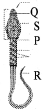
Which part of the given diagram contains enzymes necessary for fertilization?
A
$P$
B
$Q$
C
$R$
D
$S$
Solution
(B) In the given diagram of a human sperm,the part labeled $Q$ represents the acrosome.
The acrosome is a cap-like structure present at the tip of the sperm head.
It contains hydrolytic enzymes,collectively known as sperm lysins (e.g.,hyaluronidase),which are essential for penetrating the egg's protective layers during fertilization.
Therefore,the correct option is $Q$.
The acrosome is a cap-like structure present at the tip of the sperm head.
It contains hydrolytic enzymes,collectively known as sperm lysins (e.g.,hyaluronidase),which are essential for penetrating the egg's protective layers during fertilization.
Therefore,the correct option is $Q$.
0 likes
View Solution403
MediumMCQ
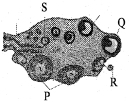
Identify the follicle showing the presence of an antrum in the given diagram.
A
$P$
B
$Q$
C
$R$
D
$S$
Solution
(A) In the given diagram of the ovary,the various stages of follicular development are shown.
$S$ represents a primary follicle.
$R$ represents a secondary follicle.
$P$ represents tertiary follicles,which are characterized by the presence of a fluid-filled cavity called the antrum.
$Q$ represents a Graafian follicle.
Therefore,the follicle showing the presence of an antrum is $P$.
$S$ represents a primary follicle.
$R$ represents a secondary follicle.
$P$ represents tertiary follicles,which are characterized by the presence of a fluid-filled cavity called the antrum.
$Q$ represents a Graafian follicle.
Therefore,the follicle showing the presence of an antrum is $P$.
0 likes
View Solution404
MediumMCQ
Identify $c$ in the given figure.

A
Female gamete
B
Primary polar body
C
Primary oocyte
D
Secondary oocyte
Solution
(D) The provided figure illustrates the process of oogenesis in human females.
$1$. The process begins with oogonia,which undergo mitosis to form primary oocytes.
$2$. The primary oocyte undergoes meiosis $I$ to produce a large secondary oocyte and a small first polar body.
$3$. In the diagram,the cell labeled $c$ represents the secondary oocyte,which is formed after the completion of meiosis $I$ and is ready to undergo meiosis $II$ (which completes only upon fertilization).
Therefore,the correct option is $D$.
$1$. The process begins with oogonia,which undergo mitosis to form primary oocytes.
$2$. The primary oocyte undergoes meiosis $I$ to produce a large secondary oocyte and a small first polar body.
$3$. In the diagram,the cell labeled $c$ represents the secondary oocyte,which is formed after the completion of meiosis $I$ and is ready to undergo meiosis $II$ (which completes only upon fertilization).
Therefore,the correct option is $D$.
0 likes
View Solution405
MediumMCQ
What is $capacitation$?
A
Increase in sperm motility
B
Decrease in sperm stability so that the acrosome can fertilize the ovum
C
Removal of cholesterol and glycoproteins from the outer membrane of the sperm,allowing the membrane to take up more $Ca^{2+}$
D
All of the above
Solution
(D) Capacitation is the physiological maturation process of spermatozoa that occurs within the female reproductive tract.
$1$. It involves the removal of cholesterol and glycoproteins from the sperm's plasma membrane,which increases membrane fluidity and permeability to $Ca^{2+}$.
$2$. This influx of $Ca^{2+}$ leads to hyperactivation,resulting in an increase in sperm motility.
$3$. These changes also facilitate the acrosome reaction,which is essential for the sperm to penetrate and fertilize the ovum.
Therefore,all the given statements are correct.
$1$. It involves the removal of cholesterol and glycoproteins from the sperm's plasma membrane,which increases membrane fluidity and permeability to $Ca^{2+}$.
$2$. This influx of $Ca^{2+}$ leads to hyperactivation,resulting in an increase in sperm motility.
$3$. These changes also facilitate the acrosome reaction,which is essential for the sperm to penetrate and fertilize the ovum.
Therefore,all the given statements are correct.
0 likes
View Solution406
EasyMCQ
Capacitation is a process associated with which of the following?
A
Ovum
B
Ovary
C
Testis
D
Sperm
Solution
(D) Capacitation is the physiological maturation process that a $Sperm$ must undergo in the female reproductive tract before it is capable of fertilizing an $Ovum$. During this process,the glycoprotein coat and seminal plasma proteins are removed from the surface of the $Sperm$ acrosome,which increases the motility of the $Sperm$ and prepares it for the acrosome reaction.
0 likes
View Solution407
EasyMCQ
Who discovered the human sperm?
A
Aristotle
B
Leeuwenhoek
C
Robert Brown
D
Both $B$ and $C$
Solution
(B) The human sperm was first observed and described by Antonie van Leeuwenhoek in $1677$. He used his self-designed microscope to observe the semen samples and identified the motile cells,which he referred to as 'animalcules'.
0 likes
View Solution408
MediumMCQ
Select the correct pair based on the amount of yolk in the egg.
A
Macrolecithal egg $-$ Mammals
B
Microlecithal egg $-$ Birds
C
Alecithal/Microlecithal egg $-$ Mammals
D
Alecithal egg $-$ Reptiles
Solution
(C) The classification of eggs based on the amount of yolk is as follows:
$1$. Alecithal/Microlecithal eggs: These contain very little or no yolk. Mammalian eggs (e.g.,human eggs) are typically alecithal or microlecithal.
$2$. Mesolecithal eggs: These contain a moderate amount of yolk (e.g.,Amphibians).
$3$. Macrolecithal/Polylecithal eggs: These contain a large amount of yolk (e.g.,Birds and Reptiles).
Therefore,the correct pair is $Alecithal/Microlecithal$ egg $-$ Mammals.
$1$. Alecithal/Microlecithal eggs: These contain very little or no yolk. Mammalian eggs (e.g.,human eggs) are typically alecithal or microlecithal.
$2$. Mesolecithal eggs: These contain a moderate amount of yolk (e.g.,Amphibians).
$3$. Macrolecithal/Polylecithal eggs: These contain a large amount of yolk (e.g.,Birds and Reptiles).
Therefore,the correct pair is $Alecithal/Microlecithal$ egg $-$ Mammals.
0 likes
View Solution409
EasyMCQ
How long does it take on average for spermatogenesis to be completed in humans?
A
$60-70$ days
B
$50-60$ days
C
$65-74$ days
D
$5-10$ days
Solution
(C) Spermatogenesis is the process of formation of spermatozoa from spermatogonia in the seminiferous tubules of the testes.
This process involves several stages including mitosis,meiosis,and spermiogenesis.
In humans,the entire process of spermatogenesis,starting from the spermatogonia to the release of mature spermatozoa (spermiation),takes approximately $65$ to $74$ days to complete.
This process involves several stages including mitosis,meiosis,and spermiogenesis.
In humans,the entire process of spermatogenesis,starting from the spermatogonia to the release of mature spermatozoa (spermiation),takes approximately $65$ to $74$ days to complete.
0 likes
View Solution410
EasyMCQ
Which cells release inhibin to inhibit spermatogenesis?
A
Vas deferens
B
Follicular cells
C
Leydig cells
D
Sertoli cells
Solution
(D) Inhibin is a hormone produced by the $Sertoli$ cells in the testes. Its primary function is to provide negative feedback to the anterior pituitary gland to inhibit the secretion of $FSH$ (Follicle Stimulating Hormone). By reducing $FSH$ levels,inhibin indirectly regulates and inhibits the process of spermatogenesis when sperm production is sufficient.
0 likes
View Solution411
EasyMCQ
Select the correct option of haploid cells from the following groups.
A
Primary spermatocyte,Secondary spermatocyte,Second polar body
B
Primary oocyte,Secondary oocyte,Spermatid
C
Secondary spermatocyte,First polar body,Ovum
D
Spermatogonia,Primary spermatocyte,Spermatid
Solution
(C) The correct answer is $C$.
$1$. Primary spermatocytes and primary oocytes are diploid $(2n)$ cells.
$2$. Spermatogonia are also diploid $(2n)$ cells.
$3$. Secondary spermatocytes,secondary oocytes,spermatids,ova,and polar bodies are haploid $(n)$ cells.
$4$. In option $C$,secondary spermatocyte $(n)$,first polar body $(n)$,and ovum $(n)$ are all haploid structures.
$1$. Primary spermatocytes and primary oocytes are diploid $(2n)$ cells.
$2$. Spermatogonia are also diploid $(2n)$ cells.
$3$. Secondary spermatocytes,secondary oocytes,spermatids,ova,and polar bodies are haploid $(n)$ cells.
$4$. In option $C$,secondary spermatocyte $(n)$,first polar body $(n)$,and ovum $(n)$ are all haploid structures.
0 likes
View Solution412
MediumMCQ
$A$ : Dictyotene stage occurs in females only.
$R$ : Gametogenesis rests for a long period at the diplotene stage in females.
$R$ : Gametogenesis rests for a long period at the diplotene stage in females.
A
Assertion and Reason both are correct and Reason is the correct explanation of Assertion.
B
Assertion and Reason both are correct but Reason is not the correct explanation of Assertion.
C
Assertion is correct,but Reason is incorrect.
D
Both Assertion and Reason are incorrect.
Solution
(A) The dictyotene stage is a prolonged diplotene stage of meiosis-$I$ in the primary oocytes of female mammals.
During oogenesis,the primary oocytes enter meiosis-$I$ but arrest at the diplotene stage until puberty.
This arrested state is specifically referred to as the dictyotene stage.
Since this process is unique to the development of female gametes (oocytes),both the Assertion and the Reason are correct,and the Reason explains why the dictyotene stage occurs.
During oogenesis,the primary oocytes enter meiosis-$I$ but arrest at the diplotene stage until puberty.
This arrested state is specifically referred to as the dictyotene stage.
Since this process is unique to the development of female gametes (oocytes),both the Assertion and the Reason are correct,and the Reason explains why the dictyotene stage occurs.
0 likes
View Solution413
MediumMCQ
Spermatogenesis is under the regulatory influence of
A
$ADH$
B
$FSH$
C
$LH$
D
$STH$
Solution
(B) Follicle Stimulating Hormone $(FSH)$ is produced by the basophilic cells of the adenohypophysis (anterior pituitary gland).
In females,this hormone is responsible for the development of ovarian follicles up to ovulation.
In males,its primary functions include the development of seminiferous tubules and the maintenance of spermatogenesis.
In females,this hormone is responsible for the development of ovarian follicles up to ovulation.
In males,its primary functions include the development of seminiferous tubules and the maintenance of spermatogenesis.
0 likes
View Solution414
MediumMCQ
In males,the spermatogenesis is regulated by
A
$FSH$
B
Androgens
C
Both $(a)$ and $(b)$
D
None
Solution
(C) Spermatogenesis in males is regulated by the hormones of the hypothalamic-pituitary-gonadal axis.
$1$. $FSH$ (Follicle Stimulating Hormone) acts on the Sertoli cells and stimulates the secretion of some factors which help in the process of spermiogenesis.
$2$. Androgens (primarily testosterone) are secreted by the Leydig cells under the influence of $LH$ (Luteinizing Hormone) and are essential for the process of spermatogenesis.
Therefore,both $FSH$ and androgens play a crucial role in regulating spermatogenesis.
$1$. $FSH$ (Follicle Stimulating Hormone) acts on the Sertoli cells and stimulates the secretion of some factors which help in the process of spermiogenesis.
$2$. Androgens (primarily testosterone) are secreted by the Leydig cells under the influence of $LH$ (Luteinizing Hormone) and are essential for the process of spermatogenesis.
Therefore,both $FSH$ and androgens play a crucial role in regulating spermatogenesis.
0 likes
View Solution415
MediumMCQ
Graafian follicle gets converted into . . . . . . after ovulation under the effect of . . . . . . .
A
Corpus callosum,$GnRH$
B
Corpus luteum,$LH$
C
Corpus albicans,$FSH$
D
Ovarian follicle,prolactin
Solution
(B) After ovulation,the ruptured Graafian follicle transforms into a yellow-colored endocrine structure known as the corpus luteum. This process is stimulated by the surge of Luteinizing Hormone $(LH)$,which is secreted by the anterior pituitary gland.
0 likes
View Solution416
EasyMCQ
Luteinising hormone $(LH)$ in females:
A
Helps in the appearance of secondary sexual characters
B
Stimulates the ovary to secrete oestradiol
C
Helps in the release of the ovum from the ovary
D
Controls the blood pressure
Solution
(C) In females,the luteinising hormone $(LH)$ triggers ovulation,which is the release of the mature ovum from the Graafian follicle.
Following ovulation,the remaining parts of the Graafian follicle transform into the corpus luteum under the influence of $LH$.
The corpus luteum then secretes progesterone,which is essential for the maintenance of the endometrium.
Following ovulation,the remaining parts of the Graafian follicle transform into the corpus luteum under the influence of $LH$.
The corpus luteum then secretes progesterone,which is essential for the maintenance of the endometrium.
0 likes
View Solution417
EasyMCQ
Gametogenesis is the formation of
A
Male gamete
B
Female gamete
C
Both $(a)$ and $(b)$
D
Spore
Solution
(C) Gametogenesis is the biological process by which diploid or haploid precursor cells undergo cell division and differentiation to form mature haploid gametes.
This process involves the formation of both male gametes (sperm) and female gametes (ovum/egg).
Therefore,gametogenesis encompasses the production of both types of gametes.
This process involves the formation of both male gametes (sperm) and female gametes (ovum/egg).
Therefore,gametogenesis encompasses the production of both types of gametes.
0 likes
View Solution418
EasyMCQ
Female gametes are also called
A
Egg
B
Ovum
C
Both $ (a) $ and $ (b) $
D
Antherozoid
Solution
(C) In biological terminology,the female gamete is referred to as an egg or an ovum.
These terms are used interchangeably in most contexts to describe the haploid female reproductive cell.
Therefore,both $ (a) $ and $ (b) $ are correct terms for female gametes.
These terms are used interchangeably in most contexts to describe the haploid female reproductive cell.
Therefore,both $ (a) $ and $ (b) $ are correct terms for female gametes.
0 likes
View Solution419
EasyMCQ
The process of release of egg from the ovary is called:
A
Reproduction
B
Ovulation
C
Menstruation
D
Insemination
Solution
(B) The process of releasing a mature ovum (egg) from the ovary is known as $Ovulation$.
In humans,this typically occurs around the $14^{th}$ day of the menstrual cycle.
$Reproduction$ is the biological process of producing offspring.
$Menstruation$ is the shedding of the uterine lining.
$Insemination$ is the introduction of semen into the female reproductive tract.
In humans,this typically occurs around the $14^{th}$ day of the menstrual cycle.
$Reproduction$ is the biological process of producing offspring.
$Menstruation$ is the shedding of the uterine lining.
$Insemination$ is the introduction of semen into the female reproductive tract.
0 likes
View Solution420
EasyMCQ
Male gametes are also called
A
Antherozoid
B
Sperm
C
Egg
D
Both $(a)$ and $(b)$
Solution
(D) Male gametes are referred to as antherozoids in lower organisms such as fungi and algae. In higher organisms,such as mammals and reptiles,they are referred to as sperm.
0 likes
View Solution421
MediumMCQ
During oogenesis,each diploid oocyte produces:
A
Four functional ova
B
Two functional eggs and two polar bodies
C
Four functional polar bodies
D
One functional egg and three polar bodies
Solution
(D) Oogenesis is the process of formation of a mature female gamete.
In this process,a diploid primary oocyte undergoes meiosis $I$ to form one large haploid secondary oocyte and one small first polar body.
The secondary oocyte then undergoes meiosis $II$ to form one large haploid ovum (egg) and one small second polar body.
The first polar body may also divide to form two additional polar bodies.
Thus,from one diploid primary oocyte,one functional egg and three polar bodies are produced.
In this process,a diploid primary oocyte undergoes meiosis $I$ to form one large haploid secondary oocyte and one small first polar body.
The secondary oocyte then undergoes meiosis $II$ to form one large haploid ovum (egg) and one small second polar body.
The first polar body may also divide to form two additional polar bodies.
Thus,from one diploid primary oocyte,one functional egg and three polar bodies are produced.
0 likes
View Solution422
MediumMCQ
$A$ : The number of male gametes produced is several times more than the number of female gametes produced.
$R$ : This compensates for the loss of male gametes during movement.
$R$ : This compensates for the loss of male gametes during movement.
A
Assertion and Reason both are correct and Reason is the correct explanation of Assertion.
B
Assertion and Reason both are correct but Reason is not the correct explanation of Assertion.
C
Assertion is correct,but Reason is incorrect.
D
Both Assertion and Reason are incorrect.
Solution
(A) In most sexually reproducing organisms,male gametes are produced in significantly larger numbers compared to female gametes.
This is because male gametes are often motile and have to travel a long distance to reach the female gamete.
During this journey,many male gametes are lost or fail to reach the target.
Therefore,the production of a large number of male gametes ensures that at least one male gamete successfully fertilizes the female gamete,thereby compensating for the loss during movement.
This is because male gametes are often motile and have to travel a long distance to reach the female gamete.
During this journey,many male gametes are lost or fail to reach the target.
Therefore,the production of a large number of male gametes ensures that at least one male gamete successfully fertilizes the female gamete,thereby compensating for the loss during movement.
0 likes
View Solution423
EasyMCQ
Which of the following provides nutrition to sperm?
A
Leydig's cell
B
Scrotum
C
Sertoli's cell
D
Epididymis
Solution
(C) Sertoli's cells are specialized cells found within the seminiferous tubules of the testes.
They provide structural and nutritional support to the developing germ cells (spermatozoa) during the process of spermatogenesis.
They provide structural and nutritional support to the developing germ cells (spermatozoa) during the process of spermatogenesis.
0 likes
View Solution424
EasyMCQ
When released from the ovary, a human egg contains:
A
$One\; Y-chromosome$
B
$Two\; X-chromosomes$
C
$One\; X-chromosome$
D
$XY-chromosomes$
Solution
(C) Human females have a sex chromosome complement of $XX$.
During oogenesis, the process of meiosis (reduction division) occurs, which halves the number of chromosomes.
Consequently, each mature egg cell (ovum) produced contains only one $X$-chromosome.
Upon fertilization by a sperm cell, the diploid number of chromosomes is restored in the zygote.
During oogenesis, the process of meiosis (reduction division) occurs, which halves the number of chromosomes.
Consequently, each mature egg cell (ovum) produced contains only one $X$-chromosome.
Upon fertilization by a sperm cell, the diploid number of chromosomes is restored in the zygote.
0 likes
View Solution425
MediumMCQ
Acrosome is a part of
A
Foetus
B
Graafian follicle
C
Human ovum
D
Human sperm
Solution
(D) The acrosome is a cap-like structure present at the anterior end of the head of a human sperm. It is derived from the Golgi apparatus and contains hydrolytic enzymes (such as hyaluronidase and acrosin) that help the sperm penetrate the zona pellucida of the ovum during fertilization.
0 likes
View Solution426
MediumMCQ
What is an ovum?
A
Secondary oocyte
B
Primary oocyte
C
Tertiary oocyte
D
None of these
Solution
(A) An ovum,at the time of ovulation,is released from the mature Graafian follicle in the form of a secondary oocyte. The secondary oocyte is arrested in the metaphase-$II$ stage of meiosis until fertilization occurs.
0 likes
View Solution427
EasyMCQ
Which part of the ovary in mammals acts as an endocrine gland after ovulation?
A
Graafian follicle
B
Stroma
C
Germinal epithelium
D
Corpus luteum
Solution
(D) After ovulation,the ruptured Graafian follicle transforms into a temporary endocrine structure known as the $Corpus \ luteum$.
This structure secretes large amounts of progesterone,which is essential for the maintenance of the endometrium and pregnancy.
This structure secretes large amounts of progesterone,which is essential for the maintenance of the endometrium and pregnancy.
0 likes
View Solution428
EasyMCQ
Releasing of sperms from seminiferous tubules is called
A
Spermiogenesis
B
Spermiation
C
Spermatogenesis
D
Spermatid
Solution
(B) The process of releasing mature spermatozoa from the Sertoli cells into the lumen of the seminiferous tubules is known as spermiation.
Spermiogenesis is the transformation of non-motile spermatids into mature,motile spermatozoa.
Spermatogenesis is the entire process of formation of spermatozoa from immature germ cells.
Therefore,the release of sperms from the seminiferous tubules is specifically called spermiation.
Spermiogenesis is the transformation of non-motile spermatids into mature,motile spermatozoa.
Spermatogenesis is the entire process of formation of spermatozoa from immature germ cells.
Therefore,the release of sperms from the seminiferous tubules is specifically called spermiation.
0 likes
View Solution429
EasyMCQ
Spermatogenesis is induced by
A
$FSH$
B
$ACTH$
C
$ICSH$
D
$ATH$
Solution
(A) $FSH$ (Follicle Stimulating Hormone),secreted by the anterior lobe of the pituitary gland,stimulates sperm formation (spermatogenesis) in males and the growth of ovarian follicles in females.
0 likes
View Solution430
EasyMCQ
Corpus luteum is developed from
A
Oocyte
B
Nephrostome
C
Graafian follicle
D
None of these
Solution
(C) The $Corpus$ $luteum$ (yellow body) is a temporary endocrine structure formed from the ruptured $Graafian$ $follicle$ after ovulation. It secretes progesterone, which is essential for maintaining the endometrium during pregnancy.
0 likes
View Solution431
EasyMCQ
Head region of the sperm contains
A
Nucleus and acrosome
B
Middle piece and neck region
C
Nucleus and tail
D
Middle piece and nucleus
Solution
(A) The head region of the sperm contains the nucleus and the acrosome.
$1$. Structure of a sperm (spermatozoon): It consists of four parts,$i.e.$,head,neck,middle piece,and tail,all enveloped by a plasma membrane.
$2$. Head: It is the enlarged anterior part of the sperm,containing a large haploid nucleus (condensed chromatin body) and is capped by an acrosome.
$3$. Acrosome: It contains hydrolytic enzymes that help in dissolving the membranes of the ovum during fertilization.
$4$. Neck: It contains the proximal centriole,which is necessary for the first cleavage division of the zygote,and the distal centriole,which is connected to the tail filament.
$5$. Middle piece: It contains numerous mitochondria that provide energy for the movement of the tail,facilitating sperm motility,which is essential for fertilization.
$6$. Tail: It consists of axial filaments surrounded by the plasma membrane,helping the sperm to swim in a fluid medium.
$1$. Structure of a sperm (spermatozoon): It consists of four parts,$i.e.$,head,neck,middle piece,and tail,all enveloped by a plasma membrane.
$2$. Head: It is the enlarged anterior part of the sperm,containing a large haploid nucleus (condensed chromatin body) and is capped by an acrosome.
$3$. Acrosome: It contains hydrolytic enzymes that help in dissolving the membranes of the ovum during fertilization.
$4$. Neck: It contains the proximal centriole,which is necessary for the first cleavage division of the zygote,and the distal centriole,which is connected to the tail filament.
$5$. Middle piece: It contains numerous mitochondria that provide energy for the movement of the tail,facilitating sperm motility,which is essential for fertilization.
$6$. Tail: It consists of axial filaments surrounded by the plasma membrane,helping the sperm to swim in a fluid medium.
0 likes
View Solution432
EasyMCQ
Which part of the sperm contains hydrolytic enzymes?
A
Head region
B
Neck region
C
Cap region
D
Tail region
Solution
(C) The acrosome,which is a cap-like structure present on the anterior portion of the sperm head,contains hydrolytic enzymes such as hyaluronidase and various proteolytic enzymes.
These enzymes are collectively known as sperm lysins.
They play a crucial role during fertilization by helping the sperm penetrate the protective layers of the egg (ovum).
These enzymes are collectively known as sperm lysins.
They play a crucial role during fertilization by helping the sperm penetrate the protective layers of the egg (ovum).
0 likes
View Solution433
EasyMCQ
The correct sequence of spermatogenetic stages leading to the formation of sperms in a mature human testis is
A
Spermatocyte-spermatogonia-spermatid-sperm
B
Spermatogonia-Spermatocyte-spermatid-sperm
C
Spermatid-Spermatocyte-spermatogonia-sperm
D
Spermatogonia-spermatid-Spermatocyte-sperm
Solution
(B) In spermatogenesis, the process begins with $Spermatogonia$ $(2n)$, which undergo mitotic divisions to increase in number.
Some of these $Spermatogonia$ grow in size by accumulating nutrients to become $Primary \text{ } Spermatocytes$ $(2n)$.
These $Primary \text{ } Spermatocytes$ undergo $Meiosis-I$ to form two haploid $Secondary \text{ } Spermatocytes$ $(n)$.
These $Secondary \text{ } Spermatocytes$ then undergo $Meiosis-II$ to produce four haploid $Spermatids$ $(n)$.
Finally, these $Spermatids$ undergo a process called $Spermiogenesis$ to transform into mature, motile $Sperms$ $(n)$.
Some of these $Spermatogonia$ grow in size by accumulating nutrients to become $Primary \text{ } Spermatocytes$ $(2n)$.
These $Primary \text{ } Spermatocytes$ undergo $Meiosis-I$ to form two haploid $Secondary \text{ } Spermatocytes$ $(n)$.
These $Secondary \text{ } Spermatocytes$ then undergo $Meiosis-II$ to produce four haploid $Spermatids$ $(n)$.
Finally, these $Spermatids$ undergo a process called $Spermiogenesis$ to transform into mature, motile $Sperms$ $(n)$.
0 likes
View Solution434
EasyMCQ
The germinal epithelium gives rise to:
A
Sertoli cells
B
Interstitial cells
C
Spermatogonia
D
Scrotum
Solution
(C) The cuboidal cells of the germinal epithelium undergo mitosis to produce spermatogonia,which then grow into primary spermatocytes.
These primary spermatocytes undergo meiosis to produce haploid cells,first secondary spermatocytes and then spermatids.
Finally,the spermatids differentiate into spermatozoa (sperms).
Sertoli cells are present within the seminiferous tubules and provide nutrition to the developing sperms,but they do not originate from the germinal epithelium in the same way as the germ cells.
These primary spermatocytes undergo meiosis to produce haploid cells,first secondary spermatocytes and then spermatids.
Finally,the spermatids differentiate into spermatozoa (sperms).
Sertoli cells are present within the seminiferous tubules and provide nutrition to the developing sperms,but they do not originate from the germinal epithelium in the same way as the germ cells.
0 likes
View Solution435
MediumMCQ
Which of the following undergoes the $Meiosis-I$ division?
A
Primary spermatocytes
B
Secondary spermatocytes
C
Sertoli cell
D
Leydig cell
Solution
(A) In the process of spermatogenesis,the $Primary$ $spermatocytes$ are diploid $(2n)$ cells that undergo the first meiotic division $(Meiosis-I)$ to form two haploid $(n)$ secondary spermatocytes.
Secondary spermatocytes then undergo $Meiosis-II$ to form spermatids.
$Sertoli$ cells are somatic support cells,and $Leydig$ cells are interstitial cells responsible for testosterone production; neither undergoes meiosis.
Secondary spermatocytes then undergo $Meiosis-II$ to form spermatids.
$Sertoli$ cells are somatic support cells,and $Leydig$ cells are interstitial cells responsible for testosterone production; neither undergoes meiosis.
0 likes
View Solution436
EasyMCQ
Which of the following undergoes spermiogenesis?
A
Spermatids
B
Spermatogonia
C
Primary spermatocytes
D
Secondary spermatocytes
Solution
(A) During the process of spermatogenesis,a diploid spermatogonium undergoes meiotic division to produce four haploid spermatids.
These spermatids are non-motile and structurally immature; they cannot function directly as gametes.
Therefore,each spermatid undergoes a transformation process known as spermiogenesis to differentiate into a functional,motile sperm (spermatozoon).
These spermatids are non-motile and structurally immature; they cannot function directly as gametes.
Therefore,each spermatid undergoes a transformation process known as spermiogenesis to differentiate into a functional,motile sperm (spermatozoon).
0 likes
View Solution437
MediumMCQ
Gametogenesis is the formation of
A
Gametes
B
Ova
C
Sperm
D
Organs
Solution
(A) Gametogenesis is the process of the formation of gametes. The major reproductive events in human beings are as follows:
$(i)$ Gametogenesis: It is the formation of gametes. It includes spermatogenesis (formation of sperms) and oogenesis (formation of ova/eggs).
$(ii)$ Insemination: It is the transfer of sperms by the male into the genital tract of the female.
$(iii)$ Fertilization: The fusion of male and female gametes to form a zygote is called fertilization.
$(iv)$ Implantation: It is the attachment of the blastocyst to the uterine wall.
$(v)$ Placentation: It involves the formation of the placenta,which is the intimate connection between the foetus and the uterine wall of the mother to exchange materials.
$(vi)$ Gastrulation: It is the process by which the blastocyst is changed into a gastrula with three primary germ layers.
$(vii)$ Organogenesis: It is the formation of specific tissues,organs,and organ systems from the three primary germ layers.
$(viii)$ Parturition: It involves the expelling of the baby from the mother's womb (uterus).
$(i)$ Gametogenesis: It is the formation of gametes. It includes spermatogenesis (formation of sperms) and oogenesis (formation of ova/eggs).
$(ii)$ Insemination: It is the transfer of sperms by the male into the genital tract of the female.
$(iii)$ Fertilization: The fusion of male and female gametes to form a zygote is called fertilization.
$(iv)$ Implantation: It is the attachment of the blastocyst to the uterine wall.
$(v)$ Placentation: It involves the formation of the placenta,which is the intimate connection between the foetus and the uterine wall of the mother to exchange materials.
$(vi)$ Gastrulation: It is the process by which the blastocyst is changed into a gastrula with three primary germ layers.
$(vii)$ Organogenesis: It is the formation of specific tissues,organs,and organ systems from the three primary germ layers.
$(viii)$ Parturition: It involves the expelling of the baby from the mother's womb (uterus).
0 likes
View Solution438
MediumMCQ
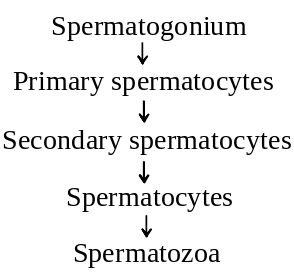
Which cells come earliest in the sequence of sperm production?
A
Spermatozoa
B
Spermatocyte
C
Spermatid
D
Spermatogonia
Solution
(D) The process of spermatogenesis follows a specific sequence:
$1$. Spermatogonia (diploid germ cells) undergo mitosis.
$2$. Primary spermatocytes (diploid) undergo meiosis $I$.
$3$. Secondary spermatocytes (haploid) undergo meiosis $II$.
$4$. Spermatids (haploid) are formed.
$5$. Spermatids differentiate into Spermatozoa (sperm cells).
Therefore,Spermatogonia are the earliest cells in this sequence.
$1$. Spermatogonia (diploid germ cells) undergo mitosis.
$2$. Primary spermatocytes (diploid) undergo meiosis $I$.
$3$. Secondary spermatocytes (haploid) undergo meiosis $II$.
$4$. Spermatids (haploid) are formed.
$5$. Spermatids differentiate into Spermatozoa (sperm cells).
Therefore,Spermatogonia are the earliest cells in this sequence.
0 likes
View Solution439
MediumMCQ
Female gamete mother cells are called
A
Oogonia
B
Ovum
C
Ootid
D
Oocyte
Solution
(A) Female gamete mother cells are called oogonia.
Oogenesis is the process of formation of a mature ovum.
It has three phases:
$(a)$ Multiplication Phase: Oogenesis takes place in the embryo stage. $A$ couple of million gamete mother cells (oogonia) are formed within each foetal ovary. No more oogonia are formed after birth. These cells (oogonia) enter prophase-$I$ of meiotic division and are temporarily arrested at this stage,called primary oocyte.
$(b)$ Growth Phase: Each primary oocyte gets surrounded by a layer of granulosa cells,forming a primary follicle. $A$ large number of these follicles degenerate from birth to puberty. At puberty,only $60,000$ to $80,000$ primary follicles remain in each ovary. The primary follicles get surrounded by more layers of granulosa cells and a new theca to form secondary follicles.
$(c)$ Maturation Phase: The secondary follicle transforms into a tertiary follicle. The primary oocyte within the tertiary follicle completes its first meiotic division to form a large haploid secondary oocyte and a tiny first polar body. The tertiary follicle changes into a mature Graafian follicle,which ruptures to release the secondary oocyte (ovum) from the ovary by a process called ovulation. The second meiotic division occurs after fertilization,resulting in the formation of a second polar body and a haploid ovum (ootid).
Oogenesis is the process of formation of a mature ovum.
It has three phases:
$(a)$ Multiplication Phase: Oogenesis takes place in the embryo stage. $A$ couple of million gamete mother cells (oogonia) are formed within each foetal ovary. No more oogonia are formed after birth. These cells (oogonia) enter prophase-$I$ of meiotic division and are temporarily arrested at this stage,called primary oocyte.
$(b)$ Growth Phase: Each primary oocyte gets surrounded by a layer of granulosa cells,forming a primary follicle. $A$ large number of these follicles degenerate from birth to puberty. At puberty,only $60,000$ to $80,000$ primary follicles remain in each ovary. The primary follicles get surrounded by more layers of granulosa cells and a new theca to form secondary follicles.
$(c)$ Maturation Phase: The secondary follicle transforms into a tertiary follicle. The primary oocyte within the tertiary follicle completes its first meiotic division to form a large haploid secondary oocyte and a tiny first polar body. The tertiary follicle changes into a mature Graafian follicle,which ruptures to release the secondary oocyte (ovum) from the ovary by a process called ovulation. The second meiotic division occurs after fertilization,resulting in the formation of a second polar body and a haploid ovum (ootid).
0 likes
View Solution440
EasyMCQ
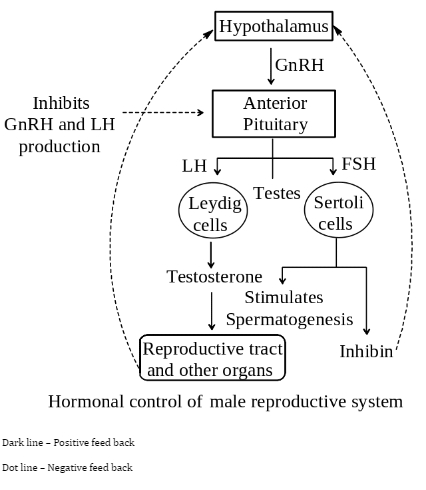
$GnRH$ stimulates the release of two hormones from the anterior lobe of the pituitary gland.
A
$FSH$ and $GH$
B
$FSH$ and $LH$
C
$LH$ and testosterone
D
Testosterone and $LH$
Solution
(B) The correct answer is $FSH$ and $LH$.
$1$. Spermatogenesis is initiated due to an increase in the secretion of Gonadotropin-Releasing Hormone $(GnRH)$ by the hypothalamus.
$2$. $GnRH$ acts on the anterior lobe of the pituitary gland to stimulate the secretion of two gonadotropins: Luteinizing Hormone $(LH)$ and Follicle-Stimulating Hormone $(FSH)$.
$3$. $LH$ acts on the Leydig cells of the testes and stimulates the synthesis and secretion of androgens (primarily testosterone).
$4$. $FSH$ acts on the Sertoli cells of the seminiferous tubules and stimulates the secretion of some factors which help in the process of spermiogenesis.
$1$. Spermatogenesis is initiated due to an increase in the secretion of Gonadotropin-Releasing Hormone $(GnRH)$ by the hypothalamus.
$2$. $GnRH$ acts on the anterior lobe of the pituitary gland to stimulate the secretion of two gonadotropins: Luteinizing Hormone $(LH)$ and Follicle-Stimulating Hormone $(FSH)$.
$3$. $LH$ acts on the Leydig cells of the testes and stimulates the synthesis and secretion of androgens (primarily testosterone).
$4$. $FSH$ acts on the Sertoli cells of the seminiferous tubules and stimulates the secretion of some factors which help in the process of spermiogenesis.
0 likes
View Solution441
EasyMCQ
Which cell organelle is absent in human sperm?
A
$ER$
B
$Mitochondria$
C
$Nucleus$
D
$Centrioles$
Solution
(A) During the process of spermiogenesis,the transformation of spermatids into spermatozoa involves the loss of most of the cytoplasm and several organelles. The endoplasmic reticulum $(ER)$,Golgi apparatus,and ribosomes are largely eliminated from the mature human sperm cell to reduce its weight and streamline its structure for motility. Therefore,the $ER$ is absent in a mature human sperm.
0 likes
View Solution442
MediumMCQ
Primary spermatocyte differs from spermatogonium in
A
Number of chromosomes
B
Size and volume
C
$DNA$ content
D
Size of chromosomes
Solution
(B) Spermatogonia are undifferentiated primordial germ cells that undergo mitotic division.
Each spermatogonium grows into a larger primary spermatocyte by accumulating nutrients and increasing its cytoplasmic volume.
The chromosome number remains diploid $(2n)$ in both spermatogonia and primary spermatocytes.
Therefore,the primary spermatocyte differs from the spermatogonium primarily in its size and volume.
Each spermatogonium grows into a larger primary spermatocyte by accumulating nutrients and increasing its cytoplasmic volume.
The chromosome number remains diploid $(2n)$ in both spermatogonia and primary spermatocytes.
Therefore,the primary spermatocyte differs from the spermatogonium primarily in its size and volume.
0 likes
View Solution443
EasyMCQ
Sperm lysins contain:
A
Hyaluronidase
B
Corona penetrating enzyme
C
Acrosin
D
All of the above
Solution
(D) Sperm lysins are a group of hydrolytic enzymes present in the acrosome of the sperm. These enzymes facilitate the penetration of the sperm through the layers of the ovum during fertilization. The acrosome contains enzymes such as hyaluronidase (which digests hyaluronic acid in the corona radiata),corona penetrating enzyme,and acrosin (a protease that helps in penetrating the zona pellucida). Therefore,all the listed enzymes are components of sperm lysins.
0 likes
View Solution444
EasyMCQ
Acrosome is the modified
A
Mitochondria
B
Lysosome
C
Golgi body
D
Nucleus
Solution
(C) The acrosome is a cap-like structure present at the anterior part of the sperm head.
It is a modified Golgi body that contains various enzymes essential for the penetration of the ovum during fertilization.
The acrosome contains hydrolytic enzymes,such as hyaluronidase and proteases,which are collectively known as sperm lysins.
These enzymes help the sperm to digest the protective layers of the egg,facilitating the entry of the sperm nucleus into the ovum.
It is a modified Golgi body that contains various enzymes essential for the penetration of the ovum during fertilization.
The acrosome contains hydrolytic enzymes,such as hyaluronidase and proteases,which are collectively known as sperm lysins.
These enzymes help the sperm to digest the protective layers of the egg,facilitating the entry of the sperm nucleus into the ovum.
0 likes
View Solution445
EasyMCQ
Spermiogenesis or spermateliosis is:
A
Changing of spermatid to spermatozoa
B
Changing of spermatid to sperm
C
Both $(A)$ and $(B)$
D
Changing of spermatid to secondary spermatocytes
Solution
(C) The transformation of non-motile spermatids into mature,motile spermatozoa is known as spermiogenesis or spermateliosis.
Since spermatozoa are commonly referred to as sperms,both descriptions refer to the same biological process.
Following this process,the heads of the sperm become embedded in the Sertoli cells to receive nutrition and are eventually released from the seminiferous tubules through a process called spermiation.
Since spermatozoa are commonly referred to as sperms,both descriptions refer to the same biological process.
Following this process,the heads of the sperm become embedded in the Sertoli cells to receive nutrition and are eventually released from the seminiferous tubules through a process called spermiation.
0 likes
View Solution446
EasyMCQ
Which of the following represents a condition where the motility of the sperms is highly reduced?
A
Oligospermia
B
Asthenospermia
C
Azoospermia
D
Polyspermy
Solution
(B) Asthenospermia is the condition where the motility of sperms is significantly reduced.
Oligospermia refers to a condition where the sperm count in the semen is lower than normal.
Azoospermia is the condition characterized by the complete absence of sperm in the semen.
Polyspermy is the process where multiple sperms penetrate a single ovum simultaneously.
Therefore,the correct answer is Asthenospermia.
Oligospermia refers to a condition where the sperm count in the semen is lower than normal.
Azoospermia is the condition characterized by the complete absence of sperm in the semen.
Polyspermy is the process where multiple sperms penetrate a single ovum simultaneously.
Therefore,the correct answer is Asthenospermia.
0 likes
View Solution447
MediumMCQ
Androgen stimulates the $...A...$ $FSH$ acts on the $...B...$ and stimulates factors for spermiogenesis. Here $A$ and $B$ refers to
A
$A-Sertoli\; cell; B-Leydig\; cell$
B
$A-Spermatogenesis; B-Spermatid$
C
$A-Spermatogenesis; B-Sertoli\; cell$
D
$A-Spermatogenesis; B-Leydig\; cell$
Solution
(C) Androgens (primarily testosterone) are secreted by Leydig cells and stimulate the process of spermatogenesis.
$FSH$ (Follicle Stimulating Hormone) acts on the Sertoli cells and stimulates the secretion of some factors which help in the process of spermiogenesis (the transformation of spermatids into spermatozoa).
Therefore,$A$ refers to spermatogenesis and $B$ refers to Sertoli cells.
$FSH$ (Follicle Stimulating Hormone) acts on the Sertoli cells and stimulates the secretion of some factors which help in the process of spermiogenesis (the transformation of spermatids into spermatozoa).
Therefore,$A$ refers to spermatogenesis and $B$ refers to Sertoli cells.
0 likes
View Solution448
EasyMCQ
How many sperms are formed by four primary spermatocytes?
A
$1$
B
$4$
C
$16$
D
$32$
Solution
(C) Spermatogenesis is the process of formation of sperms from germ cells.
In this process,one primary spermatocyte undergoes meiosis to produce four haploid spermatids,which then differentiate into four spermatozoa.
Therefore,four primary spermatocytes will produce $4 \times 4 = 16$ spermatozoa.
In this process,one primary spermatocyte undergoes meiosis to produce four haploid spermatids,which then differentiate into four spermatozoa.
Therefore,four primary spermatocytes will produce $4 \times 4 = 16$ spermatozoa.
0 likes
View Solution449
MediumMCQ
An antrum is the characteristic of $...$ follicles.
A
Secondary
B
Graafian
C
Primary
D
Tertiary
Solution
(D) The antrum is a fluid-filled cavity that begins to form during the development of the secondary follicle.
It becomes a prominent and characteristic feature of the tertiary follicle and persists in the mature Graafian follicle.
Therefore,the presence of an antrum is the defining characteristic of the tertiary follicle.
It becomes a prominent and characteristic feature of the tertiary follicle and persists in the mature Graafian follicle.
Therefore,the presence of an antrum is the defining characteristic of the tertiary follicle.
0 likes
View Solution450
MediumMCQ
Sertoli cells are found in:
A
Between the seminiferous tubules
B
In the germinal epithelium of the ovary
C
In the upper part of the fallopian tube
D
In the germinal epithelium of the seminiferous tubules
Solution
(D) Sertoli cells,also known as nurse cells,are located within the germinal epithelium of the seminiferous tubules. Their primary function is to provide nutrition and support to the developing spermatozoa during spermatogenesis.
0 likes
View SolutionHuman Reproduction — Gametogenesis · Frequently Asked Questions
1Are these Human Reproduction questions useful for JEE and NEET?
Yes. All questions in this section are mapped to JEE Main and NEET exam patterns. Previous year questions from JEE Main, NEET, GUJCET and state-level exams are included with full solutions.
2Can I switch to Hindi or Gujarati for these questions?
Yes. Use the language tabs in the hero section or the sidebar to view the same questions and solutions in English, Hindi or Gujarati.
3How do I generate a question paper from this subtopic?
Use the Vedclass Exam Paper Generator — select the chapter and subtopic, set difficulty, and generate Sets A, B, C, D automatically. First 3 chapters of every subject are free.
Vedclass Products
For Students
Vedclass Test Series
Mock tests in real JEE/NEET style with performance analysis. 5-day free trial.
Start Free TrialFor Teachers
Exam Paper Generator
Generate Set A/B/C/D papers from this chapter in 2 minutes. 3 chapters free.
Try FreeFor Institutes
Online Exam Module
Live online exams with unlimited students, 360° analytics & white-label branding.
See DemoFor Teachers & Institutes
Generate a Human Reproduction Exam Paper in 2 Minutes
Select subtopic & difficulty — Sets A, B, C, D auto-generated with No Repeat logic.
First 3 chapters of every subject are free — no payment required.