
A English
Gametogenesis Questions in English
Class 12 Biology · Human Reproduction · Gametogenesis
576+
Questions
English
Language
100%
With Solutions
Showing 50 of 576 questions in English
351
MediumMCQ
What is the ploidy of germ cells?
A
$n$
B
$2n$
C
$3n$
D
$4n$
Solution
(B) Germ cells (primary germ cells or spermatogonia/oogonia) are the precursor cells that undergo meiosis to produce gametes. These cells are diploid in nature,meaning they contain two sets of chromosomes,represented as $2n$.
0 likes
View Solution352
MediumMCQ
What is the process of transformation of spermatids into spermatozoa called?
A
Spermatogonia
B
Spermiogenesis
C
Spermatocytes
D
Oogenesis
Solution
(B) The process of transformation of spermatids into mature spermatozoa is known as $Spermiogenesis$.
After $Spermiogenesis$,sperm heads become embedded in the $Sertoli$ cells and are finally released from the seminiferous tubules by the process called $Spermiation$.
$Spermatogenesis$ is the overall process of formation of sperm from spermatogonia.
After $Spermiogenesis$,sperm heads become embedded in the $Sertoli$ cells and are finally released from the seminiferous tubules by the process called $Spermiation$.
$Spermatogenesis$ is the overall process of formation of sperm from spermatogonia.
0 likes
View Solution353
MediumMCQ
What is the correct pathway for the formation of spermatozoa?
A
Seminiferous tubule $\rightarrow$ Spermatogonia $\rightarrow$ Primary spermatocytes $\rightarrow$ Secondary spermatocytes $\rightarrow$ Spermatids $\rightarrow$ Spermatozoa
B
Spermatogonia $\rightarrow$ Spermatids $\rightarrow$ Seminiferous tubule $\rightarrow$ Primary spermatocytes $\rightarrow$ Secondary spermatocytes $\rightarrow$ Spermatozoa
C
Seminiferous tubule $\rightarrow$ Primary spermatocytes $\rightarrow$ Secondary spermatocytes $\rightarrow$ Spermatogonia $\rightarrow$ Spermatids $\rightarrow$ Spermatozoa
D
Spermatogonia $\rightarrow$ Seminiferous tubule $\rightarrow$ Primary spermatocytes $\rightarrow$ Secondary spermatocytes $\rightarrow$ Spermatozoa $\rightarrow$ Spermatids
Solution
(A) The process of spermatogenesis occurs within the seminiferous tubules of the testes.
$1$. The process begins with spermatogonia (diploid germ cells) located at the inner side of the seminiferous tubule.
$2$. These undergo mitosis to increase in number and differentiate into primary spermatocytes.
$3$. Primary spermatocytes undergo meiosis $I$ to form two haploid secondary spermatocytes.
$4$. Secondary spermatocytes undergo meiosis $II$ to form four haploid spermatids.
$5$. Finally,spermatids undergo spermiogenesis to transform into mature spermatozoa (sperm).
$1$. The process begins with spermatogonia (diploid germ cells) located at the inner side of the seminiferous tubule.
$2$. These undergo mitosis to increase in number and differentiate into primary spermatocytes.
$3$. Primary spermatocytes undergo meiosis $I$ to form two haploid secondary spermatocytes.
$4$. Secondary spermatocytes undergo meiosis $II$ to form four haploid spermatids.
$5$. Finally,spermatids undergo spermiogenesis to transform into mature spermatozoa (sperm).
0 likes
View Solution354
MediumMCQ
What is the number of chromosomes in a secondary spermatocyte?
A
$23$ pairs
B
$23$
C
$46$
D
Both $A$ and $B$
Solution
(B) During spermatogenesis,the primary spermatocyte $(2n = 46)$ undergoes the first meiotic division (meiosis-$I$) to form two haploid secondary spermatocytes $(n = 23)$.
Since meiosis-$I$ is a reductional division,the chromosome number is halved from the diploid state $(46)$ to the haploid state $(23)$.
Therefore,a secondary spermatocyte contains $23$ chromosomes.
Since meiosis-$I$ is a reductional division,the chromosome number is halved from the diploid state $(46)$ to the haploid state $(23)$.
Therefore,a secondary spermatocyte contains $23$ chromosomes.
0 likes
View Solution355
MediumMCQ
How many spermatids are produced from $200$ secondary spermatocytes through meiosis?
A
$200$
B
$400$
C
$800$
D
$100$
Solution
(B) In the process of spermatogenesis,each primary spermatocyte undergoes meiosis-$I$ to form two secondary spermatocytes.
Each secondary spermatocyte then undergoes meiosis-$II$ to produce two spermatids.
Therefore,one secondary spermatocyte produces $2$ spermatids.
Given that there are $200$ secondary spermatocytes,the total number of spermatids produced will be $200 \times 2 = 400$.
Each secondary spermatocyte then undergoes meiosis-$II$ to produce two spermatids.
Therefore,one secondary spermatocyte produces $2$ spermatids.
Given that there are $200$ secondary spermatocytes,the total number of spermatids produced will be $200 \times 2 = 400$.
0 likes
View Solution356
MediumMCQ
Identify the hormone that acts on the cells required for the nourishment of sperm and stimulates them.
A
$GnRH$
B
$LH$
C
$FSH$
D
All of these
Solution
(C) The cells responsible for the nourishment of sperm are known as $Sertoli$ cells.
$FSH$ (Follicle Stimulating Hormone) acts on the $Sertoli$ cells and stimulates the secretion of some factors which help in the process of spermiogenesis.
$LH$ acts on the $Leydig$ cells to stimulate the synthesis and secretion of androgens.
Therefore,the correct hormone that acts on the cells responsible for sperm nourishment is $FSH$.
$FSH$ (Follicle Stimulating Hormone) acts on the $Sertoli$ cells and stimulates the secretion of some factors which help in the process of spermiogenesis.
$LH$ acts on the $Leydig$ cells to stimulate the synthesis and secretion of androgens.
Therefore,the correct hormone that acts on the cells responsible for sperm nourishment is $FSH$.
0 likes
View Solution357
MediumMCQ
Which gland's hormones are essential for the process of spermiogenesis during sperm formation?
A
Hypothalamus
B
Pituitary
C
Ovary
D
Testis
Solution
(B) The process of spermiogenesis is regulated by hormones secreted by the anterior pituitary gland.
$1$. The hypothalamus releases Gonadotropin-Releasing Hormone $(GnRH)$.
$2$. $GnRH$ stimulates the anterior pituitary to secrete Luteinizing Hormone $(LH)$ and Follicle-Stimulating Hormone $(FSH)$.
$3$. $LH$ acts on the Leydig cells to stimulate the synthesis and secretion of androgens (testosterone).
$4$. $FSH$ acts on the Sertoli cells and stimulates the secretion of some factors which help in the process of spermiogenesis.
$1$. The hypothalamus releases Gonadotropin-Releasing Hormone $(GnRH)$.
$2$. $GnRH$ stimulates the anterior pituitary to secrete Luteinizing Hormone $(LH)$ and Follicle-Stimulating Hormone $(FSH)$.
$3$. $LH$ acts on the Leydig cells to stimulate the synthesis and secretion of androgens (testosterone).
$4$. $FSH$ acts on the Sertoli cells and stimulates the secretion of some factors which help in the process of spermiogenesis.
0 likes
View Solution358
MediumMCQ
Which part of the sperm contains a high concentration of enzymes?
A
Acrosome
B
Middle piece
C
Tail
D
Entire sperm
Solution
(A) The acrosome is a cap-like structure present at the anterior end of the sperm head.
It is derived from the Golgi apparatus and is filled with hydrolytic enzymes,collectively known as sperm lysins (e.g.,hyaluronidase).
These enzymes are essential for penetrating the egg's protective layers (zona pellucida) during fertilization.
It is derived from the Golgi apparatus and is filled with hydrolytic enzymes,collectively known as sperm lysins (e.g.,hyaluronidase).
These enzymes are essential for penetrating the egg's protective layers (zona pellucida) during fertilization.
0 likes
View Solution359
MediumMCQ
For normal fertility,what percentage of sperm in a human male ejaculate must have vigorous motility (in $\%$)?
A
$80$
B
$50$
C
$60$
D
$40$
Solution
(D) According to the $NCERT$ textbook,for normal fertility,at least $60 \%$ of all sperms must have normal shape and size,and at least $40 \%$ of them must show vigorous motility. Therefore,the correct option is $D$.
0 likes
View Solution360
MediumMCQ
During which period does the process of oogenesis begin in females?
A
Puberty
B
11th year
C
18th year
D
Embryonic development
Solution
(D) The process of oogenesis in females is initiated during the embryonic development stage.
During fetal development,a couple of million gamete mother cells (oogonia) are formed within each fetal ovary.
No more oogonia are formed or added after birth.
These cells start division and enter into prophase-$I$ of the meiotic division and get temporarily arrested at that stage,called primary oocytes.
During fetal development,a couple of million gamete mother cells (oogonia) are formed within each fetal ovary.
No more oogonia are formed or added after birth.
These cells start division and enter into prophase-$I$ of the meiotic division and get temporarily arrested at that stage,called primary oocytes.
0 likes
View Solution361
MediumMCQ
During oogenesis in females,the primary oocyte remains arrested for a long period in which stage?
A
Prophase
B
Prophase-$II$
C
Prophase-$I$
D
Meiosis-$II$
Solution
(C) During oogenesis,the primary oocytes enter the $Prophase-I$ stage of meiosis-$I$ and become temporarily arrested at this stage. This specific arrested stage is known as the 'Dictyate' stage. These primary oocytes are present in the ovary at the time of birth and remain arrested in this stage until the onset of puberty.
0 likes
View Solution362
MediumMCQ
What is the number of primary follicles left in each ovary at puberty?
A
$60,000-80,000$
B
$40,000-60,000$
C
$80,000-1,00,000$
D
$20,000-40,000$
Solution
(A) During fetal development,millions of oogonia are formed within each fetal ovary. No more oogonia are formed or added after birth.
Each oogonium starts division and enters into prophase-$I$ of the meiotic division and gets temporarily arrested at that stage,called primary oocytes.
Each primary oocyte gets surrounded by a layer of granulosa cells and is called the primary follicle.
$A$ large number of these follicles degenerate during the phase from birth to puberty.
Therefore,at puberty,only $60,000-80,000$ primary follicles are left in each ovary.
Each oogonium starts division and enters into prophase-$I$ of the meiotic division and gets temporarily arrested at that stage,called primary oocytes.
Each primary oocyte gets surrounded by a layer of granulosa cells and is called the primary follicle.
$A$ large number of these follicles degenerate during the phase from birth to puberty.
Therefore,at puberty,only $60,000-80,000$ primary follicles are left in each ovary.
0 likes
View Solution363
MediumMCQ
What is the name of the oocyte present in the primary and secondary follicles?
A
Oogonia
B
Primary oocyte
C
Secondary oocyte
D
Ovum
Solution
(B) In the process of oogenesis,the oogonia undergo mitosis to form primary oocytes. These primary oocytes are arrested at the prophase-$I$ stage of meiosis-$I$. $A$ primary oocyte surrounded by a layer of granulosa cells is called a primary follicle. As the follicle develops into a secondary follicle,it still contains the primary oocyte. The primary oocyte only completes meiosis-$I$ to become a secondary oocyte after the follicle matures into a tertiary follicle and is triggered by the luteinizing hormone $(LH)$ surge.
0 likes
View Solution364
MediumMCQ
What is the name of the mature ovarian follicle in females?
A
Primary follicle
B
Secondary follicle
C
Tertiary follicle
D
Graafian follicle
Solution
(D) In the human female reproductive system,the process of oogenesis involves the development of ovarian follicles.
As the follicle matures,it progresses through various stages: primary,secondary,and tertiary follicles.
The mature,fully developed follicle that is ready for ovulation is known as the $Graafian$ follicle.
Therefore,the correct option is $D$.
As the follicle matures,it progresses through various stages: primary,secondary,and tertiary follicles.
The mature,fully developed follicle that is ready for ovulation is known as the $Graafian$ follicle.
Therefore,the correct option is $D$.
0 likes
View Solution365
MediumMCQ
Which cell is released during the process of ovulation?
A
Primary oocyte
B
Secondary oocyte
C
Ootid
D
Oogonia
Solution
(B) Ovulation is the process in the human female reproductive cycle where a mature follicle ruptures to release the egg.
During oogenesis,the primary oocyte completes its first meiotic division within the Graafian follicle to form a large haploid secondary oocyte and a tiny first polar body.
The secondary oocyte is the stage that is released from the ovary during ovulation.
It remains arrested in the metaphase stage of meiosis-$II$ until fertilization occurs.
During oogenesis,the primary oocyte completes its first meiotic division within the Graafian follicle to form a large haploid secondary oocyte and a tiny first polar body.
The secondary oocyte is the stage that is released from the ovary during ovulation.
It remains arrested in the metaphase stage of meiosis-$II$ until fertilization occurs.
0 likes
View Solution366
MediumMCQ
What is the name of the layer surrounding the secondary oocyte in the fallopian tube?
A
Corona radiata
B
Oolemma
C
Zona pellucida
D
Both $A$ and $C$
Solution
(D) The secondary oocyte released into the fallopian tube is surrounded by two primary layers:
$1$. Inner layer: This is called the $Zona \text{ } pellucida$,which is composed of glycoproteins.
$2$. Outer layer: This is called the $Corona \text{ } radiata$,which is composed of follicular cells.
Therefore,the correct answer is both $A$ and $C$.
$1$. Inner layer: This is called the $Zona \text{ } pellucida$,which is composed of glycoproteins.
$2$. Outer layer: This is called the $Corona \text{ } radiata$,which is composed of follicular cells.
Therefore,the correct answer is both $A$ and $C$.
0 likes
View Solution367
MediumMCQ
What is the ploidy of a primary oocyte?
A
Haploid
B
Diploid
C
Triploid
D
Both $A$ and $B$
Solution
(B) The process of oogenesis begins during embryonic development.
Primary oocytes are formed from oogonia through mitosis.
Since oogonia are diploid $(2n)$,the primary oocytes formed from them are also diploid $(2n)$.
Therefore,the ploidy of a primary oocyte is diploid.
Primary oocytes are formed from oogonia through mitosis.
Since oogonia are diploid $(2n)$,the primary oocytes formed from them are also diploid $(2n)$.
Therefore,the ploidy of a primary oocyte is diploid.
0 likes
View Solution368
MediumMCQ
In oogenesis,when is the secondary oocyte formed in females?
A
During embryonic development
B
At the time of birth
C
During childhood
D
During puberty
Solution
(D) In females,oogenesis begins during embryonic development.
Primary oocytes are formed and arrested at the prophase-$I$ stage of meiosis-$I$.
These primary oocytes remain in this arrested state until puberty.
At puberty,the primary oocyte completes meiosis-$I$ to form a large haploid secondary oocyte and a tiny first polar body.
Therefore,the secondary oocyte is formed during puberty.
Primary oocytes are formed and arrested at the prophase-$I$ stage of meiosis-$I$.
These primary oocytes remain in this arrested state until puberty.
At puberty,the primary oocyte completes meiosis-$I$ to form a large haploid secondary oocyte and a tiny first polar body.
Therefore,the secondary oocyte is formed during puberty.
0 likes
View Solution369
DifficultMCQ
What is the number of chromosomes in a secondary oocyte?
A
$23$ pairs
B
$23$
C
$46$
D
Both $A$ and $C$
Solution
(B) The process of oogenesis involves the formation of a mature female gamete.
During the first meiotic division (meiosis $I$),the primary oocyte ($46$ chromosomes) undergoes unequal division to form a large secondary oocyte and a small first polar body.
Since meiosis $I$ is a reductional division,the chromosome number is halved.
Therefore,the secondary oocyte contains $23$ chromosomes (haploid state).
During the first meiotic division (meiosis $I$),the primary oocyte ($46$ chromosomes) undergoes unequal division to form a large secondary oocyte and a small first polar body.
Since meiosis $I$ is a reductional division,the chromosome number is halved.
Therefore,the secondary oocyte contains $23$ chromosomes (haploid state).
0 likes
View Solution370
MediumMCQ
What is the name of the structure formed after the rupture of the Graafian follicle?
A
Tertiary follicle
B
Ovarian follicle
C
Secondary follicle
D
Corpus luteum
Solution
(D) After ovulation,the ruptured Graafian follicle transforms into a temporary endocrine structure known as the $Corpus \ luteum$. This structure secretes large amounts of progesterone,which is essential for maintaining the endometrium for potential implantation of the embryo.
0 likes
View Solution371
MediumMCQ
If fertilization does not occur in a female,which oocyte is shed during menstruation?
A
Primary oocyte
B
Oogonia
C
Secondary oocyte
D
Ovum
Solution
(C) In the human female reproductive system,the process of oogenesis results in the formation of a secondary oocyte. During ovulation,the secondary oocyte is released from the Graafian follicle. If fertilization does not occur,this secondary oocyte (arrested in metaphase $II$) is shed along with the uterine lining during menstruation.
0 likes
View Solution372
MediumMCQ
During the differentiation of spermatids,they are associated with which of the following?
A
Leydig cells
B
Germ cells
C
Sertoli cells
D
Interstitial cells
Solution
(C) During the process of spermatogenesis,spermatids are transformed into spermatozoa (sperm) by a process called spermiogenesis.
After spermiogenesis,the sperm heads become embedded in the Sertoli cells to receive nourishment before being released into the seminiferous tubules by a process called spermiation.
Therefore,during the differentiation and maturation phase,spermatids and developing spermatozoa are closely associated with Sertoli cells.
After spermiogenesis,the sperm heads become embedded in the Sertoli cells to receive nourishment before being released into the seminiferous tubules by a process called spermiation.
Therefore,during the differentiation and maturation phase,spermatids and developing spermatozoa are closely associated with Sertoli cells.
0 likes
View Solution373
EasyMCQ
Which is the longest phase of spermatogenesis?
A
Multiplication phase
B
Growth phase
C
Maturation phase
D
Spermiogenesis
Solution
(B) Spermatogenesis is the process of formation of spermatozoa from spermatogonia. It consists of three main phases:
$1$. Multiplication phase: Spermatogonia divide by mitosis to increase in number.
$2$. Growth phase: Spermatogonia grow in size by accumulating nutrients to form primary spermatocytes. This is the longest phase of spermatogenesis.
$3$. Maturation phase: Primary spermatocytes undergo meiosis to form secondary spermatocytes and then spermatids.
Spermiogenesis is the transformation of spermatids into spermatozoa,which is a separate process following the maturation phase.
$1$. Multiplication phase: Spermatogonia divide by mitosis to increase in number.
$2$. Growth phase: Spermatogonia grow in size by accumulating nutrients to form primary spermatocytes. This is the longest phase of spermatogenesis.
$3$. Maturation phase: Primary spermatocytes undergo meiosis to form secondary spermatocytes and then spermatids.
Spermiogenesis is the transformation of spermatids into spermatozoa,which is a separate process following the maturation phase.
0 likes
View Solution374
EasyMCQ
What does a mature sperm contain?
A
Head,tail
B
Nucleus,acrosome,and centriole
C
Nucleus,acrosome,and a pair of centrioles
D
Nucleus,acrosome,a pair of centrioles,and a tail
Solution
(D) mature sperm consists of four main parts: the head,neck,middle piece,and tail.
$1$. The head contains an elongated haploid nucleus and an anterior cap-like structure called the acrosome.
$2$. The neck contains two centrioles: the proximal centriole and the distal centriole.
$3$. The middle piece contains numerous mitochondria which provide energy for sperm motility.
$4$. The tail facilitates the movement of the sperm.
Therefore,a mature sperm contains a nucleus,acrosome,a pair of centrioles,and a tail.
$1$. The head contains an elongated haploid nucleus and an anterior cap-like structure called the acrosome.
$2$. The neck contains two centrioles: the proximal centriole and the distal centriole.
$3$. The middle piece contains numerous mitochondria which provide energy for sperm motility.
$4$. The tail facilitates the movement of the sperm.
Therefore,a mature sperm contains a nucleus,acrosome,a pair of centrioles,and a tail.
0 likes
View Solution375
EasyMCQ
Which organelle is important for spermiogenesis and forms the acrosome?
A
Golgi apparatus
B
Mitochondria
C
Centriole
D
All of the above
Solution
(A) Spermiogenesis is the process of transformation of spermatids into spermatozoa.
During this process,the Golgi apparatus of the spermatid modifies and condenses to form the acrosome,which is a cap-like structure covering the anterior part of the sperm head.
The acrosome contains hydrolytic enzymes that help in the penetration of the egg during fertilization.
During this process,the Golgi apparatus of the spermatid modifies and condenses to form the acrosome,which is a cap-like structure covering the anterior part of the sperm head.
The acrosome contains hydrolytic enzymes that help in the penetration of the egg during fertilization.
0 likes
View Solution376
MediumMCQ
Which vitamins are essential for spermatogenesis?
A
Vitamin $A$ and $K$
B
Vitamin $E$ and $K$
C
Vitamin $A$ and $E$
D
Vitamin $E$ and $C$
Solution
(C) Spermatogenesis is the process of formation of spermatozoa from spermatogonia in the testes.
Vitamin $A$ is essential for the maintenance of the germinal epithelium of the seminiferous tubules.
Vitamin $E$ (tocopherol) is known as the anti-sterility vitamin and is crucial for the normal functioning of the reproductive system and the process of spermatogenesis.
Deficiency of these vitamins can lead to impaired sperm production and infertility.
Therefore,both Vitamin $A$ and Vitamin $E$ are essential for spermatogenesis.
Vitamin $A$ is essential for the maintenance of the germinal epithelium of the seminiferous tubules.
Vitamin $E$ (tocopherol) is known as the anti-sterility vitamin and is crucial for the normal functioning of the reproductive system and the process of spermatogenesis.
Deficiency of these vitamins can lead to impaired sperm production and infertility.
Therefore,both Vitamin $A$ and Vitamin $E$ are essential for spermatogenesis.
0 likes
View Solution377
MediumMCQ
In females, at the time of birth, the oocytes are present in which form?
A
Oogonia
B
Primary oocyte
C
Secondary oocyte
D
Mature ovum
Solution
(B) In human females, the process of oogenesis is initiated during the embryonic development stage when a couple of million gamete mother cells $(oogonia)$ are formed within each fetal ovary.
No more $oogonia$ are formed or added after birth.
These cells start division and enter into $prophase-I$ of the meiotic division and get temporarily arrested at that stage, called $primary$ $oocytes$.
Therefore, at the time of birth, the ovaries contain a large number of $primary$ $oocytes$.
No more $oogonia$ are formed or added after birth.
These cells start division and enter into $prophase-I$ of the meiotic division and get temporarily arrested at that stage, called $primary$ $oocytes$.
Therefore, at the time of birth, the ovaries contain a large number of $primary$ $oocytes$.
0 likes
View Solution378
MediumMCQ
Which of the following structures is haploid?
A
Oogonium
B
Primary oocyte
C
Secondary oocyte
D
Primary spermatocyte
Solution
(C) In human gametogenesis,the ploidy of cells changes during meiosis.
$1$. $Oogonia$ $(2n)$ are diploid cells that undergo mitosis to form primary oocytes $(2n)$.
$2$. $Primary$ $oocytes$ $(2n)$ undergo meiosis $I$ to form a secondary oocyte $(n)$ and a first polar body $(n)$.
$3$. $Primary$ $spermatocytes$ $(2n)$ undergo meiosis $I$ to form secondary spermatocytes $(n)$.
Therefore,the secondary oocyte is a haploid $(n)$ structure.
$1$. $Oogonia$ $(2n)$ are diploid cells that undergo mitosis to form primary oocytes $(2n)$.
$2$. $Primary$ $oocytes$ $(2n)$ undergo meiosis $I$ to form a secondary oocyte $(n)$ and a first polar body $(n)$.
$3$. $Primary$ $spermatocytes$ $(2n)$ undergo meiosis $I$ to form secondary spermatocytes $(n)$.
Therefore,the secondary oocyte is a haploid $(n)$ structure.
0 likes
View Solution379
EasyMCQ
What is yolk in an egg cell?
A
Nucleus
B
Stored food material
C
Cytoplasm
D
Genetic material
Solution
(B) Yolk is the nutrient-bearing portion of an egg cell. Its primary function is to provide nourishment for the developing embryo. It consists mainly of proteins,lipids,and vitamins stored in the cytoplasm of the egg cell.
0 likes
View Solution380
MediumMCQ
Which of the following secretes the female secondary sex hormone?
A
Zona pellucida
B
Theca externa
C
Corona radiata
D
Theca interna
Solution
(D) The female secondary sex hormone, primarily $Estrogen$, is secreted by the $Theca \, interna$ layer of the Graafian follicle.
$Theca \, interna$ is the inner vascularized layer of the theca folliculi that contains endocrine cells responsible for the synthesis of steroid hormones.
$Zona \, pellucida$ is a glycoprotein layer surrounding the oocyte.
$Corona \, radiata$ consists of follicular cells surrounding the zona pellucida.
$Theca \, externa$ is the outer fibrous layer of the follicle.
$Theca \, interna$ is the inner vascularized layer of the theca folliculi that contains endocrine cells responsible for the synthesis of steroid hormones.
$Zona \, pellucida$ is a glycoprotein layer surrounding the oocyte.
$Corona \, radiata$ consists of follicular cells surrounding the zona pellucida.
$Theca \, externa$ is the outer fibrous layer of the follicle.
0 likes
View Solution381
MediumMCQ
In a $25$-year-old woman,in what form is the ovum released from the ovary?
A
Primary oocyte
B
Secondary oocyte
C
Mature ovum
D
Both $A$ and $B$
Solution
(B) In the process of oogenesis,the primary oocyte undergoes meiosis $I$ to form a secondary oocyte and a first polar body.
This secondary oocyte is the stage that is released from the ovary during ovulation.
The secondary oocyte remains arrested in metaphase $II$ until fertilization occurs.
Therefore,the correct form released is the secondary oocyte.
This secondary oocyte is the stage that is released from the ovary during ovulation.
The secondary oocyte remains arrested in metaphase $II$ until fertilization occurs.
Therefore,the correct form released is the secondary oocyte.
0 likes
View Solution382
MediumMCQ
If the number of chromosomes in a somatic cell is $42$,what will be the number of chromosomes in the cuboidal epithelial cells of the seminiferous tubules?
A
$42$
B
$21$
C
$42$ or $21$
D
Cannot be determined
Solution
(A) Somatic cells are diploid $(2n)$ in nature. Given that the number of chromosomes in a somatic cell is $42$,it implies $2n = 42$.
The cuboidal epithelial cells (Sertoli cells or germinal epithelium) lining the seminiferous tubules are also somatic cells,which are diploid $(2n)$.
Therefore,the number of chromosomes in these cells will remain $42$.
The cuboidal epithelial cells (Sertoli cells or germinal epithelium) lining the seminiferous tubules are also somatic cells,which are diploid $(2n)$.
Therefore,the number of chromosomes in these cells will remain $42$.
0 likes
View Solution383
MediumMCQ
Which of the following regulates spermatogenesis?
A
Testosterone
B
$FSH$ and $LH$
C
Estrogen and Progesterone
D
Pituitary gland
Solution
(B) Spermatogenesis is regulated by the hormones secreted by the hypothalamus and the anterior pituitary gland.
$1$. The hypothalamus secretes Gonadotropin-Releasing Hormone $(GnRH)$.
$2$. $GnRH$ stimulates the anterior pituitary to secrete two gonadotropins: Luteinizing Hormone $(LH)$ and Follicle-Stimulating Hormone $(FSH)$.
$3$. $LH$ acts on the Leydig cells and stimulates the synthesis and secretion of androgens (mainly testosterone).
$4$. $FSH$ acts on the Sertoli cells and stimulates the secretion of some factors which help in the process of spermiogenesis.
Therefore,$FSH$ and $LH$ are the primary regulators of spermatogenesis.
$1$. The hypothalamus secretes Gonadotropin-Releasing Hormone $(GnRH)$.
$2$. $GnRH$ stimulates the anterior pituitary to secrete two gonadotropins: Luteinizing Hormone $(LH)$ and Follicle-Stimulating Hormone $(FSH)$.
$3$. $LH$ acts on the Leydig cells and stimulates the synthesis and secretion of androgens (mainly testosterone).
$4$. $FSH$ acts on the Sertoli cells and stimulates the secretion of some factors which help in the process of spermiogenesis.
Therefore,$FSH$ and $LH$ are the primary regulators of spermatogenesis.
0 likes
View Solution384
MediumMCQ
In humans,how many ova can $10$ secondary oocytes produce,and how many secondary spermatocytes are required to produce $40$ spermatozoa?
A
$10$ and $40$
B
$10$ and $20$
C
$10$ and $10$
D
$5$ and $10$
Solution
(B) $1$. In oogenesis,one secondary oocyte undergoes meiosis-$II$ to produce one ovum and one polar body. Therefore,$10$ secondary oocytes will produce $10$ ova.
$2$. In spermatogenesis,one secondary spermatocyte undergoes meiosis-$II$ to produce two spermatids,which then differentiate into two spermatozoa. Therefore,to produce $40$ spermatozoa,the number of secondary spermatocytes required is $40 / 2 = 20$.
$2$. In spermatogenesis,one secondary spermatocyte undergoes meiosis-$II$ to produce two spermatids,which then differentiate into two spermatozoa. Therefore,to produce $40$ spermatozoa,the number of secondary spermatocytes required is $40 / 2 = 20$.
0 likes
View Solution385
EasyMCQ
In males,where is the hormone $Inhibin$ released from?
A
Hypothalamus
B
Pituitary gland
C
Leydig cells
D
Sertoli cells
Solution
(D) $Inhibin$ is a glycoprotein hormone produced by the $Sertoli$ cells in the testes of males.
Its primary function is to provide negative feedback to the anterior pituitary gland to inhibit the secretion of $FSH$ ($Follicle$ $Stimulating$ $Hormone$).
This mechanism helps in the regulation of spermatogenesis.
Its primary function is to provide negative feedback to the anterior pituitary gland to inhibit the secretion of $FSH$ ($Follicle$ $Stimulating$ $Hormone$).
This mechanism helps in the regulation of spermatogenesis.
0 likes
View Solution386
MediumMCQ
When is the polar body extruded from the oocyte?
A
Before fertilization
B
After fertilization
C
After the entry of sperm and before the completion of fertilization
D
Before the entry of sperm and before fertilization
Solution
(C) In humans,the secondary oocyte remains arrested at the $Metaphase-II$ stage of meiosis. The completion of meiosis-$II$ is triggered only when a sperm enters the secondary oocyte. Upon the entry of the sperm,the secondary oocyte completes its second meiotic division,resulting in the formation of a large haploid ovum (ootid) and a second polar body. Therefore,the extrusion of the second polar body occurs after the entry of the sperm but before the fusion of the male and female pronuclei (completion of fertilization).
0 likes
View Solution387
EasyMCQ
After ovulation,the mammalian ovum is surrounded by which of the following layers?
A
Zona pellucida
B
Corona radiata
C
Granulosa
D
Both $A$ and $B$
Solution
(D) After ovulation,the secondary oocyte (ovum) is released from the Graafian follicle.
It is surrounded by an inner non-cellular layer called the $Zona \ pellucida$.
Outside the $Zona \ pellucida$,there is a layer of follicular cells known as the $Corona \ radiata$.
Therefore,the ovum is surrounded by both $Zona \ pellucida$ and $Corona \ radiata$.
It is surrounded by an inner non-cellular layer called the $Zona \ pellucida$.
Outside the $Zona \ pellucida$,there is a layer of follicular cells known as the $Corona \ radiata$.
Therefore,the ovum is surrounded by both $Zona \ pellucida$ and $Corona \ radiata$.
0 likes
View Solution388
MediumMCQ
In which cell does spermiogenesis occur?
A
Primary spermatocyte
B
Secondary spermatocyte
C
Spermatid
D
All of the above
Solution
(C) Spermiogenesis is the process of transformation of spermatids into mature spermatozoa (sperms).
During this process,the non-motile,spherical spermatids undergo structural changes to become motile,elongated spermatozoa.
Spermatids are haploid cells formed after the second meiotic division of secondary spermatocytes.
Therefore,the correct cell type that undergoes spermiogenesis is the spermatid.
During this process,the non-motile,spherical spermatids undergo structural changes to become motile,elongated spermatozoa.
Spermatids are haploid cells formed after the second meiotic division of secondary spermatocytes.
Therefore,the correct cell type that undergoes spermiogenesis is the spermatid.
0 likes
View Solution389
EasyMCQ
In which part of the sperm are mitochondria most abundant?
A
Acrosome
B
Head
C
Tail
D
Middle piece
Solution
(D) The sperm consists of a head,neck,middle piece,and tail. The middle piece contains numerous mitochondria,which are arranged in a spiral pattern (often called the Nebenkern). These mitochondria produce energy in the form of $ATP$ required for the movement of the tail,which facilitates sperm motility.
0 likes
View Solution390
MediumMCQ
What is spermiation?
A
Release of sperm from the germ cell
B
Release of sperm from the Sertoli cells
C
Transfer of sperm into the vagina
D
Release of semen from the male body
Solution
(B) Spermiation is the process by which mature spermatozoa are released from the Sertoli cells into the lumen of the seminiferous tubules.
After the process of spermiogenesis,where spermatids transform into spermatozoa,the heads of the spermatozoa become embedded in the Sertoli cells.
Spermiation marks the final step of spermatogenesis before the sperm move into the epididymis for maturation and storage.
After the process of spermiogenesis,where spermatids transform into spermatozoa,the heads of the spermatozoa become embedded in the Sertoli cells.
Spermiation marks the final step of spermatogenesis before the sperm move into the epididymis for maturation and storage.
0 likes
View Solution391
EasyMCQ
What is the normal sperm count in $1 \ ml$ of semen?
A
$20$ to $120$ million
B
$200$ to $300$ million
C
$100$ to $200$ million
D
$150$ to $300$ million
Solution
(A) In a normal healthy male,the total sperm count per ejaculation is about $200$ to $300$ million sperm.
Since the average volume of semen per ejaculation is about $2$ to $5 \ ml$,the concentration of sperm in $1 \ ml$ of semen typically ranges from $20$ to $120$ million.
Therefore,the correct range for $1 \ ml$ of semen is $20$ to $120$ million.
Since the average volume of semen per ejaculation is about $2$ to $5 \ ml$,the concentration of sperm in $1 \ ml$ of semen typically ranges from $20$ to $120$ million.
Therefore,the correct range for $1 \ ml$ of semen is $20$ to $120$ million.
0 likes
View Solution392
MediumMCQ
At which stage is the acrosome formed in a sperm?
A
Meiosis $I$
B
Meiosis $II$
C
Growth phase
D
Spermiogenesis
Solution
(D) The process of transformation of spermatids into mature spermatozoa is known as $Spermiogenesis$.
During this stage,several structural changes occur in the spermatid,including the formation of the acrosome from the Golgi complex,the condensation of the nucleus,and the development of the flagellum.
Therefore,the acrosome is formed during the $Spermiogenesis$ phase.
During this stage,several structural changes occur in the spermatid,including the formation of the acrosome from the Golgi complex,the condensation of the nucleus,and the development of the flagellum.
Therefore,the acrosome is formed during the $Spermiogenesis$ phase.
0 likes
View Solution393
MediumMCQ
Primordial Germ Cells $(PGC)$ are ...... .
A
$4n$
B
$3n$
C
$2n$
D
$n$
Solution
(C) Primordial Germ Cells (PGCs) are the precursor cells that give rise to gametes (sperm or ova) through the process of gametogenesis.
These cells are diploid in nature,meaning they contain two sets of chromosomes,one inherited from each parent.
Therefore,the ploidy of Primordial Germ Cells is $2n$.
These cells are diploid in nature,meaning they contain two sets of chromosomes,one inherited from each parent.
Therefore,the ploidy of Primordial Germ Cells is $2n$.
0 likes
View Solution394
MediumMCQ
Where are the $LH$ receptors located to trigger the release of estrogen?
A
Cells of corona radiata
B
Zona pellucida
C
Cells of theca externa
D
Cells of theca interna
Solution
(D) In the ovarian follicle,the $LH$ (Luteinizing Hormone) receptors are specifically located on the cells of the theca interna.
Upon stimulation by $LH$,these cells produce androgens,which are then converted into estrogens by the granulosa cells under the influence of $FSH$ (Follicle Stimulating Hormone).
Therefore,the correct option is $D$.
Upon stimulation by $LH$,these cells produce androgens,which are then converted into estrogens by the granulosa cells under the influence of $FSH$ (Follicle Stimulating Hormone).
Therefore,the correct option is $D$.
0 likes
View Solution395
MediumMCQ
Select the odd one out.
A
Primary spermatocyte
B
Primary oocyte
C
Spermatogonia
D
First polar body
Solution
(D) The options $A$,$B$,and $C$ ($Primary \ spermatocyte$,$Primary \ oocyte$,and $Spermatogonia$) are all diploid $(2n)$ cells involved in the process of gametogenesis.
In contrast,the $First \ polar \ body$ (option $D$) is a haploid $(n)$ cell formed during the process of oogenesis after the completion of meiosis-$I$.
In contrast,the $First \ polar \ body$ (option $D$) is a haploid $(n)$ cell formed during the process of oogenesis after the completion of meiosis-$I$.
0 likes
View Solution396
MediumMCQ
What are the cells of the germinal epithelium that differentiate into spermatozoa called?
A
Spermatogonia
B
Primordial germ cells
C
Spermatocytes
D
Sperm mother cells
Solution
(A) The germinal epithelium of the seminiferous tubules contains cells called $Spermatogonia$ (singular: $Spermatogonium$).
These cells undergo mitotic divisions to increase in number and then differentiate into $Spermatocytes$,which eventually develop into $Spermatozoa$ through the process of spermatogenesis.
Therefore,the cells of the germinal epithelium that give rise to spermatozoa are known as $Spermatogonia$.
These cells undergo mitotic divisions to increase in number and then differentiate into $Spermatocytes$,which eventually develop into $Spermatozoa$ through the process of spermatogenesis.
Therefore,the cells of the germinal epithelium that give rise to spermatozoa are known as $Spermatogonia$.
0 likes
View Solution397
EasyMCQ
During spermatogenesis,when is the acrosome formed?
A
First meiotic division
B
Second meiotic division
C
Growth phase
D
Spermiogenesis
Solution
(D) Spermatogenesis involves the formation of spermatozoa from spermatogonia.
It consists of two main phases: spermatocytogenesis (meiotic divisions) and spermiogenesis.
Spermiogenesis is the final stage of spermatogenesis where non-motile spermatids are transformed into mature,motile spermatozoa.
During this process,the Golgi apparatus of the spermatid gives rise to the acrosome,which is a cap-like structure containing enzymes essential for fertilization.
It consists of two main phases: spermatocytogenesis (meiotic divisions) and spermiogenesis.
Spermiogenesis is the final stage of spermatogenesis where non-motile spermatids are transformed into mature,motile spermatozoa.
During this process,the Golgi apparatus of the spermatid gives rise to the acrosome,which is a cap-like structure containing enzymes essential for fertilization.
0 likes
View Solution398
MediumMCQ
Which of the following layers is the fibrous layer of the follicle?
A
Theca externa
B
Zona pellucida
C
Membrana granulosa
D
None of these
Solution
(A) In the development of an ovarian follicle, the follicle is surrounded by layers of cells known as theca cells.
These are organized into two layers:
$1$. $Theca \text{ } externa$: This is the outer fibrous layer of the follicle.
$2$. $Theca \text{ } interna$: This is the inner vascularized layer.
Therefore, the fibrous layer is the $Theca \text{ } externa$.
These are organized into two layers:
$1$. $Theca \text{ } externa$: This is the outer fibrous layer of the follicle.
$2$. $Theca \text{ } interna$: This is the inner vascularized layer.
Therefore, the fibrous layer is the $Theca \text{ } externa$.
0 likes
View Solution399
MediumMCQ
When does the reduction division occur during the process of gametogenesis?
A
During the multiplication phase
B
During the growth phase
C
During the first maturation division
D
During the second maturation division
Solution
(C) Gametogenesis involves the formation of haploid gametes from diploid germ cells. The process consists of three phases: multiplication,growth,and maturation. The reduction division,also known as $Meiosis-I$,occurs during the first maturation division. During this stage,the diploid primary germ cell (e.g.,primary spermatocyte or primary oocyte) undergoes meiosis to produce two haploid secondary germ cells,thereby reducing the chromosome number by half.
0 likes
View Solution400
MediumMCQ
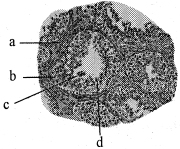
Identify the label $a$ in the given diagram.
A
Spermatogonia
B
Spermatozoa
C
Sertoli cells
D
Interstitial cells
Solution
(A) The provided diagram represents a cross-section of a seminiferous tubule.
In this diagram:
- Label $a$ points to the $Spermatogonia$ (immature germ cells located at the periphery of the tubule).
- Label $b$ points to the $Primary \text{ } spermatocytes$.
- Label $c$ points to the $Spermatozoa$ (mature sperm cells near the lumen).
- Label $d$ points to the $Sertoli \text{ } cells$ (supporting cells).
Therefore, label $a$ represents $Spermatogonia$.
In this diagram:
- Label $a$ points to the $Spermatogonia$ (immature germ cells located at the periphery of the tubule).
- Label $b$ points to the $Primary \text{ } spermatocytes$.
- Label $c$ points to the $Spermatozoa$ (mature sperm cells near the lumen).
- Label $d$ points to the $Sertoli \text{ } cells$ (supporting cells).
Therefore, label $a$ represents $Spermatogonia$.
0 likes
View SolutionHuman Reproduction — Gametogenesis · Frequently Asked Questions
1Are these Human Reproduction questions useful for JEE and NEET?
Yes. All questions in this section are mapped to JEE Main and NEET exam patterns. Previous year questions from JEE Main, NEET, GUJCET and state-level exams are included with full solutions.
2Can I switch to Hindi or Gujarati for these questions?
Yes. Use the language tabs in the hero section or the sidebar to view the same questions and solutions in English, Hindi or Gujarati.
3How do I generate a question paper from this subtopic?
Use the Vedclass Exam Paper Generator — select the chapter and subtopic, set difficulty, and generate Sets A, B, C, D automatically. First 3 chapters of every subject are free.
Vedclass Products
For Students
Vedclass Test Series
Mock tests in real JEE/NEET style with performance analysis. 5-day free trial.
Start Free TrialFor Teachers
Exam Paper Generator
Generate Set A/B/C/D papers from this chapter in 2 minutes. 3 chapters free.
Try FreeFor Institutes
Online Exam Module
Live online exams with unlimited students, 360° analytics & white-label branding.
See DemoFor Teachers & Institutes
Generate a Human Reproduction Exam Paper in 2 Minutes
Select subtopic & difficulty — Sets A, B, C, D auto-generated with No Repeat logic.
First 3 chapters of every subject are free — no payment required.