
A English
Gametogenesis Questions in English
Class 12 Biology · Human Reproduction · Gametogenesis
576+
Questions
English
Language
100%
With Solutions
Showing 49 of 576 questions in English
301
MediumMCQ
What is the correct sequence of spermatogenesis?
A
Spermatid - Secondary spermatocyte - Spermatogonia - Spermatozoa
B
Spermatogonia - Primary spermatocyte - Spermatid - Spermatozoa
C
Spermatogonia - Secondary spermatocyte - Spermatid - Spermatozoa
D
Spermatogonia - Primary spermatocyte - Secondary spermatocyte - Spermatid - Spermatozoa
Solution
(D) The process of spermatogenesis involves the following sequence:
$1$. $Spermatogonia$ $(2n)$ undergo mitosis to form $Primary \text{ } spermatocytes$ $(2n)$.
$2$. $Primary \text{ } spermatocytes$ undergo meiosis $I$ to form $Secondary \text{ } spermatocytes$ $(n)$.
$3$. $Secondary \text{ } spermatocytes$ undergo meiosis $II$ to form $Spermatids$ $(n)$.
$4$. $Spermatids$ undergo spermiogenesis to transform into $Spermatozoa$ $(n)$.
Thus, the correct sequence is: $Spermatogonia \rightarrow Primary \text{ } spermatocyte \rightarrow Secondary \text{ } spermatocyte \rightarrow Spermatid \rightarrow Spermatozoa$.
$1$. $Spermatogonia$ $(2n)$ undergo mitosis to form $Primary \text{ } spermatocytes$ $(2n)$.
$2$. $Primary \text{ } spermatocytes$ undergo meiosis $I$ to form $Secondary \text{ } spermatocytes$ $(n)$.
$3$. $Secondary \text{ } spermatocytes$ undergo meiosis $II$ to form $Spermatids$ $(n)$.
$4$. $Spermatids$ undergo spermiogenesis to transform into $Spermatozoa$ $(n)$.
Thus, the correct sequence is: $Spermatogonia \rightarrow Primary \text{ } spermatocyte \rightarrow Secondary \text{ } spermatocyte \rightarrow Spermatid \rightarrow Spermatozoa$.
0 likes
View Solution302
MediumMCQ
Which of the following events is $NOT$ associated with ovulation in a human female?
A
Decrease in estradiol levels
B
Full development of Graafian follicle
C
Release of secondary oocyte
D
$LH$ surge
Solution
(A) Ovulation is the process of releasing a secondary oocyte from the Graafian follicle.
This process is triggered by a sharp increase in Luteinizing Hormone $(LH)$ levels,known as the $LH$ surge.
During the follicular phase,the developing Graafian follicle secretes increasing amounts of estrogen (estradiol).
As the follicle reaches maturity,the high levels of estradiol exert positive feedback on the anterior pituitary,leading to the $LH$ surge.
Therefore,a decrease in estradiol levels is not associated with ovulation; rather,a peak in estradiol levels is required to trigger the $LH$ surge.
This process is triggered by a sharp increase in Luteinizing Hormone $(LH)$ levels,known as the $LH$ surge.
During the follicular phase,the developing Graafian follicle secretes increasing amounts of estrogen (estradiol).
As the follicle reaches maturity,the high levels of estradiol exert positive feedback on the anterior pituitary,leading to the $LH$ surge.
Therefore,a decrease in estradiol levels is not associated with ovulation; rather,a peak in estradiol levels is required to trigger the $LH$ surge.
0 likes
View Solution303
MediumMCQ
In human females,meiosis-$II$ is not completed until $..........$.
A
Puberty
B
Fertilization
C
Uterine implantation
D
Birth
Solution
(B) In human females,the primary oocytes complete meiosis-$I$ to form secondary oocytes and a first polar body. The secondary oocyte then begins meiosis-$II$ but gets arrested at the metaphase-$II$ stage. This meiosis-$II$ is only completed if a sperm cell enters the secondary oocyte during the process of fertilization. Therefore,the completion of meiosis-$II$ is triggered by the entry of the sperm.
0 likes
View Solution304
EasyMCQ
Which of the following layers of the antral follicle is acellular?
A
Granulosa
B
Theca interna
C
Stroma
D
Zona pellucida
Solution
(D) The $Zona$ $\text{pellucida}$ is a glycoprotein layer that surrounds the plasma membrane of the oocyte. It is an acellular layer secreted by the oocyte and the surrounding follicular cells. In contrast, the granulosa cells and theca layers are composed of living cells.
0 likes
View Solution305
MediumMCQ
Identify the correct statement regarding $Inhibin$.
A
It is produced by the granulosa cells of the ovary and inhibits the secretion of $FSH$.
B
It is produced by the granulosa cells of the ovary and inhibits the secretion of $LH$.
C
It is produced by the Sertoli cells of the testis and inhibits the secretion of $LH$.
D
It inhibits the secretion of $LH, FSH$,and prolactin.
Solution
(A) $Inhibin$ is a peptide hormone that plays a crucial role in the negative feedback regulation of the reproductive system.
In females,it is produced by the granulosa cells of the ovarian follicles and specifically inhibits the secretion of $FSH$ (Follicle Stimulating Hormone) from the anterior pituitary gland.
In males,it is produced by the Sertoli cells of the testes and also inhibits the secretion of $FSH$.
Therefore,the statement that it is produced by the granulosa cells of the ovary and inhibits the secretion of $FSH$ is correct.
In females,it is produced by the granulosa cells of the ovarian follicles and specifically inhibits the secretion of $FSH$ (Follicle Stimulating Hormone) from the anterior pituitary gland.
In males,it is produced by the Sertoli cells of the testes and also inhibits the secretion of $FSH$.
Therefore,the statement that it is produced by the granulosa cells of the ovary and inhibits the secretion of $FSH$ is correct.
0 likes
View Solution306
EasyMCQ
The difference between $Spermiogenesis$ and $Spermiation$ is:
A
In $Spermiogenesis$,spermatozoa from $Sertoli$ cells are released into the cavity of seminiferous tubules,while in $Spermiation$,spermatozoa are formed.
B
In $Spermiogenesis$,spermatids are formed,while in $Spermiation$,spermatozoa are formed.
C
In $Spermiogenesis$,spermatozoa are formed,while in $Spermiation$,spermatozoa are released from $Sertoli$ cells into the cavity of seminiferous tubules.
D
In $Spermiogenesis$,spermatozoa are formed,while in $Spermiation$,spermatids are formed.
Solution
(C) $Spermiogenesis$ is the process of transformation of non-motile spermatids into mature,motile spermatozoa.
$Spermiation$ is the process by which mature spermatozoa are released from the $Sertoli$ cells into the lumen (cavity) of the seminiferous tubules.
Therefore,$Spermiogenesis$ involves the formation of spermatozoa,and $Spermiation$ involves the release of these spermatozoa.
$Spermiation$ is the process by which mature spermatozoa are released from the $Sertoli$ cells into the lumen (cavity) of the seminiferous tubules.
Therefore,$Spermiogenesis$ involves the formation of spermatozoa,and $Spermiation$ involves the release of these spermatozoa.
0 likes
View Solution307
DifficultMCQ
Extrusion of the second polar body from the egg nucleus occurs:
A
after entry of sperm but before fertilization
B
after fertilization
C
before entry of sperm into ovum
D
simultaneously with first cleavage
Solution
(A) The secondary oocyte remains arrested at the metaphase-$II$ stage of meiosis-$II$ until a sperm makes contact with the zona pellucida of the ovum.
Upon the entry of the sperm into the cytoplasm of the secondary oocyte,the completion of meiosis-$II$ is triggered.
This process results in the formation of a large haploid ovum (ootid) and a small second polar body.
Therefore,the extrusion of the second polar body occurs after the entry of the sperm but before the fusion of the male and female pronuclei (fertilization).
Upon the entry of the sperm into the cytoplasm of the secondary oocyte,the completion of meiosis-$II$ is triggered.
This process results in the formation of a large haploid ovum (ootid) and a small second polar body.
Therefore,the extrusion of the second polar body occurs after the entry of the sperm but before the fusion of the male and female pronuclei (fertilization).
0 likes
View Solution308
MediumMCQ
Which of the following is true regarding sperm?
A
Fertilizin: For penetrating egg membrane
B
Hyaluronidase: For penetrating egg membrane
C
Acrosin: Dissolves corona radiata
D
Capacitation: Takes place in penis
Solution
(B) Sperm is the male gamete that fuses with the female gamete to produce a diploid cell called a zygote.
During fertilization,the acrosome of the sperm releases enzymes,particularly hyaluronidase,which facilitates the penetration of the sperm into the ovum.
Hyaluronidase acts on the hyaluronic acid of the corona radiata,allowing the sperm to reach the zona pellucida.
Acrosin is a protease that helps in the digestion of the zona pellucida,not the corona radiata.
Capacitation is the physiological maturation of sperm that occurs in the female reproductive tract,not the penis.
During fertilization,the acrosome of the sperm releases enzymes,particularly hyaluronidase,which facilitates the penetration of the sperm into the ovum.
Hyaluronidase acts on the hyaluronic acid of the corona radiata,allowing the sperm to reach the zona pellucida.
Acrosin is a protease that helps in the digestion of the zona pellucida,not the corona radiata.
Capacitation is the physiological maturation of sperm that occurs in the female reproductive tract,not the penis.
0 likes
View Solution309
MediumMCQ
In humans,what is the ratio of the number of gametes produced from one male primary sex cell to the number of gametes produced from one female primary sex cell?
A
$1:3$
B
$4:1$
C
$1:4$
D
$1:1$
Solution
(B) In males,one primary spermatocyte undergoes meiosis to produce $4$ functional,viable sperm cells.
In females,one primary oocyte undergoes meiosis,but due to unequal cytoplasmic division,it produces only $1$ functional,viable ovum and $2$ or $3$ non-functional polar bodies that eventually degenerate.
Therefore,the ratio of gametes produced from one male primary sex cell to one female primary sex cell is $4:1$.
In females,one primary oocyte undergoes meiosis,but due to unequal cytoplasmic division,it produces only $1$ functional,viable ovum and $2$ or $3$ non-functional polar bodies that eventually degenerate.
Therefore,the ratio of gametes produced from one male primary sex cell to one female primary sex cell is $4:1$.
0 likes
View Solution310
EasyMCQ
The correct sequence of spermatogenetic stages leading to the formation of sperms in a mature human testis is
A
spermatogonia $\rightarrow$ spermatid $\rightarrow$ spermatocyte $\rightarrow$ sperm
B
spermatocyte $\rightarrow$ spermatogonia $\rightarrow$ spermatid $\rightarrow$ sperm
C
spermatogonia $\rightarrow$ spermatocyte $\rightarrow$ spermatid $\rightarrow$ sperm
D
spermatid $\rightarrow$ spermatocyte $\rightarrow$ spermatogonia $\rightarrow$ sperm
Solution
(C) The process of spermatogenesis occurs in the following sequence:
$1$. Spermatogonia $(2n)$: These are the immature germ cells that undergo mitosis.
$2$. Primary Spermatocytes $(2n)$: Formed from spermatogonia,these undergo meiosis $I$ to form secondary spermatocytes $(n)$.
$3$. Spermatids $(n)$: Formed from secondary spermatocytes after meiosis $II$.
$4$. Spermatozoa (sperms): Formed from spermatids through the process of spermiogenesis.
Therefore,the correct sequence is: Spermatogonia $\rightarrow$ Spermatocyte $\rightarrow$ Spermatid $\rightarrow$ Sperm.
$1$. Spermatogonia $(2n)$: These are the immature germ cells that undergo mitosis.
$2$. Primary Spermatocytes $(2n)$: Formed from spermatogonia,these undergo meiosis $I$ to form secondary spermatocytes $(n)$.
$3$. Spermatids $(n)$: Formed from secondary spermatocytes after meiosis $II$.
$4$. Spermatozoa (sperms): Formed from spermatids through the process of spermiogenesis.
Therefore,the correct sequence is: Spermatogonia $\rightarrow$ Spermatocyte $\rightarrow$ Spermatid $\rightarrow$ Sperm.
0 likes
View Solution311
MediumMCQ
Ejaculation of human male contains about $200 - 300$ million sperms,of which for normal fertility . . . . . . $\%$ sperms must have normal shape and size and at least . . . . . . $\%$ must show energetic motility.
A
$40, 60$
B
$50, 50$
C
$60, 40$
D
$30, 70$
Solution
(C) During copulation (coitus),semen is released by the penis into the vagina (insemination).
The human male ejaculates about $200 - 300$ million sperms during a single coitus.
For normal fertility,it is essential that at least $60\%$ of all sperms must have normal shape and size.
Furthermore,for the sperms to reach the ovum and fertilize it,at least $40\%$ of them must show vigorous (energetic) motility.
The human male ejaculates about $200 - 300$ million sperms during a single coitus.
For normal fertility,it is essential that at least $60\%$ of all sperms must have normal shape and size.
Furthermore,for the sperms to reach the ovum and fertilize it,at least $40\%$ of them must show vigorous (energetic) motility.
0 likes
View Solution312
MediumMCQ
Assertion: Head of sperm consists of acrosome and mitochondria.
Reason: Acrosome contains spiral row of mitochondria.
Reason: Acrosome contains spiral row of mitochondria.
A
If both Assertion and Reason are correct and the Reason is a correct explanation of the Assertion.
B
If both Assertion and Reason are correct but Reason is not a correct explanation of the Assertion.
C
If both the Assertion and Reason are incorrect.
D
If the Assertion is correct but Reason is incorrect.
Solution
(C) The head of a sperm consists of an acrosome and a nucleus,not mitochondria.
The spiral row of mitochondria is present in the middle piece of the sperm,which provides energy for motility.
Therefore,both the Assertion and the Reason are incorrect.
The spiral row of mitochondria is present in the middle piece of the sperm,which provides energy for motility.
Therefore,both the Assertion and the Reason are incorrect.
0 likes
View Solution313
Easy
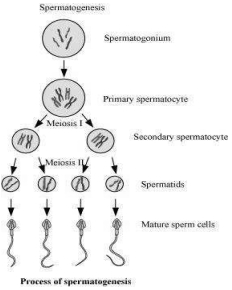
What is spermatogenesis? Briefly describe the process of spermatogenesis.
Solution
(N/A) Spermatogenesis is the process of the production of sperms from the immature germ cells in males. It takes place in the seminiferous tubules present inside the testes.
During spermatogenesis,a diploid spermatogonium (male germ cell) increases in size to form a diploid primary spermatocyte.
This diploid primary spermatocyte undergoes the first meiotic division (meiosis $I$),which is a reductional division,to form two equal haploid secondary spermatocytes.
Each secondary spermatocyte then undergoes the second meiotic division (meiosis $II$) to form two equal haploid spermatids.
Hence,a single diploid spermatogonium produces four haploid spermatids.
These spermatids are transformed into spermatozoa (sperm) by a process called spermiogenesis.
During spermatogenesis,a diploid spermatogonium (male germ cell) increases in size to form a diploid primary spermatocyte.
This diploid primary spermatocyte undergoes the first meiotic division (meiosis $I$),which is a reductional division,to form two equal haploid secondary spermatocytes.
Each secondary spermatocyte then undergoes the second meiotic division (meiosis $II$) to form two equal haploid spermatids.
Hence,a single diploid spermatogonium produces four haploid spermatids.
These spermatids are transformed into spermatozoa (sperm) by a process called spermiogenesis.
0 likes
View Solution314
EasyMCQ
Name the hormones involved in the regulation of spermatogenesis.
A
$FSH$ and $LH$
B
Testosterone and Estrogen
C
Progesterone and $LH$
D
$FSH$ and Progesterone
Solution
(A) The process of spermatogenesis is regulated by hormones secreted by the hypothalamus and the anterior pituitary gland.
$1$. Gonadotropin-releasing hormone $(GnRH)$ from the hypothalamus stimulates the anterior pituitary to secrete two gonadotropins: Follicle-stimulating hormone $(FSH)$ and Luteinizing hormone $(LH)$.
$2$. $LH$ acts on the Leydig cells (interstitial cells) of the testis and stimulates them to synthesize and secrete androgens (primarily testosterone).
$3$. $FSH$ acts on the Sertoli cells and stimulates the secretion of some factors which help in the process of spermiogenesis (the transformation of spermatids into spermatozoa).
$1$. Gonadotropin-releasing hormone $(GnRH)$ from the hypothalamus stimulates the anterior pituitary to secrete two gonadotropins: Follicle-stimulating hormone $(FSH)$ and Luteinizing hormone $(LH)$.
$2$. $LH$ acts on the Leydig cells (interstitial cells) of the testis and stimulates them to synthesize and secrete androgens (primarily testosterone).
$3$. $FSH$ acts on the Sertoli cells and stimulates the secretion of some factors which help in the process of spermiogenesis (the transformation of spermatids into spermatozoa).
0 likes
View Solution315
Easy
Define spermiogenesis and spermiation.
Solution
(N/A) Spermiogenesis: It is the process of transformation of non-motile spermatids into mature,motile spermatozoa (sperms).
Spermiation: It is the process of release of mature spermatozoa from the Sertoli cells into the lumen of the seminiferous tubules.
Spermiation: It is the process of release of mature spermatozoa from the Sertoli cells into the lumen of the seminiferous tubules.
1 likes
View Solution316
Easy
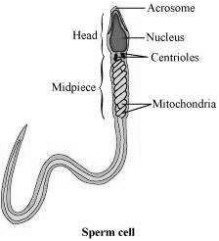
Draw a labeled diagram of a human sperm cell.
Solution
(N/A) human sperm cell is a microscopic structure composed of a head,neck,a middle piece,and a tail.
$1$. Head: Contains an elongated haploid nucleus and is covered by a cap-like structure called the acrosome,which contains enzymes that help in fertilization of the ovum.
$2$. Neck: Contains two centrioles,the proximal centriole (which helps in the first cleavage of the zygote) and the distal centriole (which gives rise to the axial filament).
$3$. Middle Piece: Contains numerous mitochondria that produce energy for the movement of the tail,which facilitates sperm motility.
$4$. Tail: $A$ long,flagellar structure that provides motility to the sperm,allowing it to swim towards the ovum.
$1$. Head: Contains an elongated haploid nucleus and is covered by a cap-like structure called the acrosome,which contains enzymes that help in fertilization of the ovum.
$2$. Neck: Contains two centrioles,the proximal centriole (which helps in the first cleavage of the zygote) and the distal centriole (which gives rise to the axial filament).
$3$. Middle Piece: Contains numerous mitochondria that produce energy for the movement of the tail,which facilitates sperm motility.
$4$. Tail: $A$ long,flagellar structure that provides motility to the sperm,allowing it to swim towards the ovum.
0 likes
View Solution317
Difficult
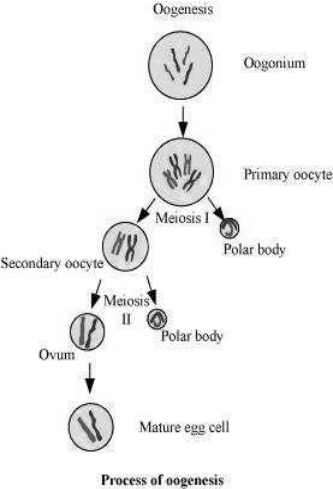
What is oogenesis? Give a brief account of oogenesis.
Solution
Oogenesis is the process of the formation of a mature ovum from the oogonia in females. It takes place in the ovaries.
During oogenesis,a diploid oogonium or egg mother cell increases in size and gets transformed into a diploid primary oocyte.
This diploid primary oocyte undergoes the first meiotic division,i.e.,meiosis $I$ or reductional division,to form two unequal haploid cells.
The smaller cell is known as the first polar body,while the larger cell is known as the secondary oocyte.
This secondary oocyte undergoes the second meiotic division,i.e.,meiosis $II$ or equational division,and gives rise to a second polar body and an ovum.
Hence,in the process of oogenesis,a diploid oogonium produces a single haploid ovum while two or three polar bodies are produced.
During oogenesis,a diploid oogonium or egg mother cell increases in size and gets transformed into a diploid primary oocyte.
This diploid primary oocyte undergoes the first meiotic division,i.e.,meiosis $I$ or reductional division,to form two unequal haploid cells.
The smaller cell is known as the first polar body,while the larger cell is known as the secondary oocyte.
This secondary oocyte undergoes the second meiotic division,i.e.,meiosis $II$ or equational division,and gives rise to a second polar body and an ovum.
Hence,in the process of oogenesis,a diploid oogonium produces a single haploid ovum while two or three polar bodies are produced.
0 likes
View Solution318
Difficult
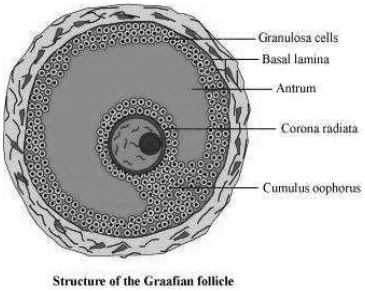
Draw a labeled diagram of a Graafian follicle.
Solution
(N/A) Graafian follicle is a mature ovarian follicle that contains a secondary oocyte. Its key components include:
$1$. $Antrum$: $A$ fluid-filled cavity.
$2$. $Granulosa$ $cells$: Cells lining the follicle that produce estrogen.
$3$. $Corona$ $radiata$: $A$ layer of follicular cells surrounding the oocyte.
$4$. $Cumulus$ $oophorus$: $A$ cluster of cells that anchors the oocyte to the follicle wall.
$5$. $Basal$ $lamina$: The basement membrane surrounding the follicle.
Refer to the provided diagram for the structural arrangement of these components.
$1$. $Antrum$: $A$ fluid-filled cavity.
$2$. $Granulosa$ $cells$: Cells lining the follicle that produce estrogen.
$3$. $Corona$ $radiata$: $A$ layer of follicular cells surrounding the oocyte.
$4$. $Cumulus$ $oophorus$: $A$ cluster of cells that anchors the oocyte to the follicle wall.
$5$. $Basal$ $lamina$: The basement membrane surrounding the follicle.
Refer to the provided diagram for the structural arrangement of these components.
0 likes
View Solution319
MediumMCQ
How many eggs do you think were released by the ovary of a female dog which gave birth to $6$ puppies?
A
$3$
B
$6$
C
$12$
D
$1$
Solution
(B) Dogs and rodents are polyovulatory species.
In these species,more than one ovum is released from the ovary at the time of ovulation.
Since each puppy develops from a separate zygote formed by the fertilization of an individual egg by a sperm,the number of eggs released must correspond to the number of offspring produced.
Therefore,$6$ eggs were released by the ovary of the female dog to produce $6$ puppies.
In these species,more than one ovum is released from the ovary at the time of ovulation.
Since each puppy develops from a separate zygote formed by the fertilization of an individual egg by a sperm,the number of eggs released must correspond to the number of offspring produced.
Therefore,$6$ eggs were released by the ovary of the female dog to produce $6$ puppies.
0 likes
View Solution320
Medium
What is gametogenesis? Explain.
Solution
(N/A) Gametogenesis is the biological process by which diploid or haploid precursor cells undergo cell division and differentiation to form mature haploid gametes.
In animals,there are two types of cells: somatic cells and germ cells.
- Somatic cells form the various organs of the body and divide by mitosis to maintain the diploid number.
- Germ cells undergo meiosis to produce gametes.
Male gametes are known as spermatozoa,and the process of their formation is called spermatogenesis.
Female gametes are known as ova (or eggs),and the process of their formation is called oogenesis.
In animals,there are two types of cells: somatic cells and germ cells.
- Somatic cells form the various organs of the body and divide by mitosis to maintain the diploid number.
- Germ cells undergo meiosis to produce gametes.
Male gametes are known as spermatozoa,and the process of their formation is called spermatogenesis.
Female gametes are known as ova (or eggs),and the process of their formation is called oogenesis.
0 likes
View Solution321
Difficult
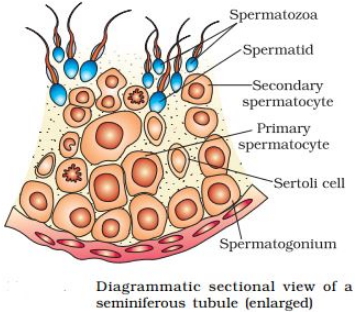
Describe the process of spermatogenesis with a labelled diagram.
Solution
(N/A) Spermatogenesis is the process by which immature male germ cells (spermatogonia) produce sperms in the testes,beginning at puberty.
Spermatogenesis involves two main stages: $(1)$ Formation of spermatids and $(2)$ Spermiogenesis.
$(1)$ Formation of spermatids: This process occurs in three phases:
$(i)$ Multiplication phase: Spermatogonia present on the inner wall of seminiferous tubules multiply by mitotic division. Each spermatogonium is diploid $(2n)$ and contains $46$ chromosomes.
(ii) Growth phase: Each spermatogonium increases in size by accumulating nutritive material and is now called a primary spermatocyte. It receives nutrition from Sertoli cells.
(iii) Maturation phase: Primary spermatocytes undergo meiosis. The first meiotic division (meiosis $I$) results in two equal,haploid cells called secondary spermatocytes $(n)$,each with $23$ chromosomes. These then undergo the second meiotic division (meiosis $II$) to produce four equal,haploid spermatids.
$(2)$ Spermiogenesis: The transformation of non-motile spermatids into mature,motile spermatozoa is called spermiogenesis.
After spermiogenesis,sperm heads become embedded in the Sertoli cells and are finally released from the seminiferous tubules by a process called spermiation.
Spermatogenesis involves two main stages: $(1)$ Formation of spermatids and $(2)$ Spermiogenesis.
$(1)$ Formation of spermatids: This process occurs in three phases:
$(i)$ Multiplication phase: Spermatogonia present on the inner wall of seminiferous tubules multiply by mitotic division. Each spermatogonium is diploid $(2n)$ and contains $46$ chromosomes.
(ii) Growth phase: Each spermatogonium increases in size by accumulating nutritive material and is now called a primary spermatocyte. It receives nutrition from Sertoli cells.
(iii) Maturation phase: Primary spermatocytes undergo meiosis. The first meiotic division (meiosis $I$) results in two equal,haploid cells called secondary spermatocytes $(n)$,each with $23$ chromosomes. These then undergo the second meiotic division (meiosis $II$) to produce four equal,haploid spermatids.
$(2)$ Spermiogenesis: The transformation of non-motile spermatids into mature,motile spermatozoa is called spermiogenesis.
After spermiogenesis,sperm heads become embedded in the Sertoli cells and are finally released from the seminiferous tubules by a process called spermiation.
0 likes
View Solution322
Medium
Give information about hormones associated with the process of spermatogenesis.
Solution
(N/A) Spermatogenesis starts at the age of puberty due to a significant increase in the secretion of gonadotropin-releasing hormone $(GnRH)$. This is a hypothalamic hormone.
The increased levels of $GnRH$ act on the anterior pituitary gland and stimulate the secretion of two gonadotropins: luteinizing hormone $(LH)$ and follicle-stimulating hormone $(FSH)$.
$LH$ acts on the Leydig cells and stimulates the synthesis and secretion of androgens. Androgens,in turn,stimulate the process of spermatogenesis.
$FSH$ acts on the Sertoli cells and stimulates the secretion of certain factors that help in the process of spermiogenesis.
The increased levels of $GnRH$ act on the anterior pituitary gland and stimulate the secretion of two gonadotropins: luteinizing hormone $(LH)$ and follicle-stimulating hormone $(FSH)$.
$LH$ acts on the Leydig cells and stimulates the synthesis and secretion of androgens. Androgens,in turn,stimulate the process of spermatogenesis.
$FSH$ acts on the Sertoli cells and stimulates the secretion of certain factors that help in the process of spermiogenesis.
0 likes
View Solution323
Medium
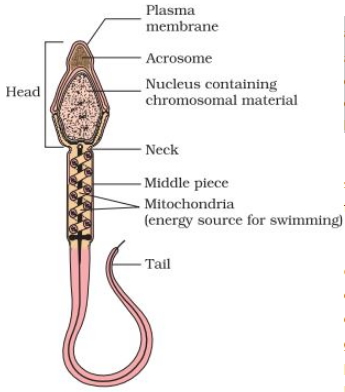
Describe the structure of a sperm.
Solution
(N/A) sperm is a microscopic structure composed of a head,neck,a middle piece,and a tail.
$A$ plasma membrane envelops the entire body of the sperm.
The sperm head contains an elongated haploid nucleus,the anterior portion of which is covered by a cap-like structure called the acrosome.
The acrosome is filled with enzymes (such as hyaluronidase) that help in the fertilization of the ovum.
The middle piece of the sperm possesses numerous mitochondria,which produce energy for the movement of the tail that facilitates sperm motility,which is essential for fertilization.
The human male ejaculates about $200$ to $300$ million sperms during a single coitus,of which,for normal fertility,at least $60 \%$ sperms must have normal shape and size,and at least $40 \%$ of them must show vigorous motility.
$A$ plasma membrane envelops the entire body of the sperm.
The sperm head contains an elongated haploid nucleus,the anterior portion of which is covered by a cap-like structure called the acrosome.
The acrosome is filled with enzymes (such as hyaluronidase) that help in the fertilization of the ovum.
The middle piece of the sperm possesses numerous mitochondria,which produce energy for the movement of the tail that facilitates sperm motility,which is essential for fertilization.
The human male ejaculates about $200$ to $300$ million sperms during a single coitus,of which,for normal fertility,at least $60 \%$ sperms must have normal shape and size,and at least $40 \%$ of them must show vigorous motility.
0 likes
View Solution324
Difficult
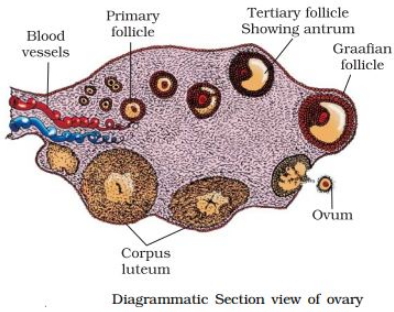
Describe the process of oogenesis.
Solution
(N/A) The process of formation of a mature female gamete is called oogenesis.
Oogenesis is initiated during the embryonic development stage when a couple of million gamete mother cells (oogonia) are formed within each fetal ovary.
No more oogonia are formed and added after birth.
Primary oocytes: These cells start division and enter into prophase-$I$ of the meiotic division and get temporarily arrested at that stage; these are called primary oocytes.
Primary follicle: Each primary oocyte then gets surrounded by a layer of granulosa cells and is called the primary follicle.
$A$ large number of these follicles degenerate during the phase from birth to puberty.
Secondary follicle: The primary follicle gets surrounded by more layers of granulosa cells and a new theca and is called a secondary follicle.
Tertiary follicles: The secondary follicle soon transforms into a tertiary follicle which is characterised by a fluid-filled cavity called antrum. The theca layer is organised into an inner theca interna and an outer theca externa.
Now,the primary oocyte within the tertiary follicle grows in size and completes its first meiotic division. It is an unequal division resulting in the formation of a large haploid secondary oocyte and a tiny first polar body.
The secondary oocyte retains the bulk of the nutrient-rich cytoplasm of the primary oocyte.
The tertiary follicle further changes into the mature follicle or Graafian follicle.
The secondary oocyte forms a new membrane called zona pellucida surrounding it.
Oogenesis is initiated during the embryonic development stage when a couple of million gamete mother cells (oogonia) are formed within each fetal ovary.
No more oogonia are formed and added after birth.
Primary oocytes: These cells start division and enter into prophase-$I$ of the meiotic division and get temporarily arrested at that stage; these are called primary oocytes.
Primary follicle: Each primary oocyte then gets surrounded by a layer of granulosa cells and is called the primary follicle.
$A$ large number of these follicles degenerate during the phase from birth to puberty.
Secondary follicle: The primary follicle gets surrounded by more layers of granulosa cells and a new theca and is called a secondary follicle.
Tertiary follicles: The secondary follicle soon transforms into a tertiary follicle which is characterised by a fluid-filled cavity called antrum. The theca layer is organised into an inner theca interna and an outer theca externa.
Now,the primary oocyte within the tertiary follicle grows in size and completes its first meiotic division. It is an unequal division resulting in the formation of a large haploid secondary oocyte and a tiny first polar body.
The secondary oocyte retains the bulk of the nutrient-rich cytoplasm of the primary oocyte.
The tertiary follicle further changes into the mature follicle or Graafian follicle.
The secondary oocyte forms a new membrane called zona pellucida surrounding it.
0 likes
View Solution325
Medium
Name a cell that is found arrested in the diplotene stage for months or years. Comment in $2-3$ lines on how it completes its cell cycle.
Solution
(N/A) The cell arrested in the diplotene stage is the primary oocyte in female mammals.
In the primary oocyte, meiosis begins during embryonic development but halts at the diplotene stage of prophase-$I$, a state known as the dictyate stage. This arrest is maintained until puberty, when hormonal signals (specifically the $LH$ surge) trigger the resumption of meiosis, allowing the cell to complete meiosis-$I$ and proceed to meiosis-$II$.
In the primary oocyte, meiosis begins during embryonic development but halts at the diplotene stage of prophase-$I$, a state known as the dictyate stage. This arrest is maintained until puberty, when hormonal signals (specifically the $LH$ surge) trigger the resumption of meiosis, allowing the cell to complete meiosis-$I$ and proceed to meiosis-$II$.
0 likes
View Solution326
MediumMCQ
What is the role played by luteinizing hormones in males and females respectively?
A
Stimulates spermatogenesis in males and ovulation in females.
B
Stimulates androgen synthesis in males and maintains corpus luteum in females.
C
Stimulates testosterone production in males and follicle development in females.
D
Stimulates sperm maturation in males and estrogen secretion in females.
Solution
(B) In males $(♂)$,$LH$ (Luteinizing Hormone) acts on the Leydig cells to induce the synthesis and secretion of androgens (testosterone). Along with $FSH$,it also regulates spermatogenesis.
In females $(♀)$,$LH$ triggers the ovulation of mature ovarian follicles (Graafian follicles). After ovulation,it maintains the corpus luteum,which secretes progesterone.
In females $(♀)$,$LH$ triggers the ovulation of mature ovarian follicles (Graafian follicles). After ovulation,it maintains the corpus luteum,which secretes progesterone.
0 likes
View Solution327
EasyMCQ
What is the function of $LH$ in males?
A
Stimulates spermatogenesis
B
Stimulates the synthesis and secretion of androgens from the testis
C
Stimulates the secretion of $FSH$
D
Stimulates the growth of the prostate gland
Solution
(B) In males,$LH$ (Luteinizing Hormone) acts on the Leydig cells of the testis.
It stimulates the synthesis and secretion of hormones called androgens,primarily testosterone.
Together with $FSH$,$LH$ plays a crucial role in regulating the process of spermatogenesis.
It stimulates the synthesis and secretion of hormones called androgens,primarily testosterone.
Together with $FSH$,$LH$ plays a crucial role in regulating the process of spermatogenesis.
0 likes
View Solution328
Medium
Do all the gametes formed from a parent organism have the same genetic composition (identical $DNA$ copies of the parental genome)? Analyse the situation with the background of gametogenesis and provide a suitable explanation.
Solution
(B) No,the gametes formed from a parent organism do not have the same genetic composition because they do not contain identical copies of $DNA$.
During the pachytene and diplotene stages of meiosis-$I$,crossing over and chiasma formation occur between homologous chromosomes.
The exchange of $DNA$ segments between non-sister chromatids of homologous chromosomes occurs in a random manner,resulting in new combinations of $DNA$ sequences.
Furthermore,the independent assortment of chromosomes during meiosis-$I$ ensures that each gamete receives a unique combination of maternal and paternal chromosomes.
Consequently,after the completion of meiotic division,the resulting gametes possess $DNA$ with varying degrees of genetic variation.
During the pachytene and diplotene stages of meiosis-$I$,crossing over and chiasma formation occur between homologous chromosomes.
The exchange of $DNA$ segments between non-sister chromatids of homologous chromosomes occurs in a random manner,resulting in new combinations of $DNA$ sequences.
Furthermore,the independent assortment of chromosomes during meiosis-$I$ ensures that each gamete receives a unique combination of maternal and paternal chromosomes.
Consequently,after the completion of meiotic division,the resulting gametes possess $DNA$ with varying degrees of genetic variation.
0 likes
View Solution329
Medium
Give scientific reasons: The spermatids are transformed into spermatozoa by the process called spermiogenesis.
Solution
(N/A) Spermatids are non-motile and structurally incomplete to reach the female reproductive tract.
During the process of spermiogenesis,the spermatids undergo significant morphological changes to become functional spermatozoa.
These changes include the formation of a tail (flagellum) for motility,the condensation of the nucleus,the formation of the acrosome from the Golgi apparatus,and the arrangement of mitochondria in the middle piece to provide energy for movement.
During the process of spermiogenesis,the spermatids undergo significant morphological changes to become functional spermatozoa.
These changes include the formation of a tail (flagellum) for motility,the condensation of the nucleus,the formation of the acrosome from the Golgi apparatus,and the arrangement of mitochondria in the middle piece to provide energy for movement.
0 likes
View Solution330
Easy
Define the following terms:
$(1)$ Spermiogenesis
$(2)$ Zona pellucida
$(1)$ Spermiogenesis
$(2)$ Zona pellucida
Solution
(N/A) $(1)$ Spermiogenesis: The process by which spermatids are transformed into mature spermatozoa is known as spermiogenesis.
$(2)$ Zona pellucida: It is a thick,transparent,non-cellular glycoprotein layer that surrounds the plasma membrane of the secondary oocyte.
$(2)$ Zona pellucida: It is a thick,transparent,non-cellular glycoprotein layer that surrounds the plasma membrane of the secondary oocyte.
0 likes
View Solution331
MediumMCQ
Define the location and function of the following: Spermatid and Hyaluronidase.
A
Spermatid: Found in the seminiferous tubules; Function: Develops into spermatozoa.
B
Hyaluronidase: Found in the acrosome; Function: Digests the zona pellucida to facilitate fertilization.
C
Spermatid: Found in the epididymis; Function: Stores sperm.
D
Hyaluronidase: Found in the seminal plasma; Function: Provides energy to sperm.
Solution
(B) $1$. Spermatid:
- Location: Formed in the seminiferous tubules of the testes during the process of spermatogenesis.
- Function: It undergoes spermiogenesis to differentiate into a mature,motile spermatozoon.
$2$. Hyaluronidase:
- Location: It is a hydrolytic enzyme present in the acrosome of the sperm head.
- Function: It digests the hyaluronic acid present in the corona radiata and zona pellucida of the ovum,enabling the sperm to penetrate and fertilize the egg.
- Location: Formed in the seminiferous tubules of the testes during the process of spermatogenesis.
- Function: It undergoes spermiogenesis to differentiate into a mature,motile spermatozoon.
$2$. Hyaluronidase:
- Location: It is a hydrolytic enzyme present in the acrosome of the sperm head.
- Function: It digests the hyaluronic acid present in the corona radiata and zona pellucida of the ovum,enabling the sperm to penetrate and fertilize the egg.
0 likes
View Solution332
Medium
Explain the difference between the following terms:
$(1)$ Spermatid - Spermatozoa
$(2)$ First polar body - Second polar body
$(1)$ Spermatid - Spermatozoa
$(2)$ First polar body - Second polar body
Solution
(N/A) $(1)$ Spermatid: These are haploid cells produced at the end of the second meiotic division during the maturation phase of spermatogenesis.
Spermatozoa: These are motile,mature male gametes formed from spermatids through the process of spermiogenesis.
$(2)$ First polar body: During the maturation phase of oogenesis,the primary oocyte undergoes an unequal first meiotic division,resulting in a large secondary oocyte and a small first polar body.
Second polar body: During the maturation phase of oogenesis,the completion of the second meiotic division of the secondary oocyte results in the formation of a mature ovum and a tiny second polar body.
Spermatozoa: These are motile,mature male gametes formed from spermatids through the process of spermiogenesis.
$(2)$ First polar body: During the maturation phase of oogenesis,the primary oocyte undergoes an unequal first meiotic division,resulting in a large secondary oocyte and a small first polar body.
Second polar body: During the maturation phase of oogenesis,the completion of the second meiotic division of the secondary oocyte results in the formation of a mature ovum and a tiny second polar body.
0 likes
View Solution333
Medium
Give the names and functions of the hormones involved in the process of spermatogenesis. Write the names of the endocrine glands from where they are released.
Solution
(N/A) Spermatogenesis begins at puberty due to a significant increase in the secretion of Gonadotropin-Releasing Hormone $(GnRH)$.
$GnRH$ is a hypothalamic hormone released from the hypothalamus.
The increased levels of $GnRH$ act on the anterior pituitary gland and stimulate the secretion of two gonadotropins: Luteinizing Hormone $(LH)$ and Follicle-Stimulating Hormone $(FSH)$.
$LH$ acts on the Leydig cells (interstitial cells) and stimulates the synthesis and secretion of androgens (testosterone). Androgens,in turn,stimulate the process of spermatogenesis.
$FSH$ acts on the Sertoli cells and stimulates the secretion of certain factors that help in the process of spermiogenesis (the transformation of spermatids into spermatozoa).
$GnRH$ is a hypothalamic hormone released from the hypothalamus.
The increased levels of $GnRH$ act on the anterior pituitary gland and stimulate the secretion of two gonadotropins: Luteinizing Hormone $(LH)$ and Follicle-Stimulating Hormone $(FSH)$.
$LH$ acts on the Leydig cells (interstitial cells) and stimulates the synthesis and secretion of androgens (testosterone). Androgens,in turn,stimulate the process of spermatogenesis.
$FSH$ acts on the Sertoli cells and stimulates the secretion of certain factors that help in the process of spermiogenesis (the transformation of spermatids into spermatozoa).
0 likes
View Solution334
Medium
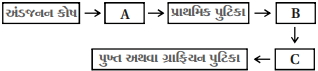
The mother germ cells are transformed into a mature follicle through a series of steps. Provide the missing steps in the blank boxes.
$\boxed{\text{Oogonia}} \to \boxed{A} \to \boxed{\text{Primary follicle}} \to \boxed{B} \to \boxed{C} \to \boxed{\text{Mature or Graafian follicle}}$
$\boxed{\text{Oogonia}} \to \boxed{A} \to \boxed{\text{Primary follicle}} \to \boxed{B} \to \boxed{C} \to \boxed{\text{Mature or Graafian follicle}}$
Solution
(N/A) The process of follicular development in the ovary follows this sequence:
$1$. $\text{Oogonia}$ (Mother germ cells) undergo differentiation.
$2$. $A = \text{Primary oocyte}$ (surrounded by a layer of granulosa cells,forming the Primary follicle).
$3$. $\text{Primary follicle}$ develops further.
$4$. $B = \text{Secondary follicle}$ (formed by the addition of more layers of granulosa cells and a new theca layer).
$5$. $C = \text{Tertiary follicle}$ (characterized by a fluid-filled cavity called the antrum).
$6$. Finally,it matures into the $\text{Graafian follicle}$.
$1$. $\text{Oogonia}$ (Mother germ cells) undergo differentiation.
$2$. $A = \text{Primary oocyte}$ (surrounded by a layer of granulosa cells,forming the Primary follicle).
$3$. $\text{Primary follicle}$ develops further.
$4$. $B = \text{Secondary follicle}$ (formed by the addition of more layers of granulosa cells and a new theca layer).
$5$. $C = \text{Tertiary follicle}$ (characterized by a fluid-filled cavity called the antrum).
$6$. Finally,it matures into the $\text{Graafian follicle}$.
0 likes
View Solution335
MediumMCQ
What is the difference between a primary oocyte and a secondary oocyte?
A
Primary oocyte is diploid $(2n)$,while secondary oocyte is haploid $(n)$.
B
Primary oocyte is formed before birth,while secondary oocyte is formed after puberty.
C
Primary oocyte undergoes meiosis-$I$,while secondary oocyte undergoes meiosis-$II$.
D
All of the above.
Solution
(D) The primary oocyte is a diploid $(2n)$ cell formed during fetal development that remains arrested in prophase-$I$ of meiosis-$I$.
Upon reaching puberty,the primary oocyte completes meiosis-$I$ to form two unequal haploid cells: a large secondary oocyte $(n)$ and a small first polar body.
The secondary oocyte then enters meiosis-$II$ but arrests in metaphase-$II$ until fertilization occurs.
Therefore,the primary oocyte is diploid $(2n)$ and the secondary oocyte is haploid $(n)$.
Upon reaching puberty,the primary oocyte completes meiosis-$I$ to form two unequal haploid cells: a large secondary oocyte $(n)$ and a small first polar body.
The secondary oocyte then enters meiosis-$II$ but arrests in metaphase-$II$ until fertilization occurs.
Therefore,the primary oocyte is diploid $(2n)$ and the secondary oocyte is haploid $(n)$.
0 likes
View Solution336
MediumMCQ
Which type of cell division forms spermatids from the secondary spermatocytes?
A
Mitosis
B
Meiosis $I$
C
Meiosis $II$
D
Amitosis
Solution
(C) Spermatogenesis involves the transformation of primary spermatocytes into secondary spermatocytes through $Meiosis-I$.
Subsequently,the secondary spermatocytes undergo $Meiosis-II$ (equational division) to produce haploid spermatids.
Therefore,the division responsible for forming spermatids from secondary spermatocytes is $Meiosis-II$.
Subsequently,the secondary spermatocytes undergo $Meiosis-II$ (equational division) to produce haploid spermatids.
Therefore,the division responsible for forming spermatids from secondary spermatocytes is $Meiosis-II$.
0 likes
View Solution337
MediumMCQ
How many spermatozoa are formed from one secondary spermatocyte?
A
$1$
B
$2$
C
$4$
D
$8$
Solution
(B) primary spermatocyte undergoes the first meiotic division (meiosis-$I$) to form two haploid secondary spermatocytes.
Each secondary spermatocyte then undergoes the second meiotic division (meiosis-$II$) to produce two haploid spermatids.
These spermatids eventually differentiate into spermatozoa.
Therefore,one secondary spermatocyte produces two spermatozoa.
Each secondary spermatocyte then undergoes the second meiotic division (meiosis-$II$) to produce two haploid spermatids.
These spermatids eventually differentiate into spermatozoa.
Therefore,one secondary spermatocyte produces two spermatozoa.
0 likes
View Solution338
Medium
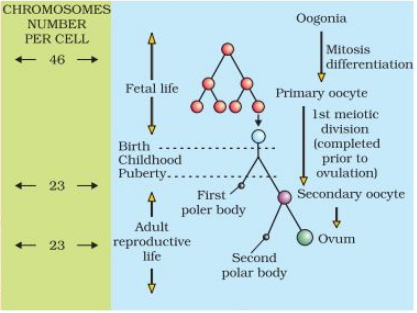
Provide a schematic labelled diagram to represent oogenesis.
Solution
(N/A) The process of oogenesis involves the following stages:
$1$. Oogonia ($46$ chromosomes) undergo mitosis and differentiation during fetal life to form Primary oocytes ($46$ chromosomes).
$2$. The Primary oocyte completes the $1^{st}$ meiotic division (prior to ovulation) to form a Secondary oocyte ($23$ chromosomes) and a First polar body ($23$ chromosomes).
$3$. The Secondary oocyte undergoes the $2^{nd}$ meiotic division to form an Ovum ($23$ chromosomes) and a Second polar body ($23$ chromosomes).
$1$. Oogonia ($46$ chromosomes) undergo mitosis and differentiation during fetal life to form Primary oocytes ($46$ chromosomes).
$2$. The Primary oocyte completes the $1^{st}$ meiotic division (prior to ovulation) to form a Secondary oocyte ($23$ chromosomes) and a First polar body ($23$ chromosomes).
$3$. The Secondary oocyte undergoes the $2^{nd}$ meiotic division to form an Ovum ($23$ chromosomes) and a Second polar body ($23$ chromosomes).
0 likes
View Solution339
Medium
What are the changes in the oogonia during the transition of a primary follicle to Graafian follicle?
Solution
(N/A) The process begins with the primary oocyte within the primary follicle. As the follicle develops into a secondary follicle and then a tertiary follicle,the primary oocyte grows in size.
Within the tertiary follicle,the primary oocyte completes its first meiotic division. This is an unequal division that results in the formation of a large haploid secondary oocyte and a tiny first polar body.
The tertiary follicle then matures into a Graafian follicle. The secondary oocyte remains within the Graafian follicle until ovulation,at which point the Graafian follicle ruptures to release the secondary oocyte from the ovary.
Within the tertiary follicle,the primary oocyte completes its first meiotic division. This is an unequal division that results in the formation of a large haploid secondary oocyte and a tiny first polar body.
The tertiary follicle then matures into a Graafian follicle. The secondary oocyte remains within the Graafian follicle until ovulation,at which point the Graafian follicle ruptures to release the secondary oocyte from the ovary.
0 likes
View Solution340
Medium
Meiotic division during oogenesis is different from that in spermatogenesis. Explain how and why?
Solution
(N/A)
In oogenesis,meiotic division is unequal,which ensures that the ovum retains almost all the cytoplasm and organelles from the primary oocyte. This provides the necessary nutrients for the early development of the embryo after fertilization. In contrast,spermatogenesis results in equal division to produce many small,motile sperms,which is advantageous for reaching the egg. Furthermore,the second meiotic division in oogenesis is arrested at metaphase-$II$ and is only completed upon the entry of a sperm.
| Spermatogenesis | Oogenesis |
|---|---|
| $1$. The process of sperm formation occurs after puberty. | $1$. Oogonia formation begins before birth. |
| $2$. Millions of sperms are produced at a time. | $2$. Only one ovum is released per month. |
| $3$. Meiosis produces four functional,equal-sized spermatids. | $3$. Meiosis is unequal,resulting in one large ovum and three small polar bodies. |
| $4$. Sperms are flagellated and motile. | $4$. The mature ovum is non-flagellated and non-motile. |
In oogenesis,meiotic division is unequal,which ensures that the ovum retains almost all the cytoplasm and organelles from the primary oocyte. This provides the necessary nutrients for the early development of the embryo after fertilization. In contrast,spermatogenesis results in equal division to produce many small,motile sperms,which is advantageous for reaching the egg. Furthermore,the second meiotic division in oogenesis is arrested at metaphase-$II$ and is only completed upon the entry of a sperm.
0 likes
View Solution341
DifficultMCQ
Males in whom testes fail to descend into the scrotum are generally infertile. Why?
A
The scrotum provides a higher temperature than the body cavity.
B
The scrotum provides a lower temperature than the body cavity,which is essential for spermatogenesis.
C
The testes fail to produce testosterone when inside the body cavity.
D
The testes are damaged by the pressure of the abdominal cavity.
Solution
(B) The testes are located outside the abdominal cavity within a pouch called the scrotum.
This is because the scrotum maintains a temperature $2-2.5^{\circ}C$ lower than the normal internal body temperature.
This lower temperature is essential for the process of spermatogenesis (production of sperms).
If the testes fail to descend into the scrotum,the higher body temperature inhibits sperm production,leading to infertility.
This is because the scrotum maintains a temperature $2-2.5^{\circ}C$ lower than the normal internal body temperature.
This lower temperature is essential for the process of spermatogenesis (production of sperms).
If the testes fail to descend into the scrotum,the higher body temperature inhibits sperm production,leading to infertility.
0 likes
View Solution342
EasyMCQ
Which of the following hormone levels will cause the release of an ovum (ovulation) from the Graafian follicle?
A
Low concentration of $FSH$
B
High concentration of Estrogen
C
High concentration of Progesterone
D
Low concentration of $LH$
Solution
(B) The process of ovulation is triggered by a sudden surge in the levels of Luteinizing Hormone $(LH)$,often referred to as the $LH$ surge. This surge is induced by a high concentration of Estrogen in the blood,which exerts positive feedback on the anterior pituitary gland. Therefore,a high concentration of Estrogen is the primary hormonal signal that leads to the release of the ovum from the Graafian follicle.
0 likes
View Solution343
MediumMCQ
Meiotic division of the secondary oocyte is completed:
A
At the time of fusion of a sperm with an ovum
B
Prior to ovulation
C
At the time of copulation
D
After zygote formation
Solution
(A) The secondary oocyte is arrested in $Metaphase-II$ of meiosis. The meiotic division of the secondary oocyte is completed only when a sperm enters the ovum during fertilization. This process results in the formation of a haploid ovum (ootid) and a second polar body.
0 likes
View Solution344
MediumMCQ
The meiotic division of the secondary oocyte is completed at the time of ................
A
Before ovulation
B
At the time of copulation
C
After the formation of the zygote
D
At the time of fusion of a sperm with an ovum
Solution
(D) The primary oocyte completes its first meiotic division to form a secondary oocyte and a first polar body before ovulation. The secondary oocyte then enters the second meiotic division but gets arrested at the metaphase-$II$ stage. This second meiotic division is completed only when a sperm cell enters the secondary oocyte during fertilization. Therefore,the fusion of a sperm with an ovum triggers the completion of the second meiotic division.
0 likes
View Solution345
Medium
Match the columns.
| Column $I$ | Column $II$ |
|---|---|
| $(a)$ Multiplier phase | $(1)$ Undeveloped primary oocyte |
| $(b)$ Growth phase | $(2)$ Primary oocyte filled with developed cytoplasm |
| $(c)$ Maturation $1$ | $(3)$ Secondary oocyte |
| $(d)$ Maturation $2$ | $(4)$ Germinal epithelial cells |
Solution
(A) The process of oogenesis occurs in distinct phases:
$1$. Multiplier phase: Germinal epithelial cells undergo mitosis to produce oogonia $(4)$.
$2$. Growth phase: Oogonia grow into primary oocytes,which are initially undeveloped $(1)$.
$3$. Maturation $1$: The primary oocyte completes the first meiotic division to form a secondary oocyte and a first polar body,where the primary oocyte is filled with developed cytoplasm $(2)$.
$4$. Maturation $2$: The secondary oocyte undergoes the second meiotic division to form an ovum and a second polar body $(3)$.
Therefore,the correct matching is $(a - 4), (b - 1), (c - 2), (d - 3)$.
$1$. Multiplier phase: Germinal epithelial cells undergo mitosis to produce oogonia $(4)$.
$2$. Growth phase: Oogonia grow into primary oocytes,which are initially undeveloped $(1)$.
$3$. Maturation $1$: The primary oocyte completes the first meiotic division to form a secondary oocyte and a first polar body,where the primary oocyte is filled with developed cytoplasm $(2)$.
$4$. Maturation $2$: The secondary oocyte undergoes the second meiotic division to form an ovum and a second polar body $(3)$.
Therefore,the correct matching is $(a - 4), (b - 1), (c - 2), (d - 3)$.
0 likes
View Solution346
MediumMCQ
Select the appropriate option for gametogenesis.
A
Meiosis
B
Mitosis
C
Meiosis and Mitosis
D
Meiosis or Mitosis
Solution
(D) Gametogenesis is the process of formation of gametes.
In organisms with a haploid plant body,gametes are produced by mitosis.
In organisms with a diploid plant body,gametes are produced by meiosis.
Therefore,gametogenesis can involve either meiosis or mitosis depending on the ploidy of the parent organism.
In organisms with a haploid plant body,gametes are produced by mitosis.
In organisms with a diploid plant body,gametes are produced by meiosis.
Therefore,gametogenesis can involve either meiosis or mitosis depending on the ploidy of the parent organism.
0 likes
View Solution347
EasyMCQ
Which cells in the mammalian testis provide nutrition to the developing spermatozoa?
A
Germ cells
B
Interstitial cells
C
Sertoli cells
D
Leydig cells
Solution
(C) Sertoli cells,also known as nurse cells,are found within the seminiferous tubules of the testis.
These cells provide structural and metabolic support to the developing spermatozoa during the process of spermatogenesis.
They nourish the germ cells and also form the blood-testis barrier.
These cells provide structural and metabolic support to the developing spermatozoa during the process of spermatogenesis.
They nourish the germ cells and also form the blood-testis barrier.
0 likes
View Solution348
MediumMCQ
Where are the sperms produced?
A
Vas deferens
B
Prostate gland
C
Seminiferous tubules
D
Leydig cells
Solution
(C) Sperms are produced in the $Seminiferous \text{ } tubules$ located within the testes.
Inside these tubules, the process of spermatogenesis occurs, which involves the transformation of spermatogonia into mature spermatozoa.
$Vas \text{ } deferens$ is a duct that transports sperms, $Prostate \text{ } gland$ secretes seminal fluid, and $Leydig \text{ } cells$ produce androgens.
Inside these tubules, the process of spermatogenesis occurs, which involves the transformation of spermatogonia into mature spermatozoa.
$Vas \text{ } deferens$ is a duct that transports sperms, $Prostate \text{ } gland$ secretes seminal fluid, and $Leydig \text{ } cells$ produce androgens.
0 likes
View Solution349
EasyMCQ
Sertoli cells are regulated by which pituitary hormone?
A
$GH$
B
$LH$
C
$FSH$
D
Prolactin
Solution
(C) Sertoli cells are located in the seminiferous tubules of the testes.
They are regulated by the Follicle Stimulating Hormone $(FSH)$ secreted by the anterior pituitary gland.
$FSH$ acts on the Sertoli cells and stimulates the secretion of some factors which help in the process of spermiogenesis.
In contrast,$LH$ acts on the Leydig cells to stimulate the synthesis and secretion of androgens.
They are regulated by the Follicle Stimulating Hormone $(FSH)$ secreted by the anterior pituitary gland.
$FSH$ acts on the Sertoli cells and stimulates the secretion of some factors which help in the process of spermiogenesis.
In contrast,$LH$ acts on the Leydig cells to stimulate the synthesis and secretion of androgens.
0 likes
View SolutionHuman Reproduction — Gametogenesis · Frequently Asked Questions
1Are these Human Reproduction questions useful for JEE and NEET?
Yes. All questions in this section are mapped to JEE Main and NEET exam patterns. Previous year questions from JEE Main, NEET, GUJCET and state-level exams are included with full solutions.
2Can I switch to Hindi or Gujarati for these questions?
Yes. Use the language tabs in the hero section or the sidebar to view the same questions and solutions in English, Hindi or Gujarati.
3How do I generate a question paper from this subtopic?
Use the Vedclass Exam Paper Generator — select the chapter and subtopic, set difficulty, and generate Sets A, B, C, D automatically. First 3 chapters of every subject are free.
Vedclass Products
For Students
Vedclass Test Series
Mock tests in real JEE/NEET style with performance analysis. 5-day free trial.
Start Free TrialFor Teachers
Exam Paper Generator
Generate Set A/B/C/D papers from this chapter in 2 minutes. 3 chapters free.
Try FreeFor Institutes
Online Exam Module
Live online exams with unlimited students, 360° analytics & white-label branding.
See DemoFor Teachers & Institutes
Generate a Human Reproduction Exam Paper in 2 Minutes
Select subtopic & difficulty — Sets A, B, C, D auto-generated with No Repeat logic.
First 3 chapters of every subject are free — no payment required.