
A English
Gametogenesis Questions in English
Class 12 Biology · Human Reproduction · Gametogenesis
576+
Questions
English
Language
100%
With Solutions
Showing 50 of 576 questions in English
501
MediumMCQ
When a germ mother cell enters meiosis,it is called .......
A
Oogonia
B
Primary oocyte
C
Secondary oocyte
D
None of these
Solution
(B) In the process of oogenesis,the oogonia (germ mother cells) multiply by mitosis and differentiate into primary oocytes. When these primary oocytes enter meiosis-$I$ (prophase-$I$) and get arrested at that stage,they are referred to as primary oocytes. Therefore,the correct answer is $B$.
0 likes
View Solution502
EasyMCQ
At puberty,how many primary follicles are left in each ovary?
A
Millions
B
Billions
C
$60,000$ to $80,000$
D
$20,000$ to $30,000$
Solution
(C) In the human female,the process of oogenesis starts during embryonic development. By birth,millions of primary follicles are present in the ovaries. However,a large number of these follicles degenerate during the period from birth to puberty. At the stage of puberty,only about $60,000$ to $80,000$ primary follicles remain in each ovary.
0 likes
View Solution503
EasyMCQ
The presence of an antrum is observed in the ........ follicle.
A
Primary
B
Secondary
C
Tertiary
D
All of the above
Solution
(C) The development of the ovarian follicle involves several stages.
$1$. The primary follicle is surrounded by a few layers of granulosa cells.
$2$. The secondary follicle is characterized by more layers of granulosa cells and a new theca layer.
$3$. The tertiary follicle is identified by the presence of a fluid-filled cavity called the antrum.
$4$. Therefore,the antrum is a characteristic feature of the tertiary follicle.
$1$. The primary follicle is surrounded by a few layers of granulosa cells.
$2$. The secondary follicle is characterized by more layers of granulosa cells and a new theca layer.
$3$. The tertiary follicle is identified by the presence of a fluid-filled cavity called the antrum.
$4$. Therefore,the antrum is a characteristic feature of the tertiary follicle.
0 likes
View Solution504
MediumMCQ
In which of the following follicles does the primary oocyte complete its meiosis-$I$ to transform into a secondary oocyte?
A
Primary follicle
B
Secondary follicle
C
Tertiary follicle
D
Graafian follicle
Solution
(C) In the human female,the process of oogenesis begins during embryonic development.
Primary oocytes are arrested in the prophase-$I$ stage of meiosis-$I$.
As the follicle matures,the primary oocyte within the tertiary follicle grows in size and completes its first meiotic division (meiosis-$I$).
This division is unequal and results in the formation of a large haploid secondary oocyte and a tiny first polar body.
Therefore,the transformation of the primary oocyte into a secondary oocyte occurs within the tertiary follicle.
Primary oocytes are arrested in the prophase-$I$ stage of meiosis-$I$.
As the follicle matures,the primary oocyte within the tertiary follicle grows in size and completes its first meiotic division (meiosis-$I$).
This division is unequal and results in the formation of a large haploid secondary oocyte and a tiny first polar body.
Therefore,the transformation of the primary oocyte into a secondary oocyte occurs within the tertiary follicle.
0 likes
View Solution505
MediumMCQ
Identify the ploidy of the following cells: Ovum,Secondary Oocyte,First Polar Body,Second Polar Body,Primary Oocyte,Oogonia.
A
$n, 2n, n, 2n, n, 2n$
B
$n, n, n, n, 2n, 2n$
C
$n, 2n, n, 2n, n, n$
D
$n, 2n, n, n, 2n, 2n$
Solution
(B) The ploidy of the cells involved in oogenesis is as follows:
$1$. Oogonia: $2n$ (Diploid,formed by mitosis).
$2$. Primary Oocyte: $2n$ (Diploid,arrested in Prophase-$I$).
$3$. Secondary Oocyte: $n$ (Haploid,formed after Meiosis-$I$).
$4$. First Polar Body: $n$ (Haploid,formed after Meiosis-$I$).
$5$. Ovum: $n$ (Haploid,formed after Meiosis-$II$).
$6$. Second Polar Body: $n$ (Haploid,formed after Meiosis-$II$).
Therefore,the sequence is: Ovum $(n)$,Secondary Oocyte $(n)$,First Polar Body $(n)$,Second Polar Body $(n)$,Primary Oocyte $(2n)$,Oogonia $(2n)$.
$1$. Oogonia: $2n$ (Diploid,formed by mitosis).
$2$. Primary Oocyte: $2n$ (Diploid,arrested in Prophase-$I$).
$3$. Secondary Oocyte: $n$ (Haploid,formed after Meiosis-$I$).
$4$. First Polar Body: $n$ (Haploid,formed after Meiosis-$I$).
$5$. Ovum: $n$ (Haploid,formed after Meiosis-$II$).
$6$. Second Polar Body: $n$ (Haploid,formed after Meiosis-$II$).
Therefore,the sequence is: Ovum $(n)$,Secondary Oocyte $(n)$,First Polar Body $(n)$,Second Polar Body $(n)$,Primary Oocyte $(2n)$,Oogonia $(2n)$.
0 likes
View Solution506
MediumMCQ
The formation of the $Zona$ $pellucida$ is a characteristic of which of the following?
A
Primary oocyte
B
Secondary oocyte
C
Oogonia
D
All of the above
Solution
(B) The $Zona$ $pellucida$ is a thick,non-cellular glycoprotein layer that surrounds the plasma membrane of the oocyte.
During the process of oogenesis,the primary oocyte grows and is surrounded by follicular cells to form the primary follicle.
As the follicle develops into a secondary and then a tertiary follicle,the $Zona$ $pellucida$ is secreted by the oocyte itself.
Specifically,this layer is formed around the oocyte while it is in the stage of the secondary oocyte,as it matures within the tertiary follicle before ovulation.
During the process of oogenesis,the primary oocyte grows and is surrounded by follicular cells to form the primary follicle.
As the follicle develops into a secondary and then a tertiary follicle,the $Zona$ $pellucida$ is secreted by the oocyte itself.
Specifically,this layer is formed around the oocyte while it is in the stage of the secondary oocyte,as it matures within the tertiary follicle before ovulation.
0 likes
View Solution507
EasyMCQ
Which hormone is responsible for ovulation?
A
$LH$
B
$FSH$
C
Estrogen
D
Progesterone
Solution
(A) The process of ovulation is primarily triggered by a surge in the levels of Luteinizing Hormone $(LH)$,known as the $LH$ surge.
This surge occurs in the middle of the menstrual cycle (around the $14^{th}$ day in a $28$-day cycle).
$LH$ acts on the mature Graafian follicle to induce the rupture of the follicle and the release of the secondary oocyte.
Therefore,$LH$ is the hormone responsible for ovulation.
This surge occurs in the middle of the menstrual cycle (around the $14^{th}$ day in a $28$-day cycle).
$LH$ acts on the mature Graafian follicle to induce the rupture of the follicle and the release of the secondary oocyte.
Therefore,$LH$ is the hormone responsible for ovulation.
0 likes
View Solution508
MediumMCQ
The following figure is a schematic representation of oogenesis. Which cells are $P$ and $Q$?
$\quad\quad\quad P\quad\quad\quad Q$
$\quad\quad\quad P\quad\quad\quad Q$
A
Secondary oocyte $\quad$ Primary oocyte
B
Primary oocyte $\quad$ Ootid
C
Secondary oocyte $\quad$ Ootid
D
Primary oocyte $\quad$ Secondary oocyte
Solution
(D) In the process of oogenesis,the oogonia undergo mitosis to form primary oocytes $(P)$.
The primary oocytes then undergo meiosis $I$ to form a secondary oocyte and a first polar body $(Q)$.
Therefore,$P$ represents the primary oocyte and $Q$ represents the secondary oocyte.
The primary oocytes then undergo meiosis $I$ to form a secondary oocyte and a first polar body $(Q)$.
Therefore,$P$ represents the primary oocyte and $Q$ represents the secondary oocyte.
0 likes
View Solution509
EasyMCQ
After ovulation,the Graafian follicle transforms into .........
A
Corpus callosum
B
Corpus albicans
C
Ovum
D
Corpus luteum
Solution
(D) After ovulation,the secondary oocyte is released from the Graafian follicle.
The remaining parts of the Graafian follicle undergo structural changes to form a temporary endocrine gland known as the $Corpus \ luteum$.
This gland secretes large amounts of progesterone,which is essential for the maintenance of the endometrium.
The remaining parts of the Graafian follicle undergo structural changes to form a temporary endocrine gland known as the $Corpus \ luteum$.
This gland secretes large amounts of progesterone,which is essential for the maintenance of the endometrium.
0 likes
View Solution510
MediumMCQ
When is the maturation of the secondary oocyte completed?
A
Before fertilization
B
After fertilization
C
Before or after fertilization
D
None of these
Solution
(B) The secondary oocyte remains arrested in the metaphase-$II$ stage of meiosis-$II$. The completion of meiosis-$II$ occurs only when a sperm enters the secondary oocyte during the process of fertilization. This division results in the formation of a haploid ovum (ootid) and a second polar body. Therefore,the maturation of the secondary oocyte is completed only after fertilization.
0 likes
View Solution511
EasyMCQ
Determine the ploidy of the following cells: Ovum,Sperm,Zygote.
A
$n, n, 2n$
B
$2n, 2n, n$
C
$n, n, n$
D
$2n, 2n, 2n$
Solution
(A) $1$. The ovum is a female gamete produced by meiosis,so it is haploid $(n)$.
$2$. The sperm is a male gamete produced by meiosis,so it is haploid $(n)$.
$3$. The zygote is formed by the fusion of the haploid ovum $(n)$ and the haploid sperm $(n)$ during fertilization,resulting in a diploid $(2n)$ cell.
$4$. Therefore,the ploidy sequence is $n, n, 2n$.
$2$. The sperm is a male gamete produced by meiosis,so it is haploid $(n)$.
$3$. The zygote is formed by the fusion of the haploid ovum $(n)$ and the haploid sperm $(n)$ during fertilization,resulting in a diploid $(2n)$ cell.
$4$. Therefore,the ploidy sequence is $n, n, 2n$.
0 likes
View Solution512
MediumMCQ
Identify the layers of the ovum from inside to outside.
A
Plasma membrane $\rightarrow$ Zona pellucida $\rightarrow$ Corona radiata
B
Corona radiata $\rightarrow$ Zona pellucida $\rightarrow$ Plasma membrane
C
Zona pellucida $\rightarrow$ Plasma membrane $\rightarrow$ Corona radiata
D
Plasma membrane $\rightarrow$ Corona radiata $\rightarrow$ Zona pellucida
Solution
(A) The structure of the human ovum consists of several layers surrounding the oocyte.
Starting from the innermost layer to the outermost layer,the arrangement is as follows:
$1$. Plasma membrane (Oolemma): The innermost boundary of the ovum.
$2$. Zona pellucida: $A$ thick,transparent,non-cellular glycoprotein layer surrounding the plasma membrane.
$3$. Corona radiata: The outermost layer consisting of follicular cells that are attached to the zona pellucida.
Therefore,the correct sequence from inside to outside is: Plasma membrane $\rightarrow$ Zona pellucida $\rightarrow$ Corona radiata.
Starting from the innermost layer to the outermost layer,the arrangement is as follows:
$1$. Plasma membrane (Oolemma): The innermost boundary of the ovum.
$2$. Zona pellucida: $A$ thick,transparent,non-cellular glycoprotein layer surrounding the plasma membrane.
$3$. Corona radiata: The outermost layer consisting of follicular cells that are attached to the zona pellucida.
Therefore,the correct sequence from inside to outside is: Plasma membrane $\rightarrow$ Zona pellucida $\rightarrow$ Corona radiata.
0 likes
View Solution513
MediumMCQ
Sperm and ovum contain ........
A
Sex chromosomes
B
Autosomes
C
Both
D
None
Solution
(C) In humans,each somatic cell contains $46$ chromosomes,which consist of $44$ autosomes and $2$ sex chromosomes. During gametogenesis (meiosis),the chromosome number is halved. Therefore,both sperm and ovum are haploid $(n = 23)$. Each gamete contains $22$ autosomes and $1$ sex chromosome. Thus,they contain both autosomes and sex chromosomes.
0 likes
View Solution514
MediumMCQ
What type of chromosomes are present in germ cells?
A
Only sex chromosomes
B
Only autosomes
C
Sex chromosomes and autosomes
D
None of these
Solution
(C) Germ cells (gametes) are haploid cells produced through meiosis. In humans,a somatic cell contains $46$ chromosomes,consisting of $44$ autosomes and $2$ sex chromosomes. During gametogenesis,these cells undergo meiosis,resulting in gametes that contain half the number of chromosomes. Therefore,a germ cell contains $22$ autosomes and $1$ sex chromosome. Thus,germ cells contain both autosomes and sex chromosomes.
0 likes
View Solution515
EasyMCQ
How many secondary spermatocytes are required to form $400\,million$ spermatozoa?
A
$50\,million$
B
$100\,million$
C
$200\,million$
D
$400\,million$
Solution
(C) In the process of spermatogenesis,one primary spermatocyte undergoes meiosis-$I$ to form two secondary spermatocytes.
Each secondary spermatocyte then undergoes meiosis-$II$ to form two spermatids.
Thus,one secondary spermatocyte produces two spermatozoa.
To form $400\,million$ spermatozoa,the number of secondary spermatocytes required is calculated as:
$\text{Number of secondary spermatocytes} = \frac{\text{Total spermatozoa}}{2} = \frac{400\,million}{2} = 200\,million$.
Each secondary spermatocyte then undergoes meiosis-$II$ to form two spermatids.
Thus,one secondary spermatocyte produces two spermatozoa.
To form $400\,million$ spermatozoa,the number of secondary spermatocytes required is calculated as:
$\text{Number of secondary spermatocytes} = \frac{\text{Total spermatozoa}}{2} = \frac{400\,million}{2} = 200\,million$.
0 likes
View Solution516
MediumMCQ
Identify the correct option $(A)$,$(B)$,$(C)$,$(D)$ with respect to spermatogenesis.
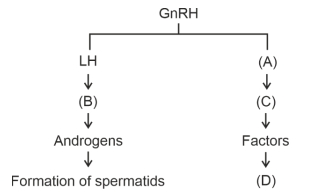
A
$ICSH$,Interstitial cells,Leydig cells,spermiogenesis.
B
$FSH$,Sertoli cells,Leydig cells,spermatogenesis.
C
$ICSH$,Leydig cells,Sertoli cells,spermatogenesis.
D
$FSH$,Leydig cells,Sertoli cells,spermiogenesis.
Solution
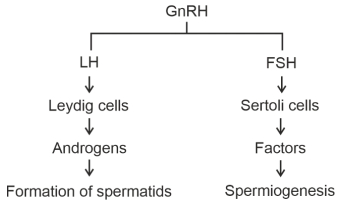
(D) The correct answer is option $(D)$.
According to the hormonal control of spermatogenesis:
$(A)$ represents $FSH$ (Follicle Stimulating Hormone),which acts on Sertoli cells.
$(B)$ represents Leydig cells,which are stimulated by $LH$ to secrete androgens.
$(C)$ represents Sertoli cells,which are stimulated by $FSH$ to secrete factors that help in the process of spermiogenesis.
$(D)$ represents Spermiogenesis,which is the process of transformation of spermatids into spermatozoa.
According to the hormonal control of spermatogenesis:
$(A)$ represents $FSH$ (Follicle Stimulating Hormone),which acts on Sertoli cells.
$(B)$ represents Leydig cells,which are stimulated by $LH$ to secrete androgens.
$(C)$ represents Sertoli cells,which are stimulated by $FSH$ to secrete factors that help in the process of spermiogenesis.
$(D)$ represents Spermiogenesis,which is the process of transformation of spermatids into spermatozoa.
0 likes
View Solution517
MediumMCQ
Match List-$I$ with List-$II$:
Choose the correct answer from the options given below:
| List-$I$ | List-$II$ |
| $A$. Head | $I$. Enzymes |
| $B$. Middle piece | $II$. Sperm motility |
| $C$. Acrosome | $III$. Energy |
| $D$. Tail | $IV$. Genetic material |
Choose the correct answer from the options given below:
A
$A-IV, B-III, C-I, D-II$
B
$A-IV, B-III, C-II, D-I$
C
$A-III, B-IV, C-II, D-I$
D
$A-III, B-II, C-I, D-IV$
Solution
(A) The structure of a human sperm consists of a head,neck,middle piece,and tail.
$1$. The head contains the haploid nucleus,which carries the genetic material $(A-IV)$.
$2$. The middle piece contains numerous mitochondria,which produce energy for the movement of the tail $(B-III)$.
$3$. The acrosome is a cap-like structure present on the head,which contains enzymes (hyaluronidase) that help in the fertilization of the ovum $(C-I)$.
$4$. The tail facilitates the motility of the sperm $(D-II)$.
Therefore,the correct matching is $A-IV, B-III, C-I, D-II$.
$1$. The head contains the haploid nucleus,which carries the genetic material $(A-IV)$.
$2$. The middle piece contains numerous mitochondria,which produce energy for the movement of the tail $(B-III)$.
$3$. The acrosome is a cap-like structure present on the head,which contains enzymes (hyaluronidase) that help in the fertilization of the ovum $(C-I)$.
$4$. The tail facilitates the motility of the sperm $(D-II)$.
Therefore,the correct matching is $A-IV, B-III, C-I, D-II$.
0 likes
View Solution518
MediumMCQ
Which structure of the ovary in mammals acts as an endocrine gland after ovulation?
A
Graafian follicle
B
Corpus luteum
C
Corpus albicans
D
Trophoblast cells
Solution
(B) After ovulation,the ruptured Graafian follicle transforms into a temporary endocrine structure known as the $Corpus \ luteum$.
This structure secretes large amounts of $progesterone$,which is essential for the maintenance of the endometrium for potential implantation of the embryo.
If fertilization does not occur,the $Corpus \ luteum$ degenerates into a scar-like tissue called $Corpus \ albicans$.
This structure secretes large amounts of $progesterone$,which is essential for the maintenance of the endometrium for potential implantation of the embryo.
If fertilization does not occur,the $Corpus \ luteum$ degenerates into a scar-like tissue called $Corpus \ albicans$.
0 likes
View Solution519
MediumMCQ
Which of the following parts of the sperm provides energy for its motility?
A
Head part
B
Neck part
C
Tail part
D
Middle piece
Solution
(D) The sperm consists of a head,neck,middle piece,and tail.
The middle piece contains numerous mitochondria,which are known as the powerhouse of the cell.
These mitochondria produce $ATP$ (Adenosine Triphosphate) through aerobic respiration.
This $ATP$ provides the necessary energy for the movement of the tail,which facilitates the motility of the sperm to reach the ovum for fertilization.
The middle piece contains numerous mitochondria,which are known as the powerhouse of the cell.
These mitochondria produce $ATP$ (Adenosine Triphosphate) through aerobic respiration.
This $ATP$ provides the necessary energy for the movement of the tail,which facilitates the motility of the sperm to reach the ovum for fertilization.
0 likes
View Solution520
DifficultMCQ
How many structures in the list given below are haploid? Spermatid,secondary oocyte,primary spermatocyte,ovum,sperm,oogonia,spermatogonia,polar body.
A
$6$
B
$4$
C
$2$
D
$5$
Solution
(D) To determine the ploidy of the given structures:
$1$. Spermatid: Haploid $(n)$
$2$. Secondary oocyte: Haploid $(n)$
$3$. Primary spermatocyte: Diploid $(2n)$
$4$. Ovum: Haploid $(n)$
$5$. Sperm: Haploid $(n)$
$6$. Oogonia: Diploid $(2n)$
$7$. Spermatogonia: Diploid $(2n)$
$8$. Polar body: Haploid $(n)$
The haploid structures are: Spermatid,secondary oocyte,ovum,sperm,and polar body.
Counting these,we get a total of $5$ haploid structures.
$1$. Spermatid: Haploid $(n)$
$2$. Secondary oocyte: Haploid $(n)$
$3$. Primary spermatocyte: Diploid $(2n)$
$4$. Ovum: Haploid $(n)$
$5$. Sperm: Haploid $(n)$
$6$. Oogonia: Diploid $(2n)$
$7$. Spermatogonia: Diploid $(2n)$
$8$. Polar body: Haploid $(n)$
The haploid structures are: Spermatid,secondary oocyte,ovum,sperm,and polar body.
Counting these,we get a total of $5$ haploid structures.
0 likes
View Solution521
MediumMCQ
Given below are two statements :
Statement-$I$ : Each primary oocyte gets surrounded by a layer of granulosa cells and is called a primary follicle.
Statement-$II$ : At puberty,only $60,000-80,000$ primary follicles are left in each ovary.
In the light of the above statements,choose the most appropriate answer from the options given below :
Statement-$I$ : Each primary oocyte gets surrounded by a layer of granulosa cells and is called a primary follicle.
Statement-$II$ : At puberty,only $60,000-80,000$ primary follicles are left in each ovary.
In the light of the above statements,choose the most appropriate answer from the options given below :
A
Both statement $I$ and statement $II$ are incorrect
B
Statement $I$ is correct but statement $II$ is incorrect
C
Statement $I$ is incorrect but statement $II$ is correct
D
Both statement $I$ and statement $II$ are correct
Solution
(B) Statement-$I$ is correct because during the development of the ovary,primary oocytes get surrounded by layers of granulosa cells and are termed as primary follicles.
Statement-$II$ is incorrect because at puberty,the number of primary follicles remaining in each ovary is $60,000-80,000$. The statement incorrectly mentions 'secondary follicles' instead of 'primary follicles'.
Therefore,Statement-$I$ is correct and Statement-$II$ is incorrect.
Statement-$II$ is incorrect because at puberty,the number of primary follicles remaining in each ovary is $60,000-80,000$. The statement incorrectly mentions 'secondary follicles' instead of 'primary follicles'.
Therefore,Statement-$I$ is correct and Statement-$II$ is incorrect.
0 likes
View Solution522
MediumMCQ
How many primary follicles are left in each ovary in a human female at puberty?
A
$200 - 300$ million
B
$15 - 20$
C
$120,000 - 160,000$
D
$60,000 - 80,000$
Solution
(D) During fetal development,millions of oogonia are formed within each fetal ovary. No more oogonia are formed or added after birth.
These oogonia start division and enter into prophase-$I$ of the meiotic division and get temporarily arrested at that stage,called primary oocytes.
Each primary oocyte gets surrounded by a layer of granulosa cells and is called the primary follicle.
$A$ large number of these follicles degenerate during the phase from birth to puberty.
Therefore,at puberty,only $60,000 - 80,000$ primary follicles are left in each ovary.
These oogonia start division and enter into prophase-$I$ of the meiotic division and get temporarily arrested at that stage,called primary oocytes.
Each primary oocyte gets surrounded by a layer of granulosa cells and is called the primary follicle.
$A$ large number of these follicles degenerate during the phase from birth to puberty.
Therefore,at puberty,only $60,000 - 80,000$ primary follicles are left in each ovary.
0 likes
View Solution523
DifficultMCQ
How many primary follicles are left in each ovary of a female at puberty?
A
$2$ million
B
$60,000-80,000$
C
$120,000-160,000$
D
$5-7$ million
Solution
(B) During fetal development,millions of oogonia are formed within each fetal ovary. No more oogonia are formed or added after birth. These oogonia start division and enter into prophase-$I$ of the meiotic division and get temporarily arrested at that stage,called primary oocytes. Each primary oocyte then gets surrounded by layers of granulosa cells and is called the primary follicle. $A$ large number of these follicles degenerate during the phase from birth to puberty. Therefore,at puberty,only $60,000-80,000$ primary follicles are left in each ovary.
0 likes
View Solution524
MediumMCQ
After spermiogenesis,sperm head becomes embedded in Sertoli cell,and is finally released from the seminiferous tubules by the process called as $:-$
A
spermiation
B
semination
C
spermatogenesis
D
ejaculation
Solution
(A) $1$. $Spermatogenesis$ is the process of formation of sperms from spermatogonia.
$2$. $Spermiogenesis$ is the transformation of spermatids into spermatozoa.
$3$. After $spermiogenesis$,the sperm heads become embedded in the $Sertoli$ cells to derive nutrition.
$4$. Finally,the release of sperms from the seminiferous tubules is known as $spermiation$.
$2$. $Spermiogenesis$ is the transformation of spermatids into spermatozoa.
$3$. After $spermiogenesis$,the sperm heads become embedded in the $Sertoli$ cells to derive nutrition.
$4$. Finally,the release of sperms from the seminiferous tubules is known as $spermiation$.
0 likes
View Solution525
EasyMCQ
The growing ovarian follicles mainly secrete a hormone named?
A
Estrogen
B
Progesterone
C
Androgens
D
Testosterone
Solution
(A) The growing ovarian follicles are responsible for the production and secretion of the hormone $Estrogen$.
$Estrogen$ is a steroid hormone that plays a crucial role in the development and maintenance of female secondary sexual characteristics and the regulation of the menstrual cycle.
$Progesterone$ is primarily secreted by the $Corpus$ $Luteum$ after ovulation.
$Androgens$ and $Testosterone$ are primarily male sex hormones,although they are present in small amounts in females.
$Estrogen$ is a steroid hormone that plays a crucial role in the development and maintenance of female secondary sexual characteristics and the regulation of the menstrual cycle.
$Progesterone$ is primarily secreted by the $Corpus$ $Luteum$ after ovulation.
$Androgens$ and $Testosterone$ are primarily male sex hormones,although they are present in small amounts in females.
0 likes
View Solution526
MediumMCQ
'Antrum' is a cavity present in $:-$
A
Primary oocyte
B
Secondary oocyte
C
Secondary follicle
D
Tertiary follicle
Solution
(D) The 'Antrum' is a fluid-filled cavity that characterizes the development of the ovarian follicle.
During the process of folliculogenesis,the primary follicle develops into a secondary follicle and then into a tertiary follicle.
The tertiary follicle is distinguished by the presence of a fluid-filled cavity called the 'Antrum'.
This cavity is formed by the accumulation of follicular fluid secreted by the granulosa cells.
Therefore,the correct option is $D$.
During the process of folliculogenesis,the primary follicle develops into a secondary follicle and then into a tertiary follicle.
The tertiary follicle is distinguished by the presence of a fluid-filled cavity called the 'Antrum'.
This cavity is formed by the accumulation of follicular fluid secreted by the granulosa cells.
Therefore,the correct option is $D$.
0 likes
View Solution527
MediumMCQ
Which of the following cells are diploid during gametogenesis?
A
Second polar body
B
First polar body
C
Spermatid
D
Oogonia
Solution
(D) In gametogenesis,diploid cells contain two sets of chromosomes $(2n)$.
$A$. The second polar body is haploid $(n)$ as it is formed after the completion of meiosis $II$.
$B$. The first polar body is haploid $(n)$ as it is formed after the completion of meiosis $I$.
$C$. Spermatids are haploid $(n)$ cells formed after the completion of meiosis $II$ in spermatogenesis.
$D$. Oogonia are the primary germ cells in the ovary that undergo mitosis to multiply and are diploid $(2n)$.
Therefore,the correct option is $D$.
$A$. The second polar body is haploid $(n)$ as it is formed after the completion of meiosis $II$.
$B$. The first polar body is haploid $(n)$ as it is formed after the completion of meiosis $I$.
$C$. Spermatids are haploid $(n)$ cells formed after the completion of meiosis $II$ in spermatogenesis.
$D$. Oogonia are the primary germ cells in the ovary that undergo mitosis to multiply and are diploid $(2n)$.
Therefore,the correct option is $D$.
0 likes
View Solution528
MediumMCQ
The provided image is completely unrelated to the question text. The question asks for a diagrammatic presentation of developing follicle events in the human ovary. Based on the standard biological sequence of ovarian follicle development:
$1$. Primary follicles develop into secondary follicles.
$2$. Secondary follicles develop into tertiary follicles.
$3$. Tertiary follicles develop into the Graafian (mature) follicle.
$4$. After ovulation,the ruptured follicle transforms into the corpus luteum.
Given the standard sequence,identify the correct labels for $C$ and $E$ in a typical diagram of this process.
$1$. Primary follicles develop into secondary follicles.
$2$. Secondary follicles develop into tertiary follicles.
$3$. Tertiary follicles develop into the Graafian (mature) follicle.
$4$. After ovulation,the ruptured follicle transforms into the corpus luteum.
Given the standard sequence,identify the correct labels for $C$ and $E$ in a typical diagram of this process.
A
$C=$ Corpus luteum,$E=$ Mature follicle
B
$C=$ Secondary follicle,$E=$ Mature follicle
C
$C=$ Mature follicle,$E=$ Corpus luteum
D
$C=$ Primary follicle,$E=$ Corpus luteum
Solution
(C) In the process of oogenesis and ovarian cycle,the development of follicles follows a specific sequence:
$1$. Primordial follicles develop into primary follicles.
$2$. Primary follicles develop into secondary follicles.
$3$. Secondary follicles develop into tertiary follicles,characterized by a fluid-filled cavity called the antrum.
$4$. The tertiary follicle further matures into the Graafian follicle (mature follicle).
$5$. Upon ovulation,the secondary oocyte is released,and the remaining parts of the Graafian follicle transform into a temporary endocrine structure called the corpus luteum.
Therefore,in a standard diagrammatic representation,$C$ typically represents the mature (Graafian) follicle,and $E$ represents the corpus luteum formed after ovulation.
$1$. Primordial follicles develop into primary follicles.
$2$. Primary follicles develop into secondary follicles.
$3$. Secondary follicles develop into tertiary follicles,characterized by a fluid-filled cavity called the antrum.
$4$. The tertiary follicle further matures into the Graafian follicle (mature follicle).
$5$. Upon ovulation,the secondary oocyte is released,and the remaining parts of the Graafian follicle transform into a temporary endocrine structure called the corpus luteum.
Therefore,in a standard diagrammatic representation,$C$ typically represents the mature (Graafian) follicle,and $E$ represents the corpus luteum formed after ovulation.
0 likes
View Solution529
MediumMCQ
Which of the following layers in the human female follicle is acellular?
A
Theca Interna
B
Corona radiata
C
Granulosa
D
Zona pellucida
Solution
(D) The $Zona$ $pellucida$ is a thick, transparent, and acellular glycoprotein layer that surrounds the plasma membrane of the oocyte.
It is secreted by the oocyte itself and plays a crucial role in sperm binding and the prevention of polyspermy.
In contrast, the $Theca$ $Interna$, $Granulosa$, and $Corona$ $radiata$ are all cellular layers composed of follicular cells.
It is secreted by the oocyte itself and plays a crucial role in sperm binding and the prevention of polyspermy.
In contrast, the $Theca$ $Interna$, $Granulosa$, and $Corona$ $radiata$ are all cellular layers composed of follicular cells.
0 likes
View Solution530
MediumMCQ
The process of formation of a mature sperm from a spermatid is called $:-$
A
Spermatogenesis
B
Oogenesis
C
Spermiogenesis
D
Insemination
Solution
(C) The transformation of non-motile spermatids into mature,motile spermatozoa (sperm) is known as $Spermiogenesis$.
$Spermatogenesis$ is the entire process of formation of sperm from spermatogonia.
$Oogenesis$ is the process of formation of a mature female gamete.
$Insemination$ is the process of transfer of sperm into the female genital tract.
$Spermatogenesis$ is the entire process of formation of sperm from spermatogonia.
$Oogenesis$ is the process of formation of a mature female gamete.
$Insemination$ is the process of transfer of sperm into the female genital tract.
0 likes
View Solution531
MediumMCQ
Which of the following cells has $23$ chromosomes only?
A
Spermatogonia
B
Secondary spermatocyte
C
Sertoli cell
D
Leydig cell
Solution
(B) In human spermatogenesis,the process involves several stages:
$1$. Spermatogonia are diploid $(2n = 46)$ cells.
$2$. Primary spermatocytes are also diploid $(2n = 46)$.
$3$. After the first meiotic division (meiosis-$I$),the primary spermatocyte divides to form two haploid $(n = 23)$ secondary spermatocytes.
$4$. Sertoli cells and Leydig cells are somatic cells of the testis and are diploid $(2n = 46)$.
Therefore,the secondary spermatocyte is the only cell among the options that contains $23$ chromosomes.
$1$. Spermatogonia are diploid $(2n = 46)$ cells.
$2$. Primary spermatocytes are also diploid $(2n = 46)$.
$3$. After the first meiotic division (meiosis-$I$),the primary spermatocyte divides to form two haploid $(n = 23)$ secondary spermatocytes.
$4$. Sertoli cells and Leydig cells are somatic cells of the testis and are diploid $(2n = 46)$.
Therefore,the secondary spermatocyte is the only cell among the options that contains $23$ chromosomes.
0 likes
View Solution532
EasyMCQ
Given below are two statements:
$Statement-I$: At the onset of puberty, the pituitary gland begins secretion of gonadotropin releasing hormone.
$Statement-II$: $GnRH$ initiates the significant increase in the secretion of follicle stimulating hormone $(FSH)$ which induces gametogenesis.
In light of above statements, choose the correct appropriate answer from the options given below.
$Statement-I$: At the onset of puberty, the pituitary gland begins secretion of gonadotropin releasing hormone.
$Statement-II$: $GnRH$ initiates the significant increase in the secretion of follicle stimulating hormone $(FSH)$ which induces gametogenesis.
In light of above statements, choose the correct appropriate answer from the options given below.
A
Both $Statement-I$ and $Statement-II$ are correct.
B
Both $Statement-I$ and $Statement-II$ are incorrect.
C
$Statement-I$ is correct and $Statement-II$ is incorrect.
D
$Statement-I$ is incorrect and $Statement-II$ is correct.
Solution
(D) $Statement-I$ is incorrect because the gonadotropin releasing hormone $(GnRH)$ is secreted by the hypothalamus, not the pituitary gland.
$Statement-II$ is correct because $GnRH$ acts on the anterior pituitary gland to stimulate the secretion of gonadotropins, specifically follicle stimulating hormone $(FSH)$ and luteinizing hormone $(LH)$, which subsequently induce gametogenesis.
Therefore, $Statement-I$ is incorrect and $Statement-II$ is correct.
$Statement-II$ is correct because $GnRH$ acts on the anterior pituitary gland to stimulate the secretion of gonadotropins, specifically follicle stimulating hormone $(FSH)$ and luteinizing hormone $(LH)$, which subsequently induce gametogenesis.
Therefore, $Statement-I$ is incorrect and $Statement-II$ is correct.
0 likes
View Solution533
EasyMCQ
Complete the analogy with respect to the structure of sperm:
Nebenkern: '$X$' :: Acrosome is formed from: '$Y$'
Nebenkern: '$X$' :: Acrosome is formed from: '$Y$'
A
| 'X' | 'Y' |
|---|---|
| Mitochondria | Centrioles |
B
| 'X' | 'Y' |
|---|---|
| Nucleus | Golgi body |
C
| 'X' | 'Y' |
|---|---|
| Mitochondria | Golgi body |
D
| 'X' | 'Y' |
|---|---|
| Nucleus | Centrioles |
Solution
(C) In the structure of a sperm cell,the 'Nebenkern' refers to the mitochondrial sheath,which is formed by the aggregation of mitochondria in the middle piece of the sperm. Therefore,'$X$' = Mitochondria.
The acrosome is a cap-like structure present at the anterior part of the sperm head. It is derived from the Golgi apparatus during the process of spermiogenesis. Therefore,'$Y$' = Golgi body.
Thus,the correct analogy is Nebenkern: Mitochondria :: Acrosome: Golgi body.
The acrosome is a cap-like structure present at the anterior part of the sperm head. It is derived from the Golgi apparatus during the process of spermiogenesis. Therefore,'$Y$' = Golgi body.
Thus,the correct analogy is Nebenkern: Mitochondria :: Acrosome: Golgi body.
0 likes
View Solution534
EasyMCQ
Total number of primordial follicles which remain in the ovary of human females at the time of puberty are . . . . . . .
A
$2$ million
B
$1$ million
C
$40$,$000$
D
$416$
Solution
(C) During fetal development,millions of oogonia are formed in each ovary.
By birth,these oogonia transform into primary oocytes and are surrounded by layers of granulosa cells to form primordial follicles.
Most of these follicles undergo degeneration during childhood.
As a result,at the time of puberty,only about $60,000$ to $80,000$ primary follicles remain in each ovary,which is often approximated as $40,000$ to $60,000$ in standard textbooks.
By birth,these oogonia transform into primary oocytes and are surrounded by layers of granulosa cells to form primordial follicles.
Most of these follicles undergo degeneration during childhood.
As a result,at the time of puberty,only about $60,000$ to $80,000$ primary follicles remain in each ovary,which is often approximated as $40,000$ to $60,000$ in standard textbooks.
0 likes
View Solution535
EasyMCQ
In human female,the process of oogenesis is completed . . . . . . .
A
during implantation
B
before puberty
C
with the entry of sperm into the ooplasm
D
after blastulation
Solution
(C) In human females,the process of oogenesis involves the development of the ovum. The primary oocyte completes its first meiotic division to form a secondary oocyte and a first polar body. The secondary oocyte then begins the second meiotic division but gets arrested at the metaphase-$II$ stage. This division is only completed when a sperm enters the secondary oocyte during fertilization. Therefore,the final completion of oogenesis occurs upon the entry of sperm into the ooplasm.
0 likes
View Solution536
EasyMCQ
In spermatogenesis,the growth phase results in the formation of:
A
primary spermatocytes
B
secondary spermatocytes
C
spermatogonia
D
spermatids
Solution
(A) Spermatogenesis occurs in three distinct phases: the multiplication phase,the growth phase,and the maturation phase.
$1$. Multiplication phase: Spermatogonia $(2n)$ undergo repeated mitotic divisions to increase their number.
$2$. Growth phase: Spermatogonia accumulate nutrients and increase in size to become primary spermatocytes $(2n)$.
$3$. Maturation phase: Primary spermatocytes undergo meiosis to form secondary spermatocytes $(n)$ and subsequently spermatids $(n)$.
Therefore,the growth phase results in the formation of primary spermatocytes.
$1$. Multiplication phase: Spermatogonia $(2n)$ undergo repeated mitotic divisions to increase their number.
$2$. Growth phase: Spermatogonia accumulate nutrients and increase in size to become primary spermatocytes $(2n)$.
$3$. Maturation phase: Primary spermatocytes undergo meiosis to form secondary spermatocytes $(n)$ and subsequently spermatids $(n)$.
Therefore,the growth phase results in the formation of primary spermatocytes.
0 likes
View Solution537
EasyMCQ
Match the part of the sperm in Column $I$ with its component in Column $II$ and its function in Column $III$, and select the correct option.
| Column $I$ (Part of sperm) | Column $II$ (Component) and Column $III$ (Function) |
| $A$. Head | $Q$. Acrosome - $Z$. Secretes penetrating enzyme |
| $B$. Neck | $P$. Centrioles - $X$. Helps in formation of synkaryon spindle |
| $C$. Middle piece | $R$. Nebenkern - $Y$. Provides energy for sperm movement |
| $D$. Tail | $S$. Axial filament - $W$. Whiplash movement in female reproductive tract |
A
$A-P-Z, B-Q-X, C-R-Y, D-S-W$
B
$A-Q-X, B-P-Y, C-S-W, D-R-Z$
C
$A-Q-Z, B-P-X, C-R-Y, D-S-W$
D
$A-P-Z, B-Q-Y, D-S-W, C-R-W$
Solution
(C) The correct matching is as follows:
$1$. $A$. Head contains $Q$. Acrosome, which $Z$. secretes penetrating enzymes (hyaluronidase) to facilitate fertilization.
$2$. $B$. Neck contains $P$. Centrioles, which $X$. help in the formation of the synkaryon spindle during the first cleavage of the zygote.
$3$. $C$. Middle piece contains $R$. Nebenkern (mitochondria), which $Y$. provides energy for sperm movement.
$4$. $D$. Tail contains $S$. Axial filament, which $W$. facilitates whiplash movement in the female reproductive tract.
Therefore, the correct sequence is $A-Q-Z, B-P-X, C-R-Y, D-S-W$.
$1$. $A$. Head contains $Q$. Acrosome, which $Z$. secretes penetrating enzymes (hyaluronidase) to facilitate fertilization.
$2$. $B$. Neck contains $P$. Centrioles, which $X$. help in the formation of the synkaryon spindle during the first cleavage of the zygote.
$3$. $C$. Middle piece contains $R$. Nebenkern (mitochondria), which $Y$. provides energy for sperm movement.
$4$. $D$. Tail contains $S$. Axial filament, which $W$. facilitates whiplash movement in the female reproductive tract.
Therefore, the correct sequence is $A-Q-Z, B-P-X, C-R-Y, D-S-W$.
0 likes
View Solution538
EasyMCQ
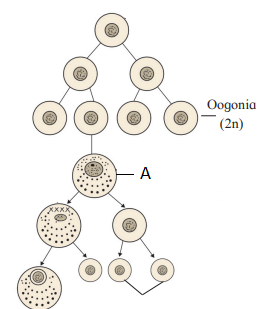
The diagram given below shows oogenesis. Identify '$A$' and choose the correct answer from the options given below.
A
Secondary oocyte-diploid
B
Primary oocyte-diploid
C
Primary oocyte-haploid
D
Secondary oocyte-haploid
Solution
(B) In the process of oogenesis,the oogonia $(2n)$ undergo mitosis to form primary oocytes $(2n)$.
The primary oocyte then undergoes meiosis $I$ (a reductional division) to form a large secondary oocyte $(n)$ and a small first polar body $(n)$.
In the provided diagram,'$A$' represents the cell that undergoes meiosis $I$ to produce the secondary oocyte and the first polar body.
Therefore,'$A$' is the primary oocyte,which is diploid $(2n)$.
The primary oocyte then undergoes meiosis $I$ (a reductional division) to form a large secondary oocyte $(n)$ and a small first polar body $(n)$.
In the provided diagram,'$A$' represents the cell that undergoes meiosis $I$ to produce the secondary oocyte and the first polar body.
Therefore,'$A$' is the primary oocyte,which is diploid $(2n)$.
0 likes
View Solution539
EasyMCQ
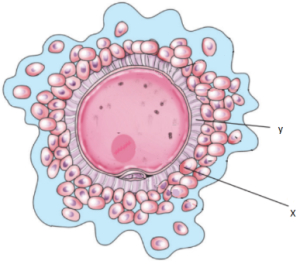
Given below is a diagram of an unfertilized egg. Identify '$X$' and '$Y$' respectively.
A
vitelline membrane and zona pellucida
B
zona pellucida and vitelline membrane
C
perivitelline space and corona radiata
D
corona radiata and zona pellucida
Solution
(D) The provided diagram represents the structure of a human ovum (unfertilized egg).
$1$. The outermost layer consists of follicular cells,which form the 'corona radiata'. In the diagram,'$X$' points to these cells.
$2$. The layer immediately surrounding the plasma membrane of the ovum is the 'zona pellucida'. In the diagram,'$Y$' points to this thick,transparent layer.
$3$. Therefore,'$X$' represents the corona radiata and '$Y$' represents the zona pellucida.
$1$. The outermost layer consists of follicular cells,which form the 'corona radiata'. In the diagram,'$X$' points to these cells.
$2$. The layer immediately surrounding the plasma membrane of the ovum is the 'zona pellucida'. In the diagram,'$Y$' points to this thick,transparent layer.
$3$. Therefore,'$X$' represents the corona radiata and '$Y$' represents the zona pellucida.
0 likes
View Solution540
EasyMCQ
Formation of oogonia in human females is completed in . . . . . . .
A
embryonic stage.
B
puberty.
C
at the time of birth.
D
proliferative phase of menstruation
Solution
(A) In human females,the process of oogenesis is initiated during the embryonic development stage.
Millions of gamete mother cells (oogonia) are formed within each fetal ovary.
No more oogonia are formed or added after birth.
Therefore,the formation of oogonia is completed during the embryonic stage.
Millions of gamete mother cells (oogonia) are formed within each fetal ovary.
No more oogonia are formed or added after birth.
Therefore,the formation of oogonia is completed during the embryonic stage.
0 likes
View Solution541
EasyMCQ
$A$ sudden rise in the level of $LH$ stimulates . . . . . . .
A
secretion of estrogen
B
ovulation
C
secretion of uterine milk
D
degeneration of uterine endometrium
Solution
(B) The rapid secretion of $LH$ leading to its maximum level during the mid-cycle is called the $LH$ surge.
This $LH$ surge induces the rupture of the Graafian follicle and thereby the release of the ovum (secondary oocyte) from the ovary.
This process is known as ovulation.
Therefore,a sudden rise in the level of $LH$ stimulates ovulation.
This $LH$ surge induces the rupture of the Graafian follicle and thereby the release of the ovum (secondary oocyte) from the ovary.
This process is known as ovulation.
Therefore,a sudden rise in the level of $LH$ stimulates ovulation.
0 likes
View Solution542
EasyMCQ
On the fourteenth day of the menstrual cycle,the female gamete released is . . . . . . .
A
Secondary oocyte
B
Primary oocyte
C
Oogonium
D
Mature ovum
Solution
(A) In the human female reproductive cycle,ovulation typically occurs around the $14^{th}$ day of a $28$-day menstrual cycle.
During this process,the Graafian follicle ruptures to release the female gamete.
At the time of ovulation,the female gamete is arrested in the metaphase stage of Meiosis-$II$ and is technically referred to as a secondary oocyte.
The secondary oocyte completes Meiosis-$II$ only upon the entry of a sperm during fertilization.
During this process,the Graafian follicle ruptures to release the female gamete.
At the time of ovulation,the female gamete is arrested in the metaphase stage of Meiosis-$II$ and is technically referred to as a secondary oocyte.
The secondary oocyte completes Meiosis-$II$ only upon the entry of a sperm during fertilization.
0 likes
View Solution543
EasyMCQ
In spermatogenesis, at the end of the first meiotic division . . . . . . are formed.
A
Spermatids
B
Primary spermatocyte
C
Secondary spermatocyte
D
Spermatogonia
Solution
(C) During spermatogenesis, the $Primary$ spermatocyte undergoes the first meiotic division (meiosis-$I$), which is a reductional division.
This process results in the formation of two haploid cells known as $Secondary$ spermatocytes.
These cells contain only $n$ number of chromosomes compared to the diploid $(2n)$ $Primary$ spermatocyte.
This process results in the formation of two haploid cells known as $Secondary$ spermatocytes.
These cells contain only $n$ number of chromosomes compared to the diploid $(2n)$ $Primary$ spermatocyte.
0 likes
View Solution544
EasyMCQ
The termination of the process of oogenesis is indicated by the formation of . . . . . . .
A
secondary oocyte
B
first polar body
C
second polar body
D
perivitelline space
Solution
(C) Oogenesis is the process of formation of a mature female gamete.
In humans,the secondary oocyte completes the second meiotic division only after the entry of a sperm.
This division is unequal and results in the formation of a large haploid ovum (ootid) and a tiny second polar body.
The formation of the second polar body marks the completion or termination of the process of oogenesis.
In humans,the secondary oocyte completes the second meiotic division only after the entry of a sperm.
This division is unequal and results in the formation of a large haploid ovum (ootid) and a tiny second polar body.
The formation of the second polar body marks the completion or termination of the process of oogenesis.
0 likes
View Solution545
EasyMCQ
In the ovary,estrogen is secreted by . . . . . . .
A
Follicular cells
B
Corona radiata cells
C
Sertoli cells
D
Primary oocyte
Solution
(A) In the human ovary,the development of follicles is stimulated by $FSH$ (Follicle Stimulating Hormone).
As the follicles mature,the follicular cells (specifically the granulosa cells) produce and secrete the hormone estrogen.
$Sertoli$ cells are found in the testes,not the ovary.
$Corona$ $radiata$ cells are protective layers surrounding the oocyte,and the primary oocyte is the germ cell itself,not the endocrine tissue producing estrogen.
Therefore,the correct answer is follicular cells.
As the follicles mature,the follicular cells (specifically the granulosa cells) produce and secrete the hormone estrogen.
$Sertoli$ cells are found in the testes,not the ovary.
$Corona$ $radiata$ cells are protective layers surrounding the oocyte,and the primary oocyte is the germ cell itself,not the endocrine tissue producing estrogen.
Therefore,the correct answer is follicular cells.
0 likes
View Solution546
EasyMCQ
Oogonia arise from the endoderm of the . . . . . . .
A
allantois
B
chorion
C
trophoblast
D
yolk sac
Solution
(D) The primordial germ cells (PGCs) are the precursors of gametes. In humans, these cells originate from the endoderm of the $yolk sac$ during early embryonic development. From the $yolk sac$, these cells migrate to the developing gonads (ovaries or testes) to differentiate into $oogonia$ or $spermatogonia$, respectively.
0 likes
View Solution547
EasyMCQ
An axial filament in the tail of sperm is modified . . . . . . .
A
Distal centriole
B
Endoplasmic reticulum
C
Golgi complex
D
Proximal centriole
Solution
(A) The sperm tail consists of an axial filament,which is a microtubular structure. This axial filament arises from the distal centriole of the sperm cell. The proximal centriole is located near the nucleus and is involved in the first cleavage of the zygote after fertilization,while the distal centriole gives rise to the flagellum or tail of the sperm.
0 likes
View Solution548
EasyMCQ
Spermiogenesis involves all of the following,$EXCEPT$
A
Formation of mitochondrial sheath
B
Formation of proximal and distal centrioles
C
Formation of acrosomes
D
Shortening of sperm
Solution
(B) Spermiogenesis is the process of transformation of spermatids into spermatozoa (sperm).
During this process,the following changes occur:
$1$. The nucleus condenses and becomes smaller.
$2$. The Golgi apparatus forms the acrosome.
$3$. Mitochondria arrange themselves to form the mitochondrial sheath (middle piece).
$4$. The cytoplasm is reduced.
However,the formation of proximal and distal centrioles occurs during the earlier stages of spermatogenesis (specifically during the division of spermatogonia or spermatocytes),not during the transformation of spermatids into spermatozoa.
Therefore,the correct answer is $B$.
During this process,the following changes occur:
$1$. The nucleus condenses and becomes smaller.
$2$. The Golgi apparatus forms the acrosome.
$3$. Mitochondria arrange themselves to form the mitochondrial sheath (middle piece).
$4$. The cytoplasm is reduced.
However,the formation of proximal and distal centrioles occurs during the earlier stages of spermatogenesis (specifically during the division of spermatogonia or spermatocytes),not during the transformation of spermatids into spermatozoa.
Therefore,the correct answer is $B$.
0 likes
View Solution549
EasyMCQ
During ovulation,the ovary releases:
A
Oogonia
B
Ootid
C
Primary oocyte
D
Secondary oocyte
Solution
(D) During the process of oogenesis,the primary oocyte undergoes meiosis-$I$ to form a large haploid secondary oocyte and a small first polar body.
This secondary oocyte then proceeds to meiosis-$II$,but it gets arrested at the metaphase-$II$ stage.
Ovulation is the process in which the Graafian follicle ruptures to release this secondary oocyte into the fallopian tube.
Therefore,the correct answer is the secondary oocyte.
This secondary oocyte then proceeds to meiosis-$II$,but it gets arrested at the metaphase-$II$ stage.
Ovulation is the process in which the Graafian follicle ruptures to release this secondary oocyte into the fallopian tube.
Therefore,the correct answer is the secondary oocyte.
0 likes
View Solution550
EasyMCQ
Which of the following processes is initiated by $FSH$?
A
Degeneration of endometrium
B
Growth of Graafian follicle
C
Maturation of spermatozoa
D
Secretion of progesterone
Solution
(B) $FSH$ stands for Follicle Stimulating Hormone.
It is secreted by the anterior pituitary gland.
In females,$FSH$ stimulates the growth and development of ovarian follicles (Graafian follicles).
It also stimulates the secretion of estrogens by the ovarian follicles.
Therefore,the growth of the Graafian follicle is initiated by $FSH$.
It is secreted by the anterior pituitary gland.
In females,$FSH$ stimulates the growth and development of ovarian follicles (Graafian follicles).
It also stimulates the secretion of estrogens by the ovarian follicles.
Therefore,the growth of the Graafian follicle is initiated by $FSH$.
0 likes
View SolutionHuman Reproduction — Gametogenesis · Frequently Asked Questions
1Are these Human Reproduction questions useful for JEE and NEET?
Yes. All questions in this section are mapped to JEE Main and NEET exam patterns. Previous year questions from JEE Main, NEET, GUJCET and state-level exams are included with full solutions.
2Can I switch to Hindi or Gujarati for these questions?
Yes. Use the language tabs in the hero section or the sidebar to view the same questions and solutions in English, Hindi or Gujarati.
3How do I generate a question paper from this subtopic?
Use the Vedclass Exam Paper Generator — select the chapter and subtopic, set difficulty, and generate Sets A, B, C, D automatically. First 3 chapters of every subject are free.
Vedclass Products
For Students
Vedclass Test Series
Mock tests in real JEE/NEET style with performance analysis. 5-day free trial.
Start Free TrialFor Teachers
Exam Paper Generator
Generate Set A/B/C/D papers from this chapter in 2 minutes. 3 chapters free.
Try FreeFor Institutes
Online Exam Module
Live online exams with unlimited students, 360° analytics & white-label branding.
See DemoFor Teachers & Institutes
Generate a Human Reproduction Exam Paper in 2 Minutes
Select subtopic & difficulty — Sets A, B, C, D auto-generated with No Repeat logic.
First 3 chapters of every subject are free — no payment required.