
A English
Gametogenesis Questions in English
Class 12 Biology · Human Reproduction · Gametogenesis
576+
Questions
English
Language
100%
With Solutions
Showing 50 of 576 questions in English
451
EasyMCQ
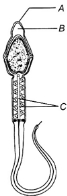
Identify $A, B$ and $C$ in the given human sperm diagram.
A
$A-$Plasma membrane,$B-$Acrosome,$C-$Mitochondria
B
$A-$Acrosome,$B-$Plasma membrane,$C-$Mitochondria
C
$A-$Mitochondria,$B-$Acrosome,$C-$Plasma membrane
D
$A-$Mitochondria,$B-$Plasma membrane,$C-$Acrosome
Solution
(A) The correct answer is $A$.
$A$ represents the Plasma membrane,which envelops the entire sperm.
$B$ represents the Acrosome,which is the cap-like structure on the head containing hydrolytic enzymes for fertilization.
$C$ represents the Mitochondria,which are located in the middle piece and provide energy for sperm motility.
Structure of a sperm: It consists of four parts: Head,Neck,Middle piece,and Tail,all enveloped by a plasma membrane.
$1$. Head: Contains a large haploid nucleus and is capped by the acrosome.
$2$. Neck: Contains centrioles.
$3$. Middle piece: Contains numerous mitochondria providing energy for tail movement.
$4$. Tail: Facilitates sperm motility.
$A$ represents the Plasma membrane,which envelops the entire sperm.
$B$ represents the Acrosome,which is the cap-like structure on the head containing hydrolytic enzymes for fertilization.
$C$ represents the Mitochondria,which are located in the middle piece and provide energy for sperm motility.
Structure of a sperm: It consists of four parts: Head,Neck,Middle piece,and Tail,all enveloped by a plasma membrane.
$1$. Head: Contains a large haploid nucleus and is capped by the acrosome.
$2$. Neck: Contains centrioles.
$3$. Middle piece: Contains numerous mitochondria providing energy for tail movement.
$4$. Tail: Facilitates sperm motility.
0 likes
View Solution452
MediumMCQ
In the testis,the immature germ cells produce sperm by $...A...$ at puberty. $...B...$ present on the inside wall of seminiferous tubules multiply by $...C...$ division and increase their number. Identify $A$,$B$,and $C$ from the above statement.
A
$A-$secondary spermatocytes,$B-$primary spermatocytes,$C-$mitosis
B
$A-$primary spermatocytes,$B-$secondary spermatocytes,$C-$mitosis
C
$A-$spermatogenesis,$B-$spermatogonia,$C-$mitosis
D
$A-$spermatogonia,$B-$spermatogenesis,$C-$meiosis
Solution
(C) In the testis,the immature germ cells (spermatogonia) produce sperm by the process of $A-$spermatogenesis at puberty.
$B-$Spermatogonia (spermatogonial stem cells) are present on the inside wall of the seminiferous tubules.
These cells multiply by $C-$mitosis division to increase their number before undergoing meiosis to form sperm.
$B-$Spermatogonia (spermatogonial stem cells) are present on the inside wall of the seminiferous tubules.
These cells multiply by $C-$mitosis division to increase their number before undergoing meiosis to form sperm.
0 likes
View Solution453
MediumMCQ
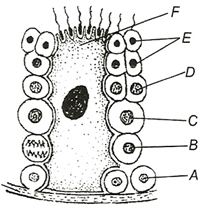
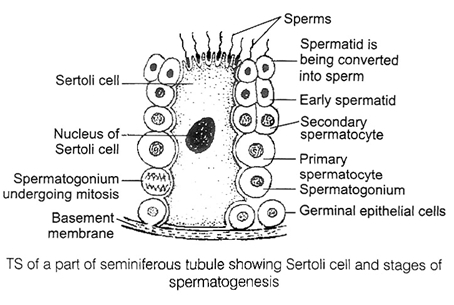
Given a diagram showing a portion of a seminiferous tubule. Identify the marked alphabets.
A
$A-$Sertoli cells,$B-$Spermatogonium,$C-$Primary spermatocyte,$D-$Secondary spermatocyte,$E-$Spermatids,$F-$Leydig cell
B
$A-$Leydig cells,$B-$Primary spermatocyte,$C-$Spermatogonium,$D-$Secondary spermatocyte,$E-$Spermatids,$F-$Sertoli cells
C
$A-$Spermatogonium,$B-$Primary spermatocyte,$C-$Secondary spermatocyte,$D-$Spermatids,$E-$Spermatozoa,$F-$Sertoli cell
D
$A-$Germinal epithelial cells,$B-$Spermatogonium,$C-$Primary spermatocyte,$D-$Secondary spermatocyte,$E-$Spermatids,$F-$Sertoli cell
Solution
(D) The correct identification of the labeled parts in the seminiferous tubule is as follows:
$A-$ Germinal epithelial cells (found at the base near the basement membrane).
$B-$ Spermatogonium (the diploid germ cells).
$C-$ Primary spermatocyte (the larger cells undergoing meiosis).
$D-$ Secondary spermatocyte (the smaller cells resulting from meiosis $I$).
$E-$ Spermatids (the haploid cells undergoing spermiogenesis).
$F-$ Sertoli cell (the large supporting cell providing nutrition).
The wall of each seminiferous tubule is lined by a single layer of germinal epithelium. Most of these cells are spermatogonia,which undergo spermatogenesis. Interspersed among these are large,tall cells known as Sertoli cells,which provide nutrition to the developing germ cells.
$A-$ Germinal epithelial cells (found at the base near the basement membrane).
$B-$ Spermatogonium (the diploid germ cells).
$C-$ Primary spermatocyte (the larger cells undergoing meiosis).
$D-$ Secondary spermatocyte (the smaller cells resulting from meiosis $I$).
$E-$ Spermatids (the haploid cells undergoing spermiogenesis).
$F-$ Sertoli cell (the large supporting cell providing nutrition).
The wall of each seminiferous tubule is lined by a single layer of germinal epithelium. Most of these cells are spermatogonia,which undergo spermatogenesis. Interspersed among these are large,tall cells known as Sertoli cells,which provide nutrition to the developing germ cells.
0 likes
View Solution454
MediumMCQ
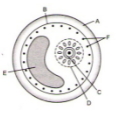
In the diagram of a section of a Graafian follicle,different parts are indicated by alphabets; choose the answer in which these alphabets have been correctly matched with the parts they indicate.
A
$A-$Theca externa,$B-$Theca interna,$C-$Ovum,$D-$Cumulus oophorus,$E-$Antrum,$F-$Membrana granulosa
B
$A-$Membrana granulosa,$B-$Theca externa,$C-$Ovum,$D-$Cumulus oophorus,$E-$Antrum,$F-$Theca interna
C
$A-$Membrana granulosa,$B-$Theca interna,$C-$Ovum,$D-$Cumulus oophorus,$E-$Antrum,$F-$Theca externa
D
$A-$Theca externa,$B-$Theca interna,$C-$Ovum,$D-$Membrana granulosa,$E-$Antrum,$F-$Cumulus oophorus
Solution
(A) Based on the structure of the Graafian follicle:
$A$ represents the outermost layer,the Theca externa.
$B$ represents the inner layer of the theca,the Theca interna.
$C$ represents the central Ovum (oocyte).
$D$ represents the cluster of cells surrounding the ovum,known as the Cumulus oophorus.
$E$ represents the fluid-filled cavity,the Antrum.
$F$ represents the layer of follicular cells lining the follicle,the Membrana granulosa.
Therefore,the correct matching is $A-$Theca externa,$B-$Theca interna,$C-$Ovum,$D-$Cumulus oophorus,$E-$Antrum,$F-$Membrana granulosa.
$A$ represents the outermost layer,the Theca externa.
$B$ represents the inner layer of the theca,the Theca interna.
$C$ represents the central Ovum (oocyte).
$D$ represents the cluster of cells surrounding the ovum,known as the Cumulus oophorus.
$E$ represents the fluid-filled cavity,the Antrum.
$F$ represents the layer of follicular cells lining the follicle,the Membrana granulosa.
Therefore,the correct matching is $A-$Theca externa,$B-$Theca interna,$C-$Ovum,$D-$Cumulus oophorus,$E-$Antrum,$F-$Membrana granulosa.
0 likes
View Solution455
MediumMCQ
Fluid-filled cavity called $...A...$ is developed in $...B...$ follicle called $...C...$. Here $A, B$ and $C$ are:
A
$A-$Secondary follicle,$B-$Primary follicle,$C-$Tertiary follicle
B
$A-$Primary follicle,$B-$Antrum,$C-$Secondary follicle
C
$A-$Tertiary follicle,$B-$Secondary follicle,$C-$Antrum
D
$A-$Antrum,$B-$Secondary follicle,$C-$Tertiary follicle
Solution
(D) The process of follicular development in the ovary involves the transformation of primary follicles into secondary follicles and then into tertiary follicles.
In the tertiary follicle,the primary oocyte grows in size and completes its first meiotic division.
$A$ characteristic feature of the tertiary follicle is the presence of a fluid-filled cavity known as the $Antrum$.
Therefore,the fluid-filled cavity $(A)$ is the $Antrum$,which develops in the $Secondary$ follicle $(B)$ to form the $Tertiary$ follicle $(C)$.
In the tertiary follicle,the primary oocyte grows in size and completes its first meiotic division.
$A$ characteristic feature of the tertiary follicle is the presence of a fluid-filled cavity known as the $Antrum$.
Therefore,the fluid-filled cavity $(A)$ is the $Antrum$,which develops in the $Secondary$ follicle $(B)$ to form the $Tertiary$ follicle $(C)$.
0 likes
View Solution456
MediumMCQ
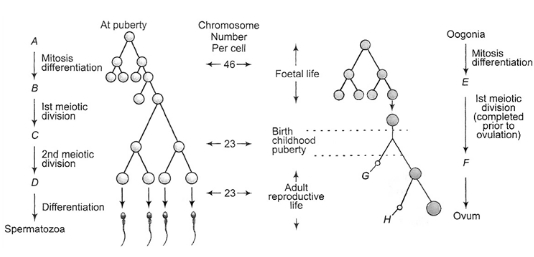
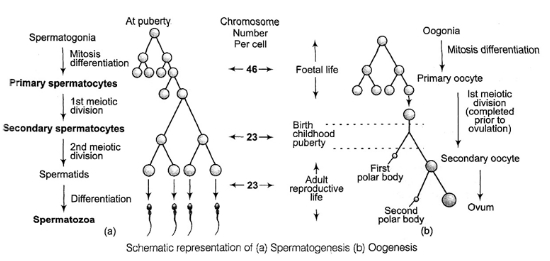
The given diagram refers to spermatogenesis and oogenesis in humans. Identify $A$ to $H$ correctly.
A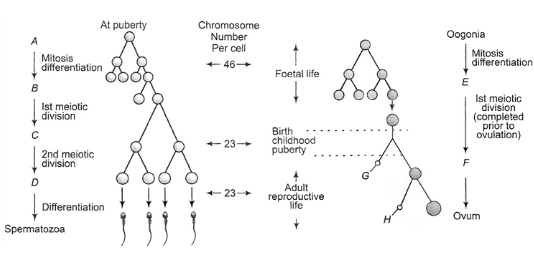
$A-$Spermatogonia,$B-$Secondary spermatocytes,$C-$Primary spermatocytes,$D-$Spermatids,$E-$Primary oocyte,$F-$Secondary oocyte,$G-$First polar body,$H-$Second polar body
B
$A-$Spermatogonia,$B-$Primary spermatocytes,$C-$Secondary spermatocytes,$D-$Spermatids,$E-$Secondary oocyte,$F-$Secondary oocyte,$G-$First polar body,$H-$Second polar body
C
$A-$Spermatogonia,$B-$Primary spermatocytes,$C-$Secondary spermatocytes,$D-$Spermatids,$E-$Primary oocyte,$F-$Secondary oocyte,$G-$First polar body,$H-$Second polar body
D
$A-$Spermatogonia,$B-$Primary spermatocytes,$C-$Secondary spermatocytes,$D-$Spermatids,$E-$Primary oocyte,$F-$Secondary oocyte,$G-$First polar body,$H-$Second polar body
Solution
(C) Based on the process of gametogenesis:
$A$ represents Spermatogonia,which undergo mitosis and differentiation.
$B$ represents Primary spermatocytes,which undergo the first meiotic division.
$C$ represents Secondary spermatocytes,which undergo the second meiotic division.
$D$ represents Spermatids,which differentiate into spermatozoa.
$E$ represents Primary oocyte,which undergoes the first meiotic division.
$F$ represents Secondary oocyte,which undergoes the second meiotic division.
$G$ represents the First polar body.
$H$ represents the Second polar body.
Therefore,the correct sequence is $A-$Spermatogonia,$B-$Primary spermatocytes,$C-$Secondary spermatocytes,$D-$Spermatids,$E-$Primary oocyte,$F-$Secondary oocyte,$G-$First polar body,$H-$Second polar body.
$A$ represents Spermatogonia,which undergo mitosis and differentiation.
$B$ represents Primary spermatocytes,which undergo the first meiotic division.
$C$ represents Secondary spermatocytes,which undergo the second meiotic division.
$D$ represents Spermatids,which differentiate into spermatozoa.
$E$ represents Primary oocyte,which undergoes the first meiotic division.
$F$ represents Secondary oocyte,which undergoes the second meiotic division.
$G$ represents the First polar body.
$H$ represents the Second polar body.
Therefore,the correct sequence is $A-$Spermatogonia,$B-$Primary spermatocytes,$C-$Secondary spermatocytes,$D-$Spermatids,$E-$Primary oocyte,$F-$Secondary oocyte,$G-$First polar body,$H-$Second polar body.
0 likes
View Solution457
MediumMCQ
$A$ boy who has not passed through puberty sustains an injury to his anterior pituitary such that $FSH$ is no longer released,but $LH$ secretion is normal. After he grows to maturity,one would expect that he would
A
Develop secondary sex characters
B
Be sterile
C
Have improper functioning of the testicular interstitial cells
D
Both $(a)$ and $(b)$
Solution
(D) In males,$LH$ (Luteinizing Hormone) acts on the Leydig cells (interstitial cells) to stimulate the synthesis and secretion of androgens (testosterone). Androgens regulate the development and maintenance of secondary sexual characters. Therefore,if $LH$ secretion is normal,the boy will develop secondary sexual characters and his interstitial cells will function properly.
$FSH$ (Follicle Stimulating Hormone) acts on the Sertoli cells and stimulates the secretion of some factors which help in the process of spermiogenesis. It is essential for spermatogenesis. Since $FSH$ is not released,spermatogenesis will not occur,and the individual will be sterile.
$FSH$ (Follicle Stimulating Hormone) acts on the Sertoli cells and stimulates the secretion of some factors which help in the process of spermiogenesis. It is essential for spermatogenesis. Since $FSH$ is not released,spermatogenesis will not occur,and the individual will be sterile.
0 likes
View Solution458
EasyMCQ
In humans,at the end of the first meiotic division,the male germ cells form
A
Spermatogonia
B
Primary spermatocytes
C
Secondary spermatocytes
D
Spermatids
Solution
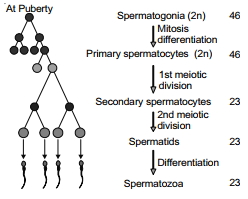
(C) The process of spermatogenesis involves several stages:
$1$. Spermatogonia $(2n)$ undergo mitosis to form primary spermatocytes $(2n)$.
$2$. Each primary spermatocyte undergoes the first meiotic division (meiosis-$I$),which is a reductional division,to form two haploid cells called secondary spermatocytes $(n)$.
$3$. These secondary spermatocytes then undergo the second meiotic division (meiosis-$II$) to form four haploid spermatids $(n)$.
$4$. Finally,spermatids differentiate into spermatozoa.
Therefore,at the end of the first meiotic division,secondary spermatocytes are formed.
$1$. Spermatogonia $(2n)$ undergo mitosis to form primary spermatocytes $(2n)$.
$2$. Each primary spermatocyte undergoes the first meiotic division (meiosis-$I$),which is a reductional division,to form two haploid cells called secondary spermatocytes $(n)$.
$3$. These secondary spermatocytes then undergo the second meiotic division (meiosis-$II$) to form four haploid spermatids $(n)$.
$4$. Finally,spermatids differentiate into spermatozoa.
Therefore,at the end of the first meiotic division,secondary spermatocytes are formed.
0 likes
View Solution459
EasyMCQ
Sertoli cells are found in
A
Ovaries and secrete progesterone
B
Testes and secrete testosterone
C
Seminiferous tubules and after spermiogenesis,sperm heads become embedded in them
D
Adrenal cortex and secrete adrenaline
Solution
(C) Sertoli cells,also known as nurse cells or sustentacular cells,are located within the seminiferous tubules of the testes. Their primary function is to provide nutrition to the developing germ cells. After the process of spermiogenesis,the heads of the spermatozoa become embedded in the Sertoli cells to receive nourishment before being released into the lumen of the seminiferous tubules.
0 likes
View Solution460
MediumMCQ
The Graafian follicle ruptures to release . . . . . . from the ovary by the process called ovulation.
A
Primary oocyte
B
Secondary oocyte after completing meiosis-$II$
C
Secondary oocyte after completing meiosis-$I$ and with the release of $1^{st}$ polar body
D
Mature ovum
Solution
(C) During oogenesis,the primary oocyte undergoes meiosis-$I$ to form a large secondary oocyte and a small first polar body.
This process occurs within the Graafian follicle.
At the time of ovulation,the Graafian follicle ruptures to release the secondary oocyte into the fallopian tube.
The secondary oocyte is arrested at the metaphase-$II$ stage of meiosis-$II$.
Meiosis-$II$ is completed only upon the entry of a sperm during fertilization.
This process occurs within the Graafian follicle.
At the time of ovulation,the Graafian follicle ruptures to release the secondary oocyte into the fallopian tube.
The secondary oocyte is arrested at the metaphase-$II$ stage of meiosis-$II$.
Meiosis-$II$ is completed only upon the entry of a sperm during fertilization.
0 likes
View Solution461
EasyMCQ
After ovulation,the Graafian follicle transforms into:
A
Corpus luteum
B
Corpus albicans
C
Corpus callosum
D
Follicular atresia
Solution
(A) During the luteal phase (after ovulation),the remaining parts of the Graafian follicle undergo luteinization and transform into a temporary endocrine structure known as the corpus luteum. This structure secretes large amounts of progesterone,which is essential for the maintenance of the endometrium.
0 likes
View Solution462
MediumMCQ
Given below are four statements $(A - D)$ each with one or two blanks. Select the option which correctly fills up the blanks in two statements:
$A.$ The human male ejaculates about $(i)$ $200-300$ million sperms during a coitus. Out of which, for normal fertility at least $(ii)$ $60$ percent sperms must have normal shape and size.
$B.$ $A$ primary spermatocyte completes $(i)$ first meiotic division leading to the formation of two equal haploid cells called $(ii)$ secondary spermatocytes.
$C.$ Spermatogenesis starts at the age of $(i)$ puberty due to significant increase in the secretion of $(ii)$ $GnRH$, a hypothalamic hormone.
$D.$ Oogenesis is initiated during embryonic development and at puberty only $(i)$ $60,000-80,000$ primary follicles are left in each ovary.
$A.$ The human male ejaculates about $(i)$ $200-300$ million sperms during a coitus. Out of which, for normal fertility at least $(ii)$ $60$ percent sperms must have normal shape and size.
$B.$ $A$ primary spermatocyte completes $(i)$ first meiotic division leading to the formation of two equal haploid cells called $(ii)$ secondary spermatocytes.
$C.$ Spermatogenesis starts at the age of $(i)$ puberty due to significant increase in the secretion of $(ii)$ $GnRH$, a hypothalamic hormone.
$D.$ Oogenesis is initiated during embryonic development and at puberty only $(i)$ $60,000-80,000$ primary follicles are left in each ovary.
A
$A - (i): 200-300; (ii): 40$; $B - (i): \text{Second}; (ii): \text{Spermatids}$
B
$A - (i): 200-300; (ii): 40$; $D - (i): 60,000-80,000$
C
$B - (i): \text{First}; (ii): \text{Secondary spermatocytes}$; $C - (i): \text{Puberty}; (ii): GnRH$
D
$C - (i): \text{Puberty}; (ii): \text{Gonadotropins}$; $D - (i): 60,000-80,000$
Solution
(C) $A.$ During coitus, the human male ejaculates $200-300$ million sperms. For normal fertility, at least $60\%$ of these sperms must have normal shape and size, and at least $40\%$ must show vigorous motility.
$B.$ $A$ primary spermatocyte undergoes the first meiotic division (meiosis $I$) to form two equal haploid cells called secondary spermatocytes.
$C.$ Spermatogenesis begins at puberty due to a significant increase in the secretion of Gonadotropin-releasing hormone $(GnRH)$, which is a hypothalamic hormone.
$D.$ Oogenesis begins during embryonic development, and by puberty, only $60,000-80,000$ primary follicles remain in each ovary.
$B.$ $A$ primary spermatocyte undergoes the first meiotic division (meiosis $I$) to form two equal haploid cells called secondary spermatocytes.
$C.$ Spermatogenesis begins at puberty due to a significant increase in the secretion of Gonadotropin-releasing hormone $(GnRH)$, which is a hypothalamic hormone.
$D.$ Oogenesis begins during embryonic development, and by puberty, only $60,000-80,000$ primary follicles remain in each ovary.
0 likes
View Solution463
EasyMCQ
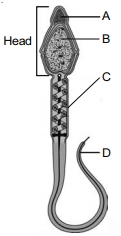
Which of the following labelled parts produces energy for the movement of the tail that facilitates sperm motility essential for fertilisation?
A
$A$
B
$B$
C
$C$
D
$D$
Solution
(C) $A -$ Acrosome (contains enzymes that help in fertilization).
$B -$ Nucleus (contains chromosomal material).
$C -$ Middle piece (contains numerous mitochondria,which produce energy for sperm motility).
$D -$ Tail (facilitates movement of the sperm).
Therefore,the part that produces energy for the movement of the tail is the middle piece,labeled as $C$.
$B -$ Nucleus (contains chromosomal material).
$C -$ Middle piece (contains numerous mitochondria,which produce energy for sperm motility).
$D -$ Tail (facilitates movement of the sperm).
Therefore,the part that produces energy for the movement of the tail is the middle piece,labeled as $C$.
0 likes
View Solution464
MediumMCQ
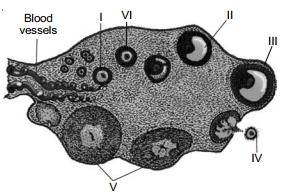
The figure given below depicts a diagrammatic sectional view of the ovary. Which one set of three parts out of $I-VI$ are correctly identified?
A
$VI$ - Primary follicle; $III$ - Graafian follicle; $V$ - Corpus luteum
B
$II$ - Secondary follicle; $III$ - Tertiary follicle; $IV$ - Ovulation
C
$I$ - Primary follicle; $II$ - Tertiary follicle; $V$ - Corpus luteum
D
$I$ - Primary follicle; $II$ - Corpus luteum; $V$ - Graafian follicle
Solution
(C) Based on the diagrammatic sectional view of the human ovary:
$I$ represents the Primary follicle.
$II$ represents the Tertiary follicle,which is characterized by the presence of a fluid-filled cavity called the antrum.
$III$ represents the Graafian follicle,the mature follicle ready for ovulation.
$IV$ represents the Ovum (released during ovulation).
$V$ represents the Corpus luteum,formed from the ruptured follicle after ovulation.
$VI$ represents the Secondary follicle.
Comparing these with the given options,option $C$ correctly identifies $I$ as the Primary follicle,$II$ as the Tertiary follicle,and $V$ as the Corpus luteum.
$I$ represents the Primary follicle.
$II$ represents the Tertiary follicle,which is characterized by the presence of a fluid-filled cavity called the antrum.
$III$ represents the Graafian follicle,the mature follicle ready for ovulation.
$IV$ represents the Ovum (released during ovulation).
$V$ represents the Corpus luteum,formed from the ruptured follicle after ovulation.
$VI$ represents the Secondary follicle.
Comparing these with the given options,option $C$ correctly identifies $I$ as the Primary follicle,$II$ as the Tertiary follicle,and $V$ as the Corpus luteum.
0 likes
View Solution465
MediumMCQ
Which of the following is not the function of $Sertoli$ cells (sustentacular cells)?
A
Release of androgen binding protein
B
Release of antimullerian factor
C
Regulate spermatogenesis by releasing inhibin
D
Secretion of testosterone
Solution
(D) $Sertoli$ cells provide nutrition to developing germ cells and secrete factors like androgen binding protein $(ABP)$,inhibin,and antimullerian hormone. However,the secretion of testosterone is the primary function of $Leydig$ cells (also known as interstitial cells),which are located in the interstitial spaces between the seminiferous tubules. $Leydig$ cells produce testosterone under the stimulation of $LH$ ($Luteinizing$ $Hormone$).
0 likes
View Solution466
MediumMCQ
Androgen binding protein,which helps in concentrating testosterone in the seminiferous tubule,and which inhibits $ICSH$ secreted by the anterior pituitary and $GnRH$ production by the hypothalamus,is secreted by:
A
Cells of Leydig
B
Sustentacular cells
C
Interstitial cells
D
Spermatogonial cells
Solution
(B) Sertoli cells are also known as nurse cells or sustentacular cells.
They secrete Androgen Binding Protein $(ABP)$ which concentrates testosterone in the seminiferous tubules.
They also secrete the hormone inhibin,which provides negative feedback to the anterior pituitary to inhibit the secretion of $ICSH$ (or $LH$) and to the hypothalamus to inhibit the production of $GnRH$.
They secrete Androgen Binding Protein $(ABP)$ which concentrates testosterone in the seminiferous tubules.
They also secrete the hormone inhibin,which provides negative feedback to the anterior pituitary to inhibit the secretion of $ICSH$ (or $LH$) and to the hypothalamus to inhibit the production of $GnRH$.
0 likes
View Solution467
MediumMCQ
$A$: Middle piece of sperm is called the powerhouse.
$R$: It contains mitochondria.
$R$: It contains mitochondria.
A
Assertion and Reason both are correct and Reason is the correct explanation of Assertion.
B
Assertion and Reason both are correct but Reason is not the correct explanation of Assertion.
C
Assertion is correct,but Reason is incorrect.
D
Both Assertion and Reason are incorrect.
Solution
(A) The middle piece of the sperm contains numerous mitochondria,which are arranged in a spiral pattern. These mitochondria produce $ATP$,which provides the energy required for the movement of the sperm tail,facilitating sperm motility. Therefore,the middle piece is often referred to as the powerhouse of the sperm.
0 likes
View Solution468
MediumMCQ
$A$ : In humans,the ovum is of the alecithal type.
$R$ : It is almost free of yolk.
$R$ : It is almost free of yolk.
A
Assertion and Reason both are correct and Reason is the correct explanation of Assertion.
B
Assertion and Reason both are correct but Reason is not the correct explanation of Assertion.
C
Assertion is correct,but Reason is incorrect.
D
Both Assertion and Reason are incorrect.
Solution
(A) The term 'alecithal' is derived from the Greek word 'lecithos',meaning yolk.
An alecithal egg is one that contains little to no yolk.
Human ova are classified as alecithal because they contain a negligible amount of yolk,as the developing embryo receives nutrition directly from the mother through the placenta.
Therefore,both the Assertion and the Reason are correct,and the Reason provides the correct explanation for the Assertion.
An alecithal egg is one that contains little to no yolk.
Human ova are classified as alecithal because they contain a negligible amount of yolk,as the developing embryo receives nutrition directly from the mother through the placenta.
Therefore,both the Assertion and the Reason are correct,and the Reason provides the correct explanation for the Assertion.
0 likes
View Solution469
MediumMCQ
$A$: In spermatogenesis,the first haploid forms are spermatids.
$R$: At the end of meiosis,cells have a haploid set of chromosomes.
$R$: At the end of meiosis,cells have a haploid set of chromosomes.
A
Assertion and Reason both are correct and Reason is the correct explanation of Assertion.
B
Assertion and Reason both are correct but Reason is not the correct explanation of Assertion.
C
Assertion is correct,but Reason is incorrect.
D
Both Assertion and Reason are incorrect.
Solution
(D) In the process of spermatogenesis,the primary spermatocyte undergoes meiosis-$I$ to form two equal haploid cells called secondary spermatocytes.
Therefore,the first haploid cells formed during spermatogenesis are secondary spermatocytes,not spermatids.
Thus,Assertion $(A)$ is incorrect.
At the end of meiosis,the chromosome number is reduced to half,making the cells haploid. Therefore,Reason $(R)$ is correct.
Since Assertion $(A)$ is incorrect and Reason $(R)$ is correct,the correct option is $(D)$.
Therefore,the first haploid cells formed during spermatogenesis are secondary spermatocytes,not spermatids.
Thus,Assertion $(A)$ is incorrect.
At the end of meiosis,the chromosome number is reduced to half,making the cells haploid. Therefore,Reason $(R)$ is correct.
Since Assertion $(A)$ is incorrect and Reason $(R)$ is correct,the correct option is $(D)$.
0 likes
View Solution470
MediumMCQ
$A$ : The most immediate effect of $FSH$ is the maturation of existing late primary or secondary follicle.
$R$ : $A$ rising level of $FSH$ causes the developing egg within the follicle to complete the first meiotic division to form a secondary oocyte.
$R$ : $A$ rising level of $FSH$ causes the developing egg within the follicle to complete the first meiotic division to form a secondary oocyte.
A
Assertion and Reason both are correct and also correct explanation.
B
Assertion and Reason both are correct but not explanation of assertion.
C
Assertion is correct,but Reason is incorrect.
D
Both Assertion and Reason are incorrect.
Solution
(A) The Assertion is correct because $FSH$ (Follicle Stimulating Hormone) stimulates the growth and maturation of ovarian follicles.
The Reason is also correct. As the follicle matures into a tertiary follicle,the primary oocyte within it completes the first meiotic division to form a secondary oocyte and a first polar body. This process is triggered by the rising levels of $FSH$ and $LH$ during the follicular phase.
Therefore,both statements are correct and the Reason provides a valid explanation for the maturation process described in the Assertion.
The Reason is also correct. As the follicle matures into a tertiary follicle,the primary oocyte within it completes the first meiotic division to form a secondary oocyte and a first polar body. This process is triggered by the rising levels of $FSH$ and $LH$ during the follicular phase.
Therefore,both statements are correct and the Reason provides a valid explanation for the maturation process described in the Assertion.
0 likes
View Solution471
EasyMCQ
What is corpus luteum?
A
$A$ temporary endocrine gland formed from the ruptured follicle after ovulation.
B
$A$ structure that secretes estrogen only.
C
$A$ part of the fallopian tube.
D
$A$ structure involved in the formation of the zygote.
Solution
(A) After ovulation,the ruptured Graafian follicle is transformed into a yellow-colored glandular structure known as the corpus luteum.
It acts as a temporary endocrine gland.
Its primary function is to secrete large amounts of progesterone,which is essential for the maintenance of the endometrium during pregnancy.
It acts as a temporary endocrine gland.
Its primary function is to secrete large amounts of progesterone,which is essential for the maintenance of the endometrium during pregnancy.
0 likes
View Solution472
Medium
Explain gametogenesis in detail.
Solution
(N/A) Gametogenesis is the biological process by which diploid or haploid precursor cells undergo cell division and differentiation to form mature haploid gametes.
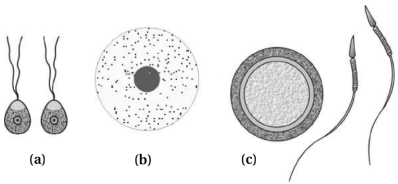
$1$. Types of Gametes: Gametes are always haploid $(n)$. They are of two main types:
- Isogametes (Homogametes): In some algae (e.g.,$Cladophora$,$Ulothrix$),the two gametes are morphologically and physiologically similar,making it impossible to distinguish them as male or female.
- Heterogametes: In the majority of sexually reproducing organisms,gametes are morphologically distinct. The male gamete is small and motile,referred to as antherozoid or sperm,while the female gamete is large and non-motile,referred to as egg or ovum.
$2$. Sexuality in Organisms: The parent body can be haploid or diploid,but gametes are always haploid.
- Haploid Parent Body: Organisms belonging to Monera,Fungi,Algae,and Bryophyta have a haploid plant body. They produce gametes through mitotic division.
- Diploid Parent Body: Organisms like Pteridophyta,Gymnosperms,Angiosperms,and most animals have a diploid body. In these organisms,specialized cells called meiocytes (gamete mother cells) undergo meiosis to produce haploid gametes.
$3$. Conclusion: At the end of meiosis,only one set of chromosomes $(n)$ is incorporated into each gamete,ensuring the maintenance of the chromosome number in the next generation after fertilization.
$1$. Types of Gametes: Gametes are always haploid $(n)$. They are of two main types:
- Isogametes (Homogametes): In some algae (e.g.,$Cladophora$,$Ulothrix$),the two gametes are morphologically and physiologically similar,making it impossible to distinguish them as male or female.
- Heterogametes: In the majority of sexually reproducing organisms,gametes are morphologically distinct. The male gamete is small and motile,referred to as antherozoid or sperm,while the female gamete is large and non-motile,referred to as egg or ovum.
$2$. Sexuality in Organisms: The parent body can be haploid or diploid,but gametes are always haploid.
- Haploid Parent Body: Organisms belonging to Monera,Fungi,Algae,and Bryophyta have a haploid plant body. They produce gametes through mitotic division.
- Diploid Parent Body: Organisms like Pteridophyta,Gymnosperms,Angiosperms,and most animals have a diploid body. In these organisms,specialized cells called meiocytes (gamete mother cells) undergo meiosis to produce haploid gametes.
$3$. Conclusion: At the end of meiosis,only one set of chromosomes $(n)$ is incorporated into each gamete,ensuring the maintenance of the chromosome number in the next generation after fertilization.
0 likes
View Solution473
Medium
Explain why meiosis and gametogenesis are always interlinked?
Solution
(N/A) Meiosis is the process of reductional division in which the amount of genetic material is reduced to half.
Gametogenesis is the process of formation of gametes.
- The gametes produced by gametogenesis are always haploid $(n)$.
- The body of an organism is typically diploid $(2n)$.
- Therefore,it is necessary that meiosis occurs during gametogenesis to produce haploid gametes,which ensures that the chromosome number is halved in the developing gametes.
- This process is essential to maintain the constant chromosome number of the species after fertilization.
Gametogenesis is the process of formation of gametes.
- The gametes produced by gametogenesis are always haploid $(n)$.
- The body of an organism is typically diploid $(2n)$.
- Therefore,it is necessary that meiosis occurs during gametogenesis to produce haploid gametes,which ensures that the chromosome number is halved in the developing gametes.
- This process is essential to maintain the constant chromosome number of the species after fertilization.
0 likes
View Solution474
MediumMCQ
Given below are two statements:
Statement $I$:
The release of sperms into the seminiferous tubules is called spermiation.
Statement $II$:
Spermiogenesis is the process of formation of sperms from spermatogonia.
In the light of the above statements,choose the most appropriate answer from the options given below:
Statement $I$:
The release of sperms into the seminiferous tubules is called spermiation.
Statement $II$:
Spermiogenesis is the process of formation of sperms from spermatogonia.
In the light of the above statements,choose the most appropriate answer from the options given below:
A
Both Statement $I$ and Statement $II$ are incorrect.
B
Statement $I$ is correct but Statement $II$ is incorrect.
C
Statement $I$ is incorrect but Statement $II$ is correct.
D
Both Statement $I$ and Statement $II$ are correct.
Solution
(B) Statement $I$ is correct: The process of release of sperms from the seminiferous tubules is known as spermiation.
Statement $II$ is incorrect: The process of transformation of spermatids into mature spermatozoa (sperms) is called spermiogenesis. The formation of sperms from spermatogonia is known as spermatogenesis,which includes spermatocytogenesis,meiosis,and spermiogenesis.
Statement $II$ is incorrect: The process of transformation of spermatids into mature spermatozoa (sperms) is called spermiogenesis. The formation of sperms from spermatogonia is known as spermatogenesis,which includes spermatocytogenesis,meiosis,and spermiogenesis.
0 likes
View Solution475
DifficultMCQ
Which of the following statements are true for spermatogenesis but do not hold true for Oogenesis?
$(a)$ It results in the formation of haploid gametes
$(b)$ Differentiation of gamete occurs after the completion of meiosis
$(c)$ Meiosis occurs continuously in a mitotically dividing stem cell population
$(d)$ It is controlled by the Luteinising hormone $(LH)$ and Follicle-Stimulating Hormone $(FSH)$ secreted by the anterior pituitary
$(e)$ It is initiated at puberty
Choose the most appropriate answer from the options given below:
$(a)$ It results in the formation of haploid gametes
$(b)$ Differentiation of gamete occurs after the completion of meiosis
$(c)$ Meiosis occurs continuously in a mitotically dividing stem cell population
$(d)$ It is controlled by the Luteinising hormone $(LH)$ and Follicle-Stimulating Hormone $(FSH)$ secreted by the anterior pituitary
$(e)$ It is initiated at puberty
Choose the most appropriate answer from the options given below:
A
$(b)$ and $(c)$ only
B
$(b)$,$(d)$ and $(e)$ only
C
$(b)$,$(c)$ and $(e)$ only
D
$(c)$ and $(e)$ only
Solution
(A) Let us analyze each statement:
$(a)$ Both spermatogenesis and oogenesis result in the formation of haploid gametes. This is true for both.
$(b)$ In spermatogenesis,the spermatids (formed after meiosis) undergo spermiogenesis (differentiation) to become spermatozoa. In oogenesis,the ovum is formed directly after the completion of meiosis without a distinct differentiation phase like spermiogenesis. This is true for spermatogenesis but not oogenesis.
$(c)$ Spermatogenesis occurs continuously in the testes from puberty throughout life in a mitotically dividing stem cell population (spermatogonia). Oogenesis is a discontinuous process; the primary oocytes are formed during embryonic development and meiosis is arrested until puberty. This is true for spermatogenesis but not oogenesis.
$(d)$ Both processes are regulated by $LH$ and $FSH$ from the anterior pituitary. This is true for both.
$(e)$ Spermatogenesis is initiated at puberty. Oogenesis is initiated during embryonic development,though it resumes at puberty. Thus,this statement is not exclusively true for spermatogenesis.
Therefore,statements $(b)$ and $(c)$ are the ones that apply specifically to spermatogenesis and not to oogenesis.
$(a)$ Both spermatogenesis and oogenesis result in the formation of haploid gametes. This is true for both.
$(b)$ In spermatogenesis,the spermatids (formed after meiosis) undergo spermiogenesis (differentiation) to become spermatozoa. In oogenesis,the ovum is formed directly after the completion of meiosis without a distinct differentiation phase like spermiogenesis. This is true for spermatogenesis but not oogenesis.
$(c)$ Spermatogenesis occurs continuously in the testes from puberty throughout life in a mitotically dividing stem cell population (spermatogonia). Oogenesis is a discontinuous process; the primary oocytes are formed during embryonic development and meiosis is arrested until puberty. This is true for spermatogenesis but not oogenesis.
$(d)$ Both processes are regulated by $LH$ and $FSH$ from the anterior pituitary. This is true for both.
$(e)$ Spermatogenesis is initiated at puberty. Oogenesis is initiated during embryonic development,though it resumes at puberty. Thus,this statement is not exclusively true for spermatogenesis.
Therefore,statements $(b)$ and $(c)$ are the ones that apply specifically to spermatogenesis and not to oogenesis.
0 likes
View Solution476
EasyMCQ
At which stage of life is the oogenesis process initiated?
A
Embryonic development stage
B
Birth
C
Adult
D
Puberty
Solution
(A) Oogenesis is the process of formation of a mature female gamete.
Unlike spermatogenesis,which initiates at puberty,oogenesis is initiated during the embryonic development stage.
During fetal development,a couple of million gamete mother cells $(oogonia)$ are formed within each fetal ovary.
No more oogonia are formed or added after birth.
These cells start division and enter into $Prophase-I$ of the meiotic division and get temporarily arrested at that stage,called primary oocytes.
Unlike spermatogenesis,which initiates at puberty,oogenesis is initiated during the embryonic development stage.
During fetal development,a couple of million gamete mother cells $(oogonia)$ are formed within each fetal ovary.
No more oogonia are formed or added after birth.
These cells start division and enter into $Prophase-I$ of the meiotic division and get temporarily arrested at that stage,called primary oocytes.
0 likes
View Solution477
MediumMCQ
Spermatogenesis is regulated by which of the following?
A
$FSH + LH$
B
$FSH +$ Androgens
C
Androgens $+ LH$
D
Androgens
Solution
(B) Spermatogenesis is the process of formation of spermatozoa from spermatogonia.
It is regulated by the hormones of the hypothalamus,anterior pituitary,and testes.
$1$. The hypothalamus releases $GnRH$ (Gonadotropin-Releasing Hormone),which stimulates the anterior pituitary.
$2$. The anterior pituitary releases $LH$ (Luteinizing Hormone) and $FSH$ (Follicle-Stimulating Hormone).
$3$. $LH$ acts on the Leydig cells to stimulate the synthesis and secretion of androgens.
$4$. Androgens,in turn,stimulate the process of spermatogenesis.
$5$. $FSH$ acts on the Sertoli cells and stimulates the secretion of some factors which help in the process of spermiogenesis (transformation of spermatids into spermatozoa).
Therefore,both $FSH$ and androgens are essential for the regulation of spermatogenesis.
It is regulated by the hormones of the hypothalamus,anterior pituitary,and testes.
$1$. The hypothalamus releases $GnRH$ (Gonadotropin-Releasing Hormone),which stimulates the anterior pituitary.
$2$. The anterior pituitary releases $LH$ (Luteinizing Hormone) and $FSH$ (Follicle-Stimulating Hormone).
$3$. $LH$ acts on the Leydig cells to stimulate the synthesis and secretion of androgens.
$4$. Androgens,in turn,stimulate the process of spermatogenesis.
$5$. $FSH$ acts on the Sertoli cells and stimulates the secretion of some factors which help in the process of spermiogenesis (transformation of spermatids into spermatozoa).
Therefore,both $FSH$ and androgens are essential for the regulation of spermatogenesis.
0 likes
View Solution478
EasyMCQ
Which hormone induces ovulation from the Graafian follicle in females?
A
$FSH$
B
$LH$
C
Oxytocin
D
Estrogen
Solution
(B) In females,the anterior pituitary gland secretes two gonadotropins: Follicle Stimulating Hormone $(FSH)$ and Luteinizing Hormone $(LH)$.
$FSH$ stimulates the growth and development of ovarian follicles.
$LH$ triggers the process of ovulation,which is the release of the secondary oocyte from the mature Graafian follicle.
Therefore,a surge in $LH$ levels,often called the '$LH$ surge',is responsible for inducing ovulation.
$FSH$ stimulates the growth and development of ovarian follicles.
$LH$ triggers the process of ovulation,which is the release of the secondary oocyte from the mature Graafian follicle.
Therefore,a surge in $LH$ levels,often called the '$LH$ surge',is responsible for inducing ovulation.
0 likes
View Solution479
EasyMCQ
After ovulation,the ruptured follicle transforms into a structure called ...... .
A
Corpus callosum
B
Corpus albicans
C
Corpus luteum
D
All of the above
Solution
(C) After ovulation,the Graafian follicle ruptures to release the secondary oocyte. The remaining parts of the follicle undergo luteinization to form a yellow-colored endocrine structure known as the $Corpus \ luteum$. This structure secretes large amounts of progesterone,which is essential for the maintenance of the endometrium.
0 likes
View Solution480
MediumMCQ
After ovulation in the Graafian follicle,the ruptured Graafian follicle secretes .........
A
Progesterone
B
Estrogen
C
Both $A$ and $B$
D
Oxytocin
Solution
(C) After ovulation,the remaining parts of the Graafian follicle transform into a temporary endocrine structure called the Corpus Luteum.
This structure primarily secretes large amounts of Progesterone,which is essential for the maintenance of the endometrium.
It also secretes some amount of Estrogen.
Therefore,the ruptured Graafian follicle (Corpus Luteum) secretes both Progesterone and Estrogen.
This structure primarily secretes large amounts of Progesterone,which is essential for the maintenance of the endometrium.
It also secretes some amount of Estrogen.
Therefore,the ruptured Graafian follicle (Corpus Luteum) secretes both Progesterone and Estrogen.
0 likes
View Solution481
EasyMCQ
What is the number of chromosomes in a human sperm?
A
$22$
B
$23$
C
$44$
D
$46$
Solution
(B) Human somatic cells are diploid $(2n = 46)$ in nature.
During gametogenesis,specifically meiosis,the chromosome number is reduced to half.
Therefore,human sperm (male gamete) is haploid $(n)$ and contains $23$ chromosomes.
This includes $22$ autosomes and $1$ sex chromosome (either $X$ or $Y$).
During gametogenesis,specifically meiosis,the chromosome number is reduced to half.
Therefore,human sperm (male gamete) is haploid $(n)$ and contains $23$ chromosomes.
This includes $22$ autosomes and $1$ sex chromosome (either $X$ or $Y$).
0 likes
View Solution482
MediumMCQ
$.....P.....$ undergo meiosis to form sperms. $.....Q.....$ provide nutrition to the germ cells.
Choose the correct option for $P$ and $Q$.
$\quad\quad\quad\quad P \quad\quad\quad Q$
Choose the correct option for $P$ and $Q$.
$\quad\quad\quad\quad P \quad\quad\quad Q$
A
Germ cells $\quad$ $\quad$ $\quad$ Sertoli cells
B
Sertoli cells $\quad$ $\quad$ $\quad$ Leydig cells
C
Leydig cells $\quad$ $\quad$ $\quad$ Sperms
D
Sertoli cells $\quad$ $\quad$ $\quad$ Interstitial cells
Solution
(A) $1$. In the process of spermatogenesis,the primary germ cells (spermatogonia) undergo meiosis to form haploid sperms.
$2$. Sertoli cells are present in the seminiferous tubules and provide nutrition to the developing germ cells (spermatids/spermatozoa).
$3$. Therefore,$P$ represents germ cells and $Q$ represents Sertoli cells.
$2$. Sertoli cells are present in the seminiferous tubules and provide nutrition to the developing germ cells (spermatids/spermatozoa).
$3$. Therefore,$P$ represents germ cells and $Q$ represents Sertoli cells.
0 likes
View Solution483
EasyMCQ
Identify the function of the cell provided in the image (Sertoli cell).
A
This cell provides nutrition to the germ cells.
B
This cell undergoes meiosis to form sperms.
C
It secretes the male sex hormone,androgens.
D
It is a cell capable of immune response.
Solution
(A) Sertoli cells are located within the seminiferous tubules of the testes. Their primary function is to provide nutrition and structural support to the developing germ cells (spermatids) during spermatogenesis. Therefore,option $A$ is the correct answer.
0 likes
View Solution484
EasyMCQ
Identify the Graafian follicle from the given options.
A
$P$
B
$Q$
C
$R$
D
$S$
Solution
(C) The Graafian follicle is the mature ovarian follicle that contains the secondary oocyte.
It is characterized by a large fluid-filled cavity called the antrum.
In typical diagrams of ovarian development,the Graafian follicle is represented by the structure that shows a large antrum,a secondary oocyte surrounded by the zona pellucida,and the cumulus oophorus.
Based on standard biological diagrams of follicular development,the structure labeled as $R$ typically represents the mature Graafian follicle.
It is characterized by a large fluid-filled cavity called the antrum.
In typical diagrams of ovarian development,the Graafian follicle is represented by the structure that shows a large antrum,a secondary oocyte surrounded by the zona pellucida,and the cumulus oophorus.
Based on standard biological diagrams of follicular development,the structure labeled as $R$ typically represents the mature Graafian follicle.
0 likes
View Solution485
MediumMCQ
Determine the ploidy of the following cells in the process of spermatogenesis:
Spermatozoa,Secondary spermatocyte,Spermatid,Spermatogonia,Primary spermatocyte.
Spermatozoa,Secondary spermatocyte,Spermatid,Spermatogonia,Primary spermatocyte.
A
$n, 2n, n, 2n, 2n$
B
$n, 2n, n, 2n, n$
C
$n, n, n, 2n, 2n$
D
$n, n, n, 2n, n$
Solution
(C) The ploidy of cells during spermatogenesis is as follows:
$1$. Spermatogonia $(2n)$: These are diploid germ cells.
$2$. Primary spermatocyte $(2n)$: These are diploid cells formed by the growth of spermatogonia.
$3$. Secondary spermatocyte $(n)$: These are haploid cells formed after the first meiotic division (meiosis $I$).
$4$. Spermatid $(n)$: These are haploid cells formed after the second meiotic division (meiosis $II$).
$5$. Spermatozoa $(n)$: These are haploid cells formed by the differentiation of spermatids.
Therefore,the sequence is: Spermatozoa $(n)$,Secondary spermatocyte $(n)$,Spermatid $(n)$,Spermatogonia $(2n)$,Primary spermatocyte $(2n)$.
This matches option $C$.
$1$. Spermatogonia $(2n)$: These are diploid germ cells.
$2$. Primary spermatocyte $(2n)$: These are diploid cells formed by the growth of spermatogonia.
$3$. Secondary spermatocyte $(n)$: These are haploid cells formed after the first meiotic division (meiosis $I$).
$4$. Spermatid $(n)$: These are haploid cells formed after the second meiotic division (meiosis $II$).
$5$. Spermatozoa $(n)$: These are haploid cells formed by the differentiation of spermatids.
Therefore,the sequence is: Spermatozoa $(n)$,Secondary spermatocyte $(n)$,Spermatid $(n)$,Spermatogonia $(2n)$,Primary spermatocyte $(2n)$.
This matches option $C$.
0 likes
View Solution486
EasyMCQ
Which cell is released from the ovary during ovulation?
A
Oogonium
B
Ootid
C
Primary oocyte
D
Secondary oocyte
Solution
(D) During the process of ovulation,the Graafian follicle ruptures to release the egg from the ovary.
At this stage,the cell released is the $Secondary \ oocyte$.
The $Primary \ oocyte$ completes its first meiotic division within the Graafian follicle just before ovulation,resulting in the formation of a large $Secondary \ oocyte$ and a small first polar body.
Therefore,the correct answer is $D$.
At this stage,the cell released is the $Secondary \ oocyte$.
The $Primary \ oocyte$ completes its first meiotic division within the Graafian follicle just before ovulation,resulting in the formation of a large $Secondary \ oocyte$ and a small first polar body.
Therefore,the correct answer is $D$.
0 likes
View Solution487
MediumMCQ
What is the ploidy of the polar body produced during oogenesis?
A
$n$
B
$2n$
C
$3n$
D
$4n$
Solution
(A) During oogenesis,the primary oocyte undergoes meiosis $I$ to form a large secondary oocyte and a small first polar body.
Since the primary oocyte is diploid $(2n)$,the meiotic division $I$ is a reductional division (meiosis),which results in daughter cells that are haploid $(n)$.
Therefore,the polar body produced is haploid $(n)$.
Since the primary oocyte is diploid $(2n)$,the meiotic division $I$ is a reductional division (meiosis),which results in daughter cells that are haploid $(n)$.
Therefore,the polar body produced is haploid $(n)$.
0 likes
View Solution488
EasyMCQ
Identify the correct sequence of sperm formation during spermatogenesis.
A
Primary spermatocyte $\rightarrow$ Secondary spermatocyte $\rightarrow$ Spermatid $\rightarrow$ Spermatogonia $\rightarrow$ Spermatozoa
B
Spermatogonia $\rightarrow$ Primary spermatocyte $\rightarrow$ Secondary spermatocyte $\rightarrow$ Spermatid $\rightarrow$ Spermatozoa
C
Spermatogonia $\rightarrow$ Primary spermatocyte $\rightarrow$ Secondary spermatocyte $\rightarrow$ Spermatozoa $\rightarrow$ Spermatid
D
None of these.
Solution
(B) Spermatogenesis is the process of formation of spermatozoa from spermatogonia in the testes.
$1$. Spermatogonia $(2n)$ undergo mitosis to increase their number.
$2$. Some spermatogonia grow into Primary spermatocytes $(2n)$.
$3$. Primary spermatocytes undergo Meiosis-$I$ to form two haploid Secondary spermatocytes $(n)$.
$4$. Secondary spermatocytes undergo Meiosis-$II$ to form four haploid Spermatids $(n)$.
$5$. Spermatids undergo spermiogenesis to transform into functional Spermatozoa $(n)$.
Thus,the correct sequence is: Spermatogonia $\rightarrow$ Primary spermatocyte $\rightarrow$ Secondary spermatocyte $\rightarrow$ Spermatid $\rightarrow$ Spermatozoa.
$1$. Spermatogonia $(2n)$ undergo mitosis to increase their number.
$2$. Some spermatogonia grow into Primary spermatocytes $(2n)$.
$3$. Primary spermatocytes undergo Meiosis-$I$ to form two haploid Secondary spermatocytes $(n)$.
$4$. Secondary spermatocytes undergo Meiosis-$II$ to form four haploid Spermatids $(n)$.
$5$. Spermatids undergo spermiogenesis to transform into functional Spermatozoa $(n)$.
Thus,the correct sequence is: Spermatogonia $\rightarrow$ Primary spermatocyte $\rightarrow$ Secondary spermatocyte $\rightarrow$ Spermatid $\rightarrow$ Spermatozoa.
0 likes
View Solution489
MediumMCQ
The schematic representation of spermatogenesis is given below. How many chromosomes do $P$,$Q$,and $R$ contain?
$P$ (Spermatogonia) $\rightarrow$ $Q$ (Primary Spermatocyte) $\rightarrow$ $R$ (Spermatid)
$P$ (Spermatogonia) $\rightarrow$ $Q$ (Primary Spermatocyte) $\rightarrow$ $R$ (Spermatid)
A
$23, 23, 23$
B
$46, 23, 23$
C
$46, 46, 23$
D
$23, 46, 23$
Solution
(C) $1$. Spermatogonia $(P)$ are diploid cells formed by mitosis in the testes,so they contain $46$ chromosomes.
$2$. Primary spermatocytes $(Q)$ are formed from spermatogonia by differentiation without division,so they remain diploid and contain $46$ chromosomes.
$3$. Spermatids $(R)$ are formed after the completion of Meiosis-$I$ and Meiosis-$II$,making them haploid cells,so they contain $23$ chromosomes.
$4$. Therefore,the chromosome numbers are $P=46$,$Q=46$,and $R=23$.
$2$. Primary spermatocytes $(Q)$ are formed from spermatogonia by differentiation without division,so they remain diploid and contain $46$ chromosomes.
$3$. Spermatids $(R)$ are formed after the completion of Meiosis-$I$ and Meiosis-$II$,making them haploid cells,so they contain $23$ chromosomes.
$4$. Therefore,the chromosome numbers are $P=46$,$Q=46$,and $R=23$.
0 likes
View Solution490
MediumMCQ
Which processes occur in the testes for the formation of spermatozoa?
A
Only mitosis
B
Only meiosis
C
Mitosis and meiosis
D
None of the above
Solution
(C) The process of spermatogenesis occurs in the testes and involves two main stages:
$1$. Mitosis: The spermatogonia $(2n)$ undergo repeated mitotic divisions to increase their number.
$2$. Meiosis: The primary spermatocytes $(2n)$ undergo meiosis ($I$ and $II$) to produce haploid $(n)$ spermatids,which then differentiate into spermatozoa.
Therefore,both mitosis and meiosis are essential for the formation of spermatozoa.
$1$. Mitosis: The spermatogonia $(2n)$ undergo repeated mitotic divisions to increase their number.
$2$. Meiosis: The primary spermatocytes $(2n)$ undergo meiosis ($I$ and $II$) to produce haploid $(n)$ spermatids,which then differentiate into spermatozoa.
Therefore,both mitosis and meiosis are essential for the formation of spermatozoa.
0 likes
View Solution491
EasyMCQ
Identify the site of spermatogenesis.
A
Epididymis
B
Seminiferous tubule
C
Seminal vesicle
D
Vas deferens
Solution
(B) Spermatogenesis is the process of formation of sperms from immature germ cells in males. This process occurs within the $Seminiferous$ $\text{tubules}$ located in the testes. The germ cells (spermatogonia) undergo meiotic divisions to produce spermatozoa.
0 likes
View Solution492
MediumMCQ
During spermatogenesis,the process of meiosis-$II$ occurs during which of the following transitions?
A
Spermatid $\rightarrow$ Spermatozoa
B
Primary spermatocyte $\rightarrow$ Secondary spermatocyte
C
Secondary spermatocyte $\rightarrow$ Spermatid
D
Spermatogonia $\rightarrow$ Primary spermatocyte
Solution
(C) Spermatogenesis involves several stages:
$1$. Spermatogonia $(2n)$ undergo mitosis to form Primary spermatocytes $(2n)$.
$2$. Primary spermatocytes $(2n)$ undergo Meiosis-$I$ to form two Secondary spermatocytes $(n)$.
$3$. Secondary spermatocytes $(n)$ undergo Meiosis-$II$ to form four Spermatids $(n)$.
$4$. Spermatids $(n)$ undergo spermiogenesis to differentiate into Spermatozoa $(n)$.
Therefore,Meiosis-$II$ occurs during the transition from Secondary spermatocyte to Spermatid.
$1$. Spermatogonia $(2n)$ undergo mitosis to form Primary spermatocytes $(2n)$.
$2$. Primary spermatocytes $(2n)$ undergo Meiosis-$I$ to form two Secondary spermatocytes $(n)$.
$3$. Secondary spermatocytes $(n)$ undergo Meiosis-$II$ to form four Spermatids $(n)$.
$4$. Spermatids $(n)$ undergo spermiogenesis to differentiate into Spermatozoa $(n)$.
Therefore,Meiosis-$II$ occurs during the transition from Secondary spermatocyte to Spermatid.
0 likes
View Solution493
EasyMCQ
What is the process of transformation of spermatids into spermatozoa called?
A
Spermiogenesis
B
Meiosis-$II$
C
Meiosis-$I$
D
None of these
Solution
(A) The transformation of non-motile spermatids into mature,motile spermatozoa is known as spermiogenesis.
During this process,the spermatid undergoes significant morphological changes,including the formation of the acrosome,condensation of the nucleus,and development of the flagellum.
Therefore,the correct option is $A$.
During this process,the spermatid undergoes significant morphological changes,including the formation of the acrosome,condensation of the nucleus,and development of the flagellum.
Therefore,the correct option is $A$.
0 likes
View Solution494
MediumMCQ
What are the site of origin and the site of action of $FSH$ respectively?
A
Hypothalamus,Pituitary gland
B
Anterior Pituitary gland,Gonads
C
Posterior Pituitary gland,Gonads
D
Hypothalamus,Gonads
Solution
(B) $FSH$ stands for Follicle Stimulating Hormone.
It is secreted by the gonadotroph cells of the anterior pituitary gland.
Its primary site of action is the gonads (testes in males and ovaries in females),where it stimulates gametogenesis and follicular development.
Therefore,the site of origin is the anterior pituitary gland and the site of action is the gonads.
It is secreted by the gonadotroph cells of the anterior pituitary gland.
Its primary site of action is the gonads (testes in males and ovaries in females),where it stimulates gametogenesis and follicular development.
Therefore,the site of origin is the anterior pituitary gland and the site of action is the gonads.
0 likes
View Solution495
EasyMCQ
Which part of the sperm contains the enzyme hyaluronidase?
A
Acrosome
B
Nucleus
C
Middle piece
D
Tail
Solution
(A) The sperm head contains an elongated haploid nucleus,the anterior portion of which is covered by a cap-like structure called the acrosome.
The acrosome is filled with enzymes that help in the fertilization of the ovum.
These enzymes,collectively known as sperm lysins,include hyaluronidase,which helps in dissolving the corona radiata of the ovum,and zona lysin (acrosin),which helps in penetrating the zona pellucida.
Therefore,the acrosome is the part of the sperm that contains the enzyme hyaluronidase.
The acrosome is filled with enzymes that help in the fertilization of the ovum.
These enzymes,collectively known as sperm lysins,include hyaluronidase,which helps in dissolving the corona radiata of the ovum,and zona lysin (acrosin),which helps in penetrating the zona pellucida.
Therefore,the acrosome is the part of the sperm that contains the enzyme hyaluronidase.
0 likes
View Solution496
EasyMCQ
Identify the location of mitochondria in a human sperm.
A
Head
B
Middle piece
C
Tail
D
All of the above
Solution
(B) The human sperm consists of a head,neck,middle piece,and tail.
The middle piece contains numerous mitochondria,which provide energy for the movement of the tail that facilitates sperm motility.
Therefore,the correct location of mitochondria is the middle piece.
The middle piece contains numerous mitochondria,which provide energy for the movement of the tail that facilitates sperm motility.
Therefore,the correct location of mitochondria is the middle piece.
0 likes
View Solution497
EasyMCQ
During coitus,the human male ejaculates about ...... number of sperms.
A
$200$ to $300$ billion
B
$400$ to $500$ million
C
$400$ to $500$ billion
D
$200$ to $300$ million
Solution
(D) During a single coitus,the human male ejaculates about $200$ to $300$ million sperms.
This is necessary because,for normal fertility,at least $60$ percent of all sperms must have normal shape and size,and at least $40$ percent of them must show vigorous motility.
This is necessary because,for normal fertility,at least $60$ percent of all sperms must have normal shape and size,and at least $40$ percent of them must show vigorous motility.
0 likes
View Solution498
EasyMCQ
For normal fertility,at least ....... of the sperm in a human ejaculate must have normal shape and size,and at least ...... of them must show vigorous motility.
A
$60\%, 40\%$
B
$70\%, 30\%$
C
$80\%, 20\%$
D
$75\%, 25\%$
Solution
(A) According to the $NCERT$ textbook,for normal fertility,at least $60\%$ of the sperm in a human ejaculate must have normal shape and size,and at least $40\%$ of them must show vigorous motility. Therefore,the correct option is $A$.
0 likes
View Solution499
MediumMCQ
State the site of the process of oogenesis.
A
Ovarian medulla
B
Ovarian cortex
C
Both
D
None of these
Solution
(B) Oogenesis is the process of formation of a mature female gamete (ovum) in the ovaries.
Within the ovary,the development of follicles occurs in the ovarian cortex.
As the follicles mature,they move towards the surface of the ovary,but the entire process of oogenesis,including the development of primary,secondary,and tertiary follicles,takes place within the ovarian cortex.
Therefore,the correct site for oogenesis is the ovarian cortex.
Within the ovary,the development of follicles occurs in the ovarian cortex.
As the follicles mature,they move towards the surface of the ovary,but the entire process of oogenesis,including the development of primary,secondary,and tertiary follicles,takes place within the ovarian cortex.
Therefore,the correct site for oogenesis is the ovarian cortex.
0 likes
View Solution500
MediumMCQ
Select the correct option regarding oogenesis.
A
Oogenesis is initiated during the embryonic development stage.
B
Millions of gamete mother cells (oogonia) are formed within each fetal ovary.
C
No more oogonia are formed or added after birth.
D
All of the above.
Solution
(D) Oogenesis is the process of formation of a mature female gamete.
$1$. It is initiated during the embryonic development stage when a couple of million gamete mother cells $(oogonia)$ are formed within each fetal ovary.
$2$. No more $oogonia$ are formed or added after birth.
$3$. These cells start division and enter into prophase-$I$ of the meiotic division and get temporarily arrested at that stage,called primary oocytes.
Therefore,all the given statements are correct.
$1$. It is initiated during the embryonic development stage when a couple of million gamete mother cells $(oogonia)$ are formed within each fetal ovary.
$2$. No more $oogonia$ are formed or added after birth.
$3$. These cells start division and enter into prophase-$I$ of the meiotic division and get temporarily arrested at that stage,called primary oocytes.
Therefore,all the given statements are correct.
0 likes
View SolutionHuman Reproduction — Gametogenesis · Frequently Asked Questions
1Are these Human Reproduction questions useful for JEE and NEET?
Yes. All questions in this section are mapped to JEE Main and NEET exam patterns. Previous year questions from JEE Main, NEET, GUJCET and state-level exams are included with full solutions.
2Can I switch to Hindi or Gujarati for these questions?
Yes. Use the language tabs in the hero section or the sidebar to view the same questions and solutions in English, Hindi or Gujarati.
3How do I generate a question paper from this subtopic?
Use the Vedclass Exam Paper Generator — select the chapter and subtopic, set difficulty, and generate Sets A, B, C, D automatically. First 3 chapters of every subject are free.
Vedclass Products
For Students
Vedclass Test Series
Mock tests in real JEE/NEET style with performance analysis. 5-day free trial.
Start Free TrialFor Teachers
Exam Paper Generator
Generate Set A/B/C/D papers from this chapter in 2 minutes. 3 chapters free.
Try FreeFor Institutes
Online Exam Module
Live online exams with unlimited students, 360° analytics & white-label branding.
See DemoFor Teachers & Institutes
Generate a Human Reproduction Exam Paper in 2 Minutes
Select subtopic & difficulty — Sets A, B, C, D auto-generated with No Repeat logic.
First 3 chapters of every subject are free — no payment required.