
A English
Female reproductive system Questions in English
Class 12 Biology · Human Reproduction · Female reproductive system
156+
Questions
English
Language
100%
With Solutions
Showing 50 of 156 questions in English
1
EasyMCQ
What is the difference between the trachea and the fallopian tube?
A
Trachea is related to respiration,whereas the fallopian tube is related to reproduction.
B
Trachea is related to respiration,and the fallopian tube is related to excretion.
C
Trachea is related to reproduction,and the fallopian tube is related to excretion.
D
Trachea is related to reproduction,and the fallopian tube is related to respiration.
Solution
(A) The $trachea$ (windpipe) is a cartilaginous tube that forms part of the respiratory system,facilitating the passage of air to the lungs.
The $fallopian \text{ } tube$ (oviduct) is a part of the female reproductive system that transports the ovum from the ovary to the uterus and is the site where fertilization typically occurs.
Therefore,the $trachea$ is associated with the respiratory system,while the $fallopian \text{ } tube$ is associated with the reproductive system.
The $fallopian \text{ } tube$ (oviduct) is a part of the female reproductive system that transports the ovum from the ovary to the uterus and is the site where fertilization typically occurs.
Therefore,the $trachea$ is associated with the respiratory system,while the $fallopian \text{ } tube$ is associated with the reproductive system.
0 likes
View Solution2
EasyMCQ
The stroma of the ovary consists of nerves,blood vessels,muscle fibres and a type of protein called
A
Collagen
B
Albumin
C
Globulin
D
Fibrin
Solution
(A) The stroma of the ovary is composed of two parts: the outer cortex and the inner medulla.
It contains a loose connective tissue framework that includes nerves,blood vessels,and muscle fibres.
This connective tissue matrix is primarily composed of collagen fibres,which provide structural support to the ovarian tissue.
It contains a loose connective tissue framework that includes nerves,blood vessels,and muscle fibres.
This connective tissue matrix is primarily composed of collagen fibres,which provide structural support to the ovarian tissue.
0 likes
View Solution3
EasyMCQ
In female mammals,Bartholin's glands open into the
A
Vestibule and release a lubricating fluid in the vagina
B
Uterus and release a lubricating fluid during the birth of young ones
C
Urinary bladder and assist in release of urine
D
Fallopian tubes and release a secretion which makes sperms motile
Solution
(A) The greater vestibular glands,also known as $Bartholin's$ glands,are a pair of glands located on either side of the vaginal opening.
These glands open into the vestibule of the vagina.
They are homologous to the bulbourethral glands (or $Cowper's$ glands) found in males.
Their primary function is to secrete a viscid,mucus-like fluid that provides lubrication during sexual intercourse.
These glands open into the vestibule of the vagina.
They are homologous to the bulbourethral glands (or $Cowper's$ glands) found in males.
Their primary function is to secrete a viscid,mucus-like fluid that provides lubrication during sexual intercourse.
0 likes
View Solution4
EasyMCQ
The mammalian follicle was first described by
A
Von Baer
B
de Graaf
C
Robert Brown
D
Spallanzani
Solution
(B) The correct answer is $B$.
Regner de Graaf $(1641-1673)$ first described the ovarian follicles in mammals in $1671$.
Although he initially mistook them for eggs,these structures were later named Graafian follicles in his honor.
Regner de Graaf $(1641-1673)$ first described the ovarian follicles in mammals in $1671$.
Although he initially mistook them for eggs,these structures were later named Graafian follicles in his honor.
0 likes
View Solution5
MediumMCQ
Graafian follicles are characteristically found in the
A
Thyroid of mammal
B
Ovary of frog
C
Testis of mammal
D
Ovary of mammal
Solution
(D) The ovarian cortex contains many small and large spherical or oval ovarian follicles in various stages of development.
$A$ fully matured ovarian follicle is known as a $Graafian$ follicle,which is a characteristic feature of the mammalian ovary.
$A$ fully matured ovarian follicle is known as a $Graafian$ follicle,which is a characteristic feature of the mammalian ovary.
0 likes
View Solution6
EasyMCQ
Bartholin's glands in rabbits are found in
A
Male and produce a viscous alkaline fluid which neutralizes acidity in the urethra
B
Male and produce the clear liquid part of the spermatic fluid
C
Female and produce the hormone estrogen which regulates secondary sexual characters
D
Female and produce a clear fluid which lubricates the vestibule during copulation
Solution
(D) Bartholin's glands (also known as greater vestibular glands) are a pair of small glands located in the female reproductive system of mammals,including rabbits.
These glands are situated on either side of the vaginal opening (vestibule).
Their primary function is to secrete a clear,mucus-like fluid that lubricates the vestibule during copulation,facilitating the process and reducing friction.
These glands are situated on either side of the vaginal opening (vestibule).
Their primary function is to secrete a clear,mucus-like fluid that lubricates the vestibule during copulation,facilitating the process and reducing friction.
0 likes
View Solution7
MediumMCQ
Stroma is a term applied to
A
Gall stone
B
Ovarian follicles
C
Connective tissue in which Graafian follicles are embedded
D
Connective tissue surrounding the seminiferous tubules
Solution
(C) In the context of the ovary,the $Stroma$ refers to the connective tissue framework that supports the various structures within the organ.
Specifically,the ovarian $Stroma$ consists of an outer $Cortex$ and an inner $Medulla$.
The $Graafian$ follicles are embedded within the $Stroma$ of the ovarian $Cortex$.
Specifically,the ovarian $Stroma$ consists of an outer $Cortex$ and an inner $Medulla$.
The $Graafian$ follicles are embedded within the $Stroma$ of the ovarian $Cortex$.
0 likes
View Solution8
MediumMCQ
What is the female counterpart of the prostate gland in the male?
A
Bartholin's gland
B
Uterus
C
Clitoris
D
Skene's gland
Solution
(D) The prostate gland in males is homologous to the Skene's gland (also known as the paraurethral gland) in females. Both glands are derived from the same embryonic tissue and are located near the urethra,playing a role in the secretion of fluids.
0 likes
View Solution9
MediumMCQ
Corpus luteum in mammals is present in
A
Heart and initiates atrial contraction
B
Brain and connects the two cerebral hemispheres
C
Ovaries and produces progesterone
D
Skin and acts as a pain receptor
Solution
(C) The $Corpus$ $\text{luteum}$ is a temporary endocrine structure in female mammals that is involved in the production of relatively high levels of progesterone and moderate levels of estradiol and inhibin $A$. It is formed from the ovarian follicle after the release of a secondary oocyte during ovulation. Therefore, it is present in the ovaries.
0 likes
View Solution10
MediumMCQ
The endometrium is the lining of
A
Bladder
B
Vagina
C
Uterus
D
Oviduct
Solution
(C) The inner glandular layer of the uterus is called the endometrium.
It is a mucous membrane that is richly supplied with blood vessels and tubular glands.
It undergoes cyclic changes during the menstrual cycle.
In contrast,the middle thick layer of smooth muscle is called the myometrium,and the thin external membrane is called the perimetrium.
It is a mucous membrane that is richly supplied with blood vessels and tubular glands.
It undergoes cyclic changes during the menstrual cycle.
In contrast,the middle thick layer of smooth muscle is called the myometrium,and the thin external membrane is called the perimetrium.
0 likes
View Solution11
MediumMCQ
The human uterus is:
A
Paired with well-separated oviducts
B
$A$ single large chamber with the posterior part of the oviduct fused to it anteriorly
C
Paired with partially fused oviducts
D
$A$ single large chamber with completely fused oviducts
Solution
(B) The human uterus,also known as the womb,is a single,large,pear-shaped muscular organ.
It is formed by the fusion of the lower parts of the two $M$üllerian ducts (oviducts) during embryonic development.
Therefore,it is described as a single large chamber where the posterior parts of the oviducts have fused to form the uterine body.
It is formed by the fusion of the lower parts of the two $M$üllerian ducts (oviducts) during embryonic development.
Therefore,it is described as a single large chamber where the posterior parts of the oviducts have fused to form the uterine body.
0 likes
View Solution12
MediumMCQ
The cervix lies between:
A
Oviduct and uterus
B
Uterus and vagina
C
Vagina and clitoris
D
Clitoris and labia
Solution
(B) The cervix is the lower,narrow part of the uterus. It connects the body of the uterus to the vagina. It opens into the uterus through the internal os and into the vagina through the external os. Therefore,it lies between the uterus and the vagina.
0 likes
View Solution13
MediumMCQ
The vaginal orifice,urethral orifice,and clitoris are protected by:
A
Labia majora
B
Labia minora
C
Vulva
D
Anus
Solution
(B) The female external genitalia,collectively known as the vulva,includes the mons pubis,labia majora,labia minora,hymen,and clitoris.
Specifically,the labia minora are paired folds of tissue located under the labia majora.
These folds surround the vestibule,which contains the vaginal orifice and the urethral orifice.
The clitoris lies at the upper junction of the two labia minora.
Therefore,the labia minora provide protection to the vaginal orifice,urethral orifice,and the clitoris.
Specifically,the labia minora are paired folds of tissue located under the labia majora.
These folds surround the vestibule,which contains the vaginal orifice and the urethral orifice.
The clitoris lies at the upper junction of the two labia minora.
Therefore,the labia minora provide protection to the vaginal orifice,urethral orifice,and the clitoris.
0 likes
View Solution14
EasyMCQ
Vestibular glands secrete:
A
Hormones
B
Enzymes
C
Mucus
D
Digestive juice
Solution
(C) The vestibular glands,specifically the greater vestibular glands (also known as Bartholin's glands) located on either side of the vaginal opening,secrete a lubricating fluid that is primarily composed of mucus. This mucus helps in lubricating the vaginal opening during sexual arousal.
0 likes
View Solution15
MediumMCQ
The uterus and vagina lie in a fold of peritoneum called:
A
Mesorchium
B
Mesovarium
C
Mesometrium
D
Peritoneal covering
Solution
(C) The uterus and vagina are supported by a broad ligament,which is a fold of the peritoneum. The portion of the broad ligament that attaches to the uterus is specifically known as the $Mesometrium$. The $Mesorchium$ is associated with the testis,and the $Mesovarium$ is associated with the ovary.
0 likes
View Solution16
MediumMCQ
The ducts which carry milk from mammary glands to the nipple are called:
A
Lactiferous sinuses
B
Lactiferous ducts
C
Areola
D
All the above
Solution
(B) The mammary glands of each breast consist of $15-20$ mammary lobes containing clusters of cells called alveoli.
The cells of alveoli secrete milk,which is stored in the cavities (lumens) of alveoli.
The alveoli open into mammary tubules. The tubules of each lobe join to form a mammary duct.
Several mammary ducts join to form a wider mammary ampulla,which is connected to the lactiferous duct through which milk is sucked out.
The lactiferous ducts carry milk from the mammary glands to the nipple.
Therefore,the correct answer is $B$.
The cells of alveoli secrete milk,which is stored in the cavities (lumens) of alveoli.
The alveoli open into mammary tubules. The tubules of each lobe join to form a mammary duct.
Several mammary ducts join to form a wider mammary ampulla,which is connected to the lactiferous duct through which milk is sucked out.
The lactiferous ducts carry milk from the mammary glands to the nipple.
Therefore,the correct answer is $B$.
0 likes
View Solution17
MediumMCQ
Note the relationship between the first two words and suggest a suitable word for the fourth place: $Mesovarium : Ovary :: Mesometrium : .............$
A
Clitoris
B
Uterus
C
Testis
D
Penis
Solution
(B) $Mesovarium$ is the peritoneal fold that attaches the ovary to the broad ligament of the uterus.
Similarly,$Mesometrium$ is the portion of the broad ligament that attaches to the uterus.
Therefore,the correct term for the fourth place is $Uterus$.
Similarly,$Mesometrium$ is the portion of the broad ligament that attaches to the uterus.
Therefore,the correct term for the fourth place is $Uterus$.
0 likes
View Solution18
MediumMCQ
In human beings,the median tube where the uterus opens independently is called:
A
Cervix
B
Clitoris
C
Vagina
D
Cloaca
Solution
(C) The uterus opens into a wide,elastic,muscular tube known as the $Vagina$.
The $Vagina$ serves as the birth canal and is lined by a stratified squamous epithelium that lacks glands.
The $Vagina$ serves as the birth canal and is lined by a stratified squamous epithelium that lacks glands.
0 likes
View Solution19
MediumMCQ
The fimbriated funnel is:
A
Proximal part of the oviduct
B
Part of the uterus
C
Part of the urinary bladder
D
Part of the ureter
Solution
(A) The fimbriated funnel is the modified proximal end of the oviduct,particularly observed in organisms like frogs.
In mammals,the oviduct,also known as the fallopian tube or uterine tube,begins with a funnel-shaped structure called the infundibulum,which possesses finger-like projections known as fimbriae.
These fimbriae help in the collection of the ovum after ovulation.
In mammals,the oviduct,also known as the fallopian tube or uterine tube,begins with a funnel-shaped structure called the infundibulum,which possesses finger-like projections known as fimbriae.
These fimbriae help in the collection of the ovum after ovulation.
0 likes
View Solution20
MediumMCQ
The Fallopian tube is a part of which of the following?
A
Uterus
B
Ureter
C
Oviduct
D
Vas deferens
Solution
(C) The female reproductive system consists of a pair of ovaries,a pair of oviducts (Fallopian tubes),the uterus,the cervix,the vagina,and the external genitalia. The Fallopian tube is anatomically synonymous with the oviduct,as it serves as the duct through which the ovum travels from the ovary to the uterus.
0 likes
View Solution21
EasyMCQ
Bartholin's glands are situated
A
On either side of vas deferens in humans
B
On the sides of the head of frog
C
At the reduced tail end of birds
D
On either side of vagina in humans
Solution
(D) $Bartholin's$ glands are a pair of small glands located on either side of the vaginal opening in human females. They are homologous to the bulbourethral glands in males and are responsible for secreting mucus to provide lubrication during sexual intercourse.
0 likes
View Solution22
MediumMCQ
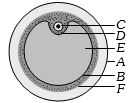
In the diagram of a section of a Graafian follicle,different parts are indicated by alphabets. Choose the answer in which these alphabets have been correctly matched with the parts they indicate.
A
$A =$ Theca externa,$B =$ Theca interna,$C =$ Ovum,$D =$ Cumulus oophorus,$E =$ Antrum,$F =$ Membrana granulosa
B
$A =$ Membrana granulosa,$B =$ Theca externa,$C =$ Ovum,$D =$ Cumulus oophorus,$E =$ Antrum,$F =$ Theca interna
C
$A =$ Membrana granulosa,$B =$ Theca interna,$C =$ Ovum,$D =$ Cumulus oophorus,$E =$ Antrum,$F =$ Theca externa
D
$A =$ Theca externa,$B =$ Theca interna,$C =$ Ovum,$D =$ Membrana granulosa,$E =$ Antrum,$F =$ Cumulus oophorus
Solution
(A) Based on the anatomical structure of a mature Graafian follicle:
$A$ points to the outermost layer,the Theca externa.
$B$ points to the layer just inside the Theca externa,which is the Theca interna.
$C$ represents the central Ovum (oocyte).
$D$ represents the cluster of follicular cells surrounding the ovum,known as the Cumulus oophorus.
$E$ represents the large fluid-filled cavity called the Antrum.
$F$ represents the layer of follicular cells lining the follicle,known as the Membrana granulosa.
Therefore,the correct matching is $A =$ Theca externa,$B =$ Theca interna,$C =$ Ovum,$D =$ Cumulus oophorus,$E =$ Antrum,$F =$ Membrana granulosa.
$A$ points to the outermost layer,the Theca externa.
$B$ points to the layer just inside the Theca externa,which is the Theca interna.
$C$ represents the central Ovum (oocyte).
$D$ represents the cluster of follicular cells surrounding the ovum,known as the Cumulus oophorus.
$E$ represents the large fluid-filled cavity called the Antrum.
$F$ represents the layer of follicular cells lining the follicle,known as the Membrana granulosa.
Therefore,the correct matching is $A =$ Theca externa,$B =$ Theca interna,$C =$ Ovum,$D =$ Cumulus oophorus,$E =$ Antrum,$F =$ Membrana granulosa.
0 likes
View Solution23
MediumMCQ
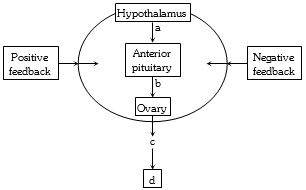
Choose the correct combination of labels for the hormonal control of the female reproductive system as shown in the diagram.
A
$(a)-GnRH, (b)-TSH, (c)-LTH, (d)-uterus$
B
$(a)-GnRH, (b)-LH/FSH, (c)-estrogen\ or\ progesterone, (d)-uterus$
C
$(a)-GnRH, (b)-STH, (c)-LH, (d)-uterus$
D
$(a)-GnRH, (b)-ACTH, (c)-LH, (d)-uterus$
Solution
(B) The hormonal control of the female reproductive system is regulated by the hypothalamus-pituitary-ovarian axis.
$1$. The hypothalamus secretes $GnRH$ (Gonadotropin-Releasing Hormone), which acts on the anterior pituitary (label $a$).
$2$. The anterior pituitary releases gonadotropins, specifically $LH$ (Luteinizing Hormone) and $FSH$ (Follicle-Stimulating Hormone), which act on the ovaries (label $b$).
$3$. The ovaries, in response to these gonadotropins, secrete steroid hormones like estrogen or progesterone (label $c$).
$4$. These ovarian hormones act on the target organ, which is the uterus, to prepare it for implantation and pregnancy (label $d$).
Therefore, the correct combination is $(a)-GnRH, (b)-LH/FSH, (c)-estrogen\ or\ progesterone, (d)-uterus$.
$1$. The hypothalamus secretes $GnRH$ (Gonadotropin-Releasing Hormone), which acts on the anterior pituitary (label $a$).
$2$. The anterior pituitary releases gonadotropins, specifically $LH$ (Luteinizing Hormone) and $FSH$ (Follicle-Stimulating Hormone), which act on the ovaries (label $b$).
$3$. The ovaries, in response to these gonadotropins, secrete steroid hormones like estrogen or progesterone (label $c$).
$4$. These ovarian hormones act on the target organ, which is the uterus, to prepare it for implantation and pregnancy (label $d$).
Therefore, the correct combination is $(a)-GnRH, (b)-LH/FSH, (c)-estrogen\ or\ progesterone, (d)-uterus$.
0 likes
View Solution24
EasyMCQ
Endometrium is found in
A
Placenta of mammals
B
Nipple of mammals
C
Uterus of mammals
D
None of these
Solution
(C) The term $Endometrium$ is derived from the Greek words $endo$ (within) and $metra$ (uterus),meaning 'within the uterus'.
$Endometrium$ is the inner glandular lining of the uterus in mammals.
It undergoes cyclic changes,thickening in response to progesterone secretion during the menstrual cycle to prepare for embryo implantation,and is sloughed off during menstruation if fertilization does not occur.
$Endometrium$ is the inner glandular lining of the uterus in mammals.
It undergoes cyclic changes,thickening in response to progesterone secretion during the menstrual cycle to prepare for embryo implantation,and is sloughed off during menstruation if fertilization does not occur.
0 likes
View Solution25
MediumMCQ
Clitoris in mammals is
A
Homologous to penis
B
Analogous to penis
C
Functional penis in female
D
Non-functional penis in male
Solution
(A) The clitoris is a small,sensitive organ composed of erectile tissue.
It is homologous to the penis in males because both structures develop from the same embryonic tissues (the genital tubercle).
It is homologous to the penis in males because both structures develop from the same embryonic tissues (the genital tubercle).
1 likes
View Solution26
MediumMCQ
The vulva is enclosed by:
A
Vaginal orifice
B
Clitoris
C
Labia majora
D
Labia majora and minora both
Solution
(C) The female external genitalia,collectively known as the vulva,consists of the mons pubis,labia majora,labia minora,hymen,and clitoris. The labia majora are fleshy folds of tissue which extend down from the mons pubis and surround the vaginal opening. The labia minora are paired folds of tissue under the labia majora. Therefore,the vulva is enclosed by the labia majora.
0 likes
View Solution27
MediumMCQ
The ostium is provided with a number of finger-like processes called fimbriae. What is their function?
A
For receiving the ovum
B
To increase the catching area
C
Both $(a)$ and $(b)$
D
To secrete hormones
Solution
(C) The fallopian tube consists of three parts: infundibulum,ampulla,and isthmus.
The infundibulum is the funnel-shaped part closer to the ovary.
It possesses finger-like projections called fimbriae.
These fimbriae help in the collection of the ovum after ovulation by increasing the surface area for catching the released egg from the ovary.
The infundibulum is the funnel-shaped part closer to the ovary.
It possesses finger-like projections called fimbriae.
These fimbriae help in the collection of the ovum after ovulation by increasing the surface area for catching the released egg from the ovary.
0 likes
View Solution28
EasyMCQ
Atretic follicles are found in the
A
Liver
B
Testis
C
Thymus
D
Ovary
Solution
(D) The correct answer is $D$.
Atretic follicles are ovarian follicles that undergo degeneration and reabsorption before they reach full maturity and ovulation.
This process is known as follicular atresia,which occurs throughout a female's reproductive life.
Atretic follicles are ovarian follicles that undergo degeneration and reabsorption before they reach full maturity and ovulation.
This process is known as follicular atresia,which occurs throughout a female's reproductive life.
0 likes
View Solution29
MediumMCQ
What is the homologue of the male penis in the female?
A
Clitoris
B
Labia majora
C
Vulva
D
None of these
Solution
(A) The $Clitoris$ is a small,finger-like structure which lies at the upper junction of the two $Labia$ $minora$ above the urethral opening.
It is considered homologous to the male $penis$ because both structures are derived from the same embryonic tissue (the genital tubercle) and contain erectile tissue that becomes engorged with blood during sexual arousal.
It is considered homologous to the male $penis$ because both structures are derived from the same embryonic tissue (the genital tubercle) and contain erectile tissue that becomes engorged with blood during sexual arousal.
0 likes
View Solution30
EasyMCQ
Mammary glands are modified $...$ glands.
A
Sweat glands
B
Sebaceous glands
C
Cutaneous glands
D
Scent glands
Solution
(A) Mammary glands are specialized organs found in mammals that produce milk to nourish their young.
Biologically,mammary glands are considered to be modified sweat glands (specifically,modified apocrine sweat glands).
These glands develop under the influence of hormones during pregnancy and lactation.
Therefore,the correct option is $A$.
Biologically,mammary glands are considered to be modified sweat glands (specifically,modified apocrine sweat glands).
These glands develop under the influence of hormones during pregnancy and lactation.
Therefore,the correct option is $A$.
0 likes
View Solution31
EasyMCQ
The germinal epithelium of the ovary is composed of which type of tissue?
A
Columnar epithelium
B
Squamous epithelium
C
Cuboidal epithelium
D
Stratified epithelium
Solution
(C) The germinal epithelium of the ovary is a layer of simple cuboidal epithelium that covers the surface of the ovary.
It plays a role in the development of ovarian follicles.
Therefore,the correct answer is $C$ (Cuboidal epithelium).
It plays a role in the development of ovarian follicles.
Therefore,the correct answer is $C$ (Cuboidal epithelium).
0 likes
View Solution32
MediumMCQ
The lining of the uterus (endometrium) is made up of which type of epithelium?
A
Stratified squamous
B
Simple squamous
C
Ciliated columnar
D
Ciliated pseudostratified
Solution
(C) The endometrium is the inner lining of the uterus.
It is composed of a simple columnar epithelium,which in certain regions,particularly in the fallopian tubes and parts of the uterus,can be ciliated to assist in the movement of the ovum or zygote.
Therefore,the correct classification for the lining of the uterus is ciliated columnar epithelium.
It is composed of a simple columnar epithelium,which in certain regions,particularly in the fallopian tubes and parts of the uterus,can be ciliated to assist in the movement of the ovum or zygote.
Therefore,the correct classification for the lining of the uterus is ciliated columnar epithelium.
0 likes
View Solution33
EasyMCQ
Mammary glands are modified $.....$ glands.
A
Sweat
B
Sebaceous
C
Lacrimal
D
Endocrine
Solution
(A) Mammary glands are specialized organs found in mammals that produce milk to nourish their young.
These glands are evolutionarily and structurally modified $sweat$ glands (specifically, modified apocrine sweat glands).
Therefore, the correct option is $A$.
These glands are evolutionarily and structurally modified $sweat$ glands (specifically, modified apocrine sweat glands).
Therefore, the correct option is $A$.
0 likes
View Solution34
MediumMCQ
The birth canal in females is called the ...... .
A
Uterus
B
Oviduct
C
Vagina
D
Cervix
Solution
(C) The female reproductive system includes the vagina,which serves as the birth canal during childbirth. The cervical canal along with the vagina forms the birth canal. Therefore,the correct option is $C$.
0 likes
View Solution35
EasyMCQ
Who first described the mammalian follicle?
A
Leeuwenhoek
B
$R$. de Graaf
C
Spallanzani
D
Von Baer
Solution
(B) The mammalian ovarian follicle was first described by the Dutch physician and anatomist $R. de Graaf$ in $1672$. These structures are now commonly referred to as $Graafian$ follicles in his honor. Therefore,the correct option is $B$.
0 likes
View Solution36
EasyMCQ
What is the function of the fimbriae?
A
To collect the ovum after ovulation
B
To maintain the shape of the ovary
C
To provide a path for sperm during fertilization
D
None of these
Solution
(A) The fimbriae are finger-like projections located at the edges of the infundibulum in the fallopian tube.
Their primary function is to collect the ovum released from the ovary after the process of ovulation.
Once the ovum is collected,it is moved into the fallopian tube for potential fertilization.
Their primary function is to collect the ovum released from the ovary after the process of ovulation.
Once the ovum is collected,it is moved into the fallopian tube for potential fertilization.
0 likes
View Solution37
EasyMCQ
Where are the Bartholin's glands found and what is their function?
A
Found in females and help as a lubricant in the vestibular region.
B
Found in females and produce estrogen for secondary sexual characteristics.
C
Found in males and contribute to the flow of sperm.
D
Found in males and secrete alkaline fluid to neutralize the acidity of the urethra.
Solution
(A) Bartholin's glands (also known as greater vestibular glands) are a pair of small glands located on each side of the vaginal opening in females.
They secrete a mucus-like fluid that acts as a lubricant during sexual intercourse,reducing friction in the vestibular region.
Therefore,option $A$ is the correct answer.
They secrete a mucus-like fluid that acts as a lubricant during sexual intercourse,reducing friction in the vestibular region.
Therefore,option $A$ is the correct answer.
0 likes
View Solution38
MediumMCQ
Where is the $ARBOR \text{ } VITAE$ located?
A
Cervical canal
B
Cerebellum
C
Uterine fundus
D
Fallopian tube
Solution
(A) The term $ARBOR \text{ } VITAE$ (meaning 'tree of life') refers to two distinct anatomical structures in the human body:
$1$. In the $CEREBELLUM$: It refers to the branching pattern of white matter within the cerebellar cortex.
$2$. In the $CERVIX$: It refers to the folds of the mucous membrane lining the cervical canal, which appear like a tree-like branching pattern.
Given the options provided, the most accurate anatomical location related to the reproductive system is the cervical canal.
$1$. In the $CEREBELLUM$: It refers to the branching pattern of white matter within the cerebellar cortex.
$2$. In the $CERVIX$: It refers to the folds of the mucous membrane lining the cervical canal, which appear like a tree-like branching pattern.
Given the options provided, the most accurate anatomical location related to the reproductive system is the cervical canal.
0 likes
View Solution39
MediumMCQ
Which of the following is a secondary sexual characteristic in females?
A
Breast development
B
Ovary
C
Testis
D
Thyroid gland
Solution
(A) Secondary sexual characteristics are features that appear at sexual maturity in animals and humans,distinguishing the two sexes of the species but not directly part of the reproductive system.
In females,the development of breasts is a primary secondary sexual characteristic triggered by the release of estrogen during puberty.
Ovaries are primary sex organs,not secondary sexual characteristics.
Testis are primary sex organs in males.
Thyroid gland is an endocrine gland involved in metabolism and is not a secondary sexual characteristic.
In females,the development of breasts is a primary secondary sexual characteristic triggered by the release of estrogen during puberty.
Ovaries are primary sex organs,not secondary sexual characteristics.
Testis are primary sex organs in males.
Thyroid gland is an endocrine gland involved in metabolism and is not a secondary sexual characteristic.
0 likes
View Solution40
MediumMCQ
What is the lower narrow part of the uterus called?
A
Urethra
B
Cervix
C
Clitoris
D
Vaginal orifice
Solution
(B) The uterus is a pear-shaped muscular organ in the female reproductive system. The lower,narrow part of the uterus is known as the $Cervix$. The cervix opens into the vagina through the cervical canal. Together,the cervical canal and the vagina form the birth canal.
0 likes
View Solution41
MediumMCQ
Estrogen is secreted by which of the following?
A
Corpus luteum
B
Membrana granulosa of the Graafian follicle
C
Germinal epithelium of the ovary
D
Pituitary gland
Solution
(B) Estrogen is primarily secreted by the $ \text{membrana granulosa} $ cells of the developing Graafian follicle in the ovary.
During the follicular phase of the menstrual cycle, these cells proliferate and produce estrogen under the influence of $ \text{FSH} $ (Follicle Stimulating Hormone).
While the corpus luteum also secretes some estrogen, its primary function is the secretion of progesterone.
Therefore, the most accurate answer regarding the primary source of estrogen during the follicular phase is the membrana granulosa of the Graafian follicle.
During the follicular phase of the menstrual cycle, these cells proliferate and produce estrogen under the influence of $ \text{FSH} $ (Follicle Stimulating Hormone).
While the corpus luteum also secretes some estrogen, its primary function is the secretion of progesterone.
Therefore, the most accurate answer regarding the primary source of estrogen during the follicular phase is the membrana granulosa of the Graafian follicle.
0 likes
View Solution42
EasyMCQ
Where are the Bartholin's glands located?
A
On the sides of the head in some amphibians
B
At the reduced tail end of birds
C
On either side of the human vagina
D
On either side of the human vas deferens
Solution
(C) Bartholin's glands,also known as greater vestibular glands,are two pea-sized compound tubuloalveolar glands located slightly posterior and to the left and right of the opening of the human vagina. They secrete mucus to provide lubrication for the vulva.
0 likes
View Solution43
EasyMCQ
What is the proximal expanded part of the fallopian tube in females called?
A
Uterus
B
Oviduct
C
Infundibulum
D
Vestibule
Solution
(C) The fallopian tube (oviduct) in females is divided into three parts: the infundibulum,the ampulla,and the isthmus.
$1$. The $Infundibulum$ is the funnel-shaped,proximal part of the fallopian tube that is closest to the ovary.
$2$. It possesses finger-like projections called fimbriae,which help in the collection of the ovum after ovulation.
$3$. Therefore,the proximal expanded part of the fallopian tube is the infundibulum.
$1$. The $Infundibulum$ is the funnel-shaped,proximal part of the fallopian tube that is closest to the ovary.
$2$. It possesses finger-like projections called fimbriae,which help in the collection of the ovum after ovulation.
$3$. Therefore,the proximal expanded part of the fallopian tube is the infundibulum.
0 likes
View Solution44
EasyMCQ
The endometrium is the lining of which organ?
A
Testis
B
Urinary bladder
C
Uterus
D
Ureter
Solution
(C) The human female reproductive system includes the uterus,which is a muscular organ.
The wall of the uterus consists of three layers of tissue:
$1$. The outer perimetrium (thin membranous layer).
$2$. The middle myometrium (thick layer of smooth muscle).
$3$. The inner endometrium (glandular layer that lines the uterine cavity).
The endometrium undergoes cyclic changes during the menstrual cycle in preparation for implantation of the embryo. Therefore,the endometrium is the lining of the uterus.
The wall of the uterus consists of three layers of tissue:
$1$. The outer perimetrium (thin membranous layer).
$2$. The middle myometrium (thick layer of smooth muscle).
$3$. The inner endometrium (glandular layer that lines the uterine cavity).
The endometrium undergoes cyclic changes during the menstrual cycle in preparation for implantation of the embryo. Therefore,the endometrium is the lining of the uterus.
0 likes
View Solution45
EasyMCQ
Which part/structure of the female reproductive system is homologous to the male penis?
A
Cervix
B
Vagina
C
Uterus
D
Clitoris
Solution
(D) In human anatomy,the $Clitoris$ is the female homologue to the male $Penis$. Both structures are derived from the same embryonic tissue (genital tubercle) and are highly sensitive,erectile tissues. While the $Penis$ contains the urethra for the passage of urine and semen,the $Clitoris$ is primarily a sensory organ.
0 likes
View Solution46
MediumMCQ
In the female reproductive system,the vagina is a.....
A
Primary copulatory organ
B
Essential copulatory organ
C
Secondary copulatory organ
D
None of these
Solution
(C) In the human female reproductive system,the vagina acts as the birth canal and also serves as the copulatory organ. It is classified as a secondary sex organ because it does not produce gametes (which is the function of the primary sex organ,the ovaries) but is essential for the reproductive process. Therefore,it is referred to as the secondary copulatory organ.
0 likes
View Solution47
EasyMCQ
What is the central stroma of the ovary composed of?
A
Fibrous connective tissue
B
Reticular tissue
C
Adipose connective tissue
D
None of these
Solution
(A) The ovary is covered by a thin epithelium which encloses the ovarian stroma. The ovarian stroma is divided into two zones: a peripheral cortex and an inner medulla. The stroma consists of a framework of fibrous connective tissue,which contains blood vessels,nerves,and ovarian follicles in various stages of development.
0 likes
View Solution48
EasyMCQ
The aperture known as the $Ostium$ is present in which part of the female reproductive system?
A
Oviduct
B
Infundibulum
C
Ovary
D
Cloaca
Solution
(B) The $Infundibulum$ is the funnel-shaped part of the fallopian tube (oviduct) that is closer to the ovary.
It possesses finger-like projections called $Fimbriae$ which help in the collection of the ovum after ovulation.
The $Infundibulum$ leads to a wider part of the oviduct called the $Ampulla$.
The opening of the $Infundibulum$ into the body cavity is known as the $Ostium$.
It possesses finger-like projections called $Fimbriae$ which help in the collection of the ovum after ovulation.
The $Infundibulum$ leads to a wider part of the oviduct called the $Ampulla$.
The opening of the $Infundibulum$ into the body cavity is known as the $Ostium$.
0 likes
View Solution49
MediumMCQ
What is $ARBOR \text{ } VITAE$ in the context of the female reproductive system?
A
Endometrium of the uterus
B
White matter of the cerebellum
C
Mucosal folds of the cervix
D
Wall of the vagina
Solution
(C) The term $ARBOR \text{ } VITAE$ (meaning 'tree of life') is used in two distinct anatomical contexts.
$1$. In the nervous system, it refers to the branching white matter of the cerebellum.
$2$. In the female reproductive system, it refers to the $ARBOR \text{ } VITAE \text{ } UTERI$, which are the distinct, branching mucosal folds found within the cervical canal of the uterus.
Given the options provided, the most accurate description related to the reproductive system is the mucosal folds of the cervix.
$1$. In the nervous system, it refers to the branching white matter of the cerebellum.
$2$. In the female reproductive system, it refers to the $ARBOR \text{ } VITAE \text{ } UTERI$, which are the distinct, branching mucosal folds found within the cervical canal of the uterus.
Given the options provided, the most accurate description related to the reproductive system is the mucosal folds of the cervix.
0 likes
View Solution50
EasyMCQ
Which of the following is not associated with the female external genitalia?
A
Mons pubis
B
Clitoris
C
Labia majora
D
Epididymis
Solution
(D) The female external genitalia,collectively known as the vulva,include the mons pubis,labia majora,labia minora,hymen,and clitoris.
$A$. Mons pubis is a cushion of fatty tissue covered by skin and pubic hair.
$B$. Clitoris is a tiny finger-like structure which lies at the upper junction of the two labia minora above the urethral opening.
$C$. Labia majora are fleshy folds of tissue,which extend down from the mons pubis and surround the vaginal opening.
$D$. Epididymis is a part of the male reproductive system,located along the posterior surface of each testis. Therefore,it is not associated with the female external genitalia.
$A$. Mons pubis is a cushion of fatty tissue covered by skin and pubic hair.
$B$. Clitoris is a tiny finger-like structure which lies at the upper junction of the two labia minora above the urethral opening.
$C$. Labia majora are fleshy folds of tissue,which extend down from the mons pubis and surround the vaginal opening.
$D$. Epididymis is a part of the male reproductive system,located along the posterior surface of each testis. Therefore,it is not associated with the female external genitalia.
0 likes
View SolutionHuman Reproduction — Female reproductive system · Frequently Asked Questions
1Are these Human Reproduction questions useful for JEE and NEET?
Yes. All questions in this section are mapped to JEE Main and NEET exam patterns. Previous year questions from JEE Main, NEET, GUJCET and state-level exams are included with full solutions.
2Can I switch to Hindi or Gujarati for these questions?
Yes. Use the language tabs in the hero section or the sidebar to view the same questions and solutions in English, Hindi or Gujarati.
3How do I generate a question paper from this subtopic?
Use the Vedclass Exam Paper Generator — select the chapter and subtopic, set difficulty, and generate Sets A, B, C, D automatically. First 3 chapters of every subject are free.
Vedclass Products
For Students
Vedclass Test Series
Mock tests in real JEE/NEET style with performance analysis. 5-day free trial.
Start Free TrialFor Teachers
Exam Paper Generator
Generate Set A/B/C/D papers from this chapter in 2 minutes. 3 chapters free.
Try FreeFor Institutes
Online Exam Module
Live online exams with unlimited students, 360° analytics & white-label branding.
See DemoFor Teachers & Institutes
Generate a Human Reproduction Exam Paper in 2 Minutes
Select subtopic & difficulty — Sets A, B, C, D auto-generated with No Repeat logic.
First 3 chapters of every subject are free — no payment required.