
A English
AIDS Questions in English
Class 12 Biology · Human Health and Disease · AIDS
220+
Questions
English
Language
100%
With Solutions
Showing 49 of 220 questions in English
101
EasyMCQ
Which of the following is a preventive measure for $AIDS$?
A
Maintaining a single sexual partner
B
Using condoms during sexual intercourse
C
Using only disposable needles and syringes for injections
D
All of the above
Solution
(D) The prevention of $AIDS$ involves several strategies:
$1$. Maintaining a single sexual partner reduces the risk of transmission through sexual contact.
$2$. Using condoms during sexual intercourse acts as a barrier,preventing the exchange of bodily fluids.
$3$. Using only disposable needles and syringes for injections prevents the transmission of the $HIV$ virus through contaminated medical equipment.
Therefore,all the mentioned options are correct preventive measures for $AIDS$.
$1$. Maintaining a single sexual partner reduces the risk of transmission through sexual contact.
$2$. Using condoms during sexual intercourse acts as a barrier,preventing the exchange of bodily fluids.
$3$. Using only disposable needles and syringes for injections prevents the transmission of the $HIV$ virus through contaminated medical equipment.
Therefore,all the mentioned options are correct preventive measures for $AIDS$.
0 likes
View Solution102
EasyMCQ
$HIV$ attacks which of the following cells?
A
$B-$cells
B
$T-$cells
C
Antigen-presenting cells
D
Helper $T-$cells
Solution
(D) $HIV$ (Human Immunodeficiency Virus) primarily targets and infects helper $T-$cells (also known as $CD4^+$ $T-$cells).
Once inside the body,the virus binds to the $CD4$ receptors on the surface of these cells.
It then enters the cell,replicates,and eventually destroys the helper $T-$cells.
This leads to a progressive decline in the number of helper $T-$cells,which severely weakens the immune system,making the body susceptible to opportunistic infections.
Once inside the body,the virus binds to the $CD4$ receptors on the surface of these cells.
It then enters the cell,replicates,and eventually destroys the helper $T-$cells.
This leads to a progressive decline in the number of helper $T-$cells,which severely weakens the immune system,making the body susceptible to opportunistic infections.
0 likes
View Solution103
EasyMCQ
$AIDS$ can be transmitted through which of the following?
A
transfusion
B
Handshaking
C
Sexual contact
D
All of the above
Solution
(A, C) $AIDS$ (Acquired Immuno Deficiency Syndrome) is caused by the $HIV$ virus.
It is transmitted through:
$1$. Sexual contact with an infected person.
$2$. Transfusion of contaminated blood or blood products.
$3$. Sharing of infected needles or syringes.
$4$. From an infected mother to her child through the placenta.
Handshaking or casual physical contact does not transmit $HIV$.
It is transmitted through:
$1$. Sexual contact with an infected person.
$2$. Transfusion of contaminated blood or blood products.
$3$. Sharing of infected needles or syringes.
$4$. From an infected mother to her child through the placenta.
Handshaking or casual physical contact does not transmit $HIV$.
0 likes
View Solution104
EasyMCQ
What does $HIV$ cause a reduction in?
A
Helper $T$-cells only
B
All $T$-cells
C
$B$-cells only
D
Both $B$ and $T$-cells
Solution
(A) $HIV$ (Human Immunodeficiency Virus) primarily targets and infects helper $T$-lymphocytes (also known as $CD4^+$ $T$-cells).
Upon entering the body,the virus replicates within these cells,leading to their progressive destruction.
As the number of helper $T$-cells decreases significantly,the body's immune system becomes severely compromised,making the individual susceptible to various opportunistic infections.
Therefore,$HIV$ causes a specific and significant reduction in helper $T$-cells.
Upon entering the body,the virus replicates within these cells,leading to their progressive destruction.
As the number of helper $T$-cells decreases significantly,the body's immune system becomes severely compromised,making the individual susceptible to various opportunistic infections.
Therefore,$HIV$ causes a specific and significant reduction in helper $T$-cells.
0 likes
View Solution105
EasyMCQ
$AIDS$ is caused by which type of virus?
A
Hepatitis-$A$
B
Myxovirus
C
Rabies virus
D
Human Immunodeficiency Virus
Solution
(D) $AIDS$ stands for Acquired Immuno Deficiency Syndrome.
It is caused by the Human Immunodeficiency Virus $(HIV)$.
$HIV$ is a retrovirus that attacks the immune system,specifically the $CD4^+$ $T$-helper cells,leading to a progressive failure of the immune system.
It is caused by the Human Immunodeficiency Virus $(HIV)$.
$HIV$ is a retrovirus that attacks the immune system,specifically the $CD4^+$ $T$-helper cells,leading to a progressive failure of the immune system.
0 likes
View Solution106
EasyMCQ
What is the genetic material present in $HIV$?
A
$DNA$
B
Chromosome
C
$RNA$
D
Centrosome
Solution
(C) $HIV$ (Human Immunodeficiency Virus) is a retrovirus.
Its genetic material consists of two identical strands of single-stranded $RNA$ $(ssRNA)$.
Upon entering the host cell,the viral $RNA$ is reverse-transcribed into $DNA$ by the enzyme reverse transcriptase,which then integrates into the host genome.
Its genetic material consists of two identical strands of single-stranded $RNA$ $(ssRNA)$.
Upon entering the host cell,the viral $RNA$ is reverse-transcribed into $DNA$ by the enzyme reverse transcriptase,which then integrates into the host genome.
0 likes
View Solution107
EasyMCQ
In $AIDS$,the number of which type of $T$-lymphocytes decreases?
A
Helper $T$-cells
B
Suppressor $T$-cells
C
Killer $T$-cells
D
Memory $T$-cells
Solution
(A) $AIDS$ (Acquired Immuno Deficiency Syndrome) is caused by the $HIV$ (Human Immunodeficiency Virus).
Upon entering the human body,the $HIV$ virus attacks and replicates within the Helper $T$-lymphocytes (also known as $CD4^+$ $T$-cells).
As the virus continues to replicate,it leads to the progressive destruction of these Helper $T$-cells.
Since Helper $T$-cells are essential for coordinating the immune response,their significant reduction leads to a severe weakening of the body's immune system,making the individual susceptible to various opportunistic infections.
Upon entering the human body,the $HIV$ virus attacks and replicates within the Helper $T$-lymphocytes (also known as $CD4^+$ $T$-cells).
As the virus continues to replicate,it leads to the progressive destruction of these Helper $T$-cells.
Since Helper $T$-cells are essential for coordinating the immune response,their significant reduction leads to a severe weakening of the body's immune system,making the individual susceptible to various opportunistic infections.
0 likes
View Solution108
EasyMCQ
How is $AIDS$ transmitted?
A
By coming in contact with the patient
B
By using the patient's clothes
C
By shaking hands with the patient
D
By organ transplantation from an infected person
Solution
(D) $AIDS$ (Acquired Immuno Deficiency Syndrome) is caused by the $HIV$ virus. It is not a contagious disease and does not spread through casual contact like shaking hands,sharing clothes,or living with an infected person. It spreads through:
$1$. Sexual contact with an infected person.
$2$. Transfusion of contaminated blood or blood products.
$3$. Sharing infected needles or syringes.
$4$. From an infected mother to her child through the placenta.
$5$. Organ transplantation from an infected donor.
$1$. Sexual contact with an infected person.
$2$. Transfusion of contaminated blood or blood products.
$3$. Sharing infected needles or syringes.
$4$. From an infected mother to her child through the placenta.
$5$. Organ transplantation from an infected donor.
0 likes
View Solution109
MediumMCQ
What is $ARC$ ($AIDS$-Related Complex)?
A
An early stage of $AIDS$
B
Not related to $AIDS$
C
An aggressive form of $AIDS$
D
None of the above
Solution
(A) $ARC$ stands for $AIDS$-Related Complex. It refers to a clinical condition that is less severe than full-blown $AIDS$ but involves symptoms such as fever,weight loss,lymphadenopathy,and fatigue,which occur in individuals infected with $HIV$ before the onset of $AIDS$. Therefore,it is considered an early or prodromal stage of $AIDS$.
0 likes
View Solution110
EasyMCQ
Which method is used for the diagnosis of $AIDS$?
A
$MRI$
B
$ELISA$
C
$CT$ scan
D
Widal test
Solution
(B) $ELISA$ (Enzyme-Linked Immunosorbent Assay) is the primary screening test used for the diagnosis of $AIDS$ (Acquired Immuno Deficiency Syndrome).
It detects the presence of antibodies produced by the body against the $HIV$ virus.
If the $ELISA$ test is positive,a confirmatory test like Western Blot is usually performed.
It detects the presence of antibodies produced by the body against the $HIV$ virus.
If the $ELISA$ test is positive,a confirmatory test like Western Blot is usually performed.
0 likes
View Solution111
EasyMCQ
Statement $P$: $HIV$ contains a $DNA$ molecule as its genetic material.
Statement $Q$: $AIDS$ is a fatal deficiency disease caused by immune system impairment.
Statement $Q$: $AIDS$ is a fatal deficiency disease caused by immune system impairment.
A
Statement $P$ and Statement $Q$ are correct.
B
Statement $P$ and Statement $Q$ are both incorrect.
C
Statement $P$ is correct and Statement $Q$ is incorrect.
D
Statement $P$ is incorrect and Statement $Q$ is correct.
Solution
(D) Statement $P$ is incorrect because $HIV$ (Human Immunodeficiency Virus) is a retrovirus that contains $RNA$ as its genetic material,not $DNA$.
Statement $Q$ is correct because $AIDS$ (Acquired Immuno Deficiency Syndrome) is a life-threatening condition caused by the $HIV$ virus,which severely damages the human immune system,leading to a deficiency in immunity.
Therefore,Statement $P$ is incorrect and Statement $Q$ is correct.
Statement $Q$ is correct because $AIDS$ (Acquired Immuno Deficiency Syndrome) is a life-threatening condition caused by the $HIV$ virus,which severely damages the human immune system,leading to a deficiency in immunity.
Therefore,Statement $P$ is incorrect and Statement $Q$ is correct.
0 likes
View Solution112
MediumMCQ
Which disease is caused by the microorganism shown in the given figure?
$(2)$ What does the part labeled $(A)$ in the given figure represent?
$(2)$ What does the part labeled $(A)$ in the given figure represent?

A
$(1)$ Malaria $(2)$ Core
B
$(1)$ Cancer $(2)$ Tumor
C
$(1)$ $AIDS$ $(2)$ Capsid
D
$(1)$ Common cold $(2)$ Capsid
Solution
(C) The figure shows the structure of the Human Immunodeficiency Virus $(HIV)$.
$(1)$ $HIV$ is the causative agent of Acquired Immuno Deficiency Syndrome $(AIDS)$.
$(2)$ The part labeled $(A)$ represents the viral core (or capsid) which contains the viral genetic material $(RNA)$.
Therefore,the correct option is $(C)$.
$(1)$ $HIV$ is the causative agent of Acquired Immuno Deficiency Syndrome $(AIDS)$.
$(2)$ The part labeled $(A)$ represents the viral core (or capsid) which contains the viral genetic material $(RNA)$.
Therefore,the correct option is $(C)$.
0 likes
View Solution113
MediumMCQ
In the given figure,what do $A$ and $B$ represent respectively?
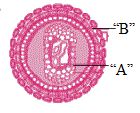
A
Viral $RNA$ and lipid layer
B
Lipid layer and capsid
C
Viral $RNA$ and receptor binding protein
D
Receptor binding protein and lipid layer
Solution
(A) The provided figure represents the structure of the $HIV$ virus.
In this structure,$A$ points to the viral genetic material,which is $RNA$.
$B$ points to the outer envelope or the lipid layer (membrane) that surrounds the capsid.
Therefore,$A$ represents viral $RNA$ and $B$ represents the lipid layer.
In this structure,$A$ points to the viral genetic material,which is $RNA$.
$B$ points to the outer envelope or the lipid layer (membrane) that surrounds the capsid.
Therefore,$A$ represents viral $RNA$ and $B$ represents the lipid layer.
0 likes
View Solution114
EasyMCQ
Which cells does $HIV$ primarily infect and destroy?
A
Leukocytes
B
Thrombocytes
C
Helper $T$-lymphocytes
D
$B$-lymphocytes
Solution
(C) $HIV$ (Human Immunodeficiency Virus) primarily targets and infects helper $T$-lymphocytes (also known as $CD4^+$ $T$-cells).
Once inside these cells,the virus replicates,leading to the destruction of the helper $T$-cells.
As the number of helper $T$-cells decreases,the body's immune system becomes severely weakened,making the individual susceptible to various opportunistic infections.
Once inside these cells,the virus replicates,leading to the destruction of the helper $T$-cells.
As the number of helper $T$-cells decreases,the body's immune system becomes severely weakened,making the individual susceptible to various opportunistic infections.
0 likes
View Solution115
EasyMCQ
In which of the following situations is $AIDS$ $NOT$ transmitted?
A
Breastfeeding by an $AIDS$-infected mother to her child
B
From an $AIDS$-infected mother to her fetus during pregnancy
C
By using clothes worn by an $AIDS$ patient
D
By using syringes previously used by an $AIDS$ patient
Solution
(C) $AIDS$ is a disease caused by the Human Immunodeficiency Virus $(HIV)$.
It is transmitted through the exchange of body fluids,specifically blood,semen,vaginal secretions,and breast milk.
$1$. Transmission occurs through sexual contact with an infected person.
$2$. Transmission occurs through the transfusion of contaminated blood or blood products.
$3$. Transmission occurs by sharing infected needles or syringes.
$4$. Transmission occurs from an infected mother to her child through the placenta or during breastfeeding.
$AIDS$ does not spread through casual physical contact,such as hugging,shaking hands,or sharing personal items like clothes,towels,or utensils,as the virus cannot survive outside the human body for long and is not present in sufficient quantities in sweat or saliva to cause infection.
Therefore,using clothes worn by an $AIDS$ patient does not transmit the virus.
It is transmitted through the exchange of body fluids,specifically blood,semen,vaginal secretions,and breast milk.
$1$. Transmission occurs through sexual contact with an infected person.
$2$. Transmission occurs through the transfusion of contaminated blood or blood products.
$3$. Transmission occurs by sharing infected needles or syringes.
$4$. Transmission occurs from an infected mother to her child through the placenta or during breastfeeding.
$AIDS$ does not spread through casual physical contact,such as hugging,shaking hands,or sharing personal items like clothes,towels,or utensils,as the virus cannot survive outside the human body for long and is not present in sufficient quantities in sweat or saliva to cause infection.
Therefore,using clothes worn by an $AIDS$ patient does not transmit the virus.
0 likes
View Solution116
EasyMCQ
Which of the following statements is true regarding $AIDS$?
A
$HIV$ infection spreads by eating food with an $AIDS$ patient.
B
Individuals who use intravenous drugs are less likely to get $HIV$ infection.
C
An $AIDS$ patient can be $100\%$ cured if given proper care and nutrition.
D
$HIV$ is a retrovirus that enters $T_H$ cells and reduces their number.
Solution
(D) $AIDS$ (Acquired Immuno Deficiency Syndrome) is caused by the $HIV$ (Human Immunodeficiency Virus).
$HIV$ is a retrovirus that primarily targets $T_H$ cells (Helper $T$-lymphocytes).
Upon entering the body, the virus replicates inside these $T_H$ cells, leading to a progressive decrease in their count.
This results in a severe weakening of the immune system, making the patient susceptible to various infections.
$AIDS$ does not spread through casual contact like sharing food, and there is currently no $100\%$ cure for it.
Therefore, statement $D$ is correct.
$HIV$ is a retrovirus that primarily targets $T_H$ cells (Helper $T$-lymphocytes).
Upon entering the body, the virus replicates inside these $T_H$ cells, leading to a progressive decrease in their count.
This results in a severe weakening of the immune system, making the patient susceptible to various infections.
$AIDS$ does not spread through casual contact like sharing food, and there is currently no $100\%$ cure for it.
Therefore, statement $D$ is correct.
0 likes
View Solution117
EasyMCQ
At which stage of $HIV$ infection do the symptoms of $AIDS$ appear?
A
When the infectious retrovirus enters the host cell.
B
When viral $DNA$ is produced with the help of reverse transcriptase.
C
When $HIV$ enters helper $T$-lymphocytes,replicates,and destroys a large number of these cells.
D
Within $15$ days after sexual contact with an infected person.
Solution
(C) The $HIV$ virus targets the immune system by infecting helper $T$-lymphocytes ($CD4^+$ cells).
After entering the host cell,the viral $RNA$ is converted into $DNA$ by the enzyme reverse transcriptase.
The viral $DNA$ incorporates into the host genome and directs the production of new viral particles.
As the virus replicates,it causes the destruction of helper $T$-lymphocytes.
When the count of helper $T$-lymphocytes drops significantly,the individual becomes immunocompromised,leading to the clinical manifestation of $AIDS$ symptoms.
After entering the host cell,the viral $RNA$ is converted into $DNA$ by the enzyme reverse transcriptase.
The viral $DNA$ incorporates into the host genome and directs the production of new viral particles.
As the virus replicates,it causes the destruction of helper $T$-lymphocytes.
When the count of helper $T$-lymphocytes drops significantly,the individual becomes immunocompromised,leading to the clinical manifestation of $AIDS$ symptoms.
0 likes
View Solution118
EasyMCQ
Which diagnostic test would you suggest for a patient suffering from Acquired Immunodeficiency Syndrome $(AIDS)$?
A
$ELISA$
B
$MRI$
C
Ultrasound
D
Widal test
Solution
(A) Acquired Immunodeficiency Syndrome $(AIDS)$ is caused by the Human Immunodeficiency Virus $(HIV)$.
To diagnose $HIV$ infection,the most commonly used screening test is $ELISA$ (Enzyme-Linked Immunosorbent Assay).
If the $ELISA$ test is positive,it is usually confirmed by a more specific test called the Western Blot test.
$MRI$ and Ultrasound are imaging techniques used for structural body analysis,and the Widal test is used for the diagnosis of Typhoid fever.
To diagnose $HIV$ infection,the most commonly used screening test is $ELISA$ (Enzyme-Linked Immunosorbent Assay).
If the $ELISA$ test is positive,it is usually confirmed by a more specific test called the Western Blot test.
$MRI$ and Ultrasound are imaging techniques used for structural body analysis,and the Widal test is used for the diagnosis of Typhoid fever.
0 likes
View Solution119
MediumMCQ
Which of the following is correct regarding $AIDS$ causative agent $HIV$?
A
$HIV$ is an enveloped virus containing one molecule of single-stranded $RNA$ and one molecule of reverse transcriptase.
B
$HIV$ is an enveloped virus that contains two identical molecules of single-stranded $RNA$ and two molecules of reverse transcriptase.
C
$HIV$ does not escape but attacks the acquired immune response.
D
Both $(b)$ and $(c)$.
Solution
(D) $HIV$ is a spherical virus with a diameter of about $90-120 \ nm$.
Its genome consists of two identical molecules of single-stranded $RNA$ and is associated with reverse transcriptase enzymes.
The envelope consists of a lipid bilayer derived from the host cell membrane with projecting glycoprotein spikes.
$HIV$ is a retrovirus that specifically attacks helper $T$ cells ($CD4^+$ cells).
By destroying these cells,it cripples the acquired immune response,as the immune system cannot signal $B$ cells to produce antibodies effectively.
This leads to a state of immune deficiency known as $AIDS$ (Acquired Immuno Deficiency Syndrome).
Its genome consists of two identical molecules of single-stranded $RNA$ and is associated with reverse transcriptase enzymes.
The envelope consists of a lipid bilayer derived from the host cell membrane with projecting glycoprotein spikes.
$HIV$ is a retrovirus that specifically attacks helper $T$ cells ($CD4^+$ cells).
By destroying these cells,it cripples the acquired immune response,as the immune system cannot signal $B$ cells to produce antibodies effectively.
This leads to a state of immune deficiency known as $AIDS$ (Acquired Immuno Deficiency Syndrome).
0 likes
View Solution120
MediumMCQ
$HIV$,which causes $AIDS$,first starts destroying:
A
helper $T$-lymphocytes
B
thrombocytes
C
$B$-lymphocytes
D
leucocytes
Solution
(A) $AIDS$ (Acquired Immuno Deficiency Syndrome) is caused by the Human Immunodeficiency Virus $(HIV)$.
$HIV$ is a retrovirus that specifically targets and destroys $CD4^+$ $T$-helper lymphocytes.
These cells are crucial for the immune system as they coordinate the immune response by activating $B$-lymphocytes to produce antibodies and stimulating cytotoxic $T$-cells.
By infecting and destroying $T$-helper cells,$HIV$ severely compromises the body's immune system,making the individual susceptible to opportunistic infections.
$HIV$ is a retrovirus that specifically targets and destroys $CD4^+$ $T$-helper lymphocytes.
These cells are crucial for the immune system as they coordinate the immune response by activating $B$-lymphocytes to produce antibodies and stimulating cytotoxic $T$-cells.
By infecting and destroying $T$-helper cells,$HIV$ severely compromises the body's immune system,making the individual susceptible to opportunistic infections.
0 likes
View Solution121
MediumMCQ
At which stage of $HIV$ infection does one usually show symptoms of $AIDS$?
A
Within $15$ days of sexual contact with an infected person
B
When the infected retrovirus enters host cells
C
When $HIV$ damages a large number of helper $T$-lymphocytes
D
When the viral $DNA$ is produced by reverse transcriptase
Solution
(C) $AIDS$ is a disorder of the cell-mediated immune system of the body.
$HIV$ (Human Immunodeficiency Virus) is the causative agent of $AIDS$.
Upon infection,the virus replicates and progressively destroys helper $T$-lymphocytes ($CD4^+$ cells).
When the count of these helper $T$-cells drops significantly,the body loses its ability to fight off infections and cancers,leading to the clinical manifestation of $AIDS$ symptoms.
Therefore,the correct stage is when $HIV$ damages a large number of helper $T$-lymphocytes.
$HIV$ (Human Immunodeficiency Virus) is the causative agent of $AIDS$.
Upon infection,the virus replicates and progressively destroys helper $T$-lymphocytes ($CD4^+$ cells).
When the count of these helper $T$-cells drops significantly,the body loses its ability to fight off infections and cancers,leading to the clinical manifestation of $AIDS$ symptoms.
Therefore,the correct stage is when $HIV$ damages a large number of helper $T$-lymphocytes.
0 likes
View Solution122
MediumMCQ
Which one of the following statements is correct with respect to $AIDS$?
A
The $HIV$ can be transmitted through eating food together with an infected person.
B
Drug addicts are least susceptible to $HIV$ infection.
C
$AIDS$ patients are being fully cured cent per cent with proper care and nutrition.
D
The causative $HIV$ retrovirus enters helper $T$-lymphocytes,thus reducing their numbers.
Solution
(D) $AIDS$ (Acquired Immuno Deficiency Syndrome) is a syndrome caused by the retrovirus $HIV$ (Human Immunodeficiency Virus).
The virus specifically targets and destroys a subgroup of lymphocytes known as helper $T$-cells (or $CD4$ lymphocytes).
This destruction leads to a severe suppression of the body's immune response.
$HIV$ is transmitted through infected blood,semen,and vaginal fluids.
The major routes of transmission include unprotected sexual intercourse,sharing of contaminated needles (common in intravenous drug abuse),and the administration of contaminated blood or blood products.
It is important to note that $HIV$ is not transmitted through casual contact like eating together.
While a combination of antiretroviral drugs can delay the progression of the disease for many years,there is currently no cure that can fully eradicate $AIDS$.
The virus specifically targets and destroys a subgroup of lymphocytes known as helper $T$-cells (or $CD4$ lymphocytes).
This destruction leads to a severe suppression of the body's immune response.
$HIV$ is transmitted through infected blood,semen,and vaginal fluids.
The major routes of transmission include unprotected sexual intercourse,sharing of contaminated needles (common in intravenous drug abuse),and the administration of contaminated blood or blood products.
It is important to note that $HIV$ is not transmitted through casual contact like eating together.
While a combination of antiretroviral drugs can delay the progression of the disease for many years,there is currently no cure that can fully eradicate $AIDS$.
0 likes
View Solution123
MediumMCQ
$A$ - $AIDS$ is caused by the $HIV$. $R$ - In $AIDS$, $HIV$ enters into helper $T$-lymphocytes.
A
$A$ and $R$ both are correct.
B
$A$ and $R$ both are incorrect.
C
$A$ is correct, $R$ is incorrect.
D
$A$ is incorrect, $R$ is correct.
Solution
$(A)$ is correct because $AIDS$ $(Acquired \text{ } Immuno \text{ } Deficiency \text{ } Syndrome)$ is caused by the Human Immunodeficiency Virus $(HIV)$.
$R$ is correct because after entering the body, the $HIV$ virus enters into macrophages and helper $T$-lymphocytes ($CD4^+$ cells), where it replicates and progressively decreases their number, leading to severe immune deficiency.
$R$ is correct because after entering the body, the $HIV$ virus enters into macrophages and helper $T$-lymphocytes ($CD4^+$ cells), where it replicates and progressively decreases their number, leading to severe immune deficiency.
0 likes
View Solution124
EasyMCQ
Which of the following is used to diagnose $AIDS$?
A
Widal test
B
$ELISA$
C
Biopsy
D
Radiography
Solution
(B) $AIDS$ (Acquired Immuno Deficiency Syndrome) is caused by the $HIV$ virus.
The $ELISA$ (Enzyme-Linked Immunosorbent Assay) test is the standard diagnostic test used for the detection of $AIDS$.
Widal test is used for typhoid fever,biopsy is used for cancer detection,and radiography is used for imaging internal body structures.
The $ELISA$ (Enzyme-Linked Immunosorbent Assay) test is the standard diagnostic test used for the detection of $AIDS$.
Widal test is used for typhoid fever,biopsy is used for cancer detection,and radiography is used for imaging internal body structures.
0 likes
View Solution125
MediumMCQ
Which of the following statements is incorrect regarding $AIDS$?
A
Viral $DNA$ replicates with the help of the enzyme reverse transcriptase.
B
In $AIDS$,the number of $T$-lymphocytes increases.
C
$A$ widely used diagnostic test for $AIDS$ is $ELISA$.
D
In $AIDS$,the person suffers from bouts of fever.
Solution
(B) The human immunodeficiency virus $(HIV)$ is a retrovirus that attacks the immune system.
Specifically,it targets and destroys $T$-helper lymphocytes ($CD4^+$ cells).
As the infection progresses,the number of $T$-lymphocytes decreases significantly,leading to a weakened immune system.
Therefore,the statement that $T$-lymphocytes increase in number is incorrect.
Viral $DNA$ is indeed synthesized from viral $RNA$ using the enzyme reverse transcriptase.
$ELISA$ (Enzyme-Linked Immunosorbent Assay) is the standard diagnostic test for $AIDS$.
Patients with $AIDS$ often experience symptoms like persistent fever,diarrhea,and weight loss due to opportunistic infections.
Specifically,it targets and destroys $T$-helper lymphocytes ($CD4^+$ cells).
As the infection progresses,the number of $T$-lymphocytes decreases significantly,leading to a weakened immune system.
Therefore,the statement that $T$-lymphocytes increase in number is incorrect.
Viral $DNA$ is indeed synthesized from viral $RNA$ using the enzyme reverse transcriptase.
$ELISA$ (Enzyme-Linked Immunosorbent Assay) is the standard diagnostic test for $AIDS$.
Patients with $AIDS$ often experience symptoms like persistent fever,diarrhea,and weight loss due to opportunistic infections.
0 likes
View Solution126
MediumMCQ
Which enzyme synthesizes $DNA$ from $RNA$ in $HIV$?
A
Transcriptase
B
Reverse transcriptase
C
Carboxypeptidase
D
Amylase
Solution
(B) $HIV$ (Human Immunodeficiency Virus) is a retrovirus.
Retroviruses contain $RNA$ as their genetic material.
Upon entering the host cell,the enzyme $Reverse \ transcriptase$ catalyzes the synthesis of $DNA$ from the viral $RNA$ template.
This process is known as reverse transcription,which allows the viral genetic material to integrate into the host cell's genome.
Retroviruses contain $RNA$ as their genetic material.
Upon entering the host cell,the enzyme $Reverse \ transcriptase$ catalyzes the synthesis of $DNA$ from the viral $RNA$ template.
This process is known as reverse transcription,which allows the viral genetic material to integrate into the host cell's genome.
0 likes
View Solution127
MediumMCQ
Which of the following is correct regarding the treatment of $AIDS$?
A
Anti-retroviral therapy is completely effective.
B
By surgery.
C
By radiation therapy.
D
None of the above.
Solution
(D) $AIDS$ (Acquired Immuno Deficiency Syndrome) is caused by the $HIV$ virus,which is a retrovirus.
Currently,there is no complete cure for $AIDS$.
Anti-retroviral drugs (like $AZT$) can only partially control the viral replication and prolong the life of the patient,but they cannot eliminate the virus completely or cure the disease.
Surgery and radiation therapy are not treatments for $AIDS$.
Therefore,none of the given options correctly describe a complete cure for $AIDS$.
Currently,there is no complete cure for $AIDS$.
Anti-retroviral drugs (like $AZT$) can only partially control the viral replication and prolong the life of the patient,but they cannot eliminate the virus completely or cure the disease.
Surgery and radiation therapy are not treatments for $AIDS$.
Therefore,none of the given options correctly describe a complete cure for $AIDS$.
0 likes
View Solution128
MediumMCQ
Transmission of $HIV$ infection from an infected mother to the fetus occurs through:
A
Liver
B
Placenta
C
Skin
D
None of these
Solution
(B) $HIV$ (Human Immunodeficiency Virus) can be transmitted from an infected mother to her fetus during pregnancy,childbirth,or breastfeeding.
During pregnancy,the virus crosses the placental barrier,which is the primary route for vertical transmission from mother to fetus.
The placenta acts as a bridge between the maternal and fetal blood circulation,allowing the virus to enter the fetal bloodstream.
During pregnancy,the virus crosses the placental barrier,which is the primary route for vertical transmission from mother to fetus.
The placenta acts as a bridge between the maternal and fetal blood circulation,allowing the virus to enter the fetal bloodstream.
0 likes
View Solution129
MediumMCQ
Identify the correct sequence for the mechanism of $HIV$ infection:
$1.$ Viral $RNA$ replicates to form viral $DNA$ with the help of reverse transcriptase.
$2.$ The progeny viruses released in the blood attack other $T_H$ cells and destroy them.
$3.$ Viral $DNA$ gets incorporated into the host cell's $DNA$ and produces virus particles.
$4.$ Virus enters into macrophages.
$1.$ Viral $RNA$ replicates to form viral $DNA$ with the help of reverse transcriptase.
$2.$ The progeny viruses released in the blood attack other $T_H$ cells and destroy them.
$3.$ Viral $DNA$ gets incorporated into the host cell's $DNA$ and produces virus particles.
$4.$ Virus enters into macrophages.
A
$4 \rightarrow 3 \rightarrow 1 \rightarrow 2$
B
$2 \rightarrow 1 \rightarrow 3 \rightarrow 4$
C
$4 \rightarrow 1 \rightarrow 3 \rightarrow 2$
D
$3 \rightarrow 2 \rightarrow 4 \rightarrow 1$
Solution
(C) The mechanism of $HIV$ infection follows these steps:
$1.$ After entering the body,the virus first enters into macrophages $(4)$.
$2.$ Inside the macrophages,the viral $RNA$ genome replicates to form viral $DNA$ with the help of the enzyme reverse transcriptase $(1)$.
$3.$ This viral $DNA$ then gets incorporated into the host cell's $DNA$,directing the host cell to produce virus particles $(3)$.
$4.$ The macrophages continue to produce virus particles,and the progeny viruses released into the blood attack other $T_H$ cells and destroy them $(2)$.
Therefore,the correct sequence is $4 \rightarrow 1 \rightarrow 3 \rightarrow 2$.
$1.$ After entering the body,the virus first enters into macrophages $(4)$.
$2.$ Inside the macrophages,the viral $RNA$ genome replicates to form viral $DNA$ with the help of the enzyme reverse transcriptase $(1)$.
$3.$ This viral $DNA$ then gets incorporated into the host cell's $DNA$,directing the host cell to produce virus particles $(3)$.
$4.$ The macrophages continue to produce virus particles,and the progeny viruses released into the blood attack other $T_H$ cells and destroy them $(2)$.
Therefore,the correct sequence is $4 \rightarrow 1 \rightarrow 3 \rightarrow 2$.
0 likes
View Solution130
MediumMCQ
$AIDS$ spreads through:
A
Infected syringe used by $HIV$ patient
B
Blood donated by $HIV$ patient
C
Infants from $HIV$ mother's placenta
D
All Correct
Solution
(D) $AIDS$ (Acquired Immuno Deficiency Syndrome) is caused by the $HIV$ virus. It spreads through the following modes:
$1$. Sharing of infected needles or syringes used by an $HIV$ patient.
$2$. Transfusion of blood or blood products contaminated with $HIV$.
$3$. Vertical transmission from an $HIV$-infected mother to her child through the placenta during pregnancy or childbirth.
Therefore,all the given options are correct modes of transmission.
$1$. Sharing of infected needles or syringes used by an $HIV$ patient.
$2$. Transfusion of blood or blood products contaminated with $HIV$.
$3$. Vertical transmission from an $HIV$-infected mother to her child through the placenta during pregnancy or childbirth.
Therefore,all the given options are correct modes of transmission.
0 likes
View Solution131
MediumMCQ
$A$ - $HIV$ has an envelope enclosing the $RNA$ genome.
$R$ - $AIDS$ is caused by $HIV$.
$R$ - $AIDS$ is caused by $HIV$.
A
$A$ and $R$ both are correct.
B
$A$ and $R$ both are incorrect.
C
$A$ is incorrect,$R$ is correct.
D
$A$ is correct,$R$ is incorrect.
Solution
(A) $HIV$ (Human Immunodeficiency Virus) is a retrovirus that contains $RNA$ as its genetic material enclosed within an envelope. Therefore,statement $A$ is correct.
$AIDS$ (Acquired Immuno Deficiency Syndrome) is a disease caused by the infection of $HIV$. Therefore,statement $R$ is correct.
Both statements are correct.
$AIDS$ (Acquired Immuno Deficiency Syndrome) is a disease caused by the infection of $HIV$. Therefore,statement $R$ is correct.
Both statements are correct.
0 likes
View Solution132
MediumMCQ
Spread of $AIDS$ does not occur through
A
More than one partner for mating.
B
Eating a meal with $AIDS$ patient.
C
Child born by an $HIV$ infected mother.
D
Entering $HIV$-infected blood in healthy person.
Solution
(B) $AIDS$ (Acquired Immuno Deficiency Syndrome) is caused by the $HIV$ virus.
It is transmitted through sexual contact with an infected person,transfusion of contaminated blood,sharing of infected needles,or from an infected mother to her child during pregnancy or childbirth.
$AIDS$ is $NOT$ spread through casual physical contact,such as shaking hands,hugging,or eating a meal together with an $AIDS$ patient.
Therefore,eating a meal with an $AIDS$ patient does not lead to the transmission of the virus.
It is transmitted through sexual contact with an infected person,transfusion of contaminated blood,sharing of infected needles,or from an infected mother to her child during pregnancy or childbirth.
$AIDS$ is $NOT$ spread through casual physical contact,such as shaking hands,hugging,or eating a meal together with an $AIDS$ patient.
Therefore,eating a meal with an $AIDS$ patient does not lead to the transmission of the virus.
0 likes
View Solution133
MediumMCQ
Which of the following techniques is routinely used to detect $HIV$ in suspected $AIDS$ patients?
A
$R-DNA$ technology
B
$PCR$
C
Conventional method
D
Widal test
Solution
(B) $PCR$ (Polymerase Chain Reaction) is a highly sensitive molecular diagnostic technique.
It is routinely used to detect $HIV$ in suspected $AIDS$ patients by amplifying the viral $DNA$ or $RNA$ (after reverse transcription) present in the blood sample.
This allows for the detection of the virus even when its concentration is very low,making it an effective tool for early diagnosis.
It is routinely used to detect $HIV$ in suspected $AIDS$ patients by amplifying the viral $DNA$ or $RNA$ (after reverse transcription) present in the blood sample.
This allows for the detection of the virus even when its concentration is very low,making it an effective tool for early diagnosis.
0 likes
View Solution134
EasyMCQ
The Human Immunodeficiency Virus $(HIV)$ consists of a protein coat and ............ as its genetic material.
A
Single-stranded $DNA$
B
Single-stranded $RNA$
C
Double-stranded $RNA$
D
Double-stranded $DNA$
Solution
(B) $HIV$ (Human Immunodeficiency Virus) is a retrovirus.
It contains two identical strands of single-stranded $RNA$ as its genetic material.
It is enclosed within a protein coat (capsid) and an outer envelope derived from the host cell membrane.
Therefore,the correct option is $B$.
It contains two identical strands of single-stranded $RNA$ as its genetic material.
It is enclosed within a protein coat (capsid) and an outer envelope derived from the host cell membrane.
Therefore,the correct option is $B$.
0 likes
View Solution135
MediumMCQ
Which of the following statements is correct regarding $AIDS$?
A
$HIV$ infection spreads by sharing food with an $AIDS$ patient.
B
Drug addicts are less likely to get $HIV$ infection.
C
An $AIDS$ patient can be $100\%$ cured if given proper care and nutrition.
D
$HIV$ is a retrovirus that enters helper $T$-cells and reduces their number.
Solution
(D) $AIDS$ (Acquired Immuno Deficiency Syndrome) is caused by the $HIV$ (Human Immunodeficiency Virus).
$HIV$ is a retrovirus that specifically targets and infects helper $T$-lymphocytes ($CD4^+$ cells).
Once inside, the virus replicates, leading to a progressive decline in the count of helper $T$-cells, which severely weakens the immune system.
$HIV$ does not spread through casual contact like sharing food, and there is currently no $100\%$ cure for $AIDS$.
$HIV$ is a retrovirus that specifically targets and infects helper $T$-lymphocytes ($CD4^+$ cells).
Once inside, the virus replicates, leading to a progressive decline in the count of helper $T$-cells, which severely weakens the immune system.
$HIV$ does not spread through casual contact like sharing food, and there is currently no $100\%$ cure for $AIDS$.
0 likes
View Solution136
MediumMCQ
Which diagnostic test is suggested for patients suspected of having $AIDS$?
A
$MRI$
B
Ultrasound
C
$WIDAL$
D
$ELISA$
Solution
(D) $AIDS$ (Acquired Immuno Deficiency Syndrome) is caused by the Human Immunodeficiency Virus $(HIV)$.
To detect the presence of $HIV$ antibodies in a patient's blood,the $ELISA$ (Enzyme-Linked Immunosorbent Assay) test is widely used as a primary screening diagnostic method.
$WIDAL$ test is used for Typhoid fever,while $MRI$ and Ultrasound are imaging techniques not used for $HIV$ detection.
To detect the presence of $HIV$ antibodies in a patient's blood,the $ELISA$ (Enzyme-Linked Immunosorbent Assay) test is widely used as a primary screening diagnostic method.
$WIDAL$ test is used for Typhoid fever,while $MRI$ and Ultrasound are imaging techniques not used for $HIV$ detection.
0 likes
View Solution137
MediumMCQ
In which of the following stages of $HIV$ infection do the symptoms of $AIDS$ appear?
A
$15$ days after sexual contact with an infected person
B
When the retrovirus enters the host cell
C
When $HIV$ causes massive destruction of helper $T$-lymphocytes
D
When viral $DNA$ is produced by reverse transcriptase
Solution
(C) $AIDS$ (Acquired Immuno Deficiency Syndrome) is caused by the $HIV$ (Human Immunodeficiency Virus).
$HIV$ primarily targets and infects helper $T$-lymphocytes ($CD4^+$ cells).
As the virus replicates,it leads to a progressive decline in the number of helper $T$-lymphocytes.
When the count of these cells drops significantly,the body's immune system becomes severely compromised,making the individual susceptible to opportunistic infections and cancers.
This stage of severe immune deficiency is clinically identified as $AIDS$.
$HIV$ primarily targets and infects helper $T$-lymphocytes ($CD4^+$ cells).
As the virus replicates,it leads to a progressive decline in the number of helper $T$-lymphocytes.
When the count of these cells drops significantly,the body's immune system becomes severely compromised,making the individual susceptible to opportunistic infections and cancers.
This stage of severe immune deficiency is clinically identified as $AIDS$.
0 likes
View Solution138
EasyMCQ
Which of the following is true regarding $HIV$,the agent responsible for $AIDS$?
A
$HIV$ is a non-enveloped retrovirus.
B
$HIV$ does not get eliminated but attacks the acquired immune system.
C
$HIV$ is an enveloped virus. It contains two identical molecules of single-stranded $RNA$ and two molecules of reverse transcriptase.
D
$HIV$ is an enveloped virus. It contains one molecule of single-stranded $RNA$ and one molecule of reverse transcriptase.
Solution
(C) $HIV$ (Human Immunodeficiency Virus) is a member of a group of viruses called retroviruses.
It has an envelope enclosing the viral genome.
The genome of $HIV$ consists of two identical molecules of single-stranded $RNA$.
It also contains two molecules of the enzyme reverse transcriptase,which is essential for the replication of the viral genome within the host cell.
Therefore,option $C$ is the correct description.
It has an envelope enclosing the viral genome.
The genome of $HIV$ consists of two identical molecules of single-stranded $RNA$.
It also contains two molecules of the enzyme reverse transcriptase,which is essential for the replication of the viral genome within the host cell.
Therefore,option $C$ is the correct description.
0 likes
View Solution139
MediumMCQ
Human immunodeficiency virus $(HIV)$ has a protein coat and a genetic material which is:
A
Single stranded $DNA$
B
Single stranded $RNA$
C
Double stranded $RNA$
D
Double stranded $DNA$
Solution
(B) The human immunodeficiency virus $(HIV)$ is a retrovirus that belongs to the genus Lentivirus.
It consists of a protein coat (capsid) that encloses its genetic material.
The genetic material of $HIV$ is single-stranded $RNA$ $(ssRNA)$.
Upon entering the host cell,the viral $RNA$ is reverse-transcribed into $DNA$ by the enzyme reverse transcriptase,which then integrates into the host genome.
It consists of a protein coat (capsid) that encloses its genetic material.
The genetic material of $HIV$ is single-stranded $RNA$ $(ssRNA)$.
Upon entering the host cell,the viral $RNA$ is reverse-transcribed into $DNA$ by the enzyme reverse transcriptase,which then integrates into the host genome.
0 likes
View Solution140
MediumMCQ
Assertion: $HIV$ infected persons are prone to opportunistic diseases.
Reason: Immune system weakens during $HIV$ infection.
Reason: Immune system weakens during $HIV$ infection.
A
If both Assertion and Reason are correct and the Reason is a correct explanation of the Assertion.
B
If both Assertion and Reason are correct but Reason is not a correct explanation of the Assertion.
C
If the Assertion is correct but Reason is incorrect.
D
If both the Assertion and Reason are incorrect.
Solution
(A) Usually,a person shows symptoms of $HIV$ infection within $2$ to $6$ weeks of exposure to the virus.
But in some persons,the virus may remain silent for long periods (up to $10$ years) before symptoms of full-blown $AIDS$ are observable.
The symptoms of $HIV$ infection include fever,lethargy,pharyngitis,nausea,headache,rashes,etc.
Persons suffering from $AIDS$ have a weakened immune system due to the depletion of $T$-helper cells.
Such persons show opportunistic infections,i.e.,infections by those fungi,bacteria,and viruses to which a person with a normal immune system is expected to be resistant.
Therefore,persons prone to opportunistic infections may be suspected to be infected by $HIV$,particularly if the count of $T$-helper cells is $200/\,ml$ or lower.
Since the depletion of $T$-helper cells directly leads to a weakened immune system,which in turn makes the body susceptible to opportunistic infections,the Reason correctly explains the Assertion.
But in some persons,the virus may remain silent for long periods (up to $10$ years) before symptoms of full-blown $AIDS$ are observable.
The symptoms of $HIV$ infection include fever,lethargy,pharyngitis,nausea,headache,rashes,etc.
Persons suffering from $AIDS$ have a weakened immune system due to the depletion of $T$-helper cells.
Such persons show opportunistic infections,i.e.,infections by those fungi,bacteria,and viruses to which a person with a normal immune system is expected to be resistant.
Therefore,persons prone to opportunistic infections may be suspected to be infected by $HIV$,particularly if the count of $T$-helper cells is $200/\,ml$ or lower.
Since the depletion of $T$-helper cells directly leads to a weakened immune system,which in turn makes the body susceptible to opportunistic infections,the Reason correctly explains the Assertion.
0 likes
View Solution141
Medium
Identify the location and function of the following: $HIV$ Antigen and Amniotic bag.
Solution
(N/A) $(1)$ $HIV$ Antigen:
- Location: Found in the blood of a patient suffering from $AIDS$.
- Function: Detection of $HIV$ antibodies or antigens is used for the diagnosis of $AIDS$.
$(2)$ Amniotic bag (Amniotic sac):
- Location: Surrounds the developing embryo in the uterus.
- Function: It contains amniotic fluid,which protects the fetus from mechanical shock and allows for amniocentesis (a prenatal diagnostic test) to detect genetic disorders.
- Location: Found in the blood of a patient suffering from $AIDS$.
- Function: Detection of $HIV$ antibodies or antigens is used for the diagnosis of $AIDS$.
$(2)$ Amniotic bag (Amniotic sac):
- Location: Surrounds the developing embryo in the uterus.
- Function: It contains amniotic fluid,which protects the fetus from mechanical shock and allows for amniocentesis (a prenatal diagnostic test) to detect genetic disorders.
0 likes
View Solution142
Medium
The following are some well-known abbreviations,which have been used in this chapter. Expand each one to its full form:
$(a)$ $MALT$
$(b)$ $CMI$
$(c)$ $AIDS$
$(d)$ $NACO$
$(e)$ $HIV$
$(a)$ $MALT$
$(b)$ $CMI$
$(c)$ $AIDS$
$(d)$ $NACO$
$(e)$ $HIV$
Solution
(N/A) $MALT -$ Mucosa-Associated Lymphoid Tissue
$(b)$ $CMI -$ Cell-Mediated Immunity
$(c)$ $AIDS -$ Acquired Immuno Deficiency Syndrome
$(d)$ $NACO -$ National $AIDS$ Control Organization
$(e)$ $HIV -$ Human Immuno Deficiency Virus
$(b)$ $CMI -$ Cell-Mediated Immunity
$(c)$ $AIDS -$ Acquired Immuno Deficiency Syndrome
$(d)$ $NACO -$ National $AIDS$ Control Organization
$(e)$ $HIV -$ Human Immuno Deficiency Virus
0 likes
View Solution143
Easy
What are the various routes by which transmission of human immunodeficiency virus takes place?
Solution
(N/A) $AIDS$ (Acquired Immuno Deficiency Syndrome) is caused by the Human Immunodeficiency Virus $(HIV)$.
It has the following modes of transmission:
$1$. Unprotected sexual contact with an infected person.
$2$. Transfusion of contaminated blood or blood products.
$3$. Sharing of infected needles and syringes.
$4$. Transmission from an infected mother to her child through the placenta.
It has the following modes of transmission:
$1$. Unprotected sexual contact with an infected person.
$2$. Transfusion of contaminated blood or blood products.
$3$. Sharing of infected needles and syringes.
$4$. Transmission from an infected mother to her child through the placenta.
0 likes
View Solution144
DifficultMCQ
What is the mechanism by which the $AIDS$ virus causes deficiency of the immune system in an infected person?
A
It destroys the bone marrow.
B
It attacks and destroys helper $T$-lymphocytes.
C
It inhibits the production of antibodies by $B$-lymphocytes.
D
It directly kills the red blood cells.
Solution
(B) $AIDS$ (Acquired Immuno Deficiency Syndrome) is caused by the Human Immunodeficiency Virus $(HIV)$ via sexual or blood-to-blood contact.
After entering the human body,the $HIV$ virus attacks and enters the macrophages.
Inside the macrophages,the $RNA$ of the virus replicates with the help of the enzyme reverse transcriptase and gives rise to viral $DNA$.
Then,this viral $DNA$ incorporates into the host $DNA$ and directs the synthesis of virus particles.
At the same time,$HIV$ enters helper $T$-lymphocytes.
It replicates and produces viral progeny there.
These newly formed progeny viruses are released into the blood,attacking other healthy helper $T$-lymphocytes in the body.
As a result,the number of helper $T$-lymphocytes in the body of an infected person decreases progressively,thereby severely weakening the person's immune system.
After entering the human body,the $HIV$ virus attacks and enters the macrophages.
Inside the macrophages,the $RNA$ of the virus replicates with the help of the enzyme reverse transcriptase and gives rise to viral $DNA$.
Then,this viral $DNA$ incorporates into the host $DNA$ and directs the synthesis of virus particles.
At the same time,$HIV$ enters helper $T$-lymphocytes.
It replicates and produces viral progeny there.
These newly formed progeny viruses are released into the blood,attacking other healthy helper $T$-lymphocytes in the body.
As a result,the number of helper $T$-lymphocytes in the body of an infected person decreases progressively,thereby severely weakening the person's immune system.
0 likes
View Solution145
Difficult
What is $AIDS$? How does $AIDS$ spread? Mention the symptoms of $AIDS$. Is there a cure for $AIDS$?
Solution
(N/A) $AIDS$ stands for Acquired Immuno Deficiency Syndrome.
$AIDS$ is not a congenital disease; it is acquired during the lifetime of an individual,indicating a deficiency of the immune system. Syndrome means a group of symptoms.
It was first reported in $1981$ in the $USA$. In the last few decades,it has spread all over the world,killing millions of people. It was first reported in India in $1986$ in Tamil Nadu.
It is caused by the Human Immuno Deficiency Virus $(HIV)$,a member of a group of viruses called retroviruses. They have an envelope enclosing $RNA$ as their genetic material.
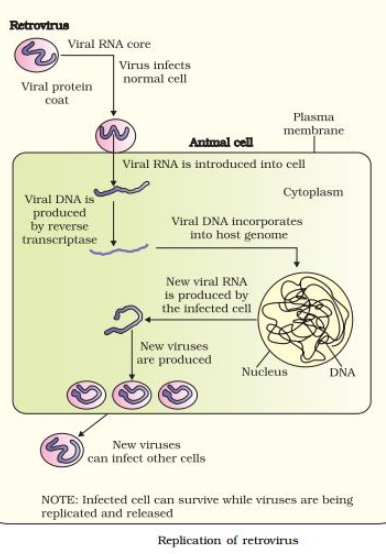
After entering the human body,the virus enters macrophages. With the help of the reverse transcriptase enzyme,viral $RNA$ is converted into viral $DNA$,which then incorporates into the host genome. The macrophage acts as an $HIV$ factory.
Subsequently,$HIV$ enters helper $T$-lymphocytes,replicates,and produces progeny viruses. These new viruses attack other $T$-cells,leading to a progressive decrease in the number of helper $T$-cells in the body.
$AIDS$ spreads through:
$1$. Sexual contact with an infected person.
$2$. Transfusion of $HIV$-contaminated blood.
$3$. Sharing infected needles or syringes.
$4$. From an infected mother to her child through the placenta or breastfeeding.
It does not spread by mere physical contact or sharing utensils.
There is a time lag between infection and the appearance of symptoms,which may vary from a few months to many years (usually $5$ to $10$ years). During this period,the person may appear healthy but can act as a carrier.
Symptoms include persistent fever,weight loss,diarrhea,fatigue,and body aches. In the final stages,patients may suffer from severe weight loss,prolonged fever,chronic diarrhea,pneumonia,and cancers like Kaposi's sarcoma.
There is no complete cure for $AIDS$. Treatment with anti-retroviral drugs is only partially effective; it can prolong the life of the patient but cannot prevent death. There is no vaccine available,making it an incurable disease. Organizations like $NACO$ and $WHO$ run various programs to prevent the spread of $HIV$ infection.
$AIDS$ is not a congenital disease; it is acquired during the lifetime of an individual,indicating a deficiency of the immune system. Syndrome means a group of symptoms.
It was first reported in $1981$ in the $USA$. In the last few decades,it has spread all over the world,killing millions of people. It was first reported in India in $1986$ in Tamil Nadu.
It is caused by the Human Immuno Deficiency Virus $(HIV)$,a member of a group of viruses called retroviruses. They have an envelope enclosing $RNA$ as their genetic material.
After entering the human body,the virus enters macrophages. With the help of the reverse transcriptase enzyme,viral $RNA$ is converted into viral $DNA$,which then incorporates into the host genome. The macrophage acts as an $HIV$ factory.
Subsequently,$HIV$ enters helper $T$-lymphocytes,replicates,and produces progeny viruses. These new viruses attack other $T$-cells,leading to a progressive decrease in the number of helper $T$-cells in the body.
$AIDS$ spreads through:
$1$. Sexual contact with an infected person.
$2$. Transfusion of $HIV$-contaminated blood.
$3$. Sharing infected needles or syringes.
$4$. From an infected mother to her child through the placenta or breastfeeding.
It does not spread by mere physical contact or sharing utensils.
There is a time lag between infection and the appearance of symptoms,which may vary from a few months to many years (usually $5$ to $10$ years). During this period,the person may appear healthy but can act as a carrier.
Symptoms include persistent fever,weight loss,diarrhea,fatigue,and body aches. In the final stages,patients may suffer from severe weight loss,prolonged fever,chronic diarrhea,pneumonia,and cancers like Kaposi's sarcoma.
There is no complete cure for $AIDS$. Treatment with anti-retroviral drugs is only partially effective; it can prolong the life of the patient but cannot prevent death. There is no vaccine available,making it an incurable disease. Organizations like $NACO$ and $WHO$ run various programs to prevent the spread of $HIV$ infection.
0 likes
View Solution146
Medium
Give the full form of $\rm {ELISA}$. Which disease can be detected using it? Discuss the principle underlying the test.
Solution
(N/A) The full form of $\rm {ELISA}$ is $\text{Enzyme-Linked Immunosorbent Assay}$.
It is primarily used for the detection of $\text{AIDS}$ (caused by $\text{HIV}$).
$\rm {ELISA}$ is based on the principle of antigen-antibody interaction.
Infection by a pathogen can be detected by the presence of antigens (proteins,glycoproteins,etc.) or by detecting the specific antibodies synthesized by the host immune system against the pathogen.
It is primarily used for the detection of $\text{AIDS}$ (caused by $\text{HIV}$).
$\rm {ELISA}$ is based on the principle of antigen-antibody interaction.
Infection by a pathogen can be detected by the presence of antigens (proteins,glycoproteins,etc.) or by detecting the specific antibodies synthesized by the host immune system against the pathogen.
0 likes
View Solution147
Medium
Provide the full forms of the following abbreviations:
$(i)$ $DNA$
$(ii)$ $AIDS$
$(i)$ $DNA$
$(ii)$ $AIDS$
Solution
(N/A) $(i)$ $DNA$ stands for Deoxyribonucleic Acid. It is the primary hereditary material in most living organisms.
$(ii)$ $AIDS$ stands for Acquired Immuno Deficiency Syndrome. It is a chronic, potentially life-threatening condition caused by the Human Immunodeficiency Virus $(HIV)$.
$(ii)$ $AIDS$ stands for Acquired Immuno Deficiency Syndrome. It is a chronic, potentially life-threatening condition caused by the Human Immunodeficiency Virus $(HIV)$.
0 likes
View Solution148
Medium
Give scientific reasons: An $AIDS$ patient should not be isolated from the family or society.
Solution
(N/A) $1$. $AIDS$ is not a contagious disease that spreads through casual contact like touching,hugging,or sharing meals.
$2$. The $HIV$ virus is transmitted only through specific routes: sexual contact with an infected person,transfusion of contaminated blood,sharing of infected needles,or from an infected mother to her child.
$3$. Isolating patients leads to psychological distress and social stigma,which can worsen their health condition.
$4$. Patients require emotional support,care,and empathy from their family and society to maintain their mental well-being and improve their quality of life.
$2$. The $HIV$ virus is transmitted only through specific routes: sexual contact with an infected person,transfusion of contaminated blood,sharing of infected needles,or from an infected mother to her child.
$3$. Isolating patients leads to psychological distress and social stigma,which can worsen their health condition.
$4$. Patients require emotional support,care,and empathy from their family and society to maintain their mental well-being and improve their quality of life.
0 likes
View Solution149
Easy
Provide the full forms of the following:
$1.$ $\text{HIV}$
$2.$ $\text{ELISA}$
$3.$ $\text{NACO}$
$1.$ $\text{HIV}$
$2.$ $\text{ELISA}$
$3.$ $\text{NACO}$
Solution
(N/A) $1.$ $\text{HIV}$: $\text{Human Immunodeficiency Virus}$
$2.$ $\text{ELISA}$: $\text{Enzyme-Linked Immunosorbent Assay}$
$3.$ $\text{NACO}$: $\text{National AIDS Control Organisation}$
$2.$ $\text{ELISA}$: $\text{Enzyme-Linked Immunosorbent Assay}$
$3.$ $\text{NACO}$: $\text{National AIDS Control Organisation}$
0 likes
View SolutionHuman Health and Disease — AIDS · Frequently Asked Questions
1Are these Human Health and Disease questions useful for JEE and NEET?
Yes. All questions in this section are mapped to JEE Main and NEET exam patterns. Previous year questions from JEE Main, NEET, GUJCET and state-level exams are included with full solutions.
2Can I switch to Hindi or Gujarati for these questions?
Yes. Use the language tabs in the hero section or the sidebar to view the same questions and solutions in English, Hindi or Gujarati.
3How do I generate a question paper from this subtopic?
Use the Vedclass Exam Paper Generator — select the chapter and subtopic, set difficulty, and generate Sets A, B, C, D automatically. First 3 chapters of every subject are free.
Vedclass Products
For Students
Vedclass Test Series
Mock tests in real JEE/NEET style with performance analysis. 5-day free trial.
Start Free TrialFor Teachers
Exam Paper Generator
Generate Set A/B/C/D papers from this chapter in 2 minutes. 3 chapters free.
Try FreeFor Institutes
Online Exam Module
Live online exams with unlimited students, 360° analytics & white-label branding.
See DemoFor Teachers & Institutes
Generate a Human Health and Disease Exam Paper in 2 Minutes
Select subtopic & difficulty — Sets A, B, C, D auto-generated with No Repeat logic.
First 3 chapters of every subject are free — no payment required.